Best HighRadius Alternatives in 2026: 14 Accounts Receivable Platforms for Mid-Market and Growing Finance Teams
Turn this article into takeaways for your work.


Each assistant summarizes the article only for you and suggests best practices for your work.
Billtrust, Esker and Sidetrade lead this list for finance teams that want HighRadius-grade cash application and credit AI without necessarily needing HighRadius itself, while Versapay and Quadient AR fit mid-market collections workflow on a specific ERP at a lighter sales motion. BILL, Chaser, Upflow, Gaviti, Invoiced, Tesorio, Peakflo and Growfin cover everything from SMB collections to CRM-tied AR for SaaS finance teams, and Rework fits a narrower case: mid-size companies that want AR sitting on the same platform and customer record as their CRM, not a dedicated point tool. HighRadius earns its reputation honestly. Autonomous Receivables spans cash application, credit management, collections prioritization, deduction management and cash forecasting on one data model, and Gartner named it a Leader (highest in execution, furthest in vision) in the 2024 Magic Quadrant for Invoice-to-Cash Applications. The reasons teams go looking for an alternative are just as real: HighRadius publishes no price at all, offers no free trial, and has no SMB or lower-cost edition, so a mid-market AR team often can't even get a self-serve entry point to compare against.
This guide ranks 14 HighRadius alternatives for CFOs, VPs of Finance, controllers, and credit and collections managers at companies roughly 20 to 5,000 employees, weighted toward who owns invoice delivery, collections outreach, cash application and the customer payment portal. Most of this category publishes as little pricing as HighRadius does, so where a vendor names a real figure, this guide states it with the source, and where nothing is published, it says so instead of guessing. For the broader category view that includes HighRadius itself, see the Best Accounts Receivable Automation Software guide.
Key Facts
- 43% of B2B credit sales in the United States were reported overdue in 2025, according to the Atradius Payment Practices Barometer for North America.
- Companies still leave an estimated $600 billion trapped in receivables, out of $1.7 trillion in total excess working capital, per the Hackett Group's U.S. Working Capital Survey as reported by PYMNTS.
- 83% of finance teams have not yet fully automated their AR operations, per the same Hackett Group research cited by PYMNTS.
- Median days sales outstanding sits at 38 days across organizations, with top-quartile performers collecting in 30 days or less, according to APQC benchmarking data.
- Nearly a third (32%) of 2024 B2B transaction volume in the US still moved by cash and check, according to a Federal Reserve Financial Services white paper citing eMarketer.
HighRadius at a Glance: Real Strengths, Real Limits
HighRadius built its reputation on Autonomous Receivables, an AI suite spanning cash application, credit management, collections prioritization, deduction management and cash forecasting on one data model, wired deep into SAP, Oracle and other large ERPs. Gartner named it a Leader in the 2024 Magic Quadrant for Invoice-to-Cash Applications, ranking it highest in execution and furthest in vision, and the company has raised roughly $484 million, last valued at $3.1 billion in a 2021 Series C. That depth is genuine: for a multi-entity organization processing thousands of invoices a month across several ERPs, few platforms match the breadth of HighRadius's invoice-to-cash coverage.
The gap is just as real. HighRadius doesn't publish a price of any kind, not a tier, not a range, not a "starting at" figure; the site routes every visitor to a consultant conversation and an ROI calculator instead. There's no free trial and no SMB or lower-cost edition, so a 150-person finance team can't sign up and compare the way it might with BILL or Upflow. And the platform is genuinely built for large, complex organizations: the implementation weight and sales cycle that make sense at 2,000 employees are usually overkill at 150. Those three facts, not any weakness in the product, are why teams outside enterprise scale shop this list.
| What HighRadius Does Well | Where It Falls Short for Smaller Teams |
|---|---|
| Cash app, credit AI, collections and deductions on one data model | No published pricing anywhere on the site |
| Gartner Leader, Invoice-to-Cash Applications, 2024 | No free trial, no self-serve way to try it |
| Deep SAP, Oracle, large-ERP integration | No SMB or lower-cost edition |
| $484M raised, $3.1B last valuation, established track record | Implementation weight assumes enterprise scale |
Quick Comparison Table
Comparing HighRadius against Chaser is comparing apples to a much bigger orange: HighRadius fits multi-entity organizations with dedicated credit teams, while Chaser fits a two- or three-person collections function that needs invoices chased consistently, not credit scoring. Use the segment each tool serves, in the Key Strength and Key Limitation columns, to narrow this list before reading further.
| Tool | Best For | Starting Price | Key Strength | Key Limitation |
|---|---|---|---|---|
| Billtrust | Enterprise invoice-to-cash | No published price | Mature cash application, lockbox matching | Private since 2022 |
| Esker | AP and AR on one data model | No published price | Synergy AI, Gartner Leader in three Magic Quadrants | Full value needs buying both sides |
| Sidetrade | AI credit scoring on payment data | No published price | Public (Euronext: ALBFR), network-trained AI | Enterprise pricing and motion |
| Versapay | Collaborative AR on Sage or Acumatica | No published price | Portal enables self-serve dispute resolution | Value tied to specific ERPs |
| Quadient AR | Mid-market predictive collections | No published price | Predictive, risk-ranked prioritization | Part of a mail-services parent |
| Rework | Mid-size teams wanting AR on the CRM platform | Quote on request | Incomes, Invoice and Bankfeeds share a CRM record | Not built for cash app or credit AI |
| BILL | SMB wanting AP and AR in one login | From $49/user/month | Published, per-user pricing | AR depth trails AR-only tools |
| Invoiced | API-first AR for dev-friendly teams | No published price | Flexible API and workflow builder | Less brand recognition |
| Chaser | Relationship-preserving collections | From $259/month | Human-sounding chasing, no migration | Collections-only |
| Upflow | Mid-market collections, strong reporting | Discover free; paid tiers quote-only | ARR-banded plans plus a free tier | Paid tiers entirely quote-only |
| Gaviti | Task automation for a small team | No published price | Usage-based, not flat per-seat | No number to anchor a budget |
| Tesorio | Collections tied to cash forecasting | No published price | AI prioritization tied to a live forecast | Thinner analyst coverage |
| Peakflo | Fast-growing mid-market, agentic AI | No published price | Agents span invoice-to-cash and procure-to-pay | Track record mostly in SE Asia |
| Growfin | B2B SaaS collections tied to CRM | No published price | Pulls HubSpot/Salesforce context into invoices | Best fit skews to subscription models |
1. Billtrust: Enterprise Invoice-to-Cash Since Before the Category Had a Name
Billtrust's core strength is cash application: matching incoming payments to open invoices automatically, including the messy remittance formats (paper checks, lockbox scans, EDI files) still common at large organizations, alongside credit decisioning, collections and a B2B payments network. It's aimed at manufacturing, distribution and healthcare finance teams running the same scale of invoice volume as HighRadius, without HighRadius's deductions-AI depth. EQT completed a $1.7 billion take-private acquisition in December 2022, and Billtrust's stock left Nasdaq that month, so unlike still-public Sidetrade it no longer files disclosures a buyer could check independently. Pricing isn't published; every deal is quoted on invoice volume and modules, the same as HighRadius.
| Pros | Cons |
|---|---|
| Deep, mature cash application matching | No published pricing |
| Credit decisioning, payments network included | Private since 2022, no public data |
| Strong fit for manufacturing, healthcare AR | Consultative, quote-only process |
| Enterprise scale without HighRadius's full suite | Less collections-AI depth than HighRadius |
Pricing: No published price, quote only. Best for: Large organizations with high-volume, high-friction remittance formats. Not ideal for: Teams wanting HighRadius's full cash-app-plus-credit-AI-plus-deductions breadth in one suite.
2. Esker: AP and AR on One Platform, One Data Model
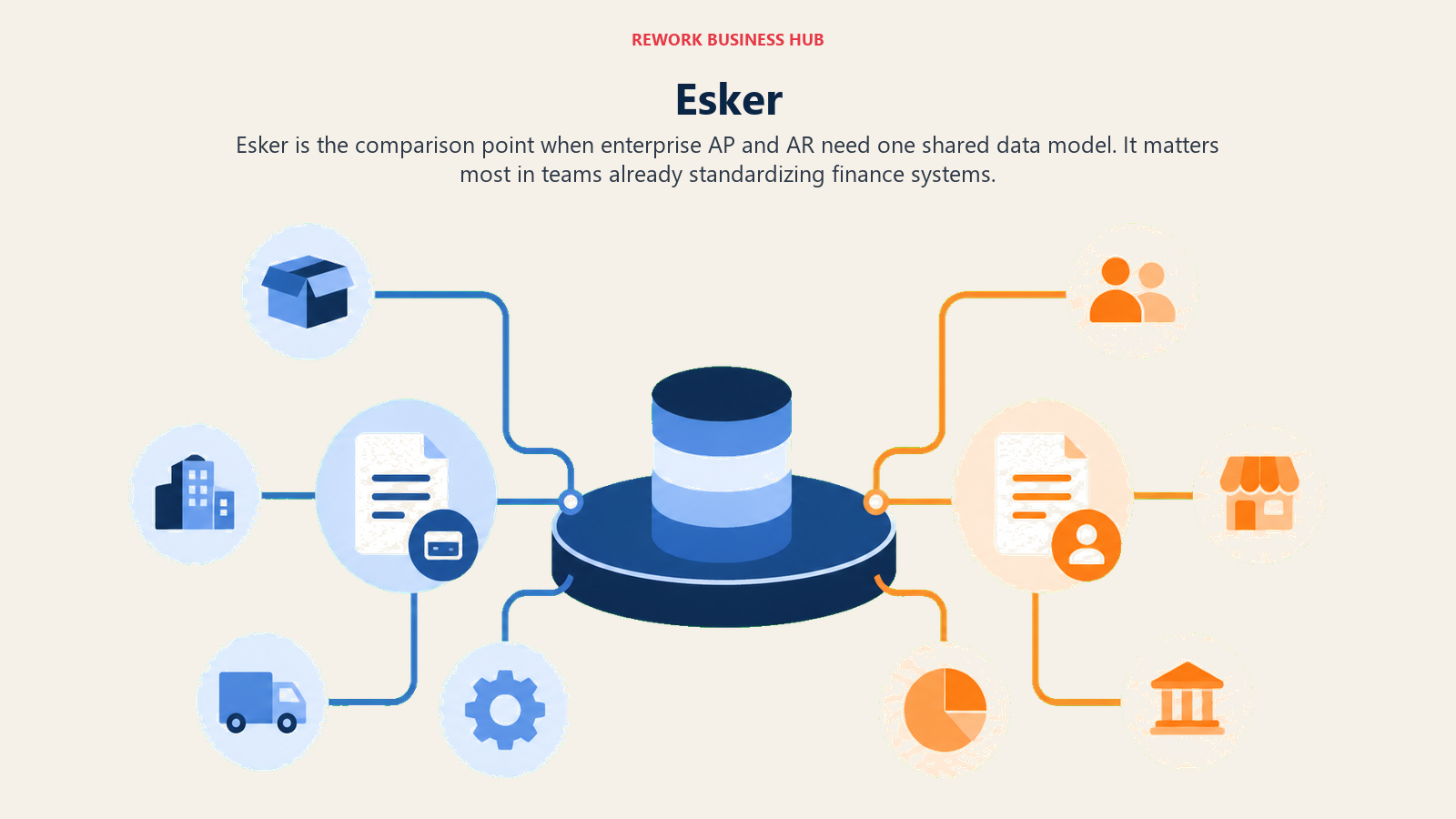
Esker, a French software company founded in 1985 and still publicly traded, runs both procure-to-pay and order-to-cash on one platform and data model, giving finance working-capital visibility from both directions at once. Esker Synergy AI, its embedded agent layer, handles extraction, matching and workflow across both sides, and Esker calls itself the only company recognized in three Gartner Magic Quadrants at once, including the newly created Accounts Payable Applications category, where it was named a Leader in 2025. None of that comes with a published price: every deal is quoted on volume and modules, same as HighRadius.
| Pros | Cons |
|---|---|
| AP and AR on one platform, one data model | No published pricing |
| Synergy AI spans source-to-pay, order-to-cash | Full value assumes buying both sides |
| Named Leader across three Gartner Magic Quadrants | Consultative, quote-only process |
| Long history as a public company | Less differentiated if you only need AR |
Pricing: No published price, quote only based on volume and modules. Best for: Enterprises wanting AP and AR on one platform instead of two, without HighRadius's AR-only focus. Not ideal for: Teams needing only AR with no interest in consolidating AP.
3. Sidetrade: AI-Native Scoring Built on a B2B Payment Data Network
Sidetrade, publicly traded on Euronext Paris (ticker ALBFR), built its platform, Sidetrade Augmented Cash, around a network effect: predictive credit scoring and collections prioritization trained on B2B payment behavior data aggregated across its whole customer base, not just one company's own history. It doesn't publish pricing either, with deals quoted per organization on invoice and revenue scope; some third-party listing sites show a placeholder monthly figure, but that number doesn't come from Sidetrade's own site and shouldn't be treated as confirmed. Being publicly traded is a real advantage over HighRadius: unlike HighRadius's private financials, Sidetrade's are independently checkable through its filings.
| Pros | Cons |
|---|---|
| Scoring trained on network-wide payment data | No published pricing |
| Publicly traded, independently checkable financials | Enterprise pricing and sales motion |
| AI-native positioning built on real data scale | Less North America brand recognition than HighRadius |
| Established European enterprise base | Quote-only, no self-serve number |
Pricing: No published price, quoted per organization on invoice and revenue scope. Best for: Enterprises wanting credit scoring that benefits from a wide payment-data network, with public-company transparency. Not ideal for: Small teams without the invoice volume for an enterprise AR platform.
4. Versapay: Collaborative AR for Sage and Acumatica Shops
Versapay's differentiator is the customer-facing side: a payment portal and "collaborative AR" model where a customer with a billing dispute resolves it in the portal instead of an email thread with your AR team. Cash application deepened through its 2021 DadeSystems acquisition, and the platform integrates most tightly with Sage Intacct, Sage 300/500, Acumatica and NetSuite, ERPs HighRadius doesn't specifically target. Great Hill Partners has owned Versapay since 2020; pricing isn't published, and every deal is quoted on invoice volume and ERP integration. For a team standardized on Sage Intacct, that native fit beats a generic enterprise AR suite.
| Pros | Cons |
|---|---|
| Portal turns disputes into self-serve resolution | No published pricing |
| Deep Sage Intacct, Acumatica, NetSuite integration | Value tied to those specific ERPs |
| Cash application strengthened by DadeSystems | Weaker fit outside that ERP ecosystem |
| Lighter sales motion than HighRadius | Less credit-AI depth than HighRadius or Sidetrade |
Pricing: No published price, quote only. Best for: Mid-market teams on Sage, Acumatica or NetSuite wanting a payment portal without an enterprise sales cycle. Not ideal for: Companies on a different ERP entirely, or needing HighRadius-grade credit AI.
5. Quadient AR: Predictive Collections Without the Enterprise Price Tag
Quadient AR, known as YayPay before Quadient's 2020 acquisition folded it into its own brand, focuses on predictive collections prioritization: ranking which accounts to chase first by payment history and risk signals, alongside credit risk dashboards, dunning workflows and a customer portal, aimed at teams processing roughly 500-plus invoices a month. Its own pricing page names a minimum threshold (a B2B business with roughly £7.8 million in yearly revenue) but still routes every quote to a sales conversation rather than naming a figure. As part of a broader document and mail-services company, it carries less pure-play AR focus than Versapay or Chaser.
| Pros | Cons |
|---|---|
| Predictive, risk-ranked collections prioritization | No published pricing |
| Credit risk dashboards included | Part of a broader mail-services parent |
| Customer payment portal included | Best fit skews to higher volume |
| Lighter footprint than HighRadius | Quote-only, no self-serve number |
Pricing: No published price, quote only (minimum threshold of roughly £7.8M annual revenue per its own pricing page). Best for: Mid-market B2B teams processing several hundred invoices a month that don't need HighRadius-scale AI. Not ideal for: Very small teams with low invoice volume, or enterprises needing multi-entity credit AI.
6. Rework: AR Operations on the Same Record as the Deal
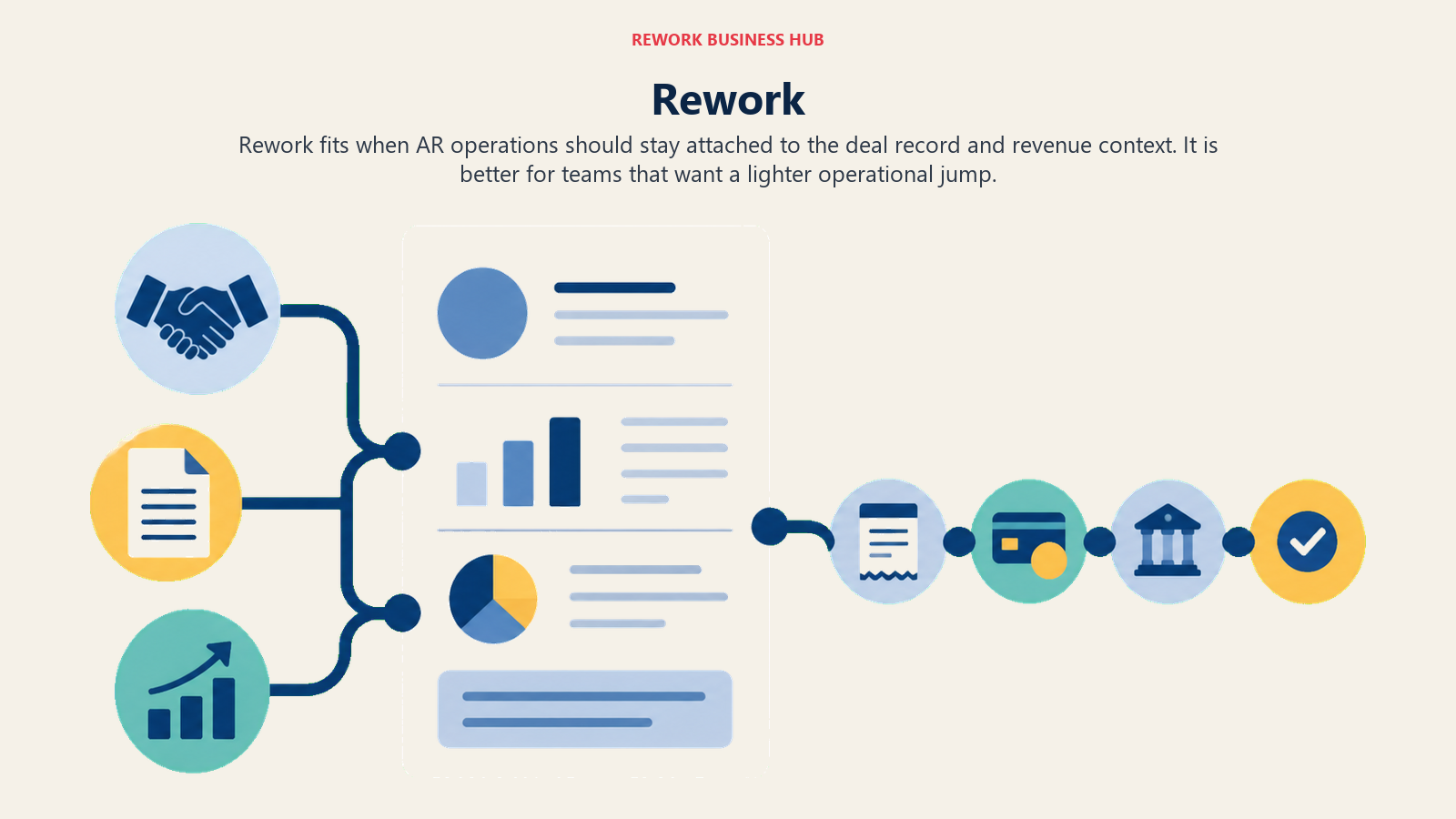
Rework's Incomes module, alongside its Invoice and Bankfeeds modules, lives inside the same platform as its CRM/Sales, Lead Management, Contract and Work Ops apps, so an invoice tied to a deal shares the account record as the pipeline that created it, instead of syncing between a CRM, a billing tool and a separate AR platform. The pitch isn't collections AI at HighRadius depth, and it doesn't try to be: it's that income operations, invoicing and reconciliation shouldn't live in three logins that quietly drift apart while a sales team and a finance team argue over which system is right.
| What you get | What you don't |
|---|---|
| Income ops on the same record as CRM/Sales | HighRadius or Sidetrade-grade cash application |
| Invoice and Bankfeeds reconciling on the same platform | Deduction management or dispute-resolution workflow |
| One platform across CRM, Lead, Contract, Incomes | A configurable collections dunning engine or credit AI |
| Packaged pricing, not per-invoice fees | A free or solo tier |
Pricing: No published price for Incomes; Rework sells packaged plans, not per-user or per-invoice licenses, quoted per organization. See rework.com/pricing. Best for: Mid-size teams (20 to 200 people) wanting AR on the same platform as the CRM pipeline, not a dedicated AR point tool. See Best CRM Software for how Sales Ops compares to Salesforce and HubSpot. Not ideal for: Cash application, credit AI or deduction management at HighRadius grade, or a solo operator (minimum package is 5 users). That depth is exactly what a reader evaluating HighRadius is shopping for, and Rework is not built to match it.
7. BILL: Accounts Payable and Receivable Under One Login
BILL, formerly branded Bill.com before an October 2022 rebrand, is the common answer for a smaller finance team wanting bill pay and invoicing or collections in one system, the opposite instinct from HighRadius's AR-only depth. It's publicly traded (NYSE: BILL) and widely used by accounting firms. Published pricing, per user per month: Essentials $49 (AP and AR), Team $65, Corporate $89 (adds Procurement), Enterprise custom; Spend & Expense is a separate $0-per-user product. For its AP-side competitors, see the BILL alternatives roundup.
| Pros | Cons |
|---|---|
| Published, per-user pricing across all tiers | AR depth trails HighRadius or AR-only tools |
| One login for both AP and AR | Corporate tier bundles Procurement regardless |
| Publicly traded, familiar to accounting firms | No credit-risk AI or deduction management |
| Free separate Spend & Expense product | Per-user cost grows fast at scale |
Pricing: Essentials $49/user/month, Team $65, Corporate $89, Enterprise custom. Best for: SMB and lower mid-market teams wanting AP and AR under one login with a real published price. Not ideal for: Teams needing deep AR-only functionality like credit scoring or cash application AI.
8. Invoiced: API-First AR for Dev-Friendly Finance Teams
Invoiced, an Austin-based platform operating since roughly 2013, built its pitch around a flexible API and workflow builder rather than a fixed process, bundling invoicing, dunning sequences, a payment portal and subscription billing in one product for teams that want to wire it into a custom workflow instead of adapting to HighRadius's defaults. It doesn't publish pricing; the site offers a demo request only, and it carries less brand recognition than HighRadius or Billtrust, though the API-first design is a genuine differentiator for teams with engineering resources.
| Pros | Cons |
|---|---|
| Flexible API and workflow builder | No published pricing |
| Invoicing, dunning, portal, billing in one product | Less brand recognition than larger names |
| Good fit for customizable workflows | Value depends on engineering resources |
| Lighter implementation than HighRadius | Demo-only, no self-serve pricing |
Pricing: No published price, demo only. Best for: Mid-market teams with engineering resources wanting a custom API-built workflow instead of an enterprise suite. Not ideal for: Teams wanting a fully pre-built workflow out of the box.
9. Chaser: Relationship-Preserving Collections, Not a Platform Overhaul
Chaser, a UK-based platform, solves one problem: getting invoices chased consistently without sounding like a collections agency, and without a HighRadius-length implementation. Its sequences run across email, SMS and letters, tuned to stay professional rather than aggressive, layered on top of QuickBooks, Xero, Sage or NetSuite instead of replacing the accounting system underneath. Published pricing (also in GBP, EUR, AUD, NZD): Compact $259/mo ($233 annual) for 4 users, Core $779/mo ($700 annual) unlimited users, Complete $1,169/mo ($1,050 annual), custom above; Chaser Care is a separate add-on.
| Pros | Cons |
|---|---|
| Published pricing across all three tiers | Collections-only, no cash app or credit AI |
| Sequences tuned to stay relationship-preserving | Big price step past Compact's 4 users |
| Layers on top of existing accounting software | Chaser Care support is a paid add-on |
| Weeks, not months, to get live | Less depth than multi-entity AR platforms |
Pricing: Compact $259/mo ($233 annual), Core $779/mo ($700 annual), Complete $1,169/mo ($1,050 annual), custom above. Best for: SMB and mid-market teams wanting invoices chased consistently, with a published price and no migration. Not ideal for: Teams needing cash application, credit scoring or deduction management.
10. Upflow: Collections Visibility With a Free Analytics Tier
Upflow's pitch is visibility: payment-behavior analytics and benchmarking alongside collections and dunning workflow, integrated with QuickBooks, Xero, NetSuite and Stripe. Its Discover tier is genuinely free forever, limited to analytics rather than full workflow, and it's one of only three tools on this list (with BILL and Chaser) that publishes any number at all. The paid tiers, Grow (under $10M ARR), Scale ($10M to $50M ARR) and Strategic ($50M-plus ARR), are all quote-only, an ARR-banded structure that prices to company scale rather than user count alone.
| Pros | Cons |
|---|---|
| Discover tier is genuinely free, not a trial | Discover tier is analytics only |
| Strong payment-behavior analytics | Paid tiers entirely quote-only |
| ARR-banded tier structure | Three tiers, no public figures |
| A self-serve way in, unlike HighRadius | Less ERP depth than HighRadius or Esker |
Pricing: Discover free forever (analytics only); Grow, Scale, Strategic tiers quote-only. Best for: Finance leaders wanting payment-behavior visibility, valuing a genuine free tier to start. Not ideal for: Teams needing full automation immediately without a sales call.
11. Gaviti: Collections Task Automation Without Hiring More Collectors
Gaviti automates the repetitive parts of a collections week (task assignment, follow-up scheduling, aging reports, dunning) so a small team can manage growing invoice volume without adding headcount, rounded out by a credit management module and configurable dashboards. It doesn't publish pricing; its site states pricing is "tailored based on your usage, not per user," a different model from flat per-seat competitors, though it leaves no published number to anchor a budget the way BILL or Chaser do.
| Pros | Cons |
|---|---|
| Task automation without adding headcount | No published pricing |
| Usage-based pricing, not flat per-seat | Harder to budget without a quote |
| Credit management module included | Less brand recognition than category leaders |
| Lighter footprint than HighRadius | Quote-only sales process |
Pricing: No published price, usage-based quote. Best for: Collections teams wanting task automation as invoice volume grows, without an enterprise price tag. Not ideal for: Teams needing a published price to budget upfront.
12. Tesorio: Collections Tied Directly to Cash Flow Forecasting
Tesorio ties AI-driven collections prioritization directly to a live cash flow forecast, so a finance team can see how chasing a specific account moves the forecast, not just the aging report, a fit for teams evaluating AR alongside a broader forecasting decision like the sibling FP&A software guide. It doesn't publish pricing; its site directs every prospect to a live conversation, and as a smaller vendor than HighRadius or Billtrust it carries thinner analyst coverage.
| Pros | Cons |
|---|---|
| Prioritization tied to a live cash forecast | No published pricing |
| Useful alongside a forecasting evaluation | Thinner analyst and partner coverage than HighRadius |
| AI prioritization beats a flat chase list | Contact-sales-only, no self-serve pricing |
| Lighter weight than HighRadius | Less ERP breadth than HighRadius |
Pricing: No published price, contact sales. Best for: Teams wanting collections prioritization tied to cash flow forecasting, without HighRadius's scale. Not ideal for: Teams needing straightforward chasing without a forecasting layer.
13. Peakflo: Agentic AI Across Both AP and AR
Peakflo, a Singapore-based company founded in 2021, builds agentic AI agents that handle both AP and AR workflows: invoice matching, payment approvals and reconciliation on the AP side, collections follow-ups and cash application on the AR side, backed by Y Combinator among other early-stage investors. It doesn't publish pricing, framing cost as built around each company's agentic workflow and directing prospects to book a call. Its customer base and track record are concentrated mostly in Southeast Asia so far, a much shorter history than HighRadius's decade-plus in the category.
| Pros | Cons |
|---|---|
| Agentic AI covers both AP and AR | No published pricing |
| Handles invoice-to-cash and procure-to-pay | Track record concentrated in Southeast Asia |
| Positioned for fast-growing mid-market companies | Younger vendor than HighRadius |
| Backed by Y Combinator and other investors | Custom-quote-only, no published range |
Pricing: No published price, custom quote based on workflow. Best for: Fast-growing mid-market companies wanting AI agents across AP and AR without HighRadius's enterprise motion. Not ideal for: Buyers wanting an established, multi-year track record first.
14. Growfin: Collections Tied to CRM Deal Context
Growfin built its platform for B2B SaaS and subscription finance teams, where the person chasing an overdue invoice benefits from seeing the same deal and account context a sales or customer success rep sees in HubSpot or Salesforce, not just an isolated invoice line. It raised a $7.5 million Series A led by Singapore's SWC Global (roughly $9 million total funding), and the company states its customers have collected more than $1 billion in receivables through the platform. Pricing isn't published; the site directs prospects to book a demo.
| Pros | Cons |
|---|---|
| Pulls HubSpot/Salesforce context into every invoice | No published pricing |
| Purpose-built for B2B SaaS and subscription teams | Best fit skews to recurring revenue |
| Backed by a 2023 Series A round | Shorter track record than HighRadius |
| Company-reported $1B+ collected across customers | Demo-only, no self-serve pricing |
Pricing: No published price, demo only. Best for: B2B SaaS teams wanting collections tied to CRM context, at a fraction of HighRadius's footprint. Not ideal for: Non-subscription businesses without recurring CRM deal data.
What Actually Changed in This Category
| Change | What happened | What it means for your shortlist |
|---|---|---|
| Bill.com became BILL | Dropped ".com" in an October 2022 rebrand; ticker and product stayed the same | Calling it "Bill.com" today is outdated branding |
| Billtrust went private | EQT completed a $1.7B take-private acquisition in December 2022 | Public financials are gone; ask for direct customer references |
| Quadient AR was YayPay | Quadient's 2020 acquisition folded YayPay into its own brand | Old reviews and search results under "YayPay" still apply |
| Esker added a third Gartner Magic Quadrant | Named a Leader in the first-ever AP Applications MQ for 2025 | Esker now spans Source-to-Pay, Invoice-to-Cash and AP recognition at once |
Stage Fit Matrix
| Company Stage | Typical Invoice Volume | Best Fit | Why |
|---|---|---|---|
| Early-stage or bootstrapped | Under 100/month | Upflow (free tier), Rework, Chaser | Low commitment, published or no price, fast setup |
| Growth stage, first AR hire | 100 to 500/month | Gaviti, Invoiced, Growfin, BILL | Automation without a dedicated credit team |
| Established mid-market | 500 to 2,000/month | Versapay, Quadient AR, Chaser Core or Complete | ERP-native workflow, real collections process |
| Multi-entity, complex ERP | 2,000+/month | HighRadius, Billtrust, Esker, Sidetrade | Cash application AI and credit scoring at scale |
Sizing and Persona Table
| Who owns the AR decision | Their real problem | What to evaluate | What to skip |
|---|---|---|---|
| Controller, no collections hire | Invoices go out, nobody follows up | Chaser, Upflow's free tier, Rework | HighRadius-scale suites sized for thousands of invoices |
| First AR hire, 100 to 300 employees | Manual aging reports eat the week | Gaviti, Invoiced, Growfin | Quote-only, multi-month enterprise sales cycles |
| VP Finance, on Sage or Acumatica | Disputes live in email, not the ERP | Versapay, Quadient AR | Point tools with no ERP integration |
| Credit manager, 1,000+ employees | Credit scoring needs to scale past spreadsheets | HighRadius, Billtrust, Sidetrade, Esker | SMB-focused tools that cap out early |
| CFO, SaaS or subscription business | Collections need to reflect ARR and churn | Tesorio, Growfin | Generic AR tools with no revenue-model context |
| Leader wanting fewer platforms | AR, CRM and invoicing sit in disconnected systems | Rework | A standalone AR point solution |
How to Choose: Decision Framework
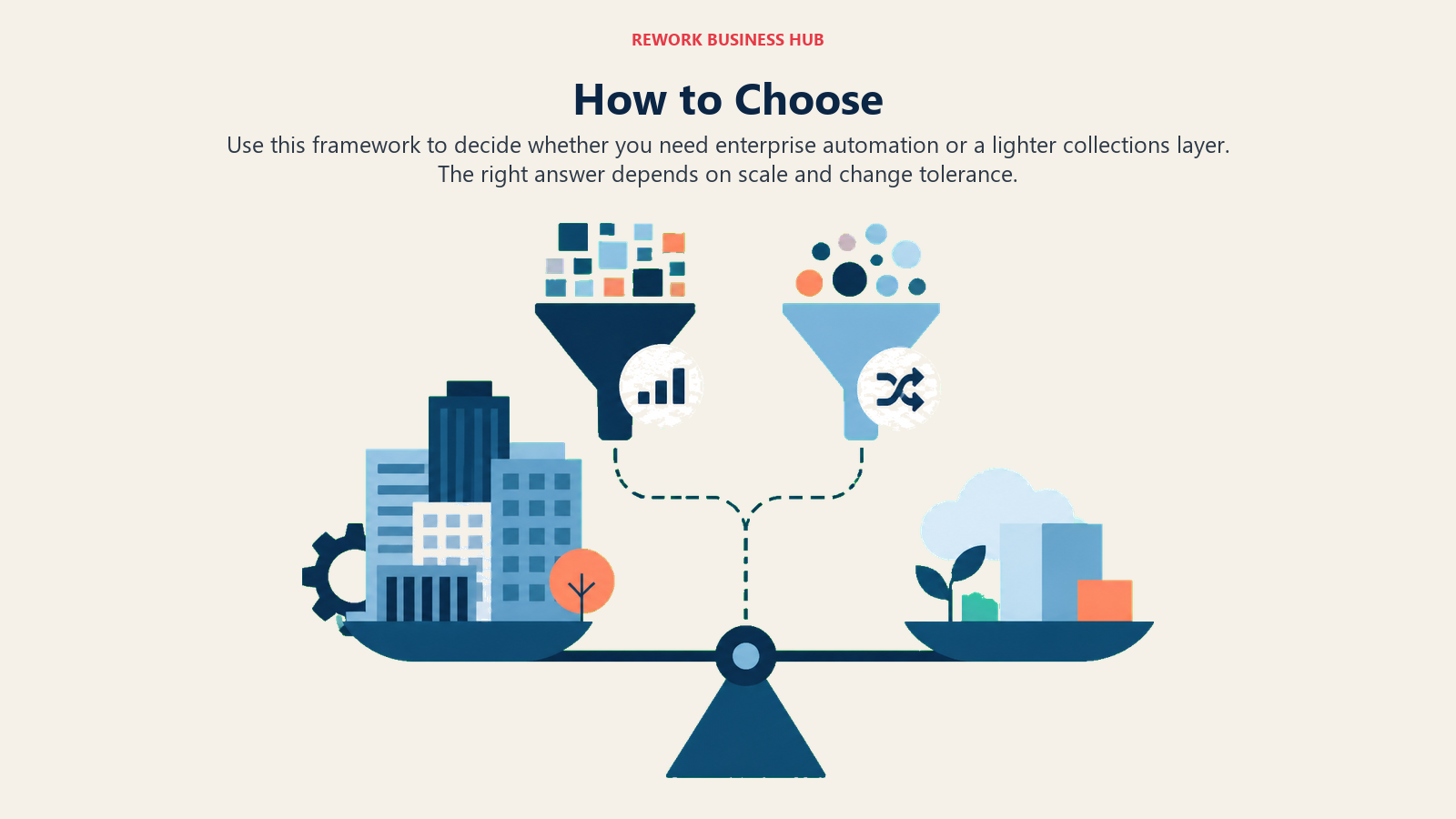
The final decision is about scale and change tolerance. HighRadius is the enterprise benchmark, but not always the lightest operational fit.
| If you need... | Pick... | Why |
|---|---|---|
| HighRadius-grade cash application AI, but a second bid | Billtrust | Mature cash application, quoted the same way as HighRadius |
| AP and AR on one data model instead of two tools | Esker | Synergy AI, Leader in three Gartner Magic Quadrants |
| AI-native credit scoring on a wide payment data network | Sidetrade | Trained across its network, checkable as a public company |
| A collaborative AR portal on Sage or Acumatica | Versapay | Native mid-market ERP integration, self-serve dispute resolution |
| Predictive collections without an enterprise price tag | Quadient AR | Risk-ranked prioritization, lighter sales motion than HighRadius |
| AP and AR under one login for a smaller team | BILL | Published per-user pricing, one system for both |
| Relationship-preserving collections, no platform overhaul | Chaser | Human-sounding sequences on your existing accounting software |
| Collections tied to CRM deal context | Growfin | Pulls HubSpot or Salesforce data into every invoice |
| One platform across CRM, invoicing and reconciliation | Rework | Incomes, Invoice and Bankfeeds share a CRM record |
What to Do Next
Pick two platforms from opposite ends of this list, one that matches your invoice volume and ERP setup today, one built for the scale you'd grow into, and run the same three tests on both before a contract reaches legal.
First, connect a real batch of your own invoices, not demo data, and watch how much manual cleanup cash application still requires. Second, log in as a customer and test the payment portal end to end, since a collections tool your customers dislike using creates as much friction as it removes. Third, get every cost in writing, including implementation, since almost nothing here publishes a number upfront, HighRadius included.
If HighRadius is still on your shortlist, ask for a reference customer close to your own invoice volume and entity count, not a case study from a much larger account. The gap between HighRadius fit and HighRadius overkill usually shows up in that one conversation.

Principal Product Marketing Strategist
On this page
- Key Facts
- HighRadius at a Glance: Real Strengths, Real Limits
- Quick Comparison Table
- 1. Billtrust: Enterprise Invoice-to-Cash Since Before the Category Had a Name
- 2. Esker: AP and AR on One Platform, One Data Model
- 3. Sidetrade: AI-Native Scoring Built on a B2B Payment Data Network
- 4. Versapay: Collaborative AR for Sage and Acumatica Shops
- 5. Quadient AR: Predictive Collections Without the Enterprise Price Tag
- 6. Rework: AR Operations on the Same Record as the Deal
- 7. BILL: Accounts Payable and Receivable Under One Login
- 8. Invoiced: API-First AR for Dev-Friendly Finance Teams
- 9. Chaser: Relationship-Preserving Collections, Not a Platform Overhaul
- 10. Upflow: Collections Visibility With a Free Analytics Tier
- 11. Gaviti: Collections Task Automation Without Hiring More Collectors
- 12. Tesorio: Collections Tied Directly to Cash Flow Forecasting
- 13. Peakflo: Agentic AI Across Both AP and AR
- 14. Growfin: Collections Tied to CRM Deal Context
- What Actually Changed in This Category
- Stage Fit Matrix
- Sizing and Persona Table
- How to Choose: Decision Framework
- What to Do Next