Best AI Tools for Proposal Creation in 2026
Turn this article into takeaways for your work.


Each assistant summarizes the article only for you and suggests best practices for your work.
If you're picking an AI tool to write and send business proposals in 2026, PandaDoc and Proposify lead if you want the broadest mix of proposal building, e-signature, and payment collection in one place, Qwilr and Storydoc lead if your proposal needs to look and behave like a living web page with embedded video and real-time view analytics, GetAccept and DealHub lead when the proposal has to plug into a deal room or CPQ-driven pricing engine, Better Proposals, Nusii, Bidsketch, and Prospero lead for small agencies and freelancers who mostly want fast templates on flat, predictable pricing, and Responsive and Loopio lead when the "proposal" is actually a formal RFP response with hundreds of scored questions and a compliance matrix attached. This guide ranks 12 tools by the job they actually do, not by whichever one shows up first in a Google ad.
This list is scoped to general commercial proposal work: sales proposals, statements of work, project quotes, and commercial RFP responses. If you're specifically responding to federal, state, or local government solicitations, best AI tools for government contractors covers the FedRAMP-cleared, CUI-appropriate tools built for that narrower, higher-compliance buying decision, GovDash, Vultron, and Rogue don't appear here because they're purpose-built for that world, not general B2B sales. And if what you actually need is an investor pitch deck or a slide-based sales deck rather than a document with pricing tables and a signature block, best AI tools for slide decks is the better starting point. A couple of tools below, Storydoc especially, sit close to that line, so we call out exactly where the overlap is in each writeup. Every tool here is evaluated on real capability, current pricing, and honest fit, checked against vendor pricing pages in July 2026.
What Changed in 2026
- Proposal software adoption crossed a real tipping point. 65% of proposal teams now use dedicated proposal or RFP software, up from 48% in 2024, a faster shift than most B2B software categories see in two years.
- Generative AI moved from experiment to default inside proposal tools. Nearly seven in ten teams now use AI to draft proposal content, and most of the tools below ship an AI writing assistant as a standard feature rather than a paid add-on.
- Response time compressed dramatically for AI-adopting teams, with average RFP turnaround falling from roughly 25 hours to under 5 hours for teams running AI-assisted drafting on top of a content library.
- Interactive, web-based proposals kept taking share from static PDFs. Qwilr, Storydoc, and GetAccept all leaned further into embedded pricing tables, video, and page-level analytics that show exactly when and how long a prospect viewed each section.
- Consolidation kept squeezing standalone e-signature into the proposal layer itself. PandaDoc, Proposify, GetAccept, and Qwilr all treat e-signature and payment collection as native features now, not integrations you bolt on separately.
Key Facts
- The average proposal and RFP win rate reached 45% in 2026, up from 43% the year before, per Bidara's 2026 RFP Statistics report.
- 65% of proposal teams now use dedicated proposal or RFP software, up from 48% in 2024, per Bidara.
- Teams using AI-powered proposal software cut average response time from roughly 25 hours to under 5 hours, close to an 80% reduction, per Bidara.
- 61% of teams that adopt dedicated proposal or RFP software report achieving ROI within the first year, per Bidara.
- Teams using dedicated proposal software submit roughly 10 more proposals or RFPs a year than teams working without it, per Loopio's 2026 RFP statistics roundup.
- The global proposal management software market reached $3.66 billion in 2026 and is projected to hit $9.19 billion by 2034, a 12.2% CAGR, per Fortune Business Insights.
- Proposals sent through dedicated proposal software see close rates rise by roughly 18%, and proposals with embedded photos or video are 32% more likely to close, per PandaDoc's own product data (vendor-reported, cited here as a directional benchmark, not an independent study).
Quick Comparison Table
| Tool | Best For | Starting Price | Key Strength | Key Limitation |
|---|---|---|---|---|
| PandaDoc | All-in-one proposals, e-signature, and payments | Free (5 docs/mo); paid from $19/user/mo | Broadest feature set for the price, strong CRM integrations | Media-heavy add-ons and API access can push the real bill higher |
| Proposify | Sales teams that need approval workflows and a content library | $19/user/mo (2-user cap) | Strong template control and role-based approval chains | Sends are metered even on paid tiers |
| Qwilr | Interactive, web-based proposals with embedded pricing | $35/user/mo | Best-in-class page analytics and QwilrPay checkout | Per-document generation fees stack up at volume |
| GetAccept | Deal rooms combining proposal, video, and e-signature | $25/user/mo (eSign only) | Stakeholder engagement tracking and built-in video messaging | CRM integrations and pricing tables locked to the $49/user Professional tier |
| Storydoc | Interactive proposals that read like a mini landing page | $19.80/mo | AI-generated design that looks custom without a designer | CRM integrations require the Pro tier; scope overlaps with pitch decks |
| DealHub | CPQ-driven proposals for complex, configurable pricing | Custom, typically $60-83/user/mo | Guided selling and quote-to-cash in one flow | No published self-serve pricing; built for larger sales orgs |
| Better Proposals | Agencies and freelancers wanting fast, on-brand templates | $19/user/mo | 200+ industry templates and built-in legal e-signing | Premium and Enterprise tiers are still per-seat, not flat |
| Prospero | Budget-conscious freelancers and small agencies | $19/mo | Unlimited proposals on the entry plan, AI drafting assistant | Thin published tier structure beyond the single Starter plan |
| Nusii | Small agencies wanting simple, branded proposals | $29/mo (1 user) | Clean UX, fast onboarding, generous template library | Additional seats add cost fast beyond the included user count |
| Bidsketch | Flat-rate proposal software for very small teams | $15/mo | Non-per-seat pricing at the entry tier | Feature depth thinner than PandaDoc or Proposify at comparable cost |
| Responsive (formerly RFPIO) | Formal RFP responses with scored questionnaires | Custom, avg. ~$13,955/yr | AI-assisted answer library built for repetitive RFP questions | No published rate card; real quote requires a sales conversation |
| Loopio | Enterprise RFP response at high submission volume | $20,000/yr (10 seats) | Deepest content library and reuse tooling in the category | Entry price puts it out of reach for small and mid-size teams |
Proposals, SOWs, Quotes, and RFP Responses: Picking the Right Category
Before comparing individual tools, it helps to be honest about which document you're actually producing, because the four sub-categories in this space have real differences in what "good" looks like.
| Document type | What it needs to do | Tools built for this |
|---|---|---|
| Sales proposal | Persuade a prospect, show pricing options, close with a signature | PandaDoc, Proposify, Qwilr, Storydoc, Better Proposals |
| Statement of work (SOW) | Define scope, deliverables, timeline, and payment terms precisely | PandaDoc, Proposify, Nusii, Bidsketch |
| Project quote / estimate | Show line-item pricing fast, often with configurable options | DealHub, Qwilr, GetAccept, Bidsketch |
| Commercial RFP response | Answer dozens to hundreds of scored questions accurately and fast | Responsive, Loopio, PandaDoc (lighter volume) |
1. PandaDoc: Broadest All-in-One Proposal, E-Signature, and Payments Platform
PandaDoc is the closest thing to a default choice in this category because it does the most things reasonably well in one subscription: proposal building from templates, legally binding e-signature, embedded payment collection (Stripe, PayPal, QuickBooks), and content library management that keeps pricing tables and boilerplate clauses consistent across a whole sales team. If you're evaluating e-signature as a standalone requirement rather than a proposal feature, how to choose e-signature software walks through the legal validity and compliance questions worth asking any vendor, including PandaDoc.
The free plan (5 documents a month) is a genuine way to test the product before committing, and the Starter tier at $19/user/month annually covers most small-team needs: unlimited documents, templates, and e-signatures. The Business tier at $49/user/month adds CRM integrations (Salesforce, HubSpot, Pipedrive), content library locking, and approval workflows. The catch is that several features teams assume are included, API access, bulk sending, web forms, notarization, are metered add-ons that push real spend above the sticker price. A 10-person team on Business alone runs about $490/month before add-ons, with median annual spend landing around $16,447 according to Vendr's 2026 marketplace data.
Best for: Teams that want one tool covering proposal drafting, e-signature, and payment collection without stitching together three vendors
| What you get | What you don't |
|---|---|
| Proposal building, e-signature, and payments in one subscription | Add-ons (API, bulk send, notarization) aren't in the base price |
| Genuine free tier for testing before you buy | Business tier's CRM integrations require the $49/user step-up |
| Strong CRM and payment processor integrations | Median 10-seat annual spend (~$16,447) is above the sticker price |
Pricing: Free (5 docs/mo); Starter $19/user/mo ($35 monthly); Business $49/user/mo ($65 monthly); Enterprise custom. See pandadoc.com/pricing.
2. Proposify: Best for Approval Workflows and Content Governance
Proposify was built around a specific pain point: sales teams sending proposals with outdated pricing, wrong logos, or unapproved terms because nobody controls the content library. Its answer is role-based permissions, locked content blocks, and an approval workflow that routes a proposal through a manager before it reaches a prospect, a feature set that matters more as a sales team grows past a handful of reps improvising their own templates.
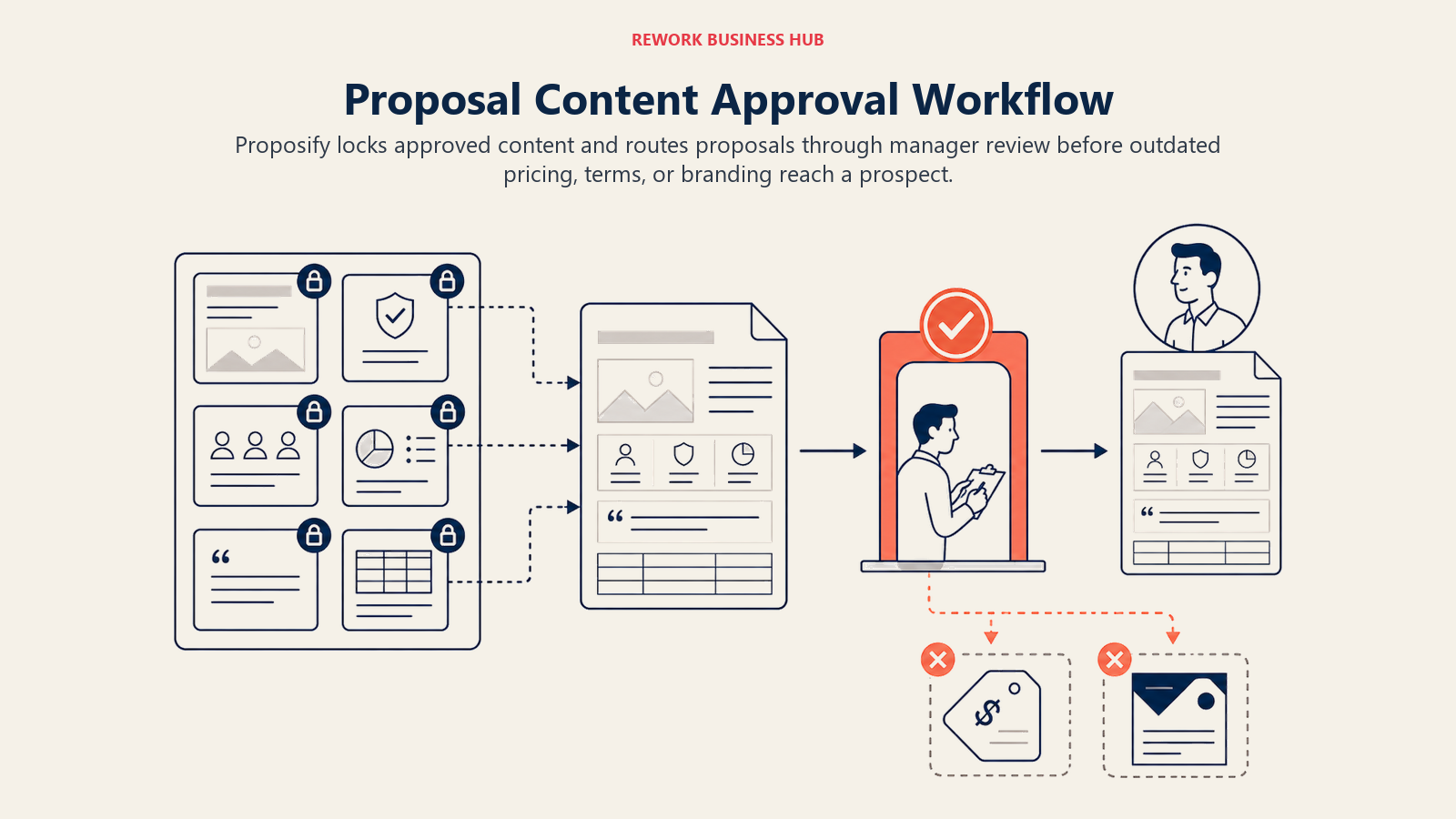
Pricing is structured around metered sends rather than documents drafted, editing and collaborating stay unlimited, but each plan caps how many proposals you can actually send to a client per month. The Basic plan tops out at 2 users and 5 sends a month for $19/user/month, which works for a very small team but forces an upgrade fast. The Team plan at $41/user/month removes the send cap and adds CRM integrations and client input forms, while Business at $65/user/month (10-user minimum) layers in approval workflows and API access. If document governance across a distributed team is the actual problem you're solving, how to choose document automation software covers the evaluation criteria that apply here too.
Best for: Sales teams of 5-50 reps that need approval workflows and a governed content library, not just a template editor
| What you get | What you don't |
|---|---|
| Role-based permissions and locked content blocks | Send limits on lower tiers force an early upgrade |
| Approval workflows before a proposal reaches a prospect | Business tier requires a 10-user minimum |
| Strong CRM integrations at the Team tier and above | No permanent free plan, only a 14-day trial |
Pricing: Basic $19/user/mo (2-user cap); Team $41/user/mo; Business $65/user/mo (10-user minimum, or custom from ~$3,900/yr). See proposify.com/pricing.
3. Qwilr: Best Interactive, Web-Based Proposal With Embedded Payments
Qwilr's core bet is that a proposal shouldn't be a static PDF at all, it should be a responsive web page with embedded video, interactive pricing tables prospects can toggle, and page-level analytics showing exactly which section a prospect lingered on and which they skipped. That view-level data is genuinely useful for follow-up: a rep who sees a prospect re-open the pricing section three times knows exactly what to call about next.
The Starter plan at $35/user/month covers the core editor, e-signature, and QwilrPay checkout with a 1-seat minimum, a real option for a solo consultant or freelancer. Growth ($55/user/month, 5-seat minimum, annual only) adds automations and custom branding, and Scale ($75/user/month, 10-seat minimum) adds Salesforce integration, conditional content logic, and AI prefill. Document generation carries a separate per-document fee ($5 on Starter, dropping to $2.50 on Growth and Scale), so high-volume senders should model that cost in before committing to a tier.
Best for: Consultants and sales teams that want proposals to feel like an interactive product demo rather than a document, with real view-level engagement data
| What you get | What you don't |
|---|---|
| Interactive web pages with embedded video and toggled pricing | Per-document generation fees stack up at real volume |
| QwilrPay checkout built into the proposal itself | Growth and Scale tiers require 5+ and 10+ seat minimums |
| Page-level analytics showing exactly what a prospect viewed | Salesforce integration is locked to the top Scale tier |
Pricing: Starter $35/user/mo (1-seat min); Growth $55/user/mo (5-seat min, annual only); Scale $75/user/mo (10-seat min, annual only). See qwilr.com/pricing.
4. GetAccept: Best for Deal Rooms With Video and Stakeholder Tracking
GetAccept positions itself less as "proposal software" and more as a digital sales room: a shared space where a proposal, contract, pricing, and a personalized video message all live together, with visibility into which specific stakeholder on the buying committee actually opened and engaged with each piece. For complex B2B deals with multiple decision-makers, that stakeholder-level tracking is the real differentiator over a simple document-view count.
The eSign plan at $25/user/month covers unlimited e-signatures, templates, and basic branding on its own, a reasonable entry point if signature is the primary need. The real proposal functionality, in-app editing, pricing tables, CRM integrations with HubSpot and Pipedrive, and stakeholder engagement tracking, sits behind the Professional tier at $49/user/month, which carries a 5-user minimum. Enterprise adds CPQ, contract management, and Salesforce/Dynamics integrations at custom pricing.
Best for: Complex B2B sales teams selling to buying committees who need visibility into which specific stakeholder engaged with what
| What you get | What you don't |
|---|---|
| Shared deal room combining proposal, video, and e-signature | Real proposal features (pricing tables, CRM sync) require Professional tier |
| Stakeholder-level engagement tracking, not just document views | Professional tier carries a 5-user minimum |
| Built-in personalized video messaging | Salesforce and Dynamics integrations are Enterprise-only |
Pricing: eSign $25/user/mo; Professional $49/user/mo (5-user minimum); Enterprise custom. See getaccept.com/pricing.
5. Storydoc: Best for Proposals That Read Like a Landing Page
Storydoc leans hardest into the "proposal as interactive content" idea of any tool on this list, using AI to generate a designed, animated, mobile-responsive document from a prompt or an existing PDF, closer in spirit to a microsite than a traditional business document. Because the underlying product treats a sales proposal, a pitch deck, and a case study the same way (all are just "Storydocs"), this is the tool on this list with the most direct overlap with best AI tools for slide decks: if your actual document is investor-facing or presentation-first rather than pricing-and-signature-first, that guide is the better fit.
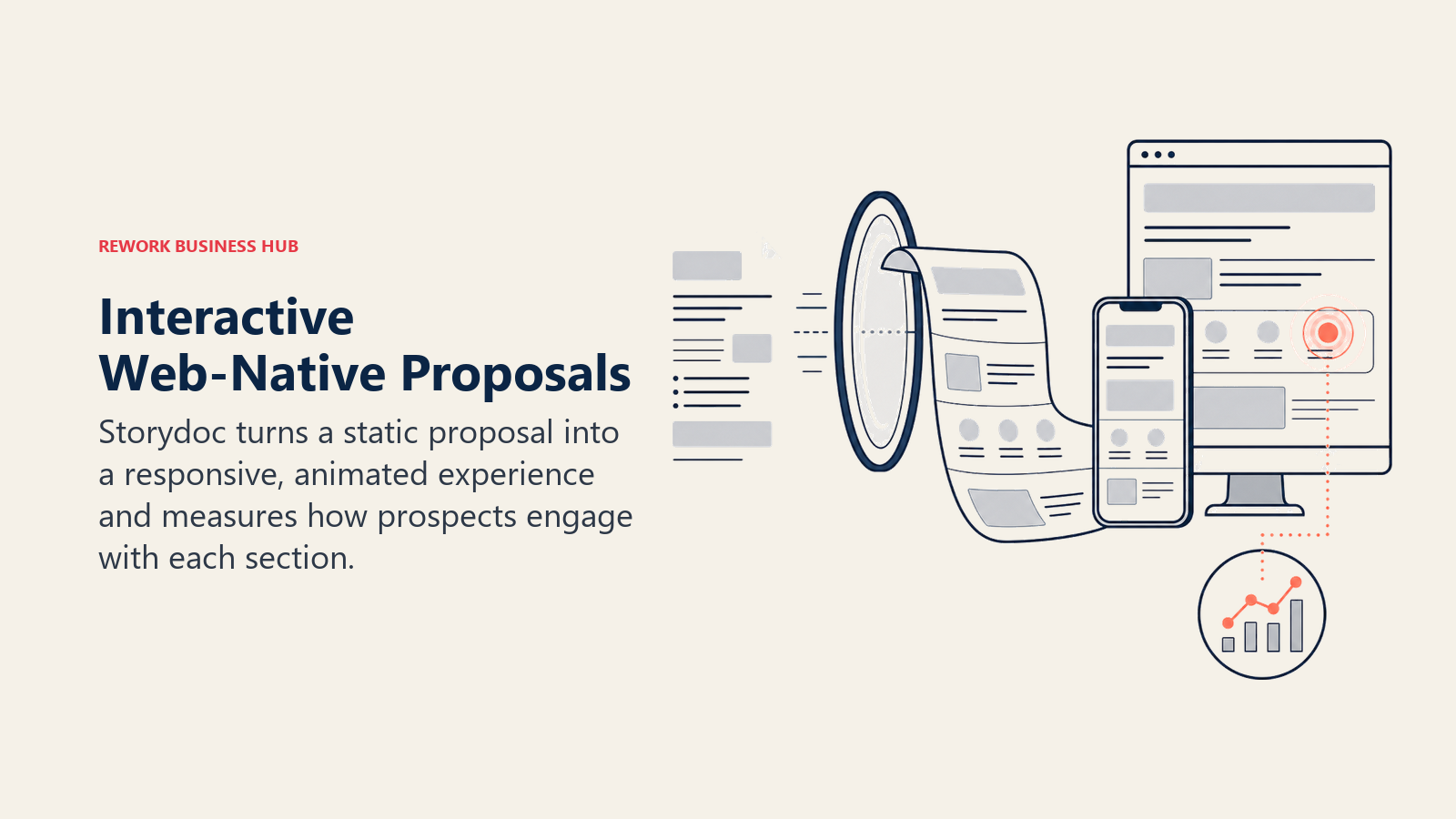
For a genuine sales proposal use case, Storydoc's strength is speed to a polished result without a designer, plus analytics on time spent per section. The Starter plan at $19.80/month covers 5 active documents with limited AI credits, useful for testing. The Pro plan at $36/month raises the document cap to 30 and unlocks CRM integrations, which is the tier any sales team actually running proposals through Storydoc needs, since CRM sync sits behind Pro, not Starter.
Best for: Teams that want AI-generated, highly designed interactive proposals without a design resource, and don't mind the overlap with presentation tooling
| What you get | What you don't |
|---|---|
| AI-generated, animated, mobile-responsive documents | CRM integrations locked to the $36/mo Pro tier, not Starter |
| Section-level analytics on time spent reading | Product scope overlaps with pitch-deck tools, less proposal-specific |
| Fast time to a polished result without a designer | Team tier pricing is fully custom, no published number |
Pricing: Starter $19.80/mo; Pro $36/mo; Team custom. See storydoc.com/pricing.
6. DealHub: Best for CPQ-Driven Proposals With Configurable Pricing
DealHub solves a different problem than most tools on this list: proposals where the pricing itself is complex, tiered discounts, bundled products, approval thresholds, usage-based components, and needs to be configured correctly before a proposal document even gets generated. Its Configure-Price-Quote (CPQ) engine builds the pricing logic, then generates the proposal, contract, and (on higher tiers) subscription billing from that same configured deal.
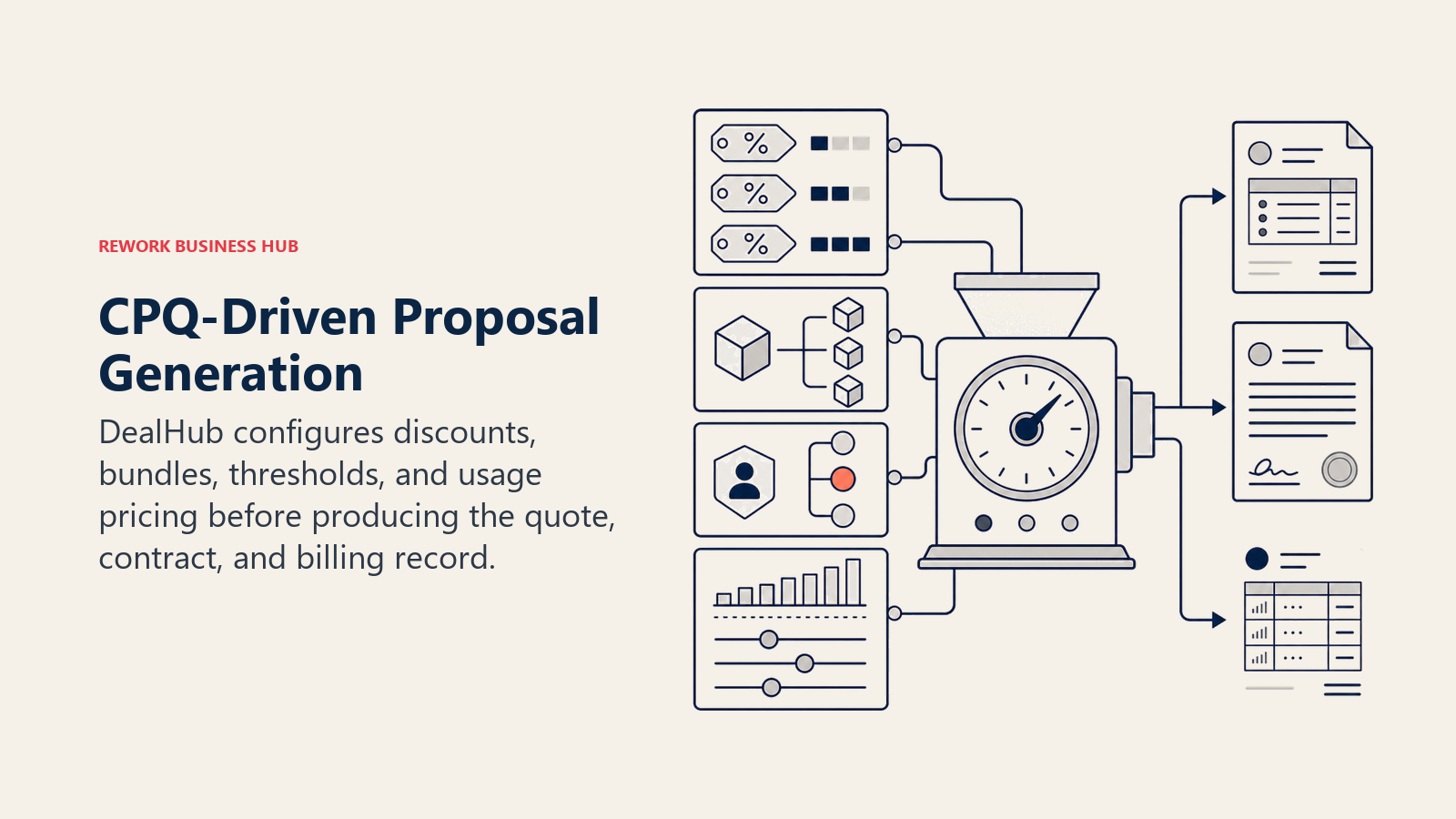
Because DealHub is priced and sold like enterprise CPQ software rather than a proposal template tool, there's no self-serve signup. Per-user pricing reportedly runs $60-83/user/month, positioned below Salesforce CPQ ($75-150/user/month) but above most of the tools on this list. If CPQ complexity isn't your actual bottleneck, that price gap isn't worth paying; if guided selling and configurable pricing logic are genuinely your problem, DealHub is built for exactly that. Teams evaluating DealHub against a broader CRM shortlist first should see best AI CRM tools or best CRM software for the platforms DealHub typically layers on top of.
Best for: Sales orgs with genuinely complex, configurable pricing (tiered discounts, bundles, approval thresholds) who need CPQ logic before the proposal generates
| What you get | What you don't |
|---|---|
| CPQ engine that builds pricing logic before generating the document | No self-serve pricing; every deal starts with a sales call |
| Quote-to-cash in one platform (CPQ, CLM, billing tiers) | Overkill and overpriced for teams with simple, flat pricing |
| Positioned below Salesforce CPQ on a per-user basis | Requires integration with an existing CRM to get full value |
Pricing: Custom, typically $60-83/user/mo depending on tier and commitment. See dealhub.io/pricing.
7. Better Proposals: Best Template Library for Agencies
Better Proposals built its reputation on volume and polish of templates, over 200 industry-specific designs covering agencies, freelancers, consultants, and SaaS sales, each legally vetted and ready to customize rather than built from a blank canvas. For a small team that needs to look established fast without hiring a designer, that template depth is the actual product.
The Starter plan at $19/user/month covers unlimited proposals, templates, and legally binding e-signatures, a genuinely complete offering at the entry tier compared to competitors that gate e-signature behind a higher plan. Premium at $29/user/month adds a content library and integrations, and Enterprise at $49/user/month adds advanced permissions and priority support. Annual billing saves 14-31% depending on tier, and a $10/user/month NUDGE add-on layers in automated follow-up reminders shown to lift close rates.
Best for: Agencies and consultancies that want a large, polished template library and complete e-signature from the entry tier
| What you get | What you don't |
|---|---|
| 200+ legally vetted, industry-specific templates | Per-seat pricing even at "unlimited users" tiers |
| E-signature included from the entry Starter tier | Content library and integrations require Premium |
| Automated reminder add-on (NUDGE) to lift close rates | Custom template design is a separate paid service ($1,495+) |
Pricing: Starter $19/user/mo; Premium $29/user/mo; Enterprise $49/user/mo. See betterproposals.io/pricing.
8. Prospero: Best Budget Option With Unlimited Proposals
Prospero's pitch is simple: one plan, unlimited proposals, an AI assistant that drafts proposal copy from a short brief, and a price low enough that a freelancer or two-person shop doesn't think twice about it. At $19/month for the Starter plan (with roughly 37% off on annual billing), it covers proposal analytics (who viewed, for how long, from what device), Stripe and QuickBooks integrations, and a shared content library.
The tradeoff for that simplicity is a thin published tier structure: there's effectively one clearly documented plan rather than a ladder of features to grow into, which is fine for a solo operator but means teams that outgrow it may need to switch tools rather than upgrade in place. Users have also flagged that pricing has moved up over the past year, worth confirming the current number directly before assuming the lowest historically-cited figure still applies.
Best for: Freelancers and very small teams that want unlimited proposals and AI drafting help at the lowest real entry price on this list
| What you get | What you don't |
|---|---|
| Unlimited proposals on a single, low-cost plan | Thin tier structure; little room to grow into higher features |
| AI assistant drafts proposal copy from a brief | Pricing has trended upward; confirm the current rate before buying |
| Proposal view analytics and payment integrations included | Less enterprise-ready than PandaDoc or Proposify at scale |
Pricing: Starter $19/mo (annual discount ~37% off). See goprospero.com/pricing.
9. Nusii: Best Simple, Branded Proposals for Small Agencies
Nusii keeps its scope deliberately narrow: proposal creation, online e-signing, and branded delivery, without trying to be a full CRM or deal room. That focus shows up as fast onboarding and a clean interface that a small agency team can start using the same day, with unlimited templates and clients on every paid tier.
The Freelancer plan at $29/month covers 1 user and 5 active proposals, useful for testing or a genuine solo operator. The Agency plan at $49/month (the most popular tier) includes 3 users and 20 active proposals, adds custom domain and CRM integrations, with additional seats at $19/user. Business at $129/month covers 5 users and 50+ active proposals, adding permissions and priority support.
Best for: Small agencies (2-5 people) that want branded, simple proposals without CRM or deal-room complexity
| What you get | What you don't |
|---|---|
| Fast onboarding, clean UI, unlimited templates and clients | Additional seats beyond the included count add cost quickly |
| Custom domain and CRM integrations at the Agency tier | No deal-room, video, or CPQ features; proposals only |
| Clear, published pricing with no custom-quote gate | Active proposal caps limit high-volume senders on lower tiers |
Pricing: Freelancer $29/mo (1 user); Agency $49/mo (3 users); Business $129/mo (5 users). See nusii.com/pricing.
10. Bidsketch: Best Flat-Rate Pricing for Very Small Teams
Bidsketch's differentiator in a category dominated by per-seat pricing is straightforward: several of its tiers price by team, not by user, which matters for a small agency that wants to add a project manager or a bookkeeper to proposal review without paying a per-seat tax for someone who touches the tool twice a month.
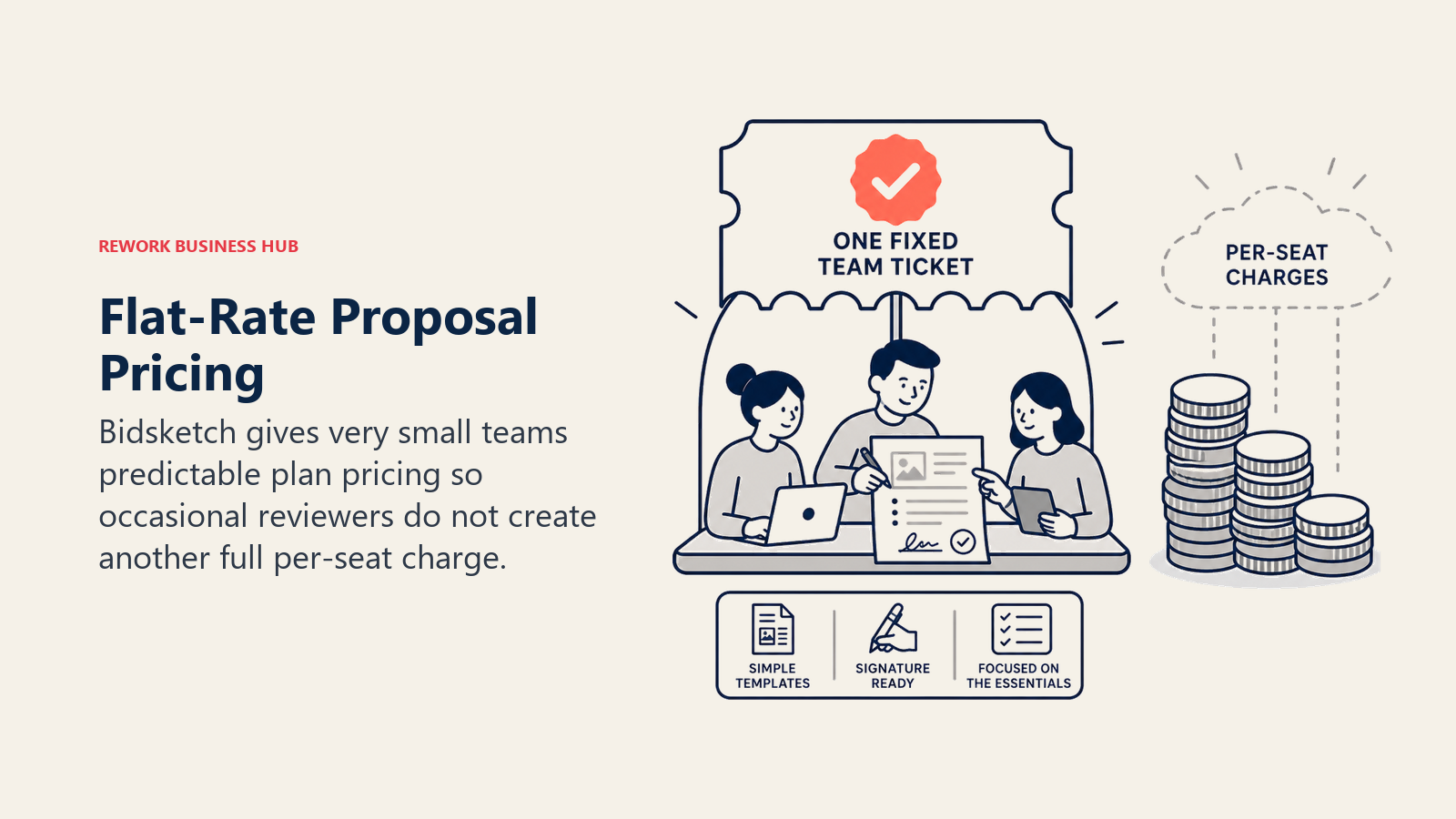
The Starter plan at $15/month is genuinely the cheapest entry point on this list. Solo at $23/month (annual) covers 1 user, Team at $47/month (annual) covers 3 users with a 41% discount over monthly billing, and Business at $119/month (annual) covers 8 users. Feature depth is thinner than PandaDoc or Proposify at a comparable price band, no interactive web proposals, no deal-room video, but for a team that just needs clean templates, e-signature, and flat-rate cost predictability, that tradeoff is often the right one.
Best for: Very small agencies and solo consultants who want predictable, non-per-seat pricing and don't need interactive or deal-room features
| What you get | What you don't |
|---|---|
| Cheapest entry price on this list ($15/mo) | Feature depth thinner than PandaDoc or Proposify |
| Team-based tiers (3 or 8 users) rather than pure per-seat pricing | No interactive web proposals or embedded video |
| 41% discount for annual billing on the Team tier | Free trial requires a credit card upfront |
Pricing: Starter $15/mo; Solo $23/mo (annual, 1 user); Team $47/mo (annual, 3 users); Business $119/mo (annual, 8 users). See bidsketch.com/pricing.
11. Responsive (formerly RFPIO): Best for Formal RFP Response Management
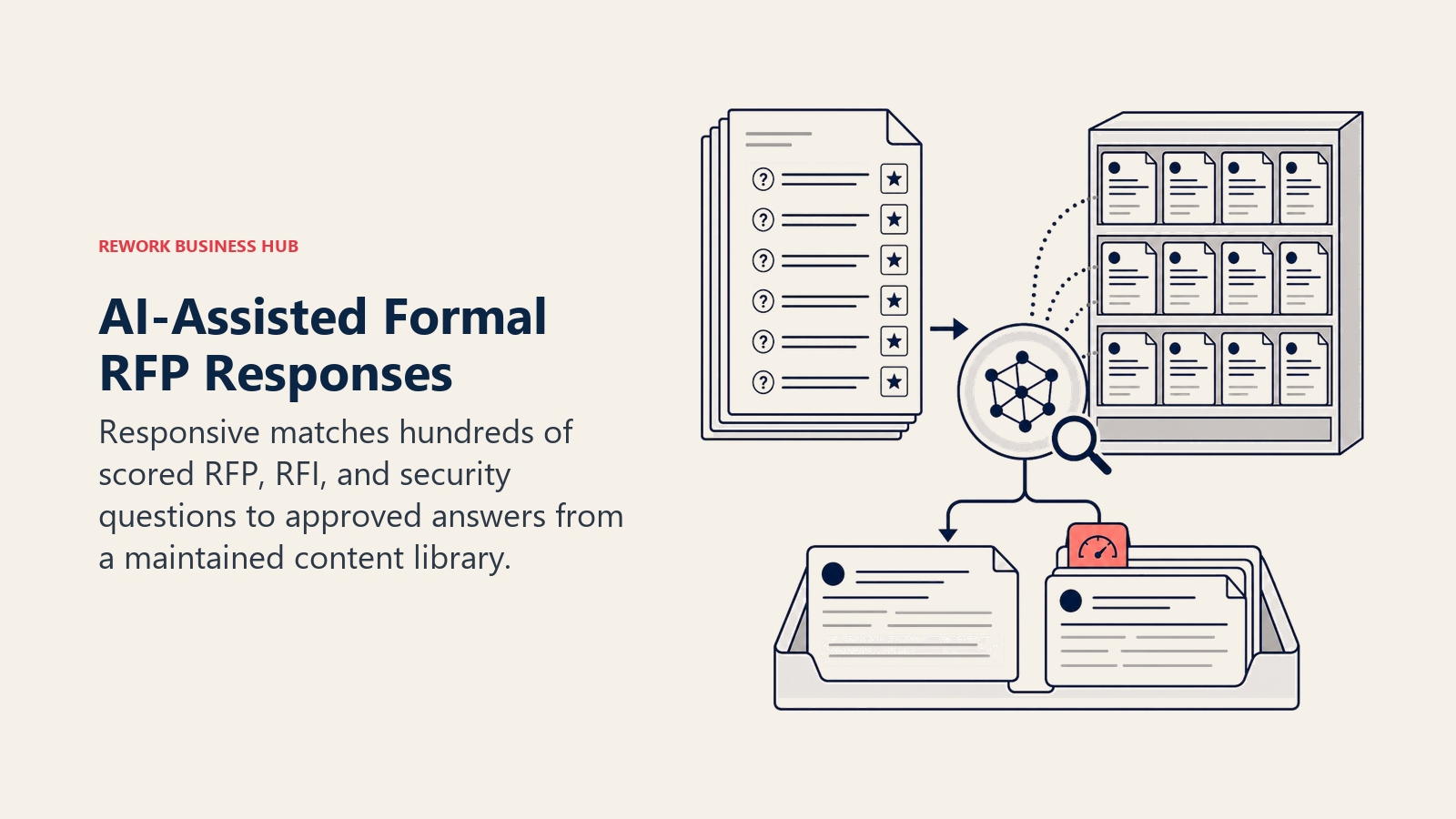
Responsive occupies a different tier of this category entirely: not a proposal template tool, but a platform for managing formal RFP, RFI, and security questionnaire responses that run to hundreds of scored questions, pulling answers from a maintained content library and using AI to suggest the best-matching prior answer for each new question. If what you're calling a "proposal" is actually a vendor questionnaire with a due date and a scoring rubric, this is the right category, not PandaDoc or Qwilr.
Pricing is entirely sales-led, with no published rate card. The typical annual cost reportedly runs between $7,000 and $28,000, averaging around $13,955/year, scoped by team size and workflow complexity across Lite, Emerging, Growth, and Enterprise tiers. Onboarding, premium support, and dedicated hosting are separate paid add-ons on top of the base license, so budget beyond the sticker quote.
Best for: Teams responding to formal RFPs, RFIs, and security questionnaires with dozens to hundreds of scored questions, not simple sales proposals
| What you get | What you don't |
|---|---|
| AI-assisted answer suggestions pulled from a maintained content library | No published pricing; every deal requires a sales conversation |
| Purpose-built for scored, multi-stakeholder RFP workflows | Onboarding, support, and hosting are separate paid add-ons |
| Scales from a 50-person team (Lite) to enterprise complexity | Overkill for a team that just sends simple sales proposals |
Pricing: Custom, typically $7,000-$28,000/yr, averaging ~$13,955/yr. See responsive.io/pricing.
12. Loopio: Best Content Library Depth for High-Volume Enterprise RFP Teams
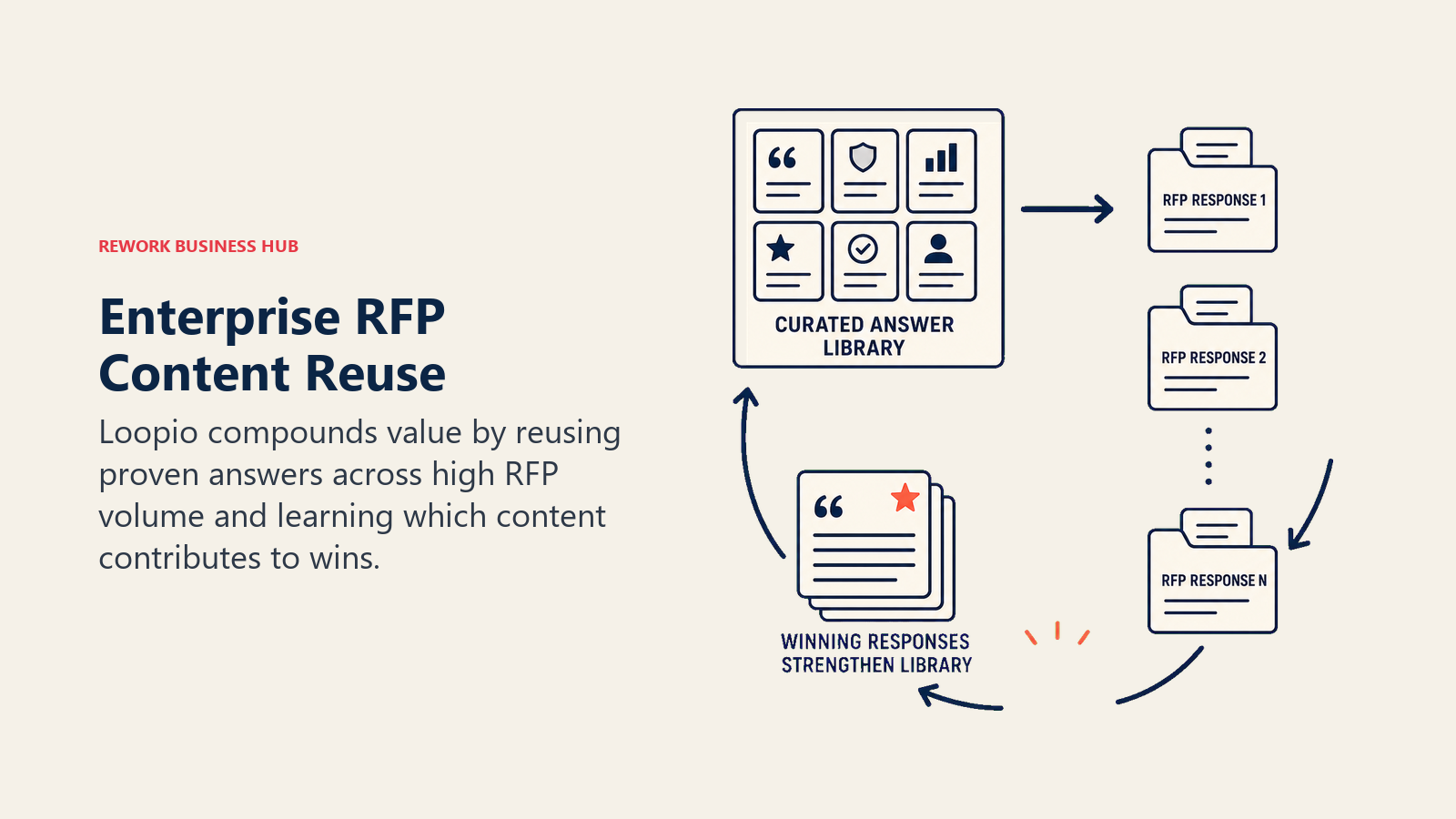
Loopio's specialty is the same category as Responsive, formal RFP response, but its differentiator is reuse tooling: a content library architecture designed for teams answering the same core questions across dozens or hundreds of RFPs a year, with AI surfacing the best existing answer and tracking which library content actually wins deals over time. For a dedicated proposal team fielding constant RFP volume, that reuse discipline compounds into real time savings.
The entry point is high by design: Foundations starts at $20,000/year for 10 seats, positioning Loopio squarely as an enterprise tool rather than something a small team backs into. Enhanced and Enterprise tiers are fully custom, and add-on capabilities like SSO and advanced workflow automation are frequently priced separately, pushing real total cost meaningfully above the base quote. Teams evaluating this level of spend against a broader enterprise AI stack should see best AI tools for enterprise for how it compares against other big-ticket categories.
Best for: Enterprise teams with a dedicated proposal function fielding high RFP volume who need the deepest content-reuse tooling in the category
| What you get | What you don't |
|---|---|
| Deepest content library and reuse architecture in the category | $20,000/yr entry price puts it out of reach below enterprise scale |
| AI surfaces best-matching answers and tracks what wins deals | SSO, integrations, and automation often priced as separate add-ons |
| Built for teams with constant, high-volume RFP flow | Not designed for occasional or low-volume proposal senders |
Pricing: Foundations $20,000/yr (10 seats); Enhanced and Enterprise custom. See loopio.com/pricing.
How to Choose: Decision Framework
| If you need... | Pick... | Why |
|---|---|---|
| One tool covering proposal drafting, e-signature, and payments | PandaDoc | Broadest feature set for the price, genuine free tier to test first |
| Approval workflows and a governed content library for a growing team | Proposify | Role-based permissions and locked content blocks prevent version drift |
| Interactive, web-based proposals with view-level analytics | Qwilr | QwilrPay checkout plus page-by-page engagement data |
| A shared deal room with video and stakeholder-level tracking | GetAccept | Sees which specific buying-committee member engaged with what |
| AI-generated, highly designed proposals without a designer | Storydoc | Fastest path to a polished result, closest to presentation tooling |
| Complex, configurable pricing (bundles, tiers, approval thresholds) | DealHub | CPQ engine builds pricing logic before the proposal generates |
| A large, legally vetted template library for an agency | Better Proposals | 200+ industry templates, e-signature included from the entry tier |
| The lowest cost with unlimited proposals | Prospero | Single low-cost plan, AI drafting assistant included |
| Simple, branded proposals for a very small agency | Nusii | Fast onboarding, clean UX, published pricing |
| Flat, non-per-seat pricing for a tiny team | Bidsketch | Cheapest entry price on this list, team-based tiers |
| Formal RFP, RFI, or security questionnaire response management | Responsive | AI-assisted answer suggestions from a maintained content library |
| The deepest content reuse tooling at high RFP volume | Loopio | Built specifically for teams fielding constant RFP flow |
Framework: By Team Size and Volume
| Profile | Budget Signal | Best Fits |
|---|---|---|
| Solo freelancer or consultant | Under $50/mo | Prospero, Bidsketch (Starter/Solo), Nusii (Freelancer) |
| Small agency (2-10 people) | $50-500/mo | Better Proposals, Nusii, Bidsketch, PandaDoc Starter |
| Growing sales team (10-50 reps) | $500-3,000/mo | Proposify, Qwilr, GetAccept, PandaDoc Business |
| Complex configurable pricing, any size | Custom, per-user | DealHub |
| Dedicated proposal function, moderate RFP volume | $7,000-30,000/yr | Responsive (Lite/Emerging) |
| Enterprise proposal team, high RFP volume | $20,000+/yr | Loopio, Responsive (Growth/Enterprise) |
Pricing at a Glance
| Tool | Entry Price | Pricing Model | Published Rate Card? |
|---|---|---|---|
| PandaDoc | Free (5 docs/mo) | Per-user tiers + add-ons | Yes |
| Proposify | $19/user/mo | Per-user tiers, metered sends | Yes |
| Qwilr | $35/user/mo | Per-user tiers + per-document fees | Yes |
| GetAccept | $25/user/mo | Per-user tiers | Yes |
| Storydoc | $19.80/mo | Per-plan (document caps) | Yes |
| DealHub | Custom (~$60-83/user/mo est.) | Contact sales | No |
| Better Proposals | $19/user/mo | Per-user tiers | Yes |
| Prospero | $19/mo | Flat single plan | Yes |
| Nusii | $29/mo (1 user) | Team tiers + per-seat overage | Yes |
| Bidsketch | $15/mo | Flat team tiers | Yes |
| Responsive | Custom (~$13,955/yr avg.) | Contact sales | No |
| Loopio | $20,000/yr (10 seats) | Contact sales above entry tier | Partial |
Where AI for Proposal Creation Is Headed
The clearest trend across every tool on this list is that AI drafting stopped being a differentiator and became table stakes. Nearly seven in ten proposal teams now use generative AI in some form, and the gap that actually separates vendors in 2026 is what happens after the draft: how well the tool tracks engagement, routes approvals, connects to CRM and pricing data, and reuses winning content automatically instead of leaving that discipline to a spreadsheet.
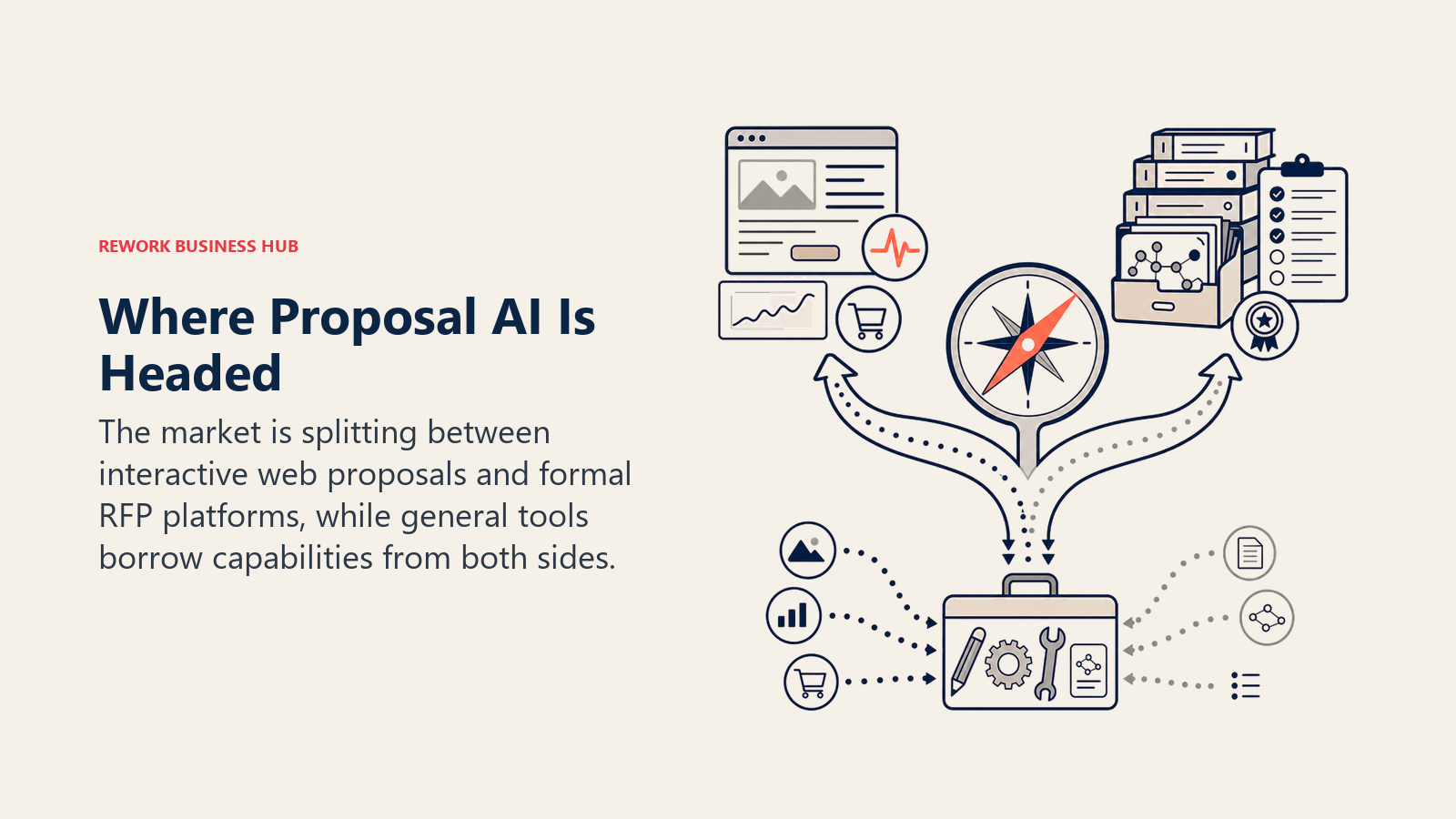
The category is also splitting more clearly into two poles. On one side, interactive, web-native proposals (Qwilr, Storydoc, and increasingly GetAccept) are pulling further away from the static-PDF model, betting that engagement data and embedded checkout matter more than a document a prospect can print. On the other, formal RFP response platforms (Responsive, Loopio) are doubling down on content-library depth and AI answer-matching for teams drowning in repetitive vendor questionnaires. Expect the mid-market, general-purpose tools (PandaDoc, Proposify, Better Proposals) to keep absorbing features from both poles rather than staying purely in the middle.
If proposal creation is one piece of a broader B2B sales stack you're evaluating, best AI tools for business development, best AI tools for sales, and best AI tools for B2B cover the adjacent categories most revenue teams are stacking alongside a proposal tool this year.
What to Do Next
Identify which document type you're actually producing first, sales proposal, SOW, quote, or formal RFP response, using the table above, then pilot exactly two tools in that category for two to three real deals rather than evaluating all 12 at once. If e-signature or CRM integration is a hard requirement, confirm it's included at the tier you'd actually pay for, several tools on this list gate those features behind a second or third pricing step.

Principal Product Marketing Strategist
On this page
- What Changed in 2026
- Key Facts
- Quick Comparison Table
- Proposals, SOWs, Quotes, and RFP Responses: Picking the Right Category
- 1. PandaDoc: Broadest All-in-One Proposal, E-Signature, and Payments Platform
- 2. Proposify: Best for Approval Workflows and Content Governance
- 3. Qwilr: Best Interactive, Web-Based Proposal With Embedded Payments
- 4. GetAccept: Best for Deal Rooms With Video and Stakeholder Tracking
- 5. Storydoc: Best for Proposals That Read Like a Landing Page
- 6. DealHub: Best for CPQ-Driven Proposals With Configurable Pricing
- 7. Better Proposals: Best Template Library for Agencies
- 8. Prospero: Best Budget Option With Unlimited Proposals
- 9. Nusii: Best Simple, Branded Proposals for Small Agencies
- 10. Bidsketch: Best Flat-Rate Pricing for Very Small Teams
- 11. Responsive (formerly RFPIO): Best for Formal RFP Response Management
- 12. Loopio: Best Content Library Depth for High-Volume Enterprise RFP Teams
- How to Choose: Decision Framework
- Framework: By Team Size and Volume
- Pricing at a Glance
- Where AI for Proposal Creation Is Headed
- What to Do Next