Best AI Tools for Government Contractors in 2026
Turn this article into takeaways for your work.


Each assistant summarizes the article only for you and suggests best practices for your work.
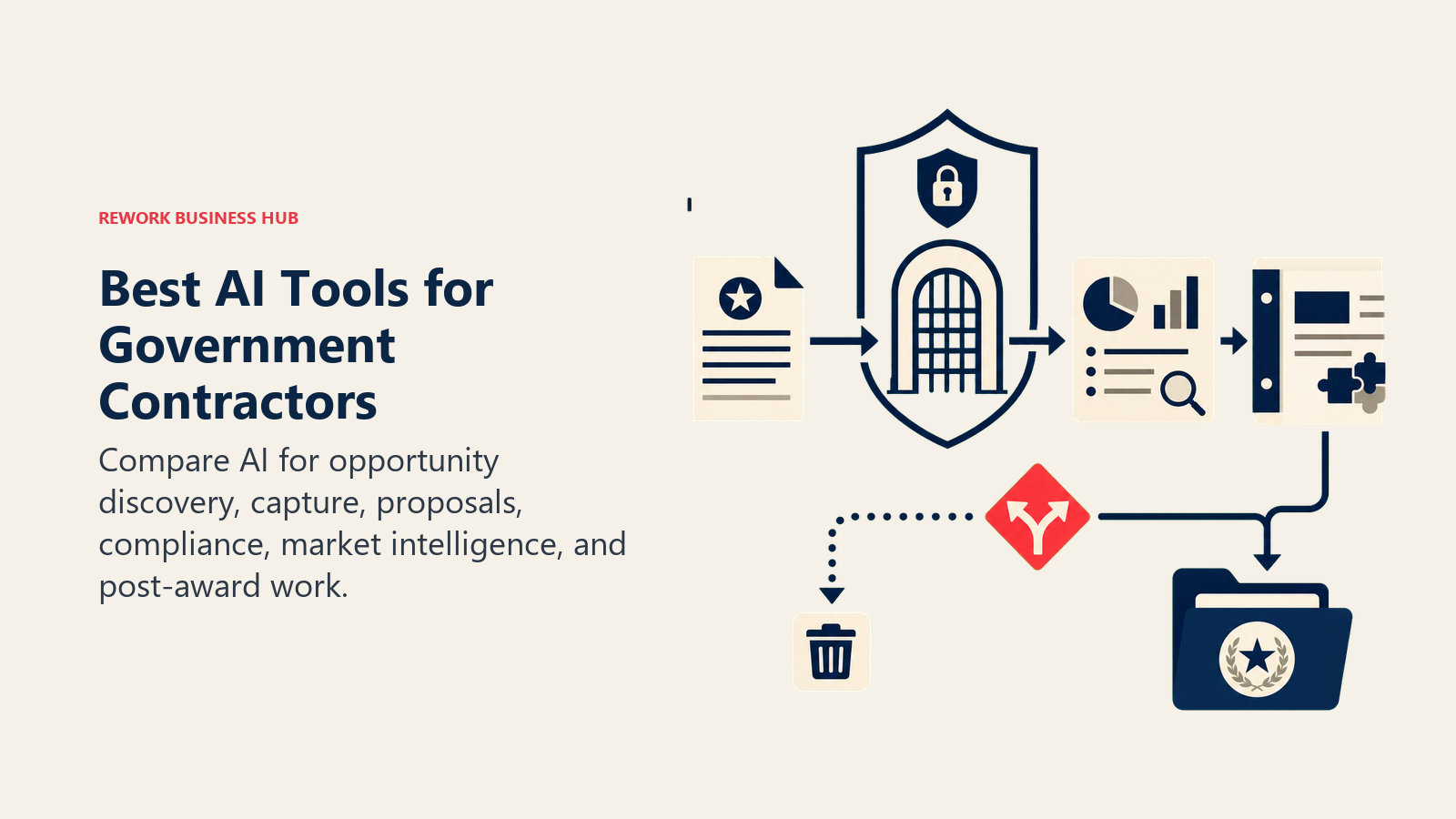
If you're picking an AI tool for government contracting in 2026, GovSignals and Sweetspot lead if you want one platform covering discovery through proposal drafting, GovDash and Vultron lead if capture and proposal generation are your bottleneck, Rogue and AutogenAI lead for AI writing assistance layered onto your own past performance library, Deltek GovWin IQ, HigherGov, GovTribe, GovSpend, and Bloomberg Government lead for market intelligence and opportunity data, Unanet leads for the ERP and compliance side of running a contract once you win it, and ChatGPT Enterprise or Microsoft 365 Copilot (GCC High) cover the general-purpose AI work your team already does daily, now cleared for Controlled Unclassified Information (CUI) environments. This guide ranks 14 tools by the job they actually do, not by whichever vendor shows up first in a Google ad.
Government contracting is a narrower, higher-stakes AI buying decision than most categories on this site. A tool that mishandles CUI, misreads a FAR clause, or hallucinates a compliance requirement doesn't just waste time, it can disqualify a bid or trigger a real security incident. Every tool below is evaluated on what it actually automates, who it's built for, what it costs, and what its security posture looks like for federal work.
Updated July 2026: What Changed
- Procurement Sciences acquired Rogue AI in February 2026, folding a well-regarded standalone proposal-writing assistant into a broader end-to-end capture-to-proposal platform. Rogue's founder now leads product strategy at the combined company.
- OpenAI's ChatGPT Enterprise and API Platform earned FedRAMP Moderate authorization in January 2026, and GSA struck a OneGov deal offering every participating federal agency ChatGPT Enterprise access for $1 in year one. Year-two renewal pricing hasn't been published yet, so budget for a real cost once the promotional period ends.
- Deltek is bringing AI proposal capabilities directly into GovWin IQ and Costpoint through 2026, shifting the platform from pure market intelligence toward an intelligence-to-proposal workflow that competes more directly with AI-native challengers.
- The FedRAMP Marketplace grew to roughly 530 listed cloud services, and the 2026 Consolidated Rules renamed "FedRAMP Authorized" to "FedRAMP Certified" to reflect ongoing, rather than point-in-time, compliance validation.
- Microsoft scheduled GCC High price increases effective July 1, 2026, pushing Copilot-enabled government tenants further above commercial pricing.
Key Facts
- Federal agencies spent $793 billion on contracts in FY2025, up roughly $18 billion from FY2024, per GAO reporting covered by FedWeek.
- Small businesses received nearly $273 billion in prime contracts and subcontracts in FY2025, about 28% of all prime federal contract dollars, above the government's 23% statutory goal, per SmallBizTrends' analysis of FY25 SBA data.
- The FedRAMP Marketplace listed about 530 certified cloud services as of mid-July 2026, per FedRAMP.gov.
- First-time federal bidders win at roughly a 3% rate, while experienced small businesses with a disciplined go/no-go process typically reach 15-25%, and top performers using strict go/no-go criteria (81% of them) hit 60%+, per Bidara's 2026 RFP Statistics report.
- OpenAI's ChatGPT Enterprise and API Platform received FedRAMP Moderate authorization in January 2026, opening frontier models to federal agencies inside an accredited environment, per OpenAI.
- Microsoft 365 GCC High G3 and G5 tenants run roughly 60-70% above commercial pricing because of U.S. sovereign data-center requirements, per Secureframe's 2026 GCC High pricing guide.
Quick Comparison Table
| Tool | Best For | Starting Price | Key Strength | Key Limitation |
|---|---|---|---|---|
| GovSignals | Full pre-to-post-award AI system of work | Custom (contact sales) | Continuous multi-source opportunity monitoring plus capture and proposal automation | Newer platform; pricing and full feature depth require a sales conversation |
| Sweetspot | Opportunity discovery, capture, and proposal drafting in one app | Historically ~$3,600/yr, now custom quote | Searches SAM.gov, USAspending, FPDS, DIBBS, and 1,000+ state/local sources | Published pricing removed from the site; you now need a demo for a number |
| GovDash | Capture-to-close in a single AI platform | Custom (contact sales), unlimited users/proposals | No seat fees or per-proposal charges regardless of team size | No published pricing tiers to compare against a budget upfront |
| Vultron | AI-native federal proposal development at enterprise scale | Custom (contact sales) | 8x faster proposal drafting claimed across 400+ contractor customers | Backed by real funding and traction, but pricing is fully opaque |
| Rogue (Procurement Sciences) | AI writing assistant trained on your own proposal library | Custom (contact sales) | NIST 800-171 compliant environment built specifically for CUI | Now part of a larger platform post-acquisition; standalone roadmap less clear |
| AutogenAI | Enterprise-grade AI proposal writing with a federal vertical | Custom (contact sales), premium tier | Purpose-built federal module with added security certifications | Zero public pricing; positioned well above budget proposal tools |
| Deltek GovWin IQ | Deep federal market intelligence, now adding AI proposal tools | ~$200/user/mo, annual deals average ~$29,000/yr | Broadest historical award data and Federal Industry Analysis | Bespoke, negotiated pricing that can run $13,000-$119,000/yr |
| HigherGov | Market intelligence and competitive pricing data on an SMB budget | Starter $500/yr (1 user) | 450K+ competitor labor rates across 25K+ job titles for price-to-win | Search-and-intel focused; not a proposal-writing or drafting tool |
| GovTribe | Opportunity discovery and capture with transparent published pricing | Launch $1,350/yr (federal only) | Clear published tiers with a 14-day free trial | Lighter AI drafting depth than the newer AI-native platforms |
| GovSpend | B2G intelligence spanning federal plus deep state and local data | ~$10,000/yr median | Best state/local procurement coverage of any tool on this list | Federal-only shops may find the state/local depth unnecessary |
| Bloomberg Government (BGOV) | Policy and legislative intelligence layered onto contract data | $7,500-$14,000/yr | Unmatched policy, regulatory, and budget-shift analysis | Contract search is secondary; not built for daily opportunity prospecting |
| Unanet | GovCon ERP, CRM, and Proposal AI for post-award compliance | AE line from $24/user/mo; ERP/CRM bundles custom | DCAA-aware project accounting used by 4,200+ GovCon and AE firms | Custom quotes for the full GovCon ERP/CRM/Proposal AI bundle |
| ChatGPT Enterprise/Gov | General-purpose AI assistant now inside a FedRAMP boundary | $1/agency (GSA OneGov, year one promo) | FedRAMP Moderate authorized as of January 2026 | Year-two renewal pricing not yet published |
| Microsoft 365 Copilot (GCC High) | AI assistant embedded in Office apps for CUI/ITAR work | GCC High G3 ~$60/user/mo before Copilot add-on | Meets DoD SRG Level 4, DFARS 7012, and NIST 800-171 for CUI | Total layered cost with Copilot add-on runs well above commercial M365 |
Security & Compliance at a Glance
Before you evaluate any AI tool for GovCon work, separate what kind of data it will actually touch. A tool that only reads public opportunity data (SAM.gov postings, historical award records) carries a much lower compliance burden than one that ingests your CUI-marked technical documents, past performance narratives, or cost data. Confirm this distinction directly with the vendor. Don't assume "government contracting" in the marketing copy means "cleared to handle CUI."
| Tool | Data It Touches | Compliance Posture |
|---|---|---|
| GovSignals | Public opportunity data plus your CUI-ready capture and proposal content | Advancing toward FedRAMP and DoD IL5 readiness as of 2026, per company statements |
| Sweetspot | Public opportunity data plus your proposal drafts | No published FedRAMP authorization; confirm current security posture before uploading CUI |
| GovDash | Your capture, pricing, and proposal data | No published FedRAMP authorization; verify directly for CUI-sensitive work |
| Vultron | Your proposal content and past performance library | No published FedRAMP status found; confirm current posture with the vendor |
| Rogue (Procurement Sciences) | Your proposal library, past performance, resumes | NIST 800-171 compliant environment, built specifically for CUI storage and processing |
| AutogenAI | Your proposal content, scaled for federal-specific security needs | Federal-tier plans include added security certifications; specifics require a sales conversation |
| Deltek GovWin IQ | Public and licensed award/opportunity data | Primarily aggregated market data, not your CUI; lower exposure by design |
| HigherGov | Public and licensed award/opportunity data | Aggregated public/licensed data; lower CUI exposure by design |
| GovTribe | Public opportunity and award data | Aggregated public data; lower CUI exposure by design |
| GovSpend | Public and licensed federal, state, and local procurement data | Aggregated public/licensed data; lower CUI exposure by design |
| Bloomberg Government | Public policy, legislative, and contract data | News and public data platform; lower CUI exposure by design |
| Unanet | Contract financials, timekeeping, project cost data | Built around DCAA and DFARS-aware project accounting; confirm current hosting/FedRAMP posture for your deployment |
| ChatGPT Enterprise/Gov | Whatever your team uploads inside the FedRAMP boundary | FedRAMP Moderate authorized (Enterprise + API Platform) as of January 2026 |
| Microsoft 365 Copilot (GCC High) | CUI, ITAR/EAR technical data, DFARS-covered defense information | Meets DoD SRG Level 4, DFARS 252.204-7012, and NIST 800-171 |
1. GovSignals: Full Pre-to-Post-Award AI System of Work
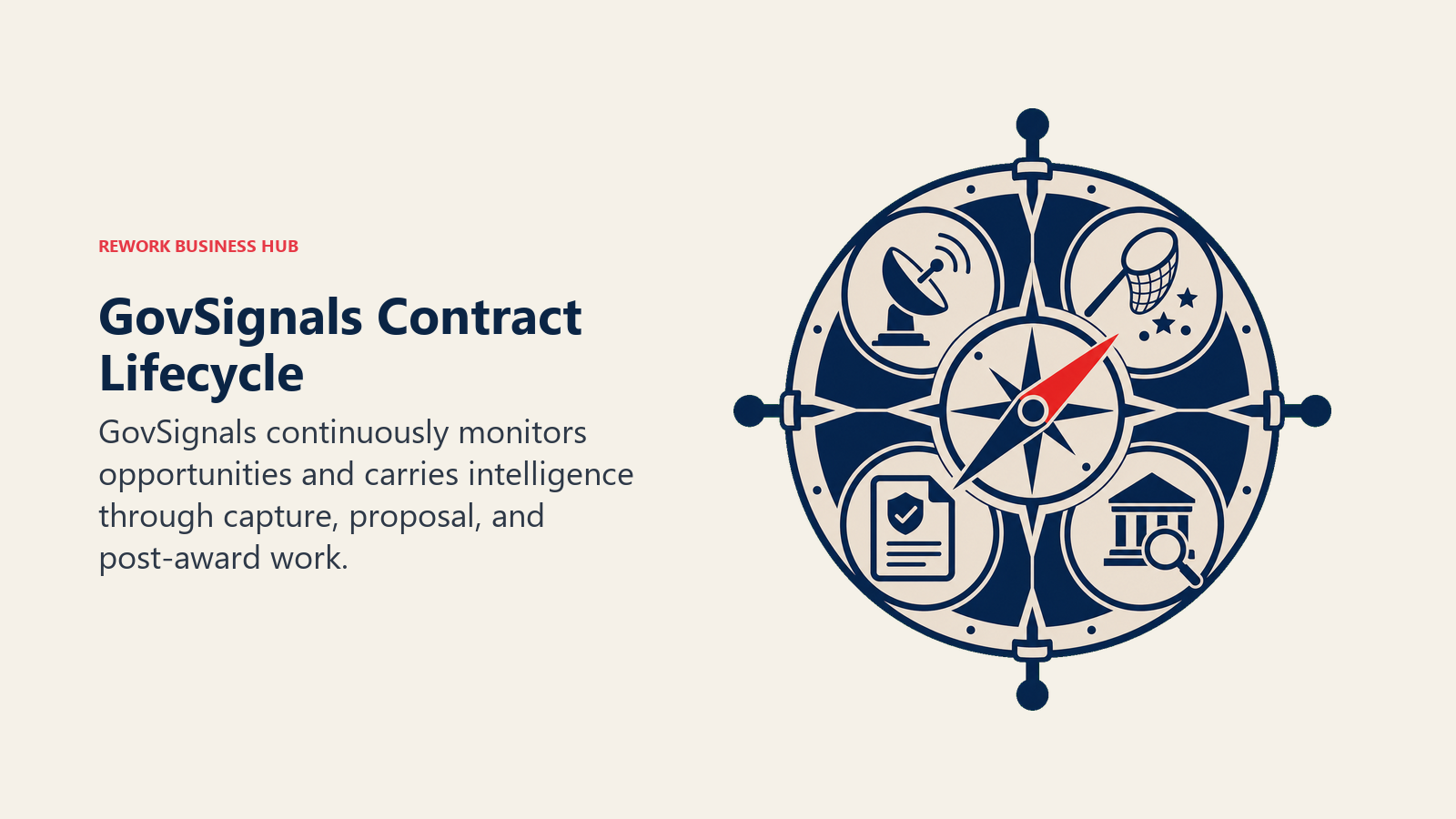
GovSignals bills itself as an AI system of work built for the entire contract lifecycle, not just one stage of it. Its engine constantly scans federal, state, and local data sources, turns raw signals into ranked opportunity intelligence, forecasts pre-RFP activity before a solicitation even posts, and then carries that intelligence into AI-assisted capture strategy, compliant proposal drafting with automated compliance matrices, and post-award oversight.
The company's pitch rests on a real problem: the federal government signs over 11 million contracts a year and posts more than $1 billion in new opportunities daily, yet over half of contractors miss bids simply because they never see them. GovSignals has already landed a multi-million dollar contract with the Defense Innovation Unit to help the agency manage its own acquisition workflows, and is actively advancing toward FedRAMP and DoD IL5 readiness, a meaningful signal for a company this young. If your team is still relying on manual SAM.gov searches or a spreadsheet-based pipeline, how to choose sales intelligence software covers the underlying evaluation criteria before AI enters the picture.
Best for: Contractors who want opportunity discovery, capture strategy, and compliant proposal drafting inside one continuously running AI system, rather than stitching together separate tools
Key strengths:
- Continuous multi-source monitoring plus pre-RFP forecasting, not just reactive keyword search
- End-to-end coverage from discovery through capture strategy to proposal drafting and post-award oversight
- Real federal customer traction (a DIU contract) advancing FedRAMP and IL5 readiness
Limitations:
- No published pricing; every deal starts with a sales conversation
- Younger platform than the market-intelligence incumbents, with a shorter track record
- Full FedRAMP/IL5 authorization is still in progress, not yet complete
| What you get | What you don't |
|---|---|
| Continuous opportunity monitoring across federal, state, and local sources | No published pricing tiers to plan a budget against upfront |
| Capture strategy and compliant proposal drafting in the same platform | FedRAMP and IL5 authorization still advancing, not yet finalized |
| A validated federal customer (DIU) using the platform on real acquisition work | Shorter operating history than incumbents like Deltek or Bloomberg Government |
Pricing: Custom, contact sales. See govsignals.ai.
2. Sweetspot: Opportunity Discovery, Capture, and Proposal Drafting in One App
Sweetspot, backed by Y Combinator, built its platform around the idea that capture and proposal work shouldn't live in three different tools. It searches SAM.gov, USAspending, FPDS, DIBBS, and more than 1,000 state and local sources to surface new buying offices, spot buying patterns, and flag growth opportunities, then carries that intelligence into pipeline management and AI-assisted proposal drafting.
The traction numbers are specific: Sweetspot reports supporting more than $3 billion in client wins across 500-plus GovCon teams, with drafting roughly 10x faster and teams pursuing 6x more RFP value than before. Pricing has shifted since the company's early days. 2024 press coverage cited around $720/yr for search-only access and $3,600/yr for the full suite, but the current pricing page directs every prospect to book a demo for a custom quote, so treat those older numbers as directional rather than current.
Best for: Small to mid-size GovCon teams that want opportunity discovery, capture, and proposal drafting in a single, fast-onboarding platform
Key strengths:
- Searches SAM.gov, USAspending, FPDS, DIBBS, and 1,000+ state/local sources in one place
- Reports 10x faster proposal drafting and 6x more RFP value pursued by customers
- Fast, white-glove onboarding, with most teams live within days
Limitations:
- Published pricing has disappeared from the site in favor of custom demo-based quotes
- Best-fit customer profile skews toward small and mid-size teams, not enterprise primes
- No published FedRAMP authorization; confirm CUI handling directly before uploading sensitive content
| What you get | What you don't |
|---|---|
| Discovery, capture, and proposal drafting in one connected workflow | No published price on the current site; every quote starts with a demo |
| Broad source coverage spanning federal plus 1,000+ state/local sites | No published FedRAMP authorization for CUI-sensitive work |
| Fast onboarding with vendor-led setup and training | Best fit narrows for large enterprise primes with complex, multi-division workflows |
Pricing: Historically ~$720/yr (search) to ~$3,600/yr (full suite) per 2024 reporting; current pricing is custom, book a demo. See sweetspot.so/pricing.
3. GovDash: Capture-to-Close in a Single AI Platform
GovDash positions itself as one platform covering the full arc from discovering an opportunity to pricing it, writing the proposal, and managing the resulting contract. Its pricing model is unusual for the category: unlimited users, unlimited data, and unlimited proposals, with no seat fees and no per-proposal charges, regardless of how many people touch a given bid.
The company claims compliant proposals produced 50-60% faster while keeping a human reviewing every stage, a meaningful distinction from tools that push toward fully autonomous drafting. GovDash also ships a dedicated pricing module (GovDash Pricer) built specifically for federal bid pricing, a workflow that generic proposal software usually leaves out entirely.
Best for: Contractors who want to avoid per-seat AI pricing entirely and need capture, proposal drafting, and bid pricing under one roof
Key strengths:
- Unlimited users, data, and proposals with no seat or per-proposal fees
- A dedicated bid-pricing module (GovDash Pricer) most competitors don't offer
- Human-in-the-loop design rather than fully autonomous drafting
Limitations:
- No published pricing tiers, so budgeting requires a sales conversation up front
- No free trial available to test the platform before committing
- No published FedRAMP authorization; verify current security posture for CUI use
| What you get | What you don't |
|---|---|
| Flat access with no per-seat or per-proposal fees, however large the team | No published pricing tiers or free trial |
| Capture, proposal drafting, and bid pricing in one platform | No published FedRAMP authorization for CUI-sensitive uploads |
| Human oversight built into every stage of proposal generation | Custom-quote-only, so early budgeting is harder than with published-tier tools |
Pricing: Custom, contact sales. See govdash.com/pricing.
4. Vultron: AI-Native Federal Proposal Development at Enterprise Scale
Vultron emerged from stealth in 2024 and has since raised a $22 million Series A led by Greycroft, with participation from Craft Ventures, South Park Commons, and Long Journey, funding that reflects real investor conviction in AI-native federal proposal tooling. The platform automates the high-cost, time-consuming parts of proposal writing that traditionally required a full department.
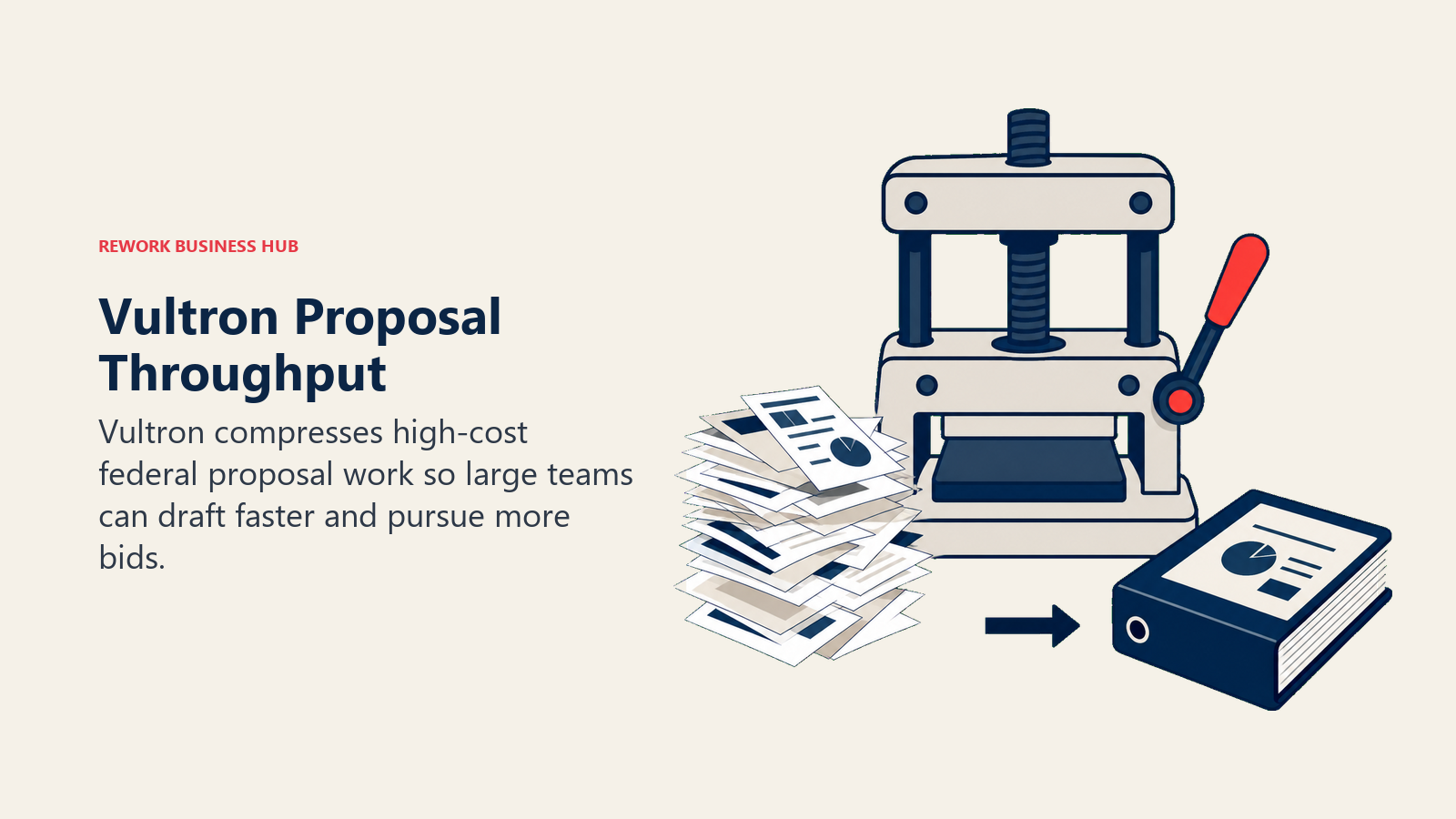
Vultron reports helping more than 400 contractors and Fortune 500 companies secure billions in awards, with customers seeing roughly 8x faster proposal drafting and managing 3x more submissions than before. The company frames the opportunity in blunt economic terms: proposal preparation alone can eat 1-2% of a contract's value, close to $2 million on a $100 million award, a cost automation is specifically designed to compress.
Best for: Larger federal contractors and enterprise BD teams that need proposal throughput at scale, not just a single-team drafting assistant
Key strengths:
- Backed by a $22M Series A from credible enterprise-software investors
- Reports 8x faster drafting and 3x more submissions managed per team
- Track record with 400+ contractors and Fortune 500-scale customers
Limitations:
- No published pricing; positioned and sold as an enterprise platform
- No published FedRAMP authorization found; confirm posture before handling CUI
- Best fit skews toward larger BD teams with real submission volume, not solo bidders
| What you get | What you don't |
|---|---|
| Enterprise-grade automation backed by real funding and customer scale | No published pricing; expect an enterprise sales cycle |
| Reported 8x faster drafting across a large customer base | No published FedRAMP authorization confirmed |
| Built specifically for high-volume federal proposal teams | Less relevant for a solo bidder or very small capture team |
Pricing: Custom, contact sales. See vultron.ai.
5. Rogue (Procurement Sciences): AI Writing Assistant Built for CUI
Rogue was one of the first AI writing assistants trained specifically on Sources Sought responses, RFIs, and RFPs rather than generic business writing. Its "Deep Dive" feature ingests an organization's best content (winning proposals, team resumes, past performance) and turns it into a customized AI experience that writes in the company's own voice, alongside RFP compliance matrix and template generation.
The standout differentiator is security: Rogue runs in a fully NIST 800-171 compliant environment, purpose-built for storing and processing CUI at the protection level government contractors actually need, rather than a generic SaaS tool retrofitted with a compliance claim. In February 2026, Procurement Sciences acquired Rogue to fold it into a broader end-to-end AI growth platform for government contracting, with Rogue's founder joining as Head of Product Strategy. If document assembly and templating matter as much to your workflow as the AI drafting itself, how to choose document automation software is a useful companion read.
Best for: Teams that want an AI writing assistant trained on their own past performance content, in an environment purpose-built for CUI
Key strengths:
- NIST 800-171 compliant environment designed specifically for CUI
- Deep Dive learns your organization's voice from past winning proposals
- Now backed by Procurement Sciences' broader platform post-acquisition
Limitations:
- Standalone product roadmap is less predictable following the 2026 acquisition
- No published self-serve pricing; every deal requires a sales conversation
- Narrower scope than full capture-to-close platforms like GovDash or GovSignals
| What you get | What you don't |
|---|---|
| A CUI-appropriate, NIST 800-171 compliant writing environment | No published pricing; every quote is custom |
| AI trained on your own proposal history, not generic templates | Standalone roadmap now depends on Procurement Sciences' integration plans |
| Compliance matrix and template generation built in | Narrower scope than end-to-end capture platforms |
Pricing: Custom, contact sales. See userogue.com.
6. AutogenAI: Enterprise-Grade AI Proposal Writing With a Federal Vertical
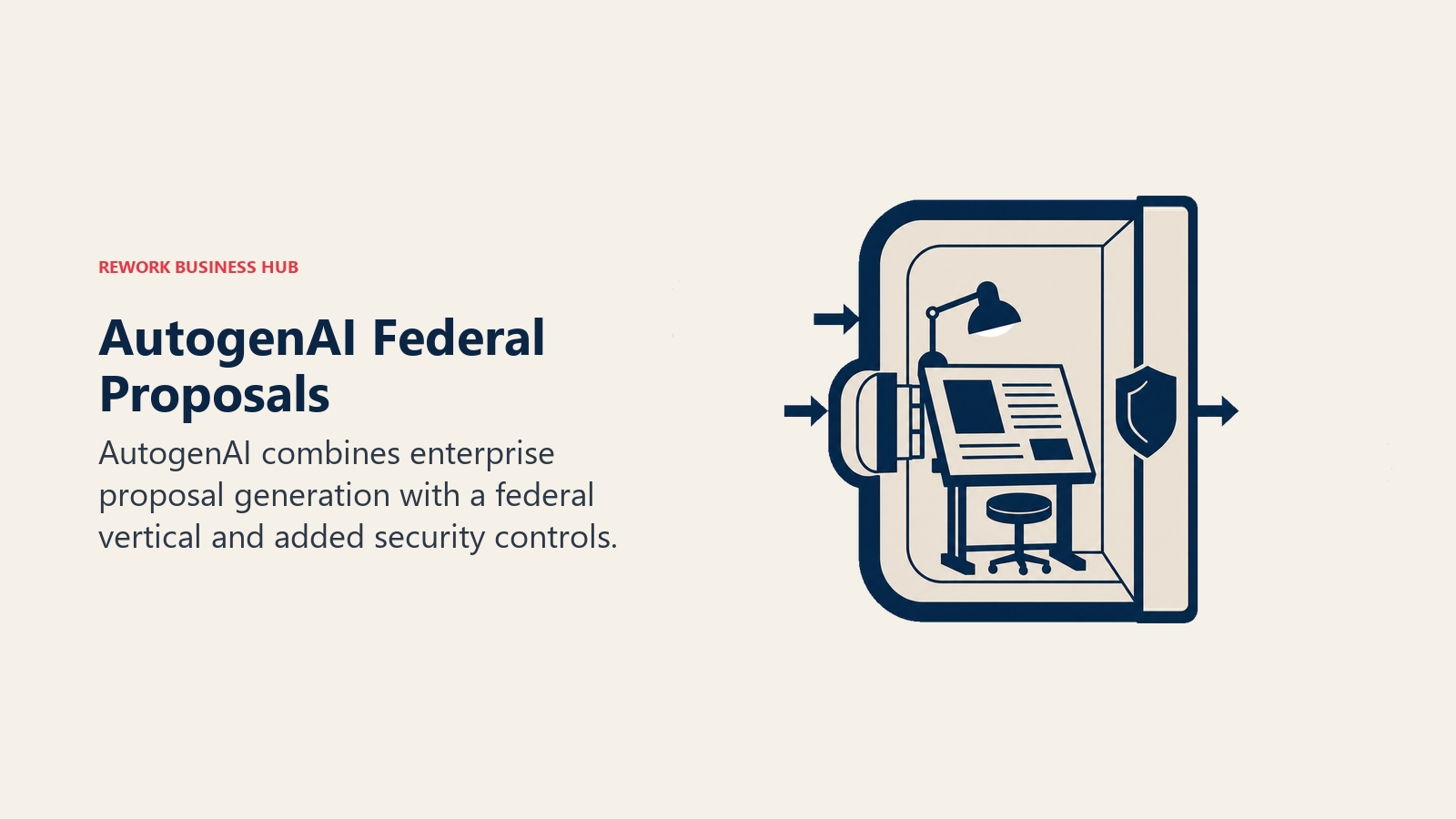
AutogenAI built its reputation in the broader bid and proposal writing market before launching a dedicated federal offering for government contractors, adding the extra security certifications and compliance features that federal work specifically demands. The platform positions itself at the premium end of proposal software, a meaningful step up in cost from general-purpose tools like Proposify.
Because AutogenAI publishes zero pricing, every prospective customer goes through an initial consultation where the sales team learns about proposal volume and usage patterns before quoting a custom number. That opacity is consistent across the category's higher-end players, but it does mean AutogenAI requires a longer evaluation cycle than a self-serve tool with published tiers.
Best for: Larger contractors and enterprises that already have proposal volume to justify a premium, enterprise-sales-cycle AI writing platform
Key strengths:
- Dedicated federal module with added security certifications beyond the base product
- Enterprise-grade positioning with a track record in the broader B2B proposal market
- Separate solutions tailored for federal contractors, large enterprises, and grant writers
Limitations:
- Zero public pricing; expect a genuine multi-step sales cycle
- Premium positioning puts it well above budget-friendly proposal tools
- Federal-specific security certifications require direct verification with the vendor
| What you get | What you don't |
|---|---|
| A federal-specific module built for government proposal compliance | No public pricing; a real sales cycle is required to get a number |
| Proven positioning from the broader enterprise proposal-writing market | Premium cost relative to general-purpose proposal tools |
| Security certifications tailored for federal-tier customers | Requires direct vendor conversation to confirm current CUI posture |
Pricing: Custom, contact sales. See autogenai.com.
7. Deltek GovWin IQ: Deep Market Intelligence, Now Adding AI Proposal Tools
Deltek GovWin IQ has been the incumbent federal market intelligence platform for years, built around the deepest historical award data and Federal Industry Analysis reports in the category. Its real shift for 2026 is strategic: Deltek is adding comprehensive AI proposal capabilities directly into GovWin IQ and Costpoint, moving the platform from pure intelligence toward an intelligence-to-revenue workflow that competes more directly with AI-native challengers like GovSignals and Sweetspot.
Pricing remains GovWin IQ's biggest friction point. Deltek won't publish rates, and the final number depends on seat count, which modules you add (Federal Industry Analysis, alerts, analyst access), and contract length. Reported figures put a single seat starting around $200/month, scaling toward roughly $1,800 for 10 users and $15,000 for 100 users, with typical annual deals averaging close to $29,000 a year and a broader observed range of $13,000 to $119,000.
Best for: Established contractors and BD teams that already rely on GovWin's historical award data and analyst reports, and want AI layered onto that foundation rather than switching platforms
Key strengths:
- Broadest historical federal award data and Federal Industry Analysis in the category
- New 2026 AI proposal capabilities extend the platform beyond pure intelligence
- Deep integration path into Deltek Costpoint for contractors already on that ERP
Limitations:
- Bespoke, negotiated pricing with no published rate card
- Meaningfully more expensive than newer AI-native intelligence tools like HigherGov
- AI proposal features are new in 2026 and less battle-tested than the core intelligence product
| What you get | What you don't |
|---|---|
| The deepest historical award data and analyst reports in the category | No published pricing; every deal is negotiated |
| New AI proposal capabilities layered onto trusted market intelligence | Meaningfully higher cost than SMB-focused alternatives |
| Native integration with Deltek Costpoint for existing Deltek customers | Newer AI features carry less of a track record than the core product |
Pricing: Roughly $200/user/mo; annual deals average ~$29,000/yr, with a broader range of $13,000-$119,000/yr depending on modules and seats. See deltek.com/products/govwin.
8. HigherGov: Market Intelligence and Competitive Pricing Data on an SMB Budget
HigherGov built its position squarely between free SAM.gov searches and GovWin's enterprise pricing, aiming at contractors with roughly $1 million to $10 million in annual revenue who've outgrown manual searching but can't justify Deltek's rates. The platform combines opportunity search with historical award data, likely-bidder and incumbent analysis, and a genuinely differentiated competitive-intelligence feature: more than 450,000 active competitor labor rates across 25,000-plus job titles for price-to-win analysis.
Pricing is published and accessible: a Starter plan runs $500/yr for one user, and a Standard plan covers up to 10 users for $2,500/yr, with broader reported ranges up to roughly $5,000/yr for more advanced access. That transparency alone sets it apart from most of the market-intelligence category.
Best for: SMB and mid-size contractors who want real historical award and pricing intelligence without GovWin's enterprise price tag
Key strengths:
- Published, transparent pricing starting at $500/yr, a rarity in this category
- 450,000+ active competitor labor rates across 25,000+ job titles for price-to-win work
- Strong likely-bidder and incumbent-tracking features for capture planning
Limitations:
- Primarily a search and intelligence tool, not an AI proposal drafting platform
- Less depth than GovWin IQ's Federal Industry Analysis for very large, complex pursuits
- Best-fit revenue band ($1M-$10M) means very small or very large contractors may want a different tool
| What you get | What you don't |
|---|---|
| Transparent published pricing starting at $500/yr | No AI proposal drafting; this is an intelligence and search tool |
| Deep competitor pricing data (450K+ rates, 25K+ job titles) | Less analyst-report depth than GovWin IQ for enterprise-scale pursuits |
| Strong capture-planning features (bidders, incumbents, agency insight) | Best fit is narrower for contractors well outside the $1M-$10M revenue band |
Pricing: Starter $500/yr (1 user), Standard $2,500/yr (up to 10 users). See highergov.com/pricing.
9. GovTribe: Opportunity Discovery and Capture With Transparent Pricing
GovTribe focuses on making government contracting approachable for smaller businesses, centering real-time federal opportunity discovery, capture management (competitor insights, agency intelligence, centralized opportunity data), and proposal organization tools that keep requirements, deadlines, and supporting documents in one place.
What sets GovTribe apart in a category full of custom-quote-only vendors is straightforward published pricing: Launch (federal only) at $1,350/yr, Launch Plus (federal plus state/local) at $1,800/yr, Growth at $4,000/yr, and Growth Plus at $5,500/yr, all backed by a 14-day free trial so you can evaluate fit before committing budget.
Best for: Small businesses that want transparent, testable pricing for opportunity discovery and capture management without a sales-call gate
Key strengths:
- Fully published pricing across four tiers, plus a 14-day free trial
- Combines opportunity discovery with capture management and proposal organization
- Straightforward federal-only or federal-plus-state/local tier options
Limitations:
- Lighter AI drafting depth than newer AI-native platforms like GovDash or Vultron
- Smaller analyst and reporting bench than incumbents like GovWin IQ or BGOV
- Best suited to opportunity tracking and capture rather than heavy AI-generated proposal content
| What you get | What you don't |
|---|---|
| Transparent tiered pricing you can evaluate with a free trial | Lighter AI proposal-drafting depth than AI-native competitors |
| Combined opportunity discovery, capture, and proposal organization | Smaller analyst/reporting bench than category incumbents |
| Clear federal-only vs. federal-plus-state/local tier choice | Less built for large enterprise BD teams with complex, high-volume pipelines |
Pricing: Launch $1,350/yr, Launch Plus $1,800/yr, Growth $4,000/yr, Growth Plus $5,500/yr; 14-day free trial. See govtribe.com.
10. GovSpend: B2G Intelligence Spanning Federal, State, and Local
GovSpend positions itself as a business-to-government intelligence platform rather than a federal-only tool, and its real differentiator is depth of state and local procurement data alongside federal coverage. For contractors whose pipeline mixes federal work with state, county, or municipal contracts, that combined view is hard to replicate by stitching together separate federal and SLED (state, local, and education) tools.
Like most players in this category, GovSpend doesn't publish pricing and requires a sales conversation for a quote, but buyer-reported purchase data puts the median annual cost around $10,000/yr, with a broader observed range of $7,300 to $24,500/yr depending on modules and seats.
Best for: Contractors who pursue state and local government business alongside federal work and need one platform covering both
Key strengths:
- Deepest state and local procurement data of any tool on this list
- Combines federal and SLED coverage in one platform rather than requiring two subscriptions
- Established B2G intelligence vendor with a broad public-sector data footprint
Limitations:
- No published pricing; expect a sales call for an exact quote
- Federal-only shops may find the state/local depth unnecessary for their actual pipeline
- Not an AI proposal-drafting tool; this is intelligence and data, not content generation
| What you get | What you don't |
|---|---|
| Combined federal and deep state/local procurement intelligence | No published pricing; sales call required for a quote |
| Median cost around $10,000/yr based on buyer-reported purchase data | No AI proposal drafting; intelligence and data only |
| Strong fit for contractors mixing federal and SLED pursuits | Less useful if your pipeline is exclusively federal |
Pricing: No published rate card; median reported cost ~$10,000/yr, range $7,300-$24,500/yr. See govspend.com.
11. Bloomberg Government (BGOV): Policy Intelligence Layered Onto Contract Data
Bloomberg Government started as a news and policy service and later added procurement intelligence, and that history still shapes where it's strongest today: legislative tracking, regulatory shifts, agency leadership changes, and budget analysis produced by an in-house analyst team, with contract search as a secondary feature rather than the core product.
That makes BGOV the right tool for BD and government-affairs teams that need to understand the policy forces shaping procurement before an agency even starts buying, not for teams doing daily opportunity prospecting. Reported pricing runs $7,500 to $14,000 a year, positioning it between the SMB-friendly tools and Deltek's enterprise rates.
Best for: Government affairs and BD leadership teams that need policy, legislative, and budget intelligence alongside contract data, not primarily daily opportunity search
Key strengths:
- Unmatched legislative, regulatory, and agency-leadership intelligence in this category
- In-house analyst team producing high-quality reports on policy shifts
- Useful upstream context before agencies formally begin procurement
Limitations:
- Contract search and daily opportunity prospecting are secondary, not the core strength
- Priced above SMB-focused intelligence tools like HigherGov or GovTribe
- Less purpose-built for capture management or proposal work than GovCon-native platforms
| What you get | What you don't |
|---|---|
| Best-in-category policy, legislative, and regulatory intelligence | Contract search is secondary; not built for daily prospecting |
| Analyst-produced reports on budget and leadership shifts | Priced above SMB-focused intelligence competitors |
| Useful upstream signal before formal procurement even starts | No dedicated capture management or AI proposal drafting |
Pricing: $7,500-$14,000/yr, no published self-serve tier. See about.bgov.com.
12. Unanet: GovCon ERP, CRM, and Proposal AI for Post-Award Compliance
Unanet covers the part of the AI-for-GovCon conversation most opportunity and proposal tools skip entirely: what happens after you win. Its GovCon ERP, CRM, Enterprise SubK, and Proposal AI generation solutions are trusted by more than 4,200 government contractor, architecture, engineering, and construction firms to manage project accounting, timekeeping, and compliance in a way that stands up to DCAA and DFARS scrutiny.
Unanet frames itself as an AI-first ERP and growth platform, using AI to streamline workflows, automate compliance checks, and improve cross-team collaboration across opportunity, project, and people management. Pricing is genuinely fragmented: the standalone Unanet AE line for architecture/engineering firms starts at $24/user/month, while the fuller GovCon ERP, Growth, and Business bundles are sold as custom packages priced by employee band, modules, and deployment needs. If you're evaluating Unanet against a broader ERP shortlist, how to choose ERP software and best NetSuite alternatives are useful companion reads, since some GovCon teams end up weighing Unanet against a general-purpose ERP with GovCon add-ons instead.
Best for: Contractors that need compliant project accounting, timekeeping, and contract management after award, not just discovery or proposal writing
Key strengths:
- DCAA and DFARS-aware project accounting trusted by 4,200+ GovCon, AE, and construction firms
- Covers the full post-award lifecycle: ERP, CRM, subcontractor management, and proposal AI
- AI-first positioning applied across compliance workflows, not just proposal drafting
Limitations:
- Pricing is fragmented across product lines, making apples-to-apples comparison hard
- Full GovCon ERP/CRM/Proposal AI bundles require a custom quote, not a published rate card
- Heavier, more operational platform than a lightweight capture or proposal tool
| What you get | What you don't |
|---|---|
| DCAA/DFARS-aware compliance built for post-award contract management | Fragmented pricing across AE, ERP, CRM, and Proposal AI product lines |
| A trusted base of 4,200+ GovCon, AE, and construction customers | Full GovCon bundle pricing requires a custom quote, not a public rate card |
| AI applied across compliance and project workflows, not just proposals | Heavier operational footprint than a standalone capture or proposal tool |
Pricing: AE line from $24/user/mo; GovCon ERP/CRM/Proposal AI bundles are custom-quoted by module, employee band, and deployment. See unanet.com/unanet-industry/unanet-for-govcon.
13. ChatGPT Enterprise/Gov and Microsoft 365 Copilot (GCC High): General-Purpose AI for CUI Environments
Not every AI need in a GovCon shop is opportunity-specific. Teams still draft internal memos, summarize long RFPs, analyze spreadsheets, and answer one-off questions the way any other business does, and in 2026 both OpenAI and Microsoft now offer accredited environments for exactly that kind of general-purpose work inside a CUI boundary. For a broader comparison of how these assistants perform outside the compliance question, see Claude vs ChatGPT vs Gemini.
OpenAI's ChatGPT Enterprise and API Platform earned FedRAMP Moderate authorization in January 2026, and GSA followed with a OneGov agreement offering every participating federal agency ChatGPT Enterprise access for $1 in year one, plus a 60-day window of unlimited advanced features like Deep Research. That deal is agency-facing rather than contractor-facing, but it signals where accredited pricing is headed; contractors typically access ChatGPT through standard Enterprise pricing with custom quotes, not the GSA promotional rate. Microsoft's path runs through GCC High, which meets DoD SRG Level 4, DFARS 252.204-7012, and NIST 800-171 for CUI, ITAR/EAR-controlled technical data, and other covered defense information. Copilot licensing there requires a qualifying M365 base license (G3 around $60/user/mo, G5 around $93/user/mo) plus the Copilot add-on, and Microsoft has scheduled further GCC High price increases effective July 1, 2026.
Best for: GovCon teams that need day-to-day AI assistance (drafting, summarizing, analysis) inside an environment already accredited for CUI, ITAR, or DFARS-covered data
Key strengths:
- Both platforms now carry real federal accreditation (FedRAMP Moderate for ChatGPT; DoD SRG Level 4/NIST 800-171 for GCC High Copilot)
- General-purpose flexibility beyond capture and proposal work: memos, summaries, spreadsheet analysis, research
- Familiar tools your team likely already uses in commercial form, reducing training overhead
Limitations:
- Neither is purpose-built for opportunity discovery, capture, or proposal compliance workflows
- GCC High pricing runs 60-70% above commercial M365, before the Copilot add-on is even applied
- ChatGPT's federal pricing model is still settling; year-two costs after the GSA promo aren't published
| Tool | Compliance Level | Starting Price | Best For |
|---|---|---|---|
| ChatGPT Enterprise/Gov | FedRAMP Moderate (Enterprise + API) | $1/agency year one (GSA OneGov); custom for contractors | Fast, familiar general-purpose AI now inside a FedRAMP boundary |
| Microsoft 365 Copilot (GCC High) | DoD SRG Level 4, DFARS 7012, NIST 800-171 | GCC High G3 ~$60/user/mo + Copilot add-on | Teams needing Copilot inside Office apps for CUI/ITAR work |
Pricing: ChatGPT: GSA OneGov offers $1/agency in year one for participating federal agencies; contractors typically use standard Enterprise pricing (custom quote). Microsoft 365 Copilot (GCC High): G3 tenant ~$60/user/mo, G5 ~$93/user/mo, plus the Copilot add-on, with further increases scheduled July 1, 2026. See openai.com/solutions/industries/government and secureframe.com/blog/gcc-high-pricing.
How to Choose: Decision Framework
Before comparing feature lists, figure out which stage of the GovCon lifecycle is actually your bottleneck. Most bad AI purchases in this category happen when a team buys a full capture-to-close platform when what they really needed was better opportunity search, or the reverse.
| If you need... | Pick... | Why |
|---|---|---|
| One platform covering discovery through proposal drafting and capture strategy | GovSignals or Sweetspot | Both combine continuous opportunity monitoring with AI-assisted capture and drafting |
| Flat, unlimited-user pricing with no per-seat AI tax | GovDash | No seat fees or per-proposal charges regardless of team size |
| Enterprise-scale proposal throughput with investor-backed traction | Vultron | Built for high-volume federal BD teams, reports 8x faster drafting |
| An AI writing assistant trained on your own proposal library, in a CUI-appropriate environment | Rogue (Procurement Sciences) | NIST 800-171 compliant, purpose-built for storing and processing CUI |
| Premium enterprise proposal writing with dedicated federal security features | AutogenAI | Federal-tier module with added security certifications beyond the base product |
| The deepest historical federal award data and analyst reports | Deltek GovWin IQ | Broadest Federal Industry Analysis, now adding AI proposal tools |
| Market intelligence and price-to-win data without enterprise pricing | HigherGov | Published pricing from $500/yr, plus 450K+ competitor labor rates |
| Transparent, testable pricing for opportunity discovery and capture | GovTribe | Four published tiers and a 14-day free trial |
| Combined federal and state/local (SLED) procurement intelligence | GovSpend | Deepest state and local data alongside federal coverage |
| Policy, legislative, and regulatory intelligence upstream of procurement | Bloomberg Government | Analyst-produced reports on budget shifts and agency leadership |
| Post-award compliance: project accounting, timekeeping, DCAA/DFARS | Unanet | GovCon ERP/CRM trusted by 4,200+ contractor, AE, and construction firms |
| General-purpose AI for memos, summaries, and analysis inside a CUI boundary | ChatGPT Enterprise/Gov or Microsoft 365 Copilot (GCC High) | Both now carry real federal accreditation for day-to-day AI work |
Framework: By Business Size and Stage
| Business Profile | Budget Signal | Best Fits |
|---|---|---|
| First-time bidder or very small business | Under $2,000/yr | GovTribe (Launch), HigherGov (Starter), SAM.gov plus ChatGPT Plus for drafting help |
| Small business scaling its bid volume | $2,000-$10,000/yr | GovTribe, HigherGov, Sweetspot, GovSpend |
| Growing mid-size contractor (established BD function) | $10,000-$40,000/yr | GovDash, GovSignals, Vultron, Deltek GovWin IQ (lower tiers) |
| Large or multi-division contractor with high proposal volume | $40,000+/yr | Deltek GovWin IQ (higher tiers), Vultron, AutogenAI, Bloomberg Government |
| Any contractor needing post-award compliance and project accounting | Custom, scales with employee count | Unanet |
| Any contractor needing CUI/ITAR-cleared day-to-day AI assistance | Per-seat, $20-$100+/user/mo | ChatGPT Enterprise/Gov, Microsoft 365 Copilot (GCC High) |
Pricing at a Glance
| Tool | Entry Price | Pricing Model | Published Rate Card? |
|---|---|---|---|
| GovSignals | Custom | Contact sales | No |
| Sweetspot | Custom (historically ~$3,600/yr) | Contact sales | No (was published, now custom) |
| GovDash | Custom, unlimited users | Contact sales | No |
| Vultron | Custom | Contact sales | No |
| Rogue (Procurement Sciences) | Custom | Contact sales | No |
| AutogenAI | Custom | Contact sales | No |
| Deltek GovWin IQ | ~$200/user/mo | Negotiated, module and seat-based | No |
| HigherGov | $500/yr (Starter) | Published tiers | Yes |
| GovTribe | $1,350/yr (Launch) | Published tiers | Yes |
| GovSpend | ~$10,000/yr median | Contact sales | No |
| Bloomberg Government | $7,500/yr | Contact sales | No |
| Unanet | $24/user/mo (AE line) | Mixed: published entry, custom bundles | Partial |
| ChatGPT Enterprise/Gov | $1/agency (year one, GSA OneGov) | Custom for contractors | Partial (gov promo only) |
| Microsoft 365 Copilot (GCC High) | ~$60/user/mo (G3) + add-on | Per-user tiers | Yes |
Where AI for Government Contracting Is Headed
The category is consolidating around two poles. On one side, AI-native challengers like GovSignals, Sweetspot, GovDash, and Vultron are building capture-to-proposal workflows from scratch, with real funding and customer traction to back it. Procurement Sciences' acquisition of Rogue in February 2026 is an early signal of consolidation among these newer players, not just competition. On the other side, incumbents like Deltek are defending their market-intelligence moat by bolting AI proposal capabilities directly onto GovWin IQ, betting that data depth and existing customer relationships outweigh a challenger's AI-native design.
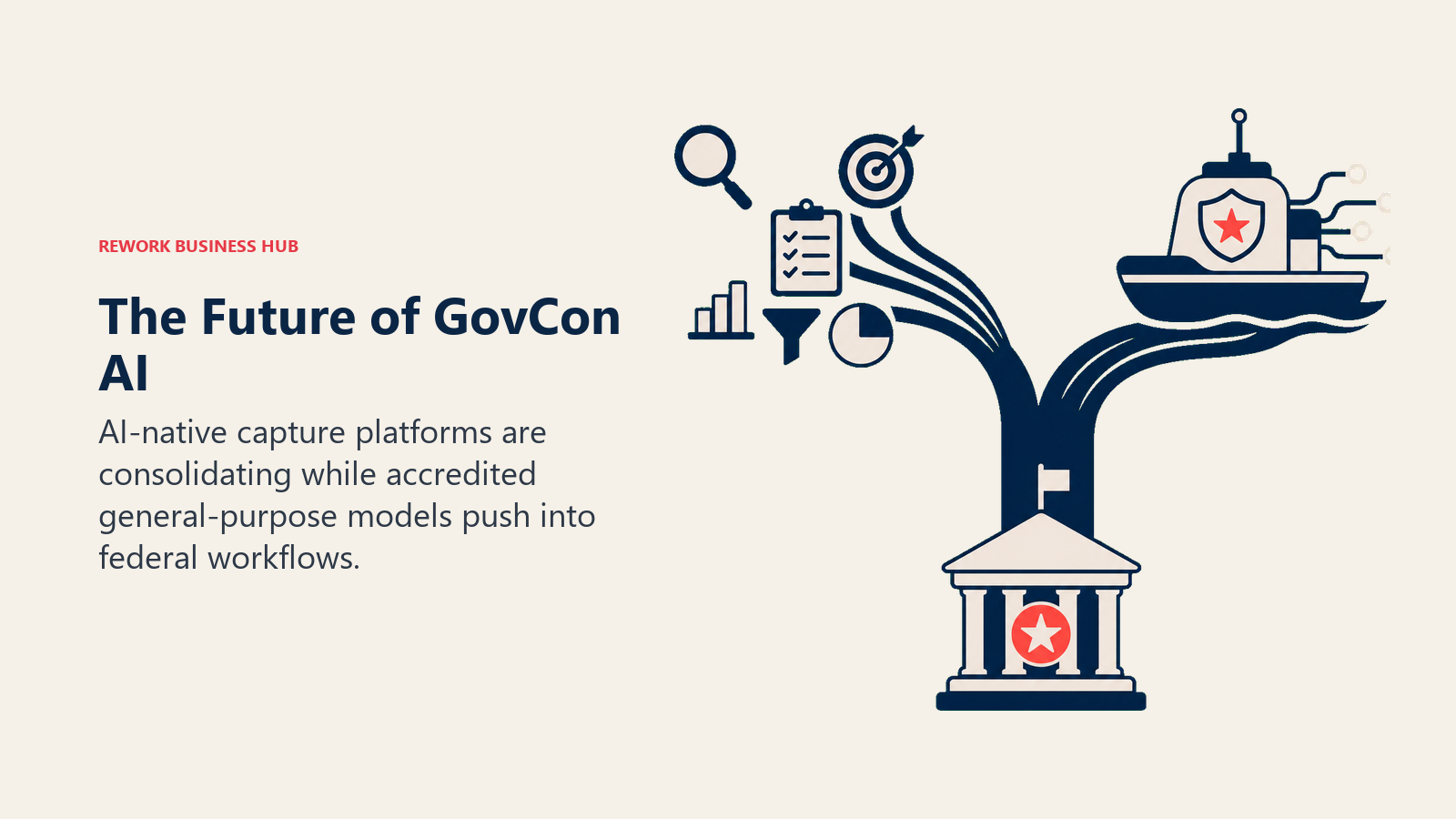
Running alongside both is a quieter but arguably bigger shift: general-purpose AI platforms clearing federal accreditation bars. ChatGPT Enterprise's FedRAMP Moderate authorization and Microsoft 365 Copilot's DoD SRG Level 4 posture in GCC High mean contractors no longer have to choose between "AI that's good" and "AI that's cleared for CUI." Expect more of the GovCon-specific tools on this list to either pursue their own FedRAMP authorization or lean harder into integrations with the now-accredited general-purpose platforms through the rest of 2026.
If AI tooling is becoming a bigger part of how your whole business operates, not just capture and proposals, best AI tools in 2026, best AI tools for enterprise, and best AI agents in 2026 cover the categories most operations and BD leaders are evaluating alongside this one. And if price-to-win analysis or spend forecasting is part of your workflow, best AI tools for data analysis and best AI tools for B2B are useful next reads.
Frequently Asked Questions about AI Tools for Government Contractors
What is the best AI tool for government contractors in 2026?
There's no single best tool, it depends on your bottleneck. GovSignals and Sweetspot lead for teams wanting discovery-through-proposal in one platform, GovDash and Vultron lead for capture and drafting at scale, Rogue and AutogenAI lead for AI writing layered onto your own past performance, Deltek GovWin IQ, HigherGov, GovTribe, GovSpend, and Bloomberg Government lead for market intelligence, Unanet leads for post-award compliance and project accounting, and ChatGPT Enterprise or Microsoft 365 Copilot (GCC High) cover general-purpose AI work now cleared for CUI environments.
Are these AI tools safe to use with Controlled Unclassified Information (CUI)?
Not all of them, and this is the single most important question to ask before uploading anything sensitive. Rogue is built specifically around a NIST 800-171 compliant environment for CUI. ChatGPT Enterprise and API Platform hold FedRAMP Moderate authorization as of January 2026. Microsoft 365 Copilot in GCC High meets DoD SRG Level 4, DFARS 252.204-7012, and NIST 800-171. Several other tools on this list, including GovDash, Sweetspot, and Vultron, have no published FedRAMP authorization, so confirm current security posture directly with the vendor before uploading CUI-marked content.
What's the difference between AI opportunity-discovery tools and AI proposal-writing tools?
Opportunity-discovery and market-intelligence tools (HigherGov, GovTribe, GovSpend, Bloomberg Government, and the core of Deltek GovWin IQ) help you find and evaluate contracts worth pursuing, using public and licensed award data. AI proposal-writing tools (Rogue, AutogenAI, and the drafting features inside GovDash, Vultron, GovSignals, and Sweetspot) help you actually write the compliant response once you've decided to bid. Several 2026 platforms, especially GovSignals, Sweetspot, and GovDash, now blend both into a single system.
Is Deltek GovWin IQ still worth it now that AI-native tools exist?
For contractors that rely heavily on its historical award data and Federal Industry Analysis reports, yes, especially now that Deltek is adding AI proposal capabilities into GovWin IQ and Costpoint through 2026. But GovWin IQ's bespoke pricing (averaging around $29,000/yr, ranging up to $119,000/yr) is meaningfully higher than newer intelligence tools like HigherGov, which publishes tiers starting at $500/yr. If your team is younger or budget-constrained, evaluate HigherGov or GovTribe before committing to GovWin's pricing.
Can I use ChatGPT or Copilot to write a federal proposal?
You can use them for drafting help, summarizing RFPs, and analysis, and both now carry real federal accreditation (FedRAMP Moderate for ChatGPT Enterprise/API, DoD SRG Level 4 and NIST 800-171 for Copilot in GCC High). But neither is purpose-built for RFP compliance matrices, past-performance libraries, or capture workflows the way Rogue, GovDash, or Vultron are. Most GovCon teams use general-purpose AI assistants alongside a purpose-built capture or proposal tool, not as a replacement for one.
How much does AI proposal software cost for a small GovCon business?
Budget realistically for $500 to $10,000 a year at the small-business end. GovTribe starts at $1,350/yr, HigherGov starts at $500/yr, and GovSpend runs a median of roughly $10,000/yr. Most of the AI-native capture-to-proposal platforms (GovDash, GovSignals, Vultron, Rogue, AutogenAI) don't publish pricing at all, so get a real quote before assuming they fit a small-business budget.
Do these tools help with FAR/DFARS compliance, or just discovery and writing?
It depends on the tool. Proposal-writing platforms like Rogue and GovSignals generate RFP compliance matrices to help you meet a specific solicitation's requirements, which is proposal-level compliance, not company-wide regulatory compliance. For DCAA and DFARS-aware contract management, timekeeping, and project accounting after you win, that's Unanet's specific job, not a proposal tool's. None of these AI tools replace a compliance officer or contracts attorney for FAR interpretation on a complex award.
What changed most in AI for government contracting during 2026?
Three shifts stand out. Procurement Sciences' acquisition of Rogue AI signaled the start of consolidation among AI-native GovCon challengers. General-purpose AI platforms cleared real federal accreditation bars, ChatGPT Enterprise/API hit FedRAMP Moderate and Microsoft 365 Copilot expanded in GCC High, both under DoD SRG Level 4 or better. And incumbents like Deltek responded by building AI proposal capabilities directly into GovWin IQ rather than ceding that ground to newer entrants.
What to Do Next
Pick your single biggest bottleneck first, discovery, capture, drafting, or post-award compliance, and run a 2-4 week pilot with one AI-native tool and one incumbent in that specific category (for example, HigherGov against GovTribe for intelligence, or GovDash against Rogue for drafting), rather than evaluating all 14 tools at once. Before any pilot touches real proposal content, confirm the vendor's current CUI and FedRAMP posture in writing, not just marketing copy, since several tools on this list have no published authorization yet.

Principal Product Marketing Strategist
On this page
- Updated July 2026: What Changed
- Key Facts
- Quick Comparison Table
- Security & Compliance at a Glance
- 1. GovSignals: Full Pre-to-Post-Award AI System of Work
- 2. Sweetspot: Opportunity Discovery, Capture, and Proposal Drafting in One App
- 3. GovDash: Capture-to-Close in a Single AI Platform
- 4. Vultron: AI-Native Federal Proposal Development at Enterprise Scale
- 5. Rogue (Procurement Sciences): AI Writing Assistant Built for CUI
- 6. AutogenAI: Enterprise-Grade AI Proposal Writing With a Federal Vertical
- 7. Deltek GovWin IQ: Deep Market Intelligence, Now Adding AI Proposal Tools
- 8. HigherGov: Market Intelligence and Competitive Pricing Data on an SMB Budget
- 9. GovTribe: Opportunity Discovery and Capture With Transparent Pricing
- 10. GovSpend: B2G Intelligence Spanning Federal, State, and Local
- 11. Bloomberg Government (BGOV): Policy Intelligence Layered Onto Contract Data
- 12. Unanet: GovCon ERP, CRM, and Proposal AI for Post-Award Compliance
- 13. ChatGPT Enterprise/Gov and Microsoft 365 Copilot (GCC High): General-Purpose AI for CUI Environments
- How to Choose: Decision Framework
- Framework: By Business Size and Stage
- Pricing at a Glance
- Where AI for Government Contracting Is Headed
- What to Do Next