Best AI Tools for B2B Companies in 2026: 14 Tools Across Sales, Marketing, and Ops
Turn this article into takeaways for your work.


Each assistant summarizes the article only for you and suggests best practices for your work.
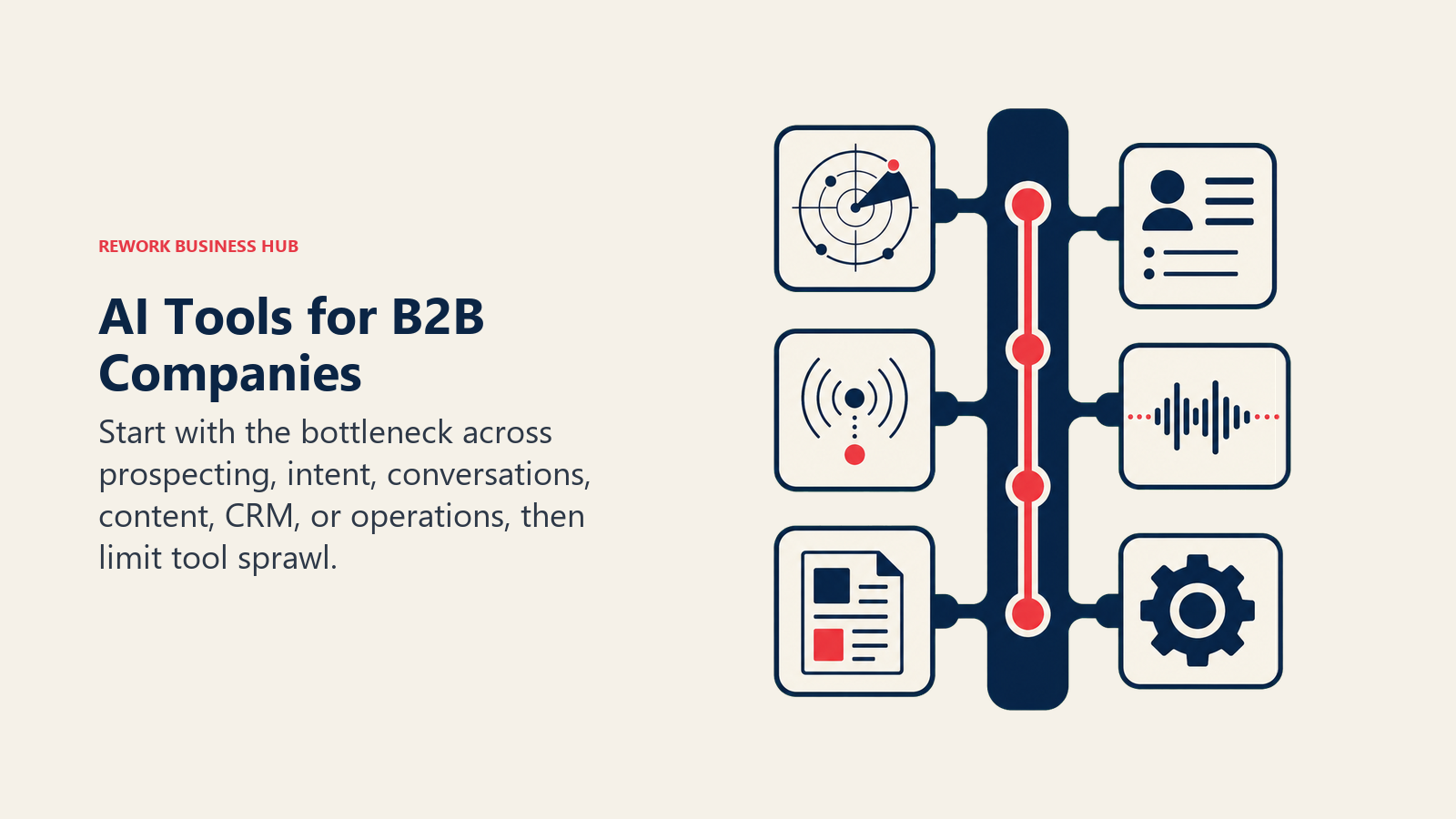
The best AI tools for B2B companies in 2026 depend on which part of the business you're fixing first: Apollo.io and Clay lead AI-powered prospecting and enrichment, Gong and 6sense own conversation intelligence and account intent, ChatGPT and Claude cover general-purpose drafting and analysis across every department, and AI-assisted CRMs such as HubSpot Breeze and Rework put AI into the record your team already works from, for companies that don't want six separate AI subscriptions stitched together with Zapier. This guide ranks 14 real tools by the job they actually do, not by how many "AI-powered" badges sit on their homepage.
Most B2B companies don't have an AI tooling problem, they have an AI tooling sprawl problem. A 40-person company can easily end up paying for a prospecting tool, an enrichment tool, an intent platform, a conversation intelligence tool, a general AI assistant, and an automation layer to connect them, most of it overlapping and half of it barely used. Each tool below is evaluated on what it actually does, who it's built for, and what it costs in 2026.
Updated July 2026: What Changed
- Zoom announced a definitive agreement to acquire Common Room on July 2, 2026, folding its signal-based go-to-market intelligence into Zoom's broader collaboration and CX stack, worth watching if you're evaluating it for a multi-year contract.
- Clearbit's standalone product is fully sunset. It now only exists as Breeze Intelligence inside HubSpot, so it's no longer an option if you're not already a HubSpot customer.
- Clay overhauled its pricing in March 2026, splitting credits into separate Data Credits and Actions and cutting per-lookup enrichment costs 50 to 90 percent.
- ChatGPT Team was renamed ChatGPT Business and OpenAI moved Enterprise to flexible, negotiated per-seat pricing instead of a single published rate.
- Anthropic split Claude's Team plan into Standard and Premium seats, with Premium adding Claude Code access for teams that want AI inside engineering and ops workflows, not just chat.
Key Facts
- 88% of organizations report regularly using AI in at least one business function, per McKinsey's State of AI report.
- 87% of sales organizations now use AI for tasks like prospecting, forecasting, lead scoring, or drafting emails, per Salesforce's State of Sales report.
- Teams that used AI in the past year saw 83% revenue growth, compared to 66% for teams that didn't, per Salesforce's State of Sales report.
- 92% of sellers now use at least some form of AI in their role, up from a small minority just two years ago, per HubSpot's B2B sales research.
- Sales organizations that give reps AI-enabled next-best-action recommendations are 2.6x more likely to hit commercial growth targets, per Gartner.
- 60% of B2B software teams already use AI somewhere in their sales process, per G2's 2026 State of AI Sales Intelligence in Prospecting report.
- 64% of salespeople say AI automation of manual tasks saves them 1 to 5 hours a week, per HubSpot's B2B sales research.
Quick Comparison Table
| Tool | Best For | Standout Capability | Starting Price | Free Tier? |
|---|---|---|---|---|
| Apollo.io | Prospecting and outbound at any team size | AI-scored 210M+ contact database with native sequences | Free tier; $49/user/mo (Basic, billed annually) | Yes |
| Clay | Custom enrichment and outbound research workflows | No-code AI agent builder for enrichment waterfalls | Free tier; $149/mo (Launch) | Yes |
| Gong | Deal risk and coaching at enterprise scale | Conversation intelligence across every call and email | Quote-only; buyer reports put Foundations near $1,400-1,600/user/yr plus a platform fee | No |
| ChatGPT Business | Cross-department drafting, research, and analysis | Fastest general-purpose assistant to roll out company-wide | $20/user/mo (annual, 2-seat minimum) | No (free consumer tier exists, not for business use) |
| Claude for Work | Long-document analysis, structured reasoning, ops workflows | Large context window for contracts, reports, and codebases | $25/seat/mo (Team Standard, 5-seat minimum) | No |
| HubSpot Breeze | HubSpot users wanting AI built into marketing, sales, and service | Outcome-based agents billed per resolved task or qualified lead | Included from Sales Hub Starter; agents from $0.50-$1/outcome | Partial |
| Rework | Mid-size B2B teams wanting CRM, lead ops, and chat inbox in one system | Lead scoring, routing, and chat inbox on one record, with copilots | From $69/mo billed yearly (Sales Engine, 5 seats); $159/mo with lead ops and inbox (Revenue Engine) | No |
| 6sense | Enterprise ABM and account-level buying intent | Predictive intent scoring across a full target account list | Not published; team plans start near $25K/yr, buyer-reported | No |
| Common Room | Signal-based GTM intelligence across product, community, and web | Unifies product usage, community, and intent signals into one feed | $2,100/mo (Essential, 5 seats, annual) | No |
| Clearbit / Breeze Intelligence | Firmographic and technographic enrichment inside HubSpot | Real-time company and contact enrichment on form fills | $45/mo for 100 credits, plus a paid HubSpot seat | No |
| Jasper | Marketing teams producing on-brand content at volume | Brand Voice and Knowledge assets keep AI copy on-message | $39-49/mo (Creator, annual) | No (7-day Pro trial only) |
| Zapier | Connecting AI tools and automating handoffs between them | AI agents and 8,000+ app integrations in one automation layer | Free (100 tasks/mo); $19.99/mo (Professional, 750 tasks) | Yes |
| Warmly | Website visitor deanonymization and warm outbound | Identifies and scores anonymous site visitors in real time | Free (500 visitors/mo); paid plans from roughly $10K/yr | Yes |
| Perplexity | Account research and market research for GTM teams | Cited, real-time web answers instead of a static knowledge cutoff | Free tier; $20/mo (Pro) | Yes |
1. Apollo.io: AI-Powered Prospecting for Any Team Size
Apollo's bet is that a huge contact database plus native sequencing beats a smaller, higher-quality database that requires a separate outreach tool. The platform combines a 210 million-plus contact and company database with AI-assisted lead scoring, intent signals, and built-in email and call sequences, all in one interface.
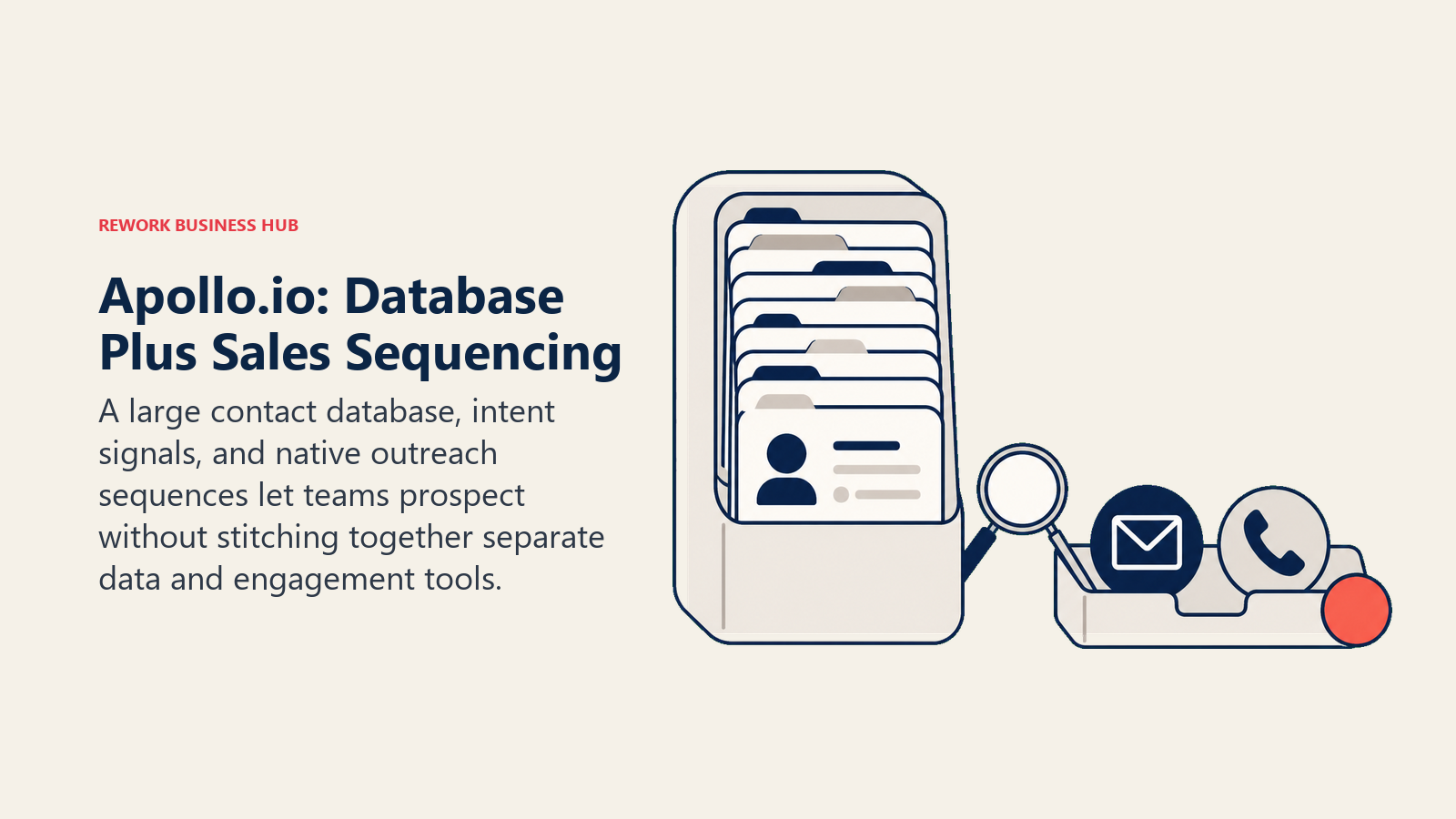
For B2B teams that need to fill a pipeline fast without stitching together a data provider and a sequencing tool, Apollo remains the default starting point. The free tier is genuinely usable for small teams testing outbound before committing budget. The tradeoff is data quality consistency: some records are stale or mismatched at the edges of smaller or newer companies, which is common across every large contact database, not unique to Apollo. If you want to see how it stacks up against the rest of the sales engagement category, or you've hit its ceiling, our best Apollo.io alternatives guide covers what else competes at this price point.
| What you get | What you don't |
|---|---|
| 210M+ contact database with native sequences | Data accuracy varies at the long tail |
| AI-assisted lead scoring and intent signals | Not a full CRM; needs a home for closed-won data |
| Free tier for testing before you commit budget | Advanced filters and data credits gate the deepest use cases |
Pricing: Free tier; Basic $49/user/mo, Professional $79/user/mo, Custom Organization tier (annual billing).
Best for: SDR and BDR teams running high-volume outbound, founders doing their own prospecting before hiring a sales team
2. Clay: No-Code AI Enrichment and Research Workflows
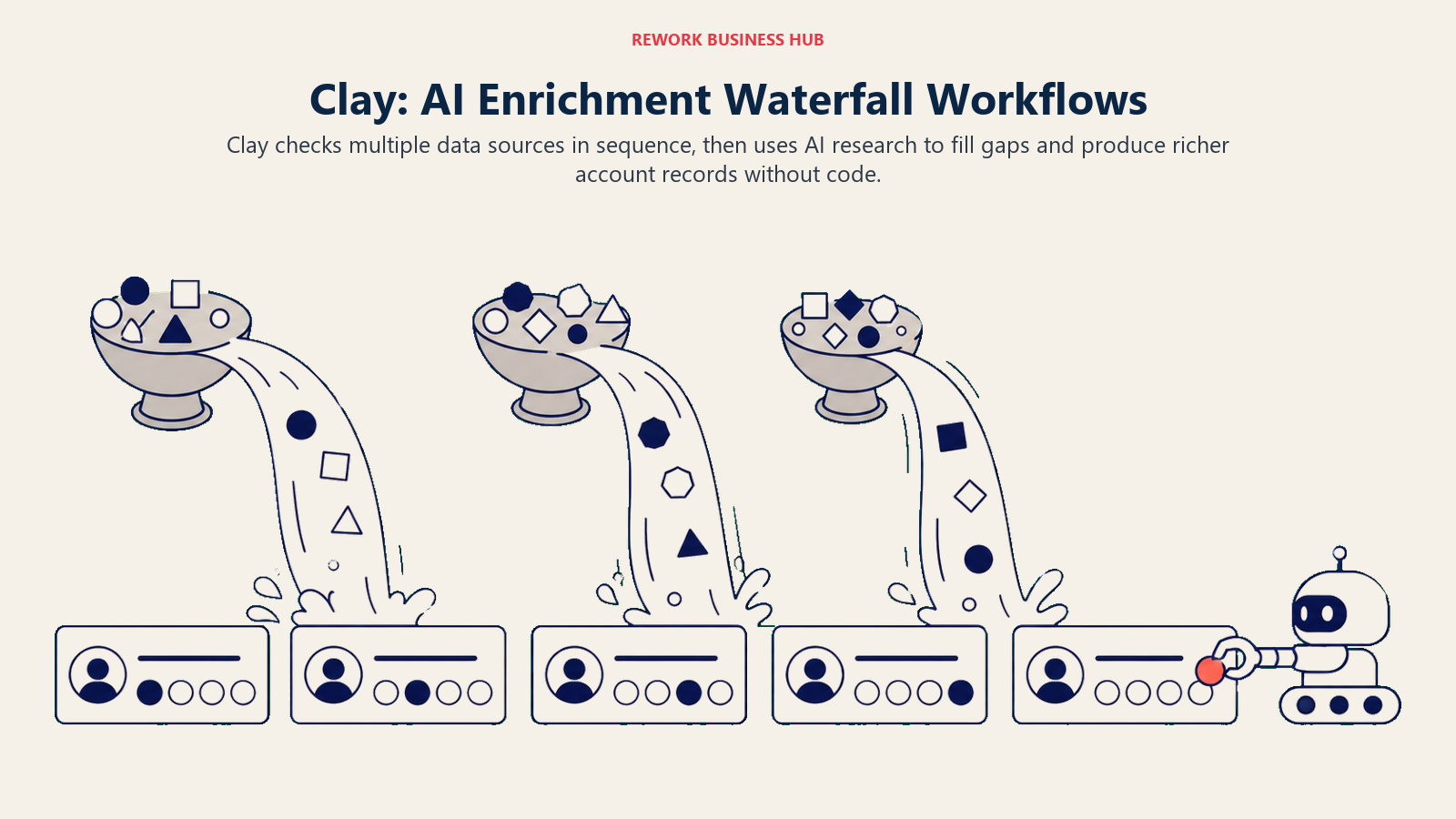
Clay's product philosophy is that enrichment shouldn't be a single API call, it should be a waterfall: try one data source, fall back to another if it misses, then run an AI agent to fill in whatever's still blank from a company's website or LinkedIn. That waterfall logic, built in a spreadsheet-like no-code interface, is what makes Clay different from a standard enrichment tool.
For B2B ops and growth teams building custom outbound workflows (personalized icebreakers at scale, account research before a demo, technographic scoring), Clay has become close to a category of its own. The March 2026 pricing overhaul split credits into Data Credits and Actions, which cut per-lookup costs significantly but adds a learning curve to understand what consumes which credit type.
| What you get | What you don't |
|---|---|
| No-code AI agent builder for enrichment waterfalls | Steep learning curve for non-technical ops teams |
| Access to 50+ data providers from one interface | Credit-based pricing can get expensive at high volume |
| Free tier for testing workflows before scaling | Not a sequencing or CRM tool on its own |
Pricing: Free tier; Launch $149/mo, Growth up to roughly $800/mo depending on credit volume (annual billing).
Best for: RevOps and growth teams building custom enrichment and personalization workflows on top of existing outbound tools
3. Gong: Conversation Intelligence for Deal Risk and Coaching
Gong's core bet has held since it entered the category: every sales call, email, and meeting contains signal that reps and managers miss in real time, and AI can surface it after the fact. Gong records and analyzes conversations, flags deal risk, and builds coaching libraries from your team's actual calls, not generic training material.
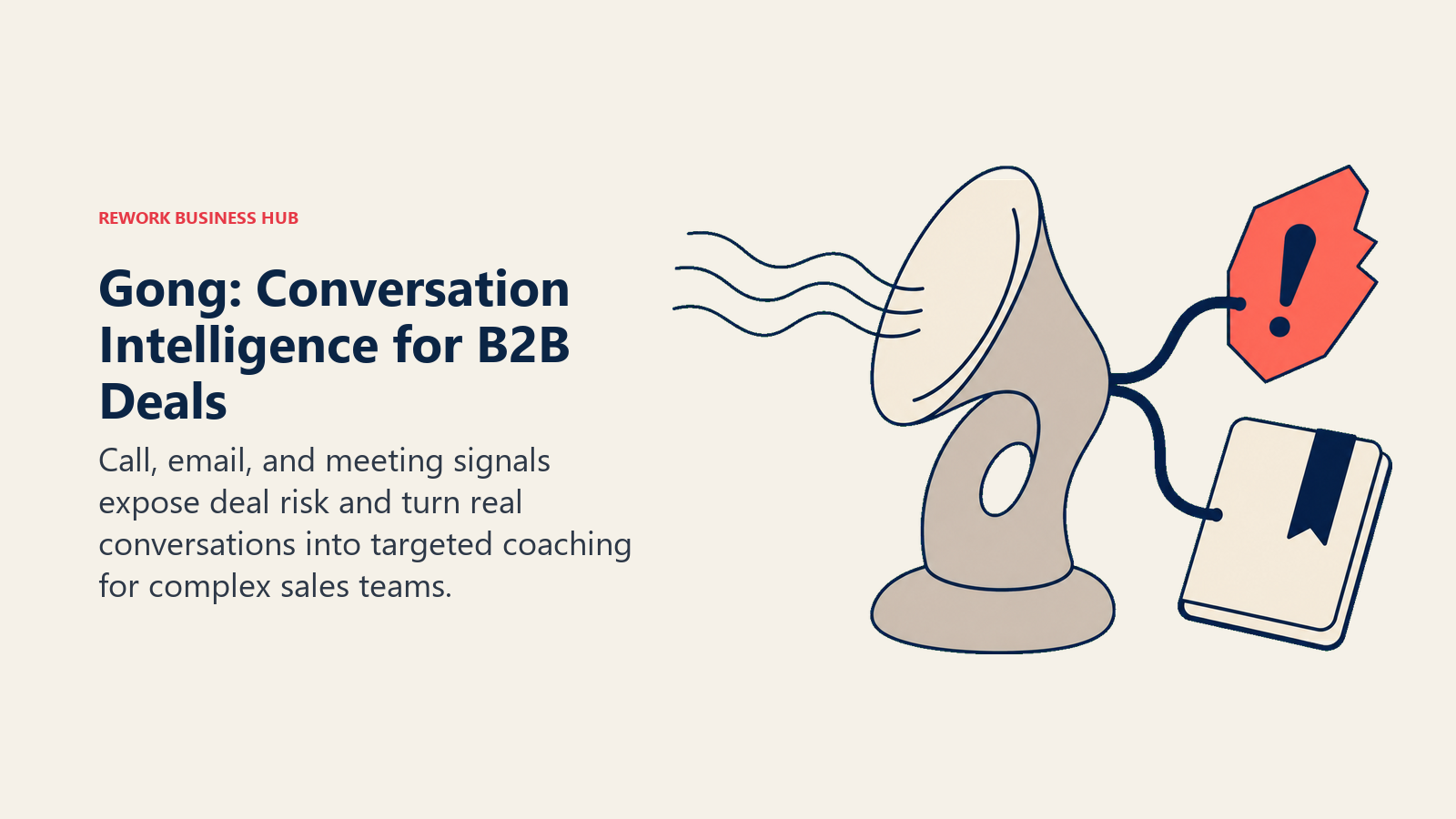
For B2B companies with a complex, multi-call sales cycle and a management layer that needs visibility into deal health, Gong remains the deepest conversation intelligence platform on the market. The honest limitation is cost and fit: Gong is built for teams doing enough call volume to justify the investment, and it's overkill for a 5-person team closing deals over a handful of emails.
| What you get | What you don't |
|---|---|
| Deepest conversation intelligence library in the category | Quote-only pricing with a separate platform fee |
| Deal-risk scoring across the full sales cycle | Overkill for small teams or short, low-touch sales cycles |
| Coaching libraries built from real team calls | Requires real call volume to justify the cost |
Pricing: Quote-only; buyer reports put Foundations near $1,400-1,600/user/year plus a platform fee.
Best for: Enterprise and mid-market B2B sales teams with multi-call cycles and a management layer that needs deal-risk visibility
4. ChatGPT Business: General-Purpose AI Across Every Department
ChatGPT's advantage in a B2B company isn't any single feature, it's breadth. Marketing drafts campaign copy, sales drafts follow-up emails, ops builds internal process docs, and support drafts macros, all in the same tool with the same admin console. That single point of adoption is why ChatGPT Business (formerly ChatGPT Team) is often the first AI line item a company buys company-wide.
The tradeoff is depth in any one workflow. ChatGPT Business is a strong generalist, not a specialist: it won't score your leads or enrich your contact database on its own. For companies needing HIPAA-level compliance or the largest context windows, Enterprise is available but priced through a sales conversation, with buyer-reported contracts commonly landing between $45 and $75 per user per month depending on seat count and term. If you're deciding between ChatGPT, Claude, and Gemini for company-wide rollout, our Claude vs ChatGPT vs Gemini breakdown compares them head to head.
| What you get | What you don't |
|---|---|
| Fastest general-purpose AI to roll out company-wide | No native CRM, enrichment, or lead scoring |
| Custom GPTs for department-specific workflows | Enterprise pricing is quote-only, not published |
| Familiar interface with low training overhead | Business tier lacks a HIPAA BAA (Enterprise only) |
Pricing: Business $20/user/mo (annual, 2-seat minimum) or $25/user/mo (monthly); Enterprise quote-only, buyer reports commonly $45-75/user/mo at 150-seat minimums.
Best for: Any B2B company standardizing on one general-purpose AI assistant across marketing, sales, support, and ops
5. Claude for Work: Long-Context Reasoning for Documents and Ops
Claude's differentiation shows up on the tasks ChatGPT handles less comfortably: analyzing a 100-page contract, summarizing a quarter's worth of customer feedback, or working through a structured multi-step reasoning task without losing the thread. The larger context window and Anthropic's focus on careful, structured output make Claude for Work a common second seat next to ChatGPT rather than a straight replacement.
Team Premium seats add Claude Code, which matters for B2B companies whose ops or RevOps teams are building internal scripts, data pipelines, or automations rather than pure prose. Enterprise pricing layers a base seat cost with usage billed at API rates, so cost scales with which model (Opus, Sonnet, or Haiku) a team actually uses.
| What you get | What you don't |
|---|---|
| Large context window for contracts, reports, and codebases | Two-tier Team pricing (Standard vs Premium) adds complexity |
| Claude Code access on Premium seats for ops automation | Enterprise usage-based billing is harder to forecast |
| Careful, structured output for compliance-sensitive work | Smaller consumer mindshare than ChatGPT company-wide |
Pricing: Team Standard $25/seat/mo, Team Premium $125/seat/mo (5-seat minimum); Enterprise quote-only with a base seat fee plus usage-based model pricing.
Best for: RevOps, legal, and ops teams doing document-heavy analysis or building internal automation on top of AI
6. HubSpot Breeze: AI Layered Into an Existing HubSpot Stack
Breeze is HubSpot's answer to standalone AI point tools: instead of buying a separate enrichment, chat, or content tool, Breeze AI agents sit inside the Hubs you already run, billed on an outcome basis (per resolved conversation or qualified lead) rather than a flat per-seat fee. For B2B companies already committed to HubSpot as their marketing and sales system of record, that's a meaningfully lower-friction way to add AI than onboarding a new vendor.
The catch is the same one that applies to every ecosystem play: Breeze's value is entirely contingent on being deep in HubSpot already. If you're not on HubSpot, none of it is accessible, and the enrichment layer (formerly Clearbit, now Breeze Intelligence) runs on its own credit system on top of your existing Hub subscription.
| What you get | What you don't |
|---|---|
| AI agents built into Marketing, Sales, and Service Hub | Requires an existing paid HubSpot subscription |
| Outcome-based pricing instead of a flat AI tax | Breeze Intelligence credits are a separate cost layer |
| Lower onboarding friction than a new standalone vendor | Locked into HubSpot's roadmap and pricing changes |
Pricing: Baseline AI features included from Sales Hub Starter; Breeze Intelligence from $45/mo for 100 credits; agents billed $0.50-$1 per resolved outcome on Pro/Enterprise Hubs.
Best for: B2B companies already running HubSpot as their core marketing and sales system
7. Rework: AI-Assisted CRM, Lead Routing, and Chat Inbox for Mid-Size B2B Teams
Rework is an operations platform with AI inside each app rather than an AI tool in its own right, which is why it sits below the prospecting, conversation intelligence, and general-assistant leaders above, and just behind HubSpot Breeze, the closest like-for-like option with a more mature AI layer and ecosystem. It's built for the gap many B2B companies fall into: too big for spreadsheets and personal WhatsApp threads, not ready for the cost and complexity of a Salesforce implementation. CRM, lead management, and a chat inbox share one data model instead of three tools glued together with automation.
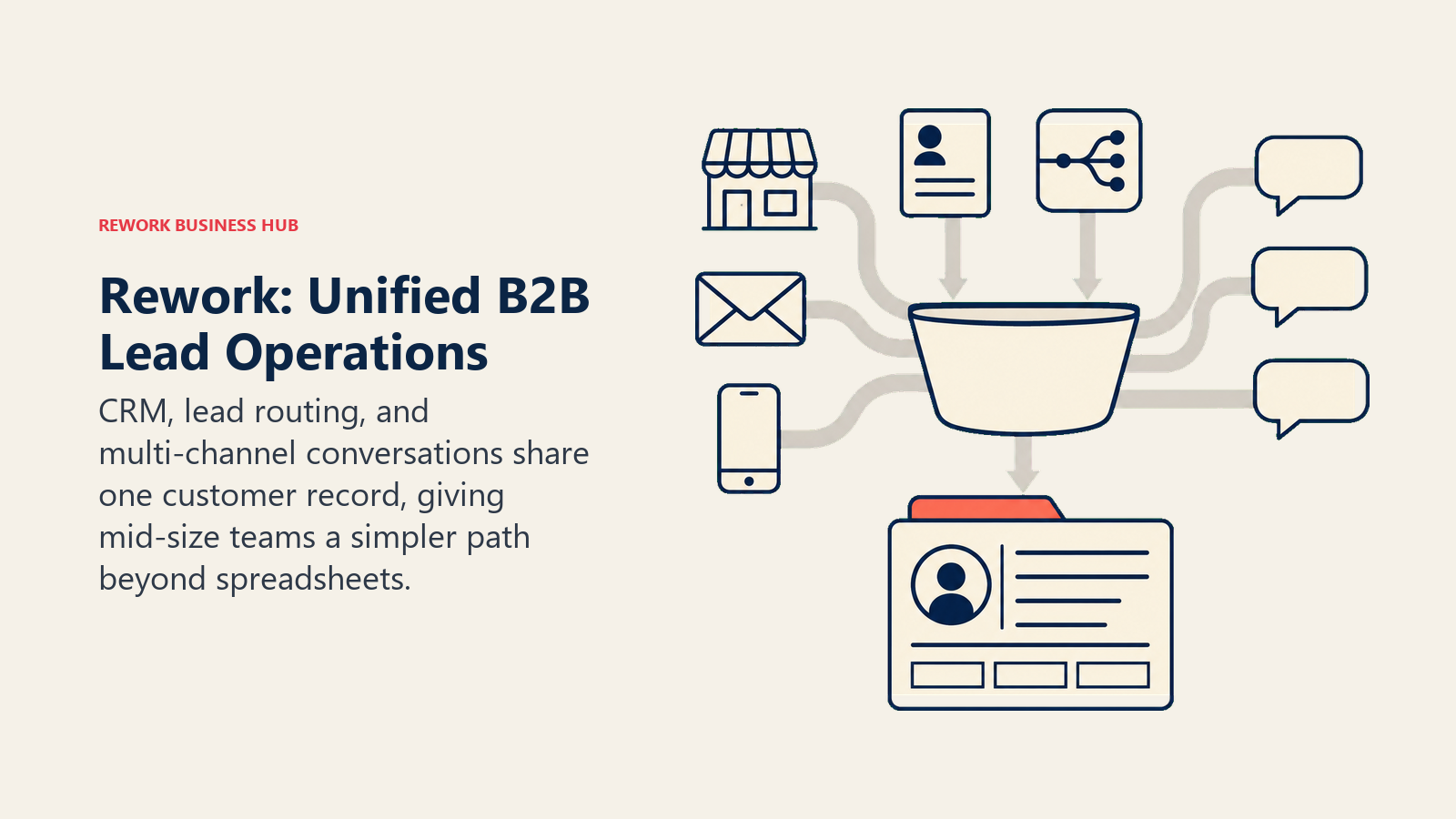
Leads captured from forms, ads, or chat get scored and routed automatically with round-robin, territory, or SLA rules, tied to the same record that holds the customer's WhatsApp, Messenger, Instagram, Telegram, Zalo, and live chat conversations. The AI is mostly copilot-style: the Sales copilot summarizes deal status, risk, and next step and drafts tasks and updates for a rep to confirm, chat AI agents (in beta) answer routine customer questions from a knowledge base, and process workflows can include an AI step. There's no contact database, conversation intelligence, or content generation, so it won't replace Apollo, Gong, or a general assistant.
| What you get | What you don't |
|---|---|
| CRM + lead capture, scoring, and routing in one product | No contact database, call analysis, or content generation |
| Chat inbox (WhatsApp, Messenger, Instagram, Telegram, Zalo, live chat) with AI agents | Email and SMS aren't inbox channels; no voice inbox |
| Copilots that draft actions, with a person confirming | Not a Salesforce-depth replacement for F500 orgs |
| Engine pricing with 5 seats included, extra seats in blocks of 5 | Not for solo operators or very small teams |
Pricing: the Sales Engine (CRM) is $69/month billed yearly or $80 month to month, with 5 sales seats included and extra seats in blocks of 5. The Marketing Engine (lead capture and inbox) is $99/month billed yearly, and the Revenue Engine bundles both for $159/month billed yearly. 14-day free trial, no free plan. See rework.com/pricing.
Best for: 10-200 person B2B teams running sales, marketing, and CS on shared workflows, especially where leads come in through paid ads or messaging channels.
8. 6sense: Predictive Intent Data for Enterprise ABM
6sense's product philosophy is that most B2B buying happens anonymously long before a lead ever fills out a form, and AI can predict which accounts are in-market by watching intent signals across the web. For enterprise B2B companies running account-based marketing at scale, 6sense's predictive scoring across a full target account list is genuinely differentiated from simpler intent add-ons.
The honest limitation is cost and complexity. 6sense pricing isn't published, real-world annual contract values run from roughly $50,000 for a limited deployment to $300,000-plus for a full enterprise rollout with expanded coverage and premium data sources, and most implementations still need a separate sequencing tool and dialer layered on top. See our best 6sense alternatives if that price point is out of reach for your stage.
| What you get | What you don't |
|---|---|
| Predictive intent scoring across a full target account list | Pricing isn't published; expect a full sales cycle |
| Deep ABM orchestration across ad, email, and sales channels | Real total cost often exceeds the base contract by $10-20K/yr |
| Strong fit for enterprise, multi-stakeholder buying committees | Overkill for teams without a mature ABM motion already |
Pricing: Not published; buyer-reported team plans start near $25,000/year, with enterprise deployments commonly ranging from $50,000 to $300,000-plus annually.
Best for: Enterprise B2B companies running account-based marketing with a mature RevOps function to operationalize the data
9. Common Room: Signal-Based GTM Intelligence
Common Room's bet is that the best buying signals aren't sitting in a single data provider, they're scattered across product usage, community activity (Slack, Discord, GitHub), and website intent, and AI can stitch them into one feed that tells a rep exactly when to reach out and why. For product-led and community-led B2B companies, that combination is hard to replicate with a traditional intent tool alone.
Zoom's announced acquisition of Common Room (July 2, 2026) is the detail worth watching before signing a multi-year contract: the roadmap and pricing model may shift as it folds into a larger platform., the published Essential tier is a reasonable entry point, but most real deployments (Advanced and Enterprise tiers) require a sales conversation.
| What you get | What you don't |
|---|---|
| Unifies product, community, and web signals into one feed | Pending Zoom acquisition adds roadmap uncertainty |
| RoomieAI research credits and Prospector credits included | Advanced and Enterprise tiers are quote-only |
| Strong fit for product-led and community-led GTM motions | Less useful without an existing PLG or community presence |
Pricing: Essential $2,100/mo (5 seats, up to 100K contacts, annual billing); Advanced and Enterprise tiers quote-only, with real-world contracts often landing $30,000-$100,000-plus per year.
Best for: Product-led and community-led B2B companies that want product usage, community activity, and web intent in one signal feed
10. Clearbit / Breeze Intelligence: Firmographic Enrichment Inside HubSpot
Clearbit built its reputation as the default firmographic and technographic enrichment layer for B2B: fill in company size, industry, and tech stack the moment a lead hits a form. That product still exists, but only as Breeze Intelligence inside HubSpot after the standalone Clearbit product was fully sunset. If you're not a HubSpot customer, this tool isn't an option anymore.
For HubSpot-native B2B companies, Breeze Intelligence is a reasonable default because it's built into the same record you already work from, no separate integration required. The credit-based pricing on top of a paid HubSpot seat is the real cost to budget for, and it can climb quickly for teams doing high-volume form enrichment. If the credit cost outgrows the value, our best Clearbit alternatives guide covers enrichment tools that don't require a HubSpot subscription.
| What you get | What you don't |
|---|---|
| Real-time firmographic and technographic enrichment on forms | Only works inside HubSpot; standalone product is gone |
| No separate integration required for HubSpot users | Credits reset monthly with no rollover |
| Continuous enrichment updates on paid HubSpot plans | Costs scale fast with form volume at mid-market scale |
Pricing: Requires a paid HubSpot subscription; Breeze Intelligence credits from $45/mo for 100 credits, with realistic entry cost around $75/mo combined.
Best for: HubSpot-native B2B companies that want firmographic enrichment without adding a separate vendor
11. Jasper: On-Brand AI Content for Marketing Teams
Jasper's differentiator against a general-purpose assistant is Brand Voice and Knowledge assets: feed it your style guide, past campaigns, and product positioning, and it holds that context across every piece of content a marketing team generates, instead of starting from a blank prompt each time. For B2B marketing teams producing content at volume across channels, that consistency is the actual time-saver.
The honest ceiling is that Jasper is a content tool, not a strategy tool. It won't tell you what to write about or whether a campaign is working, and there's no permanent free plan, only a 7-day trial of the Pro tier. Teams evaluating it against general-purpose assistants should weigh the brand-consistency gain against ChatGPT or Claude's lower cost and broader use cases, and our Jasper vs Copy.ai vs Writer comparison is a good next read if you're still shortlisting.
| What you get | What you don't |
|---|---|
| Brand Voice and Knowledge assets for on-message output | No permanent free plan, only a 7-day Pro trial |
| Marketing-specific templates and campaign workflows | Doesn't replace strategy, targeting, or distribution work |
| Business tier scales to larger content teams | Business pricing is custom and can run $900-$6,000+/mo |
Pricing: Creator $39-49/mo; Pro $59-69/mo; Business custom, typically $900/mo and up for 3-5 users (annual billing).
Best for: B2B marketing teams producing on-brand content at volume across blog, social, and campaign channels
12. Zapier: The Automation Layer Connecting Your AI Stack
Zapier's role in a B2B AI stack isn't a single AI feature, it's the connective tissue between every other tool on this list. A lead scored in Clay, enriched in Breeze Intelligence, and routed into a CRM often depends on Zapier (or a comparable automation layer) to move the data between systems that don't talk to each other natively. Its newer AI agents extend that role from simple triggers into multi-step autonomous workflows.
For B2B companies without dedicated engineering resources, Zapier remains the fastest way to wire tools together without writing code. The tradeoff is cost at scale: task-based pricing with overage charges can get expensive once a company is running dozens of active automations across its stack.
| What you get | What you don't |
|---|---|
| 8,000+ app integrations and AI agents in one platform | Task-based pricing gets expensive at high automation volume |
| No-code workflow builder for non-technical ops teams | Complex multi-branch logic still benefits from technical help |
| Free tier for testing before committing budget | Overage charges run 1.25x your base task rate |
Pricing: Free (100 tasks/mo); Professional from $19.99/mo (750 tasks); Team from $69/mo; Agents roughly $20/mo add-on (annual billing saves about a third).
Best for: B2B ops teams connecting multiple point tools (CRM, enrichment, email, chat) without a dedicated engineering team
13. Warmly: Website Visitor Deanonymization and Warm Outbound
Warmly's premise is that most website traffic is invisible: a prospect reads your pricing page and leaves, and without deanonymization, that intent signal is gone. Warmly identifies anonymous visitors, scores them against your ICP, and can trigger warm outbound (an alert, a personalized email, even a live chat prompt) while the visitor is still on the page.
For B2B companies with meaningful inbound traffic and a sales team that can act on real-time signals, Warmly closes a gap that most CRMs and marketing tools leave open. The free tier (500 deanonymized visitors a month) is a genuine way to test the signal quality before committing to a paid plan, but there's a steep jump from free to the first paid tier, with little in between.
| What you get | What you don't |
|---|---|
| Real-time deanonymization of website visitors | Steep jump from free (500 visitors) to paid tiers |
| ICP scoring and automated warm outbound triggers | Requires meaningful existing website traffic to be useful |
| Free tier for testing signal quality before buying | Full GTM bundle pricing is custom and can run $45-100K/yr |
Pricing: Free (500 visitors/mo, 10 Bombora intent signals/week); paid plans commonly start in the $10,000-$16,000/year range depending on the specific agent product.
Best for: B2B companies with real inbound web traffic that want to convert anonymous visits into warm outbound before the lead goes cold
14. Perplexity: AI-Powered Research for Account and Market Intelligence
Perplexity's differentiator against ChatGPT or Claude for B2B research tasks is that every answer comes cited, pulled from live web sources instead of a static training cutoff. For a rep researching a target account before a first call, or a marketer scanning competitor positioning, that citation trail matters: you can verify the source instead of taking the AI's word for it.
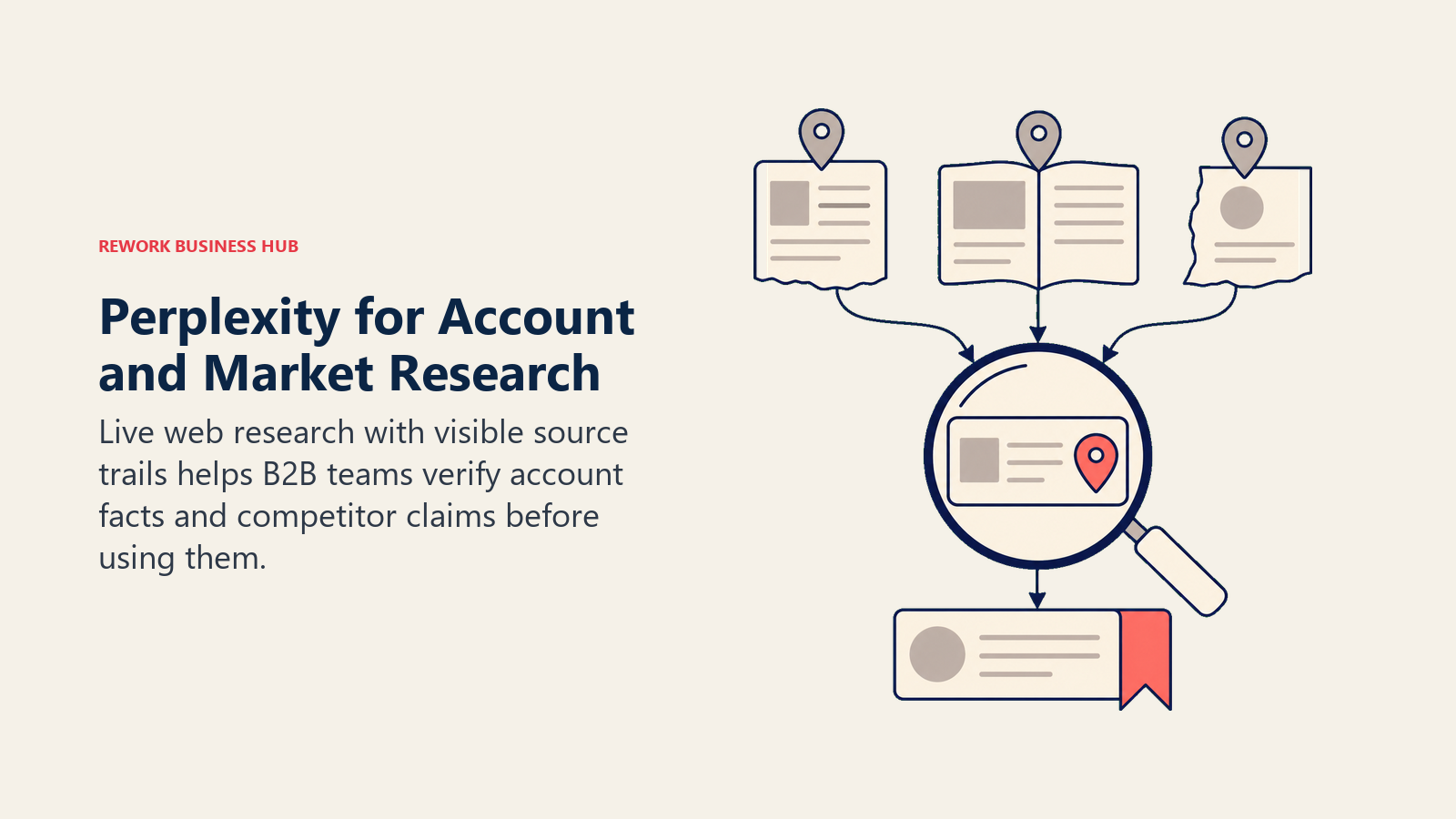
Enterprise Pro adds team collaboration, admin controls, and higher usage limits on top of the same core research experience, at a price point well below ChatGPT or Claude's enterprise tiers. The tradeoff is scope: Perplexity is a research and answer tool, not a drafting, CRM, or automation platform, so most B2B teams run it alongside one of the general-purpose assistants rather than instead of one. See Perplexity vs ChatGPT Search vs Gemini for a deeper look at how the research experience compares.
| What you get | What you don't |
|---|---|
| Cited, real-time web answers instead of a training cutoff | Not a drafting or content-generation tool by design |
| Enterprise Pro priced below ChatGPT and Claude's team tiers | No CRM, automation, or enrichment functionality |
| Free tier available for individual testing | Best used alongside, not instead of, a general assistant |
Pricing: Free tier; Pro $20/mo; Enterprise Pro $40/seat/mo ($400/yr); Enterprise Max $325/seat/mo for higher-volume needs.
Best for: GTM teams doing account and market research before outreach, competitive analysis, or exec-level briefings
How to Choose: Decision Framework
The fastest way to narrow this market is to begin with the operating need, then compare only the tools built for that job.
| If you need... | Pick... | Why |
|---|---|---|
| High-volume outbound prospecting with a large contact database | Apollo.io | Largest native database paired with sequencing in one tool |
| Custom enrichment and personalized research workflows | Clay | No-code AI agent builder for enrichment waterfalls |
| Conversation intelligence and deal-risk coaching at scale | Gong | Deepest call and email analysis library on this list |
| A single AI assistant rolled out across every department | ChatGPT Business | Fastest to adopt company-wide; broadest general use case |
| Long-document analysis or AI-assisted ops automation | Claude for Work | Larger context window; Claude Code on Premium seats |
| AI already built into a HubSpot marketing and sales stack | HubSpot Breeze | No new vendor; outcome-based pricing on existing Hubs |
| Unified CRM, lead routing, and a chat inbox for a 10-200 person team not on HubSpot | Rework | One data model instead of several stitched tools, engine pricing with seats included |
| Enterprise ABM with predictive account-level intent | 6sense | Purpose-built intent scoring across a full target account list |
| Product, community, and web signals unified in one feed | Common Room | Best fit for product-led and community-led GTM motions |
| Firmographic enrichment without leaving HubSpot | Clearbit / Breeze Intelligence | Built into the record you already work from |
| On-brand content at volume for a marketing team | Jasper | Brand Voice and Knowledge keep output on-message |
| Connecting every other tool on this list to each other | Zapier | 8,000+ integrations; no-code automation and AI agents |
| Converting anonymous website traffic into warm outbound | Warmly | Real-time deanonymization plus ICP scoring |
| Cited account and market research before outreach | Perplexity | Real-time, sourced answers instead of a static knowledge cutoff |
Frequently Asked Questions about AI Tools for B2B Companies
What is the best AI tool for a B2B company overall?
There's no single best tool for every B2B company because the category spans CRM, prospecting, content, and research. For prospecting, Apollo.io and Clay lead. For a company-wide general assistant, ChatGPT Business and Claude for Work are the two most adopted options. For AI inside the CRM, HubSpot Breeze fits companies already on HubSpot, and Rework fits mid-size teams that want CRM, lead routing, and a chat inbox on one platform.
How much do AI tools cost for a B2B company in 2026?
Entry pricing ranges from free (Apollo, Clay, Zapier, Perplexity, Warmly all offer usable free tiers) to roughly $20-50 per user per month for most general-purpose and prospecting tools. Enterprise-grade platforms like Gong, 6sense, and Common Room keep pricing behind a sales call, with real annual contracts commonly running $25,000 to $100,000-plus depending on scale.
Should a small B2B team buy Rework or a general AI assistant first?
Most small teams should start with a general assistant (ChatGPT Business or Claude for Work) for drafting and research, since the cost per seat is low and the learning curve is short. A dedicated CRM and lead-ops platform like Rework becomes the right investment once a team has 5 or more people coordinating on the same leads and losing time to dropped handoffs.
Is Apollo.io or Clay better for B2B prospecting?
They solve different problems. Apollo.io is the faster starting point because it bundles a large contact database with native sequencing in one tool. Clay is better once a team wants custom enrichment waterfalls or highly personalized outbound research that Apollo's built-in workflows don't support.
What changed in B2B AI tools pricing in 2026?
The biggest shift is outcome-based and usage-based pricing replacing flat per-seat fees. HubSpot Breeze bills by resolved outcome, Salesforce Agentforce and similar agent platforms bill per conversation or by credit, and Clay split its credits into separate Data Credits and Actions. Vendors are betting that usage-based pricing scales more fairly than a flat seat fee once AI agents are doing the actual work.
Does ChatGPT or Claude replace a CRM for a B2B company?
No. Both are strong general-purpose assistants for drafting, research, and analysis, but neither stores structured lead or deal data, tracks a pipeline, or routes leads to the right rep. B2B companies typically run a general assistant alongside a CRM like Rework, HubSpot, or Salesforce, not instead of one.
Is 6sense worth it for a mid-size B2B company?
Usually not yet. 6sense is built for enterprise account-based marketing with a mature RevOps function to operationalize the intent data, and real contracts commonly start around $50,000 a year. Mid-size teams without an established ABM motion typically get more value from a CRM with native lead scoring and a lighter-weight intent add-on first.
What's the risk of buying too many AI tools at once?
Tool sprawl. It's common for a 40-person B2B company to end up paying for a prospecting tool, an enrichment tool, an intent platform, a conversation intelligence tool, and a general AI assistant, most of it overlapping. Before adding a new AI tool, check whether a platform you already pay for (like HubSpot Breeze inside HubSpot, or Rework's built-in lead scoring) already covers the workflow.
What to Do Next
Pick the single workflow costing your team the most time right now, whether that's unreturned leads, manual prospecting, or content that takes too long to produce, and run a 2-week trial with the tool built for that specific job rather than adding a general AI subscription and hoping it fixes everything. If your B2B company is coordinating sales, marketing, and CS on shared leads and still stitching that together with spreadsheets and WhatsApp, start with a CRM that has lead routing and a shared inbox built in before layering on point solutions. If you're a 10-200 person team in that position, compare the best CRM software, Rework included, or explore the best AI tools for sales and best AI tools for business development if your immediate gap is pipeline generation specifically.

Principal Product Marketing Strategist
On this page
- Updated July 2026: What Changed
- Key Facts
- Quick Comparison Table
- 1. Apollo.io: AI-Powered Prospecting for Any Team Size
- 2. Clay: No-Code AI Enrichment and Research Workflows
- 3. Gong: Conversation Intelligence for Deal Risk and Coaching
- 4. ChatGPT Business: General-Purpose AI Across Every Department
- 5. Claude for Work: Long-Context Reasoning for Documents and Ops
- 6. HubSpot Breeze: AI Layered Into an Existing HubSpot Stack
- 7. Rework: AI-Assisted CRM, Lead Routing, and Chat Inbox for Mid-Size B2B Teams
- 8. 6sense: Predictive Intent Data for Enterprise ABM
- 9. Common Room: Signal-Based GTM Intelligence
- 10. Clearbit / Breeze Intelligence: Firmographic Enrichment Inside HubSpot
- 11. Jasper: On-Brand AI Content for Marketing Teams
- 12. Zapier: The Automation Layer Connecting Your AI Stack
- 13. Warmly: Website Visitor Deanonymization and Warm Outbound
- 14. Perplexity: AI-Powered Research for Account and Market Intelligence
- How to Choose: Decision Framework
- What to Do Next