Best AI Tools for HR in 2026: 13 Tools Ranked by HR Function
Turn this article into takeaways for your work.


Each assistant summarizes the article only for you and suggests best practices for your work.
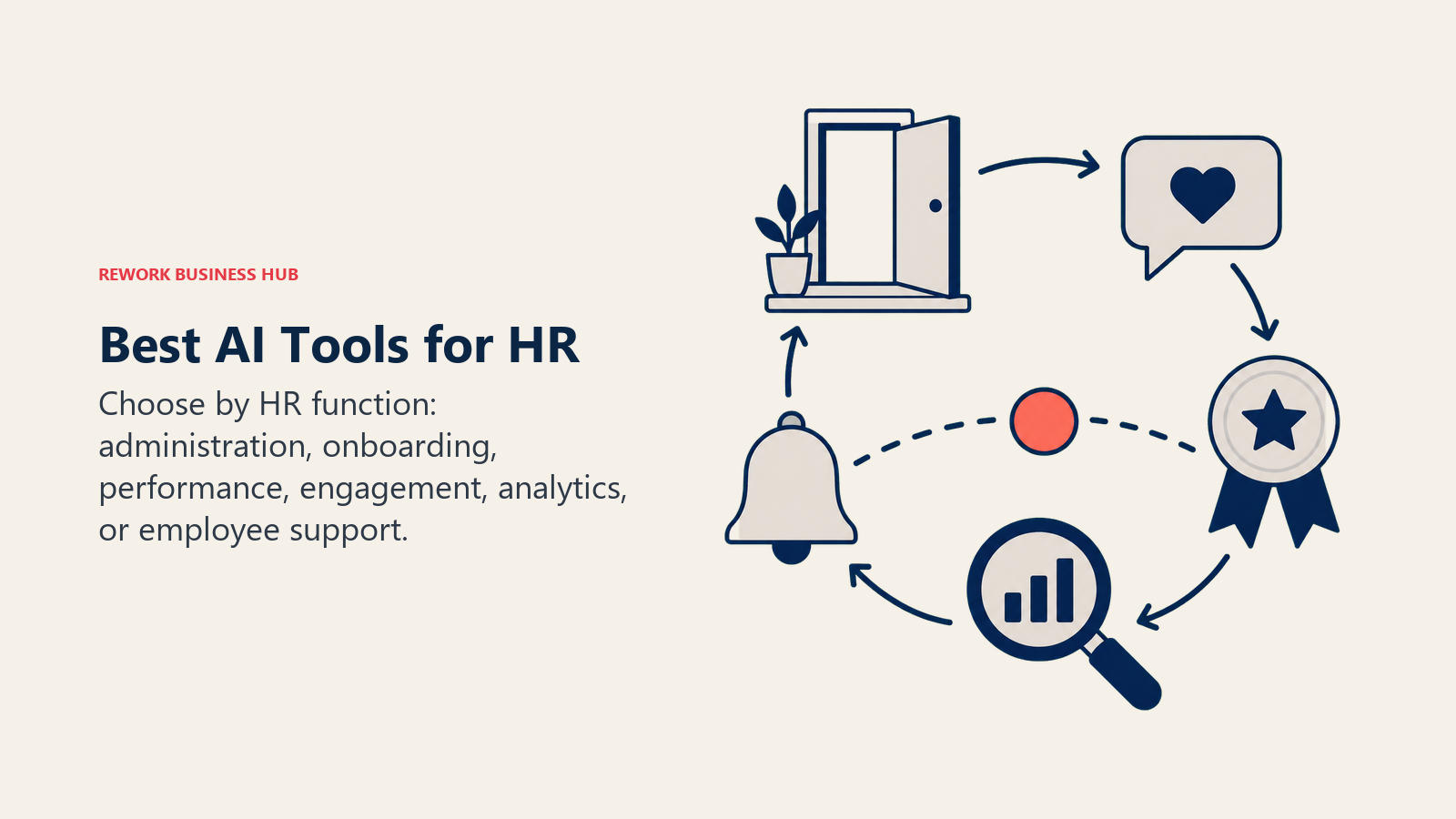
If you're building an AI-assisted HR stack in 2026, Rippling and Workday Illuminate lead AI embedded directly in the HRIS, Lattice and Macorva lead AI for performance and engagement, Visier and ChartHop lead AI-powered people analytics, and Leena AI leads the agentic HR service desk that answers employee questions around the clock. This guide ranks 13 tools by the HR job you actually need done, not by feature count, and it covers the broader HR stack (onboarding, engagement, performance, HRIS, learning and development) rather than pure recruiting. If sourcing and screening candidates is your primary pain, see our best AI recruiting tools guide instead, and if you want the full non-AI-specific HR platform comparison, see best HR software.
Most "AI for HR" roundups mix a $150,000-a-year enterprise HCM suite with a $5-a-month org chart add-on and call it a ranking. That's not useful when you're trying to shortlist in an afternoon. Each tool below is evaluated on what it actually automates (HR administration, onboarding, performance, engagement, analytics, or employee support), who it's built for, and what it costs.
What Changed in 2026
- Workday Illuminate expanded with new AI agents for HR, finance, and industry in September 2025, and its Flex Credits consumption model now bundles AI agent access into every subscription rather than selling it as a separate line item, though the deepest Illuminate capabilities still require the Full Suite tier.
- Paradox, the conversational AI assistant Olivia, was acquired by Workday in a deal that closed October 1, 2025, folding conversational onboarding and screening AI directly into Workday's talent stack; expect its packaging to keep shifting as the integration continues.
- The Josh Bersin Company's 2026 "HR 2030" research identified more than 100 distinct HR AI agent use cases, grouped into "superagent" families spanning employee services, recruiting, performance management, coaching, learning and development, and workforce management, a sign the market moved from single-purpose copilots to multi-step agents in a single year.
- Despite the hype, SHRM's 2026 survey found 54% of organizations still haven't adopted any form of AI in HR and have no plans to in 2026, so most of the tools below remain early-adopter bets outside of recruiting and core HR technology administration.
Key Facts
- Among organizations that have adopted AI for HR purposes, talent acquisition is the top use case at 64%, followed by learning and development at 43% and performance management at 25%, per SHRM's State of AI in HR 2026 report.
- 87% of HR leaders forecast greater AI adoption within HR processes in 2026, up from 83% a year earlier, and 92% of CHROs expect AI to become further integrated into the workforce, per the same SHRM report.
- 82% of CHROs plan to adopt AI agents within the next year, per Gartner's "Prepare for the Future of AI Agents in HR" research, cited via Eightfold.
- Structured onboarding produces 50% greater new-hire productivity and makes new employees 58% more likely to still be with the company after three years, per SHRM.
- Disengaged employees cost the global economy $8.9 trillion in lost productivity a year, while teams in the top quartile of engagement post 23% higher profitability than the bottom quartile, per Gallup.
- Only 24% of HR functions believe they're achieving maximum value from their HR technology investment, per Gartner research reported by SHRM.
Quick Comparison Table
| Tool | Best For | Starting Price | Key Strength | Key Limitation |
|---|---|---|---|---|
| Rippling AI | Companies wanting HR, IT, and finance unified with embedded AI | $8/employee/mo (Core) + $35/mo base; most builds land $20-35 PEPM | AI woven across HR, IT, and finance workflows in one system of record | Module pricing is custom and opaque; easy to overbuy |
| BambooHR (Ask BambooHR) | Small to mid-size teams wanting AI on top of a simple HRIS | ~$10/employee/mo (Core) | Conversational AI assistant answers HR data questions in plain language | Performance and AI depth gated behind Pro/Elite tiers |
| HiBob (Bob) | Mid-size, culture-forward companies | $8-25/user/mo depending on modules (custom quote) | AI-generated engagement and people insights inside a modern UX | No published pricing; payroll depth varies by region |
| Workday Illuminate | Large enterprises (1,000+ employees) needing full HCM plus agentic AI | Custom quote; estimated from ~$34/employee/mo, deepest AI needs Full Suite | Native AI agents across HR, finance, and industry workflows | Expensive, slow to implement; overkill under 1,000 employees |
| Rework (People) | Mid-size teams wanting HR, attendance, and payroll unified with sales and work ops | Quote on request (People is not publicly priced) | HRIS, timesheets, and payroll on one record, with copilots that draft actions for approval | No AI performance, engagement, or analytics module; no tax filing, US payroll forms, or benefits carriers |
| ChatGPT (Business/Enterprise) | General-purpose AI drafting and analysis for any HR team | Business $20/user/mo (annual, 2-seat min); Enterprise custom, ~150-seat minimum | Flexible for policy drafting, job aids, and manager coaching scripts | Not HR-specific; no native HRIS data connection out of the box |
| Leena AI | Large enterprises wanting an agentic HR service desk | Custom quote only, no published tiers | Pre-built "AI colleagues" auto-resolve routine HR, IT, and finance tickets | Enterprise-only; headcount-based pricing is hard to forecast |
| Lattice AI | Companies layering AI performance management on an existing HRIS | $13/seat/mo (Foundations bundle); $4,000/yr minimum | AI review summaries, 1:1 theme tracking, and compensation insights | Not an HRIS; needs a core payroll/records system alongside it |
| Macorva | Mid-size to large teams wanting AI-driven engagement and review data | Not published (contact for quote) | AI-generated engagement reports per manager and AI-assisted performance reviews | No transparent pricing; standalone tool, not a core HRIS |
| Visier | Large enterprises needing AI-powered workforce analytics | Custom, typically six figures annually | Vee AI assistant plus predictive workforce planning at real scale | Requires a data team and specialist to run; overkill under enterprise scale |
| ChartHop | Mid-size teams wanting AI people analytics and org charts | $5/employee/mo (Core); add-ons $3-4/employee/mo each | Modular AI insights, org charts, and workforce planning you can add to piece by piece | Full HRIS depth requires stacking several paid add-ons |
| Paradox (Olivia) | High-volume, frontline onboarding and screening | Custom, from roughly $1,000+/mo; mid-market $25K-$60K/yr | 24/7 conversational AI for screening, scheduling, and onboarding over SMS and chat | Not a general HRIS; now integrating into Workday post-acquisition |
| Textio | Enterprises wanting bias-aware AI writing for job posts and reviews | Enterprise-only, typically $15K-$50K+/yr | Flags biased or exclusionary language in job posts and performance feedback | No self-serve tier; priced separately for Hire vs Perform use cases |
How to Choose: Decision Framework
| If you need... | Pick... | Why |
|---|---|---|
| One system of record for HR, IT, and finance with AI baked in | Rippling AI | Modular platform breadth beats stitching three separate AI tools together |
| A simple HRIS with an AI assistant, not an AI-first rebuild | BambooHR | "Ask BambooHR" answers day-to-day HR questions without a new interface to learn |
| A modern, culture-forward HRIS for a mid-size team | HiBob | AI-generated insights on top of a UX employees actually enjoy using |
| Enterprise-scale HCM with agentic AI across HR and finance | Workday Illuminate | Nothing else on this list matches Illuminate's depth at 1,000+ employees |
| HR, attendance, and payroll unified with your CRM and project work, not a standalone HR stack | Rework (People) | HRIS, timesheets, and payroll share one platform with Rework's sales, marketing, and work apps |
| A flexible AI assistant for drafting and analysis, no HRIS lock-in | ChatGPT | Works for policy drafts, manager coaching scripts, and ad hoc analysis today |
| An agentic AI service desk to cut routine HR ticket volume | Leena AI | Purpose-built "AI colleagues" auto-resolve HR, IT, and finance requests |
| AI-powered performance management layered on an existing HRIS | Lattice AI | Review summaries, 1:1 tracking, and compensation insights without replacing payroll |
| AI-driven engagement surveys and manager-level feedback reports | Macorva | Radiant AI generates a personalized engagement report for every manager |
| Enterprise workforce analytics and predictive planning | Visier | Vee AI assistant plus forecasting built for organizations with a real data team |
| Modular AI people analytics and org charts without a full HRIS rebuild | ChartHop | Pay-as-you-grow modules keep cost tied to what you actually turn on |
| 24/7 conversational AI for high-volume onboarding and screening | Paradox (Olivia) | Purpose-built for retail, hospitality, and healthcare-scale hiring and onboarding |
| Bias-aware AI writing for job posts and performance feedback | Textio | The only tool here purpose-built to flag exclusionary language before it ships |
1. Rippling AI: HR, IT, and Finance Unified with Embedded AI
Rippling's product philosophy is that HR, IT, and finance are really one workforce system, and AI should sit across all three rather than in a bolt-on chatbot. Rippling AI is woven into the platform's workflow builder, letting HR teams automate policy Q&A, onboarding checklists, and cross-department approvals without writing code.
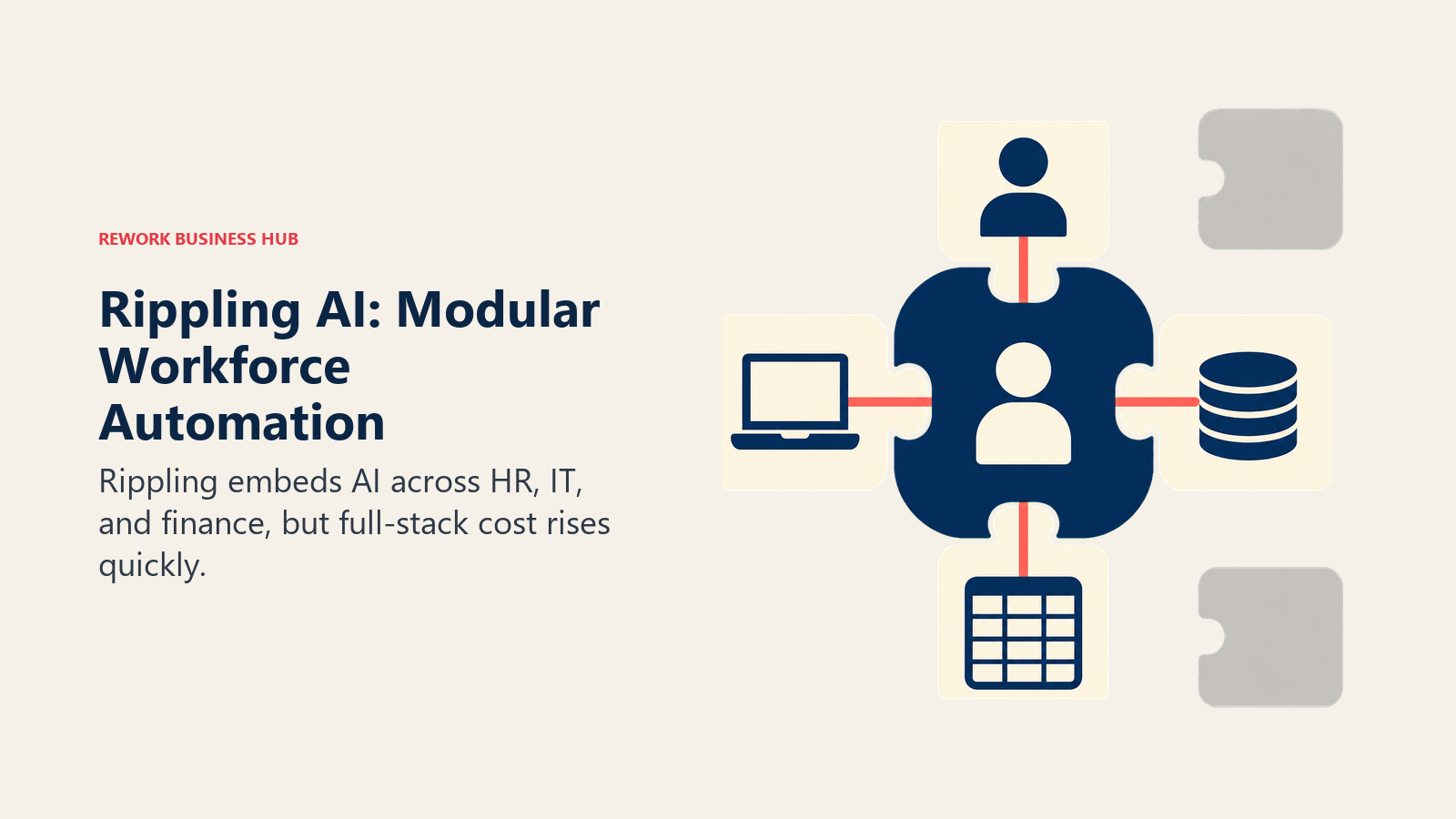
The modular pricing is the tradeoff. Core HR is competitively priced on its own, but payroll, IT device management, and finance modules each add cost, and most companies land well above the headline number once they've built out the stack they actually need. Rippling doesn't publish a full rate card, so budgeting requires a sales conversation. If you're comparing it against other unified HR platforms, see our best Rippling alternatives list.
| What you get | What you don't |
|---|---|
| AI embedded across HR, IT, and finance workflows in one system | Module-level pricing is custom and not published |
| Deepest platform breadth of any tool on this list | Easy to overbuy modules you don't need yet |
| Strong automation builder for onboarding and approvals | Implementation fees and annual contracts add friction |
| Scales from SMB to large mid-market | Total cost can climb fast once payroll and IT are added |
Pricing: Core HR from $8/employee/month plus a $35/month base fee; most full builds land at $20-35 per employee per month once payroll, IT, and benefits modules are added (Rippling doesn't publish full pricing).
Best for: Growing companies (25-500 employees) that want HR, IT, and finance on one AI-assisted platform instead of three separate vendors.
2. BambooHR (Ask BambooHR): AI Assistant on a Simple Core HRIS
BambooHR's bet has always been simplicity: a clean, well-liked HRIS for companies that don't want enterprise complexity. Its AI layer, "Ask BambooHR," extends that philosophy by letting HR admins and managers ask plain-language questions about headcount, time off, or reporting instead of building custom reports.
For small and mid-size teams, that's a real time saver without a steep learning curve. The honest limitation is that performance management, more advanced reporting, and the upgraded AI assistant all sit behind the Pro and Elite tiers, so the entry-level plan doesn't get you the full AI experience. If you've outgrown BambooHR's ceiling, our best BambooHR alternatives guide covers what to look at next.
| What you get | What you don't |
|---|---|
| Conversational AI assistant for HR data questions | Full AI experience gated behind Pro/Elite tiers |
| Simple, well-liked core HRIS UX | Payroll and benefits cost extra |
| Strong ATS add-on for smaller hiring volumes | Reporting depth is basic on lower tiers |
| Fast onboarding for HR teams without dedicated ops staff | Pricing isn't published; estimates vary widely |
Pricing: Roughly $10/employee/month (Core), $17/employee/month (Pro), and $25/employee/month (Elite); BambooHR does not publish list pricing and quotes vary by company size.
Best for: Small to mid-size teams (25-300 employees) wanting an AI assistant on top of a simple core HRIS, not an AI-first rebuild.
3. HiBob (Bob): AI Insights on a Culture-Forward HRIS
HiBob's product, known as Bob, is built for mid-size companies that care as much about culture and engagement as they do about compliance. The platform layers AI-generated insights, engagement analytics, and workforce trend detection on top of a UX that consistently earns praise for actually being pleasant to use, a rarity in HR software.
The tradeoff is transparency. HiBob doesn't publish pricing, and the range buyers report varies widely depending on which modules and regions are involved. Payroll depth also varies significantly by country, so global teams need to verify coverage before assuming Bob replaces a dedicated payroll vendor. See our best HiBob alternatives list if the pricing opacity is a dealbreaker.
| What you get | What you don't |
|---|---|
| AI-generated engagement and people insights | No published pricing; custom quote required |
| Modern UX with strong employee adoption | Payroll depth varies by region |
| Culture and engagement features built in, not bolted on | Core platform pricing climbs with each module added |
| Good fit for distributed, culture-forward teams | Less enterprise governance depth than Workday or ADP |
Pricing: $8-25/user/month depending on modules and company size (custom quote); the median buyer reportedly pays around $36,504/year.
Best for: Mid-size, culture-forward companies (100-1,000 employees) that want AI insights layered on a modern HRIS.
4. Workday Illuminate: Enterprise HCM with Agentic AI
Workday's bet in 2026 is Illuminate, its AI agent layer spanning HR, finance, and industry-specific workflows. Illuminate expanded significantly in September 2025 with new agents, and Workday introduced Flex Credits, a consumption-based model meant to make AI agent usage more transparent across the platform rather than a separate line item to negotiate.
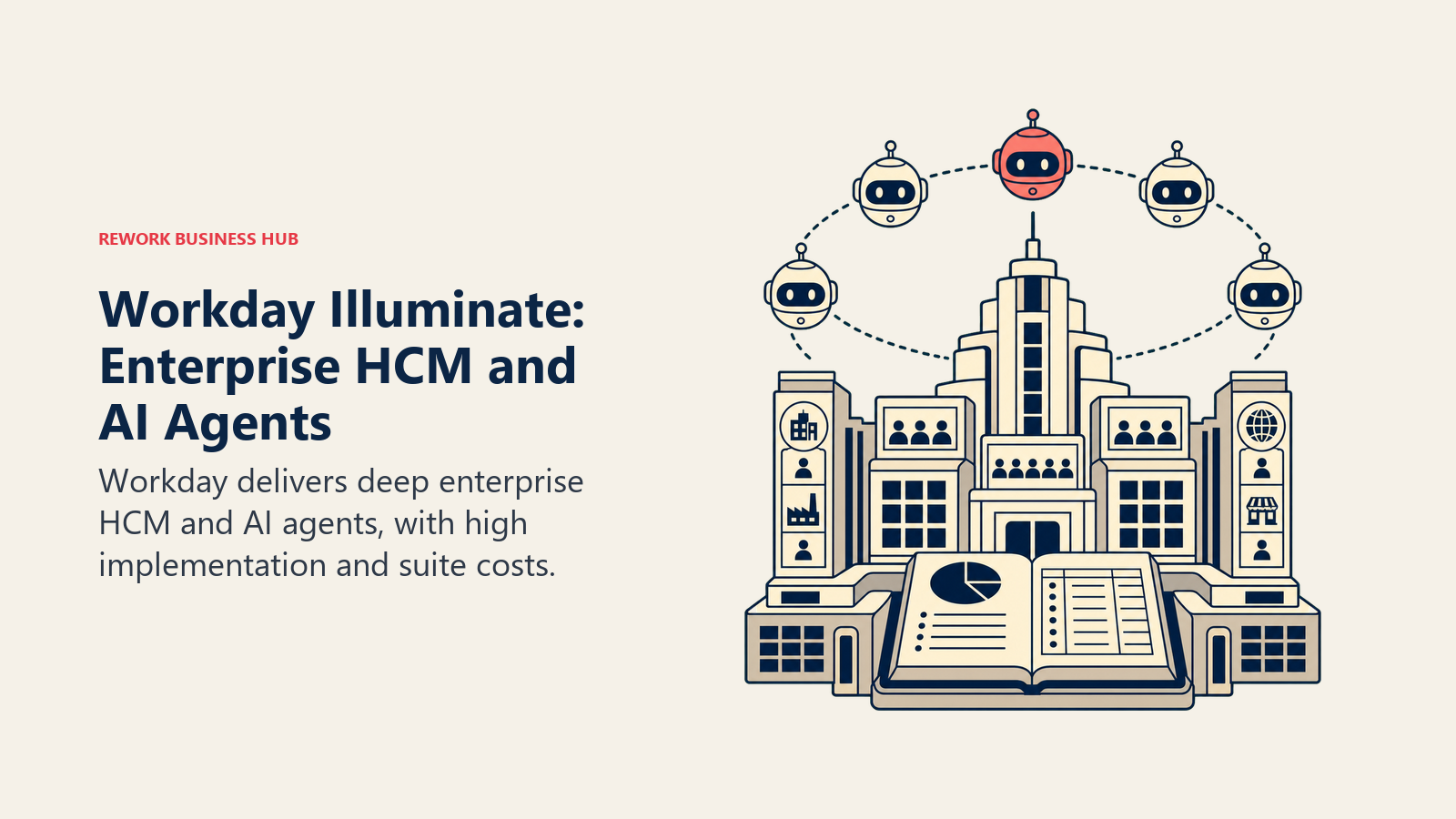
No other HRIS on this list matches Workday's depth for complex, multi-entity enterprise workforces. The cost of that depth is real: pricing is entirely custom, implementation commonly adds $300K-$800K in year one, and the deepest Illuminate AI capabilities require upgrading to the Full Suite tier, meaning you can't buy Core HCM and add AI modules a la carte. If you're not sure Workday's depth is worth the cost, our best Workday alternatives list covers lighter options.
| What you get | What you don't |
|---|---|
| Native AI agents across HR, finance, and industry workflows | Deepest AI capabilities require the Full Suite tier |
| Deepest HCM and financials integration on this list | Custom pricing; implementation adds hundreds of thousands in year one |
| Flex Credits model for more transparent AI usage | Overkill for teams under roughly 1,000 employees |
| Built for complex, multi-entity global organizations | Slow to implement; requires dedicated admin resources |
Pricing: Custom enterprise quote; estimates start from roughly $34/employee/month, with Workday Recruiting alone often running $100K-$500K+/year bundled into the broader HCM contract.
Best for: Large enterprises (1,000+ employees) needing full HCM depth plus agentic AI across HR and finance.
5. Rework: Core HR, Attendance, and Payroll With Copilots, Unified With Sales and Ops
Rework's People apps cover the core HR record for a mid-size company: an HRIS for employee records, contracts and documents, schedules and time & attendance, locked timesheets, payroll built from those timesheets, and Career for offers, onboarding, promotions and raises. All of it sits on the same platform as Rework's CRM, lead management and work apps. The AI is copilot-style: the HRIS copilot answers people-data questions and reviews contracts, the Timesheet copilot summarizes hours, leave and coverage and drafts leave or overtime actions, and the Payroll copilot explains formulas, scans runs for anomalies and writes approval briefs. A person confirms every action; the payroll copilot never approves anything by itself.
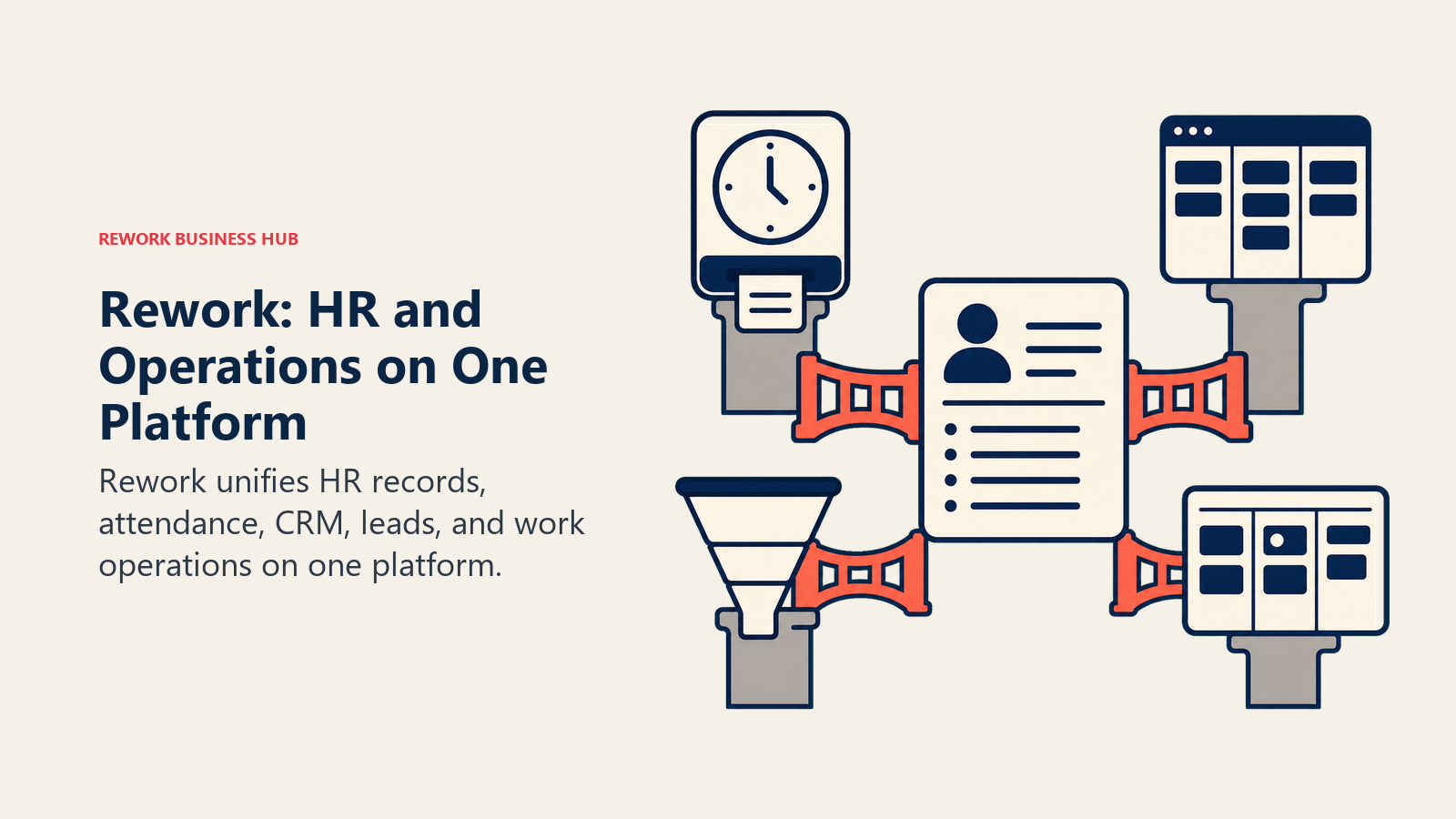
It sits below the four HRIS platforms above because its AI is narrower: there's no AI performance or engagement module, no people analytics layer, and no employee-facing HR service agent. Payroll calculates pay, tax and insurance per policy, but it doesn't file or remit taxes, disburse pay through banks, produce US forms like the W-2, or connect to benefits carriers, and its statutory defaults point to Vietnam, so it's strongest for companies in Southeast Asia. Where it wins is the stack problem: if HR, attendance and payroll sit in separate tools from your CRM and project work, Rework puts them on one employee record next to the rest of operations.
| What you get | What you don't |
|---|---|
| HRIS, attendance, timesheets, payroll and career moves on one employee record | No tax filing, bank disbursement, US payroll forms or benefits-carrier connections |
| Copilots in HRIS, Timesheet and Payroll that draft actions for a person to approve | No AI performance, engagement or people analytics module like Lattice, Macorva or Visier |
| HR data on the same platform as sales, lead and work apps | People pricing isn't published; quoted per organization |
| Built for 20-500 person, cross-functional companies | Not for solo HR admins, and not a Workday-depth enterprise HCM |
Pricing: Rework People is not publicly priced; pricing is quoted per organization (see rework.com/pricing). Rework's published engine prices cover its sales, marketing and work apps, not People.
Best for: 20-500 person companies, especially in Southeast Asia, that want HR, attendance and payroll on the same platform as sales and operations rather than in a standalone HR stack.
6. ChatGPT (Business/Enterprise): General-Purpose AI for HR Teams
Plenty of HR teams don't start with a dedicated HR AI tool at all. They start with ChatGPT, using it to draft job descriptions, summarize policy documents, write manager coaching scripts, and analyze open-ended survey feedback. It's not HR-specific, but its flexibility and low barrier to entry make it the most commonly adopted AI tool in HR functions today, per SHRM's finding that AI use is most common in recruiting, HR technology, learning and development, and employee experience, largely because general-purpose tools like ChatGPT get used across all four.
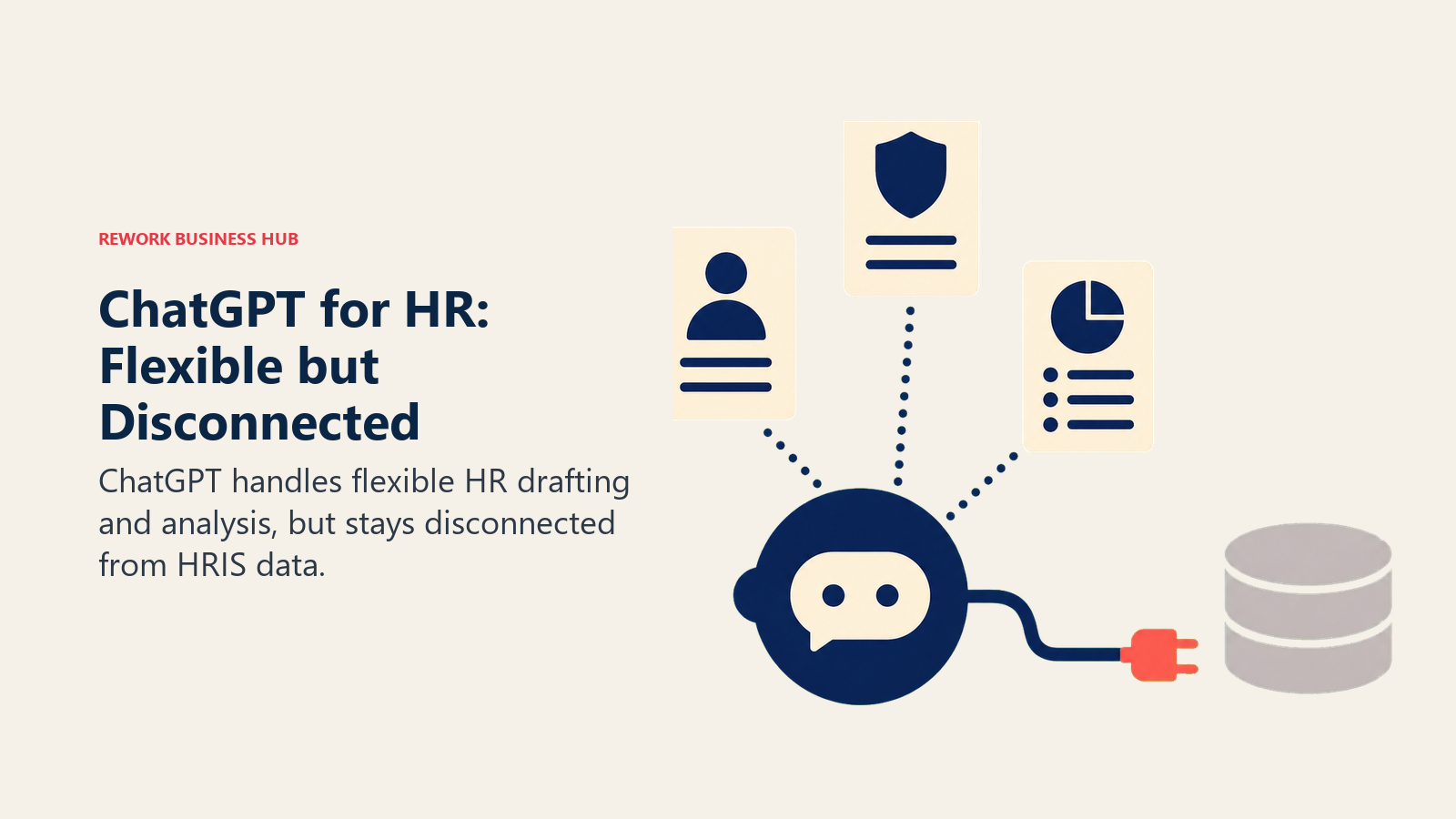
The honest limitation is that ChatGPT has no native connection to your HRIS data, so anything it produces needs to be manually pulled from and pasted back into your system of record. For task-specific AI already wired into HR workflows, the dedicated tools elsewhere on this list will save more time. If you're weighing ChatGPT against other conversational AI options, see our best AI chatbots comparison, or the broader best AI tools roundup for tools outside HR entirely.
| What you get | What you don't |
|---|---|
| Flexible drafting and analysis for any HR writing task | No native HRIS data connection |
| Low cost to start; works for any team size | Not purpose-built for HR workflows |
| Fast to adopt; no implementation project required | Output quality depends heavily on prompt skill |
| Enterprise tier adds compliance and security controls | Enterprise pricing is opaque and sales-negotiated |
Pricing: Business $20/user/month (annual, 2-seat minimum) or $25/user/month monthly; Enterprise is custom and sales-negotiated, with reported 2026 contracts averaging roughly $45-75/user/month on a 150-seat minimum.
Best for: Any HR team wanting a flexible AI assistant for drafting and analysis without committing to a dedicated HR AI platform yet.
7. Leena AI: Agentic HR Service Desk for the Enterprise
Leena AI's positioning is "AI colleagues" rather than chatbots: pre-built AI agents that sit across HR, IT, and finance and are designed to resolve routine employee requests (password resets, policy questions, leave balance checks, onboarding paperwork) without a human ticket ever being opened. The vendor reports agents going live in roughly 45 days and auto-resolving more than 70% of tickets, a vendor-reported figure worth validating in your own pilot rather than taking at face value.
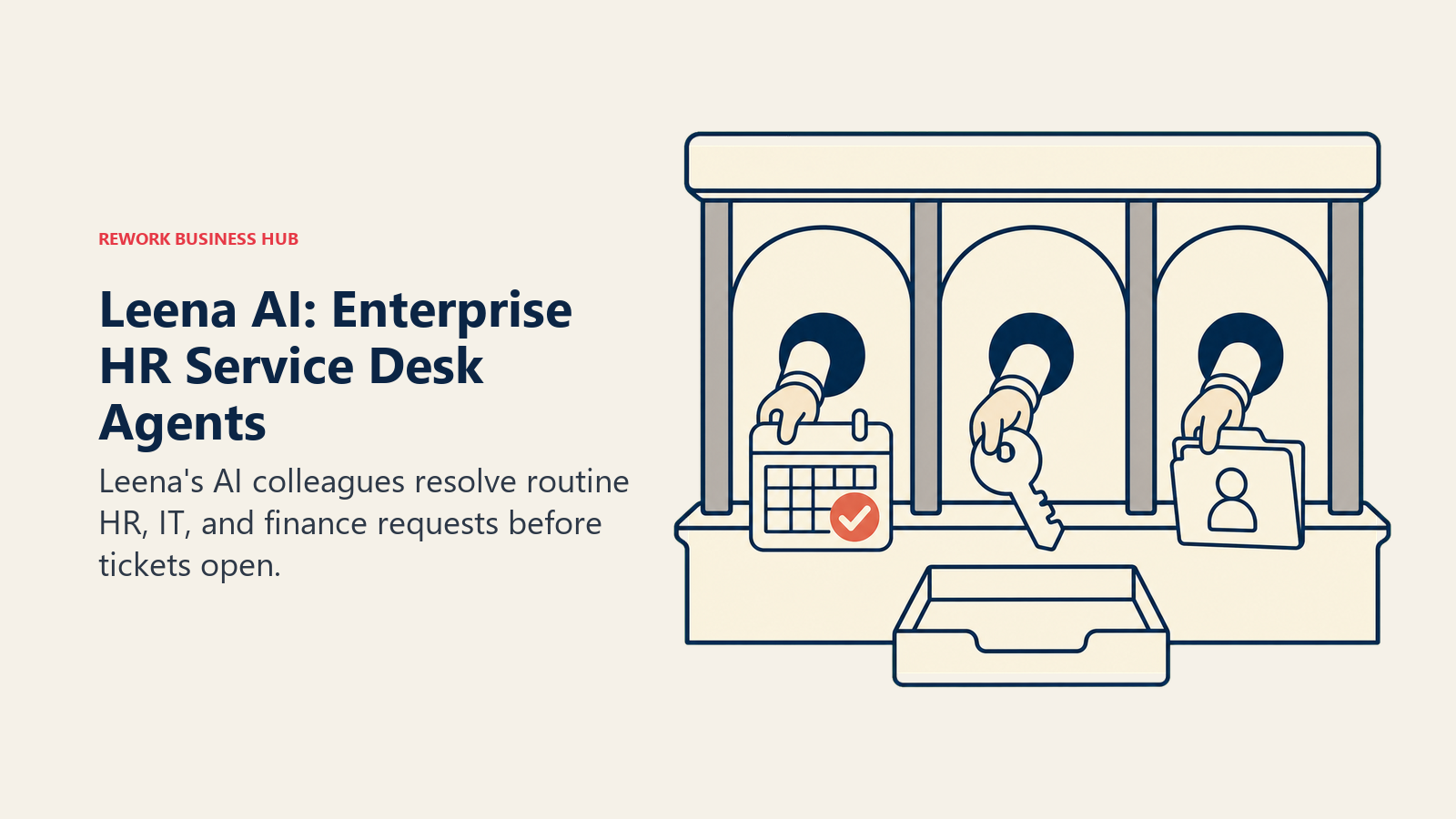
This is squarely an enterprise play. Leena AI doesn't publish pricing, and its headcount-based, quote-driven model is built for large, stable organizations, not teams still figuring out their HR tech stack. For mid-size teams, a lighter-weight AI layer on top of an existing HRIS (Lattice, Macorva, or your core HRIS's built-in assistant) will likely get more value faster.
| What you get | What you don't |
|---|---|
| Pre-built "AI colleagues" for HR, IT, and finance ticket resolution | Custom, quote-driven pricing with no published tiers |
| Vendor-reported 70%+ auto-resolution and fast go-live | Headcount-based pricing is hard to forecast |
| Reduces routine ticket load on HR operations teams | Overkill for teams without high ticket volume |
| Built for large, stable enterprise headcounts | Vendor-reported metrics should be validated in a pilot |
Pricing: Custom, enterprise-only; no published pricing tiers. Contact Leena AI directly for a quote based on employee count and modules selected.
Best for: Large enterprises with high HR/IT/finance ticket volume wanting an agentic AI service desk layered on top of their existing systems.
8. Lattice AI: AI-Powered Performance, Goals, and Engagement
Lattice built its name on performance management and OKRs, and its AI layer extends that focus rather than trying to be a full HRIS. The AI agent summarizes performance reviews, tracks recurring themes across 1:1 meetings, surfaces engagement insights, and assists with compensation analysis, all sitting on top of whatever core HRIS already runs your payroll.
That's the honest tradeoff: Lattice is not an HRIS and has no payroll of its own, so it needs a system like BambooHR, Rippling, or HiBob running underneath it. For teams that already have HR administration handled and specifically want a best-in-class AI layer for reviews, goals, and engagement, that specialization is a strength, not a gap. Our best Lattice alternatives list covers other options if you want performance management bundled differently.
| What you get | What you don't |
|---|---|
| AI review summaries, 1:1 theme tracking, and compensation insights | Not an HRIS; needs a core payroll system alongside it |
| Modular pricing lets you buy only the modules you need | $4,000/year minimum regardless of team size |
| Best-in-class OKR and goals tooling | Engagement and Grow modules cost extra on top of the base |
| Strong manager-facing coaching tools | Full stack (Performance + Engagement + Grow + Comp) adds up fast |
Pricing: Foundations bundle (Performance, Goals & OKRs, succession, 1:1s) at $13/seat/month; Engagement +$4/seat/month; Grow +$4/seat/month; Compensation +$6/seat/month. $4,000/year minimum contract.
Best for: Mid-size to large teams that already have a core HRIS and want a dedicated AI layer for performance, goals, and engagement.
9. Macorva: AI-Driven Engagement and Performance Feedback
Macorva's angle is that most engagement surveys collect data nobody acts on. Its Radiant AI technology generates a personalized engagement report for every individual manager, translating survey and pulse data into specific, actionable coaching points instead of a single company-wide dashboard nobody reads. Its companion product, Macorva MX, uses AI to draft performance reviews and development plans, with the vendor reporting the AI-generated features save managers more than 100 hours a year, a vendor claim worth testing against your own manager population before you budget around it.
Macorva doesn't publish pricing, which makes it harder to shortlist quickly against Lattice or a built-in HRIS engagement module. It's also a standalone tool, not a system of record, so it needs to sit alongside whatever HRIS already runs your employee data.
| What you get | What you don't |
|---|---|
| AI-generated, manager-specific engagement reports | No published pricing; contact for quote |
| AI-assisted performance reviews and development plans | Standalone tool, not a core HRIS |
| 360-degree feedback, eNPS, and driver analysis built in | Vendor-reported time savings should be validated in-house |
| ADP Marketplace integration for existing ADP customers | Less brand recognition than Lattice or 15Five |
Pricing: Not published; contact Macorva directly for a quote based on employee count and modules (Macorva EX vs Macorva MX).
Best for: Mid-size to large teams wanting AI-generated, manager-level engagement and performance feedback rather than a raw survey dashboard.
10. Visier: AI-Powered Workforce Analytics at Enterprise Scale
Visier's product philosophy is that people data should drive workforce planning the way financial data drives budgeting. Vee, its generative AI assistant, answers people-related questions instantly and surfaces "big picture" workforce stories through AI-augmented insight boards, while the platform's predictive analytics support attrition forecasting and headcount planning.
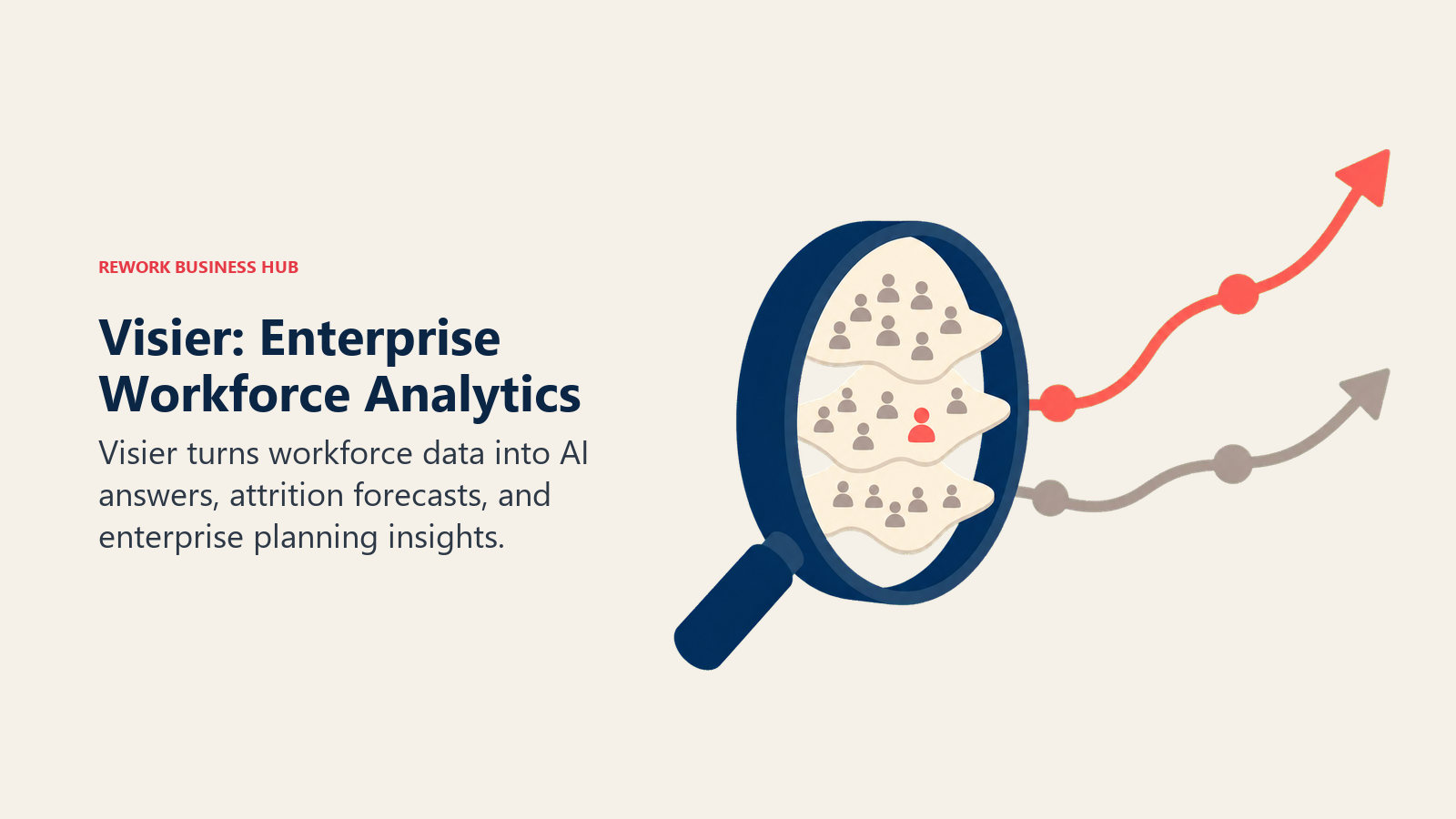
This is a serious enterprise commitment, not a self-serve tool. Visier typically requires a dedicated data team, a Visier specialist to operate it well, and a six-figure annual contract with a 1-3 year commitment. For organizations without that scale or that internal analytics capacity, ChartHop offers a lighter, more modular path to similar AI-assisted insights.
| What you get | What you don't |
|---|---|
| Vee generative AI assistant for instant people-data answers | Requires a data team and specialist to operate well |
| Predictive analytics for attrition and workforce planning | Six-figure-plus annual contracts; 1-3 year commitments typical |
| AI-augmented insight boards surface trends automatically | Lengthy implementation timelines |
| Built for genuinely enterprise-scale workforce complexity | Overkill for small and mid-size businesses |
Pricing: Custom, enterprise-only; typically a six-figure annual contract with multi-year commitments. No published self-serve pricing.
Best for: Large enterprises with a dedicated people analytics function wanting deep, AI-assisted workforce planning.
11. ChartHop: Modular AI People Analytics and Org Charts
ChartHop's bet is that people analytics shouldn't require a Visier-level commitment to get started. Its Core plan bundles people analytics, AI insights, org charts, and employee profiles at a low per-employee entry price, then lets teams add HRIS, headcount planning, compensation, performance, engagement, and goals modules individually as needed, plus a pay-as-you-go "ChartHop AI Pro" tier for workflow automation.
That modularity is the appeal for mid-size teams that want AI-assisted analytics without committing to a full HRIS replacement or an enterprise analytics contract. The tradeoff is that full HRIS depth requires stacking several paid add-ons, so a team that ends up needing most of the modules may find the total cost creeping toward what a bundled HRIS would have cost anyway.
| What you get | What you don't |
|---|---|
| AI insights, org charts, and analytics at a low entry price | Full HRIS depth requires stacking multiple paid add-ons |
| Modular pricing scales with what you actually turn on | Enterprise scale still requires a custom quote |
| Pay-as-you-go AI Pro tier for workflow automation | Less analytics depth at true enterprise scale than Visier |
| Strong for headcount planning and compensation modeling | Newer entrant with a smaller ecosystem than Workday |
Pricing: Core at $5/employee/month (analytics, AI insights, org charts); add-on modules (HRIS, headcount planning, compensation, performance) at $4/employee/month each, and engagement/goals at $3/employee/month each. Enterprise custom quote available.
Best for: Mid-size teams (100-1,000 employees) wanting modular, AI-assisted people analytics without a full HRIS or enterprise analytics commitment.
12. Paradox (Olivia): Conversational AI for High-Volume Onboarding and Screening
Paradox's Olivia is a conversational AI assistant purpose-built for high-volume, frontline hiring and onboarding, the kind of hiring where hundreds of candidates need to be screened and scheduled over SMS and chat, 24/7, without a recruiter manually triaging every application. Beyond screening, Olivia also automates onboarding paperwork and first-day logistics, which is why it earns a spot in a broader HR roundup rather than only a recruiting one.
Paradox doesn't publish pricing, and its packaging is actively shifting following its October 2025 acquisition by Workday. For teams evaluating it purely as a screening and interview tool rather than an onboarding assistant, our best AI recruiting tools guide covers Paradox alongside HireVue, SeekOut, and other sourcing-and-screening specialists in more depth.
| What you get | What you don't |
|---|---|
| 24/7 conversational AI screening, scheduling, and onboarding | No published pricing; everything is custom-quoted |
| Purpose-built for frontline, high-volume hiring | Not a general HRIS or performance tool |
| SMS and chat-native, fits candidates who don't use email daily | Packaging is shifting post-Workday acquisition |
| Reduces recruiter workload on repetitive screening tasks | Overkill for low-volume, knowledge-work hiring |
Pricing: Custom, starting from roughly $1,000+/month for smaller deployments; mid-market deployments commonly run $25,000-$60,000/year, and enterprise contracts $75,000-$150,000+/year.
Best for: Retail, hospitality, and healthcare-scale organizations hiring and onboarding large volumes of frontline workers.
13. Textio: Bias-Aware AI Writing for Job Posts and Performance Feedback
Textio's core insight is that language shapes outcomes, and its AI flags biased, exclusionary, or vague language before a job post or a performance review goes out the door. Textio Hire focuses on recruiting content, while Textio Perform extends the same augmented-writing engine to performance review feedback, which is why it belongs in a broader HR list rather than purely a recruiting one.
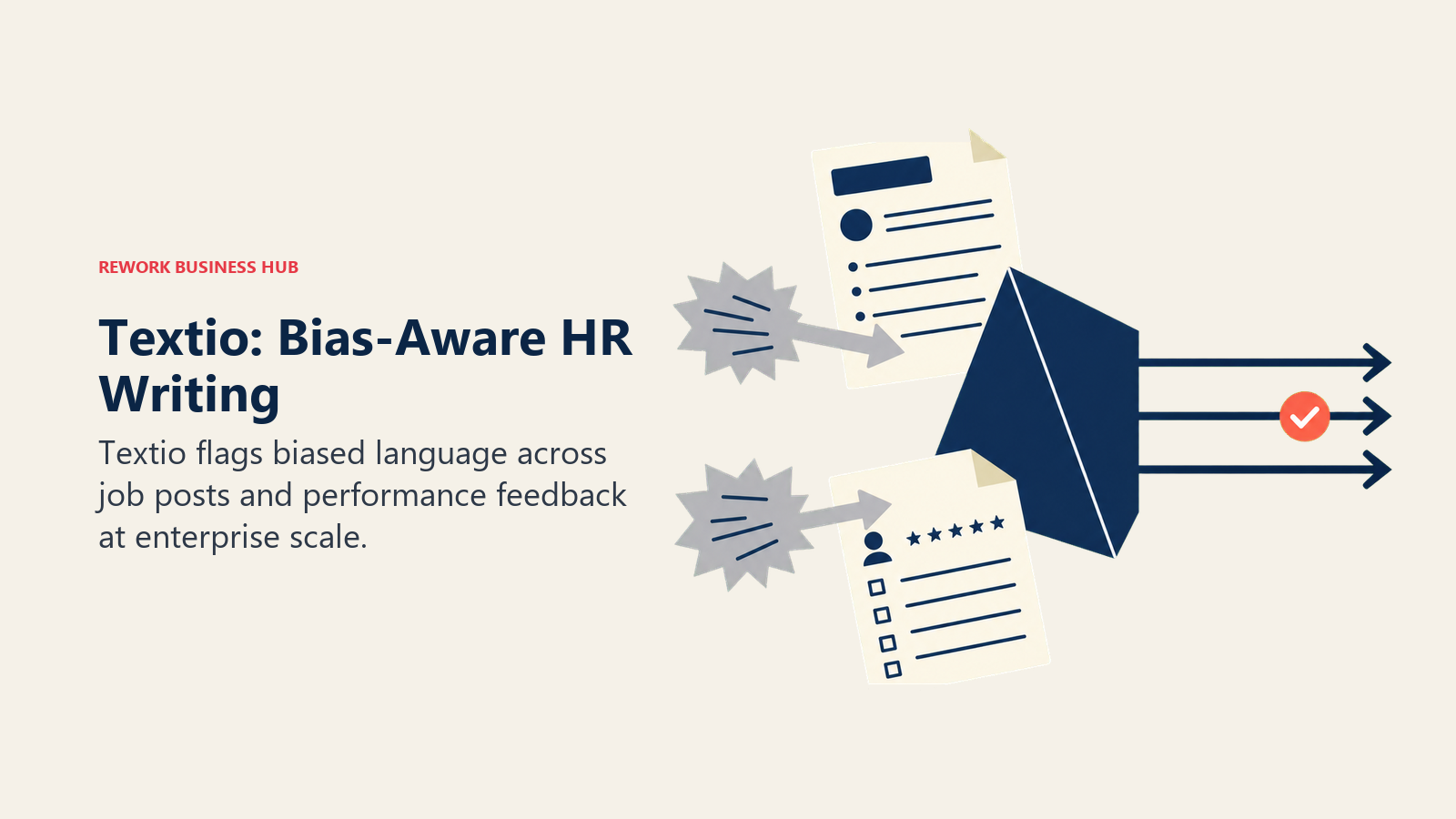
This is enterprise-only software with enterprise pricing; there's no self-serve tier for small teams to try it out cheaply. Textio Hire is priced by recruiting seat, while Textio Perform is priced by covered employee, so the total cost depends heavily on which product (or both) you're buying and how many people it touches.
| What you get | What you don't |
|---|---|
| Bias detection for job posts and performance review feedback | No self-serve or low-cost tier; enterprise-only |
| Two distinct products (Hire and Perform) for two different use cases | Pricing not published; typically $15K-$50K+/year |
| Strong evidence base for reducing exclusionary language | Adds a separate tool and workflow to an already busy HR stack |
| Useful for standardizing manager feedback quality at scale | Best value scales with volume; less economical for small teams |
Pricing: Enterprise-only, no self-serve tier; typically $15,000-$25,000/year for smaller teams, $25,000-$50,000/year for mid-market (100-500 employees), and $50,000+/year for larger enterprises.
Best for: Mid-size to large organizations wanting to standardize bias-aware language across job posts and performance reviews.
What to Do Next
Pick the HR function that hurts most right now (onboarding, performance, engagement, analytics, or general HR admin), not the tool with the flashiest AI demo. Shortlist two options from the same row of the decision framework above, run a 30-day pilot with real managers and real employee data, and measure whether it actually reduces manual work before you sign an annual contract. If your core problem is that HR data lives in a different system than the rest of your company's revenue and operations work, Rework's People apps are worth a look alongside the specialists on this list. And if recruiting and screening are the bigger gap, the best AI recruiting tools guide picks up where this one leaves off.

Principal Product Marketing Strategist
On this page
- What Changed in 2026
- Key Facts
- Quick Comparison Table
- How to Choose: Decision Framework
- 1. Rippling AI: HR, IT, and Finance Unified with Embedded AI
- 2. BambooHR (Ask BambooHR): AI Assistant on a Simple Core HRIS
- 3. HiBob (Bob): AI Insights on a Culture-Forward HRIS
- 4. Workday Illuminate: Enterprise HCM with Agentic AI
- 5. Rework: Core HR, Attendance, and Payroll With Copilots, Unified With Sales and Ops
- 6. ChatGPT (Business/Enterprise): General-Purpose AI for HR Teams
- 7. Leena AI: Agentic HR Service Desk for the Enterprise
- 8. Lattice AI: AI-Powered Performance, Goals, and Engagement
- 9. Macorva: AI-Driven Engagement and Performance Feedback
- 10. Visier: AI-Powered Workforce Analytics at Enterprise Scale
- 11. ChartHop: Modular AI People Analytics and Org Charts
- 12. Paradox (Olivia): Conversational AI for High-Volume Onboarding and Screening
- 13. Textio: Bias-Aware AI Writing for Job Posts and Performance Feedback
- What to Do Next