Best AI Tools for Dental Diagnostics in 2026: 12 Platforms Ranked by Use Case
Turn this article into takeaways for your work.


Each assistant summarizes the article only for you and suggests best practices for your work.
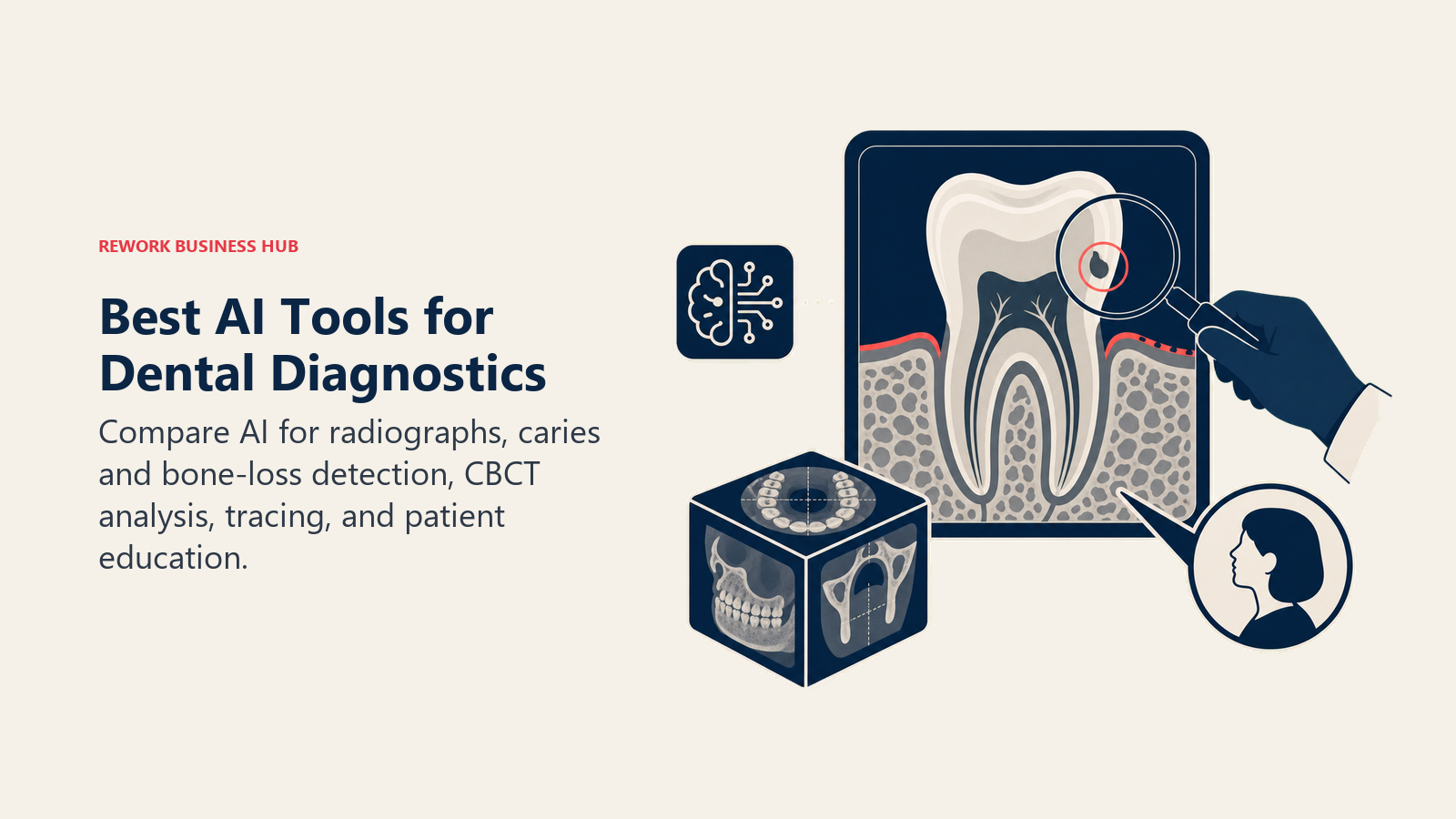
Most dental practices don't need one AI platform that does everything. They need a radiograph tool that catches what a tired set of eyes misses at 4pm on a Friday, a way to show patients what's actually on the film, and, if the practice runs CBCT or ortho, something that turns a 3D scan or a cephalometric trace into a report instead of an hour of manual measuring. Overjet and Pearl lead enterprise-scale, FDA-cleared caries and bone-loss detection for DSOs, VideaHealth and Denti.AI cover the same ground with different pricing and integration models, Diagnocat and Carestream's AI Insights extend into CBCT interpretation, and CephX and iTero's NIRI imaging handle the ortho and chairside-scanning end of the category. This guide ranks 12 dental diagnostic AI platforms practices are actually adopting in 2026, not a generic AI list repurposed for dentistry.
Every tool below was evaluated on real diagnostic use (radiograph interpretation, CBCT segmentation, charting, and patient communication). Most enterprise dental AI vendors do not publish list prices, so figures marked "estimated" or "reported" reflect third-party research, not a rate card. Confirm the current number and current FDA clearance scope with the vendor directly before you budget or rely on a specific claim clinically. Nothing in this guide is clinical advice; every AI finding here still requires review and sign-off by a licensed dentist.
What Changed in 2026
The category expanded across 2D and 3D imaging, scanner-based detection, orthodontics, implants, and lower-cost practice access.
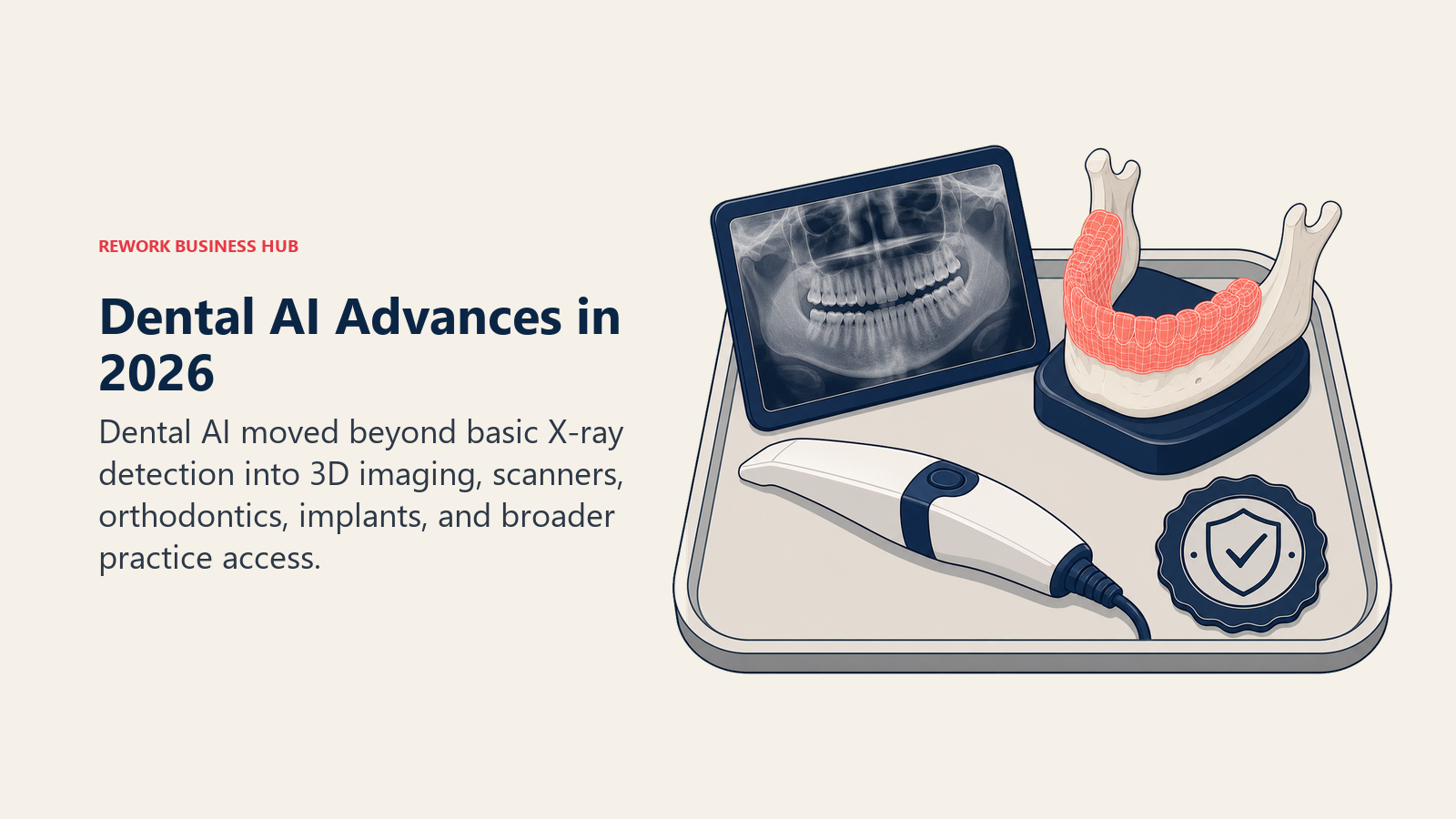
- Pearl became the first dental AI company cleared by the FDA for both 2D and 3D imaging, adding a December 2025 clearance for panoramic radiographs to its existing bitewing, periapical, and CBCT (Second Opinion 3D) clearances.
- Denti.AI cut its radiograph AI to a flat $49/month per location and folded in Auto-Chart 2, a lower published price point than most of the category.
- VideaHealth added OrthoAI and ImplantAI to its platform in July 2025, extending its FDA-cleared detection set beyond general restorative and periodontal findings into orthodontic and implant-planning use cases.
- Dentsply Sirona and Pearl announced a partnership to embed Second Opinion directly into DS Core, giving practices already on Dentsply Sirona imaging hardware a built-in path to FDA-cleared AI without a separate integration project.
- Dental Monitoring's May 2024 FDA De Novo clearance, the first and only clearance of its kind for remote orthodontic monitoring via smartphone photos, has continued to drive adoption, with the platform now used by roughly 42% of US orthodontic offices.
Key Facts
- Overjet's Caries Assist helped dentists detect 32% more tooth surfaces containing caries compared to unaided review, per Overjet's own clinical data.
- A clinical study cited by VideaHealth found its cavity-detection AI cut missed lesion detection rates by 43% when dentists used it alongside standard review, per coverage of the FDA clearance.
- Practices using Overjet's annotated imaging in patient consultations report a 25% increase in case acceptance, and 72% of surveyed patients say they'd be more likely to accept treatment when shown AI findings on their own X-ray, per Overjet's patient-education research.
- Denti.AI's clinical data shows 26% more treatment opportunities identified when dentists use its AI detection alongside standard radiograph review, per Denti.AI's FDA clearance announcement.
Quick Comparison Table
| Tool | Best For | Standout Capability | Starting Price | FDA Status |
|---|---|---|---|---|
| Overjet | DSOs and insurers wanting the broadest clinical intelligence platform | 10 FDA clearances spanning caries, bone loss, and charting | Custom, quote-based | FDA 510(k) cleared, multiple |
| Pearl (Second Opinion) | Practices wanting one AI across 30+ imaging brands | First company cleared for both 2D and 3D imaging | ~$300/mo for radiograph AI, ~$800/mo bundled (estimated) | FDA 510(k) cleared, 2D and 3D |
| VideaHealth (Videa AI) | Mid-size to large DSOs wanting ambient, no-click AI | FDA cleared for 30+ conditions, including first pediatric clearance | Custom, quote-based | FDA 510(k) cleared |
| Denti.AI | Independent practices wanting a low, published price | $49/mo flat, bundled with Auto-Chart 2 voice charting | $49/mo (Detect) + $10/user/mo (Voice Perio) | FDA 510(k) cleared, pano and intraoral |
| Diagnocat | Practices running CBCT wanting detailed 3D reporting | 65+ conditions detected on CBCT scans | ~$140/mo (2D), ~$270/mo (3D) | FDA cleared for US market |
| Carestream Dental AI Insights | Practices already on Carestream imaging hardware | Caries Pro Mode with interactive tooth-level charting | Bundled with Carestream imaging systems, quote-based | Integrated diagnostic-support module |
| Apteryx XVWeb (Planet DDS) | Practices wanting AI built into their imaging software, not bolted on | Native Caries Decision Support Tool, sub-1-second analysis | Included with XVWeb subscription, quote-based | Third-party AI integration (Overjet, VideaHealth) |
| CephX (Orca Dental AI) | Orthodontists wanting automated cephalometric tracing | 2D and CBCT-based cephalometric analysis, per-case pricing | $69/mo (3 cases) up to $449/mo (50 CBCT cases) | Not a diagnostic-detection clearance; analysis automation service |
| iTero Lumina (Align Technology) | Practices wanting caries detection built into scanning, not X-rays | NIRI near-infrared imaging alongside 3D intraoral scanning | Scanner hardware, typically $20,000-$35,000+ | NIRI is an imaging feature of a cleared scanner system |
| Dental Monitoring (DM) | Orthodontists wanting AI-driven remote patient monitoring | 130+ validated conditions tracked from smartphone photos | Custom, quote-based per patient/month | FDA De Novo cleared, first of its kind |
| Adravision | DSOs wanting AI across claims, charting, and patient communication | 71% reported reduction in charting time, insurance-claim automation | Custom, quote-based | Not positioned as a diagnostic-detection device |
| AI:D (Clinical AI:D) | Dental schools and clinics wanting a second-read training layer | Free education platform (Edu AI:D) alongside a clinical tool | Custom, quote-based; Edu AI:D is free | Explicitly research-use only, not for medical diagnosis |
Practice Type Fit Matrix
Use this as a first filter before you dig into individual tools. "Strong fit" means the pricing model and deployment path match how that kind of buyer actually purchases software.
| Tool | Solo / Independent | Small Group (2-10) | Mid-Size DSO (10-50) | Large DSO / Enterprise (50+) |
|---|---|---|---|---|
| Overjet | - | Possible | Strong fit | Strong fit |
| Pearl | Possible | Strong fit | Strong fit | Strong fit |
| VideaHealth | - | Possible | Strong fit | Strong fit |
| Denti.AI | Strong fit | Strong fit | Possible | - |
| Diagnocat | Strong fit | Strong fit | Possible | - |
| Carestream AI Insights | Possible (if on Carestream hardware) | Strong fit | Strong fit | Possible |
| Apteryx XVWeb | Strong fit | Strong fit | Possible | - |
| CephX | Strong fit (ortho) | Strong fit (ortho) | Possible | - |
| iTero Lumina | Possible | Strong fit | Strong fit | Strong fit |
| Dental Monitoring | - | Possible (ortho) | Strong fit (ortho) | Strong fit (ortho) |
| Adravision | - | Possible | Strong fit | Strong fit |
| AI:D | Strong fit (dental schools) | Possible | Possible | - |
Sizing and Persona Table
| Tool | Ideal Practice Size | Primary Buyer Persona |
|---|---|---|
| Overjet | 10-1,000+ locations | DSO Chief Clinical Officer, VP of Clinical Operations |
| Pearl | 1-1,000+ locations | Practice owner, DSO Clinical Director |
| VideaHealth | 20-1,000+ locations | DSO Clinical Director, Chief Dental Officer |
| Denti.AI | 1-50 locations | Independent dentist, small group practice owner |
| Diagnocat | 1-50 locations | Solo dentist or specialist running CBCT |
| Carestream AI Insights | 1-200+ locations | Practice owner already on Carestream imaging |
| Apteryx XVWeb | 1-100 locations | Practice IT/imaging admin, independent practice owner |
| CephX | 1-50 orthodontic practices | Orthodontist, ortho practice manager |
| iTero Lumina | 1-200+ locations | GP or ortho practice owner buying a scanner |
| Dental Monitoring | 1-500+ orthodontic locations | Orthodontist, ortho DSO clinical lead |
| Adravision | 10-500+ locations | DSO revenue cycle lead, clinical operations director |
| AI:D | Dental schools, small clinics | Dental school faculty, clinic director |
1. Overjet: Broadest FDA Clearance Portfolio, Built for DSO Scale
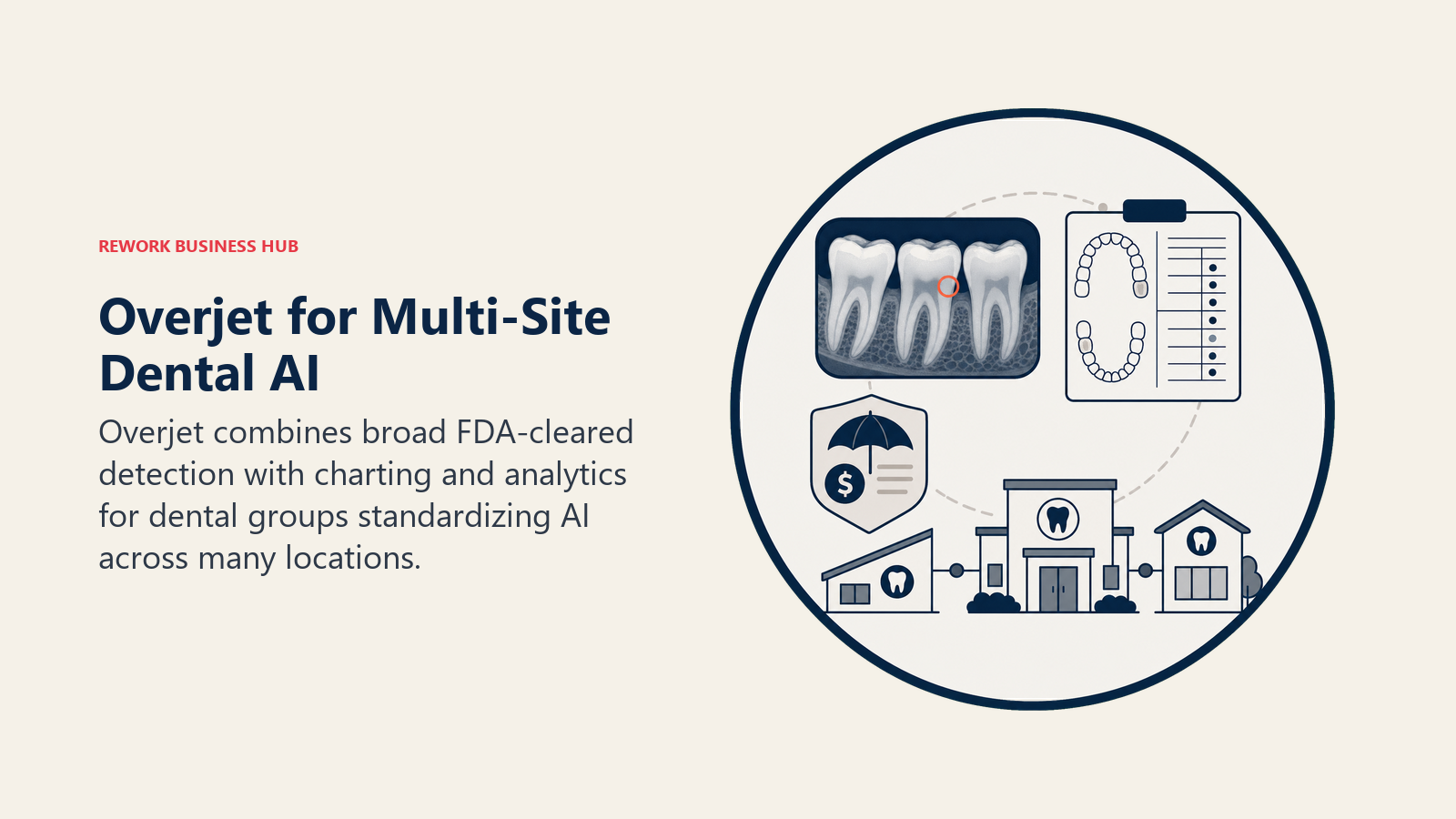
Overjet's bet is that dental AI only earns trust at scale if it covers the full clinical and financial loop, not just image annotation. It holds 10 FDA clearances spanning caries and calculus detection, quantified bone-level measurement, periapical radiolucency, charting, image enhancement, and 3D CBCT analysis, and it's deployed across major DSOs including Dental Care Alliance (400+ locations) and North American Dental Group (216 locations). That breadth is why it's often the default pick for large groups standardizing AI across dozens or hundreds of practices at once.
| What you get | What you don't |
|---|---|
| Widest FDA clearance set of any tool on this list (10 clearances) | No published pricing; every deal is custom-negotiated |
| Extends past detection into charting, insurance analytics, and patient communication | Built for DSO scale; overkill for a single-location solo practice |
| Proven track record at 1,000+ locations across major DSOs | Sales-led enterprise process, not self-serve signup |
Pricing: No public list price. Overjet sells through custom annual agreements sized to practice count, and budgeting requires a sales conversation, per The Molar Report's Overjet review.
Best for: DSOs and dental insurers wanting one AI platform that covers detection, charting, and case-acceptance analytics across many locations.
2. Pearl (Second Opinion / Second Opinion 3D): First Company Cleared for Both 2D and 3D
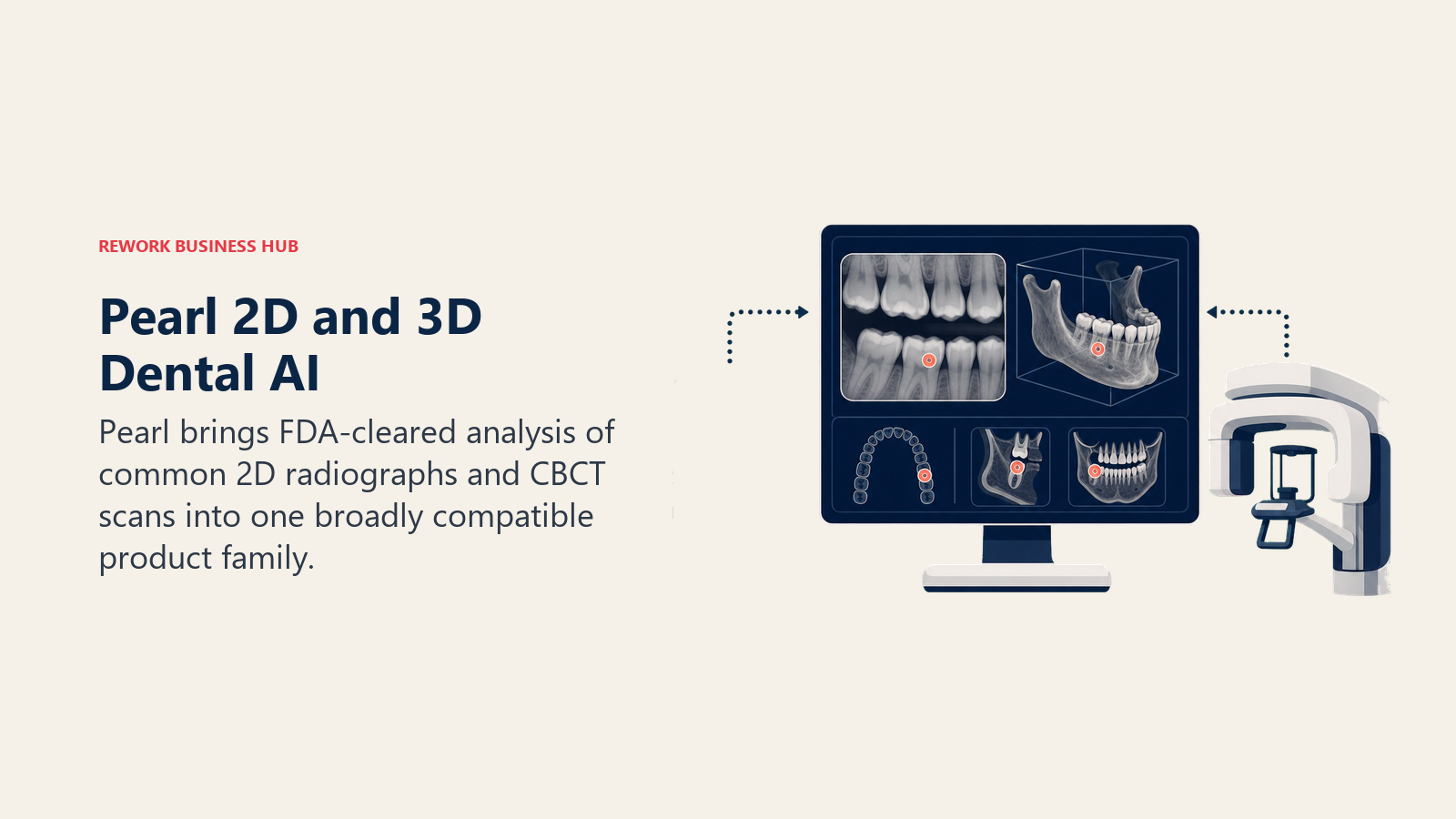
Pearl's differentiator is breadth of compatibility rather than depth in one imaging brand. Second Opinion works across more than 30 imaging and practice management platforms and is used in over 23,000 practices in 120 countries, and with its December 2025 panoramic clearance, Pearl became the first dental AI company holding FDA clearance for periapical, bitewing, panoramic, and CBCT (Second Opinion 3D) imaging in one product family.
| What you get | What you don't |
|---|---|
| Broadest FDA clearance across 2D and 3D imaging formats of any vendor here | No published pricing; third-party estimates only |
| Works across 30+ imaging and practice management brands, not locked to one vendor | Real-time chairside overlay requires compatible hardware/software on your end |
| Now embedding directly into DS Core via a Dentsply Sirona partnership | Bundled pricing (~$800/mo estimated) can be a step up from single-purpose tools |
Pricing: Pearl does not publish pricing. Third-party research places Second Opinion alone at roughly $300/month and the full bundle (including Second Opinion 3D) at roughly $800/month, per The Molar Report's Pearl pricing breakdown.
Best for: Practices and DSOs that want one AI vendor covering every radiograph type, especially those already on Dentsply Sirona or another of Pearl's 30+ integrated platforms.
3. VideaHealth (Videa AI): Ambient AI With the Broadest Single Clearance
VideaHealth's January 2024 FDA clearance covers more than 30 dental conditions in one submission, the broadest single dental AI clearance to date, including the first FDA clearance for pediatric dental AI (ages 3 and up). The platform is designed to be ambient: it runs in the background across integrated imaging software (including Apteryx XVWeb and Dentsply Sirona Sidexis) and surfaces findings automatically the moment an X-ray is taken, with no separate upload step.
| What you get | What you don't |
|---|---|
| Single clearance covering 30+ conditions, including pediatric dentistry | No published pricing; enterprise sales process |
| Ambient design; no manual upload or tab-switching required | Best suited to practices already on a compatible imaging platform |
| OrthoAI and ImplantAI (added July 2025) extend past general restorative findings | Fewer independent published pricing estimates than Pearl or Denti.AI |
Pricing: VideaHealth does not publish pricing; it's sold through a custom enterprise process sized to clinician count and imaging integration, per VideaHealth's own platform page.
Best for: Mid-size to large DSOs wanting AI that runs invisibly inside the imaging software they already use, including pediatric and ortho/implant use cases.
4. Denti.AI: Lowest Published Price for FDA-Cleared Detection
Denti.AI's pitch is straightforward: FDA-cleared detection at a flat, published price, a rarity in a category where most enterprise vendors won't quote a number publicly. Denti.AI Detect covers caries, periapical radiolucencies, and bone loss on both panoramic and intraoral radiographs, making it the only dental AI company with FDA clearance spanning both image types in one detection product, and it bundles in Auto-Chart 2 and Voice Perio for charting.
| What you get | What you don't |
|---|---|
| Published, flat $49/month price, rare for FDA-cleared dental AI | Smaller install base (10,000+ professionals) than Overjet or Pearl |
| FDA clearance spans both panoramic and intraoral radiographs | Fewer large-DSO enterprise deployments and case studies than the category leaders |
| Voice Perio adds voice-driven periodontal charting for $10/user/month | Direct integrations may cover fewer practice management systems than Pearl's 30+ |
Pricing: Denti.AI Detect costs $49/month per location; Voice Perio adds $10/user/month, per Denti.AI's own pricing announcement.
Best for: Independent practices and small groups wanting FDA-cleared caries and bone-loss detection without an enterprise sales cycle.
5. Diagnocat: Deepest CBCT Interpretation for Solo and Specialist Practices
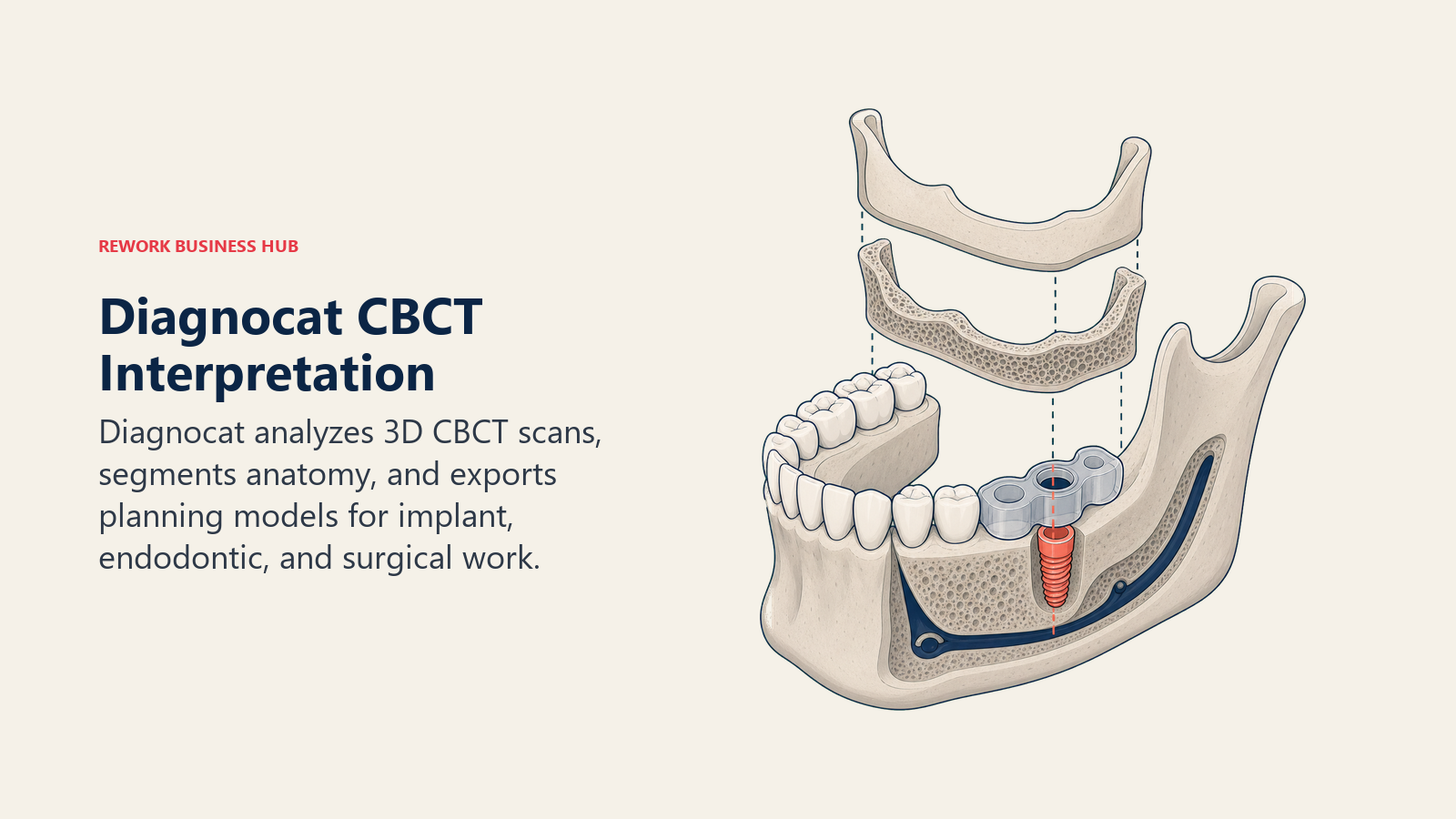
Diagnocat's strength is CBCT, not just bitewing and panoramic review. It detects over 65 conditions on 3D CBCT scans and 35+ on 2D panoramic and periapical images, automatically segments anatomy into 3D STL models exportable to surgical planning software, and generates dedicated implant and orthodontic reports, aimed at the solo dentist, endodontist, or oral surgeon who runs CBCT regularly but doesn't have Diagnocat's radiologist-level review on staff.
| What you get | What you don't |
|---|---|
| Deepest CBCT-specific detection set on this list (65+ conditions) | Published pricing is in euros, adding currency-conversion uncertainty for US buyers |
| Automated DICOM-to-STL conversion useful for implant and surgical planning | Fewer large-scale US DSO deployments referenced than Overjet, Pearl, or VideaHealth |
| Tiered, self-serve-style pricing rather than a custom enterprise quote | 3D Practice tier caps at 5 CBCT reports/month before overage or upgrade |
Pricing: 2D Practice plan at €129/month (roughly $140 USD); 3D Practice plan at €249/month (roughly $270 USD) including 5 CBCT reports monthly, 100GB storage, and DICOM/STL tools; higher-volume and enterprise tiers are custom-quoted, per Diagnocat's product page. Diagnocat has obtained FDA clearance to operate in the US market.
Best for: Solo practices, endodontists, and oral surgeons running CBCT regularly who want automated 3D interpretation without a per-scan radiologist read.
6. Carestream Dental AI Insights: AI Built Into the Imaging Hardware You Already Own
Carestream Dental's AI Insights isn't a separate app to log into; it's a module inside the imaging software that already ships with Carestream's panoramic and CBCT systems. Its Caries Pro Mode lets a dentist assess the location and depth of carious lesions directly against an interactive tooth chart, and the broader AI Insights report flags implants, fillings, and a wide range of other findings automatically once an image is captured.
| What you get | What you don't |
|---|---|
| No new software to adopt if you're already on Carestream imaging hardware | Only useful if your practice runs Carestream panoramic/CBCT equipment |
| Caries Pro Mode maps findings directly onto an interactive tooth chart | Independent, published clinical accuracy studies are less prominent than Overjet's or VideaHealth's |
| Covers both 2D panoramic and 3D CBCT within one module | Pricing is bundled into hardware/software agreements, not sold standalone |
Pricing: Not sold as a standalone subscription; AI Insights is bundled with Carestream Dental imaging systems and software agreements, quote-based through Carestream or an authorized dealer, per Carestream Dental's AI Insights product page.
Best for: Practices already invested in Carestream panoramic or CBCT hardware wanting AI without adding a separate vendor relationship.
7. Apteryx XVWeb (Planet DDS): AI Native to the Imaging Software Layer
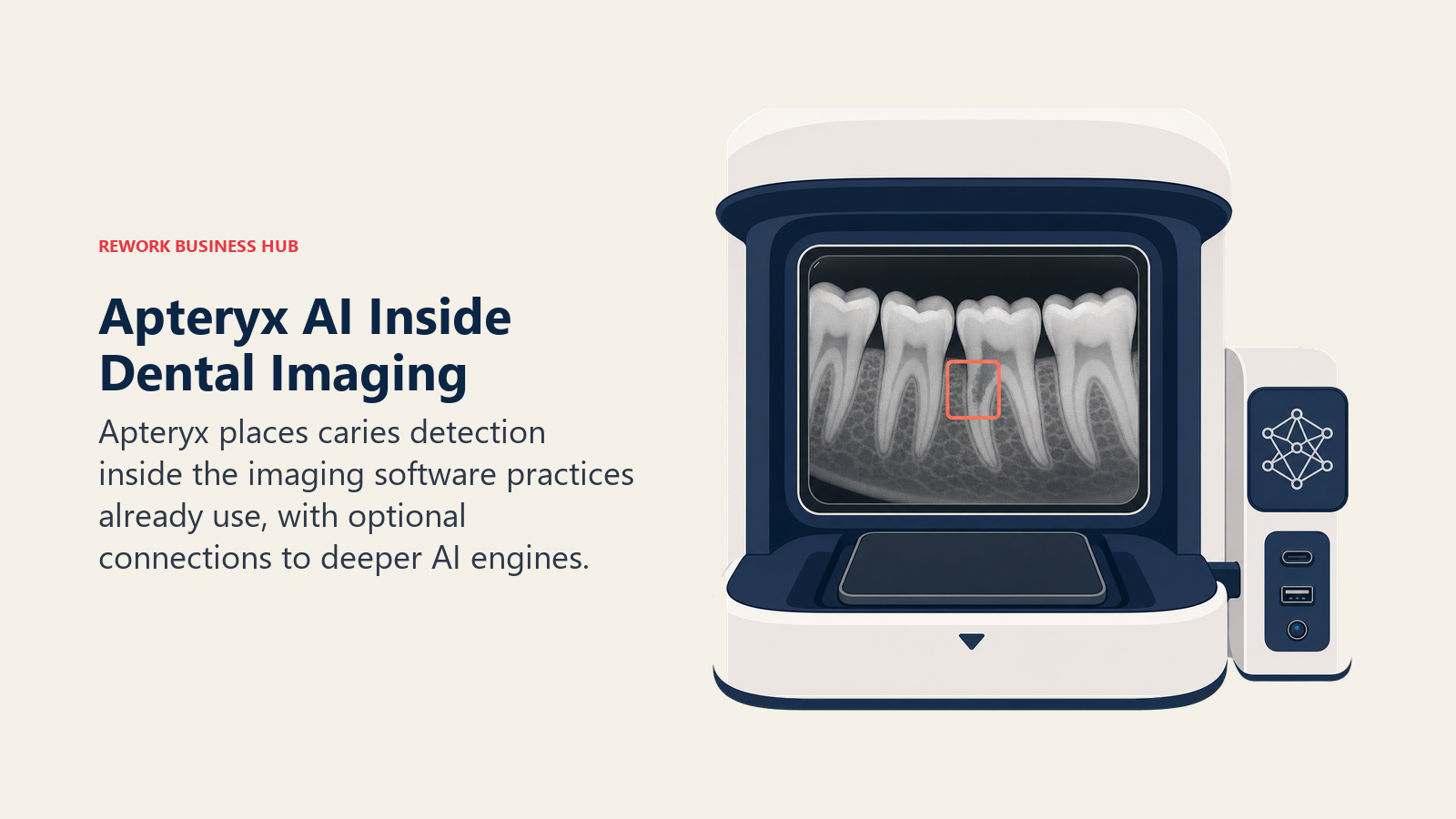
Apteryx XVWeb takes a different approach than a bolt-on detection app: its Caries Decision Support Tool is built directly into the imaging software practices already use to capture and store X-rays, analyzing images in under a second and drawing orange boxes around suspicious areas as part of the normal image-review workflow. XVWeb also supports third-party AI integrations, including Overjet and VideaHealth, so practices can layer a more specialized detection engine on top if they want deeper clinical findings than the native tool provides.
| What you get | What you don't |
|---|---|
| Caries Decision Support built natively into the imaging software, not a separate login | Native detection set is narrower than dedicated tools like Overjet or Pearl |
| Flexible integration path with Overjet or VideaHealth for deeper AI coverage | Practices not already on XVWeb gain little from this entry point |
| Reported 18% production increase tied to built-in AI capabilities | Pricing bundled into the XVWeb subscription rather than sold as a standalone AI product |
Pricing: Included as part of an Apteryx XVWeb subscription; standalone AI pricing is not separately published, quote-based through Planet DDS, per Planet DDS's coverage of the Caries Decision Support Tool.
Best for: Practices on Apteryx XVWeb wanting basic AI caries flagging built into their existing imaging workflow, with a clear upgrade path to Overjet or VideaHealth for more depth.
8. CephX (Orca Dental AI): Automated Cephalometric Tracing for Orthodontists
CephX solves a different problem than the caries-and-bone-loss detection tools above: it automates cephalometric analysis, the landmark tracing and measurement work orthodontists have historically done by hand or with semi-manual software, for both 2D lateral cephalograms and CBCT-based cephalometric analysis. DSOs including Coast Dental have adopted it specifically for the ortho side of a mixed practice.
| What you get | What you don't |
|---|---|
| Automates a genuinely tedious, error-prone manual task (landmark tracing) | Not a caries or pathology detection tool; solves a different problem entirely |
| Both 2D and CBCT-based cephalometric analysis in one platform | Per-case pricing model means costs scale directly with case volume |
| Transparent, published tiered pricing (rare in this category) | FDA clearance status for the specific AI analysis service is not published; verify current regulatory scope directly with the vendor before relying on it clinically |
Pricing: Monthly plans range from Basic 2D at $69/month (3 cases) to Pro 3D at $449/month (50 CBCT cases), with annual billing offering a discount at each tier; a free trial or 3 free cases is available for new users, per CephX's own pricing page.
Best for: Orthodontists and mixed GP/ortho practices wanting to automate cephalometric tracing rather than do it by hand or with older semi-manual software.
9. iTero Lumina (Align Technology): Caries Detection Built Into the Scanner, Not the X-Ray
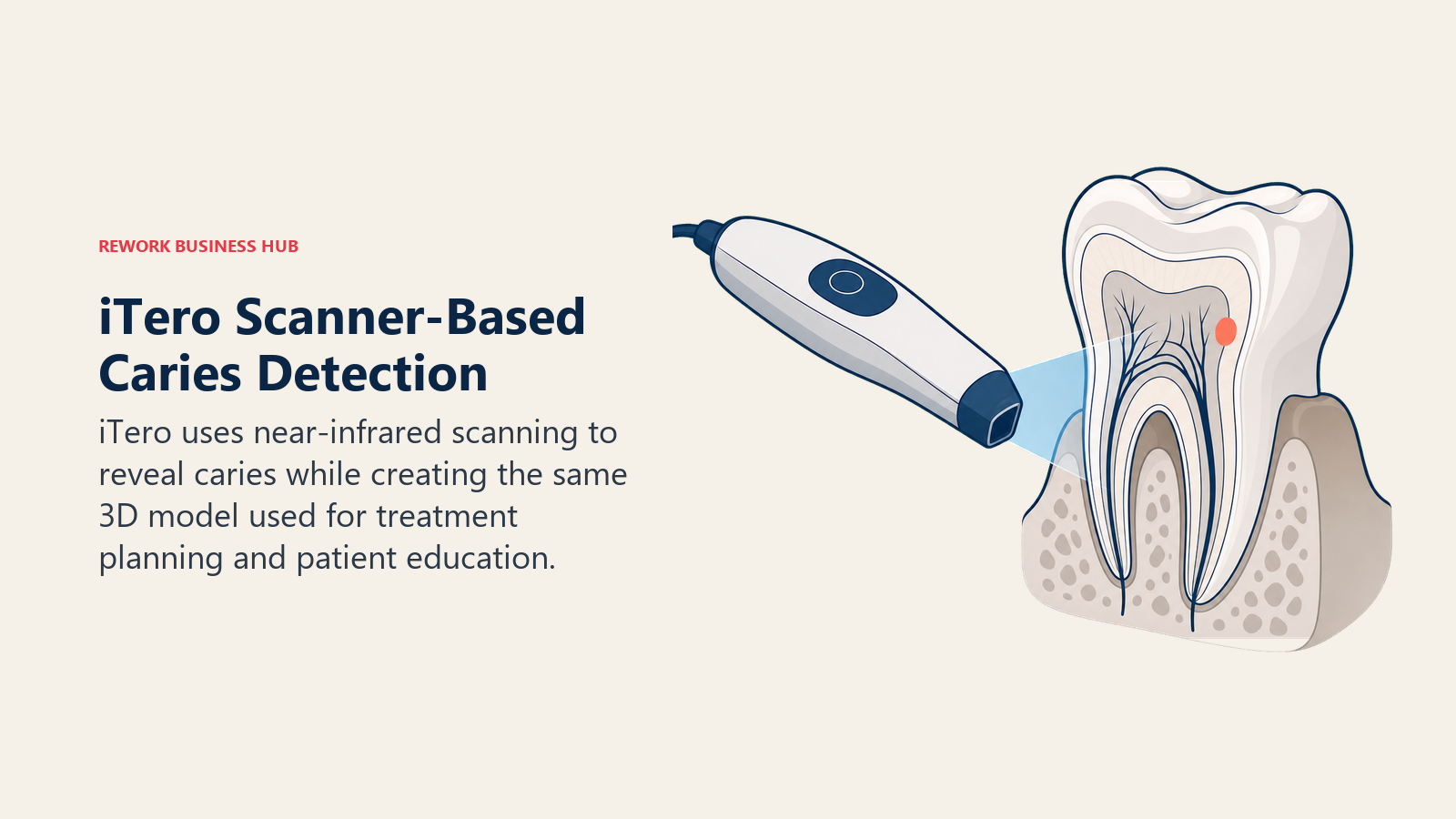
iTero takes caries detection out of the radiograph entirely. Its NIRI (Near Infra-Red Imaging) technology scans the internal structure of enamel and dentine in real time during a routine intraoral scan, and independent clinical evidence cited by Align found it 66% more sensitive than bitewing X-ray for detecting interproximal lesions. Because the same scan also produces the 3D color model patients already see for aligner or restorative treatment planning, it doubles as a strong patient-education visual without an extra step.
| What you get | What you don't |
|---|---|
| Caries detection without additional radiation exposure | Requires buying (or already owning) an iTero scanner, a $20,000-$35,000+ hardware commitment |
| NIRI shown more sensitive than bitewing X-ray for interproximal lesions in cited studies | Built for GP and ortho scanning workflows, not a standalone diagnostic AI subscription |
| Same scan doubles as a patient-facing visual for case presentation | Not a radiograph-analysis tool; doesn't replace panoramic or CBCT interpretation |
Pricing: Sold as scanner hardware plus a software/service agreement rather than a standalone AI subscription; iTero scanners typically run in the $20,000-$35,000+ range depending on model and financing, per The Molar Report's iTero review.
Best for: GP and ortho practices already buying or upgrading an intraoral scanner who want caries-detection value and a patient-education visual built into the same purchase.
10. Dental Monitoring (DM): The Only FDA-Cleared Remote Monitoring AI
Dental Monitoring solves a monitoring problem, not a chairside detection problem. Patients submit smartphone scans between visits, and DM's AI, trained on more than 500 million patient images, checks for 130+ validated clinical conditions: aligner fit and tracking, bracket debonding, tie loss, midline deviation, and more. Its May 2024 FDA De Novo clearance made it the first and only Software as a Medical Device cleared specifically for remote orthodontic monitoring, and it's now used in roughly 42% of US orthodontic offices.
| What you get | What you don't |
|---|---|
| Only FDA-cleared AI built specifically for remote orthodontic monitoring | Ortho-specific; not a general restorative or periodontal detection tool |
| Very high published accuracy (98.4% sensitivity, 99.6% specificity for bracket debonding) | Requires patient participation (regular smartphone scan submission) to work |
| Reduces in-office visit frequency for stable ortho cases | No published flat pricing; typically quoted per patient per month |
Pricing: Not publicly published; typically sold as a per-patient or per-practice subscription, quote-based, per The Molar Report's Dental Monitoring review.
Best for: Orthodontic practices and ortho-heavy DSOs wanting to monitor active treatment between visits without bringing every patient back into the chair.
11. Adravision: AI Across Claims, Charting, and Patient Communication
Adravision positions itself less as a single detection tool and more as an intelligence layer sitting across a DSO's clinical and operational data: capturing radiographs and records from existing systems, structuring the findings, then routing that evidence to clinicians, patients, and insurance payers in the format each needs. Its reported metrics (512 dental teams, 754,000+ insurance claims reviewed, a 71% reduction in charting time) point toward operational efficiency and claims turnaround as much as chairside diagnosis.
| What you get | What you don't |
|---|---|
| Covers claims review, charting, and patient communication in one layer | Not positioned or marketed as a standalone diagnostic-detection device |
| Reported 71% charting-time reduction and 4x comprehension improvement | Smaller public profile and fewer independent reviews than the category leaders |
| White-label integration option for partners and payers | No published FDA clearance status; confirm current regulatory positioning directly |
Pricing: Not publicly published; sold through a custom quote sized to claim volume and location count, per Adravision's own platform overview.
Best for: DSOs wanting to connect radiograph findings to insurance-claim workflows and patient communication, not just chairside detection.
12. AI:D (Clinical AI:D): A Training-Oriented Second Read, With Honest Limits
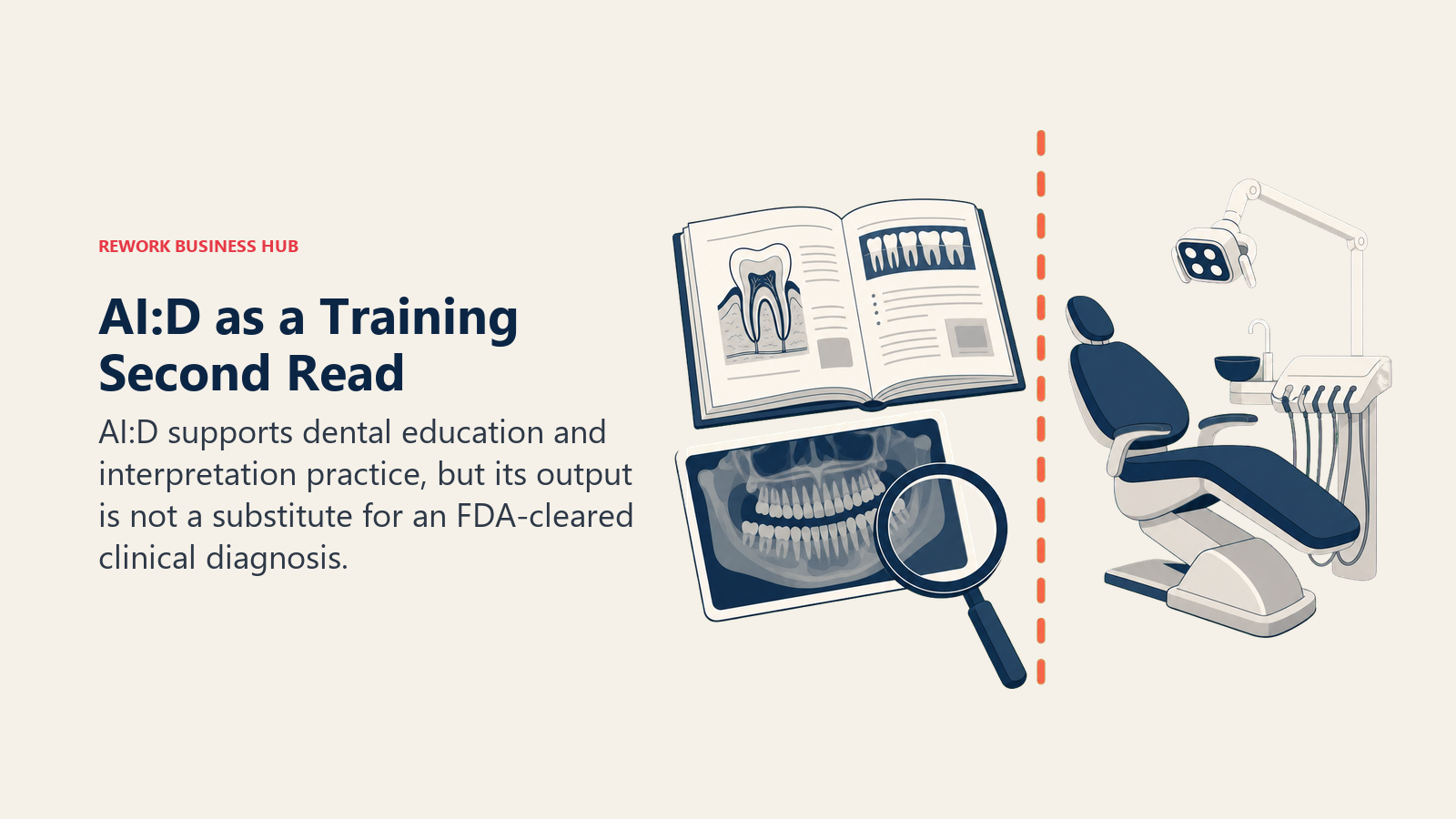
AI:D is worth including precisely because it's upfront about what it isn't. Its free Edu AI:D platform lets dental students and educators practice X-ray interpretation on real-world cases, while its paid Clinical AI:D product is described as "MDR-ready" and positioned as a second pair of eyes to reduce missed treatment opportunities. But AI:D's own site states its services are "currently intended for research purposes only and are not intended for medical diagnosis or the provision of medical care," a more conservative regulatory posture than any FDA-cleared tool on this list.
| What you get | What you don't |
|---|---|
| Free education tool (Edu AI:D) genuinely useful for dental schools | Explicitly not cleared or positioned for clinical diagnostic use in the US |
| MDR-ready framing for the EU market | No FDA clearance; do not treat its clinical output as equivalent to Overjet, Pearl, VideaHealth, or Denti.AI |
| ~3,000 independent users globally, useful for benchmarking student interpretation | Pricing for Clinical AI:D is not published; contact required |
Pricing: Edu AI:D is free; Clinical AI:D pricing is not published and requires contacting the company directly.
Best for: Dental schools and training programs wanting a free interpretation-practice tool, not practices needing an FDA-cleared clinical detection engine.
How to Choose: Decision Framework
| If your biggest need is... | Pick... | Why |
|---|---|---|
| One AI platform standardized across a large multi-location DSO | Overjet | Widest FDA clearance set, proven at 1,000+ location deployments |
| FDA-cleared AI that works across whatever imaging brand you already run | Pearl | 30+ integrations, first company cleared for both 2D and 3D |
| Ambient AI with the broadest single clearance, including pediatric | VideaHealth | 30+ conditions in one clearance, runs invisibly inside existing imaging software |
| The lowest published price for FDA-cleared detection | Denti.AI | $49/month flat, cleared for both panoramic and intraoral |
| Deep CBCT interpretation without a per-scan radiologist read | Diagnocat | 65+ CBCT conditions, automated 3D segmentation and STL export |
| AI that ships with imaging hardware you already own | Carestream AI Insights or Apteryx XVWeb | Bundled into existing panoramic/CBCT or imaging-software workflow |
| Automating cephalometric tracing for ortho cases | CephX | Purpose-built 2D and CBCT cephalometric analysis, transparent pricing |
| Caries detection without additional radiation, tied to a scanner purchase | iTero Lumina | NIRI imaging built into the same scan used for case presentation |
| Monitoring active ortho patients between visits | Dental Monitoring | Only FDA-cleared remote-monitoring AI in the category |
| Connecting radiograph findings to insurance claims and patient messaging | Adravision | Reported 71% charting-time reduction, claims-review automation |
| A free tool for dental-school training, not clinical use | AI:D | Explicitly research-use only, honest about its limits |
By Budget
| Budget | Best Fits |
|---|---|
| Free or near-free | AI:D (Edu AI:D), CephX free trial tier |
| Under $150/month | Denti.AI, Diagnocat (2D Practice), CephX (Basic/Advanced) |
| $150-$500/month | Diagnocat (3D Practice), Pearl (radiograph AI alone), CephX (Pro/3D tiers) |
| Custom enterprise quote required | Overjet, VideaHealth, Pearl (full bundle), Carestream AI Insights, Dental Monitoring, Adravision |
| Hardware purchase (scanner) | iTero Lumina, typically $20,000-$35,000+ |
FDA Clearance, HIPAA, and Where the Real Risk Sits
Adoption in dentistry is running well ahead of a lot of practices' understanding of what "FDA-cleared" actually covers. A clearance is scoped to specific conditions on specific image types, not a blanket certification of the whole product. Overjet's 10 clearances, VideaHealth's single 30-condition clearance, Denti.AI's pano-plus-intraoral clearance, and Pearl's now-complete 2D-and-3D clearance set all cover different, specific claims, and CephX's cephalometric analysis and Adravision's claims/charting layer are not positioned as FDA-cleared diagnostic-detection devices at all. Before you buy, ask the vendor exactly which conditions and image types their current clearance covers, in writing, rather than assuming "FDA-cleared" means the whole platform is cleared for every use case shown in a demo.
The second question worth asking before any patient X-ray goes into a third-party AI tool is a HIPAA one: does the vendor sign a Business Associate Agreement, and does it contractually exclude your practice's images from model training? Enterprise tools built for DSOs (Overjet, Pearl, VideaHealth, Carestream, Dental Monitoring) are built around this from the start; smaller or research-oriented tools like AI:D may not offer the same guarantee, so confirm data-handling terms before uploading identifiable patient imaging anywhere. And regardless of clearance status, every AI-flagged finding on this list still needs a licensed dentist's review and sign-off before it becomes a diagnosis or a treatment plan. If your practice's broader AI rollout needs a governance framework beyond diagnostic imaging specifically, AI security and compliance and AI ethics and data privacy cover the controls and policy questions worth answering before you sign anything, and HIPAA-compliant marketing covers the parallel compliance questions on the patient-communication side of the practice.
Medicine and law are running the same adoption curve dentistry is right now: real productivity gains, fast uptake, and a governance gap that hasn't fully closed. Our best AI tools for doctors and best AI tools for lawyers guides cover the parallel story in two other regulated professions, useful reading if you're building an AI governance policy that has to cover more than one department. And if general-purpose AI chat sits alongside a diagnostic tool in your stack, Claude vs ChatGPT vs Gemini is worth reading before you default to whichever model your practice management vendor happens to bundle in.
Frequently Asked Questions about AI Tools for Dental Diagnostics
What is the best AI tool for dental diagnostics in 2026?
There's no single best tool for every practice. Overjet and Pearl lead broad, FDA-cleared caries and bone-loss detection at DSO scale, VideaHealth offers the widest single clearance including pediatric dentistry, Denti.AI is the lowest published price for FDA-cleared detection, Diagnocat leads CBCT-specific interpretation, and CephX and Dental Monitoring cover the orthodontic-specific end of the category (cephalometric tracing and remote monitoring, respectively).
Are dental AI diagnostic tools actually FDA-cleared?
Several are, but clearance is scoped narrowly, not blanket. Overjet, Pearl, VideaHealth, and Denti.AI each hold specific FDA 510(k) clearances for defined conditions on defined image types (bitewing, periapical, panoramic, or CBCT). Diagnocat has obtained clearance for the US market. Dental Monitoring holds an FDA De Novo clearance specific to remote orthodontic monitoring. CephX's cephalometric analysis service and Adravision's claims/charting layer are not positioned as FDA-cleared diagnostic-detection devices, and AI:D explicitly states its tools are for research purposes only. Always confirm the exact scope of a vendor's current clearance before relying on a specific claim.
How much does dental diagnostic AI cost in 2026?
Published, self-serve pricing runs from free (AI:D's Edu tool) up to roughly $270/month for Diagnocat's CBCT tier. Denti.AI publishes a flat $49/month. CephX runs $69-$449/month depending on case volume and 2D vs. CBCT analysis. Enterprise platforms built for DSOs (Overjet, Pearl, VideaHealth, Carestream AI Insights, Dental Monitoring, Adravision) don't publish list prices; expect a custom quote, with third-party research placing Pearl's full bundle around $800/month as one reference point.
Do AI caries-detection tools actually catch more decay than a dentist alone?
Independent and vendor-published clinical data says yes, with the caveat that a dentist still has to review and confirm every finding. Overjet reports 32% more detected carious surfaces with its Caries Assist, VideaHealth cites a 43% reduction in missed lesion detection, and Denti.AI reports 26% more identified treatment opportunities. These are detection-assistance numbers, not a replacement for clinical judgment or diagnosis.
What's the difference between chairside caries-detection AI and remote monitoring AI?
Chairside tools (Overjet, Pearl, VideaHealth, Denti.AI, Diagnocat, Carestream AI Insights, Apteryx XVWeb) analyze a radiograph or scan taken in the office and surface findings during or right after the visit. Dental Monitoring is different: it analyzes smartphone photos patients submit between visits to track active orthodontic treatment, and it's the only tool on this list built and cleared specifically for that remote use case.
Is dental diagnostic AI worth it for a solo or small independent practice?
Yes, several tools on this list were built specifically for that buyer. Denti.AI, Diagnocat, and CephX all publish self-serve pricing with no sales call required, and AI:D's Edu tool is free. The enterprise-only platforms (Overjet, Pearl, VideaHealth, Carestream AI Insights, Adravision) are generally sold through custom quotes sized for multi-location groups and are less accessible to a solo buyer without a DSO relationship.
How does AI caries detection compare to iTero's NIRI scanning technology?
They solve the same underlying problem, spotting decay early, through different imaging methods. Radiograph AI tools (Overjet, Pearl, VideaHealth, Denti.AI, Diagnocat) analyze X-rays your practice already takes. iTero's NIRI technology detects caries through near-infrared imaging during a routine intraoral scan, with independent evidence showing it's more sensitive than bitewing X-ray for interproximal lesions, without additional radiation exposure. Many practices use both rather than choosing one over the other.
How current is this pricing, and how often should I re-check it?
This category moves fast: Denti.AI cut its price to $49/month, Pearl added a new panoramic clearance in December 2025, and VideaHealth added OrthoAI and ImplantAI in July 2025. Most enterprise vendors on this list don't publish rates at all. Re-verify directly with the vendor before committing budget, and re-confirm the exact scope of any FDA clearance before relying on a specific clinical claim.
Related Reading
- Best AI Tools in 2026: The Top 25 Across Every Category
- Best AI Tools for Doctors in 2026: 12 Clinical AI Platforms Ranked by Use Case
- Best AI Tools for Lawyers in 2026: 12 Legal AI Platforms Ranked by Use Case
- Claude vs ChatGPT vs Gemini: Which LLM Fits Your Business in 2026
- Healthcare Technology Stack: Building an Integrated Practice Technology System
- Case Acceptance Rate Optimization
- Treatment Plan Presentation
- HIPAA-Compliant Marketing
- AI Security and Compliance: Protect Your Business While Using AI Tools
- AI Ethics and Data Privacy: Responsible AI Productivity Tool Adoption
Methodology
Every tool on this list was evaluated on real diagnostic use (radiograph interpretation, CBCT segmentation, cephalometric analysis, charting, and patient communication), not feature-sheet comparisons alone. Where vendors keep pricing private (Overjet, Pearl, VideaHealth, Carestream, Dental Monitoring, Adravision, AI:D), figures are third-party estimates, clearly labeled as such throughout. Where a tool's FDA clearance status is unclear or unpublished, that uncertainty is stated directly rather than assumed.
What to Do Next
Start by separating the jobs these tools actually do: detecting findings on a radiograph, interpreting a CBCT scan, tracing a cephalogram, monitoring a patient remotely, and presenting findings to a patient are five different problems, and almost no single platform does all five best. If you're solo or independent, start with a published-price tool: Denti.AI or Diagnocat for radiograph and CBCT detection, CephX if you run ortho, and check whether your existing imaging software (Apteryx, Carestream) already has a native or integrated AI option before adding a new vendor. If you're a DSO evaluating Overjet, Pearl, or VideaHealth, run a paid pilot across a handful of locations with real patient volume before signing a multi-year enterprise agreement, and get the exact FDA clearance scope and BAA/data-training terms in writing regardless of which vendor you pick. The practices getting real value from dental AI in 2026 are the ones that matched the tool to the actual bottleneck, missed caries, slow CBCT reads, manual cephalometric tracing, or low case acceptance, not the ones that bought whichever platform had the flashiest chairside demo.

Principal Product Marketing Strategist
On this page
- What Changed in 2026
- Key Facts
- Quick Comparison Table
- Practice Type Fit Matrix
- Sizing and Persona Table
- 1. Overjet: Broadest FDA Clearance Portfolio, Built for DSO Scale
- 2. Pearl (Second Opinion / Second Opinion 3D): First Company Cleared for Both 2D and 3D
- 3. VideaHealth (Videa AI): Ambient AI With the Broadest Single Clearance
- 4. Denti.AI: Lowest Published Price for FDA-Cleared Detection
- 5. Diagnocat: Deepest CBCT Interpretation for Solo and Specialist Practices
- 6. Carestream Dental AI Insights: AI Built Into the Imaging Hardware You Already Own
- 7. Apteryx XVWeb (Planet DDS): AI Native to the Imaging Software Layer
- 8. CephX (Orca Dental AI): Automated Cephalometric Tracing for Orthodontists
- 9. iTero Lumina (Align Technology): Caries Detection Built Into the Scanner, Not the X-Ray
- 10. Dental Monitoring (DM): The Only FDA-Cleared Remote Monitoring AI
- 11. Adravision: AI Across Claims, Charting, and Patient Communication
- 12. AI:D (Clinical AI:D): A Training-Oriented Second Read, With Honest Limits
- How to Choose: Decision Framework
- By Budget
- FDA Clearance, HIPAA, and Where the Real Risk Sits
- Related Reading
- Methodology
- What to Do Next