Best AI Agents for DevOps in 2026: 14 Agents Ranked by Blast Radius
Turn this article into takeaways for your work.


Each assistant summarizes the article only for you and suggests best practices for your work.
Resolve AI and Traversal go furthest toward actually touching production, behind a permission layer you configure yourself. Datadog's Bits AI SRE and PagerDuty's SRE Agent are the safer default if you already pay for either platform. New Relic Autopilot is the cleanest example of the opposite bet: investigate hard, recommend clearly, and never touch anything without a person in the loop. This guide ranks 14 AI agents built for operational and platform engineering work (incident detection and triage, root cause analysis, on-call response, runbook execution, CI/CD failure diagnosis, infrastructure-as-code changes, and cost or capacity optimization) on four things: blast radius, whether the mean-time-to-resolution numbers are measured or just marketed, what context each agent can actually see, and real pricing, noted wherever one won't publish a number.
That's a different question than the one our best AI coding agents guide answers. A coding agent's mistake usually gets caught by a test suite, a reviewer, and a CI pipeline before it reaches anyone. A DevOps agent frequently runs during the incident itself, when the system is already broken and the clock is the thing everyone is staring at, which is why blast radius, not a benchmark score, is the real buying question here. It's also the line between an agent and a tool: something that only drafts a step for a person to run by hand is assistive software, not an agent, and belongs in best AI agents in 2026 instead. Every product below plans multiple steps, calls a real tool such as Kubernetes, PagerDuty, GitHub, or a cloud API, and observes what comes back before deciding what happens next.
Updated August 2026: What Changed
- New Relic shipped Autopilot on June 23, 2026, its first agentic SRE product, and built it explicitly recommendation-only: "Autopilot recommends actions but does not take them. A person reviews and acts," per New Relic's own launch announcement.
- Datadog rebuilt Bits AI's pricing around a shared AI Credits pool in 2026, covering Bits Chat, Investigation, Code, and Agent Builder from one meter instead of a flat per-investigation fee. Source: datadoghq.com/pricing.
- PagerDuty renamed its flagship annual survey from the "State of Digital Operations" report to the "State of AI-First Operations" report for 2026, a naming change that tracks how central agentic AI has become to its own pitch.
- Resolve AI raised a $125 million Series A in February 2026, reaching a reported $1.5 billion valuation, one of several signals that institutional money is betting the "AI SRE" category grows fast, per TechCrunch's coverage of the round.
- Gartner put a number on the risk that comes with that speed. By 2028, 40% of infrastructure and operations organizations running agentic AI at scale in production will hit a business-critical service disruption of their own making, up from under 1% in 2026, per Gartner's research on agentic AI in IT operations.
Key Facts
- More than two-thirds of organizations now lose over $300,000 per hour during a major incident, and 8% lose $1 million or more per hour, per PagerDuty's 2026 State of AI-First Operations report.
- Human error is a contributing factor in roughly 9 out of 10 outages, and 57% of major outages now cost more than $100,000, according to the Uptime Institute's 2026 Annual Outage Analysis.
- By 2029, only 20% of AI-recommended actions in IT operations will still require human-in-the-loop approval, down from 80% in 2025, per Gartner, the exact trend that makes checking an agent's approval gate before you buy more urgent every year, not less.
- By 2028, 40% of infrastructure and operations organizations running agentic AI at scale in production will experience a business-critical service disruption, up from fewer than 1% in 2026, per the same Gartner research.
- Only 16% of what companies currently call an "AI agent" in production actually plans, observes, and adapts on its own, according to Menlo Ventures' State of Generative AI in the Enterprise report; most of the rest are fixed-sequence automation wearing agent branding.
- Rootly's own marketing cites a 40% to 70% cut in mean time to resolution from AI incident automation, per Rootly's published research, the closest thing this category has to a hard MTTR number, and it's Rootly's figure about Rootly, not an independent study.
Quick Comparison Table
| Tool | Best For | Starting Price | Key Strength | Key Limitation |
|---|---|---|---|---|
| Resolve AI | Teams that want an agent cleared to act, not just talk | Custom, contact sales | Configurable autonomy up to reverting a commit or opening a PR | No published price; sales-led evaluation |
| Traversal | Complex, regulated systems that need deep root cause analysis | Custom, contact sales | Production World Model plus Workers that act unprompted | The most autonomous option here, so guardrail setup matters most |
| Datadog Bits AI SRE | Teams already paying for Datadog | ~$500/mo per 500 AI Credits, annual | Investigation and remediation share one credit pool with Chat and Code | Ask/Deny mode has to be configured correctly per team |
| PagerDuty SRE Agent | Teams already standardized on PagerDuty for on-call | $415/mo (Advance, annual) plus an AIOps base | Performs pre-approved remediation, not just triage | Two separate add-ons to price out, AIOps and Advance |
| New Relic Autopilot | Teams that want deep investigation with zero action risk | Requires Pro ($349/user/mo annual) | Explicitly recommends only; never executes, by design | Rate-limited to 100 requests per hour per org |
| Cleric | Self-improving investigation that gets faster over time | Custom, contact sales | Builds a knowledge graph that speeds up every next investigation | Proposes a fix; a human still ships it |
| Parity | Kubernetes-specific first response before an engineer wakes up | Not published | Walks your existing runbooks the way an on-call engineer would | Narrower scope than platform-wide competitors |
| Dynatrace Davis AI | Enterprise teams already on Dynatrace's full stack | No separate fee; billed through DDU consumption | Mature, deterministic causal root cause analysis, not just an LLM guess | Deeper agentic remediation is still in preview |
| Rootly AI SRE | Teams that want AI bolted onto a modern incident platform | $20/user/mo (Essentials) plus a custom AI add-on | Correlates root cause against recent changes, not just alerts | AI SRE pricing isn't public |
| incident.io AI | Teams that want AI-native postmortems without a new vendor | $25/user/mo (Pro, where AI is included) | Scribe drafts a defensible incident timeline automatically | Free and Team tiers ship with no AI at all |
| FireHydrant | Documentation and coordination, not production action | $25/responder/mo (Pro); AI needs Enterprise | Summaries, transcripts, and retros without extra tooling | Real AI features are Enterprise-gated, price on request |
| Harness SRE Agent | CI/CD failure diagnosis across the whole delivery pipeline | Not published; enterprise sales only | One agent network spans CI, CD, security, and reliability | No visible price anywhere, including the base platform |
| Cast AI | Continuous Kubernetes cost and capacity optimization | Custom, contact sales | Rightsizes, scales, and shifts to spot instances automatically | Starts read-only; full automation is an opt-in step |
| Firefly | Infrastructure-as-code drift and compliance remediation | $2,499/mo (Essential, up to 20K assets) | Generates remediation code and opens a reviewable PR | Never applies a fix directly; there's always a PR to merge |
Blast Radius: The Question That Actually Matters
Every product on this list will happily tell you what it found. Far fewer will tell you plainly what it's allowed to change, and that second question is the real decision. An agent that only investigates can be wrong all day and the worst outcome is a wasted five minutes. An agent that can revert a commit, scale a node pool, or run a runbook step changes that math: a wrong hypothesis doesn't just waste time anymore, it executes.
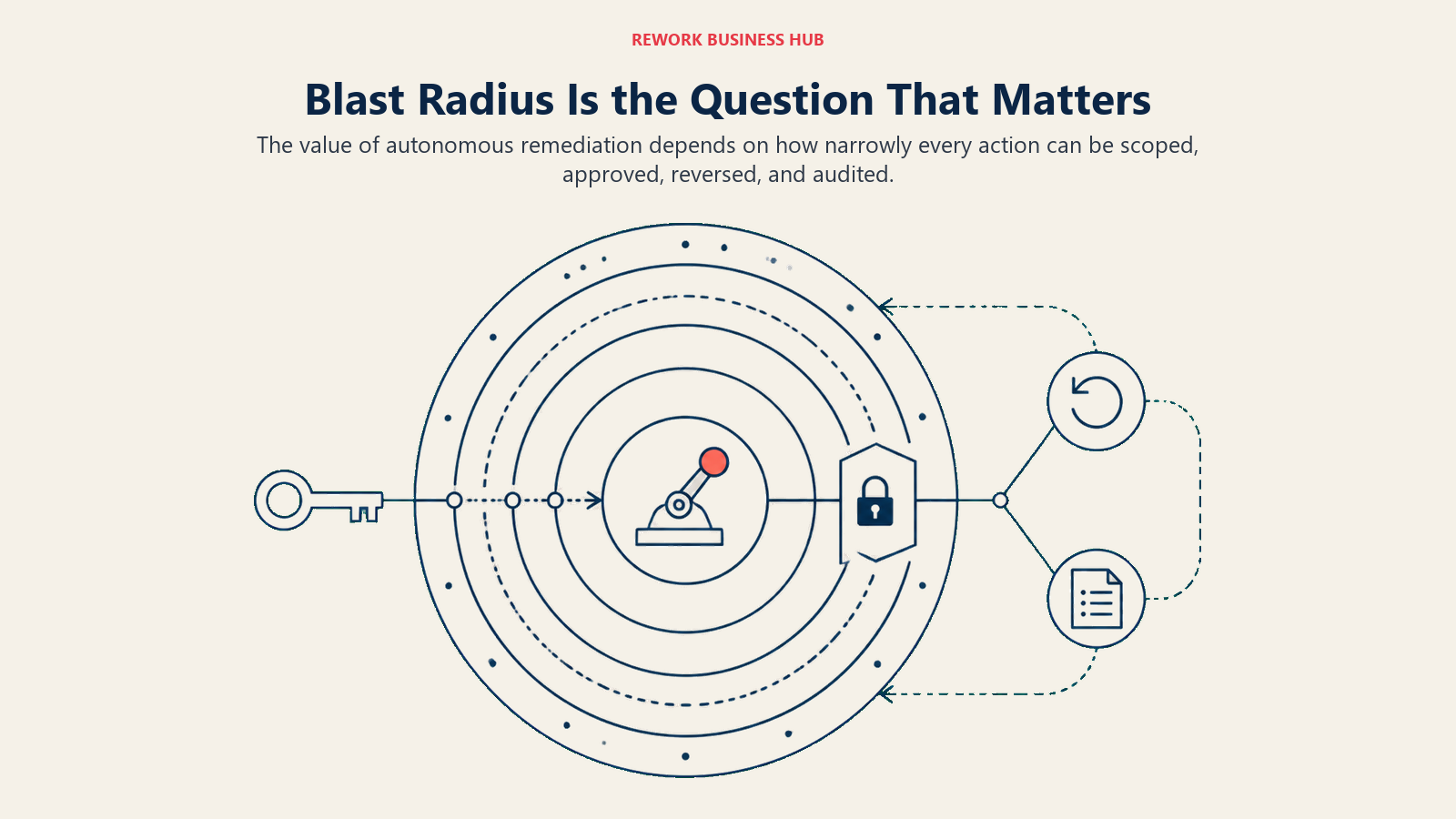
Gartner is already putting a number on that shift. Only 20% of AI-recommended actions in IT operations will still require human-in-the-loop approval by 2029, down from 80% in 2025, and by 2028, 40% of infrastructure and operations organizations running agentic AI at scale in production will cause a business-critical disruption of their own, up from under 1% in 2026. The direction of travel is toward less approval, not more, which is why the approval gate a vendor ships today, not the one on its roadmap slide, is what you're actually buying.
The clearest real-world version of this happened in March 2026, when Amazon's retail storefront went down for roughly six hours and lost an estimated 6.3 million orders. Amazon's own account of the cause was specific: not faulty AI-generated code, but an engineer who acted on inaccurate advice an AI agent inferred from an outdated internal wiki, per Wharton's AI & Analytics Initiative analysis of the incident. Every guardrail in this category assumes the human reviewing an agent's output will catch a wrong hypothesis before approving it. Amazon's incident is the case where that assumption failed anyway, and it's why "a human approves it" is necessary but not sufficient: the reviewer needs the context to catch a confidently wrong answer, not just the authority to click yes.
For the build-side version of this same question (the exact rule set, the exact moment an agent should act, ask, or hand off) see how an AI DevOps agent and an AI incident response agent are typically scoped, and what actually makes something an AI agent rather than assistive software with an agent's marketing.
| Tool | Investigates | Can Take Action | Approval Gate |
|---|---|---|---|
| Resolve AI | Yes | Yes: silence alerts, revert commits, open PRs, run GitHub workflows | Configurable per org, team, or individual |
| Traversal | Yes | Yes, via "Workers": rollback, circuit breakers, alert suppression | Acts unprompted, within a defined scope |
| Cast AI | Continuous, not incident-triggered | Yes: rightsizing, node scaling, spot migration | Starts read-only; approval workflows for riskier changes |
| Datadog Bits AI SRE | Yes | Yes: PRs, paging and ticketing actions, one-click infra commands | Ask Mode (default) or Deny Mode, admin-configured |
| PagerDuty SRE Agent | Yes | Yes, on pre-approved remediation only | Approval defined in advance, per action type |
| Harness SRE Agent | Yes | Yes: node cordon and drain shown in product walkthroughs | Human-approved today, by Harness's own roadmap |
| Firefly | Yes (drift detection) | Generates fix code | PR-based; a human merges it |
| Dynatrace Davis AI | Yes, mature causal RCA | Limited; deeper remediation is still in preview | Preview features, not GA |
| Cleric | Yes | Proposes a fix | Human ships it |
| Parity | Yes | Suggests remediation, walks runbooks | Human executes |
| Rootly AI SRE | Yes | Suggests remediation | Human executes |
| incident.io AI | Yes (documentation-focused) | No production action | N/A |
| FireHydrant AI | Yes (documentation-focused) | No production action | N/A |
| New Relic Autopilot | Yes | No; explicitly recommend-only | N/A, by design |
Evidence: Measured MTTR vs Vendor-Claimed MTTR
Every vendor in this category implies it makes incidents shorter. Almost none of them prove it with anything independent. Rootly is the rare exception that puts a number in writing at all: 40% to 70% faster mean time to resolution from AI incident automation. It's worth being precise about what that number is. It's Rootly's own marketing, about Rootly's own product, not a controlled study, not a third-party benchmark, and not a figure reproduced anywhere else in the category. That doesn't make it false. It makes it unverified, which is a different thing, and worth treating as a hypothesis to test in your own environment rather than a number to budget against.
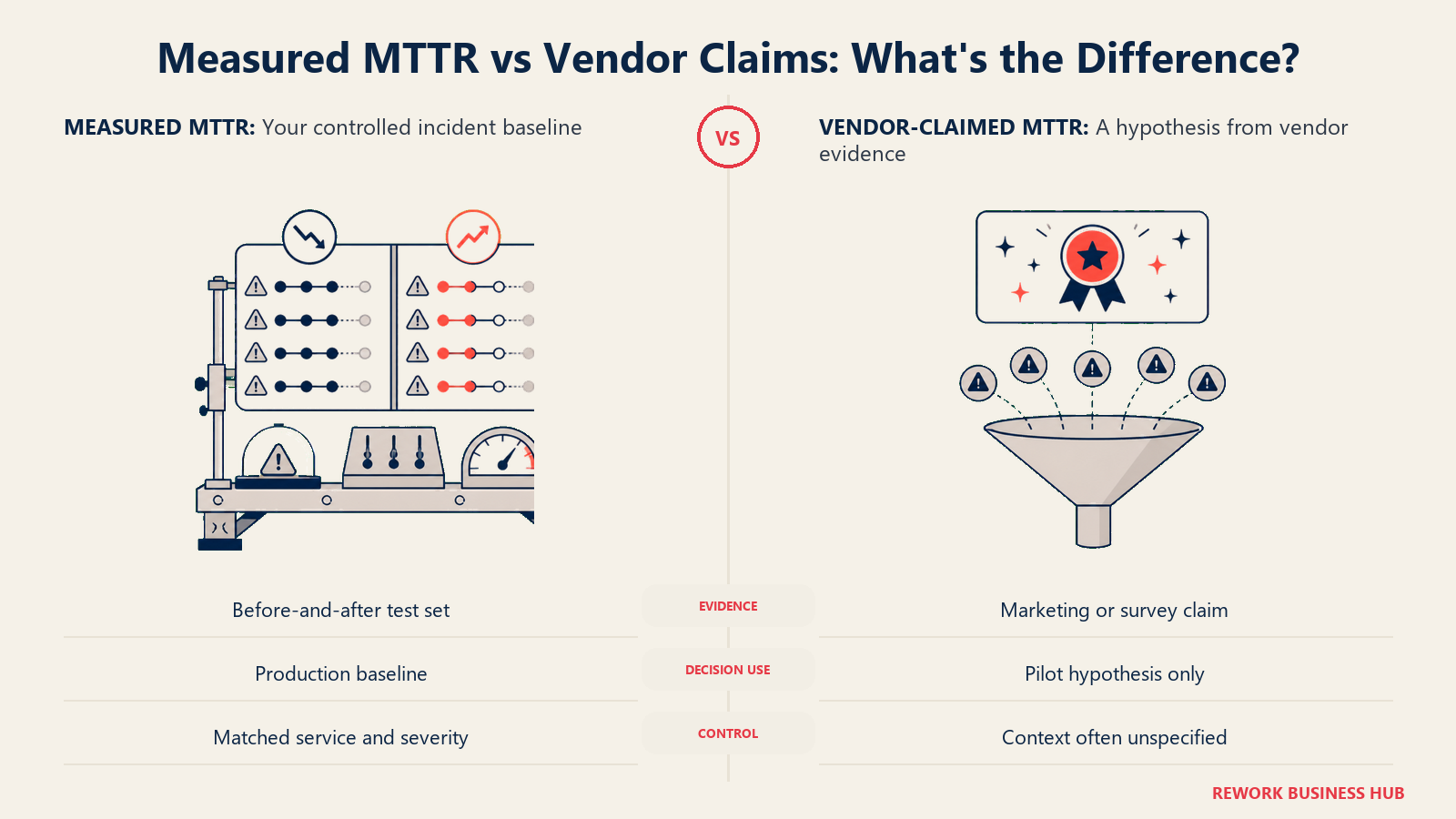
The independent research that does exist tends to describe the category, not any one product in it. PagerDuty's own 2026 survey found that 63% of organizations that improved operational resilience were using AI, against 53% of those that didn't improve, a real gap, but a correlational one, not proof that any specific agent caused it. Before you trust a vendor's MTTR pitch on a live pilot, how to evaluate and test AI agents covers building the kind of before/after test set that turns a marketing claim into an actual answer for your own incidents.
| Tool | MTTR / Efficiency Claim | Source Type |
|---|---|---|
| Rootly AI SRE | 40% to 70% faster MTTR | Vendor marketing (Rootly) |
| Cleric | 5-minute time to root cause; 92% actionable findings | Vendor marketing (Cleric) |
| Cast AI | 60%+ cloud cost reduction | Vendor marketing (Cast AI) |
| PagerDuty (category-wide) | 63% of resilient orgs use AI, vs. 53% of non-resilient orgs | Vendor-commissioned survey, correlational |
| Everyone else on this list | No published MTTR or efficiency figure found | N/A |
Context: What Each Agent Can (and Can't) See
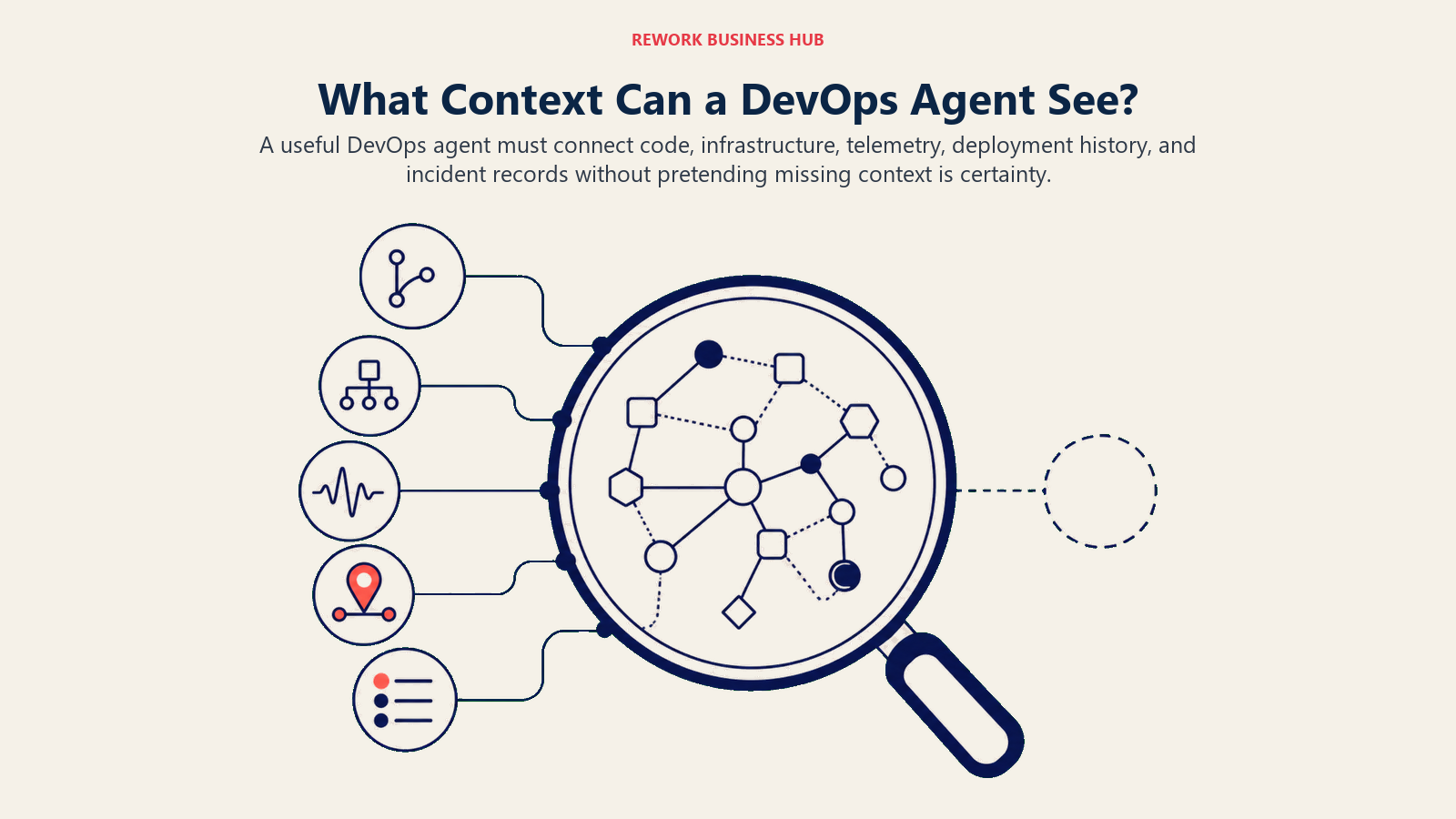
An agent is only as good as what it's allowed to look at. Some of these tools build a persistent model of your whole system (services, deploys, dependencies, past incidents) before an alert ever fires. Others start closer to a blank slate each time and lean entirely on whatever one observability platform already has. For the fuller picture of the tooling that actually feeds that context layer, best AI agent observability tools in 2026 covers the trace and eval layer that sits underneath a lot of these agents, and what AI agent observability means covers the concept if you're building this in-house instead of buying it.
| Tool | Context Sources | Notable Gap |
|---|---|---|
| Resolve AI | Code, infra, telemetry, 60+ integrations, a continuously updated dependency graph | Breadth depends on how many integrations you actually connect |
| Traversal | Kubernetes, cloud infra, databases, service meshes, observability, GitHub | Built for large, complex estates; less to prove on a small stack |
| Cleric | Kubernetes state, Datadog, Prometheus, Elasticsearch, Grafana, GitHub, AWS, GCP, Confluence, Slack | Investigates broadly, doesn't yet act on what it finds |
| Harness SRE Agent | Observability data plus runbooks and past incidents via RAG and a vector database | Best fit if you already run CI/CD inside Harness |
| Datadog Bits AI SRE | Whatever's already in Datadog: APM, logs, infra, RUM | Limited to what you've actually instrumented in Datadog |
| Dynatrace Davis AI | Dynatrace's own full-stack observability data, gathered automatically | Value scales with how much of your stack runs through Dynatrace |
| New Relic Autopilot | Architecture map, entity relationships, recent deploys, traces, logs, metrics | Recommend-only, so context depth never converts into action |
| PagerDuty SRE Agent | Past incidents, diagnostics, knowledge base, prior responder interactions | Strongest where PagerDuty is already the on-call system of record |
| Rootly, incident.io, FireHydrant | Incident timeline, chat transcripts, linked tickets and alerts | Coordination-layer context, not deep infrastructure telemetry |
| Cast AI | Live Kubernetes workload behavior, cloud spot-market signals | Infra and cost signals only, not application-level root cause |
| Firefly | Cloud provider APIs, IaC state (Terraform, OpenTofu, Pulumi), git history | Configuration and drift, not runtime application behavior |
1. Resolve AI: Configurable Autonomy Up to Reverting a Commit
Resolve AI is built around the idea that most "AI SRE" products stop one step short of useful: they explain what's wrong and a human still does the fix by hand. Resolve's Incidents agent investigates in parallel across code, infrastructure, and telemetry, then can act on what it finds: silence a noisy alert, revert a bad commit, open a pull request, or run a GitHub workflow, scoped by permissions defined at the org, team, or individual level. It maintains a continuously updated graph of services, dependencies, and deploys built from more than 60 integrations, and every resolved incident becomes context the next investigation can retrieve.
That range is also the thing to interrogate hardest before buying. An agent cleared to revert a commit needs its guardrails configured correctly on day one, not tuned after the first bad call.
| What you get | What you don't |
|---|---|
| Configurable autonomy, from investigate-only up to reverting a commit | No published pricing; sales-led evaluation |
| 60+ integrations feeding a continuously updated dependency graph | Value scales with how many integrations you actually connect |
| Permission scoping at org, team, and individual level | A newer entrant with less production track record than the incumbents on this list |
Pricing: Not published. Contact sales for a demo, deployment guidance, and a quote. Source: resolve.ai/pricing.
Best for: Teams that want an agent cleared to actually change something in production, with permission scoping they control rather than a vendor default.
2. Traversal: Deep Root Cause Analysis, With Workers That Act Unprompted
Traversal builds what it calls a Production World Model, a live map connecting Kubernetes clusters, cloud infrastructure, databases, service meshes, observability data, and your GitHub history, so it can trace a symptom back through dependencies instead of guessing from a single stack trace. That depth is aimed squarely at large, complex, regulated systems where a human root-causing an incident manually would need to hold ten services' worth of context in their head at once.
The part worth reading twice is "Traversal Workers": a layer that can act unprompted, rolling back a deployment, engaging a circuit breaker, or suppressing a noisy alert without waiting for a person to approve that specific step. That makes Traversal the most autonomous option in this guide by design, backed by Sequoia and Kleiner Perkins, which also makes its guardrail configuration the single most important setup decision a buyer makes.
| What you get | What you don't |
|---|---|
| A Production World Model spanning infra, databases, meshes, and code | No public pricing; demo-gated enterprise sales motion |
| Workers that can act unprompted on rollback, circuit-breaking, and alert suppression | The most autonomous option here means guardrail setup carries the most weight |
| Built for petabyte-scale, multi-service enterprise environments | Likely more depth than a small, single-service team needs |
Pricing: Not published. Contact sales for a demo. Source: traversal.com.
Best for: Enterprise platform teams running complex, regulated systems who want root cause analysis deep enough to trust an autonomous action layer.
3. Datadog Bits AI SRE: Investigation and Remediation Inside One Credit Pool
Bits AI SRE is Datadog's agentic teammate for the platform you may already run your observability through, and its biggest practical advantage is that it isn't a separate tool: it investigates alerts using the same APM, logs, infrastructure, and RUM data already flowing into Datadog, without a second integration to maintain. Remediation runs through configurable Guardrails: Ask Mode requires approval before Bits executes anything, scoped by team, role, or individual, while Deny Mode limits it to recommendations only, and either can be loosened toward one-click execution as trust builds.
Pricing moved onto a shared AI Credits pool in 2026 that also covers Bits Chat, Bits Code, and Bits Agent Builder, so an SRE investigation (roughly 6.5 credits on average) competes for budget against every other Bits feature your team turns on, not a separately metered line item.
| What you get | What you don't |
|---|---|
| Investigation and remediation inside the observability data you already have | AI Credits are shared across Chat, Code, and Agent Builder, so usage adds up fast |
| Configurable Ask/Deny guardrails, scoped by team, role, or person | Value caps out at what you've actually instrumented in Datadog |
| One-click remediation actions once a team trusts the agent | Unused credits don't roll over month to month |
Pricing: $500/month for 500 AI Credits billed annually (about $1/credit), or $1.30/credit on-demand; an autonomous SRE investigation averages roughly 6.5 credits. Source: datadoghq.com/pricing.
Best for: Teams already running Datadog as their primary observability platform who want triage and remediation in the same pane of glass.
4. PagerDuty SRE Agent: Pre-Approved Remediation Built on Your On-Call Data
PagerDuty's SRE Agent, part of the PagerDuty Advance bundle alongside a Scribe Agent for meeting capture, a Shift Agent for on-call scheduling, and an Insights Agent for operational analytics, is explicit about its operating model: it can "detect, triage, diagnose incidents and perform approved remediation," drawing on a memory of past incidents, diagnostics, knowledge base entries, and how responders have handled similar alerts before. Because it sits on top of the escalation and on-call data PagerDuty already has, it has a real head start on knowing who owns what before an investigation even begins.
The pricing is genuinely two separate add-ons stacked on top of an Incident Response plan: AIOps for the underlying alert correlation and noise reduction, and Advance for the agents themselves, each billed and scoped independently.
| What you get | What you don't |
|---|---|
| Pre-approved remediation, not just triage and a summary | Two separate add-ons (AIOps and Advance) to budget for |
| Built on the escalation, on-call, and past-incident data you already have in PagerDuty | Requires an existing Professional or Business Incident Response plan first |
| Bundles SRE, Scribe, Shift, and Insights agents under one add-on | Advance requires an annual commitment, no month-to-month option |
Pricing: AIOps starts at $799/month ($699/month billed annually), priced per accepted event; PagerDuty Advance adds $415/month on an annual commitment. Source: pagerduty.com/pricing/aiops.
Best for: Teams already standardized on PagerDuty for on-call who want remediation actions tied to escalation data they already trust.
5. New Relic Autopilot: Deep Investigation, Zero Action Risk by Design
Autopilot, launched June 23, 2026, is New Relic's answer to a real question in this category: what if an agent went all-in on investigation and simply refused to act? It triages alerts against historical baselines, correlates golden-signal metrics with infrastructure health, flags regressions tied to a specific deploy, and walks through distributed traces, logs, and metrics to find a root cause, all built on New Relic's own observability data substrate. New Relic's own documentation is explicit about the boundary: "Autopilot recommends actions but does not take them. A person reviews and acts," and the agent does not create alerts, instrument applications, or write to external systems beyond posting to Slack.
That makes it the cleanest control case in this guide for a team that wants the investigative power of an agent without touching its production-action risk at all.
| What you get | What you don't |
|---|---|
| Deep root cause analysis with zero default action risk | Recommend-only means someone still has to execute every fix |
| Built on New Relic's existing observability data, no new integration | Requires the Pro tier plus the Advanced Compute add-on |
| Explicit, documented boundary on what it will never auto-execute | Rate-limited to 100 requests per hour per organization |
Pricing: Requires Pro ($349/user/month annual, $418.80/month monthly) or Enterprise (custom), plus the Advanced Compute add-on. Source: newrelic.com/pricing and docs.newrelic.com.
Best for: Teams that want agent-grade investigation depth with the lowest possible action risk while they build trust in the category.
6. Cleric: Self-Learning Investigation That Gets Faster Every Time
Cleric's pitch is operational memory: every investigation builds a knowledge graph of your environment, and the next one gets faster because Cleric already knows the shape of your infrastructure instead of rediscovering it from scratch. It integrates broadly, Kubernetes state, Datadog, Prometheus, Elasticsearch, Grafana, GitHub, AWS, GCP, Confluence, and Slack, and reports its findings directly into the channel where your team is already working the incident.
Cleric investigates and proposes a fix; it does not ship that fix itself, which puts it firmly in the propose-and-wait tier alongside Parity and Rootly rather than the act-with-guardrails tier above it. Backed by more than $14 million from Zetta Venture Partners and Vertex Ventures US, it's a smaller company than the platform incumbents on this list, which shows up as thinner enterprise governance tooling today.
| What you get | What you don't |
|---|---|
| A knowledge graph that compounds, each investigation faster than the last | Proposes a fix; a human still ships it |
| Broad, established integrations across Kubernetes, observability, and ticketing tools | Pricing is entirely sales-led with no public tiers |
| Findings delivered directly in Slack, where the incident is already being worked | Smaller company than the observability incumbents also on this list |
Pricing: Not published. Request-based, sales-engaged, typically with an evaluation period before a quote. Source: cleric.ai.
Best for: Teams that want investigation quality to compound over time and are comfortable keeping a human in the fix-shipping loop.
7. Parity: Kubernetes-First Response Before an Engineer Wakes Up
Parity, a Y Combinator S24 company, positions itself narrowly and specifically: the first line of defense for on-call engineers running Kubernetes. It plugs into an existing alerting stack (PagerDuty, Datadog) and, by the time a human opens their laptop, has already triaged the alert, inspected the cluster, determined a likely root cause, and suggested a fix. If a team has existing runbooks, Parity follows them the way an engineer would rather than improvising a diagnostic path from nothing.
That narrow focus is the whole trade-off. Parity doesn't try to cover CI/CD, cost optimization, or non-Kubernetes infrastructure the way the platform-wide competitors above do, which makes it a lighter lift to adopt but a smaller piece of a larger operational picture.
| What you get | What you don't |
|---|---|
| Kubernetes-specific triage and root cause analysis before an engineer is paged in | Narrower scope than platform-wide agents like Resolve AI or Datadog Bits AI |
| Follows existing runbooks instead of improvising a diagnostic path | No public pricing found anywhere on the site |
| Plugs directly into an existing PagerDuty or Datadog alerting stack | Suggests remediation; doesn't execute it |
Pricing: Not published. Source: tryparity.com.
Best for: Kubernetes-heavy teams that want a focused first responder rather than a platform-wide agent suite.
8. Dynatrace Davis AI: Mature Causal RCA, With Agentic Remediation Still in Preview
Davis AI is the oldest, most established root cause engine in this guide, built on deterministic causal analysis across Dynatrace's own full-stack observability data rather than an LLM guessing at correlation. Davis CoPilot layers a natural-language interface on top for building queries, dashboards, and workflows, and per Dynatrace's own FAQ, that generative and CoPilot layer currently carries no separate license fee: it draws down your existing consumption-based (DDU) allocation instead of a standalone SKU.
The newer, more autonomous piece, agentic workflows that can reportedly edit a manifest to autoscale infrastructure on their own, is real but not yet generally available; Dynatrace's own documentation places it in preview. That makes Davis AI a strong pick today for root cause analysis specifically, and a name worth watching rather than buying yet for autonomous remediation.
| What you get | What you don't |
|---|---|
| Deterministic causal RCA with a long production track record, not a new LLM bet | Deeper agentic remediation is explicitly still in preview, not GA |
| No separate license fee for the generative/CoPilot layer today | Cost still scales with overall Dynatrace consumption, not a flat fee |
| Value compounds with how much of your stack already runs through Dynatrace | Less useful if Dynatrace isn't already your primary observability platform |
Pricing: No separate fee for Davis AI/CoPilot currently; usage draws from your existing DDU-based Dynatrace consumption. Source: docs.dynatrace.com.
Best for: Enterprise teams already standardized on Dynatrace who want the most mature root cause engine in this list, with autonomous remediation still on the roadmap.
9. Rootly AI SRE: Root Cause Correlation Bolted Onto a Modern Incident Platform
Rootly built its reputation as an incident response and on-call platform first, and its AI SRE add-on layers root cause identification, change correlation, impact analysis, and noise suppression on top: instead of just flagging that an alert fired, it checks what deployed recently and surfaces that as a likely cause. Stack integration and API/MCP access mean the output can feed back into whatever automation a team already runs.
Rootly is also the one vendor here that publishes an actual MTTR figure (40% to 70% faster resolution), which is worth remembering is Rootly's own marketing claim rather than an independently verified number, as covered above. Startup-friendly pricing programs, up to 50% off for companies under 100 employees and under five years old, make it more approachable than most of the enterprise-first names on this list.
| What you get | What you don't |
|---|---|
| Root cause correlated against recent changes, not just the raw alert | AI SRE pricing isn't public; Incident Response and On-Call are priced separately too |
| Startup discount programs that undercut most enterprise-first competitors | Suggests remediation; doesn't execute it |
| API/MCP access to feed findings into existing automation | The 40-70% MTTR figure is Rootly's own claim, not independently verified |
Pricing: Incident Response and On-Call each start at $20/user/month (Essentials); AI SRE is a separate add-on, contact sales. Source: rootly.com/pricing.
Best for: Teams that want change-aware root cause suggestions layered onto an incident platform they're already adopting for coordination.
10. incident.io AI: Scribe and AI-Native Postmortems, Gated to Pro
incident.io's AI story centers on Scribe, which drafts an incident timeline and a postmortem automatically from the Slack or Microsoft Teams conversation as it happens, turning what's usually an hour of someone reconstructing events after the fact into a draft a human edits instead of writes from scratch. That's a documentation and coordination play, not a production-action one; nothing in incident.io's AI feature set claims to touch infrastructure directly.
The catch worth knowing before you shortlist it: AI is not included on the Free or Team tiers. Scribe and AI-native postmortems only ship starting at Pro, which changes the real per-seat cost of "the AI version" of incident.io relative to its cheaper on-call-only plans.
| What you get | What you don't |
|---|---|
| Scribe drafts a defensible incident timeline and postmortem automatically | Free and Team tiers ship with no AI features at all |
| Native Slack and Microsoft Teams incident response, not a bolted-on integration | No production remediation; documentation and coordination only |
| Straightforward per-user pricing with no separate AI SKU to negotiate | On-call is a further $10-20/user/month add-on on top of the base plan |
Pricing: Free (Basic, no AI); Team $15-19/user/month (no AI); Pro $25/user/month (Scribe and AI-native postmortems included); Enterprise custom. Source: incident.io/pricing.
Best for: Teams that want AI-assisted incident documentation without adding a new vendor, and are already planning to buy the Pro tier anyway.
11. FireHydrant: Coordination and Documentation, With AI Gated to Enterprise
FireHydrant is a responder-based incident management platform (you pay per person actively working incidents, not per seat), and its AI features, summaries, meeting transcripts, automated triage notes, and retro drafts, are aimed squarely at the coordination and documentation side of an incident rather than production action. There's no claim anywhere in FireHydrant's materials that its AI executes a fix; it's built to make the record of what happened faster to produce, not to change what's running.
The practical issue is availability: FireHydrant AI is gated entirely to the custom-priced Enterprise tier, so a team evaluating it on the public Pro plan won't actually see the AI features in action without a sales conversation first.
| What you get | What you don't |
|---|---|
| Summaries, transcripts, and retro drafts without extra tooling | AI features are Enterprise-only; Free and Pro ship without them |
| Responder-based pricing, not charged for read-only stakeholders | No production remediation claims anywhere in the product |
| Solid core incident management (runbooks, status pages, service catalog) below the AI layer | Enterprise pricing isn't public; requires a sales conversation to see AI at all |
Pricing: Free tier available; Pro $25/responder/month billed annually (no AI); Enterprise custom (AI included). Source: firehydrant.com/pricing.
Best for: Enterprise teams that want incident documentation and coordination automated, and don't need the agent to touch production.
12. Harness SRE Agent: CI/CD Failure Diagnosis Across the Whole Delivery Pipeline
Harness's SRE Agent is one node in a broader network of specialized agents (SRE, AppSec, Test, FinOps, and more) built into a platform that already covers CI, CD, and feature flags, which makes it the strongest fit on this list for a team whose incidents are as likely to trace back to a bad deploy as to a live production event. In Harness's own worked examples, the SRE Agent detects an anomaly, identifies something like a noisy neighbor, drains and cordons the affected node, verifies stability, and posts a post-mortem to Slack.
Harness's own roadmap language is worth reading literally here: it places itself at "Horizon 1," agents as sidecars with human approval today, moving toward more autonomous "human-on-the-loop" and eventually "autonomous SRE" operation over the next several years. Treat the node-draining example as what the agent can do inside that approval flow now, not as unattended production authority.
| What you get | What you don't |
|---|---|
| One agent network spanning CI, CD, security, testing, and reliability | No public pricing anywhere, including the base platform |
| Real infrastructure actions (node cordon, drain) shown inside an approval flow | Harness's own roadmap places current autonomy at "human-approved," not autonomous |
| Native fit if pipeline failures, not just live incidents, are a big share of your alerts | Full platform deployments run as enterprise contracts, not self-serve plans |
Pricing: Not published; AI SRE is listed as a separate Enterprise module. Every tier requires a sales conversation. Source: harness.io/pricing.
Best for: Engineering orgs whose incidents span the whole delivery pipeline, not just production, and who already run CI/CD in Harness or are evaluating it.
13. Cast AI: Continuous Kubernetes Cost and Capacity Optimization
Cast AI is a different shape of agent than the rest of this list: it isn't triggered by an incident, it runs continuously in the background, rightsizing pod CPU and memory requests, scaling nodes, improving bin packing, and shifting workloads to spot instances as pricing and availability change, predicting spot interruptions up to 30 minutes ahead and migrating gracefully before they hit. That makes its risk profile genuinely different from an agent that acts during an active outage: the blast radius is ongoing background optimization, not a single high-stakes decision under time pressure.
New accounts start in read-only mode with no infrastructure changes until a team turns automation on, and higher-risk actions can run through approval workflows rather than executing immediately, which is the right default for a tool making changes to running infrastructure every day rather than only during an incident.
| What you get | What you don't |
|---|---|
| Continuous rightsizing, autoscaling, and spot automation, not incident-triggered | No public pricing; usage-based and environment-specific, contact sales |
| Starts read-only; automation is an explicit opt-in, not a default | Cost-and-capacity focused, not a general incident investigation or RCA tool |
| Predicts spot interruptions and migrates workloads before they hit | The 60%+ savings figure is Cast AI's own claim, not independently audited |
Pricing: Not published. Usage-based and specific to your environment; contact sales. Source: cast.ai/pricing.
Best for: Kubernetes-heavy teams that want continuous cost and capacity optimization running in the background, separate from incident response.
14. Firefly: Infrastructure-as-Code Drift and Compliance Remediation
Firefly's job is catching the gap between what your Infrastructure-as-Code says should be running and what's actually running in AWS, Azure, Google Cloud, or OCI, then closing it. It detects drift and misconfiguration continuously, checks changes against frameworks like SOC 2, PCI DSS, HIPAA, and ISO 27001, and alerts through Slack or PagerDuty the moment something drifts. When it finds a fix, it generates the remediation code and opens a pull request rather than applying the change directly, which keeps a human review step in front of every infrastructure change by default.
That PR-based model is a meaningfully different blast radius than the incident-response agents above: Firefly's worst case is a bad PR sitting unmerged, not a bad change already live in production, which is a deliberate and reasonable trade-off for a compliance-adjacent tool.
| What you get | What you don't |
|---|---|
| Continuous drift detection against SOC 2, PCI DSS, HIPAA, and ISO 27001 | Never applies a fix directly; there's always a PR to review and merge |
| Generates ready-to-merge remediation code, not just a description of the problem | Essential tier caps at 20,000 assets before Enterprise pricing kicks in |
| Multi-cloud discovery across AWS, Azure, Google Cloud, and OCI in one place | A different job than live incident response; won't help mid-outage |
Pricing: Essential $2,499/month billed annually, up to 20,000 assets; Enterprise custom. Source: firefly.ai/pricing.
Best for: Platform and security teams that need IaC drift and compliance violations remediated on a reviewable pull request, not applied live.
How to Choose: Decision Framework
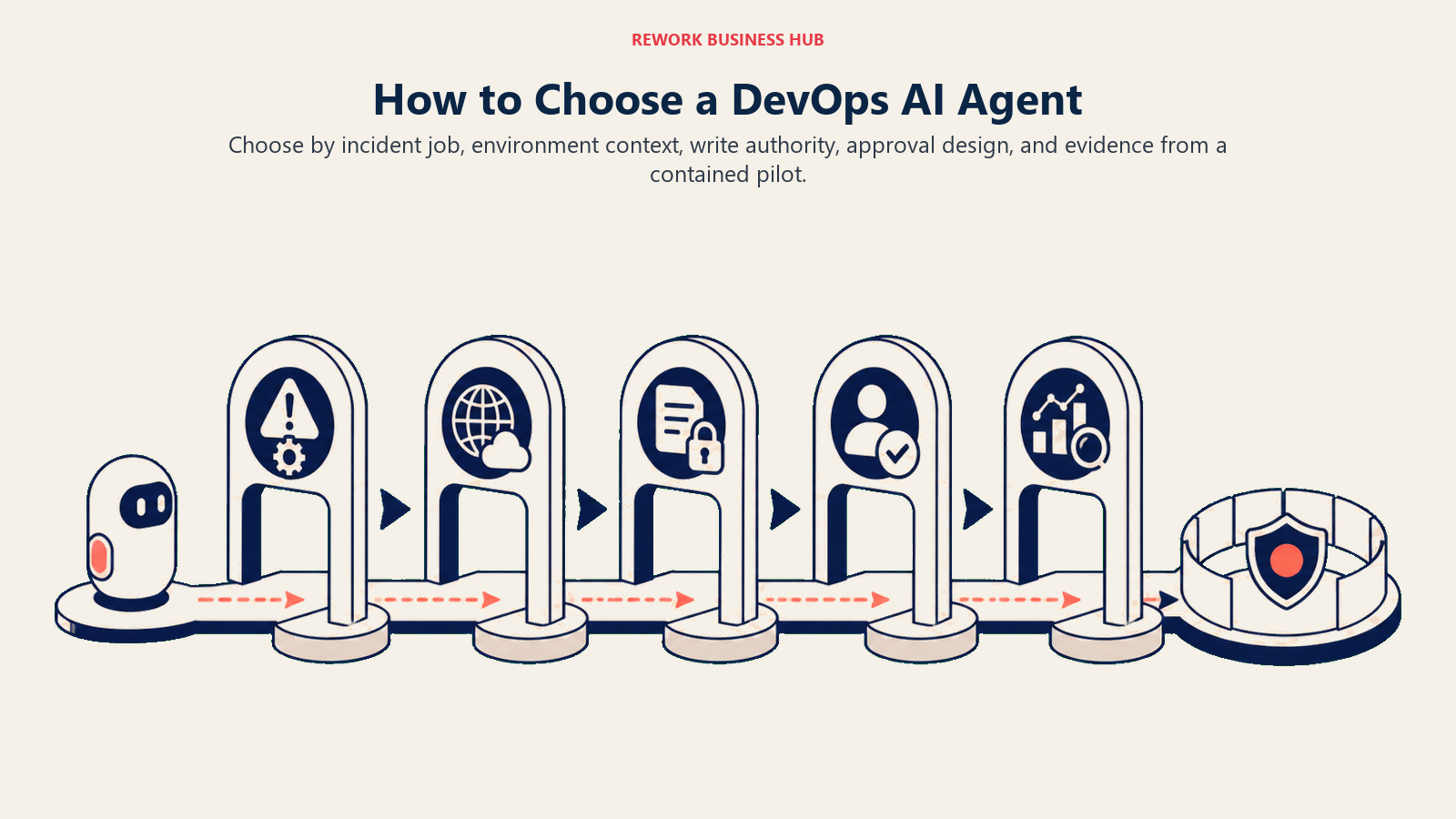
Choose by the incident job, environment context, write authority, approval design, and evidence from a contained pilot.
| If you need... | Pick... | Why |
|---|---|---|
| The most autonomous option, with guardrails you configure | Resolve AI | Configurable permission scoping down to reverting a commit |
| Deep root cause analysis on a complex or regulated estate | Traversal | A Production World Model plus Workers built for large, multi-service systems |
| The safest possible starting point, with zero action risk | New Relic Autopilot | Explicitly recommends only, by design, not by configuration |
| You already pay for Datadog | Datadog Bits AI SRE | Shares one credit pool and one pane of glass with data you already have |
| You already pay for PagerDuty for on-call | PagerDuty SRE Agent | Performs pre-approved remediation using escalation data you already trust |
| Kubernetes-specific triage on a tighter budget | Parity or Cleric | Both are narrower, Kubernetes-first alternatives to full platform suites |
| CI/CD pipeline failure diagnosis, not just live incidents | Harness SRE Agent | Part of one agent network spanning CI, CD, security, and reliability |
| Continuous cost and capacity optimization | Cast AI | Runs constantly in the background; not triggered by an alert |
| Infrastructure-as-code drift and compliance violations | Firefly | Generates remediation code and opens a reviewable PR automatically |
| Incident coordination and documentation over production action | incident.io, Rootly, or FireHydrant | All three focus on the timeline and the postmortem, not executing the fix |
DevOps AI Agent Buying Mistakes to Avoid
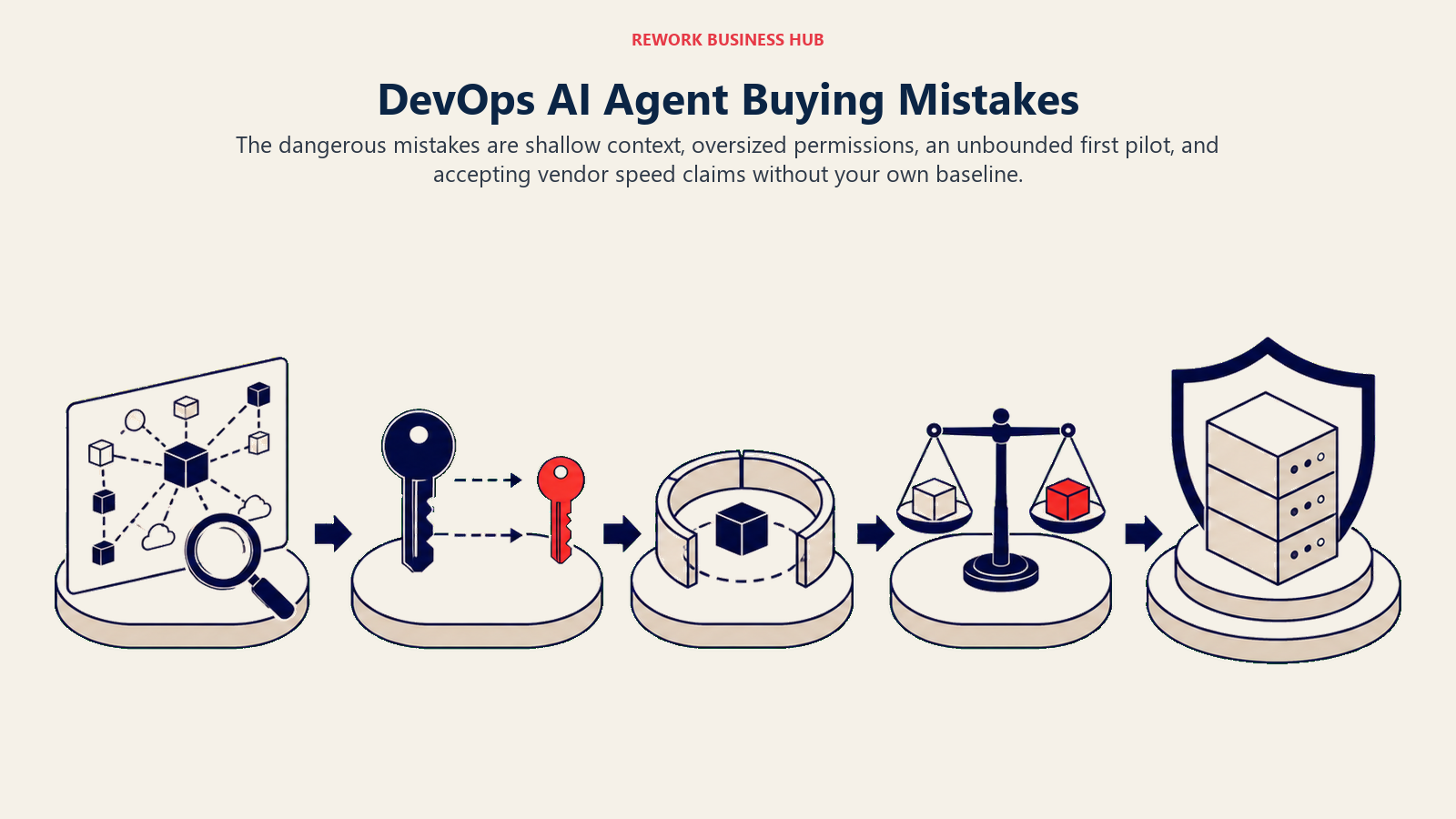
The dangerous mistakes are shallow context, oversized permissions, an unbounded first pilot, and accepting vendor speed claims without your own baseline.
| Mistake | What It Looks Like | What to Do Instead |
|---|---|---|
| Buying for the demo, not the approval gate | Watching an agent nail a scripted investigation, never asking what it's allowed to touch live | Ask exactly which actions ship enabled by default, and which an admin has to turn on |
| Trusting a vendor's MTTR number as your own | Budgeting a headcount change off a 40-70% MTTR claim from the vendor's own site | Pilot on real incidents for 4-6 weeks and measure your own before/after |
| Skipping the context audit | Assuming an agent "just knows" your architecture because it's plugged into an alert feed | Confirm what it actually ingests: code, runbooks, past incidents, or alerts alone |
| Widening autonomy after one good week | Loosening the approval gate because the agent got the first ten calls right | Expand scope gradually, tied to a track record, not a hot streak |
| Assuming human approval equals safety | Treating "a person reviews it" as a solved problem | Check whether reviewers have the context to catch a confidently wrong hypothesis, not just a click-through queue |
| Ignoring where the tool's blind spot is | Deploying an agent that only sees Kubernetes state into an incident caused by a third-party API | Match an agent's context sources to where your incidents actually originate |
| Treating incident-response AI and cost-optimization AI as one purchase | Evaluating Cast AI against Resolve AI on the same rubric | Separate "acts during an outage" tools from "acts continuously in the background"; the risk profile differs |
| Not re-checking pricing at renewal | Budgeting off a quote from a category where pricing models changed more than once this year | Re-verify the vendor's current page; credit-based and consumption pricing shifts often |
What to Do Next
Don't start by picking a vendor. Start by writing down the blast radius you're actually comfortable with today, in one sentence, before a single demo call. "It can page the right person and draft a timeline" is a different purchase than "it can revert last night's deploy at 3am without waking anyone up," and the 14 products above span that entire range. Pilot one against real incidents for 4-6 weeks, measure your own before/after MTTR instead of trusting a vendor's number, and only widen what it's allowed to touch once you've watched it be right for a while, not just once.
If you haven't settled on the broader agent platform underneath this decision yet, best AI agent platforms in 2026 is the pillar guide for choosing that layer first.

Principal Product Marketing Strategist
On this page
- Updated August 2026: What Changed
- Key Facts
- Quick Comparison Table
- Blast Radius: The Question That Actually Matters
- Evidence: Measured MTTR vs Vendor-Claimed MTTR
- Context: What Each Agent Can (and Can't) See
- 1. Resolve AI: Configurable Autonomy Up to Reverting a Commit
- 2. Traversal: Deep Root Cause Analysis, With Workers That Act Unprompted
- 3. Datadog Bits AI SRE: Investigation and Remediation Inside One Credit Pool
- 4. PagerDuty SRE Agent: Pre-Approved Remediation Built on Your On-Call Data
- 5. New Relic Autopilot: Deep Investigation, Zero Action Risk by Design
- 6. Cleric: Self-Learning Investigation That Gets Faster Every Time
- 7. Parity: Kubernetes-First Response Before an Engineer Wakes Up
- 8. Dynatrace Davis AI: Mature Causal RCA, With Agentic Remediation Still in Preview
- 9. Rootly AI SRE: Root Cause Correlation Bolted Onto a Modern Incident Platform
- 10. incident.io AI: Scribe and AI-Native Postmortems, Gated to Pro
- 11. FireHydrant: Coordination and Documentation, With AI Gated to Enterprise
- 12. Harness SRE Agent: CI/CD Failure Diagnosis Across the Whole Delivery Pipeline
- 13. Cast AI: Continuous Kubernetes Cost and Capacity Optimization
- 14. Firefly: Infrastructure-as-Code Drift and Compliance Remediation
- How to Choose: Decision Framework
- DevOps AI Agent Buying Mistakes to Avoid
- What to Do Next