Best AI Agent Observability Tools in 2026: 13 Tools for Tracing, Evaluating, and Monitoring Production Agents
Turn this article into takeaways for your work.


Each assistant summarizes the article only for you and suggests best practices for your work.
If your agent runs on LangChain or LangGraph, LangSmith or Langfuse cover the most ground, and Langfuse is the one to pick if you want to self-host it for free. If you want agent traces sitting next to the APM and infrastructure data you already watch, Datadog Agent Observability is built for that. And if evaluation, not dashboards, is the actual job, Braintrust, Galileo, and Maxim AI lead on testing an agent's behavior systematically instead of eyeballing a chart after something breaks. This guide compares 13 tools built specifically to trace, evaluate, and monitor agents that already call tools and take multi-step actions on their own, past the staged rollout stage rather than still in it.
Every tool below was evaluated on four things that actually separate them in production: whether it traces every tool call or just the final answer, whether it speaks OpenTelemetry or locks you into its own SDK, whether it evaluates agents on a schedule or just shows you a dashboard, and how the bill grows once your agent's trace volume does, since this category bills by ingestion and that's where most surprises come from.
Key Facts
- 89% of organizations have implemented some form of AI observability, but only 52.4% run offline evaluations against a test set and just 37.3% run online evaluations on live traffic, the gap between watching an agent and actually testing it, per LangChain's State of Agent Engineering survey of 1,340 practitioners (fielded November 18 to December 2, 2025).
- Among agents specifically running in production, 94% have some observability in place, but only 71.5% trace individual steps and tool calls; the rest see only coarser input and output logs, per the same LangChain survey.
- Of the teams that do evaluate their agents, 53.3% use an LLM-as-judge approach and 59.8% still lean on human review, often running both, per LangChain's report.
- Gartner predicts over 40% of agentic AI projects will be canceled by the end of 2027, citing unclear business value and inadequate risk controls, not model quality, as the leading causes.
- Only 21% of organizations have a mature governance model for autonomous agents, even as most plan to expand agent use within two years, per Deloitte's State of AI in the Enterprise report.
- MIT's NANDA initiative found that 95% of enterprise generative AI pilots failed to deliver a measurable financial return in 2025, a gap researchers tied to missing operational discipline rather than model quality, as reported by Fortune in August 2025.
Quick Comparison Table
| Tool | Best For | Starting Price | Key Strength | Key Limitation |
|---|---|---|---|---|
| LangSmith | Teams already building on LangChain or LangGraph | Free (1 seat); Plus $39/seat/mo | Deep native tracing plus a real OTLP endpoint if you need to move later | Dataset and eval UX still assumes a LangChain-shaped app |
| Langfuse | Teams that want to self-host for free with no lock-in | Free, self-hosted; Cloud from $29/mo | Fully open source, OpenTelemetry-native on every tier | Cloud Pro jumps to $199/mo once you need multi-year retention |
| Arize (Phoenix and AX) | Teams wanting open source now, enterprise later | Free (Phoenix, self-hosted); AX from $50/mo | OpenInference/OTel-native, unlimited evals even on the paid entry tier | Self-hosting the commercial AX product itself needs Enterprise |
| Datadog Agent Observability | Teams already paying for Datadog APM | Free to 40K spans/mo; Pro $160/mo | Agent traces sit next to the APM and infra data you already monitor | SaaS only, no self-hosted option at any tier |
| Braintrust | Teams that want evaluation and CI-gated releases as the job | Free; Pro $249/mo | LLM-as-judge and custom scorers built around test-then-ship workflows | On-prem or hosted-private deployment requires Enterprise |
| W&B Weave | Teams already using Weights and Biases for ML experiments | Free; Pro from $60/mo | Familiar home for ML teams already tracking runs in W&B | OpenTelemetry support isn't documented on its own pricing or docs |
| Comet Opik | Budget-conscious teams that still want a real paid tier | Free (open source or cloud); Pro $19/mo | Full OpenTelemetry support and LLM-as-judge even on the cheapest paid tier | Smaller mindshare than LangSmith or Langfuse in most stacks |
| Helicone | Teams that want the fastest possible setup | Free; Pro $79/mo | One-line proxy swap, Sessions group calls into a full agent trace | Native evaluation and LLM-as-judge tooling is thin next to specialists |
| HoneyHive | Teams that want OpenTelemetry auto-instrumentation out of the box | Free; Enterprise custom | 50+ libraries auto-instrumented, online and offline evals on the free tier | No public self-serve tier between Free and Enterprise |
| Galileo | Enterprise teams wanting purpose-built judge models | Free; Pro $100/mo (billed annually) | Luna evaluator family plus real-time guardrails at the enterprise tier | OpenTelemetry support and mid-tier pricing details are both thin publicly |
| Pydantic Logfire | Polyglot teams wanting one OTel backend for everything | Free; Team $49/mo | Explicitly OpenTelemetry-native across Python, Go, Java, JS, and Rust | General-purpose observability first, not purpose-built for agent evals |
| Traceloop (OpenLLMetry) | Teams that want the instrumentation layer, not just a dashboard | Free (OpenLLMetry SDK); Traceloop free to 50K spans/mo | OpenTelemetry-native from the ground up, Apache-2.0 licensed SDK | Free tier data retention is only 24 hours |
| Maxim AI | Teams that want to simulate agent conversations before launch | Free; Professional $29/seat/mo | Simulation runs test multi-turn agent behavior before it reaches a customer | Per-seat pricing climbs fast once a team grows past a handful of people |
What "Agent Observability" Actually Means
An AI agent doesn't produce one output you can eyeball. It runs a loop: read context, decide on an action, call a tool, read what came back, decide again, sometimes five times, sometimes fifty. AI agent observability means instrumenting that whole loop, not just its final answer, which makes it a narrower job than general AI observability, a category that also covers data pipelines and single-call model monitoring that never touches a multi-step decision chain. And be honest about how much of this actually applies to what you run: Menlo Ventures found that only 16% of what companies currently call an "AI agent" in production actually plans, observes, and adapts on its own, per its State of Generative AI in the Enterprise report, with most of the rest being fixed-sequence workflows wearing agent branding. A fixed workflow barely needs a trace tool. A system that genuinely decides its own next step does.
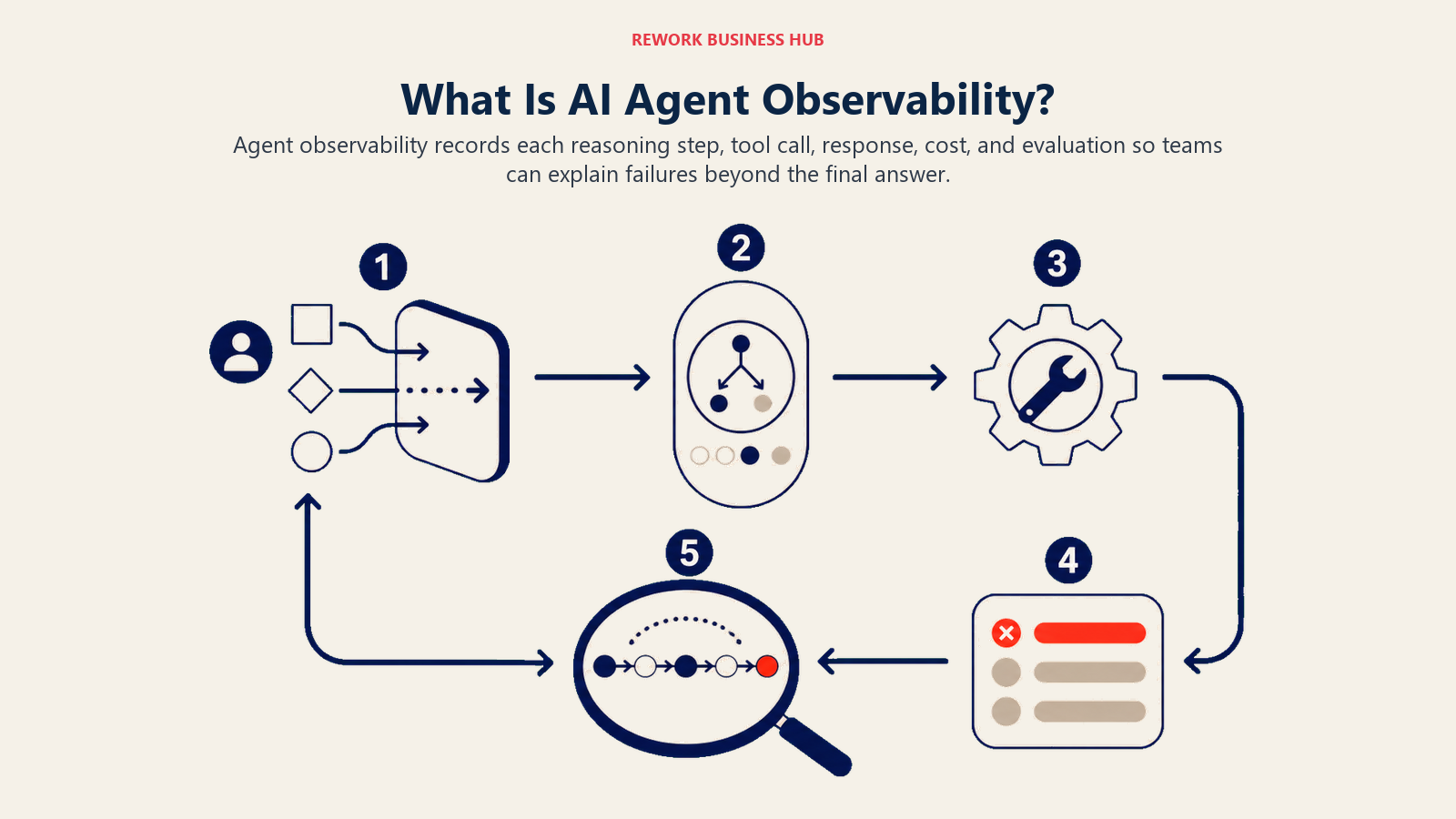
That distinction is the first thing worth checking in any tool on this list: does it show you every tool call and what came back, or just the prompt that went in and the answer that came out? A support agent that calls a refund API with the wrong order ID, then apologizes smoothly anyway, looks fine in an output-only log. Only step-level tracing catches what actually happened.
This guide also isn't the agent itself. If you haven't picked an agent platform or framework yet, start with best AI agent platforms in 2026, or best open-source AI agent frameworks for the code-first route; this guide covers what you bolt on once that agent is live. It's also a different product than what you'll find in best AI tools in 2026: an AI tool assists a human through one task, so there's one input and one output to check by hand. An agent acts across a chain of steps nobody reviews line by line, which is why it needs a trace instead of a transcript.
The bigger gap isn't which tool to buy, though. It's that most teams stop at monitoring. 89% of organizations have some form of AI observability in place, but only 52.4% run offline evaluations and just 37.3% run online evaluations on live traffic, per LangChain's survey cited above. Watching a dashboard tells you an agent is running. It doesn't tell you whether it's right. Evaluation answers that, and it's the step most teams skip, which is why it gets its own buying dimension below instead of folding into "monitoring" as an afterthought.
How to Choose an AI Agent Observability Tool in 2026
Most teams default to whichever tool their framework's docs happen to recommend (LangSmith if they built on LangChain, Logfire if they built on Pydantic AI) without checking whether it actually fits how they plan to run the agent for the next two years. Work through these six questions before you shortlist.
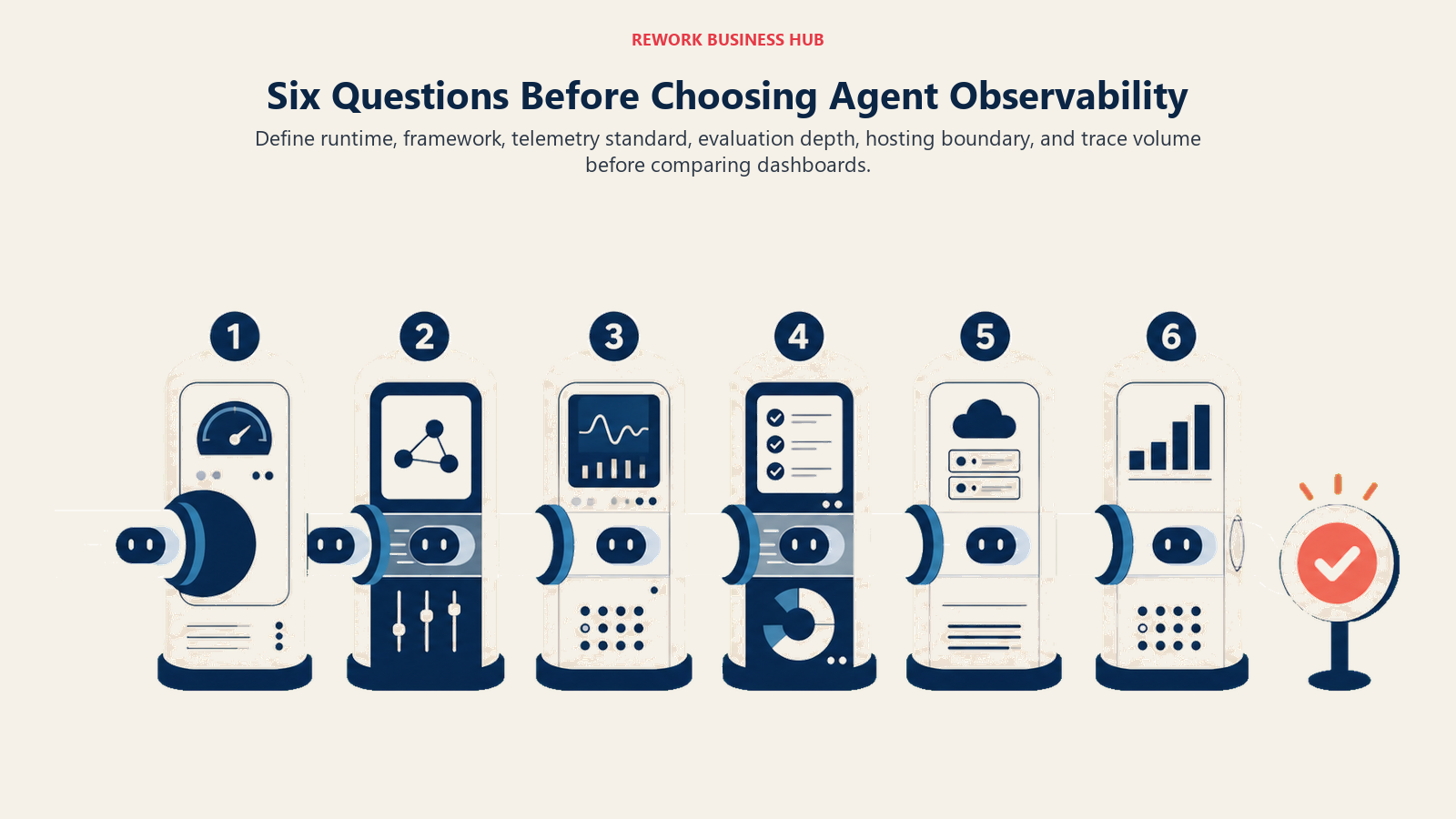
- Does it trace every tool call, or just the final answer? Full step-level tracing catches an agent that called the right tool with the wrong parameters, or looped on a failed step before giving up. Output-only logging misses both.
- Does it speak OpenTelemetry, or lock you into its SDK? A tool that ingests standard OTLP traces and maps them to the OpenTelemetry GenAI semantic conventions (the
gen_ai.*attribute set) lets you swap the backend later without re-instrumenting your code. A proprietary-SDK-only tool is cheaper to adopt today and pricier to leave. - Will you actually run evaluations, or just watch a dashboard? Decide this before you buy, not after the first incident. Offline evaluation runs a fixed test set before you ship a change; online evaluation scores live production traffic after. Most teams need both eventually and start with neither; how to evaluate and test AI agents covers building the test set either mode assumes you already have.
- Do you trust an LLM-as-judge to gate a release? 53.3% of teams that evaluate now use an LLM-as-judge approach, per LangChain's survey, but a model grading another model's work still needs a human-reviewed rubric and periodic spot checks, not blind trust in the score it returns.
- Does compliance or data residency force self-hosting? If agent traces can carry customer PII, health data, or anything else that can't leave your VPC, that rules out SaaS-only tools immediately, however good their tracing is.
- How does the bill grow as trace volume grows? This category bills by ingestion (spans, traces, events, or logs), not seats, so a "free" pilot can get expensive fast once an agent runs thousands of times a day instead of a few dozen.
Trace Granularity and OpenTelemetry Support
| Tool | Traces Every Tool Call | OpenTelemetry Support | Self-Host Option |
|---|---|---|---|
| LangSmith | Yes, full run tree | Yes, OTLP endpoint with GenAI semantic-convention mapping | Enterprise only |
| Langfuse | Yes, full trace and span tree | Yes, native, on every tier | Yes, free (open source) |
| Arize (Phoenix and AX) | Yes, span-level via OpenInference | Yes, built on OpenTelemetry | Phoenix yes, free; AX Enterprise only |
| Datadog Agent Observability | Yes, prompts, retrieval, tool calls, and decisions | Yes, full OTel support across languages | No |
| Braintrust | Yes, spans within a trace | Yes, via a listed OTel integration | Enterprise only |
| W&B Weave | Yes, per-operation tracing | Not documented publicly | Personal tier only (single user, local) |
| Comet Opik | Yes, span-level | Yes, native, on every tier | Yes, free (open source) |
| Helicone | Yes, via Sessions (tool calls, vector queries) | Partial, via an OpenLLMetry async integration | Enterprise only |
| HoneyHive | Yes, auto-instrumented | Yes, native Python and TypeScript SDKs | Enterprise (self-hosted, hybrid, or single-tenant) |
| Galileo | Yes, agent graph tracing | Not publicly documented | Enterprise (hosted, VPC, or on-prem) |
| Pydantic Logfire | Yes, if instrumented (general OTel spans) | Yes, explicitly OTel-native, polyglot | Enterprise (self-hosted option) |
| Traceloop (OpenLLMetry) | Yes, by design | Yes, this is the product's core identity | Enterprise (on-prem, including air-gapped) |
| Maxim AI | Partial, log-based; simulation adds step detail | Not publicly documented | Enterprise (in-VPC) |
Evaluation Approach
| Tool | Offline Evaluation | Online Evaluation | LLM-as-Judge |
|---|---|---|---|
| LangSmith | Yes, all tiers | Yes, all tiers | Yes, tuned evaluators in public beta |
| Langfuse | Yes, all tiers | Yes, all tiers | Yes, all tiers |
| Arize (Phoenix and AX) | Yes, dataset-based | Yes, on live traces and spans | Yes, plus "agent as a judge" at Enterprise |
| Datadog Agent Observability | Yes, datasets built from production traces | Yes, built-in and custom evaluators | Yes |
| Braintrust | Yes, experiments | Yes, via sampling and scores | Yes, plus custom code scorers |
| W&B Weave | Yes | Yes, production monitoring | Yes, "LLM-as-a-judge" metrics |
| Comet Opik | Yes, test suites and datasets | Yes | Yes, all tiers |
| Helicone | Limited | Limited | Not a core feature |
| HoneyHive | Yes | Yes, with sampling | Yes, or code-based scoring |
| Galileo | Yes, unlimited even on the free tier | Yes | Yes, the Luna evaluator family |
| Pydantic Logfire | Limited (general-purpose platform) | Limited | Not a core feature |
| Traceloop (OpenLLMetry) | Yes, an Evaluation Dashboard on both tiers | Not detailed publicly | Not detailed publicly |
| Maxim AI | Yes, plus simulation runs | Yes, from the Professional tier up | Yes, via an "evaluator store" |
Pricing Model and Free-Tier Volume
| Tool | Billed Unit | Free-Tier Volume | Cheapest Paid Tier |
|---|---|---|---|
| LangSmith | Traces, plus compute and storage units beyond that | 5,000 traces/mo | $39/seat/mo |
| Langfuse | "Units" (observations) | 50,000 units/mo | $29/mo |
| Arize AX | Spans | 25,000 spans/mo | $50/mo |
| Datadog Agent Observability | LLM-call spans only | 40,000 spans/mo | $160/mo |
| Braintrust | Processed data, scores, and model credits | 10,000 scores/mo | $249/mo |
| W&B Weave | GB of Weave data ingested | 1 GB/mo | $60/mo |
| Comet Opik | Spans | 25,000 spans/mo | $19/mo |
| Helicone | Requests | 10,000 requests/mo | $79/mo |
| HoneyHive | Events | 10,000 events/mo | Enterprise (custom) |
| Galileo | Traces | 5,000 traces/mo | $100/mo, billed annually |
| Pydantic Logfire | Records (logs, spans, metrics combined) | 10,000,000 records/mo | $49/mo |
| Traceloop (OpenLLMetry) | Spans | 50,000 spans/mo | Enterprise (custom) |
| Maxim AI | Logs | 10,000 logs/mo | $29/seat/mo |
1. LangSmith: Deepest Tracing for LangChain and LangGraph Teams
LangSmith is LangChain's own observability and evaluation platform, and it shows in how little setup it takes if you're already building on LangChain or LangGraph: tracing turns on with an environment variable, and every chain, tool call, and retry shows up as a run in a full execution tree. What's less well known is that LangSmith isn't locked to LangChain-only traffic. It exposes a real OTLP endpoint and maps standard OpenTelemetry GenAI attributes (gen_ai.system, gen_ai.prompt, gen_ai.completion, and related fields) to its own schema, so a team running a mixed stack can still send everything to one place.
Evaluation is built in rather than bolted on: online and offline evals, dataset creation, and human annotation queues are available on every tier, with tuned evaluators in public beta for Plus and Enterprise. The free Developer tier caps at one seat, which is the main thing that pushes teams to Plus once more than one person needs access.
| What you get | What you don't |
|---|---|
| Deep native tracing for LangChain and LangGraph apps, plus a real OTLP endpoint | Developer tier caps at a single seat |
| Online and offline evals, dataset management, and human annotation on every tier | Dataset and eval UX still assumes a LangChain-shaped app |
| SaaS, hybrid, and fully self-hosted deployment at Enterprise | Self-hosting isn't available below Enterprise |
Pricing: Developer $0/seat (5,000 traces/month included, 1 seat max, 14-day retention). Plus $39/seat/month, unlimited seats (10,000 traces/month included, one free small serverless deployment). Enterprise custom, with SaaS, hybrid, and self-hosted options. Usage beyond included amounts: $1.50 per compute unit, $1.00 per storage unit. Source: langchain.com/pricing.
Best for: Teams already building agents in LangChain or LangGraph who want tracing that understands the framework natively.
2. Langfuse: The Open-Source Standard, Self-Hosted for Free
Langfuse is the open-source default in this category for a reason: the full product, tracing, evaluation, prompt management, and datasets, is free to self-host under an open-source license, with Docker Compose for a local setup and Kubernetes templates for running it in production. That's a meaningfully different offer than "open core with a crippled free tier," and it's why so many teams that care about vendor lock-in start here.
OpenTelemetry support runs across every tier, cloud or self-hosted, which means you can point any OTel-instrumented agent at Langfuse without a Langfuse-specific SDK in the critical path. Evaluation is just as complete: LLM-as-judge evaluators, datasets, and experiments are available even on the free Hobby plan, not gated behind a paid tier the way some competitors handle it.
| What you get | What you don't |
|---|---|
| Free, fully open-source self-hosting, not a limited free tier | Cloud Pro's 3-year data retention jumps to $199/mo |
| OpenTelemetry-native ingestion on every plan, cloud or self-hosted | Team collaboration features add $300/mo on top of Pro |
| LLM-as-judge, datasets, and experiments included even on the free Hobby plan | Enterprise features (SCIM, audit logs, uptime SLA) start at $2,499/mo |
Pricing: Hobby free (50,000 units/month, 2 users, 30-day data access). Core $29/month or $348/year (100,000 units/month, unlimited users, 90-day access). Pro $199/month or $2,388/year (100,000 units/month, 3-year access, unlimited annotation queues, SOC 2/ISO 27001 reports; +$300/month for a Teams add-on). Enterprise $2,499/month (audit logs, SCIM, custom rate limits, uptime SLA). Overage runs $8 per 100,000 units down to $6 per 100,000 at high volume. Self-hosting is free and open source at any scale. Source: langfuse.com/pricing.
Best for: Teams that want the full feature set for free by self-hosting, with no vendor lock-in if they later want to leave.
3. Arize (Phoenix and AX): OpenTelemetry-Native From Open Source to Enterprise
Arize covers both ends of this category under one brand. Phoenix is the open-source, self-hosted half: built directly on OpenTelemetry and powered by Arize's own OpenInference instrumentation, it accepts traces over OTLP and runs on Docker, Kubernetes, or whatever cloud you already use, for free. Arize AX is the commercial evolution, a hosted platform with tiered pricing that adds team management, longer retention, and enterprise controls on top of the same OTel-native core.
The AX Free and Pro tiers both include unlimited evaluations and unlimited users, which is unusually generous for a paid entry tier in this category (most competitors gate LLM-as-judge behind a higher plan). Evaluation covers both live traces and offline datasets, and Enterprise adds an "agent as a judge" mode built for scoring multi-step agent runs specifically, not just single model calls.
| What you get | What you don't |
|---|---|
| Free, self-hosted Phoenix built natively on OpenTelemetry and OpenInference | Phoenix Cloud's hosted pricing isn't published |
| Unlimited evals and unlimited users on both AX Free and AX Pro | Self-hosting the commercial AX product needs Enterprise |
| Session support and multi-modal tracing (image, voice, PDF) | AX Free and Pro are SaaS-only |
Pricing: Phoenix is free and open source, self-hosted. AX Free $0/month (25,000 trace spans/month, 1 GB storage, 15-day retention). AX Pro $50/month (50,000 spans/month, 10 GB storage, 30-day retention). AX Enterprise custom, SaaS or self-hosted. Source: arize.com/pricing and arize.com/docs/phoenix.
Best for: Teams that want to start on a free, OpenTelemetry-native open-source tool and have a real upgrade path to an enterprise platform without switching vendors.
4. Datadog Agent Observability: Agent Traces Next to the Infrastructure Data You Already Watch
Datadog's entry in this category (branded LLM Observability when it launched, now positioned as Agent Observability within its broader AI product line) makes its case through consolidation rather than depth: if your infrastructure, APM, and log data already live in Datadog, agent traces show up correlated with the same services, hosts, and user sessions you're already watching, instead of in a fifth tab you have to check separately.
Tracing covers the full execution path (prompts, retrieval steps, tool calls, and agent decisions), with latency, token usage, retries, and errors captured at each step, and it supports OpenTelemetry natively alongside SDKs for Python, Node.js, and Java. Pricing is scoped tightly to actual LLM calls: tool, workflow, agent, and retrieval spans are free to trace, and only spans that hit an LLM provider count against the metered limit, which is a genuinely different billing model than competitors that meter every span type equally.
| What you get | What you don't |
|---|---|
| Agent traces correlated with existing APM, infrastructure, and RUM data | SaaS only, no self-hosted or on-prem option |
| Only LLM-call spans are billed; tool and workflow spans are free to trace | Requires an existing or new Datadog relationship to get full value |
| Built-in evaluators for hallucination, prompt injection, and PII exposure | Framework support list is solid but narrower than pure-play OTel tools |
Pricing: Free up to 40,000 LLM spans/month. Pro $160/month for up to 100,000 LLM spans/month, with additional on-demand usage billed beyond that. Retention add-ons available at 30, 60, or 90 days for traces. Source: datadoghq.com/product/llm-observability.
Best for: Teams already running Datadog for APM and infrastructure monitoring who want agent traces in the same place rather than a new standalone vendor.
5. Braintrust: Built Around Evaluation, Not Just Dashboards
Braintrust leads with evaluation as the primary product, not an add-on bolted onto a tracing tool. Every plan includes unlimited projects, datasets, playgrounds, and experiments, and its "Loop" feature runs autonomous evaluation iteration, generating test cases and refining scorers without a human writing every rubric by hand. That evaluation-first design makes it a natural fit for teams that want a CI-gated release process: run the eval suite against a new prompt or model version before it ships, not after a customer notices.
Pricing has an unusual structure worth understanding before you budget: the monthly fee doubles as a pool of model credits through Braintrust's AI proxy, so the $249 Pro plan isn't a flat platform fee sitting on top of your model spend, it's $249 of usable credit plus separately metered data processing and scoring volume. OpenTelemetry is listed as a supported integration alongside native SDKs and 100-plus provider and framework integrations.
| What you get | What you don't |
|---|---|
| Evaluation-first design: LLM-as-judge, custom code scorers, and autonomous eval iteration | Braintrust's own docs don't foreground OTel as the primary ingestion path |
| Unlimited projects, datasets, and experiments even on the free Starter plan | On-prem or hosted-private deployment requires Enterprise |
| 100+ pre-built integrations across model providers and agent frameworks | Pro's monthly fee doubles as model credit, which takes some getting used to |
Pricing: Starter free ($10 in model credits/month, 1 GB processed data/month, 10,000 scores/month, 14-day retention). Pro $249/month ($249 in model credits/month, 5 GB processed data/month, 50,000 scores/month, 30-day retention). Enterprise custom, with on-prem or hosted-private deployment for high-volume or privacy-sensitive workloads. Overage: processed data $4/GB (Starter) or $3/GB (Pro); scores $2.50 per 1,000 (Starter) or $1.50 per 1,000 (Pro). Source: braintrust.dev/pricing.
Best for: Teams that want evaluation, not monitoring, to be the center of how they ship agent changes.
6. W&B Weave: For Teams Already Living in Weights and Biases
Weave extends Weights and Biases, the experiment-tracking platform many ML teams already use for training runs, into LLM and agent observability. That heritage is the whole pitch: if your ML team already lives in W&B for model training and evaluation history, Weave puts agent traces, evaluations, and production monitoring in the same registry and dashboard instead of a separate tool with a separate login.
Weave traces at the operation level, capturing inputs, outputs, and metadata for each inference a decorated function makes, and it includes LLM-as-a-judge metrics and PII redaction across every tier, including the free plan. What it doesn't do, at least not anywhere documented on its pricing or marketing pages, is advertise OpenTelemetry support, which makes it a weaker fit than Langfuse or Arize if OTel portability specifically is a requirement rather than a nice-to-have.
| What you get | What you don't |
|---|---|
| Familiar, unified home for ML teams already using W&B for training runs | OpenTelemetry support isn't documented anywhere on its own site |
| LLM-as-a-judge metrics and PII redaction on every tier, including free | Weave data ingestion overage runs noticeably higher than storage overage |
| A free single-user self-hosted Personal tier for local experimentation | Advanced Enterprise self-hosting requires a custom quote |
Pricing: Free $0/month (up to 5 seats, 5 GB storage/month, 1 GB Weave data ingestion/month). Pro from $60/month (up to 10 seats, 100 GB storage/month, 1.5 GB Weave data ingestion/month, 30-day trial). Enterprise custom. Overage: storage $0.03/GB, Weave data ingestion $0.10/MB. A free single-user self-hosted Personal tier exists for local Docker/Python use. Source: wandb.ai/site/pricing.
Best for: ML teams already running experiments in Weights and Biases who want agent tracing in the same platform.
7. Comet Opik: Open Source Plus the Cheapest Real Paid Tier Here
Comet, an established ML experiment-tracking platform and a direct competitor to Weights and Biases, built Opik as its answer to LLM and agent observability, and open-sourced it. That gives Opik the same "free forever if you self-host" option as Langfuse, plus a hosted Free Cloud tier and a genuinely cheap Pro Cloud tier at $19/month, the lowest paid entry price of any tool in this comparison by a wide margin.
Opik's OpenTelemetry support is native across every tier, including languages beyond Python and JavaScript (Comet specifically calls out Ruby and Java support), and LLM-as-judge evaluation, custom metrics, and test suites are all included at every paid level, not gated to Enterprise. Enterprise adds "OpikAssist," a natural-language debugging assistant for tracing down agent failures.
| What you get | What you don't |
|---|---|
| $19/month Pro Cloud tier with full OTel support and LLM-as-judge included | Smaller ecosystem and mindshare than LangSmith or Langfuse |
| Free, open-source self-hosted option in addition to the hosted Free Cloud tier | Extended data retention beyond 60 days costs extra even on Pro |
| Native OpenTelemetry support across more languages than most competitors | AI-powered debugging (OpikAssist) is Enterprise-only |
Pricing: Open Source free, self-hosted. Free Cloud $0/month (up to 10 team members, 25,000 spans/month, 60-day retention). Pro Cloud $19/month (up to 50 members, 100,000 spans/month, 60-day retention). Enterprise custom, with flexible deployment including on-premises. Overage: additional spans $5 per 100,000 (Pro); extended retention to 400 days costs $29 per 100,000 spans (Pro). Source: comet.com/site/pricing.
Best for: Budget-conscious teams that still want real OpenTelemetry support and LLM-as-judge evaluation rather than a stripped-down free tier.
8. Helicone: The Fastest Proxy-Based Setup
Helicone's original design is a proxy: you point your API calls at Helicone instead of directly at OpenAI or Anthropic, and logging happens automatically with essentially no code change. That's still its fastest path to value, and for teams that mostly want cost, latency, and request-level visibility without touching their instrumentation, it's hard to beat for setup speed.
Multi-step agent visibility comes through Helicone's Sessions feature, which groups related calls (LLM calls, vector database queries, and tool calls) into one unified view of an entire agent run rather than a pile of disconnected requests. An async OpenLLMetry-based integration also exists for teams that want OTel-style logging without routing traffic through the proxy. What Helicone doesn't have, at least not as a headline feature, is a strong evaluation layer: there's no prominent LLM-as-judge or systematic offline-eval product to speak of, which makes it a monitoring and cost tool first and an evaluation platform a distant second.
| What you get | What you don't |
|---|---|
| One-line proxy integration, among the fastest setups in this category | Native evaluation and LLM-as-judge tooling is thin compared to specialists |
| Sessions feature groups tool calls and vector queries into a full agent trace | Base 1-month data retention on Pro is short next to Langfuse or Comet |
| Unlimited seats even on the $79/mo Pro tier | On-prem deployment requires Enterprise |
Pricing: Hobby free (10,000 requests/month, 1 GB storage, 1 seat, 7-day retention). Pro $79/month (unlimited seats, usage-based overage on requests and storage beyond the included amount, 1-month retention). Team $799/month (5 organizations, 3-month retention, SOC 2 and HIPAA compliance). Enterprise custom, with SAML SSO and on-prem deployment. Source: helicone.ai/pricing.
Best for: Teams that want request-level cost and latency visibility live in minutes, with evaluation handled by a separate tool if they need it.
9. HoneyHive: OpenTelemetry-Native With No Self-Serve Middle Tier
HoneyHive's technical foundation is genuinely strong: native OpenTelemetry SDKs for Python and TypeScript, with automatic instrumentation for more than 50 popular libraries including LangChain, LangGraph, and the OpenAI Agents SDK. Both evaluation types are available even on the free tier, code-based checks and LLM-as-judge scoring for automated evaluation, plus human annotation queues, online evaluation with sampling on live traffic, and offline experiments.
The catch, as of August 2026, is the pricing ladder itself: HoneyHive's public pricing page lists only a Free developer tier (10,000 events/month, up to 5 users, 30-day retention) and a custom-quoted Enterprise tier. There's no visible self-serve paid plan in between, so a team that outgrows the free allotment goes straight into a sales conversation rather than clicking "upgrade" the way it can on LangSmith, Langfuse, or Comet Opik.
| What you get | What you don't |
|---|---|
| Native OpenTelemetry SDKs with 50+ libraries auto-instrumented | No public self-serve tier between Free and Enterprise |
| Both automated (code or LLM-as-judge) and human evaluation on the free tier | Growing past 10,000 events/month requires a sales call |
| Enterprise offers self-hosted, hybrid, or single-tenant deployment choices | Overage rates for the free tier aren't published |
Pricing: Free/Developer $0/month (10,000 events/month, up to 5 users, 30-day retention). Enterprise custom pricing (unlimited users, customizable retention, SAML/SSO, dedicated TAM). Source: honeyhive.ai/pricing.
Best for: Teams that want auto-instrumented OpenTelemetry tracing out of the box and are comfortable moving straight to a sales conversation once they outgrow the free tier.
10. Galileo: Enterprise Evaluation With Purpose-Built Judge Models
Galileo positions itself as an observability, evaluation, and guardrail platform built specifically for GenAI and agentic applications, and its evaluation approach is its clearest differentiator: rather than relying only on a general-purpose LLM prompted to act as a judge, Galileo built its own Luna family of smaller, purpose-tuned evaluator models aimed at faster, cheaper, more consistent scoring than a full frontier model call for every evaluation.
Evaluations are unlimited even on the free tier, which is unusual generosity for a category where most competitors gate LLM-as-judge behind a paid plan. Enterprise adds real-time guardrails and dedicated low-latency inference infrastructure, aimed at teams that need to catch a bad agent action before it reaches a customer, not just log it afterward. What's less clear from Galileo's public pages is OpenTelemetry support and mid-tier pricing detail: the Pro plan's $100/month figure is explicitly the annually billed rate, described as a 33% discount versus paying month-to-month, without the month-to-month number stated directly.
| What you get | What you don't |
|---|---|
| Unlimited custom evaluations even on the free tier | OpenTelemetry support isn't documented publicly |
| Purpose-built Luna evaluator models instead of only general LLM-as-judge prompts | Month-to-month Pro pricing isn't stated directly, only the annual-billed rate |
| Real-time guardrails and dedicated inference infrastructure at Enterprise | Deployment flexibility (VPC, on-prem) is an Enterprise-only feature |
Pricing: Free $0/month (5,000 traces/month, unlimited users, unlimited custom evals). Pro $100/month billed annually, described as a 33% discount versus month-to-month (50,000 traces/month, standard RBAC, advanced analytics). Enterprise custom, with hosted, VPC, or on-premises deployment. Source: galileo.ai/pricing.
Best for: Enterprise teams that want purpose-built judge models and real-time guardrails rather than a general LLM prompted to grade its own category.
11. Pydantic Logfire: A General-Purpose OpenTelemetry Backend That Fits Agents Well
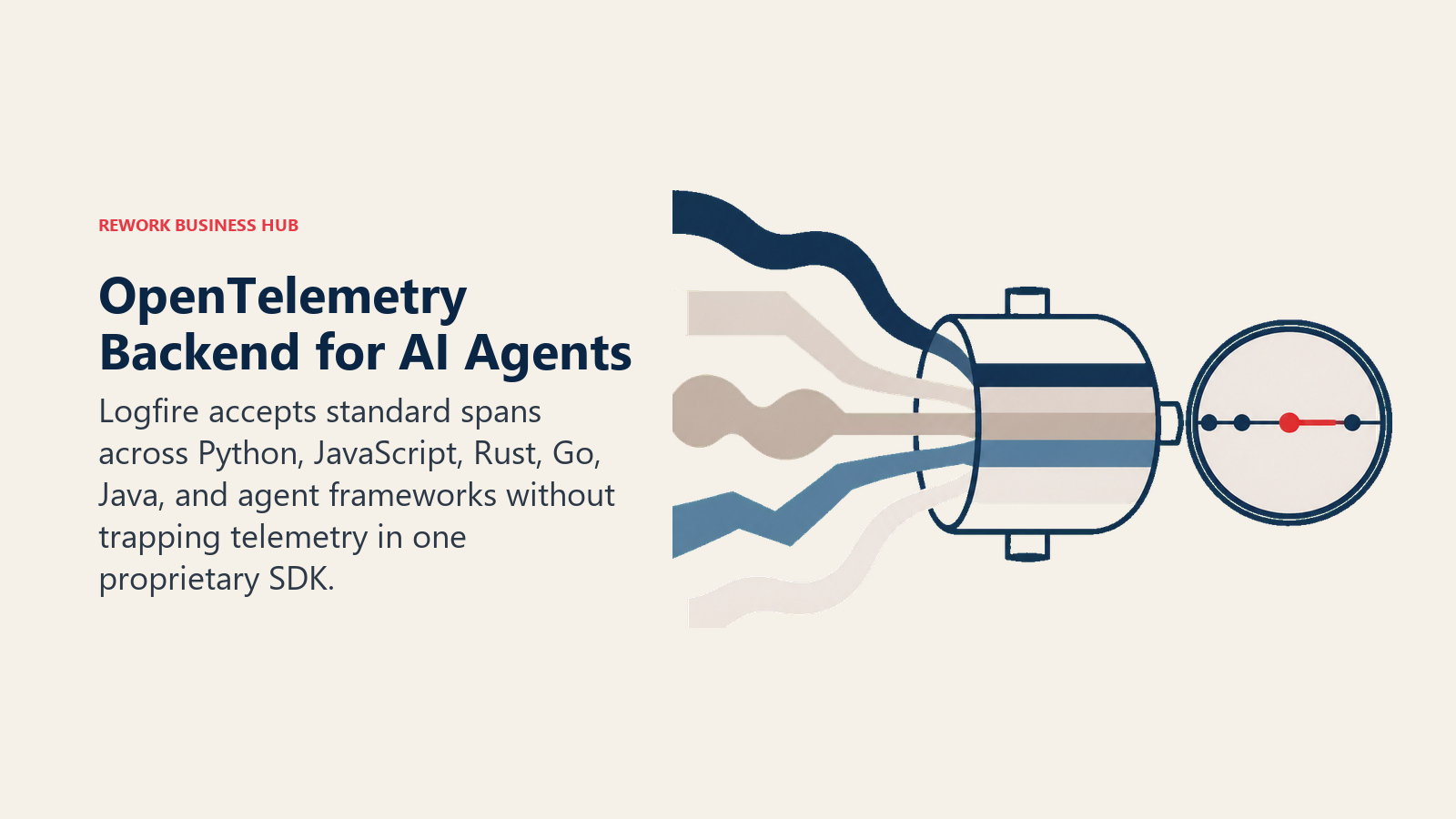
Logfire, from the team behind Pydantic and Pydantic AI, is built on OpenTelemetry from the ground up, explicitly marketed as "OTel-native" and compatible with any framework that already emits OTel spans, in Python, JavaScript and TypeScript, Rust, Go, Java, or anything else that speaks the protocol. For a team running a polyglot stack, that's a real advantage over tools that only fully support Python: a Go microservice, a Java legacy system, and a Python agent can all land in the same correlated view.
The honest trade-off is that Logfire is a general-purpose observability platform first, one that happens to work well for agent traces because agents are just another OTel-instrumented workload, rather than a purpose-built agent evaluation product. It doesn't market LLM-as-judge or systematic offline evaluation the way Langfuse, Braintrust, or Galileo do; you get logs, traces, and metrics in one place, and you build evaluation logic yourself or pair it with a specialist tool.
| What you get | What you don't |
|---|---|
| Explicitly OpenTelemetry-native across Python, Go, Java, JS, and Rust | Not purpose-built for agent evaluation; no strong LLM-as-judge feature |
| 10 million records/month included on every paid tier, not just an entry tier | Enterprise required for a dedicated single-tenant or self-hosted deployment |
| Unified view across a polyglot stack, not just LLM calls | The SDKs are open source, but the server and UI are closed source |
Pricing: Personal free (1 admin plus 2 guests, 10 million records/month, 30-day retention). Team $49/month (5 seats included, +$25/seat up to 12, 10 million records/month, 30-day retention). Growth $249/month (unlimited seats, 10 million records/month, up to 90-day retention). Enterprise custom (cloud multi-tenant, dedicated single-tenant, or self-hosted). Overage: $2 per additional million records on Team and Growth. Source: pydantic.dev/pricing.
Best for: Polyglot engineering teams that want one OpenTelemetry backend across every service, agents included, rather than a separate LLM-specific tool.
12. Traceloop (OpenLLMetry): The OpenTelemetry Instrumentation Layer Itself
Traceloop built OpenLLMetry, an Apache 2.0-licensed, fully open-source instrumentation library that extends OpenTelemetry specifically for LLM and agent applications, and its own hosted platform is the reference implementation of what to do with the traces it produces. Where most tools in this list added OTel support to an existing product, OpenLLMetry's semantic conventions for LLM calls were built alongside, and helped shape, the broader OTel GenAI semantic-convention effort the rest of the category is now converging on.
That heritage makes Traceloop the purest OTel-first option here: OpenLLMetry itself is free to use with any OTel-compatible backend, including competitors on this list, and Traceloop's own platform is one place to view what it collects, with a Monitoring Dashboard, an Evaluation Dashboard, and prompt management. The real limitation is retention on the free tier: 24 hours, which is fine for active debugging but not for looking back at a pattern from last week.
| What you get | What you don't |
|---|---|
| OpenTelemetry-native from the ground up; the SDK works with any OTel backend | Free tier data retention is only 24 hours |
| Apache 2.0-licensed OpenLLMetry SDK, genuinely free with no feature gate | No visible self-serve tier between Free and Enterprise |
| On-prem deployment across AWS, GCP, Azure, and Kubernetes, including air-gapped setups | Evaluation feature depth is less documented than dedicated eval-first tools |
Pricing: OpenLLMetry SDK free and open source (Apache 2.0), usable with any OTel-compatible backend. Traceloop Free Forever $0/month (up to 50,000 spans/month, up to 5 seats, 24-hour retention). Enterprise custom (unlimited seats, custom retention, SOC 2, on-prem deployment). Source: traceloop.com/pricing.
Best for: Teams that want the OpenTelemetry instrumentation itself to be portable, with the option to view traces in Traceloop or point them anywhere else that speaks OTel.
13. Maxim AI: Simulation Testing Before an Agent Ever Talks to a Customer
Maxim AI's differentiator is simulation: rather than only replaying logged production traces through an evaluator, Maxim can run simulated multi-turn conversations against an agent before it ever reaches a real customer, testing how it handles a full back-and-forth rather than a single isolated call. That's a meaningfully different question than "did this one response look right," and it pairs with online evaluation on live traffic once the agent is actually in production.
Pricing is per-seat rather than per-volume at the entry tiers, which is a different model than most of this list: Professional at $29/seat/month unlocks simulation runs and online evals, and Business at $49/seat/month adds PII management and scheduled runs. That structure is straightforward to budget for a small team and gets expensive quickly for a larger one, since the cost scales with headcount rather than agent traffic. Neither OpenTelemetry support nor self-hosting is documented publicly outside the Enterprise tier's in-VPC deployment option.
| What you get | What you don't |
|---|---|
| Simulation runs test multi-turn agent behavior before launch, not just single calls | Per-seat pricing scales with headcount, not agent traffic |
| LLM-as-judge via an "evaluator store" plus custom evaluators and human review | OpenTelemetry support isn't documented publicly |
| Enterprise offers in-VPC deployment and SOC 2 Type II, ISO 27001, HIPAA, and GDPR coverage | Free tier's 3-day data retention is the shortest in this comparison |
Pricing: Developer free forever (up to 3 seats, 1 workspace, 10,000 logs/month, 3-day retention). Professional $29/seat/month (unlimited seats, up to 3 workspaces, 100,000 logs/month, 7-day retention, simulation runs and online evals included). Business $49/seat/month (unlimited workspaces, 500,000 logs/month, 30-day retention). Enterprise custom (in-VPC deployment, custom SSO). Overage: $1 per 10,000 logs on Professional and Business. Source: getmaxim.ai/pricing.
Best for: Teams that want to simulate how an agent handles a full conversation before it goes live, not just score individual responses after the fact.
AI Agent Observability Buying Mistakes to Avoid
| Mistake | What It Looks Like | What to Do Instead |
|---|---|---|
| Buying tracing and calling it done | A clean dashboard with no failed run in months, because nobody's grading correctness | Budget for evaluation from day one, not as a phase-two project |
| Assuming OTel support means full portability | Discovering the "OTel integration" only covers ingestion, not the eval or dataset layer | Check whether evaluation and datasets travel with the traces or stay locked to the vendor |
| Picking the tool your framework's docs mention first | Defaulting to LangSmith because the LangChain quickstart uses it, without comparing alternatives | Evaluate against your own retention, compliance, and eval needs, not just setup speed |
| Ignoring how the free tier's unit is defined | Budgeting off "spans" without checking that a single agent run can burn 10-20 spans | Estimate real monthly volume per agent run before comparing free-tier limits |
| Treating LLM-as-judge as ground truth | Shipping changes based on a judge score with no human spot-check | Pair LLM-as-judge with periodic human review, especially before a high-stakes release |
| Assuming self-hosting is available at every tier | Building an on-prem rollout plan around a tool where self-hosting requires Enterprise | Confirm the self-hosted or VPC deployment tier and its price before you commit to an architecture |
| Not re-checking pricing before renewal | Budgeting off a review site's numbers from months earlier in a fast-moving category | Re-verify vendor pricing pages directly; ingestion-based pricing changes often |
How to Choose: Decision Framework
| If you need... | Pick... | Why |
The final matrix maps technical constraints to tools with very different strengths.
 |---|---|---|
| Deepest tracing for a LangChain or LangGraph-built agent | LangSmith | Native run-tree tracing, plus a real OTLP endpoint if you need to move later |
| To self-host for free with no vendor lock-in | Langfuse | Fully open source, OpenTelemetry-native on every tier, including self-hosted |
| An OTel backend already tied to your APM and infrastructure dashboards | Datadog Agent Observability | Agent spans sit next to the same infrastructure and RUM data you already monitor |
| Evaluation and CI-gated releases as the primary job | Braintrust | Built around scorers, experiments, and an autonomous eval-iteration workflow |
| The cheapest real paid tier with full OTel and LLM-as-judge | Comet Opik | $19/month Pro tier, with a free open-source option underneath it |
| The fastest possible setup with minimal code changes | Helicone | One-line proxy swap; Sessions group calls into a full agent flow after the fact |
| Purpose-built judge models instead of a general LLM prompt | Galileo | The Luna evaluator family, plus real-time guardrails at the enterprise tier |
| One OTel backend across a polyglot stack, not just Python | Pydantic Logfire | Explicitly OTel-native across Python, Go, Java, JavaScript, and Rust |
| To simulate multi-turn agent conversations before launch | Maxim AI | Simulation runs test behavior across a conversation, not just one call |
| Regulated data that can't leave your VPC | Arize AX, Langfuse, or Traceloop | All three offer a genuine self-hosted or on-prem path, not just a sales conversation |
|---|---|---|
| Deepest tracing for a LangChain or LangGraph-built agent | LangSmith | Native run-tree tracing, plus a real OTLP endpoint if you need to move later |
| To self-host for free with no vendor lock-in | Langfuse | Fully open source, OpenTelemetry-native on every tier, including self-hosted |
| An OTel backend already tied to your APM and infrastructure dashboards | Datadog Agent Observability | Agent spans sit next to the same infrastructure and RUM data you already monitor |
| Evaluation and CI-gated releases as the primary job | Braintrust | Built around scorers, experiments, and an autonomous eval-iteration workflow |
| The cheapest real paid tier with full OTel and LLM-as-judge | Comet Opik | $19/month Pro tier, with a free open-source option underneath it |
| The fastest possible setup with minimal code changes | Helicone | One-line proxy swap; Sessions group calls into a full agent flow after the fact |
| Purpose-built judge models instead of a general LLM prompt | Galileo | The Luna evaluator family, plus real-time guardrails at the enterprise tier |
| One OTel backend across a polyglot stack, not just Python | Pydantic Logfire | Explicitly OTel-native across Python, Go, Java, JavaScript, and Rust |
| To simulate multi-turn agent conversations before launch | Maxim AI | Simulation runs test behavior across a conversation, not just one call |
| Regulated data that can't leave your VPC | Arize AX, Langfuse, or Traceloop | All three offer a genuine self-hosted or on-prem path, not just a sales conversation |
What to Do Next
Pick one agent you already have running in production, the one with the highest volume or the most customer exposure, and instrument it with your shortlisted tool's free tier for two weeks before you sign anything. Confirm you can see every tool call it makes, not just the final answer, and run at least one offline evaluation against a small test set of real cases. If the tool can't show you where a bad run actually went wrong, or evaluation feels bolted on rather than built in, it's the wrong tool regardless of how clean the dashboard looks.
If you're still comparing agent platforms themselves before you get to this step, best enterprise AI agent platforms in 2026 and best AI coding agents in 2026 cover two of the most common starting points, and what is an AI agent is the place to start if the plan-act-observe loop itself still needs defining first.

Principal Product Marketing Strategist
On this page
- Key Facts
- Quick Comparison Table
- What "Agent Observability" Actually Means
- How to Choose an AI Agent Observability Tool in 2026
- Trace Granularity and OpenTelemetry Support
- Evaluation Approach
- Pricing Model and Free-Tier Volume
- 1. LangSmith: Deepest Tracing for LangChain and LangGraph Teams
- 2. Langfuse: The Open-Source Standard, Self-Hosted for Free
- 3. Arize (Phoenix and AX): OpenTelemetry-Native From Open Source to Enterprise
- 4. Datadog Agent Observability: Agent Traces Next to the Infrastructure Data You Already Watch
- 5. Braintrust: Built Around Evaluation, Not Just Dashboards
- 6. W&B Weave: For Teams Already Living in Weights and Biases
- 7. Comet Opik: Open Source Plus the Cheapest Real Paid Tier Here
- 8. Helicone: The Fastest Proxy-Based Setup
- 9. HoneyHive: OpenTelemetry-Native With No Self-Serve Middle Tier
- 10. Galileo: Enterprise Evaluation With Purpose-Built Judge Models
- 11. Pydantic Logfire: A General-Purpose OpenTelemetry Backend That Fits Agents Well
- 12. Traceloop (OpenLLMetry): The OpenTelemetry Instrumentation Layer Itself
- 13. Maxim AI: Simulation Testing Before an Agent Ever Talks to a Customer
- AI Agent Observability Buying Mistakes to Avoid
- How to Choose: Decision Framework
- What to Do Next