Glossário de Alinhamento entre Sales e Customer Success: 30 Termos que Toda Equipe de Receita Precisa Alinhar
Turn this article into takeaways for your work.


Each assistant summarizes the article only for you and suggests best practices for your work.
Aqui está um cenário real que se repete a cada trimestre. Um account executive (AE) fecha um negócio e o marca como "onboarded" no CRM. O Customer Success Manager (CSM) herda a conta. Abre o registro e vê um cliente que nunca fez login. Não completou a configuração principal. Já está enviando e-mails com perguntas que o AE deveria ter respondido antes de passar o bastão. Ambas as equipes usaram a palavra "onboarded." Nenhuma quis dizer a mesma coisa.
Essa lacuna não fica no handoff. Ela se acumula em uma erosão de confiança de 90 dias. O health score parece bom até desabar. E o problema de net revenue retention (NRR) chega a uma revisão de board que ninguém esperava.
O processo recebe a maior parte da culpa quando o alinhamento Sales-CS falha. Geralmente é o vocabulário. Duas equipes podem seguir o mesmo playbook e falhar porque definem os mesmos termos de forma diferente. E nenhuma das equipes percebe isso até um cliente dar churn.
Este glossário é a referência canônica para toda a coleção de alinhamento entre Sales e CS. Cada artigo da coleção vincula de volta a este quando um termo precisa de uma definição precisa. Use-o como ferramenta de trabalho: reúna o líder de equipe de AE e o líder de equipe de CS na mesma sala, abra este documento e sinalize cada termo onde suas definições atuais divergem. Essas divergências são sua agenda de alinhamento.
Termos Mais Citados Neste Glossário
São os termos com maior volume de busca e maior frequência de desacordo definitório em equipes de receita SMB e mid-market. Se sua equipe tem apenas 45 minutos para uma revisão do glossário, comece e termine aqui.
- NRR (Net Revenue Retention): A métrica que torna Sales e CS responsáveis pelo mesmo número. O termo de receita mais pesquisado depois de ARR em SaaS B2B.
- GRR (Gross Revenue Retention): Mede a retenção pura antes do upsell. A diferença entre GRR e NRR mostra o quanto a expansão está mascarando a fraqueza de retenção.
- ICP (Ideal Customer Profile): Definição upstream que determina quais clientes chegam ao CS. Quando o ICP está errado, o CS herda contas que não conseguem ter sucesso, independentemente da qualidade do handoff.
- RevOps (Revenue Operations): A função responsável pelo registro compartilhado do cliente, pelo sistema de pontuação de handoff e pelo modelo de dados de NRR. A dona natural deste glossário.
- CSM (Customer Success Manager): Responsável pelo relacionamento pós-venda. O papel cujo escopo, propriedade de renovação e responsabilidade por expansão precisam ser definidos explicitamente para o alinhamento funcionar.
- Onboarded: O marco definido de forma mais inconsistente nas operações pós-venda. 58% das empresas SaaS não têm uma definição compartilhada.
- At-Risk: Não significa nada até o limite ser escrito. Quando é específico e numérico, os save plays podem ser acionados de forma proativa, e não reativa.
- Handoff Packet: O que viaja do AE para o CSM no Closed-Won. Frequentemente vazio. A versão estruturada é medida pelo scorecard de handoff.
- Health Score: Sinal composto. Inútil se o contexto de Sales não estiver nele junto com os dados de uso do produto.
- Save Play: Uma intervenção definida com etapas, responsáveis e cronograma. Não "vamos entrar em uma ligação."
Como Usar Este Glossário
O glossário é uma ferramenta de trabalho de alinhamento, não uma página de referência para folhear uma vez e esquecer.
Isto não é uma tarefa de leitura. É uma ferramenta de facilitação.
Realize uma sessão de 45 minutos com os líderes que são responsáveis pelo pipeline de Sales e pela retenção de CS. Percorra as seis seções abaixo. Para cada termo, faça uma pergunta: "Temos uma definição escrita e acordada agora?" Se sim, confirme que corresponde ao que está aqui e siga em frente. Se não, ou se cada equipe tiver uma resposta diferente, você encontrou uma lacuna que vale a pena fechar antes do próximo trimestre.
Cada termo tem uma definição e um exemplo de uma linha. O exemplo existe porque definições abstratas parecem idênticas até você as aplicar a uma conta real. O caso concreto é onde o desacordo surge.
Vincule a termos individuais de outros documentos usando os IDs de âncora em cada título de seção. Ao fazer o onboarding de um novo AE ou CSM, envie este glossário na primeira semana. Quando um novo VP de Sales ou CS entra, realize a revisão do glossário nos primeiros 30 dias antes que as definições da empresa anterior se tornem o padrão da equipe.
Análise da Rework: Os termos que causam mais dano ao alinhamento não são os obscuros. São os de alta frequência que toda equipe acha que já tem alinhados. NRR, onboarded, champion e at-risk aparecem em revisões semanais de liderança e em decks trimestrais de board. Mas quando Sales e CS definem "onboarded" de formas diferentes, essa palavra aparece em toda conversa de handoff com significados diferentes, e ninguém sinaliza a divergência porque ambos os lados presumem que o outro usa a mesma definição. A sessão de glossário de 45 minutos descrita acima não é um exercício de documentação. É uma sessão de descoberta de desacordos. O objetivo não é produzir um documento. É encontrar os termos em que as duas definições da sua equipe não coincidem.
Os dados sobre o que acontece quando as equipes realmente fecham essas lacunas estão nos Dados Relevantes abaixo. Comece pelos termos de ciclo de vida: é onde a maioria das equipes encontra sua primeira lacuna.
Dados Relevantes: O Custo de Termos Indefinidos
- Empresas B2B com definições alinhadas de Sales e CS geram taxas de ganho em vendas 38% maiores e taxas de retenção de clientes 36% maiores do que equipes desalinhadas, segundo pesquisa da MarketingProfs.
- Empresas que alinham Sales e CS em uma definição escrita de "at-risk" reduzem o tempo de ativação reativa de save play em 40%, segundo a pesquisa anual de customer success da Gainsight.
- O NRR melhora em média 8-12 pontos percentuais em empresas que implementam um registro compartilhado de clientes com entradas de health score definidas conjuntamente, segundo os benchmarks State of Customer Success da Gainsight.
Termos do Ciclo de Vida do Cliente
Definições de ciclo de vida evitam que Sales e CS relatem o mesmo momento do cliente sob rótulos diferentes.
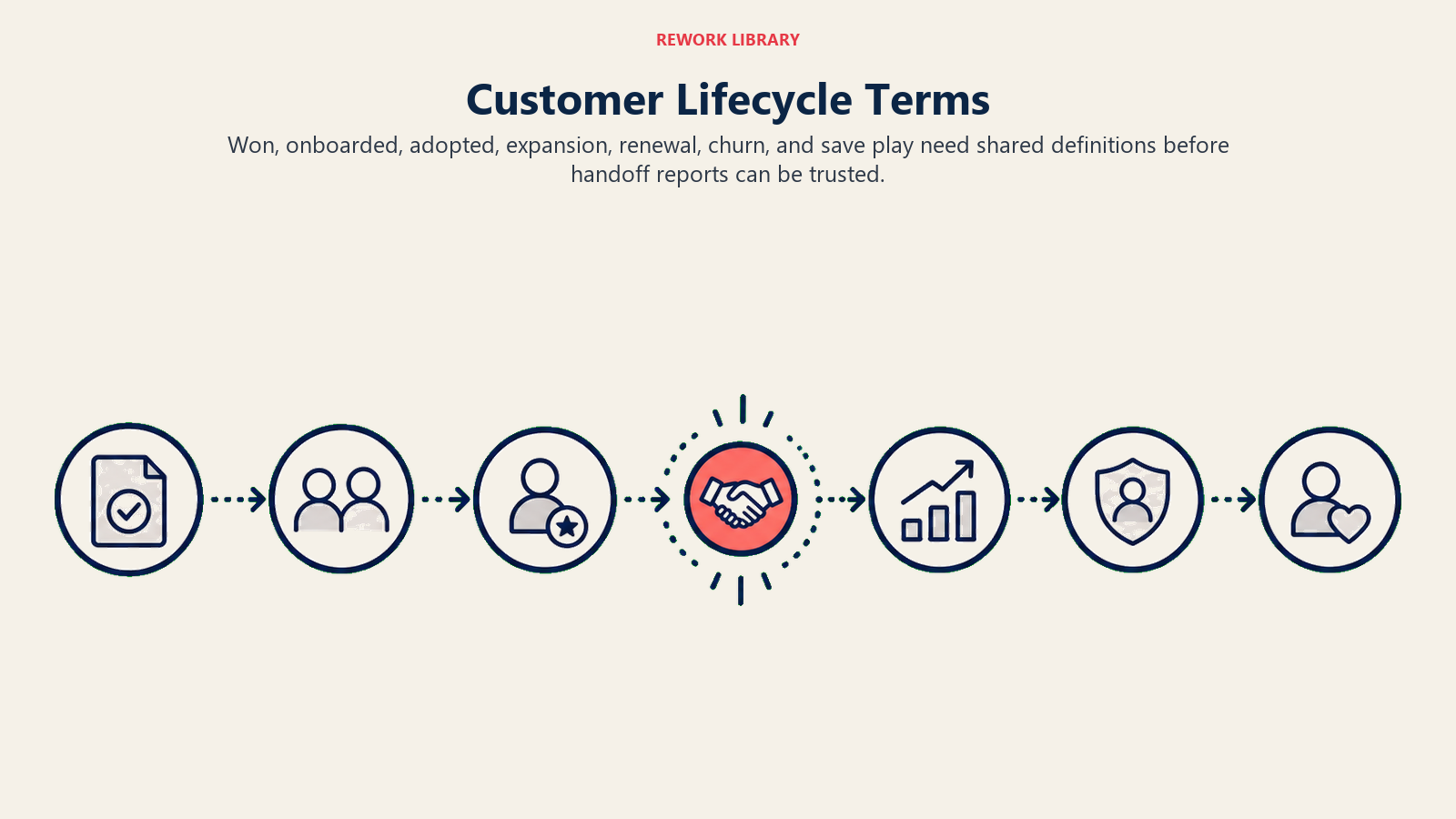 Esses termos definem os estágios pelos quais um cliente passa desde a assinatura do contrato até a renovação. Se os estágios do seu CRM e os estágios da sua plataforma de CS usam linguagem diferente para os mesmos marcos, todo relatório de handoff estará errado.
Won
Um negócio marcado como Closed-Won no CRM. A receita está contratada. O processo de handoff começa. "Won" não significa que o cliente começou a usar o produto. Significa que o acordo comercial está assinado e a conta está fazendo a transição da movimentação de Sales para a movimentação de CS.
Exemplo: O AE recebe um MSA assinado e marca a oportunidade como Closed-Won. A conta aparece na fila de onboarding da equipe de CS. Nada foi configurado ainda.
Onboarded
O cliente concluiu os marcos de implementação acordados e está usando ativamente o produto para seu caso de uso principal. "Onboarded" não é sinônimo de "kickoff concluído" ou "go-live". Requer quatro critérios: conclusão técnica, gatilho de adoção, marco de sucesso e confirmação do sponsor. Os critérios exatos devem ser escritos no registro do cliente antes do kickoff.
Veja O Que "Onboarding Bem-Sucedido" Realmente Significa para como escrever a definição da sua equipe e operacionalizar o marco.
Exemplo: A integração do cliente está ativa, três usuários principais concluíram seu primeiro workflow, o champion confirmou que o caso de uso principal está funcionando, e o CSM marcou "Onboarding Bem-Sucedido: Sim" no registro do cliente.
Adopted
O cliente está usando o produto regularmente nas funcionalidades vinculadas aos seus critérios de sucesso declarados. A adoção é medida, não assumida. Requer definir quais funcionalidades contam como "principais" para cada tipo de cliente e qual frequência de uso constitui uso regular. Um cliente adotado não é necessariamente um cliente em expansão, mas clientes não adotados dão churn em taxas significativamente maiores na renovação.
Exemplo: Uma conta usando o módulo de CRM diariamente, com 8 dos 10 assentos licenciados ativos e o recurso de relatórios de pipeline funcionando automaticamente a cada semana, está adotada. Uma conta com 2 dos 10 assentos ativos e sem atividade de CRM em 14 dias não está.
Expansion
Qualquer aumento no valor do contrato após o fechamento inicial: adições de assentos, upgrades de plano, cross-sells, novos módulos. A expansão é rastreada separadamente da renovação. O Expansion ARR é a principal alavanca de crescimento para contas existentes e é a diferença entre NRR acima de 100% e NRR em 100%. Quem é responsável pelas movimentações de expansão (CSM, AM ou AE) deve ser decidido explicitamente porque a ambiguidade aqui corrói tanto relacionamentos quanto receita.
Exemplo: Um cliente que começou com 10 assentos adiciona mais 5 no mês 7, gerando $9.000 em Expansion ARR.
Renewal
O ponto em que o prazo do contrato de um cliente termina e uma decisão é tomada para continuar. Uma renovação não é um evento administrativo passivo. É uma decisão comercial que requer gestão ativa. A conversa de renovação deve começar 90-120 dias antes da data de término do contrato, não na semana em que ele expira. Quem é responsável pelo processo de renovação (AE, AM ou CSM) varia por modelo de equipe e deve ser decidido explicitamente para evitar lacunas de propriedade no momento mais crítico do ciclo de vida do cliente.
Exemplo: Um contrato de 12 meses renova em 1º de novembro. A equipe de CS deve iniciar a conversa de renovação no máximo em 1º de agosto, com uma verificação de saúde, discussão de expansão e revisão de contrato agendadas antes de 1º de outubro.
Churn
Um cliente que não renova. O churn de logo conta a conta perdida. O churn de receita conta o ARR perdido. O churn bruto e líquido são calculados de formas diferentes. Rastrear apenas o churn de logo esconde o impacto de receita de perder contas maiores. Rastrear apenas o churn de receita pode mascarar uma base de clientes deteriorando, mascarada por algumas contas de alto valor retidas.
Exemplo: 100 clientes no início do ano. 10 dão churn até o final do ano. Churn de logo = 10%. Se essas 10 contas representavam 25% do ARR, o churn de receita = 25% apesar do churn de logo de 10%.
Save Play (Plano de Resgate)
Uma intervenção definida acionada quando um cliente atinge um limite de risco. Um save play tem etapas nomeadas, responsáveis atribuídos, um cronograma e um objetivo específico. "Vamos entrar em uma ligação" não é um save play. É um pânico reativo. Um save play eficaz é executado antes que o cliente peça para cancelar, não depois. As condições de gatilho (qual limite de health score, qual red flag) devem ser escritas antecipadamente.
Exemplo: Um save play acionado quando o health score cai abaixo de 40 por 14 dias consecutivos: Dia 1, CSM envia e-mail pessoal de verificação. Dia 3, CSM propõe uma ligação de 30 minutos. Dia 7, Gerente de CS participa da ligação. Dia 14, AE e CSM apresentam conjuntamente um plano de sucesso revisado.
Papéis e Relacionamentos
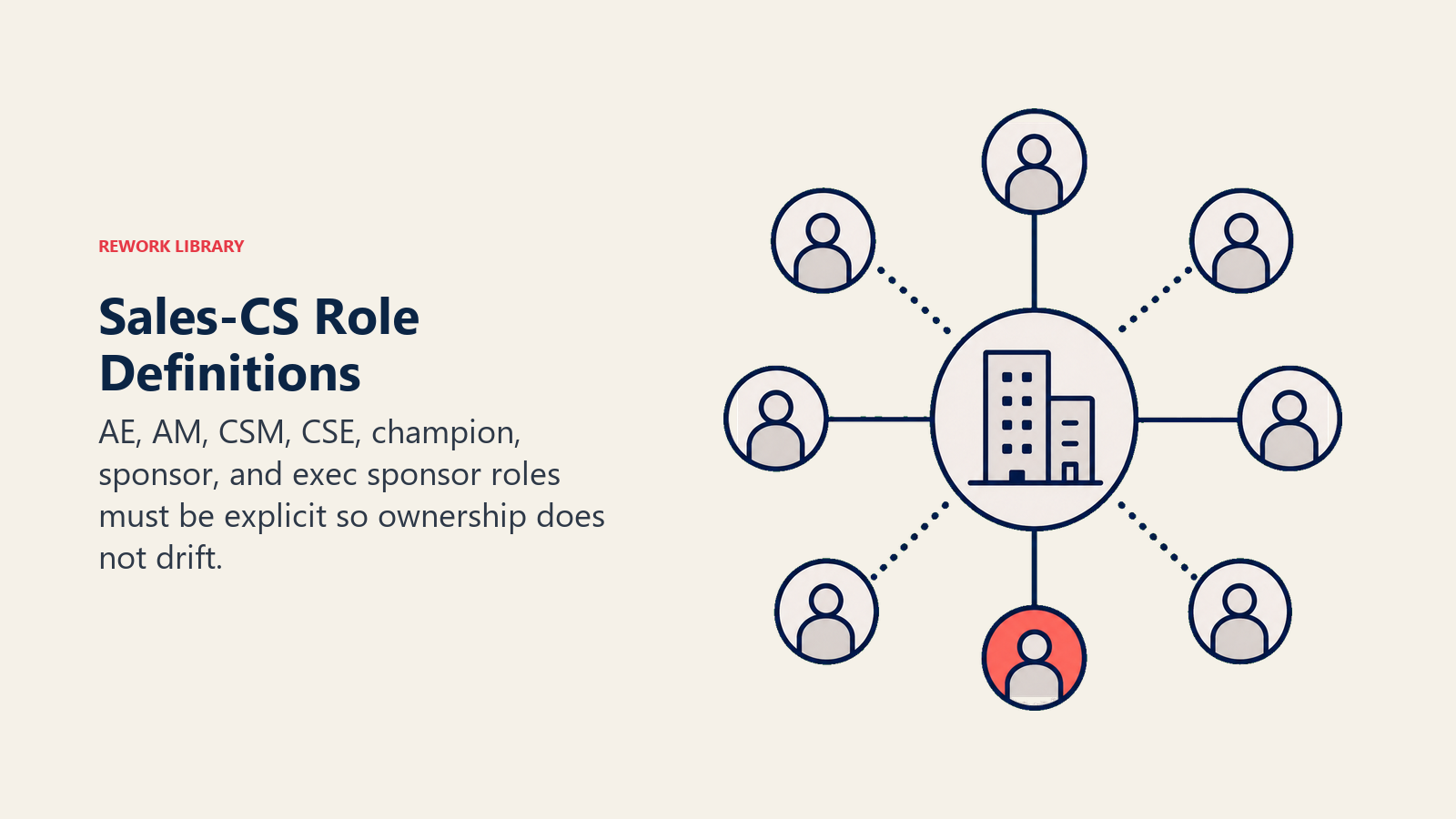
Esses termos definem quem é responsável pelo quê na movimentação pós-venda. A fonte mais comum de conflito AE-CSM é a responsabilidade indefinida, não pessoas ruins, mas papéis ambíguos.
AE: Account Executive (Executivo de Contas)
Responsável pelo ciclo de vendas desde a oportunidade qualificada até o Closed-Won. Responsabilidade principal é o novo ARR. No modelo mais comum, a responsabilidade do AE termina na assinatura do contrato. Em modelos de remuneração vinculados ao NRR, o AE retém responsabilidade pela primeira renovação ou pela expansão nos primeiros 12 meses. O que o AE deve completar antes de se desengajar de uma conta deve ser definido no processo de handoff, não deixado ao julgamento individual.
Exemplo: AE fecha um negócio de $48.000 ARR, completa o pacote de handoff, participa do kickoff e transfere a responsabilidade da conta ao CSM dentro de 14 dias do fechamento.
AM: Account Manager (Gerente de Contas)
Em alguns modelos, é responsável pelo relacionamento comercial pós-venda, cobrindo renovações e expansões, sem um papel dedicado de CSM. Comum em SMB transacional onde o tamanho do negócio não justifica cobertura separada de CS. AMs frequentemente carecem de profundidade técnica para solucionar problemas de adoção, o que cria uma lacuna em contas que precisam de suporte de implementação junto com a gestão comercial. Veja modelos de propriedade de renovação para como estruturar a decisão AE-AM-CSM.
Exemplo: Uma conta SMB de $6.000 ARR é gerenciada por um AM que trata da renovação, upsell e relacionamento, com escalada de suporte indo para um pool compartilhado de CS em vez de um CSM dedicado.
CSM: Customer Success Manager (Gerente de Sucesso do Cliente)
Responsável pelo relacionamento pós-venda com o cliente. Responsabilidade principal é retenção e saúde. Pode ou não ser responsável pela receita de renovação dependendo do modelo da equipe. Quando CSMs têm quota de renovação, carregam uma movimentação comercial junto com seu papel de retenção. Isso cria eficiência mas também tensão se um cliente precisa de más notícias francas sobre uma implementação que está tendo dificuldades. Veja modelos de propriedade de renovação para como estruturar a decisão.
Exemplo: CSM é responsável por 35 contas. KPIs principais: NRR em todo o livro, distribuição de health score, tempo de onboarding. KPI secundário: Expansion ARR se o modelo incluir upsell gerenciado pelo CSM.
CSE: Customer Success Engineer (Engenheiro de Sucesso do Cliente)
Contraparte técnica do CSM. Trata da implementação, integrações e escaladas técnicas durante e após o onboarding. O relacionamento com o CSE é particularmente importante para contas com requisitos de integração complexos. Os detalhes técnicos que os AEs comprometem durante os negócios devem chegar ao CSE, não apenas ao CSM.
Exemplo: Uma conta com uma integração de API personalizada depende do CSE para configurar e testar a conexão durante o onboarding. Se o AE comprometeu com uma integração não padrão no negócio, o CSE precisa saber antes do kickoff, não depois.
Champion
O usuário interno ou gerente que defendeu a compra e continua a impulsionar a adoção internamente. O champion é frequentemente a pessoa com quem o CSM constrói o relacionamento mais próximo durante o onboarding. A saída do champion é um dos preditores de churn de maior probabilidade. Quando o champion sai, a defesa interna desaparece e o produto perde seu suporte político interno independentemente de o produto estar funcionando. Veja transição de champion de AE para CSM para como gerenciar esse handoff sem perder o relacionamento.
Exemplo: A Diretora de Operações defendeu a implementação, treinou a equipe e impulsionou a adoção por 8 meses. Ela foi para uma nova empresa. Seu substituto não conhece a ferramenta e não foi onboardado. Este é um red flag que requer ação imediata.
Sponsor
Executivo interno na empresa do cliente que aprovou a compra. Alto nível organizacional de autoridade, baixo envolvimento diário no produto. Os relacionamentos com o sponsor importam mais na renovação. Se o CSM construiu apenas o relacionamento com o champion e o sponsor não se lembra do produto quando a renovação chegar, o champion tem que lutar pelo orçamento sozinho. Os AEs devem identificar o sponsor durante o ciclo de vendas e garantir que o CSM tenha suas informações de contato no handoff.
Exemplo: O VP de Receita aprovou o contrato. Ela não fez login no produto mas recebe o deck de QBR em nível executivo. Na renovação, sua aprovação é o que importa.
Exec Sponsor (Patrocinador Executivo)
Um líder sênior na sua empresa (VP ou acima) emparelhado com um stakeholder sênior no cliente. Usado para contas estratégicas para sinalizar comprometimento de longo prazo e abrir um canal direto de comunicação executiva. Os relacionamentos de exec sponsor são ativados para contas estratégicas em risco e para conversas de expansão que requerem alinhamento executivo.
Exemplo: Seu VP de Customer Success é exec sponsor das suas 10 principais contas. Ela participa da revisão anual de negócio e está disponível para escalada fora do caminho normal de CSM-para-champion.
Health Scoring (Pontuação de Saúde)
Os termos de health scoring só são úteis se sua equipe definiu o que "saudável" e "at-risk" significam por escrito. Essas definições direcionam alertas automáticos, gatilhos de save play e alocação de recursos. E só funcionam se o contexto de Sales (promessas de negócio, estabilidade do champion, encaixe de ICP) alimentar o modelo junto com os dados de uso do produto. Veja health scoring de clientes com entradas de contexto de Sales para como conectar essas entradas em um modelo de saúde funcional.
Health Score (Pontuação de Saúde)
Um sinal numérico composto ou codificado por cor que resume o perfil de risco de uma conta de cliente. Combina dados de uso, volume de tickets de suporte, pontuações de NPS ou CSAT, frequência de engajamento e, em modelos bem projetados, entradas de contexto de Sales do pacote de handoff (encaixe de ICP, estabilidade do champion, complexidade de comprometimento). Um health score que depende apenas de dados de uso do produto perde o contexto que explica por que o uso é o que é.
Exemplo: Uma conta pontua 72/100 (uso: 30/40, engajamento: 20/30, sentimento: 10/10, carga de suporte: 12/20). Abaixo de 70 aciona revisão. Acima de 85 sinaliza para conversa de expansão.
Red Flag (Sinal de Alerta)
Um sinal específico e observável de que uma conta pode dar churn. Os red flags diferem de um health score em declínio porque são eventos discretos, não tendências. Exemplos: a frequência de login cai 50% ou mais em 30 dias, o champion sai ou é promovido para um papel sem supervisão do produto, a reunião de renovação foi recusada duas vezes, uma integração chave falha e não é corrigida em 5 dias úteis, NPS cai de 8+ para 5 ou abaixo em um ciclo de pesquisa.
Exemplo: O usuário principal não fez login há 22 dias. O champion não respondeu aos últimos dois e-mails do CSM. Esses dois sinais juntos constituem um red flag que requer contato na mesma semana.
At-Risk
Uma conta cujo health score cruzou um limite definido indicando que a intervenção é necessária. At-risk não é um sentimento. É um número. Quando uma conta atinge o limite at-risk, um save play deve ser ativado dentro de uma janela de tempo definida. A diferença entre uma equipe que captura o churn antecipadamente e uma equipe que está sempre surpresa é se "at-risk" significa algo específico e acionável ou apenas "não está ótimo."
Exemplo: Health score abaixo de 45 por duas medições semanais consecutivas = at-risk. O status at-risk aciona um save play em 48 horas e escala a visibilidade para o Gerente de CS.
Termos de Handoff
Esses são os termos que governam o que viaja de Sales para CS no Closed-Won. A ambiguidade aqui produz as lacunas de informação que forçam CSMs a reconstruir o contexto que o AE já tinha, e clientes a responder as mesmas perguntas duas vezes.
Handoff Packet (Pacote de Handoff)
A coleção estruturada de informações de negócio transferida do AE para o CSM no Closed-Won. Um handoff packet completo inclui: caso de uso e problema de negócio, mapa de stakeholders (champion, sponsor, contato do dia a dia, objecionistas), compromissos feitos durante a venda, requisitos técnicos, expectativas de prazo e notas de contexto do negócio (por que compraram agora, o que quase matou o negócio). Veja o scorecard de handoff para o que "completo" significa em forma pontuada.
Exemplo: Um AE completa o handoff packet no CRM dentro de 48 horas do fechamento. O CSM o revisa antes do kickoff e chega sabendo os critérios de sucesso do cliente, sua estrutura de stakeholders e quaisquer promessas não padrão feitas.
Kickoff
A primeira reunião conjunta entre o cliente, CSM e frequentemente o AE após o Closed-Won. Define o plano de onboarding, os critérios de sucesso, a concordância com o prazo de implementação e estabelece o marco de go-live. O kickoff é onde o contexto do handoff packet se torna um acordo compartilhado com o cliente, não apenas um documento interno. Veja agenda da ligação de kickoff conjunto para estrutura e resultados.
Exemplo: Ligação de kickoff no Dia 5 pós-fechamento. AE abre com um resumo de contexto, CSM lidera a discussão de critérios de sucesso, o cliente confirma ou corrige o registro, e ambas as equipes alinham em um plano de onboarding de 30 dias antes de encerrar a ligação.
Deal Context (Contexto do Negócio)
O contexto qualitativo de uma venda: por que o cliente comprou, que dor impulsionou a urgência, quem influenciou a decisão, que objeções foram levantadas, o que quase matou o negócio. O deal context é distinto dos dados do negócio (ARR, data de fechamento, termos do contrato). É a narrativa que explica os números. CSMs não conseguem perguntar aos clientes por que compraram sem parecer que não foram informados. O deal context no handoff packet evita isso.
Exemplo: Nota de deal context: "O cliente teve uma implementação falha com um concorrente 18 meses atrás. A principal objeção foi a complexidade de implementação. Nos comprometemos com um CSE dedicado para os primeiros 60 dias. O champion é a COO, que estava cética até que o trial mostrou o relatório de pipeline. O CFO assinou, mas não está engajado."
Expectations Document (Documento de Expectativas)
Um registro escrito dos compromissos feitos durante o ciclo de vendas (prazos, funcionalidades, integrações, resultados) aprovado tanto pelo AE quanto pelo CS antes do kickoff. O expectations document é a ferramenta que evita o modo de falha "Sales prometeu demais, CS entrega de menos". Não precisa ser formal. Uma seção de notas do CRM ou um documento compartilhado funcionam. Mas precisa ser escrito e confirmado antes de o cliente chegar ao kickoff esperando algo que o CSM não foi informado.
Veja prevenindo excessos de promessa de Sales para como construir a revisão de CS pré-fechamento que cria este documento.
Exemplo: O expectations document registra: "Integração com ERP existente até o Dia 30. Marco de go-live: primeiro relatório automatizado funcionando até o Dia 45. Dashboard personalizado para revisão do CFO concluído até o Dia 60." CSM confirmou o escopo antes do kickoff.
Renovação e Expansão
Os termos de renovação e expansão conectam a qualidade diária do handoff às métricas de receita pós-venda que a liderança acompanha.
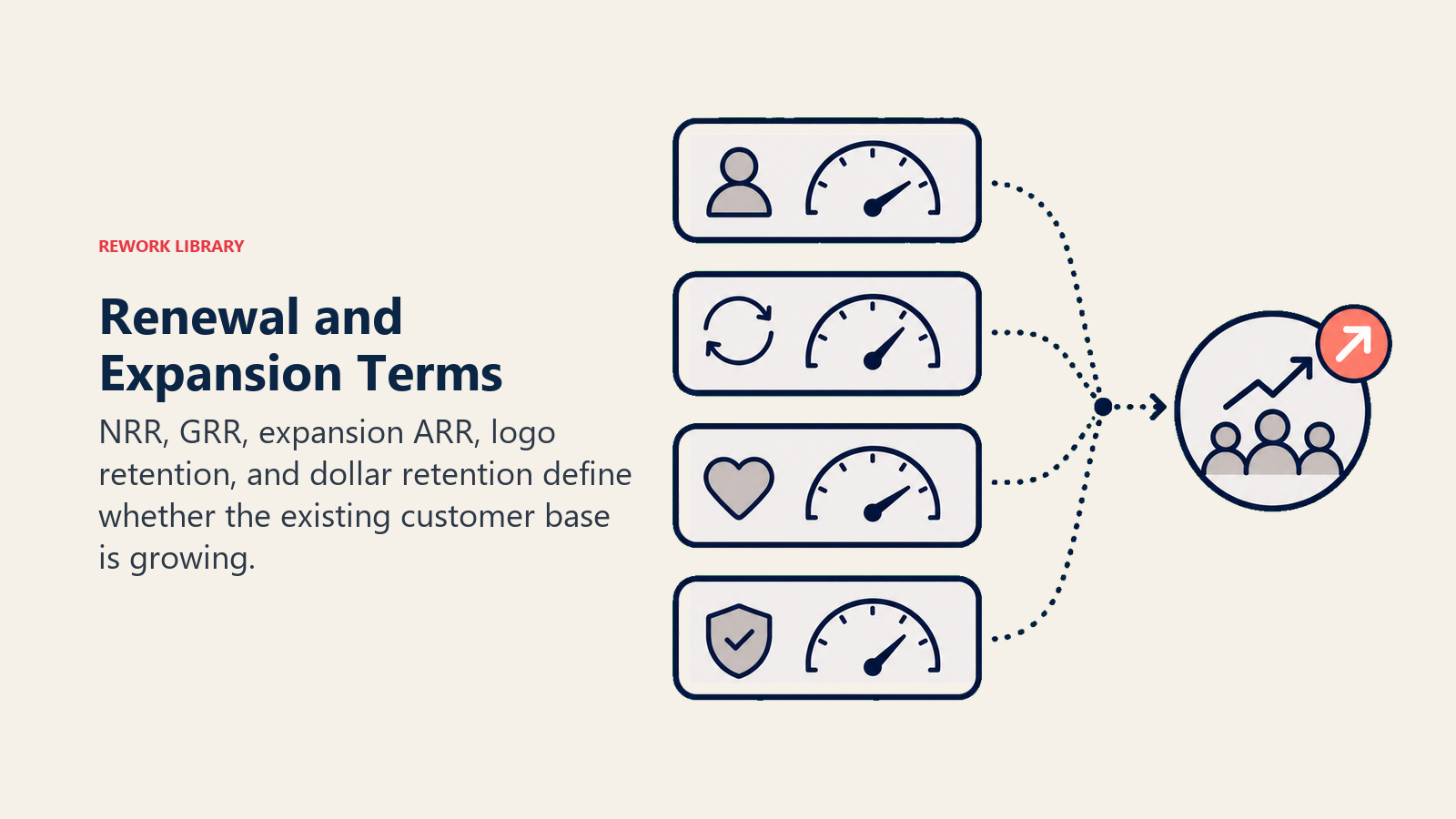 As métricas nesta seção determinam se Sales e CS estão remando para o mesmo resultado. O NRR é o número mais importante para uma equipe de receita pós-venda, e requer que ambas as equipes entendam o que estão contribuindo para ele.
NRR: Net Revenue Retention (Retenção Líquida de Receita)
Net Revenue Retention é a receita retida e expandida de clientes existentes, líquida de churn e contração. NRR acima de 100% significa que a base de clientes existente está crescendo sem nenhum novo logo. O NRR é a métrica principal para responsabilidade conjunta Sales-CS em empresas que vinculam ambas as equipes à saúde das contas existentes. É calculado como: (ARR Inicial + Expansion ARR − ARR em Churn − ARR Contraído) / ARR Inicial.
Veja o custo de um handoff quebrado: matemática de NRR para como a qualidade do handoff se traduz diretamente em resultados de NRR.
Exemplo: ARR de janeiro: $1.000.000. Expansão no T1: $80.000. Churn no T1: $40.000. Contração: $10.000. NRR = ($1.000.000 + $80.000 − $40.000 − $10.000) / $1.000.000 = 103%.
GRR: Gross Revenue Retention (Retenção Bruta de Receita)
Gross Revenue Retention é a receita retida de clientes existentes, sem contar expansões. Mede a retenção pura antes do upsell. O GRR nunca pode exceder 100%. Ele mede apenas o que foi mantido, não o que foi cultivado. Uma empresa com GRR de 92% está perdendo 8% do seu ARR para churn e contração antes de qualquer expansão ser contada. A diferença entre GRR e NRR diz o quanto sua movimentação de expansão está mascarando problemas de retenção subjacentes.
Exemplo: ARR inicial: $1.000.000. Churn: $40.000. Contração: $10.000. GRR = ($1.000.000 − $40.000 − $10.000) / $1.000.000 = 95%. O NRR pode ser 103% se a expansão for forte, mas a lacuna de retenção de 5 pontos ainda é real.
Expansion ARR (ARR de Expansão)
ARR adicional gerado de clientes existentes em um período: adições de assentos, upgrades de plano, cross-sells, novos módulos. A fonte de NRR acima de 100%. A propriedade do Expansion ARR (quem inicia e fecha movimentações de expansão: CSM, AM ou AE) deve ser definida explicitamente. Quando é ambígua, as conversas de expansão ou não acontecem ou acionam conflito de canal que prejudica o relacionamento com o cliente.
Exemplo: Um cliente adiciona 5 assentos a $150/assento/mês no mês 8 = $750/mês = $9.000 de Expansion ARR anualizado.
Logo Retention (Retenção de Logos)
Porcentagem de contas de clientes renovadas em um período, independentemente do valor em dólares. Uma empresa pode ter alta retenção de logos mas NRR em declínio se as contas sendo retidas são menores do que as que estão dando churn. A retenção de logos é um sinal útil para alcance de go-to-market e satisfação do cliente, mas não é um proxy confiável para saúde de receita.
Exemplo: 100 clientes, 92 renovaram = 92% de retenção de logos. Mas se as 8 contas que deram churn eram as 8 maiores, o churn de receita pode ser de 35%. A retenção de logos parecia bem; o negócio não estava.
Dollar Retention (Retenção em Dólares)
Porcentagem de ARR retida e crescida de uma coorte. Equivalente ao NRR na maioria dos usos. Os termos são frequentemente intercambiáveis em relatórios para board e conversas com investidores. Quando um CFO pergunta "qual é o seu dollar retention?", eles querem dizer NRR.
Exemplo: Uma coorte de janeiro de $500.000 ARR. Em dezembro, a mesma coorte representa $520.000 ARR (líquido de churn + expansão). Dollar retention = 104%.
Remuneração e Incentivos
Os termos de remuneração determinam o comportamento que suas equipes de Sales e CS realmente exibem, não o que suas descrições de cargo dizem. A remuneração desalinhada é a causa raiz da maioria das falhas de qualidade de handoff: os AEs fazem handoffs ruins porque não custa nada a eles, e os CSMs não escalam contas de mau encaixe porque são medidos em retenção independentemente do encaixe.
NRR Comp Plan (Plano de Remuneração por NRR)
Uma estrutura de remuneração que vincula uma parte da remuneração variável do AE ou CSM à retenção líquida de receita de suas contas (retenção mais expansão, menos churn). Os planos de remuneração de NRR alinham os incentivos de Sales à saúde de conta de longo prazo em vez de apenas ao volume de novos logos. Quando os AEs têm responsabilidade de NRR, a qualidade do handoff melhora porque um handoff ruim cria churn que afeta seu próprio contracheque. Veja remuneração alinhada ao NRR para padrões de design.
Exemplo: AE ganha 80% de comissão no fechamento, 20% no desempenho de NRR de 12 meses de sua coorte. Uma conta que dá churn no mês 6 claw back uma parte da comissão de fechamento.
Retention Bonus (Bônus de Retenção)
Um incentivo fixo ou variável pago ao Sales por contas que renovam acima de um limite definido, separado da estrutura de comissão de novos logos. Os bônus de retenção são comuns em empresas que não querem redesenhar o plano completo de remuneração do AE, mas querem adicionar um sinal de responsabilidade pós-venda. Mais simples do que os planos de remuneração de NRR, mas também menos preciso. Recompensa a renovação sem medir a expansão ou a qualidade das contas retidas.
Exemplo: AE ganha um bônus trimestral de $2.000 se 90%+ das contas fechadas 12 meses atrás renovaram no ARR original ou acima.
Expansion Quota (Quota de Expansão)
Uma meta de receita atribuída a CSMs ou AMs para upsell e cross-sell dentro do seu livro de contas. Quando presente, os CSMs carregam uma movimentação comercial junto com seu papel de retenção. A expansion quota cria alinhamento entre CS e Sales no crescimento, mas requer treinamento dos CSMs em como gerenciar conversas comerciais sem comprometer o relacionamento de confiança que construíram como conselheiros do cliente.
Exemplo: CSM tem uma expansion quota anual de $200.000 em 30 contas. A expansão originada pela movimentação de CS conta para o número; expansões originadas pelo AE da mesma conta não contam.
Índice de Referência Rápida Alfabético
Manutenção do Glossário
Um glossário que ninguém atualiza é um glossário em que ninguém confia. Atribua um responsável (tipicamente RevOps ou quem conduz a cadência de alinhamento Sales-CS) para revisar essas definições trimestralmente. Para equipes que também querem se alinhar nos termos upstream de demand gen, o glossário de alinhamento marketing-sales cobre o vocabulário de MQL, SQL e ICP que alimenta essas definições pós-venda.
Acione uma sessão de redefinição quando: uma nova linha de produto adiciona um tipo de comprador diferente; uma mudança de go-to-market altera o que "onboarding bem-sucedido" parece; o churn aumenta inesperadamente em uma coorte onde o handoff foi considerado completo; ou um novo VP de Sales ou CS entra com definições diferentes da empresa anterior. O framework de desenvolvimento de ICP da Gartner é um exercício complementar útil ao redefinir termos após uma mudança de go-to-market: o alinhamento de ICP e o do glossário são dois lados do mesmo problema de targeting. Novos líderes trazem vocabulário da empresa anterior que diverge silenciosamente da prática atual, e essa divergência se acumula por meses antes que alguém a nomeie.
Mantenha versão do documento. Quando uma definição muda, registre a data e o motivo. O alinhamento verbal não sobrevive a mudanças de headcount. Quais termos quebram primeiro quando um novo VP entra? O FAQ abaixo cobre as disputas de maior frequência que as equipes realmente enfrentam na prática.
Saiba Mais
- O Que é Alinhamento entre Sales e Customer Success
- O Que "Onboarding Bem-Sucedido" Realmente Significa
- O Custo de um Handoff Quebrado: Matemática de NRR
- Scorecard de Handoff: O Sales Fez um Bom Handoff?
- Health Scoring de Clientes com Entradas de Contexto de Sales
- Glossário de Alinhamento Marketing-Sales
- Fundamentos de Onboarding: O Que as Equipes de Pós-venda Precisam

Principal Solution Architect
On this page
- Como Usar Este Glossário
- Termos do Ciclo de Vida do Cliente
- Won
- Onboarded
- Adopted
- Expansion
- Renewal
- Churn
- Save Play (Plano de Resgate)
- Papéis e Relacionamentos
- AE: Account Executive (Executivo de Contas)
- AM: Account Manager (Gerente de Contas)
- CSM: Customer Success Manager (Gerente de Sucesso do Cliente)
- CSE: Customer Success Engineer (Engenheiro de Sucesso do Cliente)
- Champion
- Sponsor
- Exec Sponsor (Patrocinador Executivo)
- Health Scoring (Pontuação de Saúde)
- Health Score (Pontuação de Saúde)
- Red Flag (Sinal de Alerta)
- At-Risk
- Termos de Handoff
- Handoff Packet (Pacote de Handoff)
- Kickoff
- Deal Context (Contexto do Negócio)
- Expectations Document (Documento de Expectativas)
- Renovação e Expansão
- NRR: Net Revenue Retention (Retenção Líquida de Receita)
- GRR: Gross Revenue Retention (Retenção Bruta de Receita)
- Expansion ARR (ARR de Expansão)
- Logo Retention (Retenção de Logos)
- Dollar Retention (Retenção em Dólares)
- Remuneração e Incentivos
- NRR Comp Plan (Plano de Remuneração por NRR)
- Retention Bonus (Bônus de Retenção)
- Expansion Quota (Quota de Expansão)
- Índice de Referência Rápida Alfabético
- Manutenção do Glossário
- Saiba Mais