Previsão de NRR Conjunta: Como Sales e CS Constroem um Número em que o Board Confia
Turn this article into takeaways for your work.


Each assistant summarizes the article only for you and suggests best practices for your work.
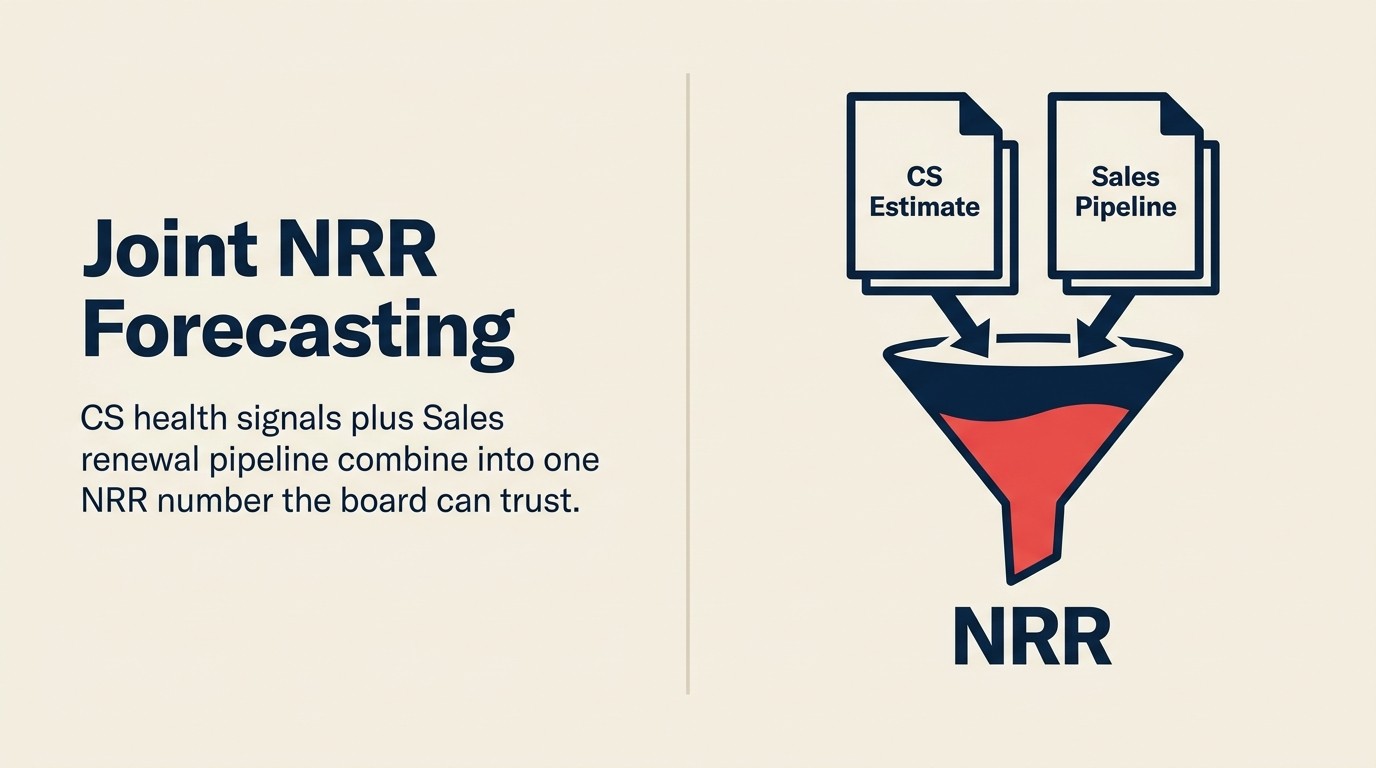
Veja como a maioria das empresas constrói sua previsão de NRR. CS realiza uma análise de health scoring e sinaliza as contas que considera em risco. Sales faz uma revisão do Pipeline de renovação e marca tudo o que ainda não foi cancelado como provável de fechar. O financeiro pede os números de ambas as equipes. Os números não se reconciliam. Alguém encontra um meio-termo antes da reunião do Board. O Board faz uma pergunta que ninguém consegue responder.
Esse é o problema das duas previsões. E é tão comum que se tornou ruído de fundo em muitas organizações de receita: um exercício de reconciliação trimestral que todos sabem estar quebrado, mas ninguém tem autoridade interfuncional para corrigir.
A previsão de NRR é mais difícil do que a previsão de ARR por uma razão estrutural: os componentes pertencem a equipes diferentes. Churn é o sinal do CS. Expansão geralmente está no Pipeline de Sales. Contração fica entre os dois. Nenhuma equipe sozinha tem o quadro completo. O único caminho para um número confiável é um processo operacional conjunto, não um exercício de reconciliação posterior.
O que o NRR Realmente Mede e Por que É Mais Difícil que o ARR
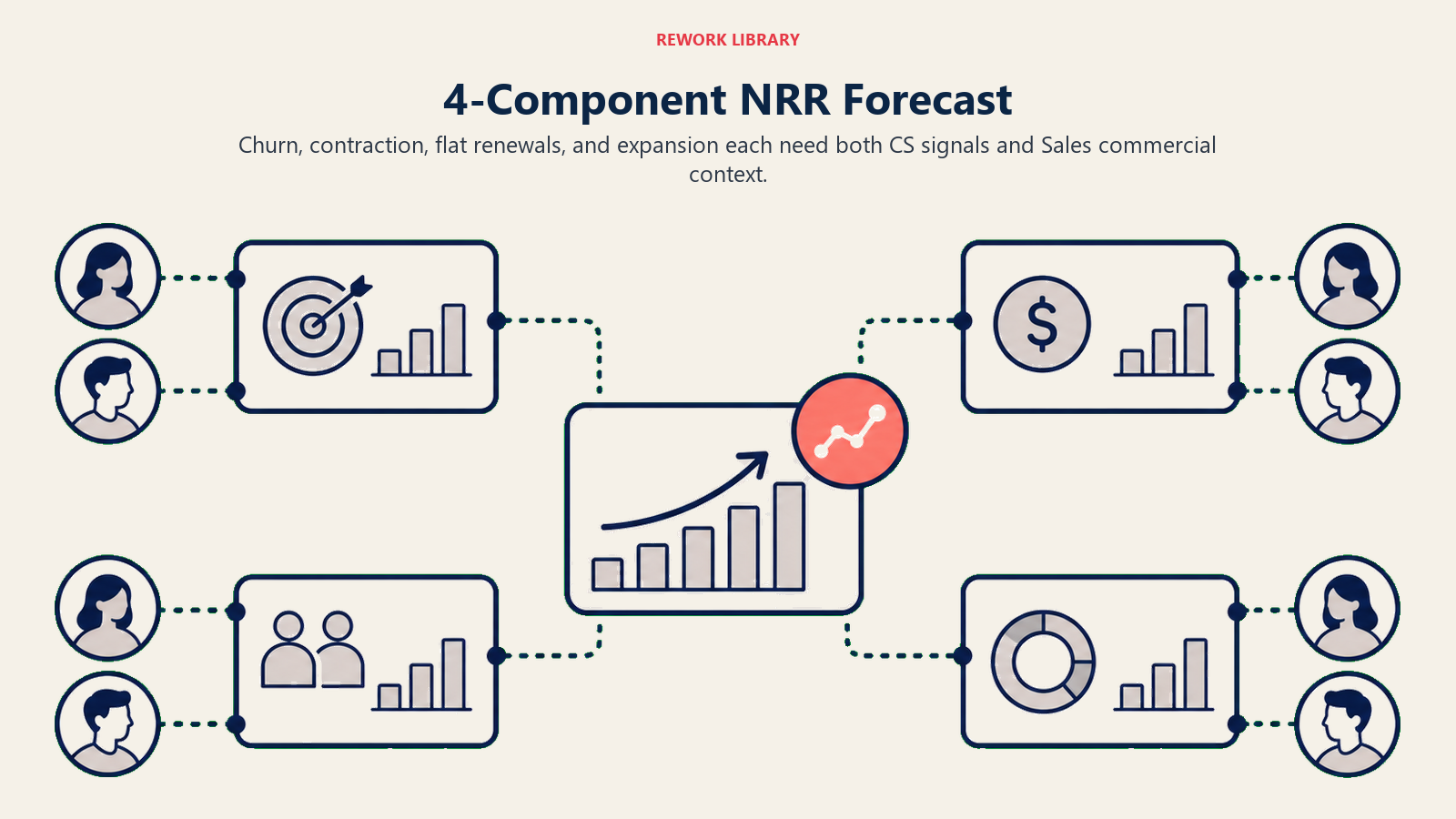
Análise Rework: A Previsão de NRR de 4 Componentes (Churn, Contração, Renovações Simples e Expansão) é mais difícil de construir do que uma previsão de ARR, não porque a matemática seja complexa, mas porque cada componente tem um proprietário diferente, uma qualidade de sinal diferente e um prazo de antecedência diferente. Uma previsão conjunta de NRR não é um exercício de reconciliação entre duas previsões existentes. É um único modelo construído a partir dos sinais de ambas as equipes simultaneamente. A diferença estrutural, uma construção em vez de duas reconciliações, é o que produz a melhoria de 31% na precisão que as equipes com previsão conjunta observam em relação à previsão departamental (pesquisa da SiriusDecisions).
Net Revenue Retention é o percentual de receita recorrente retida de uma base de clientes existente ao longo de um período, incluindo expansões, contrações e Churn. A fórmula:
NRR = (ARR Inicial + Expansão − Contração − Churn) / ARR Inicial
A previsão de ARR é difícil, mas gerenciável: você tem um Pipeline, tem taxas históricas de conversão e pode construir um modelo ponderado por probabilidade. A incerteza está concentrada no Pipeline de novos negócios.
A previsão de NRR é mais difícil porque cada componente tem um proprietário diferente, uma qualidade de sinal diferente e um nível de confiança diferente:
- Churn tem a maior consequência e o sinal mais defasado. CS rastreia health scores e sinais de risco, mas os health scores frequentemente são atribuídos pelos CSMs e sujeitos a viés de otimismo. O sinal comercial (um concorrente está ativamente fazendo proposta? essa conta era um fit forçado do ICP?) está com o AE.
- Contração é o componente mais silencioso e o mais subestimado nas previsões. Conversas sobre redução de escopo muitas vezes acontecem informalmente em QBRs, sem nenhum alerta levantado na plataforma de CS ou no CRM até que o aditivo contratual seja assinado.
- Renovações simples deveriam ser a parte fácil, mas exigem validação conjunta dos termos comerciais. CS possui o relacionamento; o AE possui a conversa de preços e sabe se o cliente tem poder de negociação.
- Expansão é o componente mais visível para Sales (parece um deal no Pipeline), mas o sinal está totalmente no CS (limites de uso, promoções de champion, resultados de QBR que revelam apetite de expansão). Nenhuma equipe tem o quadro completo sozinha.
Dados Relevantes: Previsão de NRR
- A precisão mediana da previsão de NRR para empresas de SaaS de médio porte é de ±18%, ou seja, a maioria dos Boards trabalha com uma previsão que pode estar errada em quase um quinto em qualquer direção, conforme benchmarks da OpenView de 2024.
- 72% dos CROs relatam que suas equipes de CS e Sales submetem previsões de renovação separadas que não se alinham antes da apresentação ao Board (Bain & Company, 2024).
- Empresas com processos de previsão de NRR conjuntos alcançam precisão de previsão 31% maior do que as que têm previsões departamentais separadas, conforme pesquisa da SiriusDecisions.
Os Quatro Componentes e Quem Detém o Sinal: A Previsão de NRR de 4 Componentes
Esse é o mapa de alinhamento sobre o qual a previsão conjunta de NRR é construída. Não é uma discussão sobre quem "possui" o NRR. Propriedade é uma distração. A questão relevante é quem detém qual sinal.
| Componente do NRR | CS Detém | Sales (AE) Detém | Nível de Confiança |
|---|---|---|---|
| Churn | Health score, queda de uso, redução de engajamento, troca de champion | Risco competitivo, sinal de fit do ICP, histórico de promessas excessivas no deal | Médio (sinal de saúde defasado) |
| Contração | Conversas de redução de escopo, gaps de fit do produto | Dinâmicas de ajuste de preços, autoridade de negociação comercial | Baixo (frequentemente silencioso até a assinatura) |
| Renovação simples | Health score, conclusão de onboarding, marcos de sucesso | Validação dos termos comerciais, preços de renovação | Alto quando ambos os sinais estão presentes |
| Expansão | Limites de uso do produto, promoções de champion, resultados do QBR | Pipeline de expansão, conhecimento multi-produto, fechamento de expansão | Médio-alto com dados de uso |
O insight central desta tabela: nenhum componente pertence claramente a uma única equipe. Cada componente tem um sinal do CS e um sinal de Sales. Uma previsão construída em apenas um desses sinais é sistematicamente enviesada para a versão da realidade daquela equipe.
Health scores do CS sem sinais comerciais de Sales superestimam dados de adoção e perdem riscos competitivos e de fit. Pipelines de renovação de Sales sem health scores do CS tratam "ainda não recebi e-mail de cancelamento" como proxy de probabilidade de renovação. A combinação produz uma previsão que é de fato calibrada. Para que o sinal de saúde seja confiável, ele precisa incorporar o contexto comercial que o AE detém. Veja customer health scoring com contexto de Sales para entender como esse modelo funciona.
O Pipeline de Renovação Ponderado por Risco
O produto mecânico do processo conjunto de previsão é um Pipeline de renovação ponderado por risco. Isso substitui o pressuposto padrão do forecast de Sales ("tudo tem 90% de chance até o cliente cancelar") por um modelo de probabilidade em camadas baseado em sinais reais.
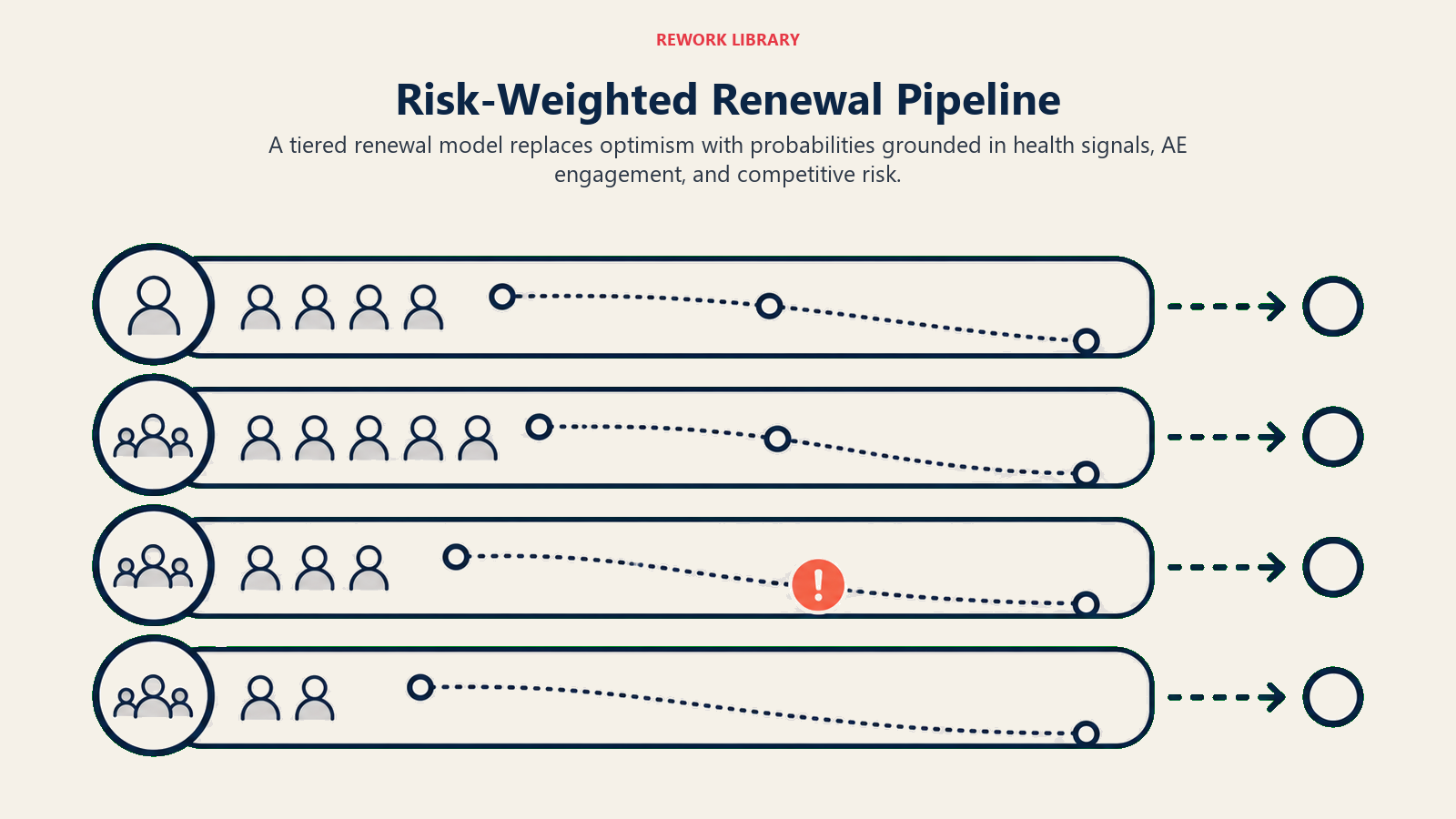
Camada 1: Renovações confirmadas. Health score verde, engajamento recente e positivo do AE, sem sinais competitivos, termos contratuais limpos. Peso de probabilidade: 95%. Essas contas não precisam de atenção conjunta. Precisam ser visíveis na previsão sem consumir tempo de revisão.
Camada 2: Renovações prováveis. Health score amarelo ou verde com alertas menores, AE teve uma conversa executiva nos últimos 60 dias, sem ameaça competitiva ativa. Peso de probabilidade: 75-85%. Essas contas recebem uma breve revisão mensal. Sem alertas, sem ação necessária, a menos que algo mude.
Camada 3: Renovações em risco. Health score amarelo ou vermelho, um ou mais sinais do CS ou de Sales presentes (veja os critérios da revisão conjunta de contas em risco), inteligência competitiva ativa, ou a conta tem histórico de solicitações de redução de escopo. Peso de probabilidade: 40-60%. Essas contas requerem a revisão conjunta de contas em risco.
Camada 4: Churn provável. Health score vermelho, múltiplos sinais presentes, tentativa de salvamento já falhou ou não foi tentada com antecedência suficiente. Peso de probabilidade: 10-25%. Essas contas estão em encerramento gerenciado. A questão é se contração ou Churn total é o resultado adequado.
A atribuição de camada é o trabalho conjunto. CS atribui uma camada baseada em saúde. O AE aplica sinais comerciais que podem mover a camada para cima ou para baixo. Quando CS e AE discordam sobre a camada, essa discordância é a parte mais valiosa da reunião. Ela revela os dados que cada equipe não tem sobre a conta. A forma como o sistema de camadas interage com o modelo de propriedade da renovação determina quem age em seguida.
A Reunião de Previsão Conjunta: Estrutura e Cadência
Quem participa:
- VP CS (detém sinais de saúde e dados de onboarding)
- VP Sales ou responsável por Sales (detém Pipeline de renovação e contexto comercial)
- RevOps (detém a extração de dados, o formato e a reconciliação entre plataforma de CS e CRM)
- CRO: opcional para a maioria das contas, obrigatório para contas acima de um determinado limite de ARR

Cadência:
- Mensal: revisão de previsão de NRR dos próximos 90 dias para toda a carteira de renovações, com atualizações de camada
- Semanal: contas na janela de renovação de 90 dias e todas as contas das Camadas 3 e 4
- Ad hoc: quando um sinal de saúde significativo surge fora da cadência regular (saída de champion, grande escalada de suporte, alerta de inteligência competitiva)
Insumos da reunião (ambas as equipes preparam antes da chamada):
- CS: camadas de saúde atualizadas para todas as contas na janela de renovação, alertas de expansão da plataforma de CS, escaladas de suporte abertas com risco comercial
- Sales: Pipeline de renovação atualizado com datas de engajamento do AE, inteligência competitiva, Pipeline de expansão por conta
- RevOps: carteira consolidada de renovações mostrando camada atual, ARR em jogo, dias até a renovação e precisão da previsão do trimestre anterior para calibração
Resultado da reunião:
- Único número de NRR ponderado por risco com intervalo de confiança (não dois números separados)
- Atribuições de camada atualizadas para todas as contas na janela
- Itens de ação para contas das Camadas 3 e 4: responsável, ação, data
- Atualizações do Pipeline de expansão com sinais do CS integrados
O resultado desta reunião alimenta diretamente a previsão de NRR para o Board. Sem exercício de reconciliação. Sem "dividir a diferença". Um número que tanto o VP CS quanto o VP Sales estão preparados para defender. A estrutura de remuneração precisa reforçar isso. Se os AEs não são medidos em NRR, tratarão a reunião de previsão conjunta como uma obrigação do CS, não como sua própria responsabilidade.
Expansão como Alavanca de NRR: Como o CS Alimenta o Pipeline
A expansão é onde a previsão de NRR mais frequentemente se rompe porque Sales e CS cada um vê metade do quadro.
CS enxerga o sinal de expansão primeiro. O uso do produto ultrapassa um limite indicando que o cliente precisa de mais capacidade. Um champion é promovido e quer expandir o rollout. Um QBR produz uma conversa sobre roadmap que revela novos casos de uso. Esses sinais vivem na plataforma de CS.
Sales detém o fechamento da expansão. O AE conhece o contexto multi-produto, tem autoridade sobre preços e conduz a conversa comercial. Mas sem o sinal do CS, o AE não sabe quando iniciar.
O fluxo automatizado que resolve isso é o Ponto de Integração 3 do artigo sobre o stack alinhado: sinais de expansão da plataforma de CS criando automaticamente tasks no CRM para o AE. Sem essa automação, o sinal depende do CSM enviar mensagem ao AE manualmente, e essa mensagem se perde no Slack pelo menos 30% das vezes.
Para a previsão de NRR especificamente, isso significa:
- Sinais de expansão que foram acionados mas ainda não têm uma oportunidade criada pelo AE devem ser sinalizados como "Pipeline pendente" com um peso de probabilidade
- Pipeline de expansão do AE sem um sinal de expansão do CS deve ser revisado quanto ao alinhamento de sinais (o deal pode ser especulativo)
- A linha de previsão de expansão no modelo de NRR deve ser de responsabilidade conjunta: sinais originados no CS × taxas de conversão do AE a partir de dados históricos de expansão
Falhas Comuns de Previsão
Health scores do CS que não consideram sinais comerciais. Um health score construído inteiramente em métricas de adoção do produto não detecta um cliente que está avaliando ativamente um concorrente, ou cujo champion recebeu diretriz para reduzir gastos com software. Equipes de CS que não recebem regularmente inteligência comercial do AE sistematicamente subestimam o risco de Churn.
Pipeline de renovação que trata todo deal como provável até o cancelamento. Pipelines de renovação de Sales têm viés para o otimismo. Uma renovação que não foi explicitamente rejeitada frequentemente é marcada como 85% ou 90% provável. Sem calibração do health score do CS, isso produz uma previsão de renovação que sistematicamente superestima o NRR até o trimestre estar quase encerrado.
Dupla contagem da expansão. CS sinaliza um sinal de expansão na plataforma de CS. O CSM menciona ao AE. O AE cria uma oportunidade no CRM. CS também registra como "expansão pendente" em sua previsão. Ambos os sinais aparecem na previsão de NRR, contando efetivamente o mesmo evento de receita duas vezes. A correção é um único registro de Pipeline de expansão, de propriedade do AE no CRM, com o sinal de expansão do CS como um campo, não dois registros separados.
Sem reunião de reconciliação: duas previsões enviadas ao financeiro de forma independente. Esta é a versão da causa raiz do problema das duas previsões. CS envia sua estimativa de Churn. Sales envia seu Pipeline de renovação. O financeiro recebe ambos, adiciona algum buffer e apresenta ao Board. Ninguém examinou as contas onde as duas estimativas divergem. A divergência é geralmente onde o risco está oculto. Essa também é uma causa raiz do desalinhamento Sales-CS, em que a divergência de previsão costuma ser o primeiro sintoma mensurável de uma coordenação quebrada.
As Métricas que Tornam a Previsão Conjunta Honesta
Três métricas calibram o modelo e expõem o viés de otimismo ao longo do tempo.
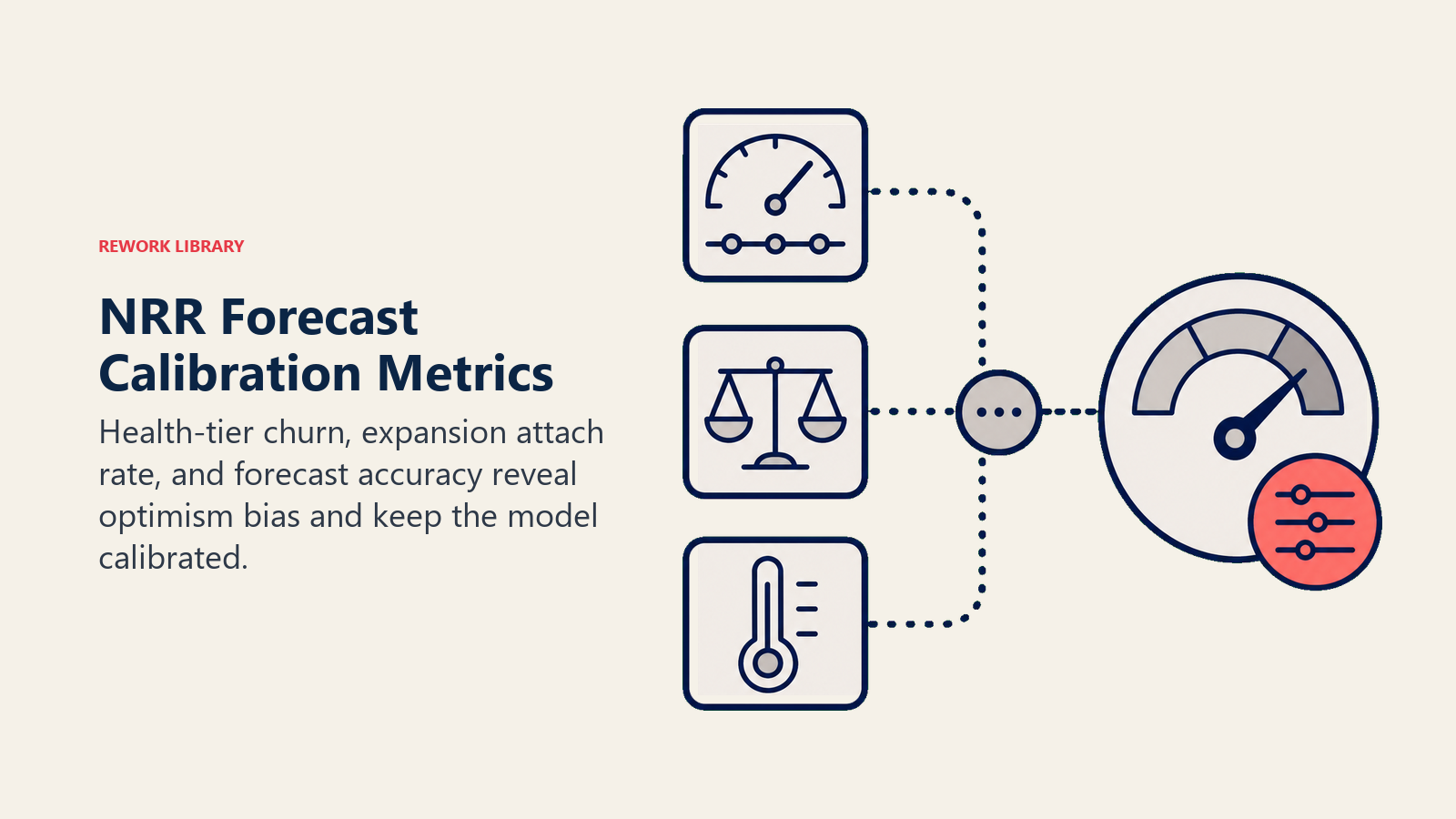
Taxa histórica de Churn por camada de saúde. Se as contas da Camada 2 (renovações prováveis, peso de probabilidade de 75-85%) tiveram Churn efetivo de 30% nos últimos quatro trimestres, o peso de probabilidade está errado. Os dados de benchmark de retenção da SaaS Capital mostram que o NRR mediano de empresas de SaaS privadas hoje fica em torno de 101%, com empresas do quartil superior chegando a 111%. Esse é um ponto de calibração externo útil ao definir os pesos de probabilidade das camadas. Construa uma tabela de calibração que mapeia os pesos de probabilidade atribuídos aos resultados reais em base rolling de 6 trimestres. Essa é a ferramenta mais poderosa para reduzir o viés de otimismo sistemático.
Taxa de attach de expansão por segmento do ICP. Nem todos os sinais de expansão convertem na mesma taxa. Contas Enterprise podem converter sinais de expansão do CS a 60%. Contas SMB podem converter a 20%. Se a previsão de NRR aplica uma única taxa de conversão de expansão em todos os segmentos, ela sistematicamente superestima ou subestima a expansão por segmento. Separe por segmento do ICP e atualize trimestralmente.
Precisão da previsão de NRR (previsto vs. real, últimos 6 meses). Essa é a métrica principal. Tomasz Tunguz documentou que uma melhoria de 20 pontos na retenção líquida de dólares se traduz em cerca de 40% mais eficiência de vendas, o que faz o exercício de calibração valer muito mais do que o tempo de planilha que exige. Se a previsão de NRR está consistentemente 12% acima do real, há viés de otimismo sistemático na Camada 2 ou no Pipeline de expansão. Se está consistentemente 8% abaixo, você está deixando sinais de expansão sem captura. Rastreie o delta e investigue qual componente gerou o desvio.
Citável: A precisão da previsão de NRR para empresas de SaaS de médio porte tem média de mais ou menos 18%, o que significa que os Boards recebem regularmente um número de renovação que pode estar errado em quase um quinto em qualquer direção. A previsão conjunta de NRR, em que CS e Sales classificam em camadas todas as contas a partir da mesma carteira de renovações, reduz essa variância em 31% (pesquisa da SiriusDecisions; benchmarks SaaS 2024 da OpenView).
Citável: O health score sozinho prevê Churn corretamente em apenas 58% das vezes quando usado sem sinais comerciais do lado de Sales. Quando os dados de engajamento de renovação do AE são combinados aos health scores do CS no mesmo modelo de previsão, a precisão sobe para 74%. É uma melhoria de 16 pontos que se traduz diretamente em menos surpresas para o Board (dados de benchmark da Gainsight, 2024).
Citável: Uma melhoria de 20 pontos na retenção líquida de dólares se traduz em cerca de 40% mais eficiência de vendas, segundo análise de Tomasz Tunguz, o que faz o ganho de 31 pontos percentuais de precisão da previsão conjunta de NRR valer substancialmente mais do que o tempo de coordenação que ela exige.
Guia de Implementação em 30 Dias
Não é necessário um build completo de RevOps para começar a executar uma previsão conjunta de NRR. A versão mínima viável:
Semana 1: Alinhar sobre as definições de camada. Reúna VP CS e VP Sales para acordar os critérios das Camadas 1/2/3/4. Essa é a conversa de maior alavancagem. A maior parte do desalinhamento de previsão vem de cada equipe usando critérios de camada implícitos que a outra equipe não compartilha.
Semana 2: Construir a carteira compartilhada de renovações. RevOps extrai uma lista de todas as contas com renovação nos próximos 90 dias com ARR em jogo, health score atual (da plataforma de CS), data de engajamento do AE (do CRM) e dias até a renovação. Esse é o documento base para cada reunião conjunta de previsão. Ele fica em uma planilha compartilhada ou Dashboard de RevOps, não na caixa de entrada de alguém.
Semana 3: Executar a primeira reunião conjunta de previsão. Ambas as equipes atribuem camada a cada conta usando os critérios acordados. Registre cada discordância. Essas são as contas que precisam de mais atenção. Produza um único número de NRR ponderado por risco com um intervalo de confiança. Essa é a primeira previsão. Não será precisa. Isso é esperado.
Semana 4: Integrar a reunião à cadência regular. Mensal para toda a carteira de renovações. Semanal para a janela de 90 dias. Coloque no calendário antes que qualquer outra coisa mude. A disciplina da reunião vale 80% do valor; as ferramentas representam os outros 20% e podem ser construídas ao longo do tempo. A decisão sobre o modelo de propriedade da renovação deve ser tomada antes de essa cadência começar. A ambiguidade sobre quem é dono da conversa de renovação surgirá na primeira reunião de previsão e a travará.
Após três meses nessa cadência, você terá dados históricos suficientes para começar a calibrar os pesos de probabilidade em relação aos resultados reais. Após seis meses, você tem um modelo de previsão. Após um ano, você tem uma previsão de NRR confiável para o Board que tanto o VP CS quanto o VP Sales estão preparados para defender.
Perguntas Frequentes sobre Previsão de NRR Conjunta
O que é a Previsão de NRR de 4 Componentes?
A Previsão de NRR de 4 Componentes é um modelo de previsão conjunta que divide o net revenue retention em seus quatro componentes operacionais (Churn, Contração, Renovações Simples e Expansão) e mapeia os sinais de propriedade do CS e de Sales para cada um. Em vez de reconciliar duas previsões separadas depois do fato, o modelo constrói um único Pipeline de renovação ponderado por risco a partir dos sinais de ambas as equipes simultaneamente. O resultado é um único número de NRR que tanto o VP CS quanto o VP Sales estão preparados para defender perante o Board.
Como a previsão conjunta de NRR difere da previsão padrão de ARR?
A previsão de ARR tem um único Pipeline e um único proprietário (Sales). A previsão de NRR envolve quatro componentes, cada um com um dono de sinal diferente e um nível de confiança diferente. Os sinais de Churn vêm dos dados de saúde do CS e da inteligência competitiva de Sales. Os sinais de contração são os mais silenciosos e mais subestimados, frequentemente surgindo apenas quando um aditivo contratual é assinado. As renovações simples exigem validação conjunta dos termos comerciais. Os sinais de expansão vivem no CS (limites de uso, resultados de QBR), mas fecham por meio de Sales (autoridade sobre preços, conhecimento multi-produto). Um modelo conjunto combina os quatro; um modelo departamental captura apenas metade dos sinais.
Com que frequência a reunião de previsão conjunta de NRR deve acontecer?
Mensalmente para toda a carteira de renovações, cobrindo uma janela rolling de 90 dias. Semanalmente para contas com renovação nos próximos 90 dias e todas as contas das Camadas 3 e 4 (em risco e Churn provável). Ad hoc quando um sinal de saúde significativo surge fora da cadência regular, como a saída de um champion, uma grande escalada de suporte ou um alerta ativo de inteligência competitiva. A cadência semanal para contas de alto risco é a disciplina que separa as equipes com previsões precisas das equipes que são surpreendidas todo trimestre.
Qual é um bom benchmark de NRR para empresas de SaaS?
Os dados de benchmark da SaaS Capital mostram que o NRR mediano de empresas de SaaS privadas fica em torno de 101%, o que significa que a empresa média mal retém sua base de ARR existente. Empresas do quartil superior chegam a 111% de NRR, o que significa que expandem os clientes existentes em 11% ao ano antes de qualquer receita de novos logos. Empresas focadas em Enterprise normalmente miram 120%+ de NRR, onde a receita de expansão é um motor estrutural de crescimento. A implicação prática: a precisão da previsão importa mais nos extremos. Errar a expansão em 5% ou subestimar o Churn em 5% tem consequências desproporcionais no valor da empresa, nos múltiplos que a McKinsey documenta (24x para o quartil superior vs. 5x para o quartil inferior em desempenho de NRR).
Que melhoria de precisão devemos esperar ao migrar para a previsão conjunta de NRR?
A pesquisa da SiriusDecisions aponta uma melhoria de precisão de 31% para empresas que migram de previsões departamentais separadas para um modelo conjunto em que CS e Sales classificam em camadas todas as contas a partir da mesma carteira de renovações. O ganho não vem principalmente de dados melhores. Ambas as equipes já tinham os mesmos dados de conta. Vem de trazer as discordâncias à tona. Quando o CS classifica uma conta na Camada 2 (renovação provável) e Sales a classifica na Camada 3 (em risco) com base em inteligência competitiva que o CSM não tinha, essa discordância é o sinal. A previsão conjunta converte discordâncias ocultas em ações visíveis.
O que é o Pipeline de renovação ponderado por risco e como as camadas são atribuídas?
O Pipeline de renovação ponderado por risco substitui a previsão binária "vai renovar / não vai renovar" por quatro camadas ponderadas por probabilidade. Camada 1 (Renovações confirmadas, peso de 95%): health score verde, engajamento executivo recente do AE, sem sinais competitivos. Camada 2 (Renovações prováveis, peso de 75-85%): alertas amarelos menores, contato do AE nos últimos 60 dias, sem ameaça competitiva ativa. Camada 3 (Renovações em risco, peso de 40-60%): um ou mais sinais do CS ou de Sales presentes, exige revisão conjunta de contas em risco. Camada 4 (Churn provável, peso de 10-25%): múltiplos sinais, a tentativa de salvamento falhou ou não foi tentada com antecedência suficiente. O CS atribui a camada inicial baseada em saúde; o AE aplica sinais comerciais que podem movê-la para cima ou para baixo. As discordâncias de camada são o resultado mais valioso da reunião.
Saiba Mais
- Propriedade da Renovação: AE vs AM vs CSM
- Propriedade da Expansão e Upsell Motion
- Customer Health Scoring com Contexto de Sales
- Stack Alinhado: CRM, Plataforma de CS e Revenue Intelligence
- Glossário de Alinhamento entre Sales e Customer Success
- Remuneração Alinhada ao NRR
- Revisão Conjunta de Contas em Risco
- 8 Sinais de Alerta de Desalinhamento entre Sales e CS

Principal Solution Architect
On this page
- O que o NRR Realmente Mede e Por que É Mais Difícil que o ARR
- Os Quatro Componentes e Quem Detém o Sinal: A Previsão de NRR de 4 Componentes
- O Pipeline de Renovação Ponderado por Risco
- A Reunião de Previsão Conjunta: Estrutura e Cadência
- Expansão como Alavanca de NRR: Como o CS Alimenta o Pipeline
- Falhas Comuns de Previsão
- As Métricas que Tornam a Previsão Conjunta Honesta
- Guia de Implementação em 30 Dias
- Saiba Mais