Modelo de Maturidade de Alinhamento Sales-CS: Cinco Estágios do Caos de Handoff à Co-propriedade de Receita
Turn this article into takeaways for your work.


Each assistant summarizes the article only for you and suggests best practices for your work.
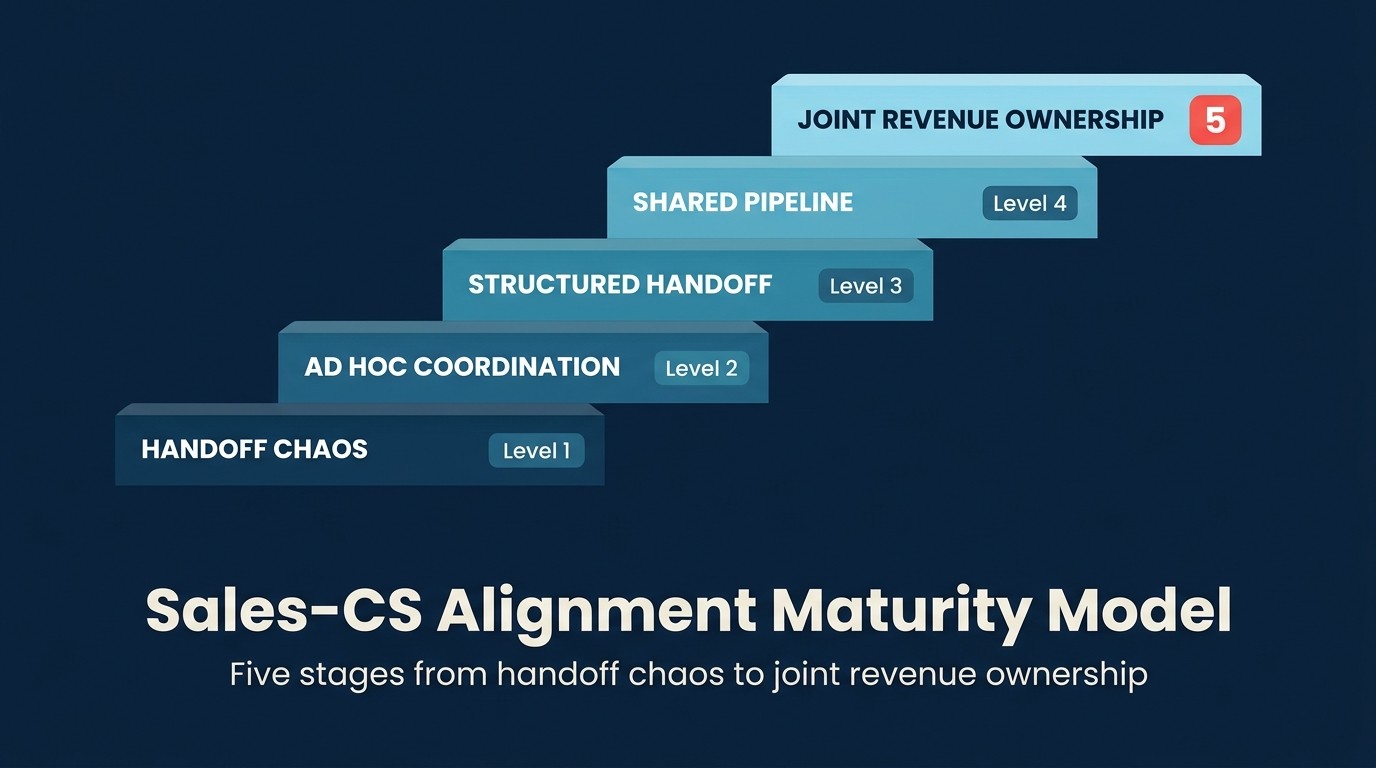
O Modelo de Maturidade de Alinhamento Sales-CS mapeia a progressão do handoff reativo (Estágio 1, retenção líquida de receita (NRR) de 75-88%) até a parceria de receita (Estágio 5, NRR de 110-130%+). A maioria das empresas de mid-market que ultrapassaram $10M de receita recorrente anual (ARR) com NRR abaixo de 90% está presa no Estágio 2 ou 3, muitas vezes porque tem os artefatos do alinhamento sem os acordos que os sustentam. Este modelo é o diagnóstico compartilhado que permite ao VP de Sales e ao VP de CS concordar onde realmente estão.
Existe um padrão que aparece em quase toda conversa sobre alinhamento entre Sales e CS: o VP de Sales e o VP de CS avaliam a organização em estágios diferentes. O VP de Sales diz "temos um processo de handoff: o AE preenche um template." O VP de CS diz "nossos CSMs ainda começam do zero em metade das contas porque o template mal é preenchido." Os dois estão descrevendo a mesma organização. Nenhum está errado. Eles simplesmente não têm um vocabulário compartilhado para o que "alinhado" realmente significa.
É para isso que serve um modelo de maturidade. Não é um scorecard para envergonhar nenhuma das funções. É uma linguagem comum, um conjunto de descrições de estágios que ambos os líderes podem observar, debater e, por fim, concordar, para que a conversa sobre o que precisa mudar aconteça com especificidade, não com frustração.
A maioria das empresas com menos de $10M ARR superestima significativamente sua maturidade de alinhamento. Os sinais do Estágio 1 podem parecer o Estágio 3 por dentro. Você tem um template, tem um canal no Slack, tem uma reunião semanal. Nada disso é alinhamento. São o andaime do alinhamento, e até você testar esse andaime sob pressão, você não sabe o que está realmente sustentando tudo. O modelo de maturidade de alinhamento entre marketing e vendas segue a mesma lógica de cinco estágios para a costura anterior. Se você já leu esse artigo, este framework vai soar familiar.
Por que Usar um Modelo de Maturidade em vez de um Checklist?
Um checklist diz o que fazer. Um modelo de maturidade diz onde você está, o que é mais valioso quando o problema é de diagnóstico, não de atribuição de tarefas.
Checklists também criam uma falsa sensação de conclusão. "Temos um documento de handoff" vira a resposta da caixinha de verificação, mesmo que o documento seja preenchido com três frases e ninguém o leia antes do kickoff. Um modelo de maturidade força a pergunta por baixo da caixinha: ter um documento de handoff significa que o CSM começa consistentemente com contexto suficiente? Se a resposta for não na metade das vezes, você ainda não passou desse estágio.
Três coisas que um modelo de maturidade faz e que um checklist não consegue:
Ele dá às duas equipes uma linguagem compartilhada. Quando VP de Sales e VP de CS conseguem apontar para o Estágio 2 e dizer "sim, somos nós: o template de handoff existe, mas a qualidade é inconsistente" em vez de discutir se "têm um processo", a conversa se torna produtiva em vez de defensiva.
Ele impede que "temos X" seja confundido com "X está funcionando." As descrições de estágio focam em resultados (como é a posição de partida do CSM, com qual NRR o estágio está associado, qual é o sintoma quando as coisas falham) e não em saber se o artefato existe.
Ele define expectativas realistas para transições. Sair do Estágio 2 para o Estágio 3 não é um sprint de um trimestre. Exige mudar comportamentos em múltiplas contas e múltiplos AEs, e essas mudanças não se sustentam sem reforço estrutural. Equipes que sabem disso se planejam para isso. Equipes que não sabem ficam se perguntando por que a iniciativa "não pegou."
Dados Relevantes: O que os Níveis de Maturidade Significam para o NRR
- Organizações no Estágio 1-2 de maturidade de alinhamento têm NRR médio entre 80-92%, com base em dados de benchmarking da SaaS Capital e ChurnZero para empresas com menos de $10M ARR.
- Empresas que avançam do Estágio 2 para o Estágio 4 (de responsabilidade definida para accountability conjunto) registram melhora de NRR de 8-15 pontos em média num período de 12-18 meses, conforme pesquisa de maturidade de Customer Success da Gainsight.
- Empresas SaaS de classe mundial no Estágio 5 (parceria de receita) reportam consistentemente NRR acima de 115%, com o quartil superior superando 125%, segundo os benchmarks anuais da SaaS Capital.
O Modelo de Maturidade de Alinhamento Sales-CS em Cinco Estágios
| Estágio | Nome | Sintoma Definidor | Faixa Típica de NRR | Contexto Típico de ARR |
|---|---|---|---|---|
| 1 | Handoff Reativo | CSM começa do zero; e-mail de apresentação = handoff | 75-88% | Abaixo de $5M ARR |
| 2 | Handoff Documentado | Template existe; qualidade inconsistente por AE | 82-92% | $3M-$10M ARR |
| 3 | Responsabilidade Definida | Swimlanes documentadas; ainda reativo nas escalações | 88-98% | $5M-$20M ARR |
| 4 | Accountability Conjunto | Métrica de NRR compartilhada; revisões conjuntas; feedback formal de CS para Sales | 95-110% | $10M-$30M ARR |
| 5 | Parceria de Receita | Expansão co-gerida; loop de feedback de ICP; forecasting conjunto | 110-130%+ | $15M+ ARR |
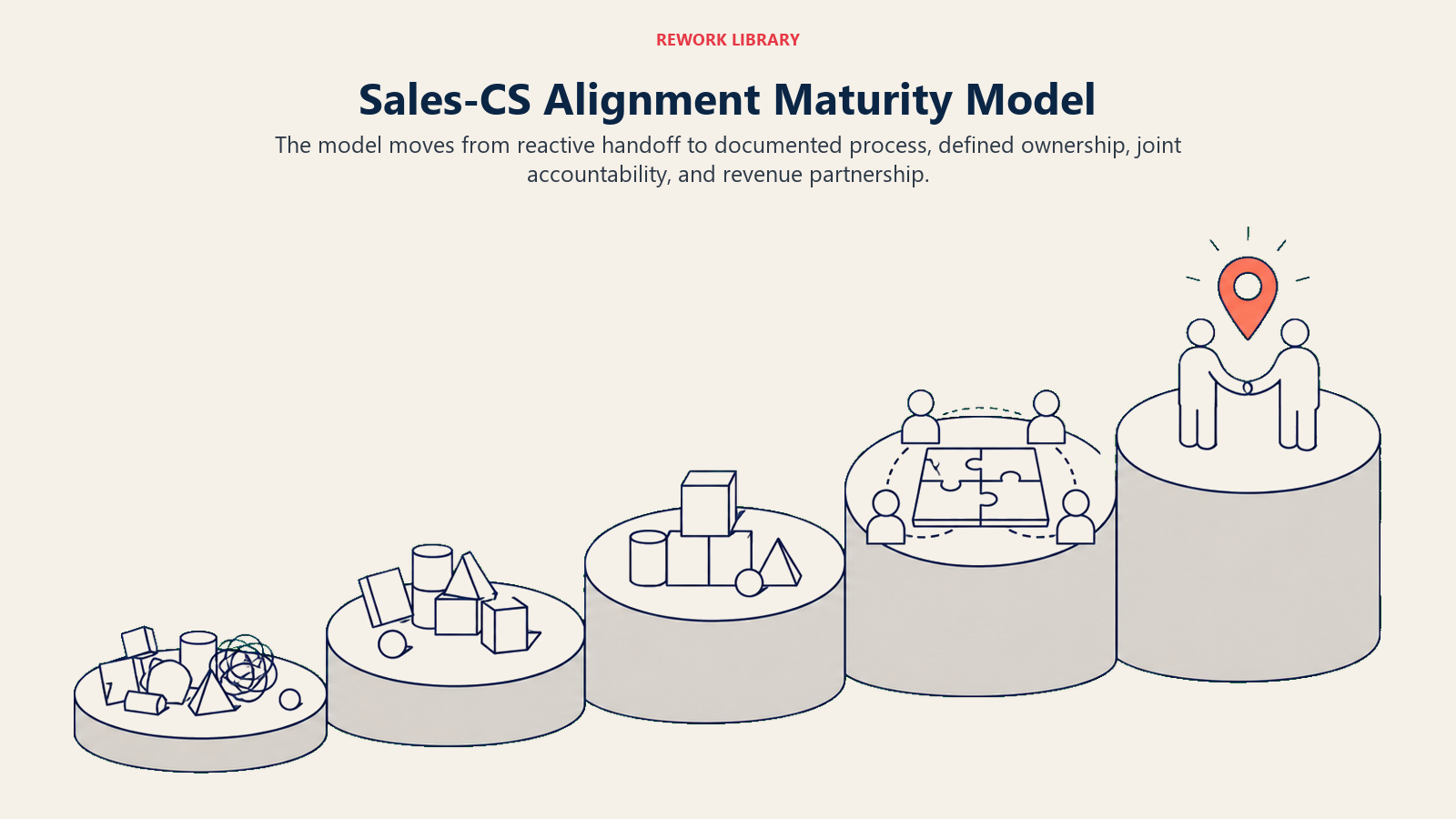
Essas faixas refletem padrões, não garantias. Você pode ter alinhamento no Estágio 1 com $15M ARR (só dói mais). Pode estar no Estágio 4 com $8M ARR se a liderança priorizou isso cedo. A coluna de contexto ARR reflete onde a dor normalmente se torna aguda o suficiente para forçar uma ação.
Citável: "Organizações que avançam do Estágio 2 para o Estágio 4 de alinhamento registram melhora de NRR de 8-15 pontos em média num período de 12-18 meses. Isso faz dessa uma das transformações de maior ROI à disposição de uma equipe de liderança de SaaS de mid-market." (pesquisa de maturidade de Customer Success da Gainsight)
Estágio 1: Handoff Reativo
Como é: O AE fecha o negócio, envia um e-mail de apresentação para o cliente e para o CSM designado, e parte para o próximo negócio. O CSM agenda um kickoff. No kickoff, pergunta ao cliente quais são seus objetivos, qual é seu ambiente técnico e qual prazo ele espera: perguntas que o AE já respondeu, documentou e esqueceu de transferir.
O sintoma definidor: Um gerente de CS revisando as notas de kickoff veria o CSM coletando contexto básico que deveria ter chegado via Sales. O cliente é paciente na primeira vez. Na segunda ou terceira "você pode me lembrar o que discutiu com a equipe de Sales sobre X?", ele já formou uma impressão durável sobre a comunicação interna desse fornecedor.
Por que as empresas ficam presas aqui: Organizações no Estágio 1 geralmente têm uma de duas dinâmicas. Ou a proporção AE:CSM é alta o suficiente (4:1 ou mais) para o AE genuinamente não ter tempo para um handoff estruturado, ou a expectativa cultural é de que o trabalho do AE termina no fechamento. Ambos são solucionáveis, mas não sem direção explícita da liderança.
Consequência para o NRR: O churn se concentra nos meses 6-12. Contas que começam do zero têm mais probabilidade de ter atrasos no time-to-value, que são o principal indicador de churn no primeiro ano. O frustrante no NRR do Estágio 1 é que ele parece um problema de execução do CS. As contas que churnearam foram para o CS. Mas a causa raiz foi definida no handoff.
Quem está preso aqui: A maioria das empresas com menos de $5M ARR, especialmente aquelas que cresceram via vendas lideradas pelo fundador, onde ele conhecia pessoalmente cada conta e o conceito de handoff não era necessário. Quando o primeiro CSM dedicado chega, o Estágio 1 é o padrão até alguém decidir que não deveria ser.
Estágio 2: Handoff Documentado
Como é: Existe um template de handoff. Os AEs precisam preenchê-lo antes do negócio ser oficialmente fechado. O template cobre o básico: objetivos do cliente, compromissos técnicos, principais stakeholders e quaisquer termos especiais. Alguns AEs o preenchem completamente. Outros preenchem dois campos e seguem em frente. A qualidade varia significativamente por AE.
O sintoma definidor: A qualidade do handoff está diretamente correlacionada à disciplina do AE, não ao processo da empresa. Os CSMs que têm sorte com AEs detalhistas têm saúde de conta inicial consistentemente melhor. Os CSMs designados para AEs de alto volume que tratam o template como uma formalidade estão começando do zero na metade das vezes. As revisões do gerente de CS revelam uma ampla variação na qualidade das chamadas de kickoff que não deveria existir se o processo estivesse realmente funcionando.
O que move você para o Estágio 3: Duas mudanças: tornar o documento de handoff obrigatório com um gate de conclusão (não é possível marcar o negócio como fechado sem campos específicos preenchidos), e adicionar uma etapa de revisão pelo CSM antes do kickoff (o CSM revisa o briefing antes da chamada de kickoff, sinaliza as lacunas e tem um canal para solicitar ao AE que as preencha). Nenhuma das duas é culturalmente confortável no início. Ambas são necessárias. O template de scorecard de handoff oferece uma ferramenta pronta para medir se o briefing está realmente completo.
Consequência para o NRR: Inconsistente. As contas que recebem handoffs completos produzem bom NRR. As que não recebem produzem churn desproporcional. Do ponto de vista do NRR do portfólio, isso parece alta variância em vez de um problema sistemático, o que é parte do motivo pelo qual organizações no Estágio 2 conseguem manter a ilusão de que o processo está funcionando. Está funcionando para alguns AEs. Não está funcionando como sistema.
Estágio 3: Responsabilidade Definida
Como é: Além do documento de handoff, existem swimlanes documentadas para todo o ciclo de vida do cliente. As duas equipes sabem quem é responsável pelo onboarding (CS), quem lidera o check-in de 90 dias (CS com AE disponível), quem gerencia o período de renovação (conjunto, a partir de 120 dias), quem inicia as conversas de expansão (CS sinaliza, AE lidera o aspecto comercial) e quem escala para a liderança quando as contas entram em risco.
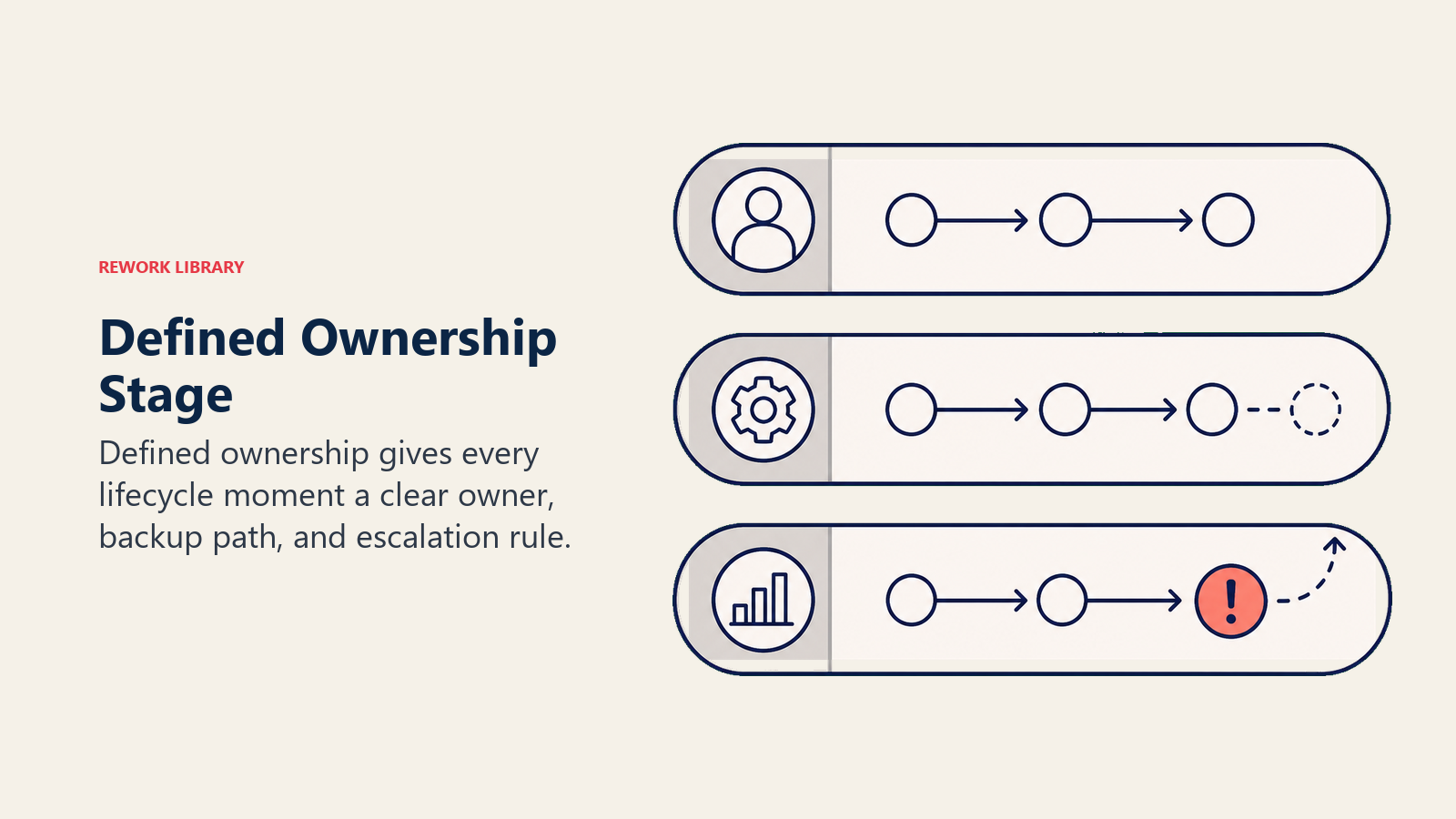
O sintoma definidor: As equipes estão coordenadas, mas ainda não são proativas. O processo de escalação funciona: quando o CS precisa de suporte do AE, existe um canal. Mas as escalações de CS para Sales ainda parecem um pouco desconfortáveis. Os AEs não internalizaram completamente que têm obrigações pós-fechamento. A expansão acontece quando alguém se lembra de iniciá-la, não porque existe um processo baseado em gatilhos.
Consequência para o NRR: A retenção bruta se estabiliza. O churn decorrente de falhas de handoff cai significativamente porque o processo captura a maioria das lacunas. Mas a expansão permanece oportunista: bons CSMs com AEs proativos a produzem; os demais perdem essa oportunidade. A variância do NRR diminui, mas o teto ainda fica na faixa de 95-100% porque a expansão não é sistemática.
A armadilha do platô no Estágio 3: Esta é a transição de estágio mais perigosa. Organizações no Estágio 3 sentem que "consertaram o alinhamento." O churn caiu. As reclamações dos CSMs sobre maus handoffs são menos frequentes. A liderança celebra a vitória e segue em frente. Mas o NRR do Estágio 3 ainda deixa 10-15 pontos na mesa em comparação com o Estágio 4-5. O platô acontece porque a melhora restante exige métricas compartilhadas e mudanças de remuneração, mais difíceis e politicamente mais complexas do que mudanças de processo. Uma cadência de revisão conjunta de contas em risco costuma ser o primeiro comportamento de Estágio 4 que as equipes conseguem adicionar sem mexer na remuneração.
O que move você para o Estágio 4: Duas adições estruturais. Primeiro, uma métrica compartilhada de NRR pela qual tanto o VP de Sales quanto o VP de CS são avaliados, idealmente vinculada aos OKRs de ambas as equipes ou pelo menos às suas avaliações de desempenho. Segundo, uma cadência regular de revisão de contas conjunta (mensal para contas em risco, trimestral para todas as contas acima do ACV mínimo) em que as duas funções estão na sala olhando para os mesmos dados.
Estágio 4: Accountability Conjunto
Como é: Sales e CS compartilham um número de NRR. Revisões de contas conjuntas existem em uma cadência regular. O CS tem um canal formal para sinalizar contas de baixo fit de volta para Sales: não uma mensagem no Slack, mas um processo estruturado de revisão que resulta em feedback de ICP documentado. Os AEs participam dos QBRs para contas estratégicas e são avaliados pela retenção além do novo ARR.
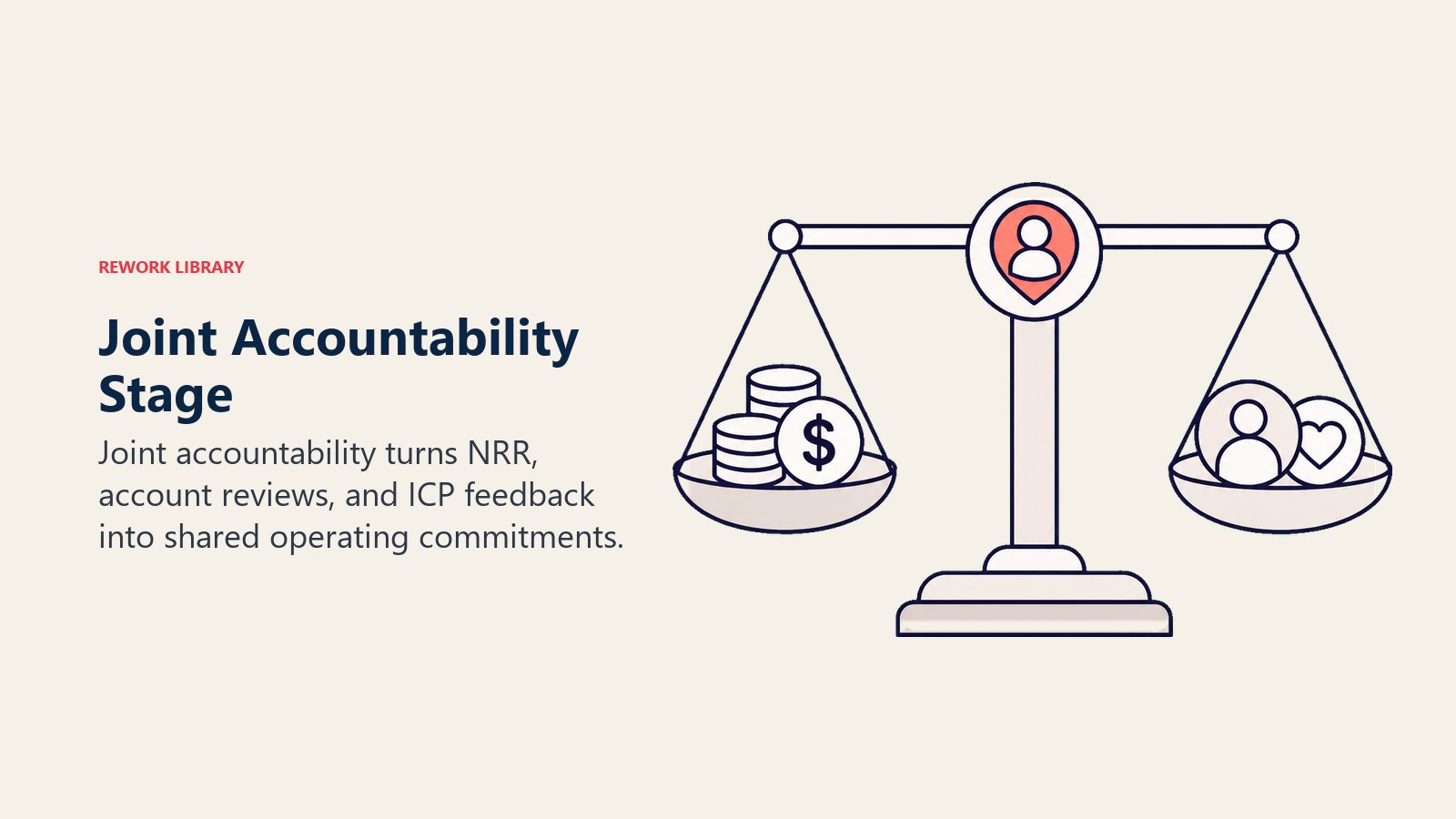
O sintoma definidor: Algum atrito na remuneração. Nem todos os AEs compraram a ideia do feedback do CS sobre as contas que fecharam. Há uma mudança cultural em andamento que não está completa. AEs acostumados a tratar o fechamento como a linha de chegada estão se adaptando a um modelo onde sua carteira de negócios inclui accountability pós-fechamento. A liderança sustenta essa tensão em vez de deixar qualquer equipe regredir.
Consequência para o NRR: O NRR melhora 5-10 pontos em relação ao Estágio 3. A expansão se torna previsível: é acionada por sinais, não por quem se lembra. O feedback de ICP de CS para Sales começa a moldar a qualificação de negócios futuros, reduzindo a taxa de contas fora do ICP que entram no Pipeline logo de início.
Quem está no Estágio 4: Empresas que foram intencionais sobre alinhamento, tipicamente com $10M-$30M ARR, com patrocínio no nível de CRO e capacidade de RevOps para manter a infraestrutura compartilhada. Poucas empresas chegam ao Estágio 4 tão cedo, mas é alcançável. As empresas que chegam aqui cedo superam significativamente seus pares na fase de $10M-$30M porque seu ARR de expansão se multiplica em vez de estabilizar.
O que move você para o Estágio 5: Ferramentas compartilhadas (um registro de cliente unificado em que ambas as equipes confiam e atualizam) e um loop formal de refinamento de ICP em que os sinais do CS alimentam os critérios de qualificação dos AEs em uma cadência regular. Isso requer maturidade de RevOps: alguém é dono do modelo de dados, dos dashboards e da cadência. Não acontece organicamente.
Estágio 5: Parceria de Receita
Como é: AEs e CSMs operam como equipes de conta genuínas, pareados ou em pods dependendo do tier da conta, com co-propriedade do cliente desde o fechamento até a renovação e expansão. O forecasting conjunto de NRR existe junto ao forecasting de novo ARR. O ICP é continuamente refinado a partir de sinais do CS, o que significa que os critérios de qualificação de Sales evoluem com base no que a base de clientes está revelando sobre fit. A expansão é co-gerida e co-remunerada.
O sintoma definidor: Requer maturidade de RevOps e alinhamento de remuneração que a maioria das empresas de mid-market não tem com $10M ARR. Não é mais uma lacuna de processo. É uma lacuna de sistemas e incentivos. Você não consegue atingir o Estágio 5 sem resolver a questão de comp (veja o artigo compensation aligned on NRR) e sem uma função de RevOps que seja dona e mantenha a infraestrutura de dados compartilhados.
Consequência para o NRR: NRR de classe mundial. Organizações no Estágio 5 estão consistentemente na faixa de 115-130%+. A parcela de expansão da fórmula de NRR torna-se o principal motor de crescimento: os clientes existentes se expandem mais rápido do que novos logos são adquiridos. Este é o modelo de crescimento liderado pela expansão que as empresas SaaS de alto nível descrevem em suas narrativas para investidores, e é construído sobre essa infraestrutura de alinhamento.
Estágio realista para a maioria do mid-market: $20M+ ARR com uma função de RevOps madura. Tentar implementar a infraestrutura do Estágio 5 com $5M ARR geralmente cria overhead sem a complexidade de contas que a justifique. O modelo está certo; o timing importa.
Como Realizar a Autoavaliação de Maturidade?
O valor do modelo de maturidade é maior quando tanto o VP de Sales quanto o VP de CS realizam a avaliação juntos, na mesma reunião, no mesmo dia. Aqui está um processo que funciona.
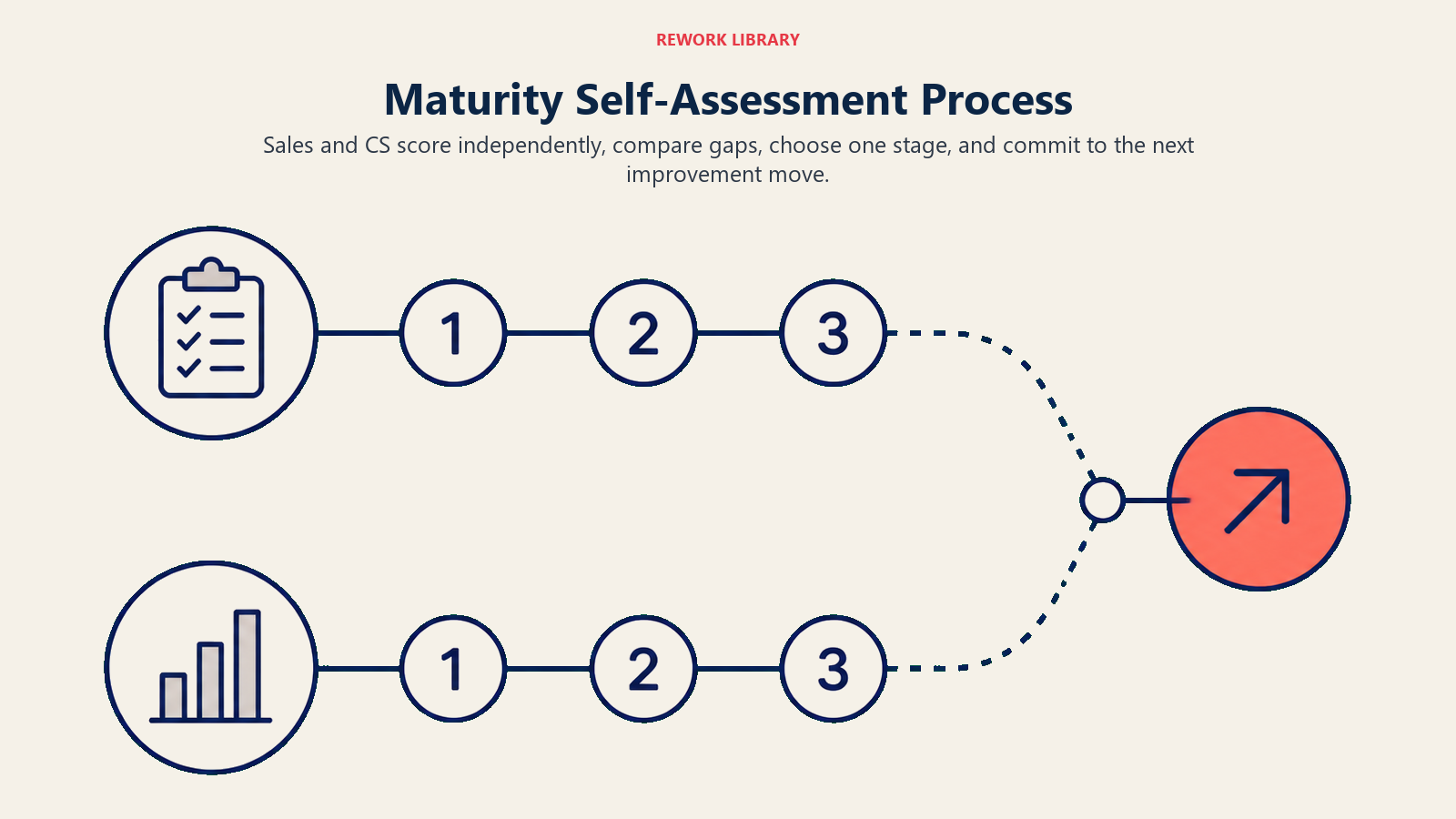
Passo 1: As duas funções respondem às cinco perguntas de diagnóstico de forma independente, antes de comparar.
- Qual percentual de chamadas de kickoff começa com o CSM tendo contexto suficiente para pular a redescoberta? (Abaixo de 50% = Estágio 1 ou 2; 70-90% = Estágio 3; 90%+ com consistência = Estágio 4+)
- Existe um documento de swimlane escrito e acordado que ambas as equipes seguem? (Não = Estágio 1-2; Sim, mas não consistentemente = Estágio 2-3; Sim e aplicado = Estágio 3+)
- Existe um mecanismo formal para o CS comunicar sinais de contas de baixo fit de volta para Sales? (Não = Estágio 1-3; Sim, informalmente = Estágio 3-4; Sim, formalmente com responsável e cadência = Estágio 4+)
- As duas equipes compartilham pelo menos uma métrica de receita (NRR, ARR de expansão ou valor do ciclo de vida do cliente) que aparece nos OKRs de ambas? (Não = Estágio 1-3; Sim = Estágio 4+)
- O ARR de expansão é projetado de forma conjunta? (Não = Estágio 1-4; Sim = Estágio 5)
Passo 2: Compare as respostas e encontre as discordâncias. As lacunas na avaliação entre o VP de Sales e o VP de CS são o sinal mais útil. Quando Sales diz "sim, temos o mecanismo" e CS diz "existe, mas ninguém o usa", você encontrou exatamente o que precisa corrigir.
Passo 3: Concorde sobre o estágio atual real. Use o estágio respondido de forma consistente mais baixa como o estágio atual. "Fazemos isso às vezes" não é o mesmo que "fazemos isso consistentemente." Apenas a execução consistente conta.
Passo 4: Identifique a única coisa que o moveria para o próximo estágio. Não três coisas. Uma. Qual é a única mudança estrutural que moveria 80% das suas contas do comportamento do Estágio N para o comportamento do Estágio N+1? Esse é o item do roadmap.
O que Quebra quando Você Pula Estágios no Modelo de Maturidade?
O erro mais comum na melhora do alinhamento é tentar ir do Estágio 2 direto para o Estágio 4. A liderança tem um bom trimestre, contrata um analista de RevOps, cria um dashboard conjunto e anuncia que todos agora são conjuntamente responsáveis pelo NRR.
Seis meses depois, o dashboard não está sendo atualizado, as reuniões conjuntas têm baixa participação e o NRR não se moveu. O que aconteceu?
Os Estágios 3 e 4 têm pré-requisitos. O Estágio 4 (accountability conjunto) exige o Estágio 3 (responsabilidade definida) porque accountability exige clareza. Você não pode responsabilizar duas equipes conjuntamente por um resultado quando nenhuma sabe quem é dono do quê em cada estágio do ciclo de vida. A métrica compartilhada é inútil sem o modelo de responsabilidade subjacente.
Prazos típicos de transição, assumindo prioridade ativa da liderança:
- Estágio 1 → Estágio 2: 4-6 semanas (criação do template, treinamento, rollout)
- Estágio 2 → Estágio 3: 2-3 meses (definição de swimlane, gate de conclusão, mudança de comportamento)
- Estágio 3 → Estágio 4: 3-6 meses (configuração de métrica compartilhada, revisão de remuneração, estabelecimento de cadência conjunta)
- Estágio 4 → Estágio 5: 6-12 meses (construção de RevOps, redesenho de remuneração, implementação do modelo de pod)
Citável: "A pesquisa da TSIA constatou que organizações com revisões de contas conjuntas formais (um indicador do Estágio 4) têm taxas de retenção bruta 28% maiores do que organizações sem esse processo, mesmo controlando por qualidade do produto e segmento de mercado."
Esses são prazos realistas, não aspiracionais. Eles levam em conta o fato de que mudanças comportamentais em equipes de Sales levam mais tempo do que mudanças de processo, e que mudanças de remuneração envolvem jurídico, financeiro e RH, não apenas decisões de liderança.
As equipes que avançam mais rápido pelos estágios são as que têm patrocínio explícito do CRO. Quando o CRO é dono da iniciativa de alinhamento (não o VP de Sales ou o VP de CS separadamente, mas o CRO que gere as duas funções), o atrito organizacional reduz significativamente. E a armadilha mais perigosa dessa progressão não é o Estágio 1. É o Estágio 3.
Como Evitar o Platô do Estágio 3?
Uma última nota sobre o modo de falha mais comum: chegar ao Estágio 3 e parar.
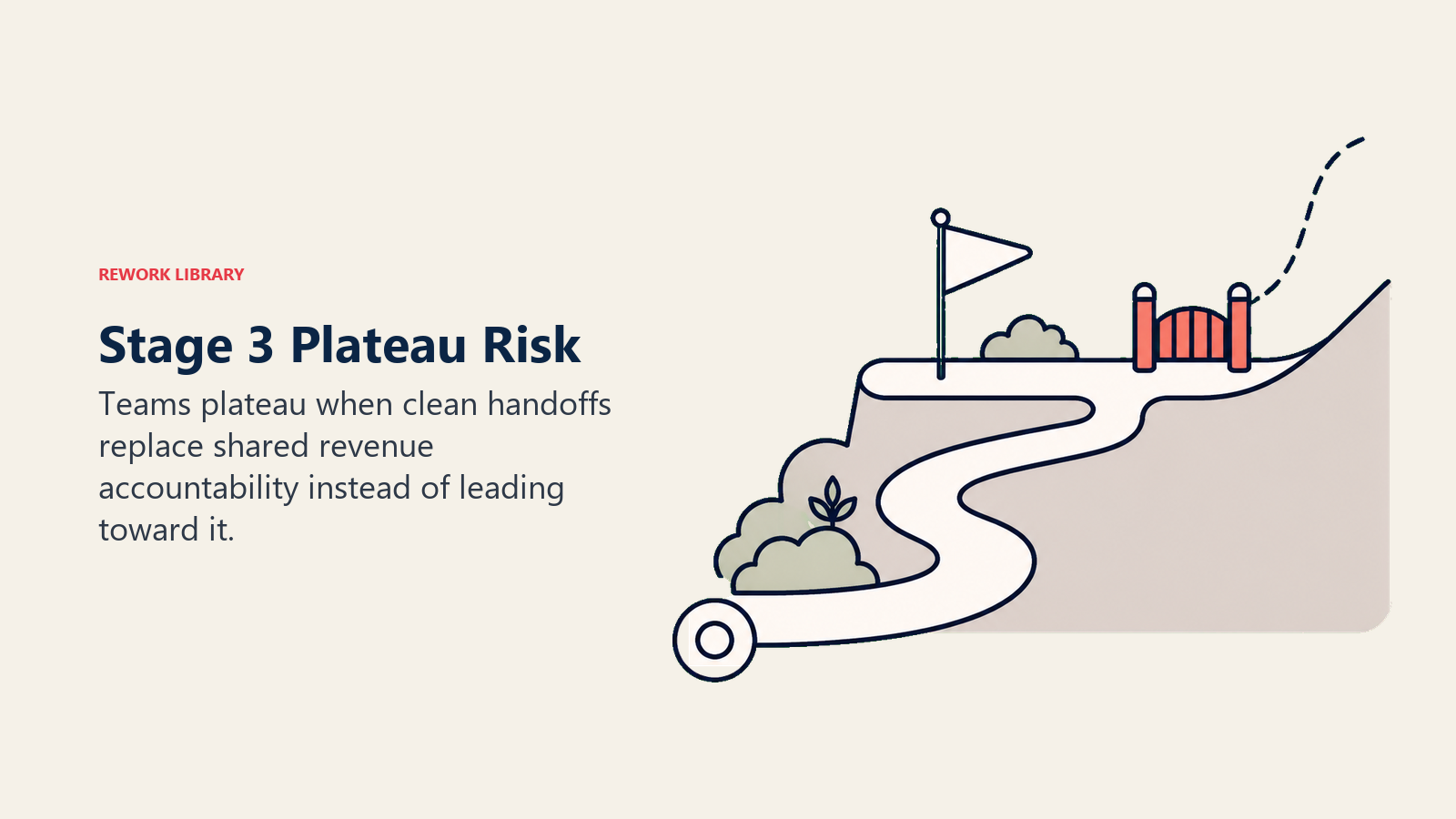
A razão pela qual o Estágio 3 parece sucesso é que as falhas mais visíveis dos Estágios 1 e 2 desaparecem. A qualidade das chamadas de kickoff melhora. Os CSMs param de reclamar (tão alto) sobre maus handoffs. O churn decorrente de falhas de handoff cai. A liderança passa para a próxima prioridade.
Análise Rework: O platô do Estágio 3 é a armadilha mais cara do Modelo de Maturidade de Alinhamento Sales-CS em Cinco Estágios porque é invisível. As empresas no Estágio 3 resolveram o problema mais visível (o caos de handoff), mas seu teto de NRR (tipicamente 95-100%) ainda deixa muita receita na mesa. Em uma base de $15M ARR, a diferença entre 97% de NRR e 108% de NRR é $1,65M em receita recorrente anual. O platô persiste porque o próximo estágio exige métricas compartilhadas e mudanças de remuneração, que são mais difíceis de implementar do que mudanças de processo. Equipes que reconhecem o platô do Estágio 3 pelo nome estão mais bem posicionadas para superá-lo.
Mas o teto de NRR no Estágio 3 é real. A expansão ainda é oportunista. O feedback de ICP não está fluindo. A remuneração ainda está impulsionando a otimização independente. E a diferença entre 97% de NRR (teto do Estágio 3) e 108% de NRR (faixa do Estágio 4-5) é substancial: em uma base de $15M ARR, isso equivale a $1,65M em receita recorrente anual.
A forma de evitar o platô é definir a meta do Estágio 4 antes de ter estabilizado completamente o Estágio 3. Não para acelerar a transição, mas para manter o destino visível. Equipes que sabem que o Estágio 3 não é a linha de chegada tomam decisões diferentes ao longo do caminho. O artigo sobre como prever o NRR em conjunto traz a mecânica prática de uma das mudanças estruturais mais visíveis do Estágio 4.
Use este modelo em uma reunião de liderança conjunta. Execute o diagnóstico. Concorde sobre o estágio atual. E defina a meta do Estágio 4 com um prazo específico.
As empresas que tratam o alinhamento como uma correção única e as que o tratam como uma progressão contínua chegam a números de NRR muito diferentes três anos depois. A pesquisa da McKinsey sobre customer success mostra que os clientes existentes respondem por entre um terço e metade do crescimento total de receita, mesmo em empresas em estágio inicial. Esse é o argumento composto para priorizar a maturidade de alinhamento.
Perguntas Frequentes sobre o Modelo de Maturidade de Alinhamento Sales-CS
Como é uma organização no Estágio 3 versus no Estágio 4?
O Estágio 3 tem swimlanes documentadas e handoffs consistentes, mas a expansão é oportunista e o feedback de CS para Sales é informal. O Estágio 4 adiciona métricas de NRR compartilhadas, revisões de contas conjuntas formais e um mecanismo estruturado de feedback de CS para Sales. A diferença de NRR entre os dois é tipicamente de 5-10 pontos. O Estágio 4 exige disposição da liderança para mudar as estruturas de remuneração, o que torna a transição mais difícil do que a do Estágio 2 para o Estágio 3.
Quanto tempo leva para chegar ao Estágio 4?
A maioria das organizações consegue avançar do Estágio 2 para o Estágio 4 em 6-12 meses com patrocínio ativo do CRO. A transição do Estágio 2 para o 3 leva 2-3 meses (mudança comportamental em torno da qualidade do handoff). A transição do Estágio 3 para o 4 leva 3-6 meses (configuração de métricas compartilhadas, revisão de remuneração, estabelecimento de cadência conjunta). Tentar comprimir esses prazos geralmente resulta em mudanças superficiais que regridem quando a pressão aumenta.
Uma empresa pode pular estágios no modelo de maturidade?
Não de forma sustentável. O Estágio 4 (accountability conjunto) exige o Estágio 3 (responsabilidade definida) como pré-requisito, pois você não consegue responsabilizar as equipes por resultados compartilhados quando a responsabilidade em cada estágio do ciclo de vida ainda é ambígua. O Estágio 5 exige a infraestrutura de métricas compartilhadas do Estágio 4. Equipes que tentam pular estágios tendem a instalar os artefatos de um estágio superior sem os acordos fundamentais, e esses artefatos decaem em dois trimestres.
Qual é o ARR mínimo para começar a se preocupar com isso?
O ponto de inflexão onde o desalinhamento Sales-CS começa a prejudicar materialmente o NRR é tipicamente $3-5M ARR, quando a equipe é grande o suficiente para o fundador ou o primeiro CSM não conhecer mais cada conta pessoalmente, e os handoffs se tornam processos reais em vez de conversas. Com $10M ARR, o alinhamento no Estágio 1 ou 2 é um risco significativo de receita.
Onde a maioria das empresas SaaS de mid-market se posiciona no Modelo de Maturidade em Cinco Estágios?
A maioria das empresas com $5M-$15M ARR está no Estágio 2 ou no início do Estágio 3. Têm um template de handoff, mas qualidade de preenchimento inconsistente. Têm acordos informais de swimlane, mas nenhum documento escrito de responsabilidades que as duas equipes sigam. Acreditam estar no Estágio 3 quando as evidências do diagnóstico as colocam no Estágio 2. O sinal mais confiável de um Estágio 3 verdadeiro é um gerente de CS que consegue confirmar que 90%+ das chamadas de kickoff começam com contexto suficiente. Não a existência de um template, mas sua eficácia consistente.
Saiba Mais
- O que é Alinhamento Sales-CS
- O Custo de um Handoff Quebrado de Sales para CS: O que Faz com o Seu NRR
- 8 Sinais de Alerta de Desalinhamento Sales-CS
- Modelos de Equipe de Conta: Pod, Swarm e Sequencial
- Remuneração Alinhada ao NRR
- Modelo de Maturidade de Alinhamento entre Marketing e Vendas
- Estruturas de Equipe de Pós-Venda

Principal Solution Architect
On this page
- Por que Usar um Modelo de Maturidade em vez de um Checklist?
- O Modelo de Maturidade de Alinhamento Sales-CS em Cinco Estágios
- Estágio 1: Handoff Reativo
- Estágio 2: Handoff Documentado
- Estágio 3: Responsabilidade Definida
- Estágio 4: Accountability Conjunto
- Estágio 5: Parceria de Receita
- Como Realizar a Autoavaliação de Maturidade?
- O que Quebra quando Você Pula Estágios no Modelo de Maturidade?
- Como Evitar o Platô do Estágio 3?
- Saiba Mais