Peringkat 5: Apabila AI Membentuk Semula Produk Anda, Tahap Kematangan Paling Jarang

Turn this article into takeaways for your work.


Each assistant summarizes the article only for you and suggests best practices for your work.
Peringkat 5 adalah satu-satunya tahap kematangan di mana AI mengubah apa yang dijual oleh sebuah perniagaan, bukan sekadar cara ia menyampaikannya. Bukan kecekapan operasi. Produk itu sendiri.
Kebanyakan syarikat pada 2026 belum sampai ke sana. Kebanyakan syarikat pada 2028 pun masih belum sampai. Itu bukan kegagalan. Ia mencerminkan keperluan struktur tulen yang mesti wujud di Peringkat 3 dan 4 sebelum Peringkat 5 pun bermakna untuk dipertimbangkan. Laporan Indeks AI 2026 Stanford HAI mendapati bahawa pelaburan AI korporat global mencecah $581.7 bilion pada 2025, naik 130% berbanding tahun sebelumnya, tetapi jumlah pelaburan sahaja tidak menghasilkan keputusan Peringkat 5. Kerja asas di peringkat lebih awal yang menghasilkannya.
Tetapi memahami apa yang diperlukan Peringkat 5 menjelaskan mengapa pelaburan yang anda buat di Peringkat 1 hingga 4 penting. Ia bukan sekadar penambahbaikan operasi. Ia adalah prasyarat untuk kategori kelebihan daya saing yang kebanyakan pesaing sedia ada tidak akan dapat aksesnya.
Artikel ini untuk CEO dan pemimpin produk yang berfikir tentang kedudukan daya saing tiga hingga lima tahun. Bukan sebagai peta jalan operasi. Sebagai konteks strategik. Jika anda lebih awal dalam perjalanan kematangan, mulakan dengan gambaran keseluruhan 5 Peringkat Kematangan AI.
Rupa Peringkat 5 yang sebenar
Fakta Utama: Realiti Daya Saing Produk AI-Natif
- Syarikat permulaan AI-natif menguasai 63% hasil pasaran AI generatif pada 2025, naik dari 36% tahun sebelumnya, meraih hampir $2 untuk setiap $1 yang diperoleh syarikat perisian sedia ada yang menyesuaikan diri dengan AI (Menlo Ventures, State of Generative AI in the Enterprise 2025)
- Sekurang-kurangnya 60 produk AI-natif telah mencapai $100 juta dalam ARR (annual recurring revenue); menjelang akhir 2026, sekurang-kurangnya 50 perniagaan AI-natif dijangka mencapai $250 juta dalam ARR, dengan beberapa calon bersedia melintasi $1 bilion (Bessemer Venture Partners, 2025)
- Pelaburan AI perusahaan berkembang dari $1.7 bilion kepada $37 bilion antara 2023 dan 2025, peningkatan 21 kali ganda; syarikat permulaan AI menarik $89.4 bilion dalam VC global pada 2025, mewakili 34% daripada semua pelaburan VC walaupun hanya 18% daripada syarikat yang dibiayai (Menlo Ventures / Bessemer, 2025)
Cara paling jelas untuk mendefinisikan Peringkat 5 adalah melalui ujian kebolehbuangan.
Di Peringkat 3 dan Peringkat 4, jika anda membuang AI, perniagaan berterusan. Ia beroperasi kurang cekap. Hasil mungkin merosot. Tetapi produk masih wujud dan menyampaikan sebahagian nilai terasnya.
Di Peringkat 5, jika anda membuang AI, produk tidak wujud. Bukan dalam bentuk yang degradasi. Langsung tidak wujud.
Contoh konkrit dari 2025-2026.
Cursor adalah editor kod di mana AI bukan ciri: ia adalah produk. Tanpa pengaturcaraan berpasangan AI, penjanaan kod, dan pengeditan sedar konteks, Cursor adalah editor teks. Keseluruhan proposisi nilai adalah AI.
Jasper dan Copy.ai adalah platform penjanaan kandungan. Produk adalah kandungan yang dijana AI. Tanpa AI, tiada produk.
Otter.ai menulis transkripsi dan meringkaskan mesyuarat secara automatik. Kecerdasan mesyuarat adalah produk. Tanpa AI, anda mempunyai alat rakaman.
Perhatikan apa yang ada persamaan di antara contoh-contoh ini. AI tidak meningkatkan aliran kerja yang boleh wujud tanpanya. AI adalah aliran kerja itu. Pengguna membeli akses kepada hasil AI, bukan kepada alat yang membantu mereka menghasilkan hasil sendiri.
Bandingkan ini dengan syarikat seperti Salesforce, yang telah menambah ciri AI secara meluas merentasi platform CRM-nya. Tetapi CRM itu sendiri (sistem rekod, pengurusan pipeline, pangkalan data kenalan) akan berfungsi pada tahap yang berkurang tetapi nyata tanpa Einstein. Salesforce dengan Einstein dilumpuhkan adalah produk yang lebih lemah. Cursor tanpa AI adalah pengganti Notepad.
Peringkat 5 bermaksud mendarat di sisi Cursor dari garis itu, bukan sisi Salesforce.
Ambang AI-Sebagai-Produk
Rangka kerja diagnostik untuk menentukan sama ada sebuah organisasi telah melepasi dari Peringkat 4 (operasi berteraskan AI) ke Peringkat 5 (produk AI-natif). Ambang AI-Sebagai-Produk mempunyai tiga kriteria. Kriteria 1 (Ujian Kebolehbuangan): membuang AI menghapuskan nilai teras produk, bukan sekadar ciri. Kriteria 2 (Parit Data Proprietari): produk telah mengumpul data melalui interaksi pengguna yang tidak dapat direplikasi oleh pesaing dengan mengakses model asas yang sama. Kriteria 3 (Roda Kitaran Penambahbaikan): setiap interaksi pengguna menjana isyarat latihan yang menjadikan AI jauh lebih baik dari masa ke masa, mewujudkan kelebihan daya saing yang mengukuhkan diri. Produk yang memenuhi ketiga-tiga kriteria berada di atas ambang. Produk yang memenuhi Kriteria 1 tetapi bukan Kriteria 2 dan 3 berada di ambang tetapi tidak mempunyai ketahanan yang diperlukan untuk kedudukan Peringkat 5 yang mampan.
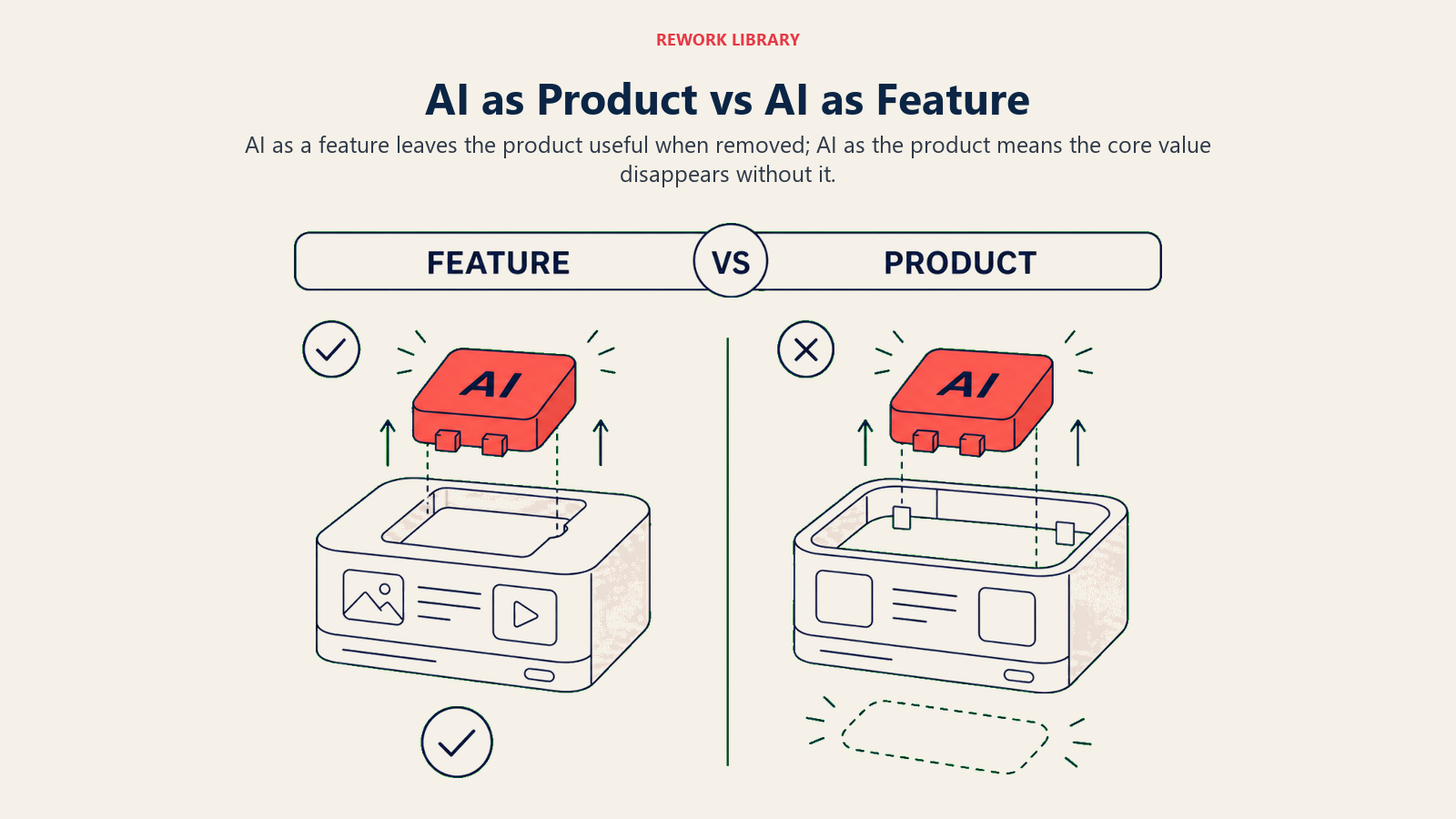
"Syarikat permulaan AI-natif menguasai 63% hasil pasaran AI generatif perusahaan pada 2025, naik dari 36% tahun sebelumnya, meraih hampir $2 untuk setiap $1 yang diperoleh syarikat perisian sedia ada yang melapisi AI ke atas produk sedia ada. Perbezaan peringkat produk antara 'AI sebagai ciri' dan 'AI sebagai produk' turut menjadi perbezaan peringkat hasil." (Rework, berdasarkan Menlo Ventures 2025)
Soalan peringkat lembaga yang dipaksa oleh Peringkat 5
Bagi syarikat di Peringkat 3 atau Peringkat 4, AI adalah senjata daya saing. Ia menjadikan operasi lebih pantas, produk lebih baik, pelanggan lebih gembira.
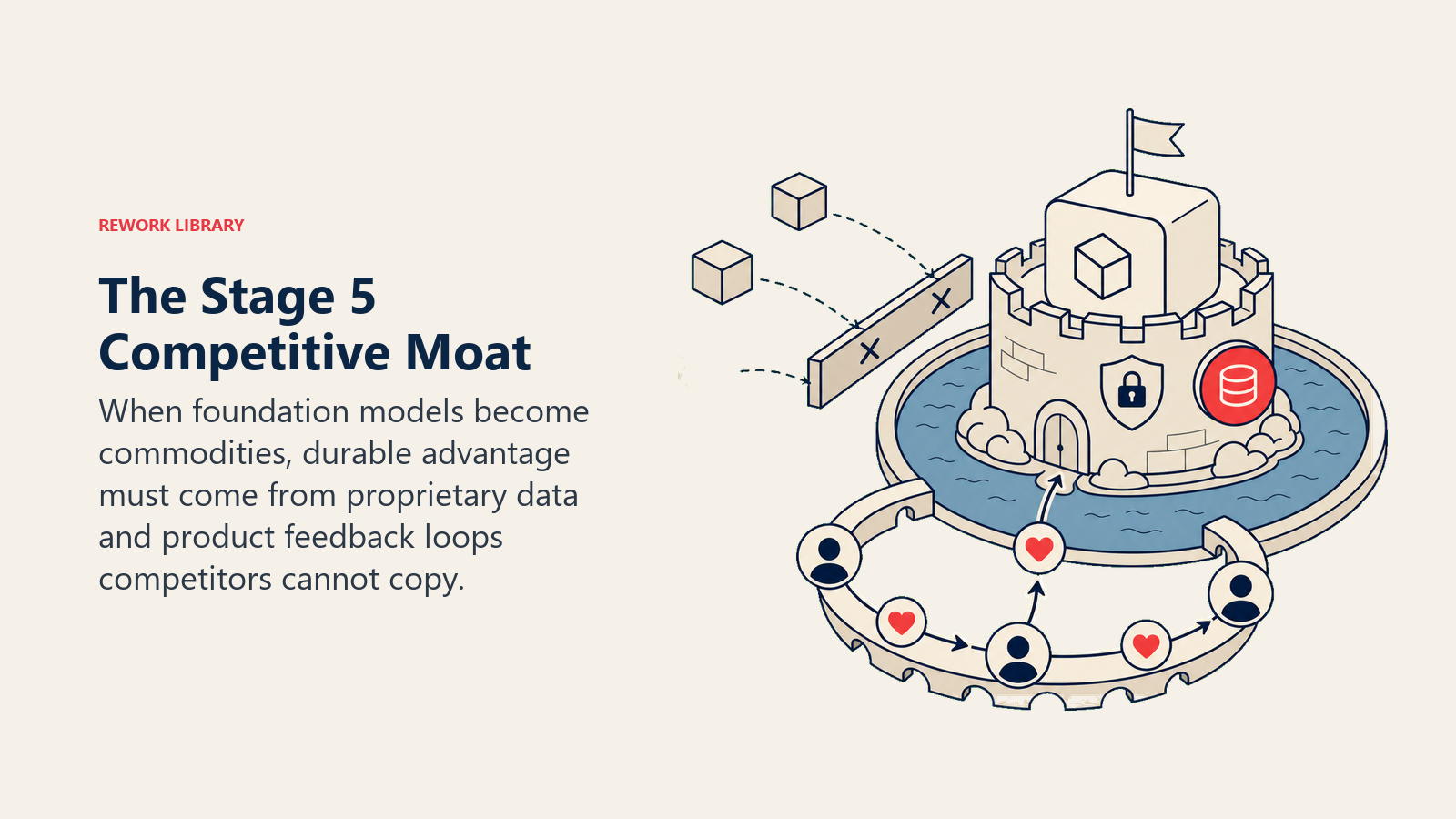
Bagi syarikat yang mempertimbangkan Peringkat 5, soalannya berbeza. Dan lebih tidak selesa.
"Jika keupayaan AI menjadi komoditi, jika setiap pesaing boleh mengakses model yang sama pada harga yang sama, apakah nilai terdifferensiasi produk kita?"
Soalan ini sudah hidup. Pada 2022, keupayaan untuk menjana catatan blog dengan AI adalah luar biasa. Pada 2025, ia adalah keupayaan asas yang tersedia dalam berpuluh-puluh produk pada kos marginal hampir sifar. Pasukan yang membina parit daya saing di sekitar "penjanaan kandungan AI" mendapati parit itu terhakis apabila keupayaan itu menjadi universal.
Peringkat 5 hanya mampan jika jawapan kepada soalan lembaga itu adalah: "Kami mempunyai sesuatu yang pesaing AI tidak boleh replikasi dengan mengakses model yang sama."
Dua jawapan yang boleh dipertahankan adalah data proprietari dan gelung maklum balas.
Data proprietari. Produk anda telah mengumpul data yang pesaing tidak boleh akses. Gong mempunyai rakaman jutaan panggilan jualan B2B. Veeva mempunyai data ujian klinikal dari pelanggan farmaseutikal. Set data ini, yang digunakan untuk fine-tuning atau RAG (retrieval-augmented generation), menghasilkan hasil AI yang tidak boleh dipadankan oleh mana-mana model tujuan umum. Tetapi: data proprietari sebagai parit memerlukan bertahun-tahun pengumpulan, kepercayaan pelanggan untuk berkongsi data itu, dan infrastruktur untuk menggunakannya di Peringkat 4 sebelum ia menjadi kelebihan di Peringkat 5.
Gelung maklum balas produk. Setiap interaksi pengguna menambah baik AI untuk pengguna seterusnya. Apabila pengguna membetulkan hasil AI, pembetulan itu dimasukkan semula ke dalam fine-tuning model atau pengoptimuman prompt. Apabila pengguna secara konsisten lebih suka hasil tertentu berbanding yang lain, keutamaan itu menjadi isyarat latihan. Ini adalah roda kitaran yang memisahkan produk AI-natif dari produk berteraskan AI. Tetapi ia memerlukan instrumentasi di Peringkat 3, saluran paip data di Peringkat 4, dan jumlah yang hanya datang dari penggunaan produksi sebenar.
Kedua-dua parit mengambil bertahun-tahun untuk dibina. Syarikat yang mengumumkan "aspirasi Peringkat 5" tanpa infrastruktur Peringkat 3 sedang membelanjakan modal untuk destinasi yang mereka tidak ada laluan untuk mencapainya.
Bagaimana syarikat mencapai Peringkat 5
Peringkat 5 bukan strategi yang anda pilih. Ia adalah destinasi yang anda perolehi dengan membina dengan betul di Peringkat 3 dan 4.
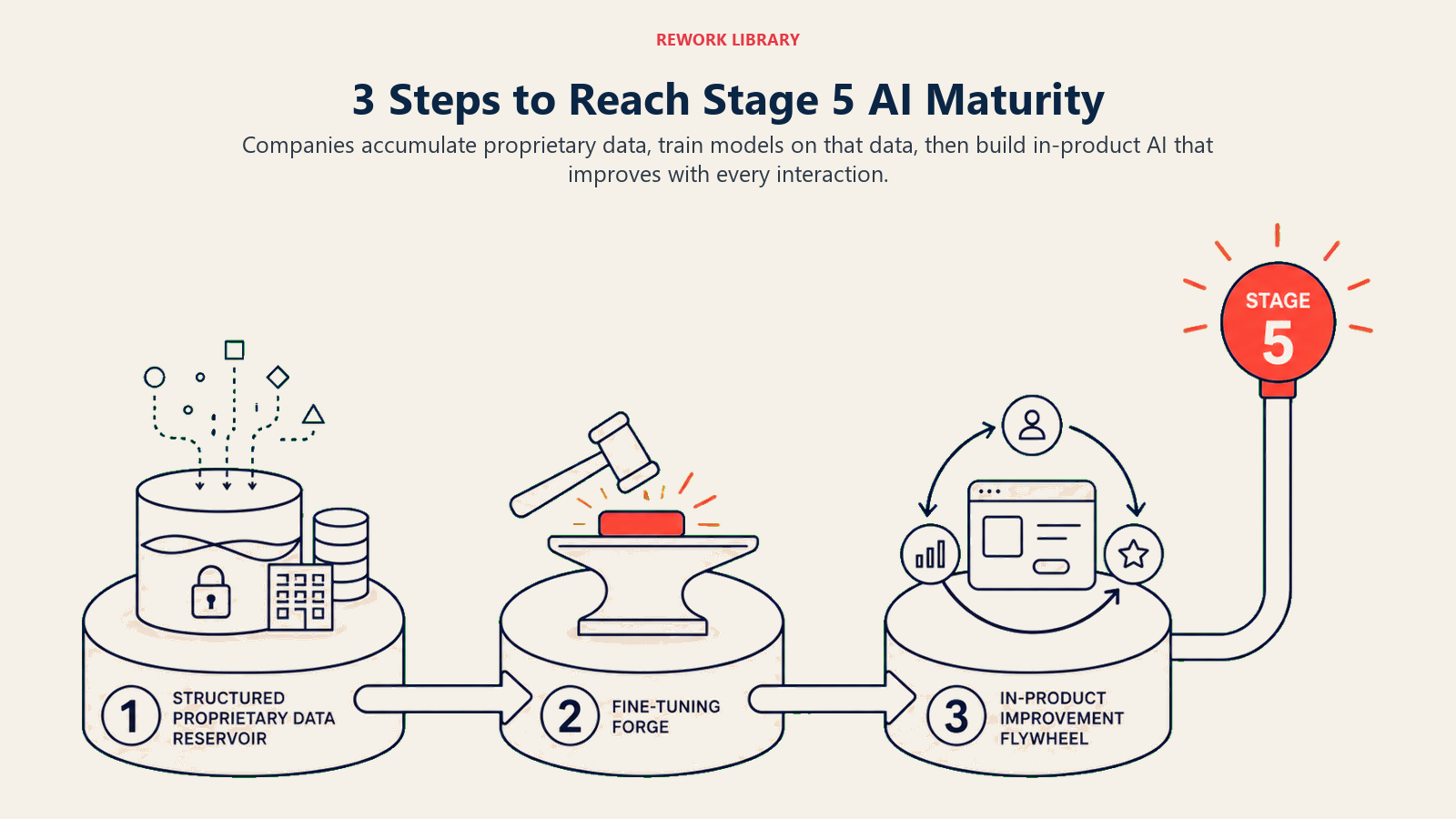
Laluan itu mempunyai tiga kaki.
Kaki 1: Pengumpulan data proprietari. Setiap interaksi dalam produk anda menjana data. Soalannya ialah sama ada anda mengumpulnya, melabelkannya, dan menyusunnya dengan cara yang mewujudkan kelebihan latihan AI. Kebanyakan syarikat di Peringkat 3 tidak melakukan ini secara sengaja. Mereka menjana data tetapi tidak menganggapnya sebagai aset strategik. Syarikat yang mencapai Peringkat 5 mula menganggap data produk sebagai bahan latihan AI di Peringkat 3, bukan Peringkat 5.
Kaki 2: Model fine-tuned atau terlatih pada data proprietari. LLM (large language models) tujuan umum tersedia untuk semua orang. Model fine-tuned yang dilatih pada data proprietari hanya tersedia untuk anda. Fine-tuning memerlukan data berlabel yang besar, pelaburan kejuruteraan, dan gelung maklum balas kualiti yang jelas. Ia bukan titik permulaan. Ia adalah hasil dari Kaki 1 dan 2 yang berjalan selama 18-24 bulan.
Kaki 3: AI dalam produk yang bertambah baik dari masa ke masa. Produk menjadi jauh lebih baik semakin banyak ia digunakan. Pengguna melihat penambahbaikan ini dan mengaitkannya dengan produk secara khusus. Ini mewujudkan kos pertukaran yang bukan sekadar kebiasaan aliran kerja. Ia adalah "AI ini tahu perniagaan dan keutamaan saya, dan akan mengambil masa setahun untuk membina semula konteks itu di tempat lain." Itulah parit struktural.
Ketiga-tiga kaki memerlukan infrastruktur Peringkat 4 sebagai asas. Saluran paip data masa nyata menyuap gelung maklum balas. Sistem operasi yang terhubung API menangkap pembetulan dan keutamaan. Kebolehperhati membolehkan anda memantau prestasi model dari masa ke masa. Syarikat yang cuba melompat ke Peringkat 5 tanpa asas ini sedang melabur dalam destinasi tanpa membina jalan.
Laluan khusus SaaS ke Peringkat 5
Syarikat SaaS mencapai Peringkat 5 dengan cara yang berbeza kerana produk itu sendiri boleh menjana telemetri proprietari yang menambah baik sistem AI dari semasa ke semasa.
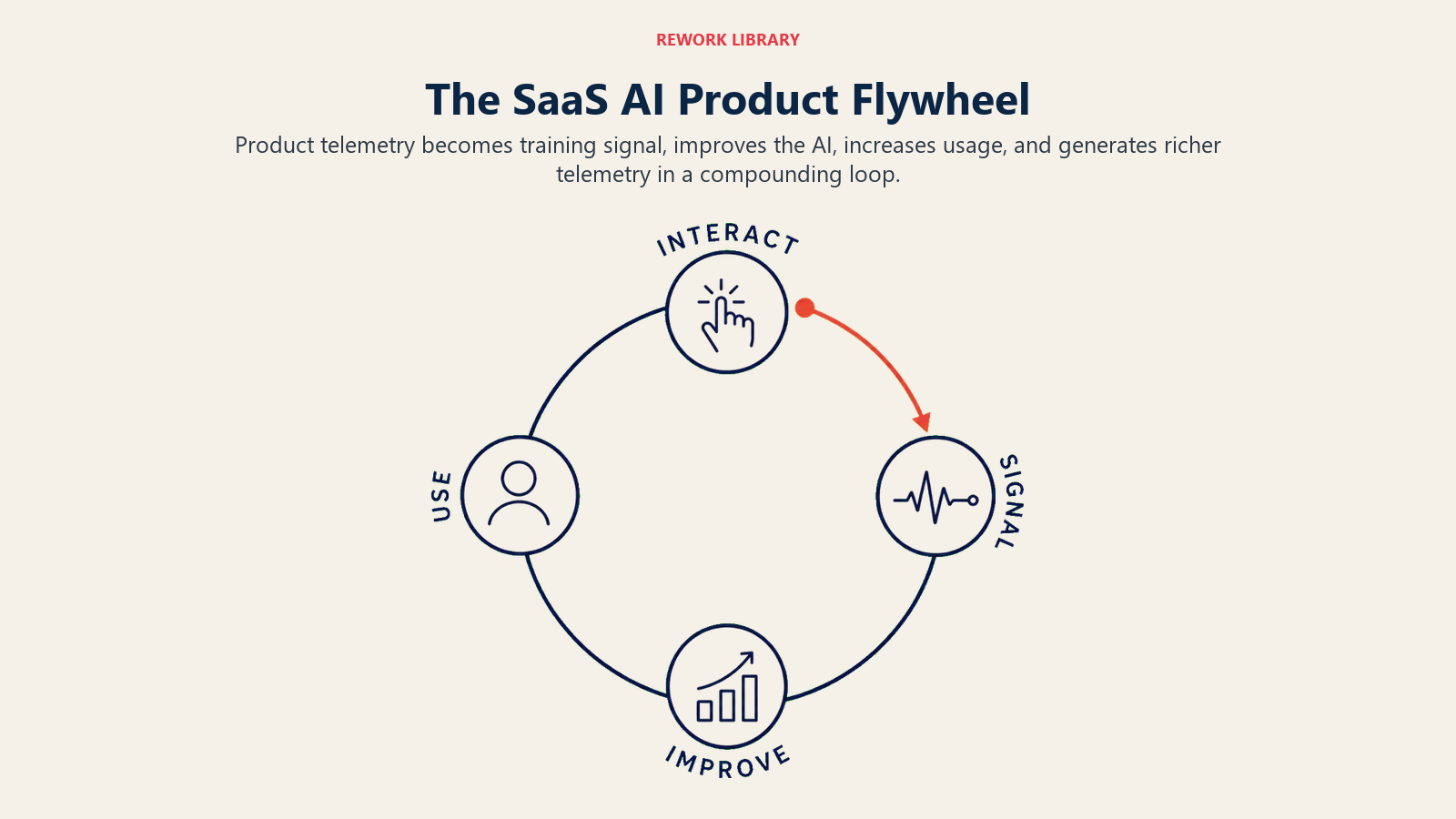
Untuk syarikat SaaS, Peringkat 5 mempunyai bentuk yang spesifik: telemetri produk sebagai kelebihan latihan AI.
Setiap tindakan yang diambil pengguna dalam produk menjana isyarat. Ciri-ciri yang mereka gunakan dan dalam urutan apa. Di mana mereka berhenti. Hasil AI mana yang mereka terima, sunting, atau tolak. Apa yang mereka cari tetapi tidak jumpa. Berapa lama mereka habiskan pada skrin mana.
Di Peringkat 3, telemetri ini digunakan untuk analitik produk: memahami ciri-ciri yang mendorong pengekalan, langkah onboarding yang menyebabkan berhenti, di mana pengguna keliru. Kerja kecerdasan produk standard.
Di Peringkat 5, telemetri ini juga merupakan isyarat latihan. Corak dalam tingkah laku pengguna membantu AI memahami apa yang "baik" kelihatan untuk setiap pengguna, setiap peranan, dan setiap segmen industri. Semakin banyak AI belajar dari tingkah laku dalam produk sebenar, semakin tepat ia dapat menjangka apa yang diperlukan pengguna sebelum mereka bertanya. Bagaimana AI Membentuk Semula Model Operasi SaaS meneroka bagaimana gelung telemetri ini mengubah model perniagaan SaaS sepenuhnya.
Ini mewujudkan roda kitaran: AI yang lebih baik mendorong lebih banyak penggunaan, lebih banyak penggunaan menjana isyarat latihan yang lebih baik, isyarat yang lebih baik menambah baik AI. Setiap iterasi roda kitaran menjadikan produk semakin sukar untuk digantikan.
Tetapi roda kitaran ini hanya beroperasi jika produk diinstrumentasi untuk menangkap isyarat di Peringkat 3, saluran paip data disediakan untuk menyuap fine-tuning di Peringkat 4, dan pasukan produk menganggap data tingkah laku pengguna sebagai aset AI strategik dan bukannya input pelaporan.
Risiko melompat ke Peringkat 5
Adalah menggoda bagi syarikat yang berambisi untuk mengisytiharkan "strategi produk AI-pertama" dan melabur besar-besaran dalam keupayaan Peringkat 5 sebelum asas Peringkat 3 dan 4 tersedia.
Coraknya kelihatan seperti ini. Sebuah syarikat di Peringkat 2 melihat pesaing melancarkan ciri produk AI-natif yang mendapat liputan positif. Kepimpinan memutuskan syarikat perlu "menjadi syarikat AI." Mereka mengambil VP Produk AI. Mereka menugaskan pembinaan model tersuai. Mereka mengagihkan semula sumber kejuruteraan dari kerja produk teras ke pembangunan ciri AI.
Lapan belas bulan kemudian: model tersuai memerlukan lebih banyak data latihan daripada yang mereka ada. Ciri-ciri AI tidak konsisten kerana infrastruktur data belum bersedia. Produk teras telah mengumpul hutang teknikal kerana perhatian kejuruteraan beralih. Pelanggan keliru sama ada produk lebih baik atau sekadar berbeza. VP Produk AI telah pergi.
Ini adalah aspirasi Peringkat 5 tanpa pelaksanaan Peringkat 3. Ia mahal, dan ia biasa.
Soalan diagnostik: "Adakah kami mempunyai penggunaan produksi yang lengkap di Peringkat 3, dengan keputusan infrastruktur yang dibuat dengan betul dan pelbagai kes penggunaan dalam produksi?" Jika jawapannya tidak, pelaburan Peringkat 5 adalah terlalu awal. Anda sedang membina di atas asas yang belum wujud.
Tadbir urus Peringkat 5: apabila AI adalah pendedahan kawal selia
Di Peringkat 3 dan 4, tadbir urus AI adalah fungsi operasi dan undang-undang. Di Peringkat 5, ia adalah soalan liabiliti produk.
EU AI Act. Di bawah EU AI Act, sistem AI yang diklasifikasikan sebagai "risiko tinggi" (pemarkahan kredit, keputusan pengambilan, penilaian pendidikan, penguatkuasaan undang-undang, peranti perubatan) menghadapi keperluan pematuhan yang besar: dokumentasi teknikal, penilaian kesesuaian, kewajipan pengawasan manusia, dan pendaftaran mandatori dalam pangkalan data EU. Jika produk Peringkat 5 anda membuat keputusan berkesan tentang orang, EU AI Act terpakai.
Liabiliti produk. Jika produk anda adalah AI, kecacatan produk adalah kecacatan AI. Halusinasi, hasil yang berat sebelah, dan cadangan yang salah bukan sekadar isu sokongan pelanggan; ia adalah tuntutan liabiliti produk berpotensi. Di Peringkat 5, pasukan undang-undang dan produk anda memerlukan pemilikan bersama kualiti hasil AI sebagai fungsi keselamatan produk.
Berat sebelah pada skala. Apabila AI membuat ribuan keputusan sejam tentang orang, berat sebelah dalam model menghasilkan keputusan diskriminasi pada skala besar. Alat pengambilan yang secara sistematik mengutamakan kumpulan demografik tertentu lebih rendah. Alat kredit yang menghasilkan impak yang berbeza. Alat diagnostik yang berprestasi lebih buruk pada populasi pesakit tertentu. Tadbir urus Peringkat 5 memerlukan ujian berat sebelah berkala yang boleh diaudit pihak ketiga ke atas hasil AI berisiko tinggi, bukan sekadar pemeriksaan dalaman.
Pemilikan risiko peringkat lembaga. Lembaga syarikat Peringkat 5 memerlukan pengawasan risiko AI yang eksplisit. Ini biasanya bermaksud subkemite lembaga dengan literasi AI, pelaporan berkala tentang pendedahan risiko AI, dan laluan eskalasi yang jelas dari pengurusan ke lembaga untuk insiden AI yang ketara. Keperluan tadbir urus EU AI Act menolak ke arah ini untuk syarikat Eropah; jangkaan serupa muncul dalam panduan kawal selia AS.
Penutup yang jujur: kebanyakan pembaca harus fokus pada Peringkat 2-3
Jika anda membaca ini sebagai CEO atau CTO syarikat dengan 100 hingga 2,000 pekerja, Peringkat 5 bukan keutamaan operasi anda pada 2026.
Keutamaan anda adalah membuat peralihan Peringkat 1-ke-2 dengan bersih: satu projek perintis yang dijalankan dengan baik dengan pengukuran yang betul. Kemudian peralihan Peringkat 2-ke-3 dengan keputusan infrastruktur yang dibuat dengan betul dan penggunaan produksi yang bertahan. Kemudian kerja organisasi integrasi Peringkat 3-ke-4 dalam fungsi bernilai tertinggi anda.
Memahami Peringkat 5 penting kerana ia menjelaskan mengapa anda melabur. Anda bukan sekadar membeli alat kecekapan. Anda sedang membina asas data, infrastruktur, dan gelung maklum balas yang akhirnya akan menjadikan AI pembeza dalam produk anda, bukan sekadar operasi anda. Setiap set data berlabel yang anda bina di Peringkat 3. Setiap gelung maklum balas yang anda instrumentasi di Peringkat 4. Setiap aliran kerja AI produksi yang anda urus dengan betul. Ini adalah bahan mentah yang membentuk Peringkat 5.
Analisis Rework: Berdasarkan corak pertumbuhan syarikat AI-natif, syarikat yang melepasi $100 juta ARR dengan produk AI-natif berkongsi sejarah struktural yang konsisten: mereka menginstrumentasi telemetri produk sebagai isyarat latihan di Peringkat 3, membina saluran paip data proprietari sebelum fine-tuning model di Peringkat 4, dan menganggap gelung maklum balas sebagai strategi produk dan bukannya tugas kejuruteraan. Pertumbuhan 21 kali ganda dalam pelaburan AI perusahaan antara 2023 dan 2025 telah mengintensifkan persaingan, tetapi ia juga meningkatkan bar data dan infrastruktur. Produk AI-natif yang dilancarkan pada 2026 perlu menjelaskan parit data proprietarinya dari hari pertama. "Kami akan menambah AI" bukan lagi strategi daya saing. "Kami mempunyai data yang pesaing tidak boleh akses" adalah.
Syarikat yang mencapai Peringkat 5 akan menoleh ke belakang dan menunjuk kepada keputusan spesifik yang dibuat di Peringkat 2 dan Peringkat 3 sebagai saat yang memungkinkannya. Disiplin untuk mengukur sebelum bertindak. Keputusan untuk berkongsi infrastruktur dan bukannya menyilokan alat. Pelaburan tadbir urus yang membolehkan mereka diskala tanpa insiden bencana.
Peringkat 5 adalah jarang. Kerja yang memungkinkannya tidak.
Ia bermula di Peringkat 2, dan jam sudah berjalan.
Apa yang dibaca seterusnya
Baca: Peringkat 3 ke 4: Dari Diskala ke Diintegrasikan untuk memahami kerja organisasi dan seni bina yang menjadi asas Peringkat 5.
Baca: 5 Peringkat Kematangan AI untuk model kematangan lengkap dengan kriteria peralihan antara setiap peringkat.
Baca: Daftar Risiko AI: Apa yang Perlu Dijejaki untuk infrastruktur tadbir urus yang diperlukan oleh pendedahan liabiliti produk Peringkat 5.
Soalan Lazim
Apakah kematangan AI Peringkat 5?
Peringkat 5 (Transformasional) adalah tahap kematangan di mana AI membentuk semula produk dan perkhidmatan yang ditawarkan perniagaan, bukan sekadar cara ia disampaikan. Ujian penentunya adalah kebolehbuangan: jika anda membuang AI, produk tidak akan wujud dalam bentuk yang degradasi. Ia tidak akan wujud sama sekali. Syarikat Peringkat 5 mempunyai AI sebagai produk mereka, parit data proprietari yang tidak dapat direplikasi pesaing, dan roda kitaran penambahbaikan di mana setiap interaksi pengguna menjadikan AI lebih baik untuk pengguna berikutnya.
Apakah Ambang AI-Sebagai-Produk?
Ambang AI-Sebagai-Produk adalah rangka kerja tiga kriteria untuk menentukan sama ada sebuah organisasi telah melepasi dari Peringkat 4 ke Peringkat 5. Kriteria 1 (Kebolehbuangan): membuang AI menghapuskan nilai teras produk. Kriteria 2 (Parit Data Proprietari): interaksi pengguna telah mengumpul data yang tidak dapat direplikasi pesaing dari model asas. Kriteria 3 (Roda Kitaran Penambahbaikan): setiap interaksi menjana isyarat latihan yang menambah baik AI secara material dari masa ke masa. Produk yang memenuhi ketiga-tiganya berada di atas ambang dengan kedudukan Peringkat 5 yang tahan lama. Produk yang hanya memenuhi Kriteria 1 berada di ambang tanpa ketahanan daya saing yang diperlukan untuk kebolehupayaan Peringkat 5 jangka panjang.
Seberapa cepat syarikat AI-natif berkembang berbanding syarikat sedia ada?
Syarikat permulaan AI-natif menguasai 63% hasil pasaran AI generatif perusahaan pada 2025, naik dari 36% tahun sebelumnya, meraih hampir $2 untuk setiap $1 yang diperoleh syarikat sedia ada yang menyesuaikan diri dengan AI. Sekurang-kurangnya 60 produk AI-natif telah mencapai $100 juta dalam ARR. Pelaburan AI perusahaan berkembang 21 kali ganda antara 2023 dan 2025, dari $1.7 bilion kepada $37 bilion. Syarikat permulaan AI menarik $89.4 bilion dalam modal teroka global pada 2025, mewakili 34% daripada semua pelaburan VC walaupun hanya 18% daripada syarikat yang dibiayai.
Apakah dua parit daya saing yang boleh dipertahankan di Peringkat 5?
Dua parit Peringkat 5 yang tahan lama adalah data proprietari dan gelung maklum balas produk. Data proprietari bermaksud produk anda telah mengumpul data latihan melalui interaksi pelanggan yang tidak boleh diakses pesaing. Gelung maklum balas bermaksud setiap interaksi pengguna menambah baik AI untuk pengguna seterusnya, mewujudkan dinamik roda kitaran di mana skala menjana penambahbaikan. Kedua-duanya memerlukan bertahun-tahun pengumpulan: instrumentasi di Peringkat 3, saluran paip data di Peringkat 4, dan jumlah yang hanya datang dari penggunaan produksi sebenar.
Adakah syarikat mid-market patut melabur untuk mencapai Peringkat 5?
Bagi kebanyakan syarikat dengan 100-2,000 pekerja, Peringkat 5 bukan keutamaan operasi pada 2026. Keutamaannya adalah peralihan Peringkat 1-ke-2 yang bersih, penggunaan produksi Peringkat 2-ke-3 yang betul dari segi infrastruktur, dan integrasi aliran kerja Peringkat 3-ke-4 dalam fungsi bernilai tinggi. Walau bagaimanapun, memahami Peringkat 5 memaklumkan keputusan pelaburan Peringkat 2-4: membina set data berlabel, menginstrumentasi gelung maklum balas, dan menganggap telemetri produk sebagai aset latihan AI adalah keputusan Peringkat 3-4 yang berganda menjadi pilihan Peringkat 5 kemudian. Syarikat yang melangkau keputusan ini di Peringkat 3 akan menghadapi pengubahsuaian yang mahal jika mereka kemudian menginginkan kedudukan Peringkat 5.
Lihat juga:
- Agenda AI CEO 18 Bulan: peta jalan operasi jangka pendek yang membina asas untuk Peringkat 5
- Peringkat Kematangan AI SaaS: bagaimana kematangan khusus SaaS dipetakan kepada model ini
- Transformasi AI vs. Transformasi Digital: mengapa Peringkat 5 secara kategoris berbeza dari mana-mana gelombang transformasi sebelumnya

Co-Founder, Rework.com
On this page
- Rupa Peringkat 5 yang sebenar
- Ambang AI-Sebagai-Produk
- Soalan peringkat lembaga yang dipaksa oleh Peringkat 5
- Bagaimana syarikat mencapai Peringkat 5
- Laluan khusus SaaS ke Peringkat 5
- Risiko melompat ke Peringkat 5
- Tadbir urus Peringkat 5: apabila AI adalah pendedahan kawal selia
- Penutup yang jujur: kebanyakan pembaca harus fokus pada Peringkat 2-3
- Apa yang dibaca seterusnya