Bagaimana AI Membentuk Semula Model Operasi SaaS

Turn this article into takeaways for your work.


Each assistant summarizes the article only for you and suggests best practices for your work.
Model operasi SaaS klasik mempunyai andaian mudah pada terasnya: jika Anda mahukan lebih banyak pendapatan, Anda tambah headcount. Lebih banyak wakil menutup lebih banyak perjanjian. Lebih banyak CSM mengekalkan lebih banyak pelanggan. Lebih banyak ejen sokongan menyelesaikan lebih banyak tiket. Model ini berskala secara linear kerana manusia melakukan kebanyakan kerja kognitif.
AI memecahkan andaian tersebut. Bukan sepenuhnya, bukan dalam semalaman, tetapi secara arah dan boleh diukur. Syarikat yang terlebih dahulu mengetahui nisbah baharu, dan mereka bentuk semula organisasi mereka di sekitarnya sebelum terpaksa berbuat demikian, akan beroperasi pada tahap kecekapan yang berbeza secara asas berbanding pesaing mereka.
Ini bukan ramalan tentang AI menggantikan pekerjaan. Ini adalah penerangan tentang bagaimana matematik pendapatan-per-headcount berubah apabila AI mengendalikan kognisi berulang dalam setiap fungsi.
Peralihan nisbah headcount-ke-pendapatan dalam customer success
AI mengubah model operasi dengan memindahkan kerja pemantauan dan penyediaan yang berulang keluar daripada perancangan kapasiti manusia.
Penanda aras tradisional untuk kakitangan CS SaaS B2B adalah $1 juta hingga $1.5 juta ARR (Annual Recurring Revenue) setiap CSM (Customer Success Manager) untuk produk pasaran pertengahan. SaaS perusahaan dengan model perkhidmatan sentuhan tinggi beroperasi lebih rendah, sekitar $500K hingga $800K setiap CSM. Syarikat PLG (product-led growth) dengan churn yang lebih rendah dan pelanggan yang lebih layan diri boleh menolak nisbah itu lebih tinggi.
Fakta Utama: Model Operasi SaaS dengan AI
- ARR terbaik dalam kelas setiap FTE melonjak 42% untuk syarikat dengan ARR $20-50 juta (mencapai $350K) dan 50% untuk syarikat di atas ARR $50 juta (mencapai $400K), didorong sebahagian besarnya oleh peningkatan kecekapan headcount yang didorong AI (High Alpha SaaS Benchmarks, 2025)
- Purata CSM akan mempunyai 25-50% lebih banyak kapasiti menjelang akhir 2026 dengan bekerja secara berbeza, bukan lebih lama: CSM kini menghabiskan dua pertiga masa mereka untuk tugasan bernilai rendah yang AI boleh automasi (penyelidikan CEO ChurnZero, 2025)
- Syarikat yang melaksanakan model CS berasaskan pengecualian (di mana AI menandai akaun berisiko dan CSM hanya mengendalikan apa yang ditandai) melaporkan kadar pengekalan 25-40% lebih tinggi dan ROI 3-5x pada headcount customer success (Benchmarkit, 2025)
Apabila AI Customer Success Manager (tindanan Anomaly Agent ditambah RAG (Retrieval-Augmented Generation) Assistant ditambah Meeting Intelligence) mengendalikan kognisi rutin, penanda aras tersebut berubah.
CSM yang dibantu AI dalam penggunaan 2025-2026 mengurus buku akaun $2.5 juta hingga $4 juta ARR di syarikat SaaS pasaran pertengahan tanpa pengurangan kualiti respons atau prestasi churn. Matematiknya: CSM yang sebelumnya menghabiskan 40% masa mereka untuk pemeriksaan kesihatan manual, penyediaan pembaharuan, dan entri data kini menghabiskan 40% itu untuk perbualan pelanggan yang sebenar kerana AI melakukan pemantauan kesihatan, menandai akaun berisiko, menyediakan dek QBR, dan menggubal mesej semakan berkala.
Nilai CSM terletak pada hubungan dan keputusan pertimbangan, bukan pemasangan data. Apabila AI mengambil alih pemasangan data, CSM boleh melayani lebih banyak akaun tanpa penurunan kualiti yang secara tradisinya mengikut apabila saiz buku akaun meningkat.
Untuk syarikat SaaS pada ARR $15 juta:
- Kakitangan tradisional: 10 hingga 15 CSM pada ARR $1 juta-$1.5 juta setiap orang
- Kakitangan yang dibantu AI: 5 hingga 7 CSM pada ARR $2 juta-$3 juta setiap orang
Itu perbezaan 5 hingga 8 headcount. Pada kos CSM yang dimuatkan sepenuhnya $120K hingga $180K setahun, itu adalah $600K hingga $1.4 juta dalam kos headcount yang dielakkan setiap tahun, pada skala ARR $15 juta. Dan kerana AI CSM menandai isyarat churn lebih awal, delta ARR yang dikekalkan boleh lebih ketara lagi.
Sejak 2022, ARR setiap pekerja telah meningkat dalam setiap band ARR sementara median headcount telah menurun, terutamanya untuk syarikat di atas ARR $5 juta. AI adalah pemacu utama.
Implikasi perancangan: dalam pelan operasi tahunan seterusnya, modelkan kedua-dua barisan headcount tradisional dan barisan headcount yang dibantu AI untuk CS, dan putuskan andaian ARR mana yang Anda kakitangkan. Kebanyakan syarikat SaaS masih lalai kepada nisbah tradisional tanpa menjalankan perbandingan.
Kecekapan jualan dan bayaran balik CAC
AI Sales Operator (Scoring+Routing, Meeting Intelligence, Generative Research, Workflow Copilot) memampatkan masa antara ketibaan lead dan perbualan jualan bermakna pertama. Ia juga mengurangkan overhead pentadbiran yang menggunakan 30% hingga 40% masa wakil.
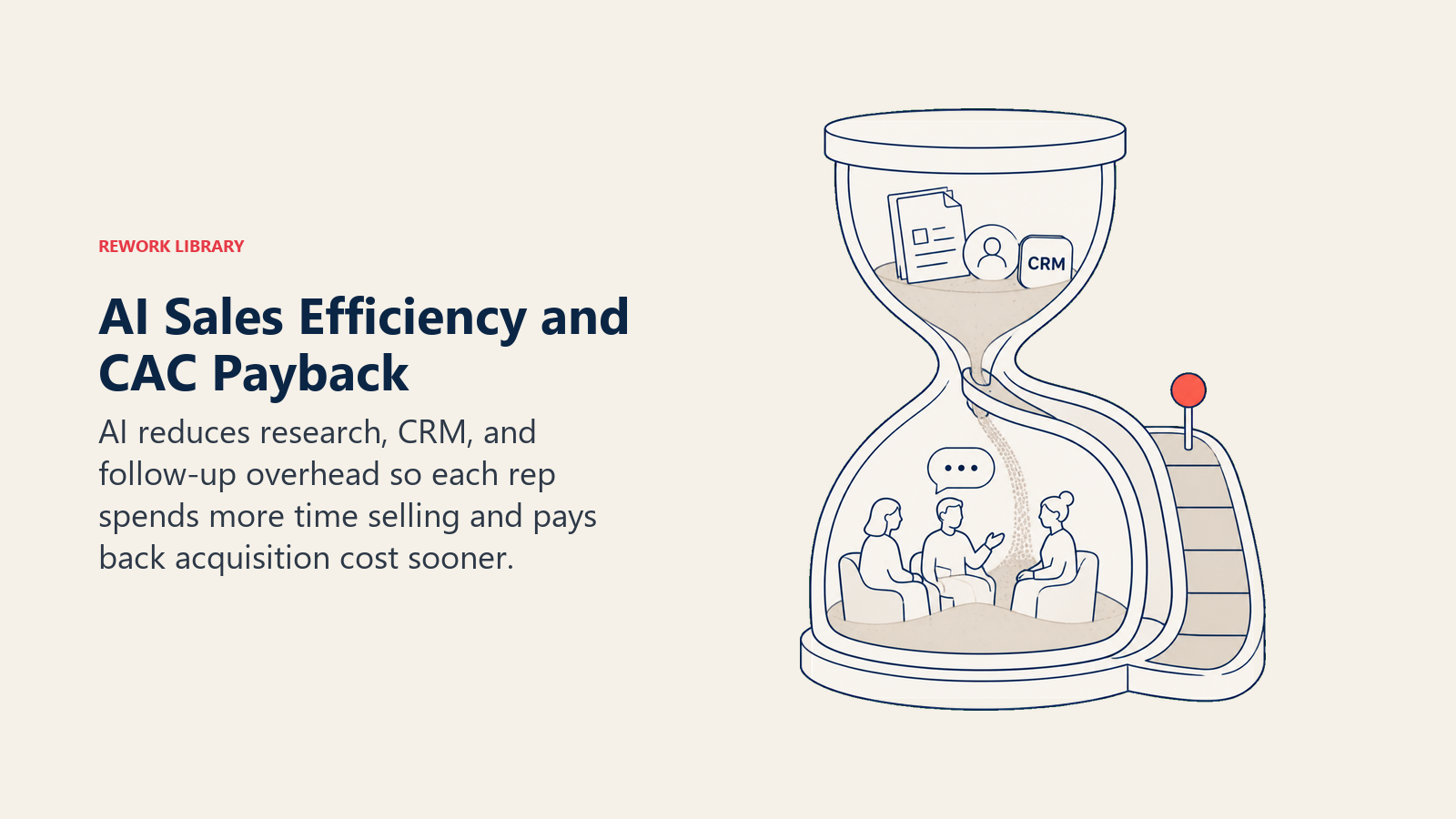
Kesan pada kecekapan jualan muncul di dua tempat: produktiviti setiap wakil dan tempoh bayaran balik CAC (Customer Acquisition Cost).
Produktiviti setiap wakil: Seorang wakil yang menghabiskan 40% minggu mereka untuk tugasan pentadbiran (kemas kini CRM, penyediaan panggilan, draf susulan, penyelidikan perjanjian) mempunyai 60% masa mereka untuk kerja bersemuka pelanggan. McKinsey menganggarkan AI generatif boleh mengautomasi 60-70% daripada tugasan rutin yang menggunakan masa profesional jualan dan perkhidmatan hari ini. Wakil yang dibantu AI yang menjalankan tindanan Sales Operator penuh biasanya mengurangkan overhead pentadbiran kepada 15% hingga 20% minggu mereka. Itu 20 hingga 25 mata peratusan lebih banyak masa produktif setiap wakil setiap minggu, yang diterjemahkan kepada lebih banyak mesyuarat dijalankan, lebih banyak perjanjian dimajukan, dan lebih banyak pipeline disentuh dalam suku tahun tertentu.
Bayaran balik CAC: Jika wakil baharu purata Anda mencapai produktiviti penuh dalam enam bulan dan kemudian menjana ARR baharu $800K setahun, kecekapan kos jualan Anda ditanda aras terhadap output tersebut. Apabila alatan AI meningkatkan output produktif wakil itu sebanyak 25% tanpa menambah kos, Anda secara efektif mendapat ARR baharu $1 juta setiap wakil pada kos yang sama. Bayaran balik CAC menjadi lebih singkat.
Rework Sales AI, yang dibina untuk menjalankan tindanan Sales Operator penuh dalam satu CRM, direka bentuk khusus untuk pasukan SaaS B2B pasaran pertengahan yang mahu menjalankan Scoring+Routing, Meeting Intelligence, dan Workflow Copilot tanpa mengintegrasikan tiga alatan berasingan. Untuk pasukan jualan 10 orang, Sales Engine pada edisi Standard berharga $90/bulan dibilkan tahunan ($1,080/tahun), merangkumi infrastruktur CRM asas, dengan seat tambahan dalam blok 5 seat ($21/bulan bagi setiap blok) apabila pasukan berkembang. Lihat rework.com/pricing untuk butiran semasa. Hujah kecekapan: ROI peningkatan produktiviti jualan daripada Sales Operator yang diselaraskan membayar balik kos alatan dalam beberapa minggu.
CFO dan CRO sama-sama mengambil berat tentang metrik yang sama di sini: pada ARR per wakil mana kita mencapai titik pulang modal pada pengambilan jualan suku tahun ini? AI mengalihkan titik pulang modal tersebut.
Kos sokongan dan margin kasar
Sokongan adalah tempat AI mengubah margin kasar, bukan hanya kecekapan headcount.
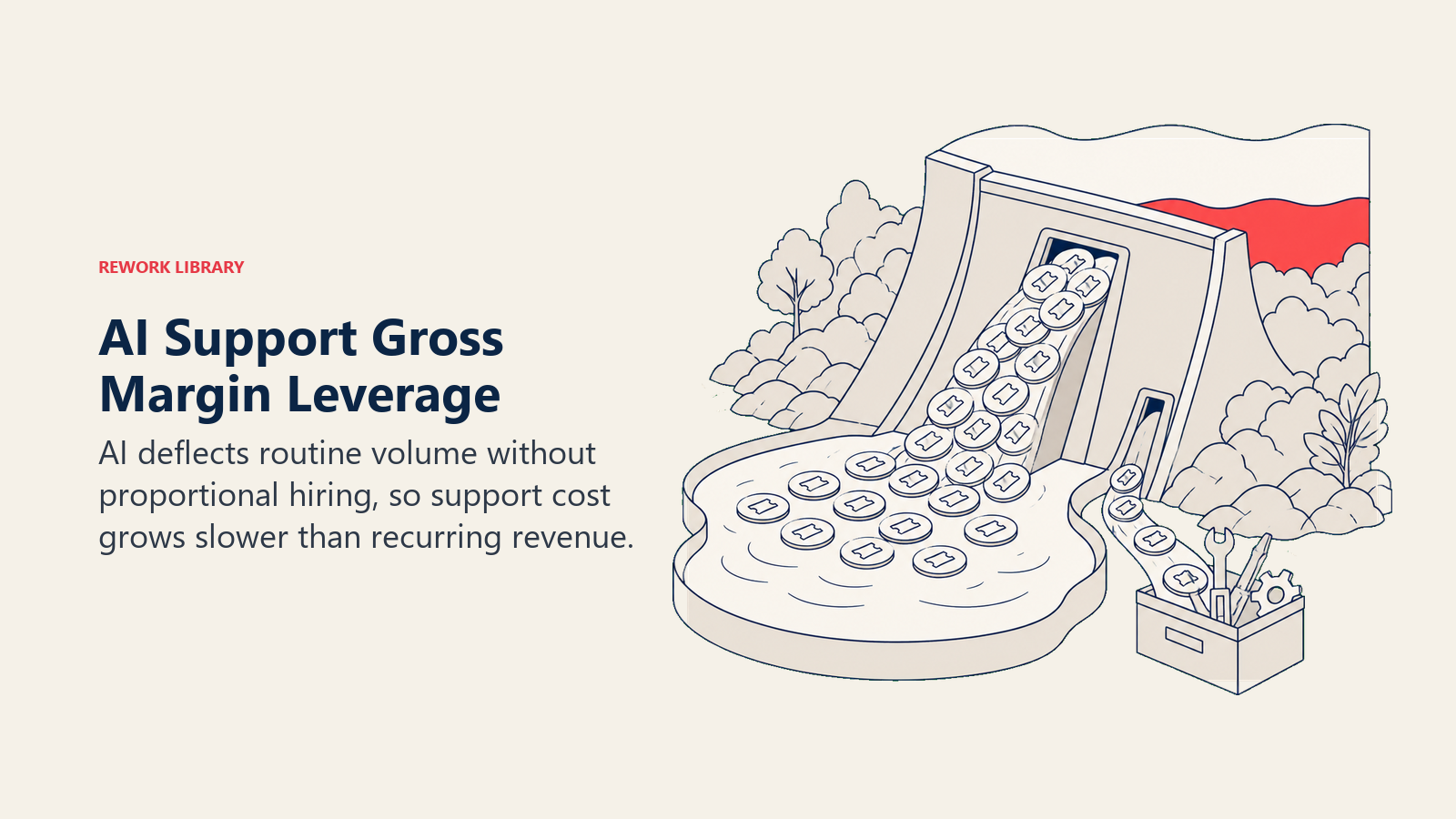
Syarikat SaaS pasaran pertengahan pada 1,000 pelanggan yang mengendalikan 6,000 tiket sokongan sebulan mempunyai masalah unit ekonomi: jika setiap tiket kos $25 untuk diselesaikan (dimuatkan sepenuhnya dengan masa ejen, alatan, overhead pengurusan), itu adalah $150K sebulan dalam kos sokongan. Pada kadar operasi ARR $5 juta, itu adalah 36% pendapatan bulanan untuk sokongan. Margin kasar terjejas.
Ejen Sokongan AI (RAG Assistant ditambah Scoring+Routing ditambah Workflow Copilot) mengubah matematik ini melalui pengalihan. Intercom Fin, yang digunakan merentasi produk SaaS yang didokumentasikan dengan baik, secara konsisten mengalihkan 40% hingga 55% daripada jumlah tiket masuk. Sesetengah industri dengan soalan L1 yang sangat berulang (tetapan semula kata laluan, soalan cara-melakukan, pertanyaan pengebilan) melihat kadar pengalihan melebihi 60%. Gartner meramalkan AI agentic akan secara autonomi menyelesaikan 80% isu perkhidmatan pelanggan biasa menjelang 2029, menunjukkan ke arah peralihan hampir lengkap dalam ekonomi sokongan L1.
Pada pengalihan 50% daripada 6,000 tiket sebulan, Anda telah mengalihkan 3,000 tiket. Pada $25 setiap tiket yang diselesaikan, itu adalah $75K sebulan dalam pemulihan margin kasar. AI Support Agent biasanya berharga $3K hingga $10K sebulan pada jumlah tersebut. Matematik berfungsi walaupun pada kadar pengalihan yang konservatif.
Tetapi kesan margin kasar berganda seiring Anda berskala. Seiring syarikat berkembang dan jumlah tiket meningkat, AI Support Agent mengalihkan bahagian yang lebih besar secara proporsional tanpa memerlukan pertumbuhan headcount yang proporsional. Barisan kos sokongan berkembang lebih perlahan daripada pendapatan, yang mengembangkan margin kasar dari semasa ke semasa. Itulah sebabnya syarikat SaaS perusahaan yang berdagang pada gandaan pendapatan yang tinggi melabur banyak dalam AI sokongan: ia adalah salah satu tuas operasi yang secara langsung meningkatkan peratusan margin kasar yang diutamakan oleh pelabur.
Kecekapan kandungan dan pemasaran
AI Content Operator (Generative Research ditambah RAG Assistant ditambah Workflow Copilot) mengurangkan kos setiap bahagian kandungan yang diterbitkan sebanyak 60% hingga 80% dalam pasukan pemasaran SaaS yang melaksanakannya dengan baik.
Tetapi perubahan model operasi yang lebih penting bukanlah pengurangan kos. Ia adalah halaju output. Pasukan kandungan lima orang yang boleh menghasilkan 10 artikel sebulan secara manual boleh menghasilkan 40 hingga 60 artikel sebulan dengan AI Content Operator dalam aliran kerja. Perubahan halaju output itulah yang membolehkan syarikat SaaS membina dan mengekalkan parit kandungan yang memacu pipeline organik.
Implikasi reka bentuk organisasi: pasukan kandungan baharu lebih kecil tetapi berbeza. Lebih sedikit penulis generalis yang menulis segala-galanya dari awal. Lebih banyak penyunting pakar bidang yang memberi taklimat kepada AI, menyemak output, meningkatkan kualiti, dan mengekalkan suara jenama. Peranan penyunting lebih sukar dilakukan dengan baik berbanding peranan penulis kerana ia memerlukan pertimbangan tentang apa yang tidak ada, bukan hanya kemahiran untuk menghasilkan sesuatu.
Pasukan yang membuat kesilapan mengekalkan komposisi pasukan yang sama dan hanya menambah alatan AI akhirnya mendapat kualiti yang lebih rendah pada jumlah yang lebih tinggi. Perubahan model operasi memerlukan reka bentuk semula peranan, bukan hanya perubahan alatan.
Corak Organisasi SaaS Hibrid
Corak Organisasi SaaS Hibrid menggambarkan seni bina organisasi syarikat SaaS selepas AI digunakan merentasi semua empat fungsi pendapatan. Dalam model ini, setiap jabatan menjalankan teras kecil manusia yang intensif pertimbangan bersama ejen AI yang mengendalikan kognisi berulang. CS mempunyai 5-7 CSM yang dibantu AI yang merangkumi apa yang 12-15 CSM tradisional lakukan sebelumnya. Jualan mempunyai bilangan wakil yang sama tetapi menghasilkan output 25-30% lebih tinggi. Sokongan mempunyai lebih sedikit ejen tetapi beban kes yang lebih kompleks. Pemasaran mempunyai lebih sedikit penulis tetapi kawasan permukaan kandungan yang lebih besar. Operasi Pendapatan menjadi Operasi AI. Ciri penentuan ialah headcount berskala pada sebahagian kecil pertumbuhan ARR, kerana AI menyediakan leveraj produktiviti yang headcount sebelumnya perlu sediakan. Syarikat dalam Corak Organisasi SaaS Hibrid secara konsisten menunjukkan peningkatan pendapatan-per-FTE dari semasa ke semasa; syarikat yang masih menggunakan model headcount linear melihatnya mendatar atau menurun.
| Fungsi | Model Tradisional | Model yang Dibantu AI | Keuntungan Kecekapan |
|---|---|---|---|
| Customer Success | ARR $1-1.5 juta setiap CSM | ARR $2.5-4 juta setiap CSM | Saiz buku akaun 2-3x |
| Jualan | 40% minggu untuk tugasan pentadbiran | 15-20% untuk tugasan pentadbiran | 20-25% lebih banyak masa menjual |
| Sokongan | Kos $25 setiap tiket | $10-15 dengan pengalihan 50% | Pengurangan kos 40-60% |
| Kandungan | 10 artikel/bulan untuk pasukan 5 orang | 40-60 artikel/bulan | Halaju output 4-6x |
Sumber: ChurnZero, Forrester, Intercom, McKinsey (2024-2025)
Apa yang berubah dalam carta organisasi
Carta organisasi beralih apabila ejen AI menyerap kerja berjumlah besar dan manusia menumpukan pada pertimbangan, eskalasi, dan pemilikan hubungan.
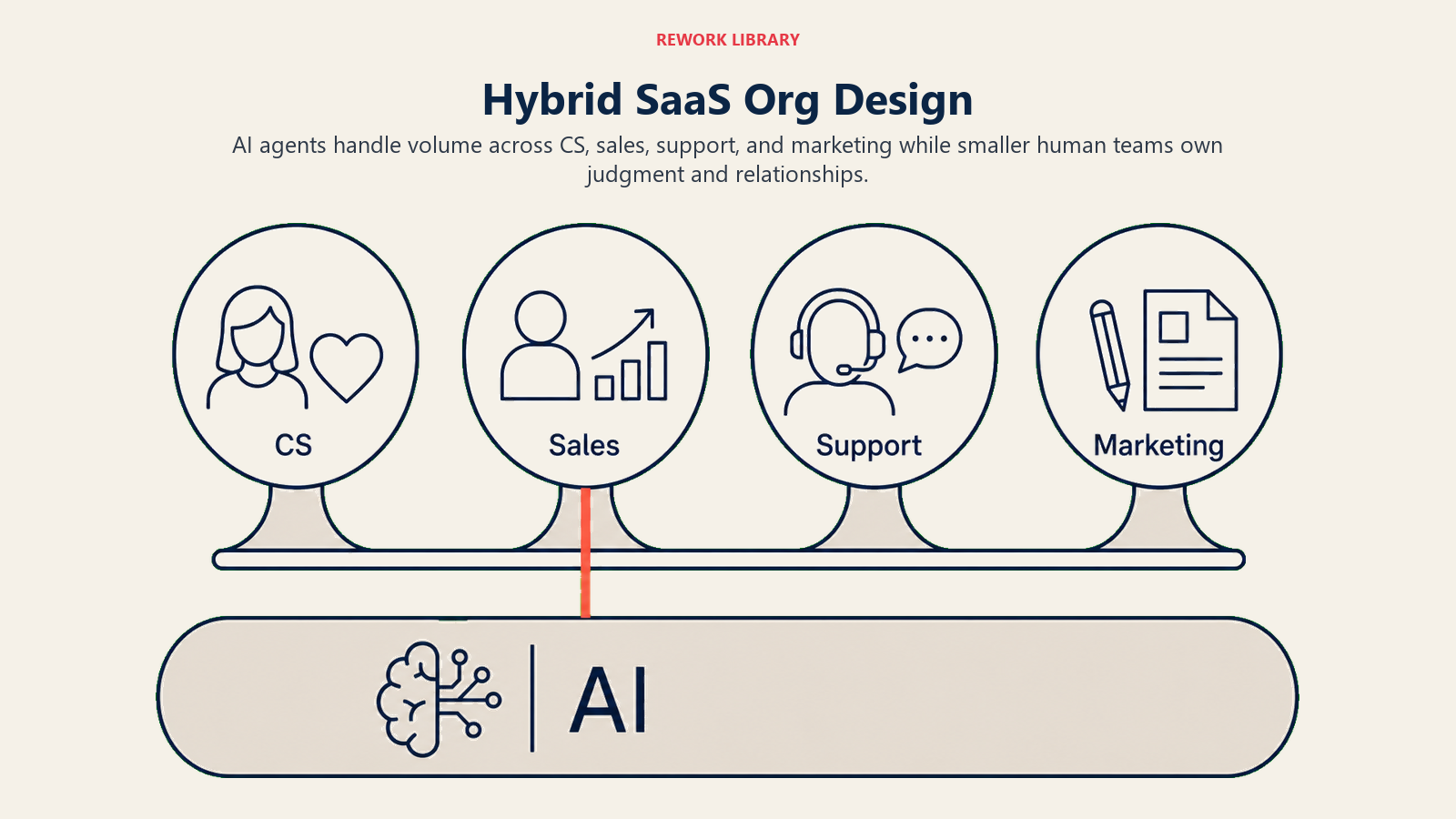
Implikasi fungsi daripada keempat-empat ejen AI yang berjalan bersama:
Customer Success: VP CS dengan 5 CSM yang dibantu AI berbanding 10 CSM tradisional pada tahap ARR yang sama. Setiap CSM mempunyai AI CSM yang melakukan pemantauan kesihatan, pemasangan data, dan draf jangkauan. CSM fokus pada akaun yang kompleks dan keputusan pertimbangan yang AI tandai. Peranan VP CS beralih ke arah kalibrasi model AI dan pengurusan eskalasi akaun.
Jualan: CRO dengan bilangan wakil yang sama tetapi profil produktiviti yang berbeza. Setiap wakil menjalankan lebih banyak mesyuarat, menyediakan lebih cepat, dan mengikuti susulan dengan lebih konsisten kerana Sales Operator mengendalikan kognisi berulang. Operasi Pendapatan menjadi Operasi AI: pasukan yang mengkonfigurasi, mengkalibrasi, dan mengaudit tindanan AI Sales Operator dan bukannya membina papan pemuka.
Sokongan: Ketua Sokongan yang mengurus lebih sedikit ejen manusia tetapi mengambil tanggungjawab konfigurasi ejen AI, kualiti pangkalan pengetahuan, dan kualiti penghalaan eskalasi. Laluan kerjaya sokongan beralih ke arah kedalaman pengetahuan produk dan penyelesaian masalah yang kompleks, kerana AI mengendalikan segala-galanya yang rutin.
Pemasaran: Pasukan kandungan mengecil dari segi headcount tetapi berkembang dalam output. Peranan SEO dan strategi kandungan menjadi lebih penting kerana kekangan beralih daripada kapasiti pengeluaran kepada kualiti strategi kandungan. AI menghasilkan perkataan; ahli strategi memutuskan soalan apa yang perlu dijawab.
Kewangan dan Operasi: Model perancangan headcount berubah. Model lama: headcount berkembang secara proporsional dengan ARR. Model baharu: headcount berkembang pada sebahagian kecil pertumbuhan ARR kerana AI menyediakan leveraj produktiviti yang headcount sebelumnya perlu sediakan. CFO yang tidak mengemas kini model perancangan mereka akan sama ada merekrut terlalu ramai (terlalu banyak ejen manusia di mana AI boleh melakukan kerja) atau merekrut terlalu sedikit (tidak cukup peranan pertimbangan untuk mengawasi AI). Lihat perbualan CFO tentang belanjawan AI untuk pembingkaian yang betul.
Apa yang tidak berubah
Dua perkara kekal secara keras pada manusia.
Hubungan berasaskan kepercayaan: Perjanjian perusahaan yang kompleks masih ditutup kerana VP Jualan membina hubungan dengan VP Kejuruteraan selama enam bulan. Customer success yang strategik masih berfungsi kerana CSM kanan memahami dinamik politik syarikat dengan baik untuk menavigasi pembaharuan yang sukar. AI boleh menyediakan wakil dan CSM, tetapi ia tidak boleh menggantikan hubungan. Setiap aliran kerja yang dibantu AI dalam jualan dan CS akhirnya adalah sistem dengan manusia dalam gelung untuk saat-saat yang penting.
Pertimbangan di pinggiran: AI mengendalikan 80% daripada situasi yang mengikut corak. 20% situasi yang tidak mengikut corak, eskalasi yang salah laluan oleh AI, pelanggan yang isyarat churnnya tidak sepadan dengan sebarang tandatangan sejarah, perjanjian dengan kekangan perolehan yang luar biasa, masih memerlukan pertimbangan manusia. Dan 20% itu sebenarnya adalah 20% yang paling penting, kerana di situlah Anda menang atau kalah pelanggan terbaik dan perjanjian terbesar Anda.
Perubahan model operasi bukan tentang menghapuskan manusia. Ia tentang mengubah apa yang manusia fokuskan. Wakil yang biasanya menghabiskan 40% masa mereka untuk tugasan pentadbiran kini menghabiskannya untuk lebih banyak perbualan dan penyediaan yang lebih baik. CSM yang biasanya memeriksa 80 akaun secara manual untuk isyarat kesihatan kini fokus pada 15 akaun yang AI tandai sebagai memerlukan sentuhan peribadi. Ejen sokongan yang biasanya menjawab soalan tetapan semula kata laluan kini menyelesaikan isu integrasi yang kompleks yang AI tidak dapat pecahkan.
Metrik baharu yang penting
Model operasi yang dibantu AI memerlukan metrik yang menunjukkan sama ada automasi meningkatkan kecekapan tanpa melemahkan retention atau kualiti.
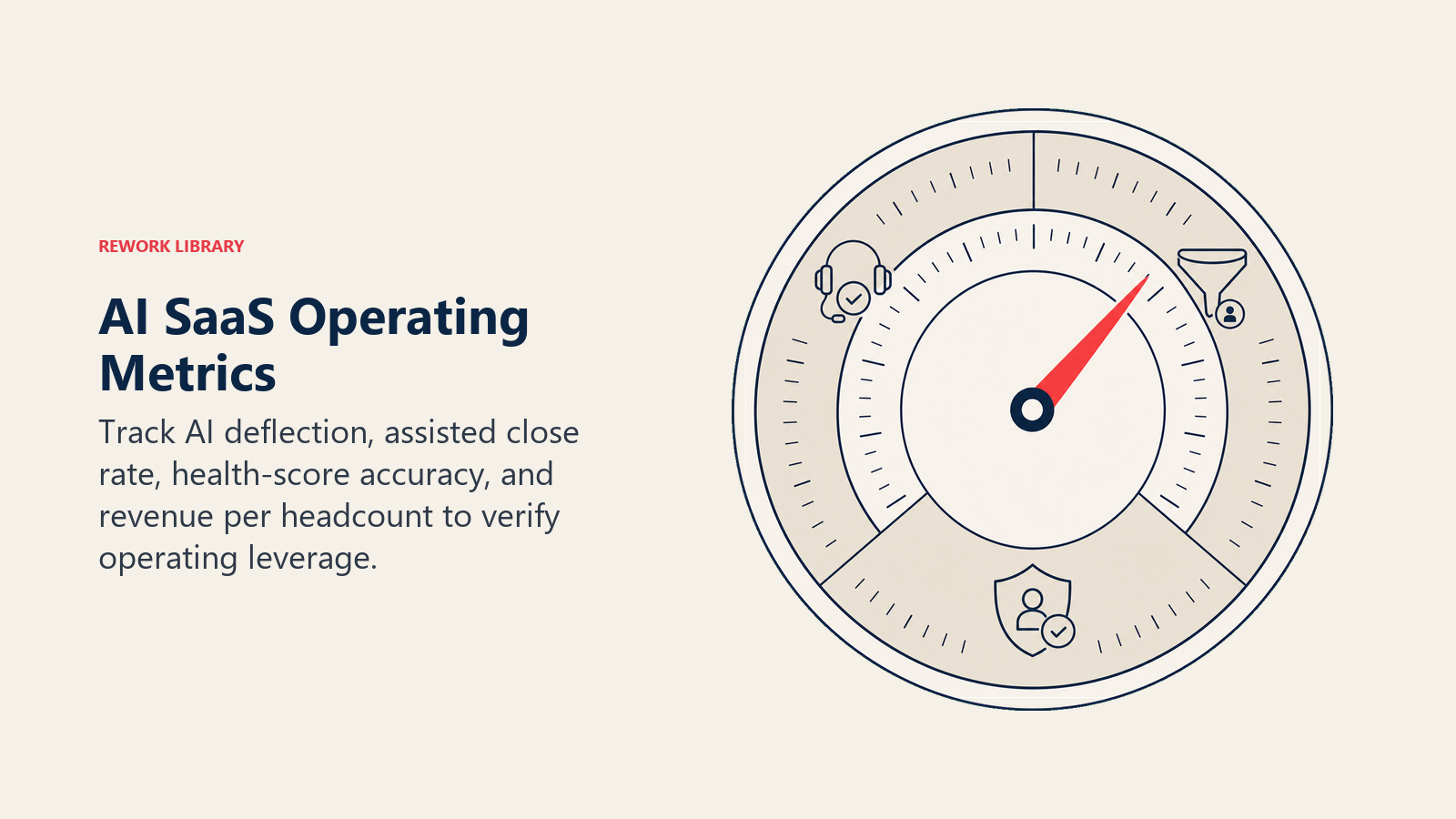
Metrik operasi SaaS tradisional masih terpakai. ARR, NRR (net revenue retention), bayaran balik CAC, margin kasar. Tetapi model operasi yang didorong AI menambah set metrik kecekapan operasi yang menjejak sama ada tindanan AI berprestasi:
Kadar pengalihan AI: Berapa peratus daripada jumlah sokongan masuk yang AI selesaikan tanpa penglibatan manusia? Sasaran berbeza mengikut kerumitan produk tetapi 40% hingga 55% adalah penanda aras yang munasabah untuk produk SaaS yang diinstrum dengan baik.
Kadar tutup yang dibantu AI: Adakah wakil yang menggunakan tindanan AI Sales Operator penuh menutup pada kadar yang lebih tinggi berbanding wakil yang tidak menggunakannya? Ini patut boleh diukur dalam satu suku tahun penggunaan.
Ketepatan skor kesihatan AI: Daripada akaun yang AI CSM tandai sebagai risiko churn tinggi 90 hari lalu, berapa peratus yang sebenarnya churned atau menunjukkan tanda-tanda churn? Inilah cara Anda mengkalibrasi model. Skor kesihatan AI yang meramalkan dengan ketepatan 70% lebih baik berbanding intuisi CSM manual pada skala besar. Di bawah 60%, model perlu dilatih semula.
Pendapatan per headcount: Mungkin metrik baharu paling penting untuk perbincangan model operasi AI di peringkat lembaga. Jika AI memberikan leveraj, pendapatan-per-headcount patut berkembang lebih cepat berbanding tahun-tahun sebelumnya. Jika tidak, sama ada pelaburan AI tidak berfungsi atau ia berada di tempat yang salah.
Reka bentuk semula berlaku sebelum tekanan
Model operasi SaaS tidak hilang dengan AI. Ia mendapat lebih banyak leveraj. Hubungan headcount-ke-pendapatan linear klasik membengkok: pendapatan yang sama boleh dihasilkan dengan lebih sedikit orang dalam peranan kognisi berulang, sementara peranan yang intensif pertimbangan perlu diisi dengan berhati-hati sama seperti sebelumnya.
Syarikat yang mereka bentuk semula model operasi mereka secara proaktif, sebelum tekanan persaingan memaksa mereka, akan beroperasi pada CAC yang lebih rendah secara struktur, margin kasar yang lebih tinggi, dan NRR yang lebih kukuh berbanding syarikat yang masih menggunakan nisbah lama.
Syarikat SaaS yang asli-AI mencapai gandaan bakar 0.8x hingga 1.2x, mengatasi SaaS tradisional pada hampir setiap peringkat pertumbuhan. Kecekapan tersebut semakin menjadi perkara yang membezakan syarikat yang mencapai keuntungan daripada yang terhenti pada kadar bakar peringkat pertumbuhan.
Analisis Rework: Syarikat yang kami perhatikan mendapat leveraj operasi tertinggi daripada AI adalah syarikat yang menyusun semula peranan sebelum menyusun semula headcount. Kesilapannya ialah memotong kepala dahulu dan menambah alatan AI kemudian. Urutan yang betul: gunakan ejen AI ke dalam peranan sedia ada, ukur keuntungan produktiviti, dan kemudian berhenti merekrut untuk menggantikan pergeseran dalam fungsi-fungsi tersebut dan bukannya melakukan pemberhentian. Pengaturan tersebut lebih baik untuk pengekalan, lebih baik untuk budaya, dan memberi Anda masa untuk mengesahkan prestasi AI sebelum membuat pertaruhan struktur. Syarikat yang tergesa-gesa memotong headcount sebelum alatan AI dikalibrasi mewujudkan masalah kualiti perkhidmatan yang mengambil masa 12-18 bulan untuk pulih.
Urutannya penting. Mulakan dengan fungsi di mana perubahan nisbah membayar balik paling cepat, berdasarkan kekangan perniagaan semasa Anda. Untuk kebanyakan syarikat SaaS, itu adalah sama ada sokongan (margin kasar adalah yang paling cepat boleh diukur) atau CS (peningkatan NRR adalah yang paling berganda). Bina model operasi baharu di sana terlebih dahulu, buktikan metrik, dan kembangkan.
Untuk lebih lanjut tentang mengapa SaaS secara struktur diposisikan untuk bergerak lebih cepat dalam AI berbanding industri lain, hujah struktur bermula dengan kelebihan data dan berakhir dengan kelajuan-untuk-menghantar.
Soalan Lazim
Bagaimana AI mengubah nisbah headcount-ke-pendapatan dalam SaaS?
AI mengubah nisbah dengan mengendalikan kognisi berulang yang sebelumnya memerlukan headcount untuk berskala. Dalam customer success, CSM yang dibantu AI mengurus ARR $2.5 juta-$4 juta setiap satu, berbanding $1-$1.5 juta dalam model tradisional. Dalam jualan, wakil mengurangkan masa pentadbiran daripada 40% kepada 15-20% minggu mereka. Dalam sokongan, pengalihan AI memotong kos setiap tiket sebanyak 40-60%. Kesan agregat: ARR per FTE melonjak 42% untuk syarikat pada ARR $20-50 juta antara 2022 dan 2025, didorong terutamanya oleh produktiviti yang dibolehkan AI.
Apakah Corak Organisasi SaaS Hibrid?
Corak Organisasi SaaS Hibrid adalah seni bina organisasi di mana teras kecil manusia yang intensif pertimbangan berjalan bersama ejen AI yang mengendalikan kognisi berulang dalam setiap fungsi pendapatan. CS mempunyai 5-7 CSM yang dibantu AI yang merangkumi apa yang 12-15 CSM tradisional lakukan. Wakil jualan menghasilkan 25-30% lebih banyak dengan headcount yang sama. Sokongan mengendalikan kes yang lebih kompleks sementara AI mengalihkan 50% jumlah. Metrik penentunya ialah headcount berkembang pada sebahagian kecil pertumbuhan ARR. Syarikat yang melaksanakan corak ini secara konsisten menunjukkan peningkatan pendapatan-per-FTE; syarikat pada model headcount linear melihatnya mendatar.
Apa yang berlaku kepada peranan CSM apabila AI mengendalikan pemantauan kesihatan?
CSM beralih daripada pemasangan data kepada pengurusan hubungan dan keputusan pertimbangan. Daripada memeriksa 80 akaun secara manual untuk isyarat kesihatan, AI menandai 15 akaun yang memerlukan campur tangan peribadi. Penyelidikan ChurnZero meramalkan CSM akan mempunyai 25-50% lebih banyak kapasiti menjelang akhir 2026 kerana dua pertiga masa CSM semasa pergi kepada tugasan yang AI boleh automasi. Syarikat yang melaksanakan model CS berasaskan pengecualian, di mana CSM hanya bertindak pada tanda AI, melaporkan kadar pengekalan 25-40% lebih tinggi dan ROI 3-5x pada headcount CS.
Bagaimana AI mengubah margin kasar dalam SaaS melalui sokongan?
AI Support Agent mengalihkan 40-55% daripada jumlah tiket masuk untuk produk SaaS yang didokumentasikan dengan baik, dengan sesetengah industri melihat pengalihan 60%+. Pada $25 setiap tiket yang diselesaikan, pengalihan 50% pada 6,000 tiket bulanan memulihkan $75K sebulan dalam margin kasar. Apabila jumlah tiket berkembang dengan syarikat, pengalihan berskala secara proporsional tanpa pertumbuhan headcount yang proporsional, jadi peratusan margin kasar meningkat dari semasa ke semasa. Gartner meramalkan AI agentic akan secara autonomi menyelesaikan 80% isu perkhidmatan pelanggan biasa menjelang 2029.
Metrik baharu apa yang penting dalam model operasi SaaS yang didorong AI?
Empat metrik operasi baharu menjejak prestasi tindanan AI: kadar pengalihan AI (berapa peratus jumlah sokongan yang AI selesaikan tanpa manusia, sasaran 40-55%), kadar tutup yang dibantu AI (sama ada pengguna Sales Operator menutup pada kadar yang lebih tinggi berbanding bukan pengguna, boleh diukur dalam satu suku tahun), ketepatan skor kesihatan AI (berapa peratus akaun berisiko yang AI tandai sebenarnya churned, sasaran di atas 70%), dan pendapatan per headcount (metrik kecekapan AI paling penting di peringkat lembaga).
Apa yang tidak berubah tentang model operasi SaaS dengan AI?
Hubungan perusahaan berasaskan kepercayaan dan pertimbangan di pinggiran kekal pada manusia. Perjanjian yang kompleks masih ditutup kerana VP Jualan membina hubungan selama enam bulan. 20% daripada situasi yang tidak mengikut corak, eskalasi yang luar biasa, pelanggan yang isyarat churnnya tidak sepadan dengan tandatangan sejarah, perjanjian dengan kekangan perolehan yang tidak standard, masih memerlukan pertimbangan manusia. Ini juga merupakan 20% yang paling penting, di mana Anda menang atau kalah pelanggan terbaik dan perjanjian terbesar Anda.
Berkaitan:

Co-Founder, Rework.com
On this page
- Peralihan nisbah headcount-ke-pendapatan dalam customer success
- Kecekapan jualan dan bayaran balik CAC
- Kos sokongan dan margin kasar
- Kecekapan kandungan dan pemasaran
- Corak Organisasi SaaS Hibrid
- Apa yang berubah dalam carta organisasi
- Apa yang tidak berubah
- Metrik baharu yang penting
- Reka bentuk semula berlaku sebelum tekanan