Kunci Masuk Vendor AI: Strategi Mitigasi untuk CIO dan CTO
Turn this article into takeaways for your work.


Each assistant summarizes the article only for you and suggests best practices for your work.
Organisasi anda memilih GPT-4 untuk infrastruktur AI pada 2024. Anda membina 15 alat dalaman di atasnya. Pasukan kejuruteraan prompt anda menghabiskan tiga bulan mengoptimumkan prompt sistem dan contoh beberapa-shot. Pembangun anda membina integrasi API tersuai merentasi enam sistem dalaman.
Kemudian OpenAI menaikkan harga API perusahaan sebanyak 40%. Atau menyusutkan model dengan notis 6 bulan. Atau Anthropic mengeluarkan model yang jauh lebih baik untuk kes penggunaan khusus anda, pada kos lebih rendah setiap token. Atau pelanggaran data pada infrastruktur OpenAI mewujudkan tempoh 72 jam di mana operasi anda yang dikuasakan AI berhenti.
Seberapa cepat anda boleh beralih? Jika anda belum memikirkan soalan itu, anda mungkin sudah mengunci diri.
Kunci masuk vendor dalam perisian tradisional adalah mahal tetapi biasanya terbatas. Anda boleh mengeksport data anda dari Salesforce, walaupun memerlukan usaha. Anda boleh berhijrah dari AWS (Amazon Web Services), walaupun mengambil masa setahun. Kos peralihan adalah besar tetapi terhingga. Gartner meramalkan menjelang 2027, 35% negara akan terkunci dalam platform AI khusus rantau menggunakan data kontekstual proprietari, memberi isyarat bahawa kunci masuk platform AI sedang menjadi masalah geopolitik serta masalah komersial.
Kunci masuk vendor AI mempunyai dimensi tambahan yang menjadikannya lebih sukar dikuantifikasi dan lebih mahal untuk dibatalkan. Kerja kejuruteraan prompt anda adalah khusus model. Penalaan halus anda adalah khusus model. Intuisi pasukan anda tentang cara bekerja dengan AI adalah khusus model. Dan hasil perniagaan anda dikalibrasi kepada tingkah laku model khusus. Pertukaran model boleh mengubah kualiti output dengan cara yang memecahkan aliran kerja hiliran walaupun model baru secara objektif "lebih baik." Rangka Kerja Penilaian Vendor untuk Alat AI merangkumi cara menilai risiko kunci masuk sebelum pemilihan; artikel ini merangkumi apa yang perlu dilakukan setelah anda berada dalam hubungan vendor.
Artikel ini merangkumi tiga bentuk kunci masuk vendor AI, mitigasi khusus untuk masing-masing, dan semakan realisme yang penting: sesetengah kunci masuk adalah boleh diterima, dan matlamatnya adalah kunci masuk yang termaklum berbanding tiada kunci masuk sama sekali.
Mengapa Kunci Masuk Berbeza dalam AI berbanding Perisian Tradisional
Fakta Utama: Kunci Masuk Vendor AI
- 94% organisasi bimbang tentang kunci masuk vendor AI, dengan 45% mengatakan ia sudah menghalang kemampuan mereka untuk menggunakan alat yang lebih baik. (Parallels 2026 Cloud Survey)
- Hanya 6% pemimpin perusahaan mengatakan mereka boleh menukar penyedia AI utama tanpa gangguan, dan 47% mengatakan fungsi perniagaan utama akan berhenti jika penyedia utama mereka terputus. (Zapier)
- Perusahaan yang dibina untuk kemudahalihan dari awal menghadapi kos migrasi 60-80% lebih rendah apabila menukar vendor AI, berbanding yang berintegrasi dengan rapat tanpa lapisan abstraksi. (Kellton)
Dalam perisian tradisional, kunci masuk vendor terutamanya tentang kemudahalihan data dan kerja integrasi. Jika anda ingin meninggalkan Salesforce, anda mengeksport kenalan, akaun, dan peluang anda sebagai fail CSV, mengimportnya ke dalam HubSpot, dan membina semula integrasi anda. Data datang bersama anda. Pengetahuan produk (cara menggunakan Salesforce) sebahagian besarnya boleh dipindahkan kerana kategori produk adalah stabil.
Dalam AI, kunci masuk beroperasi pada tiga lapisan tambahan.
Tingkah laku model tidak boleh dipindahkan. Jika anda telah membina aliran kerja yang bergantung pada tingkah laku khusus GPT-4o (nadanya, keutamaan pemformatannya, pengendalian ralatnya, responsnya kepada corak prompt tertentu), beralih kepada Claude 3.7 Sonnet tidak memberi anda tingkah laku yang sama walaupun ia memberi anda output yang lebih baik secara teknikal. Sistem hiliran anda, proses semakan manusia, dan templat output dikalibrasi kepada model lama.
Kerja pengoptimuman adalah khusus model. Kejuruteraan prompt bukan artifak yang boleh dipindahkan. Prompt sistem yang dioptimumkan untuk GPT-4 sering berprestasi jauh lebih rendah pada model Anthropic tanpa kejuruteraan semula yang substantif. Penalaan halus adalah sepenuhnya khusus model. Menala halus model GPT tidak memberi anda Claude yang ditala halus.
Pembelajaran tidak boleh dipindahkan. Jika anda telah menghabiskan enam bulan mempelajari cara model tertentu berkelakuan dalam kes tepi, apa yang mungkin dihalusinasikannya, cara ia mengendalikan arahan yang samar, pengetahuan itu tidak berhijrah. Anda memulakan keluk pembelajaran semula.
Tiada satu pun daripada ini yang menjadikan kunci masuk tidak dapat dielakkan, tetapi ia menjadikan kunci masuk yang tidak disengajakan jauh lebih mahal berbanding dalam perisian tradisional.
3 Bentuk Kunci Masuk Vendor AI

Kunci Masuk Model
Kunci masuk model berlaku apabila logik aplikasi anda digandingkan rapat kepada tingkah laku khusus model satu vendor. Anda telah mengoptimumkan prompt untuknya, proses jaminan kualiti (QA) anda telah dikalibrasi kepada outputnya, dan pasukan anda memahami tingkah laku khususnya cukup baik untuk bekerja dengannya dengan berkesan.
Isyarat bahawa anda mempunyai kunci masuk model: apabila ditanya "apa yang diperlukan untuk beralih kepada model yang berbeza?", jawapannya ialah "beberapa minggu pengujian semula dan pengoptimuman semula merentasi semua aliran kerja AI kami." Itulah kunci masuk model.
Penyusutan model adalah pencetus utama untuk kos kunci masuk model. OpenAI menyusutkan titik akhir arahan GPT-3.5 asal pada Januari 2024 dengan notis enam bulan. Barisan GPT-4 telah dikemas kini beberapa kali, dengan ID model berubah. Organisasi yang ditetapkan pada versi model khusus (gpt-4-0314, gpt-4-0613) terpaksa menguji semula pelaksanaan mereka setiap kali.
Anthropic juga mengemas kini barisan modelnya. Claude 1, Claude 2, Claude 2.1, Claude 3 Haiku, Sonnet, dan Opus, Claude 3.5, dan siri Claude 4 telah mengikuti satu sama lain dalam bawah tiga tahun. Peningkatan prestasi antara versi adalah substantif, tetapi setiap kemas kini memerlukan pengesahan semula pelaksanaan pengeluaran anda.
Mitigasi kunci masuk model:
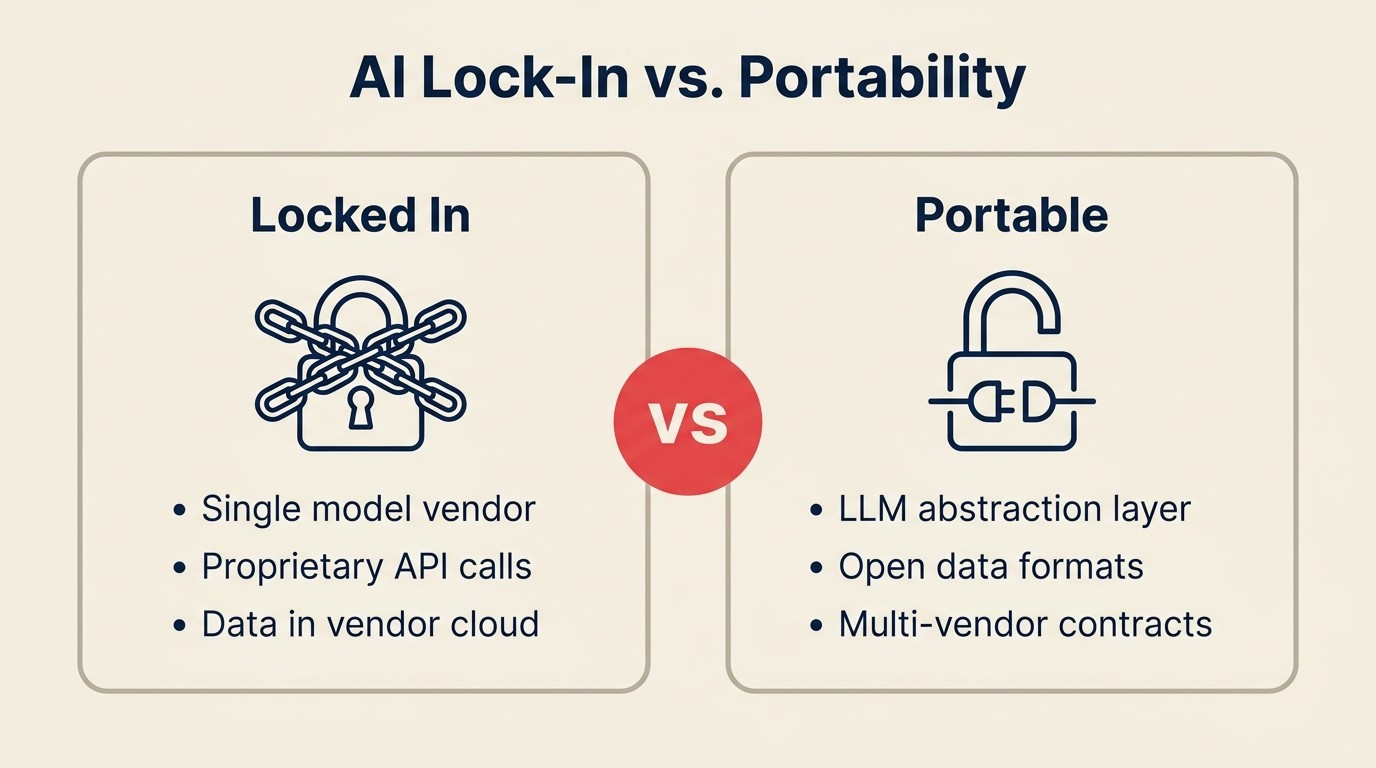
Mitigasi seni bina utama adalah lapisan abstraksi yang memisahkan logik aplikasi anda daripada API model. Alat seperti LiteLLM (perpustakaan Python yang menyediakan antara muka bersatu merentasi OpenAI, Anthropic, Cohere, dan penyedia lain) atau LangChain (rangka kerja aplikasi yang mengabstrakkan panggilan model) membolehkan anda menukar model yang mendasari dengan mengubah parameter konfigurasi berbanding menulis semula kod integrasi API. Rangka kerja Keputusan Bina vs. Beli vs. Integrasikan adalah konteks huluan di sini: laluan "integrasikan" secara eksplisit mengesyorkan membina lapisan abstraksi ini sebagai sebahagian daripada reka bentuk integrasi.
LiteLLM khususnya memberi anda format panggilan API tunggal yang menghala kepada model mana yang anda tentukan. Kod aplikasi anda memanggil litellm.completion(model="gpt-4o", messages=...) hari ini. Jika anda ingin beralih kepada claude-3-7-sonnet-20250219, anda mengubah parameter model, bukan kod persekitaran. Abstraksi tidak sempurna (tingkah laku model masih berbeza), tetapi kerja integrasi dihapuskan.
Kadangan pengujian berbilang model juga membantu. Jika anda secara tetap membandingkan aliran kerja utama anda dengan 2 hingga 3 model setiap suku, anda akan tahu sama ada alternatif yang boleh dilaksanakan wujud dan kira-kira berapa banyak pengoptimuman semula yang diperlukan untuk beralih. Ini adalah mitigasi kunci masuk (anda sentiasa dikemas kini dengan alternatif) dan alat pengoptimuman kos (anda mungkin menemui model yang lebih murah yang berprestasi setanding).
Satu amaran penting: lapisan abstraksi mempunyai overhed prestasi dan kadang-kadang mengehadkan akses kepada ciri khusus model. Jika model tertentu mempunyai keupayaan yang teras kepada kes penggunaan anda (tetingkap konteks diperluas Anthropic, pemprosesan visi OpenAI, input multimodal Google), lapisan abstraksi mungkin tidak mendedahkan keupayaan itu dengan bersih. Matlamatnya adalah menggunakan lapisan abstraksi untuk model di mana keupayaan adalah setanding, bukan memaksa kebolehoperasian model di mana perbezaan keupayaan asas wujud.
Kunci Masuk Data
Kunci masuk data berlaku apabila data latihan AI, set data penalaan halus, atau embeddings vektor anda disimpan dalam format proprietari vendor yang menjadikan keluar mahal dan rumit.
Ini lebih biasa daripada yang disedari organisasi, kerana alat AI sering menyediakan antara muka yang mudah untuk menyimpan dan mengurus data khusus AI. Anda membina pangkalan pengetahuan dalam Notion AI atau integrasi SharePoint Microsoft Copilot. Anda menyimpan sejarah interaksi pelanggan anda dalam pangkalan data vektor proprietari vendor. Anda menala halus model menggunakan antara muka penalaan halus vendor, yang menyimpan pemberat yang ditala halus dalam infrastruktur vendor.
Apabila hubungan vendor berakhir atau penetapan harga menjadi tidak boleh dikekalkan, anda perlu mengekstrak data itu. Jika data dalam format proprietari, anda mungkin mengekstraknya rekod demi rekod melalui panggilan API, atau membayar yuran perkhidmatan profesional, atau kehilangan konteks yang terkumpul bertahun-tahun.
Mitigasi kunci masuk data:
Embeddings vektor adalah aset data khusus AI utama untuk dilindungi. Jika anda menjalankan sistem RAG (Retrieval-Augmented Generation), embeddings dokumen anda mewakili pelaburan yang ketara dalam penyediaan dan pengindeksan. Simpan ini dalam pangkalan data vektor format terbuka (FAISS, Chroma, Weaviate, Qdrant) berbanding storan embedding proprietari vendor. Semua ini menyokong format eksport standard. Pola Pembantu RAG merangkumi keputusan seni bina untuk reka bentuk pangkalan pengetahuan yang secara semula jadi melindungi kemudahalihan dari awal.
Dokumen sumber adalah sama penting. Pangkalan pengetahuan AI anda hanya sepadan kemudahalihannya dengan dokumen sumber yang mendasari. Simpan dokumen sumber dalam sistem anda sendiri (baldi S3 anda sendiri, penyewa SharePoint anda sendiri) berbanding dalam storan vendor. Antara muka vendor harus mengakses data anda, bukan memegangnya.
Pemberat model yang ditala halus adalah aset data AI yang paling sukar diurus. Jika anda telah melabur dalam penalaan halus, pemberat yang dicipta dari data latihan proprietari anda adalah milik anda di bawah kebanyakan perjanjian perusahaan. Rundingan untuk hak eksport pemberat yang eksplisit dalam kontrak. Anda mungkin tidak selalu dapat menjalankan pemberat tersebut di tempat lain (pemberat GPT-4 yang ditala halus hanya boleh berjalan pada infrastruktur OpenAI), tetapi mempunyai hak eksport bermakna anda sekurang-kurangnya boleh mengesahkan apa yang anda hilangkan sebelum menandatangani.
Klausa kontrak untuk mitigasi kunci masuk data:
Setiap kontrak vendor AI harus memasukkan:
- Kenyataan eksplisit bahawa data pelanggan tidak digunakan untuk latihan model tanpa persetujuan yang tegas
- Hak eksport data, termasuk spesifikasi format dan komitmen masa respons
- Hak pemadaman data dengan pensijilan pemadaman dalam 30 hari dari penamatan kontrak
- Jaminan kemudahalihan: data dikembalikan dalam format standard terbuka, bukan format proprietari
Titik terakhir adalah tempat rundingan paling penting. "Kami akan menyediakan data anda atas permintaan" tidak mencukupi. "Kami akan menyediakan data anda dalam [format khusus] dalam [tempoh waktu] dan menyediakan sijil pemadaman dalam 30 hari" adalah mencukupi.
Kunci Masuk Integrasi
Kunci masuk integrasi berlaku apabila sistem anda berhubung secara mendalam kepada reka bentuk API khusus, format respons, dan corak integrasi satu vendor. Kod tersuai yang membungkus kit pembangunan perisian (SDK) vendor, alat dalaman yang dibina pada rangka kerja agen vendor, dan automasi aliran kerja yang bergantung pada format peristiwa khusus vendor semuanya mewakili kunci masuk integrasi.
Ini adalah bentuk kunci masuk yang paling kelihatan secara operasi. Apabila organisasi yang terkunci integrasi ingin menukar vendor, soalan pertama yang ditanya oleh kejuruteraan adalah: "Berapa banyak integrasi yang perlu kita tulis semula?" Jika jawapannya adalah 15 hingga 20 integrasi tersuai merentasi sistem pengeluaran, kos peralihan diukur dalam bulan masa kejuruteraan, bukan minggu.
Mitigasi kunci masuk integrasi:
Abstraksi API adalah corak seni bina utama. Daripada setiap sistem dalaman memanggil API vendor AI secara langsung, halakan semua panggilan AI melalui perkhidmatan dalaman yang anda kawal. Sistem dalaman anda memanggil perkhidmatan abstraksi anda. Perkhidmatan abstraksi anda memanggil API vendor. Apabila anda perlu menukar vendor, anda mengemas kini perkhidmatan abstraksi, bukan setiap sistem yang menggunakan AI.
Ini juga memberi anda keterlihatan yang integrasi langsung tidak. Setiap panggilan AI dalam infrastruktur anda dicatat oleh perkhidmatan abstraksi. Anda boleh mengukur penggunaan, kos, latensi, dan kadar ralat dalam satu tempat. Gartner memberi amaran bahawa tanpa seni bina kos yang teliti, organisasi boleh membuat kesilapan 500-1000% dalam pengiraan kos GenAI apabila penggunaan berskala, menjadikan pemantauan terpusat kos setiap panggilan penting dari hari pertama.
Terma kontrak penting di sini juga. SLA (perjanjian tahap perkhidmatan) yang memasukkan peruntukan sokongan migrasi memberi anda perlindungan jika hubungan vendor berakhir dengan buruk. Khususnya: jika vendor menamatkan perkhidmatan, sokongan apa yang mereka komited untuk menyediakan migrasi? Komitmen bantuan migrasi 90 hari bermakna berbeza daripada tiada komitmen.
Kriteria penilaian berkecuali vendor dalam perolehan mengurangkan risiko melabur berlebihan dalam corak integrasi khusus vendor pada mulanya. Jika anda menilai vendor sebahagiannya berdasarkan "berapa banyak kod tersuai yang kita perlukan?", anda akan cenderung memilih vendor dengan reka bentuk API yang lebih bersih dan corak integrasi standard.
Peta Jenis Kunci Masuk 3
Peta Jenis Kunci Masuk 3 membezakan tiga bentuk kunci masuk vendor AI yang masing-masing memerlukan strategi mitigasi yang berbeza: Kunci Masuk Model (logik aplikasi digandingkan rapat kepada tingkah laku model satu vendor, kerja pengoptimuman, dan intuisi yang dipelajari pasukan), Kunci Masuk Data (data latihan, set data penalaan halus, atau embeddings vektor disimpan dalam format proprietari), dan Kunci Masuk Integrasi (sistem dalaman dihubungkan terus kepada reka bentuk API khusus, format respons, dan struktur peristiwa satu vendor). Mitigasi memerlukan campur tangan seni bina yang berbeza untuk setiap jenis, dan menangani hanya satu jenis meninggalkan organisasi terdedah kepada dua yang lain.
Petikan: "Perusahaan yang dibina untuk kemudahalihan dari awal menghadapi kos migrasi 60-80% lebih rendah apabila menukar vendor AI berbanding yang berintegrasi dengan rapat tanpa lapisan abstraksi. Kos pelaburan kemudahalihan adalah kecil; kos migrasi tanpanya adalah besar." (Kellton)
Petikan: "Kunci masuk yang termaklum kelihatan seperti: 'Kami memilih untuk membina dengan rapat pada keupayaan visi GPT-4o kerana ia adalah model berprestasi terbaik untuk kes penggunaan kami, dan kos peralihan boleh diterima memandangkan premium prestasi. Kami mempunyai pelan beralih-kepada-alternatif 6 bulan yang telah disemak dan bersedia untuk dilaksanakan.' Kunci masuk yang tidak disengajakan kelihatan seperti: 'Kami telah menggunakan model ini selama dua tahun dan tidak pernah menilai sama ada kami boleh beralih.'"
Petikan: "Gartner meramalkan menjelang 2027, 35% negara akan terkunci dalam platform AI khusus rantau menggunakan data kontekstual proprietari, memberi isyarat bahawa kunci masuk platform AI sedang menjadi masalah geopolitik serta masalah komersial." (Gartner)
| Jenis Kunci Masuk | Isyarat Utama | Mitigasi Seni Bina | Mitigasi Kontrak |
|---|---|---|---|
| Kunci Masuk Model | "Beralih akan mengambil minggu pengujian semula" | Lapisan abstraksi LiteLLM atau LangChain; penanda aras bulanan berbilang model | Hak penetapan versi model; komitmen notis penyusutan |
| Kunci Masuk Data | Embeddings dan pemberat penalaan halus dalam storan vendor | Pangkalan data vektor format terbuka (FAISS, Chroma, Qdrant); dokumen sumber dalam storan anda sendiri | Hak eksport data dengan spesifikasi format; pensijilan pemadaman dalam 30 hari |
| Kunci Masuk Integrasi | "Kami perlu menulis semula 15-20 integrasi tersuai" | Perkhidmatan abstraksi AI dalaman yang dipanggil semua sistem; pengelogan terpusat | Komitmen bantuan migrasi SLA; sokongan 90 hari pada penamatan kontrak |
Analisis Rework: Berdasarkan corak infrastruktur AI perusahaan, bentuk kunci masuk yang paling berbahaya adalah kunci masuk integrasi kerana ia paling tidak kelihatan sehingga migrasi sedang berjalan. Kunci masuk model adalah kelihatan (kos pengujian semula boleh dianggarkan). Kunci masuk data sebahagiannya kelihatan (anda boleh menghitung apa yang disimpan di mana). Kunci masuk integrasi hanya menjadi kelihatan apabila anda mengira kod tersuai yang membungkus SDK satu vendor merentasi setiap sistem dalaman.
Semakan Realisme: Kunci Masuk yang Termaklum Adalah Boleh Diterima

Menghapuskan kunci masuk sepenuhnya bukan matlamat yang realistik, dan mengejarnya secara agresif mempunyai kosnya sendiri. Kejuruteraan berlebihan untuk berkecuali vendor meningkatkan kerumitan pelaksanaan, mengurangkan prestasi (lapisan abstraksi menambah latensi), dan sering menghalang anda daripada menggunakan ciri khusus model yang secara material meningkatkan kes penggunaan anda.
Sesetengah kunci masuk adalah boleh diterima. Soalannya ialah sama ada anda telah membuat keputusan termaklum tentang kunci masuk apa yang anda terima dan pada harga berapa.
Kunci masuk yang termaklum kelihatan seperti: "Kami telah memilih untuk membina dengan rapat pada keupayaan visi GPT-4o kerana ia adalah model berprestasi terbaik untuk kes penggunaan pemprosesan invois kami, dan kos peralihan boleh diterima memandangkan premium prestasi. Kami telah mendokumentasikan pilihan ini dan mempunyai pelan beralih-kepada-alternatif 6 bulan yang telah kami semak dan selesa dilaksanakan jika OpenAI mengubah penetapan harga atau ketersediaan."
Kunci masuk yang tidak disengajakan kelihatan seperti: "Kami telah menggunakan GPT-4 selama dua tahun dan kami tidak pernah menilai sama ada kami boleh beralih. OpenAI baru sahaja mengubah penetapan harga dan kami cuba mencari tahu seberapa dalam kami terkunci."
Rangka kerja mitigasi di atas mengurangkan kunci masuk yang tidak disengajakan. Ia tidak menghapuskan keperluan untuk membuat keputusan kunci masuk yang disengajakan.
Perancangan Penyusutan Model
Sejarah penyusutan model vendor AI frontier memberi anda ufuk perancangan yang realistik tentang berapa lama versi model yang diberikan akan tersedia.
Garis masa penyusutan OpenAI sehingga 2025: GPT-4 asal (gpt-4-0314) disusutkan pada Jun 2023, dengan tempoh notis 6 bulan. GPT-4 (gpt-4-0613) mendapat layanan yang sama. GPT-3.5-turbo-instruct disusutkan dengan notis 6 bulan pada awal 2024.
Corak Anthropic adalah iterasi yang lebih pantas dengan notis penyusutan yang kurang formal, terutamanya untuk versi Claude yang lebih lama.
Implikasi perancangan praktikal: bina infrastruktur AI anda dengan mengandaikan sebarang versi model khusus akan disusutkan dalam 12 hingga 18 bulan. Ini bukan pesimistik. Ia konsisten dengan tingkah laku vendor sebenar dalam pasaran. Artikel Peringkat Kematangan AI SaaS menunjukkan cara landskap vendor sendiri berubah pada setiap peringkat, yang merupakan konteks berguna untuk memahami mengapa pilihan yang terkunci hari ini mungkin perlu disemak semula apabila pasaran matang. Ini bermakna:
- Jangan ditetapkan pada rentetan versi model khusus dalam kod pengeluaran tanpa kitaran semakan yang dirancang
- Bina kapasiti pengesahan semula ke dalam kerja suku tahunan pasukan AI anda (andaikan 1 hingga 2 ujian model utama setahun)
- Belanjawankan untuk kerja pengoptimuman semula setiap tahun berbanding menganggap prestasi model semasa sebagai kekal
Ini bukan tentang risiko vendor. Ia tentang kadar pembangunan AI. Model benar-benar meningkat, dan anda akan mahu menaik taraf. Organisasi yang akan membuat peralihan itu dengan lancar adalah yang merancanginya berbanding terkejut olehnya.
Untuk proses penilaian vendor yang memaklumkan penilaian kunci masuk sebelum keputusan pemilihan, Rangka Kerja Penilaian Vendor untuk Alat AI merangkumi dimensi 4 (fleksibiliti model) secara terperinci. Untuk keputusan beli-integrasikan-bina yang lebih luas yang menentukan seberapa dalam anda membina pada platform mana-mana vendor, Keputusan Bina vs. Beli vs. Integrasikan merangkumi rangka kerja peringkat kematangan.
Daftar Risiko AI: Apa yang Perlu Dijejaki mempunyai kategori khusus untuk risiko kebergantungan vendor. Kerja mitigasi di atas memetakan terus kepada entri daftar tersebut. Dan ACE Framework (Ingest, Analyze, Predict, Generate, Execute) membantu menilai keparahan kunci masuk mengikut keupayaan: kebergantungan vendor peringkat Execute adalah paling mahal untuk dibatalkan, sementara kunci masuk peringkat Generate umumnya boleh diurus dengan pengoptimuman semula prompt sahaja.
Kunci masuk bukan musuh. Kejutan adalah musuh. Organisasi yang mengurus hubungan vendor AI dengan terbaik adalah yang memahami pendedahan mereka sebelum ia menjadi masalah.
Soalan Lazim
Apakah tiga bentuk kunci masuk vendor AI?
Tiga bentuk adalah: Kunci Masuk Model (logik aplikasi digandingkan rapat kepada tingkah laku model satu vendor, pengoptimuman, dan intuisi yang dipelajari pasukan anda), Kunci Masuk Data (data latihan, set data penalaan halus, atau embeddings vektor dalam format storan proprietari vendor), dan Kunci Masuk Integrasi (sistem dalaman dihubungkan terus kepada reka bentuk API dan format peristiwa khusus satu vendor). Setiap satu memerlukan mitigasi seni bina dan kontrak yang berbeza.
Bagaimana kunci masuk vendor AI berbeza daripada kunci masuk perisian tradisional?
Kunci masuk perisian tradisional terutamanya tentang kemudahalihan data dan kerja integrasi. Kunci masuk AI menambah tiga lapisan tambahan: tingkah laku model tidak boleh dipindahkan (prompt yang dioptimumkan untuk GPT-4o berprestasi jauh lebih rendah pada Claude tanpa kejuruteraan semula), kerja pengoptimuman adalah khusus model (menala halus model satu vendor tidak menghasilkan artifak yang boleh dipindahkan), dan pengetahuan kes tepi yang dipelajari pasukan anda adalah khusus model. Pertukaran model memerlukan memulakan semula keluk pembelajaran, walaupun model baru secara teknikal lebih baik.
Apakah lapisan abstraksi LLM dan mengapa ia penting?
Lapisan abstraksi LLM (model bahasa besar) adalah perkhidmatan atau perpustakaan dalaman (alat seperti LiteLLM atau LangChain adalah pelaksanaan yang biasa) yang memisahkan kod aplikasi anda daripada API vendor AI khusus. Sistem dalaman anda memanggil lapisan abstraksi; lapisan abstraksi memanggil model vendor mana yang anda konfigurasi. Peralihan penyedia kemudian memerlukan mengubah parameter konfigurasi, bukan menulis semula setiap integrasi. Perusahaan yang membina lapisan abstraksi dari awal menghadapi kos migrasi 60-80% lebih rendah berbanding yang berintegrasi secara langsung.
Klausa kontrak apa yang harus melindungi daripada kunci masuk data?
Setiap kontrak vendor AI harus memasukkan: larangan eksplisit menggunakan data anda untuk melatih model mereka tanpa persetujuan yang tegas, hak eksport data dengan format khusus dan komitmen masa respons, hak pemadaman data dengan pensijilan pemadaman dalam 30 hari dari penamatan kontrak, dan jaminan kemudahalihan bahawa data dikembalikan dalam format standard terbuka berbanding format proprietari. "Kami akan menyediakan data anda atas permintaan" tidak mencukupi. Format, tempoh waktu, dan pensijilan pemadaman perlu eksplisit.
Bagaimana rupa kunci masuk yang termaklum?
Kunci masuk yang termaklum adalah keputusan yang didokumentasikan: "Kami telah memilih untuk membina dengan rapat pada model vendor ini kerana ia adalah pilihan berprestasi terbaik untuk kes penggunaan ini. Kami memahami pelaburan pengoptimuman yang diperlukan untuk beralih. Kami mempunyai pelan beralih-kepada-alternatif 6 bulan yang telah kami semak dan selesa dilaksanakan jika penetapan harga, ketersediaan, atau prestasi berubah." Kunci masuk yang tidak disengajakan adalah mendapati selepas dua tahun penggunaan bahawa anda tidak pernah menilai kos peralihan.
Berapa lama penyusutan model AI biasanya mengambil masa?
Berdasarkan corak sejarah dari vendor AI frontier utama, rancang sebarang versi model khusus untuk disusutkan dalam 12-18 bulan. OpenAI menyusutkan GPT-4 (gpt-4-0314) dengan notis 6 bulan. Anthropic telah beralih dari Claude 1 hingga siri Claude 4 dalam bawah tiga tahun. Implikasi praktikal: bina kitaran pengesahan semula suku tahunan ke dalam kerja pasukan AI anda berbanding menganggap prestasi mana-mana model yang diberikan sebagai infrastruktur kekal.

Co-Founder, Rework.com