More in
Revenue Operations Insights
Should You Trust the AI Forecast Over Your Reps' Commit?
Oct 12, 2026
Should RevOps Own AI in the Revenue Engine?
Oct 12, 2026
How Much Should a Growing Company Invest in Revenue Operations?
Oct 11, 2026
Is Pipeline Coverage the Most Misleading Number in Your Forecast?
Oct 11, 2026
Shared Revenue Targets: Do They Align Teams or Blur Accountability?
Oct 11, 2026
Why Buying Tools Before Fixing Process Is the Most Expensive RevOps Mistake
Oct 11, 2026
Should RevOps Report to the CRO, the CFO, or the CEO?
Oct 11, 2026
The True Cost of Software Sprawl (It's Not the Licenses)
Jun 12, 2026 · Currently reading
Pipeline Hygiene as a Cultural Practice, Not a Data Problem
Apr 7, 2026
The RevOps Maturity Model: From Reactive to Strategic
Apr 6, 2026
The True Cost of Software Sprawl (It's Not the Licenses)
Turn this article into takeaways for your work.


Each assistant summarizes the article only for you and suggests best practices for your work.
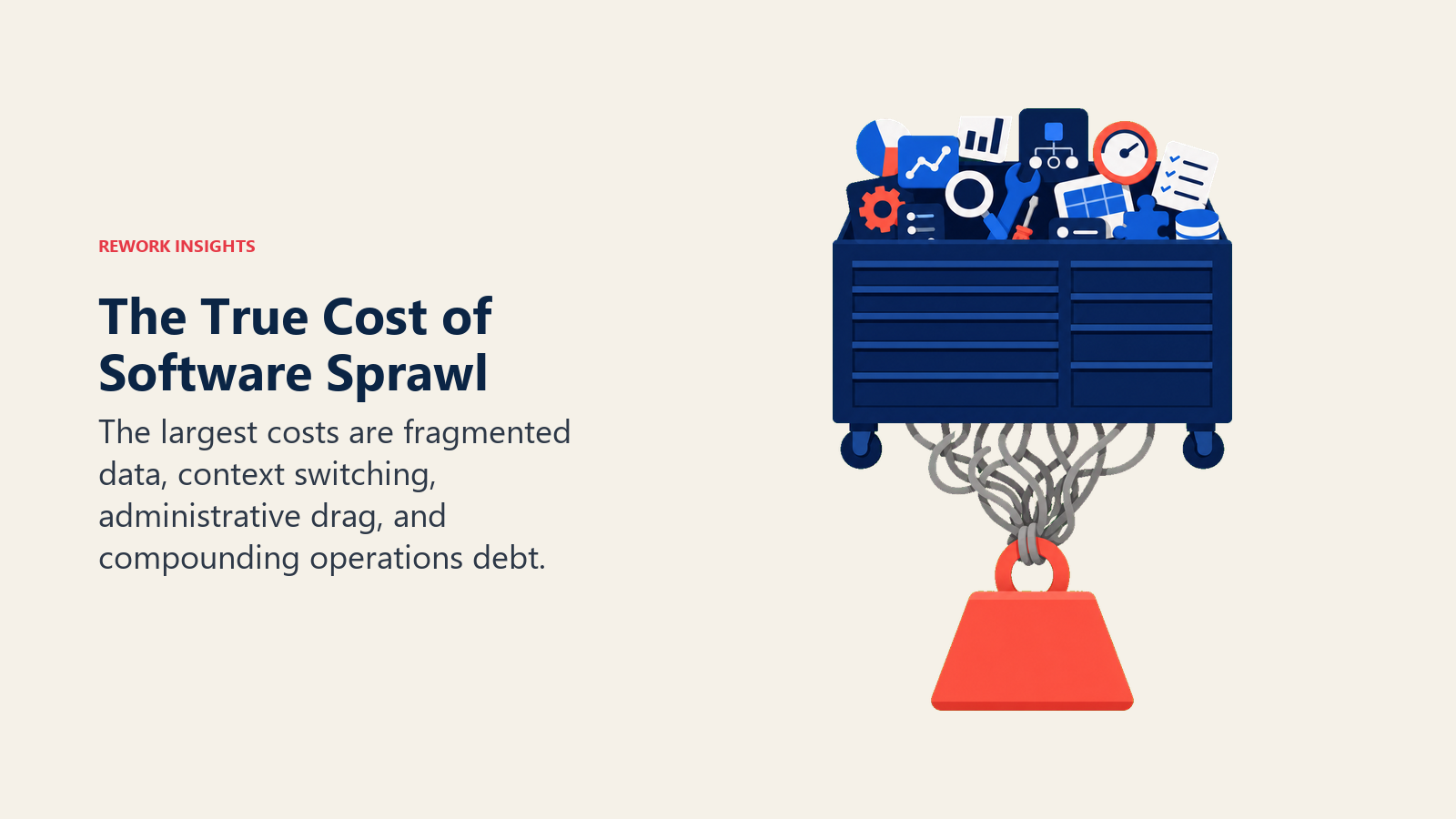
The average mid-market RevOps function runs 14 to 22 tools touching the revenue process. Sales engagement, CRM, intent data, conversation intelligence, deal forecasting, CPQ, customer success, data enrichment, territory planning, quota management -- each solving a real problem, each purchased by someone who needed it urgently at the time.
The license costs are visible and debated in every budget cycle. The actual costs of running all those tools are mostly invisible, and they're much larger.
Here's where software sprawl really costs you.
The Data Integration Tax
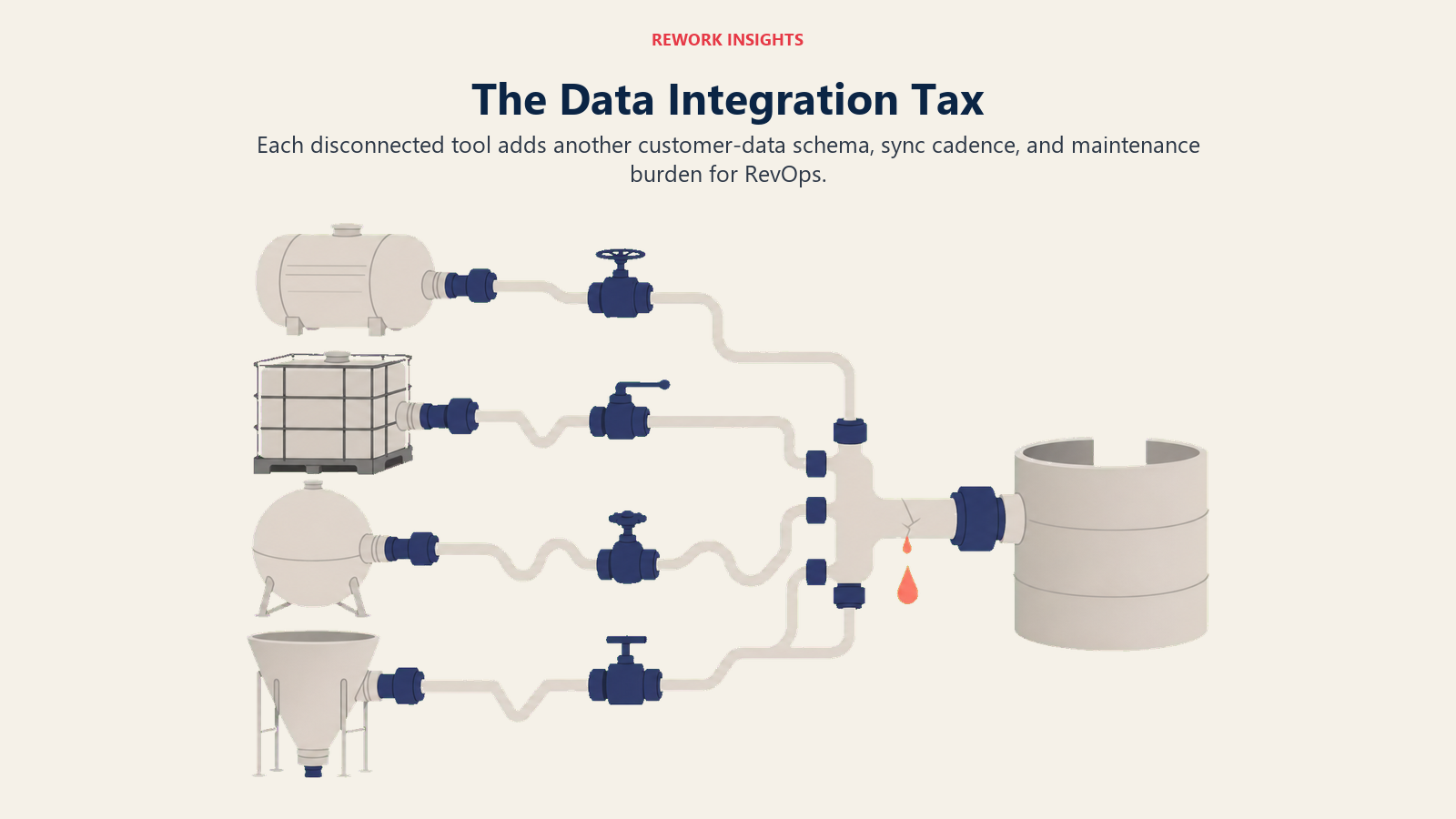
Every tool that touches your revenue process generates data. The problem is that it generates that data in its own schema, with its own identifiers, on its own update schedule. When you run 14 tools, you have 14 versions of your customer and pipeline data, none of which fully agrees with the others.
Your CRM says the account is in "negotiation." Your conversation intelligence tool shows the last call was 23 days ago and the primary contact hasn't responded to follow-up. Your intent data shows the account is researching competitors. Your CSM platform shows the account health score has dropped 18 points.
None of these tools are wrong. None of them are talking to each other. And your AE has no way to see the full picture without logging into four separate systems and manually synthesizing the signals.
The integration tax manifests in two ways. First, your data team or RevOps function spends significant time building and maintaining the pipelines that try to normalize data across these systems. That work is never done -- every new tool adds new fields, new objects, new update cadences that break the existing integrations. In most 50-200 person RevOps functions, this maintenance burden consumes 20-30% of available capacity that could otherwise go toward analysis and strategy.
Second, and harder to measure: reps and CSMs don't bother logging into four systems to get the full picture. They work from the one or two tools they check habitually, which means they're operating on partial information. The integration tax on data creates a downstream execution tax on every customer interaction.
The Context-Switching Cost
Knowledge work productivity research consistently finds that context switching is expensive. Moving between tasks costs 20-40% of productive time, and the cost compounds with the complexity of the context being switched.
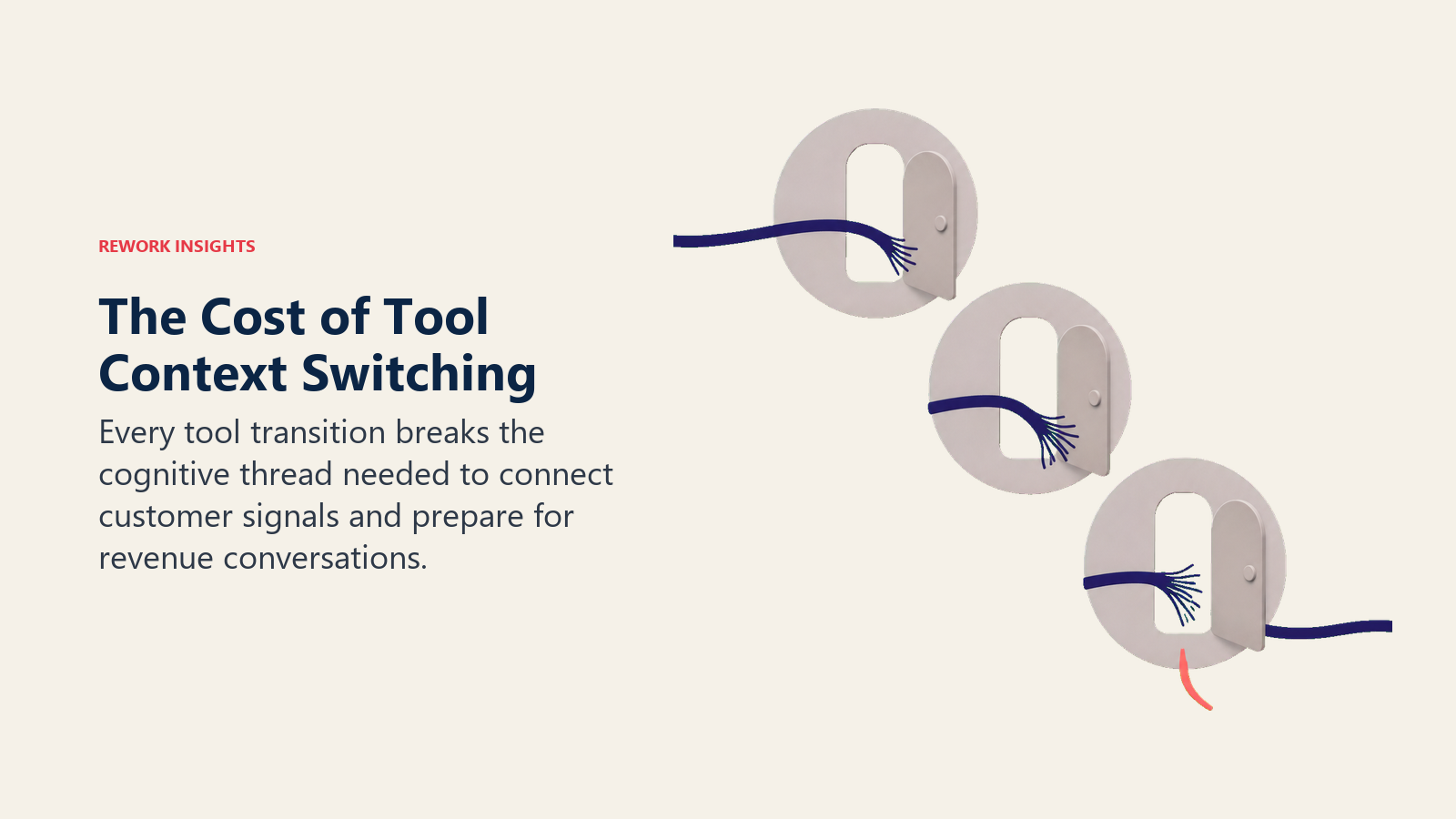
For revenue teams, every tool transition is a context switch with stakes. A rep moving from their email client to their CRM to their sales engagement tool to their conversation intelligence platform to pull together pre-call prep isn't just losing time to the navigation -- they're losing the cognitive thread between the pieces of information they're trying to connect.
The measurable consequence is inconsistent pre-call preparation, which shows up in lower discovery quality, worse objection handling, and deals that stall for reasons that could have been anticipated from the data that was sitting in three different systems.
For RevOps leaders running a 25-person sales team, if each rep loses 45 minutes per day to context switching across tools, that's 18+ hours of selling time per day evaporating across the team -- not from one dramatic cause, but from dozens of small tool-to-tool transitions that each look trivial in isolation.
The Administrative Overhead on Your Best People
Software sprawl creates administrative overhead that disproportionately burdens your strongest performers.
Strong reps and CSMs care about doing their job well. That means they actually try to maintain data hygiene across multiple systems, keep notes synchronized, update deal stages accurately, and log activities consistently. They do this because they've learned that good data produces good insights and good forecasts.
Weaker performers update whatever is easiest and ignore the rest. The tools they don't use go stale. But management accepts this because the aggregate data looks passable.
The perverse result: software sprawl taxes your best people more than your weakest. Your strongest AE is spending two hours per week on cross-system data maintenance that a weaker AE isn't bothering with. The total administrative burden falls on the people you can least afford to have doing administrative work.
When you consolidate tools in a way that reduces the maintenance burden, the productivity gains are concentrated among your strongest performers -- which is exactly where additional selling or relationship time has the highest expected value.
The Ops Debt That Compounds
Every tool you add to your stack creates configuration debt. Workflows need to be built. Field mappings need to be designed. Sync rules need to be tested. Reporting logic needs to account for the new tool's data.
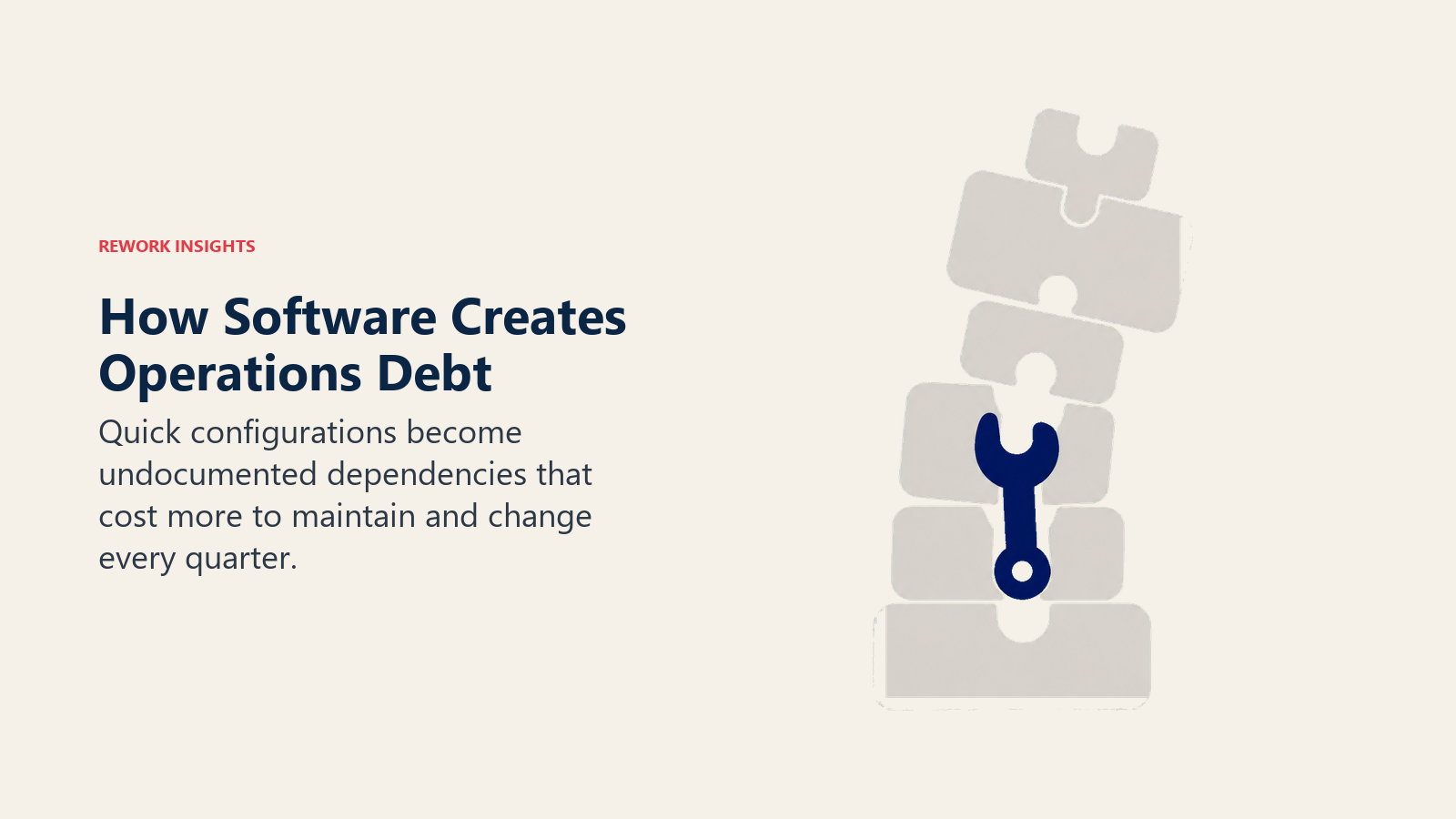
When the tool was new and the problem was urgent, someone in RevOps or IT built the minimum viable configuration to get the team unblocked. That configuration was rarely designed for longevity. Edge cases were papered over. Field names were invented ad hoc. The sync rules created technical dependencies that weren't documented.
Now, two years later, that tool is embedded in your stack. The person who built the configuration has left. The business requirements have changed. And any attempt to update the integration or reconfigure the tool risks breaking something downstream that no one fully understands anymore.
This is ops debt, and it compounds exactly like financial debt. The longer you carry it, the more expensive it becomes to service. Every new tool you add creates a new configuration surface that will become future ops debt. Every tool you rationalize out of the stack eliminates a future obligation.
The RevOps maturity model is largely about managing this tradeoff: sophisticated teams make deliberate choices about which tools to add, build integrations correctly the first time, document their configurations, and do periodic audits to eliminate tools that are generating ops debt faster than business value.
What a Tool Rationalization Exercise Actually Reveals
Most RevOps leaders who run a serious tool rationalization exercise find two things they didn't expect.
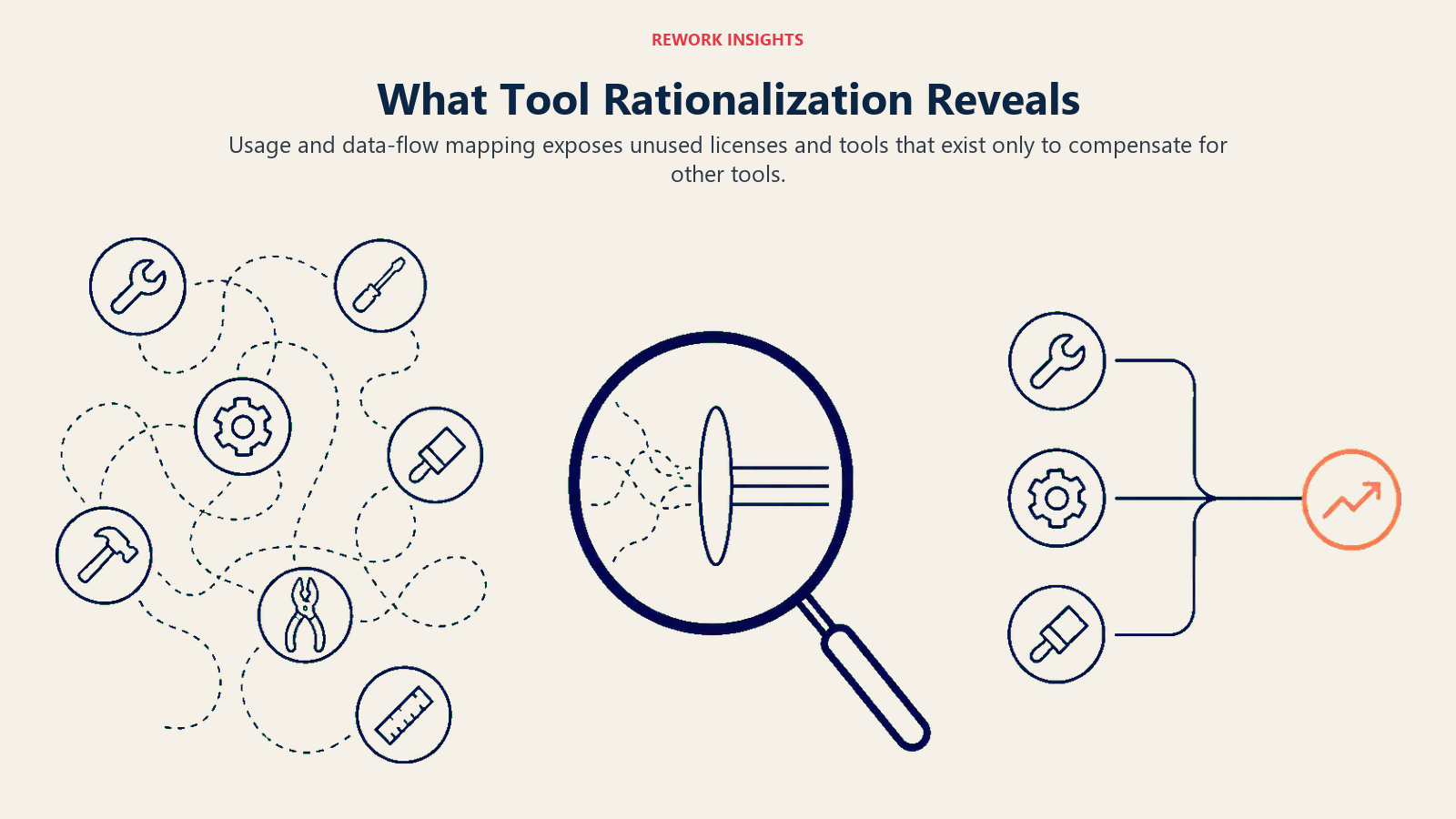
First, they find tools that are being paid for but not used. Not "not used optimally" -- genuinely not used. License counts that were purchased for 40 seats have 8 active users. A contract that auto-renewed three quarters ago for a tool the team switched away from. These are direct cost savings that become visible only when someone actually audits usage against spend.
Second, they find tools that are being used heavily but providing negative ROI. Not because the tool is bad, but because the tool is solving a problem that exists only because of another tool in the stack. The data enrichment tool exists to compensate for the fact that the CRM doesn't capture prospect data well. The CRM doesn't capture prospect data well because the sales engagement tool doesn't sync bidirectionally with it. If you fixed the sync, you might eliminate the data enrichment tool -- or at least reduce the seats you need.
This cascade of interdependencies is usually invisible until you map the data flows explicitly. When you do, you typically find that 30-40% of your tool spend is addressing problems created by other tools in your stack rather than addressing genuine business problems.
The Organizational Cost: Fragmented Accountability
Software sprawl creates a governance problem that becomes a cultural problem.
When every department can buy tools with their own budget, you get tools that optimize for the function that bought them rather than for the revenue process as a whole. Marketing buys a tool that generates leads in a format that doesn't integrate cleanly with the sales development workflow. Sales ops buys a forecasting tool that requires data that the CRM doesn't cleanly produce. Customer success buys a health scoring platform that uses different account identifiers than the CRM.
Each purchase was defensible in isolation. The cumulative effect is a revenue process that requires significant manual coordination to function -- because the tools were bought by different budget holders solving different problems without a shared view of how the data needs to flow end to end.
The accountability fragmentation that creates software sprawl is the same fragmentation that makes RevOps hard. It's not a coincidence that organizations with strong, centralized RevOps functions tend to have smaller, more integrated tech stacks. The same governance capability that prevents tool sprawl is the capability that enables coherent pipeline management, accurate forecasting, and effective go-to-market execution.
Where to Start
The useful first step isn't a platform audit. It's a workflow audit.
Map three to five core workflows -- the actual steps a rep, SDR, or CSM goes through to do a high-frequency task. Lead follow-up. Opportunity creation and qualification. Renewal preparation. Map every tool they touch, every manual step they take, every place where they're transferring data from one system to another or looking at information in multiple systems to get a complete picture.
You'll find the friction quickly. And you'll find that the friction clusters around the integration points between tools, not within any single tool. That's where consolidation generates the most immediate ROI -- not by eliminating tools, but by eliminating the seams between them.
Tool rationalization follows naturally from that workflow mapping. Some tools survive. Some get replaced. Some get eliminated because their function is now handled by a tool that's already in the stack and was just underutilized.
Related Resources
- The RevOps Maturity Model: From Reactive to Strategic - Where tool governance fits in the maturity progression
- Attribution Is Broken. Here's What to Measure Instead - When data fragmentation makes attribution unreliable
- CAC Payback: The Metric That Actually Predicts SaaS Survival - Stack costs show up in CAC before they show up in EBITDA
- Pipeline Hygiene as a Cultural Practice, Not a Data Problem - How tool sprawl degrades pipeline data quality
- CRM Data Hygiene - The downstream effect of multi-tool data fragmentation
- CRM Adoption Operating Model - Building adoption across a rationalized stack

Co-Founder, Rework.com