Cumplimiento de Preguntas de Discovery con Revisión de IA

Turn this article into takeaways for your work.


Each assistant summarizes the article only for you and suggests best practices for your work.
Entrenó a su equipo en MEDDIC. Ejecutó el workshop. Certificó a los reps. Tiene la documentación del proceso en el playbook de ventas.
Y luego su herramienta de conversation intelligence le muestra los datos reales: el rep promedio de su equipo hace 1,4 preguntas de impacto económico por llamada de discovery. Su formación en MEDDIC cubre Economic Buyer, Decision Criteria, Decision Process, Identify Pain, Champion y Competition. En las llamadas, la mayoría de los reps pregunta consistentemente sobre el pain y ocasionalmente sobre los decision criteria. El resto de la metodología es en gran medida teórico.
La metodología no es el problema. El bucle de accountability sí lo es. Los equipos de ventas se forman en metodología en un entorno de workshop y luego regresan a las llamadas donde los hábitos, la presión del tiempo y la dinámica con el prospecto anulan el playbook. Sin un mecanismo de feedback que opere a nivel de llamada, la formación en metodología tiene una vida media medida en semanas. El análisis de HBR sobre la formación en ventas sitúa el número en más del 80% del contenido de formación olvidado en 90 días, que es precisamente la razón por la que un bucle continuo de accountability con IA importa más que cualquier workshop de formación único.
El rastreo de cumplimiento de preguntas de discovery cierra ese bucle. Es parte del Patrón 2 en el AI Sales Operator: Meeting Intelligence aplicado no solo a lo que dicen los compradores, sino a lo que preguntan los reps.
Qué es el rastreo de cumplimiento de preguntas de discovery
El cumplimiento de preguntas de discovery es la aplicación de la capacidad Analyze de la IA a las transcripciones de llamadas con un objetivo específico: verificar si los reps hicieron las preguntas requeridas por la metodología, anotar cuáles se omitieron, y mostrar esos datos donde cambian el comportamiento.
Se ubica dentro del patrón Meeting Intelligence, usando el mismo flujo de Ingest (grabación de audio a transcripción) → Analyze (extraer y clasificar las preguntas hechas) → Generate (informe de cumplimiento, notas de coaching) → Execute (enviar al CRM, plataforma de coaching, dashboard del manager) que impulsa la resumen de llamadas y el análisis de objeciones.
La diferencia respecto al coaching general de llamadas es la especificidad de lo que se mide. En lugar de "cómo fue esta llamada en general", el rastreo de cumplimiento pregunta: ¿preguntó el rep sobre el Economic Buyer? ¿Preguntó sobre el Decision Process? ¿Preguntó sobre el plazo de implementación, o las alternativas competitivas, o el costo del status quo? La respuesta es sí o no, extraída de la transcripción, cruzada con la biblioteca de preguntas que el equipo definió.
Esto no se trata de evaluar el tono o el rapport. Se trata de rastrear si una metodología estructurada se está ejecutando realmente en el campo.
Key Facts: Cumplimiento de Discovery y Tasas de Victorias
- Más del 80% del contenido de formación en ventas se olvida en 90 días, lo que hace que el cumplimiento de la metodología posterior al workshop sea un problema de rastreo, no de formación (análisis de formación en ventas de HBR)
- En una empresa SaaS de 200 personas usando MEDDIC más Gong Smart Trackers, las llamadas de discovery con las 6 categorías principales de MEDDIC abordadas tuvieron una tasa de victoria del 58%; las llamadas en las que faltó la identificación de Champion y/o Economic Buyer tuvieron una tasa de victoria del 31%, una brecha de 27 puntos
- Los deals donde no se discutió el Decision Process en el discovery tienen ciclos de ventas promedio que se extienden 20-30 días más que los deals donde sí se cubrió, según datos agregados de cumplimiento de MEDDIC de plataformas de conversation intelligence
El Discovery Compliance Score
The Discovery Compliance Score es una métrica por llamada que mide qué porcentaje de las categorías de preguntas requeridas de una metodología definida abordó un rep durante una conversación de discovery. Una puntuación basada en MEDDIC cuenta el número de categorías principales (Metrics, Economic Buyer, Decision Criteria, Decision Process, Identify Pain, Champion) con al menos una pregunta calificadora hecha, dividido por seis. Una puntuación de 4/6 (67%) significa que se abordaron cuatro categorías y se omitieron dos. Las puntuaciones de cumplimiento se vuelven predictivas cuando se correlacionan con las tasas de victoria: los equipos que miden el DCS durante 90+ días consistentemente encuentran que las puntuaciones por debajo del 50% (menos de 3 de 6 categorías) se correlacionan con tasas de victoria 20-30 puntos porcentuales por debajo de la media del equipo. La puntuación es un indicador adelantado, no una garantía; el cumplimiento impulsa las tasas de victoria cuando se combina con escucha activa y seguimiento de calidad.
Las metodologías que la IA puede rastrear
Cualquier metodología que se mapee a categorías de preguntas identificables puede rastrearse mediante análisis de cumplimiento de IA. Los marcos más comunes en ventas B2B SaaS, y cómo se traducen:
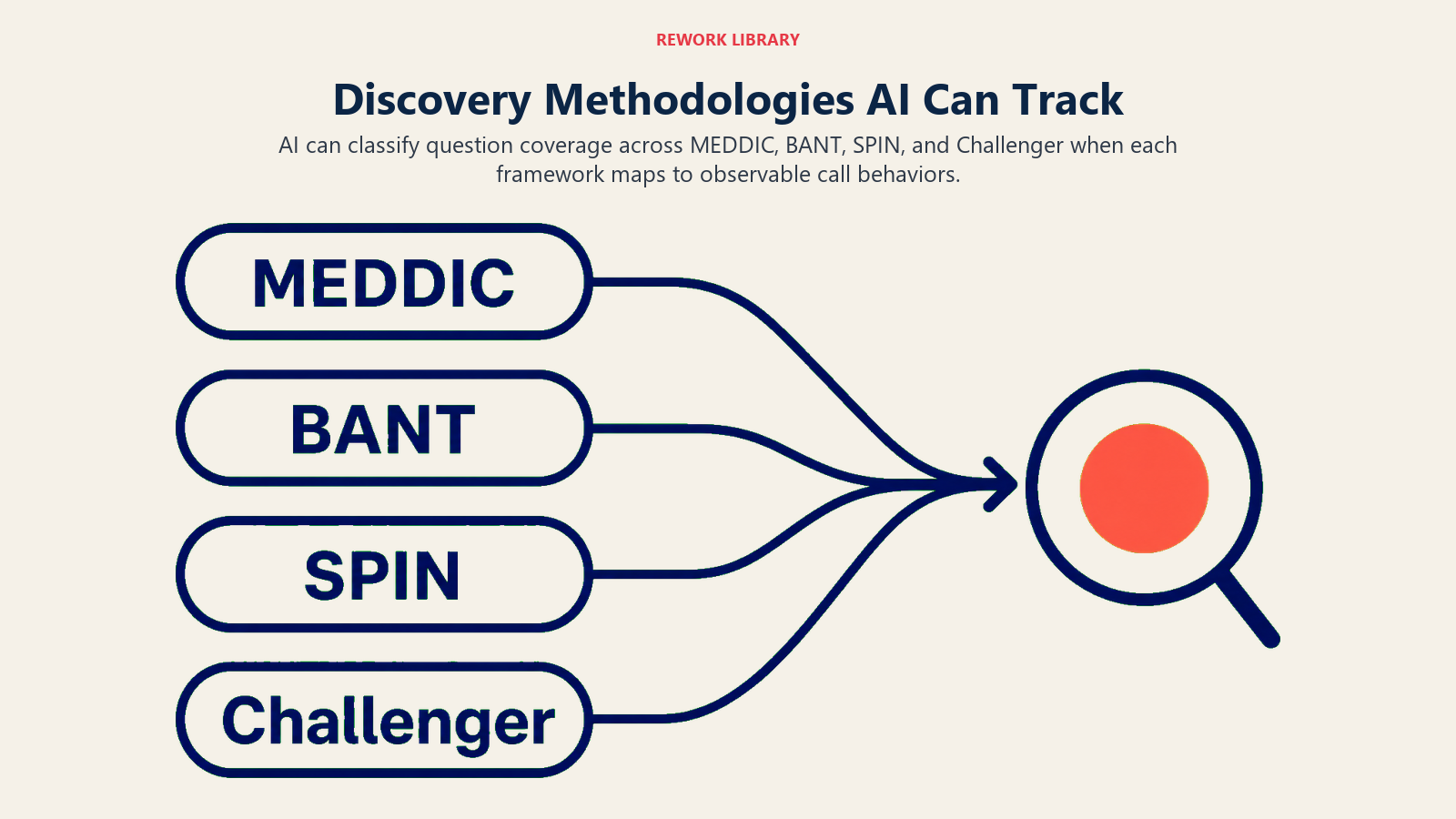
MEDDIC / MEDDPICC El estándar de oro para ventas enterprise complejas. Cada letra se mapea a una categoría de preguntas:
- Metrics: "¿Cómo se ve el éxito numéricamente? ¿Qué KPIs cambiarían?"
- Economic Buyer: "¿Quién tiene el presupuesto para esto? ¿Quién más necesita firmar?"
- Decision Criteria: "¿Cuáles son los criterios clave que usará su equipo para evaluar esto?"
- Decision Process: "Explíqueme cómo toman una decisión como esta."
- Identify Pain: "¿Cuál es el costo de no resolver esto en los próximos 12 meses?"
- Champion: "¿Quién internamente está más interesado en que esto funcione?"
- Paper Process: "¿Cómo es el proceso de compras de su parte?"
- Competition: "¿Están evaluando otras opciones? ¿Con qué nos están comparando?"
BANT BANT (Budget, Authority, Need, Timeline) es un marco más simple, usado frecuentemente para calificación de SMB y mid-market:
- Budget: "¿Cuál es el rango de presupuesto aprobado para esta iniciativa?"
- Authority: "¿Quién toma la decisión final?"
- Need: "¿Qué está impulsando la urgencia de resolver esto ahora?"
- Timeline: "¿Para cuándo necesita tener esto implementado?"
SPIN Selling SPIN Selling de Neil Rackham (Situation, Problem, Implication, Need-Payoff) fue desarrollado a partir de un estudio de 12 años de 35,000 llamadas de ventas. Se trata más de la secuencia de preguntas que de completar una lista:
- Situation: "Cuénteme cómo está manejando X hoy."
- Problem: "¿Dónde se rompe ese proceso?"
- Implication: "¿Qué ocurre aguas abajo cuando eso falla?"
- Need-Payoff: "Si pudiera resolver eso, ¿qué haría posible?"
Challenger Discovery Se enfoca en enseñar al prospecto algo que no sabe. Más difícil de rastrear programáticamente, pero la IA puede identificar si los reps hacen preguntas basadas en insights frente a preguntas de recopilación de hechos.
Los clasificadores de IA no necesitan que el rep formule las preguntas exactamente. Una pregunta como "¿Quién más va a tener voz en esta compra?" se mapea claramente a Economic Buyer, aunque no se use la terminología exacta de MEDDIC. Las plataformas modernas de conversation intelligence usan datos de entrenamiento de miles de llamadas de ventas para reconocer estos mapeos de forma fiable. Para el panorama completo de herramientas que apoyan esto, vea choosing a conversation intelligence tool.
Qué revelan los datos de cumplimiento
La imagen agregada que emerge de 60 a 90 días de datos de cumplimiento es típicamente más útil que cualquier revisión individual de llamadas.
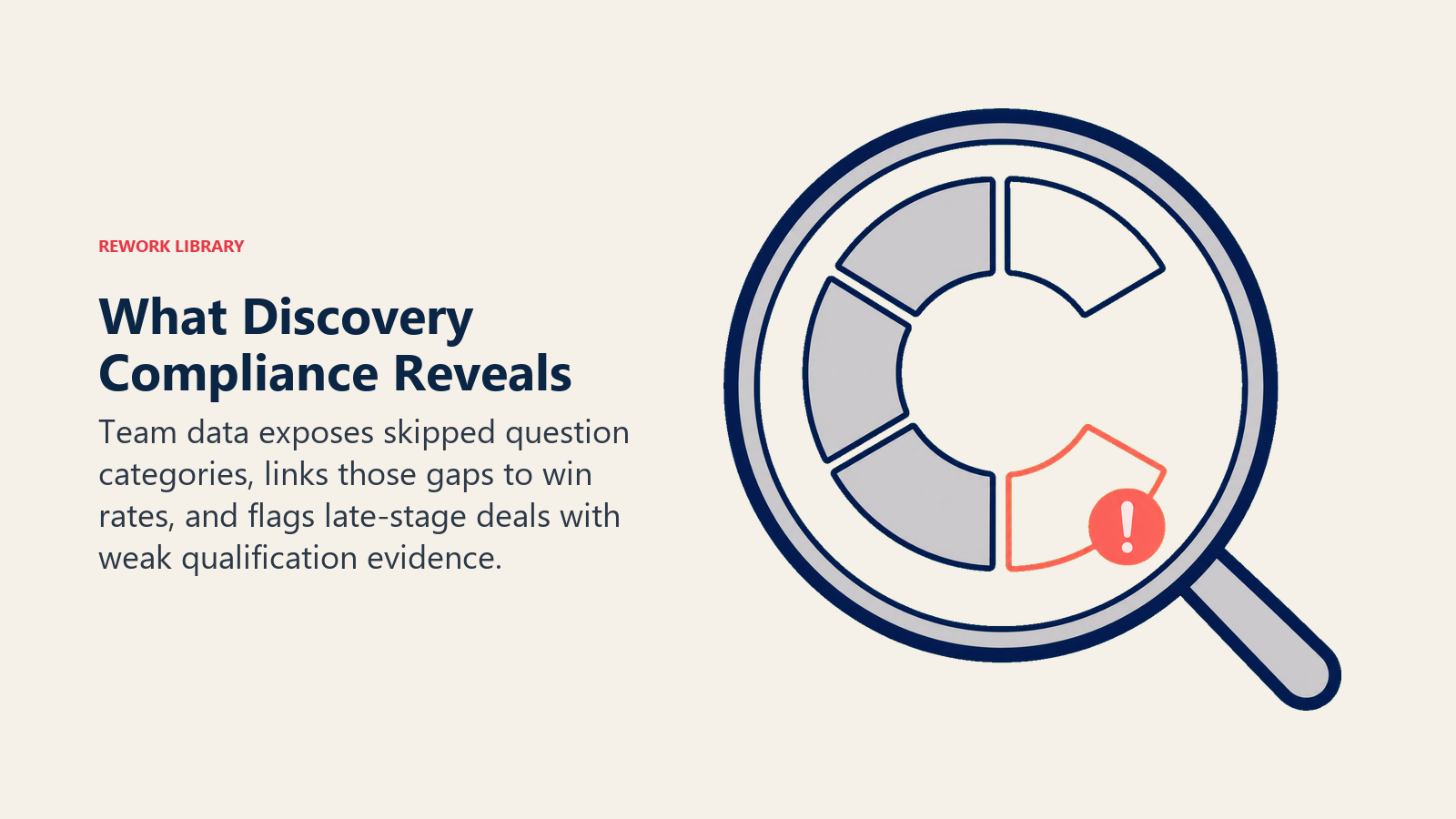
Una instantánea representativa de cumplimiento para un equipo de 15 reps usando MEDDIC podría verse así:
| Categoría MEDDIC | Esperado por Llamada de Discovery | Promedio del Equipo | Brecha |
|---|---|---|---|
| Metrics | 2-3 preguntas | 2,1 | Aceptable |
| Economic Buyer | 1-2 preguntas | 0,6 | Brecha significativa |
| Decision Criteria | 1-2 preguntas | 1,4 | Aceptable |
| Decision Process | 1-2 preguntas | 0,9 | Brecha moderada |
| Identify Pain | 2-3 preguntas | 2,8 | Sólido |
| Champion | 1-2 preguntas | 0,4 | Brecha crítica |
| Paper Process | 1 pregunta | 0,2 | Brecha crítica |
| Competition | 1-2 preguntas | 1,1 | Aceptable |
Las brechas en Champion y Paper Process son llamativas. Ambas son preguntas que tienen un costo social en el discovery. Preguntar "¿quién internamente está más interesado en que esto funcione?" puede sentirse presuntuoso al principio de una llamada. Preguntar sobre el proceso de compras puede sentirse como adelantarse. Los reps las omiten porque se sienten arriesgadas, no porque no sepan que deben hacerlas.
Pero cuando cruza esta tabla de cumplimiento con los resultados de los deals, la correlación suele ser llamativa. Los deals donde no se identificó al Champion en el discovery se cierran a tasas materialmente más bajas. Los deals donde no se discutió el Paper Process hasta la etapa de propuesta tienen ciclos de ventas más largos, a veces de 20-30 días.
Ese es el número que cambia el comportamiento: no "deberías preguntar sobre el Champion" (lo saben), sino "los deals donde no identificas un Champion en el discovery se cierran al 38% frente al 64% cuando sí lo haces."
Correlación con las tasas de victoria: un ejemplo real. En una empresa SaaS de 200 personas usando MEDDIC más Gong Smart Trackers, un análisis de 340 deals cerrados durante 18 meses encontró que las llamadas de discovery con las 6 categorías principales de MEDDIC abordadas tuvieron una tasa de victoria del 58%. Las llamadas de discovery sin identificación de Champion y/o Economic Buyer tuvieron una tasa de victoria del 31%. Esa brecha de 27 puntos no es atribuible solo a la metodología, pero el patrón fue consistente en todos los segmentos, la antigüedad del rep y el rango de ACV.
Brechas de discovery como riesgo de deal en revisiones de pipeline. Los datos de cumplimiento también aparecen como una señal de riesgo en vivo en las revisiones de deals. Un deal en etapa de Propuesta donde el Economic Buyer nunca fue identificado es un perfil de riesgo diferente a un deal donde todas las categorías de MEDDIC se abordaron en el discovery. La IA puede detectar estas señales automáticamente en su CRM o herramienta de forecasting, etiquetando deals para revisión del manager donde las brechas de metodología se correlacionan con el riesgo en etapas tardías. El Meeting Intelligence Pattern explica cómo opera esta capacidad Analyze a nivel de patrón.
El bucle de feedback del rep
La característica más importante del rastreo de cumplimiento impulsado por IA no es el dashboard del manager. Es el bucle de feedback individual del rep.
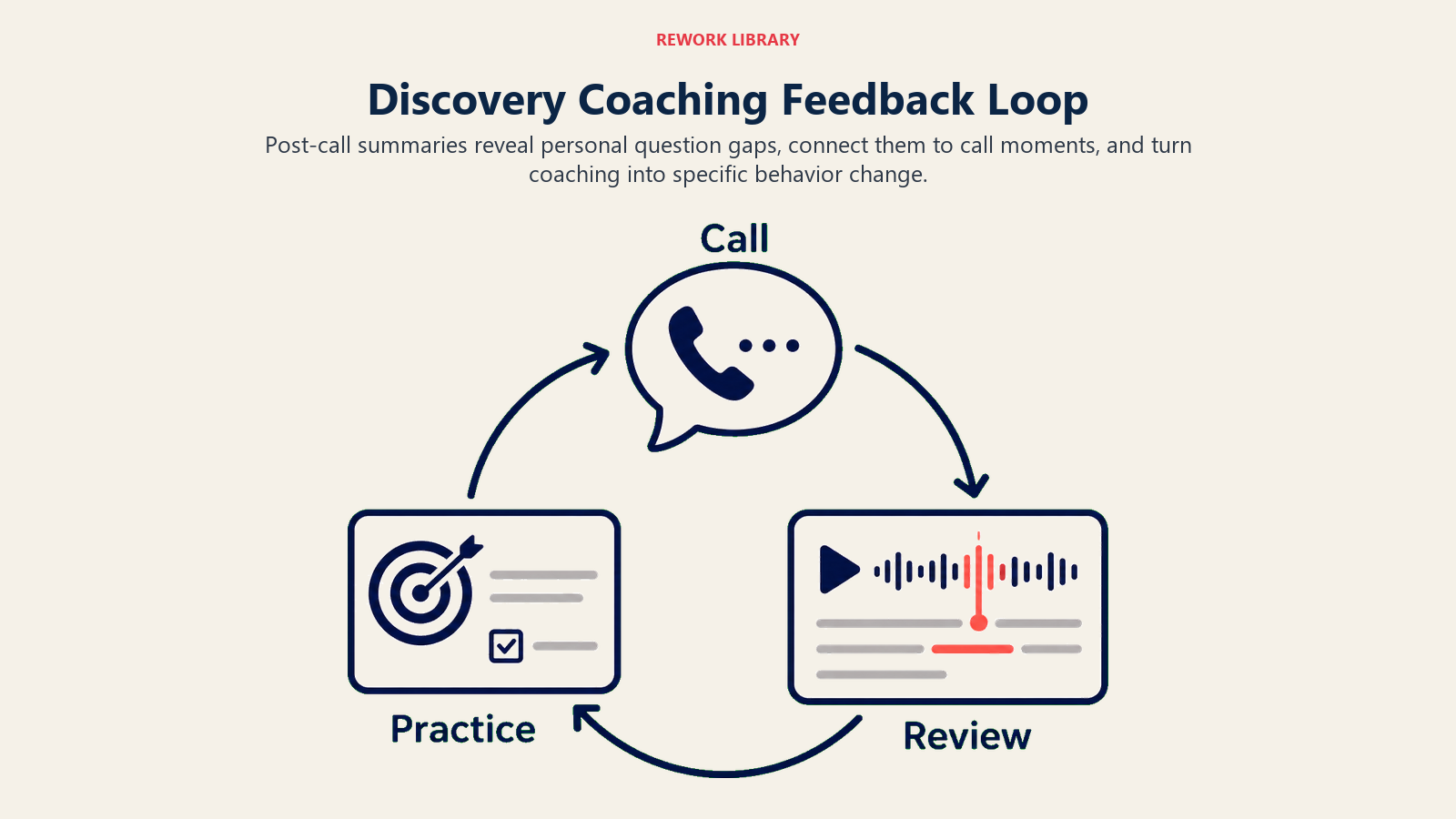
Cuando un rep termina una llamada y ve su resumen de cumplimiento antes del 1:1 semanal, ocurren dos cosas. Primero, nota patrones en su propio comportamiento que no son visibles llamada por llamada. "Consistentemente omito la identificación del Champion en las llamadas de discovery inicial y vuelvo a ello en la segunda llamada" es algo que un rep no sabría sobre sí mismo sin datos agregados. Segundo, tiene la propiedad de los datos. No lo está diciéndole su manager; puede verlo él mismo.
Plataformas como Gong, Chorus (ahora ZoomInfo) y Salesforce Einstein Conversation Insights muestran este feedback en una interfaz de coaching de autoservicio. El rep puede ver su tendencia individual de cumplimiento a lo largo del tiempo, compararse con los benchmarks del equipo y hacer clic para ver momentos específicos de llamadas donde hizo o no hizo la pregunta.
La conversación de coaching con el manager cambia en consecuencia. En lugar de discutir la impresión general ("siento que no estás generando suficiente urgencia en el discovery"), la conversación comienza con datos ("tus preguntas de Implication promediaron 0,3 por llamada el mes pasado frente a la media del equipo de 1,4. Escuchemos este segmento de llamada"). Esa especificidad reduce la actitud defensiva y enfoca el tiempo de coaching en lo que realmente está ocurriendo, no en lo que el manager sospecha.
Para los equipos en industrias reguladas, especialmente seguros y servicios financieros, el rastreo de cumplimiento sirve a un segundo propósito: documentación. Algunos procesos de ventas en estas industrias requieren que se hagan preguntas específicas de divulgación o calificación en cada llamada, por ley o por política de la empresa. El rastreo de cumplimiento con IA proporciona un registro de auditoría que la memoria del rep o las notas del CRM no pueden proporcionar.
Usando datos de cumplimiento en las revisiones de pipeline
El cumplimiento de preguntas de discovery se conecta naturalmente con la inspección del pipeline y la calificación de deals.
Un deal que entra en el forecast sin el Economic Buyer identificado es diferente de un deal donde el rep ha hablado con el CFO dos veces. Un deal donde nunca se discutió el Decision Process es una señal de riesgo diferente a uno donde el rep ha recorrido un plan de cierre mutuo.
La IA puede marcar esto automáticamente. Cuando los datos de cumplimiento se unen a la etapa del CRM y la categoría de forecast, los deals con brechas específicas de metodología aparecen como excepciones. La conversación de revisión del pipeline cambia de "¿qué tan seguro está de este deal?" (lo que invita al sesgo de optimismo) a "este deal está en Etapa 4 sin ningún Economic Buyer identificado. ¿Cuál es el plan para conseguirlo esta semana?"
Este es uno de los usos de mayor valor de los datos de cumplimiento para RevOps: crea una definición cuantificada y consistente de "calificado" que no depende del auto-reporte del rep.
Lo que el rastreo de cumplimiento no puede medir
Sea honesto sobre esto con sus equipos de enablement y liderazgo.
No puede decirle si el rep escuchó. Un rep puede hacer las ocho preguntas de MEDDIC y no escuchar realmente las respuestas. El comprador señala que su champion interno es débil ("bueno, nuestro VP de Ventas está interesado pero el CEO es escéptico"), y el rep pasa a la siguiente pregunta sin explorar más. El rastreo de cumplimiento registra la pregunta. No registra si el rep cambió su estrategia basándose en la respuesta.
No puede medir la calidad de la pregunta. "¿Cuáles son sus criterios de decisión?" y "¿Cuáles son las dos o tres cosas que harían que esto fuera un sí claro para su equipo?" son ambas preguntas de Decision Criteria. La segunda es más probable que obtenga una respuesta útil. El rastreo de cumplimiento cuenta la categoría. No evalúa el encuadre.
No puede medir el timing. Preguntar sobre el Paper Process en los primeros tres minutos de una llamada de discovery inicial es técnicamente conforme. También es probable que se sienta insistente y cree fricción. La secuencia y el timing aún requieren juicio humano.
El gaming de la métrica es real. Los reps aprenden rápidamente que decir ciertas frases de activación les da crédito por una categoría de cumplimiento. "¿Quién más necesita estar involucrado en una decisión como esta?" hecha como una pregunta de verificación sin seguimiento no es lo mismo que el discovery real del Economic Buyer. Trate los datos de cumplimiento como un indicador adelantado, no como una garantía de la calidad de la metodología.
El cumplimiento de la metodología solo no impulsa las tasas de victoria. El product-market fit, la posición competitiva, la urgencia del comprador y la calidad de la relación importan más que el cumplimiento de la metodología en la mayoría de los deals. Un rep que hace las ocho preguntas de MEDDIC a la persona equivocada en la empresa equivocada no cierra. El rastreo de cumplimiento es una señal en un contexto más amplio. Pero es la señal que la mayoría de los equipos actualmente está ignorando.
Rework Analysis: El insight más impactante de los programas de rastreo de cumplimiento es casi siempre el mismo: la identificación del Champion es la categoría de MEDDIC que más se omite y la que más se correlaciona con la pérdida de deals. Los reps saben que deben identificar un champion. Les resulta socialmente incómodo preguntar "¿quién internamente está más interesado en que esto funcione?" antes de haber establecido rapport. Así que lo omiten con la intención de volver a ello más tarde, y a menudo nunca lo hacen. Cuando mostramos a los reps los datos de correlación (los deals donde no se identificó ningún champion tuvieron una tasa de cierre del 38% frente al 64% con champion identificado), el comportamiento cambia. Los datos hacen que valga la pena navegar la incomodidad social. Esa es la conversión que el rastreo de cumplimiento crea: de saber qué hacer a realmente hacerlo bajo la presión de la llamada.
Guía de implementación
La implementación funciona mejor como un despliegue de cinco pasos que prioriza la confianza y da visibilidad a los reps antes de que los datos se conviertan en un scorecard de gestión.
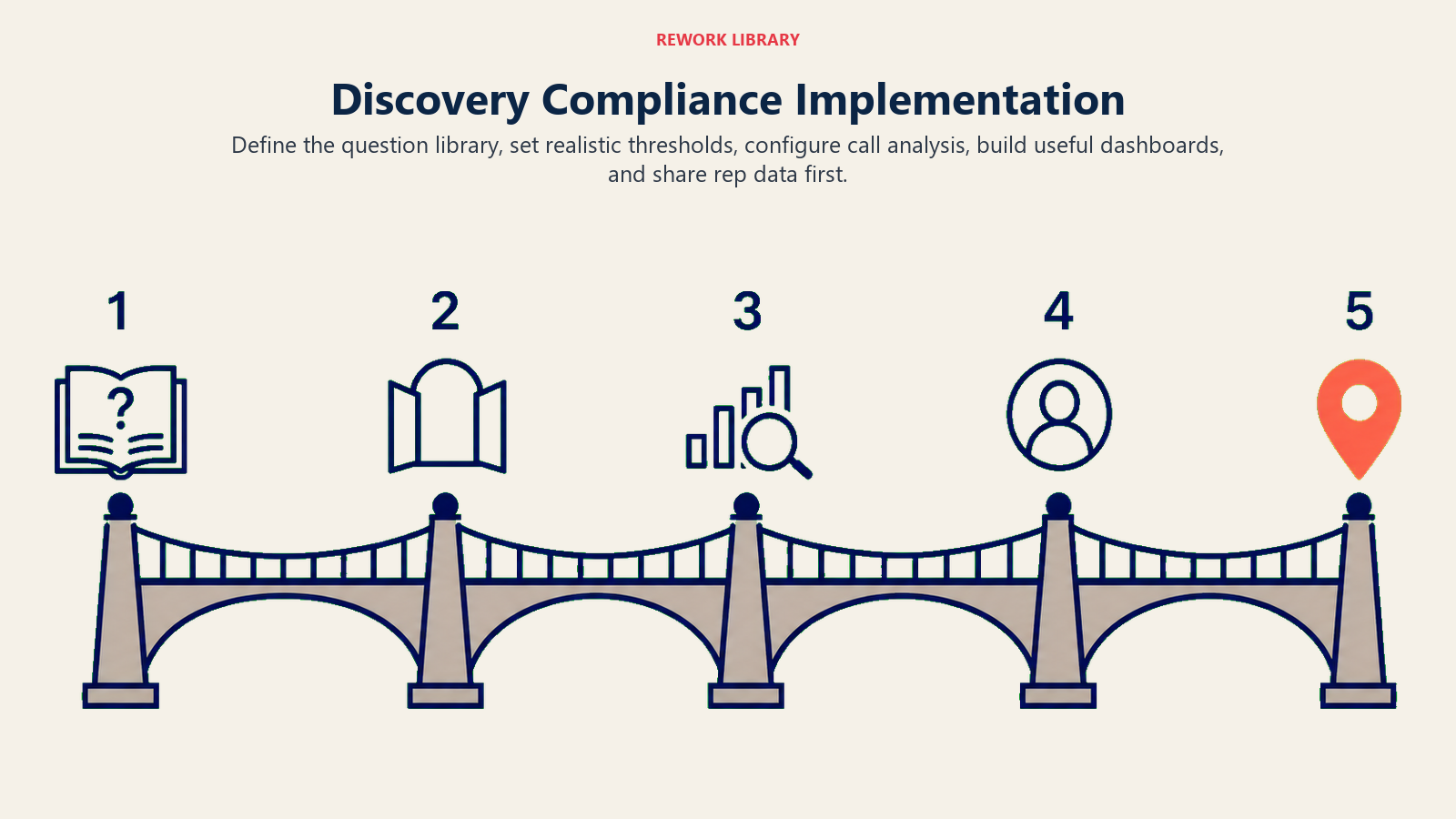
Paso 1: Defina su biblioteca de preguntas. Para cada categoría de metodología, escriba 4-8 formulaciones representativas de preguntas que sus reps realmente usan. No use solo las definiciones del libro de texto. El clasificador se entrena con estos ejemplos, por lo que la especificidad importa.
Paso 2: Establezca los umbrales de cumplimiento. Decida qué significa "conforme" por llamada. Para una llamada de discovery inicial de 30 minutos usando MEDDIC, un umbral razonable podría ser: al menos 4 de las 6 categorías principales abordadas, con Economic Buyer y Pain como obligatorios. No establezca umbrales tan altos que nunca sean alcanzables, o los datos se vuelven desmoralizantes en lugar de instructivos.
Paso 3: Configure su plataforma de conversation intelligence (CI). En Gong, esto significa Smart Trackers y scorecards personalizados. En Chorus, son las bibliotecas de rastreo de preguntas. En Salesforce Einstein Conversation Insights, son los temas configurados. La mayoría de las plataformas admiten bibliotecas de categorías de preguntas personalizadas que se mapean a su metodología.
Paso 4: Cree dashboards para managers. Muestre las tendencias de cumplimiento a nivel de equipo, los deals marcados y los datos individuales de reps en una vista útil para los 1:1 semanales y las revisiones de pipeline. Manténgala accionable: demasiadas métricas lleva a ceguera del dashboard.
Paso 5: Comparta los datos individuales con los reps primero. Distribuya los datos a los reps antes de mostrarlos en los reportes de gestión. Esto genera confianza en el sistema y lo posiciona como una herramienta de coaching en lugar de una herramienta de vigilancia. Ambas son ciertas, pero el primer encuadre es más probable que impulse la adopción.
Conclusión
El rastreo de cumplimiento no reemplaza el juicio del rep. Una lista de preguntas hechas no es una conversación de ventas. Pero los datos de patrón que emergen del rastreo de cumplimiento en un equipo y en cientos de llamadas son uno de los diagnósticos más útiles que tiene un equipo de sales enablement.
Hace visibles los patrones invisibles. El rep que consistentemente omite la identificación del Champion, el equipo que nunca discute el Paper Process hasta la etapa de Propuesta, la correlación entre la falta del Economic Buyer y la precisión del forecast a 30 días. Nada de eso es visible sin un análisis sistemático. La intuición sobre dónde necesita coaching el equipo es útil. Los datos sobre exactamente qué brechas de metodología se correlacionan con las pérdidas, por segmento, rep y tamaño de deal, son mejores.
Y cuando un rep ve su propio patrón en los datos antes de que el manager lo plantee, la conversación sobre cambiarlo se convierte en un tipo diferente de conversación.
Preguntas Frecuentes
¿Qué es el rastreo de cumplimiento de preguntas de discovery?
El rastreo de cumplimiento de preguntas de discovery usa IA para analizar las transcripciones de llamadas y determinar si los reps hicieron las preguntas requeridas por la metodología (MEDDIC, BANT, SPIN, etc.) durante las llamadas de discovery. El sistema clasifica las preguntas hechas frente a una biblioteca definida de categorías de metodología, produce una puntuación de cumplimiento por llamada, rastrea las tendencias a lo largo del tiempo por rep, y correlaciona las brechas de cumplimiento con los resultados de los deals. Crea un bucle de accountability para la ejecución de la metodología que la formación sola no puede sostener.
¿Por qué los reps omiten las preguntas de la metodología de discovery incluso después de la formación?
El hábito, la presión del tiempo y la dinámica social anulan la formación del playbook en entornos de llamadas en vivo. Preguntas como la identificación del Champion ("¿quién está más interesado en esto internamente?") se sienten presuntuosas en la construcción temprana del rapport. Las preguntas sobre el Paper Process se sienten como adelantarse a la relación. Los reps las omiten con la intención de volver, y a menudo no lo hacen. El cumplimiento de la metodología requiere un mecanismo de feedback continuo a nivel de llamada, no solo el refuerzo periódico de la formación.
¿Qué categorías de MEDDIC omiten más frecuentemente los reps?
La identificación del Champion y el Paper Process son las categorías de MEDDIC que más se omiten consistentemente. Ambas tienen un costo social: preguntar sobre champions internos se siente presuntuoso, y preguntar sobre compras se siente prematuro en el discovery inicial. Ambas también se correlacionan fuertemente con la pérdida de deals cuando se omiten. El análisis de los datos de cumplimiento de MEDDIC muestra que los deals sin champions identificados se cierran a aproximadamente el 38% frente a tasas de victoria del 64% cuando el champion fue establecido en el discovery.
¿Cómo mejoran los datos de cumplimiento del discovery las revisiones de pipeline?
Unir los datos de cumplimiento a la etapa del deal en el CRM y la categoría de forecast permite a RevOps marcar automáticamente los deals con brechas de metodología en las revisiones de pipeline. Un deal en etapa de Propuesta sin Economic Buyer identificado es un riesgo cuantificablemente diferente a un deal donde el rep se ha reunido con el CFO dos veces. La conversación cambia de "¿qué tan seguro está?" (lo que invita al sesgo de optimismo) a "este deal no tiene un champion identificado en Etapa 4. ¿Cuál es el plan?" Esto crea una definición consistente y objetiva de "calificado" que no depende del auto-reporte del rep.
¿Puede la IA clasificar con precisión las preguntas de discovery en diferentes formulaciones?
Sí. Las plataformas modernas de conversation intelligence usan datos de entrenamiento de miles de llamadas de ventas para reconocer las categorías de metodología en formulaciones variadas. "¿Quién más necesita opinar en esta compra?" y "¿Quién tiene el presupuesto aquí?" y "¿Quién es el decisor económico?" se mapean de forma fiable a la categoría de Economic Buyer, aunque ninguno use el término exacto de MEDDIC. El clasificador no requiere la formulación del libro de texto; reconoce la intención de la pregunta.
¿Qué no puede medir el rastreo de cumplimiento del discovery?
Cuatro limitaciones importantes: (1) si el rep realmente escuchó y ajustó su estrategia basándose en la respuesta; (2) la calidad del encuadre de la pregunta (una versión genérica frente a una versión de sondeo de la misma categoría reciben igual crédito); (3) el timing y la secuenciación (preguntar sobre el Paper Process en el minuto 3 es conforme pero potencialmente perjudicial); y (4) el gaming, donde los reps aprenden qué frases de activación generan crédito de cumplimiento sin ejecutar la metodología genuina. El cumplimiento es un indicador adelantado de la calidad de la ejecución de la metodología, no una garantía de ello.
¿Cómo deberían las empresas implementar el rastreo de cumplimiento del discovery para evitar la resistencia de los reps?
Comparta los datos de cumplimiento individuales con los reps antes de mostrarlos en los reportes del manager. Esto enmarca la herramienta como un recurso de coaching de autoservicio en lugar de vigilancia, lo que reduce drásticamente la resistencia. Considere un período de 30 días en el que los reps pueden ver sus propios datos pero los managers no pueden acceder a los desgloses individuales. Muestre los datos de correlación (puntuaciones de cumplimiento y tasas de victoria) a los reps antes del despliegue, para que entiendan el caso de negocio. Los equipos que manejan el despliegue de esta manera ven mayor adopción y reps que proactivamente referencian sus propios datos de cumplimiento en las sesiones de coaching.
Más información
- Sales Call Recording and Transcript Analysis
- Coaching Reps With Conversation Intelligence
- Objection Mining: What Buyers Actually Push Back On
- From Call to CRM Update Automatically
- Choosing a Conversation Intelligence Tool
- Failure Modes: When AI Sales Ops Backfires
- Meeting Intelligence: From Audio to Action Items
- Analyze: How AI Makes Sense of What You've Collected
- HBR: Your Sales Training Is Probably Lackluster

Co-Founder, Rework.com
On this page
- Qué es el rastreo de cumplimiento de preguntas de discovery
- El Discovery Compliance Score
- Las metodologías que la IA puede rastrear
- Qué revelan los datos de cumplimiento
- El bucle de feedback del rep
- Usando datos de cumplimiento en las revisiones de pipeline
- Lo que el rastreo de cumplimiento no puede medir
- Guía de implementación
- Conclusión
- Más información