Cotizaciones y Propuestas Generadas con AI
Turn this article into takeaways for your work.


Each assistant summarizes the article only for you and suggests best practices for your work.
Un rep cerrando un deal de $80,000 no debería pasar 4 horas construyendo una propuesta en PowerPoint.
Pero muchos lo hacen. Extraen los precios manualmente de una hoja de cálculo, personalizan la portada, buscan en una carpeta compartida los casos de estudio correctos, pegan la plantilla del resumen ejecutivo, revisan la sección "sobre nosotros" por centésima vez, y escriben un párrafo de propuesta de valor a medida que es mitad copiado de la última propuesta y mitad escrito desde cero.
El resultado es una propuesta que tarda medio día en producirse, luce inconsistente de rep a rep, y con frecuencia contiene errores de precios o contenido desactualizado porque la hoja de cálculo no era la versión más reciente.
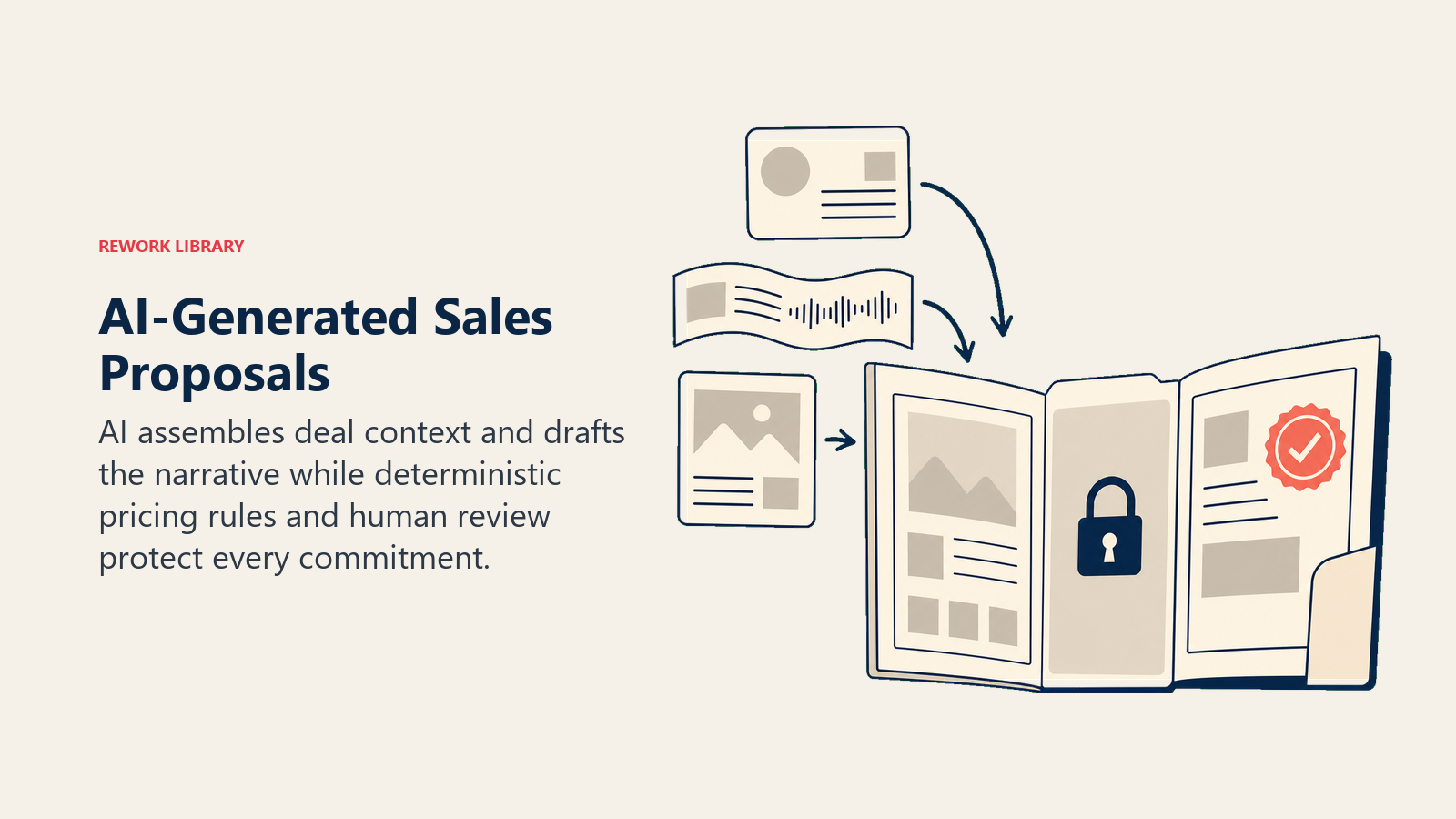
La generación de cotizaciones y propuestas asistida por AI no reemplaza la participación del rep en este proceso. Se encarga de la investigación, la configuración y el borrador inicial para que el tiempo del rep se dedique a las decisiones que realmente requieren juicio: estrategia del deal, contexto de la relación, encuadre de la negociación, y el caso de valor específico para este comprador. Tiempo total del rep: 45 minutos en lugar de 4 horas.
Pero esto solo funciona si se entiende exactamente dónde ayuda la AI y dónde no. Los modos de fallo son reales. Una propuesta mal generada por AI enviada a un prospecto enterprise sin revisión puede dañar el deal, la relación y la credibilidad de toda la iniciativa de AI.
Qué maneja la AI en la generación de cotizaciones y propuestas
Datos Clave: Generación de Propuestas y Cotizaciones Asistida por AI
- Las empresas que implementan AI CPQ reportan reducciones del 75% en el tiempo promedio de generación de cotizaciones y aumentos del 23% en las tasas de cierre. (Mobileforce, 2025)
- AI CPQ reduce el tiempo de entrega de cotizaciones de 5 días a 1.5 días en promedio, una reducción del 67%, mientras que también reduce las tasas de error de precios del 15-20% al 2-5%. (DealHub, 2025)
- Las organizaciones que usan venta guiada con AI y configuración CPQ reportan hasta un 20% de deals más grandes a través de estrategias de precios optimizadas. (CPQ.se, 2025)
Al desglosar el proceso de propuesta en componentes, queda claro dónde la AI agrega valor versus dónde el juicio humano es innegociable.
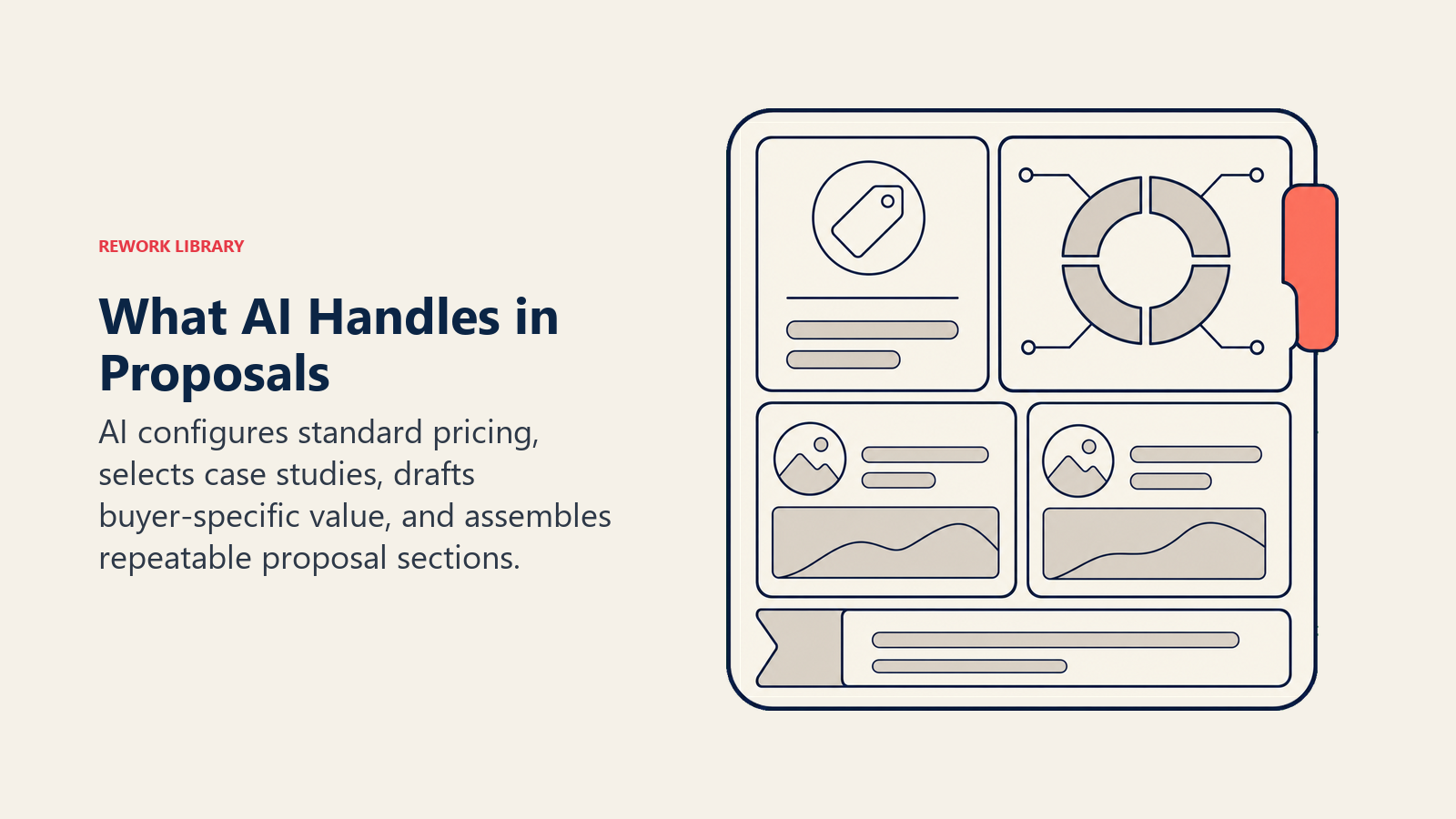
Configuración de precios. La AI extrae del registro del CRM: los productos seleccionados, el nivel del deal, el número de usuarios, y las reglas de descuento preaprobadas. Para configuraciones de productos estándar, esto se adapta bien al manejo por AI. La AI ensambla la tabla de precios con precisión a partir de los datos del catálogo en lugar de requerir que el rep calcule manualmente desde una hoja de cálculo.
Declaración de valor específica para el cliente. La parte más diferenciada de cualquier propuesta y en la que la mayoría de los reps pasan más tiempo. La AI genera esto a partir de tres inputs: transcripciones de llamadas (qué dijo el comprador sobre sus puntos de dolor, prioridades y criterios de éxito), el account brief (qué es específico de la situación de esta empresa), e historial del deal (a qué han respondido positivamente hasta ahora). La AI produce un primer borrador; el rep lo lee contra su memoria de la relación y revisa donde el tono o el énfasis no es el correcto.
Selección y personalización de casos de estudio. La AI empareja la industria, el caso de uso y el tamaño de la empresa del prospecto con los casos de estudio existentes en su biblioteca. Selecciona los 2 o 3 más relevantes y personaliza el encuadre introductorio: "Una empresa de logística similar a la suya en tamaño y etapa de crecimiento redujo los costos de procesamiento de pedidos en un 23% en los primeros 6 meses." El rep no tiene que buscar en la carpeta compartida. La AI presenta las historias correctas.
Resumen ejecutivo. La página individual más importante de la propuesta es también la más tardada de personalizar. La AI genera un primer borrador a partir del contexto del deal: qué problema fue identificado, qué solución se está proponiendo, qué resultado se espera, y por qué ahora. El rep edita el tono, afina el lenguaje específico, y agrega cualquier contexto de relación que deba reflejarse.
Secciones estándar. Antecedentes de la empresa, descripción general del producto, cronograma de implementación, modelo de soporte, resumen de seguridad y cumplimiento. Estas secciones son en su mayoría consistentes entre propuestas con personalización menor. La AI las maneja desde plantillas; el rep revisa su precisión.
Lo que la AI no maneja: el juicio estratégico sobre cómo enmarcar el deal (¿priorizar precio o ROI?), decisiones a nivel de relación (¿responde mejor este comprador a propuestas con muchos datos o con historias?), estrategia de negociación incorporada en el lenguaje de la propuesta (¿cuánto margen dejar para la negociación?), y contexto específico del deal que vive en la cabeza del rep pero no está en el CRM.
El pipeline Workflow Copilot para propuestas
En el ACE Framework, la generación de propuestas es una aplicación de Workflow Copilot con un paso Execute adicional para enrutamiento y aprobación.
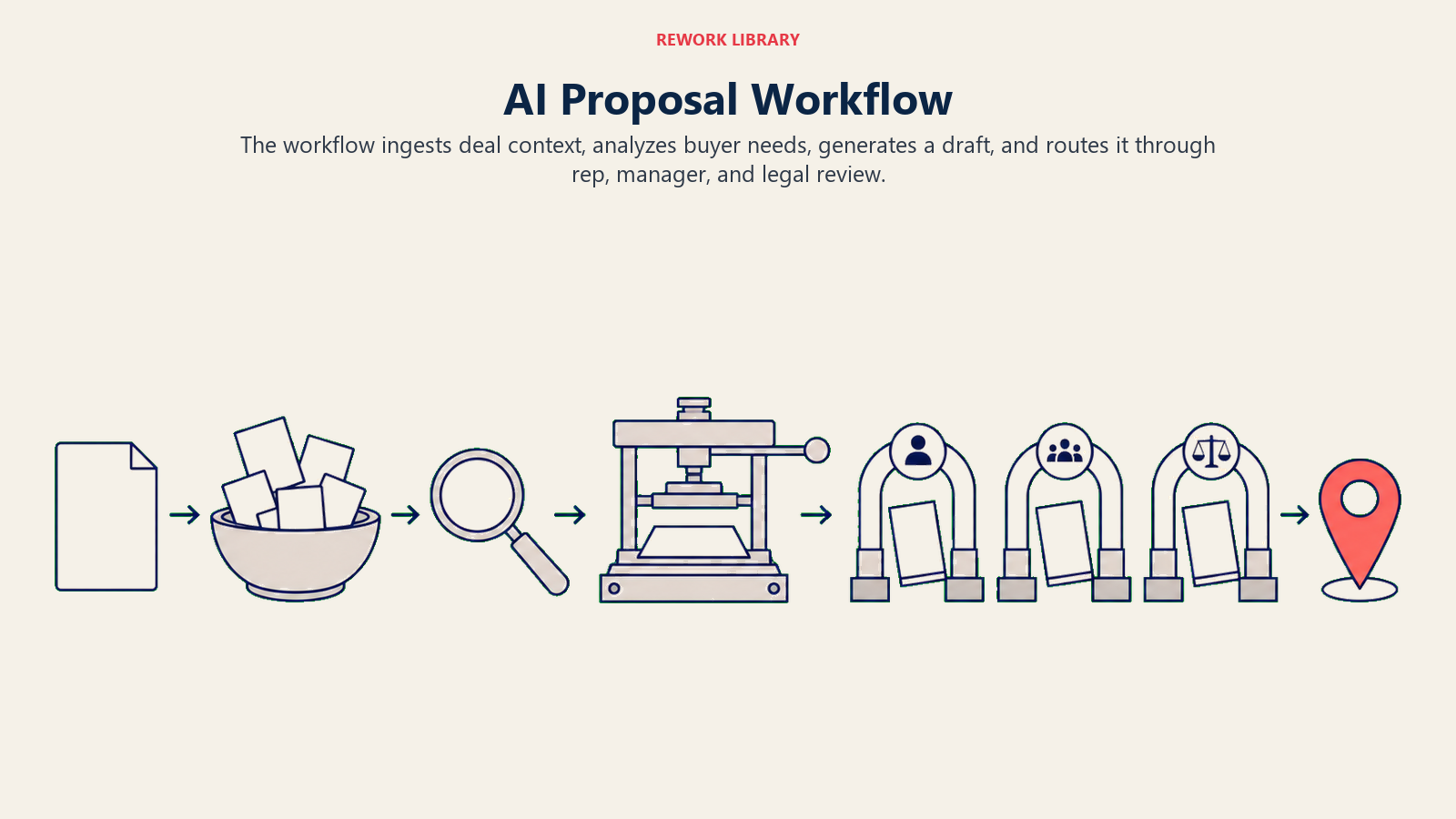
Ingest recopila los inputs:
- Registro del deal en CRM: etapa, valor, fecha de cierre, cuenta, lista de contactos, criterios calificados
- Transcripciones de llamadas: prioridades del comprador, objeciones, criterios de éxito, impulsores del cronograma
- Catálogo de precios: productos, niveles, rangos de usuarios, reglas de descuento estándar
- Biblioteca de plantillas de propuestas: plantillas de secciones, lenguaje aprobado, términos legales estándar
- Biblioteca de casos de estudio: indexada por industria, caso de uso y tipo de resultado
Analyze extrae el contexto relevante:
- ¿Qué productos y configuraciones aplican a este deal?
- ¿Qué puntos de dolor y criterios de éxito del comprador debe abordar la propuesta?
- ¿Qué casos de estudio coinciden con el perfil de este prospecto?
- ¿Qué nivel de descuento aplica según el tamaño del deal y el segmento de cuenta?
Generate produce el borrador completo de la propuesta:
- Portada con contenido específico para el prospecto
- Resumen ejecutivo (personalizado desde el contexto del deal)
- Encuadre problema/solución (desde la transcripción de llamada y el contexto de cuenta)
- Tabla de precios (desde el catálogo y la configuración del deal)
- Casos de estudio (seleccionados y encuadrados para este prospecto)
- Cronograma de implementación (desde la metodología estándar)
- Compromisos de soporte y SLA (desde plantilla)
- Resumen de términos legales (términos estándar)
Execute enruta para revisión y aprobación:
- Revisión del rep: ¿es preciso el contenido y representa correctamente el deal?
- Aprobación del manager si el nivel de descuento lo requiere (configurable por umbral)
- Revisión legal si se solicitan términos no estándar
- Entrega al prospecto una vez aprobado
El paso Execute es donde vive la gobernanza. Enviar una propuesta es una acción con consecuencias. Un error en los precios, un compromiso que la empresa no puede cumplir, o una cláusula legal que crea responsabilidad: estos son riesgos de nivel Execute que justifican una revisión obligatoria antes de la entrega.
El Deterministic Price + Generative Narrative Split
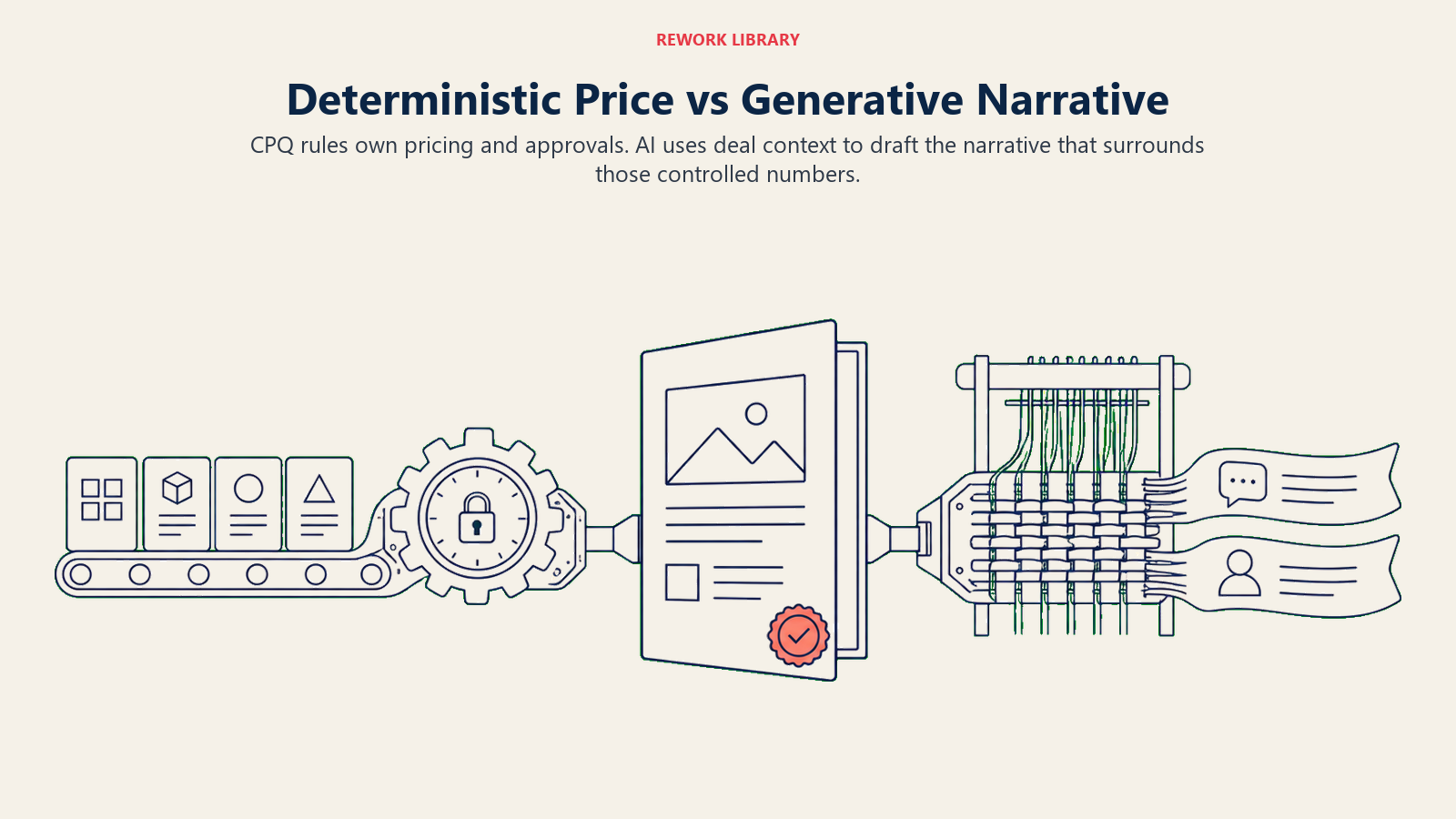
El Deterministic Price + Generative Narrative Split es el principio de diseño central para las propuestas asistidas por AI: la configuración de precios sigue reglas deterministas (lógica de catálogo, niveles de descuento aprobados, estructuras de términos estándar) mientras que la narrativa de la propuesta se produce generativamente a partir del contexto del deal. Los dos nunca deben confundirse. Aplicar AI generativa a la configuración de precios crea riesgo de alucinaciones en números con consecuencias financieras. Aplicar plantillas rígidas a la narrativa de la propuesta crea documentos genéricos que no reflejan las situaciones específicas del comprador. La separación divide la fortaleza de la máquina (aplicación precisa de reglas a velocidad) de la fortaleza del modelo (síntesis contextual de lenguaje), manteniendo cada una en su carril apropiado. Cualquier flujo de trabajo de propuestas que no implemente explícitamente esta separación eventualmente generará un error de precios o una narrativa impersonalizada, ambos de los cuales reducen las tasas de cierre.
Un distribuidor de equipos de manufactura que implementó el Deterministic Price + Generative Narrative Split redujo el tiempo de generación de cotizaciones de 3 días a 2 horas mientras aumentó la precisión de cotizaciones en un 89%. (Caso de estudio de Mobileforce, 2025)
El problema de la precisión en la configuración
Los deals enterprise introducen complejidad que pone a prueba la configuración de precios por AI: términos plurianuales con diferentes tarifas anuales, productos en paquete con precios interdependientes, alcances de implementación personalizados, niveles de volumen que requieren negociación manual, y términos de pago no estándar.
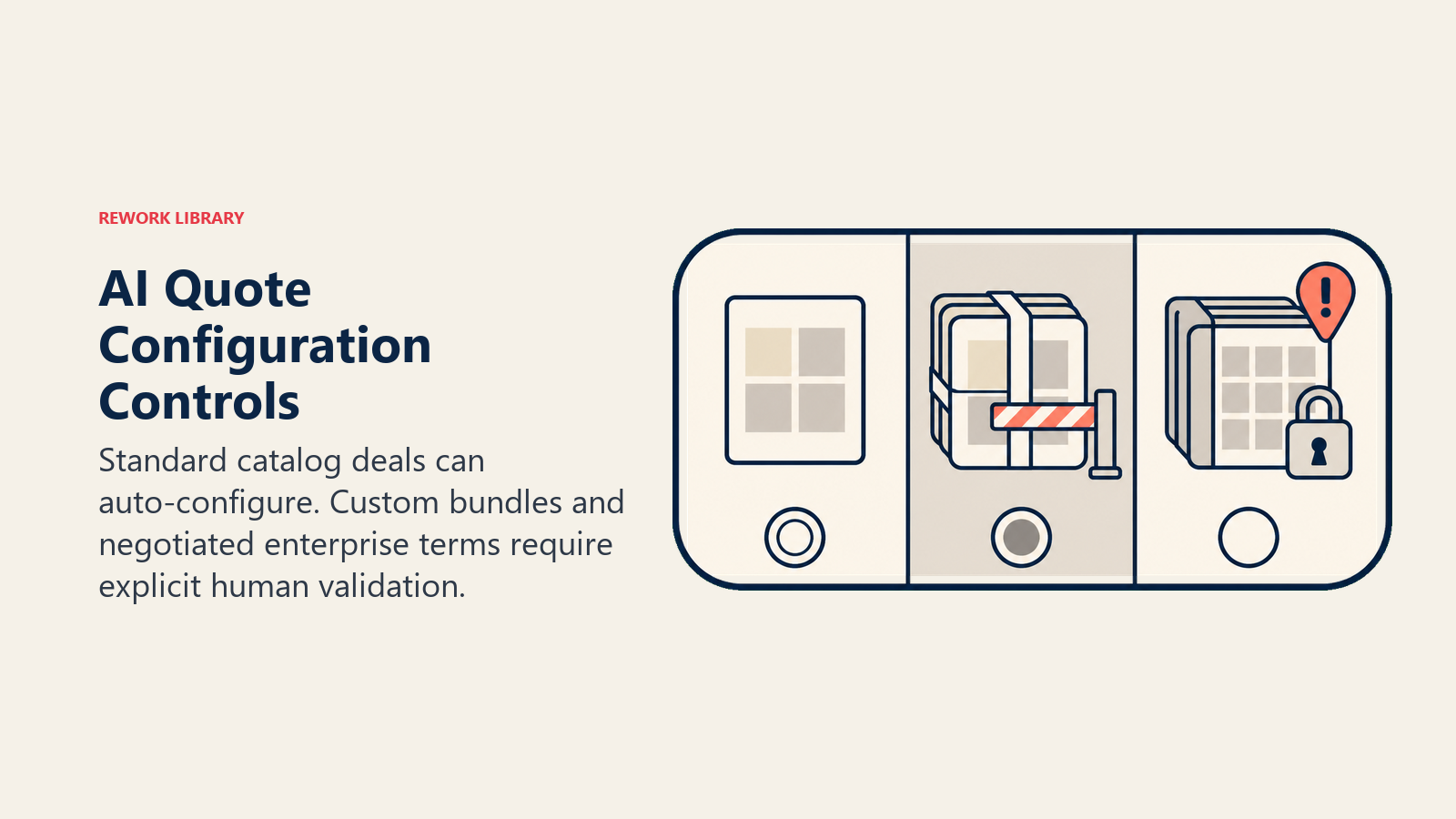
Las configuraciones de catálogo estándar se adaptan bien al manejo por AI. La AI lee el registro del deal, aplica la lógica del catálogo y produce una tabla de precios precisa sin riesgo. Pero los deals complejos requieren supervisión humana en el paso de configuración.
El modelo de gobernanza práctico:
Configuración estándar (auto-configurada por AI): El producto es del catálogo, el descuento está dentro de las reglas estándar, el término es estándar. El rep revisa el resultado para verificar precisión, pero no se requiere aprobación.
Configuración personalizada (borrador de AI + revisión humana requerida): Paquete de productos no estándar, descuento por encima del umbral de aprobación automática, plurianual con precios escalonados, o alcance personalizado. La AI produce un borrador que indica explícitamente dónde se requieren decisiones humanas. El rep o el deal desk completan la configuración. No se envía hasta que la configuración sea confirmada por un humano.
Enterprise negociado (AI asiste solo la narrativa): Deals enterprise complejos donde los precios se negocian fuera del catálogo. La AI maneja las secciones narrativas de la propuesta. Los precios son configurados manualmente por el rep y el deal desk. Este es el segmento de mayor valor y el que requiere más participación humana.
El riesgo de errores de precios por AI en el segmento de configuración compleja es real. Una AI que calcula mal un compromiso plurianual o aplica el nivel de descuento incorrecto crea una propuesta que compromete a la empresa con términos que no puede cumplir. Para deals de alto valor, el estándar debe ser: la AI maneja el borrador, un humano valida cada número antes de que se envíe el documento.
Calidad de la narrativa de la propuesta
La diferencia entre una propuesta que gana y una que no rara vez es el precio. Casi siempre es qué tan bien la propuesta refleja la situación específica del comprador.
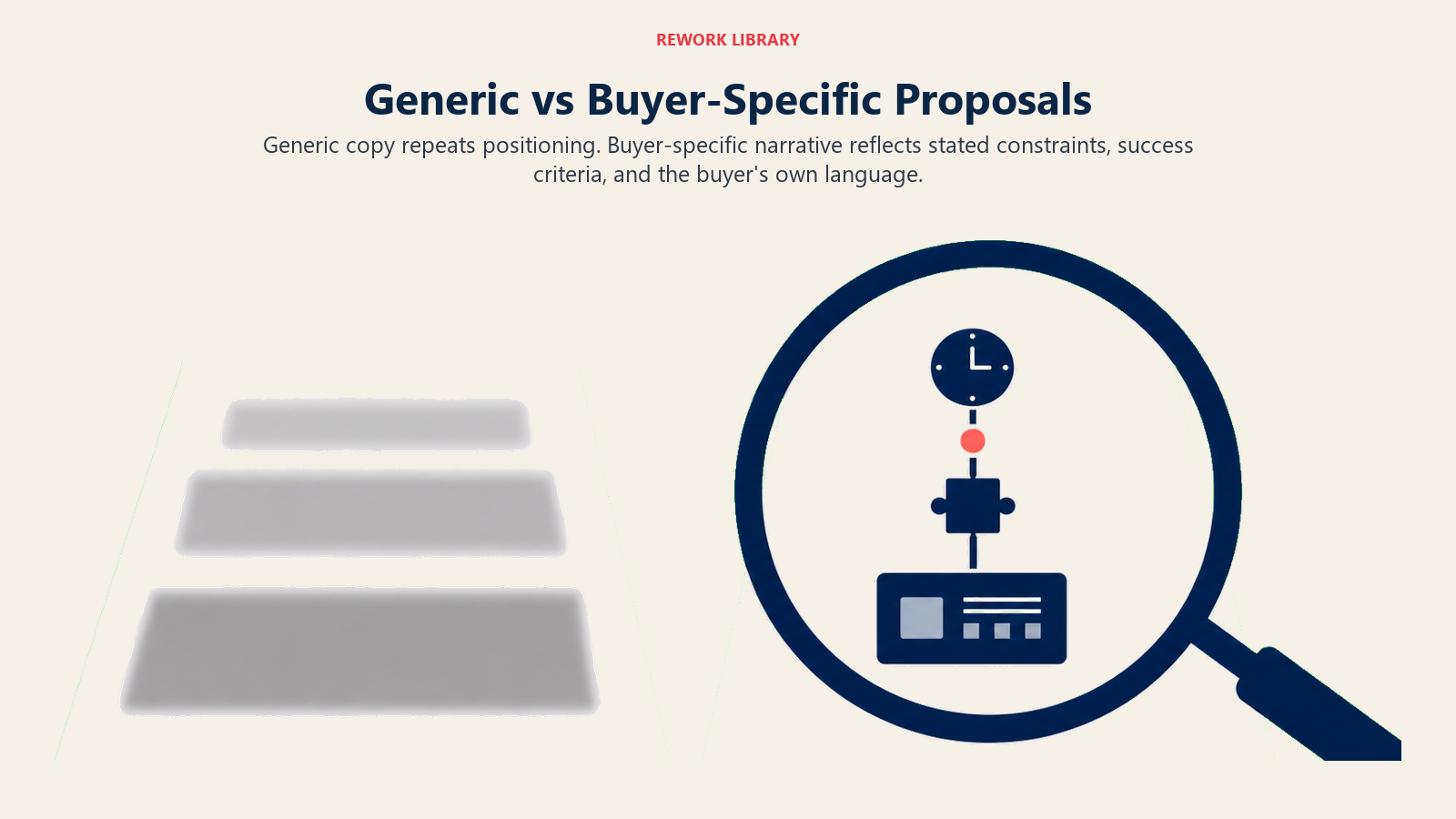
La narrativa genérica de una propuesta suena así: "Nuestra plataforma ayuda a empresas como la suya a lograr la excelencia operativa y acelerar el crecimiento de ingresos. Hemos trabajado con más de 500 clientes en todas las industrias para ofrecer resultados medibles."
Eso podría haberse escrito antes de que el rep hablara con este comprador. No le dice al comprador nada sobre qué tan bien el rep entendió su situación.
La narrativa específica suena así: "Su equipo identificó dos restricciones durante nuestras conversaciones de evaluación: la presión de tiempo para implementar antes de la revisión de la junta directiva en el Q3, y la preocupación de que su stack tecnológico existente (Salesforce más ERP heredado) requeriría una integración compleja. Nuestro enfoque de implementación está diseñado alrededor de ambas. Nuestro conector preconfigurado para Salesforce se implementa en 5 días. Y podemos escalonar la integración con el ERP para que entre en funcionamiento después del despliegue inicial, lo que mantiene su deadline del Q3 sin requerir el alcance técnico completo en la primera fase."
Esa es una conversación diferente. El comprador lo lee y sabe que el rep estaba escuchando. Aborda directamente las dos cosas que generaban hesitación.
La AI genera la versión específica cuando los inputs son ricos: cuando las transcripciones de llamadas capturaron esas restricciones, cuando el account brief documentó el stack tecnológico, y cuando la AI recibe instrucciones de priorizar las preocupaciones declaradas por el comprador sobre el lenguaje de posicionamiento genérico.
La configuración del prompt importa significativamente: "Genera un resumen ejecutivo que aborde directamente las 2 o 3 preocupaciones que el comprador expresó. Usa su lenguaje donde sea posible. No uses lenguaje de posicionamiento genérico. El comprador debería leer esto y sentir que entendimos exactamente lo que nos dijeron."
Revisión legal y de cumplimiento
Las propuestas frecuentemente contienen compromisos. Cronogramas de implementación que se convierten en SLAs contractuales. Certificaciones de seguridad que el equipo legal necesita validar. Compromisos de residencia de datos que requieren aprobación de TI. Garantías de tiempo de respuesta de soporte.
Las propuestas generadas por AI deben pasar por un paso de revisión legal o de cumplimiento para cualquier sección que contenga compromisos más allá del lenguaje estándar. Esto no es opcional.
El diseño práctico: definir qué secciones de la propuesta son "compromisos activos" que requieren revisión versus cuáles son "informativas" que no requieren aprobación legal. Las secciones estándar (descripción general del producto, casos de estudio, precios del catálogo) son informativas. Los compromisos de SLA, cronogramas de implementación, certificaciones de seguridad y términos contractuales personalizados son compromisos activos.
Para la segunda categoría, el flujo de trabajo debe requerir que un revisor apruebe explícitamente cada sección antes de que se envíe la propuesta. La mayoría de las herramientas CPQ y de propuestas lo soportan con flujos de trabajo de aprobación a nivel de sección.
Integración con herramientas CPQ
La generación de propuestas con AI se superpone a las herramientas CPQ (Configure Price Quote) en lugar de reemplazarlas. CPQ maneja el motor de precios: gestión de catálogo, reglas de descuento, flujos de aprobación y generación de documentos de cotización. La AI maneja la capa narrativa: la escritura contextual que envuelve la configuración de precios.
Salesforce CPQ es el CPQ más ampliamente implementado en ventas B2B enterprise. Einstein AI de Salesforce agrega recomendaciones de productos asistidas por AI y cierta funcionalidad de venta guiada. La generación completa de narrativa con AI requiere integración con un LLM a través de la plataforma Salesforce.
DealHub ofrece una plataforma CPQ con venta guiada y generación de propuestas asistida por AI. La AI se integra nativamente con el flujo de trabajo CPQ en lugar de requerir integración separada.
PandaDoc se enfoca en la capa de generación de documentos: plantillas de propuestas, firma electrónica, y generación de contenido con AI agregada recientemente. Ideal para equipos que no necesitan lógica CPQ pesada pero quieren narrativa asistida por AI en un formato de documento profesional.
Proposify similar a PandaDoc en posicionamiento: generación de documentos, gestión de plantillas, análisis sobre el engagement del prospecto (¿en qué secciones pasó tiempo?). La generación de contenido con AI es más reciente.
DocuSign CLM (Contract Lifecycle Management) maneja el flujo de trabajo post-propuesta: redlining, seguimiento de negociación, ejecución y gestión de obligaciones. La capa de AI se enfoca en el análisis de contratos y la identificación de riesgos más que en la generación de propuestas.
El stack práctico para la mayoría de los equipos mid-market: una herramienta CPQ (o hoja de cálculo de precios para deals más simples) para la capa de precios, una herramienta de generación de propuestas (PandaDoc, Proposify) para la capa de documentos, y generación de narrativa con LLM integrada en la herramienta de propuestas. No cuatro herramientas separadas; dos herramientas que se conectan.
Correos de Seguimiento de Ventas Auto-Redactados describe el mismo patrón Workflow Copilot aplicado antes en el ciclo del deal. Siguiente Mejor Acción para Cada Deal Abierto cubre cómo la etapa de propuesta se conecta con las recomendaciones de progresión del deal. E Investigación de Cuentas con AI Antes del Primer Contacto cubre el contexto de cuenta upstream que hace posible la personalización de propuestas.
Tasa de cierre y calidad de la propuesta
La conexión entre la calidad de la propuesta y la tasa de cierre es medible pero requiere atribución adecuada. La investigación de Capacidades Críticas CPQ de Gartner identifica la venta guiada y la configuración asistida por AI como las capacidades de mayor ROI en el stack CPQ, con equipos que las usan reportando ciclos de ventas significativamente más cortos y tasas de aceptación en el primer intento más altas.
Tiempo de entrega. Los deals donde la propuesta fue entregada dentro de las 48 horas de la solicitud tienen tasas de cierre significativamente más altas que los deals donde las propuestas tardaron más de 5 días. Los compradores interpretan la entrega rápida como competencia operativa e interés genuino. La generación asistida por AI mejora directamente esta métrica.
Calidad de personalización. Las propuestas que hacen referencia al lenguaje y las preocupaciones específicas del comprador de las conversaciones de descubrimiento tienen tasas de cierre más altas que las genéricas. Esto es cualitativo, pero algunos equipos lo rastrean haciendo que un segundo revisor califique las propuestas en una escala simple de 1 a 5 de especificidad antes de rastrear los resultados.
Tasa de aceptación en el primer intento. ¿Con qué frecuencia acepta el prospecto la primera propuesta versus solicita revisiones sustanciales? Las altas tasas de revisión indican que la propuesta no reflejó con precisión lo que se discutió o que los precios estaban mal. Las propuestas generadas por AI que extraen datos precisos del CRM deberían reducir las tasas de rechazo en el primer intento.
Número de versiones. ¿Cuántas rondas de revisión pasa típicamente una propuesta antes de su aceptación? Más de 3 rondas a menudo indica desalineación inicial. Las propuestas generadas por AI con un flujo sólido de datos de descubrimiento a propuesta deberían reducir el número de versiones.
El rep sigue siendo el dueño del resultado
El encuadre que importa para la adopción por parte de los reps: la AI está redactando el primer borrador, no el documento final. El nombre del rep va en la propuesta. La relación del rep está en juego si algo en la propuesta está mal. El rep revisa, el rep aprueba, el rep envía.
Este encuadre hace dos cosas. Posiciona a la AI correctamente como una herramienta que elimina el trabajo tedioso (ensamblaje de plantillas, selección de casos de estudio, secciones estándar). Y preserva la responsabilidad a nivel del rep, lo cual es apropiado para un documento que puede representar un compromiso de $50,000 a $500,000.
Las propuestas no son correos de seguimiento. Son precursores contractuales. La revisión no es fricción opcional a optimizar; es la gobernanza apropiada para documentos que contienen compromisos.
Pero un rep que revisa una propuesta de AI bien redactada, precisa y personalizada en 20 minutos no está haciendo un trabajo menos valioso que un rep que construye la misma propuesta desde cero en 4 horas. Está haciendo un trabajo más valioso: enfocando su juicio en lo que es estratégico en lugar de lo que es mecánico. El artículo Pipeline Review Prep con un AI Copilot conecta esto con la estrategia del deal más amplia, donde el patrón Workflow Copilot libera el ancho de banda cognitivo del rep para el trabajo intensivo en juicio.
El patrón Workflow Copilot describe el principio de diseño más amplio: la AI maneja el ensamblaje de contexto y el trabajo de primer borrador; los humanos manejan las decisiones con consecuencias reales. La generación de propuestas es la expresión más clara de ese patrón en el ciclo de ventas. La AI es el mejor asistente de investigación y redactor de borradores que su equipo ha tenido. Y el rep que revisa ese borrador en 20 minutos sigue siendo el dueño del deal. Esa distinción de propiedad es lo que hace que la pregunta de gobernanza en el siguiente paso sea crítica.
Rework Analysis: En los flujos de trabajo de propuestas B2B SaaS mid-market, la sección que requiere más tiempo de edición del rep después de la generación por AI es consistentemente el resumen ejecutivo, no la tabla de precios. El resumen ejecutivo falla con más frecuencia cuando las transcripciones de llamadas son incompletas (los reps no registraron correctamente la llamada de descubrimiento) o cuando la conversación de descubrimiento no reveló criterios de éxito específicos del comprador. La implicación: la calidad de las propuestas es un indicador rezagado de la calidad del descubrimiento. Los equipos que ven narrativas de propuestas de AI consistentemente de baja calidad deben investigar primero el proceso de llamada de descubrimiento, no la configuración del prompt.
Preguntas Frecuentes
¿Cuánto tiempo ahorra realmente la generación de propuestas asistida por AI?
Las herramientas AI CPQ y de propuestas reducen el tiempo promedio de generación de cotizaciones en un 75%, del proceso manual típico de 2 a 5 días a 2-4 horas. Para los reps individuales, esto generalmente significa 45 minutos de revisión e input estratégico versus 4 horas de ensamblaje de plantillas, cálculo de precios y búsqueda de contenido. Un distribuidor de equipos de manufactura documentó la reducción de la generación de propuestas de 3 días a 2 horas con una mejora del 89% en la precisión de precios después de implementar AI CPQ.
¿Qué es el Deterministic Price + Generative Narrative Split?
El Deterministic Price + Generative Narrative Split es el principio de diseño que separa el rol de la AI en las propuestas en dos carriles distintos: los precios siguen reglas deterministas del catálogo (sin generación de números de precios por AI), mientras que las secciones narrativas se producen generativamente a partir del contexto del deal. Mezclar AI generativa en la configuración de precios crea riesgo de alucinaciones en números con consecuencias financieras. Aplicar plantillas rígidas a la narrativa produce documentos impersonalizados que no reflejan las situaciones del comprador. Mantener la separación explícita previene ambos modos de fallo.
¿Cuál es el impacto en la tasa de cierre de propuestas más rápidas y personalizadas?
Las implementaciones de AI CPQ reportan un aumento promedio del 23% en las tasas de cierre de deals, impulsado en gran parte por una entrega más rápida y precios más precisos. Los deals donde las propuestas se entregan dentro de las 48 horas de la solicitud cierran a tasas significativamente más altas que aquellos donde las propuestas tardan más de 5 días, porque los compradores interpretan la entrega rápida como competencia operativa. La venta guiada con AI también permite deals hasta un 20% más grandes a través de recomendaciones de precios optimizadas.
¿Qué secciones de una propuesta debe generar la AI versus escribir los humanos?
La AI debe generar: tabla de precios (desde el catálogo y la configuración del deal), selección y encuadre de casos de estudio, secciones estándar (antecedentes de la empresa, cronograma de implementación, modelo de soporte, términos legales estándar), y un primer borrador del resumen ejecutivo y la declaración de valor. Los humanos deben ser dueños de: decisiones estratégicas de encuadre del deal (priorizar precio vs. ROI), ajustes de tono específicos de la relación, lenguaje consciente de la negociación, términos contractuales personalizados, y validación final de todos los números de precios antes del envío.
¿Cuáles son los requisitos de gobernanza para las propuestas generadas por AI?
Todas las propuestas requieren revisión del rep antes del envío: el nombre del rep está en el documento y es dueño de cualquier compromiso que contenga. Las propuestas con precios no estándar (por encima del umbral de descuento automatizado) requieren aprobación del manager. Cualquier sección que contenga compromisos activos (cronogramas de SLA, certificaciones de seguridad, garantías de residencia de datos, términos contractuales personalizados) requiere revisión legal o de cumplimiento antes de la entrega. Las configuraciones de catálogo estándar con descuentos aprobados pueden ser auto-configuradas; los deals enterprise complejos requieren validación humana del deal desk en cada número de precio.
¿Por qué fallan los resúmenes ejecutivos generados por AI y cómo se corrige?
Los resúmenes ejecutivos de AI fallan cuando las transcripciones de llamadas son incompletas (faltan criterios de éxito del comprador y puntos de dolor declarados) o cuando las conversaciones de descubrimiento no revelaron prioridades específicas del comprador. La solución es upstream: mejorar el registro de llamadas de descubrimiento y la cobertura de transcripciones antes de ajustar la configuración del prompt. Los resúmenes ejecutivos de AI consistentemente deficientes son una señal de calidad de descubrimiento, no una señal de calidad de AI. La sección que necesita más edición es siempre aquella donde los datos subyacentes son más débiles.
Qué leer a continuación
- Workflow Copilot: AI como Asistente de Nivel Par: el patrón ACE detrás de la generación de propuestas asistida por AI
- Correos de Seguimiento de Ventas Auto-Redactados: el mismo patrón Workflow Copilot antes en el ciclo del deal
- Pipeline Review Prep con un AI Copilot: conectar el estado de la propuesta con la estrategia del deal en los pipeline reviews
- AI Sales Ops Governance y Audit Trails: diseño de gobernanza para acciones de AI con consecuencias financieras reales

Co-Founder, Rework.com
On this page
- Qué maneja la AI en la generación de cotizaciones y propuestas
- El pipeline Workflow Copilot para propuestas
- El Deterministic Price + Generative Narrative Split
- El problema de la precisión en la configuración
- Calidad de la narrativa de la propuesta
- Revisión legal y de cumplimiento
- Integración con herramientas CPQ
- Tasa de cierre y calidad de la propuesta
- El rep sigue siendo el dueño del resultado
- Qué leer a continuación