Die ehrlichen Kosten der KI-Transformation

Turn this article into takeaways for your work.


Each assistant summarizes the article only for you and suggests best practices for your work.
Das Anbieter-Pitch verspricht eine 30-prozentige Senkung der Betriebskosten. Der ROI-Rechner des KI-Startups sagt, das Tool amortisiert sich in 4 Monaten. Die Fallstudie von der Enterprise-Konferenz zeigt ein Unternehmen, das im ersten Jahr 2 Millionen Euro gespart hat.
Der CFO stellt eine Frage: Was kostet es tatsächlich, dorthin zu gelangen?
Fast niemand nennt die echte Zahl. Nicht weil Anbieter unehrlich sind. Sondern weil die meisten KI-ROI-Aussagen auf einer engen Kostendefinition basieren: Lizenzen. Und Lizenzen sind, bestenfalls, 20-30 % dessen, was KI-Transformation ein ernsthaftes Unternehmen tatsächlich kostet. McKinseys KI-Transformationsmanifest stellt fest, dass Unternehmen für jeden Euro, der für die Entwicklung von KI-Lösungen ausgegeben wird, mindestens einen weiteren Euro planen sollten, um vollständige Nutzerakzeptanz und Skalierung sicherzustellen. Das ist ein 2:1-Verhältnis, das die meisten Budgets vollständig ignorieren.
Dieser Artikel richtet sich an Führungskräfte, die das vollständige Bild brauchen, bevor sie eine Kapitalallokationsentscheidung treffen. Denn das ist KI-Transformation: eine Kapitalallokationsentscheidung, keine IT-Kostenlinie.
Die sichtbaren Kosten: Was Finanzteams tatsächlich modellieren
Wichtige Fakten: Die tatsächlichen Kosten der KI-Transformation
- Enterprise-KI-Implementierungen kosten typischerweise das 3-5-fache des beworbenen Abonnementpreises, wenn Integration, Anpassung, Infrastrukturskalierung und Betriebsaufwand berücksichtigt werden; sichtbare Lizenzen repräsentieren nur 15-20 % der Gesamtausgaben (Branchenbenchmarks, 2025)
- 85 % der Unternehmen schätzen KI-Projektkosten um mehr als 10 % falsch, und Unternehmen, die es versäumen, umfassende Kosten zu berücksichtigen, erleben Budgetüberschreitungen von durchschnittlich 30-40 % im ersten Jahr (Keyhole Software-Analyse, 2025)
- McKinsey schätzt, dass Unternehmen für jeden Euro, der für die Entwicklung von KI-Lösungen ausgegeben wird, mindestens einen weiteren Euro für vollständige Adoption und Skalierung einplanen sollten, ein 2:1-Verhältnis, das die meisten Budgets ignorieren (McKinsey KI-Transformationsmanifest)
Die Kostenkategorie, mit der fast jedes KI-Budget beginnt und endet, sind SaaS-Lizenzgebühren und API-Nutzungskosten. Diese sind sichtbar, weil sie in Anbieterverträgen auftauchen.
Für ein mittelständisches Unternehmen mit 200-500 Mitarbeitern, das eine ernsthafte KI-Initiative durchführt, sieht der Lizenzstack in etwa so aus:
Eine Foundation-LLM-API oder KI-Plattformlizenz kostet je nach Nutzungsstufe typischerweise 15-50 Euro pro Nutzer und Monat. Eine KI-gestützte Produktivitätssuite (Copilot-Äquivalent) kostet 20-30 Euro pro Nutzer und Monat zu Enterprise-Preisen. Spezialisierte KI-Tools für spezifische Funktionen (Vertriebsintelligenz, Support-Automatisierung, Coding-Assistenten, Finanzmodellierung) fügen 20-80 Euro pro Nutzer und Monat hinzu, für die Teams, die sie nutzen.
Das summiert sich schnell. Ein Unternehmen, das drei oder vier KI-Tools für ein 200-köpfiges Team einsetzt, kann leicht 150-300 Euro pro Nutzer und Monat allein für Lizenzen ausgeben. In der Skalierung sind das 360.000 bis 720.000 Euro jährlich, allein für Tool-Lizenzen, bevor eine einzige Zeile Integrationscode geschrieben wurde.
Die meisten KI-Budgets hören hier auf. Das ist der Fehler.
„Enterprise-KI-Implementierungen kosten das 3-5-fache des beworbenen Abonnementpreises, wenn Integration, Dateninfrastruktur, Change Management und Governance einbezogen werden. Der ROI-Rechner des Anbieters ist für das, was er misst, korrekt. Er misst nur 20 % der tatsächlichen Investition." (Rework, basierend auf Branchenbenchmarks 2025)
Die versteckten Kosten (typischerweise das 3-5-fache der Lizenzkosten)
Das 3-Bucket-KI-Kostenmodell
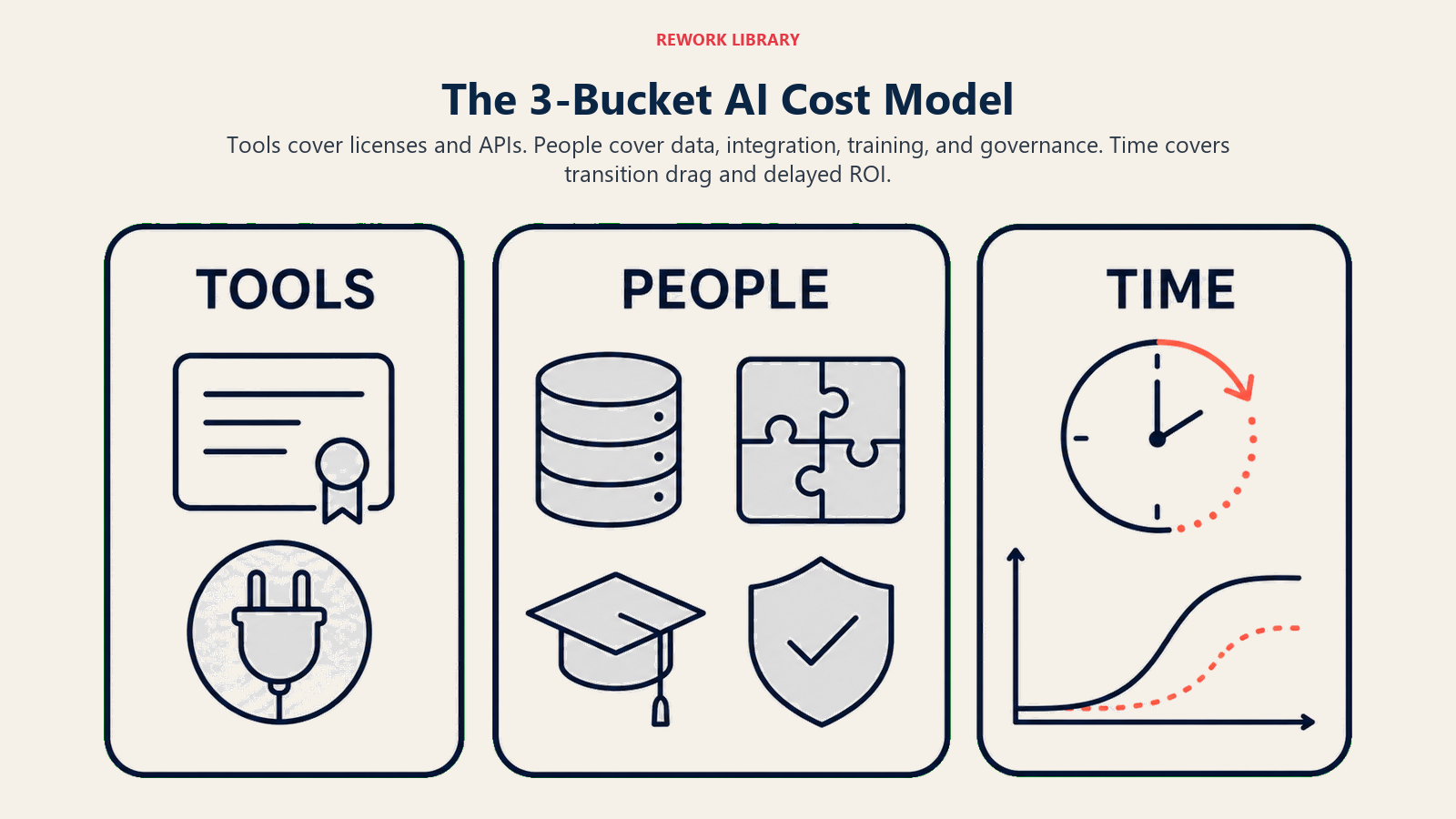
Ein Framework zum Aufbau vollständiger KI-Transformationsbudgets, die Finanzteams gegenüber dem Aufsichtsrat vertreten können. Bucket 1 (Tools) umfasst alle SaaS-Lizenzen, API-Nutzung und Plattformgebühren. Bucket 2 (Menschen) umfasst Data Engineering, Integrationsarbeit, Change Management, Schulung und Governance-Einrichtung. Bucket 3 (Zeit) umfasst den Produktivitätsverlust während des Übergangs und die Kosten der verzögerten ROI-Realisierung während der Aufbauphase. Die meisten Anbieter-ROI-Modelle stellen nur Bucket-1-Kosten dar. Das 3-Bucket-Modell stellt sicher, dass Buckets 2 und 3 explizit vor der Kapitalverpflichtung umfangreich geplant werden, anstatt als Überschreitungen 6 Monate später entdeckt zu werden. Historisch gesehen beträgt Bucket 2 das 1,5-2-fache von Bucket 1. Bucket 3 ist typischerweise 15-25 % der gesamten 18-monatigen Investition.
Versteckte Kosten sind nicht obskur. Sie sind vorhersehbar. Sie werden einfach nicht in Anbieter-Pitches zitiert, weil kein Anbieter eine Budgetlinie für die Kosten der Bereinigung Ihrer Dateninfrastruktur oder des Change Managements hat, das sein Produkt erfordert.
Datenvorbereitung und Infrastruktur. KI läuft nicht auf unordentlichen Daten. Ingest- und Analyze-Fähigkeiten, das Fundament des ACE Framework, erfordern, dass Daten erfasst und strukturiert werden können. Für die meisten mittelständischen Unternehmen bedeutet das ein Projekt, das Monate dauert: CRM-Datensätze deduplizieren, Namenskonventionen standardisieren, Pipelines aufbauen, um disparate Systeme zu verbinden, möglicherweise ein Data Warehouse oder eine Vektordatenbank lizenzieren und einen Data Engineer engagieren, um es zu warten.
Diese Arbeit kostet Geld. Ein Dateninfrastrukturprojekt für ein 300-Personen-Unternehmen läuft typischerweise auf 80.000 bis 300.000 Euro für die erste Bereinigung und Verbindung, plus 60.000-150.000 Euro pro Jahr für laufende Wartung (Data-Engineer-Gehalt oder Auftragnehmer-Retainer). Unternehmen, die diese Arbeit überspringen, geben das Dreifache für gescheiterte KI-Piloten aus, die unbrauchbare Outputs produzieren, weil ihre zugrundeliegenden Daten nicht bereit sind.
Integrations-Engineering. KI-Tools fügen sich nicht sauber in bestehende Systeme ein, ohne maßgeschneiderte Arbeit. Einen KI-Vertriebsassistenten mit Ihrem CRM, Ihrem E-Mail-System, Ihrer Anrufaufzeichnungsplattform und Ihrem Deal-Desk zu verbinden, erfordert APIs, Webhooks, Datentransformationen und laufende Wartung, wenn jedes System aktualisiert wird. Ein typisches Enterprise-Integrationsprojekt für drei verbundene KI-Tools kostet 50.000 bis 200.000 Euro in Engineering-Zeit, abhängig von der Komplexität bestehender Systeme.
Diese Kosten sind besonders unsichtbar, weil sie oft in „IT-Projektzeit" absorbiert werden, anstatt im KI-Budget. Aber es sind echte Kosten für die Umsetzung der KI-Transformation.
Change Management und Schulung. Ein KI-Tool an 200 Mitarbeiter auszuliefern, ohne sie zu schulen, produziert keine Adoption. Es produziert eine 12-prozentige Nutzungsrate. Change Management für einen ernsthaften KI-Einsatz umfasst: mitarbeiterbezogene Schulungen (geschätzt auf 500-1.500 Euro pro Person für strukturierte Programme), Workflow-Neugestaltungs-Workshops für jedes betroffene Team und Manager-Schulungen, damit direkte Vorgesetzte KI-Nutzung coachen können.
Für ein 200-Personen-Unternehmen, das einen gestaffelten KI-Rollout über drei Funktionen hinweg durchführt, belaufen sich die Change-Management-Kosten typischerweise auf 100.000 bis 250.000 Euro über 18 Monate. Unternehmen, die das überspringen, erhalten Shadow AI, aufgegebene Tools und gescheiterte Initiativen.
„68 % der Unternehmen unterschätzen Datenvorbereitung und modellbezogene Ausgaben. Wenn gescheiterte KI-Projekte schließlich Datensanierung einkalkulieren, betragen die Kosten durchschnittlich das 2,8-fache des ursprünglichen Projektbudgets. Das ist keine Kostenüberschreitung. Es ist ein Budget, das von Anfang an nicht korrekt erstellt wurde." (Informatica, 2025)
Governance-Einrichtung. Eine KI-Nutzungsrichtlinie zu schreiben, Tool-Genehmigungsprozesse einzurichten, Audit-Protokollierung für KI-Aktionen zu implementieren und Compliance-Überprüfungen für branchenspezifische Anforderungen (Gesundheitswesen, Finanzdienstleistungen, Recht) durchzuführen, erfordert echte Arbeit. Ein grundlegendes Governance-Programm für ein mittelständisches Unternehmen umfasst 40-80 Stunden Führungszeit, rechtliche Überprüfung von KI-Nutzungsrichtlinien (10.000-30.000 Euro je nach Komplexität) und Tooling zur Überwachung der KI-Nutzung (15.000-50.000 Euro jährlich).
Governance sieht wie Overhead aus, bis der Incident passiert. Das Unternehmen, dessen Marketing-Team Kundendaten in ein nicht genehmigtes öffentliches KI-Tool eingefügt hat und dabei eine Datenpannenmeldepflicht ausgelöst hat, gab 500.000 Euro für Anwaltskosten, regulatorische Reaktion und Kundenkommunikation aus. Das Governance-Programm, das das verhindert hätte, hätte 50.000 Euro gekostet.
Produktivitätsverlust während des Übergangs. Diese Kosten sind real und werden fast nie modelliert. Wenn ein Team von einem manuellen Prozess zu einem KI-gestützten übergeht, sinkt die Produktivität, bevor sie steigt. Die ersten sechs Wochen der Nutzung eines neuen KI-Workflows sind langsamer, nicht schneller. Ein Team von 20 Personen, das 15 % der Produktivität über 6-8 Wochen verliert, verliert 240 Personenstunden Output. Bei einem vollständig belasteten Kostensatz von 75 Euro pro Stunde für Wissensarbeiter sind das 18.000 Euro pro Team.
Multipliziert über drei oder vier Teams, die gestaffelte Rollouts durchführen, summieren sich die Übergangskosten auf 60.000-100.000 Euro für ein mittelständisches Unternehmen.
Die vollständige Kostenaufschlüsselung
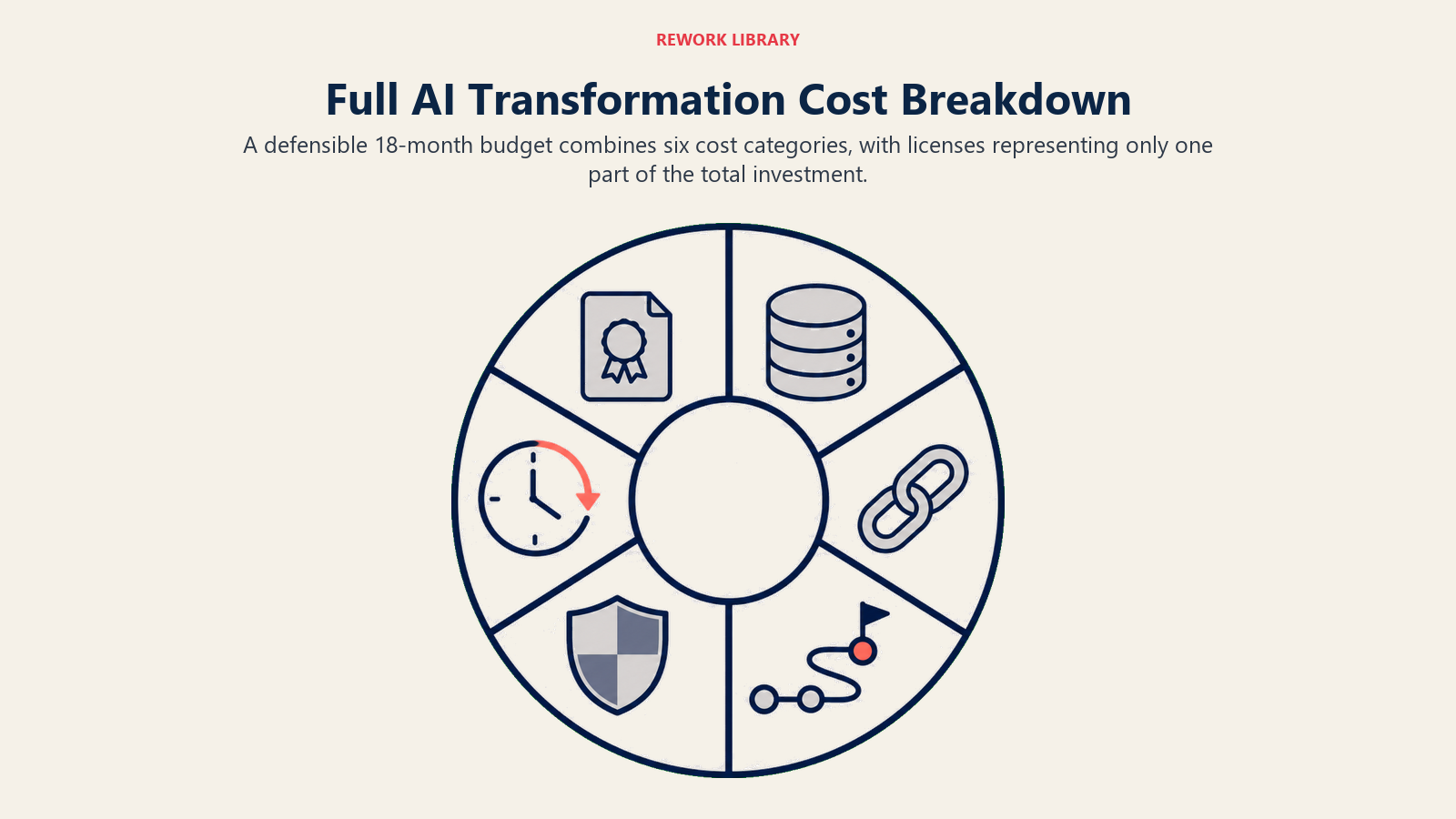
| Kostenkategorie | Mittelständische Schätzung (200-500 Mitarbeiter, 18 Monate) | Anmerkungen |
|---|---|---|
| SaaS-Lizenzen und API-Nutzung | 300.000 bis 720.000 Euro | Variiert nach Tool-Stack und Nutzeranzahl |
| Datenvorbereitung und Infrastruktur | 100.000 bis 350.000 Euro | Einmalige Bereinigung plus laufende Wartung |
| Integrations-Engineering | 75.000 bis 200.000 Euro | KI-Tools mit bestehenden Systemen verbinden |
| Change Management und Schulung | 100.000 bis 250.000 Euro | Mitarbeiterschulung plus Manager-Schulung |
| Governance-Einrichtung | 50.000 bis 100.000 Euro | Richtlinie, Rechtsberatung, Monitoring-Tooling |
| Produktivitätsverlust während des Übergangs | 60.000 bis 100.000 Euro | 6-8 Wochen pro Team, vorübergehend |
| Gesamtinvestition 18 Monate | 685.000 bis 1.720.000 Euro | Bevor ROI realisiert wird |
Die Spanne ist weit, weil Unternehmensgröße, vorhandene Infrastrukturqualität und der Umfang der KI-Initiative erheblich variieren. Aber die Botschaft ist konsistent: Für ein Unternehmen, das KI-Transformation ernsthaft betreibt, liegt die realistische 18-monatige Investition im Bereich von 700.000 bis 1,7 Millionen Euro. Nicht 150.000 Euro in Lizenzkosten.
Kosten nach Reifegrad
Die obigen Kosten spiegeln ein Unternehmen wider, das von Stufe 1 (ad hoc) zu Stufe 2-3 (Pilot bis frühe Skalierung) des 5-Stufen-KI-Reifemodells übergeht. Die Kostenstruktur auf Stufe 4-5 ist ein anderes Gespräch.
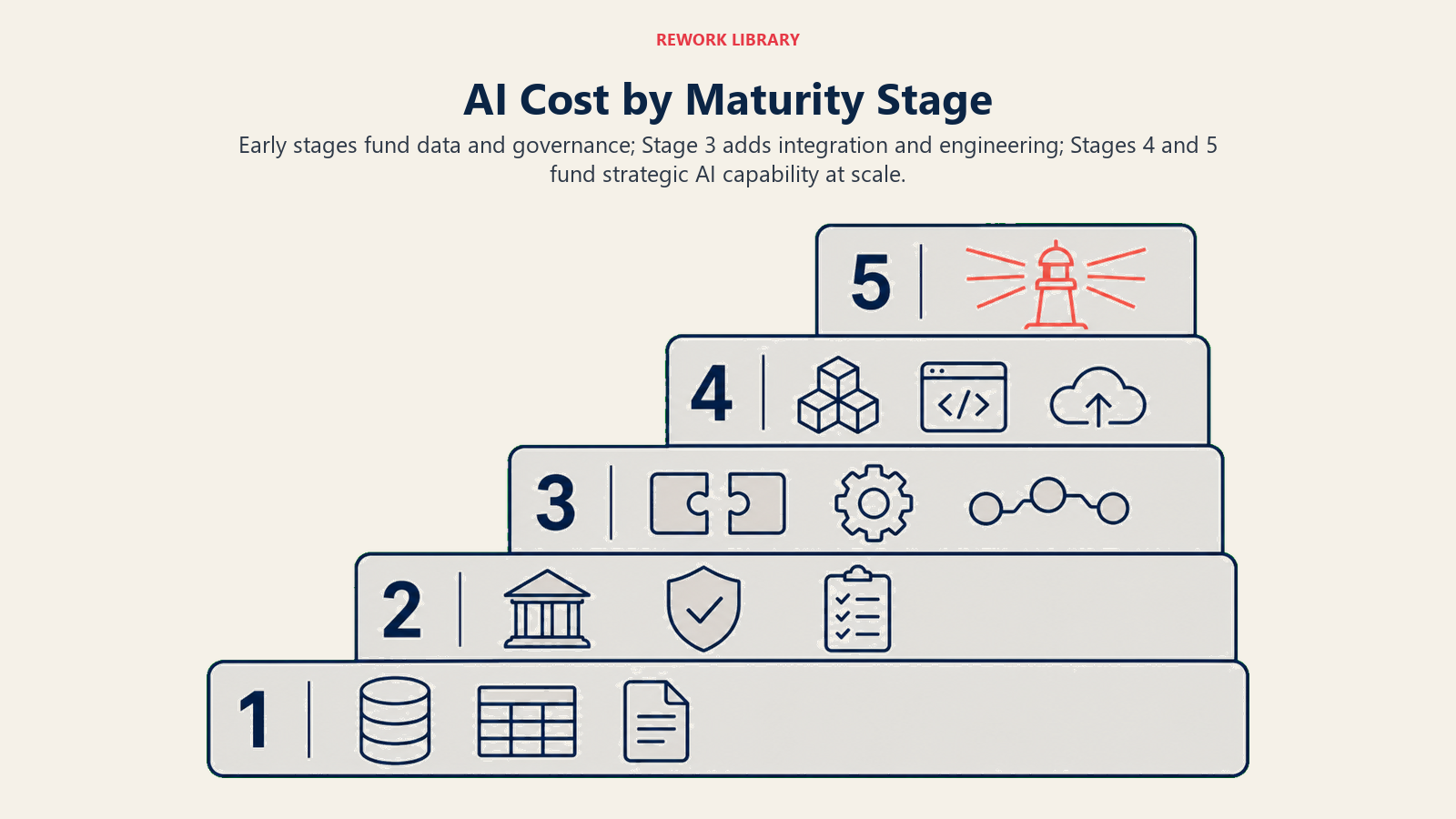
Auf Stufe 1-2: Der Großteil der Kosten ist Dateninfrastruktur und Governance-Einrichtung. Sie bauen Fundamente. Tool-Lizenzen sind relativ bescheiden, weil Sie begrenzte Piloten durchführen.
Auf Stufe 3: Engineering-Kosten steigen scharf. Sie verbinden mehrere KI-Systeme, bauen maßgeschneiderte Integrationen auf und setzen möglicherweise Vektordatenbanken oder maßgeschneiderte Fine-Tuned-Modelle ein. Ein Stufe-3-Unternehmen könnte jährlich 200.000-500.000 Euro zusätzlich für Infrastruktur und Engineering über Stufe 2 hinaus aufwenden.
Auf Stufe 4-5: Die Investition wird in Millionen jährlich gemessen, aber auch das ROI-Potenzial wird anders gemessen. Unternehmen auf Stufe 4-5 optimieren keine Workflows. Sie bauen Wettbewerbswälle. Die ROI-Frage auf dieser Stufe lautet nicht: „Hat dieses Tool uns Geld gespart?" Sie lautet: „Ermöglicht diese KI-Fähigkeit uns, Deals zu gewinnen, Kunden zu halten, oder Märkte zu erschließen, die Wettbewerber nicht erreichen können?"
Die 18-Monats-Cashflow-Realität
Die Cashflow-Sicht trennt die Amortisationsrechnung der Anbieter von den breiteren Transformationskosten, die die Führung tatsächlich finanzieren muss.
Der Anbieter-ROI-Rechner, der 4-monatige Amortisation zeigt, lügt nicht. Er zeigt Ihnen eine spezifische Kennzahl (Lizenzkosten, die durch Zeiteinsparungen zurückgewonnen werden) auf einem spezifischen Zeitrahmen. Diese Berechnung ignoriert alles oberhalb der Lizenzkostenlinie.
Das ehrliche Cashflow-Modell für KI-Transformation sieht so aus:
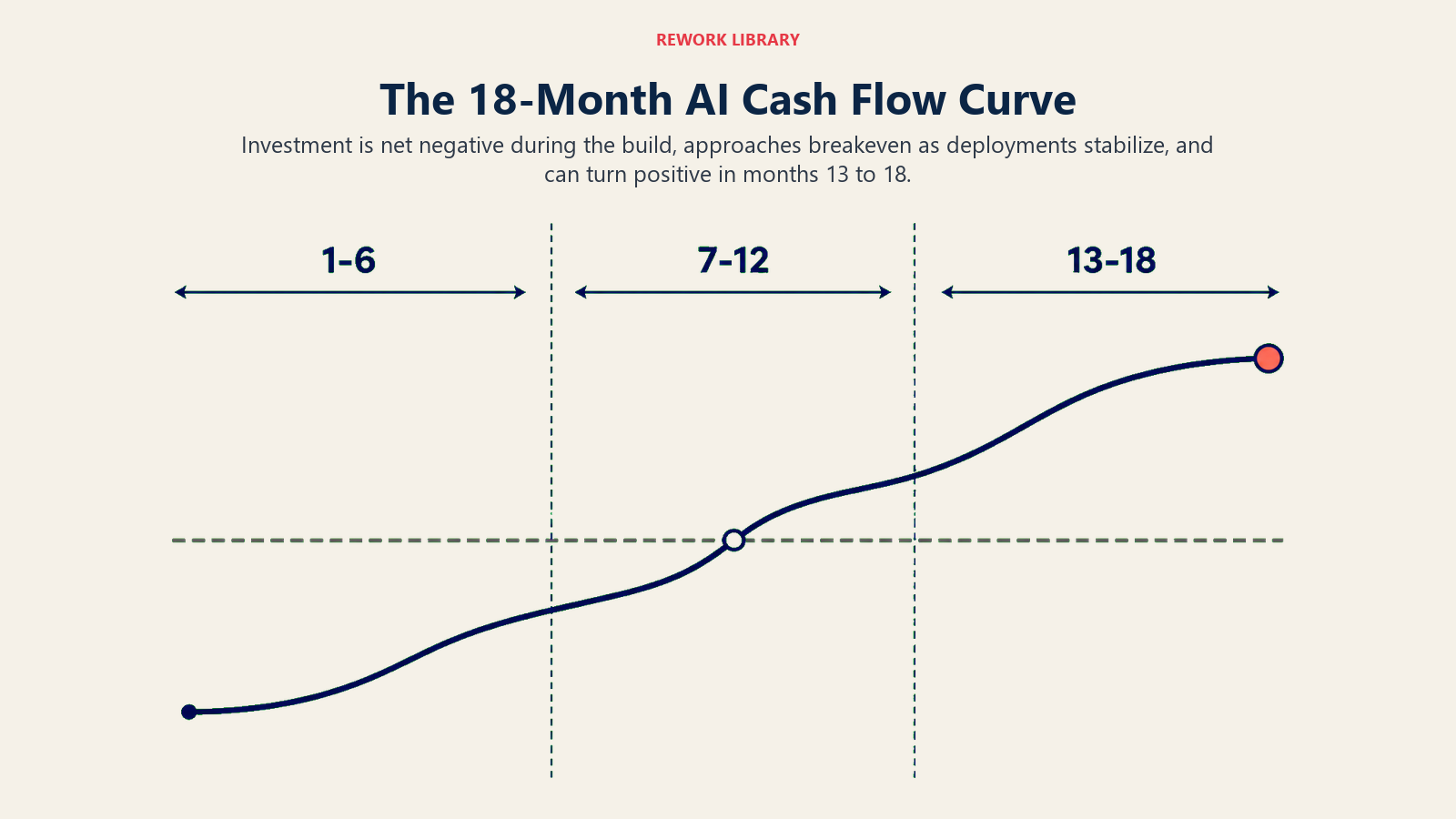
Monate 1-6: Netto-negativ. Infrastruktur wird aufgebaut. Schulungen finden statt. Integrations-Engineering läuft. Piloten produzieren Erkenntnisse, keinen ROI. Erwarten Sie Ausgaben von 300.000-600.000 Euro mit minimalem messbaren Return, wenn Sie das Programm korrekt durchführen.
Monate 7-12: Break-even bis bescheiden positiv. Die ersten Produktionseinsätze laufen. Messbare Zeiteinsparungen, Fehlerquotenreduzierungen oder Konversionsverbesserungen zeigen sich in den Kennzahlen, die Sie vor den Piloten eingerichtet haben. Die Daten deuten darauf hin, dass die Investition sich auszahlen wird.
Monate 13-18: Positiver ROI-Bereich, vorausgesetzt, das Programm wurde gut durchgeführt. Produktionssysteme generieren konsistente Einsparungen oder Umsatzauswirkungen.
Gut geführte KI-Transformationsprogramme bei mittelständischen Unternehmen erreichen typischerweise Break-even um Monat 12-18 im vollständigen Kostenmodell. Unternehmen, die nur Lizenzkosten modellieren, erreichen ihren Papier-ROI in Monat 4-6 und werden dann überrascht, wenn die tatsächliche Amortisationszeit sichtbar wird.
Rework-Analyse: Basierend auf dem 3-Bucket-KI-Kostenmodell für mittelständische Unternehmen (200-500 Mitarbeiter) repräsentiert Bucket 1 (Tools) typischerweise 30-40 % der 18-monatigen Gesamtkosten, Bucket 2 (Menschen) 45-55 % und Bucket 3 (Zeit/Übergangsverlust) 10-15 %. Unternehmen, die KI-Transformation richtig machen, geben in den Monaten 1-9 mehr in Buckets 2 und 3 aus und sehen in den Monaten 10-18 eine schnellere ROI-Beschleunigung. Das Verhältnis kehrt sich um: Unterspendung bei Menschen und Zeit erhöht die Gesamtprogrammkosten, weil gescheiterte Piloten Neustarts erfordern, die mehr kosten als korrekt durchgeführtes Change Management beim ersten Versuch.
Der CFO, der das 18-Monats-Modell korrekt erstellt, setzt ehrliche Erwartungen gegenüber dem Aufsichtsrat und erklärt nicht bei Monat 9 eine Kostenüberschreitung. Eine ausführlichere Darstellung, wie sich das Gespräch mit dem Aufsichtsrat aufbauen lässt, finden Sie in Das CFO-Gespräch über das KI-Budget.
Wann die Kosten es wert sind
Die Szenarien, in denen KI-Transformation 5-10-fache Renditen liefert, sind spezifisch. McKinsey schätzt, dass generative KI jährlich 2,6 bis 4,4 Billionen Euro Wert für Enterprise-Anwendungsfälle hinzufügen könnte, aber nur für Unternehmen, die die vollständige Transformation ausführen, nicht nur die Tool-Adoption. Zwei Kategorien stechen konsistent hervor.
Kundenseitiges Execute in der Skalierung. Wenn KI Aktionen ausführt, die zuvor von menschlichen Agenten bearbeitet wurden (Kundendienst-Antworten, ausgehende Nachverfolgung, Verlängerungsmanagement), sind die Wirtschaftlichkeitsdaten überzeugend. Klarnas KI-Kundendiensteinsatz 2024 erledigte Arbeit, die 700 Vollzeitmitarbeitern entspricht. Aber um diesen Einsatz zu erreichen, war Reife auf Stufe 3-4 erforderlich: saubere Daten, integrierte Systeme, Governance und die Workflow-Neugestaltung.
Skaliertes Predict für Risiko- oder Umsatzentscheidungen. Wenn KI Kreditanträge bewertet, gefährdete Kundenaccounts erkennt oder Ausbauchancen identifiziert, und diese Vorhersagen präzise genug sind, um Entscheidungen zu treffen, ist der ROI-Multiplikator hoch.
Unternehmen, die 5-10-fache Renditen sehen, sind nicht diejenigen, die ihre KI-Investition minimiert haben. Sie sind diejenigen, die die vollständige Investition getätigt haben.
Wie man den ehrlichen Business Case aufbaut
Drei Dinge, die der CFO vor der Genehmigung eines KI-Transformationsbudgets verlangen sollte:
Total Cost of Transformation (TCT)-Modell. Nicht nur Lizenzen. Alle sechs Kostenkategorien oben, mit realistischen Schätzungen für Ihre Unternehmensgröße, bestehenden Infrastrukturzustand und Transformationsumfang. Die TCT ist die Treuhandgeld-Zahl. Auf ihrer Basis sollten Kapitalallokationsentscheidungen getroffen werden.
ROI-Hypothese mit messbarer Baseline. Vor Programmstart: Welche Kennzahl wird sich verändern, von welcher Baseline, zu welchem Ziel, bis wann? Ohne das gibt es keinen ROI zu messen.
Stufenweise Kapitalfreigabe. Das anfängliche Budget finanziert das Fundament (Daten, Governance, erster Pilot). Die nächste Tranche wird freigegeben, wenn der erste Pilot seine ROI-Hypothese erfüllt. Stufenweise Kapitalfreigabe ist Standard in der Produktentwicklung. Sie sollte Standard in der KI-Transformation sein.
KI-Transformation ist es wert, durchgeführt zu werden. Für die meisten Unternehmen in 2026 lautet die Frage nicht, ob in KI investiert werden soll, sondern ob mit einem realistischen Modell investiert werden soll. Die Unternehmen, die in drei Jahren den Wettbewerbsvorteil haben werden, sind diejenigen, die jetzt den richtigen Weg einschlagen.
Für die stufenbezogenen Kostenimplikationen gibt Die 5 Stufen der KI-Reife die technischen und organisatorischen Anforderungen pro Stufe. Für die Entscheidung, ob maßgeschneiderte KI aufgebaut oder SaaS-Tools gekauft werden sollen, behandelt Die Build vs. Buy vs. Integrate-Entscheidung das Framework vollständig.
Häufig gestellte Fragen
Was sind die tatsächlichen Gesamtkosten der KI-Transformation für ein mittelständisches Unternehmen?
Für ein Unternehmen mit 200-500 Mitarbeitern, das eine ernsthafte KI-Transformation über 18 Monate durchführt, liegt die realistische Gesamtinvestition zwischen 685.000 und 1,7 Millionen Euro. Lizenz- und API-Gebühren (Bucket 1) repräsentieren nur 30-40 % dieses Gesamtbetrags. Dateninfrastruktur, Integrations-Engineering, Change Management, Governance-Einrichtung und Übergangsverluste machen die verbleibenden 60-70 % aus.
Warum unterschätzen KI-Anbieter-ROI-Rechner die tatsächlichen Kosten?
Anbieter-ROI-Rechner messen Lizenzkosten gegenüber Zeiteinsparungen. Sie berücksichtigen nicht die Kosten der Datenvorbereitung, des Integrations-Engineerings, des Change Managements, der Governance-Einrichtung oder des 6-8-wöchigen Produktivitätsrückgangs, den Teams beim Übergang zu neuen KI-gestützten Workflows erleben. Diese nicht aufgeführten Kosten belaufen sich typischerweise auf das 3-5-fache der Lizenzlinie.
Was ist das 3-Bucket-KI-Kostenmodell?
Das 3-Bucket-KI-Kostenmodell ist ein Framework zum Aufbau vollständiger KI-Transformationsbudgets. Bucket 1 (Tools) umfasst Lizenz- und API-Kosten. Bucket 2 (Menschen) umfasst Data Engineering, Integration, Change Management, Schulung und Governance. Bucket 3 (Zeit) umfasst den Übergangsverlust und die Kosten der verzögerten ROI-Realisierung. Die meisten Anbieter-Angebote adressieren nur Bucket 1. Das 3-Bucket-Modell stellt sicher, dass alle drei vor der Kapitalverpflichtung geplant werden.
Wie lange dauert es, bis KI-Transformationsinvestitionen ROI zeigen?
Gut geführte mittelständische KI-Transformationsprogramme erreichen typischerweise Break-even bei Monat 12-18 im vollständigen Kostenmodell. Unternehmen, die nur Lizenzkosten modellieren, sehen möglicherweise Papier-ROI bei Monat 4-6 und erleben dann Überraschungen, wenn die Gesamtprogrammkosten sichtbar werden. Der Break-even-Punkt beschleunigt sich, wenn Change Management und Dateninfrastruktur korrekt vorab finanziert werden, weil Piloten beim ersten Versuch erfolgreich sind, anstatt Neustarts zu erfordern.
Welcher Anteil der KI-Transformationskosten ist Change Management?
Change Management und Schulung machen typischerweise 100.000 bis 250.000 Euro eines 18-monatigen KI-Transformationsprogramms für ein 200-Personen-Unternehmen aus. Das entspricht ungefähr 10-15 % der Gesamtprogrammkosten. Unternehmen, die das überspringen, berichten von Adoptionsraten unter 20 % nach 90 Tagen, was die Lizenz- und Integrationsinvestition effektiv verschwendet. McKinseys Empfehlung lautet, für jeden Euro, der für KI-Entwicklung ausgegeben wird, mindestens einen Euro für Adoption und Change Management einzuplanen.
Was sollte ein CFO vor der Genehmigung eines KI-Transformationsbudgets verlangen?
Ein CFO sollte drei Dinge verlangen: ein Total Cost of Transformation (TCT)-Modell, das alle sechs Kostenkategorien (nicht nur Lizenzen) abdeckt, eine spezifische ROI-Hypothese mit einer messbaren Baseline-Kennzahl und einem Ziel, sowie stufenweise Kapitalfreigabe, sodass jede Budgettranche erst freigegeben wird, nachdem die vorherige Stufe ihre Ziele erfüllt hat. Stufenweise Freigabe ist Standard in der Produktentwicklung und sollte Standard in der KI-Transformation sein.
Siehe auch:
- Warum die meisten KI-Transformationen scheitern: Die fünf Versagensmuster, die diese Investition in Verschwendung verwandeln
- Die 18-Monats-CEO-KI-Agenda: Budget-Verpflichtungen über die Roadmap phasenweise aufteilen
- Die 5 Dimensionen des KI-ROI: Wie man die Ertragsseite dieser Gleichung misst

Co-Founder, Rework.com
On this page
- Die sichtbaren Kosten: Was Finanzteams tatsächlich modellieren
- Die versteckten Kosten (typischerweise das 3-5-fache der Lizenzkosten)
- Das 3-Bucket-KI-Kostenmodell
- Die vollständige Kostenaufschlüsselung
- Kosten nach Reifegrad
- Die 18-Monats-Cashflow-Realität
- Wann die Kosten es wert sind
- Wie man den ehrlichen Business Case aufbaut