Die Evolution der Business-KI: Von Classical ML zur modernen KI
Turn this article into takeaways for your work.


Each assistant summarizes the article only for you and suggests best practices for your work.
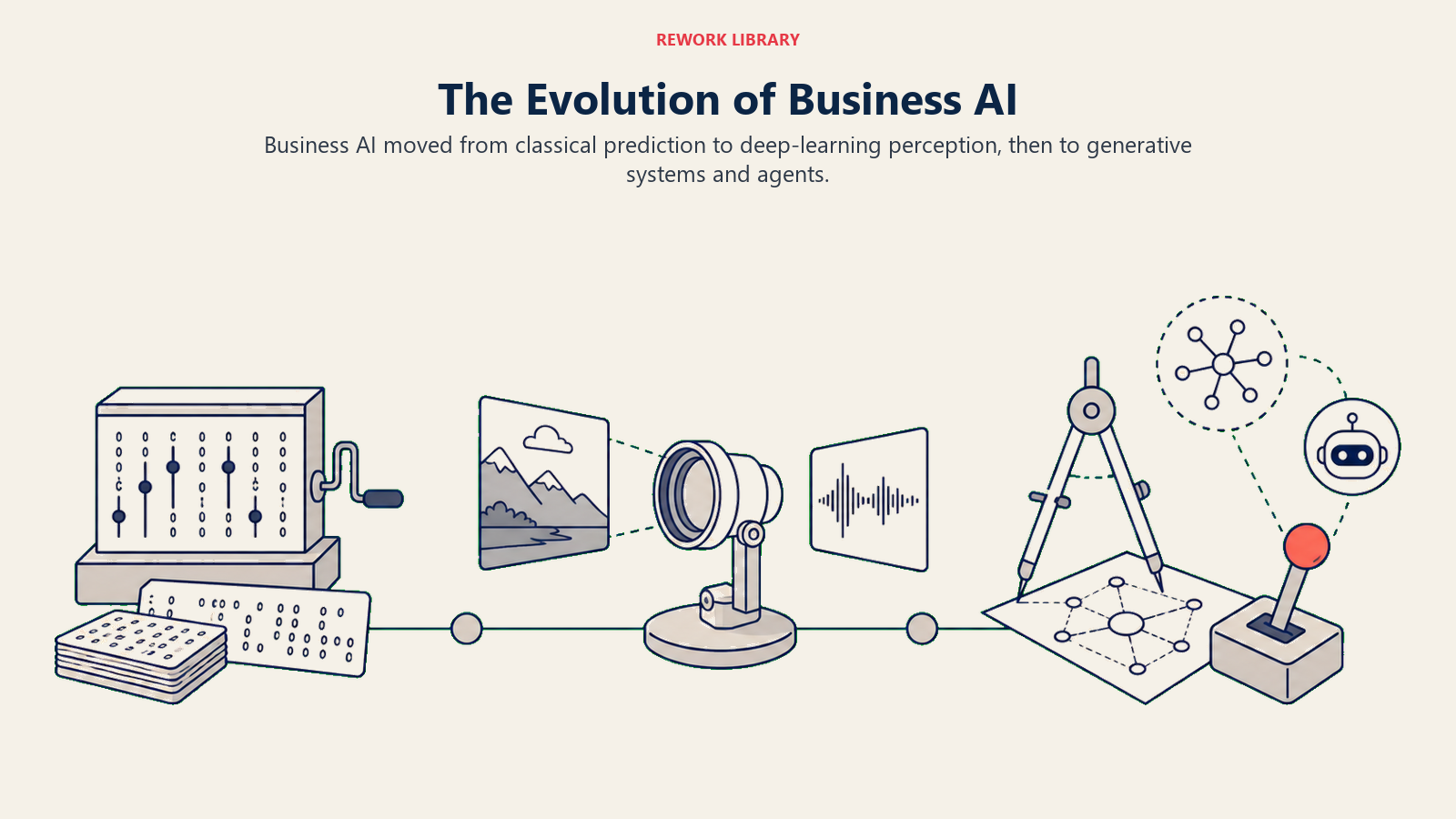
Jede Anbieter-Demo beginnt mit „der KI-Revolution“. Die meisten, die diese Demos halten, haben ihre Karriere nach der letzten großen KI-Welle begonnen. Wenn sie also sagen, KI habe 2022 alles verändert, meinen sie das ernst. Doch die historische Faktenlage erzählt etwas anderes.
Business-KI ist über 30 Jahre alt. FICO-Scores automatisierten Kreditentscheidungen bereits 1989. Spamfilter nutzten in den 1990er Jahren statistische Klassifikation. Amazons Empfehlungsmaschine lief, bevor die meisten heutigen Operatoren ihren ersten Job hatten. KI begann nicht 2022. Die Benutzeroberfläche änderte sich. Die Zugänglichkeit änderte sich. Der Lärmpegel hat sich zweifellos verändert. Aber das Grundprinzip wurde schon drei Jahrzehnte lang aufgebaut, bevor ChatGPT startete.
Das ist aus praktischen Gründen wichtig, nicht aus historischen. Wenn Sie KI für ein Phänomen von 2022 halten, gewichten Sie die neuesten Tools über und die dauerhaften Investitionen unter, die in jeder Ära über den KI-Erfolg entschieden haben. Sie jagen dem neuesten Modell hinterher, statt die unspektakuläre Datenarbeit zu erledigen. Und Sie müssen Ihr mentales Modell alle sechs Monate neu aufbauen, weil sich die Produktlandschaft verschiebt.
Wenn Sie die drei Ären der Business-KI verstehen und wissen, was sich in jeder tatsächlich verändert hat, erhalten Sie einen Rahmen, um die aktuelle Welle zu bewerten, ohne vom Hype hin- und hergerissen zu werden. Es erklärt auch, warum das ACE Framework um Fähigkeiten statt um Produkte herum gebaut ist: Die Fähigkeiten sind Jahrzehnte älter als ChatGPT, und sie werden alles überdauern, was als Nächstes kommt.
Epoche 1: Classical ML (grob 1990 bis 2010)
Die erste Epoche der Business-KI war leise. Sie hatte keine Marke. Niemand schrieb Keynote-Folien darüber. Sie lief einfach innerhalb von Systemen, für die Unternehmen bezahlten und die sie größtenteils ignorierten.
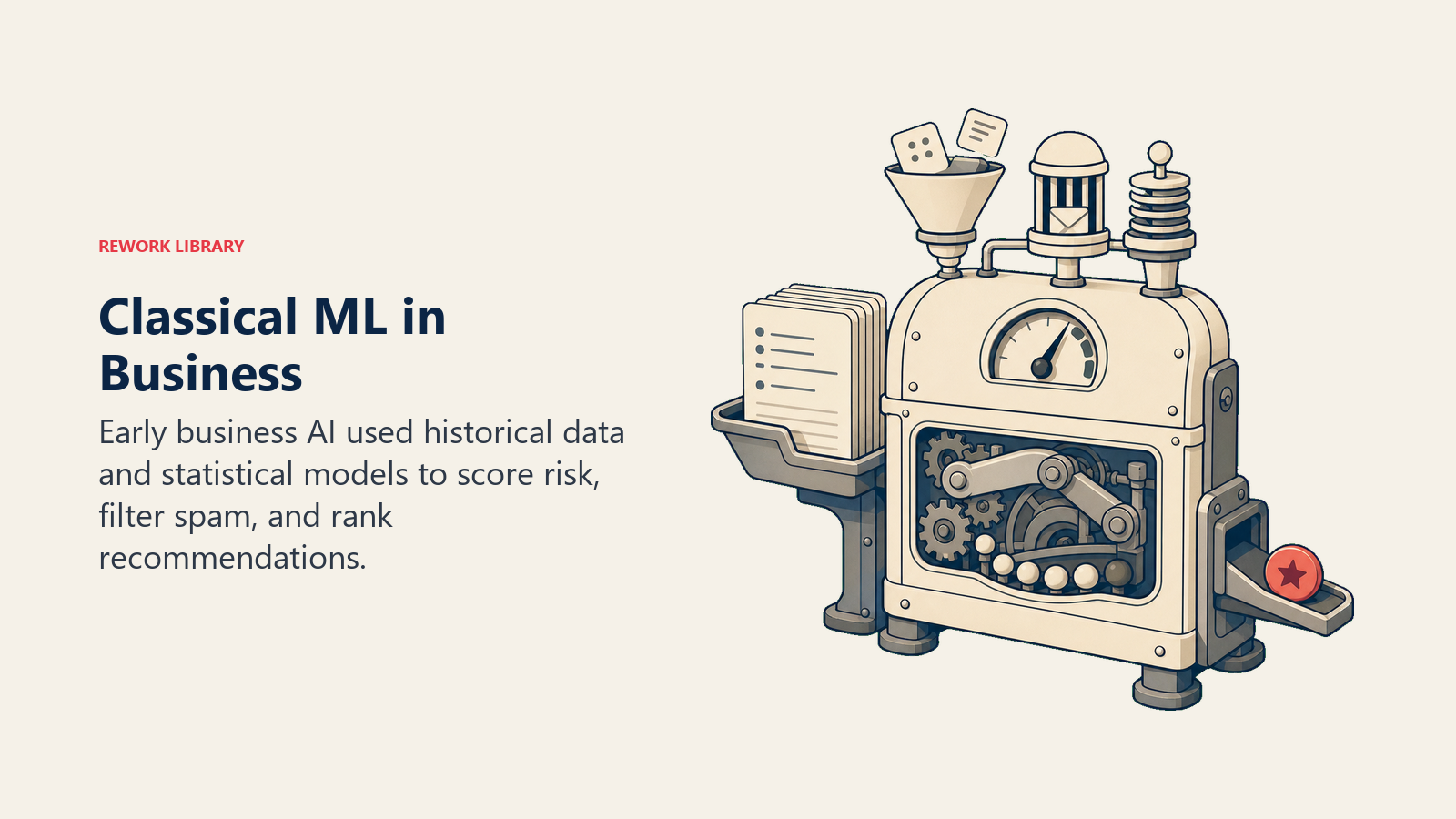
Das technische Fundament war klassisches Machine Learning: Entscheidungsbäume, logistische Regression, statistische Modelle, die auf historischen Daten trainiert wurden. Das waren keine neuronalen Netze im Deep-Learning-Sinne. Im Kern waren es ausgefeilte Mustererkennungswerkzeuge, die gelabelte historische Datensätze in Wahrscheinlichkeitsschätzungen umwandelten.
Was funktionierte. Spam-Filter, FICO-Scores (1989 eingeführt, in den 1990er Jahren dominant) und Empfehlungsalgorithmen beim frühen Amazon und Netflix. Das war nicht glamourös. Aber es funktionierte in großem Maßstab. Mitte der 2000er Jahre betrieben große Banken automatisierte Zeichnungssysteme, die Tausende von Kreditanträgen mit minimalem menschlichem Eingriff beim ersten Screening verarbeiteten.
Wer es einsetzte. Große Unternehmen mit Data-Science-Teams und eigener Infrastruktur. Man brauchte Doktoranden, proprietäre Trainingspipelines und Monate, um ein aussagekräftiges Modell zu bauen und zu deployen. Ein mittelständisches Unternehmen mit 200 Mitarbeitern hatte das nicht.
ACE Framework-Zuordnung. Diese Epoche war hauptsächlich Predict: Scoring, Forecasting, Anomalie-Erkennung, Ranking. Etwas Analyze war vorhanden. Ingest, Generate und Execute fehlten oder waren extrem eingeschränkt. Das war KI für wenige.
Epoche 2: Deep Learning im großen Maßstab (grob 2010 bis 2020)
Die zweite Epoche brachte eine andere Art von Veränderung. Es war nicht so, dass Predict dramatisch besser wurde. Es war, dass eine neue Familie von Fähigkeiten kommerziell nutzbar wurde.
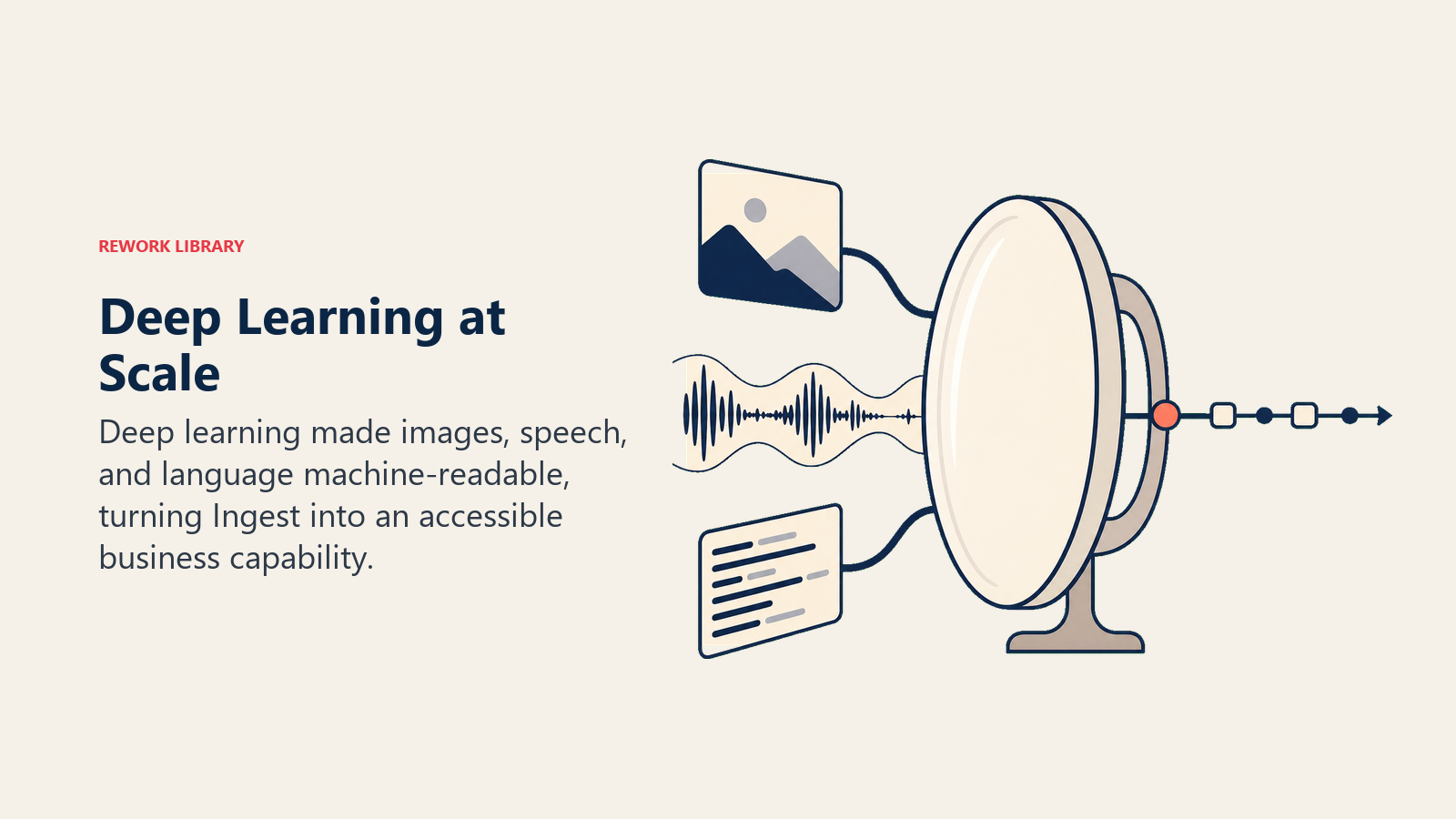
Deep Learning, betrieben durch GPUs und trainiert auf Datensätzen in Internet-Größenordnung, erschloss, was Classical ML nicht gut konnte: Bilder wahrnehmen, Sprache verstehen, zwischen Sprachen übersetzen. Das AlexNet-Paper von 2012 zeigte, dass ein tiefes neuronales Netz jeden bestehenden Ansatz bei der Bilderkennung übertreffen konnte. Dieses Ergebnis löste ein Jahrzehnt angewandter Forschung aus, die innerhalb weniger Jahre ihren Weg in Produkte fand.
Was sich änderte. Verlässliches Ingest in großem Maßstab. KI konnte nun Bilder verarbeiten (Google Vision API, 2015), Sprache mit nahezu menschlicher Genauigkeit transkribieren (Google Cloud Speech-to-Text, 2016) und in Echtzeit übersetzen. Informationen, die in Audio und Bildern gefangen waren, konnten kostengünstig in KI-Systeme fließen.
Business-Anwendungen. Sprachassistenten (Siri 2011, Alexa 2014), Bilderkennung für die Qualitätskontrolle im Einzelhandel und in der Fertigung, Übersetzungstools. Gong und Chorus wurden in diesem Zeitraum gegründet, aufgebaut auf der Idee, dass KI nun zuverlässig einen Vertriebsanruf transkribieren und Bedeutung daraus extrahieren konnte.
Wer es einsetzte. Big Tech legte das Fundament (Google, Microsoft, Amazon) und öffnete es als APIs. Schnelle Nachfolger mit Entwicklerteams nutzten diese APIs. Die Hürde sank von „ein Doktorandenteam einstellen" auf „einen Softwareentwickler einstellen, der REST versteht."
ACE Framework-Zuordnung. Ingest wurde eine echte, zugängliche Fähigkeit. Analyze wurde reichhaltiger. Predict reifte weiter. Generate blieb primitiv. Execute war technisch möglich, aber selten autonom.
Epoche 3: LLMs und Agenten (2022 bis heute)
ChatGPT wurde im November 2022 veröffentlicht und erreichte in fünf Tagen eine Million Nutzer. Diese Adoptionsgeschwindigkeit war real und spiegelte etwas genuein Neues wider: Zum ersten Mal war die Schnittstelle zur KI natürliche Sprache. Man musste nicht wissen, wie man Code schreibt, eine API konfiguriert oder Modellarchitektur versteht. Man tippte.
Aber die Technologie hinter der Oberfläche wurde nicht in diesem Monat geboren. GPT-3 war seit 2020 öffentlich verfügbar. Die Transformer-Architektur stammt aus einem Google-Paper von 2017. Die Forschung, die GPT-4 ermöglichte, lief seit Jahren. Was sich im November 2022 änderte, war die Verpackung und der Zugang, nicht die grundlegende Physik dessen, was KI kann.
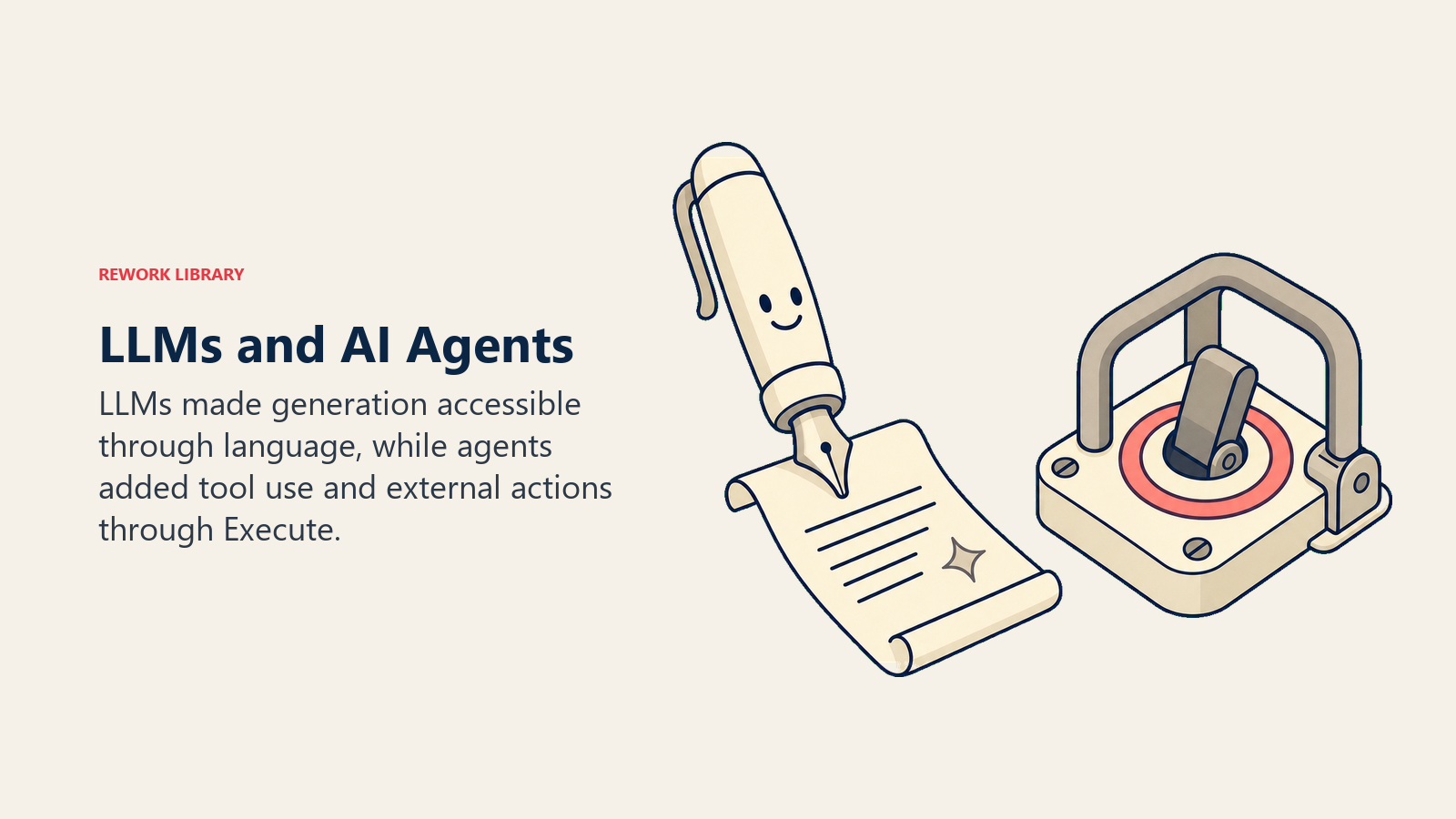
Was sich änderte. Die Generate-Fähigkeit rückte von der Peripherie ins Zentrum. KI konnte nun flüssigen, kohärenten Text in fast jeder Domäne produzieren. Und da die Schnittstelle gesprächsorientiert war, musste der Nutzer nichts über das zugrundeliegende Modell wissen. Ein Vertriebsmitarbeiter konnte eine Akquise-E-Mail schreiben. Ein Gründer konnte eine Zusammenfassung für den Vorstand entwerfen. Ein Operations-Leiter konnte einen ersten Entwurf eines Prozessdokuments erstellen.
Dann kamen die Agenten. KI, die nicht nur einen Entwurf generiert, sondern Sequenzen von Aktionen ausführt: suchen, zusammenfassen, schreiben, und dann tatsächlich etwas in einem externen System tun. Das ist Execute, das in großem Maßstab real wird.
Business-Anwendungen. GitHub Copilot (Code-Generierung), Gongs KI-Gesprächszusammenfassungen, Intercom Fin (Support-Agent, der Tickets von Anfang bis Ende bearbeitet), Salesforce Agentforce, Jasper und Writer für Content. Die Liste wächst ständig, weil die Hürde zum Aufbau mit dieser Technologie fast auf null gesunken ist.
Wer es einsetzt. Alle. Product Manager. Operations-Leiter. Vertriebsmitarbeiter. CEOs. Das ist die erste Epoche, in der ein nicht-technischer Mensch sinnvollen Wert aus KI ziehen kann, ohne einen Konfigurationsschritt jenseits des Öffnens eines Browser-Tabs zu benötigen.
ACE Framework-Zuordnung. Generate wurde eine erstklassige Business-Fähigkeit. Execute wurde real: KI-Systeme, die E-Mails versenden, CRM-Einträge aktualisieren, Code committen und Workflows auslösen, ohne dass ein Mensch jeden Schritt anfasst. Das vollständige Fünf-Fähigkeiten-Bild, Ingest, Analyze, Predict, Generate, Execute, ist nun erstmals für mittelständische Unternehmen zugänglich.
Was sich über alle drei Epochen nicht verändert hat
Die unbequeme Wahrheit, die es nicht in Anbieter-Demos schafft: Das meiste, was bestimmt, ob KI funktioniert oder scheitert, gilt seit den 1990er Jahren. Die Epoche änderte sich. Die Blockadefaktoren nicht.
Datenqualität bestimmt immer noch die Ergebnisse. Ein Gartner-Bericht von 2025 ergab, dass 60 % der KI-Projekte bis 2026 wegen unzureichender Daten aufgegeben werden. Das ist ein 30 Jahre altes Problem in neuem Gewand. Das Kreditmodell der Bank aus 2001 scheiterte an schlechten Eingaben. Ihr CRM-basiertes Lead Scoring scheitert heute an schlechten Eingaben. Datenbereitschaft ist immer noch die unspektakuläre Voraussetzung, die alles entscheidet.
Systemintegration dauert immer noch länger als erwartet. Jede Epoche machte KI-Fähigkeiten zugänglicher. Keine von ihnen hat die Verbindung dieser Fähigkeiten mit bestehenden Business-Systemen wesentlich beschleunigt. Sie brauchen immer noch API-Verträge, Datenpipeline-Arbeit und Berechtigungsmanagement in derselben mühsamen Abfolge wie zuvor.
Governance ist immer noch wichtig. Kreditscoring in Epoche 1 musste Fair-Lending-Regeln einhalten. Bilderkennung in Epoche 2 legte Vorurteile in Einstellungstools offen. LLMs in Epoche 3 produzieren selbstbewusst falsche Antworten und leaken vertrauliche Daten. Die Art des Governance-Problems hat sich weiterentwickelt. Der Bedarf ist nie verschwunden.
Predict ist immer noch die schwierigste Fähigkeit. Predict hängt von gelabelten historischen Daten ab, die die Zukunft widerspiegeln, die Sie vorhersagen möchten. Diese Abhängigkeit ändert sich nicht mit dem zugrundeliegenden Modell. Schlechte Eingaben produzieren schlechte Scores in allen drei Epochen.
Menschen müssen für kritische Execute-Schritte weiterhin in der Schleife bleiben. Die Generate-vs.-Execute-Grenze verdient menschliche Aufsicht, unabhängig vom Jahr. Epoche 1 hatte automatisierte Kreditablehnungen, die Fair-Lending-Regeln verletzten. Epoche 3 hat KI-Agenten, die falsche E-Mails versenden und CRM-Einträge inkorrekt aktualisieren. Andere Tools, dieselbe Problemkategorie.
Wie das ACE Framework alle drei Epochen abbildet
Das ACE Framework ist um Fähigkeiten statt um Technologien strukturiert, weil die Fähigkeiten den aktuellen Tools um Jahrzehnte voraus sind.
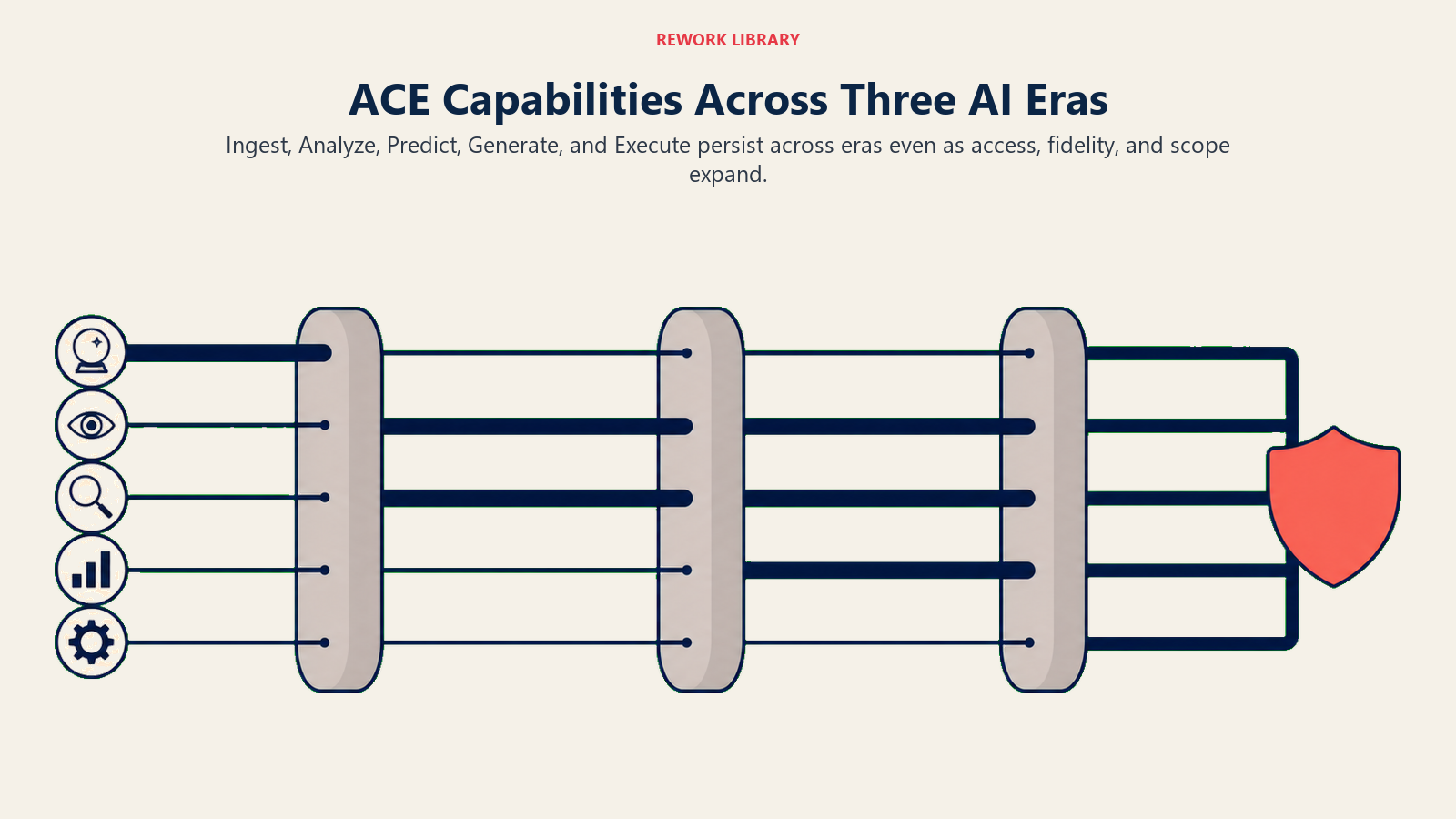
Ingest gab es in allen drei Epochen: OCR und manuelle Eingabe in Epoche 1, Google Vision- und Speech-to-Text-APIs in Epoche 2, multimodale Modelle in Epoche 3. Die Fähigkeit ist konsistent. Treue und Zugang verbesserten sich.
Analyze ist die älteste Fähigkeit. Textklassifikation und Entity Extraction existierten in der Forschung, bevor kommerzielle KI eine Kategorie war. Epoche 3 macht sie über natürlichsprachliche Anweisungen für jeden mit einem Browser zugänglich.
Predict ist das Heimterritorium von Epoche 1, über 30 Jahre verfeinert. Die Logik, historische Daten produzieren probabilistische Vorhersagen, hat sich nicht verändert. LLM-augmentierte Ansätze integrieren nun unstrukturierte Signale neben strukturierten Daten, aber die Fähigkeitskategorie bleibt dieselbe.
Generate existierte in Epoche 1 kaum über Template-Füllungen hinaus. Epoche 3 machte es zur sichtbarsten Fähigkeit, weil sein Output für jeden Menschen ohne technischen Kontext lesbar ist.
Execute gab es in allen drei Epochen in zunehmend breiten Formen: automatisierte Kreditablehnungen in Epoche 1, Content-Moderation in großem Maßstab in Epoche 2, autonome KI-Agenten in Epoche 3. Was sich änderte, ist der Umfang der Aktionen und wie schnell KI sie verknüpfen kann. Die Governance-Anforderungen wuchsen proportional.
Warum Framework-Stabilität wichtig ist
Spezifische Modellnamen haben eine kurze Haltbarkeit. GPT-4 wurde zu GPT-4o. Claude 3 wurde zu Claude 3.5, dann 3.7. Gemini Ultra wurde angekündigt, aktualisiert und innerhalb eines Jahres umbenannt. GitHub Copilot fügte quartalsweise Features hinzu. Jasper bekam Übernahmeberichte, Partnerschaftsänderungen und eine oder zwei Pivots.
Wenn Ihr Verständnis von KI um spezifische Produkte herum organisiert ist, bauen Sie Ihr mentales Modell alle sechs Monate neu. Das ist erschöpfend, und es führt zu schlechten Entscheidungen: dem neuesten Modell hinterherjagen statt die unspektakuläre Integrationsarbeit zu erledigen, auf einen Anbieter zu setzen, der in zwei Jahren vielleicht nicht mehr existiert, und „neue Oberfläche" mit „neuer Fähigkeit" zu verwechseln.
Das ACE Framework ist auf einem Abstraktionsniveau organisiert, das Produktzyklen überdauert. Ingest ist Ingest, egal ob Sie 2016 die Google Vision API aufrufen oder 2025 einen multimodalen GPT-4o-Endpunkt. Predict ist Predict, egal ob Sie XGBoost auf einem Server betreiben oder Salesforce Einstein Forecasting aufrufen. Die Tools ändern sich. Die Fähigkeiten nicht.
Das ist nicht nur philosophisch. Es hat praktische Implikationen für die Strukturierung Ihres KI-Denkens. Wenn Sie KI-Initiativen mithilfe von Capability Tagging statt Produktnamen bewerten, übersteht Ihr Bewertungsrahmen Anbieterveränderungen, Fusionen und Modell-Deprecations. Sie können das Tool austauschen. Die Fähigkeitskarte bleibt konsistent.
Was in Epoche 4 kommen könnte: Spekulation
Niemand weiß, wie Epoche 4 aussieht. Aber es gibt Forschungsrichtungen, die es wert sind, beobachtet zu werden und die neue erstklassige Fähigkeiten befördern könnten.
World Models geben KI ein persistentes physisches Verständnis: wie sich Objekte im Raum verhalten, wie mechanische Systeme funktionieren. Das ist am relevantesten für die Fertigung und physische Infrastruktur. Verlässliche World Models würden eine genuein neue Fähigkeitsachse darstellen, nicht nur eine bessere Version bestehender.
Persistentes Gedächtnis verändert, wie Analyze und Predict funktionieren. Die KI von heute beginnt jede Sitzung weitgehend von vorne. Ein System, das über Monate Kontext über Ihr Unternehmen aufbaut, würde ganz anders funktionieren als eines, das Sie bei jeder Aktualisierung vergisst.
Multi-Agenten-Koordination treibt Execute in Richtung voller Autonomie: Ein Agent plant, ein anderer führt aus, ein dritter validiert, ein vierter eskaliert zu einem Menschen. Frühe Versionen existieren (AutoGPT, Microsoft Copilot Studio), aber verlässliche Multi-Agenten-Systeme im Business-Maßstab befinden sich noch in einem frühen Stadium.
Wenn irgendeines davon zu einer kommerziellen Fähigkeit reift, könnten „Erinnern" oder „Koordinieren" neben den fünf bestehenden ACE-Fähigkeiten Platz verdienen. Das Framework macht explizit, dass es möglicherweise überarbeitet werden muss. Die aktuellen fünf decken das Feld ab, Stand 2026.
Wie man sich auf Epoche 4 vorbereitet
Die Vorbereitungsstrategie lautet nicht „das beste Modell von heute wählen." Jedes Unternehmen, das stark auf ein spezifisches Modell oder einen Anbieter gesetzt hat, musste Arbeit wiederholen, als sich die Dinge verlagerten. Die dauerhaften Investitionen sind epochenunabhängig.
Investieren Sie zuerst in Foundation-Arbeit. Datenbereitschaft ist langweilig. Sie ist auch die dauerhafteste KI-Investition. Saubere, gelabelte, zugängliche Daten extrahieren Wert aus jeder Generation von Tooling. Schmutzige Eingaben produzieren schlechte Ausgaben unabhängig vom Modell.
Halten Sie das zugrundeliegende Modell austauschbar. Wenn Ihre Workflows auf der API eines Anbieters ohne Abstraktionsschicht aufgebaut sind, kann dieser Anbieter Ihren Ansatz jederzeit widerrufen. Bibliotheken wie LangChain und LlamaIndex existieren genau deshalb, damit Sie Modelle austauschen können, ohne Workflows neu aufzubauen. Die Grenzen des ACE Frameworks schließen explizit technologieagnostisch zu sein ein. Ihr Stack sollte das auch sein.
Bewerten Sie nach Fähigkeit, nicht nach Produktname. Fragen Sie, welche ACE-Fähigkeiten eine neue Initiative nutzt. Taggen Sie Tools nach Fähigkeit. Ein KI-Use-Case zu lesen durch seine Fähigkeitsmischung ist eine Kompetenz, die epochenübergreifend transferiert, weil sich die Anbieterschaft weiterhin verschieben wird.
Der 30-Jahres-Bogen in einem Rahmen
Business-KI ist seit längerem im Einsatz, als die meisten Menschen, die sie heute verkaufen, ihre Karriere begonnen haben. Die Fähigkeiten haben sich erweitert. Die Zugangshürden sind gesunken. Die Schnittstelle änderte sich 2022 dramatisch, und diese Veränderung ist real und bedeutsam.
Aber die zugrundeliegende Logik hat sich nicht verändert. Datenqualität bestimmt Ergebnisse. Integration ist schwierig. Governance ist wichtig. Predict ist immer noch die schwierigste Fähigkeit, richtig hinzubekommen. Menschen müssen weiterhin in der Schleife bleiben für folgenreiche Aktionen.
Das ACE Framework beschreibt nicht die KI von 2026. Es beschreibt was Business-KI ist: fünf Verben, angewandt auf Daten, zu Workflows zusammengestellt. Diese fünf Verben sind ChatGPT um Jahrzehnte voraus. Und wenn Epoche 4 ein sechstes hinzufügt, werden wir das Framework entsprechend aktualisieren.
Priya muss nicht glauben, dass KI 2022 begann. Sie muss verstehen, was KI tut, wie man sie bewertet, und wo die dauerhaften Investitionen liegen. Dieses Verständnis ist das, wofür das Framework gebaut ist.
Was Sie als nächstes lesen sollten
- Das ACE Framework: das vollständige Fünf-Fähigkeiten-Modell mit dem Sechs-Ebenen-Stack und einem durchgearbeiteten Beispiel zu Gong
- Predictive AI vs. Generative AI: wie das populäre Branchenbinär auf das ACE Framework abbildet und wo es zusammenbricht
- Was ist Business-KI?: eine praktische Definition, die alle drei Epochen abdeckt
- Grenzen des ACE Frameworks: ehrliche Grenzen, einschließlich der Tatsache, dass dieses Framework überarbeitet werden muss, wenn sich das Feld weiterentwickelt
- Datenbereitschaft: die Voraussetzung, die in allen drei Epochen gleichermaßen wichtig ist
- Predict: die älteste Fähigkeit, und immer noch die schwierigste, richtig hinzubekommen

Principal Solution Architect
On this page
- Epoche 1: Classical ML (grob 1990 bis 2010)
- Epoche 2: Deep Learning im großen Maßstab (grob 2010 bis 2020)
- Epoche 3: LLMs und Agenten (2022 bis heute)
- Was sich über alle drei Epochen nicht verändert hat
- Wie das ACE Framework alle drei Epochen abbildet
- Warum Framework-Stabilität wichtig ist
- Was in Epoche 4 kommen könnte: Spekulation
- Wie man sich auf Epoche 4 vorbereitet
- Der 30-Jahres-Bogen in einem Rahmen
- Was Sie als nächstes lesen sollten