Help Scout vs Front vs Gladly: Which One Fits Your Support Team in 2026?
Turn this article into takeaways for your work.


Each assistant summarizes the article only for you and suggests best practices for your work.
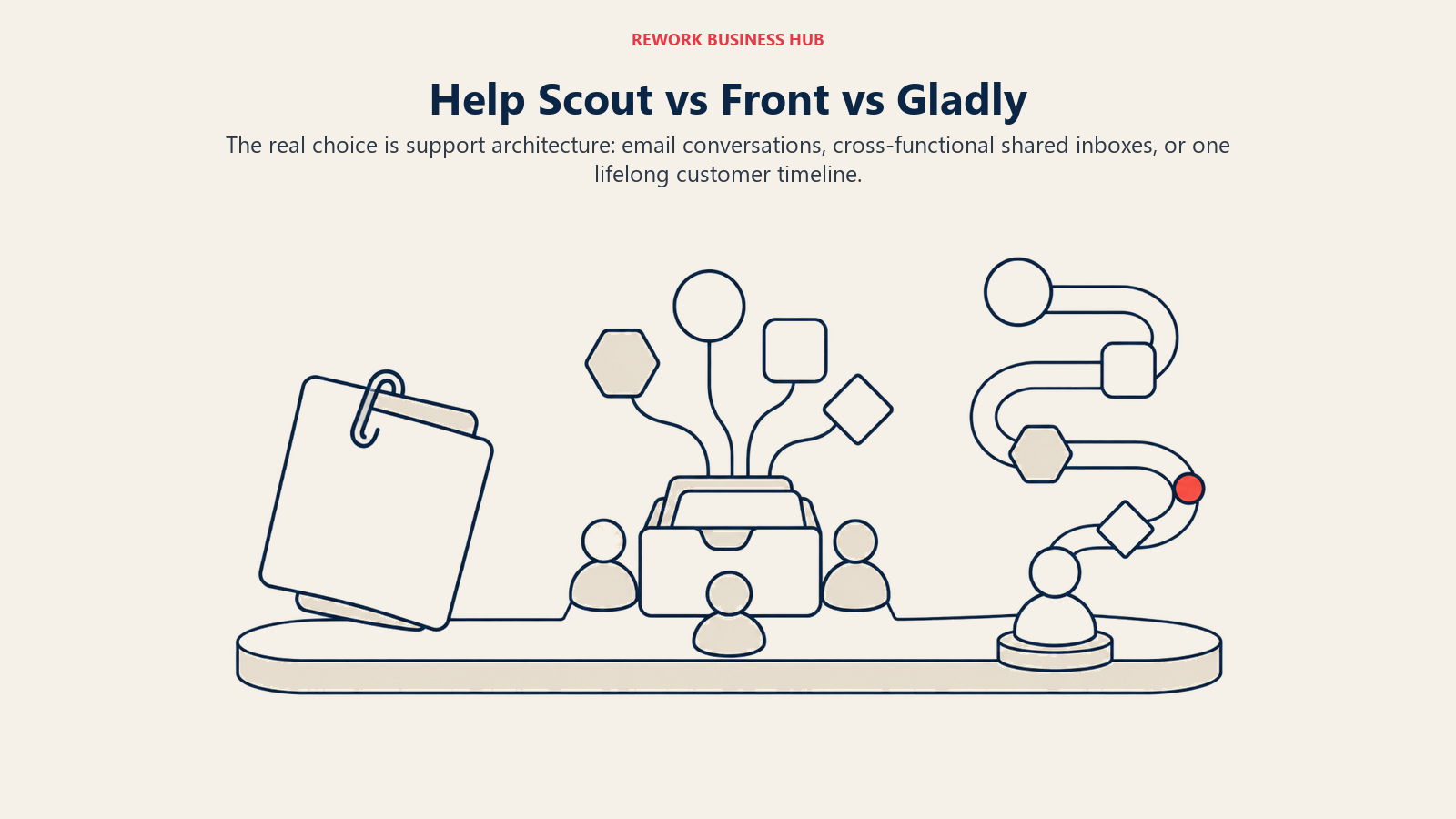
If you run support for a company between 20 and 500 people, you've probably already ruled out Zendesk on cost or complexity and landed on a shortlist of three names that keep coming up together: Help Scout, Front, and Gladly. That's not a coincidence. All three built their product around rejecting the same thing: the ticket queue that Zendesk and Freshdesk run on, where every conversation becomes a numbered case waiting in a routing rule. What's less obvious is that the three of them didn't converge on the same replacement. They rejected the ticket in three different directions, and picking the wrong one costs more than a bad trial ever would.
You're likely evaluating these three from one of three angles: running support for a small product where the tool should stay out of the way, running shared communication across a business where support is one of several teams working out of the same inboxes, or running a premium consumer service brand where the same customer contacts you for years and the relationship, not the case, is what you're actually managing. Each angle points at a different one of these three tools, and this comparison prices all three at 5, 20, and 60 agents so you can see exactly where that choice starts costing real money.
Key Facts: Help Scout vs Front vs Gladly
- None of the three uses a ticket-number model: Help Scout and Front are shared-inbox tools built around conversation threads, and Gladly has no ticket construct anywhere in the product (Help Scout pricing, Front pricing, Gladly pricing).
- Gladly's Hero plan carries a 10-agent minimum at a reported $180 per agent per month, so a 5-person support team is billed for 10 seats regardless of actual headcount (eesel AI's Gladly pricing analysis).
- Help Scout's AI Answers add-on averages a 73% resolution rate across customers, according to Help Scout's own pricing page.
- 85% of CX leaders say a customer will drop a brand entirely over a single unresolved issue, even on the first contact (Zendesk's CX Trends 2026 report).
Before comparing these three specifically, our help desk versus shared inbox guide is worth reading if you haven't settled on this category at all, and our best help desk software roundup ranks all 13 major platforms, including the ticket-queue tools these three are reacting against.
TL;DR
| Help Scout | Front | Gladly | |
|---|---|---|---|
| What it replaces the ticket with | The email thread. No ticket numbers, one inbox that reads like a real inbox | The collaborative inbox. Real threads plus internal comments and assignment | The person. One lifelong customer timeline, no ticket construct at all |
| Built for | Small support teams that want email to stay email | Any team whose daily work is external communication, support included | High-touch consumer brands with repeat-contact customers |
| Entry price | Free (5 users); Standard $25/user/month (annual) | Starter $25/seat/month (annual), up to 10 seats | Not published; reported around $180/agent/month, 10-agent minimum |
| Native voice | No | No | Yes, plus usage-based Voice AI |
| Native CRM | No | No | No |
| AI billing model | Per resolution: $0.75 each | Per conversation (Autopilot) plus per-seat add-ons (Copilot, Smart QA, Smart CSAT) | Per conversation and per minute, reported, on top of the seat |
| Where it breaks | Reporting and routing top out fast at real ticket volume | Stops being a support platform once you need formal SLAs | Price and a multi-month implementation before a single seat ships |
| Best for | 5-100 agent teams that want simplicity over channel breadth | 5-300 seat ops teams sharing addresses across functions | 10-1,000+ agent consumer contact centers |
What Each Tool Is Actually Built For
Help Scout: the inbox that refuses to become a ticket system
Help Scout's whole design argument is that support should feel like a good email exchange, not a filing system. There are no ticket numbers anywhere a customer can see, no case IDs, just a shared inbox with collision detection so two agents don't reply to the same person at once. Docs, its knowledge base product, surfaces relevant articles right inside the reply pane, and Beacon adds a lightweight chat widget on top. The product has stayed disciplined about this for over a decade rather than growing into a heavier platform.
Front: the shared inbox for teams whose job is communication, not just support
Front starts from a different premise: the shared inbox is a collaboration surface for anyone managing external communication, and support is only one of the teams that fits that description. Internal comments and @mentions sit directly on real email, SMS, and social threads, so account management, logistics, and partnerships teams end up running the same tool as support, often out of separate addresses inside the same workspace. That's why Front's buyer is as often an Operations Director as a Head of Support.
Gladly: no tickets, ever, organized around the person instead
Gladly takes the anti-ticket philosophy furthest. Every channel, voice, chat, email, SMS, and social, lands on one continuous timeline tied to a person, not a case. Retail and hospitality brands with high repeat-contact volume built their contact centers around this specifically because the alternative, a ticket history scattered across separate cases, actively works against a brand that wants a returning customer to feel remembered.
| Channel | Help Scout | Front | Gladly |
|---|---|---|---|
| Yes, all tiers | Yes, all tiers | Yes | |
| Live chat | Yes, from Standard | Yes, from Professional (omnichannel) | Yes |
| SMS | Yes, from Standard | Yes, from Professional | Yes |
| Social (Instagram, Messenger, WhatsApp) | Yes, from Standard | Yes, from Professional | Yes |
| Voice | Not native | Not native | Yes, native, plus usage-priced Voice AI |
Free tier note: Help Scout's Free plan covers 5 users but only 1 inbox and 1 Docs site; the channel breadth above starts at Standard. If channel coverage isn't the deciding factor and you're weighing this purely as an email tool, our guide to choosing shared inbox software covers that narrower comparison.
Decision by Business Goal
| Business goal | Best fit | Why |
|---|---|---|
| Support should feel personal without hiring a support-ops specialist | Help Scout | Cleanest shared inbox of the three, fastest onboarding, no configuration layer to learn |
| One collaboration layer across support, account management, and vendor or partner email | Front | Built for shared addresses used by more than the support team alone |
| Every channel a customer uses should resolve into one lifelong relationship, not a queue | Gladly | The only one of the three with no ticket construct anywhere in the product |
| Cost-sensitive and under 20 seats | Help Scout | Lowest realistic per-seat cost of the three at that size |
| Need SMS and social under one roof without buying a second product | Front | Omnichannel bundled from Professional; Help Scout and Gladly both cover it too, but Front's automation rules are built around it |
| Same customer contacts the brand repeatedly across months or years | Gladly | The people-first data model is purpose-built for exactly that pattern |
| Board-ready reporting with cross-channel SLA attribution | None of the three cleanly | All three cap out short of Zendesk Explore or Kustomer-grade reporting; see our help desk software roundup for that tier |
Team and Role Fit
| Role | Best fit among these three | Why |
|---|---|---|
| Support team lead at a small SaaS or e-commerce brand | Help Scout | Built for exactly this buyer, historically and today |
| Ops Director running support, account management, and vendor comms from shared addresses | Front | The collaboration model was built for cross-functional teams, not support alone |
| Head of CX at a retail, hospitality, or consumer brand with high repeat-contact volume | Gladly | Matches Gladly's named customer base directly |
| Budget owner comparing sticker price only | Help Scout, then Front | Both list a $25/seat or $25/user entry tier before minimums; Gladly's list price alone rules it out under 10 agents |
| COO evaluating whether support needs its own lightweight CRM layer | Front, cautiously | Has account context inside conversations but no native CRM object model; you're still connecting a separate CRM either way |
What Buyers Underestimate
Three things decide this comparison more than the sticker price does: how deep the reporting actually goes once you need to defend a number to leadership, whether there's a real SLA and routing engine underneath the friendly inbox, and how AI is metered on top of the seat.
Reporting depth for a support leader
| Tool | What you get out of the box | Where it hits a ceiling |
|---|---|---|
| Help Scout | Seven standard report templates covering email, chat, phone, company and user data, CSAT, and knowledge base performance | Custom reports require Plus or above, and Help Scout's own documentation confirms there's no way to build a custom calculated metric or a cross-referenced report at any tier |
| Front | Basic analytics on Starter, advanced analytics on Professional, fully custom reports on Enterprise | Custom reporting is an Enterprise-only line, the same tier that also unlocks unlimited automation rules |
| Gladly | Built-in dashboards covering standard contact-center KPIs | Reviewers on G2 consistently note that deep customization, cross-channel analysis, and sentiment-trend mapping go beyond what the standard dashboards offer |
SLA, routing, and automation
| Tool | SLA policies | Routing | Automation |
|---|---|---|---|
| Help Scout | One basic SLA policy (Standard), two advanced (Plus), unlimited (Pro) | Round robin from Plus; multiple routing types on Pro | Basic workflows on Standard, advanced on Plus, unlimited on Pro |
| Front | No formal SLA policy engine at any tier | Assignment rules, with up to 10 (Starter), 20 (Professional), or unlimited (Enterprise) automation rules | Macros from Professional; smart rules on Enterprise |
| Gladly | No ticket-based SLA object, since there's no ticket; service levels are managed through staffing and routing, not a policy you configure | Native to the platform, deepens on Superhero | AI-driven routing and Sidekick are the automation layer, billed on usage on top of the seat |
This is where the ticket-queue rejection actually shows its cost. If your board wants an SLA-attribution report with a hard number behind it, none of these three hands you one the way Zendesk's Explore does. That gap is worth knowing before you sign, not after your first quarterly review.
How AI is actually priced
| Tool | Included with the seat | Usage-based add-on | Agent-assist layer |
|---|---|---|---|
| Help Scout | Basic AI Inbox assistant and AI Drafts from Standard up | AI Answers: $0.75 per resolution, 3-month free trial, pre-paid discounts available | Folded into AI Answers; no separate copilot SKU |
| Front | Compose, Translate, and Summarize included with daily caps on every plan | Autopilot: starting at $0.05 per conversation | Copilot ($20/seat/month), Smart QA ($20/seat/month), Smart CSAT ($10/seat/month), all three included free on Enterprise |
| Gladly | Platform and routing intelligence is part of the seat price | Sidekick conversational AI at a reported ~$0.60 per conversation; Voice AI at a reported ~$0.062 per minute | Deeper AI and routing is the functional difference Superhero's higher seat price buys over Hero |
Sources: Help Scout's pricing page and Front's pricing page; Gladly's Sidekick and Voice AI unit costs are reported via eesel AI's Gladly pricing analysis, since Gladly does not publish these rates itself.
Pricing at Real Team Sizes
Published tiers
| Tool | Plan | Monthly billing | Annual billing (per month) | Seats |
|---|---|---|---|---|
| Help Scout | Free | $0 | $0 | Up to 5 |
| Help Scout | Standard | $30/user | $25/user | Up to 25 |
| Help Scout | Plus | $54/user | $45/user | Up to 50 |
| Help Scout | Pro | $90/user | $75/user | Unlimited, 10-user minimum |
| Front | Starter | ~$33/seat (calculated) | $25/seat | Up to 10 |
| Front | Professional | ~$86/seat (calculated) | $65/seat | Up to 50 |
| Front | Enterprise | ~$138/seat (calculated) | $105/seat | No stated cap |
| Gladly | Hero | Not published | ~$180/agent (reported) | 10-agent minimum |
| Gladly | Superhero | Not published | ~$210/agent (reported) | 45-agent minimum |
Source: Help Scout's pricing page and Front's pricing page. Front discloses a flat "24% savings" for annual billing but doesn't display the monthly figure directly, so the monthly-billing numbers above are calculated from that disclosed discount, not quoted from the page. Gladly's Hero and Superhero pricing is gated behind a demo request; the figures above are reported via eesel AI's Gladly pricing analysis. One exception: Gladly does publish a real rate card for a self-serve Shopify App Store plan, $120 per agent seat plus $1.50 per AI resolution and $0.25 per AI assist, but that's a lighter product for individual merchants, not the enterprise platform most support teams here are evaluating.
The cost at 5, 20, and 60 agents
| Team size and billing | Help Scout | Front | Gladly |
|---|---|---|---|
| 5 agents, annual | Standard: $1,500/yr | Starter: $1,500/yr | Hero (10-seat minimum forces 10 seats): $21,600/yr |
| 5 agents, monthly | Standard: $1,800/yr | Starter: ~$1,980/yr | Not published |
| 20 agents, annual | Plus: $10,800/yr | Professional: $15,600/yr | Hero: $43,200/yr |
| 20 agents, monthly | Plus: $12,960/yr | Professional: ~$20,640/yr | Not published |
| 60 agents, annual | Pro: $54,000/yr | Enterprise: $75,600/yr | Superhero: $151,200/yr |
| 60 agents, monthly | Pro: $64,800/yr | Enterprise: ~$99,360/yr | Not published |
The 5-agent row is the one worth staring at. Gladly's Hero plan has a 10-agent minimum, so a genuine 5-person team pays $21,600 a year for 10 seats, five of them empty, before a single AI resolution or voice minute gets billed on top. Help Scout and Front both let a 5-person team pay for exactly 5 people. That gap alone rules Gladly out for most teams under 10 agents regardless of how well its model fits their support motion.
At 60 agents, Gladly's math changes shape. Superhero's 45-agent minimum is now comfortably cleared, so $151,200/year reflects the tier built for that scale. A 60-agent team that doesn't need Superhero's deeper AI and routing could stay on Hero instead, a reported $129,600/year at that headcount. Either way, Gladly at 60 agents costs roughly double Front's Enterprise tier and nearly triple Help Scout's Pro tier for the same headcount, a gap that only makes sense if the people-first model solves a problem the other two genuinely can't.
Implementation and Change Management
| Factor | Help Scout | Front | Gladly |
|---|---|---|---|
| Typical time to first value | Hours to days; 15-day free trial on Standard and Plus | Days; self-serve trial available | Reported months, not weeks; sales-led from the first call |
| Who configures it | Any team member; the interface stays close to email | Any team member for the inbox itself; SSO and SCIM setup needs IT once you're on Professional or above | A dedicated implementation team; Gladly's own positioning treats this as a structured onboarding program, not a self-serve signup |
| Migrating conversation history in | Manual CSV export plus the API for full detail; no one-click ticket importer highlighted on the pricing page | Manual; Front's own help documentation notes some content, including attachments and individual-inbox conversations, doesn't come along in a standard export | Gladly documents historical-conversation import from several named platforms, though it's text-based only. No images, recordings, attachments, or prior routing assignments carry over |
| Training load | Low; closest of the three to a plain email inbox | Low to moderate; more surface area once omnichannel and automation rules are in play | Moderate to high; the people-timeline model is a different mental model from a shared inbox, even for agents coming from Front or Help Scout |
Source: Front's own guide to exporting account data and Gladly's historical conversation import documentation; implementation timelines for Gladly are reported, since none of the three vendors publish an official commitment.
Risk and Governance
| Dimension | Help Scout | Front | Gladly |
|---|---|---|---|
| SSO / SAML | Pro tier only | From Professional | Handled as part of the Hero or Superhero sales conversation; not separately priced or documented publicly |
| Compliance | HIPAA compliance on Pro | Not highlighted on the public pricing page | Serves regulated-adjacent retail and hospitality brands; specific certifications aren't listed on the public pricing page |
| Data retention after cancellation | Account data permanently deleted 60 days after cancellation, per Help Scout's own documentation | Customer data permanently deleted 30 days after subscription termination, per Front's own help documentation | Not publicly documented at the same level of detail; governed by contract and account-level retention settings |
| Self-serve conversation export | No; full conversation threads aren't exportable from the UI. Customer name and email export via CSV; full thread content needs the API or a support request | No; a full account data export requires contacting Front Support, and it excludes attachments, individual-inbox conversations, and contact data | Yes; Gladly documents self-serve Conversation Export and a per-customer profile export as standard features |
| Vendor concentration risk | Low; a focused support point-tool that runs alongside any CRM without friction | Low to moderate; teams often route sales and ops mail through the same workspace, which raises the cost of switching later | Moderate; the deeper routing and the customer timeline get wired into daily work, the more Gladly becomes infrastructure rather than a swappable tool |
Source: Help Scout's data export documentation, Front's account data export guide, and Gladly's conversation export documentation.
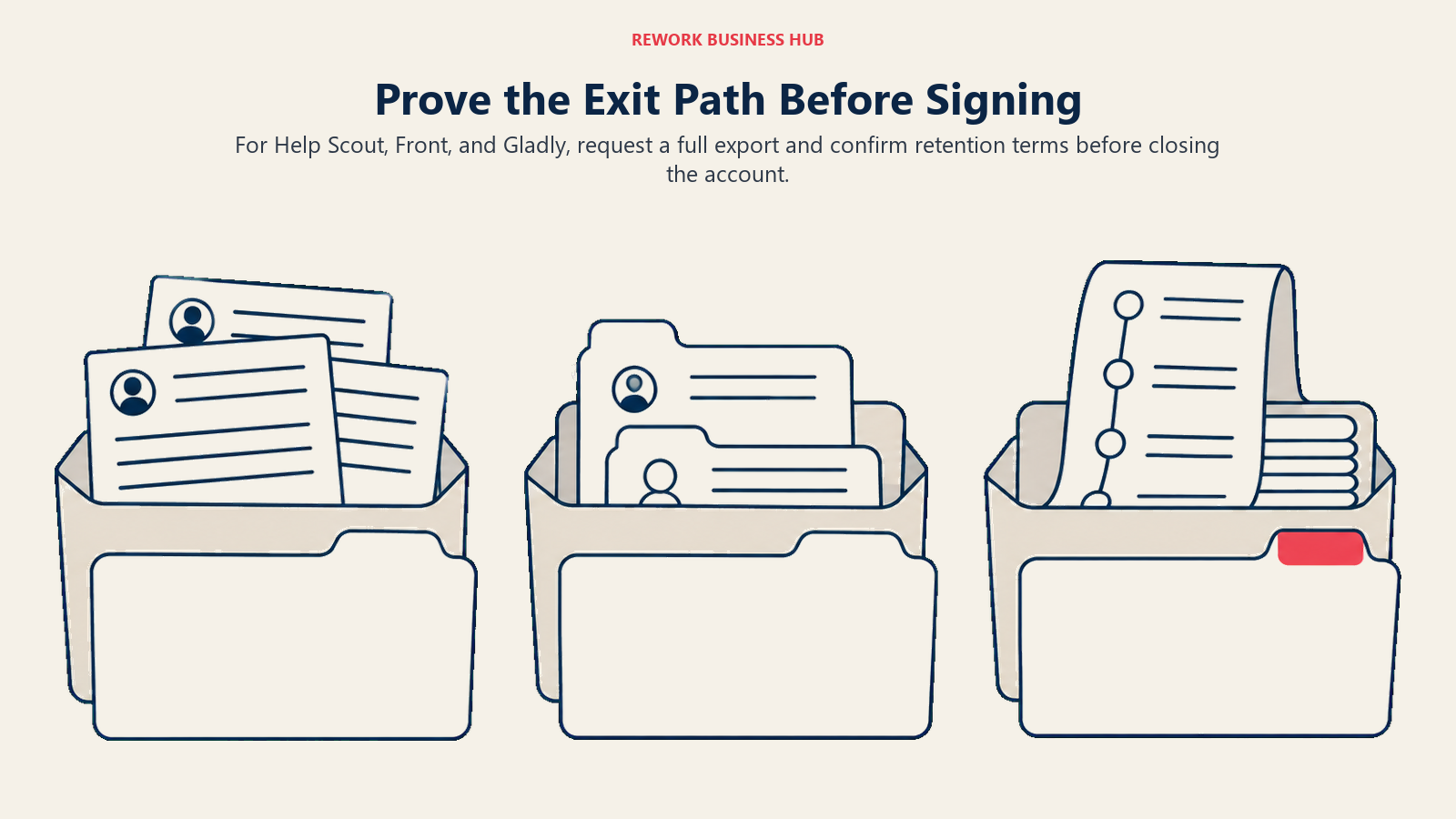
The export row is the counterintuitive one. Gladly, the most expensive and most enterprise of the three, is the only one with a documented self-serve path to get full conversation data out. Both cheaper, friendlier-feeling shared inboxes require a support ticket for a full conversation-history export, and both delete everything on a fixed timer once you cancel. If what leaving actually costs matters to your evaluation, build the export test into your pilot, not your exit plan.
When Help Scout Is the Right Call
- Your team is 5-100 people, support is the whole job, and you want the tool to feel like email, not a filing system.
- Budget matters and you're staying meaningfully under Front's or Gladly's price floor.
- Your channel mix is genuinely email plus light chat, not social or voice.
- You don't need custom, cross-referenced reporting; the seven standard templates cover what your team actually reviews week to week.
Where it breaks: no native voice or deep social presence, custom reporting doesn't exist below Plus and stays limited even on Pro, and routing tops out at round robin and "multiple routing types," nowhere near skills-based or SLA-tiered routing at real ticket volume. Teams that outgrow this specifically should read our Help Scout alternatives guide.
When Front Is the Right Call
- Your team's actual job is external communication broadly: support, but also account management, partner and vendor email, logistics coordination, sometimes inbound sales, all sharing addresses.
- You need omnichannel (email, SMS, social) without adopting a full ticketing platform.
- Internal collaboration on a reply before it goes out (comments, @mentions) matters as much as resolving fast.
Where it breaks: no formal SLA policy engine at any tier, so a hard "time to first response against a signed SLA" number is something you'd build yourself. There's no native CRM either, so account context stays thin unless you wire one in separately. And the jump from Starter's 10-seat cap to Professional's omnichannel tier lands the moment you cross 10 people, at roughly 2.6 times the per-seat price. Teams that hit that wall should see our Front alternatives guide.
When Gladly Is the Right Call
- You're a retail, hospitality, or consumer brand where the same customer contacts you repeatedly over months or years, and the relationship, not the case, is what you're managing.
- Voice is a real, primary channel, not an afterthought bolted onto a chat-first tool.
- You have the budget and a real service organization behind it: a 10-plus agent floor, a multi-month implementation, and a team that can operate a genuinely different, ticketless model.
Where it breaks: the 10-agent (Hero) and 45-agent (Superhero) minimums mean you pay for headcount you may not have yet, list price puts a 20-agent team past $43,000 a year before a single AI resolution or voice minute is billed, and implementation runs months, not the Friday-afternoon signup the other two offer. Teams where that math doesn't pencil out should see our Gladly alternatives guide.
Decision Framework
| If you are... | Pick |
|---|---|
| A 5-20 person support team that wants email to stay email | Help Scout |
| A team where support, account management, and vendor email share the same addresses | Front |
| A consumer brand running high-touch, repeat-contact service across voice, chat, and social | Gladly |
| Cost-sensitive and under Gladly's 10-agent minimum | Help Scout or Front |
| Needing omnichannel without buying a second product | Front (Professional) |
| Willing to trade a ticket queue for a people-first model at enterprise pricing | Gladly |
| Not sure a full platform switch is the right move yet | See help desk versus shared inbox |
| Wanting the full field before narrowing to these three | See our help desk software roundup |
What to Do Next
- Match the model to your channel mix and org shape first, price second. If support isn't the only team touching the inbox, that alone should push you toward Front regardless of what the seat math says.
- Run a real two-week pilot with actual conversations, not a sandbox. The routing and reporting gaps in this article show up fastest under real volume, not a demo.
- Before signing with Gladly, get the seat minimum and the Superhero threshold in writing. A 12-agent team quoted Hero pricing should confirm that's 12 billed seats, not the 10-seat floor plus two.
- If Front's jump from Starter to Professional changes your math, price Professional now, not after you've crossed 10 seats and need omnichannel mid-contract.
- Ask each vendor what a full conversation-history export looks like before you sign, not after you've decided to leave. Two of the three require a support ticket to get it.
- If none of these three fit, the category itself might be wrong. Our help desk software roundup covers the other 10 platforms, including Zendesk vs Freshdesk and Freshdesk vs HubSpot Service Hub, if a real ticket queue with SLA reporting is what you actually need.

Principal Product Marketing Strategist
On this page
- TL;DR
- What Each Tool Is Actually Built For
- Help Scout: the inbox that refuses to become a ticket system
- Front: the shared inbox for teams whose job is communication, not just support
- Gladly: no tickets, ever, organized around the person instead
- Decision by Business Goal
- Team and Role Fit
- What Buyers Underestimate
- Reporting depth for a support leader
- SLA, routing, and automation
- How AI is actually priced
- Pricing at Real Team Sizes
- Published tiers
- The cost at 5, 20, and 60 agents
- Implementation and Change Management
- Risk and Governance
- When Help Scout Is the Right Call
- When Front Is the Right Call
- When Gladly Is the Right Call
- Decision Framework
- What to Do Next