Best Kustomer Alternatives in 2026: 12 Customer Support Platforms Compared
Turn this article into takeaways for your work.


Each assistant summarizes the article only for you and suggests best practices for your work.
Kustomer is a genuinely impressive platform. The conversation-centric data model, true omnichannel timeline, and enterprise-grade automation set it apart from basic ticketing tools. But a lot of teams reach the same conclusion after a few months: it's built for companies running a contact center at scale, not a 20-person support team trying to stay close to customers.
The price alone is a filter. Enterprise starts at $89 per seat per month with an 8-seat minimum and a $18,000-$30,000 first-year implementation tab. Add AI add-ons and you're looking at $129-$139 per seat before you've written a single automation. Then there's the ownership uncertainty: Kustomer went from Facebook's portfolio to independent again, and teams that remember that shift are watching the roadmap more carefully. If you're a CX lead, support manager, or ops owner evaluating a move, here are 12 platforms worth a serious look.
Quick Comparison Table
| Tool | Best For | Starting Price | Key Strength | Key Limitation |
|---|---|---|---|---|
| Zendesk | Mid-market to enterprise, any channel | $55/agent/month (Suite Team) | Deepest ecosystem, most integrations | Complex, expensive at scale |
| Rework | Mid-size teams wanting support + CRM in one | From $159/mo billed yearly (Revenue Engine) | Unified inbox, CRM, and ops in one platform | Not built for high-volume enterprise contact centers |
| Front | Relationship-driven support teams | $25/seat/month (Starter) | Shared inbox with a collaborative email feel | AI features add significant cost |
| Freshdesk | Budget-conscious teams of any size | Free plan; Growth at $19/agent/month | Best value at entry level, strong automation | Omni features cost more |
| Help Scout | SMBs and growing teams | Free plan; Standard at $25/user/month | Clean UX, excellent documentation | Limited enterprise depth |
| Gorgias | E-commerce brands (Shopify/WooCommerce) | From $10/month (ticket-based) | Built around order data, fast for DTC | E-commerce-only focus |
| Intercom | Product-led or SaaS teams | $29/seat/month (Essential) | Proactive messaging + reactive support | AI costs make it expensive fast |
| Gladly | Retail and high-fashion brands | From ~$180/agent/month | People-centric model, no ticket numbers | Very expensive, complex implementation |
| HubSpot Service Hub | HubSpot CRM shops | Free; Starter at $15/seat/month | Tight CRM integration, familiar for HubSpot users | Limited stand-alone CX depth |
| Zoho Desk | Cost-sensitive teams, Zoho ecosystem | Free; Standard at $14/user/month | Cheapest feature-rich option | UI feels older, AI is limited |
| LiveAgent | SMBs wanting multi-channel on a budget | Small at $15/agent/month | Live chat, call center, email all included | Dated interface, weaker enterprise controls |
| Kayako | Teams wanting AI-first, pay-per-resolution | $0 Starter; $1/resolved ticket (AI) | Pure resolution-based pricing, no seats | Newer model, limited deep reporting |
1. Zendesk: Best for Complex, Multi-Channel Enterprise Support
Zendesk is the default enterprise choice for a reason. Its ecosystem is the deepest in the category: 1,500+ integrations, a native voice product, workforce management, QA, AI Agents billed per resolution, and a mature marketplace. If Kustomer is where you are, Zendesk Suite is almost certainly on your shortlist.
Suite Team starts at $55/agent/month and Professional at $115/agent/month (annual billing). The AI Copilot add-on is another $50/agent/month. In 2026, AI Agents shifted to outcome-based pricing at $1-2 per resolution, which keeps base costs predictable but adds a usage variable at scale. Enterprise tier moved to "Suite Enterprise + Copilot" at a custom quote.
The trade-off is complexity. Zendesk's admin experience rewards dedicated ops specialists. It can do almost anything, but getting it to do anything specific requires configuration time and, often, a solutions partner. Smaller teams and those without a Zendesk admin frequently find themselves under-using it.
| Pros | Cons |
|---|---|
| Broadest integration ecosystem | Steep learning curve, admin-heavy |
| Best-in-class voice and omnichannel | Per-resolution AI adds billing unpredictability |
| Workforce management and QA built in | Enterprise tier requires custom quote |
| Trusted by thousands of enterprise teams | Can be overkill for under 50 agents |
Pricing: Suite Team $55/agent/month, Suite Professional $115/agent/month. AI Copilot $50/agent/month extra. Zendesk pricing
Best for: Mid-market to enterprise teams with complex routing, multi-channel volume, and a dedicated support ops function. See best Zendesk alternatives if it doesn't fit.
2. Rework: Best for Mid-Size Teams Wanting Support Unified with CRM and Ops
Rework is a unified platform that brings together a multi-channel inbox, CRM, sales pipeline, lead management, and cross-team workflows. It's not a stand-alone helpdesk. It's what you reach for when you're tired of stitching together a support tool, a CRM, and a project tracker with Zapier in between.
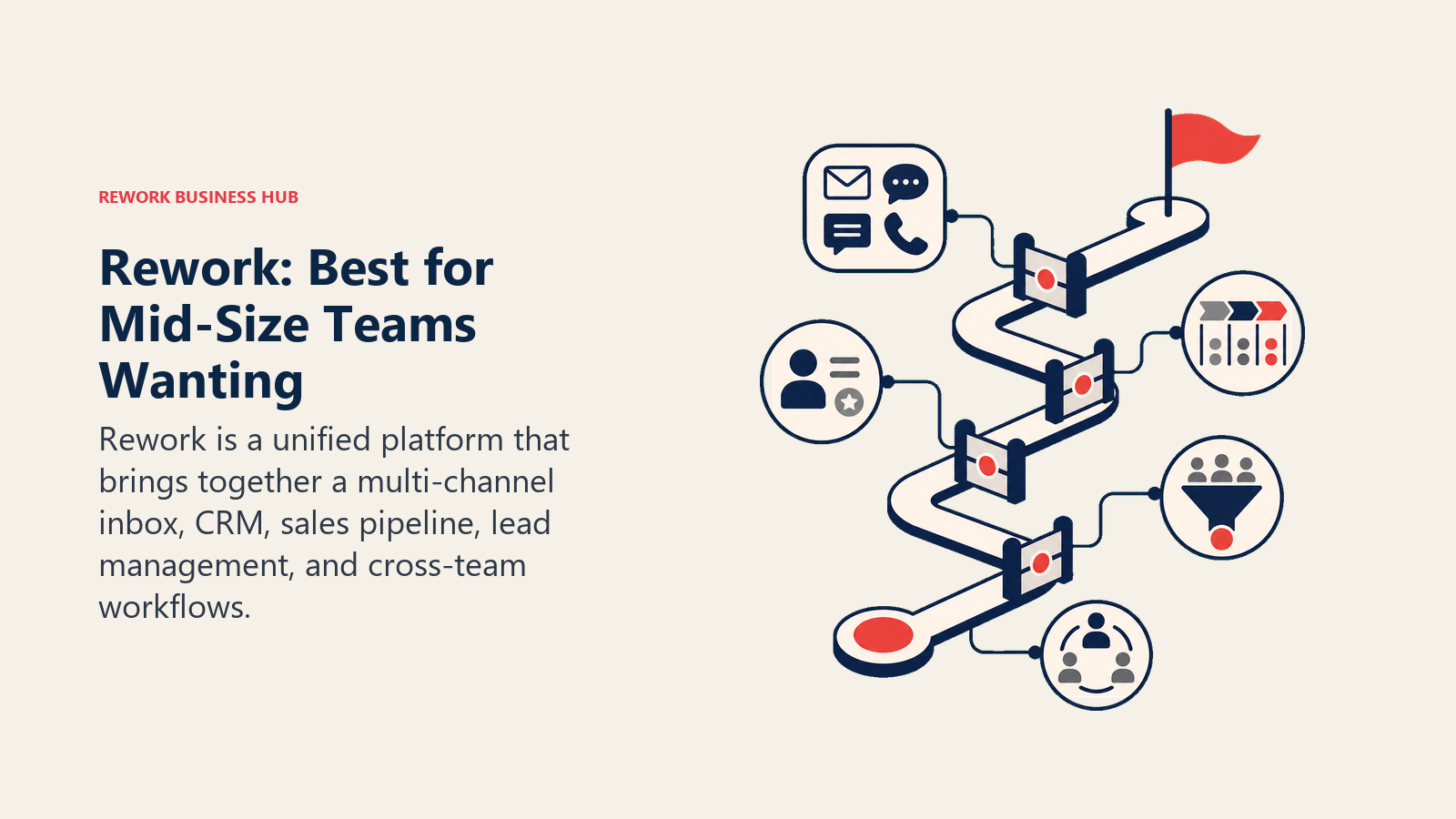
The support angle centers on the chat inbox: conversations from WhatsApp, Messenger, Instagram, TikTok, Telegram, LINE, Zalo, and web chat land in one shared workspace alongside your CRM records, with routing rules, SLA deadlines, and AI agents (in beta) that answer routine questions from your own knowledge sources. Email runs in a separate app, Rework Mail, where team inboxes handle a shared support address. Your agents see deal history, contact notes, and open tasks alongside the incoming message. That context-at-a-glance is usually the argument for a platform like Kustomer, but Rework packages it at mid-size-team pricing rather than enterprise contact center pricing.
The honest ICP is a team of 5-50 people in services, consulting, sales-led SaaS, or e-commerce where the same person touching a support ticket also owns the relationship. If your support motion is tightly coupled to your sales and ops motion, Rework earns back its cost quickly.
Not ideal for: large enterprise contact centers with hundreds of agents, teams that need voice, SMS (neither is offered) or a customer-facing help center, advanced workforce management, or customers who need Kustomer-class omnichannel routing at high volume. Those teams should look at Zendesk Suite or a dedicated CCaaS platform.
| Pros | Cons |
|---|---|
| Support, CRM, and ops in one monthly bill | No per-seat licensing option (seats sold in blocks of 5) |
| 11-channel chat inbox with full CRM context | Not built for high-volume contact centers |
| Strong lead management and pipeline built in | No voice, SMS, or help center |
| Transparent package pricing, no hidden add-ons | 5-seat minimum per seat type |
Pricing: Revenue Engine (CRM, omnichannel inbox and lead capture) is $159/month billed yearly ($1,908/year) or $190 month to month, with 5 marketing and 5 sales seats included. Extra seats come in blocks of 5 ($21/month per block on yearly billing). 14-day free trial. See rework.com/pricing.
Best for: Teams of 5-50 that want a single platform for support conversations, CRM, and cross-team coordination.
3. Front: Best for Collaborative, Relationship-Driven Support
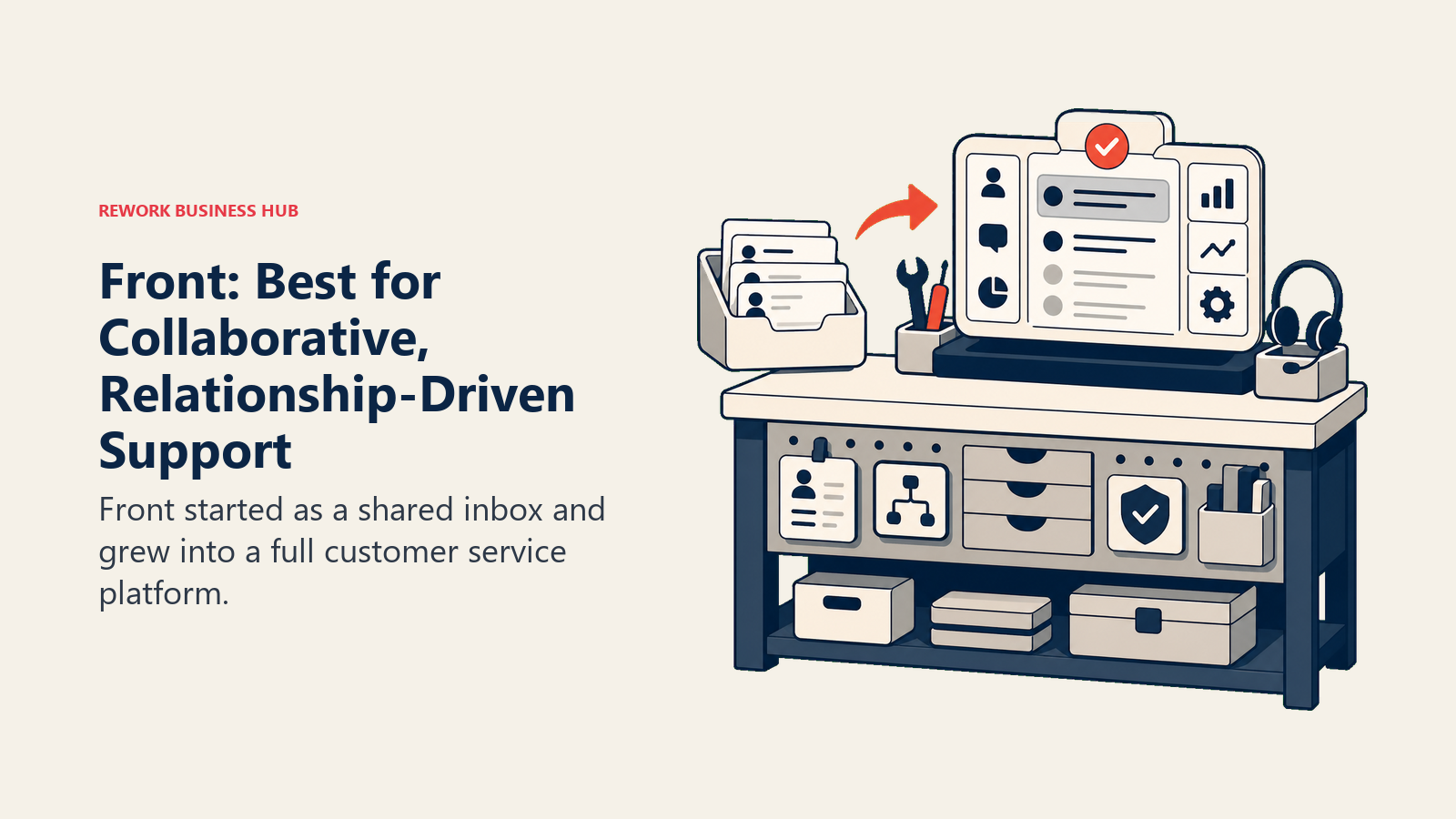
Front started as a shared inbox and grew into a full customer service platform. Its big differentiator is the email-native experience: messages look and feel like email, agents can collaborate with internal notes and mentions inside threads, and external communication stays personal. For account-based teams or agencies where the support relationship is as important as the resolution, this matters.
Starter is $25/seat/month (email-focused, no omnichannel). Professional at $65/seat/month adds SMS, social, and omnichannel. Enterprise is $105/seat/month. AI Copilot costs $20/seat extra, Smart QA another $20/seat, and AI Autopilot is $0.89 per resolved conversation. For a 15-person team on Professional with Autopilot, you're at $975/month before resolution fees.
The limitation is that Front's AI story is still bolted on rather than native. Teams that need high-volume automation at low cost will find the per-resolution charges stack up. And it's not a CRM. You'll still need a separate CRM integration or HubSpot sync to see deal context in a conversation.
| Pros | Cons |
|---|---|
| Best collaborative inbox experience | AI features add significant per-seat cost |
| Personal email feel, strong for account-based teams | No built-in CRM |
| Clean, modern interface | Omnichannel requires Professional tier |
| Good for agencies and professional services | Limited custom reporting without Enterprise |
Pricing: Starter $25/seat/month, Professional $65/seat/month, Enterprise $105/seat/month. Front pricing
Best for: Teams that handle email-heavy, relationship-driven support where agent collaboration inside threads is a daily need. See best Front alternatives for more.
4. Freshdesk: Best Budget-to-Mid Helpdesk with Strong Automation
Freshdesk is the go-to for teams that want a capable helpdesk without a Kustomer-sized invoice. The free plan covers basic ticketing for small teams. Growth at $19/agent/month gives you SLA management, automation, a knowledge base, and time tracking. The real jump is Freshdesk Omni: Growth $29, Pro $79, Enterprise $119 per agent per month, which layers in live chat, messaging, and social channels.
Freddy AI Copilot adds $29/agent/month. The automation engine is one of the most capable at this price tier: canned responses, scenario automations, and observer rules cover most mid-market needs without needing a dedicated ops person.
Freshdesk doesn't have Kustomer's conversation-centric data model. Each ticket is its own object, and assembling a full customer timeline requires the Freshworks ecosystem (Freshsales for CRM, Freshservice for IT). If you're already a Freshworks shop, that's a strength. If you're evaluating stand-alone, the cross-product dependency is a real consideration.
| Pros | Cons |
|---|---|
| Free plan for small teams | CRM requires separate Freshsales product |
| Best value at entry and mid tier | Omnichannel costs more (Omni plans) |
| Strong automation and SLA management | Customer timeline fragmented without full Freshworks suite |
| Large ecosystem of integrations | Support quality varies by plan |
Pricing: Free plan; Growth $19/agent/month; Pro $55/agent/month; Enterprise $89/agent/month. Freshdesk Omni starts at $29/agent/month. Freshdesk pricing
Best for: Cost-conscious teams of any size who want helpdesk-first and will add channels gradually. See best Freshdesk alternatives.
5. Help Scout: Best Simple, Human-Centric Support for SMBs
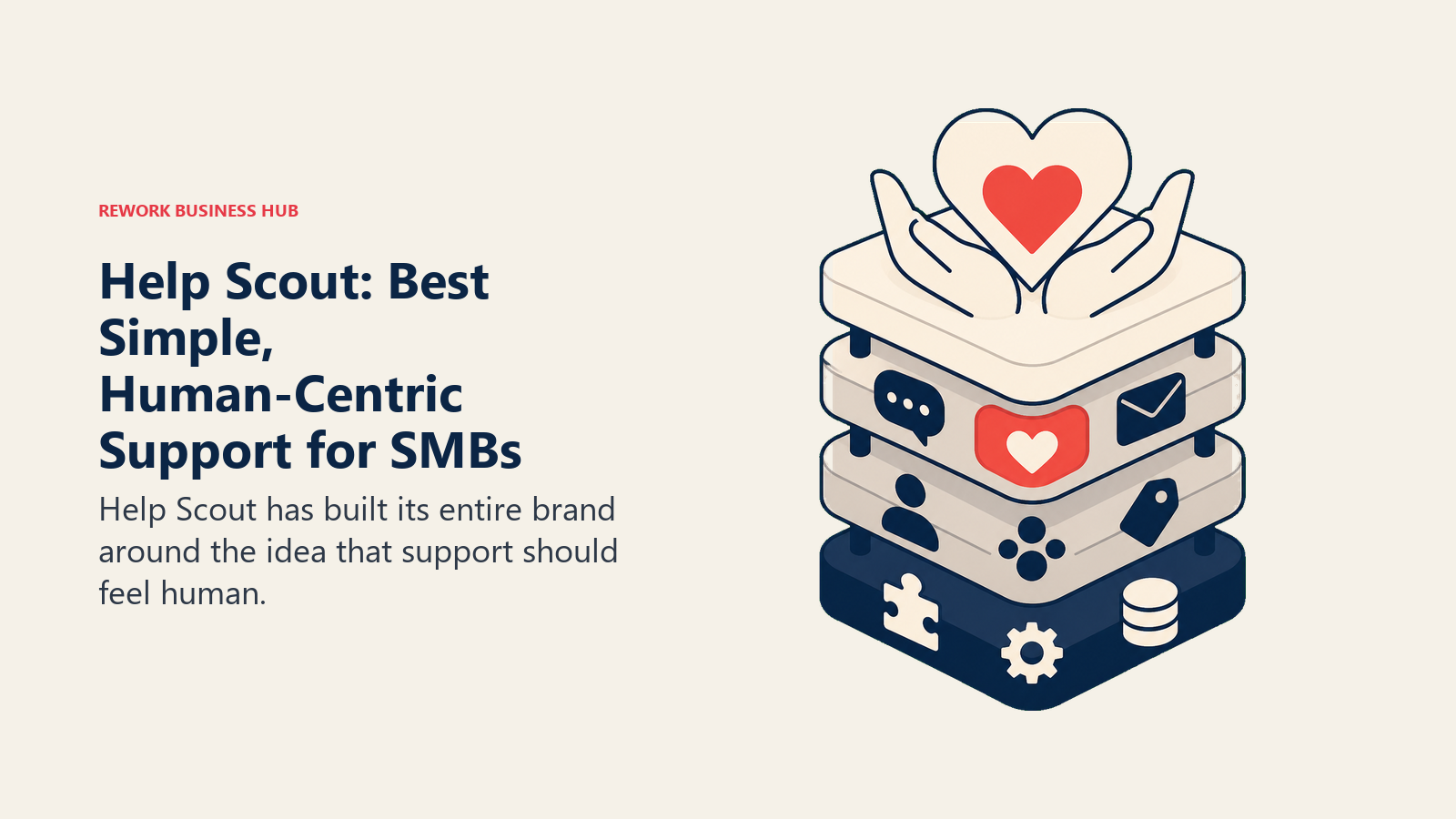
Help Scout has built its entire brand around the idea that support should feel human. No ticket numbers in replies, clean shared inboxes, embedded help docs that surface answers before a customer hits send. It's the anti-Kustomer in spirit: minimal, opinionated, and deliberately SMB-focused.
Pricing is clean: Free (5 users, limited), Standard $25/user/month, Plus $45/user/month, Pro $75/user/month. AI Answers is $0.75 per resolution. For a 10-person team on Standard with moderate AI usage, you're looking at $250-$700/month depending on automation adoption.
The limitation is enterprise depth. Help Scout doesn't do voice, doesn't have a native CRM, and the analytics stop well short of what Kustomer-class teams need. But for a 5-30 person team that wants their support to feel like a warm handwritten letter rather than a ticketing queue, it's one of the best tools available.
| Pros | Cons |
|---|---|
| Clean, human-feeling inbox experience | No native CRM or voice |
| Built-in knowledge base (Docs) | Limited reporting at Standard tier |
| Free plan available | Not suitable for high-volume contact centers |
| Generous per-resolution AI pricing | Pro tier required for advanced security |
Pricing: Free (5 users); Standard $25/user/month; Plus $45/user/month; Pro $75/user/month. Help Scout pricing
Best for: SMBs and early-growth companies that prioritize a personal, non-ticketing customer experience. See best Help Scout alternatives.
6. Gorgias: Best for E-Commerce Brands on Shopify or WooCommerce
Gorgias is purpose-built for direct-to-consumer brands. The platform's core differentiator is deep Shopify integration: order data, return status, subscription state, and purchase history surface directly inside every conversation. An agent doesn't need to open Shopify to answer "where's my order." It's right there.
Pricing runs by ticket volume, not by agent seat (except Starter, capped at 3 agents). Basic is $10/month, Pro $300/month, Advanced $900/month. All paid plans include unlimited agents above the Starter tier. AI Agent interactions cost $0.90-$1.00 per conversation, and the AI is double-billed: you pay for the helpdesk ticket AND the automation fee. Overages run $0.36-$0.40 per ticket beyond your plan limit.
The hard constraint: Gorgias doesn't make much sense outside e-commerce. If your support isn't centered on order management, you're paying for integrations you won't use and missing the platform's core value. Teams with a B2B support motion, or mixed commerce/SaaS products, usually end up frustrated. See best Gorgias alternatives for more.
| Pros | Cons |
|---|---|
| Best Shopify/WooCommerce integration in the market | E-commerce-only focus, no B2B fit |
| Unlimited agents on most plans | AI double-billing adds real cost |
| Ticket-volume pricing fits growing DTC brands | Overage fees can spike unexpectedly |
| Strong macro automation for repeat order questions | Limited CRM and relationship management |
Pricing: Starter $10/month (3 agents); Basic $60/month; Pro $300/month; Advanced $900/month. AI Agent $0.90/conversation. Gorgias pricing
Best for: E-commerce and DTC brands running Shopify or WooCommerce with high order-related inquiry volume.
7. Intercom: Best for SaaS and Product-Led Teams Blending Support and Engagement
Intercom blurs the line between support and marketing in a way few platforms match. The in-app messenger, product tours, outbound campaigns, and Fin AI Agent all live on the same platform. For a SaaS product team that wants to handle reactive support AND run proactive engagement from one tool, Intercom is the most complete option.
Essential plan is $29/seat/month, Advanced $85/seat/month, Expert $132/seat/month. Fin AI Agent is $0.99 per resolved outcome. Add-ons for WhatsApp ($29/month), SMS ($29/month), and phone ($29/month) stack up quickly. A 20-person team on Advanced with Fin handling 30% of volume could easily hit $2,500-$4,000/month.
The challenge for Kustomer refugees is that Intercom's support motion is strongest when your customers are inside your product. External-facing B2B support or e-commerce isn't its sweet spot. And the per-outcome AI billing makes forecasting harder as automation adoption grows. See best Intercom alternatives.
| Pros | Cons |
|---|---|
| Best proactive messaging + reactive support combo | Per-resolution AI billing is hard to forecast |
| Strong for in-app support and onboarding | Channel add-ons add cost quickly |
| Fin AI Agent handles complex queries well | Not ideal for non-product-led support motions |
| Active community and extensive docs | Enterprise plans average $55K/year |
Pricing: Essential $29/seat/month; Advanced $85/seat/month; Expert $132/seat/month. Fin AI $0.99/outcome. Intercom pricing
Best for: SaaS and product-led companies that need proactive in-app engagement alongside reactive support.
8. Gladly: Best for High-End Retail Brands Where Voice is the Primary Channel
Gladly sits closest to Kustomer in philosophy: people-centric, not ticket-centric. Every customer has a single conversation timeline across all channels, and agents work from a people record rather than a ticket queue. The platform is trusted by Crate and Barrel, Ulta Beauty, and Tumi because it handles the phone-first, high-touch support motion that luxury retail demands.
But Gladly is expensive. Pricing typically starts around $180-$210/agent/month, billed annually, with voice and SMS billed separately on top. This is in Kustomer territory, and the implementation is similarly complex. It's not a lateral move. It's a considered enterprise migration.
If you're leaving Kustomer for budget reasons, Gladly isn't the answer. But if you're leaving because Kustomer's data model doesn't quite fit your voice-heavy retail operation, Gladly is worth an evaluation call.
| Pros | Cons |
|---|---|
| True people-centric model, no ticket numbers | Very expensive ($180-$210/agent/month+) |
| Excellent for phone-first, high-touch retail | Voice and SMS billed separately |
| Strong timeline across all channels | Long implementation timeline |
| Trusted by major retail and fashion brands | Not suitable for SMBs or SaaS teams |
Pricing: Custom; typically $180-$210/agent/month. Contact sales for current rates. Gladly
Best for: Retail, fashion, and e-commerce brands where voice is the primary support channel and agent context continuity drives CSAT.
9. HubSpot Service Hub: Best for Teams Already Using HubSpot CRM
If your team runs HubSpot for marketing and sales, Service Hub is the path of least resistance for support. Tickets, live chat, shared inbox, knowledge base, and CSAT surveys all tie natively into the same contact and company records your sales team uses. There's no integration to maintain, no contact sync to debug.
Free plan covers basic ticketing. Starter is $15/seat/month. Professional jumps to $90/seat/month with a $1,500 onboarding fee, and Enterprise is $150/seat/month with a 10-seat minimum and $3,500 onboarding fee. For HubSpot-native teams, the Professional tier is where the platform really earns its keep: custom pipelines, playbooks, and SLA reporting all unlock there.
The honest limitation: Service Hub as a stand-alone helpdesk is mediocre. The tooling was built as a CRM extension, not a dedicated support platform. Teams comparing it directly to Zendesk or Freshdesk on support depth usually come away underwhelmed. Its value comes from the HubSpot flywheel, not from the support features alone.
| Pros | Cons |
|---|---|
| Native CRM integration, no sync needed | Weak as a stand-alone helpdesk |
| Free plan for basic needs | Professional tier onboarding fee ($1,500) |
| Familiar UI for HubSpot users | $90/seat/month is expensive for support depth offered |
| Scales within the full HubSpot suite | Enterprise requires 10-seat minimum |
Pricing: Free; Starter $15/seat/month; Professional $90/seat/month; Enterprise $150/seat/month. HubSpot Service Hub pricing
Best for: Teams running HubSpot CRM that want a joined-up view of support tickets alongside sales and marketing contacts.
10. Zoho Desk: Best for Budget-Conscious Teams or Zoho Ecosystem Users
Zoho Desk is the best-value structured helpdesk in this list. Express plan at $7/user/month, Standard at $14/user/month, Professional at $23/user/month, Enterprise at $40/user/month. The feature-per-dollar ratio at Standard and Professional is hard to match. If you're running Zoho CRM, Zoho Books, or Zoho Analytics alongside it, the cross-app context is genuinely useful.
The limitation is surface-level polish. Zoho's interface has improved but still feels behind Zendesk, Front, or Help Scout in UX quality. The AI assistant, Zia, covers the basics but isn't competitive with Fin or Freshdesk's Freddy at the more complex query types. And teams outside the Zoho ecosystem lose most of the CRM advantage.
For teams that need more than a free plan but can't justify $55/agent for Zendesk, Zoho Desk is a reasonable choice with real longevity. See best Zoho Desk alternatives if you need more modern tooling.
| Pros | Cons |
|---|---|
| Best price-per-feature at mid tier | UI quality lags behind competitors |
| Strong within the Zoho ecosystem | AI (Zia) limited vs dedicated platforms |
| Free plan available | Less valuable outside Zoho ecosystem |
| 15-day free trial, no credit card required | Reporting can be clunky |
Pricing: Free (3 users); Express $7/user/month; Standard $14/user/month; Professional $23/user/month; Enterprise $40/user/month. Zoho Desk pricing
Best for: Cost-sensitive teams, Zoho ecosystem users, and teams that need a capable helpdesk without enterprise-level spend.
11. LiveAgent: Best Multi-Channel SMB Option with Built-In Call Center
LiveAgent packs more channels into a low entry price than almost any competitor: email, live chat, call center, social media, and a knowledge base are all available from the Small plan at $15/agent/month. The 30-day free trial with no credit card is one of the most generous in the industry. For a team of 5-15 that genuinely needs voice support but can't afford Zendesk Talk pricing, LiveAgent is often the answer.
Small plan at $15/agent/month includes 1 email account and 3 departments. Medium at $29/agent/month expands to 10 email accounts and adds unlimited chat buttons. Large at $49/agent/month goes unlimited. Enterprise at $69/agent/month adds custom roles and senior support. One watch-out: social media channels cost $39-$58 extra per month on the smaller tiers, which can erode the value story.
The interface is functional but not modern. Teams coming from Front or Help Scout will find the UX transition uncomfortable. And LiveAgent's enterprise controls, reporting depth, and AI capabilities are well below what Kustomer refugees are used to. But for a price-sensitive team that needs phone support, it's a genuine option. See best LiveAgent alternatives.
| Pros | Cons |
|---|---|
| Voice/call center included at low price | Interface is dated |
| Generous 30-day free trial | Social channels cost extra on Small/Medium |
| Good channel breadth for the price | Limited AI and advanced routing |
| API and integrations included at all tiers | Not suitable for enterprise scale |
Pricing: Small $15/agent/month; Medium $29/agent/month; Large $49/agent/month; Enterprise $69/agent/month. LiveAgent pricing
Best for: SMBs (5-20 agents) that need multi-channel support including voice and can't justify Zendesk's pricing. See also best LiveAgent alternatives.
12. Kayako: Best for Teams That Want Pure AI Resolution-Based Pricing
Kayako made a significant pivot in 2026: the platform consolidated into "Kayako One" and moved to a pure resolution-based model. $1 per ticket resolved by the "Kay" AI agent, no per-seat fees, no setup fees. Starter is free. If your team can automate a high proportion of incoming requests, the economics are compelling: 500 AI-resolved tickets a month is $500, whether you have 5 agents or 50.
The trade-off is platform depth. Kayako's traditional strengths (shared inboxes, customer journeys, collaboration) are solid mid-tier. But coming from Kustomer's omnichannel breadth, reporting power, and customer history model, you'll notice the gaps quickly. Real-time dashboards, advanced SLA workflows, and enterprise identity management aren't Kayako's strengths.
This is a platform best evaluated by teams that are early in their support operations and want to keep costs tied to automation outcomes rather than headcount. For an established contact center migrating from Kustomer, the reporting and admin gaps will likely be blockers. See best Kayako alternatives.
| Pros | Cons |
|---|---|
| No per-seat fees, cost tied to AI performance | Limited reporting depth |
| Free Starter plan | New model, less proven at scale |
| Scales without headcount-based billing | Advanced enterprise features limited |
| Clean, simple onboarding | Less omnichannel breadth than Kustomer |
Pricing: Free Starter; $1/AI-resolved ticket (Kayako One). Kayako pricing
Best for: Small to mid-size teams willing to invest in AI-first support and wanting costs to scale with automation success rather than agent count.
Stage Fit Matrix
| Stage | Best Fits | Why |
|---|---|---|
| Startup (under 10 people) | Help Scout, Freshdesk (Free/Growth), Kayako Starter, Zoho Desk | Low cost, fast setup, no implementation overhead |
| Growth (10-50 people) | Rework, Front, Freshdesk Pro, Intercom | Balance of channels, CRM context, and reasonable per-agent cost |
| Mid-market (50-200 people) | Zendesk Suite, Freshdesk Omni, Intercom, Gorgias (e-commerce) | Routing depth, omnichannel, workforce management begins to matter |
| Enterprise (200+ people) | Zendesk Enterprise, Gladly, Kustomer (stayed) | CCaaS-grade routing, WFM, compliance, custom SLAs, enterprise SSO |
Sizing and Persona
| Team Size | Buyer Persona | Best Match | Why |
|---|---|---|---|
| 1-4 people | Founder or first support hire | Help Scout Standard, Freshdesk Growth | Fast to set up, human scale |
| 5-15 people | Support lead or customer success manager | Rework, Front, LiveAgent | Multi-channel, CRM context, team coordination |
| 15-50 people | Head of CX or director of support | Freshdesk Omni, Zendesk Suite Team, Intercom | Routing rules, reporting, automation depth |
| 50-150 people | VP of CX or COO | Zendesk Professional, Gorgias (e-com), Gladly (retail) | Workforce tools, custom SLAs, enterprise compliance |
| 150+ people | Head of operations or enterprise buyer | Zendesk Enterprise, Gladly, Kustomer | Full CCaaS feature set, contract pricing, WFM |
How to Choose: Decision Framework
This option addresses a distinct buyer need within Best Kustomer Alternatives in 2026: 12 Customer Support Platforms Compared.
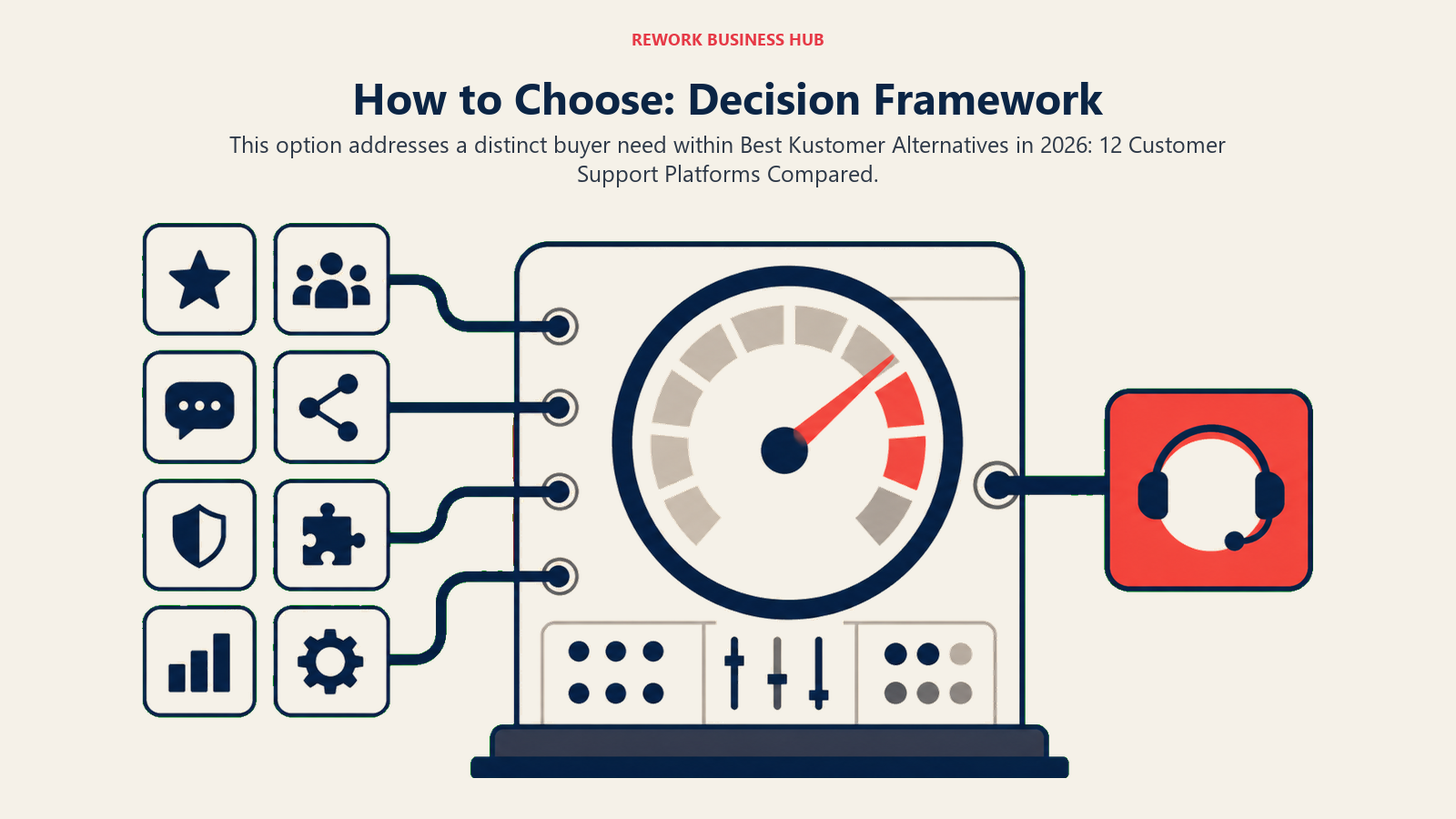
| If you need this | Pick this |
|---|---|
| The widest channel coverage and integration ecosystem | Zendesk Suite |
| Support conversations tied to CRM and ops in one platform | Rework |
| Collaborative shared inbox with a personal email feel | Front |
| The best value entry point with room to grow | Freshdesk |
| Simple, human-scale support without a ticketing feel | Help Scout |
| Order-centric support for Shopify or WooCommerce | Gorgias |
| In-app support and proactive messaging for SaaS | Intercom |
| Voice-first, people-centric model for luxury retail | Gladly |
| Support tied natively to HubSpot CRM | HubSpot Service Hub |
| The cheapest capable helpdesk with voice included | LiveAgent or Zoho Desk |
| AI-first pricing where cost tracks automation outcomes | Kayako One |
| Staying with Kustomer but reducing cost | Kustomer conversation-based model |
What to Do Next
Start with the sizing and persona table. Most teams overthink the tool and underthink the fit: a 15-person team that buys Zendesk Enterprise wastes money on features they won't touch for two years. A 100-person contact center that picks Help Scout will hit the ceiling inside six months.
If you're currently on Kustomer and weighing a switch, the most common moves are:
- To Zendesk: when you need all the same channels and depth, but want more integration options and a more established partner ecosystem.
- To Rework: when your support team is mid-size and you want CRM and ops consolidated alongside the inbox.
- To Freshdesk or Zoho Desk: when the primary driver is cost reduction without losing omnichannel coverage.
- To Help Scout: when the team is smaller than you thought you needed Kustomer for, and customer relationships matter more than ticket throughput.
Most of these platforms offer a free trial. Run a pilot with your two or three most common conversation types and stress-test the routing rules before committing to a migration.

On this page
- Quick Comparison Table
- 1. Zendesk: Best for Complex, Multi-Channel Enterprise Support
- 2. Rework: Best for Mid-Size Teams Wanting Support Unified with CRM and Ops
- 3. Front: Best for Collaborative, Relationship-Driven Support
- 4. Freshdesk: Best Budget-to-Mid Helpdesk with Strong Automation
- 5. Help Scout: Best Simple, Human-Centric Support for SMBs
- 6. Gorgias: Best for E-Commerce Brands on Shopify or WooCommerce
- 7. Intercom: Best for SaaS and Product-Led Teams Blending Support and Engagement
- 8. Gladly: Best for High-End Retail Brands Where Voice is the Primary Channel
- 9. HubSpot Service Hub: Best for Teams Already Using HubSpot CRM
- 10. Zoho Desk: Best for Budget-Conscious Teams or Zoho Ecosystem Users
- 11. LiveAgent: Best Multi-Channel SMB Option with Built-In Call Center
- 12. Kayako: Best for Teams That Want Pure AI Resolution-Based Pricing
- Stage Fit Matrix
- Sizing and Persona
- How to Choose: Decision Framework
- What to Do Next