Best Similarweb Alternatives in 2026: 13 Website Traffic Intelligence Tools
Turn this article into takeaways for your work.


Each assistant summarizes the article only for you and suggests best practices for your work.
The best Similarweb alternative depends on what you were using it for. For market-level benchmarking, Semrush Traffic & Market is the closest match. For competitor search traffic and top pages, Ahrefs, SE Ranking, SpyFu and Ubersuggest are cheaper. For your own site, nothing beats Google Analytics and Search Console, because they measure traffic instead of guessing it. This guide covers 13 options, priced for a three-person team rather than a single seat.
Similarweb sells self-service packages to individuals at three levels. Competitive Intelligence is $65 per month billed annually or $99 billed monthly, with one user and three months of history. Competitive Intel & SEO & AEO is $165 per month billed annually or $199 monthly, with six months of history and 150 tracked AI prompts. The top package, which adds ads data, is $270 billed annually or $325 monthly. Business and team packages are custom, which means a quote. There's also a free Website Traffic Checker limited to 3 searches a day.
So why look elsewhere? Three reasons come up again and again. First, price at seat scale: a package is one user, so three people means three packages or a sales call. Second, team plans have no printed price, which makes budgeting hard. Third, and most important, every third-party traffic figure, Similarweb's included, is a modelled estimate. If your decision depends on the exact visitor count of a small competitor, no tool in this guide can give you that. This article is specifically about replacing Similarweb. For the wider category of checkers, see our best website traffic checkers roundup, and for the full SEO picture see the best SEO tools hub.
Key Facts
- Similarweb says its data blends four source types: direct measurement, a contributory network, partnerships and public data extraction, run through machine learning calibration and predictive models.
- Semrush says Traffic Analytics is based on clickstream data approximated from the behaviour of over 200 million internet users, and notes that it doesn't come from a site's own analytics.
- In Ahrefs' study of 1,635 websites, Ahrefs' US organic traffic estimate had a median deviation of 49.52% from Google Search Console and Semrush's had 68.36%.
- Ahrefs defines organic traffic as an estimation of how many clicks from Google a site gets each month, so it won't match your own analytics.
- Google Trends values are scaled from 0 to 100 based on a topic's proportion of all searches, so they show relative interest, not absolute volume.
Quick Comparison Table
| Tool | Best For | Starting Price | Key Strength | Key Limitation |
|---|---|---|---|---|
| Semrush Traffic & Market | Market-level benchmarking | Listed at $289 per month | Clickstream-based, up to 100 competitors | Separate purchase on top of any Semrush plan |
| Semrush SEO plan | Competitor organic traffic plus SEO | $139/mo billed monthly ($117.33/mo billed annually) | Keyword, audit and tracking tools in one login | Search traffic only; extra users from $45 |
| Ahrefs | Rival top pages and keywords | Lite $129/mo billed monthly | Page-level competitor research | Google search clicks only |
| SE Ranking | Competitor traffic plus rank tracking | Core $129/mo billed monthly ($103.20/mo billed annually) | 2k tracked keywords and 10 projects | One manager seat on Core |
| SpyFu | Organic and paid history | Basic $39/mo billed monthly ($29/mo billed annually) | 10+ years of history on higher plans | No free tier published |
| Ubersuggest | Cheap competitor checks | Individual $29/mo billed monthly | Lifetime purchase option | Small per-project limits |
| Moz Pro | Estimated clicks beside authority | Starter $49/mo; Standard $99/mo billed monthly | Readable domain reports | Seats cost $49 each |
| Mangools | Light site profiling | $49/mo billed monthly (US list price) | Simple interface | Not an all-channel visits tool |
| Similarweb free checker | A quick look before paying | Free, 3 searches a day | Same dataset family, sample view | Full lists gated behind a trial |
| Google Analytics 4 | Your own all-channel traffic | Free of charge | Measured, not modelled | Your tagged sites only |
| Google Search Console | Your own Google search clicks | Free | First-party clicks and impressions | Google Search only |
| Google Trends | Relative search interest | Free | Long history, compare topics | Not volume or visits |
| Bing Webmaster Tools | Your own Bing performance | Free | Search data plus competitor backlinks | Bing data only |
Why Teams Look for a Similarweb Alternative
It helps to separate the reasons, because each points to a different replacement.
| Reason | What it looks like | Where to look |
|---|---|---|
| Price at seat scale | Packages are 1 user each, so 3 seats means 3 packages | A suite that includes extra seats, or a free first-party tool |
| No printed team price | Business and team plans are custom | A tool with published seat prices |
| Modelled, not measured | Every number is an estimate | Your own analytics for your own site |
| Narrow need | Only search traffic or only top pages matter | A keyword-ranking tool |
| Short history on entry plan | Entry package shows 3 months of history | SpyFu or Ahrefs for deeper history |
Notice that the last two have nothing to do with money. If all you ever check is a rival's Google search traffic, a panel-based tool is more than you need. If you need total visits across direct, social and referral, a keyword tool can't tell you.
How Traffic Estimates Differ From Your Own Analytics
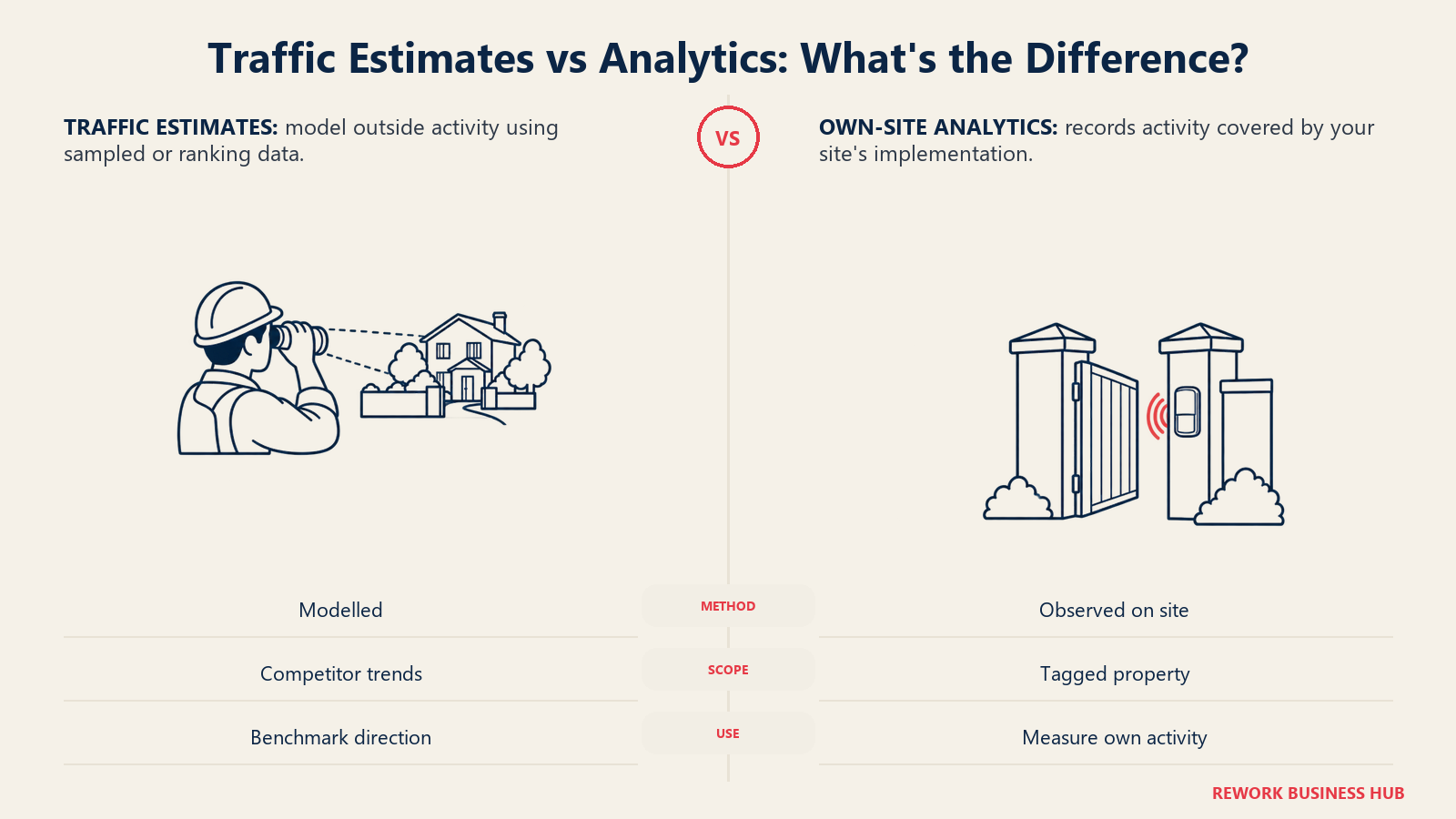
This is the section that decides how much to trust anything below. Third-party tools estimate; your own tools count.
| Source | What it produces | How |
|---|---|---|
| Similarweb | Modelled total visits and channel mix | Blend of direct measurement, a contributory network, partnerships and public data, then ML calibration |
| Semrush Traffic & Market | Modelled visits and sources | Clickstream data from proprietary and third-party sources, approximated with Semrush's own algorithms |
| Ahrefs, SE Ranking, Ubersuggest, SpyFu, Moz | Estimated Google search clicks | Keywords a site ranks for, times search volume, times a modelled click-through rate |
| Google Analytics 4 | Counted on-site activity | A tag on your own pages |
| Search Console | Counted Google Search clicks and impressions | Google's own reporting for verified sites |
Ahrefs lists three reasons its estimate won't match Google Analytics or Search Console: it tracks only a subset of keywords, it models search volume by combining Keyword Planner and clickstream data, and it projects clicks from ranking position, because only Google knows the real click counts. Panel tools have a different weakness. Semrush itself says its Traffic Analytics data doesn't come from a website's internal analytics, so figures can differ from Google Analytics, and sample-based data gets thinner for small sites.
The practical consequences:
- Use estimates for direction and rank order, not for absolute counts. Is a rival growing? Is it bigger than you? Those questions survive modelling error far better than "how many visitors did they get in March?"
- Calibrate on your own site. Look up your own domain in each tool, compare to Search Console for Google clicks, and note the gap. Apply that relationship loosely to competitors.
- Treat the Ahrefs and Semrush deviation figures above as one data point. The study was published by a vendor measuring itself and its closest rival, and it didn't include Similarweb. It tells you estimates can be far off for individual sites, not which vendor is best.
- Never print a competitor's estimated visits as fact in a report. Write a range and name the tool.
What a Realistic Small-Team Setup Costs
A small team here means 3 seats and a handful of competitor lookups a week, with some rank tracking if the tool offers it. The first column adds up printed prices billed monthly. The second shows the equivalent where the vendor prints an annual per-month figure. Sums are our addition of printed figures, nothing more.
| Setup | Seats and limits | Billed monthly | Billed annually, where printed |
|---|---|---|---|
| Similarweb Competitive Intelligence | 3 individual packages at $99 each, 3 months history each | $297 | $195 (3 x $65) |
| Semrush SEO plan | 5 websites, 500 daily keywords, plus 2 extra users from $45 each | From $229 | From $207.33 ($117.33 plus 2 x $45) |
| Semrush SEO plan plus Traffic & Market | $139 plus $289 listed for one Traffic & Market seat | $428; team access to Traffic & Market is a Custom plan | Not printed |
| Ahrefs Lite | 5 projects, 750 keywords, plus 2 users at $40 each | $209 | Not printed |
| SE Ranking Core | 10 projects, 2k keywords, plus 2 extra seats from $16 each | From $161 | From $135.20 ($103.20 plus 2 x $16) |
| Ubersuggest Business | 2 users included, 7 projects, plus 1 add-on user at $5 | $54 (US list, localised by region) | Yearly price is $326 per year, plus add-ons |
| SpyFu Pro + AI | 15k weekly keyword rankings, 1 user included, plus 2 users at $30 each | $179 (after the $59 first month) | $149 ($89 plus 2 x $30) |
| Moz Medium | 2 users, 10 sites, 1,500 keywords, plus 1 seat at $49 | $228 | $192 first-year ($143 plus $49) |
| Mangools Premium | 700 keywords, 3 extra seats available | $69 (US list price) | $538.80 per year |
| Google Analytics 4, Search Console, Bing Webmaster Tools | Your own sites | $0 | $0 |
Three things stand out. Seats move the answer more than the headline price: Ahrefs Lite and SE Ranking Core both list at $129 monthly, yet land $48 apart for three people. Similarweb's three packages cost more than Semrush's whole SEO plan with two added users, but it's a different product, with all-channel visits instead of search clicks. And the free tools are free of any seat arithmetic, which is why they belong in every setup. For deeper tracking-focused pricing see the rank tracker guide.
Similarweb vs Alternatives by Capability
Where a cell says "Search only", the tool estimates Google organic clicks, not visits from every source.
| Capability | Similarweb | Semrush T&M | Semrush SEO | Ahrefs | SE Ranking | SpyFu | Ubersuggest | GA4 / GSC |
|---|---|---|---|---|---|---|---|---|
| Competitor total visits | Yes (modelled) | Yes (modelled) | No | No | No | No | No | Own site only |
| Competitor search traffic | Keyword view | Via the SEO plan | Search only | Search only | Search only | Search only | Search only | Own site only |
| Channel mix | Yes, top 3 free | Yes | No | No | No | No | No | Own site only |
| Competitor top pages | Gated | Yes | Yes | Yes | Yes | Partial | Yes | Own site only |
| Rank tracking | Not its focus | Not in this toolkit | Yes | Yes | Yes | Yes | Yes | GSC position |
| Site audit | Not its focus | Not in this toolkit | Yes | Yes | Yes | Yes | Yes | No |
| Free tier | Checker, 3 per day | Sample domains | Free plan, 1 demo project | Ahrefs Free (own sites) | Trial only | None published | Free account | Free |
| Seats on entry plan | 1 | 1 | 1 | 1 | 1 | 1 | 1 | Unlimited |
1. Semrush Traffic & Market: The Closest Like-for-Like
If you used Similarweb for market benchmarking, this is the nearest equivalent. Semrush's Traffic Analytics is clickstream based and lets you compare a domain against competitors. Semrush's Traffic & Market page lists the Pro plan at $289 per month, and its knowledge base says you can purchase the toolkit separately from the other toolkits. It isn't part of the SEO plans. Our Semrush vs Similarweb comparison sets the two side by side.
Who it's for: SEO leads and strategists who need share of traffic across several rivals.
How it differs from Similarweb: same family of method (clickstream and modelling), a competitor ceiling of 100, and a pricing structure that sits on top of a Semrush account instead of replacing one.
What it does best: market landscape, acquisition channel mix and competitor alerts, plus historical and worldwide data.
Honest limit: it's a second bill. Seats are the other catch: Semrush's Traffic & Market help page says Pro includes 1 user seat and puts team access and team pricing on a Custom plan, so get a team quote before you commit. Free users can only view sample domains.
| Pros | Cons |
|---|---|
| Up to 100 competitors to analyse | Listed at $289 per month, separate purchase |
| Historical and worldwide data | Extra seat pricing needs confirming |
| Pairs with Semrush SEO data | Modelled data, like Similarweb |
Pricing: Traffic & Market Pro is listed at $289 per month. There's a 7-day free access trial for users who haven't had one.
Best for: teams that want a Similarweb-style market view and already live in Semrush.
2. Semrush SEO Plan: Competitor Search Traffic Without the Panel
Most teams that leave Similarweb don't actually need all-channel visits. They need to see how much Google search traffic a rival gets and which pages bring it. The SEO side of Semrush covers that using the keyword-ranking method. Our Semrush alternatives guide covers the suite in more depth.
Who it's for: small SEO teams that want competitor research, rank tracking and audits in one login.
How it differs from Similarweb: it estimates search clicks from ranking keywords, not total visits from a panel. Direct, email and social traffic never appear.
What it does best: breadth. A keyword gap, a site audit and a rank report in one afternoon.
Honest limit: one user is included, and the entry plan monitors 5 websites and 500 keywords daily. Extra users start at $45 per month.
| Pros | Cons |
|---|---|
| Widest toolkit under one login | Search traffic only |
| 7-day free trial and a free plan with 1 demo project | Extra users from $45 per month |
| Starter and Pro+ add AI search features | Pro+ is $299 monthly for 15 websites |
Pricing: the SEO plan is $139 per month billed monthly or $117.33 per month billed annually. Starter is $199 monthly or $165.17 annually. Pro+ is $299 monthly or $248.17 annually. Advanced is custom. The old Pro, Guru and Business plans are retired.
Best for: teams that want competitor organic research alongside the rest of their SEO work.
3. Ahrefs: Best for a Rival's Top Pages and Keywords
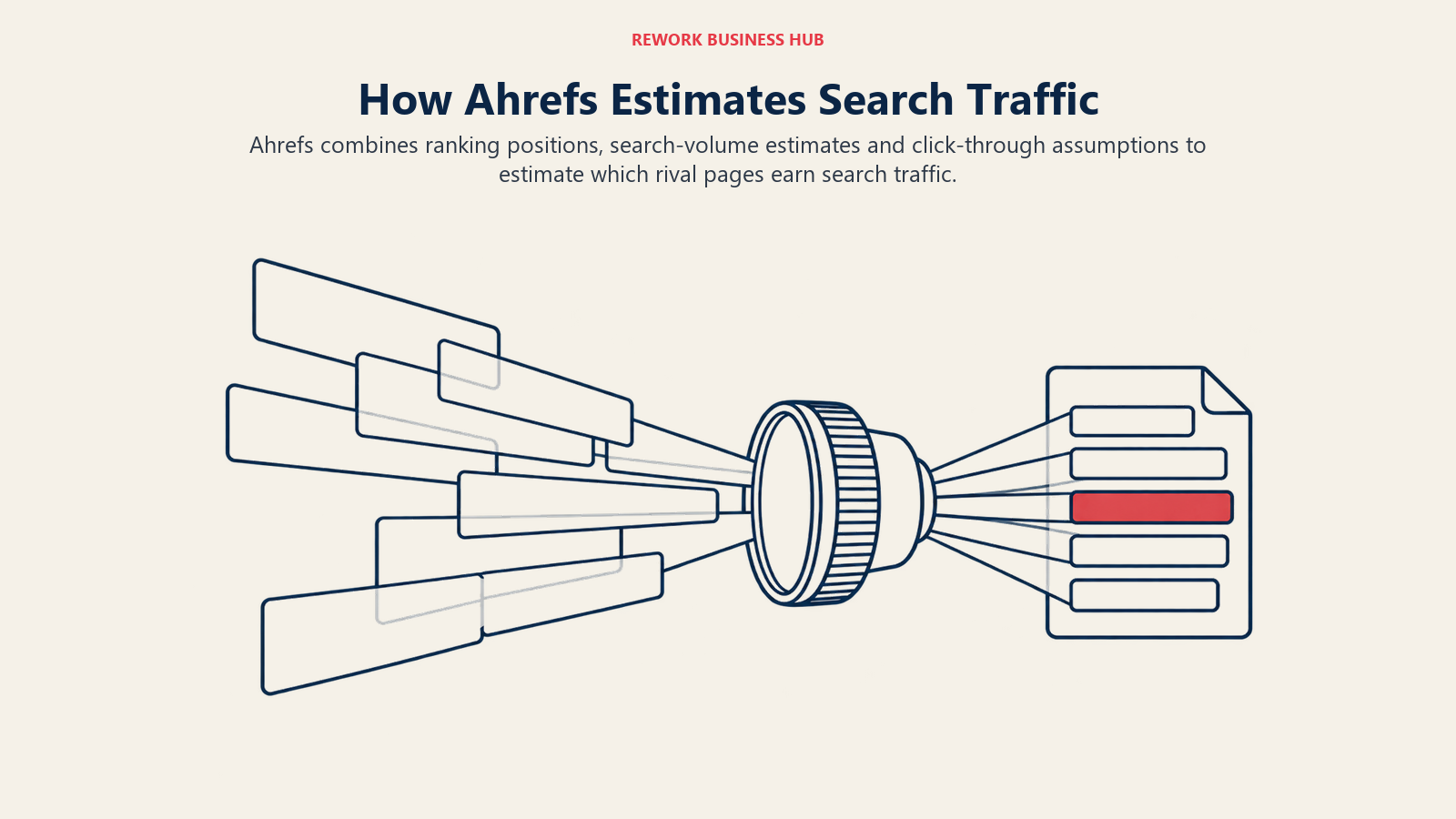
Ahrefs is the clearest example of a keyword-ranking estimator. It finds the keywords a site ranks for, estimates clicks per keyword from position, volume and click-through rate, and sums them. Its help center calls the result an estimate and says it is best used to compare sites. See our Ahrefs alternatives guide for the other direction.
Who it's for: content and SEO teams who want to see which pages bring a competitor search traffic.
How it differs from Similarweb: page-level and keyword-level detail instead of channel mix. No panel data at all.
What it does best: competitor research by page and keyword, with a long history on higher plans (6 months on Lite, 2 years on Standard).
Honest limit: Google search clicks only, and seats cost extra.
| Pros | Cons |
|---|---|
| Page-level competitor research | No direct, social or email traffic |
| Lite covers 5 projects and 750 tracked keywords | One user included |
| Ahrefs Free covers your own verified sites | Annual dollar prices not printed |
Pricing (Ahrefs pricing, billed monthly): Starter $29, Lite $129, Standard $249, Advanced $449, Enterprise $1,499 per month on an annual commitment. Lite adds 2 users at $40 each, Standard adds 5 at $60, Advanced adds 10 at $80.
Best for: finding the pages that earn a competitor its search traffic.
4. SE Ranking: Competitor Traffic With Enough Seats and Keywords
SE Ranking's competitor research tool shows monthly clicks estimated with AI, competitors' top keywords and pages, and their traffic cost, inside the same plan as rank tracking. Read our SE Ranking alternatives article for the head-to-head view.
Who it's for: small teams and agencies that want competitor traffic and daily rank tracking without two subscriptions.
How it differs from Similarweb: search clicks, not total visits, but with 2k tracked keywords and 10 projects on the entry plan.
What it does best: pairing competitor estimates with your own tracked rankings, which makes calibration easy.
Honest limit: Core has one manager seat. Core and Growth replaced the older Essential, Pro and Business plans, so older reviews describe a lineup that no longer exists.
| Pros | Cons |
|---|---|
| 10 projects and 2k daily keywords on Core | One manager seat on Core |
| 14-day trial, no card | Search traffic only |
| Extra seats from $16 | Plan names changed |
Pricing (SE Ranking): Core is $129 per month billed monthly or $103.20 billed annually. Growth is $279 monthly or $223.20 annually, with 30 projects, 5k keywords and 3 manager seats. Enterprise is custom.
Best for: teams that want one login for competitor traffic and rank tracking. See the rank trackers guide if tracking is the main job.
5. SpyFu: Best for Competitor Organic and Paid History
SpyFu is built around competitors' search and Google Ads activity. Its homepage shows an organic clicks per month figure for a domain alongside organic keywords.
Who it's for: teams that run paid search and SEO together.
How it differs from Similarweb: search and ads only, but with 10+ years of historical data on Pro + AI and Team/Agency, against Similarweb's 3 to 6 months on individual packages.
What it does best: seeing when a rival's traffic or ad activity changed.
Honest limit: no all-channel view, and no free tier or trial is published, only a 30-day money-back guarantee.
| Pros | Cons |
|---|---|
| Long history on higher plans | No free trial published |
| Basic from $39 monthly | Search and Google Ads focus |
| Team/Agency includes 5 users | Extra users $30 each on Pro + AI |
Pricing (SpyFu): Basic $39 per month billed monthly or $29 billed annually. Pro + AI is $59 for the first month, then $119 monthly, or $89 per month billed annually. Team/Agency is $249 monthly or $187 billed annually.
Best for: competitor organic and paid history on a modest budget.
6. Ubersuggest: The Cheapest Paid Competitor Check
Ubersuggest's traffic overview offers organic and paid traffic estimates for any domain, plus top pages and a keyword gap view. It's the lowest-priced paid entry here and one of the few with a one-time lifetime purchase.
Who it's for: founders and small content teams.
How it differs from Similarweb: estimates search traffic from keywords, at a fraction of the price, with small limits.
What it does best: fast, low-cost lookups.
Honest limit: Individual allows 125 tracked keywords on 1 project. Pricing is localised by region, and lifetime plans carry reduced AI credits.
| Pros | Cons |
|---|---|
| $29 monthly entry | 125 tracked keywords per project on Individual |
| Lifetime option | Regional pricing |
| Add-on users $5 each | No API |
Pricing (Ubersuggest, USD, localised by region): Individual $29 per month, $192 a year or $290 lifetime. Business $49 monthly, $326 a year or $490 lifetime, with 2 users and 7 projects. Enterprise/Agency $99 monthly, $657 a year or $990 lifetime. A one-time 7-day trial is offered on monthly plans.
Best for: a budget-first competitor check.
7. Moz Pro: Estimated Clicks Next to Authority Metrics
Moz's free domain analysis lists a site's top keywords sorted by position and estimated clicks, next to a Domain Authority score. See Moz alternatives for the wider market.
Who it's for: teams that already use Domain Authority.
How it differs from Similarweb: estimated clicks per keyword, not a single visits figure.
What it does best: a readable domain snapshot with a free entry point.
Honest limit: seats cost $49 a month each, and keyword counts are modest.
| Pros | Cons |
|---|---|
| Free domain analysis | Seats $49/mo each |
| Standard: 3 sites, 300 keywords | No all-channel visits |
| Medium: 2 users, 10 sites | Annual prices are first-year prices |
Pricing (Moz): Starter $49 per month. Standard $99 monthly or $79 billed annually. Medium $179 monthly or $143 billed annually. Large $299 monthly or $239 billed annually. Annual figures are first-year prices.
Best for: teams that want estimated clicks beside authority metrics.
8. Mangools: A Light Profiler for Small Teams
Mangools' SiteProfiler checks authority, backlinks and top content, and spots competitors' most popular content. It's closer to a profiler than a visits estimator.
Who it's for: freelancers and tiny teams.
How it differs from Similarweb: content and links, not visits.
What it does best: an approachable, low-clutter toolset.
Honest limit: Basic has no extra seats and allows 20 site analyses per 24 hours. Pricing is geo-served.
| Pros | Cons |
|---|---|
| Simple interface | No visits estimate |
| Premium allows 3 extra seats | Basic has no extra seats |
| 700 keywords on Premium | Regional pricing |
Pricing (Mangools, US list price): Basic $49 monthly or $358.80 per year billed annually. Premium $69 or $538.80. Agency $129 or $1,078.80.
Best for: small teams that want profiling plus keyword tools simply.
9. Similarweb's Free Checker: Try Before You Buy
Before paying anyone, use the free Website Traffic Checker. A domain page shows rank, visits over three months, bounce rate, pages per visit and top channels. It allows 3 searches a day, and the full channel breakdown, keyword list and exports sit behind a trial. A free browser extension works without an account, though small sites may return partial data.

Who it's for: anyone who only needs an occasional look.
How it differs from paid Similarweb: a high-level sample, no history beyond three months.
What it does best: a recognisable answer in seconds.
Honest limit: 3 searches a day and a sample view.
| Pros | Cons |
|---|---|
| Free, no card | 3 searches per day |
| Browser extension, no account | Partial data for small sites |
| Shows channels, countries, competitors | Full lists gated |
Pricing: free.
Best for: occasional checks that don't justify a subscription. Our free SEO tools roundup lists more.
10. Google Analytics 4: The Only Real Visitor Count
Google Analytics gives you tools, free of charge, to understand the customer journey on your own site. It sees activity from every source it's tagged for, including direct, email, social and referral.
Who it's for: every site owner.
How it differs from Similarweb: it counts instead of models, but only for your site.
What it does best: checking a panel tool's channel mix against your real one.
Honest limit: no competitor view.
| Pros | Cons |
|---|---|
| Measured traffic | Own site only |
| All channels | Needs a tag |
| Free of charge | Numbers differ from Search Console |
Pricing: free of charge.
Best for: the baseline for every estimate you read.
11. Google Search Console: Measured Google Search Clicks
Google calls Search Console a free service that helps you monitor your site's presence in Google Search. It reports queries, impressions, clicks and position for verified sites.
Who it's for: everyone with a site.
How it differs from Similarweb: first-party Google clicks, no competitors.
What it does best: calibrating keyword-ranking estimators.
Honest limit: Google only, verified sites only.
| Pros | Cons |
|---|---|
| Measured clicks and impressions | No competitor data |
| Free | Google Search only |
| Reference for other tools | Needs ownership verification |
Pricing: free.
Best for: judging every paid tool's accuracy on your own site. Pair it with a keyword research tool when you need new ideas.
12. Google Trends: Relative Interest, Not Visits
Google Trends isn't a traffic tool, but it answers a question Similarweb users often have: is interest in a topic or brand rising? Values are scaled from 0 to 100 based on a topic's proportion to all searches, so they show relative popularity, not volume. Google News Initiative says the range runs from 2004 to the present.
Who it's for: analysts checking demand trends.
How it differs from Similarweb: search interest rather than site traffic.
What it does best: comparing brand or topic interest over time.
Honest limit: very low volume shows as 0, and it's based on a sample of Google searches.
| Pros | Cons |
|---|---|
| Free, no account for Explore | No absolute volume |
| Long history | Sample-based |
| Compare terms | Not site traffic |
Pricing: free.
Best for: validating whether a competitor's rise matches rising interest.
13. Bing Webmaster Tools: A Second First-Party Source
Microsoft's Bing Webmaster Tools is free and reports impressions, clicks and average position by page and keyword using up to 16 months of data. It also includes backlink data that covers competitors and an on-demand site scan, and its AI Performance report is in public preview. AI visibility is a separate buying decision; see AEO vs SEO.
Who it's for: teams whose audience uses Bing.
How it differs from Similarweb: your own Bing data, not competitors' visits.
What it does best: free first-party data and some competitor backlink visibility.
Honest limit: Bing only.
| Pros | Cons |
|---|---|
| Free | Bing data only |
| Competitor backlinks | Verification required |
| 16 months of data | No total visits |
Pricing: free.
Best for: a second first-party check beside Search Console.
When Staying on Similarweb Is Still the Right Call
None of this means Similarweb is a bad buy. If your question is "how big is this competitor across every channel, and where do their visitors come from?", a keyword-ranking tool can't answer it, because it never sees direct, email, social or referral traffic. Similarweb's four-source blend is built for exactly that question. The free checker is also a genuinely useful first look, and the Competitive Intelligence package at $65 per month billed annually is a modest line item for one analyst.
The case for switching gets stronger as soon as one of three things is true. You need more than one seat and the packages start multiplying. You only ever look at Google search traffic, so you're paying for a panel you don't use. Or you're making decisions about your own site, where measured data from Google Analytics and Search Console is simply better than any model. In that last case, the switch costs nothing.
Match the Tool to the Question
Most disappointment with traffic tools comes from asking an estimator the wrong question. This table pairs common questions with the kind of source that can answer them.
| Question | Best kind of source | Example tools |
|---|---|---|
| How many visitors did my own site get? | First-party measurement | Google Analytics 4 |
| How many Google clicks did my pages earn? | First-party measurement | Search Console |
| Is a competitor growing or shrinking over six months? | Any estimator, trend only | Similarweb, Semrush, Ahrefs |
| Which of my rivals is biggest in the market? | Panel or clickstream, rank order | Similarweb, Semrush Traffic & Market |
| Which competitor pages earn search traffic? | Keyword-ranking estimator | Ahrefs, SE Ranking, SpyFu |
| Is interest in a topic rising? | Relative search interest | Google Trends |
A worked example shows the pattern. Say a three-person marketing team wants to know whether a rival is winning in organic search. They set up Search Console on their own site and note that a keyword tool overstates or understates their own clicks by some factor. They then check three competitors in the same tool, adjust loosely by that factor, and look at the top pages rather than the headline total. The decision they take is "write about the topics where the rival's pages dominate", which doesn't depend on the exact visitor count being right.
Two habits keep you out of trouble. Compare tools to each other only on the same definition of traffic: a panel tool's total visits and a keyword tool's search clicks are different things, so a gap between them isn't an error. And re-check quarterly rather than daily, because a single month of modelled data is noisy and the trend over several months is what holds up.
How to Choose: Decision Framework
| If you need | Pick | Why |
|---|---|---|
| A like-for-like market view | Semrush Traffic & Market | Clickstream based, up to 100 competitors |
| Rival top pages and keywords | Ahrefs | Page and keyword depth |
| Competitor traffic plus rank tracking | SE Ranking Core | 2k keywords and 10 projects |
| Organic and paid history | SpyFu | 10+ years on higher plans |
| The cheapest paid lookup | Ubersuggest | $29 monthly, lifetime option |
| Estimated clicks beside authority | Moz Pro | Domain analysis |
| Truth about your own site | GA4 and Search Console | Measured, free |
| Interest trends | Google Trends | Relative demand |
| A quick look before buying | Similarweb free checker | 3 searches a day, no card |
What to Do Next
Start with what your own analytics already say. Set up Google Analytics and Search Console if you haven't, then look up your own domain in two shortlisted tools and compare their numbers to yours. Whichever sits closest, and prices acceptably for three seats, wins a month's trial. If you're still choosing across the whole category, the SEO tools hub and the website traffic checkers roundup show how these tools fit together, and the SEO audit tools guide covers the technical side.

Principal Product Marketing Strategist
On this page
- Key Facts
- Quick Comparison Table
- Why Teams Look for a Similarweb Alternative
- How Traffic Estimates Differ From Your Own Analytics
- What a Realistic Small-Team Setup Costs
- Similarweb vs Alternatives by Capability
- 1. Semrush Traffic & Market: The Closest Like-for-Like
- 2. Semrush SEO Plan: Competitor Search Traffic Without the Panel
- 3. Ahrefs: Best for a Rival's Top Pages and Keywords
- 4. SE Ranking: Competitor Traffic With Enough Seats and Keywords
- 5. SpyFu: Best for Competitor Organic and Paid History
- 6. Ubersuggest: The Cheapest Paid Competitor Check
- 7. Moz Pro: Estimated Clicks Next to Authority Metrics
- 8. Mangools: A Light Profiler for Small Teams
- 9. Similarweb's Free Checker: Try Before You Buy
- 10. Google Analytics 4: The Only Real Visitor Count
- 11. Google Search Console: Measured Google Search Clicks
- 12. Google Trends: Relative Interest, Not Visits
- 13. Bing Webmaster Tools: A Second First-Party Source
- When Staying on Similarweb Is Still the Right Call
- Match the Tool to the Question
- How to Choose: Decision Framework
- What to Do Next