ZoomInfo vs Cognism (2026): Phone Data, Regional Coverage, Credits, Contracts and Compliance Compared
Turn this article into takeaways for your work.


Each assistant summarizes the article only for you and suggests best practices for your work.
You're a CRO, a VP Sales or a RevOps lead, and both of these vendors are on your shortlist for the same reason: your reps need verified contacts, and they need phone numbers that connect. Neither vendor publishes a price. Both sell through a sales conversation. So the real questions are narrower than a feature list suggests. Where is your territory? How much of your outbound is phone? And what happens to your budget when the quote lands?
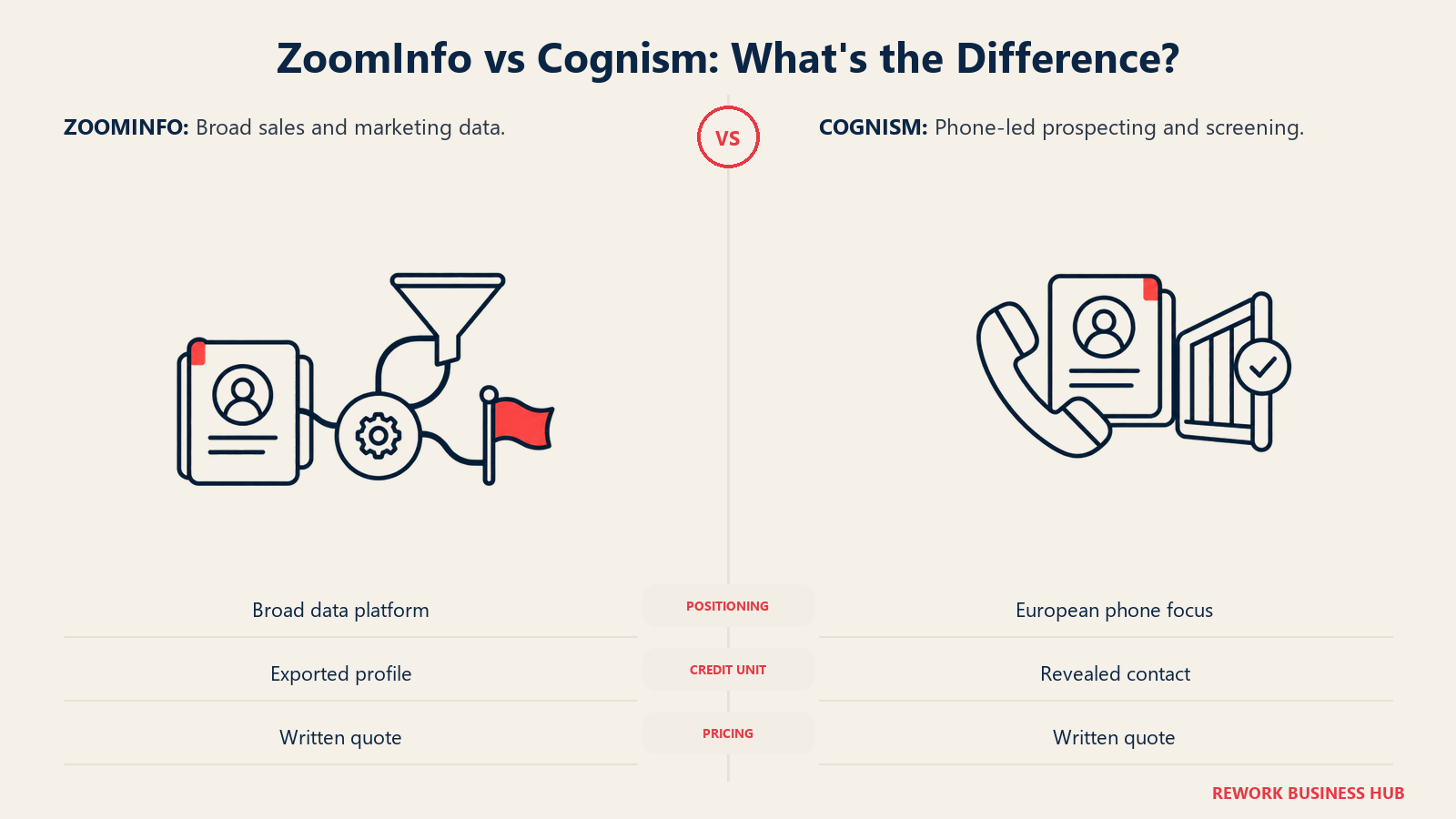
ZoomInfo is the larger, platform-style option. It sells editions priced by features, licenses and credit usage, and it publishes a regional breakdown of its database that leans heavily to North America. Cognism sells two plans with five seats each, leads its marketing with phone-verified mobile numbers and built-in call screening, and positions itself as "built for growth in Europe". This page compares them as data platforms and as buying decisions: verification claims, regional coverage, credit mechanics, contract terms and the compliance rules that apply when you call or email what you buy. For the wider market, start with the best sales intelligence tools hub, or the best B2B data providers comparison.
TL;DR
| Factor | ZoomInfo | Cognism |
|---|---|---|
| What it is | Data and go-to-market platform with intent data, Copilot and enrichment | Sales intelligence platform led by phone-verified mobiles, intent data and compliance |
| Pricing model | Pricing on request, set by features, licenses and credit usage | Pricing on request, tailored; two plans (Standard, Pro) with 5 seats each |
| Credit unit | 1 credit per exported contact or company profile | 1 credit per revealed contact; viewing it again is free |
| Entry point | Free trial of the paid platform | Demo and free data sample, no free trial listed |
| Reported spend | Vendr median $33,500/yr (reported) | Roughly $15,000 platform plus about $1,500 per user/yr on Standard (reported) |
| Regional stance | Published breakdown; North America is the largest block | European-first, with EMEA, US and APAC named |
| Phone data claim | 87% mobile number accuracy (vendor claim) | Phone-verified mobiles, up to 3x higher connect rates (vendor claim) |
| Call screening | Not stated on its data page | Scrubbed against Do Not Call and TPS lists in 12 countries per its FAQ |
| Best for | US-weighted teams wanting breadth, intent and a platform | Europe-heavy outbound that dials mobiles |
Key Facts
- Reps spend 40% of the workweek selling and almost one full day a week on prospecting, per Salesforce's State of Sales report, so the quality of a contact list is multiplied across every rep.
- ZoomInfo's data page lists North America as 157.8M+ contacts and 77.7M+ mobile numbers, against Europe at 66M+ contacts and 18.5M+ mobiles (vendor claim).
- Cognism says its phone-verified mobiles bring "up to 3x higher connect rates" and that Director-level and above data is refreshed on a 30-day basis (vendor claims).
- Cognism's compliance page says data is scrubbed against "15 major Do Not Call and TPS lists", while its FAQ names 12 countries (vendor claim).
- Vendr reports a median ZoomInfo contract value of $33,500 a year across 1,578 purchases (reported), with contracts running one to three years.
- The UK ICO fined a company GBP 160,000 on 20 May 2026 for over 700,000 unsolicited calls to numbers on the TPS and CTPS registers.
Who Each Platform Is Built For
ZoomInfo and Cognism overlap on the core job: a verified email or mobile number for a named buyer. They differ on where that buyer is likely to sit and what you're expected to buy around the data.
ZoomInfo is built as a platform. Its pricing page lists three sales editions (Professional, Copilot Advanced and Copilot Enterprise) and three marketing editions (Demand, ABM Lite and ABM Enterprise), and the price depends on features, number of licenses and credit usage. That shape suits a company where RevOps governs the data, marketing and sales share account lists, and intent signals feed territory planning.
Cognism is narrower. Its pricing page offers Standard and Pro, each with five seats included, and the pitch is data quality on the phone plus compliance. Pro adds higher-quality mobile data, on-demand verification and buying-intent prioritisation. CRM enrichment is sold as an add-on or on its own. That suits a sales team whose reps spend their day dialing decision-makers, especially in Europe.
| Dimension | ZoomInfo | Cognism |
|---|---|---|
| Typical buyer | VP Sales, CRO, RevOps or Marketing Ops with procurement | VP Sales or Head of Revenue running phone-led outbound |
| Purchase path | Sales-led quote, negotiated terms | Sales-led quote, demo first |
| Packaging | Six editions across sales and marketing | Two plans, plus a CRM Enrichment add-on |
| Seats | Licenses set in the quote | 5 seats included per plan |
| Free way in | Free trial of the paid platform | Demo and free data sample |
| Stated home market | Global, with a regional breakdown | "Built for growth in Europe", EMEA, US and APAC named |
Team Fit
| Team | ZoomInfo | Cognism |
|---|---|---|
| SDR and BDR teams dialing mobiles | Strong data, phone quality depends on region and tier | Core use case, verified mobiles and on-demand verification on Pro |
| Account executives | Good for buying-committee mapping | Good for finding the right mobile on named accounts |
| Marketing and demand gen | Dedicated editions (Demand, ABM Lite, ABM Enterprise) | Limited; CRM Enrichment add-on and intent data |
| RevOps | Built for enrichment, routing and CRM hygiene at scale | CRM Enrichment add-on or standalone |
| European sales teams | Covered, with Europe a smaller share of the stated database | The vendor's stated focus |
| US-only teams | Largest block of the stated database | Covered, though the vendor leads with Europe |
| Founders and tiny teams | Hard to justify at quote-only pricing | Hard to justify, two plans with 5 seats each |
Data Claims Compared
Both vendors make claims, and none of the numbers below is an audited count. Each defines "accuracy" its own way, so read them as marketing positions and test them on your own list.
ZoomInfo's data page claims 500M+ professional profiles, 300M+ verified business emails and 135M+ direct dial numbers, plus a 96% email deliverability rate and 87% mobile number accuracy. The same page gives the company count as both 122M+ and 100M+ in different places, which is a good reason to ask the rep which figure applies.
Cognism publishes no total contact count. Its homepage says decision-maker data is "refreshed every 30 days", its FAQ says Director-level and above data is continually refreshed on a 30-day basis, and its pricing page says it is trusted by "4000+ companies worldwide", which counts customers, not records. The comparison is therefore asymmetrical: ZoomInfo gives you big numbers to question, Cognism gives you a verification method to question.
| Capability | ZoomInfo | Cognism |
|---|---|---|
| Contacts claimed | 500M+ professional profiles | Not published |
| Companies claimed | 122M+ (also shown as 100M+ on the same page) | Not published |
| Verified emails | 300M+ claimed | Not published |
| Direct dials / mobiles | 135M+ direct dial numbers claimed | Not published |
| Email quality claim | 96% email deliverability | Not published as a single figure |
| Mobile quality claim | 87% mobile number accuracy | Up to 3x higher connect rates, no baseline given |
| Refresh claim | 60-day average refresh cycle for technology stack data | 30 days for Director-level and above |
| Intent data | Streaming Intent add-on (confirm topic count with the vendor) | Bombora Company Surge, up to 12 topics from 11,000+ (Pro) |
| Security certifications | SOC 2 Type II, ISO 27001, ISO 27701 | SOC 2 Type II, ISO 27001, ISO 27701 |
Phone Verification: What Each Vendor Actually Says
Phone data is the reason most buyers shortlist Cognism, so it deserves its own section.
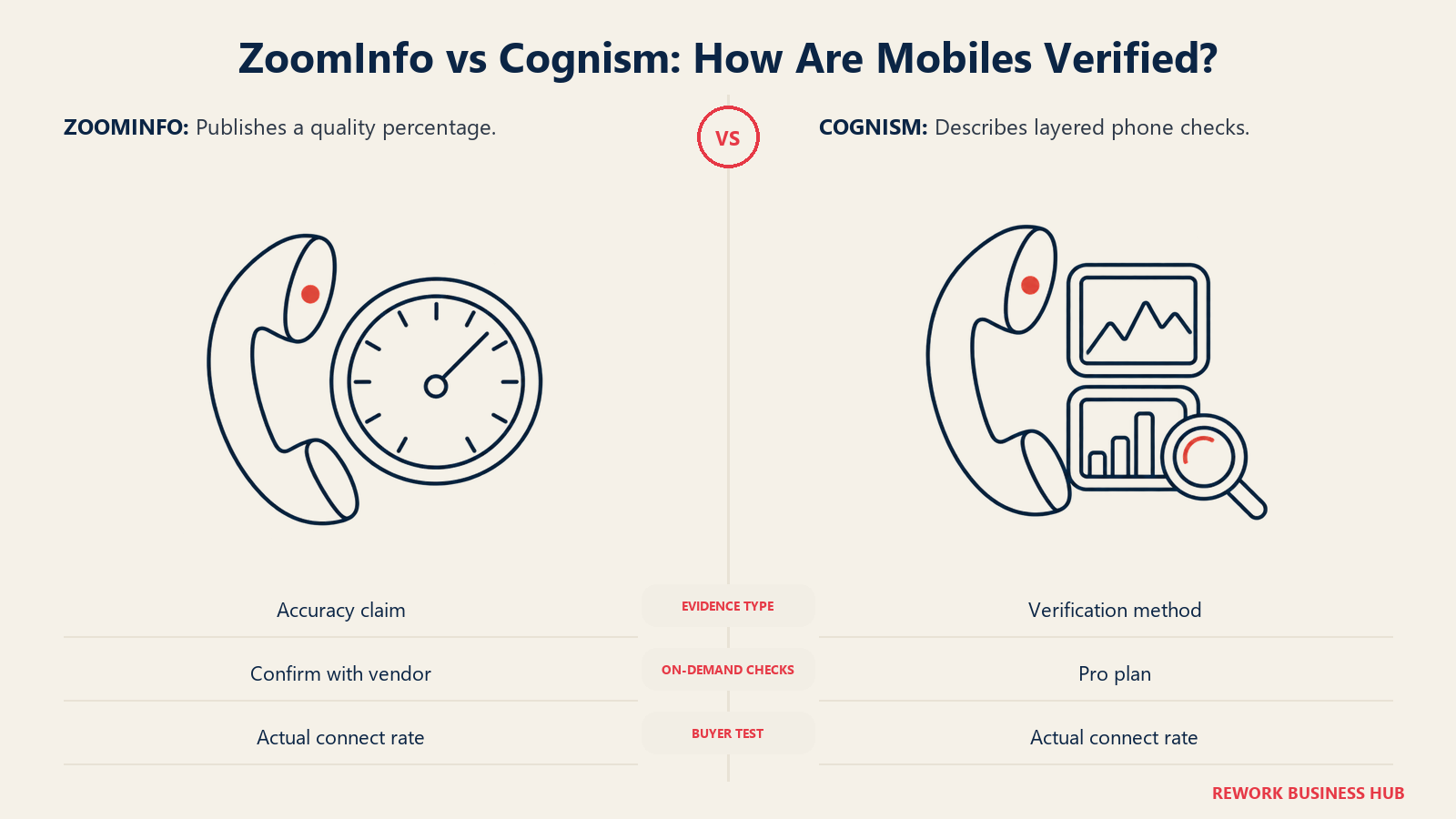
Cognism's homepage says its mobile numbers "go through additional verification layers to improve accuracy and reliability" and claims up to 3x higher connect rates, without defining the baseline. Its FAQ says it uses "proprietary data validation methodologies, which also include manual data verification" and that a research team manually verifies customers' most desired contacts. A comparison page on its own site says numbers are validated directly by its research team and that customers can request verification on demand. The pricing page puts on-demand mobile verification in the Pro plan. Its Diamond Data product, announced in a 4 October 2021 press release, is described as phone-verified data cross-checked against global DNC lists, with "Diamonds on Demand" letting customers flag the contacts most valuable to them. The press release gives no accuracy percentage.
ZoomInfo's data page gives a number instead of a method: 87% mobile number accuracy, and 135M+ direct dials. It doesn't describe how the number is measured.
So the two vendors answer different questions. Cognism tells you how it tries to get a mobile right (manual and on-demand verification). ZoomInfo tells you how often it says it's right (a percentage). Neither gives you what you actually need, which is the connect rate on your own list.
| Phone question | ZoomInfo | Cognism |
|---|---|---|
| Stated method | Not described on the data page | Additional verification layers, manual verification by a research team |
| On-demand verification | Confirm with vendor | Pro plan |
| Stated quality figure | 87% mobile number accuracy | Up to 3x higher connect rates, no baseline |
| Premium tier name | None on the data page | Diamond Data |
| Do Not Call screening | Not stated on the data page | Stated, scrubbed against registries in several countries |
| Independent evidence of either claim | None cited | None cited |
Regional Coverage: US vs EMEA vs APAC
This is where the two diverge most, and where you should be most careful about what is a fact and what is a claim.
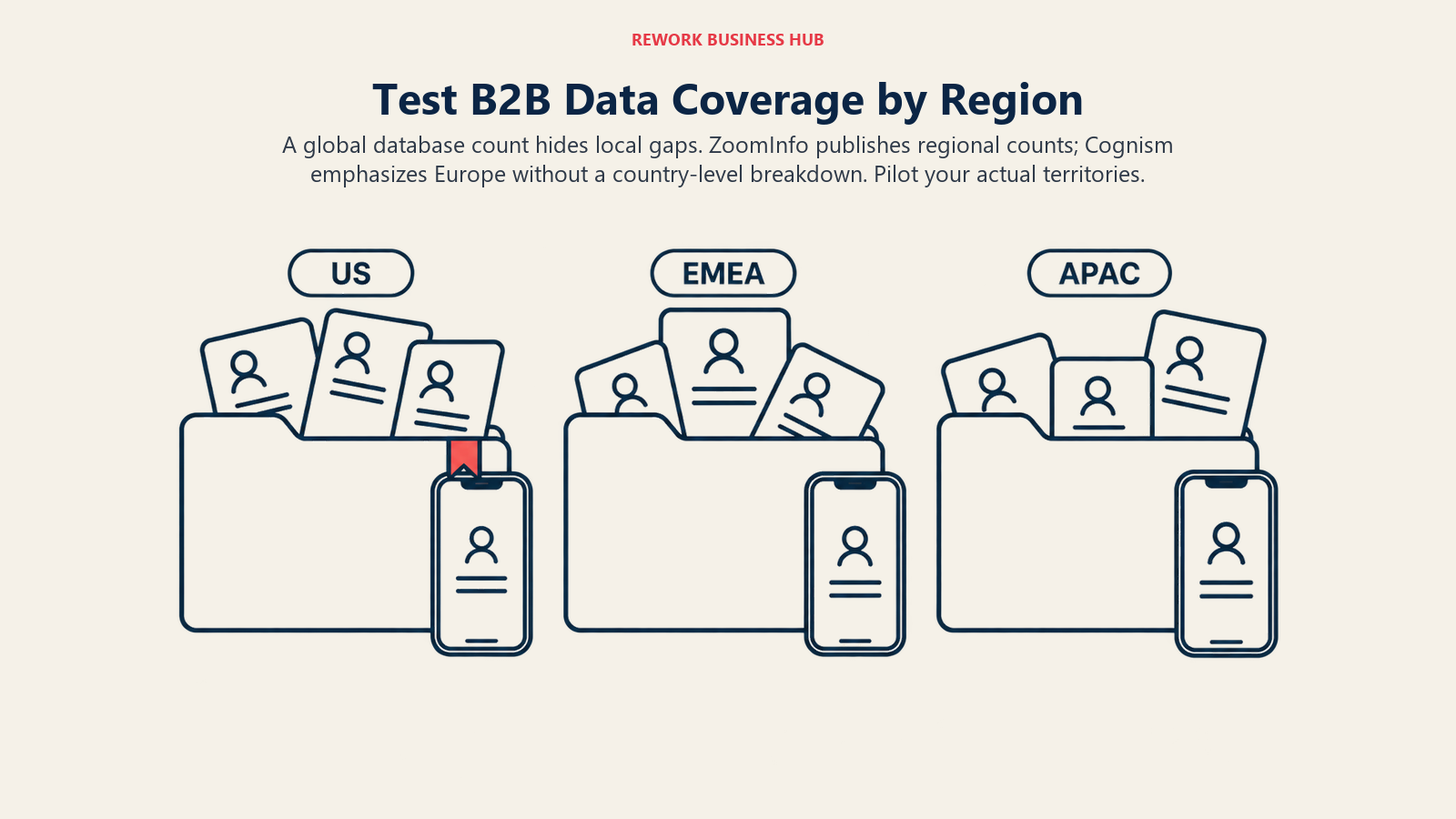
ZoomInfo publishes a regional table on its data page. The figures are the vendor's claims, but they are specific enough to reason about. The share of contacts that have a mobile number, calculated from those claims, drops from roughly half in North America to under a third in Europe and under a fifth in Asia.
| Region (ZoomInfo's stated figures) | Companies | Contacts | Mobile numbers | Mobiles per contact (our arithmetic) |
|---|---|---|---|---|
| North America | 79.6M+ | 157.8M+ | 77.7M+ | about 49% |
| Europe | 20.5M+ | 66M+ | 18.5M+ | about 28% |
| Asia | 4.8M+ | 68.3M+ | 12.9M+ | about 19% |
| Australia and NZ | 2.2M+ | 12.7M+ | 4.1M+ | about 32% |
| South America | 2.6M+ | 28.7M+ | 2.3M+ | about 8% |
| Africa | 824K+ | 18.1M+ | 2.8M+ | about 15% |
Read that table for what it is: the vendor's own count of records, not a measure of accuracy. But it does show where the weight sits. If your reps call into North America, ZoomInfo's stated mobile coverage there is large. If they call into Europe or Asia, the stated pool is a fraction of that, and you'll want to test it.
Cognism gives no breakdown. Its homepage says "Built for growth in Europe". Its FAQ refers to decision-makers in EMEA, the US and APAC, and a comparison page lists EMEA, NAM and APAC while claiming deep UK and EU coverage and strong mobile coverage across Europe, with no country-level figures. Its Do Not Call screening list also leans European: the UK, US, Australia, New Zealand, Germany, France, Ireland, Spain, Portugal, Croatia, Sweden and Belgium, per its compliance FAQ.
| Territory | What ZoomInfo states | What Cognism states | What to test |
|---|---|---|---|
| US and Canada | Largest block: 157.8M+ contacts, 77.7M+ mobiles | US named; no volume given | Mobile hit rate on 200 named US contacts |
| UK and Western Europe | 66M+ contacts, 18.5M+ mobiles for Europe | Core focus, DNC screening in several countries | Mobile hit rate and connect rate by country |
| APAC | Asia 68.3M+ contacts, 12.9M+ mobiles; Australia and NZ shown separately | APAC named, no figures | Ask each vendor for country-level coverage |
| Southeast Asia | Not broken out by country | Not broken out by country | Test your own list; confirm PDPA handling |
How to Test Data Accuracy Before You Buy
Every vendor shows its best number. The only one that decides the purchase is the one from your own list. Cognism offers a demo and a free data sample, and ZoomInfo links to a free trial of the paid platform, so you can run this without a signed contract.
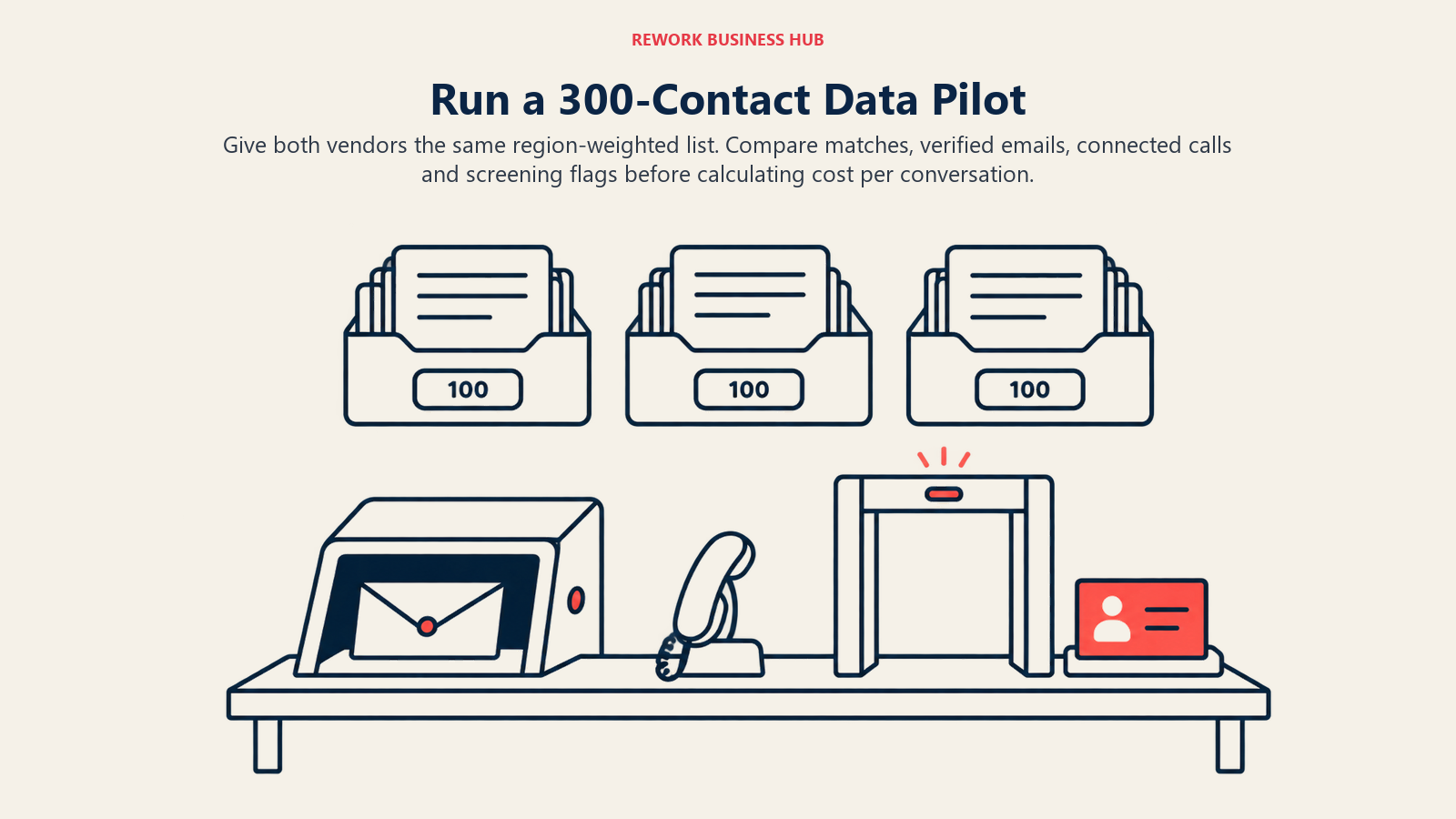
- Build a pilot list of 300 contacts you can verify independently. Use 100 from accounts you already sell to, 100 from accounts you're prospecting now and 100 from a territory you want to enter. Weight it by region: if half your outbound is US and half is EMEA, split the list that way.
- Pull the same 300 from each vendor. Record the email, the mobile and the title each returns.
- Verify emails with a separate checker, then send a small test from a domain you can afford to risk.
- Dial the mobiles. Have two reps call each set at the same times of day and log whether the right person answered.
- Count empty results. A vendor that returns nothing for a third of your list is expensive even if what it returns is clean.
- Check call-screening flags. For the UK and EU contacts, note how each platform marks numbers on Do Not Call or TPS lists.
| Test metric | What to measure | Why it decides the purchase |
|---|---|---|
| Match rate by region | Share of the 300 returned with an email and a mobile, split US, EMEA, APAC | Shows where each vendor is thin |
| Mobile connect rate | Calls that reach the named person | The metric Cognism's "3x" claim is about, measured on your list |
| Hard bounce rate | Bounces from a test send | Drives sender reputation and rep trust |
| Title accuracy | Titles that match the company site | Wrong titles break routing |
| Screening coverage | Share of numbers flagged as DNC or TPS | Decides how much a separate screening step costs you |
| Cost per connected conversation | Spend divided by calls that reach the right person | The only fair price comparison |
Credit Models Compared
Credits behave differently on the two platforms, and neither vendor prints a per-credit price.
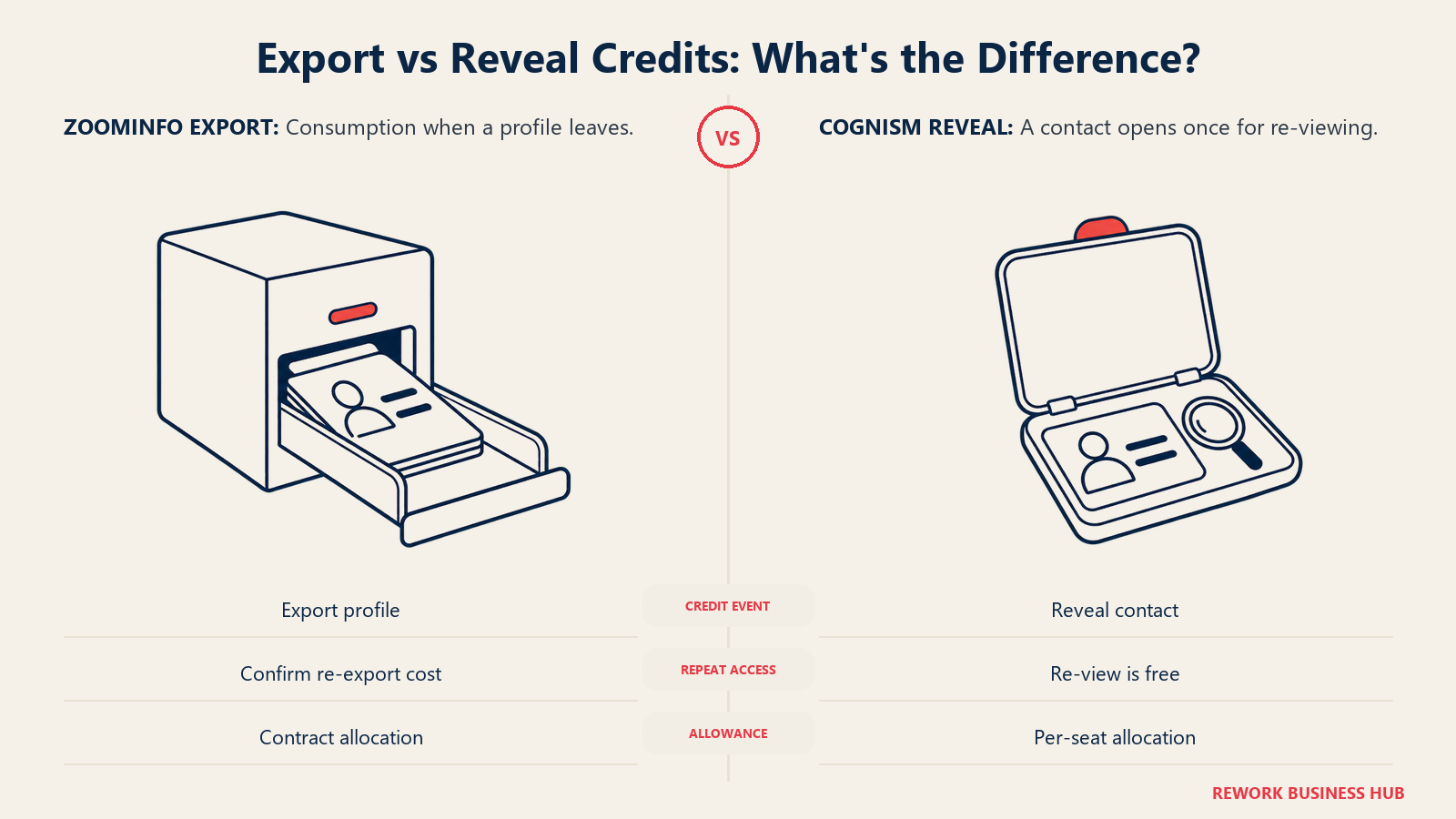
ZoomInfo's pricing page defines a credit as "the consumption (export) of a professional or company profile". Each export costs one credit, whether it happens as a CSV or application export, through an integration, or through the ReachOut Chrome Extension. Basic credits cover standard demographic and firmographic data, while more advanced credits cover items like technographics and org charts. Add-ons such as Streaming Intent and integrations can also affect the price.
Cognism's pricing page says "1 credit = 1 revealed contact". Viewing a previously revealed contact costs nothing. Each seat includes an allocation of credits (the page doesn't state how many), more can be bought at any time, and credits work across the platform, Enrich and the API. For CRM Enrichment, a credit is used on a new record and again only when key details change, such as a job move.
| Credit detail | ZoomInfo | Cognism |
|---|---|---|
| Unit | 1 credit per exported contact or company profile | 1 credit per revealed contact |
| Re-viewing a record | Confirm whether re-exporting a record costs another credit | Free for previously revealed contacts |
| Phone premium | Confirm whether mobile reveals cost more than email exports | No separate phone credit stated on the pricing page |
| Advanced data | Advanced credits for technographics and org charts | Not stated |
| Where credits live | Allocated by contract | Per seat, more purchasable any time |
| Integrations and API | Credit use applies | Credits work across platform, Enrich and API |
| Rollover | Confirm in the contract | Confirm in the contract |
| Number of credits per seat | Set in the quote | Not published |
The practical difference is repeat access. If your reps revisit the same accounts over a long cycle, Cognism's free re-viewing of revealed contacts matters. If you export in bulk to a CRM or sequencer, ZoomInfo's per-export meter is the thing to model. Ask each vendor for the credit count in writing and compute cost per connected conversation, not cost per credit.
Pricing and Packaging
Neither vendor prints a price. That removes the usual first step in a comparison, so this section lays out what each vendor says and what buyers report.
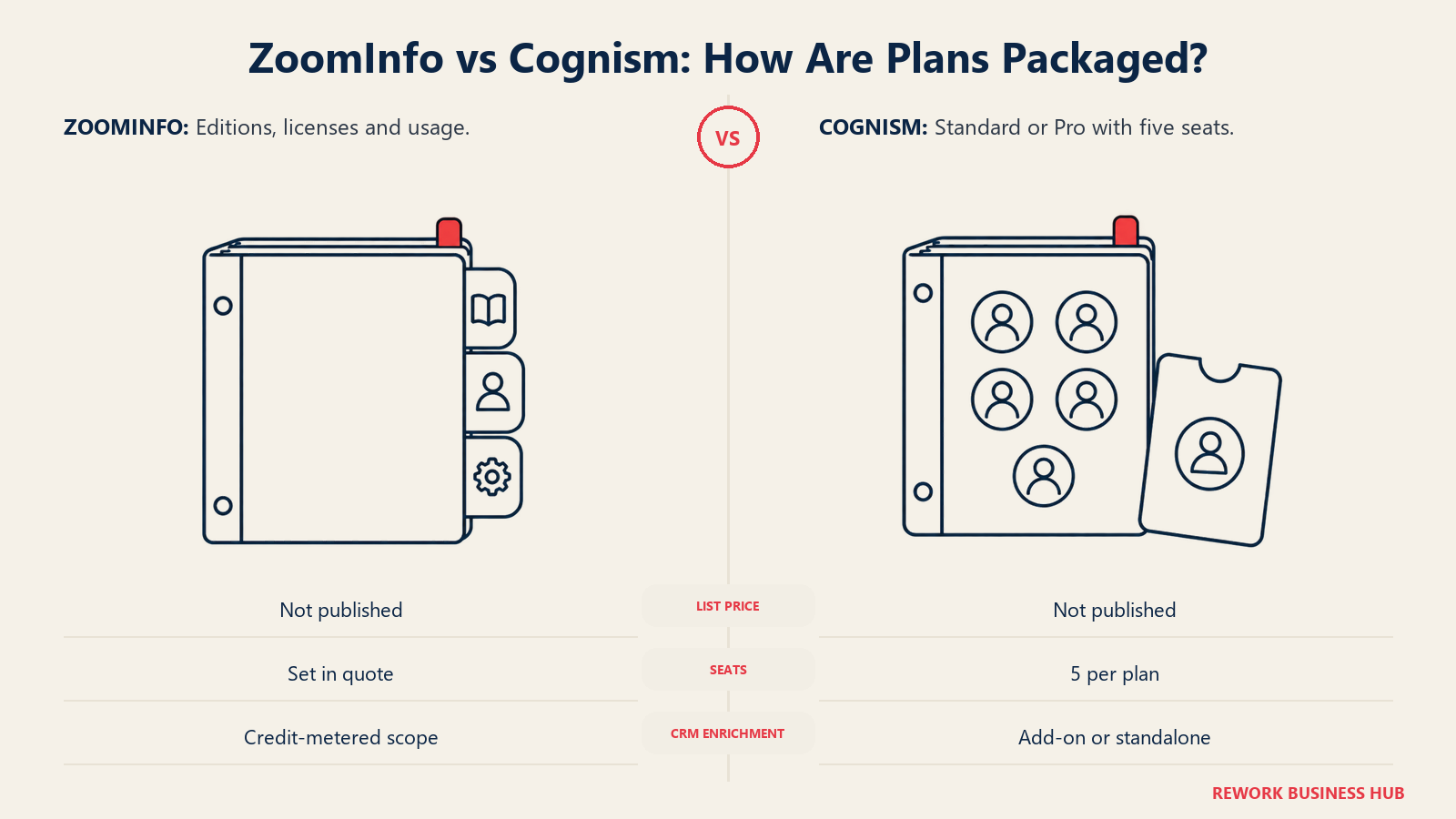
| ZoomInfo item | What the vendor states |
|---|---|
| Sales editions | Professional, Copilot Advanced, Copilot Enterprise |
| Marketing editions | Demand, ABM Lite, ABM Enterprise |
| Price | Based on licenses and credit usage, as well as desired features |
| Free options | Free trial of the paid platform |
| Cognism item | What the vendor states |
|---|---|
| Plans | Standard and Pro, each with 5 seats included |
| Pro adds | Higher-quality mobile data, mobile verification on demand, buying-intent prioritisation |
| Intent data | Bombora Company Surge, up to 12 topics from a library of 11,000+ |
| CRM Enrichment | Add-on to Standard or Pro, or standalone |
| Price | Tailored, personalised quote |
| Free options | Demo and free data sample |
Reported spend is the only way to size a budget. Vendr reports a median ZoomInfo contract value of $33,500 a year, from $7,247 to $156,032, across 1,578 purchases (reported). Source: Vendr. For Cognism, the only reported figures come from a competitor's blog: roughly $15,000 platform fee plus about $1,500 per user a year on Standard, and roughly $25,000 plus about $2,500 per user a year on Pro (reported). Source: Amplemarket. Amplemarket sells a rival product and attributes the figures to several third-party sources, so treat them as a planning range and ask Cognism for a written proposal.
| Spend lens | ZoomInfo | Cognism |
|---|---|---|
| Published list price | None, pricing on request | None, pricing on request |
| Reported midpoint or range | Median $33,500/yr, range $7,247 to $156,032 (reported) | About $15,000 plus about $1,500 per user/yr on Standard (reported) |
| Five-seat team on Standard | Quote required | Quote required; the reported platform fee plus per-user fee is the planning range above |
| Source quality | Vendr marketplace data | Competitor blog estimates |
Don't read the table as a ranking. The ZoomInfo figure is a median across all editions and buyers, the Cognism figures are estimates for two plans, and neither is a quote for your headcount.
Contract Terms and What to Ask For
For ZoomInfo, Vendr's page gives a useful picture of how these contracts work. Terms run one to three years, multi-year commitments are described as unlocking lower annual pricing, auto-renewal clauses are common and often carry a 5 to 10% annual escalation, notice periods are typically 30 to 90 days, and seat and credit changes are often restricted. Vendr's page suggests negotiating a longer notice window and the right to adjust seats and credits annually.
For Cognism, the same competitor blog reports that annual contracts are required, that onboarding fees of about $500 to $1,500 are usually charged separately, that auto-renewals carry 60 to 90 day notice, and that minimum seat commitments apply (reported). Source: Amplemarket. Cognism's own pricing page doesn't state any of this, so confirm each point.
| Contract term | ZoomInfo (reported by Vendr) | Cognism (reported by Amplemarket) |
|---|---|---|
| Term length | 1 to 3 years | Annual contracts required |
| Multi-year discount | 15 to 30% off initial quotes | Discounts reported on multi-year or end-of-quarter deals |
| Annual prepay discount | 10 to 20% off initial quotes | Not reported |
| Auto-renewal | Common, often with a 5 to 10% annual escalation | Typical 60 to 90 day notice |
| Notice period | Typically 30 to 90 days | 60 to 90 days |
| Seat and credit changes | Often restricted | Credit allocations reset annually, user reductions need a sales conversation |
| One-off fees | Not stated | Onboarding about $500 to $1,500 |
Whichever vendor you pick, put these questions to the rep and get answers in writing:
| Question | Why it matters |
|---|---|
| What is the term, and does it renew automatically? | Renewal terms decide whether you can leave |
| What is the uplift at renewal? | A year-one discount can become a bigger year-two bill |
| How many credits are included and what happens to unused ones? | Credits that expire are money already spent |
| Is mobile access priced differently from email? | Phone-led teams live or die on this |
| Which countries are covered by call screening, and how often do lists refresh? | Decides your separate screening cost |
| Are bounced or wrong records credited back? | Shifts data risk to the vendor |
| Can seats and credits be reduced mid-term? | Headcount changes faster than contracts |
| What happens to exported data if we cancel? | Matters for your CRM after the contract ends |
Compliance and Data Rights
The vendor supplies data and a compliance posture. You still send the email or place the call, so the legal duty sits with you. What differs is how much each vendor tells you about its own handling, and how much of the call-screening job it takes on.
GDPR and the EU. Cognism's compliance page says it relies on legitimate interest under Article 6.1(f), notifies business contacts of their inclusion "within GDPR timeframes", keeps data generally inside the EEA and uses standard data protection clauses for transfers elsewhere, and notifies clients of a breach no later than 72 hours after it occurs. ZoomInfo's data page shows GDPR Compliant and CCPA Compliant badges and TRUSTe certification. A badge tells you the vendor has a program. It doesn't give you a lawful basis for your campaign.
A fine worth knowing about. Kaspr is a separate Cognism-owned product, not Cognism itself, and the ruling was not about Cognism. Cognism acquired Kaspr in 2022, for an undisclosed sum. The French regulator then fined Kaspr EUR 240,000 in a decision dated 5 December 2024, published by the EDPB on 23 January 2025, for collecting contact details through a Chrome extension from LinkedIn and other sources into a database of about 160 million contacts, citing Articles 5(1)(e), 6, 12, 14 and 15. The lesson isn't about either vendor. It's that source and transparency decide enforcement, so ask any vendor where its contacts come from and how it informs the people in its database.
CCPA and US state laws. Cognism says it is registered as a data broker with the California Attorney General and offers an opt-out form for sale of data. ZoomInfo shows a CCPA badge. Neither removes your own duties, and California's Attorney General notes that the exemptions for business-to-business transaction data expired on 31 December 2022, so B2B contact data isn't exempt by default.
PDPA in Southeast Asia. Singapore, Malaysia and Thailand each run their own data protection law with consent and notice rules that differ from the GDPR model. Neither vendor's compliance material gives a country-by-country PDPA statement. Ask each how it sources and flags contacts in the countries you target, and read the local regulator's guidance, such as the Singapore PDPC, before dialing.
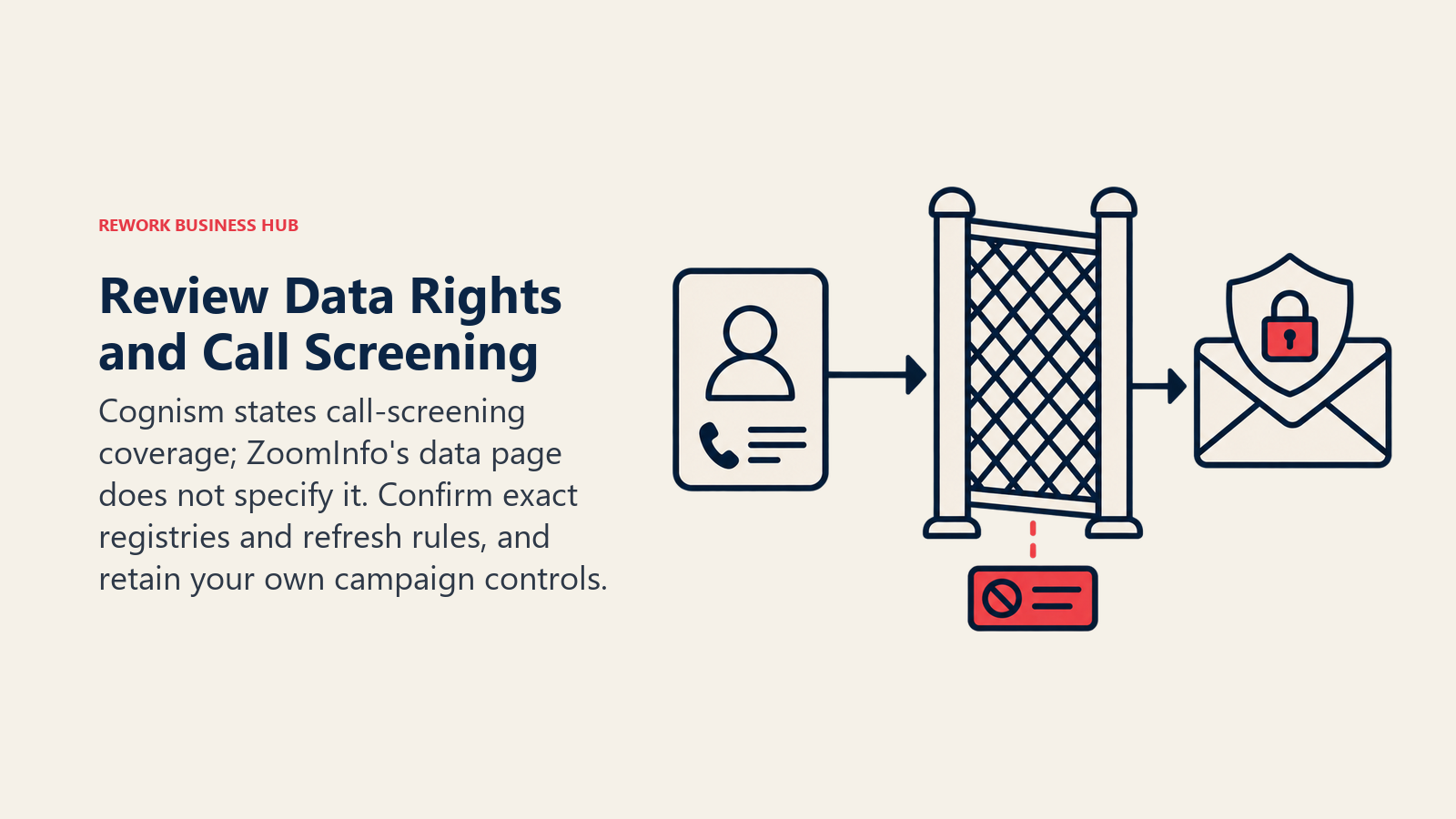
Phone data and Do Not Call. This is where mistakes get expensive and where the two vendors differ most. Cognism says it matches phone numbers against Do Not Call registries and marks matches in the platform, scrubbing against lists in the US, Australia, the UK (TPS and CTPS), France, Germany and other European countries. ZoomInfo's data page doesn't mention call screening, so assume you need a separate step and ask the rep.
The rules themselves point in different directions by country. The FTC says most business-to-business calls are exempt from the Telemarketing Sales Rule, and that includes the National Do Not Call Registry provisions. Calls and texts to cell phones can still bring a private claim under the TCPA, which allows $500 in damages for each violation, trebled for willful or knowing violations. In the UK, the ICO fined Energy Prices Direct Limited GBP 160,000 for over 700,000 unsolicited sales calls between January 2024 and January 2025 to numbers on the TPS and CTPS registers. The US exemption and the UK rule pull in opposite directions, which is why a team calling both markets needs screening that covers both.
| Compliance item | ZoomInfo | Cognism |
|---|---|---|
| GDPR | Badge on data page | Legitimate interest under Article 6.1(f), contacts notified, 72-hour breach notice to clients |
| CCPA | Badge on data page | Registered California data broker, opt-out form |
| Security certifications | SOC 2 Type II, ISO 27001, ISO 27701 | ISO 27001, ISO 27701, SOC 2 Type II |
| Do Not Call and TPS screening | Not mentioned on data page | Stated, with registries in 12 countries named in its FAQ |
| PDPA (Singapore, Malaysia, Thailand) | Confirm with vendor | Confirm with vendor |
| Data location | Confirm with vendor | Generally inside the EEA, standard clauses for transfers out |
| Your own duties | Lawful basis, notice, suppression, opt-out | Same, no vendor can take them over |
One inconsistency to raise with Cognism: its compliance page says "15 major Do Not Call and TPS lists", while its FAQ names 12 countries (13 registries if you count the UK's two lists separately). Ask for the exact list in writing before you rely on it.
Integrations and Workflow Fit
ZoomInfo is closest to a data and orchestration layer. It feeds your CRM, your marketing automation and your sequencing tool, and its credit rules mean integrations need planning rather than a casual click. Its editions add Copilot on the sales side and Demand and ABM options on the marketing side.
Cognism is closest to a prospecting tool with a compliance backbone. Its API and Enrich credits are shared with the platform, CRM Enrichment is sold separately, and intent data comes from Bombora's Company Surge topics on the Pro plan.
| Workflow need | ZoomInfo | Cognism |
|---|---|---|
| Prospecting search | Core feature | Core feature |
| CRM enrichment | Core use case, credit-metered | Add-on or standalone product |
| API access | Credit use applies | Credits work across platform, Enrich and API |
| Intent and buying signals | Streaming Intent add-on and intent topics | Bombora Company Surge, Pro plan |
| Marketing and ABM | Demand, ABM Lite, ABM Enterprise | Not a stated focus |
| Call screening in workflow | Confirm with vendor | Matches flagged as DNC in the platform |
| On-demand verification | Confirm with vendor | Pro plan |
Implementation and Time to Value
| Phase | ZoomInfo | Cognism |
|---|---|---|
| Day 1 | Demo, scoping call, trial access | Demo, free data sample |
| Week 1 | Trial list pulls, security review | Sample review, security review |
| Weeks 2 to 4 | Quote negotiation, contract signed, CRM and integration setup | Quote, contract signed, seat setup |
| Month 2 and after | Rollout to teams, credit governance, intent routing | Rep onboarding, credit tracking, on-demand verification requests |
| Training load | Heavier, several modules and admin controls | Lighter, a narrower product |
| Who owns it | Usually RevOps or Sales Ops | Usually the sales leader |
If your company needs a vendor security review first, both vendors list SOC 2 Type II, ISO 27001 and ISO 27701, which should speed the questionnaire.
When ZoomInfo Is the Right Call
Your outbound is weighted to North America. The vendor's own regional table puts 157.8M+ contacts and 77.7M+ mobiles in North America, the largest block it shows. If most of your calls land in the US and Canada, that is where its stated depth sits.
Sales and marketing share one data layer. The Demand, ABM Lite and ABM Enterprise editions put the same data behind account-based campaigns. A team that wants one source of truth for both functions gets more from a platform built that way.
You want breadth, not just mobiles. Technographics, org charts and intent topics are part of the credit design. If your motion needs account intelligence as well as contact data, ZoomInfo's scope is wider.
You want a free look first. ZoomInfo links to a free trial of the paid platform, which makes a pilot easier than a demo-only process. If cost is the sticking point, the best ZoomInfo alternatives page covers the field.
When Cognism Is the Right Call
Your outbound is weighted to Europe. Cognism's positioning, its research teams and its call-screening list all lean European. For reps dialing into the UK, Germany, France and neighboring markets, that focus is what you're paying for.
You dial mobiles and need screening built in. Cognism says it matches numbers against Do Not Call and TPS registries and flags matches in the platform. If you'd otherwise buy a separate screening service, that bundled step has real value.
You want verification on demand. The Pro plan includes on-demand mobile verification, so reps can send priority prospects to Cognism's research team. That suits a team working a short list of named accounts.
You re-open the same accounts a lot. Viewing a previously revealed contact is free, which is a better fit for long, multi-threaded cycles. If you're weighing Cognism against other options, see the best Cognism alternatives page.
Not the Right Fit for Either
If you're a small team that wants published prices, a free plan and sequencing in one tool, neither is the natural fit. Compare Apollo vs ZoomInfo for that route, or Lusha vs Apollo if phone data on a small budget is the deciding factor. If you mainly need enrichment on an existing list, the best data enrichment tools page is a better start. And if you're still choosing a category before a vendor, the guide on how to choose sales intelligence software sets out the questions to ask first.
Decision Framework
| If this describes you | Pick | Why |
|---|---|---|
| Most calls go to the US and Canada | Run the pilot, lean ZoomInfo | Largest stated block of contacts and mobiles |
| Most calls go to the UK and Europe | Run the pilot, lean Cognism | European focus and bundled call screening |
| You split between US and EMEA | Pilot both, split the list by region | Regional strengths differ, so one vendor may not win both |
| Mobile connect rate is your key metric | Pilot both | Cognism's 3x and ZoomInfo's 87% are both unbenchmarked claims |
| You need marketing and sales on one data layer | ZoomInfo | Dedicated marketing and ABM editions |
| You need DNC and TPS screening included | Cognism | Stated in the platform; ZoomInfo's data page is silent |
| Procurement wants a negotiated multi-year deal | Either | Both are quote-based; negotiate term, uplift and credits |
| You can't tell yet | Run the 300-contact pilot | Your own connect rate beats either vendor's claim |
Frame it as a question about your own territory: how many of your best-fit contacts does each vendor return with a working mobile, how many of those calls reach the right person, and what does a connected conversation cost you at your real volume. If the answers are close, pick the vendor with the easier exit.
What to Do Next
Build the 300-contact pilot list this week, split by the regions you actually call. Ask Cognism for its free data sample, ask ZoomInfo for a trial of the paid platform, and pull the same contacts from each. Dial the mobiles, verify the emails with a separate checker and log the connect rate by region. Take the cost per connected conversation to both quote conversations and use it to push on price, credit counts and renewal terms. If neither wins clearly, widen the field with the best sales intelligence tools hub before you commit.

Principal CRM Strategist
On this page
- TL;DR
- Key Facts
- Who Each Platform Is Built For
- Team Fit
- Data Claims Compared
- Phone Verification: What Each Vendor Actually Says
- Regional Coverage: US vs EMEA vs APAC
- How to Test Data Accuracy Before You Buy
- Credit Models Compared
- Pricing and Packaging
- Contract Terms and What to Ask For
- Compliance and Data Rights
- Integrations and Workflow Fit
- Implementation and Time to Value
- When ZoomInfo Is the Right Call
- When Cognism Is the Right Call
- Not the Right Fit for Either
- Decision Framework
- What to Do Next