Apollo vs ZoomInfo (2026): Data Coverage, Credits, Contracts and Compliance Compared
Turn this article into takeaways for your work.


Each assistant summarizes the article only for you and suggests best practices for your work.
You're a VP Sales, a RevOps lead or a founder-operator, and the shortlist for your contact data has two names on it. One publishes a price card and lets you start free. The other asks you to book a call and then sends a quote. That difference is the first thing to understand about Apollo vs ZoomInfo, because it shapes how you buy, how long you commit and how much room you have to walk away.
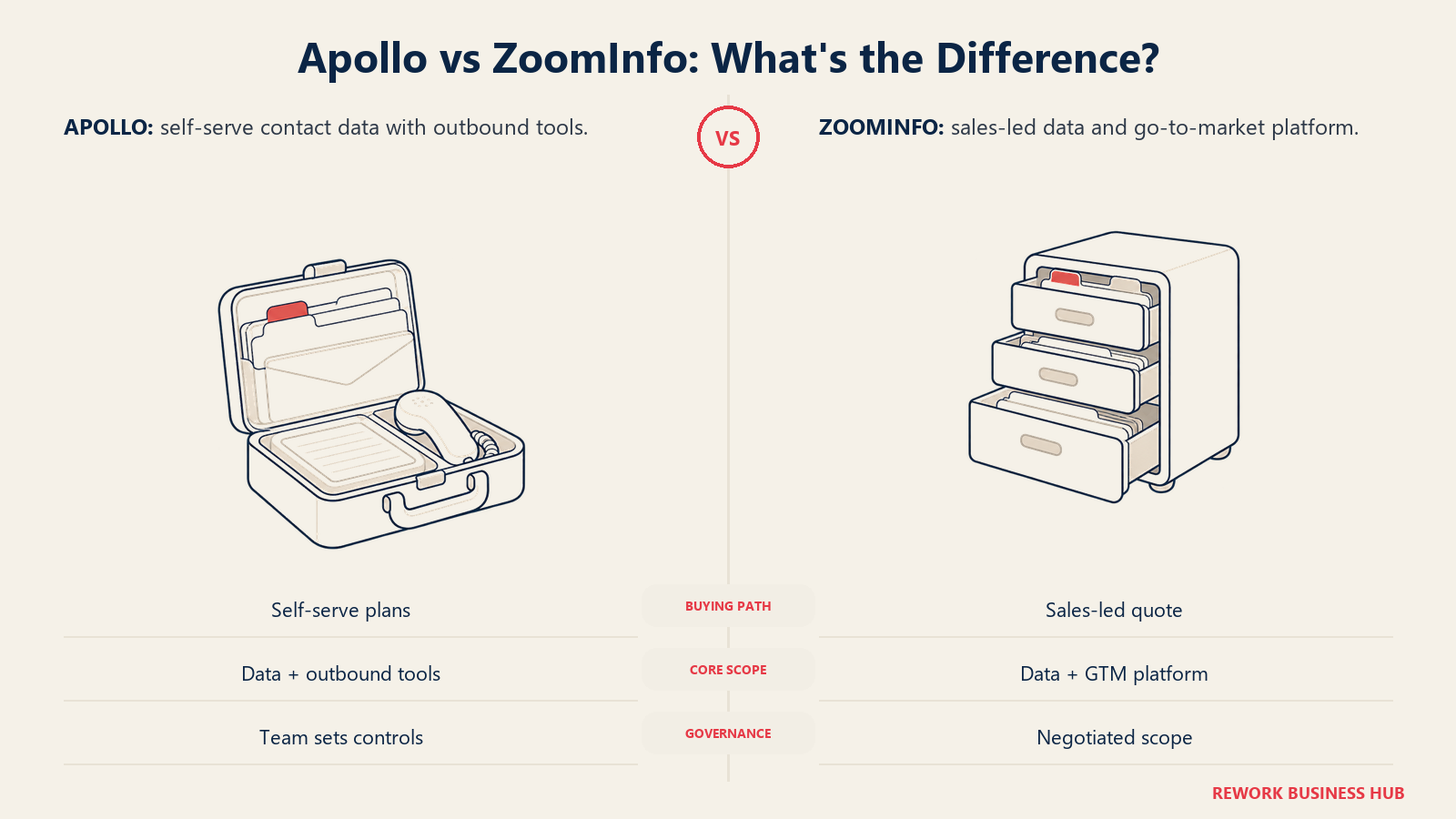
Apollo is a self-serve platform that bundles a contact database with sequencing, a dialer and a CRM-style workspace, sold per seat with a monthly or annual credit pool. ZoomInfo is a sales-led data and go-to-market platform, priced by features, licenses and credit usage, with editions that run from a data-first Professional plan up to its Copilot tiers. This page compares them as data platforms and as buying decisions. If you want the head-to-head on their AI assistants, that lives on a separate page, Apollo AI vs ZoomInfo Copilot. For the wider market, start with the best sales intelligence tools hub.
TL;DR
| Factor | Apollo | ZoomInfo |
|---|---|---|
| What it is | Contact database plus sequences, dialer and CRM workspace | Data and go-to-market platform with intent data, Copilot and enrichment |
| Pricing model | Published per-seat plans plus a credit pool | Pricing on request, set by features, licenses and credit usage |
| Entry point | Free plan, 14-day trial | Free ZoomInfo Lite, free trial of the paid platform |
| Paid starting price | Basic $49/seat/mo billed annually ($65 billed monthly) | Quote only. Vendr reports a median of $33,500/yr (reported) |
| Credit rollover | None, including add-on credits | Not for ZoomInfo Lite; paid terms are negotiated with sales |
| Data claims | 240M+ contacts, 30M+ companies, 98% email accuracy (vendor claim) | 500M+ profiles, 122M+ companies, 96% email deliverability (vendor claim) |
| Best for | Small and mid-size teams that want one affordable tool | Larger teams that want deep data, intent and a negotiated contract |
| Main risk | Credit pool runs dry, quality varies by segment | Cost and contract terms, plus a credit meter on exports |
Key Facts
- Reps spend 40% of the workweek selling and 60% on everything else, and almost one full day a week on prospecting, per Salesforce's State of Sales report (4,050 sales professionals, 22 countries).
- 46% of sales pros with agents say data quality issues hurt their sales, per the same report.
- Median tenure with a current employer was 4.1 years in January 2026, per the US Bureau of Labor Statistics, so every contact record starts aging the day it is collected.
- Apollo says it holds 240M+ contacts and 30M+ companies (vendor claim). ZoomInfo says it holds 500M+ professional profiles and 122M+ company records (vendor claim).
- Vendr reports a median ZoomInfo contract value of $33,500 a year, across 1,578 purchases (reported).
- ZoomInfo's stock ticker changed from ZI to GTM on 12 May 2025, alongside the launch of GTM Studio.
Who Each Platform Is Built For
Apollo and ZoomInfo overlap on the core job, which is finding a verified email or phone number for a named buyer. They differ on who is expected to buy and who is expected to run it.
Apollo assumes a person with a card and a quota. You sign up, run a search, spend credits and send a sequence from the same screen. That works for a founder doing outbound alone, a five-person SDR team, or a RevOps lead who wants a database without a procurement cycle. The trade is that you assemble your own governance: who gets credits, who can export, and how the data lands in your CRM.
ZoomInfo assumes a buying process. A sales rep scopes your needs, a quote lands, and the contract covers licenses, a credit allowance and often a set of integrations. That suits teams where a RevOps owner governs the data, where marketing and sales share an account list, and where intent signals feed territory planning. The trade is cost and a longer path to the first export.
| Dimension | Apollo | ZoomInfo |
|---|---|---|
| Typical buyer | Founder, SDR manager, RevOps lead | VP Sales, CRO, RevOps or Marketing Ops with procurement |
| Purchase path | Self-serve card, annual or monthly | Sales-led quote, negotiated terms |
| Onboarding | Same-day start from the free plan or trial | Scoped rollout with integrations and credit planning |
| Governance model | You set it up yourself | License structure and credit allocation negotiated in the contract |
| Switching cost | Low, month-to-month is available on Basic and Professional | Higher, depends on the term you sign |
Team Fit
| Team | Apollo | ZoomInfo |
|---|---|---|
| Founder or solo seller | Strong fit, free plan then Basic | Free ZoomInfo Lite for light use, paid tiers are a stretch |
| SDR and BDR teams | Strong fit, sequences and dialer in the same tool | Strong data, usually paired with a separate sequencer |
| Account executives | Good for finding extra contacts on open deals | Good for buying-committee mapping on larger accounts |
| Marketing and demand gen | Limited, inbound add-ons exist | Dedicated marketing editions (Demand, ABM Lite, ABM Enterprise) |
| RevOps | Fine for enrichment at modest volume | Built for enrichment, routing and CRM data hygiene at scale |
| Enterprise sales | Possible with a Custom plan | Enterprise editions and negotiated terms |
Core Data Platform Comparison
Both vendors market on database size, and both numbers are claims rather than audited counts. Apollo's data page lists 240M+ global contacts and 30M+ global companies, a 98% email accuracy figure, and SOC 2 Type II and ISO 27001 certification. ZoomInfo's data page lists 500M+ verified professional profiles, 122M+ company records, 300M+ verified emails and 135M+ direct dial numbers, a 96% email deliverability rate, an 87% mobile number accuracy figure and more than 4,500 intent topics.
Treat those as marketing positions. Each vendor defines "accuracy" and "deliverability" its own way, and a figure measured on its best segment says little about your segment. A database twice the size can still be thinner on your target: mid-market manufacturers in Southeast Asia, for example, or ops directors at 50-person agencies. Size tells you the ceiling, not your hit rate.
| Capability | Apollo | ZoomInfo |
|---|---|---|
| Contacts claimed | 240M+ | 500M+ profiles |
| Companies claimed | 30M+ | 122M+ |
| Email quality claim | 98% email accuracy | 96% email deliverability |
| Direct dials | Phone numbers cost 8 credits each | 135M+ direct dial numbers claimed |
| Mobile quality claim | Confirm with Apollo | 87% mobile number accuracy |
| Intent data | Website visitor tracking and add-ons | 4,500+ intent topics |
| Security certifications | SOC 2 Type II, ISO 27001 | SOC 2 Type II, ISO 27001, ISO 27701 |
| Privacy badges on data page | GDPR (legitimate interest) | GDPR and CCPA |
| Engagement tools | Sequences, dialer, meetings, AI assistant | Copilot, GTM Workspace, GTM Studio, Chorus |
If you need technology installed data rather than contacts, neither is the right first stop. See the best technographic data providers page.
How to Test Data Accuracy Before You Buy
Every vendor shows you its best accuracy number. The only number that matters is the one from your own list. This is the test we recommend, and it works on both platforms because both offer a way in without a contract: Apollo's free plan and 14-day trial, and ZoomInfo's free trial of the paid platform.
- Build a pilot list of 300 contacts you can verify independently. Mix them: 100 contacts from accounts you already sell to, 100 from accounts you're prospecting now, 100 from a segment you want to enter. Include titles you know are current.
- Pull the same 300 from each platform. Record the email, the phone and the job title it returns.
- Run every email through a separate verifier, not the vendor's own checker. Then send a small test through a warmed domain you can afford to burn.
- Measure three numbers. The hard bounce rate on the emails, the share of phone numbers that reach the right person, and the share of titles that match reality.
- Count the empty results. A platform that returns nothing for 40% of your list is expensive even if what it does return is clean.
Why bounce rate matters beyond wasted sends: Gmail requires senders of more than 5,000 messages a day to keep spam rates below 0.30%, with DMARC and one-click unsubscribe, and a dirty list is the fastest way to a spam-rate problem. And why a fresh pull beats an old export: median tenure with a current employer is 4.1 years, and the US had 3.2% total separations in a single month in August, per the BLS JOLTS release. People move constantly, so any contact you exported last year is partly wrong today.
| Test metric | What to measure | Why it decides the purchase |
|---|---|---|
| Match rate | Share of the 300 returned with an email | Low match means credits spent for nothing, or gaps in your segment |
| Hard bounce rate | Bounces from a test send, split by platform | Drives sender reputation and rep trust in the data |
| Phone connect rate | Calls that reach the named person | Phone credits cost more, so low quality is expensive |
| Title accuracy | Titles that match LinkedIn or the company site | Wrong titles break routing and personalization |
| Segment spread | Results split by the three sub-lists | Shows where each vendor is strong or thin |
| Cost per good record | Spend divided by verified, usable contacts | The only fair price comparison |
Credit Models Compared
Credits are where the two platforms feel most different in daily use, so read this section before you read the price tables.
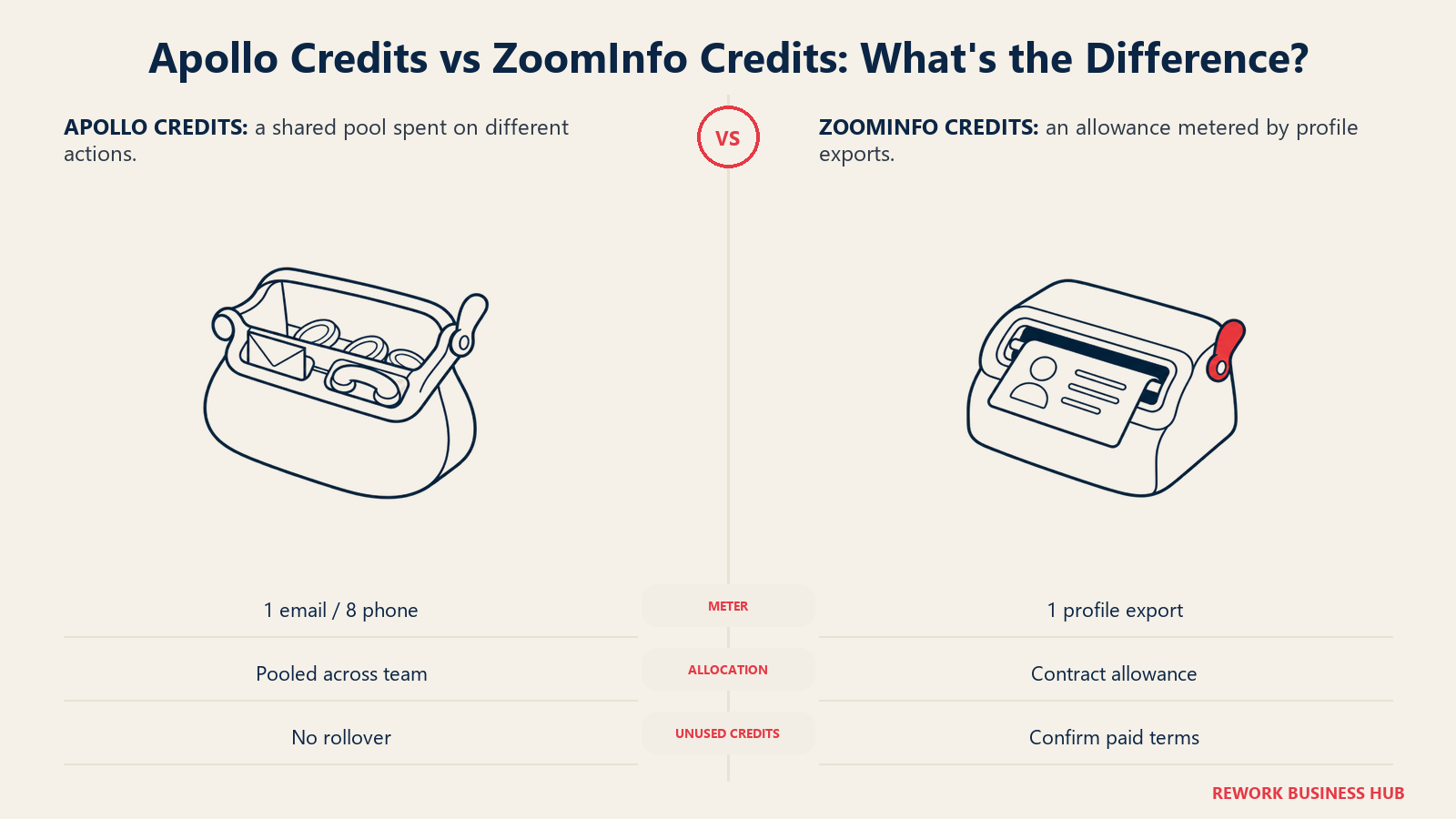
Apollo charges per action from a pooled team balance. An email costs 1 credit, a phone number 8, an enrichment between 1 and 8, an AI research run 1, and the US dialer 1 credit per 30 seconds. Credits are pooled across the team and do not roll over, and that includes add-on credits. "Unlimited" features sit under a Fair Use Policy with no published numeric cap.
ZoomInfo charges per export. One credit is one export of a contact or company profile, whether it happens in the platform, in the browser extension or through an API or integration. Integrations need a minimum bulk credit purchase. How many credits you get is part of the quote, and ZoomInfo's marketing editions state included allowances (75,000 for Demand and 150,000 for ABM Enterprise).
| Credit detail | Apollo | ZoomInfo |
|---|---|---|
| Unit | 1 credit per email, 8 per phone, 1 to 8 per enrichment | 1 credit per contact or company profile exported |
| Phone premium | 8x an email | Confirm whether phone reveals cost more than an email export |
| Where credits live | Pooled across the team | Allocated by contract |
| Rollover | None, including add-ons | Confirm with the vendor; ZoomInfo Lite credits do not roll over |
| Integrations and API | Credit use applies | Needs a minimum bulk credit purchase |
| Unlimited wording | Fair Use Policy, no numeric cap | Not applicable, credit counts are in the quote |
| Free credits | 75 a month on the free plan | A standard monthly allowance on ZoomInfo Lite (confirm the amount with the vendor) |
| Running out | Buy an add-on pack, expires with the term | Negotiate a top-up or a higher tier |
A practical way to compare: Apollo Basic annual gives 30,000 credits per seat per year upfront, which at 1 credit per email is up to 30,000 emails, or up to 3,750 phone numbers at 8 credits each. That's the ceiling per seat, and since credits don't roll over, whatever you don't use by the end of the year is gone. For heavy phone prospecting, price the credits first and the seat second.
Pricing and Packaging
Apollo prints its plans. ZoomInfo doesn't. That alone changes the buying conversation, so here are both sides laid out with the billing term on every line.
| Apollo plan | Billed annually (per seat/mo) | Billed monthly (per seat/mo) | Credits |
|---|---|---|---|
| Free | $0 | $0 | 900 per seat per year, granted monthly (75/mo) |
| Basic | $49 | $65 | 30,000 per seat per year upfront, or 2,500 per month |
| Professional | $79 | $99 | 48,000 per seat per year, or 4,000 per month |
| Organization | $119, minimum 3 seats | Annual only, no monthly option | 72,000 per seat per year, or 6,000 per month |
| Custom | Contact sales | Contact sales | Contact sales |
Annual billing on the page is labeled as a 24% saving. Add-ons are priced per team: Inbound Essentials at $119 a month and Inbound Max at $639 a month, and the Advanced Dialer at $119 a month, all billed annually. A five-seat Professional team on annual billing is $395 a month before add-ons.
| ZoomInfo item | What the vendor states |
|---|---|
| Sales editions | Professional, Copilot Advanced, Copilot Enterprise |
| Marketing editions | Demand (75K included credits), ABM Lite, ABM Enterprise (150K included credits) |
| Price | On request, based on features, licenses and credit usage |
| Credit unit | 1 credit per export of a contact or company profile |
| Payment frequency | Negotiated with sales |
| Free options | ZoomInfo Lite (business email required, not for current or past premium subscribers), free trial of the paid platform |
| Reported contract value | Median $33,500/yr, range $7,247 to $156,032, 1,578 purchases (reported). Source: Vendr |
The Vendr figures are what buyers have reported paying, not a price list, and your quote will depend on seats, credits, editions and your negotiating position. Use the range as a reality check on a quote, not as a forecast.
| Annual budget lens | Apollo | ZoomInfo |
|---|---|---|
| Solo seller | Free, or Basic at $49/seat/mo billed annually | ZoomInfo Lite for light use |
| Five-seat SDR team | Professional: $79/seat/mo billed annually, $395/mo for five | Quote required |
| Larger team with governance needs | Organization: $119/seat/mo, minimum 3 seats, annual only | Quote required, Vendr median $33,500/yr (reported) |
| Price transparency | High, every plan is printed | Low until a quote arrives |
Contract Terms and What to Ask For
Apollo's lower plans are the easy exit. Basic and Professional are available month to month at a higher price, so you can start monthly, learn what your credit burn really looks like, then move to annual for the saving. Organization is annual only with a three-seat minimum, so treat it as a commitment.
With ZoomInfo, the contract is where the cost lives. Payment frequency is negotiated, and the credit allowance, license count and edition all sit in the quote. Before you sign, put these questions to the rep and get the answers in writing:
| Question | Why it matters |
|---|---|
| What is the contract term, and does it renew automatically? | Renewal terms decide whether you can leave when the data stops earning its keep |
| What is the price uplift at renewal? | A discount in year one can turn into a larger bill in year two |
| How many credits are included, and what happens to unused credits? | Credits that expire are money you've already spent |
| What does an integration or API export cost? | Integrations need a minimum bulk credit purchase |
| Can seats and credits be reduced mid-term? | Headcount changes faster than contracts |
| What are the data accuracy remedies? | Ask whether bounced or wrong records earn credit refunds |
| Who owns the exported data if we cancel? | Matters for your CRM after the contract ends |
One more note on status. ZoomInfo's ticker changed from ZI to GTM on 12 May 2025, when GTM Studio launched. The company is still ZoomInfo, and its product line now includes Copilot, GTM Workspace, GTM Studio, a ZoomInfo MCP and Chorus. If you're comparing against older reviews, the names will not match what you see today.
Integrations and Workflow Fit
Apollo is closest to an all-in-one. Prospecting, sequences, calls, meetings and an AI assistant live in one product, so a small team can run outbound without a separate sequencer. The free plan limits you to a Gmail-only mailbox, 2 sequences, a 5-chat AI assistant, 100 CRM enrichments a month and 20 website-visitor companies a month, so a real team will outgrow it quickly.
ZoomInfo is closest to a data and orchestration layer. It feeds your CRM, your marketing automation and your sequencing tool, and its credit rules mean integrations need planning rather than a casual click. Teams that already run a sequencer and a CRM usually buy ZoomInfo for the data underneath them. If you already own a sequencer, the part of Apollo you'd pay for is the database, and that is a fair question to put to both vendors.
| Workflow need | Apollo | ZoomInfo |
|---|---|---|
| Outbound sequences | Built in | Confirm by edition |
| Dialer | Advanced Dialer add-on at $119/team/mo billed annually | Confirm by edition |
| CRM enrichment | Free plan includes 100 enrichments a month | Core use case, credit-metered |
| Website visitor identification | 20 companies a month on the free plan | Marketing editions and GTM tools |
| Intent and buying signals | Limited | 4,500+ intent topics claimed |
| AI assistant | Included, 5 chats on the free plan | Copilot tiers |
| Marketing and ABM | Inbound add-ons | Demand, ABM Lite and ABM Enterprise editions |
Compliance and Data Rights
Contact data comes with legal obligations, and both vendors only handle part of them. The vendor supplies the data and a compliance posture. You are still the one sending the email or placing the call.
GDPR and the EU. Apollo's data page states GDPR compliance based on legitimate interest. ZoomInfo's data page shows GDPR and CCPA badges. Neither statement transfers your duty to have a lawful basis, give notice and honor objections. For a sense of enforcement, the French regulator fined KASPR EUR 240,000 in December 2024 for scraping LinkedIn members' contact details into a database of about 160 million contacts, citing breaches of Articles 5, 6, 12, 14 and 15. If you sell into the EU, ask each vendor how it informs the people in its database and how an objection is passed to you.
PDPA in Southeast Asia. Singapore, Malaysia and Thailand each run their own personal data law with consent and notice rules that differ from the GDPR model. A vendor's EU badge doesn't settle your PDPA position. Confirm with each vendor how it sources and flags contacts in the countries you target, and keep your own suppression list.
CCPA and US state laws. ZoomInfo's data page shows a CCPA badge. Apollo's data page makes no CCPA statement. Ask Apollo how it handles California deletion and opt-out requests if you sell to California residents.
Phone data and Do Not Call. This is where mistakes get expensive. The FTC says telemarketers face civil penalties of up to $53,088 for each violation and must synchronize their lists every 31 days, though the registry rule does not apply to business-to-business calls. Calls and texts to cell phones can still bring a private claim under the TCPA, which allows $500 in damages for each violation, trebled for willful violations. In the UK, the ICO fined a company GBP 160,000 in May 2026 for over 700,000 unsolicited calls to TPS and CTPS numbers, including businesses.
Neither vendor's data page promises that its phone numbers are screened against Do Not Call lists. If a dialer is part of your plan, confirm in writing whether screening is included, how often lists refresh, and who carries the liability.
| Compliance item | Apollo | ZoomInfo |
|---|---|---|
| GDPR | Stated, legitimate interest | Badge on data page |
| CCPA | No statement on the data page | Badge on data page |
| Security certifications | SOC 2 Type II, ISO 27001 | SOC 2 Type II, ISO 27001, ISO 27701 |
| Do Not Call screening | Confirm with the vendor | Confirm with the vendor |
| PDPA (Singapore, Malaysia, Thailand) | Confirm with the vendor | Confirm with the vendor |
| Your own duties | Lawful basis, notice, suppression, opt-out | Same, no vendor can take them over |
Implementation and Time to Value
| Phase | Apollo | ZoomInfo |
|---|---|---|
| Day 1 | Sign up, connect a mailbox, run a first search | Demo, scoping call, trial access |
| Week 1 | Build ICP filters, load a first list, enrich 100 CRM records | Quote negotiation, trial list pulls, security review |
| Weeks 2 to 4 | Launch sequences, tune credit use | Contract signed, CRM and integration setup |
| Month 2 and after | Review credit burn, move to annual if usage is steady | Rollout to teams, credit governance, intent routing |
| Training load | Light, one tool for most tasks | Heavier, several modules and admin controls |
| Who owns it | Usually the sales lead | Usually RevOps or Sales Ops |
If speed matters, Apollo starts the same day. If your company needs a vendor security review before any tool touches CRM data, both vendors list SOC 2 Type II and ISO 27001, which will help, and ZoomInfo adds ISO 27701.
When Apollo Is the Right Call
You're a small team and want one tool. A five-person SDR group that needs a database, sequences and a dialer is unlikely to want three contracts. Apollo's per-seat price is printed, you can start monthly, and the free plan lets you test the data without a card.
You want to test before committing. Apollo's 14-day trial and free plan let you run the pilot list from the testing section without a sales call. If the hit rate on your segment is good, you've saved a quote cycle. If it isn't, you've lost an afternoon.
Budget has a hard ceiling. When the price list is the budget, a printed plan beats an open quote. A solo seller on Basic pays $49 a month billed annually, or $65 billed monthly.
You can live with a credit pool. If your team's volume is predictable and you don't need rollover, the pooled model is fine. See the best Apollo alternatives page for options if the credit model or quality doesn't fit, and Lusha vs Apollo if phone data is the deciding factor.
When ZoomInfo Is the Right Call
You need depth on larger accounts. Buying-committee mapping, org structures and intent signals are what the 500M+ profiles and 4,500+ intent topics are sold for. If your deals involve six or more stakeholders, the depth can justify the cost.
Sales and marketing share one data layer. ZoomInfo's marketing editions (Demand, ABM Lite, ABM Enterprise) put the same data behind account-based campaigns. A team that wants one source of truth across both functions gets more from a platform built for that.
You want a negotiated contract. For a procurement-led company, a quote, a defined credit allowance and negotiated payment frequency are features. You get leverage, terms and a vendor contact.
You're starting from zero and want to test lightly. ZoomInfo Lite is free, needs a business email and has a standard monthly allowance of credits (confirm the amount with the vendor) and it isn't open to current or past premium subscribers. It's a way to see the data before a sales conversation. If cost is the sticking point, the best ZoomInfo alternatives page covers the field, and the best B2B data providers comparison goes wider.
Decision Framework
| If this describes you | Pick | Why |
|---|---|---|
| Fewer than 10 sellers, tight budget | Apollo | Printed pricing, free plan, sequencing included |
| You need to test data quality in a day | Apollo | Free plan and trial, no sales call |
| Phone-heavy outbound at volume | Run the pilot on both | Apollo charges 8 credits per phone, ZoomInfo's cost sits in the quote |
| Enterprise accounts, long buying committees | ZoomInfo | Larger profile and intent coverage claimed |
| Marketing and sales on one data layer | ZoomInfo | Dedicated marketing and ABM editions |
| Procurement requires a negotiated contract | ZoomInfo | Quote, terms and payment frequency are negotiable |
| You want flexibility to leave | Apollo | Monthly billing on Basic and Professional |
| You can't tell yet | Run the 300-contact pilot | Your own hit rate beats either vendor's claim |
Frame it as a question about your own situation: how many of your best-fit contacts does each platform actually return, how clean is the result, and what does a good record cost you at your real volume. If the answers are close, pick the one with the easier exit.
What to Do Next
Build the 300-contact pilot list this week and run it through both platforms. Start Apollo on the free plan or trial, ask ZoomInfo for a trial of the paid platform, and pull the same contacts from each. Verify every email with a separate checker, send a small test, and calculate the cost per good record. Take that number to the ZoomInfo quote conversation and use it to push on price and terms. If neither wins clearly on your segment, widen the field with the best sales intelligence tools hub before you commit to a contract.

Principal CRM Strategist
On this page
- TL;DR
- Key Facts
- Who Each Platform Is Built For
- Team Fit
- Core Data Platform Comparison
- How to Test Data Accuracy Before You Buy
- Credit Models Compared
- Pricing and Packaging
- Contract Terms and What to Ask For
- Integrations and Workflow Fit
- Compliance and Data Rights
- Implementation and Time to Value
- When Apollo Is the Right Call
- When ZoomInfo Is the Right Call
- Decision Framework
- What to Do Next