Best Technographic Data Providers in 2026: 13 Tools for Sales Teams and Site Lookups
Turn this article into takeaways for your work.


Each assistant summarizes the article only for you and suggests best practices for your work.
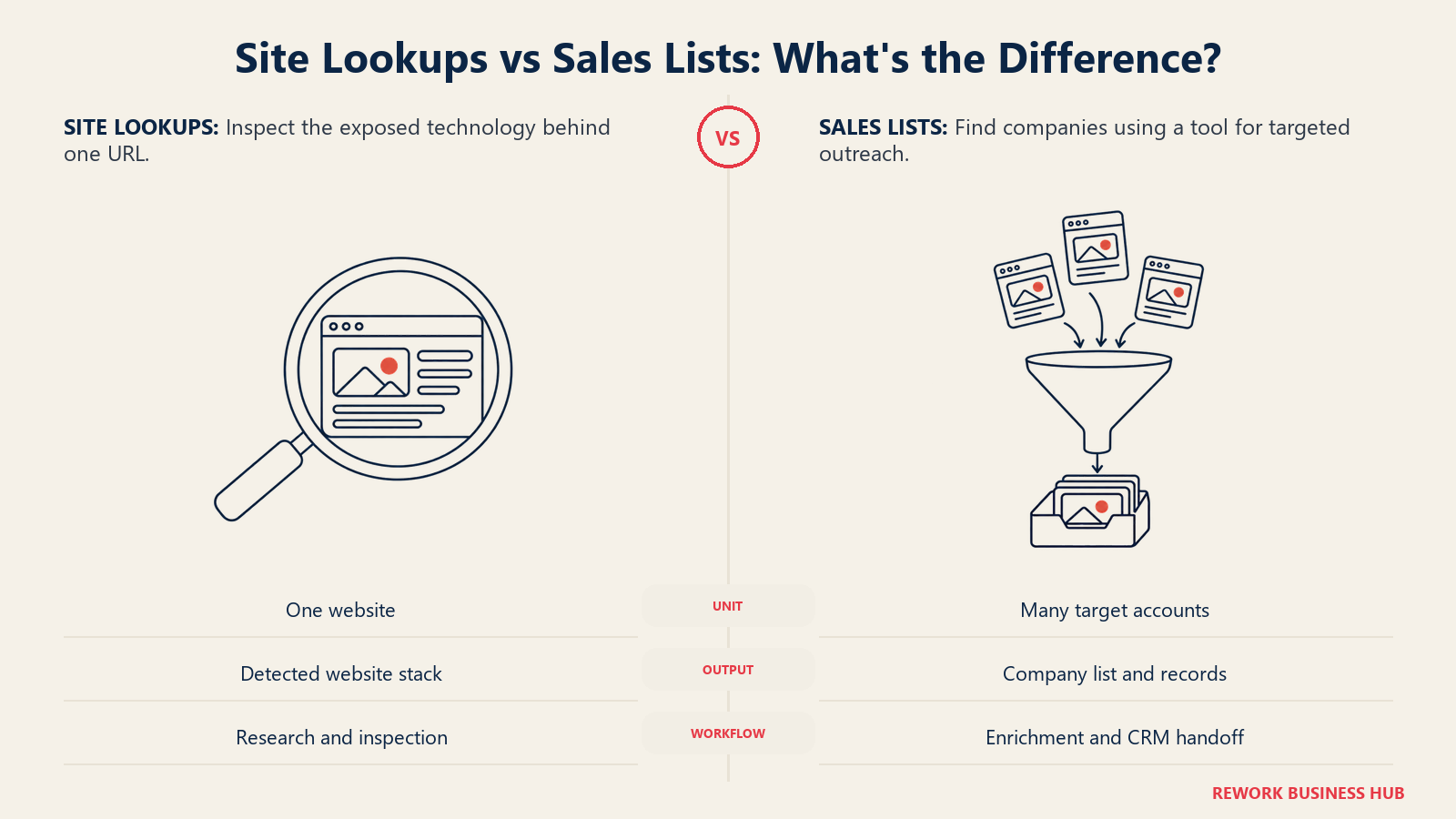
If you sell to companies that run a specific tool, BuiltWith and Wappalyzer are the fastest way to a list of websites using it, and HG Insights, ZoomInfo and Enlyft go deeper on company-level install base. If you only need to see what one website runs, a free extension (Wappalyzer, WhatRuns) or W3Techs does the job at no cost. Nobody buys "technographic data" in the abstract. A sales team wants a list of accounts with a particular CRM, cloud or payment tool installed. A developer or marketer wants the stack behind one URL. Those are two different jobs, and the tools below split along that line.
That split is why most roundups mislead. They rank a $295-a-month list builder next to a free browser extension as if both solved the same problem. We sort every tool by the reader it actually suits, then compare it on three things that decide whether the data is any good: how it detects technology, what it costs on the vendor's own price page, and what you need to think about on compliance.
This page is about technology-install data specifically. For the wider category of buyer data, intent signals and contact data, start with the best sales intelligence tools in 2026, and for company and contact records see the best B2B data providers.
Key Facts
- Salesforce's State of Sales report puts selling at 40% of a rep's workweek, with 60% spent on other work, which is the case for pre-filtering lists by installed technology instead of prospecting blind.
- The same report says reps spend almost one full day of the workweek on prospecting.
- BuiltWith says it tracks 127,890 different web technologies across 491.9 million domains (vendor claim).
- Median tenure with a current employer is 4.1 years, per the US Bureau of Labor Statistics, so the contact attached to any tech-install record goes stale on a similar clock.
- TheirStack lists 51M technographics records alongside 225M job records (vendor claim).
Two readers, one label
Technographics means data about the technology an organization uses. The same label covers two very different products.
| Reader | The question | What you want | Tools that fit |
|---|---|---|---|
| Sales or SDR leader | "Which companies run X, and who do I email?" | Lists by installed tech, company records, contacts, CRM sync | BuiltWith, HG Insights, ZoomInfo, 6sense, Demandbase, Enlyft, Similarweb, TheirStack |
| Marketer or competitive analyst | "What does this competitor run, and who is switching?" | Lookups, alerts, trend data, free tier | Wappalyzer, BuiltWith, W3Techs, WhatRuns |
| Developer or agency | "What is this site built with?" | Instant lookup, browser extension, API | Wappalyzer, WhatRuns, BuiltWith (free lookups) |
| Account-based team | "Which in-market accounts also run our integration partner?" | Technographics layered on intent and fit scores | 6sense, Demandbase, HG Insights |
If you're the first reader, your real purchase is a list-building and enrichment workflow. If you're the second or third, you probably need a free tool and should stop reading the price tables.
Quick Comparison Table
| Tool | Best For | Starting Price | Key Strength | Key Limitation |
|---|---|---|---|---|
| BuiltWith | Lists of websites by installed tech | Basic $295/mo or $2,950/yr | Largest public coverage claim (491.9M domains) | Flat per-account pricing starts high; website-centric |
| Wappalyzer | Developers, marketers, SMB list builders | Pro $250/mo billed monthly | Free extension plus paid lead lists | Pro caps lead-list targets at 2 |
| HG Insights | Enterprise TAM and tech spend | Pricing on request (reported median $90,000/yr) | Company-level install data with spend context | Two-year standard term, no free trial |
| 6sense | ABM teams combining intent and tech | Pricing on request (reported median $62,000/yr) | Technographics inside an intent platform | Not a standalone tech database |
| Demandbase | ABM teams with ad and sales alignment | Pricing on request (reported median $68,591/yr) | Account intelligence plus advertising | Platform plus per-user fee |
| ZoomInfo | Sales teams that need tech filters plus contacts | Pricing on request (reported median $33,500/yr) | Technology filters on a large contact database | Credit-based exports; quote required |
| Apollo.io | SDR teams on a budget | Free; Basic $49/seat/mo billed annually | Tech filter plus sequencing in one tool | Web-detected technologies only |
| Similarweb Sales Intelligence | Teams that value traffic plus tech | Pricing on request | Tech detection alongside traffic data | SimilarTech is no longer standalone |
| Enlyft | Cloud and software vendors, channel teams | Pricing on request | 24,000+ technologies across 45M+ companies (vendor claim) | No published price or trial terms |
| TheirStack | Technical founders, data teams, API users | From $49/mo (1,500 API credits) | Job-post-based tech detection, public credit packs | Detects what job posts mention, not everything installed |
| W3Techs | Market-share research | Public reports (no price listed) | Transparent method and monthly market reports | Aggregate stats, not account lists |
| WhatRuns | Quick single-site lookups | Free | Free extension, no signup | No list building |
| Datanyze | Contact reveals in a browser | $29/mo billed monthly | Cheap credits per user | No longer a technographic list tool |
How technographic data is actually detected
This is where accuracy lives, and vendors are uneven about publishing it. There are three detection styles.
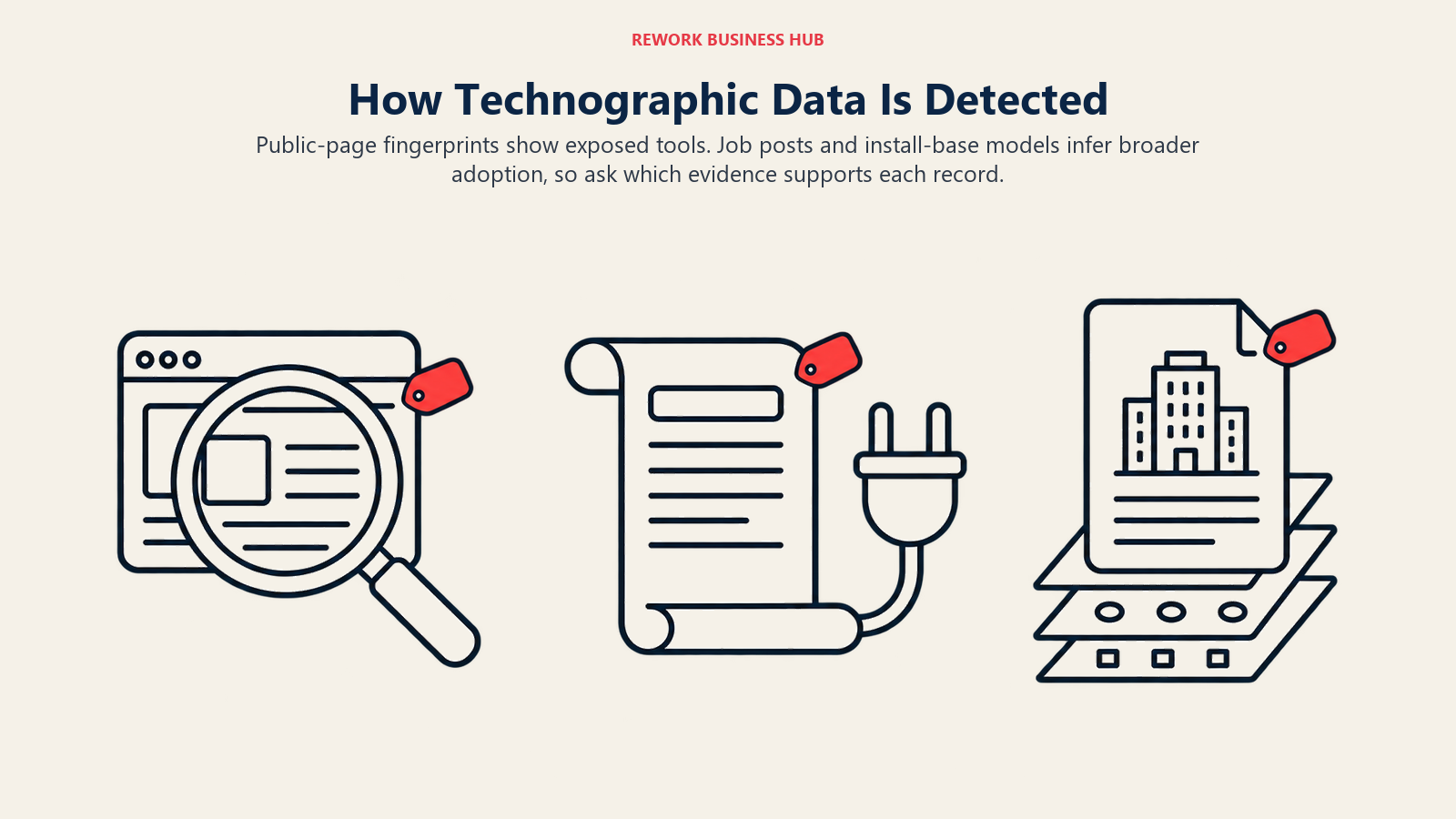
- Front-end fingerprinting. A crawler or browser extension reads a page's HTML, scripts, headers and cookies and matches them against known patterns. W3Techs is the clearest about it: it says it searches pages for specific patterns, using regular expressions and DOM traversal, with several thousand indicators. This is accurate for anything that leaves a trace on a public page (CMS, analytics, ecommerce platform, chat widget) and blind to anything that doesn't (internal CRM, ERP, back-office tools).
- Inferred or install-base signals. Job postings, customer testimonials, partner listings and integration data hint at tools that never touch a public page. TheirStack builds from job postings, and its pricing page lists 352k job sources across 195 countries. Enlyft says it models an Intelligence Graph in-house rather than borrowing from a data-sharing network, though it doesn't publish the underlying sources.
- Blended. ZoomInfo's own blog says its coverage spans 30,000+ technologies across 200+ categories, but that page describes industry collection methods generally and doesn't say which ones ZoomInfo uses.
| Detection style | Sees | Misses | Typical tools |
|---|---|---|---|
| Front-end fingerprinting | Public-facing stack (CMS, tags, payments, chat) | Internal and back-office software | BuiltWith, Wappalyzer, W3Techs, WhatRuns |
| Job-post inference | Tools a company hires for | Tools nobody mentions in a posting | TheirStack |
| Install-base modeling | Company-level adoption and spend | Anything the model can't infer; method often undisclosed | HG Insights, Enlyft |
| Blended with intent | Tech plus in-market behavior | Method usually not published | 6sense, Demandbase, ZoomInfo |
The practical test: ask the vendor which signal produced a given record. If it's "we saw a script on their site", the record is as good as that crawl's freshness. If it's "a job post mentioned it", the record shows intent to hire for a skill, not proof of production use.
1. BuiltWith: the default for lists of websites by technology
BuiltWith is the best-known name for sales teams that need a list of websites using a specific tool. The vendor's plans page claims 491.9 million domains and 127,890 technologies tracked, with history going back 41 years (vendor claims). If its price floor is the problem, the BuiltWith alternatives page sorts replacements by reader, and the free website technology checkers roundup covers one-off lookups.
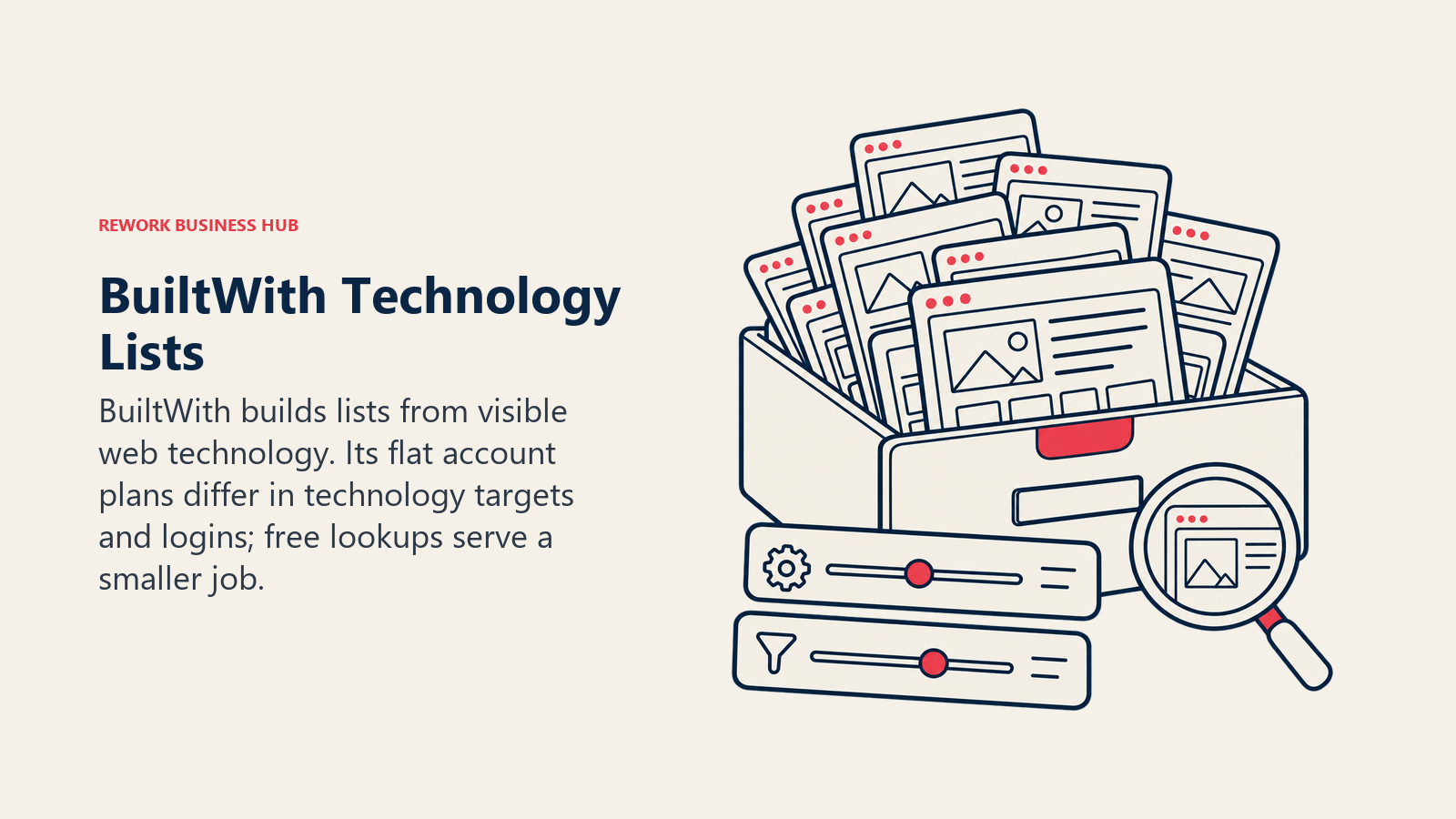
Pricing is flat per account, not per user. Basic is $295/mo or $2,950/yr with 2 technologies, 2 keywords and 1 login. Pro is $495/mo or $4,950/yr with unlimited technologies and keywords. Team is $995/mo or $9,950/yr with unlimited Pro logins. Annual billing is cheaper than monthly. Individual site lookups are free, according to the vendor.
Best for: sales and marketing teams building outbound lists from installed technology, agencies pitching site owners. Not ideal for: teams that need company-level records on tools that leave no web trace.
| Pros | Cons |
|---|---|
| Free single-site lookups | Basic tier limits you to 2 technologies |
| Unlimited technologies and keywords from Pro | Account-level price is high for one seller |
| Flat per-account pricing | Detection is web-facing, so back-office tools are invisible |
| Contact names and emails attached to leads | Verify contact data before sending |
2. Wappalyzer: the free extension with a paid lead-list side
Wappalyzer serves both readers in this article. The extension is free, and Wappalyzer says it turns public web signals into technographic data across "thousands of web technologies across millions of websites", available through its site, APIs, extension and bulk data (vendor claims). We compare its closest replacements in the Wappalyzer alternatives.
Paid plans on its pricing page: Pro $250/mo, Business $450/mo, Enterprise from $850/mo, all billed monthly. Annual billing saves 17%; ask Wappalyzer for the annual figure. A free account includes 50 technology lookups and 50 email verifications a month. Pro gives one user and 2 lead-list technology targets; Business gives 5 users and unlimited targets plus CRM enrichment.
Best for: developers and marketers (free), SMB sellers starting list-building (paid). Not ideal for: enterprises that need account-level install data beyond the website.
| Pros | Cons |
|---|---|
| Free extension for quick lookups | Pro limits you to 2 technology targets |
| Unlimited targets from Business | Annual prices not published |
| API and bulk data options | Coverage stated as "thousands of technologies", no hard count |
| Free account with monthly lookups | Plan API credits expire after 60 days |
3. HG Insights: enterprise install base and technology spend
HG Insights sits at the other end of the market from a browser extension. Its pricing page lists Starter, Growth and Enterprise plans with seats, Intelligence credits and leads processed, and says coverage runs to 70M+ companies (vendor claim). The standard term is two years, with one-year at a higher price, and there's no free trial. Vendr reports a median of $90,000 a year (low $31,498, high $173,119, 46 purchases) (reported). HG Insights acquired TrustRadius, announced 19 June 2025.
Best for: enterprise strategy and sales-ops teams sizing a TAM by technology. Not ideal for: small teams or anyone who needs a free pilot first.
| Pros | Cons |
|---|---|
| Company-level install data | Two-year standard term |
| Seat bundles and credit model | Credits rollover capped at 20% monthly |
| TrustRadius ownership adds review data | No free trial |
| Built for TAM and targeting work | Method not described on the homepage |
4. 6sense: technographics as one signal inside an intent platform
6sense lists "verified B2B data and technographics" as part of a wider signal foundation, so don't treat it as a technology database you can buy alone. Pricing is on request across three packages, and credits unlock emails, phones and records. Vendr reports a median of $62,000 a year, low $11,183, high $176,213 across 387 purchases (reported). The pricing page shows no free plan.
If you're evaluating it mainly for technology filters, read the best 6sense alternatives first, and for how intent and install data interact see our intent data guide.
Best for: ABM teams that want tech fit and in-market behavior in one scoring model. Not ideal for: anyone who only needs a technology list.
| Pros | Cons |
|---|---|
| Technographics combined with intent | Not sold as a standalone tech database |
| Predictive scoring across accounts | Pricing on request |
| Data credits for exports | Detection method not published |
| Package options for data and AI | Reported prices are far above list tools |
5. Demandbase: account intelligence with an ad and sales layer
Demandbase sells a platform, and technology data is one part of its account profile. Its pricing page describes a platform fee plus a flat fee per user, with Advertising and Data sold as standalone products. Vendr reports a median of $68,591 a year, low $24,000, high $164,037 across 187 purchases (reported).
Best for: ABM teams that run advertising and sales plays off the same account list. Not ideal for: small teams buying technology data only.
| Pros | Cons |
|---|---|
| Account data tied to advertising | Platform fee plus per-user fee |
| Data sold standalone | Price on request |
| Fits mature ABM programs | Platform fee on top of seats |
| Established vendor in the category | Tech detection method not published |
6. ZoomInfo: technology filters on a contact database
ZoomInfo's technology filters sit on top of its contact and company data. Its own blog says coverage spans 30,000+ technologies across 200+ categories (vendor claim). Pricing is on request, by features, licenses and credit usage, where one credit equals one export of a contact or company profile. Vendr reports a median of $33,500 a year, range $7,240 to $156,042, 1,577 purchases (reported). A free ZoomInfo Lite tier exists for business email users, per the pricing page. For alternatives, see the best ZoomInfo alternatives.
Best for: sales teams that want tech filters and verified contacts in one subscription. Not ideal for: buyers who only need domain-level tech lists.
| Pros | Cons |
|---|---|
| Tech filters plus contact data | Credit-based exports |
| Large contact database | Quote required |
| Free Lite tier and trial offered | Integrations need a bulk credit purchase |
| Intent topics available | Collection method for tech data not specified |
7. Apollo.io: a technology filter inside a prospecting tool
Apollo is the budget path for sellers. It has a technology filter on company search, so a seller can build a list by installed tool and enrich it in the same account. The data page claims 240M+ contacts and 30M+ companies (vendor claim).
Plans run Free at $0, Basic at $49 per seat a month billed annually ($65 monthly), Professional at $79 annually ($99 monthly), and Organization at $119 annually with a 3-seat minimum. A credit buys an email for 1 and a phone number for 8, with no rollover. For comparisons see the best Apollo alternatives.
Best for: small SDR teams that want tech-based filters, contacts and sequencing together. Not ideal for: analysts who need deep technology coverage beyond the web.
| Pros | Cons |
|---|---|
| Free plan to test | Web-detected technologies only |
| Contacts and sequencing included | Credits don't roll over |
| Cheaper per seat than enterprise suites | Annual billing needed for the lowest rate |
| Pooled team credits | Tech coverage is a filter, not a research tool |
8. Similarweb Sales Intelligence: tech data with traffic signals
SimilarTech is no longer sold on its own. Its site now reads "A Similarweb Company", and the paid path is Similarweb Sales Intelligence. Similarweb says the product blends contributory network signals, direct site measurement, panel analytics and public sources, and lets you filter by technographic data and track technology changes. It doesn't state a technology count, and pricing is on request.
Best for: teams that want website traffic and technology data in one place. Not ideal for: anyone wanting a standalone, priced technology database.
| Pros | Cons |
|---|---|
| Traffic plus tech in one tool | No standalone SimilarTech product |
| Technology change signals | Technology count not published |
| Free trial offered | Pricing on request |
| CRM enrichment use case | Detection sources blended, not itemized |
9. Enlyft: install-base modeling for software and cloud sellers
Enlyft states it tracks 24,000+ technologies across 45M+ companies and 50+ first-party signals per account (vendor claims), modeled in-house in what it calls an Intelligence Graph. It powers channel tools such as Microsoft partner programs, according to its site. Pricing isn't published; the call to action is a demo. It doesn't explain which sources feed the signals, so ask for them during evaluation.
Best for: cloud, security and software vendors and channel teams that sell against an installed product. Not ideal for: buyers who need a published price or self-serve trial.
| Pros | Cons |
|---|---|
| Large claimed technology and company coverage | Sources not disclosed |
| Account scoring on top of install base | No pricing published |
| Built for channel and partner selling | Demo-led buying |
| Re-scored as signals change | Hard to benchmark before purchase |
10. TheirStack: tech stack from job postings, with public credit pricing
TheirStack is the most transparent newer entrant on price. App company credits are one-time packs: 1,000 credits for $109, up to 200,000 for $999. One credit unlocks a company's jobs, tech stack and firmographics, viewable for 90 days. API plans run monthly from $49 for 1,500 credits to $5,500 for 5,000,000, with a 10% discount versus buying packs. Unused credits roll over for 12 months. Annual prices aren't listed.
Its datasets include 225M job records and 51M technographics records (vendor claims). Because detection leans on job postings, it shows what companies are hiring for, which is a stronger buying signal than a script tag but a weaker proof of production use.
Best for: technical founders, growth engineers and data teams who want API access. Not ideal for: teams that need every installed tool, including those no job post mentions.
| Pros | Cons |
|---|---|
| Public credit and API pricing | Detection depends on job postings |
| Credits roll over 12 months | Free trial credit amount not stated |
| Jobs plus tech plus intent in one API | Dataset pricing needs a sales call |
| One-time credit packs | Annual prices not listed |
11. W3Techs: the transparent source for market-share research
W3Techs isn't a lead list. It publishes technology usage statistics and says it measures technologies used on "the relevant web", excluding parked and spam sites. It revisits a site about once a month, updates reports daily and generates larger market reports monthly. The page doesn't list subscription prices, so confirm any paid access with the vendor.
Best for: analysts and marketers who need market-share trends (for example, which CMS is growing). Not ideal for: anyone who needs a list of accounts or contacts.
| Pros | Cons |
|---|---|
| Method is documented | Aggregate stats, not accounts |
| Public usage reports | No contact or company records |
| Daily and monthly updates | Sample size not stated |
| Good for strategy and content | No CRM integration |
12. WhatRuns: a free extension for one-off lookups
WhatRuns calls itself a free browser extension that identifies technologies on any website and claims 450k+ active users, with 50 to 100 new web apps added daily (vendor claims). The page lists no paid plans and doesn't describe how detection works.
Best for: developers and marketers checking a competitor's site. Not ideal for: building lists or exporting data.
| Pros | Cons |
|---|---|
| Free | No paid tier or export |
| One-click lookups | Detection method not described |
| No setup | Single-site only |
| Frequent technology additions | No accuracy figures |
13. Datanyze: now a contact-reveal extension
Datanyze used to be a technographic prospecting name. Today its product is a Chrome extension that reveals contacts. ZoomInfo acquired it in 2018. The pricing page shows Nyze Pro 1 at $29/mo billed monthly (80 credits) or $21/mo billed yearly, and Nyze Pro 2 at $55/mo monthly (160 credits) or $39/mo yearly, per user. Nyze Lite is a 90-day trial at 10 credits a month, not a permanent free tier. One credit is one contact reveal.
Best for: individual sellers who want cheap contact reveals while browsing. Not ideal for: anyone looking for a technographic list builder.
| Pros | Cons |
|---|---|
| Low per-user price | Not a technographic list tool any more |
| Chrome extension workflow | Lite is a 90-day trial |
| ZoomInfo ownership | Yearly plans non-refundable |
| Simple credit model | Limited credits per month |
Reader-fit matrix
| Tool | Sales list building | Developer or marketer lookup | ABM and scoring | Free option |
|---|---|---|---|---|
| BuiltWith | Strong | Strong (free lookups) | Light | Yes |
| Wappalyzer | Medium (paid) | Strong | Light | Yes |
| HG Insights | Strong | No | Strong | No |
| 6sense | Medium | No | Strong | Not shown |
| Demandbase | Medium | No | Strong | No |
| ZoomInfo | Strong | No | Medium | Lite |
| Apollo.io | Medium | No | Light | Yes |
| Similarweb | Medium | Light | Light | Trial |
| Enlyft | Strong | No | Medium | No |
| TheirStack | Medium | Medium (API) | Light | Trial |
| W3Techs | No | Strong (research) | No | Yes |
| WhatRuns | No | Strong | No | Yes |
| Datanyze | No | No | No | 90-day trial |
Stage-fit matrix
| Company stage | Best starting point | Why |
|---|---|---|
| Solo founder or pre-seed | Wappalyzer or WhatRuns free, Apollo Free | No spend, enough for a first 100 accounts |
| Seed to Series A (1-5 sellers) | BuiltWith Pro or Apollo Basic | Lists and contacts without a platform contract |
| Series B to growth (5-30 sellers) | ZoomInfo, TheirStack API, Wappalyzer Business | Credits, CRM sync and repeatable lists |
| Enterprise ABM | 6sense, Demandbase, HG Insights | Tech fit combined with intent and scoring |
| Channel or partner team | Enlyft, HG Insights | Install base and spend for co-sell targeting |
Sizing and persona table
| Persona | Team size | Likely tools | Budget signal |
|---|---|---|---|
| Developer or agency owner | 1-10 | Wappalyzer, WhatRuns, BuiltWith free | $0 |
| SDR lead at a startup | 2-10 sellers | Apollo, Datanyze, Wappalyzer Pro | Tens to low hundreds a month |
| Head of growth | 10-50 | BuiltWith, TheirStack, ZoomInfo | Hundreds to low thousands a month |
| RevOps at mid-market | 50-200 | ZoomInfo, Enlyft, Similarweb | Annual contract, quote-based |
| VP Marketing (ABM) | 200+ | 6sense, Demandbase, HG Insights | Five-figure annual contracts, reported |
Accuracy and compliance: what to check before you buy
Technology data goes stale in a few ways: a company switches vendor, a crawl misses a subdomain, or a record points to a contact who left. Median employer tenure is 4.1 years, so assume the people attached to old records move on. Salesforce's report also notes 46% of sales pros with agents say data quality issues hurt their sales.
| Question | Why it matters |
|---|---|
| How was this record detected (page scan, job post, model)? | Sets how much you can trust "uses X" |
| When was it last seen? | Old detections overstate current installs |
| What does a credit or export cost? | Technology filters can still meter contacts |
| Does it include personal contact data? | Triggers privacy rules below |
On compliance, the technology fact about a company is business data, but contacts attached to it are personal data. The French regulator fined Kaspr EUR 240,000 for collecting LinkedIn members' contact details, a reminder that scraping personal contacts is a legal risk even when the intent is B2B. For calls, the FTC says Do Not Call civil penalties reach $53,088 per violation but the registry rule does not apply to business-to-business calls. In the UK, the ICO fined a firm £160,000 for calls to TPS and CTPS numbers, including businesses. In Southeast Asia, check PDPA obligations in each country you sell into. This isn't legal advice; have counsel review your outreach.
How to Choose: Decision Framework
| If you need... | Pick | Why |
|---|---|---|
| One site's stack, today, free | Wappalyzer or WhatRuns | Free extensions |
| Lists of websites running a given tool | BuiltWith | Built for that job |
| Tech filters plus contacts at low cost | Apollo.io | Filter and sequencing in one |
| Tech filters on a big contact database | ZoomInfo | Credits and CRM sync |
| Install base and spend for enterprise TAM | HG Insights | Company-level data |
| Tech fit plus intent for ABM | 6sense or Demandbase | Signals in one score |
| API access to tech and job data | TheirStack | Public credit pricing |
| Market-share trends for content or strategy | W3Techs | Documented method |
For how to define who to target before filtering, see our ideal customer profile guide, and for the buying process around the data see how to choose sales intelligence software. If you also need to refresh existing records, the best data enrichment tools covers that angle.
What to Do Next
Pick one use case and run a two-week test. If you're a developer or marketer, install Wappalyzer and WhatRuns and compare results on five sites you know well. If you're building sales lists, choose one technology your best customers run, pull the same list from two tools (for example BuiltWith and Apollo), and check overlap and contact bounce rates before committing to an annual plan. For the wider stack of data tools around this decision, return to the sales intelligence hub.

Principal CRM Strategist
On this page
- Key Facts
- Two readers, one label
- Quick Comparison Table
- How technographic data is actually detected
- 1. BuiltWith: the default for lists of websites by technology
- 2. Wappalyzer: the free extension with a paid lead-list side
- 3. HG Insights: enterprise install base and technology spend
- 4. 6sense: technographics as one signal inside an intent platform
- 5. Demandbase: account intelligence with an ad and sales layer
- 6. ZoomInfo: technology filters on a contact database
- 7. Apollo.io: a technology filter inside a prospecting tool
- 8. Similarweb Sales Intelligence: tech data with traffic signals
- 9. Enlyft: install-base modeling for software and cloud sellers
- 10. TheirStack: tech stack from job postings, with public credit pricing
- 11. W3Techs: the transparent source for market-share research
- 12. WhatRuns: a free extension for one-off lookups
- 13. Datanyze: now a contact-reveal extension
- Reader-fit matrix
- Stage-fit matrix
- Sizing and persona table
- Accuracy and compliance: what to check before you buy
- How to Choose: Decision Framework
- What to Do Next