HackerRank vs CodeSignal: Which Technical Assessment Platform Fits Your Engineering Hiring in 2026?
Turn this article into takeaways for your work.


Each assistant summarizes the article only for you and suggests best practices for your work.
If you're a Head of Talent Acquisition, VP Engineering, or Engineering Manager narrowing a shortlist of technical assessment platforms, HackerRank and CodeSignal are almost certainly both on it. Both let you send candidates timed coding challenges, run structured technical interviews, and score the results before a human ever opens a resume. But the two companies charge for that work in genuinely different ways, cover different roles with their AI interviewers, and answer 2026's real test of any assessment platform, whether a candidate quietly used an AI model to pass, in different ways too.
This comparison walks through what each platform actually charges at real hiring volumes (the arithmetic, not just the sticker price), how far each one's AI Interviewer reaches beyond pure engineering roles, and how each one defends against the wave of AI-assisted interview cheating reshaping this category this year. If you're comparing every option in this space, not just these two, see our roundup of pre-employment assessment tools.
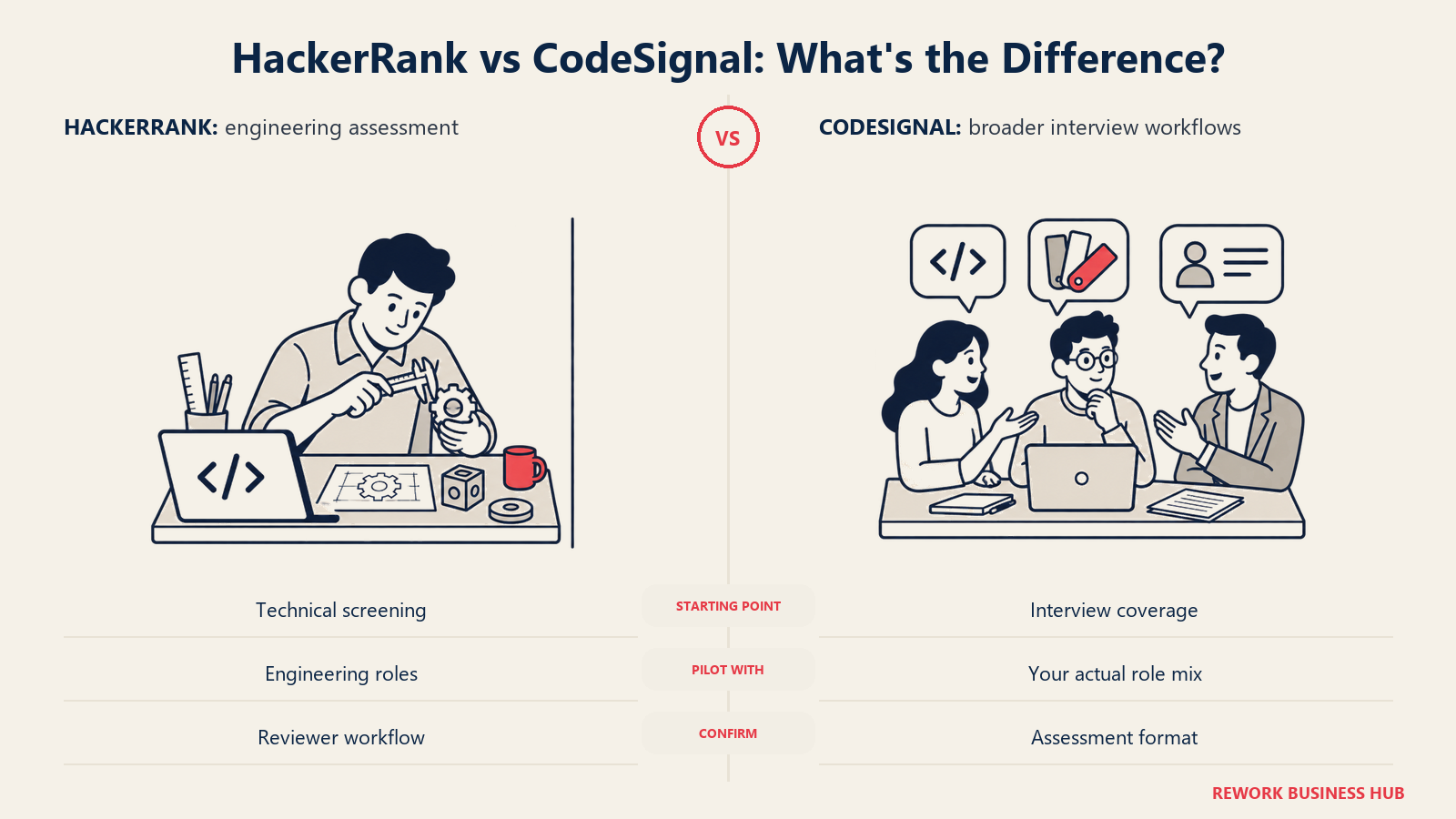
Neither platform tries to be everything in your hiring stack, and that's actually the useful frame for this whole comparison. HackerRank goes deep on engineering-only technical assessment at a flat, budgetable price. CodeSignal goes broad, spreading a credit-based AI Interviewer across engineering and the go-to-market roles sitting next to it. Which one wins depends less on brand familiarity and more on which shape actually matches how many roles, and which roles, you're hiring for this year.
TL;DR
| HackerRank | CodeSignal | |
|---|---|---|
| Core philosophy | Deep, engineering-only technical assessment and interviews with a flat, budgetable entry price | Credit-based technical assessment plus an AI Interviewer that spans engineering and go-to-market roles |
| Best for | Engineering-heavy hiring teams that want a single-seat plan with a hard attempt cap to budget against | Teams that want AI-run interviews across both technical and non-technical roles from one credit pool |
| Pricing model | Attempt-based: fixed candidate attempts per year, $20 for each additional attempt | Credit-based: fixed credits per year, $20 for each on-demand credit beyond the plan |
| Entry tier, billed annually | Starter: $1,990/year (about $165/month effective) | Build: $79/month billed annually, $948/year total |
| Entry tier, billed monthly | Starter: $199/month, no annual commitment | Build: $99/month, no annual commitment |
| Seats on entry tier | 1 seat, 120 candidate attempts/year | Not published as a per-seat limit; priced by credit volume instead |
| AI Interviewer coverage | Bundled into Starter for Screen and Interview, engineering-focused | Engineering, product, and design on Build; adds sales, customer success, and marketing on Grow |
| Transparency above entry tier | Pro and Enterprise are quote-only; no dollar figure published anywhere | Grow is published ($479 to $599/month); only Pro is quote-only |
Who Each Platform Is Actually Built For
HackerRank's own materials frame Starter around a single technical recruiter or hiring manager who wants a fixed, predictable cost for a defined volume of engineering hires. Go past that volume or that one seat, and HackerRank pushes you toward Pro or Enterprise, both unpublished, both sales-led. The company builds specifically for engineering hiring: coding assessments and structured technical interviews, not a general pre-employment testing platform. That broader, cross-functional testing category (cognitive ability, personality, dozens of role-specific skills) is TestGorilla's territory instead; see our Best TestGorilla Alternatives guide if that's the gap you're actually closing.
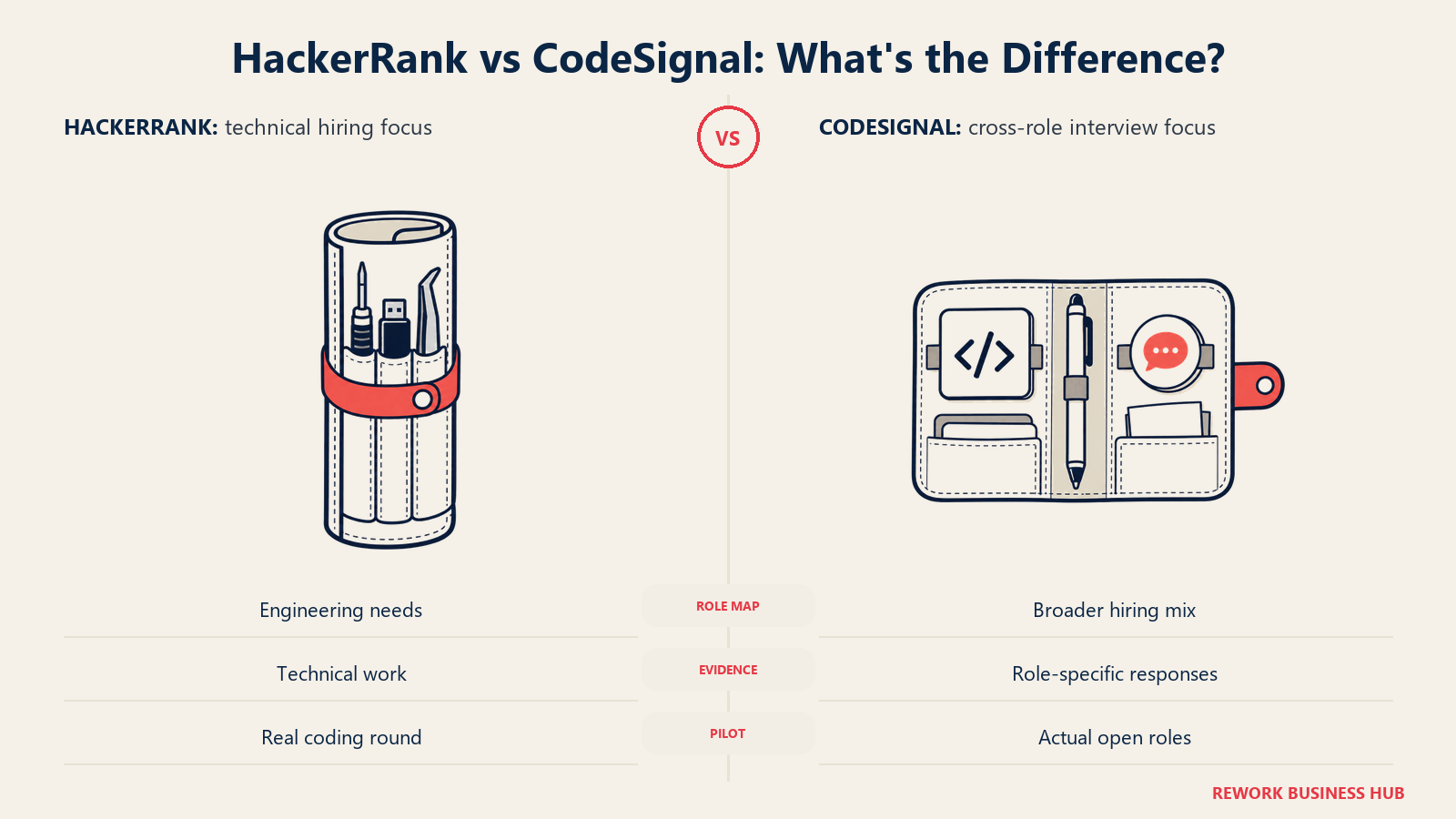
CodeSignal positions Hire around a wider slice of a growing company's hiring: the engineering org plus the go-to-market roles sitting next to it. Its AI Interviewer runs a structured, timed conversation with a candidate and produces a scored writeup, a step further than a static coding test, and the company extends that same AI-run interview format to product, design, sales, customer success, and marketing roles depending on tier.
| HackerRank | CodeSignal | |
|---|---|---|
| Sweet-spot team | Engineering-only hiring that wants standardized, auto-graded technical screening | Teams hiring across engineering and adjacent go-to-market, product, or design roles from one platform |
| Entry-tier seat cap | 1 seat (Starter) | Not seat-capped; priced by credit volume rather than named users |
| Buying motion | Starter is self-serve at a published price; Pro and Enterprise are sales-led and quote-only | Build and Grow are self-serve at published prices; Pro is sales-led and quote-only |
| Primary use case | Screen and Interview: coding assessments plus live or structured technical interviews | Coding assessments plus an AI Interviewer spanning technical and go-to-market roles |
| HackerRank | CodeSignal | |
|---|---|---|
| Typical buying trigger | Wants a hard, budgetable cap on technical hiring cost, measured in attempts, not credits | Wants one tool running AI interviews for both engineering hires and the revenue-facing roles around them |
| Assessment depth needed | Deep and narrow: coding tests plus live or structured technical interviews | Broad: coding tests plus an AI Interviewer extending past engineering into go-to-market roles |
| Cost predictability | High at Starter, a flat annual fee up to 120 attempts with $20 overage after that | High inside a credit tier, but Grow ($5,748/year) is a large step up from Build ($948/year) |
Key Facts
- HackerRank Starter costs $199/month month-to-month or $1,990/year billed annually, capped at 1 seat and 120 candidate attempts a year, with each additional attempt billed at $20, per HackerRank's own pricing writeup.
- CodeSignal's Build tier runs $79/month billed annually ($948/year) or $99/month month-to-month for 60 annual credits, and Grow runs $479/month billed annually ($5,748/year) or $599/month month-to-month for 420 annual credits, per CodeSignal's pricing page.
- A credit or attempt on either platform is consumed when a candidate actually starts an assessment or interview, not when they're invited, per CodeSignal's pricing page.
- HackerRank does not publish Pro or Enterprise pricing. Vendr's buyer-reported purchase data across 185 tracked purchases puts the median annual contract around $13,099, ranging from roughly $4,508 to $45,861, reported rather than confirmed by HackerRank, per Vendr's HackerRank marketplace listing.
- An analysis of 19,368 live technical interviews found 38.5% of candidates flagged for AI-assisted cheating overall, rising to 48% in software engineering roles specifically, per Fabric's 2026 interview cheating report.
Credit-Based vs Attempt-Based Pricing: What Each Model Actually Charges For
The two companies solved the same problem, how to price something that scales with hiring volume, in different ways, and the label matters more than it sounds like it should. HackerRank counts attempts: one candidate starting one assessment consumes one attempt, full stop, regardless of what that assessment contains. CodeSignal counts credits: one credit is consumed when a candidate starts an assessment or interview, but the credit pool covers both a plain coding test and a full AI-run interview identically, so the meter runs the same way whichever format you send.
| Plan | HackerRank | CodeSignal |
|---|---|---|
| Entry tier, billed annually | Starter: $1,990/year ($165/month effective) | Build: $948/year ($79/month) |
| Entry tier, billed monthly | Starter: $199/month, no annual commitment | Build: $99/month, no annual commitment |
| Mid or growth tier, billed annually | Not published; Pro is quote-only | Grow: $5,748/year ($479/month) |
| Mid or growth tier, billed monthly | Not published | Grow: $7,188/year ($599/month) |
| Top tier | Enterprise: quote-only | Pro: quote-only, custom credit allocation |
| What one unit buys | One candidate attempt at an assessment | One credit, consumed when a candidate starts an assessment or interview |
| HackerRank Starter | CodeSignal Build | |
|---|---|---|
| Seats included | 1 | Not stated as seat-limited; priced by credit volume instead |
| Annual volume included | 120 candidate attempts/year | 60 annual credits (billed annually), or the same 60/year total via 5 monthly credits (billed monthly) |
| Overage rate | $20 per additional attempt | $20 per additional on-demand credit |
| What's bundled at entry tier | Full access to Screen and Interview, advanced plagiarism detection, question-leak protection | Coding assessments, technical interviews, an AI Interviewer for engineering, product, and design roles, AI proctoring and ID verification |
Notice what neither table shows: a free tier. Both companies expect a paying relationship from day one, unlike some of the psychometric-testing vendors in this category that lead with a free plan to get a foot in the door.
The Real Cost at Your Hiring Volume: A Worked Example
Sticker prices don't tell you which platform is actually cheaper once you know how many candidates you screen a year, because the overage math changes the answer at every volume. Here's the arithmetic at three volumes, using each platform's own annual billed rate, since annual billing is cheaper per month than month-to-month on both platforms.
| Annual hiring volume | HackerRank Starter (annual) | CodeSignal Build or Grow (annual) | Cheaper option |
|---|---|---|---|
| 60 candidates/year | $1,990/year flat, well under the 120-attempt cap | Build: $948/year (60 credits included, no overage) | CodeSignal, by $1,042/year |
| 120 candidates/year | $1,990/year flat, exactly at the attempt cap | Build: $948 + (60 extra credits x $20) = $2,148/year | HackerRank, by $158/year |
| 420 candidates/year | $1,990 + (300 extra attempts x $20) = $7,990/year on paper, but Starter's 1-seat cap makes this volume impractical regardless of price | Grow: $5,748/year flat (420 credits included) | CodeSignal, by $2,242/year, with no forced seat upgrade |
The crossover sits almost exactly at HackerRank's own attempt cap. Under 120 attempts a year, CodeSignal's Build tier is the cheaper way to run coding assessments alone. Push past 120 and HackerRank's flat annual fee starts winning on pure arithmetic, right up until a second consideration overtakes the math: Starter is a 1-seat plan. A team running 420 attempts a year almost always has more than one person reviewing results, which forces an upgrade to HackerRank's unpublished Pro tier regardless of what the overage calculation says. Vendr's buyer-reported data puts the median Pro or Enterprise contract around $13,099/year (reported), which is a useful order-of-magnitude check, not a substitute for getting HackerRank's actual quote before you commit to a volume assumption.
Go higher still, past a few hundred candidates a year and multiple reviewers, and both platforms funnel you into the same unpublished territory: HackerRank's Enterprise and CodeSignal's Pro are both custom-quoted, both credit or attempt allocations negotiated case by case. At that scale the published tiers on this page stop being the decision, and the decision becomes how well each vendor's sales team can actually model your hiring plan, not which pricing page has the lower number.
AI Interviewer Coverage: Engineering Only vs Engineering Plus Go-To-Market
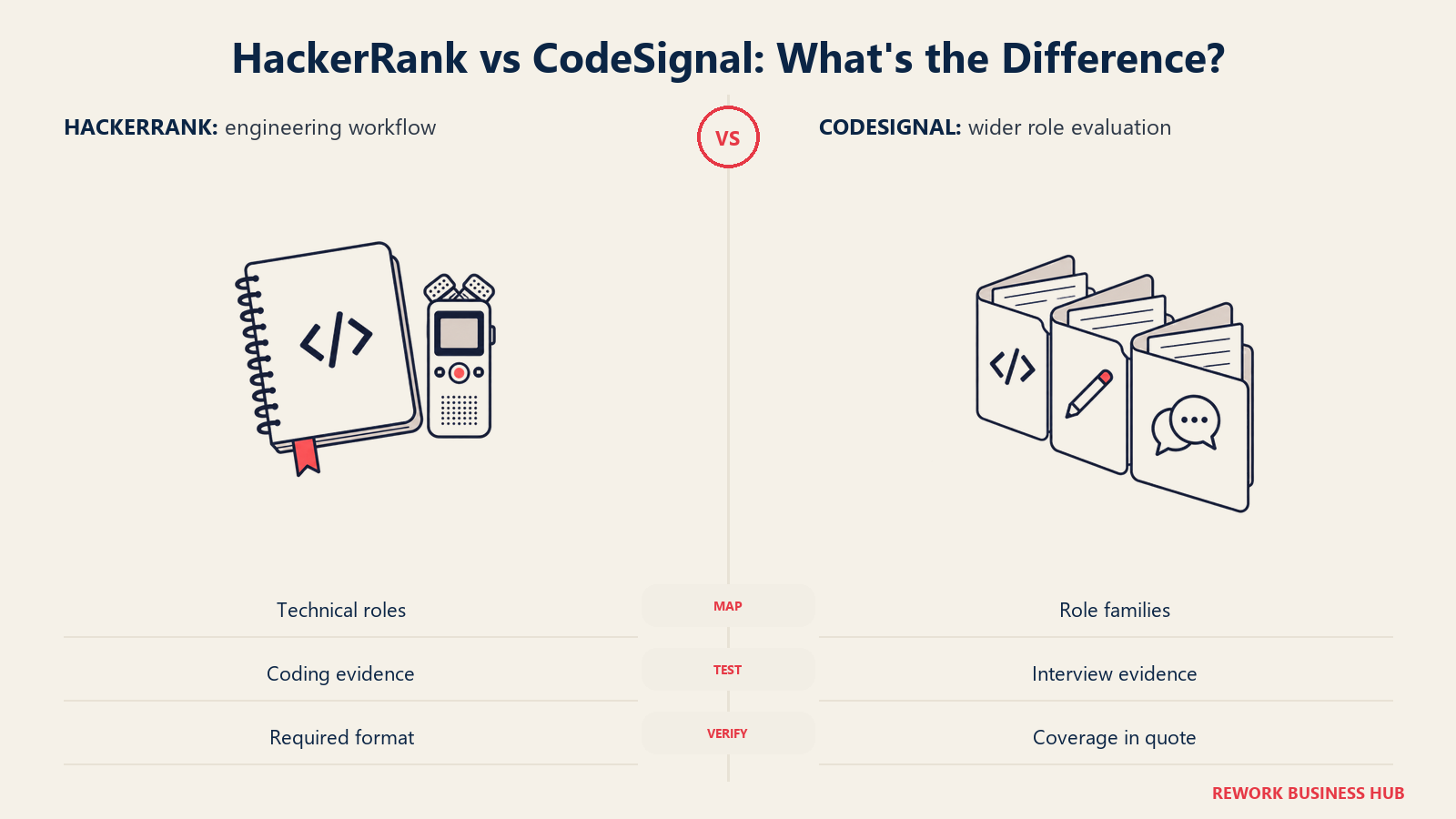
This is the clearest structural difference between the two platforms, and it's easy to miss if you're only comparing coding-test features. HackerRank's Screen and Interview products are built around code: technical screening and technical interviews, full stop. CodeSignal's AI Interviewer runs a structured, timed conversation and produces a scored writeup for roles well outside engineering, and it splits that coverage across tiers rather than bundling everything at once.
| Role coverage | HackerRank | CodeSignal |
|---|---|---|
| Engineering | Yes, Screen and Interview cover coding tests and technical interviews | Yes, on Build and above |
| Product and design | Not a named AI Interviewer category | Yes, on Build and above |
| Sales, customer success, marketing | Not offered | Yes, added on Grow and above |
| Where the AI Interviewer sits in pricing | Bundled into the core Starter plan, no separate tier for it | Split by tier: Build covers engineering, product, and design; Grow adds go-to-market roles |
If your hiring plan for the year is entirely backend, frontend, and infrastructure engineers, this gap doesn't matter to you, HackerRank's depth in that lane is real. If your next dozen hires include a sales engineer, a product manager, and a growth marketer who needs a structured, scored interview rather than an unscripted call, CodeSignal's Grow tier reaches roles HackerRank's product line doesn't touch at all.
Question Library Depth, Custom Questions, and Leak Protection
| HackerRank | CodeSignal | |
|---|---|---|
| Included in entry tier | Full access to Screen and Interview question sets | Roughly 2,000 questions on Build |
| Custom questions | Available for teams building role-specific assessments | Available on paid tiers |
| Question-leak protection | Advanced plagiarism detection and question-leak protection named explicitly on Starter | AI proctoring and ID verification named explicitly on Build |
| Where the library gets deeper | Pro and Enterprise, both unpublished | Grow and Pro, with Grow's pricing published and Pro quote-only |
A deep question library is only worth as much as your ability to keep it from leaking. Both companies treat that as a Starter or Build-tier feature rather than something you have to pay more to unlock, which matters more in 2026 than it did two years ago.
AI-Assisted Cheating Defenses and Proctoring
This is the category's defining problem this year, and neither platform gets to sit it out. An analysis of 19,368 live technical interviews found 38.5% of candidates flagged for AI-assisted cheating overall, and 48% in software engineering roles specifically, per Fabric's 2026 report. Purpose-built tools built to help candidates cheat invisibly during a live interview are now a funded product category in their own right, not a fringe hack. If you're building or updating a policy on where AI genuinely helps a recruiting workflow versus where it creates new risk, see our guide on AI in the recruiter workflow.
| Defense | HackerRank | CodeSignal |
|---|---|---|
| Plagiarism or leak detection | Advanced plagiarism detection and question-leak protection, included on Starter | Not named as a separate feature from proctoring on Build |
| Identity verification | Not named as a Starter feature | AI proctoring and ID verification, included on Build |
| Live human fallback | Live interviews are available on every tier as a harder-to-fake format | Live-style structured conversation via the AI Interviewer, still automated rather than human-run |
| Scale of the problem both are defending against | Same industry-wide exposure: 38.5% of candidates flagged overall, 48% in software engineering (Fabric, 2026) | Same industry-wide exposure: 38.5% of candidates flagged overall, 48% in software engineering (Fabric, 2026) |
Neither company's entry-tier defenses make a hiring process immune to AI-assisted cheating. They lower the odds and raise the cost of cheating undetected, which is the realistic bar for this category right now, not a guarantee. Before you sign with either vendor, ask directly how their detection actually flags a session, what a flagged result looks like to a reviewer, and whether that detection is included at your tier or gated behind a higher one. The answer changes the real cost of the plan you're comparing above just as much as the credit or attempt count does.
Candidate Experience: Timed Puzzle vs Real-World Task
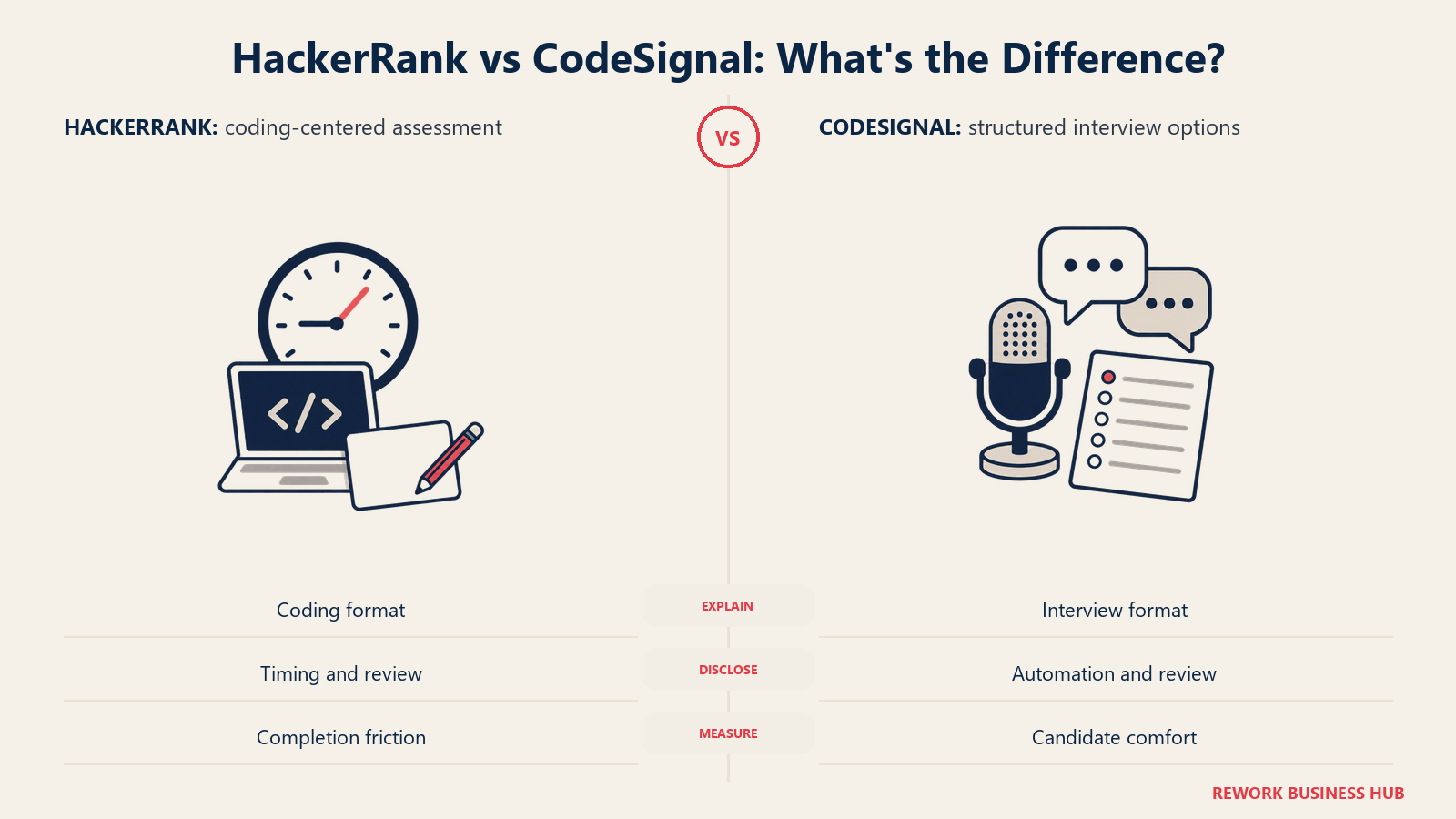
The two platforms feel different to sit through, and that difference is now a real recruiting-funnel risk, not just a UX preference. HackerRank's core format is the timed coding challenge candidates have seen for over a decade, plus a live or structured technical interview layered on top. CodeSignal's AI Interviewer format feels closer to a real-time conversation, even though the interviewer on the other side is a model rather than a person, with a structured, timed exchange that produces a scored writeup afterward.
| HackerRank | CodeSignal | |
|---|---|---|
| Core format | Timed coding challenges plus live or structured technical interviews | Timed coding challenges plus an AI Interviewer conducting a structured, scored conversation |
| Feels most like | A proctored exam | A real-time interview, run by a model instead of a person |
| Where it tends to go wrong | High-volume, on-demand rounds that feel impersonal at scale, a candidate-experience complaint HackerRank's own research has documented, see Best HackerRank Alternatives | Candidates uneasy being scored by an AI Interviewer rather than a human, a pattern showing up broadly across AI-scored interview tools industry-wide |
Neither format is inherently better for candidate goodwill. What matters is disclosure: telling candidates up front what's automated, what's scored by AI, and what a human actually reviews before a decision gets made.
What Neither Platform Does
Worth stating plainly before you assume one of these tools solves your whole hiring stack: neither HackerRank nor CodeSignal is a psychometric or personality testing platform, a full applicant tracking system, or a one-way video interview specialist.
| Neither platform is... | Where that gap actually lives |
|---|---|
| A psychometric or personality testing platform | Cognitive ability, personality, and behavioral testing sit with TestGorilla, SHL, and the Predictive Index, not HackerRank or CodeSignal |
| A full applicant tracking system | Both plug into whatever ATS you already run rather than replacing it; see our Best Applicant Tracking Systems roundup if that's the actual gap |
| A one-way video interview specialist | HireVue and Spark Hire own that specific format; see our HireVue vs Spark Hire comparison |
Transparency: Published Tiers vs Quote-Only Above Starter
| HackerRank | CodeSignal | |
|---|---|---|
| Entry tier pricing | Published: $199/month or $1,990/year | Published: $99/month or $79/month billed annually |
| Mid tier pricing | Not published | Published: $599/month or $479/month billed annually (Grow) |
| Top tier pricing | Not published (Enterprise, quote-only) | Not published (Pro, quote-only, custom credit allocation) |
| Where the quote-only wall sits | Immediately above Starter, at 1 seat and 120 attempts/year | One tier higher, after both Build and Grow are already published |
CodeSignal gives a buyer two full rungs of the pricing ladder before the wall hits. HackerRank gives you one, and it's a narrow one at that: a single seat and 120 attempts a year before you're back to a sales conversation with no public benchmark beyond Vendr's reported deal range.
| What you get with HackerRank Starter | What you don't |
|---|---|
| A flat, budgetable annual price for up to 120 attempts | More than 1 seat without upgrading |
| Advanced plagiarism detection and question-leak protection included | An AI Interviewer for non-engineering roles |
| Full access to Screen and Interview from day one | Published Pro or Enterprise pricing |
| What you get with CodeSignal Build or Grow | What you don't |
|---|---|
| AI Interviewer coverage for engineering, product, and design on Build | Go-to-market role coverage until you upgrade to Grow |
| A published price at every tier except Pro | A flat per-seat model; cost scales with credit volume, not named users |
| AI proctoring and ID verification included on Build | A single, explicitly-named leak-protection feature the way HackerRank names one |
When HackerRank Is the Right Call
- Your hiring plan is entirely engineering roles, and you don't need an AI Interviewer to reach product, design, sales, or marketing candidates
- You want a single, published, flat annual price you can put in a budget before any sales conversation
- Advanced plagiarism detection and question-leak protection matter more to you than a broader credit pool covering multiple interview formats
- One seat genuinely covers your hiring team at your current volume, roughly under 120 candidate attempts a year
- You're prepared to negotiate a custom Pro or Enterprise contract once you outgrow Starter, without a published benchmark beyond Vendr's reported range
If Starter's single seat or 120-attempt cap is the actual wall you're hitting, our Best HackerRank Alternatives guide covers 14 other tools built around that exact gap.
When CodeSignal Is the Right Call
- Your hiring plan spans engineering plus product, design, sales, customer success, or marketing roles you want a structured, scored interview for
- You want to see a real published price two tiers deep (Build and Grow) before you ever need a sales call
- AI proctoring and ID verification bundled at the entry tier matter more to you than a named plagiarism-detection feature specifically
- Your hiring volume runs meaningfully above 120 candidates a year and you don't want a 1-seat cap forcing an early upgrade
- You'd rather scale spend with a credit pool than negotiate a custom seat count every time headcount changes
If Neither Fits: When the Assessment Ends and the Employee Record Begins
Worth naming honestly: HackerRank and CodeSignal are both built to solve one job, evaluating whether a candidate can do the technical work, and each does that well within its own model. Rework doesn't build or sell an assessment or automated code-evaluation product, and nothing here should be read as a testing capability claim.
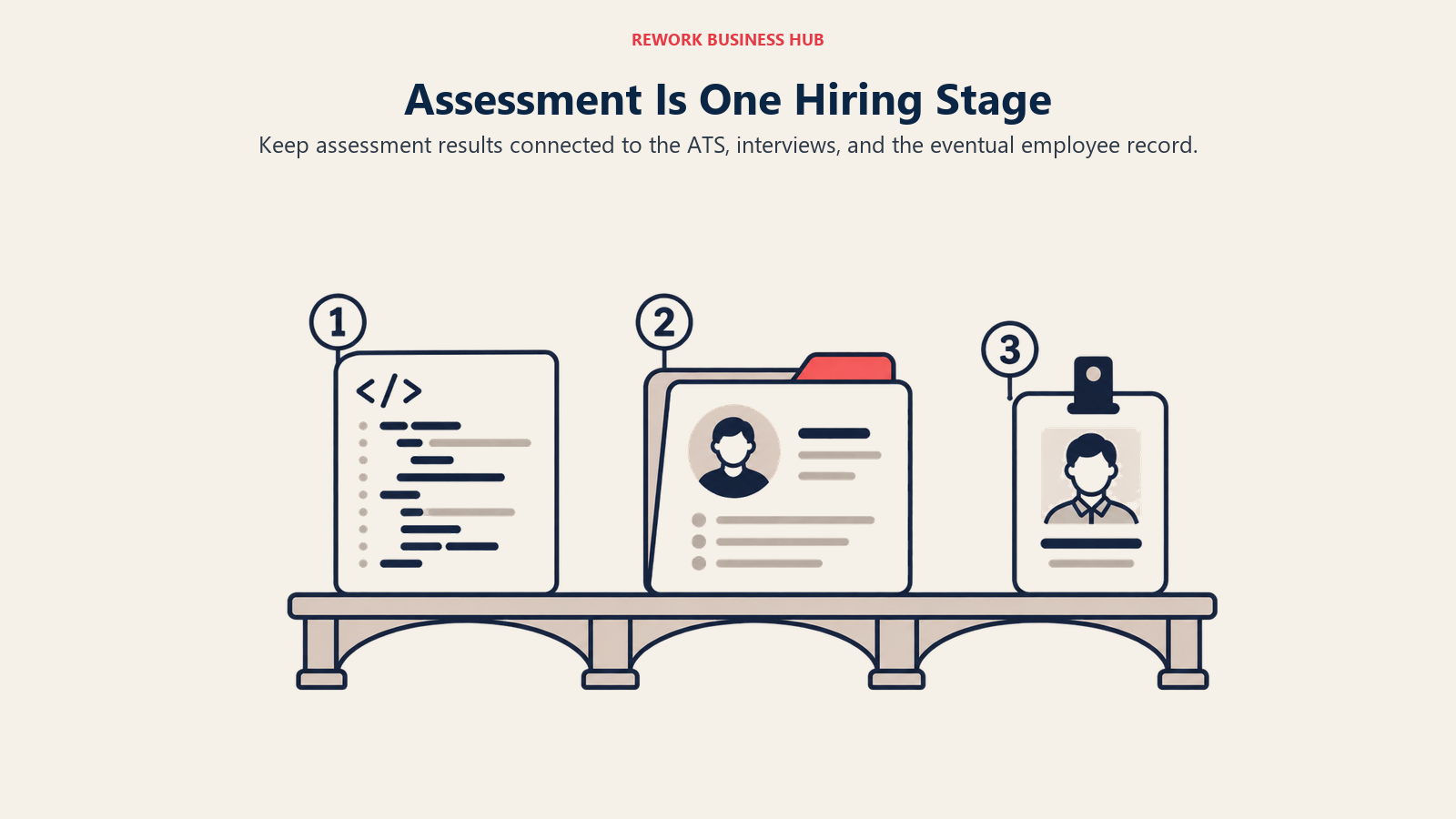
But the assessment is usually one stage in a longer hiring process, and for some teams the real friction shows up right after it: interview scorecards, offer details, and the eventual employee record all live in systems that don't talk to each other. Rework's Interview module runs structured interviews and scorecards, not automated code evaluation, on the same platform as HRIS, time and attendance, and timesheets, so a hire doesn't need a manual handoff into a separate HR system once the coding round is done. Pair it with whichever platform above fits your engineering assessment needs, don't replace it with Rework. See our guide on structured interview scorecards either way.
Pricing: Quote on request (rework.com/pricing).
Decision Framework
| If you are... | Pick |
|---|---|
| Hiring engineering roles only and want a flat, published annual price with a hard attempt cap | HackerRank |
| Hiring across engineering and go-to-market roles and want AI interviewers covering both | CodeSignal |
| Running under 120 candidate assessments a year and prioritizing the lowest entry price | CodeSignal (Build undercuts Starter below the attempt cap) |
| Running well past 120 candidates a year but still fitting one seat | HackerRank (Starter's flat fee beats Build's overage math at this volume) |
| Prioritizing question-leak protection named as its own explicit feature | HackerRank |
| Looking for hiring as one part of a broader HR and workforce platform, not deeper code evaluation | Rework (see rework.com/pricing) |
What to Do Next
- Count your actual annual hiring volume before you compare sticker prices. The worked example above shows the cheaper platform flips depending on whether you're screening 60, 120, or 420 candidates a year.
- Ask CodeSignal directly what a Pro quote looks like once Grow's 420 credits aren't enough, and ask HackerRank the same question about Pro once Starter's 120 attempts or single seat runs out. Neither published number tells the whole story past its own ceiling.
- Map which of your open roles need an AI Interviewer outside engineering. If none do, HackerRank's narrower, engineering-only focus isn't a limitation for you. If several do, CodeSignal's Grow tier is the more direct fit.
- Still building your shortlist? Our Best CodeSignal Alternatives guide and Best HackerRank Alternatives guide cover lighter and heavier options on either side, and our Best VidCruiter Alternatives guide is the place to look if the actual gap is video interviewing rather than code evaluation.
- Not sure a standalone assessment tool solves the whole problem? Our guide to choosing recruiting software walks through how an assessment platform fits into the rest of your recruiting stack before you sit through a single sales call.
Frequently Asked Questions about HackerRank vs CodeSignal
Is HackerRank or CodeSignal cheaper?
It depends on your annual hiring volume. Under 120 candidates a year, CodeSignal's Build tier at $948/year billed annually beats HackerRank Starter's flat $1,990/year. Past 120 candidates, HackerRank's flat fee plus $20-per-attempt overage starts winning the arithmetic, though its 1-seat cap on Starter often forces an upgrade to an unpublished Pro tier before the math matters.
Does CodeSignal's AI Interviewer cover roles outside engineering?
Yes. CodeSignal's Build tier covers AI-run interviews for engineering, product, and design roles, and its Grow tier adds sales, customer success, and marketing. HackerRank's Screen and Interview products are built around engineering and coding assessment specifically.
How does the credit or attempt system actually work?
On both platforms, one unit (an attempt on HackerRank, a credit on CodeSignal) is consumed when a candidate starts an assessment or interview, not when they're invited. Unused invitations don't cost anything on either platform.
Which platform publishes more of its pricing?
CodeSignal, by one full tier. Its Build and Grow tiers both list exact monthly and annual rates, with only the top Pro tier quote-only. HackerRank publishes only its entry Starter tier; Pro and Enterprise are both quote-only, with Vendr's buyer-reported data putting the median contract around $13,099/year as the only public benchmark.
Do either HackerRank or CodeSignal defend against AI-assisted interview cheating?
Both include some defense at their entry tier. HackerRank Starter bundles advanced plagiarism detection and question-leak protection. CodeSignal Build bundles AI proctoring and ID verification. Neither claims to eliminate AI-assisted cheating, and an analysis of 19,368 live technical interviews found 38.5% of candidates flagged for it overall, rising to 48% in software engineering roles.
Can Rework replace HackerRank or CodeSignal?
No. Rework doesn't build or sell automated code evaluation or a technical assessment product. Its Interview module runs structured interviews and scorecards on the same platform as HRIS, time and attendance, and timesheets, which is useful for the handoff after a hire clears a coding assessment, not for grading the assessment itself.
Related Resources:
- Best Pre-Employment Assessment Tools in 2026
- Best HackerRank Alternatives in 2026
- Best CodeSignal Alternatives in 2026
- Best TestGorilla Alternatives in 2026
- Best Applicant Tracking Systems in 2026
- HireVue vs Spark Hire: Which Video Interview Platform Fits Your Hiring Volume
- Best VidCruiter Alternatives in 2026
- AI in the Recruiter Workflow
- Structured Interview Scorecards vs Rubrics

Principal Product Marketing Strategist
On this page
- TL;DR
- Who Each Platform Is Actually Built For
- Key Facts
- Credit-Based vs Attempt-Based Pricing: What Each Model Actually Charges For
- The Real Cost at Your Hiring Volume: A Worked Example
- AI Interviewer Coverage: Engineering Only vs Engineering Plus Go-To-Market
- Question Library Depth, Custom Questions, and Leak Protection
- AI-Assisted Cheating Defenses and Proctoring
- Candidate Experience: Timed Puzzle vs Real-World Task
- What Neither Platform Does
- Transparency: Published Tiers vs Quote-Only Above Starter
- When HackerRank Is the Right Call
- When CodeSignal Is the Right Call
- If Neither Fits: When the Assessment Ends and the Employee Record Begins
- Decision Framework
- What to Do Next