Best Shopify Alternatives in 2026: 12 E-Commerce Platforms for Growing Brands
Turn this article into takeaways for your work.


Each assistant summarizes the article only for you and suggests best practices for your work.
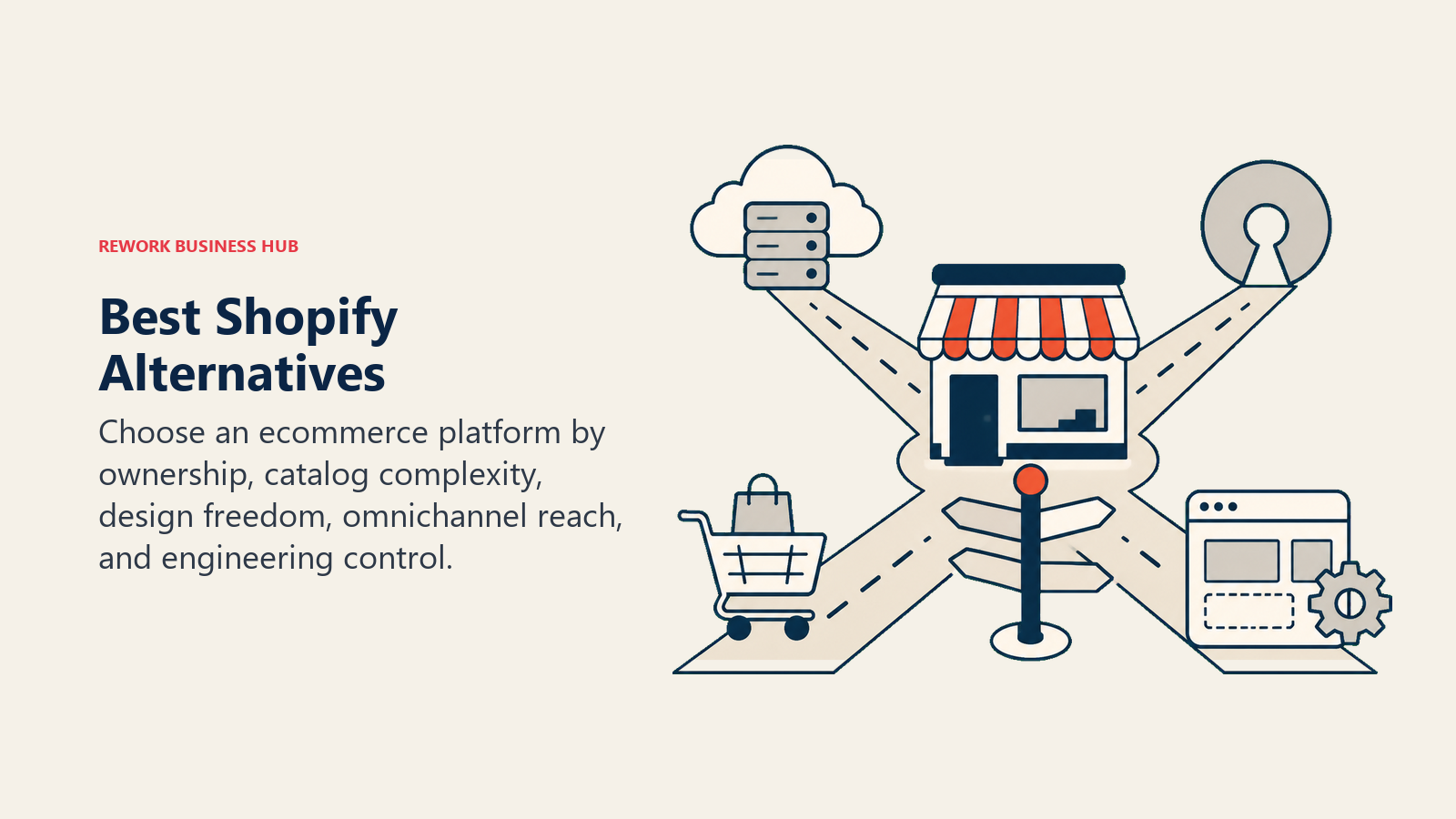
The best Shopify alternatives in 2026 are BigCommerce and WooCommerce for brands escaping transaction fees, Magento or Medusa for enterprise and headless builds, and Squarespace or Wix for design-led small stores. The right pick depends on your GMV, B2B needs, and whether you want hosted simplicity or full infrastructure ownership.
Shopify built its reputation on removing friction for new merchants. It works: millions of stores run on it. But as brands scale past $1M in GMV, the math changes. Transaction fees of 0.5–2% on every order (unless you use Shopify Payments, which isn't available in every country) add up fast. Basic features like abandoned cart recovery, B2B pricing, and advanced reporting sit behind paid apps that stack monthly costs to $300–$500+. Themes feel constrained without expensive custom development. And at Shopify Plus (their enterprise tier) you're looking at $2,300/month minimum.
None of that makes Shopify a bad platform. But it does mean there's a real, growing market of brands for whom Shopify is no longer the right fit. Maybe you're a developer who wants full control. Maybe you sell in markets where Shopify Payments isn't supported. Maybe you've outgrown hosted simplicity and need actual infrastructure ownership. This guide is for those brands. For brands also evaluating the WooCommerce side of this decision, best WooCommerce alternatives covers the open-source route in more depth.
We evaluated 12 Shopify alternatives on pricing transparency, scalability ceiling, customization depth, B2B capability, international commerce support, and total cost of ownership at three revenue levels: sub-$500K, $500K–$5M, and $5M+ GMV.
Quick Comparison Table
| Platform | Best For | Starting Price | Key Strength | Key Limitation |
|---|---|---|---|---|
| WooCommerce | WordPress-native brands | Free (hosting ~$20/mo) | Infinite customization, no transaction fees | Developer-dependent, plugin sprawl |
| BigCommerce | Mid-market scaling | $39/mo | Enterprise features at SMB price | Fewer themes, steeper learning curve |
| Wix eCommerce | Small brands, creatives | $17/mo | Drag-and-drop ease, fast setup | Weak at high SKU volume and B2B |
| Squarespace Commerce | Design-led brands | $23/mo | Best-in-class aesthetics | Limited app ecosystem |
| Magento / Adobe Commerce | Large enterprise | Free (open-source) / custom | Power, flexibility, global scale | High dev cost, complex ops |
| PrestaShop | European SMBs | Free (hosting required) | Strong EU compliance, no fees | Needs developer for customization |
| OpenCart | Budget-conscious SMBs | Free (hosting required) | Lightweight, low overhead | Dated UI, limited scalability |
| Ecwid | Multi-channel sellers | Free tier / $19/mo | Embed anywhere, multi-channel sync | Not a standalone store builder |
| Volusion | Simple product catalogs | $35/mo | Clean analytics, no transaction fees | Limited app marketplace |
| Shift4Shop | US sellers avoiding fees | Free (with Shift4 payments) | Genuinely $0/mo with US payments | US-only free tier, dated UX |
| Sellfy | Creators, digital goods | $22/mo | Digital + physical + subscriptions | Limited for physical-only brands |
| Medusa | Dev teams, headless builds | Free (open-source) | Full ownership, API-first, composable | Requires engineering resources |
Stage Fit Matrix
| Platform | Startup (0–$500K GMV) | Growth ($500K–$5M GMV) | Mid-Market ($5M–$50M GMV) | Enterprise ($50M+ GMV) |
|---|---|---|---|---|
| WooCommerce | Strong | Strong | Moderate | Possible with investment |
| BigCommerce | Moderate | Strong | Strong | Strong |
| Wix eCommerce | Strong | Moderate | Weak | Not suitable |
| Squarespace Commerce | Strong | Moderate | Weak | Not suitable |
| Magento / Adobe Commerce | Weak | Moderate | Strong | Strong |
| PrestaShop | Strong | Strong | Moderate | Possible |
| OpenCart | Strong | Moderate | Weak | Not suitable |
| Ecwid | Strong | Moderate | Weak | Not suitable |
| Volusion | Strong | Moderate | Weak | Not suitable |
| Shift4Shop | Strong | Moderate | Weak | Not suitable |
| Sellfy | Strong | Moderate | Weak | Not suitable |
| Medusa | Weak | Strong | Strong | Strong |
Sizing and Persona Table
| Platform | Ideal Team Size | Primary Buyer Persona | Secondary Persona |
|---|---|---|---|
| WooCommerce | 1–50 | Developer / technical founder | Digital marketer with WordPress experience |
| BigCommerce | 5–200 | E-commerce director, VP Commerce | IT manager evaluating platform migration |
| Wix eCommerce | 1–10 | Solo founder, small business owner | Freelance designer building for clients |
| Squarespace Commerce | 1–15 | Brand owner, creative professional | Portfolio/service business adding commerce |
| Magento / Adobe Commerce | 20–500+ | CTO, VP Engineering, Head of E-Commerce | Enterprise IT, system integrator |
| PrestaShop | 1–50 | European SMB owner, developer | Agencies serving EU clients |
| OpenCart | 1–20 | Technical founder, freelance developer | Budget-conscious SMB needing custom store |
| Ecwid | 1–30 | Multi-channel seller, existing web owner | Social commerce operator |
| Volusion | 1–30 | Non-technical SMB owner | Small brand migrating from older platforms |
| Shift4Shop | 1–30 | US-based SMB owner | Cost-sensitive founder replacing Shopify |
| Sellfy | 1–10 | Creator, educator, indie maker | Musician, author, coach |
| Medusa | 2–50 (eng) | CTO, lead engineer, startup founder | Head of E-Commerce at API-first company |
1. WooCommerce: The open-source workhorse for WordPress brands
WooCommerce's philosophy is simple: commerce should be an extension of content, not a separate product. It ships as a WordPress plugin, which means your store inherits everything WordPress offers: thousands of themes, plugins, hosting flexibility, and two decades of ecosystem maturity. WooThemes (acquired by Automattic in 2015) positioned it as the infrastructure layer, not the product. The assumption is that developers and agencies build on top of it.
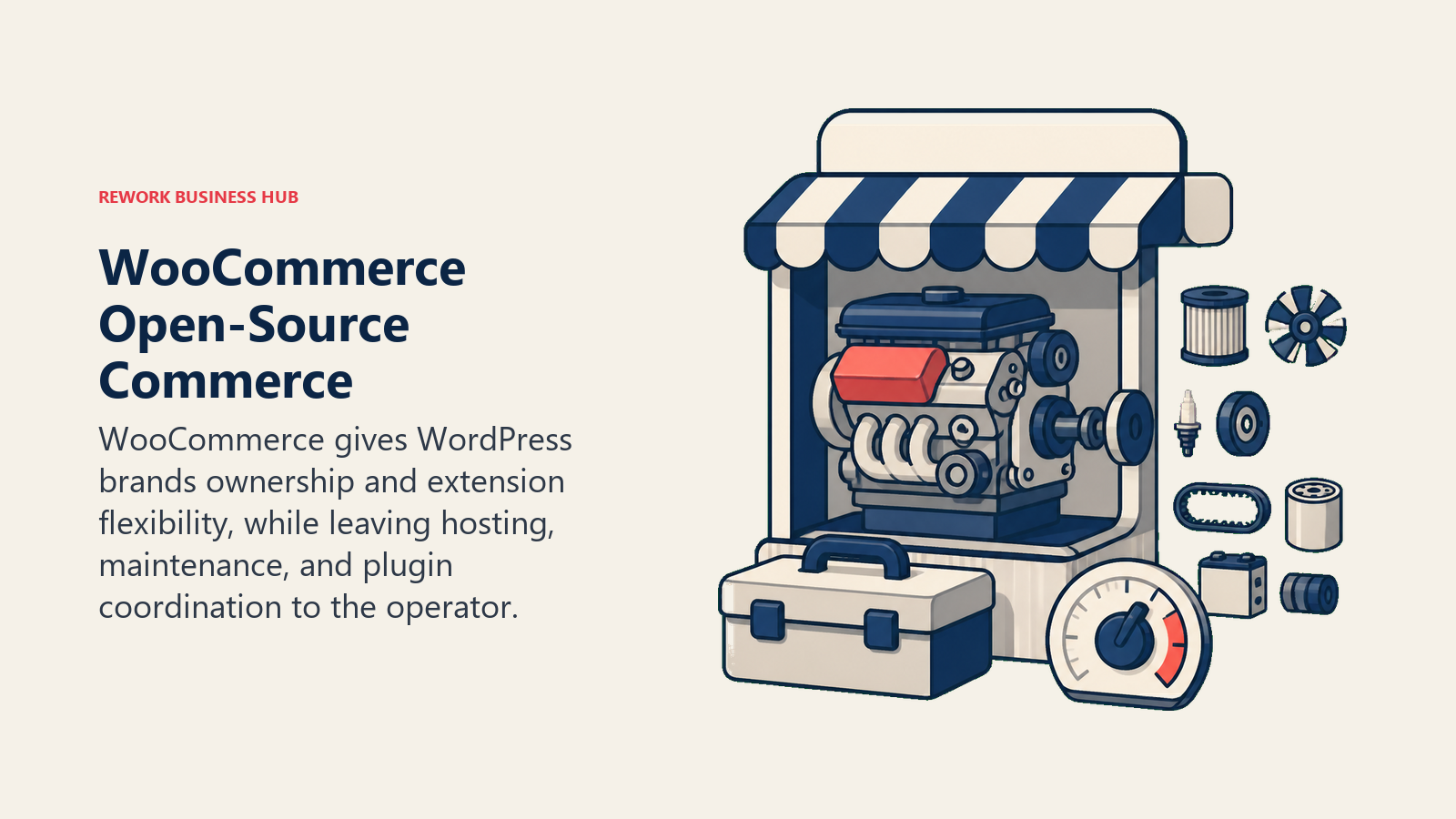
Methodology / vision: Commerce as a composable layer on an existing CMS, not a standalone SaaS. You own the stack.
Target audience: Brands already on WordPress, developer-led teams, agencies managing multiple client stores, B2C and B2B brands who need deep integration with content marketing.
Sizing fit: Works from solo founder to mid-market. Starts to strain above $10M GMV without dedicated infrastructure investment. You'll need managed WordPress hosting (Kinsta, WP Engine) and a dev team.
Stage fit: Ideal at startup and growth stages. Mid-market requires investment in hosting, security, and developer resources.
Team vs company-wide: Team tool by default (e-commerce team manages it), but it integrates broadly enough to serve as a company-wide commerce platform.
| Pros | Cons |
|---|---|
| No transaction fees | Plugin sprawl becomes technical debt |
| Unlimited customization | Security is your responsibility |
| Massive plugin/theme ecosystem | Performance degrades at high SKU volume without optimization |
| No monthly platform fee (pay for hosting only) | WooCommerce itself has no native B2B pricing |
| Full data ownership | Requires developer for anything beyond basic setup |
Pricing: WooCommerce plugin is free. Hosting runs $20–$100/mo for SMB, $200–$500/mo for high-traffic stores. Extensions (subscriptions, bookings, B2B, etc.) add $50–$300/year each.
Best for: WordPress-native brands, content-heavy stores, and teams with in-house developer capacity who want zero transaction fees and full infrastructure control.
2. BigCommerce: Enterprise features without the enterprise price tag
BigCommerce built its product around one argument: mid-market merchants shouldn't pay enterprise prices to get enterprise capabilities. Out of the box (no apps required) you get multi-currency, B2B pricing groups, abandoned cart recovery, faceted search, and strong APIs. That's a real difference from Shopify's base tier, where many of those features sit behind app subscriptions.
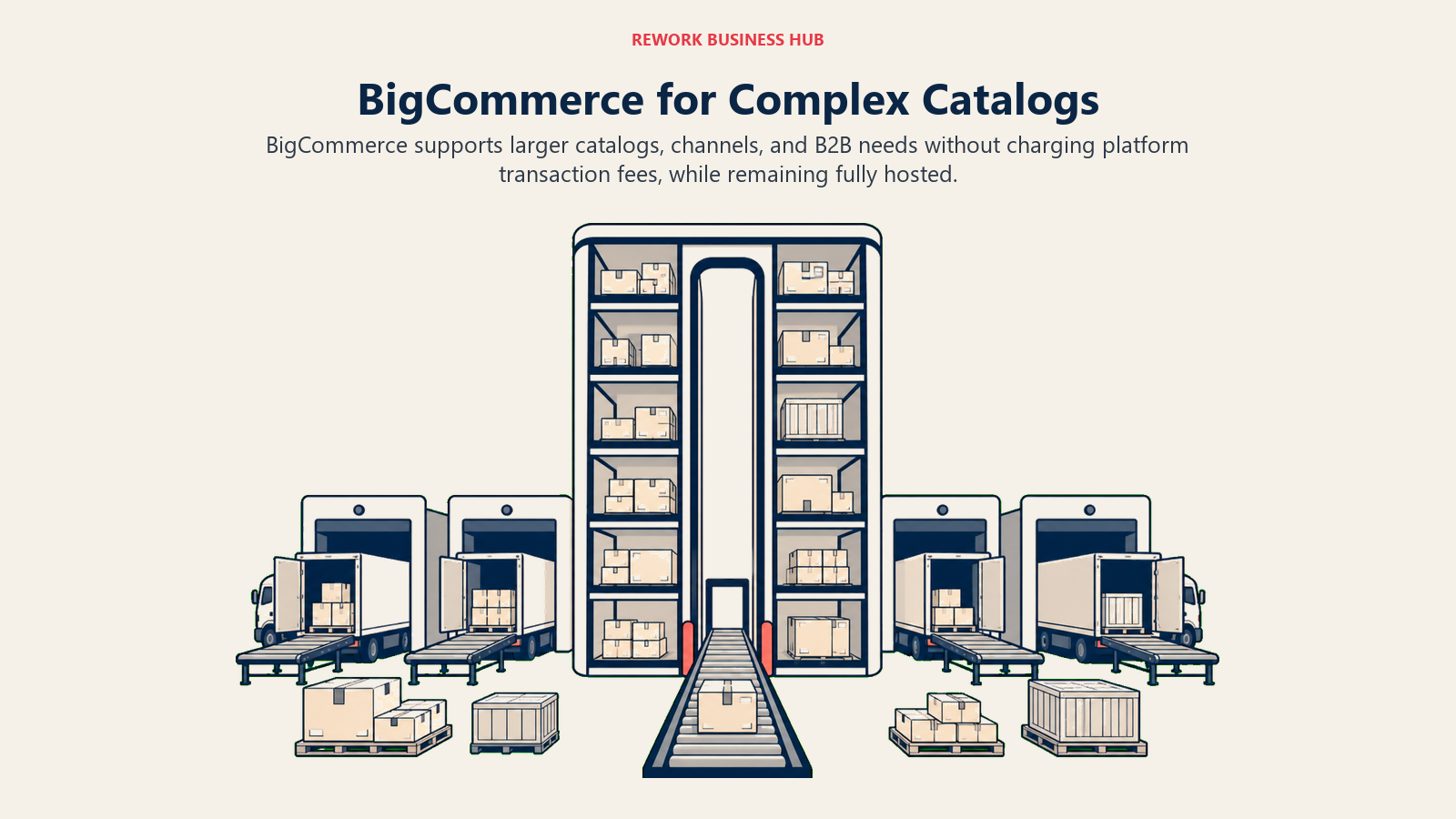
Methodology / vision: Built for merchants who are scaling, not just starting. The product assumption is that you'll eventually need complex operations, so it ships with them by default rather than charging for them later.
Target audience: Mid-market e-commerce brands ($1M–$50M GMV), B2B distributors needing customer-specific pricing, international brands managing multiple storefronts, and merchants frustrated by Shopify's app costs.
Sizing fit: Works from 5 to 200+ person teams. The Catalyst (headless Next.js storefront) and Enterprise tiers extend it to large-scale operations.
Stage fit: Best at growth and mid-market stages. Not the simplest choice for day-one startups, but grows well with you.
Team vs company-wide: E-commerce and ops teams primarily. It integrates with ERP and PIM systems, making it extensible to company-wide infrastructure.
| Pros | Cons |
|---|---|
| No transaction fees on any plan | Annual sales caps per pricing tier (e.g., $50K/year on Standard) |
| Native B2B pricing and customer groups | Fewer premium themes than Shopify |
| Multi-storefront on Enterprise | Steeper learning curve than Wix or Squarespace |
| Headless-ready with Catalyst framework | App marketplace smaller than Shopify's |
| Strong API for custom integrations | Can feel over-featured for small catalogs |
Pricing: Standard $39/mo, Plus $105/mo, Pro $399/mo, Enterprise custom. No transaction fees on any tier.
Best for: Growing brands hitting Shopify's app-cost ceiling, B2B merchants needing customer-specific pricing, and international sellers managing multiple storefronts.
3. Wix eCommerce: Drag-and-drop simplicity for small brands
Wix started as a website builder and added commerce later. That lineage shows. It's genuinely easy to use, the design tooling is excellent, and you can launch a functional store in a day. For small brands where the owner wears all the hats, that matters. But it also means the product's core identity is "website with a shop" rather than "commerce platform with content tools."
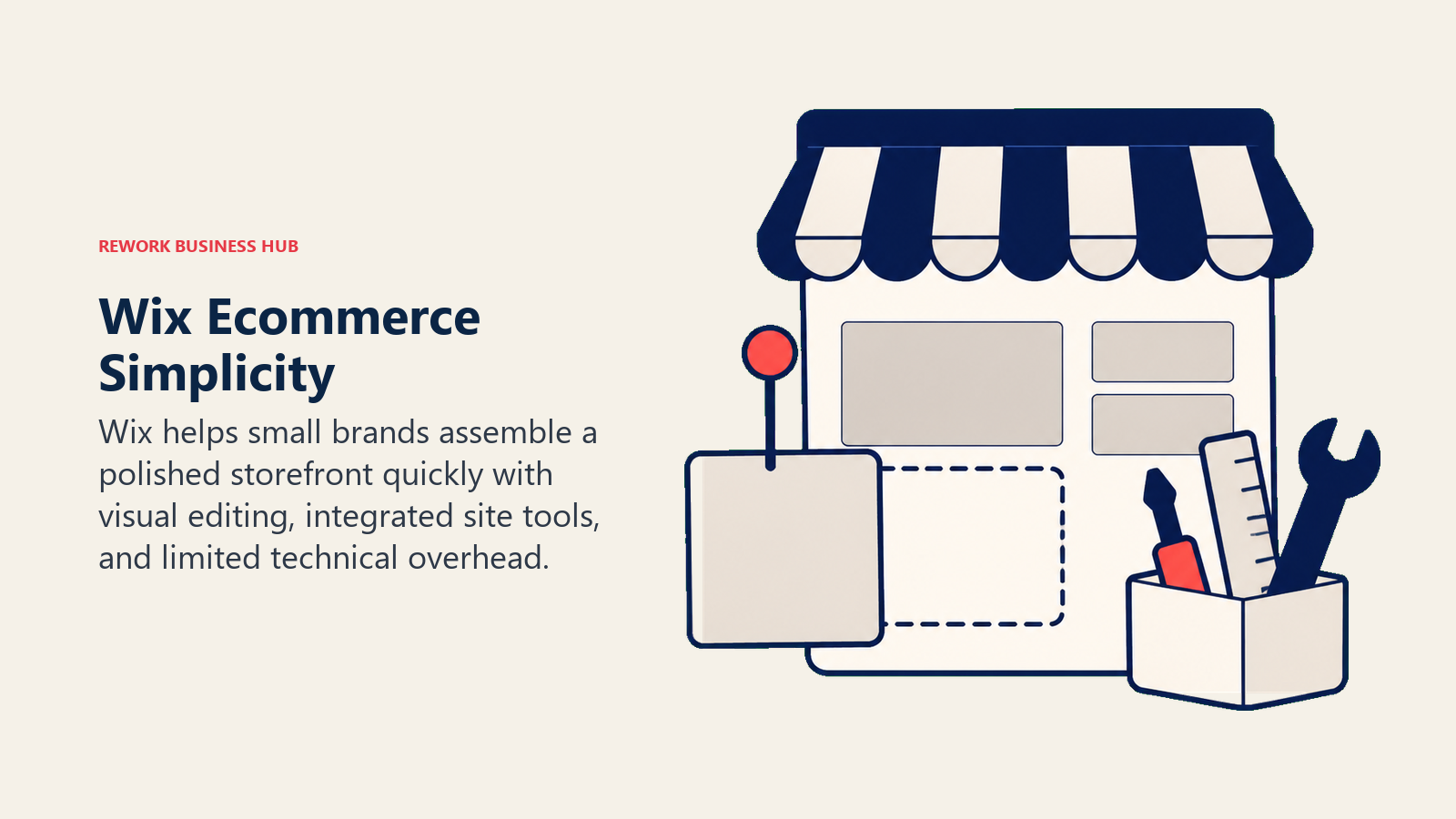
Methodology / vision: Remove technical barriers entirely. The product bet is that non-developers should be able to build beautiful, functional online businesses without writing a line of code.
Target audience: Solo founders, small business owners (1–10 people), creatives selling physical or digital products, service businesses adding online sales, and anyone for whom ease of use outweighs customization depth.
Sizing fit: Strong for small teams. Starts to show limits around 1,000+ SKUs or complex inventory management. Not designed for high-volume or B2B operations.
Stage fit: Startup stage, early growth. Not a good migration destination for brands already past $500K GMV who need advanced commerce tooling.
Team vs company-wide: Typically a solo or small-team tool. The platform doesn't map naturally to multi-team or enterprise workflows.
| Pros | Cons |
|---|---|
| Genuinely fast setup - hours, not days | Weak at high SKU volume |
| Strong design flexibility for non-coders | No native B2B or wholesale features |
| Includes basic SEO tools | Limited headless or API capabilities |
| Reasonable starting price | Transaction fees unless on Business plans |
| Built-in marketing tools (email, social) | You can't migrate your site to another platform easily |
Pricing: Business Basic $17/mo, Business Unlimited $25/mo, Business VIP $35/mo. Transaction fees apply on lower tiers.
Best for: Solo founders and small brands who prioritize design and ease of use over scalability, especially for boutique, creative, or single-category stores.
4. Squarespace Commerce: The best-looking store you can build without a designer
Squarespace is the platform designers recommend when a client says "I want it to look premium without paying for custom design." The commerce layer is solid (subscriptions, digital products, appointments, inventory management), and it integrates cleanly with the content and portfolio features the platform is known for.
Methodology / vision: Commerce should feel like a natural extension of brand storytelling, not a bolted-on transactional layer. Every commerce feature is built to preserve the visual integrity of the site.
Target audience: Design-led brands, creative professionals, boutique retailers, independent artisans, service businesses selling packages, coaches and educators selling digital products.
Sizing fit: Best at 1–15 person operations. The app ecosystem is limited, which creates a ceiling for brands that need custom integrations or complex operations.
Stage fit: Startup and early growth. Strong for brands where brand aesthetics drive conversion more than feature depth.
Team vs company-wide: Solo or small-team. The platform doesn't support multi-seat workflows at any depth.
| Pros | Cons |
|---|---|
| Best default visual design of any platform | App marketplace very limited |
| Subscriptions and memberships built in | No native abandoned cart recovery on lower plans |
| Clean product + content integration | Advanced customization requires CSS knowledge |
| No transaction fees on Commerce plans | Less competitive for high-SKU catalogs |
| Good built-in SEO | Not suitable for B2B or wholesale |
Pricing: Basic Commerce $23/mo, Advanced Commerce $45/mo. No transaction fees on Commerce plans.
Best for: Brand-first small businesses where design quality and simplicity matter more than app ecosystem depth or advanced commerce logic.
5. Magento / Adobe Commerce: Enterprise-grade power for large, complex operations
Magento (now Adobe Commerce) is the platform you choose when your business has outgrown everything else. It's open-source at the community level (Magento Open Source) and enterprise-licensed as Adobe Commerce. The power is real: multi-site, multi-currency, multi-language, B2B quoting and requisition lists, complex pricing rules, and an architecture that can handle millions of SKUs and thousands of concurrent users. For e-commerce teams that run email marketing alongside the store, best Mailchimp alternatives covers the email tools that connect to Shopify's competitors just as cleanly as they connect to Shopify itself.
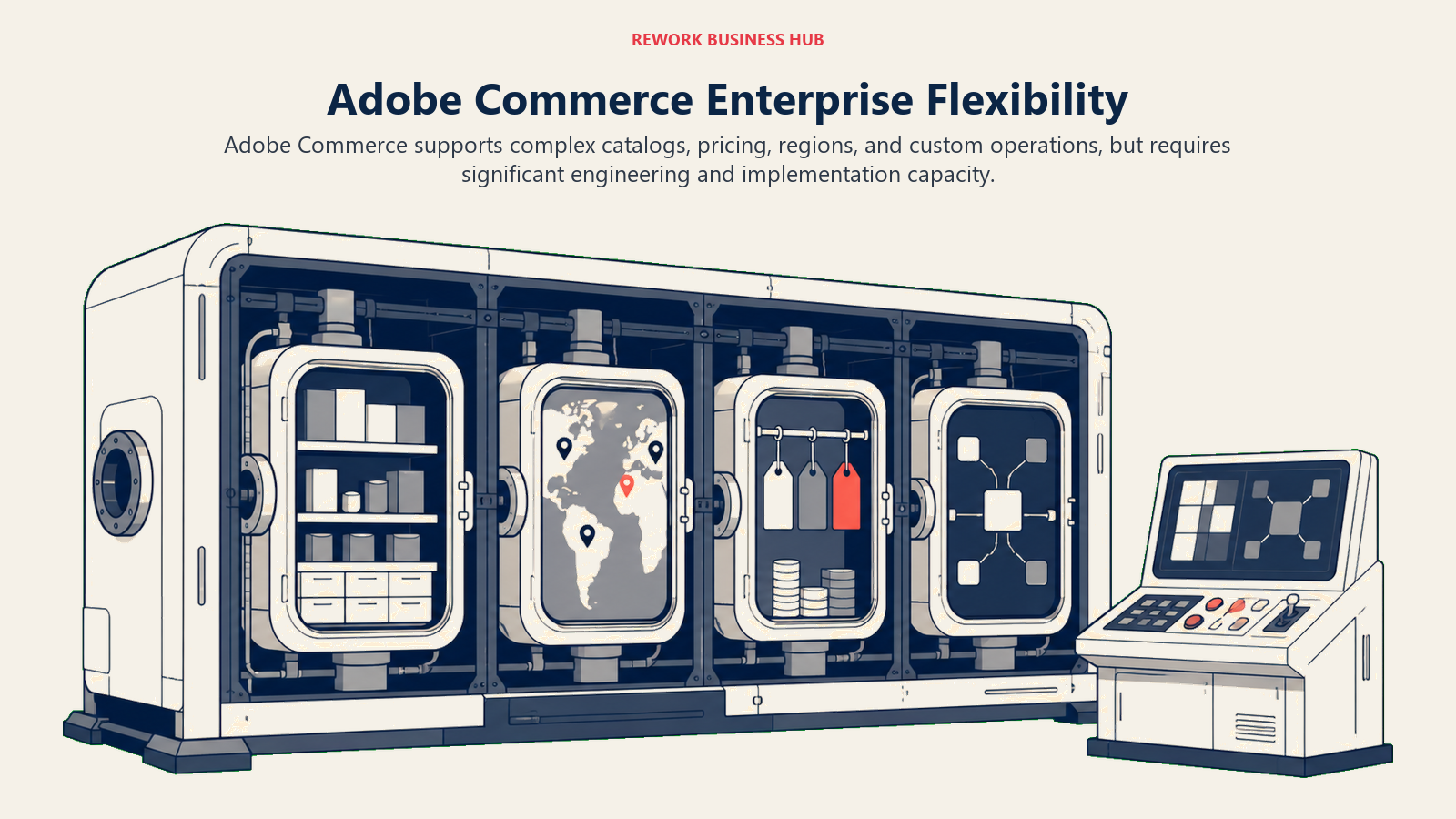
Methodology / vision: Commerce infrastructure, not a product. The assumption is that your business has unique requirements that no standard SaaS can meet. You need a foundation, not a hosted solution.
Target audience: Large retailers, manufacturers with complex B2B sales, global brands managing regional storefronts, enterprise teams with dedicated IT and development resources, and organizations that need deep ERP/PIM integration.
Sizing fit: Starts to make sense at $5M+ GMV. Below that, the total cost of ownership (development, hosting, maintenance) rarely makes sense relative to BigCommerce or WooCommerce.
Stage fit: Mid-market to enterprise. Not recommended for startups or early-growth brands unless you have unusual technical requirements from day one.
Team vs company-wide: Platform-wide. Typically spans e-commerce, IT, marketing, and operations teams. Often managed by a dedicated team or external agency.
| Pros | Cons |
|---|---|
| Unlimited customization ceiling | High total cost of ownership (dev + hosting + maintenance) |
| Native B2B features (quoting, requisition, tiered pricing) | Takes months to implement correctly |
| Multi-site and multi-language out of the box | Requires dedicated developer and hosting infrastructure |
| Strong ERP/PIM integration ecosystem | Adobe Commerce licensing is expensive ($22,000+/year) |
| Active global developer and agency community | Overkill for most brands under $5M GMV |
Pricing: Magento Open Source is free (self-hosted). Adobe Commerce licensing starts around $22,000/year. Hosting, development, and maintenance add $30,000–$150,000+ annually.
Best for: Enterprise retailers, manufacturers with B2B complexity, and global brands that have outgrown every hosted SaaS option and need full infrastructure ownership.
6. PrestaShop: Open-source commerce with strong EU footing
PrestaShop is the dominant open-source e-commerce platform in Europe, with a large user base in France, Spain, and Latin America. It shares WooCommerce's DNA in one key way: it's free software you self-host, so there are no transaction fees and no monthly license costs. But PrestaShop was built as a standalone e-commerce platform (not a CMS plugin), which gives it a cleaner product catalog and order management layer than WooCommerce by default.
Methodology / vision: Democratize commerce infrastructure for independent merchants globally, with a focus on European regulatory requirements (GDPR, VAT, multi-currency) built in rather than bolted on.
Target audience: European SMBs, developers and agencies serving EU clients, brands in markets where localization matters (tax rules, payment methods, languages), and merchants who want open-source control without WordPress dependency.
Sizing fit: Well-suited for 1–50 person teams managing small to medium catalogs. Starts to require significant customization investment above $5M GMV.
Stage fit: Startup through growth. Can serve mid-market with proper developer investment.
Team vs company-wide: E-commerce team tool. Can integrate with broader business systems through its module ecosystem.
| Pros | Cons |
|---|---|
| Free platform, no transaction fees | Requires developer for meaningful customization |
| Strong EU compliance built in (GDPR, VAT) | Module costs can accumulate |
| Multi-language and multi-currency by default | Smaller marketplace than WooCommerce |
| Clean product and order management | Hosting, security, and updates are your responsibility |
| Large community, especially in Europe | UX is dated compared to modern SaaS platforms |
Pricing: Free to download. Hosting $5–$50/mo. Paid modules $30–$300 each.
Best for: European SMBs and agencies who need robust localization, GDPR compliance, and no transaction fees, and who have or can access developer resources.
7. OpenCart: Lightweight open-source for budget-conscious builders
OpenCart is the no-frills option in the open-source world. It's been around since 2005, it's genuinely lightweight (low server requirements), and it has a long tail of free and low-cost extensions. It won't win awards for its default UI or feature depth, but for a developer who wants a clean base to build a custom store without paying for a platform, it gets the job done.
Methodology / vision: Provide a functional, lightweight e-commerce base that doesn't assume what your store needs. Build nothing you don't have to. Let extensions handle the rest.
Target audience: Technical founders and freelance developers building custom stores on a budget, small businesses in developing markets where low hosting costs matter, and agencies handling simple B2C store builds.
Sizing fit: Solo to small teams (1–20). Doesn't scale well past a few thousand SKUs without developer optimization. Not suited for mid-market or enterprise.
Stage fit: Startup stage. Rarely the right choice once a brand is generating meaningful revenue, because the maintenance burden relative to modern platforms doesn't justify the cost savings.
Team vs company-wide: Solo or small e-commerce team. No enterprise workflow capabilities.
| Pros | Cons |
|---|---|
| Free and open-source | Dated admin UI |
| Very low server requirements | Limited scalability |
| Long extension library | Extensions vary widely in quality |
| No transaction fees | Not suitable for high-volume operations |
| Multi-store from the core | Less developer community activity than WooCommerce |
Pricing: Free. Hosting $5–$20/mo. Extensions typically $30–$150 each.
Best for: Developers and technical founders who want a lightweight, no-cost foundation for a simple B2C store and don't need the overhead of a more complex platform.
8. Ecwid: Embed commerce anywhere, sync everywhere
Ecwid (now part of Lightspeed) takes a different approach than every other platform on this list: it doesn't replace your existing website. It embeds commerce into it. You can add Ecwid to a WordPress site, a Wix site, a custom HTML page, Facebook, Instagram, and a mobile app simultaneously, with inventory synced across all channels. That makes it genuinely useful for sellers who already have a web presence and want to add transactions without rebuilding from scratch.
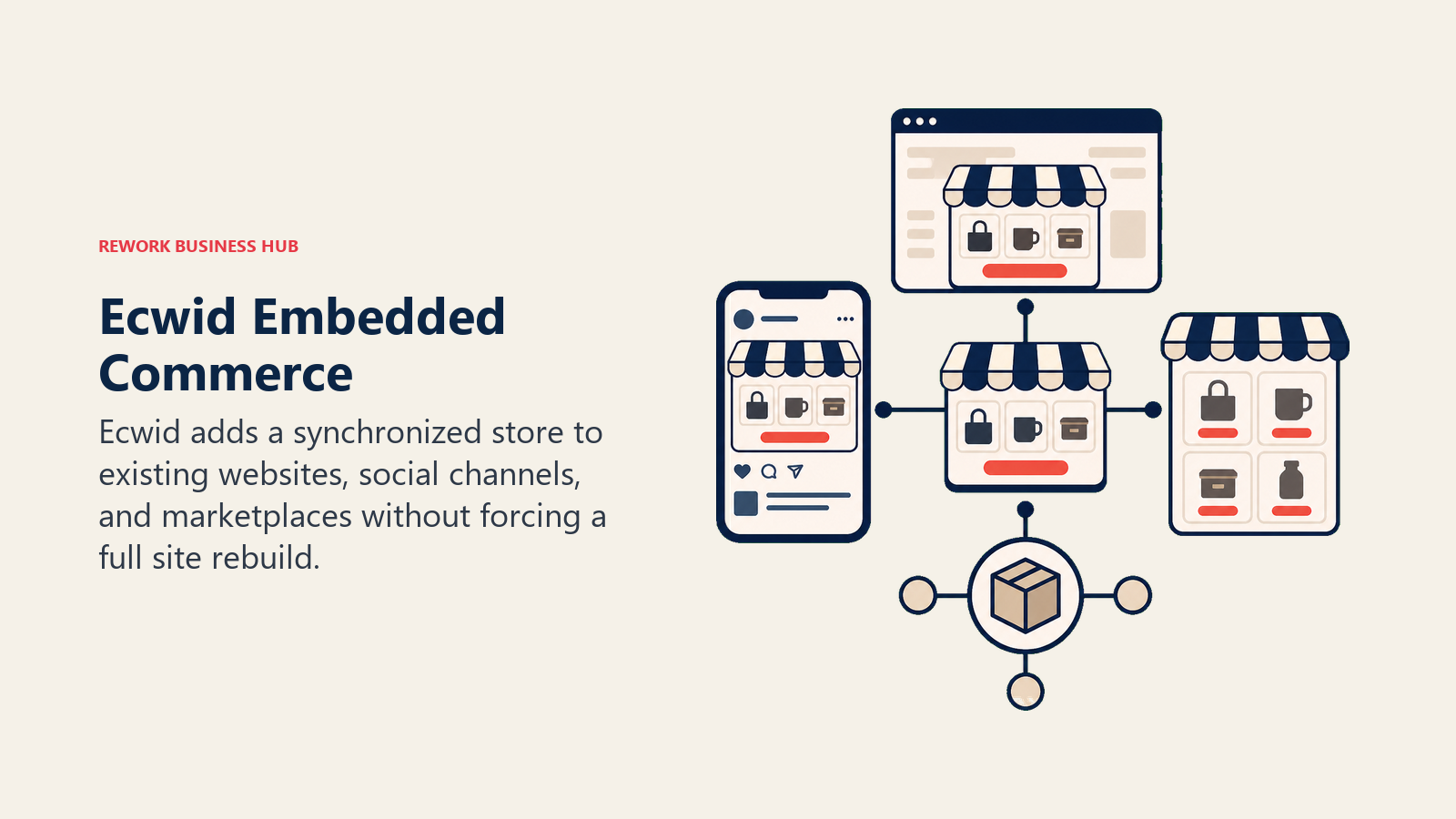
Methodology / vision: Commerce should be a layer you apply to existing digital touchpoints, not a destination you force customers to visit. Meet customers where they are.
Target audience: Multi-channel sellers with existing websites, social commerce operators, small businesses with a web presence they don't want to disrupt, brick-and-mortar retailers adding online channels.
Sizing fit: Suits 1–30 person operations. The platform's ceiling is lower than standalone stores. Complex catalog management or B2B operations quickly exceed what Ecwid handles well.
Stage fit: Startup and early growth. Works best when the priority is omnichannel presence over storefront sophistication.
Team vs company-wide: Typically single person or small team. The multi-channel sync is its core value, not internal workflow management.
| Pros | Cons |
|---|---|
| Embeds into any existing website | Not a standalone storefront builder |
| Syncs across web, mobile, social, and marketplace | Limited product page and checkout customization |
| Free tier available | Advanced features gated to higher plans |
| Good POS integration | Weak SEO for standalone store use cases |
| No coding required | Limited B2B or wholesale capability |
Pricing: Free (up to 5 products), Venture $19/mo, Business $39/mo, Unlimited $99/mo.
Best for: Sellers who already have a web presence and want to add or sync commerce across multiple channels without rebuilding their existing site.
9. Volusion: Clean, no-frills hosted commerce for simple catalogs
Volusion is one of the older hosted e-commerce platforms still in active operation. It's gone through ownership changes and product rebuilds, and it now positions itself as a clean, focused solution for merchants with simple product catalogs who want a managed, no-fee platform without complexity. It won't compete with BigCommerce on features or with Shopify on ecosystem, but it has no transaction fees, built-in analytics, and a dashboard that non-technical users can navigate.
Methodology / vision: Managed commerce without the complexity tax. For merchants who need a functional store and good analytics, not an app marketplace.
Target audience: Non-technical SMB owners with focused product catalogs (under 500 SKUs), merchants who prioritize analytics over app flexibility, and brands migrating from older platforms to a cleaner hosted environment.
Sizing fit: Suited for 1–30 person teams. Product plan limits apply per tier. Not designed for rapid SKU growth or complex operations.
Stage fit: Startup and early growth. Best for established SMBs with stable product lines, not high-growth brands scaling aggressively.
Team vs company-wide: Solo or small e-commerce team.
| Pros | Cons |
|---|---|
| No transaction fees | Limited app marketplace |
| Built-in analytics dashboard | Product limits by plan tier |
| Clean, manageable admin | Smaller feature set than BigCommerce |
| Managed hosting | Fewer themes and design options |
| Phone support included | Less development community activity |
Pricing: Personal $35/mo, Professional $79/mo, Business $299/mo.
Best for: Non-technical SMB owners with focused product catalogs who want a managed platform with no transaction fees and decent built-in analytics.
10. Shift4Shop: The only truly free hosted platform for US sellers
Shift4Shop (formerly 3dcart) made a notable move: if you use Shift4 Payments as your payment processor, the platform is genuinely $0/month on the End-to-End Commerce plan. No transaction fees, no hidden charges. That's a real competitive offer for US-based merchants who are paying $79–$299/month on Shopify or BigCommerce. The catch is that the free tier is US-only and requires Shift4 Payments. International sellers and merchants who want payment processor flexibility pay standard rates.
Methodology / vision: Commerce costs should be near-zero when merchants process through integrated payments. Revenue comes from payment processing, not platform subscriptions.
Target audience: US-based SMB owners who want to eliminate monthly platform fees, cost-sensitive founders replacing Shopify, merchants comfortable with Shift4's payment processing ecosystem.
Sizing fit: Small to medium teams (1–30). The platform handles reasonable SKU volumes, but it's not designed for enterprise-scale operations.
Stage fit: Startup and growth. Best suited for brands where cost efficiency is a priority and the US market is the primary channel.
Team vs company-wide: Small e-commerce team. Lacks enterprise workflow features.
| Pros | Cons |
|---|---|
| Genuinely free for US sellers using Shift4 Payments | Free tier limited to US merchants only |
| No transaction fees | Dated UI compared to modern platforms |
| Good feature set for the price | Requires Shift4 Payments for free tier |
| SEO tools included | Smaller app marketplace |
| Unlimited products on free tier | Less developer community support |
Pricing: End-to-End Commerce plan: $0/month with Shift4 Payments (US only). Basic $29/mo, Plus $79/mo, Pro $229/mo for non-Shift4 users.
Best for: US-based SMB owners who want to eliminate platform subscription costs and are willing to use Shift4 as their payment processor.
11. Sellfy: The creator economy's all-in-one storefront
Sellfy is built for creators first. Physical products, digital downloads, subscriptions, print-on-demand - all managed from a single dashboard, with a storefront that takes under an hour to set up. It's not trying to compete with WooCommerce on customization or BigCommerce on B2B. It's competing with Gumroad, Patreon, and direct-to-fan models, and it often wins on the combination of physical + digital in one place.
Methodology / vision: Creators should own their audience and their revenue, not split it with platforms that charge 10–30% transaction fees. A complete storefront with subscriptions should cost what a SaaS tool costs, not a commission on every sale.
Target audience: Creators (educators, musicians, artists, coaches, writers), indie makers selling both physical and digital products, YouTubers and newsletter writers monetizing their audience, small direct-to-consumer brands starting out.
Sizing fit: Solo to 10 people. Designed for individual creators and very small teams. Not the right choice for multi-person operations with complex inventory.
Stage fit: Startup stage. Best for creators launching their first monetized presence, not for established brands scaling operations.
Team vs company-wide: Single-person tool in most use cases. Multi-seat collaboration is limited.
| Pros | Cons |
|---|---|
| Digital + physical + subscription in one dashboard | Not designed for complex physical inventory |
| Fast setup (under an hour) | Limited customization depth |
| No transaction fees on paid plans | Small app ecosystem |
| Print-on-demand built in | Weak for B2B use cases |
| Fair pricing for creators | Less SEO control than self-hosted options |
Pricing: Starter $22/mo (no transaction fees), Business $59/mo, Premium $119/mo.
Best for: Creators and indie makers who sell a mix of digital products, physical goods, and memberships, and who prioritize simplicity and ownership over customization depth.
12. Medusa: The open-source headless platform for engineering-first teams
Medusa is what you build with when you want the flexibility of Magento but the developer experience of a modern API-first framework. It's open-source, Node.js-based, and designed from the ground up as a composable commerce platform. Your storefront is completely decoupled. You build it in Next.js, Gatsby, or any frontend framework. The backend handles cart, orders, payments, inventory, and fulfillment via a clean REST/GraphQL API. Medusa v2 (released in 2024) added a modular architecture that makes it even easier to swap in custom logic. For teams building automation around their headless commerce stack, best Make alternatives covers the workflow automation tools that engineering-led teams often pair with composable platforms.
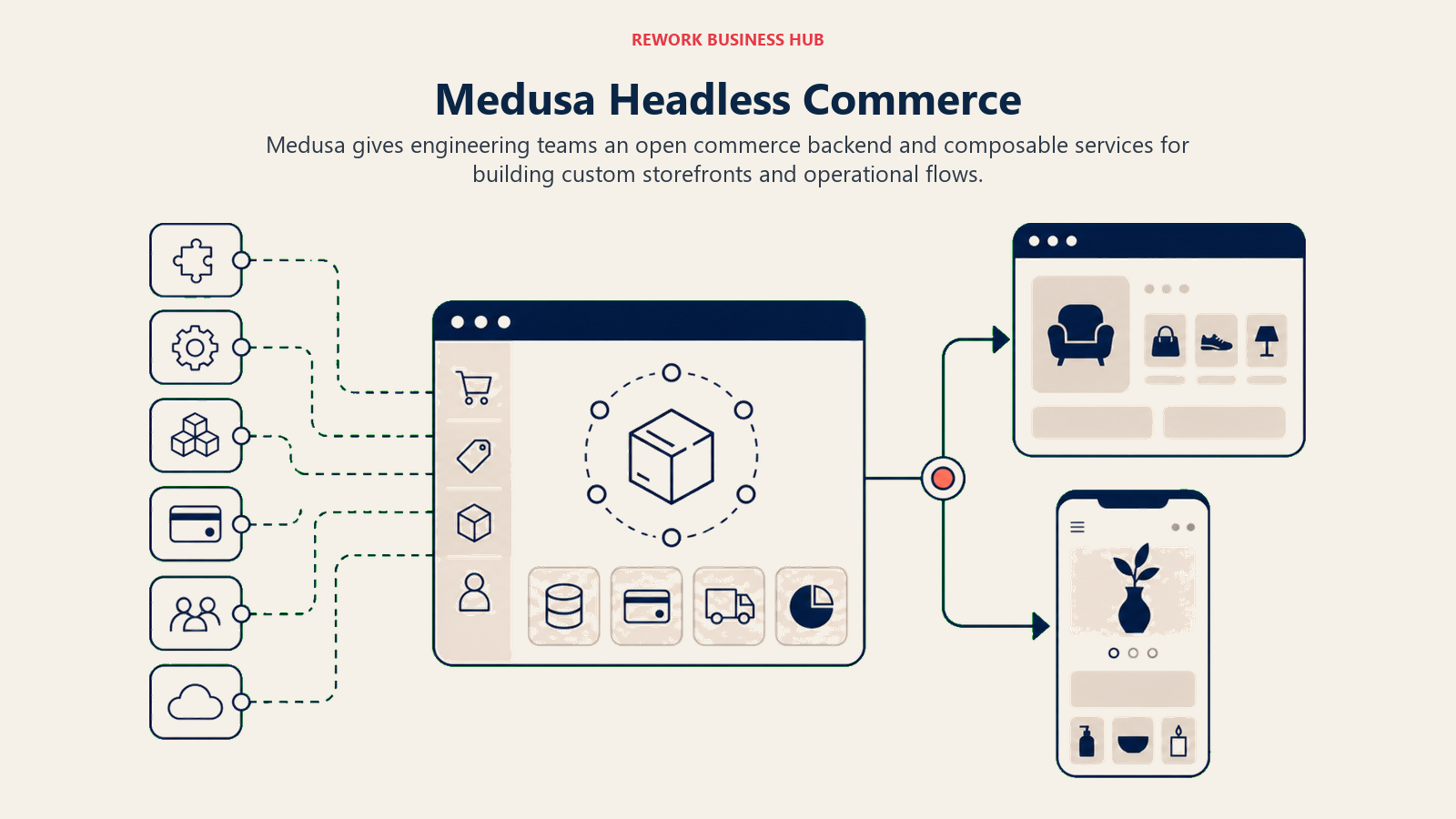
Methodology / vision: Commerce infrastructure should be as flexible and developer-friendly as any other modern API. Every commerce concept (cart, order, product, customer) should be composable and replaceable, not locked in a SaaS vendor's black box.
Target audience: Engineering-led startups and scale-ups, CTOs evaluating Shopify Plus alternatives with lower lock-in, brands building custom storefront experiences that SaaS platforms can't support, B2B platforms needing custom quoting or order logic.
Sizing fit: Requires at least one backend developer to run effectively. Best for teams of 2–50 engineers. Can scale to enterprise with proper infrastructure.
Stage fit: Growth to mid-market. Not ideal for day-one founders without technical resources, but an excellent choice for growth-stage teams that have outgrown hosted platforms and need infrastructure ownership.
Team vs company-wide: Engineering team deploys and maintains it; e-commerce and operations teams use the admin. Can become a company-wide commerce platform with the right investment.
| Pros | Cons |
|---|---|
| Full infrastructure ownership, no vendor lock-in | Requires engineering resources to deploy and maintain |
| Modern developer experience (TypeScript, modular) | No hosted option - you manage your own infrastructure |
| Free and open-source | Less mature ecosystem than Magento |
| Composable architecture - swap any module | Storefront is not included; you build it separately |
| Active developer community, frequent updates | Not suitable for non-technical founders |
Pricing: Free and open-source. Hosting runs $20–$200/mo depending on infrastructure. Medusa Cloud (managed option) pricing available on request.
Best for: Engineering-led teams who want full ownership of their commerce infrastructure, need custom storefront experiences, and are ready to invest developer time to avoid SaaS lock-in and transaction fees.
Why Teams Leave Shopify: The Real Reasons
Before choosing an alternative, it's worth being precise about which Shopify pain point is driving the decision. Different problems point to different solutions.
| Pain Point | Details | Best Alternatives |
|---|---|---|
| Transaction fees | 0.5–2% per order unless you use Shopify Payments (unavailable in many countries) | BigCommerce, WooCommerce, PrestaShop, Shift4Shop |
| App dependency for basic features | Abandoned cart, B2B pricing, advanced reporting all require paid apps | BigCommerce, Magento |
| Theme / design limitations | Deep customization requires expensive Liquid development | WooCommerce, Medusa, Magento |
| Shopify Plus cost | $2,300/month minimum for enterprise features | Magento (open-source), BigCommerce Enterprise, Medusa |
| Data portability concerns | Difficult to export full customer and order data portably | WooCommerce, PrestaShop, Medusa (you own the DB) |
| International commerce gaps | Shopify Markets works but adds complexity and cost | BigCommerce, Magento, PrestaShop |
| Headless / custom storefront needs | Shopify Hydrogen exists but ties you to Shopify APIs | Medusa, Magento, WooCommerce (headless via REST) |
One pattern shows up across these pain points: the more a brand scales, the more Shopify's per-feature and per-transaction costs compound. A store doing $3M GMV paying 1% in fees plus $400/month in apps is spending roughly $35,000/year on costs that BigCommerce or a self-hosted WooCommerce build folds into a flat platform fee. That gap is what pushes most growth-stage brands to evaluate alternatives in the first place.
Migration effort scales with the destination, so factor switching cost into the decision, not just monthly price:
| Destination | Typical Migration Effort | Who Should Do It | Main Risk |
|---|---|---|---|
| BigCommerce | 2-6 weeks, low dev | Growth brands hitting app-cost ceilings | URL/redirect mapping for SEO |
| WooCommerce | 4-10 weeks, medium dev | WordPress-native teams | Plugin compatibility and hosting setup |
| Magento / Adobe Commerce | 3-9 months, high dev | Enterprise with B2B complexity | Cost and timeline overruns |
| Medusa | 2-6 months, engineering-led | Teams wanting headless ownership | Storefront built from scratch |
Feature Depth Comparison
| Feature | WooCommerce | BigCommerce | Magento | Medusa | Shopify (baseline) |
|---|---|---|---|---|---|
| No transaction fees | Yes | Yes | Yes | Yes | Only with Shopify Payments |
| Native B2B pricing | Via plugin | Yes (built in) | Yes (built in) | Via module | Via app ($) |
| Multi-currency | Via plugin | Yes | Yes | Yes | Via Markets (paid) |
| Multi-storefront | Via plugin | Yes (Enterprise) | Yes | Yes | Shopify Plus only |
| Abandoned cart recovery | Via plugin | Yes | Yes | Via module | Yes (all plans) |
| Headless / API-first | Yes | Yes (Catalyst) | Yes | Yes (core concept) | Via Hydrogen |
| Data portability | Full (you own DB) | Good | Full (you own DB) | Full (you own DB) | Limited |
| Custom checkout logic | Yes | Partially | Yes | Yes | Shopify Plus only |
How to Choose: Decision Framework
| If your priority is... | Best choice | Why |
|---|---|---|
| Zero platform costs (US merchant) | Shift4Shop | Free with Shift4 Payments, no transaction fees |
| Maximum customization + no fees | WooCommerce or Medusa | Full code ownership, no vendor lock-in |
| Enterprise B2B with complex pricing | Magento / Adobe Commerce | Native requisition lists, tiered pricing, multi-site |
| Scaling from $500K to $5M without app bloat | BigCommerce | Enterprise features at SMB price, no per-transaction fees |
| Design quality, small catalog | Squarespace Commerce | Best default aesthetics, clean product/content blend |
| Speed to launch, non-technical founder | Wix eCommerce | Fastest setup, no developer needed |
| Creator selling digital + physical | Sellfy | Designed for exactly this use case |
| Multi-channel without rebuilding your site | Ecwid | Embeds everywhere, syncs inventory across channels |
| European compliance (GDPR, VAT) | PrestaShop | Built for EU requirements, free platform |
| Headless storefront, eng-led team | Medusa | Modern API-first, composable, open-source |
| Low-cost physical store, stable catalog | OpenCart or Volusion | Low overhead, functional for simple operations |
Pricing Summary at Scale
To make the total cost of ownership comparison concrete, here's what each platform costs at three GMV levels (estimates based on typical configurations):
| Platform | Sub-$500K GMV | $500K–$5M GMV | $5M+ GMV |
|---|---|---|---|
| WooCommerce | $50–$150/mo (hosting + plugins) | $150–$500/mo | $500–$2,000/mo |
| BigCommerce | $39–$105/mo | $105–$399/mo | $399/mo–Enterprise |
| Wix eCommerce | $17–$35/mo | $35/mo (at ceiling) | Not recommended |
| Squarespace Commerce | $23–$45/mo | $45/mo (at ceiling) | Not recommended |
| Magento | Not recommended | $500–$2,000/mo (infra + dev) | $3,000–$15,000+/mo |
| PrestaShop | $20–$100/mo | $100–$400/mo | $400–$1,500/mo |
| OpenCart | $10–$50/mo | $50–$200/mo | Not recommended |
| Ecwid | $19–$99/mo | $99/mo (at ceiling) | Not recommended |
| Volusion | $35–$79/mo | $79–$299/mo | Not recommended |
| Shift4Shop | $0/mo (US, Shift4) | $0–$79/mo | Not recommended |
| Sellfy | $22–$59/mo | $59–$119/mo | Not recommended |
| Medusa | $50–$200/mo (hosting) | $200–$800/mo | $800–$3,000+/mo |
Frequently Asked Questions
What is the best Shopify alternative overall? There is no single winner. BigCommerce is the strongest all-around alternative for growth-stage brands that want enterprise features without app costs. WooCommerce wins for WordPress-native teams, Magento and Medusa for enterprise and headless builds, and Squarespace or Wix for design-led small stores.
Which Shopify alternative has no transaction fees? WooCommerce, BigCommerce, Magento, PrestaShop, OpenCart, Volusion, and Medusa charge no platform transaction fees. Shift4Shop is genuinely $0/month for US sellers using Shift4 Payments. You still pay normal payment-processor rates on every platform.
What is the cheapest Shopify alternative for a small store? For US merchants, Shift4Shop can be free with Shift4 Payments. Otherwise WooCommerce, PrestaShop, and OpenCart are free software where you pay only for hosting (often $10 to $50/month), and Wix starts at $17/month for a fully hosted option.
Which Shopify alternative is best for B2B? BigCommerce and Magento ship native B2B features like customer-specific pricing, quoting, and requisition lists. Medusa supports custom B2B logic if you have engineering resources. Shopify gates most B2B behind apps or its Plus tier.
Should I leave Shopify if I am under $1M GMV? Usually not for cost reasons alone. Below $1M, Shopify's fees are modest and migration risk (SEO disruption, downtime, re-training) often outweighs the savings. The case to switch gets strong as fees and app costs compound past that level.
What to Do Next
Don't migrate platforms based on a feature list alone. The cost of a bad migration (developer time, re-training, SEO disruption, downtime) often exceeds a year of platform fees.
The practical path: pick your top two candidates based on this guide, run a 2-week pilot with a subset of your catalog, and validate three things: the checkout conversion rate, the admin workflow your team will actually use day-to-day, and the total monthly cost once you account for hosting, extensions, and any developer time. Those three data points will tell you more than any comparison article.
If you're leaving Shopify because of transaction fees, BigCommerce or WooCommerce solves that cleanly. If you're leaving because you need infrastructure ownership and a modern dev stack, Medusa is worth the engineering investment. If you're leaving because Shopify Plus pricing doesn't match your revenue, Magento Open Source or a self-hosted WooCommerce build is the honest answer.
The right platform is the one that costs the least to operate at your current and next-stage GMV, not the one with the most features.
For e-commerce teams that run marketing campaigns alongside the store, best Klaviyo alternatives covers the email and SMS tools that connect to Shopify's competitors just as cleanly as they connect to Shopify itself. If you're migrating and need to move customer data without losing lead history, Form-to-CRM Automation covers how to handle records that exist across your old platform, your CRM, and your email list simultaneously. And if transaction fees are the core driver, the true cost of software sprawl puts the full platform cost picture together: not just the monthly fee, but the apps, the integrations, and the developer time that add up around it.
External Resources:
- Shopify pricing: Basic through Plus plans
- BigCommerce pricing: Standard, Plus, Pro comparison
- WooCommerce.com: plugin download and extension marketplace
- Medusa open-source: self-hosted and cloud options
- Magento Open Source: Adobe Commerce licensing overview

Principal Product Marketing Strategist
On this page
- Quick Comparison Table
- Stage Fit Matrix
- Sizing and Persona Table
- 1. WooCommerce: The open-source workhorse for WordPress brands
- 2. BigCommerce: Enterprise features without the enterprise price tag
- 3. Wix eCommerce: Drag-and-drop simplicity for small brands
- 4. Squarespace Commerce: The best-looking store you can build without a designer
- 5. Magento / Adobe Commerce: Enterprise-grade power for large, complex operations
- 6. PrestaShop: Open-source commerce with strong EU footing
- 7. OpenCart: Lightweight open-source for budget-conscious builders
- 8. Ecwid: Embed commerce anywhere, sync everywhere
- 9. Volusion: Clean, no-frills hosted commerce for simple catalogs
- 10. Shift4Shop: The only truly free hosted platform for US sellers
- 11. Sellfy: The creator economy's all-in-one storefront
- 12. Medusa: The open-source headless platform for engineering-first teams
- Why Teams Leave Shopify: The Real Reasons
- Feature Depth Comparison
- How to Choose: Decision Framework
- Pricing Summary at Scale
- Frequently Asked Questions
- What to Do Next