Best Microsoft 365 Alternatives in 2026: 13 Office Suites for Every Team and Budget
Turn this article into takeaways for your work.


Each assistant summarizes the article only for you and suggests best practices for your work.
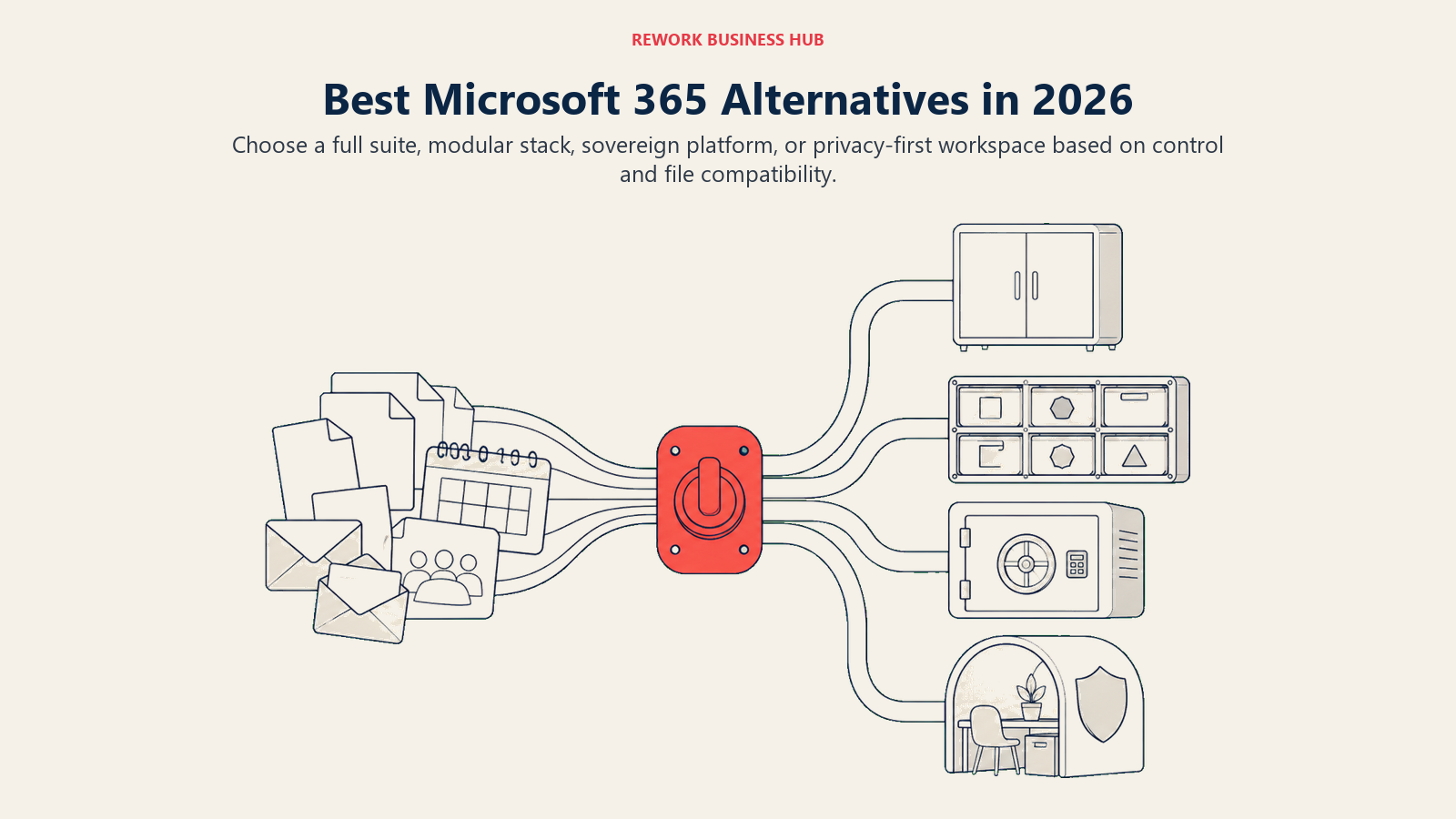
The best Microsoft 365 alternatives in 2026 are Google Workspace for the closest full-suite replacement, Zoho Workplace for the cheapest complete stack, and Lark for all-in-one Asia-Pacific operations. Nextcloud paired with Collabora Online, OnlyOffice, and LibreOffice cover self-hosted and free options for teams that want their files off Microsoft's servers entirely, while Proton, Fastmail, and Tuta serve buyers who want privacy and encryption built into email first. Rework fits a narrower but real case: teams whose actual complaint about Microsoft 365 was never the Office apps, it was that the suite never gave them a CRM or cross-team workflows. And if you've already decided one bundled suite isn't for you, Slack, Notion, and Zoom show what assembling your own best-of-breed stack looks like instead.
Microsoft 365 works for hundreds of millions of people every day, and Microsoft's own investor filings show why: Microsoft 365 Commercial seats grew 6% year over year in the most recent quarter, with commercial cloud revenue up 19%, growth Microsoft credits partly to Microsoft 365 Copilot. That last detail is also the top reason people go looking for alternatives. Microsoft folded Copilot into its mid-tier plans, and the plan most small businesses actually want, Business Standard, is now sold only as "Business Standard with Copilot" at $23.50/user/month paid yearly, a real jump from the $12.50 many buyers still expect from an old price list Microsoft no longer publishes. Cost is one driver, but not the only one: data residency and cloud sovereignty are now board-level topics for non-US organizations (more on that below), and plenty of teams simply don't need SharePoint's permission model or Exchange's admin center for a five-person shop. For a side-by-side on the two biggest full-suite options, see Microsoft 365 vs Google Workspace. And if your actual complaint is Teams specifically rather than the whole suite, Best Microsoft Teams Alternatives covers that narrower question in more depth.
This guide covers 13 alternatives with honest assessments: real pricing, real target audiences, real limitations, no vague summaries.
Key Facts
- Google Workspace has empowered more than 10 million businesses of all sizes, from startups to global enterprises, according to Google's own January 2025 announcement (Google Workspace Blog).
- Microsoft 365 Commercial seats grew 6% year over year in fiscal Q3 2026, while commercial cloud revenue grew 19%, with Microsoft crediting revenue-per-user growth to Microsoft 365 E5 and Microsoft 365 Copilot specifically (Microsoft Investor Relations).
- 79% of IT leaders faced a price increase at renewal in the past 12 months, and 78% were hit with unexpected charges tied to consumption or AI features, according to Zylo's 2026 SaaS Management Index (Zylo).
- 82% of German companies say they no longer want to be technically dependent on US cloud providers, though 78% admit they still are in practice, per Bitkom's Cloud-Report 2025 (Bitkom).
- The share of organizations citing "avoiding vendor lock-in" as a reason to adopt open source software jumped from 33% to 55% in a single year, according to the 2026 State of Open Source Report (OpenLogic).
Quick Comparison Table
| Tool | Best For | Starting Price | Key Strength | Key Limitation |
|---|---|---|---|---|
| Google Workspace | Closest full-suite drop-in replacement | Business Starter $7/user/mo (promo $3.50 first 12 months) | Gmail, Docs, Drive, Meet all native and integrated | Weak fidelity on complex Excel macros |
| Zoho Workplace | Cheapest complete email + docs stack | Workplace Standard $3/user/mo annual | Full mail + docs + drive suite under $4/user | Thinner third-party app ecosystem |
| Lark | All-in-one suite for Asia-Pacific teams | Free (Starter, 20 users); Basic $6/user/mo annual | Chat, docs, video, and attendance in one app | Free tier capped at 20 users, not 50 |
| Slack + Notion + Zoom | Best-of-breed stack instead of one bundle | About $31/user/mo combined (all three Pro tiers) | Best tool in each category, not "good enough" versions | No native spreadsheet or email included |
| Dropbox Business | File storage and sharing without a full suite | Standard $15/user/mo | Best-in-class file sync and sharing UX | Paper's desktop/mobile apps retired Oct 2025 |
| Rework | Teams whose real complaint is no CRM, not the Office apps | Process Engine from $99/mo billed yearly (5 seats) | CRM, tasks, workflows, and chat on one platform | No Mail, Drive, or Knowledge modules |
| Nextcloud + Collabora | Self-hosted, EU-sovereign files and docs | Nextcloud Standard EUR71.29/user/year (100+ users) | Full data sovereignty, on-premise or private cloud | Official support tiers need a 100-user minimum |
| OnlyOffice | Closest file-format fidelity to Word/Excel/PowerPoint | DocSpace Business $20/admin/month | True OOXML compatibility, cloud or self-hosted | On-premises Enterprise pricing is quote-only |
| LibreOffice | Zero-cost desktop office suite | Free, forever | No license cost, no user cap, no vendor | No hosted real-time co-editing on its own |
| Zimbra | Self-hosted email with Outlook compatibility | No published self-serve price | ActiveSync and Outlook desktop support built in | Pricing runs through resellers, not a rate card |
| Proton for Business | Privacy-first mail, drive, and docs from Switzerland | No published price (shown at sign-up) | End-to-end encryption on mail, drive, and calendar | No desktop-grade spreadsheet or slide editor |
| Fastmail | Standards-based, ad-free business email | Basic $3/user/mo annual | Full IMAP/CalDAV, no lock-in, fast support | Email only, no docs or storage suite |
| Tuta | Encrypted email under German data protection law | Reported ~EUR6/user/mo annual (Essential) | Post-quantum encryption on every plan | Pricing isn't published statically on the vendor page |
Stage Fit Matrix
| Tool | Startup (1-20) | Growth (20-100) | Mid-Market (100-500) | Enterprise (500+) |
|---|---|---|---|---|
| Google Workspace | Strong fit | Strong fit | Good fit | Good fit |
| Zoho Workplace | Primary target | Good fit | Possible | Not ideal |
| Lark | Possible | Good fit | Strong fit | Selective (Asia-Pacific) |
| Slack + Notion + Zoom | Good fit | Strong fit | Good fit | Possible (3 vendors) |
| Dropbox Business | Good fit | Strong fit | Good fit | Possible |
| Rework | Not ideal | Strong fit | Primary target | Selective fit |
| Nextcloud + Collabora | Not ideal | Possible | Strong fit | Primary target |
| OnlyOffice | Possible | Good fit | Strong fit | Good fit |
| LibreOffice | Primary target | Good fit | Possible | Not ideal (no central admin) |
| Zimbra | Not ideal | Possible | Good fit | Good fit |
| Proton for Business | Good fit | Good fit | Possible | Limited (compliance depth) |
| Fastmail | Primary target | Good fit | Possible | Not ideal |
| Tuta | Primary target | Good fit | Possible | Not ideal |
Sizing and Persona Table
| Tool | Team Size Sweet Spot | Primary Buyer Persona | Secondary Buyer |
|---|---|---|---|
| Google Workspace | 5-1,000 | IT Admin, Office Manager | Any team leaving Microsoft |
| Zoho Workplace | 5-250 | Founder, Ops Manager (Zoho customer) | IT Admin |
| Lark | 20-1,000 | COO, IT Manager (Asia-Pacific) | HR Director |
| Slack + Notion + Zoom | 10-300 | Head of Ops, IT Manager | Team Lead |
| Dropbox Business | 3-1,000 | IT Manager, Office Manager | Creative and agency teams |
| Rework | 10-200 | COO, Head of Ops, RevOps Director | Director of Sales, IT Manager |
| Nextcloud + Collabora | 100-5,000 | CISO, IT Director | Compliance Officer |
| OnlyOffice | 10-1,000 | IT Manager, Office Manager | Government and education buyers |
| LibreOffice | 1-100 | Founder, Budget Owner | IT Manager (paired with a cloud layer) |
| Zimbra | 25-2,000 | IT Director, Sysadmin | CISO |
| Proton for Business | 2-200 | Founder, Privacy Officer | Legal, Compliance |
| Fastmail | 1-100 | Founder, IT Admin | Developer-led teams |
| Tuta | 2-100 | Founder, Privacy Officer (EU) | Legal, HR |
1. Google Workspace: The Closest Full-Suite Replacement
Google Workspace is the most direct, drop-in replacement for Microsoft 365, and it's the one most IT buyers evaluate first. Gmail replaces Outlook, Drive replaces OneDrive, Docs and Sheets replace Word and Excel for real-time collaborative editing, and Meet replaces Teams for video. For a team that spends its day in the browser rather than deep in desktop Office macros, the switch is close to seamless, and Gemini is now included across every business tier rather than sold as a separate Copilot-style add-on.
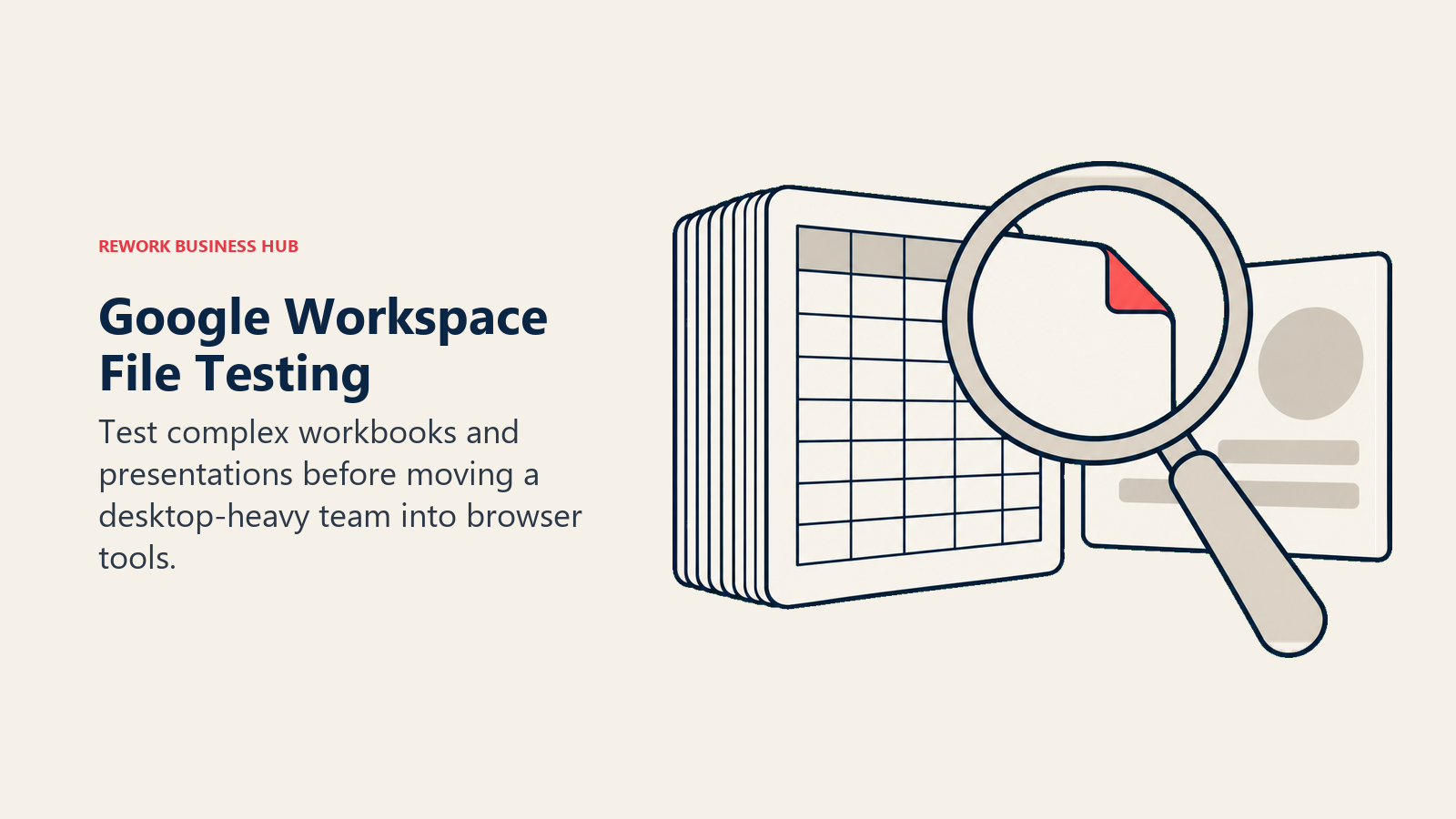
Where Workspace shows real limits is file fidelity. Complex Excel workbooks with VBA macros, pivot-table-heavy financial models, and PowerPoint decks with intricate animations don't always survive a round trip through Sheets or Slides cleanly, so finance and heavy-Office teams should test their actual files before committing rather than trusting a marketing demo. For a head-to-head on the two biggest full-suite contenders, Microsoft 365 vs Google Workspace goes deeper than a single comparison table can, and if Workspace itself isn't quite right, Best Google Workspace Alternatives covers what else exists in its orbit.
| What you get | What you don't |
|---|---|
| The most direct like-for-like replacement for Word, Excel, Outlook, and OneDrive | Guaranteed fidelity on complex Excel macros and VBA |
| Gemini AI included across every business tier, no separate Copilot-style add-on | A desktop-first experience, Workspace is browser-native |
| Native Meet, Chat, and Calendar in every document | Enterprise governance depth on par with Microsoft Purview |
| A first-12-months promo price for new customers | The promo price after the first year (list price applies) |
| Business tiers cap at 300 seats, simple to budget under that | A published Enterprise price without a sales call |
Pricing: Business Starter $7.00/user/month (promo $3.50 for new customers, first 20 users, first 12 months); Business Standard $14.00/user/month (promo $8.40); Business Plus $22.00/user/month; Enterprise custom. Business tiers cap at 300 users.
Best for: teams that want the closest full-suite, browser-native replacement for Microsoft 365 and are comfortable trading some Office file fidelity for that.
2. Zoho Workplace: The Cheapest Complete Suite on This List
Zoho Workplace is what a full office suite looks like when it's priced for a small business budget rather than an enterprise one. Mail, Writer (docs), Sheet, Show (slides), and WorkDrive are bundled into Workplace Standard for $3/user/month billed annually, and Professional at $6/user/month adds a full terabyte of shared team storage on top of 100 GB of mail. If your company already runs Zoho CRM, Zoho Desk, or Zoho Projects, the fit gets stronger: documents and mail sit next to the rest of the Zoho ecosystem instead of being a separate purchase.
The tradeoff is depth and polish. Zoho's editors are genuinely usable but don't match Google Docs or Word for real-time collaboration feel, and the third-party integration marketplace is thinner than either of the two market leaders. For a company with no existing Zoho footprint evaluating this purely as an office suite, it's a serious budget option rather than an obvious first choice.
| What you get | What you don't |
|---|---|
| A complete mail + docs + drive suite for $3 to $6/user/month | Real-time editing polish on par with Google Docs |
| Deep integration if you already run Zoho CRM, Desk, or Projects | A large third-party app marketplace |
| Mail Free tier for up to 5 users at zero cost | Standalone brand pull outside the Zoho ecosystem |
| Workplace Professional bundles 1 TB of team storage | Guaranteed complex Excel/PowerPoint fidelity |
| One vendor for mail, docs, and drive | Enterprise governance depth on par with Microsoft or Google |
Pricing: Mail Free ($0, up to 5 users, 5 GB/user); Mail Lite $1/user/month; Mail Premium $4/user/month (annual only); Workplace Standard $3/user/month ($4 monthly); Workplace Professional $6/user/month ($7 monthly); Enterprise on request.
Best for: budget-conscious small businesses, especially existing Zoho CRM or Zoho One customers, that want mail, docs, and drive under one low-cost umbrella.
3. Lark: Chat, Docs, and HR in One App From ByteDance
Lark packages chat, video meetings, real-time collaborative docs and spreadsheets, a lightweight database tool called Base, OKR tracking, and attendance management into a single subscription. For fast-growing teams in Asia-Pacific markets, that breadth genuinely replaces Microsoft 365 plus a separate HR tool plus a separate project tracker, rather than adding one more subscription line. Lark Docs handles real-time co-editing at a level close to Google Docs, and Lark Sheets covers most of what a growing team needs from Excel without a desktop install.
The free Starter tier caps at 20 users, not the 50 that older sources still repeat, so confirm the current limit before promising it to a team about to cross that line. Outside Asia-Pacific, ByteDance ownership and data residency are real objections for US and EU buyers running a formal security review. For more on how Lark stacks up against other options built for the same use case, Best Lark Alternatives covers that ground directly.
| What you get | What you don't |
|---|---|
| Chat, docs, spreadsheets, video, and HR tools in one app | Data residency assurances for US/EU buyers |
| Strong Asia-Pacific localization and market support | Western enterprise ecosystem depth |
| A usable free plan for small teams (20 users, 100 GB) | Independence from ByteDance data-handling concerns |
| Real-time collaborative docs near Google-Docs quality | A neutral answer to regulatory scrutiny questions |
| OKR and attendance tools bundled at no extra cost | Deep Excel-macro or VBA compatibility |
Pricing: Free (Starter, 20 users, 100 GB storage); Basic $6/user/month billed annually (500 users max, 5 TB); Pro $12/user/month billed annually (500 users max, 15 TB); Enterprise custom.
Best for: fast-growing Asia-Pacific teams that want chat, docs, and light HR tooling from one vendor and where ByteDance data handling isn't a compliance blocker.
4. Slack + Notion + Zoom: The Best-of-Breed Stack Instead of One Bundle
Not every team wants one vendor for everything, and this is what the alternative looks like: Slack for chat, Notion for docs and a wiki, and Zoom Workplace for video, each the strongest tool in its own category rather than the "good enough" version bundled into a suite. Run the math and it's not obviously cheaper: Slack Pro at $7.25/user/month, Notion Plus at $10/member/month, and Zoom Workplace Pro at $14.16/user/month add up to roughly $31/user/month, more than Microsoft 365 Business Standard with Copilot at $23.50 and close to Business Premium with Copilot at $32.00. The case for assembling it yourself isn't price, it's fit: each piece is best-in-class rather than adequate, and you can swap any one of the three without touching the other two.
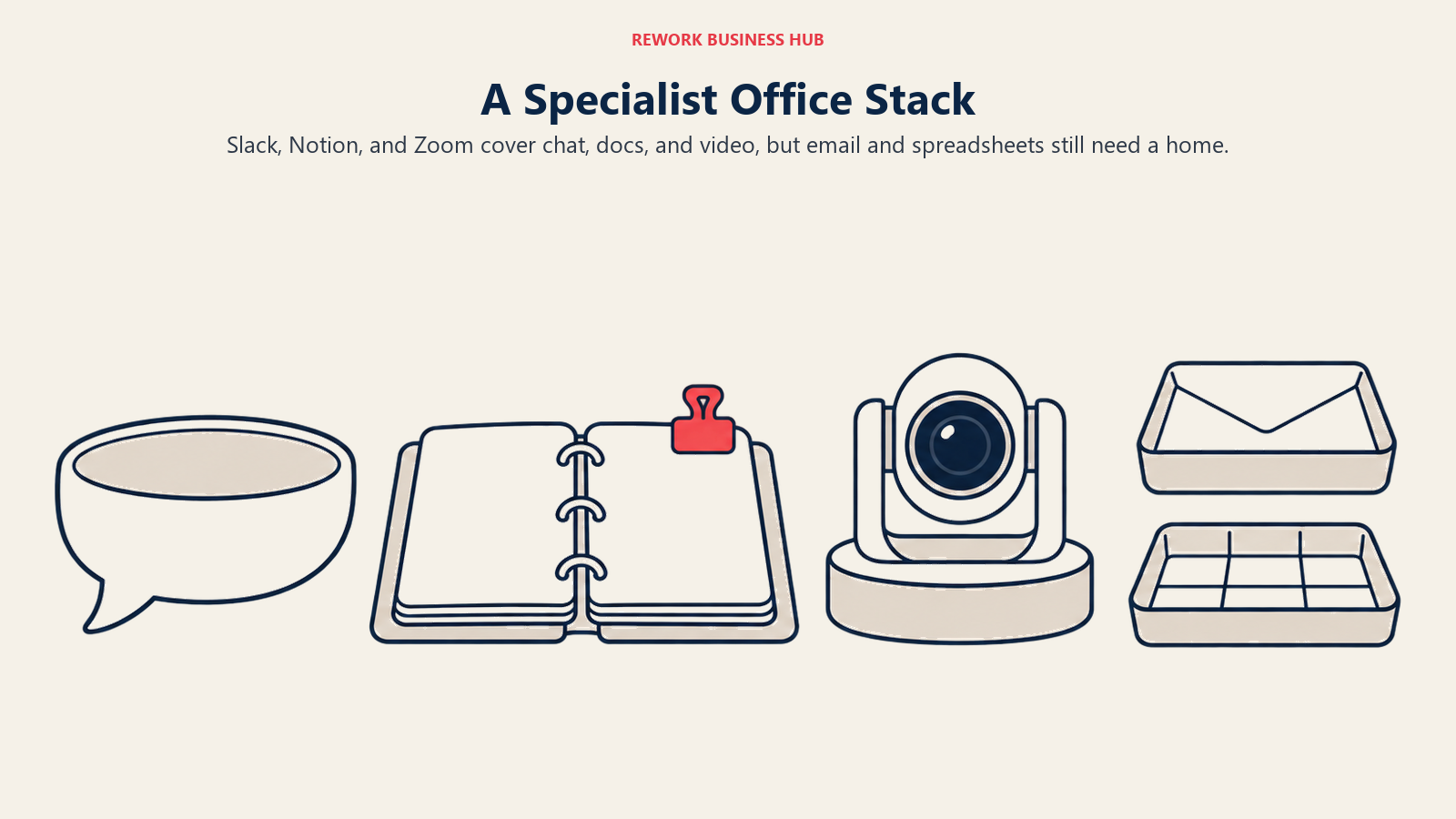
What this stack doesn't give you is a spreadsheet or an email host. Most teams running this combination still need Google Workspace or a standalone provider like Fastmail for mail, and Google Sheets or Airtable for anything spreadsheet-heavy, so factor that fourth line item into the real comparison before assuming best-of-breed is a straight swap for one Microsoft invoice. For teams weighing Slack specifically against Teams or evaluating the wider chat market, Slack vs Microsoft Teams and Best Slack Alternatives go deeper on that one piece, and Best Zoom Alternatives does the same for the video layer. If you're still deciding whether best-of-breed or a bundle fits your team, How to Choose Team Chat Software walks through that tradeoff in more depth.
| What you get | What you don't |
|---|---|
| Best-in-class tool in each category instead of a bundled compromise | A single invoice, admin console, or vendor support line |
| Freedom to swap any one piece without replacing the whole stack | A built-in spreadsheet or email host, you'll still need one |
| Slack's 2,600+ integrations and Zoom's meeting reliability | A combined price that's necessarily cheaper than a bundle |
| Notion's flexible docs-plus-wiki-plus-database model | Native file storage the way OneDrive or Drive provide it |
| No single point of failure if one vendor has an outage or price hike | Cross-tool search that works as one unified index |
Pricing: Slack Pro $7.25/user/month annual, $8.75 monthly; Notion Plus $10/member/month annual (monthly runs higher); Zoom Workplace Basic free (40-minute meetings) or Pro $14.16/user/month annual. Combined Pro-tier stack runs about $31/user/month annual, before adding a separate email and spreadsheet provider.
Best for: teams that have already decided a single bundled suite isn't for them and would rather pay for the best chat, docs, and video tools individually.
5. Dropbox Business: File Storage and Sharing Without the Rest of the Suite
Dropbox solves one specific Microsoft 365 complaint and doesn't pretend to solve the others: if OneDrive's sync client is the actual pain point, not Word or Excel, Dropbox Business replaces just that piece. Standard starts teams at $15/user/month with 3 TB of pooled team storage and file transfers up to 100 GB, and Advanced at $24/user/month adds a full jump to 15 TB, single sign-on, and extended one-year file recovery. Dropbox's sync reliability and sharing UX are still a real step up from OneDrive for teams that move large files with outside collaborators constantly.
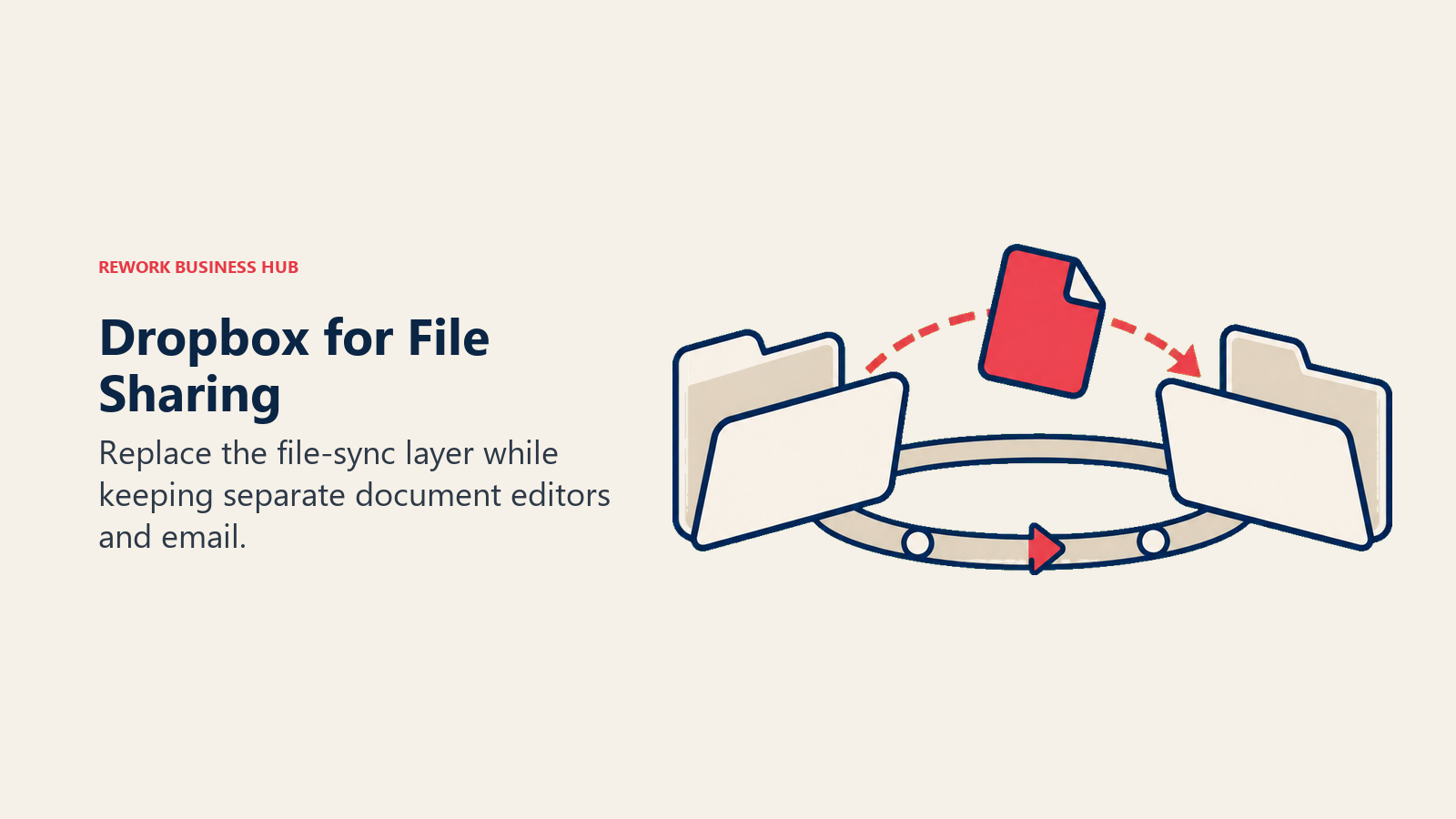
What Dropbox is not, as of 2026, is a docs and spreadsheet suite. Dropbox Paper, its lightweight collaborative-doc product, had its mobile and desktop apps retired in October 2025 and now runs as a web-only tool, so don't plan around it as an Office or Google Docs substitute. Most teams pairing Dropbox with something else use Google Docs, Notion, or OnlyOffice for the actual document editing and keep Dropbox purely for storage and sharing. If Dropbox itself isn't the right fit for that storage layer, Best Dropbox Alternatives covers the rest of that specific market.
| What you get | What you don't |
|---|---|
| Best-in-class file sync and sharing reliability | A docs or spreadsheet editor built into the same subscription |
| Fast onboarding, minimal admin overhead | Dropbox Paper as a real-time collaborative doc tool (apps retired Oct 2025) |
| Extended file recovery and SSO on Advanced | The lowest price on this list |
| Works alongside any docs suite you already use | Native email hosting |
| Strong large-file transfer for external collaborators | A published Enterprise price without a sales call |
Pricing: Standard $15/user/month (1+ users, 3 TB pooled team storage); Advanced $24/user/month (3+ users, 15 TB); Enterprise custom.
Best for: teams whose real complaint about Microsoft 365 is OneDrive's sync experience specifically, and who already have (or plan to add) a separate docs and email solution.
6. Rework: CRM and Ops Next to Chat, Not a Replacement for Office
Every alternative on this list is trying to replace Word, Excel, Outlook, or Teams with something equivalent. Rework isn't, and it's worth saying that plainly before going further: Rework's Mail, Drive, and Knowledge modules are not live. It doesn't give you business email, a cloud file drive, or a spreadsheet app, and it was never going to make this list on Office-app parity.
Rework earns a spot here for a different, real reason: the actual complaint behind a lot of Microsoft 365 evaluations isn't the Office apps, it's that the suite never gave the company a CRM or a way to run cross-team work. Task, Project, Workflow, BPM, Request (approvals), Docs (collaborative docs), E-Sign, E-Office, Automation, and Chat are live modules on one platform, sitting next to a Sales CRM, Lead management, the People app, and a unified inbox spanning WhatsApp, Messenger, Instagram DM, TikTok, Zalo, and web chat. For the reader who's going to keep their email and cloud storage provider regardless, whether that's Google Workspace or one of the self-hosted options below, and actually needs CRM and operations software next to it, that's the argument for Rework, not a claim that it replaces Office.
Not ideal for: anyone expecting Rework to replace Outlook, OneDrive, or Word/Excel/PowerPoint (it doesn't try to), and not for solo operators or 1-2 person teams, since every engine starts with 5 seats, sold in blocks of 5.
| What you get | What you don't |
|---|---|
| CRM, Lead management, Task, Project, Workflow, and BPM on one platform | Business email (Mail module is not live) |
| A unified inbox: WhatsApp, Messenger, Instagram DM, TikTok, Zalo, web chat | Cloud file storage or a Drive-equivalent (Drive module is not live) |
| Docs, E-Sign, E-Office, and Automation alongside the CRM | A company wiki or knowledge base (Knowledge module is not live) |
| The People app (HRIS, timesheets, payroll) in the same login | A fit for solo operators, every engine starts at 5 seats |
| A published engine price, no sales call needed for a number | Word, Excel, or PowerPoint equivalents of any kind |
Pricing: The Process Engine (workflows, BPM, requests) and the Project Engine each cost $99/month billed yearly ($1,188/year), or $120 month to month, with 5 work seats included. Extra seats come in blocks of 5 ($13/month per block on yearly billing). Worked totals on yearly billing: 25 seats = $1,812/year, 50 seats = $2,592/year, 100 seats (Advanced edition) = $5,424/year. The CRM is priced separately as the Sales Engine ($69/month billed yearly, 5 sales seats), and the inbox as the Marketing Engine ($99/month billed yearly). A 14-day free trial is available. (Rework)
Best for: a 10 to 200 person team that's going to keep its email and file-storage provider regardless, and whose real reason for leaving Microsoft 365 is that it never covered CRM and cross-team operations.
7. Nextcloud + Collabora Online: Self-Hosted, EU-Sovereign Files and Docs
Nextcloud handles the file-sync-and-share half of the Microsoft 365 replacement, the OneDrive and SharePoint piece, and Collabora Online handles real-time document editing on top of it, the Word, Excel, and PowerPoint piece. Pairing the two is the standard way teams self-host their way out of both. Everything runs on infrastructure you control, on-premise or with a hosting partner of your choice, which is the whole point for organizations under EU data-residency requirements or a formal digital sovereignty mandate. That's not a niche concern in 2026: 82% of German companies say they no longer want to be technically dependent on US cloud providers, according to Bitkom's Cloud-Report 2025, even though 78% admit they still are in practice.
Nextcloud's official enterprise Files tiers, Standard at EUR71.29/user/year, Premium at EUR104.99, and Ultimate at EUR204.75, all carry a 100-user minimum, so a genuinely small team is really choosing between the free, self-support Community edition or a hosting partner's smaller-scale plan rather than Nextcloud's own support contract. Collabora Online layers on top separately at EUR3/user/month for up to 99 users on its Business plan, moving to custom Enterprise pricing above that, so budget for both pieces rather than assuming one price covers the whole stack.
| What you get | What you don't |
|---|---|
| Full data sovereignty, on-premise or private-cloud hosting | Official enterprise support below a 100-user minimum |
| Real-time doc, sheet, and slide editing via Collabora Online | One combined price, Nextcloud and Collabora bill separately |
| Open-source codebase, no vendor lock-in | A polished, consumer-grade onboarding flow |
| Optional Microsoft Exchange/Teams integration at the Ultimate tier | Native AI features on par with Copilot or Gemini |
| A real answer to EU digital-sovereignty requirements | Low IT resource requirements to run and maintain |
Pricing: Nextcloud Files Standard EUR71.29/user/year, Premium EUR104.99/user/year, Ultimate EUR204.75/user/year (all require 100+ users; bulk discounts from 200+ users). Collabora Online Business EUR3/user/month (up to 99 users); Enterprise custom (100+ users).
Best for: EU-based or regulated organizations with real data-sovereignty requirements and the IT staff to run a self-hosted or privately-hosted deployment.
8. OnlyOffice: The Closest File-Format Fidelity to Word, Excel, and PowerPoint
Where Google Docs and Zoho Writer sometimes mangle a complex Word document on import, OnlyOffice's whole design premise is native OOXML compatibility, the actual file format Word, Excel, and PowerPoint use. That makes it the safest bet on this list for a team that needs to hand a .docx or .xlsx to an outside partner still running real Microsoft Office and have it open looking exactly the same. DocSpace, the cloud product, wraps that editor in room-based document collaboration and costs $20 per admin per month for the Business plan, with unlimited users and guests underneath each admin seat.
For teams that want it fully on their own infrastructure instead, Workspace Enterprise ships as a lifetime, on-premises license covering 50 users per server, but OnlyOffice's own pricing page lists all three Enterprise tiers (Enterprise, Enterprise Plus, Enterprise Premium) as "upon request" rather than a published number, a change from older third-party listicles that still quote specific per-server dollar figures. Treat any specific number you see elsewhere for the on-premises tier as stale until confirmed directly with OnlyOffice sales.
| What you get | What you don't |
|---|---|
| True OOXML file-format compatibility with Word, Excel, PowerPoint | A published price for the on-premises Enterprise tiers |
| Cloud (DocSpace) or fully self-hosted (Workspace) deployment options | Unlimited storage on the entry Business cloud plan |
| Unlimited users and guests under each DocSpace admin seat | A free tier past 3 admins and 2 GB |
| SSO, branding, and integrations on the Business cloud plan | A large third-party app marketplace |
| A free, capped Community edition for self-hosted evaluation | A confirmed number for on-premises licensing without a sales call |
Pricing: DocSpace Startup free (3 admins, 2 GB, 12 rooms); DocSpace Business $20/admin/month (unlimited users/guests/rooms, 250 GB/admin); DocSpace Enterprise custom (on-premises, unlimited). Workspace Enterprise on-premises tiers: Enterprise, Enterprise Plus, Enterprise Premium, all priced upon request (lifetime license, 50 users/server).
Best for: teams that exchange complex Word, Excel, or PowerPoint files with outside partners and need format fidelity more than Google-level real-time polish.
9. LibreOffice: The Zero-Cost Desktop Office Suite
LibreOffice is the honest answer to "what if we just don't pay for an office suite at all." Writer, Calc, and Impress cover Word, Excel, and PowerPoint's core functionality, file format compatibility is solid for most everyday documents, and it's free for personal and business use with no seat limit, no trial period, and no vendor to negotiate with. For a cash-strapped startup or a nonprofit watching every line item, that's a real answer, not just a checkbox.
The catch is that LibreOffice by itself is a desktop application, not a hosted collaboration suite: there's no built-in real-time co-editing, no cloud storage, and no admin console for managing users across a company. Teams that want those things pair LibreOffice with a separate sync layer like Nextcloud, or step up to Collabora Online, built by many of the same engineers, or OnlyOffice for the real-time editing piece. The Document Foundation and partners like Collabora Office also sell optional paid support contracts for organizations that want an SLA behind the free software, without changing the fact that the software itself costs nothing.
| What you get | What you don't |
|---|---|
| Completely free for personal and business use, no seat limit | Built-in real-time multi-user co-editing |
| Solid Word, Excel, and PowerPoint file compatibility for everyday use | Cloud storage or file sync of its own |
| No vendor, no license negotiation, no per-user billing ever | A central admin console for managing company-wide users |
| Optional paid support available via The Document Foundation or Collabora | Native AI features of any kind |
| Open-source, auditable codebase | A polished, modern UI on par with Google Docs |
Pricing: Free, forever, for personal and business use. Optional paid support contracts available through The Document Foundation or partners like Collabora Office.
Best for: budget-constrained teams that need a capable desktop office suite and are willing to add a separate tool for real-time collaboration and cloud sync.
10. Zimbra: Self-Hosted Email and Collaboration With Outlook Compatibility
Zimbra covers the email, calendar, and file-sharing side of Microsoft 365 for organizations that want to run it themselves, and it's one of the few self-hosted options that still supports genuine Outlook desktop clients (via ZCO) and native ActiveSync for mobile, which matters if your team has years of Outlook muscle memory you don't want to retrain. The Open Source edition is free to self-host, though it comes without official support or the Outlook/ActiveSync connectors, which live in the paid Network Edition tiers (Standard and Professional).
Zimbra's own site doesn't publish a self-serve price anywhere; every tier routes to a "Get a Quote" form. Authorized resellers do publish real numbers: XMission, a Zimbra reseller, lists Professional Edition subscriptions with standard support at roughly $963/year for a 25-mailbox minimum (about $38.52/mailbox/year), with volume-based sliding-scale discounts above that and separate rates for government, education, and nonprofit buyers. Treat that figure as reported, via XMission, a Zimbra reseller, not Zimbra's own published rate card.
| What you get | What you don't |
|---|---|
| Genuine Outlook desktop and ActiveSync mobile compatibility | A published self-serve price on Zimbra's own site |
| Self-hosted deployment, full control over data location | A free tier with Outlook/ActiveSync support included |
| Free Open Source edition for teams that just want mail and calendar | Community-edition support (Open Source edition is self-support only) |
| Sliding-scale volume discounts for larger deployments | A quick self-serve signup, quoting goes through a reseller or sales |
| Government, education, and nonprofit discount tiers | Real-time collaborative docs or spreadsheets built in |
Pricing: Open Source edition free, self-hosted, self-support. Network Edition (Standard and Professional) has no published self-serve price; a Zimbra reseller quotes Professional subscriptions with standard support at roughly $963/year for a 25-mailbox minimum, reported, with volume discounts above that.
Best for: IT teams that want a self-hosted email and calendar platform with real Outlook and mobile ActiveSync compatibility, and the in-house capacity to run a mail server.
11. Proton for Business: Privacy-First Mail, Drive, and Docs From Switzerland
Proton built its reputation on Proton Mail's end-to-end encryption, and Proton for Business extends that same encryption model across Mail, Drive, Docs, Calendar, and Pass (password management), all running under Swiss privacy law rather than US or EU jurisdiction. For organizations where "who can technically access our email and files" is a real question, not a theoretical one, that's a genuinely different security posture than Google Workspace or Microsoft 365 offer by default.
Proton renamed its business tiers, so ignore any older article that mentions "Mail Essentials" or "Business Suite," those plan names don't exist any more. The current lineup is Workspace Standard (1 TB per user) and Workspace Premium (3 TB per user), plus a custom Enterprise tier. Proton's own pricing page renders the actual dollar figures client-side at sign-up rather than as static text, so confirm current pricing directly on proton.me before budgeting rather than trusting a cached number from a search result. What Proton doesn't give you is a desktop-grade spreadsheet or presentation editor on par with Excel or Google Sheets; Docs is closer to a secure collaborative word processor than a full office suite replacement.
| What you get | What you don't |
|---|---|
| End-to-end encryption on Mail, Drive, Calendar, and Docs | A desktop-grade spreadsheet or presentation editor |
| Swiss jurisdiction, outside US and EU data-request frameworks | A price visible without visiting the sign-up flow |
| Pass password management bundled into the business suite | The plan names used by older Proton pricing (they changed) |
| A strong, specific answer for privacy- and compliance-sensitive buyers | Deep third-party integrations or an app marketplace |
| Workspace Premium's 3 TB per user storage allowance | Office-file-format fidelity on par with OnlyOffice |
Pricing: Workspace Standard (1 TB/user) and Workspace Premium (3 TB/user), plus a custom Enterprise tier. Pricing is shown on Proton's own site at sign-up rather than published as a static rate card.
Best for: privacy- and compliance-sensitive organizations that want encrypted mail, drive, and docs from a Swiss provider and don't need deep Office-file fidelity or a spreadsheet engine.
12. Fastmail: Standards-Based, Ad-Free Business Email
Fastmail solves exactly one problem, business email, and solves it without the ads, the AI upsells, or the ecosystem lock-in that come with the bigger suites. It's built on open standards (IMAP, CalDAV, CardDAV), so it works with whatever calendar and contacts apps your team already prefers instead of pushing you into a proprietary client, and support tends to be genuinely fast because the company is small and email is the entire product, not a footnote next to a search or ads business.
Basic starts at $3/user/month billed annually with 6 GB of combined storage, Standard at $5/user/month bumps that to 60 GB and adds custom domains and scheduled send, and Professional at $9/user/month adds a 150 GB allowance and a legal-hold email retention archive. What you don't get is anything past email and calendar: no docs, no drive, no video, so Fastmail is really the email half of a stack you're assembling from multiple vendors, not a suite on its own.
| What you get | What you don't |
|---|---|
| Standards-based IMAP/CalDAV/CardDAV, no proprietary lock-in | Docs, drive, video, or chat, email and calendar only |
| No ads, no AI upsells, transparent per-seat pricing | A bundled suite you can point to as "one vendor for everything" |
| Fast, human support from a company where email is the whole product | A free tier for evaluation beyond a trial |
| Legal-hold email retention archive on Professional | Enterprise governance depth on par with Microsoft Purview |
| Pro-rated billing when adding or removing users mid-cycle | Multi-year contract discounts beyond the published 24/36-month rates |
Pricing: Basic $4/user/month monthly, $3/user/month annual ($36/year); Standard $6/user/month monthly, $5/user/month annual ($60/year); Professional $10/user/month monthly, $9/user/month annual ($108/year). Multi-year contracts (24 and 36 months) bring the per-month rate down further.
Best for: teams that want fast, standards-based, ad-free business email and are already sourcing docs, drive, and video from other tools on this list.
13. Tuta: Encrypted Email Under German Data Protection Law
Tuta, formerly Tutanota, runs its infrastructure entirely in Germany and layers post-quantum encryption across every plan, including the free tier, an unusual commitment when most competitors reserve their strongest encryption for paid tiers. For organizations that specifically want EU-hosted, GDPR-native email with encryption that isn't a marketing checkbox, Tuta is one of the more credible options, and it sits in the same conversation as Proton for buyers weighing German versus Swiss jurisdiction.
Business plans scale by storage and domain count: Essential (50 GB, 3 custom domains) for freelancers and small teams, Advanced (500 GB, 10 custom domains) aimed at teams, and Unlimited (1,000 GB, unlimited custom domains) for larger organizations, all with an admin console for managing users, password resets, and centralized billing. One honest limitation: Tuta's own pricing page renders exact dollar amounts dynamically rather than as static text, so the specific figures below are third-party reported, not pulled directly off Tuta's rendered page. Confirm the current rate at tuta.com before budgeting. Reported pricing for the yearly-billed rate runs roughly EUR6/user/month for Essential, EUR8 for Advanced, and EUR12 for Unlimited, reported, per work-management.org's 2026 Tuta review.
| What you get | What you don't |
|---|---|
| Post-quantum encryption on every tier, including free | A static, easily-verified price on Tuta's own page |
| German-hosted infrastructure under EU/GDPR jurisdiction | Docs, drive, or video, email and calendar only |
| Unlimited calendars and labels on every business tier | Vendor-confirmed pricing (figures here are third-party reported) |
| An admin console for user management and centralized billing | The brand recognition of Proton in the same category |
| Custom domain support scaling from 3 to unlimited by tier | A desktop client on par with full Outlook feature depth |
Pricing: Essential, Advanced, and Unlimited business tiers scale by storage (50 GB / 500 GB / 1,000 GB) and custom domains (3 / 10 / unlimited), billed per user per month, paid yearly. Tuta's own page does not render a static dollar figure; third-party reporting puts the yearly rate at roughly EUR6, EUR8, and EUR12 per user per month respectively (reported).
Best for: organizations that want EU-hosted, GDPR-native, strongly encrypted business email and are comfortable confirming the exact price directly with Tuta before signing.
Why Teams Leave Microsoft 365: The Specific Pain Points
| Pain Point | Who Feels It Most | What to Look For Instead |
|---|---|---|
| Copilot bundled into Business Standard/Premium, pushing the price up | Finance, IT Procurement | Zoho Workplace or Google Workspace for a lower per-seat rate |
| No CRM or cross-team workflow tooling in the suite itself | Ops managers, RevOps teams | Rework, for CRM and workflows next to chat and docs |
| Data residency or cloud sovereignty requirements | Regulated industries, EU and government buyers | Nextcloud + Collabora, OnlyOffice on-premises, or Zimbra |
| Wanting encryption and privacy as the default, not an add-on | Legal, compliance, privacy-conscious founders | Proton for Business, Fastmail, or Tuta |
| SharePoint's permission model and Exchange admin overhead | Small IT teams without dedicated Microsoft admins | Google Workspace or Zoho Workplace for simpler admin |
| Wanting one platform for chat, docs, video, and light HR | COO, fast-growing Asia-Pacific teams | Lark |
| Believing one bundled suite is worse than picking best-in-class tools | Teams that already know what they want per category | Slack + Notion + Zoom |
| Zero budget for licensing at all | Bootstrapped startups, nonprofits | LibreOffice, paired with a free-tier cloud layer |
One factor buyers underweight: the real cost isn't the license, it's the migration. Moving mailboxes, retraining a company on a new editor, and rebuilding whatever automation lived on top of SharePoint or Power Automate all take longer than the sales page suggests, and self-hosted options add server setup and ongoing patching on top of that. Tools with a familiar browser-based UX (Google Workspace, Zoho Workplace) cut the retraining tax, while self-hosted options (Nextcloud, OnlyOffice, Zimbra) trade a heavier setup for long-term control over where the data actually lives. For a fuller evaluation checklist before you shortlist anything, How to Choose an Office Suite covers the criteria in more depth than one table can.
Feature Coverage Table
| Tool | Docs + Spreadsheet | Cloud Storage | Chat/Video | Self-Hosted Option | |
|---|---|---|---|---|---|
| Google Workspace | Yes (Gmail) | Yes (Docs, Sheets) | Yes (Drive) | Yes (Chat, Meet) | No |
| Zoho Workplace | Yes | Yes (Writer, Sheet) | Yes (WorkDrive) | Limited (separate Zoho Cliq) | No |
| Lark | Yes | Yes (Docs, Sheets, Base) | Yes | Yes | No |
| Slack + Notion + Zoom | No (bring your own) | Notion docs, no spreadsheet | No (bring your own) | Yes | No |
| Dropbox Business | No | No (Paper is web-only, legacy) | Yes | No | No |
| Rework | No | Docs (collaborative docs only) | No | Yes (Chat) | No |
| Nextcloud + Collabora | No (bring your own) | Yes (via Collabora) | Yes | Talk add-on | Yes |
| OnlyOffice | No | Yes | Yes (DocSpace rooms) | No | Yes |
| LibreOffice | No | Yes (desktop only) | No | No | Yes (it's local software) |
| Zimbra | Yes | No | Yes (files module) | No | Yes |
| Proton for Business | Yes | Docs (word processor only) | Yes (Drive) | No | No |
| Fastmail | Yes | No | No | No | No |
| Tuta | Yes | No | No | No | No |
Migration Complexity Table
| Tool | Data Migration Effort | Retraining Effort | Typical Timeline |
|---|---|---|---|
| Google Workspace | Low (Google's own mail/calendar/file migration tools) | Low to moderate (familiar browser UX) | 2-6 weeks for most SMBs |
| Zoho Workplace | Low to moderate | Moderate (different editor UX) | 2-4 weeks |
| Lark | Moderate (fewer direct M365 import tools) | Moderate to high (new paradigm) | 4-8 weeks |
| Slack + Notion + Zoom | Moderate (three separate migrations, not one) | Moderate (three tools to learn, not one) | 4-10 weeks |
| Dropbox Business | Low (file-level migration only) | Low | 1-3 weeks |
| Rework | Low for CRM/ops data; email and files stay where they are | Moderate (new CRM/workflow paradigm) | 3-6 weeks for the CRM/ops rollout |
| Nextcloud + Collabora | High (self-hosted setup, data transfer, staff training) | Moderate to high | 2-4 months with IT resourcing |
| OnlyOffice | Moderate (strong format compatibility eases document migration) | Low to moderate | 3-6 weeks |
| LibreOffice | Low (install and open existing files) | Low to moderate (no cloud layer to configure) | 1-2 weeks |
| Zimbra | High (mail server migration, DNS cutover) | Moderate | 1-3 months |
| Proton for Business | Moderate (encrypted migration tools available) | Moderate (new security model to learn) | 3-6 weeks |
| Fastmail | Low to moderate (standard IMAP migration tools) | Low | 1-2 weeks |
| Tuta | Moderate (fewer bulk-import tools than Proton or Google) | Moderate | 3-6 weeks |
Pricing at a Glance
| Tool | Free Tier | Entry Paid Price | Notes |
|---|---|---|---|
| Google Workspace | None standalone | Business Starter $7.00/user/mo | Promo $3.50 for new customers, first 12 months |
| Zoho Workplace | Mail Free, 5 users | Workplace Standard $3/user/mo annual | Professional $6/user/mo adds 1 TB team storage |
| Lark | Starter, 20 users | Basic $6/user/mo annual | Pro $12/user/mo annual (500-user cap) |
| Slack + Notion + Zoom | Limited free tiers on all three | About $31/user/mo combined (all three Pro tiers) | Still need separate email and spreadsheet tools |
| Dropbox Business | None (trial only) | Standard $15/user/mo | Advanced $24/user/mo adds SSO and 15 TB |
| Rework | n/a | Process Engine $99/mo billed yearly (5 seats) | Never sold per user; seats in blocks of 5 |
| Nextcloud + Collabora | Free Community edition (self-support) | Nextcloud Standard EUR71.29/user/year (100+ users) | Collabora Online Business adds EUR3/user/mo |
| OnlyOffice | DocSpace Startup, 3 admins | DocSpace Business $20/admin/mo | On-premises Enterprise tiers priced upon request |
| LibreOffice | Free, unlimited, forever | n/a | Optional paid support via Document Foundation/Collabora |
| Zimbra | Open Source edition (self-support) | No published self-serve price | Reseller-reported roughly $963/yr for a 25-mailbox minimum |
| Proton for Business | No free business tier | No published price | Shown at sign-up on proton.me |
| Fastmail | None (trial only) | Basic $3/user/mo annual | Professional $9/user/mo annual adds legal-hold archive |
| Tuta | Free personal tier only | Reported ~EUR6/user/mo annual (Essential) | Vendor page renders price dynamically, unconfirmed statically |
How to Choose: Decision Framework
| If you need... | Pick this |
|---|---|
| The closest full-suite, browser-native replacement for Office and Outlook | Google Workspace |
| The cheapest complete mail + docs + drive stack | Zoho Workplace |
| One app for chat, docs, video, and light HR in an Asia-Pacific footprint | Lark |
| Best-in-class chat, docs, and video individually, not one bundle | Slack + Notion + Zoom |
| Just better file storage and sharing, keeping your current docs tools | Dropbox Business |
| CRM and cross-team workflows next to chat, keeping your current email and drive | Rework |
| Full data sovereignty with a self-hosted or private-cloud deployment | Nextcloud + Collabora Online |
| The closest file-format fidelity to Word, Excel, and PowerPoint | OnlyOffice |
| Zero licensing budget for a desktop office suite | LibreOffice |
| Self-hosted email with real Outlook and ActiveSync compatibility | Zimbra |
| Privacy-first encrypted mail, drive, and docs under Swiss law | Proton for Business |
| Standards-based, ad-free business email and nothing else | Fastmail |
| Encrypted, GDPR-native business email hosted in Germany | Tuta |
Still narrowing a shortlist rather than reading thirteen full writeups? How to Choose an Office Suite covers the evaluation criteria (data residency, admin overhead, file fidelity, total cost per seat) in more structured detail than a single table can. If your team's real gap is a company wiki rather than an office suite, Best Knowledge Management Software is the closer comparison.
What to Do Next
Shortlist your top two candidates from the framework above and run a real two-week pilot with one team of 5 to 10 people, not a demo tenant. Migrate an actual folder of files, send real client emails through it, and open your messiest existing Excel workbook or Word document to see how it survives the format conversion before you commit a whole company to it.
If Rework is on your shortlist because the CRM-and-operations gap is your real complaint about Microsoft 365, the fair test is keeping your current email and file storage exactly where they are and running one live sales or operations workflow through Rework for two weeks with the team that would actually use it. If your team's real need is simply a cheaper or more sovereign version of the same Office-plus-email bundle, one of the other twelve tools above will likely serve you better.
Frequently Asked Questions about Microsoft 365 Alternatives
Can Google Workspace fully replace Microsoft 365?
For most day-to-day work, yes. Gmail, Docs, Sheets, Drive, and Meet cover the core of what most teams need. The real risk is complex Excel workbooks with macros or intricate PowerPoint animations, so test your actual files before switching a whole company over.
What's the cheapest full Microsoft 365 replacement?
Zoho Workplace's Standard tier at $3/user/month billed annually is the least expensive complete mail-plus-docs-plus-drive stack on this list. LibreOffice is free but is a desktop application only, with no built-in email, cloud storage, or hosted collaboration.
What's the best self-hosted Microsoft 365 alternative?
Nextcloud paired with Collabora Online for full file storage plus document editing, OnlyOffice Workspace for the closest file-format fidelity to Word and Excel on your own infrastructure, and Zimbra if email with real Outlook and ActiveSync compatibility is the priority.
Does Rework replace Microsoft 365?
No, and it isn't trying to. Rework's Mail, Drive, and Knowledge modules aren't live, so it doesn't give you business email, cloud file storage, or Word/Excel/PowerPoint equivalents. It fits teams that will keep their email and file-storage provider and specifically need CRM and cross-team workflow software alongside it.
Why did Microsoft 365 get more expensive in 2026?
Microsoft folded Copilot into its mid-tier and top-tier business plans. Business Standard is now sold only as "Business Standard with Copilot" at $23.50/user/month paid yearly, and Business Premium is $32.00/user/month, both up from the non-Copilot prices many buyers still expect from an older price list Microsoft no longer publishes.
Which alternatives work best for data privacy or EU data residency?
Proton for Business and Tuta both encrypt mail by default and host outside the standard US cloud jurisdictions, Switzerland and Germany respectively, while Nextcloud paired with Collabora Online is the strongest option for organizations that need full self-hosted or private-cloud control over where data physically lives.

Principal Product Marketing Strategist
On this page
- Key Facts
- Quick Comparison Table
- Stage Fit Matrix
- Sizing and Persona Table
- 1. Google Workspace: The Closest Full-Suite Replacement
- 2. Zoho Workplace: The Cheapest Complete Suite on This List
- 3. Lark: Chat, Docs, and HR in One App From ByteDance
- 4. Slack + Notion + Zoom: The Best-of-Breed Stack Instead of One Bundle
- 5. Dropbox Business: File Storage and Sharing Without the Rest of the Suite
- 6. Rework: CRM and Ops Next to Chat, Not a Replacement for Office
- 7. Nextcloud + Collabora Online: Self-Hosted, EU-Sovereign Files and Docs
- 8. OnlyOffice: The Closest File-Format Fidelity to Word, Excel, and PowerPoint
- 9. LibreOffice: The Zero-Cost Desktop Office Suite
- 10. Zimbra: Self-Hosted Email and Collaboration With Outlook Compatibility
- 11. Proton for Business: Privacy-First Mail, Drive, and Docs From Switzerland
- 12. Fastmail: Standards-Based, Ad-Free Business Email
- 13. Tuta: Encrypted Email Under German Data Protection Law
- Why Teams Leave Microsoft 365: The Specific Pain Points
- Feature Coverage Table
- Migration Complexity Table
- Pricing at a Glance
- How to Choose: Decision Framework
- What to Do Next