Paycom vs Paylocity: Which HCM Platform Fits Your Company in 2026?
Turn this article into takeaways for your work.


Each assistant summarizes the article only for you and suggests best practices for your work.
Paycom and Paylocity get shortlisted together because they sell the same basic pitch to the same buyer: payroll, HR, time, and talent on one database instead of stitched-together modules, sold hard into the 50 to 2,000 employee range where a company has outgrown a bookkeeper-run payroll tool but isn't ready for a six-figure enterprise rollout. If you're an HR director, VP of People, or CFO running this selection, the feature lists already look nearly identical on a vendor chart. What differs is how each company built its single database, not whether it has one.
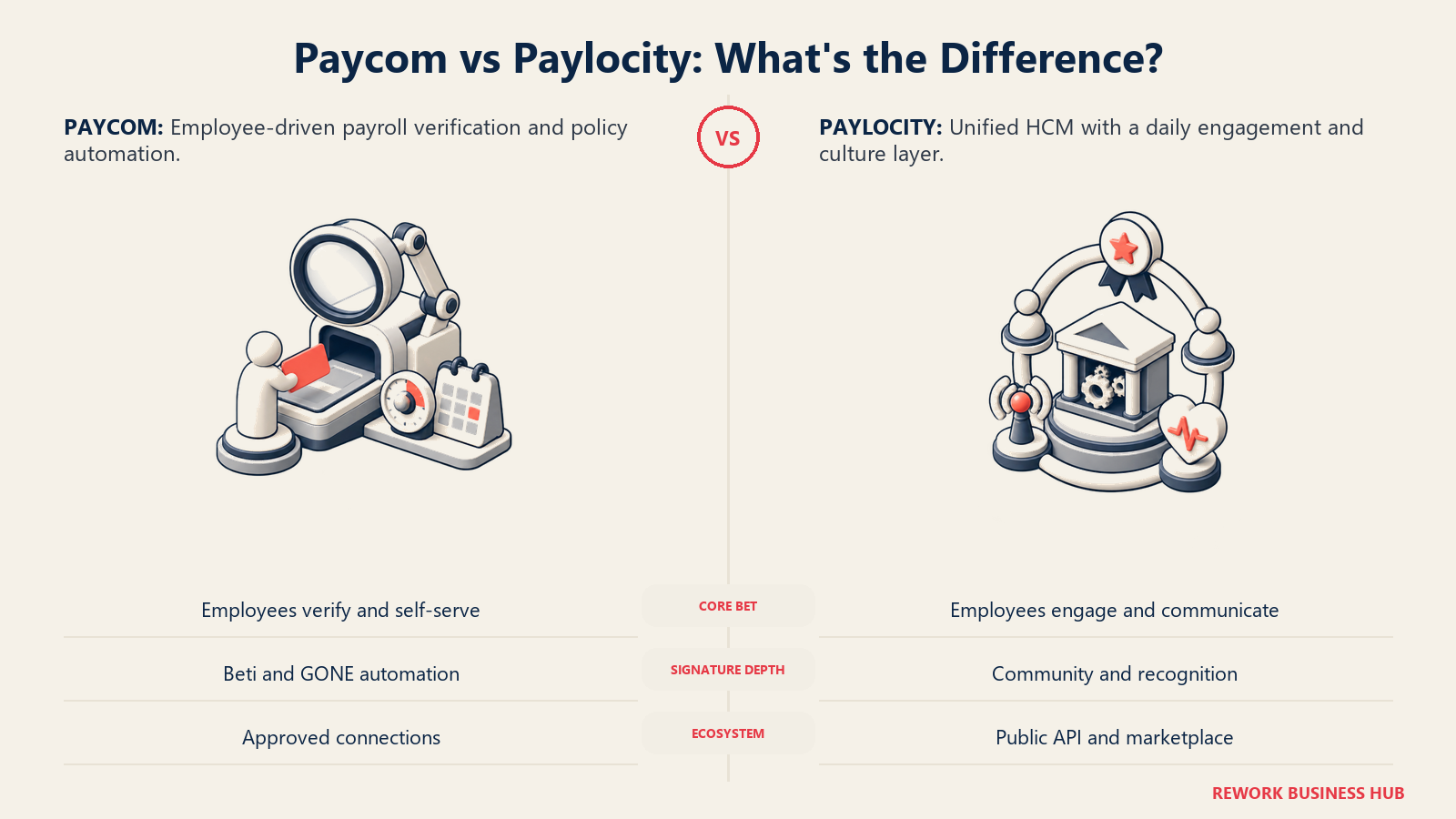
"Both have a unified database" isn't a real answer to "which one should we buy." Paycom built its data model around Beti, an employee-run payroll verification step, and GONE, an automated time-off decision engine, betting that pushing more work and visibility onto employees produces fewer errors. Paylocity built the same foundation, then layered a genuine engagement product on top, betting that a workforce that opens the app for recognition and company news also engages more with its own payroll data. Neither bet is wrong. They produce different products, and the one that fits your team depends on what your HR org is optimizing for this year.
TL;DR
| Paycom | Paylocity | |
|---|---|---|
| What it is | Single database built around employee-driven payroll verification and automated time-off decisioning | Single database built around a genuine employee engagement layer on standard payroll and HR |
| Core mechanism | Beti has employees confirm their paycheck before it runs; GONE auto-decisions time-off against policy rules | Community feed, peer recognition, pulse surveys, and internal video, native to the same product employees use for pay |
| Pricing model | Quote-only, customized to functionality needed and headcount | Quote-only, billed PEPM; rate confirmed not to rise with headcount |
| Reported cost range | $25 to $35 PEPM full suite, or $16 to $22 payroll plus core HR (reported) | $22 to $33 PEPM depending on modules (reported) |
| Integration posture | Closed. No general-purpose public API; connections run through approved partners or middleware | Open. Public developer API plus a marketplace of hundreds of pre-built integrations |
| Implementation timeline | Typically 6 to 12 weeks | Typically 4 to 8 weeks |
| Support model | Dedicated named specialist; strong when good, disruptive on turnover | Standard account management and support queue; slower response, less single-person dependency |
| Best for | Teams wanting payroll accuracy enforced by employee self-verification | Teams wanting a unified database plus a culture layer employees use daily |
Key Facts
- A Forrester Consulting Total Economic Impact study commissioned by Paycom found that automating time-off decisions with GONE delivered up to 821% ROI over three years, saving managers nearly a full workweek of unproductive hours annually, according to Paycom's press room.
- Employees who received high-quality recognition in 2022 were 45% less likely to have left their job by 2024, according to a joint Gallup and Workhuman study that tracked nearly 3,500 employees over two years.
- The average HRIS is actively used by only 32% of employees once it's live, a 2022 Gartner finding still cited as the industry benchmark in SHRM's 2026 analysis of failed HR technology rollouts.
- Paycom holds a 4.4 out of 5 rating across more than 2,800 reviews on G2, while Paylocity holds a 4.5 out of 5 rating across more than 5,100 reviews on G2, both strong scores in a category where switching vendors is a genuine operational risk.
Who Each Tool Is Built For
Paycom sells to HR leaders who want fewer hands touching payroll before it runs. Beti has each employee review and confirm their own paycheck ahead of submission, catching an address change, a missed hour, or a deduction error before it becomes a correction. GONE applies the same philosophy to time off, auto-deciding requests against a policy engine instead of routing every request to a manager's inbox.
Paylocity sells to HR leaders who see engagement as inseparable from HR operations, not a side initiative. Community, peer recognition, pulse surveys, and internal video all live inside the same platform employees use for their paystub. Instead of reducing what employees have to check, Paylocity is trying to raise how often employees open the app at all, on the theory that a platform people use daily catches more of everything, payroll errors included.
| Paycom | Paylocity | |
|---|---|---|
| Natural buying trigger | HR wants payroll accuracy and time-off decisions automated and pushed onto employees, not centralized in HR's queue | HR wants a single platform that also carries the company's communication and recognition program |
| Team maturity assumed | Comfortable asking employees to take on more direct responsibility for their own payroll accuracy | Comfortable investing in a culture and communication program run through the same system as payroll |
| Primary champion | HR director or VP of People accountable for payroll accuracy and HR administrative load | Head of People or HR director building a formal engagement and culture program alongside compliant payroll |
| Company profile that fits best | 100 to 5,000-employee companies with an established HR function ready to shift routine data entry to employees | 100 to 1,000-employee companies formalizing people programs shortly after crossing the 100-employee mark |
Neither company chases the smallest employers or the largest enterprises. Both sell mid-market, both lead with "one database," and the honest split is what each vendor built on top of that database once they had it.
The Single-Database Claim: What It Actually Buys
Both vendors lean hard on "single database" in their marketing, so it's worth being specific about what that claim buys.
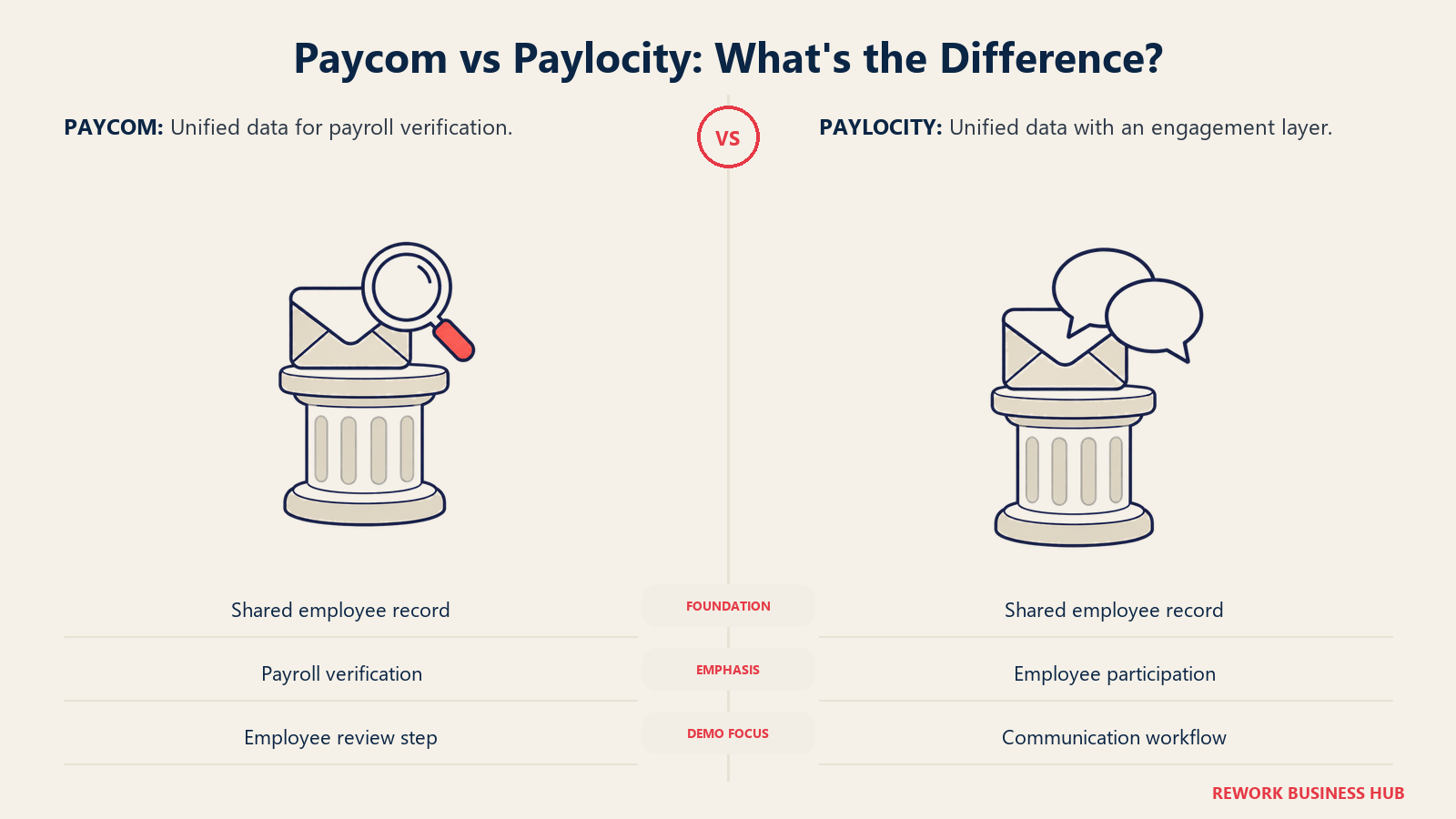
A stitched-together HCM platform, assembled through acquisitions or module partnerships, stores HR, payroll, time, and talent data in separate systems that talk through integrations or nightly syncs. Change an address in the HR module and payroll might not see it until the next sync, exactly the kind of gap that produces a missed direct deposit or a wrong W-2. Paycom and Paylocity both avoid that structurally: one employee record feeds every module in real time.
What the single database doesn't do, on its own, is decide what happens with that unified data. Paycom uses the record to hand payroll verification and time-off decisions to employees directly. Paylocity uses the same record to power a communication and recognition layer that keeps employees inside the platform for reasons that have nothing to do with payroll. If a sales deck leads with "single database" as the whole pitch, ask what they built on top of it, since that's where the two companies genuinely diverge.
| Capability | Paycom | Paylocity |
|---|---|---|
| Single employee record, real-time across payroll, HR, time, talent | Yes | Yes |
| What the unified data is used to drive | Employee-verified payroll (Beti) and automated time-off decisions (GONE) | Employee engagement, recognition, surveys, internal communication (Community) |
| Vendor's own framing of the pitch | Fewer errors from re-keyed or unsynced data | One place employees check daily, so more gets caught in real time |
Beti and GONE: Paycom's Employee-Driven Payroll and Time-Off Engine
This is where Paycom's product philosophy stops being a marketing line and becomes a concrete workflow difference, and the two mechanisms work together rather than separately.
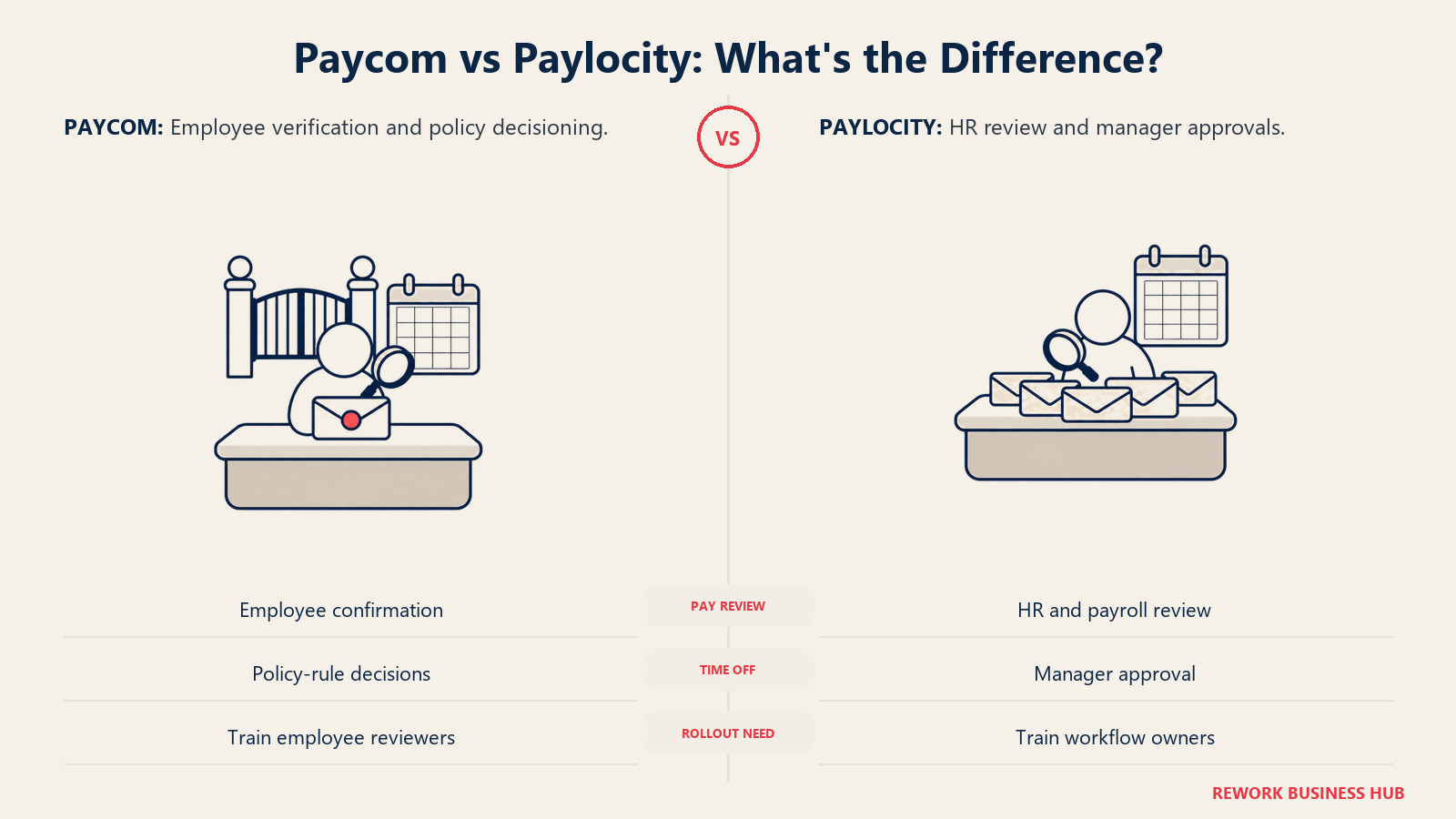
Beti flips the standard payroll review process. Instead of an HR admin or payroll manager reviewing every paycheck before a run, each employee reviews and confirms their own pay, hours, deductions, and any changes, before submission. A Nucleus Research study distributed by Paycom found organizations using Beti cut payroll corrections by more than 80% after implementation, some eliminating post-run corrections entirely. The tradeoff is real: employees now do a review step that used to sit with HR, and that shift needs genuine change management or it reads as more work dumped on the workforce.
GONE, launched in 2023, automates the decision on a time-off request rather than just tracking it. HR sets a decision engine using criteria like staffing needs, consecutive days requested, hours already worked, and seniority, and GONE approves or denies against those rules without a manager reviewing every request. Managers can still override. The Forrester TEI study cited above ties this to real time savings, close to a full workweek annually per manager and nearly five workweeks across HR, finance, and admin staff combined.
Paylocity doesn't have a direct equivalent to either mechanism. Its payroll review process is closer to the traditional model, an HR admin or payroll specialist runs and reviews payroll before submission, with employees able to view but not formally confirm their own pay. Time-off requests route to a manager for approval rather than an automated decision engine.
| Capability | Paycom | Paylocity |
|---|---|---|
| Employee confirms own paycheck before it runs | Yes, named Beti | No, standard HR-reviewed payroll |
| Automated decisioning on time-off requests, manager override available | Yes, named GONE, customizable rule engine | No, requests route to a manager for approval |
| Vendor-reported impact on payroll corrections | More than 80% reduction, per Nucleus Research (Paycom-distributed) | Not applicable, no equivalent mechanism |
| Change management burden | Real, employees take on a review step that used to sit with HR | Lower, since the review workflow doesn't change |
Paylocity's Engagement Layer: Community, Recognition, Surveys, and Video
Where Paycom's differentiator lives in payroll and time-off mechanics, Paylocity's lives almost entirely in what it built for the parts of HR that aren't payroll at all.
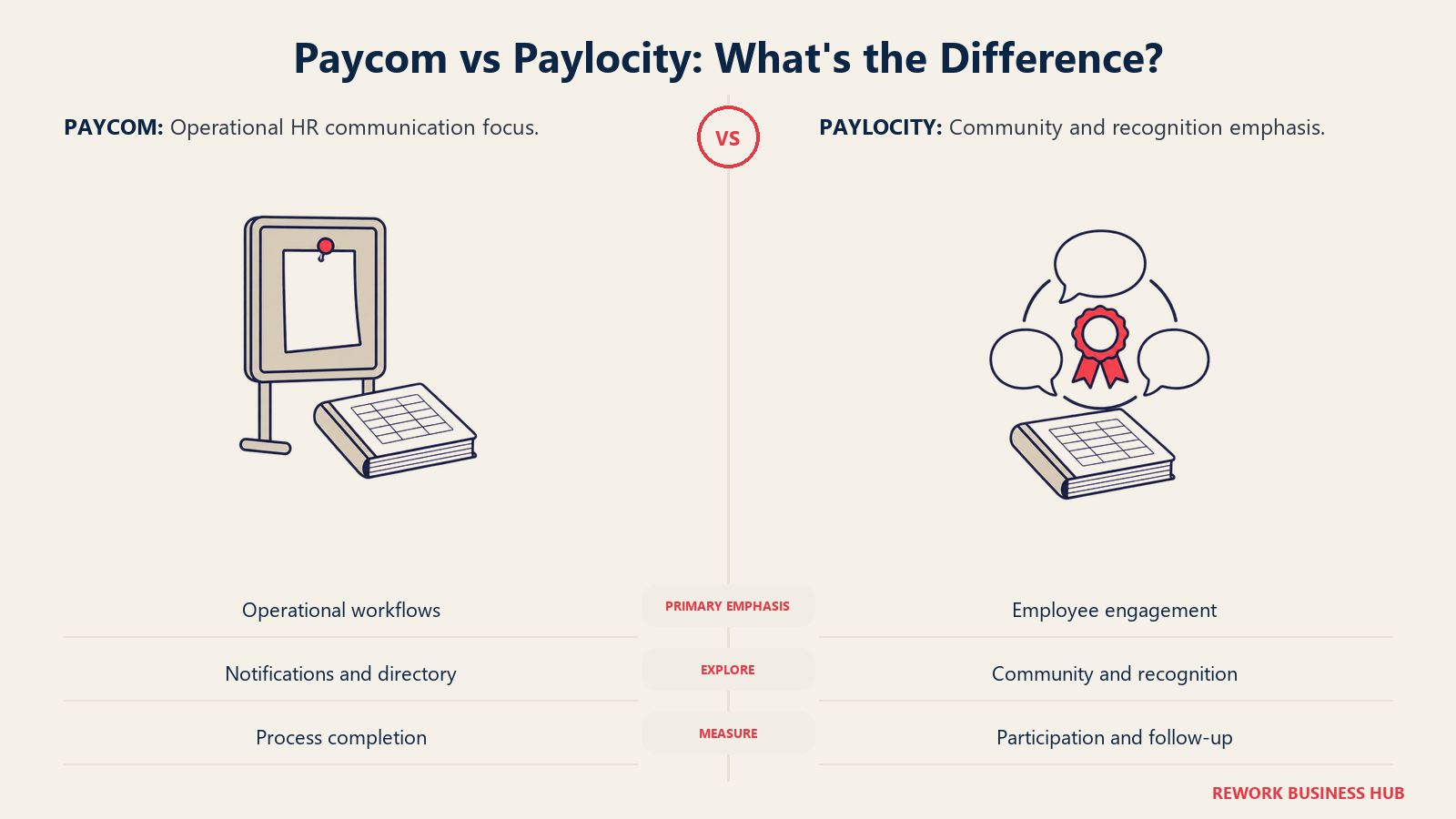
Community is Paylocity's social collaboration hub: a company feed, discussion groups, peer-to-peer recognition, employee profiles, and directory search, all inside the same login employees use for their paystub and benefits. Recognition and Rewards sits alongside it as its own product, built to help HR run structured recognition programs rather than leave culture-building to a Slack channel disconnected from HR systems. Surveys uses a research-backed engagement model built by Paylocity's own data scientists to produce an engagement score HR can track over time instead of a generic pulse-check. Premium Video lets leaders share company-wide updates directly inside Community, and Paylocity has reported video usage nearly tripling in prior growth periods as clients folded it into onboarding, learning, and recruiting content.
The Gallup and Workhuman finding in Key Facts above, 45% lower turnover for well-recognized employees over a two-year window, is third-party evidence this layer is more than a nice-to-have for a company worried about attrition. It's not proof Paylocity's specific tools produce that outcome, but it does confirm the underlying behavior the product encourages has a measured relationship to retention.
Paycom's equivalent tools exist but are thinner: standard company-wide notifications and a directory, with focus staying on operational workflows rather than a dedicated social or recognition layer.
| Capability | Paycom | Paylocity |
|---|---|---|
| Company social feed / discussion hub | No dedicated equivalent | Yes, named Community |
| Peer-to-peer recognition tool | Basic notifications only | Yes, dedicated Recognition and Rewards product |
| Structured, scored engagement surveys | Standard survey tooling | Yes, research-backed score built by in-house data scientists |
| Native internal video for company updates | No dedicated equivalent | Yes, named Premium Video |
| Where the layer sits in the product | Secondary to payroll and time-off automation | Core, cross-selling into Learning, Onboarding, Recruiting |
Payroll and Tax Depth
Both platforms run full-service US payroll with tax filing built in, and neither is meaningfully weaker on core mechanics like multi-state tax handling, garnishments, or year-end filings. The difference is workflow, not depth: Paycom's engine shifts the payroll team's job from catching errors to reviewing what employees already confirmed via Beti, while Paylocity runs a conventional review-and-submit process backed by exception reports flagging unusual pay, missing timesheets, or out-of-range deductions.
| Capability | Paycom | Paylocity |
|---|---|---|
| Multi-state tax handling, automated filing (federal, state, local) | Yes | Yes |
| Garnishment processing, off-cycle and bonus runs | Yes | Yes |
| Primary error-catching mechanism | Employee self-verification via Beti, before the run | HR/payroll review plus exception reporting |
| Year-end filing (W-2, 1099) | Included | Included |
Time and Attendance, Scheduling
Time and attendance is where GONE gives Paycom its clearest edge for a company with meaningful time-off volume, since the decisioning engine is purpose-built for that friction point. Both platforms cover the fundamentals: mobile clock-in, geofencing, overtime alerts, and scheduling tools synced directly with the same payroll engine. Neither is a specialist scheduling platform, though, so a company with genuinely complex shift patterns, union rules, or predictive-scheduling-law exposure across many locations should evaluate both against a category specialist rather than assume either HCM's time module goes deep enough alone.
| Capability | Paycom | Paylocity |
|---|---|---|
| Mobile time clock with GPS/geofencing, overtime alerts | Yes | Yes |
| Time-off request decisioning | Automated via GONE, policy-rule engine | Manager-approved, standard workflow |
| Scheduling tools, synced to payroll data | Standard | Standard |
| Fit for complex, multi-location shift work | Moderate, stronger via GONE for time-off volume | Moderate, comparable depth without decisioning automation |
Benefits Administration
Both platforms run open enrollment, carrier connections (EDI), and benefits eligibility tracking natively inside the same database that runs payroll, avoiding the reconciliation gap between separate benefits and payroll systems. Paylocity's benefits workflows lean on Community to drive enrollment engagement, sending reminders through the channel employees already check daily. Paycom's benefits administration is solid but more purely transactional, without that communication layer wrapped around it.
| Capability | Paycom | Paylocity |
|---|---|---|
| Native open enrollment, carrier EDI connections | Yes | Yes |
| Benefits eligibility tied to real-time HR data | Yes | Yes |
| ACA compliance tracking and reporting | Yes | Yes |
| Enrollment communication and reminders | Standard notifications | Delivered through Community, tied to the engagement layer |
Talent Acquisition and Onboarding
Both platforms include applicant tracking and onboarding as native modules, so a candidate who accepts an offer flows straight into the employee record without re-entry.
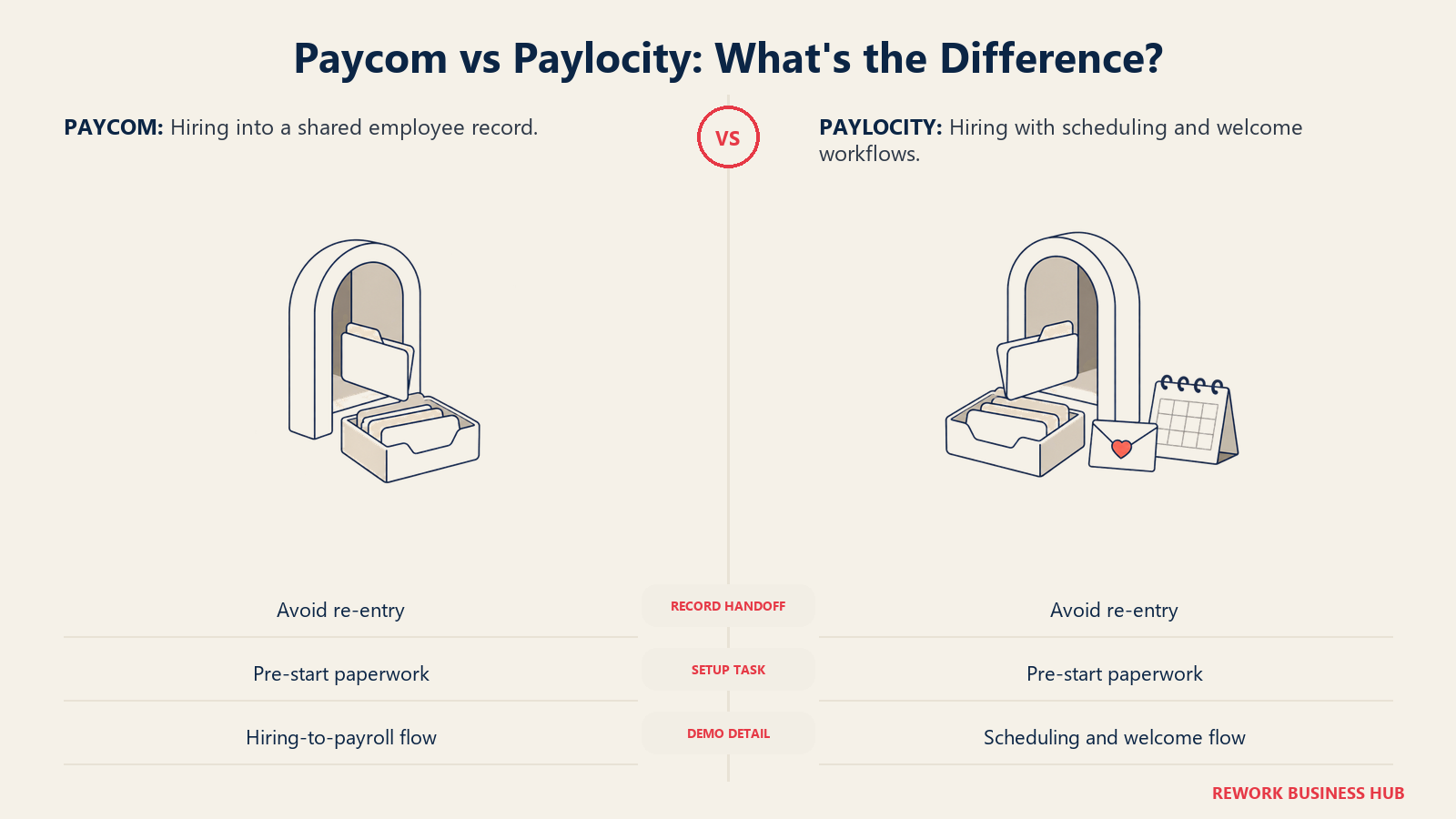
Paycom's applicant tracking automatically posts open roles to job boards, parses resumes to pre-fill candidate profiles, and pushes hired candidates into onboarding and background checks with no re-entry. New-hire onboarding lets employees complete paperwork and set up direct deposit before their first day. Paylocity's ATS covers the same workflow and adds calendar integrations with Gmail, Outlook, and iCloud plus generative AI to help write job descriptions and interview invites. Its onboarding product, sold under Paylocity Guide, handles I-9 verification and lets teammates leave welcome notes for new hires.
| Capability | Paycom | Paylocity |
|---|---|---|
| Native applicant tracking, resume parsing and auto-fill | Yes | Yes |
| Calendar integration for interview scheduling | Standard | Yes, native Gmail, Outlook, iCloud sync |
| Generative AI for job descriptions/interview invites | Not a named feature | Yes |
| Paperless onboarding before day one, no re-entry to employee record | Yes | Yes, includes teammate welcome notes |
LMS and Performance Management
Learning and performance management are native modules on both platforms rather than add-ons, worth noting since several competitors (BambooHR, isolved, various PEOs) treat one or both as a paid bolt-on.
Paycom's talent tools tie training assignments directly to performance reviews, so a manager can auto-assign a course based on a review outcome and track completion in the same system. Its performance tooling can tie merit pay updates directly to outcomes since it's the same payroll engine underneath. Paylocity's LMS tracks development against retention and productivity goals, and its performance suite, sold under Paylocity Perform, includes formal goal management and 360-degree feedback rather than a single-rater model.
| Capability | Paycom | Paylocity |
|---|---|---|
| Native LMS | Yes | Yes, sold under Paylocity Guide |
| Native performance review tooling and goal management | Yes | Yes, sold under Paylocity Perform |
| 360-degree feedback | Not a named core feature | Yes |
| Auto-assigned training tied to review outcomes | Yes | Not a named integration |
| Merit pay updates tied directly to review outcomes | Yes, same payroll engine | Standard compensation management workflow |
Reporting and Analytics
Both vendors ship standard and custom reporting, with dashboards for headcount, turnover, labor cost, and compliance metrics pulled from the same live database that runs payroll, so reports don't lag behind a sync job. Neither is a dedicated BI platform, so a company cross-referencing HR data against sales or operations metrics will likely still export to a BI tool either way.
| Capability | Paycom | Paylocity |
|---|---|---|
| Pre-built and custom reports | Yes | Yes |
| Real-time dashboards (headcount, turnover, labor cost) | Yes | Yes |
| Compliance reporting (ACA, EEO-1, etc.) | Yes | Yes |
| Engagement-specific reporting (survey scores over time) | Not a core focus | Yes, tied to Surveys' scoring model |
Integrations and Open API Posture
This is one of the sharpest structural differences between the two, worth flagging plainly for any HR team already running a meaningful tech stack alongside payroll.
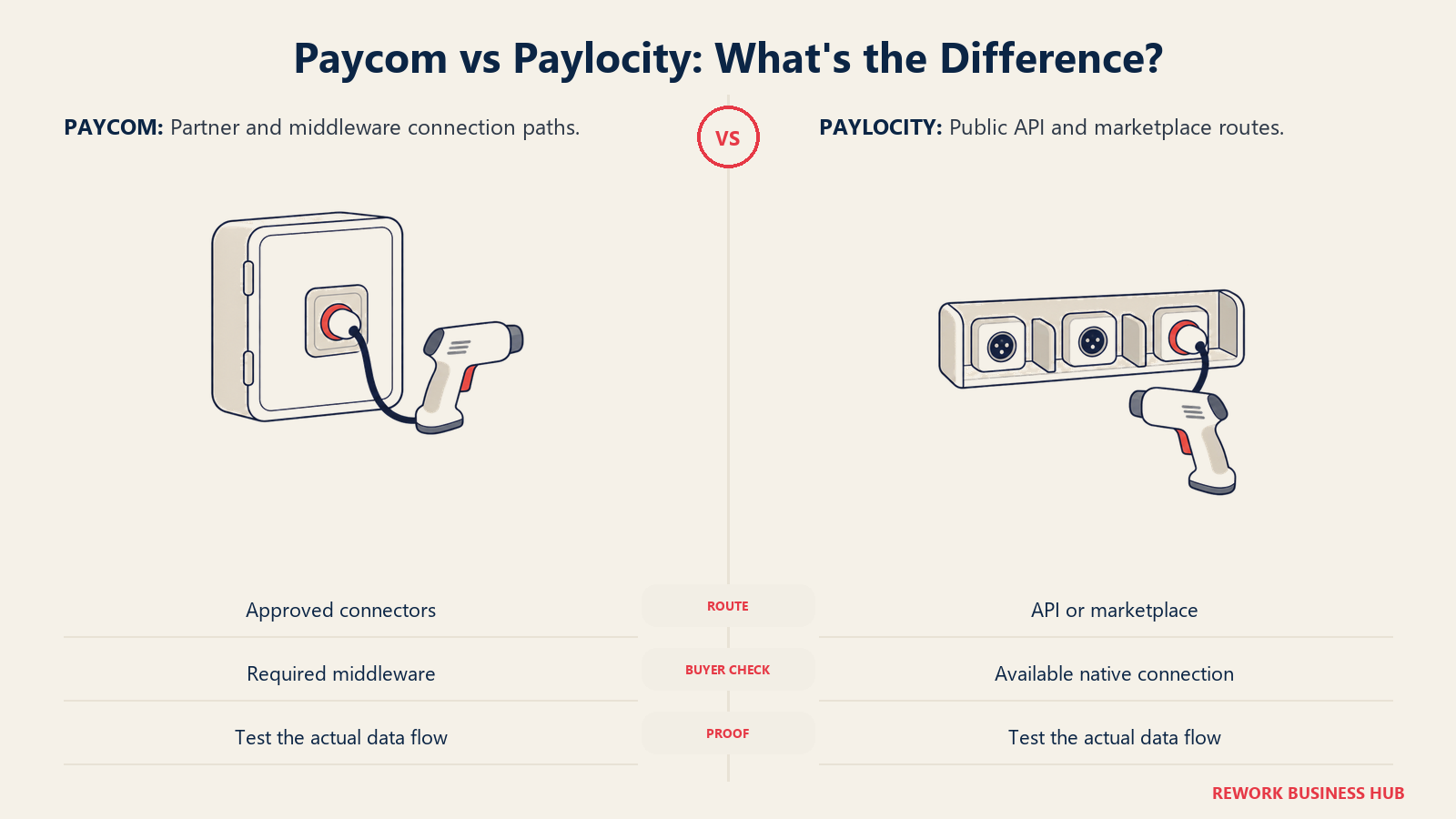
Paycom does not offer a general-purpose public API. Third-party connections run through approved partner integrations, middleware like Finch or Merge, or bulk CSV and SFTP transfers. That's deliberate, not an oversight: Paycom's pitch is that you shouldn't need many integrations because everything already lives in one database. The tradeoff shows up the moment a company wants to connect a specialized applicant tracking system, an external learning platform, or a BI tool it didn't get from Paycom itself. Reviewers describe those connections as workable but more painful than on more open platforms.
Paylocity takes the opposite approach: open, developer-friendly APIs and a Marketplace listing hundreds of pre-built integrations, with an Accelerate Partner Program built to bring technology vendors into that ecosystem. Teams without an in-house dev team can also build a Paylocity integration through Merge's embedded platform. For an HR team that already needs other systems to talk to payroll data, this is a real, structural advantage over Paycom's closed-by-design model.
| Capability | Paycom | Paylocity |
|---|---|---|
| Public, general-purpose developer API | No | Yes |
| Pre-built integration marketplace | No, connections run through approved partners/middleware | Yes, hundreds of listed integrations |
| Partner program for technology vendors | Limited | Yes, named Accelerate Partner Program |
| Typical path to connect a non-native tool | Middleware (Finch, Merge) or CSV/SFTP | Native Marketplace listing or direct API |
Implementation Timeline and Effort
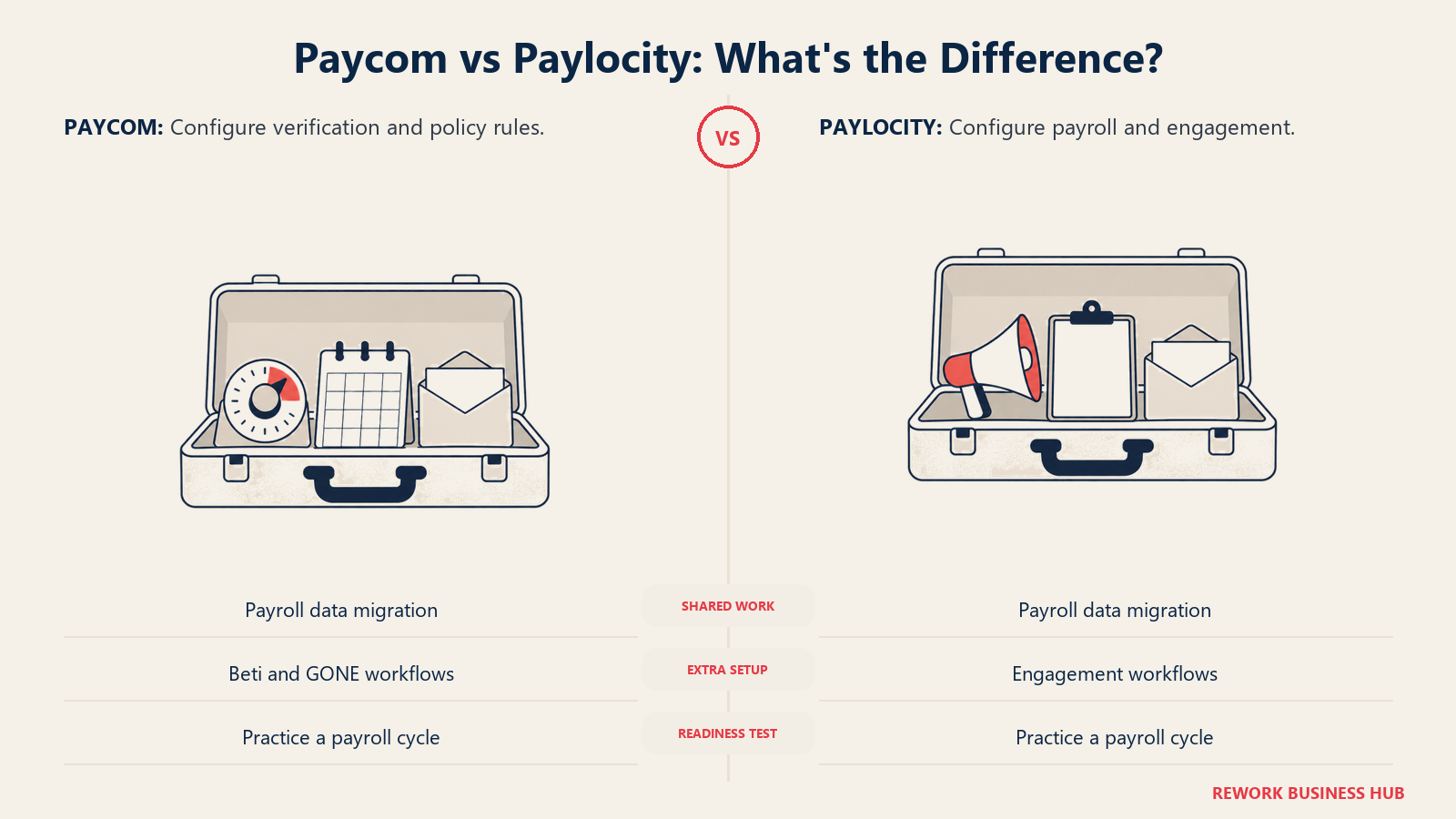
Paylocity generally goes live faster than Paycom for a comparable mid-market rollout, according to SaaSRat's 2026 mid-market payroll implementation analysis: 4 to 8 weeks to a clean first payroll versus Paycom's 6 to 12 weeks. Part of that gap is Beti and GONE themselves, since standing up an employee-verification workflow and a rules-based decision engine both take real configuration time beyond a standard data migration. Paylocity's rollout adds its own layer too, setting up Community, Recognition, and Surveys, but that tends to add less critical-path time than configuring a policy engine that has to be right before it can safely make automated decisions.
| Factor | Paycom | Paylocity |
|---|---|---|
| Typical timeline, mid-market rollout | 6 to 12 weeks | 4 to 8 weeks |
| What drives the timeline | Beti and GONE configuration on top of standard migration | Data migration plus engagement feature setup |
| Implementation fee (reported) | Roughly 15 to 35% of annual contract | Roughly 10 to 20% of annual software cost |
Support Model and Account-Rep Variability
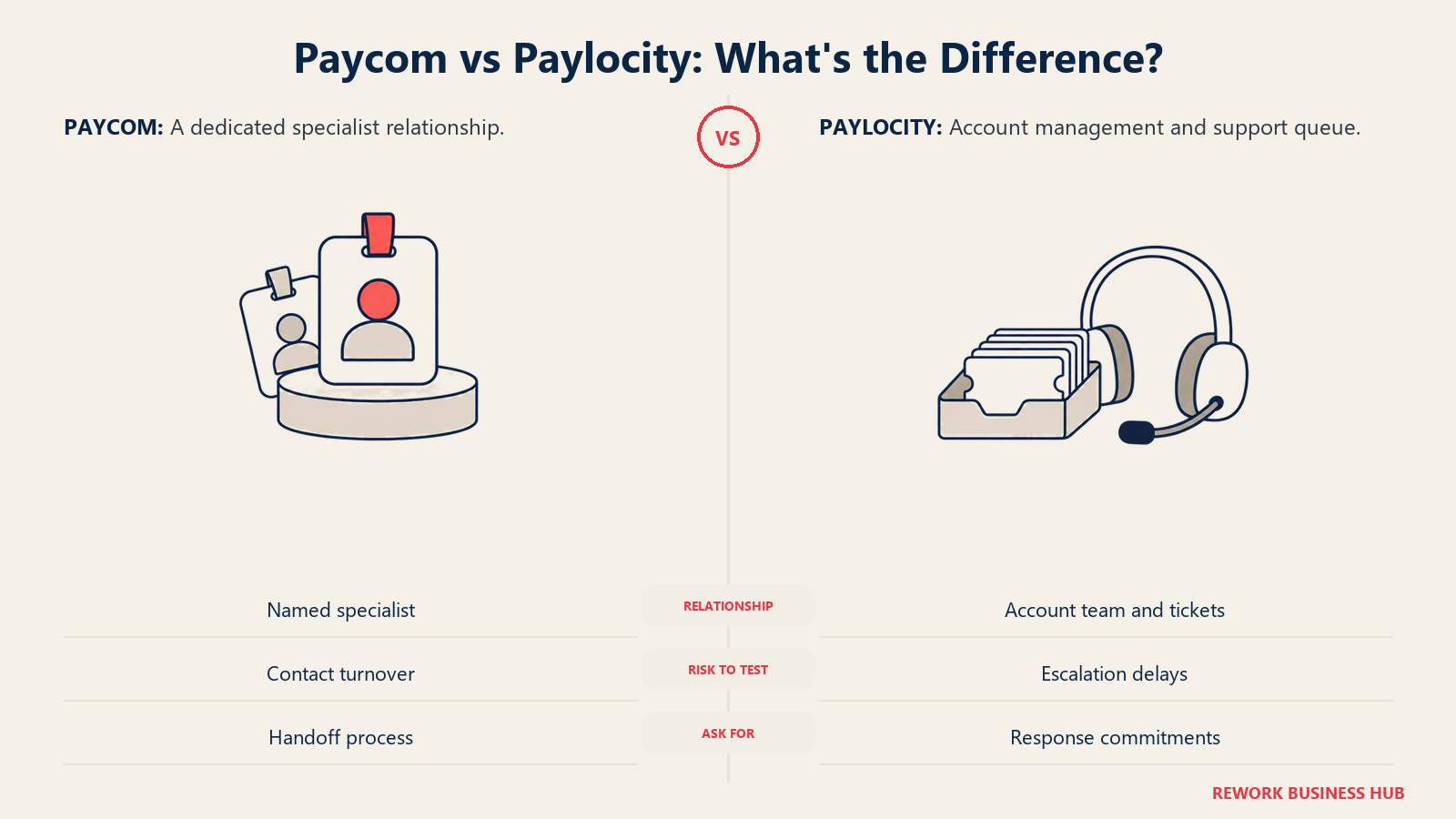
Both vendors' review histories point to the same pattern: support quality depends heavily on which individual gets assigned to your account, not a documented service tier. Paycom assigns each account a dedicated, named payroll specialist, consistently the most-praised part of the experience when it works, but the catch raised repeatedly across review platforms is turnover: some customers report a new specialist roughly every six months, resetting the relationship without proactive notice. Paylocity uses a more conventional account-management and support-ticket model. Review patterns there skew toward slower response times, multi-day ticket resolution, and complaints that an account manager sometimes lacks authority to resolve an issue directly and has to escalate regardless.
| Factor | Paycom | Paylocity |
|---|---|---|
| Support structure | Dedicated named specialist per account | Account manager plus general support queue |
| Most common complaint | Specialist turnover resets the relationship, sometimes without notice | Slower response times, escalations for issues a manager can't resolve directly |
| Predictability | High variance, tied to one person | More consistent structurally, but response speed varies |
Contract and Renewal Behavior
Neither vendor publishes standard contract terms, so this is buyer guidance rather than a fixed number, worth confirming with your rep before signing either way. Both typically sell on annual or multi-year agreements with auto-renewal clauses, commonly a 60 to 90 day notice window, and both are known in the vendor-pricing-benchmarking community to include an annual increase at renewal tied to "then-current pricing" rather than a fixed percentage, negotiable at signing but hard to walk back later.
| Factor | Paycom | Paylocity |
|---|---|---|
| Typical contract length | Annual, with multi-year options | Annual, sometimes initial terms up to three years |
| Auto-renewal | Yes, standard | Yes, standard |
| What to negotiate before signing | A capped renewal increase, and what a "module" price covers going forward | A capped renewal increase, and which engagement features stay in the base price |
Pricing: Why Neither Publishes a Number, and How to Structure Your Quote Comparison
Here's the plain fact worth sitting with before you request a demo: Paycom states each quote is customized to the functionality a company needs and its headcount, and Paylocity confirms it bills per employee per month but publishes no rate, only that the per-employee price doesn't rise as headcount grows. Neither is being cagey by accident. Both have decided a published price list would let competitors undercut them on the specific modules a prospect needs, and both would rather run a sales conversation that flexes around what you'll actually pay for.
That's a feature of this category, not a gap in this comparison. Spend less energy chasing a number neither vendor will confirm and more controlling what you can. Third-party trackers report Paycom in the $25 to $35 PEPM range for the full suite (or $16 to $22 for payroll plus core HR), and Paylocity in the $22 to $33 PEPM range, per Outsail's Paycom breakdown and Outsail's Paylocity breakdown. Treat both as directional ranges to sanity-check a quote against, never as a confirmed number.
What you can control is making sure both quotes are built on the same terms before comparing a dollar figure. Line items that tend to surface after the demo: implementation fees (reported at 15 to 35% of annual contract for Paycom, 10 to 20% for Paylocity), per-module pricing for talent acquisition, learning, or performance if not bundled in, year-end filing fees, and the renewal escalation clause above.
| Line item | Ask both vendors this exact question |
|---|---|
| Base PEPM rate | What is the per-employee monthly rate at our exact headcount, and does it change at any threshold? |
| Included modules | Which modules are in the base quote, and which (talent acquisition, learning, advanced analytics) are priced separately? |
| Implementation fee | What is the one-time fee, as a flat number and as a percentage of annual contract value? |
| Year-one vs year-two cost | What does the bill look like once the implementation fee rolls off, and does the base rate change? |
| Renewal terms and support tier | What is the auto-renewal notice window and price-increase clause, and is a named specialist or account manager guaranteed? |
Run both vendors through this same worksheet before comparing a single number. A quote that looks cheaper on the PEPM line can end up costing more in year one once implementation and module fees land, and a quote that looks pricier up front can be the better deal once a renewal cap is negotiated in.
Who Should Pick Paycom
- Payroll accuracy is the top priority and you're comfortable shifting paycheck verification onto employees, with the change management that requires
- Time-off request volume is high enough that an automated decision engine (GONE) would meaningfully cut manager and HR workload
- You want a closed, single-vendor ecosystem and don't have an existing tech stack that needs an open API into payroll
- You're comfortable with a dedicated-specialist support model and the variability that comes with it
- Your company sits in the 100 to 5,000-employee range with an established HR function ready to hand employees more responsibility
Who Should Pick Paylocity
- Employee engagement and internal communication are a real, funded priority alongside compliant payroll, not an afterthought
- You want one platform carrying recognition, pulse surveys, and internal video, rather than a separate engagement tool bolted onto HR
- You already run other systems (BI tools, recruiting platforms, internal apps) that need to talk to payroll data through an open API
- You want a faster implementation timeline and are comfortable with a standard account-management structure over one named specialist
- Your company recently crossed 100 employees and is formalizing people programs for the first time
Decision Framework
| If you are... | Pick |
|---|---|
| Optimizing hardest for payroll accuracy, or managing high time-off volume | Paycom |
| Building a genuine culture and engagement program inside your HR platform | Paylocity |
| Needing an open API and integration marketplace for an existing tech stack | Paylocity |
| Prioritizing the fastest realistic implementation timeline | Paylocity |
| Considering a deeper compliance bench or wider integration marketplace than either | ADP Workforce Now |
| Wanting HR and IT provisioning unified alongside payroll | Rippling |
| Above 1,000 employees and outgrowing both platforms | Workday |
What to Do Next
- Name your real priority before the first demo. Payroll accuracy and time-off volume, weight the Beti and GONE demos heavily. Engagement and culture, spend the time in Paylocity's Community, Recognition, and Surveys products, not just its payroll screens.
- Run the quote-comparison worksheet above with both vendors, not a single PEPM number. Get the full year-one and year-two cost in writing, including implementation and per-module fees.
- Check your existing tech stack against each vendor's integration posture. Tools that need to pull from or push to payroll data make Paylocity's open API and Marketplace a real structural advantage over Paycom's closed model.
- Ask directly about specialist turnover (Paycom) or response-time SLAs (Paylocity) before signing, the most commonly cited friction points in reviews of each platform.
- Still building the shortlist? Best Paycom alternatives and best Paylocity alternatives cover the wider field, and how to choose payroll software plus how to choose HR software are worth reading before any vendor call. If part of your workforce sits outside the US, see Deel vs Remote for that layer, since neither platform replaces a dedicated global payroll tool. And if the underlying question is whether to run HR in-house at all, the best PEO services for small business roundup covers the outsourced route these two platforms are the alternative to.
Frequently Asked Questions about Paycom vs Paylocity
Is Paycom or Paylocity cheaper?
Neither publishes pricing. Third-party trackers report Paycom around $25 to $35 PEPM for the full suite and Paylocity around $22 to $33 PEPM, but both are directional estimates, not vendor-confirmed numbers. The only way to know your real cost is a quote built against your exact headcount and module mix.
What is Beti and how is it different from standard payroll review?
Beti is Paycom's employee-driven payroll verification tool. Instead of HR or a payroll manager reviewing every paycheck before a run, each employee reviews and confirms their own pay before submission. A Nucleus Research study distributed by Paycom found this cut payroll corrections by more than 80% at organizations that implemented it. Paylocity uses a more conventional HR-reviewed process with no equivalent employee-verification step.
What does GONE do?
GONE is Paycom's automated time-off decision engine, launched in 2023. HR sets rules based on staffing needs, consecutive days requested, hours already worked, and seniority, and GONE approves or denies requests against those rules automatically, with managers able to override. Paylocity has no direct equivalent; requests route to a manager for approval.
Which platform has better integrations?
Paylocity, by a meaningful margin. It publishes an open developer API and runs a Marketplace listing hundreds of pre-built integrations, plus an Accelerate Partner Program for technology vendors. Paycom offers no general-purpose public API; third-party connections run through approved partners, middleware like Finch or Merge, or bulk CSV and SFTP transfers.
How long does implementation take for each platform?
Paylocity typically runs 4 to 8 weeks to a clean first payroll for a mid-market rollout, versus 6 to 12 weeks for Paycom, per SaaSRat's 2026 mid-market payroll analysis. Paycom's longer timeline is largely driven by configuring Beti and GONE's policy-rule engine before go-live.
Should I ask about renewal price increases before I sign either contract?
Yes. Both vendors typically sell on annual or multi-year agreements with auto-renewal clauses and a renewal increase tied to "then-current pricing" rather than a fixed number. Get the renewal-increase language in writing and negotiate a cap before signing, not after your first renewal notice arrives.
Related Resources:

Principal Product Marketing Strategist
On this page
- TL;DR
- Key Facts
- Who Each Tool Is Built For
- The Single-Database Claim: What It Actually Buys
- Beti and GONE: Paycom's Employee-Driven Payroll and Time-Off Engine
- Paylocity's Engagement Layer: Community, Recognition, Surveys, and Video
- Payroll and Tax Depth
- Time and Attendance, Scheduling
- Benefits Administration
- Talent Acquisition and Onboarding
- LMS and Performance Management
- Reporting and Analytics
- Integrations and Open API Posture
- Implementation Timeline and Effort
- Support Model and Account-Rep Variability
- Contract and Renewal Behavior
- Pricing: Why Neither Publishes a Number, and How to Structure Your Quote Comparison
- Who Should Pick Paycom
- Who Should Pick Paylocity
- Decision Framework
- What to Do Next