Best OptinMonster Alternatives in 2026: 14 Popup and Lead Capture Tools

Turn this article into takeaways for your work.


Each assistant summarizes the article only for you and suggests best practices for your work.
The best OptinMonster alternative for most teams depends on what you actually need once the popup fires: Poptin and Getsitecontrol if you want a real free tier and a lightweight email tool bundled in, Privy or Klaviyo if you're on Shopify and want popups tied to revenue attribution, Wisepops or Justuno if you want a managed, strategy-led service instead of self-serve software, and Rework (at #6) if your real bottleneck isn't capturing more emails, it's what happens to the leads after they're captured. OptinMonster itself is a genuinely capable, feature-dense popup and lead-capture builder with strong exit-intent detection, A/B testing, and a large template library, and plenty of teams should stay on it for exactly that reason.
But look closely at OptinMonster's own pricing page and you'll find a 60%-off-for-12-months promo running on every tier, which means the price you see is not the price you'll pay in year two. This guide evaluated all 14 tools below on published pricing (with monthly versus annual billing, and promotional versus renewal pricing, stated explicitly), free-tier caps from the vendor's own page, and real fit for the job a popup tool does: getting a visitor's email address before they leave. A popup is only one tactic inside a wider lead magnet strategy, so treat the tool choice below as one piece of that bigger picture rather than the whole plan.
Key Facts
- The average popup conversion rate across more than 1 billion displays was 4.82% in 2026, up from 4.65% the year before. (Wisepops, 2026 Popup Statistics)
- A separate benchmark of more than 10,000 popup campaigns put the average conversion rate at 3.49%, with an average interaction (open) rate of 7.05%. (Popupsmart, 2025 Popup Conversion Benchmark Report)
- The top 10% of A/B-tested popup campaigns converted 26.83% of visitors on average, nearly six times the category median. (Wisepops, 2026 Popup Statistics)
- The average ecommerce cart abandonment rate sits at 70.22% across 50 studies, which is the underlying reason exit-intent popups exist as a category at all. (Baymard Institute, Cart Abandonment Rate Statistics)
- Google has ranked mobile pages lower since January 2017 when a popup covers the main content immediately after a visitor taps through from a mobile search result, with exceptions for cookie and age-verification banners. (Google Search Central, Helping Users Easily Access Content on Mobile)
The Promo Price Isn't the Price: OptinMonster's Renewal Math
OptinMonster's pricing page currently runs a 60%-off promotion for the first 12 months on every plan, billed annually. That's a real discount, and it's also the single most misleading number in this category if you only read the headline. Here is what you actually pay in year one and what the plan renews at in year two, both figures printed together because almost nothing else written about this tool does that:
| Tier | Sites | Impressions/mo | Promo price (year one) | Renewal price (year two) |
|---|---|---|---|---|
| Basic | 1 | 2,500 | $7/month ($84/yr) | $210/year |
| Plus | Up to 2 | 10,000 | $19/month ($228/yr) | $570/year |
| Pro | Up to 3 | 25,000 | $29/month ($348/yr) | $870/year |
| Growth | Up to 5 | 100,000 | $49/month ($49/yr, first year) | $1,470/year |
There's no free plan, only a 14-day refund guarantee. And OptinMonster meters on two axes at once, monthly impressions and number of sites, which is a different cost model from most of the tools below: Poptin and Getsitecontrol meter on visitors or widget views, Privy and Sleeknote meter on pageviews or contacts, and Klaviyo, Brevo, and Mailchimp meter on contacts or emails sent. A reader comparing OptinMonster's "$7/month" against a competitor's "$9/month" is very often comparing a 12-month promo against that competitor's permanent price, and comparing an impression cap against a contact cap. Neither comparison means much without both numbers on the table, which is why the table below exists.
Quick Comparison Table
| Tool | Best For | Starting Price | Key Strength | Key Limitation |
|---|---|---|---|---|
| Poptin | Budget-conscious SMBs wanting popups plus a lightweight email tool | Free (1,000 visitors/mo); $25/mo (Basic, $240/yr annual) | Real free tier, popups and email in one product | Visitor caps get pricey fast once you outgrow Basic |
| Privy | Shopify and BigCommerce stores wanting popups tied to email/SMS | $24/mo (popups only, 10,000 views); $30/mo (email bundle, 1,500 contacts) | Deep native ecommerce integrations | Two different pricing axes (views vs contacts) for two different plans |
| Justuno | Mid-size ecommerce brands wanting AI personalization, not just popups | $59/mo (Lite, 10,000 visitors) | AI-driven onsite recommendations beyond basic popups | No free plan; entry tier's visitor cap is tight for the price |
| Wisepops | Larger ecommerce or media sites wanting a managed popup service | From EUR 499/mo (custom quote after audit) | Hands-on strategy and creative support, not just software | Far pricier than every other tool here; pricing is opaque until a sales call |
| Klaviyo (Sign-Up Forms) | Ecommerce brands wanting forms and email/SMS in one Shopify-native tool | Free (250 profiles); $20/mo (251-500 profiles) | Forms feed straight into Shopify-native flows and revenue attribution | Not a standalone popup tool; you buy the whole platform for the forms |
| Rework | Routing and working the leads a popup captures | Marketing Engine from $99/mo billed yearly (5 seats) | Native lead scoring, routing, and a multi-channel inbox for captured leads | No popup builder, no exit-intent triggers, no on-site display targeting |
| ConvertBox | WordPress and agency users wanting a one-time payment instead of a subscription | Reported ~$495 one-time (if the lifetime offer is live) | Potential one-time payment, no recurring fee | Pricing model itself is inconsistent and hard to verify at time of purchase |
| Thrive Leads | WordPress site owners already using (or open to) other Thrive Suite tools | $299/yr (Thrive Suite, 5 sites; not sold standalone) | Deep A/B testing and conversion templates built for WordPress | Can't buy Thrive Leads alone anymore; WordPress only |
| Sleeknote | Ecommerce and content brands wanting on-brand, less "salesy" popups | From EUR 49/mo billed annually (up to 25,000 visitors) | Strong design templates and optional gamification | Priced in EUR; gamification costs extra on top of the base tier |
| Getsitecontrol | Small sites wanting a real free popup tool plus optional email | Free (10,000 widget views/mo); $19/mo (Pro, 100,000 views) | Genuine free tier still exists; email billed separately by volume | Pricing is per site, costly for agencies running many client sites |
| Hello Bar | Simple notification bars and basic popups for small sites | Free (5,000 views/mo); $29/mo (Growth, 50,000 views) | Real free tier, fast setup | Free tier keeps Hello Bar branding; A/B testing locked behind Growth+ |
| Unbounce (Popups and Sticky Bars) | Teams wanting landing pages and popups from one vendor | $22/mo billed annually ($29 monthly), 5 pages, 500 visits | Popups and sticky bars bundled free with a real landing-page builder | Starter and Build are 1 user only; Starter's 500-visit cap is tiny |
| Brevo (Forms Plus Email) | Teams wanting a form widget bundled into a generous free email platform | Free (100,000 contacts, 300 emails/day); from $9/mo (reported) | Forms, email, SMS and chat under one roof, billed by send volume | Forms are a secondary feature bolted onto email, not a dedicated tool |
| Mailchimp (Pop-Up Forms) | Teams already on Mailchimp wanting a basic on-site form for free | Free (250 contacts, 500 sends/mo); from $13/mo (Essentials) | Pop-up forms are free and wired straight into Mailchimp audiences | Free tier capped at 250 contacts; popup has no A/B testing or deep triggers |
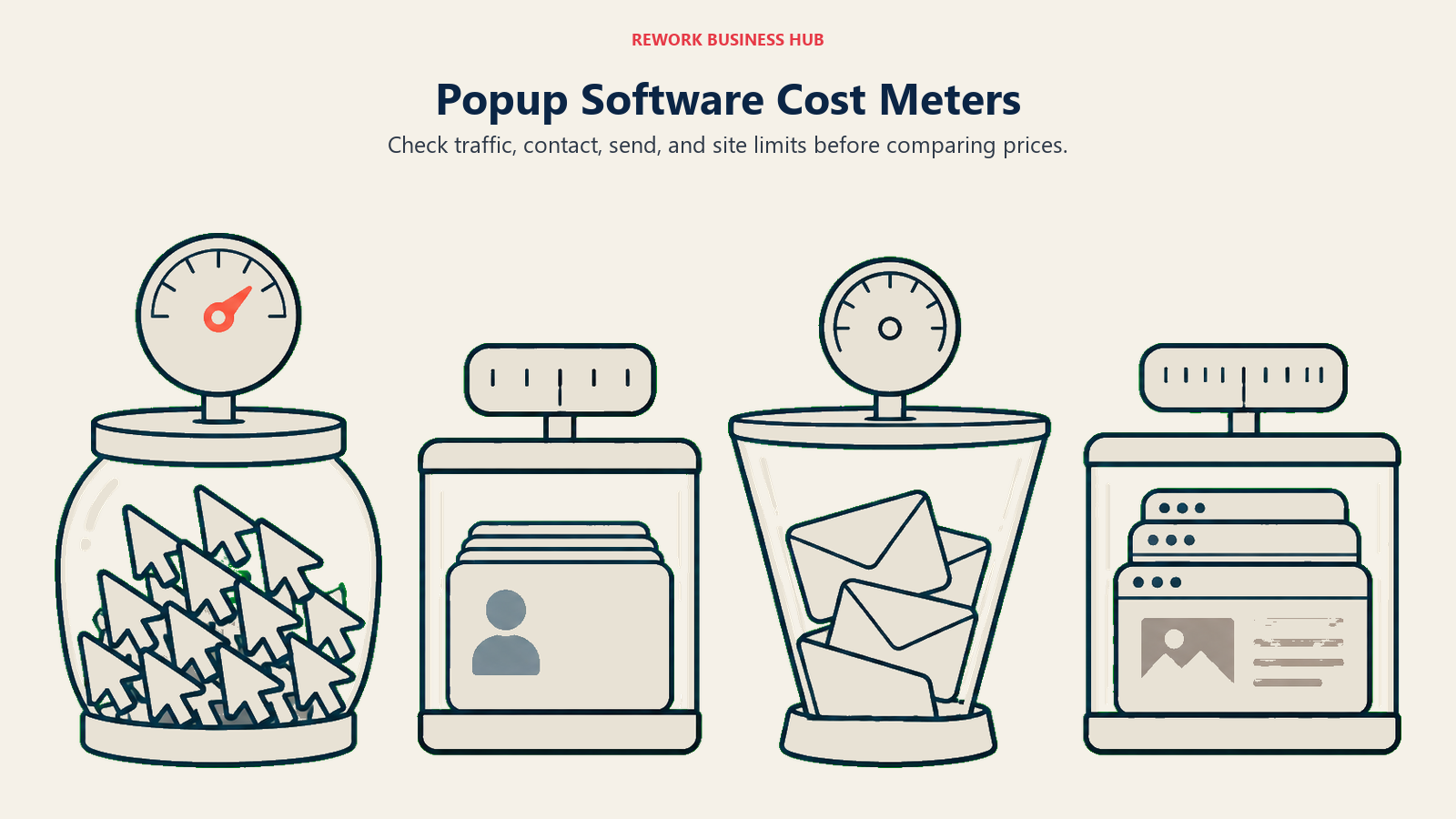
How These Tools Meter Cost: Impressions, Pageviews, Contacts, and Sites
The same monthly number means something different depending on which of these four meters a vendor uses. A site with 100,000 monthly visitors and a 20,000-contact email list will pay a very different amount on an impressions-based tool than on a contacts-based one, so check the meter before you compare the sticker price.
| Tool | What it meters | What that means for a growing site |
|---|---|---|
| OptinMonster | Monthly impressions, plus number of sites | Cost rises with traffic, not with list size; a viral post can push you into overage mid-month |
| Poptin | Monthly visitors, plus number of domains | Similar to OptinMonster, but the free tier and Basic plan are usable at real SMB traffic levels |
| Privy | Monthly pageviews (popups plan) or mailable contacts (email plan) | Two separate meters depending on which plan you pick; easy to choose the wrong one |
| Justuno | Monthly visitors | Traffic-based like OptinMonster, but with no free tier to absorb early growth |
| Wisepops | Custom, based on traffic, channels, and service level | Not self-serve; you don't know the number until after a data audit |
| Klaviyo | Active profiles (contacts), not popup impressions | Popup form displays are unlimited; you pay for the list it builds, not the traffic it sees |
| Getsitecontrol | Monthly widget views, contacts unlimited | Similar shape to OptinMonster, but the free tier and per-email pricing keep costs low at small scale |
| Hello Bar | Monthly popup views | Straightforward, and the free tier absorbs the first 5,000 views/month |
| Unbounce | Monthly landing page visits, popups included at no extra cost | Traffic cap governs the whole plan, not just the popup feature |
| Brevo / Mailchimp | Contacts stored and/or emails sent | Popup impressions are free and unlimited; you pay for the list the popup grows |
The practical takeaway: if your traffic is spiky (a product launch, a viral post, a seasonal sale), a contacts-metered tool like Klaviyo, Brevo, or Mailchimp won't punish you for a traffic spike the way an impressions-metered tool like OptinMonster, Poptin, or Justuno can.
1. Poptin: A Real Free Tier With Email Attached
Poptin is the closest thing to a direct, budget-friendly OptinMonster swap on this list. It covers the same core job (exit-intent popups, slide-ins, spin-to-win wheels, embedded forms) with a visual editor and a genuine free plan, not just a trial. The free tier covers 1,000 monthly visitors, one domain, 250 active email contacts, and 500 email sends, which is enough to run a real small-business site without paying anything.
Where Poptin earns its place on this list is the bundled email tool: you don't need a second product just to send the welcome sequence that fires after someone opts in. Where it falls short of OptinMonster is targeting depth. The rules engine is solid but not as granular, and the visitor caps climb fast: Basic covers 10,000 visitors for $25/month ($240/year billed annually), Pro covers 50,000 for $59/month ($564/year), and Agency covers 150,000 for $119/month ($1,140/year), each tier also raising the domain limit.
| What you get | What you don't |
|---|---|
| A genuine free plan (1,000 visitors, 250 contacts) | OptinMonster's deeper targeting rule combinations |
| Popups and a lightweight email sender in one product | Unlimited visitors on any tier; every plan caps traffic |
| Unbranded popups even on the free plan | AI-personalization comparable to Justuno |
Pricing: Free (1,000 visitors/mo, 1 domain, 250 contacts). Basic $25/mo or $240/yr (10,000 visitors). Pro $59/mo or $564/yr (50,000 visitors, 4 domains). Agency $119/mo or $1,140/yr (150,000 visitors, unlimited domains). (poptin.com/pricing) Best for: Budget-conscious small businesses that want a real free tier and don't want to buy a separate email tool just to follow up with new subscribers.
2. Privy: Built for Shopify and BigCommerce Stores
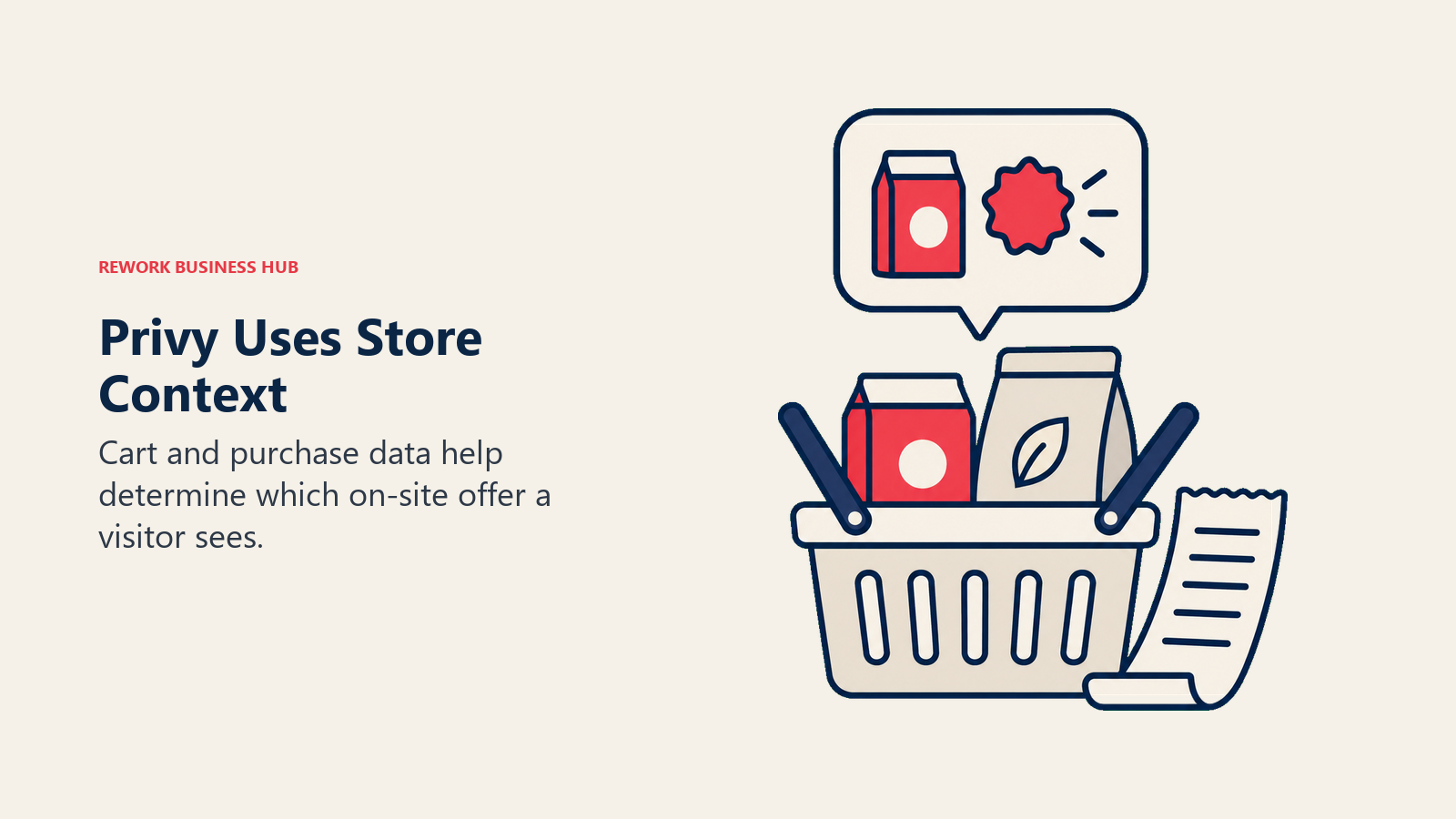
Privy grew up inside the Shopify ecosystem and it shows. The popup and banner editor is straightforward, but the real value is how tightly it ties into store data: cart contents, purchase history, and product catalogs are all available as popup targeting conditions without custom setup, and Privy syncs directly with Klaviyo for stores that want Privy's on-site capture paired with Klaviyo's email engine.
Privy sells two separate pricing tracks, and picking the wrong one is an easy mistake. The popups-and-displays-only track is priced by monthly pageviews, starting at $24/month for up to 10,000 views. The email-and-SMS track is priced by mailable contacts instead, starting at $30/month for 0 to 1,500 contacts with unlimited sends included. A store that only wants the popup and already has an email tool should pick the first track; a store that wants Privy to also send the welcome email should pick the second, and paying for both by accident is a real risk if you don't read the plan names carefully.
| What you get | What you don't |
|---|---|
| Native Shopify, BigCommerce, and Wix integrations | A single, simple pricing axis (it's pageviews on one plan, contacts on the other) |
| A 15-day free trial with no credit card required | A free-forever plan |
| Unlimited email sends on every email-tier plan | Deep AI personalization (see Justuno for that) |
Pricing: Popups and displays only, from $24/mo (10,000 monthly pageviews) up to $1,500/mo (3.5M views). Email plans, from $30/mo (0-1,500 contacts, unlimited sends). 15-day free trial, no card required. (privy.com/pricing) Best for: Shopify, BigCommerce, or Wix stores that want popups built around real store and cart data.
3. Justuno: AI Personalization Beyond the Popup
Justuno positions itself a step past OptinMonster: instead of a rules engine you configure by hand, it leans on AI to recommend products, personalize onsite messaging, and verify email and SMS addresses in real time before they ever hit your list. For a mid-size ecommerce brand that has outgrown basic exit-intent popups and wants onsite personalization closer to what a much larger retailer would run, that's a real differentiator.
The tradeoff is price and floor. There's no free plan, the Lite tier starts at $59/month for up to 10,000 monthly visitors with a 14-day trial, and the jump to Done-For-You at $299/month (20,000 visitors, 30-day trial) buys you a dedicated account manager, a CRO strategist, and unlimited custom workflows, but at nearly five times the entry price. For a site under 10,000 monthly visitors, Justuno is a lot of tool and a lot of price for what a $25 to $59 tool elsewhere on this list already covers.
| What you get | What you don't |
|---|---|
| AI-driven product recommendations and personalization | A free plan or a low-cost entry tier |
| Instant email and SMS verification built in | A visitor cap that scales gracefully with the entry price |
| Cross-domain reporting and custom team roles at the top tier | Simplicity; the feature set assumes a dedicated CRO owner |
Pricing: Lite $59/mo (10,000 visitors, 14-day trial). Done-For-You $299/mo (20,000 visitors, 30-day trial). No free plan. (justuno.com/pricing) Best for: Mid-size ecommerce brands with a dedicated conversion-rate-optimization owner who wants AI personalization, not just a rules-based popup.
4. Wisepops: A Managed Popup Service, Not Just Software
Wisepops is a different kind of alternative entirely: not self-serve software you configure yourself, but a managed service where Wisepops' own team designs, builds, and optimizes your popup strategy after auditing seven days of your site's traffic. Wisepops' pricing page doesn't publish a tier table at all; it states pricing starts "from EUR 499/month" and depends on traffic volume, channels, and level of service, with a custom quote following a demo rather than a self-serve signup.

That model fits a specific buyer: a larger ecommerce or media site with meaningful traffic (Wisepops' own published benchmark data comes from analyzing more than a billion popup displays across its customer base) that would rather pay for strategy and execution than hire an in-house CRO specialist to run OptinMonster or Justuno. It's a poor fit for anyone comparing it against the $7 to $59 tools on this list, because the price floor and the buying process are built for a completely different budget.
| What you get | What you don't |
|---|---|
| A managed strategy, design, and execution team, not just software | Self-serve signup or a published price table |
| Benchmark data drawn from over a billion popup displays informing your setup | A price point anywhere near the rest of this list |
| A 14-day trial (though a demo is the recommended path) | Fast time-to-launch; onboarding starts with a data audit |
Pricing: From EUR 499/month, custom quote after a traffic and service-level audit. No published self-serve tiers. (wisepops.com/pricing) Best for: Larger ecommerce or media sites that want a managed popup strategy team rather than a self-serve tool.
5. Klaviyo: Sign-Up Forms Inside a Full Ecommerce Platform
Klaviyo's Sign-Up Forms aren't a separate product, they're a feature of the same platform that runs your email and SMS flows, which is exactly why ecommerce brands choose it over a standalone popup tool. A visitor who opts in through a Klaviyo popup lands directly in a segment with their full purchase and browsing history attached, and the welcome flow that follows is built in the same editor, not stitched together with an integration.
The free plan covers up to 250 active profiles, 500 email sends per month, and $5 of SMS credit, with sign-up forms included at no charge. Once you pass 250 profiles, the Email plan starts at roughly $20/month for 251 to 500 profiles and scales up from there by active profile count (not just recently emailed contacts, a billing change Klaviyo made in 2025), with Email+SMS plans priced higher at the same profile tiers. The catch is that you're not buying a popup tool, you're buying the whole Klaviyo platform to get one.
| What you get | What you don't |
|---|---|
| Popup forms wired directly into Shopify/WooCommerce segments and flows | A standalone popup product you can buy without the rest of Klaviyo |
| Revenue attribution per form and per flow | Pricing that stays flat as your list grows; it's pure profile-count billing |
| A genuinely usable free tier up to 250 profiles | A fit for non-ecommerce sites; the whole product is built around store data |
Pricing: Free (250 active profiles, 500 sends/mo, $5 SMS credit). Email plan from roughly $20/mo (251-500 profiles), scaling by active profile count. (klaviyo.com/pricing) Best for: Shopify or WooCommerce brands that want popup capture and revenue-attributed email/SMS in a single native platform. If Klaviyo itself is what you're evaluating rather than just its forms, Best Klaviyo Alternatives covers that landscape directly.
6. Rework: Where the Leads a Popup Captures Actually Go
Rework is not a popup builder, and it doesn't belong on this list as one. It has no exit-intent triggers, no gamified spin-to-win templates, no A/B-tested popup campaigns, and no on-site display targeting rules. If you're comparing it feature-for-feature against OptinMonster, Poptin, or Privy, it loses on every row, because that's not the job it does.
Here's the honest reason it's still worth a look at #6: a popup tool's job ends the moment it captures an email address, and that's exactly where most teams lose the lead. The form fires, the email lands in an inbox or a spreadsheet, and nobody owns what happens next: who follows up, how fast, and whether the lead gets forgotten between marketing and sales. Rework is what a captured lead flows into. It scores incoming leads, routes them by round-robin, territory, or SLA rule to the right person automatically, tracks status through the lifecycle, and gives the team a multi-channel inbox (WhatsApp, Messenger, Instagram DM, TikTok, Zalo, live chat) so the follow-up conversation has one home instead of living across whoever's phone answered first.
Rework sells lead capture and routing as the Marketing Engine: $99/month billed yearly ($1,188/year), or $115 month to month, with 5 marketing seats included and extra seats in blocks of 5 at $21/month per block on yearly billing. A 14-day free trial is available. See rework.com/pricing for current details.
| What you get | What you don't |
|---|---|
| Lead scoring, round-robin/territory/SLA routing, and lifecycle tracking | Any popup, exit-intent, or on-site display capability whatsoever |
| A unified inbox across WhatsApp, Messenger, Instagram DM, TikTok, Zalo, chat | A/B testing of on-site messaging or gamified opt-in templates |
| A destination CRM for the leads a popup tool like OptinMonster captures | A fit for solo marketers or single-site owners |
Pricing: Marketing Engine $99/month billed yearly ($1,188/year) or $115 month to month, 5 seats included; extra seats $21/month per block of 5 (yearly billing). Revenue Engine (adds the CRM) $159/month billed yearly. rework.com/pricing. Best for: Mid-size teams (roughly 10-200 people) whose real gap is what happens after a popup captures a lead, not the capture itself: routing, ownership, and follow-up. Not ideal for: Most OptinMonster buyers, honestly. If you're a solo marketer or a single-site owner just trying to grow an email list, Rework is the wrong answer; you need a popup tool, not a CRM, and the 5-seat engine floor doesn't fit a one-person operation. Pair Rework with whichever popup tool above fits your site, don't replace one with the other. If routing and meeting scheduling specifically (not the CRM around it) is the real bottleneck, Best Chili Piper Alternatives covers that narrower category, and Best LeadSquared Alternatives covers lifecycle-focused platforms closer to Rework's own shape.
7. ConvertBox: The One-Time-Payment Popup Tool (Verify Before You Buy)
ConvertBox built its reputation on a single idea: pay once, use it forever, no monthly bill ever again. For years that made it the go-to answer for bloggers and small agencies tired of subscription fatigue. The catch, and the reason this section carries more hedging than the others, is that third-party trackers disagree about whether the one-time model is still the live offer.
The most recent 2026-dated sources describe an active "early access lifetime deal" at roughly $495 one-time for the Standard tier (10 sites, 250,000 monthly views, 1 user login) and $590 one-time for Pro (50 sites, 500,000 views, 5 sub-user logins), labeled (reported). Other trackers report the lifetime offer has, at points, been replaced by monthly billing instead (roughly $75/month Standard, $150/month Pro). If ConvertBox's one-time-payment reputation is the reason you're considering it, confirm the current offer directly on convertbox.com before you buy, because the two pricing models produce wildly different total costs.
| What you get | What you don't |
|---|---|
| A potential one-time payment with no recurring subscription | Certainty about which pricing model is currently live |
| Real WordPress and non-WordPress site support | A vendor pricing page that renders for a quick sanity check |
| Behavior-based on-site messaging, not just exit-intent | A free plan or a published, stable price list |
Pricing: Reported (vendor page did not render for direct verification): a one-time "lifetime" offer around $495 (Standard, 10 sites) to $590 (Pro, 50 sites), per multiple 2026 trackers including Elite Content Marketer and The Double Think; some sources report a shift to monthly billing instead. Confirm on convertbox.com before purchase. Best for: WordPress and agency users specifically motivated by avoiding a recurring subscription, provided you verify the current offer first.
8. Thrive Leads: WordPress Popups, Now Suite-Only
Thrive Leads has a loyal following among WordPress publishers for its A/B testing depth (it will test not just headlines but entire opt-in form types against each other) and its library of conversion-focused templates. If you've seen an older review quoting a standalone Thrive Leads price around $99/year, that price no longer exists: as of this guide's research, Thrive Themes' own pricing page confirms Thrive Leads is not sold as a standalone product anymore. The only way to get it is inside Thrive Suite.
Thrive Suite Yearly runs $299/year (listed on the vendor's page as discounted from $599/year) for up to 5 websites, and includes all eight Thrive plugins, not just Leads: Architect, Quiz Builder, Ultimatum, Apprentice, Ovation, Optimize, and Comments come bundled in. A quarterly option runs $149/quarter. For a WordPress site that would use several of those tools anyway, that's genuinely good value. For a site that only wants the popup and opt-in builder, you're paying suite pricing for one plugin, and the whole product only runs on WordPress.
| What you get | What you don't |
|---|---|
| Deep A/B testing across entire form types, not just headlines | A way to buy Thrive Leads by itself anymore |
| Seven other conversion plugins bundled at the same price | Platform flexibility; WordPress only |
| A 30-day money-back guarantee | Cloud-hosted or non-WordPress site support |
Pricing: Not sold standalone. Thrive Suite Yearly $299/year (5 websites, all 8 plugins including Thrive Leads) or $149/quarter. (thrivethemes.com/pricing) Best for: WordPress site owners who'd use several Thrive plugins, not just the popup builder, and don't mind buying the suite to get it.
9. Sleeknote: On-Brand Popups With Optional Gamification
Sleeknote's pitch is that most popups look and feel like ads, and Sleeknote's don't. The templates lean toward slide-ins, embedded forms, and bar-style prompts that sit inside a site's design language rather than interrupting it, which is why content publishers and design-conscious ecommerce brands gravitate toward it over a more aggressive tool like OptinMonster or Justuno.
Pricing runs in euros and scales by monthly visitors rather than pageviews or contacts: the entry tier (up to 25,000 monthly visitors) starts around EUR 49/month billed annually, or EUR 62/month billed monthly, climbing to EUR 369/month at the 300,000-to-500,000-visitor tier, with custom pricing above that. Every tier includes unlimited campaigns and domains, which is generous. Gamification (spin-to-win, scratch cards, quizzes) is a separate add-on running roughly EUR 19 to EUR 99/month on top of the base plan, so a headline feature that competitors like Sleeknote itself gets referenced for isn't included by default.
| What you get | What you don't |
|---|---|
| Unlimited campaigns and domains on every tier | USD pricing; everything is billed in euros |
| Design-forward templates that don't look like typical popups | Gamification included in the base price |
| A 14-day trial with no card required, and a money-back guarantee | The lowest entry price on this list |
Pricing: From EUR 49/month billed annually (up to 25,000 monthly visitors) or EUR 62/month billed monthly, scaling to EUR 369/month at 300,000-500,000 visitors. Gamification add-on EUR 19-99/month extra. (sleeknote.com/pricing) Best for: Content publishers and design-conscious ecommerce brands who want on-brand popups without an aggressive, ad-like feel.
10. Getsitecontrol: A Free Tier That's Actually Still Free
Getsitecontrol is one of the few tools in this category whose free plan hasn't quietly shrunk into uselessness. Free covers 10,000 monthly widget views with unlimited contacts and no branding requirement, which is a genuinely usable starting point for a small site, not just a crippled trial. Email is billed separately and cheaply, at $2 per 1,000 sent emails on the free plan, dropping to $1.60 on Pro and $1.40 on Pro Max, so a low-volume site's total bill stays close to zero.
Pro at $19/month raises the widget-view cap to 100,000 and Pro Max at $29/month removes the cap entirely, with annual billing saving up to 25% on either. The catch is that pricing applies per site, so an agency or a company running several branded properties pays the plan cost on each one rather than getting a shared pool, which is where a per-organization tool like OptinMonster's multi-site tiers can work out cheaper at scale.
| What you get | What you don't |
|---|---|
| A real, currently-usable free tier (10,000 views, unlimited contacts) | A multi-site plan; pricing is per site |
| Cheap, separately metered email that scales down for low-volume senders | OptinMonster's exit-intent sophistication out of the box |
| Unlimited widgets on every tier, including free | A free tier that includes email sends beyond the per-send charge |
Pricing: Free (10,000 widget views/mo, unlimited contacts, email at $2/1,000 sent). Pro $19/mo (100,000 views, email at $1.60/1,000). Pro Max $29/mo (unlimited views, email at $1.40/1,000). Annual billing saves up to 25%. (getsitecontrol.com/pricing) Best for: Small sites and solo site owners who want a genuinely free popup tool and only want to pay for the email they actually send. A popup is one form format among several; Best Form Builder Software in 2026 covers standalone form tools for teams whose real need is embedded forms rather than on-site popups.
11. Hello Bar: Simple Bars, Fast Setup
Hello Bar earned its name from its original format: a thin, non-intrusive bar across the top of the page, a gentler alternative to a full-screen takeover. It has since expanded to full popups, slide-ins, and exit-intent triggers, but the bar-style, low-friction format is still where it's strongest, and setup is genuinely fast if that's the format you want.
The free Starter plan covers up to 5,000 popup views a month with unlimited popups and subscribers, though every bar carries Hello Bar's own branding and there's no live chat support at that tier. Growth at $29/month ($289/year annually, two months free) raises the cap to 50,000 views and unlocks 20-plus targeting rules and A/B testing. Premium at $49/month (150,000 views) and Elite at $99/month (500,000 views, unlimited seats) scale from there, each with a per-overage rate if you exceed the monthly view cap.
| What you get | What you don't |
|---|---|
| A real free tier (5,000 views/mo, unlimited popups and subscribers) | An unbranded free plan; Hello Bar branding stays until you upgrade |
| Fast setup for simple bar-style and slide-in formats | A/B testing or advanced targeting on the free tier |
| Unlimited seats at the top Elite tier | Justuno-level AI personalization |
Pricing: Free/Starter (5,000 views/mo, branded). Growth $29/mo or $289/yr (50,000 views). Premium $49/mo or $499/yr (150,000 views). Elite $99/mo or $999/yr (500,000 views, unlimited seats). (Hello Bar plan details) Best for: Small sites wanting a simple, fast-to-set-up notification bar or popup without a steep learning curve.
12. Unbounce: Popups and Sticky Bars Bundled With Landing Pages
Unbounce is a landing page builder first, but popups and sticky bars are bundled into every plan at no additional cost, which makes it worth a look for a team that would otherwise be paying for a landing page tool and a separate popup tool. The popup and sticky bar editor supports the same AI-assisted copy and design tools as Unbounce's landing pages, and campaigns can trigger off scroll depth, exit intent, or time on page the same way a dedicated tool like OptinMonster would.
The current Starter tier runs $29/month billed monthly, or $22/month billed annually ($264/year), and it's genuinely an entry-level plan: 5 pages, up to 500 monthly visits, 1 user, and 1 root domain, with popups and sticky bars included. Build at $99/month monthly ($888/year annual) removes the page cap and raises the traffic ceiling to 20,000 visits, still on 1 user. Experiment ($149/month, $1,344/year annual, 3 users) and Optimize ($249/month, $2,244/year annual, 5 users) add more traffic, users, and domains; Concierge and Agency tiers are custom-quoted. Note that Starter and Build cap out at a single user, which is easy to miss if you're comparing headline prices across a team.
| What you get | What you don't |
|---|---|
| Popups and sticky bars bundled free with a real landing-page builder | A popup-only plan; you're buying the landing page product to get them |
| AI-assisted copy and design tools shared across pages and popups | More than 1 user on Starter or Build |
| A 14-day free trial, no card required | A traffic ceiling anywhere near generous on Starter (500 visits/mo) |
Pricing: Starter $29/mo monthly or $22/mo billed annually ($264/yr; 5 pages, 500 visits, 1 user). Build $99/mo monthly or $74/mo annually ($888/yr). Experiment $149/mo monthly or $112/mo annually ($1,344/yr). Optimize $249/mo monthly or $187/mo annually ($2,244/yr). Concierge/Agency custom. (unbounce.com/pricing) Best for: Teams already buying (or planning to buy) a landing page tool who want popups and sticky bars included rather than paying for a second vendor. See landing page lead capture for how the two formats work together, and Best Unbounce Alternatives for a direct look at Unbounce against its own competitors.
13. Brevo: Forms Bolted Onto a Generous Free Email Plan
Brevo (formerly Sendinblue) treats sign-up forms and popups as one feature inside a much broader marketing platform, rather than the product itself. That's a fundamentally different pitch from OptinMonster: instead of buying the best possible popup, you're buying a generous free email platform that happens to include a usable form and popup builder for free.
The free plan is worth spelling out precisely, because Brevo's free tier is one of the more generous ones in this category and gets referenced constantly: it allows storing up to 100,000 contacts and sending up to 300 emails per day, with Brevo's own branding on outgoing emails. That daily send cap, not a monthly one, is the real constraint for anything beyond a small list. Paid plans bill by email volume rather than contact count, which favors a business with a large, infrequently-emailed list: Starter pricing is reported at roughly $9/month for 5,000 emails/month with no daily cap, and Business tier pricing (which adds marketing automation, A/B testing, and landing pages) sits somewhat higher at the same volume tier. This guide could not get Brevo's own pricing page to render directly for a line-by-line vendor citation, so the paid figures above are corroborated across multiple 2026 pricing trackers rather than pulled straight from brevo.com.
| What you get | What you don't |
|---|---|
| Sign-up forms, email, SMS, and live chat under one largely-free roof | A popup tool built and optimized as the primary product |
| Billing by emails sent, not contacts stored (good for large, quiet lists) | An unbranded free tier |
| A genuinely usable 100,000-contact free plan | OptinMonster's dedicated on-site targeting and A/B testing depth |
Pricing: Free (100,000 contacts stored, 300 emails/day, Brevo branding). Starter from roughly $9/mo (5,000 emails/mo, reported, multiple 2026 trackers). Business tier adds automation and landing pages at a higher rate. (brevo.com/pricing) Best for: Teams that want a form/popup builder bundled into a genuinely generous free email platform, and don't need popup-specific depth. For a closer look at Brevo as a primary email platform rather than just its form builder, see Best Brevo Alternatives.
14. Mailchimp: Free Pop-Up Forms, Shrinking Free Tier
Mailchimp includes pop-up sign-up forms on every plan, free included, and for a team already running Mailchimp for email, that's the whole appeal: one less integration, one shared audience list, zero extra cost for the popup itself. The form builder covers the basics (a single-field email capture, a discount-code style layout, simple targeting by page or timing) but it is not built to compete with a dedicated popup tool on triggers, A/B testing, or design flexibility.
The free plan's limits are worth stating plainly because Mailchimp's free tier has shrunk considerably from its old reputation: as of this guide's research, Mailchimp's own pricing page states a 250-contact limit and a cap of 500 sends per month (250 per day). That's a small list by the standards of Poptin's or Getsitecontrol's free tiers. Paid plans price by contact count and unlock more: Essentials starts around $13/month at the smallest contact tier (after Mailchimp's stated annual discount), Standard around $20/month, and Premium at $350/month for unlimited contacts and phone support, all scaling upward as the list grows.
| What you get | What you don't |
|---|---|
| Pop-up forms included free, tied directly to Mailchimp audiences | A popup builder with OptinMonster's targeting depth or A/B testing |
| No extra cost or separate tool if you're already on Mailchimp | A generous free tier; it's capped at 250 contacts |
| Simple setup inside a platform your team may already know | A popup-first product; it's an email tool with a form bolted on |
Pricing: Free (250 contacts, 500 sends/mo, popup forms included). Essentials from $13/mo. Standard from $20/mo. Premium from $350/mo (unlimited contacts). Scales by contact count. (mailchimp.com/pricing) Best for: Teams already running Mailchimp for email who want a basic, free on-site form without adding a second vendor. If Mailchimp's own pricing and automation limits are the real question, Best Mailchimp Alternatives covers that in depth, and Best Email Marketing Software in 2026 covers the wider category.
Stage Fit Matrix
| Tool | Solo / small site | Growing SMB | Established ecommerce | Enterprise / managed |
|---|---|---|---|---|
| Poptin | Strong fit | Good fit | Works | Not designed for it |
| Privy | Works | Strong fit (ecommerce) | Good fit | Limited |
| Justuno | Not ideal (no free tier) | Works | Strong fit | Good fit |
| Wisepops | Not designed for it | Not ideal | Works | Strong fit |
| Klaviyo | Works (free tier) | Strong fit (ecommerce) | Strong fit | Good fit |
| Rework | Not ideal (solo) | Not ideal (under 5 users) | Works (10-200 people) | Not F500-scale |
| ConvertBox | Works, if lifetime offer live | Good fit | Works | Not designed for it |
| Thrive Leads | Works (WordPress) | Good fit (WordPress) | Limited outside WordPress | Not designed for it |
| Sleeknote | Works | Good fit | Strong fit | Custom tier available |
| Getsitecontrol | Strong fit | Good fit | Works | Limited (per-site pricing) |
| Hello Bar | Strong fit | Good fit | Works | Limited |
| Unbounce | Works | Good fit | Good fit | Custom tier available |
| Brevo | Strong fit (free tier) | Strong fit | Works | Good fit |
| Mailchimp | Works (limited free) | Good fit | Works | Good fit |
Rework's row reads differently from the other 13 on purpose: the sizing question that matters for a popup tool is site traffic, and the sizing question that matters for Rework is team headcount, since it's not competing on the same axis at all.
How to Choose: Decision Framework
| If you need... | Best pick |
|---|---|
| A real free tier plus a lightweight email tool, no separate purchase | Poptin or Getsitecontrol |
| Popups built around Shopify or BigCommerce cart and order data | Privy |
| AI-driven onsite personalization beyond rules-based popups | Justuno |
| A managed strategy and execution team instead of self-serve software | Wisepops |
| Popup capture inside a full ecommerce email/SMS platform | Klaviyo |
| Routing and working the leads a popup already captured | Rework |
| A one-time payment instead of a subscription (verify current offer first) | ConvertBox |
| Deep A/B testing on WordPress, and you'll use other Thrive plugins too | Thrive Leads |
| On-brand, less ad-like popups with optional gamification | Sleeknote |
| Landing pages and popups bundled from one vendor | Unbounce |
| A generous free email platform with a form builder included | Brevo |
| A free popup form because you're already paying for Mailchimp | Mailchimp |
| The lowest possible entry price with a real free tier and fast setup | Hello Bar |
Whichever tool you shortlist, weigh the promo-versus-renewal math from the table earlier in this guide before you sign, since the sticker price on a 12-month promo (OptinMonster) or a first-year discount (several tools above) is rarely the number you'll pay in year two.
Frequently Asked Questions about OptinMonster Alternatives
Why does OptinMonster's price look so different depending on where I read it?
Because OptinMonster is running a 60%-off promotion for the first 12 months on every tier, and most articles quote only that promo price. Basic looks like $7/month but renews at $210/year, Plus renews at $570/year, Pro at $870/year, and Growth at $1,470/year. Check both numbers before comparing it to any competitor.
What's the cheapest way to replace OptinMonster?
Getsitecontrol and Poptin both have real free tiers, not just trials. Getsitecontrol covers 10,000 monthly widget views with unlimited contacts for $0, and Poptin covers 1,000 monthly visitors and 250 email contacts for $0. Hello Bar's free tier (5,000 views/month) is a close third if you only need a simple bar or basic popup.
Is ConvertBox's one-time lifetime deal still available?
It's genuinely unclear as of this guide's research. Multiple 2026-dated trackers describe an active one-time payment offer around $495 to $590, while others report a shift to monthly billing. ConvertBox's own pricing pages blocked automated verification, so confirm the current offer directly on convertbox.com before you buy.
Can I still buy Thrive Leads by itself?
No, not anymore. Thrive Leads is only available bundled inside Thrive Suite, which costs $299/year for up to 5 websites and includes seven other Thrive plugins along with it. Older reviews citing a standalone price are out of date.
Does Rework replace a popup tool like OptinMonster?
No. Rework has no popup builder, no exit-intent triggers, and no on-site targeting. It's the CRM a captured lead flows into: scoring, routing, lifecycle tracking, and a multi-channel inbox. Pair it with a popup tool from this list, don't expect it to replace one.
Which tool is best for a Shopify store specifically?
Privy and Klaviyo are both built around Shopify store data (cart contents, order history, product catalogs), with Klaviyo leaning further into revenue-attributed email and SMS flows and Privy leaning toward simpler, more affordable popup-first pricing.
What's a good popup conversion rate to benchmark against?
Recent benchmark studies put the category average between 3.49% and 4.82% depending on methodology, with the top 10% of A/B-tested campaigns converting above 26%. If your popup converts under 2%, the targeting rules or offer are worth revisiting before you blame the tool.
Do popups hurt my Google search ranking?
Only a specific kind. Google has ranked mobile pages lower since January 2017 when a popup covers the main content immediately after a visitor taps through from a mobile search result. Exit-intent popups, scroll-triggered popups, and desktop popups fall outside that penalty; a full-screen interstitial blocking a mobile visitor the instant they land from Google search does not.
What to Do Next
Start with the promo-versus-renewal table near the top of this guide and run the same check against whichever tool you shortlist: get the vendor's current price, then ask directly what it renews at in year two. Pick your top two picks from the Quick Comparison Table, sign up for the free plan or trial on each, and run a real two-week test with an actual offer, not a placeholder headline, on your live traffic. The popup that wins isn't always the one with the most features; it's the one whose targeting rules match how your specific visitors actually browse.
If your gap turns out to be downstream of capture (leads sitting unrouted, follow-up happening whenever someone remembers, no visibility into who owns what), that's a different problem than a popup tool solves, and it's worth reading about multi-channel lead capture and lead response time before you assume a better popup fixes it. For the wider category view across capture, routing, and lifecycle tools together, see Best Lead Management Software in 2026. And if landing pages are also on your shortlist alongside popups, Best Unbounce Alternatives covers that adjacent buy in the same depth as this guide.

Sales Operations Practice Lead
On this page
- Key Facts
- The Promo Price Isn't the Price: OptinMonster's Renewal Math
- Quick Comparison Table
- How These Tools Meter Cost: Impressions, Pageviews, Contacts, and Sites
- 1. Poptin: A Real Free Tier With Email Attached
- 2. Privy: Built for Shopify and BigCommerce Stores
- 3. Justuno: AI Personalization Beyond the Popup
- 4. Wisepops: A Managed Popup Service, Not Just Software
- 5. Klaviyo: Sign-Up Forms Inside a Full Ecommerce Platform
- 6. Rework: Where the Leads a Popup Captures Actually Go
- 7. ConvertBox: The One-Time-Payment Popup Tool (Verify Before You Buy)
- 8. Thrive Leads: WordPress Popups, Now Suite-Only
- 9. Sleeknote: On-Brand Popups With Optional Gamification
- 10. Getsitecontrol: A Free Tier That's Actually Still Free
- 11. Hello Bar: Simple Bars, Fast Setup
- 12. Unbounce: Popups and Sticky Bars Bundled With Landing Pages
- 13. Brevo: Forms Bolted Onto a Generous Free Email Plan
- 14. Mailchimp: Free Pop-Up Forms, Shrinking Free Tier
- Stage Fit Matrix
- How to Choose: Decision Framework
- What to Do Next