NinjaOne vs Atera: Which RMM Platform Fits Your IT Team in 2026?
Turn this article into takeaways for your work.


Each assistant summarizes the article only for you and suggests best practices for your work.
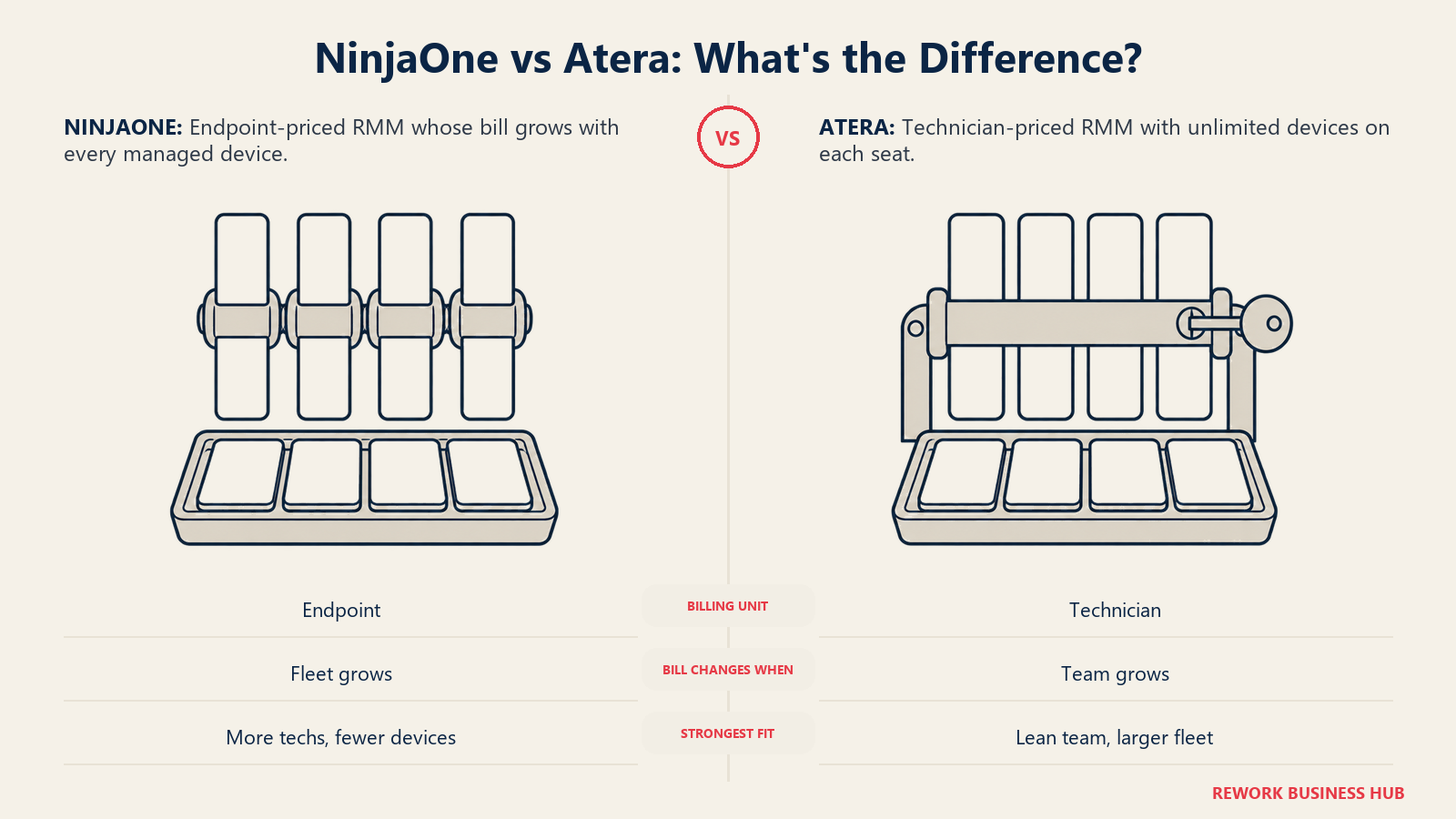
Most NinjaOne vs Atera comparisons put both prices in one column and call it a day. That's the wrong instinct, because these two platforms don't charge for the same thing.
Atera bills per technician, with unlimited managed devices included. A three-person IT team pays the same Atera bill whether it manages 90 laptops or 900. NinjaOne bills per endpoint, and it is deliberately quote-only: the only number it publishes is a single band, "as low as $1.50 USD per month at 10,000 endpoints, increasing to $3.75 USD at 50 or fewer endpoints." Put a NinjaOne per-device figure and an Atera per-technician figure side by side without labeling the basis, and the comparison is broken before the first table.
This page is for the IT director, systems admin or CIO who has already shortlisted these two and needs an honest answer to one question: given your actual technician headcount and your actual fleet size, which one costs less and does the job? Every figure below states its billing basis, and every NinjaOne figure between its two published anchors is labeled as a modeled estimate, not a quote, because NinjaOne does not publish the curve between them.
TL;DR
| NinjaOne | Atera | |
|---|---|---|
| What it is | Unified RMM, patch, remote access, ticketing and asset platform, aimed at MSPs and internal IT teams | All-in-one RMM plus PSA (ticketing, ticketing automation, reporting) with AI Copilot and an autonomous AI agent, Robin |
| Billing basis | Per endpoint, per month, quote-only | Per technician, per month, unlimited devices included |
| Published price | One band only: $1.50 at 10,000 endpoints, rising to $3.75 at 50 or fewer | Fully published: Professional $149 to Master $219 per technician per month, billed annually |
| Free trial | 14 days | Confirm trial availability with Atera; treat as a sales conversation |
| AI features | No built-in AI Copilot or script-generation assistant | AI Copilot included free on every plan since the 2026 pricing update; Robin, an autonomous agent, is a separate paid add-on |
| Backup, MDM, documentation | Separately licensed add-on modules, not in the base per-endpoint rate | Not confirmed as separate line items in the sources checked; treat backup and advanced MDM as a question for the sales call either way |
| Company trajectory | $12.3 billion valuation as of June 2026, Gartner Magic Quadrant Leader (Endpoint Management Tools, January 2026) | Public performance guarantee on its AI agent (May 2026); ranked in G2's 2026 Enterprise AIOps indices |
| Best for | Large fleets managed by a lean team, where the flat per-tech Atera fee would multiply against every device | Lean fleets managed by a bigger team, or any team that wants a published number before a sales call |
| Worst for | Teams that need a firm price today without a quote | A tiny team managing tens of thousands of devices, where per-device billing eventually undercuts a flat per-tech fee |
The short verdict. If your technician headcount is small relative to your device count, Atera's flat per-technician fee is very likely cheaper, sometimes by an order of magnitude. If your technician headcount is large relative to your device count, NinjaOne's per-device model is very likely cheaper, and by a wide margin too. The two platforms cross over somewhere between roughly 40 and 150 endpoints per technician, depending which Atera tier and which end of NinjaOne's published range you use, and that ratio, not either raw number alone, is what actually decides this purchase.
Key Facts
- NinjaOne publishes exactly one pricing data point. Its own pricing page states verbatim: "NinjaOne starts as low as $1.50 USD per month at 10,000 endpoints, increasing to $3.75 USD at 50 or fewer endpoints; pricing varies by region and products purchased," and applies only to "the commercial, non-FedRAMP instance." ninjaone.com/pricing
- Atera's IT Department plans are fully published, per technician, with unlimited devices. Professional runs $169 monthly or $149 annual, Expert $229 or $189, Master $269 or $219, all per technician per month. atera.com/it-department-pricing
- Atera folded AI Copilot into every plan at no extra charge as part of a 2026 pricing update, effective from the first monthly billing cycle in June 2026 and the first annual renewal on or after late July 2026. Any prior standalone AI Copilot add-on charge was removed automatically during the transition. support.atera.com's 2026 pricing FAQ
- NinjaOne raised more than $400 million in a June 2026 Series C extension, reaching a $12.3 billion valuation, up from a $5 billion valuation in February 2025, a 146% jump in about sixteen months. The company reports nearly 70% year-over-year growth, roughly $600 million in annual recurring revenue and Q1 2026 profitability. ninjaone.com press release
- NinjaOne was named a Leader in the 2026 Gartner Magic Quadrant for Endpoint Management Tools, announced January 7, 2026, its first appearance in the report. ninjaone.com press release
- Atera's autonomous AI agent, Robin, carries a public performance guarantee: resolve 50% of an enterprise's Tier 1 and complex Tier 2 tickets, including password resets, software deployment and system troubleshooting, within the first 90 days of onboarding, or Atera waives all fees. Atera states Robin is capable of resolving up to 92% of technical issues autonomously over time. PR Newswire, May 5, 2026
- NinjaOne's backup, mobile device management and IT documentation are separately licensed modules, not part of the base per-endpoint rate. Third-party pricing trackers report backup alone runs roughly $2 to $3 per workstation per month and from about $7 per server per month depending on retention, though NinjaOne does not publish these figures itself. (Reported, Faddom)
- Both vendors are actively reviewed at scale: NinjaOne shows a 4.7-star rating across more than 4,300 G2 reviews and a 4.8 on Capterra; Atera shows 4.6 stars across more than 1,100 G2 reviews and a similar 4.5 to 4.6 on Capterra. (G2, Capterra listings, current)
Per Technician or Per Endpoint: The Billing Split That Decides Everything
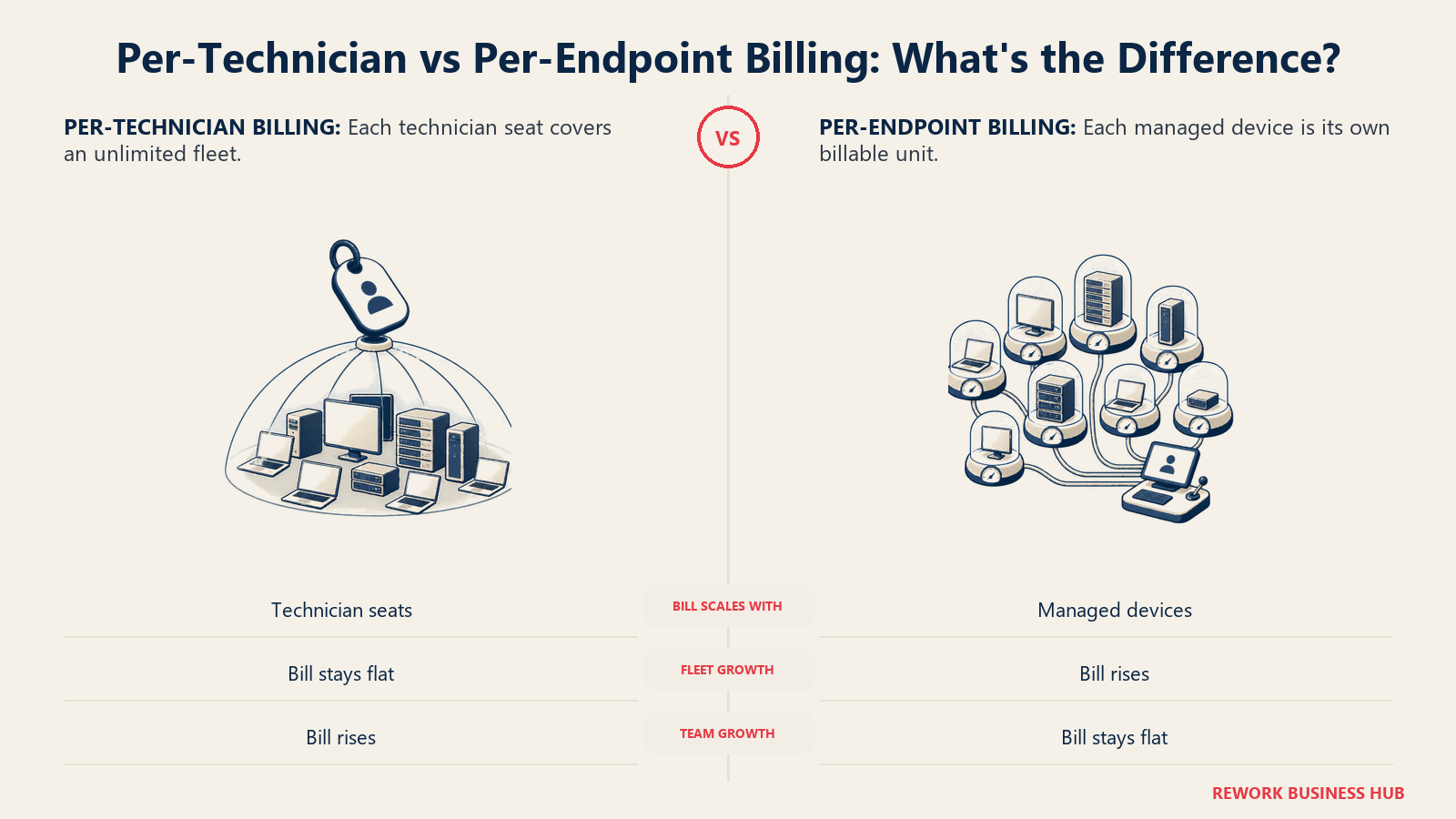
Atera counts people. Every technician who logs into the console is one billable seat, and that seat covers however many devices the technician's clients or company have, no per-device add-on. NinjaOne counts machines. Every laptop, desktop, server or managed mobile device is its own line, and the rate per line drops as total device count climbs, per the one band NinjaOne publishes.
| Atera | NinjaOne | |
|---|---|---|
| What's billed | The technician seat | The managed endpoint |
| Devices per seat | Unlimited | Not applicable, each device is its own unit |
| Bill moves when... | You add or remove a technician | You add or remove a device |
| Bill stays flat when... | Your fleet grows but headcount doesn't | Your headcount grows but the fleet doesn't |
| Published pricing curve | Full: three tiers, monthly and annual, no quote needed | Two anchor points only, everything between is a quote |
The consequence is that "endpoints per technician" is the single number that matters most in this decision, more than either raw headcount or raw device count on its own. A five-person team managing 50 devices and a fifty-person team managing 500 devices have the same ratio, ten devices per technician, and would land in roughly the same place on this comparison despite looking nothing alike on paper.
Endpoints Per Technician: The Ratio That Actually Decides This
Because Atera's cost scales only with technician count and NinjaOne's scales only with device count, there's a breakeven ratio at which the two bills are roughly equal. Below that ratio, NinjaOne's per-device model usually costs less. Above it, Atera's flat per-technician fee usually wins, sometimes dramatically.
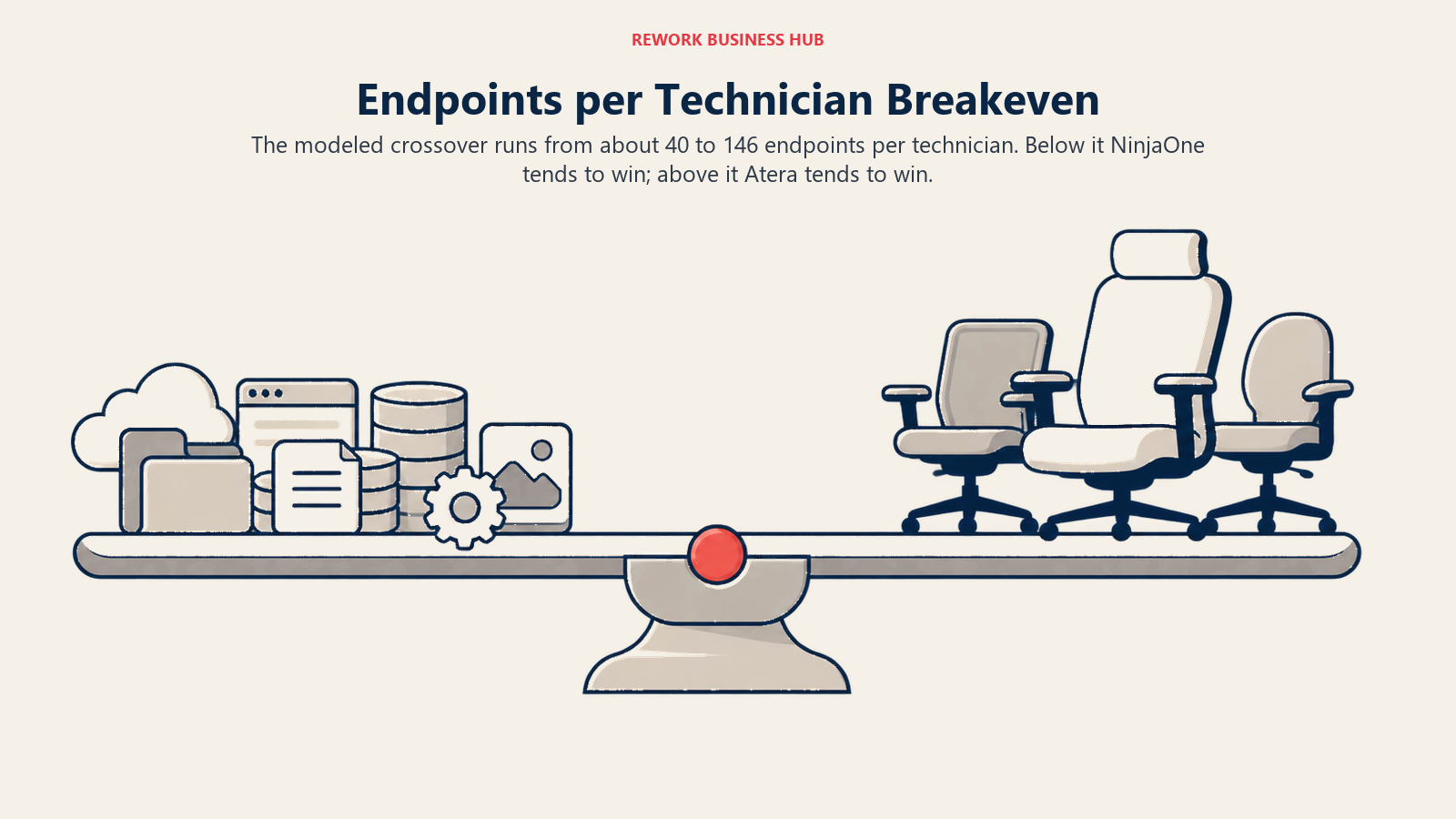
The math: Atera's annual cost for a tier is technicians × (12 × monthly-annual-rate). NinjaOne's annual cost is endpoints × (12 × per-device-rate). Setting the two equal and solving for endpoints per technician gives a breakeven ratio of Atera's annual rate divided by NinjaOne's per-device rate. Because NinjaOne only publishes two per-device rates, the breakeven isn't one number, it's a range bounded by those two anchors.
| Atera tier | Annual rate per technician | Breakeven ratio at NinjaOne's $3.75 ceiling | Breakeven ratio at NinjaOne's $1.50 floor |
|---|---|---|---|
| Professional | $1,788/year ($149/mo) | ~40 endpoints per technician | ~99 endpoints per technician |
| Expert | $2,268/year ($189/mo) | ~50 endpoints per technician | ~126 endpoints per technician |
| Master | $2,628/year ($219/mo) | ~58 endpoints per technician | ~146 endpoints per technician |
Read it this way: on the Professional tier, if your fleet runs meaningfully below roughly 40 devices per technician, NinjaOne is likely cheaper, since there aren't enough devices for its per-unit rate to outpace a flat Atera seat. Above roughly 99 to 150 devices per technician, depending on tier, Atera is very likely cheaper, since NinjaOne's per-device bill keeps climbing with every endpoint while Atera's doesn't move. Inside that band, the real NinjaOne quote decides it. Our guide to modeling total cost of ownership for SaaS walks through building this kind of ratio-based model for your own renewal.
What Four Real IT Teams Actually Pay
Every NinjaOne figure below states which anchor rate it uses and is labeled as modeled, not quoted. Atera figures use the published Professional tier, annual billing, the entry point of its IT Department plan.
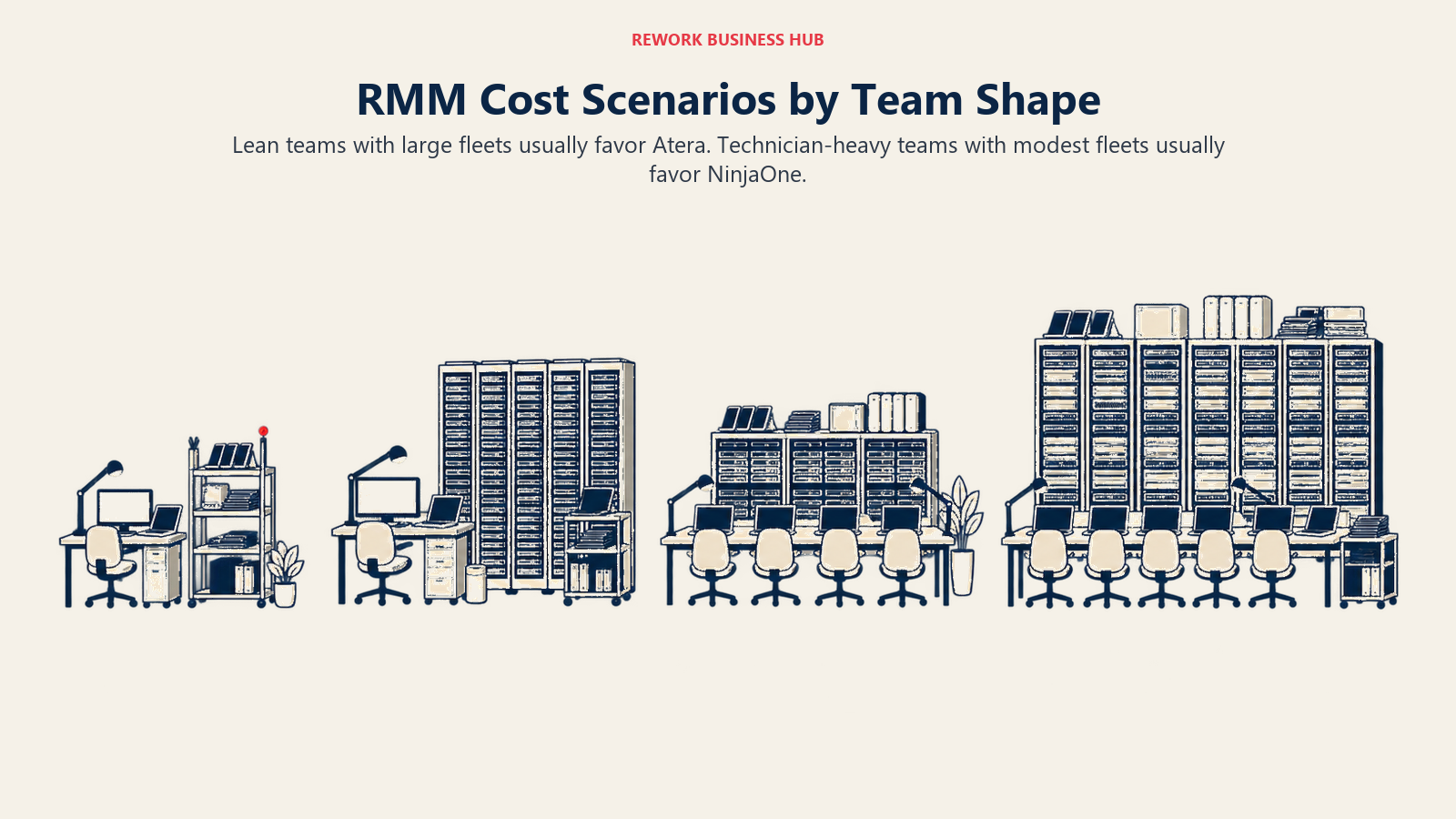
Team A: 4 technicians, 160 endpoints. Ratio: 40 devices per technician, right at the low edge of the modeled crossover band.
| Platform | Calculation | Annual cost |
|---|---|---|
| Atera Professional | 4 technicians x $1,788 | $7,152 |
| NinjaOne (modeled, ceiling rate) | 160 endpoints x $3.75 x 12 | $7,200 |
At this ratio the two platforms land within about 1% of each other. This is the genuine toss-up zone: whichever product wins here will win on feature fit, support quality or the actual NinjaOne quote, not on the sticker price.
Team B: 4 technicians, 4,000 endpoints. Ratio: 1,000 devices per technician, deep above the crossover band.
| Platform | Calculation | Annual cost |
|---|---|---|
| Atera Professional | 4 technicians x $1,788 | $7,152 |
| NinjaOne (modeled, floor rate, best case) | 4,000 endpoints x $1.50 x 12 | $72,000 |
| NinjaOne (modeled, ceiling rate) | 4,000 endpoints x $3.75 x 12 | $180,000 |
Even using NinjaOne's cheapest published rate, a rate that technically applies at 10,000 endpoints rather than 4,000, this fleet costs at least ten times more on NinjaOne than on Atera. This is the scenario where a lean team with a large fleet should expect Atera to win, and win by a wide margin.
Team C: 25 technicians, 200 endpoints. Ratio: 8 devices per technician, deep below the crossover band.
| Platform | Calculation | Annual cost |
|---|---|---|
| Atera Professional | 25 technicians x $1,788 | $44,700 |
| NinjaOne (modeled, ceiling rate, realistic for a small fleet) | 200 endpoints x $3.75 x 12 | $9,000 |
Here the pattern flips hard. A large technician headcount supporting a modest device count, a common shape in white-glove desk-side support, healthcare or trading-floor environments, makes NinjaOne roughly five times cheaper than Atera.
Team D: 25 technicians, 10,000 endpoints. Ratio: 400 devices per technician, deep above the crossover band despite the large headcount.
| Platform | Calculation | Annual cost |
|---|---|---|
| Atera Professional | 25 technicians x $1,788 | $44,700 |
| NinjaOne (this is the published floor rate, not modeled) | 10,000 endpoints x $1.50 x 12 | $180,000 |
This is the scenario that surprises people. Twenty-five technicians sounds like a large team, and 10,000 endpoints sounds like the exact volume where NinjaOne's rate card is supposed to be at its cheapest. But the ratio, not the headcount, is what matters, and at 400 endpoints per technician, NinjaOne costs roughly four times more than Atera even using NinjaOne's best published number. Raw team size does not override the ratio, and any comparison that models "large team" and "large fleet" as separate variables instead of a single ratio will get this scenario wrong.
Core RMM Capability Comparison
Setting price aside, both platforms are genuine RMM suites: agent-based monitoring, patching, remote access and scripting sit at the center of each.
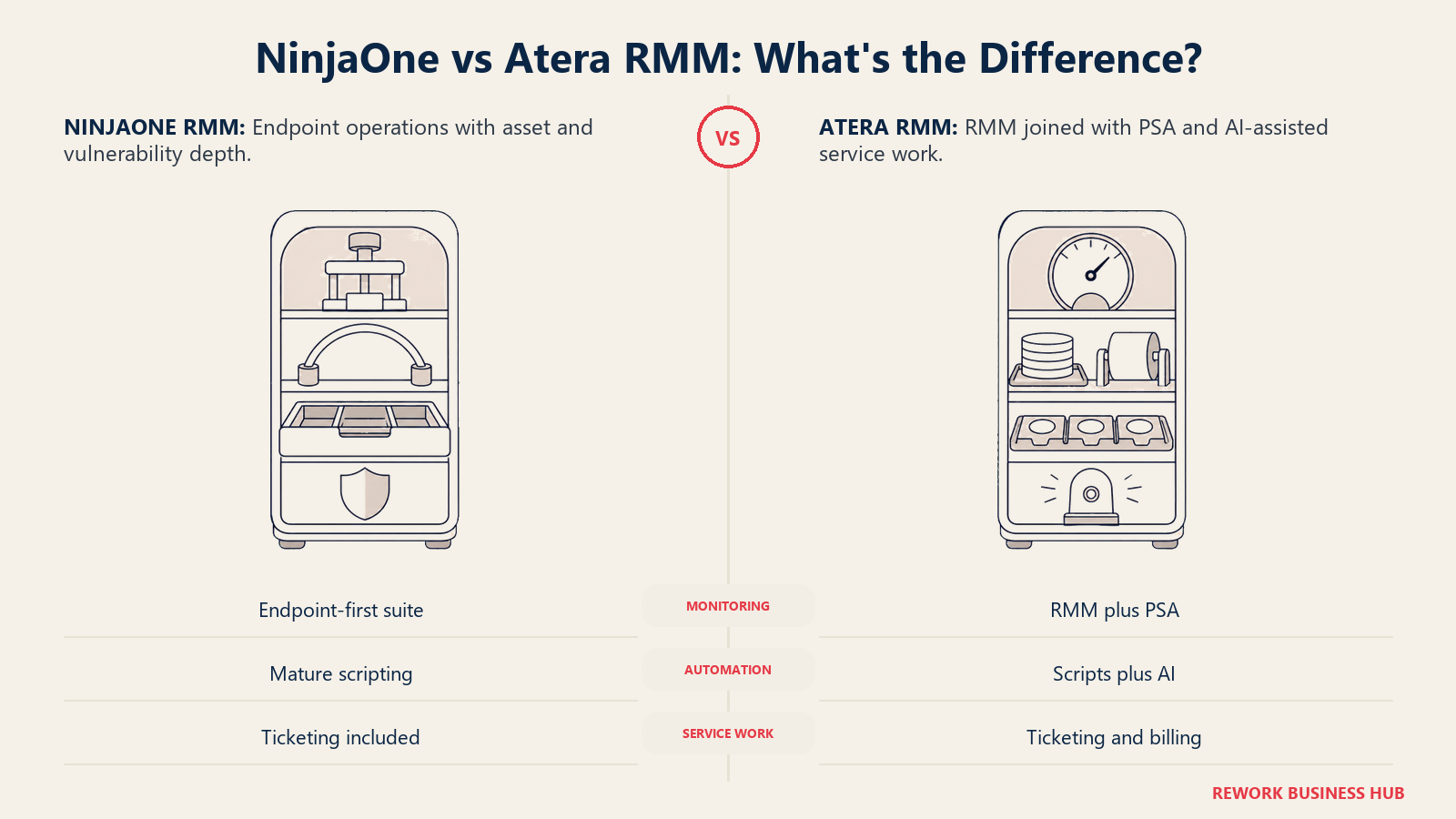
| Capability | NinjaOne | Atera |
|---|---|---|
| Windows, macOS, Linux monitoring | Yes, built into the core platform | Yes, agent installs on Windows, Mac, Linux and Unix |
| Patch management | Yes, described as "autonomous patch management" | Yes, across Windows, Mac and Linux |
| Remote access | Yes, built-in | Yes, built-in |
| Scripting and automation | Yes, core to the platform | Yes, plus AI Copilot can generate PowerShell scripts on request |
| Network discovery, SNMP | Yes, network device monitoring listed as a core capability | Yes, a dedicated Network Discovery tool with automatic SNMP device detection |
| Mobile device management | Yes, a listed core module for tablets and smartphones | Agent-based coverage extends to Android and iOS, per Atera's own platform description |
| IT asset management | Yes, built-in | Confirm with Atera whether this ships as a distinct module |
| Vulnerability tracking | Yes, KEV-based vulnerability tracking shipped in a recent release | Confirm with Atera whether this ships as a distinct module |
| Ticketing and service management | Yes, built-in | Yes, built-in, with automation rules for technician assignment |
| Professional services automation (billing, contracts) | Not confirmed as a built-in module; NinjaOne's public materials emphasize consolidating "4+ tools" but don't name a native PSA/billing suite | Marketed as a combined RMM-plus-PSA platform, with billing and reporting described as part of the same interface |
If your team runs both an internal fleet and any client-billing relationships, that PSA distinction is worth confirming directly with each vendor since it changes whether you need a third tool for invoicing.
AI and Automation: Where the Two Platforms Have Actually Diverged
This is the one category where the two products no longer look like close substitutes.
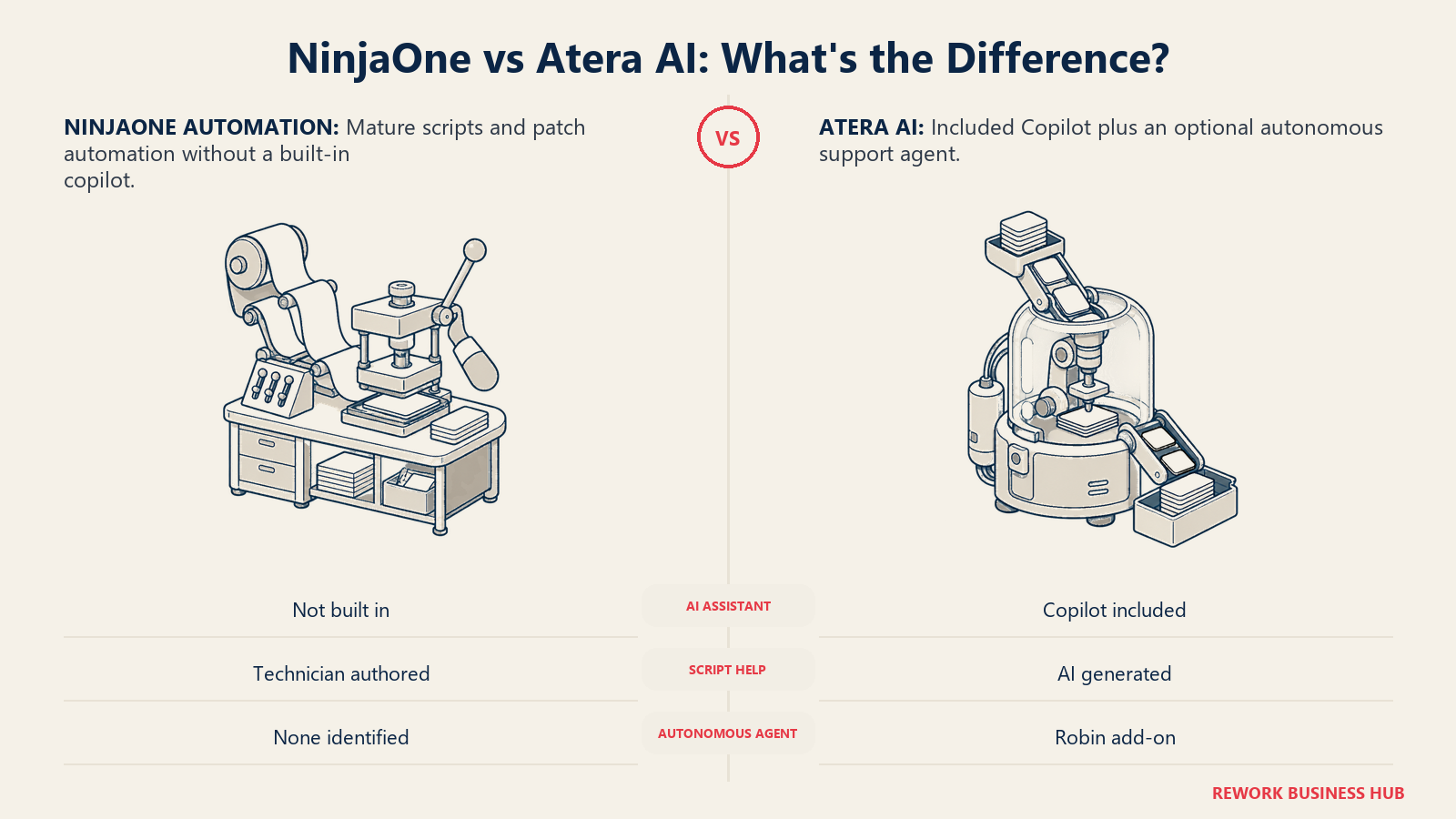
Atera folded AI Copilot into every plan for free as part of the 2026 pricing update described above. Copilot helps technicians diagnose device health, generate scripts on request and summarize long ticket histories. Separately, Atera sells Robin, an autonomous agent aimed at resolving end-user issues without a technician in the loop, backed by the public 90-day, 50%-resolution guarantee cited above. Robin is a paid add-on billed on an annual-only contract; Atera hasn't published a Robin price in the sources checked here.
NinjaOne, by contrast, doesn't currently ship a comparable AI Copilot or script-generation assistant as a built-in feature. Independent reviews note this as a gap relative to competitors that have added AI copilots, describing NinjaOne's automation as mature on patch and scripted-remediation depth but manual where an AI assistant would otherwise draft the script or summarize the ticket.
| AI capability | NinjaOne | Atera |
|---|---|---|
| Technician-facing AI assistant (script generation, diagnostics, ticket summaries) | Not currently a built-in feature | Yes, AI Copilot, included free on every plan since the 2026 update |
| Autonomous end-user-facing agent | No equivalent identified | Yes, Robin, a separate paid add-on with a public performance guarantee |
| Public performance commitment on AI outcomes | None identified | Yes, 50% of Tier 1 and complex Tier 2 tickets resolved within 90 days, or fees waived |
If AI-assisted ticket handling is a genuine priority for your team, this section alone may be the deciding factor regardless of the pricing math above.
Backup, Documentation and the Modules That Aren't in the Headline Rate
NinjaOne's published $1.50 to $3.75 band covers the base RMM platform. Backup, mobile device management depth and IT documentation are licensed as separate add-on modules, and NinjaOne does not publish their rates. Third-party pricing trackers report NinjaOne Backup running roughly $2 to $3 per workstation per month and from around $7 per server per month, with the exact figure depending on retention period and storage volume; these are reported estimates, not vendor-published prices, so confirm them on your own quote.
That means a NinjaOne quote built purely off the published $1.50-to-$3.75 band is very likely an undercount of what a fully-featured deployment, RMM plus backup plus documentation, will actually cost. Ask specifically which modules are bundled into any NinjaOne quote before comparing it to Atera's all-in seat price, since Atera's per-technician fee already includes unlimited devices under the core plan regardless of module depth.
Company Trajectory, Market Position and Reviews
Both companies had an eventful 2026, and the shape of that news differs enough to matter for a buyer weighing vendor stability.
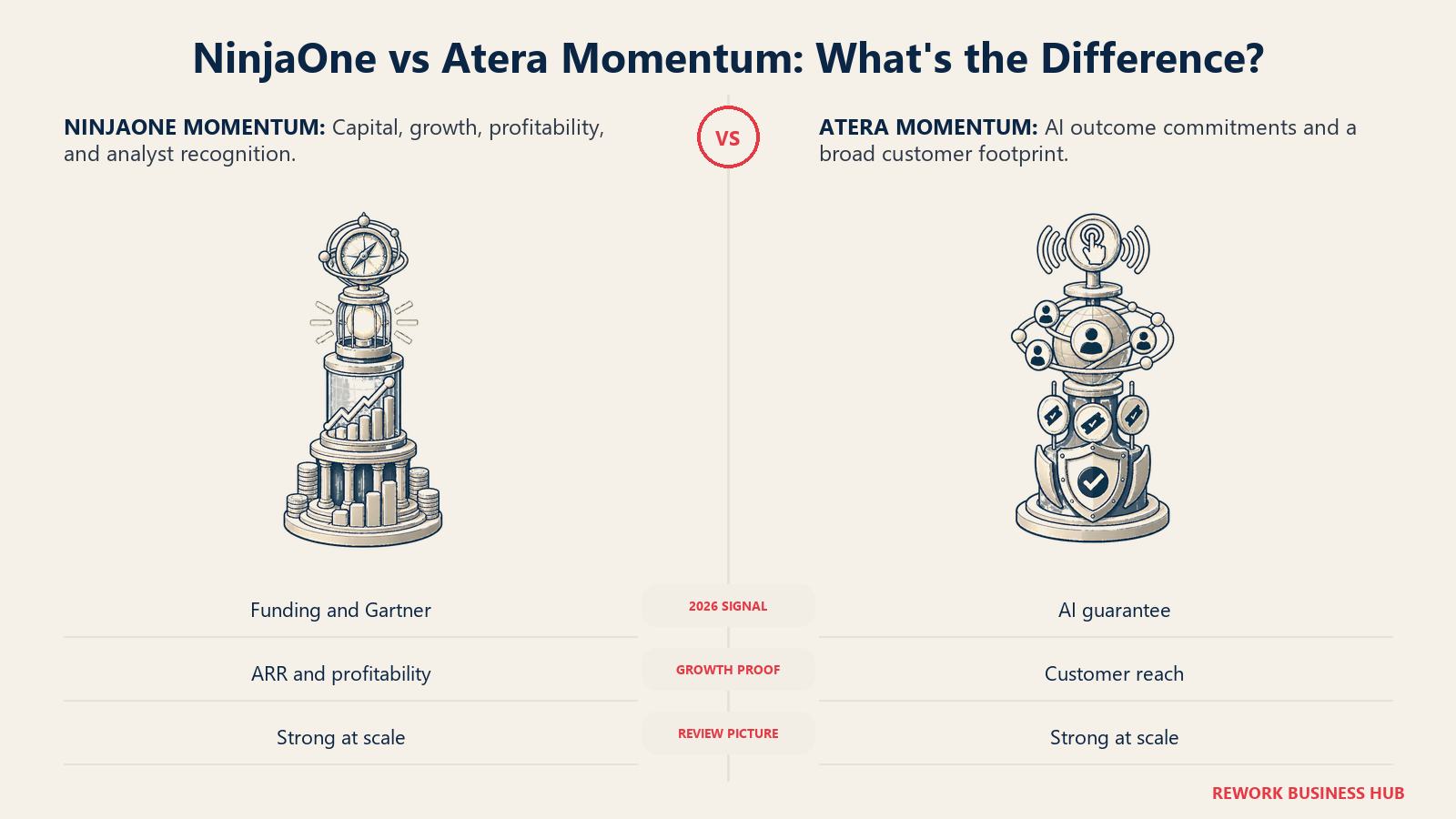
NinjaOne closed a Series C extension of more than $400 million on June 9, 2026, reaching a $12.3 billion valuation, up from $5 billion in February 2025. The company states nearly 70% year-over-year growth, close to $600 million in annual recurring revenue and profitability as of Q1 2026, alongside a January 2026 placement as a Leader in the Gartner Magic Quadrant for Endpoint Management Tools, its first appearance in that report. NinjaOne also cites IDC research finding a 720% three-year ROI and a four-month payback period, with roughly $1 million in annual benefits per 5,000 managed endpoints.
Atera's headline 2026 story is its AI push. Beyond folding Copilot into every plan, the company announced the Robin performance guarantee in May 2026 and, per G2's Summer 2026 Enterprise indices, ranked first among enterprise AIOps platforms on results and usability. Atera states across multiple pages on its own site that it serves more than 13,000 customers across 120-plus countries, with roughly 6 million devices under management and more than 1 million tickets resolved monthly.
On review platforms, both products post strong, similar scores: NinjaOne shows roughly 4.7 stars across more than 4,300 G2 reviews and about 4.8 on Capterra; Atera shows roughly 4.6 stars across more than 1,100 G2 reviews and a similar 4.5-to-4.6 band on Capterra. The decision here comes down to billing basis and feature fit, not user satisfaction.
Onboarding, Support and Admin Experience
NinjaOne offers a 14-day free trial and states support is "completely free and unlimited" with no separate onboarding fee, plus a 60-day cancellation notice on standard contracts outside promotional terms, worth flagging to procurement before signing.
Reviewers cite similar strengths and gaps on both platforms. NinjaOne users praise ease of navigation, reliable automated patching and fast remote access, while some note reporting could be more customizable and pricing isn't published up front. Atera users praise the unified dashboard combining monitoring, ticketing and patching, and describe setup as fast, though some flag reporting flexibility and enterprise-scale customization as gaps. Neither review base shows a clear support-quality edge; weigh the pricing model and AI features more heavily instead.
When Atera Is the Right Call
- Your technician-to-endpoint ratio is high, meaning a relatively small team supports a relatively large fleet. The flat per-technician fee doesn't move as the fleet grows, and that alone can be worth tens of thousands of dollars a year at scale, as Team B above shows.
- You want AI-assisted ticket handling without an extra line item. AI Copilot now ships free on every Atera plan, and Robin is available as an add-on with a public, dated performance guarantee behind it.
- You need a published number today. Every Atera figure in this article came from a real vendor rate card; a procurement team that needs a defensible budget line before a sales call gets one immediately.
- You bill clients and want PSA in the same interface. Atera's positioning as RMM-plus-PSA in one product is a genuine differentiator if invoicing and contracts currently live in a separate tool.
- Your fleet composition changes often. Because devices are unlimited per seat, onboarding a wave of new hardware doesn't require a mid-cycle pricing conversation the way an endpoint-billed platform would.
When NinjaOne Is the Right Call
- Your technician-to-endpoint ratio is low, meaning a relatively large team supports a relatively modest fleet. As Team C above shows, NinjaOne can cost a fraction of Atera's flat per-seat fee in this shape.
- You're already deep in enterprise device volume. At true high-volume scale, NinjaOne's published floor rate of $1.50 per endpoint is genuinely competitive on a per-device basis, even though the actual quote at any specific volume below 10,000 endpoints remains unpublished.
- You want a platform with a documented enterprise analyst placement. The Gartner Magic Quadrant Leader recognition and the reported IDC ROI figures give a procurement team third-party validation to point to.
- You need backup, documentation and asset management inside the same console, even if they're separately licensed add-ons rather than included in the base rate.
- You can live without a built-in AI copilot for now, or you're planning to source that capability through a separate integration such as CrowdStrike Falcon or SentinelOne rather than a native one.
If Neither Fits
Plenty of teams land on this page already knowing their real requirement sits somewhere adjacent to RMM rather than squarely inside it. If the core issue is asset tracking and lifecycle visibility rather than active monitoring and patching, start with our best IT asset management software roundup, which covers the asset-count-licensed tools that sit next to RMM platforms, including where Lansweeper's alternatives fit for teams that outgrew its 2,000-asset Starter floor.
If you're specifically trying to replace or supplement NinjaOne, our best NinjaOne alternatives roundup goes wider than this head-to-head, and if the real evaluation is device management rather than remote monitoring, our Jamf vs Intune comparison covers the MDM category these two RMM platforms sit beside. Teams evaluating the broader ITSM layer, ticketing, SLAs and service catalogs, should also see Freshservice vs Jira Service Management plus our best Freshservice alternatives and best Intune alternatives roundups, since RMM, MDM and ITSM get confused as one purchase when they're really three adjacent ones. And if SaaS license sprawl alongside your device fleet is part of the problem, our best SaaS management software roundup covers that separate budget line.
Before signing anything, our vendor diligence checklist and guide to negotiating a SaaS contract are worth running through, especially given how much of NinjaOne's real cost sits in an unpublished quote. And if you're moving off an incumbent RMM entirely, our guide to switching SaaS vendors covers the agent-migration and data-export questions that tend to surface late in an RMM switch.
Decision Framework
Match the billing unit to your team shape first, then use AI, PSA, endpoint depth, and budget visibility to break the tie.
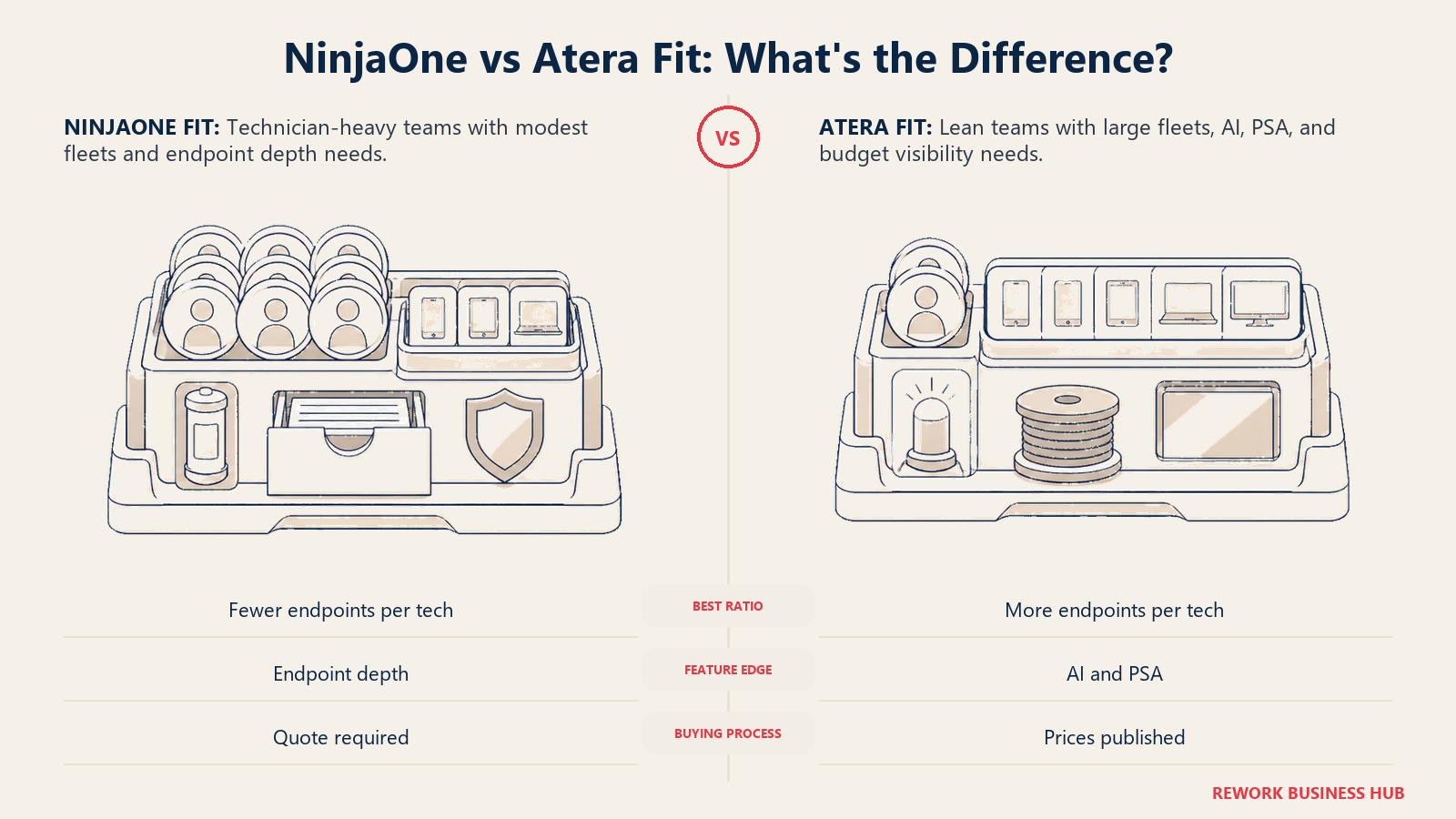
| If you are... | Pick |
|---|---|
| A small team managing a large, growing fleet | Atera, the flat per-technician fee won't multiply against every new device |
| A large team managing a modest, stable fleet | NinjaOne, per-device billing stays cheap when device count is low |
| Running roughly 40 to 150 devices per technician, depending on tier | Either, this is the modeled toss-up zone; get a real NinjaOne quote before deciding |
| Wanting AI-assisted ticketing with no separate line item | Atera, AI Copilot is included free on every plan |
| Wanting a documented Gartner Leader placement to cite in procurement | NinjaOne |
| Billing clients and needing PSA in the same product | Atera |
| Needing a firm number before any sales conversation | Atera, every figure here is a vendor-published rate |
| Already deep into enterprise-scale device volume (10,000-plus endpoints) | NinjaOne, its published floor rate is genuinely competitive at that scale |
| Needing backup, documentation and asset tracking natively, even as paid add-ons | NinjaOne |
The verdict. Neither platform is the broadly cheaper choice; the cheaper one is whichever matches your endpoints-per-technician ratio. Above roughly 100 devices per technician, Atera's flat fee usually wins, often by a wide margin. Below roughly 40, NinjaOne's per-device rate usually wins, also by a wide margin. In between, the deciding factor shifts from price to feature fit: Atera has bet heavily on AI, with Copilot now free everywhere and Robin backed by a public guarantee, while NinjaOne has bet on breadth and third-party validation, with a $12.3 billion valuation and a first-time Gartner Leader placement behind it.
What to Do Next
- Calculate your own endpoints-per-technician ratio first. Total managed devices divided by total technicians who'd use the console. That single number predicts the pricing outcome better than either headcount or fleet size alone.
- Get a real NinjaOne quote at your specific device count, not just the two published anchor rates. Ask explicitly whether backup, MDM and documentation are included or priced separately, since the base rate almost certainly doesn't cover all three.
- Confirm which Atera tier you actually need. Professional covers core RMM and ticketing; Expert and Master add depth that may or may not matter for an internal IT team versus an MSP.
- Trial the AI features against your actual ticket volume, not a demo script. If AI Copilot's script generation or Robin's autonomous resolution would meaningfully cut technician hours, that value can outweigh a pricing gap in either direction.
- Read the contract terms before you sign either one. Our guide to negotiating a SaaS contract is a reasonable checklist for cancellation notice periods, renewal uplift and true-up terms on a per-device platform in particular.
Frequently Asked Questions about NinjaOne vs Atera
Is NinjaOne cheaper than Atera?
It depends entirely on your endpoints-per-technician ratio. NinjaOne bills per device, starting as low as $1.50 per endpoint per month at 10,000 endpoints and rising to $3.75 at 50 or fewer, so it tends to be cheaper when a relatively large technician team supports a relatively small fleet. Atera bills per technician with unlimited devices, from $149 to $219 per technician per month depending on tier, so it tends to be cheaper when a small team supports a large fleet. Neither is categorically cheaper than the other.
How much does NinjaOne cost per endpoint?
NinjaOne publishes only one pricing data point: as low as $1.50 USD per month at 10,000 endpoints, increasing to $3.75 USD at 50 or fewer endpoints, with pricing varying by region and products purchased. Anything between those two points is a negotiated quote that NinjaOne does not publish, so any figure quoted for a mid-sized fleet should be treated as an estimate until confirmed with NinjaOne directly.
How much does Atera cost per technician?
Atera's IT Department plans run Professional at $169 monthly or $149 annual, Expert at $229 or $189, and Master at $269 or $219, all per technician per month, with unlimited managed devices included at every tier. AI Copilot is included free on all three tiers as of Atera's 2026 pricing update.
Does Atera charge extra for AI features?
AI Copilot, which assists technicians with diagnostics, script generation and ticket summaries, is included free on every Atera plan following the 2026 pricing update. Robin, Atera's autonomous agent for resolving end-user tickets without technician involvement, is a separate paid add-on billed annually, backed by a public guarantee to resolve 50% of Tier 1 and complex Tier 2 tickets within 90 days or waive fees.
Does NinjaOne have an AI assistant like Atera's Copilot?
Not as a built-in feature. Independent reviews describe NinjaOne as mature on patch management and scripted automation but lacking a comparable AI copilot for script generation or ticket summarization, one of the more meaningfully differentiated gaps between the two platforms right now.
What's included in NinjaOne's base per-endpoint price?
The published $1.50-to-$3.75 band covers NinjaOne's core RMM platform: endpoint monitoring, patch management, remote access and ticketing. Backup, deeper mobile device management and IT documentation are separately licensed add-ons NinjaOne doesn't publish pricing for; third-party trackers report backup alone running roughly $2 to $3 per workstation per month and from around $7 per server.
Which is better for an internal IT department versus an MSP?
Both serve both audiences, but the billing math points toward different fits. A lean internal team supporting a large device fleet, common in retail, healthcare or education, tends to land above the crossover ratio where Atera's flat fee is cheaper. An MSP or team with many technicians supporting a modest number of devices per client tends to land below it, where NinjaOne's per-device rate is cheaper.
Is NinjaOne or Atera more financially stable as a vendor?
Both show strong 2026 momentum by different measures. NinjaOne raised over $400 million in a June 2026 Series C extension at a $12.3 billion valuation, reports nearly 70% year-over-year growth and roughly $600 million in annual recurring revenue, and was named a Leader in the 2026 Gartner Magic Quadrant for Endpoint Management Tools. Atera hasn't disclosed comparable funding or valuation figures in the sources checked here, but it backed its Robin AI agent with a public performance guarantee in May 2026 and ranked first in several of G2's Summer 2026 enterprise indices.
Related Resources:
- Best IT Asset Management Software in 2026
- Best NinjaOne Alternatives in 2026
- Best Lansweeper Alternatives in 2026
- Jamf vs Microsoft Intune
- Freshservice vs Jira Service Management
- Best Freshservice Alternatives in 2026
- Best Intune Alternatives in 2026
- Best SaaS Management Software in 2026
- TCO Modeling for SaaS
- Vendor Diligence Checklist
- Negotiating a SaaS Contract
- Switching SaaS Vendors

Principal Product Marketing Strategist
On this page
- TL;DR
- Key Facts
- Per Technician or Per Endpoint: The Billing Split That Decides Everything
- Endpoints Per Technician: The Ratio That Actually Decides This
- What Four Real IT Teams Actually Pay
- Core RMM Capability Comparison
- AI and Automation: Where the Two Platforms Have Actually Diverged
- Backup, Documentation and the Modules That Aren't in the Headline Rate
- Company Trajectory, Market Position and Reviews
- Onboarding, Support and Admin Experience
- When Atera Is the Right Call
- When NinjaOne Is the Right Call
- If Neither Fits
- Decision Framework
- What to Do Next