Cube vs Pigment: Which FP&A Platform Fits What You're Willing to Teach Your Finance Team in 2026?
Turn this article into takeaways for your work.


Each assistant summarizes the article only for you and suggests best practices for your work.
Start with our best FP&A software roundup for 2026 if you haven't narrowed the category yet. If Cube and Pigment are already your shortlist, you've probably read our Cube vs Datarails comparison, or ruled out Anaplan on cost and timeline. What's left is a narrower, more personal question than most FP&A shootouts admit to: how much are you willing to ask your finance team to change.
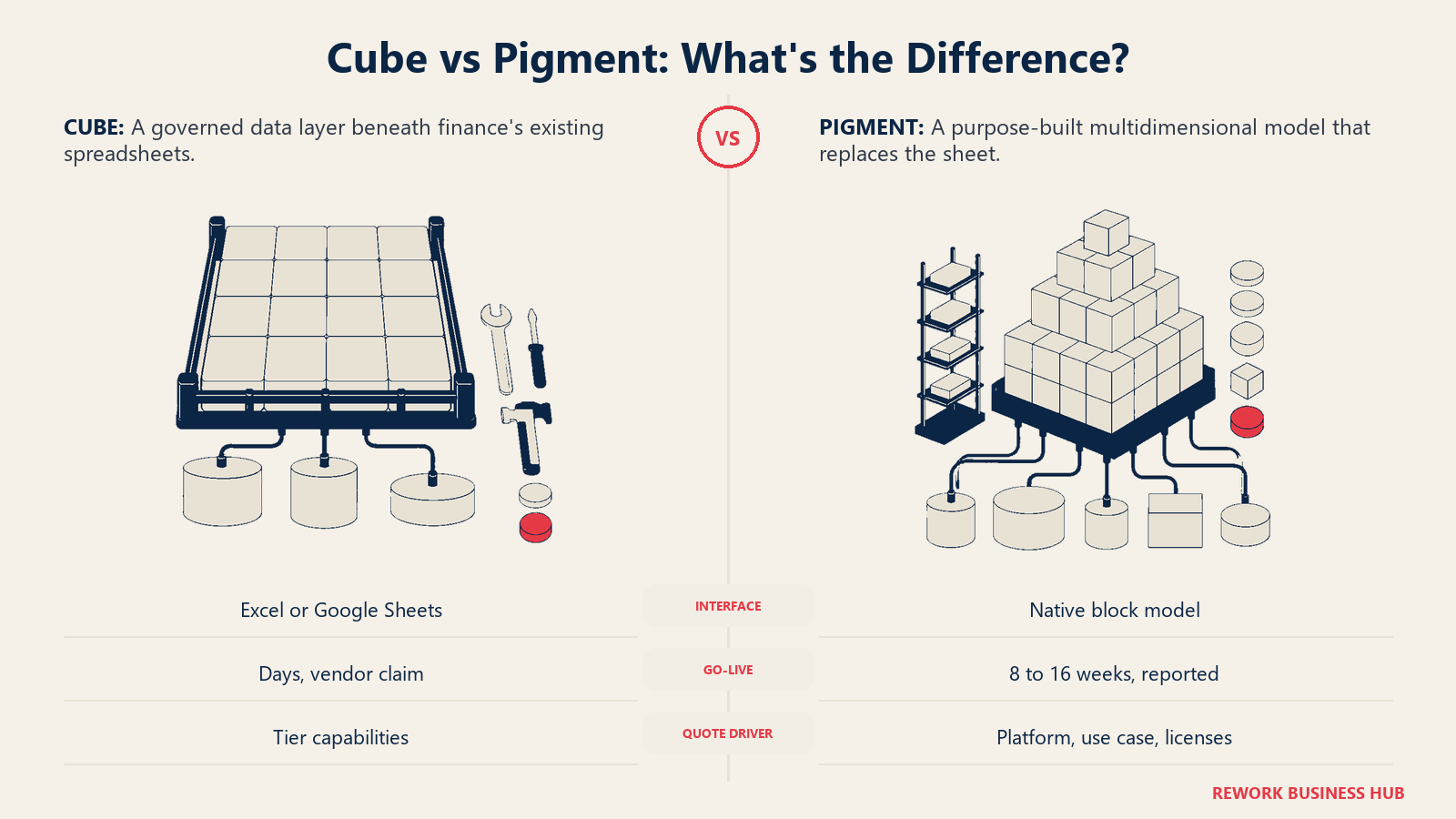
That's the real fork between these two platforms, because the vendors start from opposite premises about where FP&A should live. Cube's thesis is that FP&A already lives in Excel and Google Sheets, whether anyone planned it that way or not, and software's job is to make that spreadsheet reality governed and synced instead of replacing it. Pigment's thesis is the opposite: spreadsheets are the ceiling, not the floor, and a team that wants finance, sales, and workforce planning sharing one live model needs to move into an environment built for exactly that.
Neither vendor publishes a price, so this comparison won't pretend otherwise. Instead it works through what each platform actually asks of your team, how long implementation genuinely takes, and what you inherit either way: spreadsheet weaknesses on one side, a real implementation project on the other.
TL;DR
| Cube | Pigment | |
|---|---|---|
| Core premise | Governs the spreadsheets you already use, Excel and Google Sheets, live and bi-directional | Replaces the spreadsheet with a purpose-built, multi-dimensional modeling canvas |
| Where the model lives | Inside Excel or Google Sheets, synced to Cube's data layer | Inside Pigment's own block-based platform, not a spreadsheet |
| Licensing shape | Bronze, Silver, Gold tiers; "Unlimited Dimensions and Users" on every tier, per Cube's pricing page | Explorer, Contributor, Editor license types, plus a platform fee and a use-case fee |
| AI agent layer | FP&Agents (Data Managers, Analysts, Planners, Business Partners); MCP Integration on Silver and Gold only | Analyst and Modeler Agents live today; Planner Agent labeled "Coming soon" on pigment.com/ai |
| Security certifications | SOC 2 Type II | SOC 2 Type II, SOC 1 Type II, ISO 27001, CSA STAR Level 1 |
| Stated implementation speed | "Typically go live in days, not months," per Cube's own FP&A page | Partner-led, phased rollout; one certified partner reports eight to sixteen weeks (reported) |
| Published pricing | None; every tier is "Get quote" | None; no public pricing page found, every deal is CSM-quoted |
| Best fit | Lean finance teams, roughly 20 to 500 employees, already living in spreadsheets | Mid-market to enterprise finance teams, roughly 200 to 5,000 employees, wanting connected planning |
Key Facts
- 96% of FP&A practitioners still use spreadsheets for planning, and 93% use them for reporting, on a daily or weekly basis, per the AFP's 2025 FP&A Benchmarking Survey of 362 practitioners (AFP).
- Only 23% of FP&A practitioners report actually using AI day to day, well behind stated CFO ambition for the category, per an AFP-sourced figure covered by CFO.com.
- 51% of CFOs rank improving forecast accuracy and quality among their top five priorities for 2026, per a Gartner survey of more than 200 finance chiefs.
- Cube's MCP Integration, the connector into Claude, ChatGPT, and Copilot, ships on the Silver and Gold tiers only, not the entry Bronze tier, per Cube's own pricing page.
- Pigment's Planner Agent, the one that would simulate strategies and generate recommendations, is still labeled "Coming soon" on Pigment's own AI page, even though the Analyst and Modeler Agents are both live (pigment.com/ai).
- Pigment added ISO 27001 certification in 2026 to its SOC 1 and SOC 2 Type II stack, describing its compliance program as "independently audited on an annual basis," per Pigment's own security page.
What Each Platform Actually Asks Of Your Team
Every FP&A platform decision is a change-management decision wearing a software costume, and Cube and Pigment sit at opposite ends of how much change they ask for.
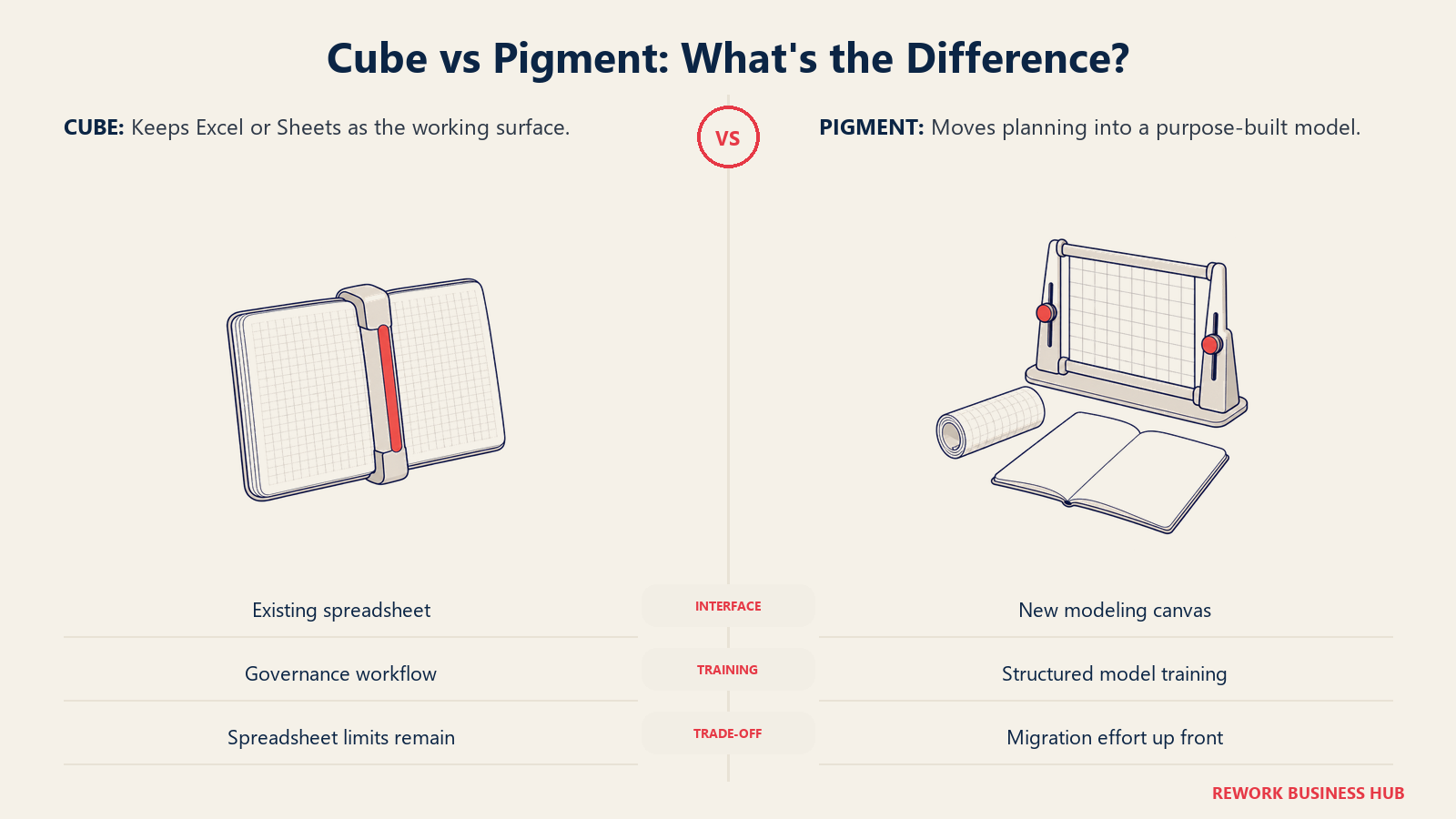
Cube asks for almost none. Analysts keep opening Excel or Google Sheets exactly like they do today, same shortcuts, same formulas they already know how to audit by eye. What changes underneath is that the spreadsheet stops being a static file: it's a live, governed layer connected to Cube's data layer, so a template built in Excel opens identically in Google Sheets and a number can trace back to the source system that produced it. That's Cube's pitch in its own words: "No new tool to learn. No rip-and-replace." The honest cost is that Cube inherits every structural weakness spreadsheets already have. A cell reference can still be silently broken. A model still lives as a grid rather than a governed dimensional structure, so genuinely complex planning, workforce numbers crossed with product-line P&L crossed with region, gets harder to build cleanly the more dimensions you stack on it.
Pigment asks for a real change. Your team moves off the Excel or Sheets grid entirely into Pigment's own block-based canvas, built for multi-dimensional modeling where finance, sales, and workforce data can share one live model instead of three spreadsheets that reconcile once a month if you're lucky. That buys modeling depth Cube's spreadsheet layer doesn't attempt: native dimensionality, several planners editing the same live model at once, and increasingly a Modeler Agent that can build that structure from a plain-language description instead of a human building every driver by hand. The honest cost is that this is a genuine implementation project, not a plug-in. Pigment's own materials describe a phased "Frame" methodology, onboarding, training, build, testing, adoption, typically run jointly with a certified implementation partner. One such partner, Amvent Consulting, states plainly that "most setups take about eight to sixteen weeks" depending on scope, data readiness, and integration count (reported), with Pigment's own blog noting that during the build phase, customers spend most of their time in training and roughly twenty percent actually building in the platform.
Neither cost is wrong to pay. A finance team comfortable in Excel that mostly needs version-control chaos solved gets real value fast from Cube and loses nothing it was already using. A team that's hit the wall on what a spreadsheet can model, manually reconciling three departmental plans by hand every cycle, is paying an ongoing tax that eight to sixteen weeks of implementation will end for good.
| What changes for your team | Cube | Pigment |
|---|---|---|
| Day-to-day interface | Excel or Google Sheets, unchanged | Pigment's own block-based canvas, a new interface to learn |
| Who can build a model | Anyone who can already build a spreadsheet formula | Editor-license holders; formula and model-logic access sits behind a distinct, higher permission tier |
| Existing Excel models | Stay in place, gain a live sync layer underneath | Retired or rebuilt inside Pigment; formulas don't carry over |
| Training load | Close to none on the interface; the ramp is on Cube's governance features | Real and structured: most of Pigment's build phase is spent in training |
| Risk you inherit | Spreadsheet-native risks: broken references, human error, a dimensional ceiling | Implementation risk: partner dependency, migration effort, a longer path to first value |
| Reward for the ask | Fast governance, near-zero retraining | Genuine multi-dimensional modeling depth a spreadsheet can't reach |
Who Each Platform Is Really For
Cube's natural buyer has already decided spreadsheets aren't going anywhere and wants the risk taken out of that decision, not a replacement for it: often a first or second FP&A hire currently holding scattered workbooks together by memory. The question they're solving is "how do I stop being the single point of failure for our numbers," not "how do we model complexity the spreadsheet was never built for."
Pigment's natural buyer is further along a different path: a team that already tried connected planning in a spreadsheet or a lighter tool and hit a real ceiling, usually where finance, sales, and workforce planning all need the same live numbers and nobody trusts whose spreadsheet is current. That team isn't avoiding change, it's looking for a platform that can justify asking for it.
Neither profile is more sophisticated, they're solving different problems at different points in the same company's life. A 40-person company forcing itself into Pigment's modeling depth before it needs it pays for capability nobody uses yet. A 1,500-person company holding connected planning together with governed spreadsheets keeps hitting the same wall Cube's sync was never built to solve.
| Cube | Pigment | |
|---|---|---|
| Natural buyer | Lean finance team already in spreadsheets, wants governance, not replacement | Mid-market to enterprise team that has outgrown spreadsheet-based connected planning |
| Company size (this collection's sizing) | Roughly 20 to 500 employees | Roughly 200 to 5,000 employees |
| The question they're solving | "How do we stop scattered workbooks from silently disagreeing?" | "How do we model finance, sales, and workforce on one live structure?" |
| Team maturity assumed | Comfortable in Excel or Sheets today, low appetite for a new interface | Ready to invest in training and a certified-partner-led rollout |
| Buying trigger | Version-control chaos, a single point of failure leaving | Hitting a real modeling ceiling spreadsheets can't clear |
| What they'd lose picking the other tool | Multi-dimensional depth for genuinely complex, cross-functional plans | A fast, low-retraining path; Pigment is overkill if governed spreadsheets were enough |
Spreadsheet Sync vs a Purpose-Built Modeling Canvas
Cube's mechanism is a bi-directional sync, described on the company's own Google Sheets integration page: "Use Cube to bring data from your source system into Google Sheets (or Microsoft Excel). You can also send new data back to Cube." That works identically in either spreadsheet tool, and a template built in one "can be edited in Excel or Google Sheets, regardless of which software was used to create them." The result is a governed data layer under a familiar grid: pull actuals in, push a forecast back, and the source of truth stays in sync no matter which spreadsheet an analyst prefers.
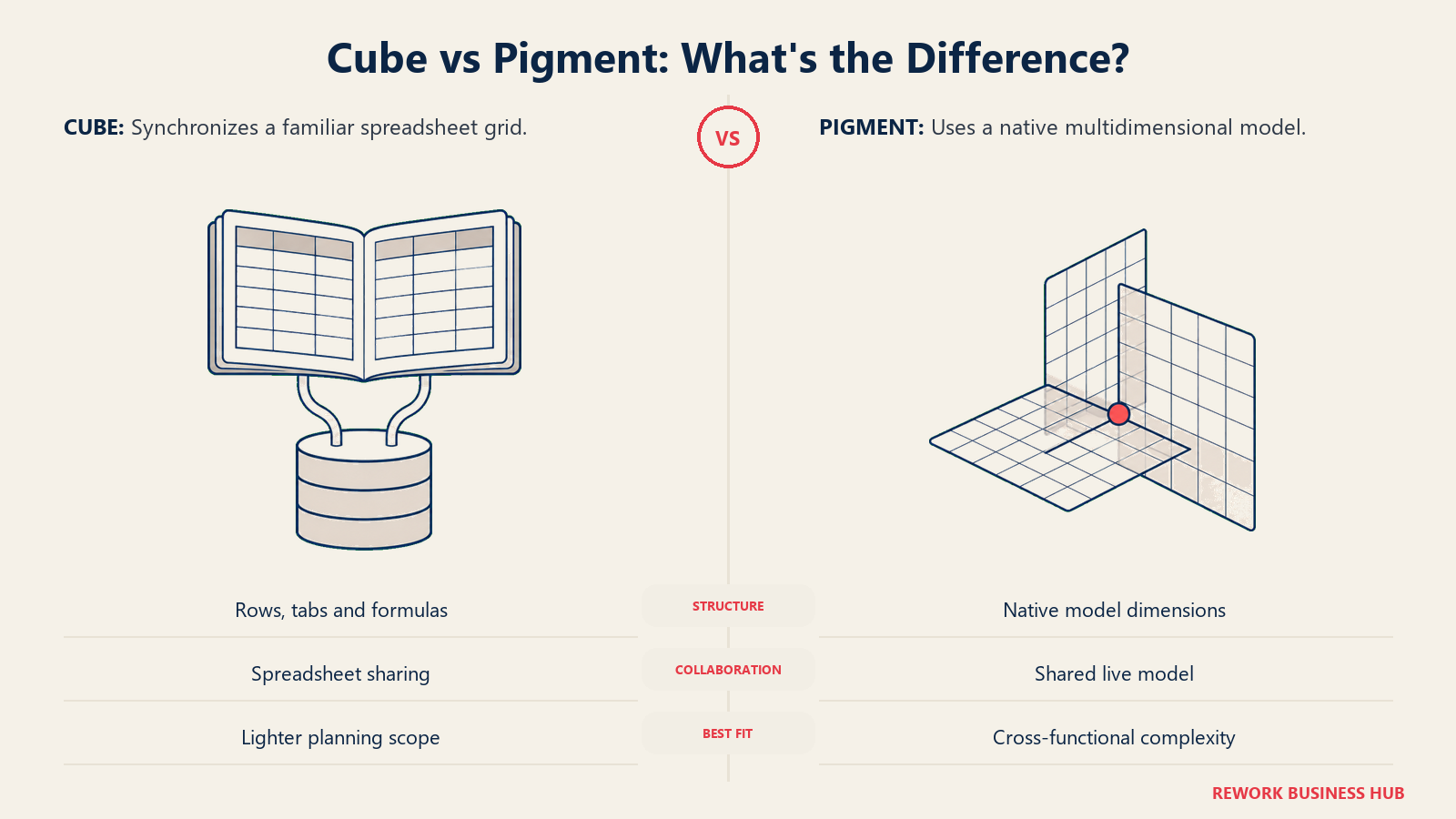
Pigment's mechanism is structurally different because there's no spreadsheet underneath at all. The platform runs on block-based modeling, where several planners edit the same live model simultaneously rather than merging file versions after the fact, and dimensions (product, region, department, time) are native to the model instead of approximated through pivot tables and lookups. That's real modeling power a spreadsheet, governed or not, doesn't have: a genuinely many-dimensional plan doesn't get slower or more fragile as you add dimensions the way an Excel workbook does.
Where this gets interesting in 2026 is Pigment's Modeler Agent, an answer to the exact complaint that sends buyers toward Cube, that a new platform is slower to build in than a spreadsheet. It builds and updates the underlying model from a plain-language description and runs its own data-quality checks, trying to close the setup-speed gap with AI instead of by becoming a spreadsheet. Whether that holds up depends on your model's complexity, but it's a genuine attempt at the tradeoff this comparison is about, not a chat layer bolted onto the same old build process.
The practical takeaway: if your planning problem is genuinely dimensional, unifying finance, sales capacity, and headcount on one live structure, a spreadsheet is the wrong shape of tool regardless of how good Cube's sync is. If it isn't, if you mostly need one department's numbers to stop drifting across five copies of the same file, Pigment's modeling depth is capability you're paying for and not using.
| Modeling factor | Cube | Pigment |
|---|---|---|
| Underlying structure | Spreadsheet grid (Excel or Google Sheets), synced live | Native block-based, multi-dimensional model, no spreadsheet |
| Multi-user editing | Standard spreadsheet sharing and version behavior | Several planners editing the same live model simultaneously |
| Dimensionality | Approximated through tabs, pivots, and formulas | Native to the model: product, region, department, time as first-class dimensions |
| AI-assisted model building | Planner agents build forecasts and scenarios inside the existing sheet | Modeler Agent builds and updates the model itself from a plain-language description |
| Best suited to | Single-department or lightly cross-functional planning | Genuinely multi-dimensional, cross-functional connected planning |
| What breaks first at scale | Formula complexity and file size as dimensions stack | Nothing structural; implementation weight and cost are the constraint instead |
The AI Agent Layer Built Around Each Model
Neither vendor sells a bare modeling tool anymore. Both have built a named AI agent layer around their core product, and the honest state of each in August 2026 is more different than the marketing pages suggest.
Cube's FP&Agents are organized into four teams: Data Managers handle data integrity, Analysts handle variance and root-cause questions drillable to the source transaction, Planners handle forecasts and scenario building, and Business Partners draft board decks and executive narratives from live data. All four are live, and every insight is meant to trace through Cube's "Trace to Truth" architecture, mapping a board slide's numbers to the specific transactions behind them. The catch is tier gating: the MCP Server, which plugs Cube's data into Claude, ChatGPT, and Copilot directly, ships on Silver and Gold, not the entry Bronze tier.
Pigment's agent story is genuinely three-part, and the parts sit at different stages of readiness. The Analyst Agent is live and generally available to all customers, surfacing trends, anomalies, and reports from connected data. The Modeler Agent is also live, marketed as turning "intent into plan" by building governed models from plain language. The Planner Agent, the one that would simulate strategies and generate recommendations, is explicitly labeled "Coming soon". Two of the three are real today; the third is a roadmap commitment worth clarifying with a rep before you buy against it.
Both companies back these claims with customer-reported numbers rather than independently audited accuracy figures, real signal, not proof. Pigment cites Figma reporting "80% reduced time spent on design, modeling, and framework creation thanks to the Modeling Agent," and Danone cutting strategic planning from two weeks to one day. Cube's equivalent claim is structural: every FP&Agent output traces to a transaction, a trust mechanism more than a speed one. Ask each vendor to run its agent against your own last-closed month, not a demo dataset. For the fuller field, see best AI agents for FP&A in 2026.
| AI agent layer | Cube | Pigment |
|---|---|---|
| Name | FP&Agents (Agentic Finance Layer) | Analyst, Modeler, and Planner Agents |
| Data integrity and prep | Data Manager agents | Modeler Agent runs its own data-quality checks |
| Variance and reporting | Analyst agents, drillable to the source transaction | Analyst Agent, generally available to all customers |
| Model and forecast building | Planner agents, inside the existing spreadsheet | Modeler Agent, builds the model from plain language |
| Strategic scenario simulation | Business Partner agents draft board narratives | Planner Agent, still labeled "Coming soon" |
| Outside AI assistant access | MCP Server into Claude, ChatGPT, Copilot; Silver and Gold tiers only | Not positioned as a third-party AI connector; agents are native to the platform |
| Trust mechanism cited | "Trace to Truth": every insight maps to a GL transaction | Vendor-reported customer time savings (Figma, Danone) |
Governance, Security, and Data Trust
Security review is a real gate for either purchase, and the two vendors publish overlapping but not identical certification stacks. Cube's security page states SOC 2 Type II certification, plus HIPAA compliance, with data encrypted in transit and at rest, MFA, SAML SSO, and full audit logs, hosted on AWS.
Pigment's published stack is broader: SOC 2 Type II and SOC 1 Type II, plus ISO 27001, added in 2026, alongside GDPR and CCPA/CPRA compliance programs, CSA STAR Level 1, and a stated capability to support Sarbanes-Oxley needs, all "independently audited on an annual basis."
Neither gap should decide the purchase alone. Cube's certification is real and sufficient for plenty of buyers, and SOC 2 Type II is the baseline most security reviews check for first. But if procurement specifically requires ISO 27001 or SOX-readiness documentation, Pigment currently answers that in its public materials and Cube's don't address it. Ask both vendors for current trust-center documentation directly; certifications get added faster than marketing pages get updated.
| Certification or control | Cube | Pigment |
|---|---|---|
| SOC 2 Type II | Yes, examined by Dansa D'Arata Soucia | Yes |
| SOC 1 Type II | Not published | Yes |
| ISO 27001 | Not published | Yes, added in 2026 |
| HIPAA compliance | Yes, stated on Cube's security page | Not detailed in sources reviewed |
| GDPR / CCPA compliance program | Not detailed with the same specificity | Yes, both named explicitly |
| CSA STAR | Not published | Yes, Level 1 |
| SOX-readiness capability | Not published | Yes, stated capability |
| Infrastructure detail | AWS-hosted, encrypted in transit and at rest, MFA, SAML SSO, full audit logs | Not detailed with the same specificity in sources reviewed |
Implementation Effort and Time to First Model
This is the section that matters most given neither vendor will give you a number to compare against. Cube's own claim is aggressive and specific: "Cube implementations typically go live in days, not months. No consultants. No IT project." Data sources connect "through no-code integrations…without IT involvement," and the company states most FP&A teams are live within days of starting setup. That claim is plausible because of what Cube is actually doing: not building a new model, but connecting a governed layer underneath a spreadsheet structure your team already has. There's comparatively little to build from scratch.
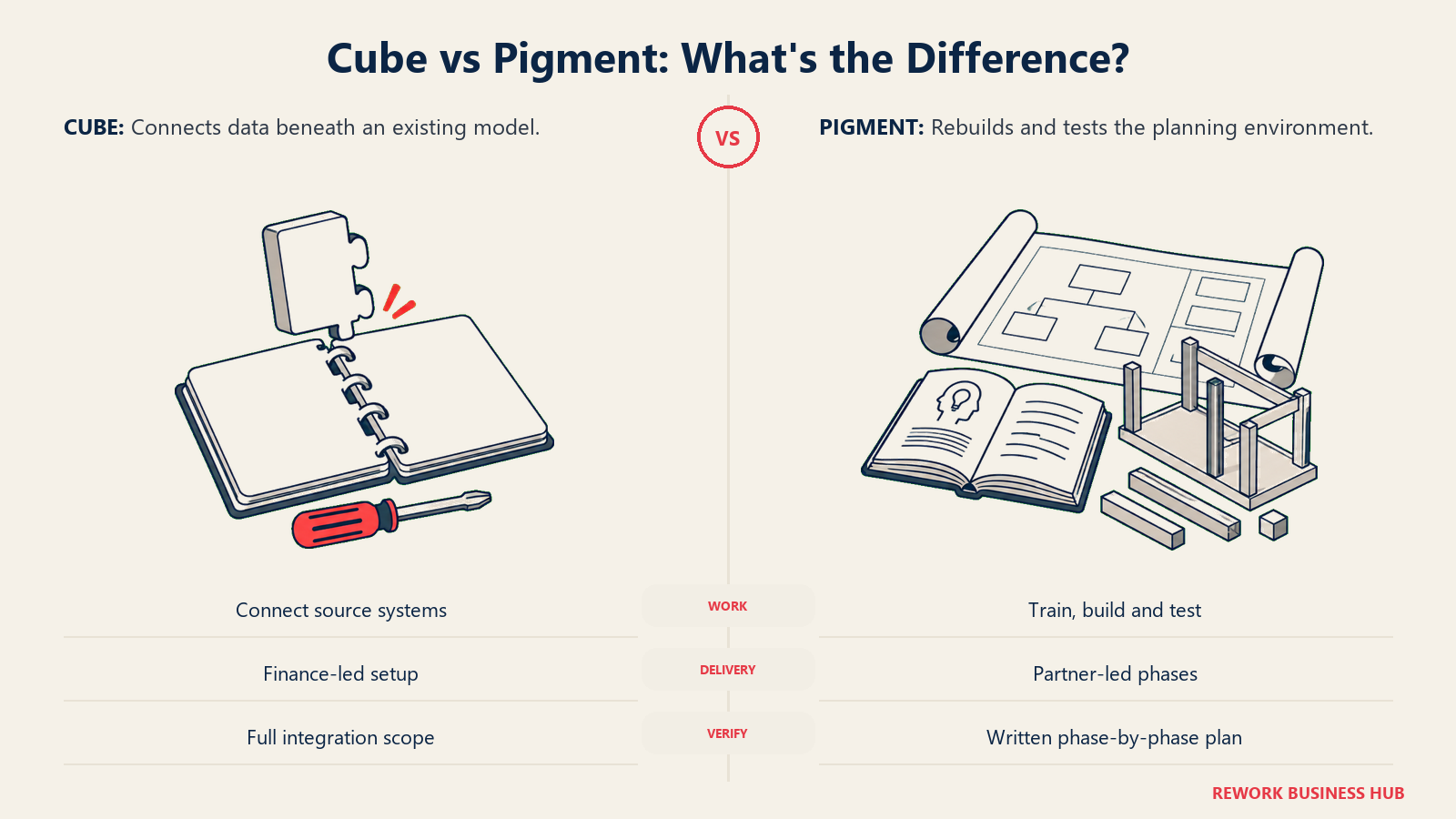
Pigment's honest timeline is longer because the work is different in kind, not just degree. Implementation runs through Pigment's own phased "Frame" methodology (onboarding, training, build, testing, adoption), typically delivered jointly with a certified implementation partner. Pigment's own blog describes the build phase as mostly training, with about twenty percent of the time spent actually building in the platform. One certified partner, Amvent Consulting, states directly that "most setups take about eight to sixteen weeks" depending on scope, data readiness, and integration count, and that adding workforce planning alongside sales planning extends that cycle further (reported). Treat that figure as reported, since it comes from a partner rather than a published Pigment number, but it matches the shape any buyer should expect from a platform replacing the model structure itself, not layering on top of one.
The gap between "days" and "eight to sixteen weeks" is the real price of Pigment's modeling depth: a governed, multi-dimensional model built and tested with an experienced partner, versus a spreadsheet sync that's live almost immediately but was never going to model five departments on one structure regardless of how much time you gave it. Neither number is a trick, they describe two different kinds of work.
What to verify before you sign: ask Cube whether "days" holds once your ERP, CRM, and HRIS connections are all in scope, not just a first single-department model. Ask Pigment's partner for a reference customer at your scope and headcount, and get a written, phase-by-phase project plan before assuming eight weeks over sixteen.
| Implementation factor | Cube | Pigment |
|---|---|---|
| Published claim | "Typically go live in days, not months" | No specific figure published |
| Reported figure where none is published | n/a, Cube's claim is specific | "Eight to sixteen weeks," per certified partner Amvent Consulting (reported) |
| Who leads implementation | Your team, via no-code integrations, "no IT project" | Jointly: a certified implementation partner plus your internal team |
| Named methodology | Not published as a formal phased process | "Frame" methodology: onboarding, training, build, testing, adoption |
| Where the time actually goes | Connecting source systems through no-code integration | Mostly training, roughly 20% hands-on building, per Pigment's own materials |
| What extends the timeline | More source systems (ERP, CRM, HRIS) in scope | Adding workforce planning alongside sales planning, or other cross-functional scope |
| What to verify before signing | Whether "days" holds with full integration scope, not a single-department pilot | A written, phase-by-phase project plan and a reference customer at your scope |
What Actually Drives Each Quote
Neither vendor publishes a dollar figure anywhere, and treating any number found on a review aggregator or a rival's comparison page as real would make this article less accurate, not more useful, so there isn't one here.
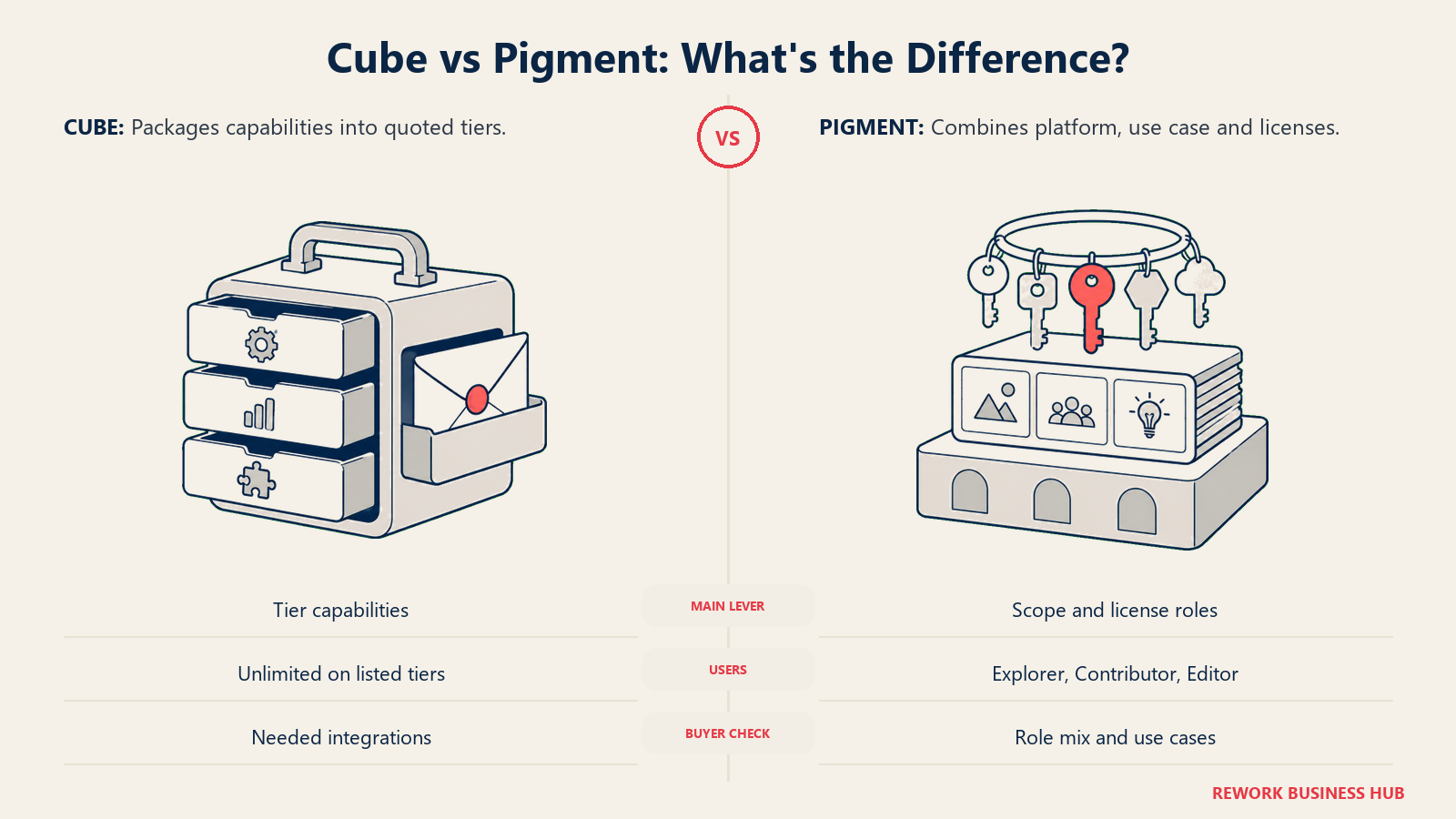
Cube's pricing page, headed "Transparent and Upfront Pricing" despite listing no figures, shows three tiers. Bronze includes full platform access, custom roles, and unlimited dimensions and users. Silver adds Slack and Teams integration, workflow automation, PowerPoint and Slides integration, and MCP Integration. Gold adds premium support and "all integrations & workflows," plus custom modules. Since users and dimensions are unlimited on every tier, what drives a Cube quote is capability, which integrations, whether MCP access matters, not headcount. Add-ons (Premium Support+, additional modules, API access) sit outside the three tiers and are presumably priced separately, though that isn't published either.
Pigment's model is structurally different and more layered: a platform fee, a use-case fee, and per-license costs by license type. Explorer is the default, lowest-permission seat, mostly for viewing and commenting. Contributor adds the ability to input data and update assumptions. Editor carries full access, including the formula and model-logic changes that define how the platform works, making Editor seats the smallest and most expensive group in most deals. No public pricing page is currently live on Pigment's site and there's no self-serve signup; every deal routes through a Customer Success Manager.
The practical difference at negotiation time: a Cube quote is mostly about which Silver or Gold capabilities you need, since seats aren't the constraint. A Pigment quote juggles three cost levers at once, the platform fee, the use-case fee, and how many of each license type your rollout needs, harder to estimate walking in. Get both figures in writing, scoped to your actual headcount and use case, before either goes into a budget conversation.
| What to ask about | Cube | Pigment |
|---|---|---|
| Published price | None; every tier is "Get quote" | None; no public pricing page found, CSM-quoted |
| Pricing structure | Three tiers (Bronze, Silver, Gold); unlimited users and dimensions on every tier | Platform fee, plus a use-case fee, plus per-license costs (Explorer, Contributor, Editor) |
| What drives the number up | Capability: integrations, MCP access, support tier | Headcount by license type, especially Editor seats, plus use-case scope |
| Free trial or self-serve signup | Not published | Not found; CSM-quoted only |
| Cheapest seat type | n/a, users are unlimited on every tier | Explorer: view-focused, lowest permission |
| Most expensive seat type | n/a | Editor: full model-logic access, typically the smallest and priciest group |
| Real budget question to ask | Which Silver or Gold capabilities the team actually needs | How many Editor versus Contributor versus Explorer seats the rollout really requires |
Sizing: Where Each Platform Tops Out
Headcount is a reasonable proxy for which platform to evaluate first, though not the only variable. A 150-person company running complex, multi-entity modeling can outgrow Cube's ceiling faster than headcount alone suggests, and a 600-person company that just needs one department's numbers to stop drifting may never need Pigment's full depth. If Workday Adaptive Planning is also on your list at the top end of either range, Cube vs Workday Adaptive Planning and Pigment vs Workday Adaptive Planning run that exact matchup from each side.
| Headcount | Likely fit | Watch out for |
|---|---|---|
| Under 50 | Cube | Pigment's implementation weight and license-mix pricing are hard to justify this early |
| 50 to 200 | Cube, unless planning is already genuinely cross-functional | The moment two departments need one live model, Cube's spreadsheet ceiling shows up |
| 200 to 1,000 | Either, depending on modeling complexity, not headcount alone | Don't let headcount alone decide; ask what's actually breaking in your process today |
| 1,000 to 5,000 | Pigment | A spreadsheet-governance layer, however good, rarely holds at this scale of connected planning |
| 5,000-plus | Pigment, or a heavier connected-planning platform | At real enterprise scale, weigh Pigment against Anaplan and Workday too, not just Cube |
Switching and Migration Considerations
If you're moving toward either platform from spreadsheets alone, or from a different FP&A tool, the friction shows up in different places depending on which way you're headed.
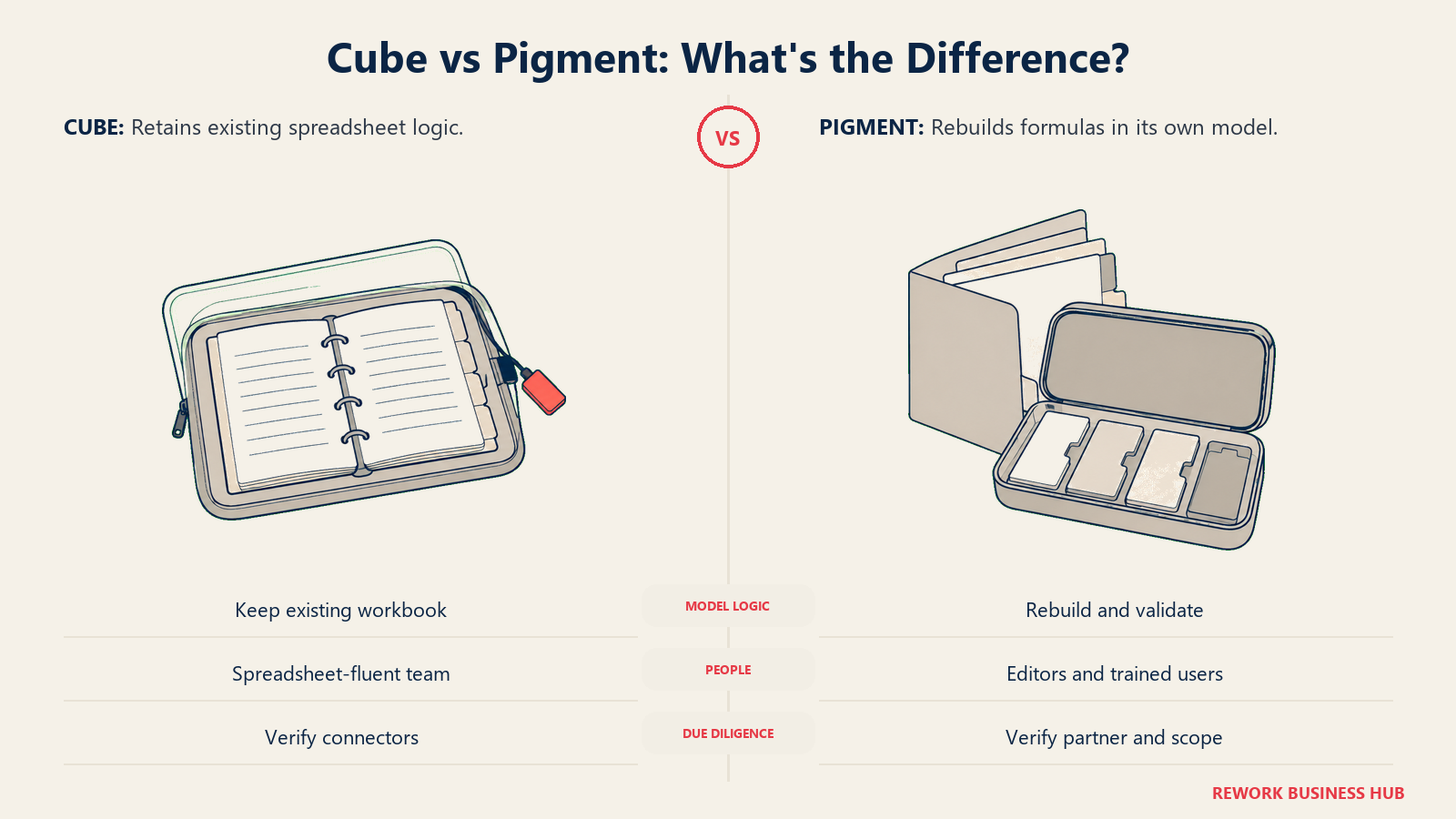
| Switching factor | What to check |
|---|---|
| Existing Excel or Sheets model logic | Cube keeps it in place; Pigment requires rebuilding formulas and structure inside its own model |
| Team's spreadsheet fluency | High fluency and low appetite for a new interface points toward Cube; a team already frustrated with spreadsheet limits fits Pigment better |
| Data source count and complexity | Confirm your ERP, CRM, and HRIS connect natively before signing either vendor; ask for the specific connector list, not a general integrations claim |
| Certified partner dependency | Pigment's rollout typically involves a named implementation partner; ask who that is and request their reference list before signing |
| License mix forecasting | Model Pigment's Explorer, Contributor, and Editor mix against your real org chart rather than guessing; getting it wrong under- or over-licenses the team |
| Change management load | Cube asks little of a spreadsheet-fluent team; Pigment's training-heavy build phase is a real project, not a weekend rollout |
When Cube Is the Right Call
- Your team is fluent in Excel or Sheets, and the real problem is version control, not modeling depth.
- You need to be live in days, not weeks, and can't justify a partner-led implementation right now.
- Your planning is mostly single-department or lightly cross-functional, not genuinely multi-dimensional.
- You'd rather negotiate on capability than forecast a license mix across three seat types.
If Cube's spreadsheet-first approach isn't the differentiator you need, the best Cube alternatives roundup is worth a look before you commit.
When Pigment Is the Right Call
- Your planning is already cross-functional: finance, sales, and workforce data need one live model, not three spreadsheets reconciled by hand.
- You've hit a real dimensional ceiling, where adding one more product line, region, or scenario makes the file slower and more fragile, not just longer.
- You have the appetite, and roughly eight to sixteen weeks, for a real implementation with a certified partner.
- Broader security certification, ISO 27001, SOC 1 Type II, SOX-readiness, is a real procurement requirement, not a nice-to-have.
If Pigment's implementation weight feels like more than your team needs, the best Pigment alternatives roundup covers the wider field, including lighter options.
Decision Framework
| If this is true for you | Pick |
|---|---|
| Your team is fluent in Excel or Sheets and mostly needs version-control governance | Cube |
| Finance, sales, and workforce planning need to share one live, multi-dimensional model | Pigment |
| You need to be live in days, not weeks | Cube |
| You can commit to an eight-to-sixteen-week, partner-led rollout for real modeling depth | Pigment |
| Outside AI assistant access (Claude, ChatGPT, Copilot) matters and you're fine paying for Silver or above | Cube |
| ISO 27001 or SOX-readiness is a hard procurement requirement | Pigment |
| Neither fits because you need enterprise-scale connected planning across finance, sales, and supply chain at once | See our Anaplan vs Workday Adaptive Planning comparison for a heavier class of platform |
What to Do Next
- Name what's actually breaking in your process. "Scattered spreadsheet versions nobody trusts" points at Cube. "Departments planning on numbers that don't reconcile" points at Pigment.
- If Cube leads, ask whether "days, not months" holds once your ERP, CRM, and HRIS are all connected, not just a first single-department model.
- If Pigment leads, get a written, phase-by-phase plan from a certified partner, plus a reference customer at your scope, before assuming eight weeks over sixteen.
- Model your license mix or capability list against your real org chart: Explorer, Contributor, and Editor seats for Pigment; Silver-versus-Gold capabilities for Cube.
- Ask both vendors for a written, scope-specific quote, and confirm current security certifications against each vendor's trust center before procurement starts, not after.
The underlying discipline matters more than either platform. A structured scenario planning practice and clear forecast governance will make either tool perform better, and expose a weak one faster than a demo does.
Frequently Asked Questions about Cube vs Pigment
Does Cube support Google Sheets, or just Excel?
Both, with the same bi-directional sync. Cube's own Google Sheets integration page states you can bring data into Google Sheets or Excel and send new data back to Cube, and templates built in one open identically in the other.
Does Pigment let our team keep working in spreadsheets alongside it?
Not as the modeling surface. Pigment's core model lives in its own block-based platform rather than a spreadsheet, though teams commonly export views to Excel or Sheets for distribution. If the spreadsheet itself has to stay the interface, that favors Cube.
Which platform is faster to implement?
Cube, by a wide margin on its own claims: implementations "typically go live in days, not months." Pigment's rollout runs through a phased, certified-partner-led methodology one implementation partner reports typically takes eight to sixteen weeks (reported), since it's building a new model structure rather than syncing an existing one.
Does either platform publish pricing?
No. Cube's pricing page lists Bronze, Silver, and Gold tiers, all behind a "Get quote" button despite its "Transparent and Upfront Pricing" heading. Pigment has no public pricing page; its Explorer, Contributor, and Editor license types are quoted through a Customer Success Manager, combined with a platform fee and a use-case fee.
Are Pigment's AI agents actually available today?
Two of the three are. The Analyst Agent and the Modeler Agent are both live and generally available, per Pigment's own materials. The Planner Agent is still labeled "Coming soon" on Pigment's own AI page.
Does Cube's AI agent layer cost extra?
The FP&Agents are described as part of the core platform, but the MCP Server, which plugs Cube's data into Claude, ChatGPT, and Copilot, is gated to the Silver and Gold tiers, not the entry Bronze tier.
Which platform has stronger security certifications?
Pigment's published stack is broader: SOC 2 Type II and SOC 1 Type II, plus ISO 27001, GDPR and CCPA compliance programs, and CSA STAR Level 1. Cube states SOC 2 Type II certification plus HIPAA compliance. Both are real; Pigment's is simply wider as published.
What's the actual difference between Cube and Pigment?
Cube governs the spreadsheets your team already uses, syncing Excel and Google Sheets live against a shared data layer without asking anyone to change tools. Pigment replaces the spreadsheet with a purpose-built, multi-dimensional modeling platform that can do more, but asks your team to learn a new environment and commit to a real implementation project first.
Related Resources:
- Best FP&A Software in 2026
- Best Cube Alternatives
- Best Pigment Alternatives
- Cube vs Datarails
- Cube vs Workday Adaptive Planning
- Pigment vs Workday Adaptive Planning
- Best AI Agents for FP&A in 2026
- Anaplan vs Workday Adaptive Planning
- Best Anaplan Alternatives
- Best Budgeting and Forecasting Software in 2026

Principal Product Marketing Strategist
On this page
- TL;DR
- Key Facts
- What Each Platform Actually Asks Of Your Team
- Who Each Platform Is Really For
- Spreadsheet Sync vs a Purpose-Built Modeling Canvas
- The AI Agent Layer Built Around Each Model
- Governance, Security, and Data Trust
- Implementation Effort and Time to First Model
- What Actually Drives Each Quote
- Sizing: Where Each Platform Tops Out
- Switching and Migration Considerations
- When Cube Is the Right Call
- When Pigment Is the Right Call
- Decision Framework
- What to Do Next