Best Pigment Alternatives in 2026: 13 FP&A Platforms With Clearer Pricing and Faster Rollouts

Turn this article into takeaways for your work.


Each assistant summarizes the article only for you and suggests best practices for your work.
Pigment's pitch is a genuinely modern take on connected planning: one model spanning finance, sales, workforce, and supply chain, built around an AI Modeler that helps build drivers and formulas instead of just calculating what a Model Builder already wrote. For a finance team that wants cross-functional planning ambition without Anaplan's two-decade architecture underneath it, Pigment is a legitimate top choice. This guide is not a takedown of it.
It's also, for plenty of buyers, a platform they shop away from before they ever see a number. Every deal routes through a Customer Success Manager, and the commercial model layers a platform fee, a use-case fee, and per-license costs across three license types, Explorer, Contributor, and Editor, with nothing published to budget against. Add an enterprise-length implementation and cross-functional scope many finance teams never use outside FP&A, and it's easy to see why buyers look elsewhere. This guide is for the CFOs, VPs of Finance, and FP&A leads deciding whether Pigment's ambition matches what their team needs.
Below are 13 alternatives ordered by relevance, not alphabet, evaluated on sizing fit, implementation weight, and pricing transparency, since that's what sends buyers looking in the first place. Every price comes from the vendor's own page as of August 2026, and where a vendor publishes nothing, this guide says so plainly instead of dressing up a third-party guess as a "starting price." Start with the best FP&A software roundup if you haven't narrowed the category, or the Anaplan alternatives guide if the real question is which enterprise platform to pick, not whether to leave one.
Key Facts
- 96% of FP&A professionals still use spreadsheets weekly, and 71% also use an EPM or enterprise planning tool at least quarterly, a gap the report says shows enterprise tools "are not fully successful" at solving the underlying data-reliability problem (AFP FP&A Benchmarking Survey 2025: Technology & Data).
- The average budgeting cycle still takes nearly nine weeks, unchanged across three years of the survey regardless of how much planning software organizations have bought (AFP FP&A Benchmarking Survey 2026: Integrated Planning).
- 43% of North American CFOs named cloud-based planning, budgeting, and forecasting their top lever for cost management heading into 2026, just ahead of data analytics tools at 42.5% (Deloitte CFO Signals, Q4 2025).
- Only 38% of organizations use structured scenario planning, but those that do complete budgets 11% faster on average than peers without it (same AFP 2026 report).
- 56% of finance leaders now use AI, up from 17% in 2023, though finance still ranks last among business functions in AI deployment (State of AI in Finance 2026, CFO Connect).
Quick Comparison Table
| Tool | Best For | Starting Price | Key Strength | Key Limitation |
|---|---|---|---|---|
| Anaplan | Deepest connected-planning ecosystem | No published price, via certified partner | Widest partner network, most mature history | Longest implementation |
| Workday Adaptive Planning | Workday HCM or Financials shops | Pricing varies, quote only, 30-day trial | Native Workday integration, trial available | No pricing outside the trial |
| Board | Planning and BI in one platform | Quote only, per solution area | Native analytics and dashboards, one model | EMEA-heavy partner network |
| OneStream | Planning plus statutory consolidation | No pricing page, Request Demo only | Unified consolidation, planning, reporting | Heaviest deployment here |
| Planful | Finance-first FP&A, no cross-functional modules | No published pricing | Scoped to FP&A, faster to stand up | Less breadth than Pigment |
| Prophix | Mid-market CPM, AI in the budgeting workflow | Quote only | AI-assisted budgeting built in | No published pricing |
| Centage | Mid-market budgeting with an actual price list | $1,750/month (Core), annual billing | Only tool here with real prices | Fewer modules than Pigment |
| Vena Solutions | Teams that want to keep Excel as the interface | Quote only (Professional, Complete) | Native Excel interface, minimal retraining | Some features cost extra |
| Cube | Spreadsheet-native FP&A on Excel or Sheets | Quote only (Bronze, Silver, Gold) | Fast to deploy, unlimited users | No pricing on any tier |
| Datarails | Lean teams that want Excel as the surface | Custom quote (3 tiers, seat and integration) | FinanceOS keeps Excel as the front end | Seat caps limit scale |
| Drivetrain | SaaS companies planning around revenue metrics | Quote only, implementation included | Built-in SaaS metrics templates | Narrower non-subscription fit |
| Abacum | Scaling tech companies, collaborative FP&A | No published pricing (Book a Demo) | Live GL, HRIS, and CRM connections | Shorter track record |
| Limelight | Budget-conscious SMB or mid-market CPM | Quote only (Starter, Unlimited) | Simple two-tier structure | Smaller feature set |
Why Teams Leave Pigment
Pigment's model is genuinely different from a legacy connected-planning tool. Three license types, Explorer (default, view-focused), Contributor (can input data and update assumptions), and Editor (full access, defines model logic and structure), sit underneath a commercial model combining a platform fee, a use-case fee, and per-license costs. None of that is unusual for enterprise software, but it's a real problem for a buyer who wants a number before the first call.
| Reason teams start shopping | What actually happens | What buyers look for instead |
|---|---|---|
| No published pricing at any license type | Every deal routes through a Customer Success Manager before a figure appears | A public tier structure or starting price |
| Platform fee plus use-case fee is hard to pre-budget | Total cost layers a platform fee, a use-case fee, and per-license costs, not one number | A flatter model, or named tiers to reason against |
| License tiers add a second budgeting variable | Getting the Explorer, Contributor, Editor mix wrong under- or over-licenses the team | Clear, published seat definitions before signing |
| Implementation still runs long for cross-functional scope | Modeling across finance, sales, workforce, and supply chain takes real project time to configure | A platform sized to the one function being modeled |
| Overkill for a team that just wants a budget and a forecast | Cross-functional capability nobody outside finance touches still shows up in the price | A finance-first tool without extra modules |
1. Anaplan - The Deepest Enterprise Connected-Planning Ecosystem
Anaplan is the platform Pigment set out to modernize, and it's still the more mature choice for buyers wanting the widest certified-partner network and a two-decade track record. It runs on Hyperblock, an in-memory engine with two workspace types, Classic for dense data and Polaris for sparse, high-dimensional models, chosen once and not convertible later. Licensing runs on three tiers, Model Builder, Contributor, and Viewer, quoted only through the certified-partner ecosystem that also handles implementation, with no published figures anywhere.
Target audience and sizing. Enterprise finance teams, roughly 500 to 10,000-plus employees, willing to invest in owning the model long term.
Stage fit. Best for organizations that already tried a lighter tool and want more partner depth, not less.
| Pros | Cons |
|---|---|
| Widest certified-partner ecosystem in the category | No published pricing, longest quote-to-close cycle here |
| Most mature product history for a board-level decision | Implementation runs through a partner, measured in months |
| Two engine options (Classic, Polaris) fit different model shapes | Workspace type is a one-time decision that can't be reversed |
Pricing: No public price. Quote only, through the certified-partner network, based on workspace count, license tier, and Hyperblock capacity.
Best for: Teams leaving Pigment because they want more enterprise depth and partner support, not less. See the Anaplan alternatives guide if Anaplan is also on your shortlist.
2. Workday Adaptive Planning - The Enterprise Peer With a Free Trial
For organizations already on Workday HCM or Financials, Adaptive Planning is the obvious next call: native data integration is a real structural advantage Pigment can't match without custom connectors. Pricing isn't public (the vendor's page reads "Pricing varies" with a Request a Quote button, the same quote-only pattern as Pigment), but Workday offers something Pigment doesn't publish anywhere: a 30-day free trial, confirmed live on the vendor's site. The Close and Consolidation add-on is quoted separately.
Target audience and sizing. Mid-market to enterprise finance teams on or evaluating Workday, typically 500 to 10,000-plus employees.
Stage fit. Best when an ERP or HRIS decision is being made alongside a planning decision, so integrations get designed together.
| Pros | Cons |
|---|---|
| Native integration with Workday HCM and Financials data | No published pricing, same quote cycle as Pigment |
| 30-day free trial, something Pigment does not offer | Weakest fit for organizations not already on Workday |
| AI-powered forecasting pulls from live operational data | Close and Consolidation priced as a separate add-on |
Pricing: Pricing varies, quote only, for both Adaptive Planning and the Close and Consolidation add-on. 30-day free trial available.
Best for: Workday shops that want a trial period before committing, something no other platform on this list publishes. See the Anaplan vs Workday Adaptive Planning comparison, or the Workday Adaptive Planning alternatives guide if Adaptive Planning is what you're replacing.
3. Board - Planning and BI Under One Roof
Board answers a different complaint: instead of unifying planning across business functions the way Pigment does, it unifies planning and BI in one platform, so the model producing your budget also produces the dashboards leadership reviews. Verified on Board's own pricing page today, pricing is quote-only, organized by solution area (Finance, Supply Chain, Retail, Sales, HR, Predictive Analytics, Add-ins and Integrations, Premium Support), each routed to its own "Request pricing" form.
Target audience and sizing. Mid-market to enterprise finance teams, especially multinational ones, roughly 200 to 5,000-plus employees.
Stage fit. Best when a team evaluates its BI stack and planning stack as one purchase, not two.
| Pros | Cons |
|---|---|
| Planning and BI native in one platform, one model | No published pricing, quoted per solution area |
| Strong European and multinational deployment history | Partner ecosystem skews EMEA, thinner in North America |
| Reduces the export-to-BI-tool step a modeling-only platform requires | Solution-area pricing structure is unusual to evaluate against |
Pricing: Quote only, by solution area. No published figures.
Best for: Finance teams, particularly multinational ones, that want one platform driving both the model and its dashboards.
4. OneStream - When Planning and Consolidation Need to Live Together
OneStream solves a gap that shows up for plenty of Pigment users at close time: Pigment plans, but doesn't consolidate statutory financials, leaving teams to reconcile two systems by hand every cycle. OneStream's architecture folds consolidation, planning, reporting, and data quality into one model. OneStream has no dedicated pricing page; every path routes to a Request a Demo form instead of any figure or tier name.
Target audience and sizing. Finance organizations of 500 to 10,000-plus employees that own both FP&A and statutory consolidation.
Stage fit. Best for teams replacing an aging consolidation stack alongside modernizing planning.
| Pros | Cons |
|---|---|
| Consolidation and planning run on one unified platform | No pricing page published anywhere on the site |
| Reduces the reconcile-two-systems problem at close | Implementation is as heavy as an enterprise platform gets |
| Strong fit for teams also modernizing a legacy consolidation tool | Overkill if you only need planning, not consolidation |
Pricing: No published pricing page. Every inquiry routes to a Request a Demo form, with quotes scoped after that conversation.
Best for: Finance teams that need consolidation and connected planning on the same model, not two systems bridged by spreadsheets.
5. Planful - Finance-First, Without Pigment's Cross-Functional Modules
Planful's argument is scope, not features. Where Pigment connects finance, sales, workforce, and supply chain planning under one roof, Planful stays deliberately finance-first: budgeting, forecasting, reporting, and consolidation, built for the FP&A team rather than a company-wide platform other departments also license. That narrower scope tends to mean a shorter path to a working model. Planful doesn't maintain a public pricing page with figures; quotes scope to a platform fee, user licenses, and which modules (FP&A, consolidation, reporting, analytics) get deployed.
Target audience and sizing. Mid-market finance teams, roughly 100 to 2,000 employees, wanting a dedicated FP&A platform, not a cross-functional one.
Stage fit. Good for teams standardizing their first real planning platform after outgrowing spreadsheets.
| Pros | Cons |
|---|---|
| Finance-first scope, typically faster to implement than Pigment | No published pricing |
| Built-in consolidation alongside budgeting and forecasting | Less cross-functional reach than Pigment, Board, or Anaplan |
| Familiar, finance-specific modeling without extra modules | Module-by-module pricing adds a planning step to your own budget |
Pricing: No published pricing. Contact sales only; quotes scope to platform fee, user licenses, and deployed modules.
Best for: FP&A teams that want a dedicated finance platform without Pigment's sales, workforce, or supply-chain modules. See the Planful alternatives guide if Planful is what you're replacing.
6. Prophix - Mid-Market CPM With AI Built Into the Budgeting Workflow
Prophix targets the finance team that likes Pigment's AI-assisted modeling story but doesn't need cross-functional scope or an enterprise-scale commitment. The product, sold as Prophix One, covers budgeting, forecasting, reporting, and consolidation, with AI features rolling out through 2026 built into the core workflow. The pricing page carries genuine educational content on how CPM pricing typically works, alongside a Book a Call CTA, but stops short of publishing Prophix's own tiers.
Target audience and sizing. Mid-market finance teams, roughly 50 to 1,000 employees, wanting AI-assisted CPM without an enterprise price tag.
Stage fit. Best for a first structured budgeting and consolidation process on dedicated software.
| Pros | Cons |
|---|---|
| AI-assisted budgeting built into the core workflow | No published pricing, despite educational pricing content |
| Consolidation included alongside planning and reporting | Less enterprise scale than Pigment, Anaplan, or OneStream |
| Positioned clearly at mid-market, an easier evaluation fit | Smaller partner and integration ecosystem |
Pricing: Quote only (Prophix One). No published figures.
Best for: Mid-market finance teams that want AI-assisted budgeting without Pigment's licensing model.
7. Centage - The Rare Mid-Market Platform With a Real Price List
Centage stands out here for one reason: it actually publishes dollar figures, a genuine contrast to Pigment's CSM-only quote process. Three tiers, Core, Strategic, and Performance, are billed monthly at $1,750, $2,500, and $3,500, all on annual billing. Performance includes up to 5 GL integrations and full multi-entity consolidation. Centage's own site positions typical mid-market spend at $18,000 to $40,000 a year against enterprise FP&A tools it puts at $100,000 to $200,000-plus, scaling for companies from roughly $25 million to $500 million-plus in revenue.
Target audience and sizing. Mid-market finance teams, roughly $25M to $500M-plus in revenue, wanting a published number before a call.
Stage fit. Best for a first dedicated budgeting platform, or a team tired of unpriced enterprise quotes.
| Pros | Cons |
|---|---|
| Published monthly pricing on all three tiers | Smaller cross-functional footprint than Pigment |
| Performance tier bundles multi-entity consolidation | Pricing is based on users, size, and complexity, so real cost can exceed the sticker |
| Vendor publishes its own cost comparison against enterprise tools | Less brand recognition among connected-planning specialists |
Pricing: Core $1,750/month, Strategic $2,500/month, Performance $3,500/month, all billed annually. Vendor states typical mid-market spend of $18K to $40K/year.
Best for: Finance teams that want a real number before evaluating anything else here. See the budgeting and forecasting software roundup for a wider field of priced and unpriced options.
8. Vena Solutions - For Teams That Refuse to Leave Excel
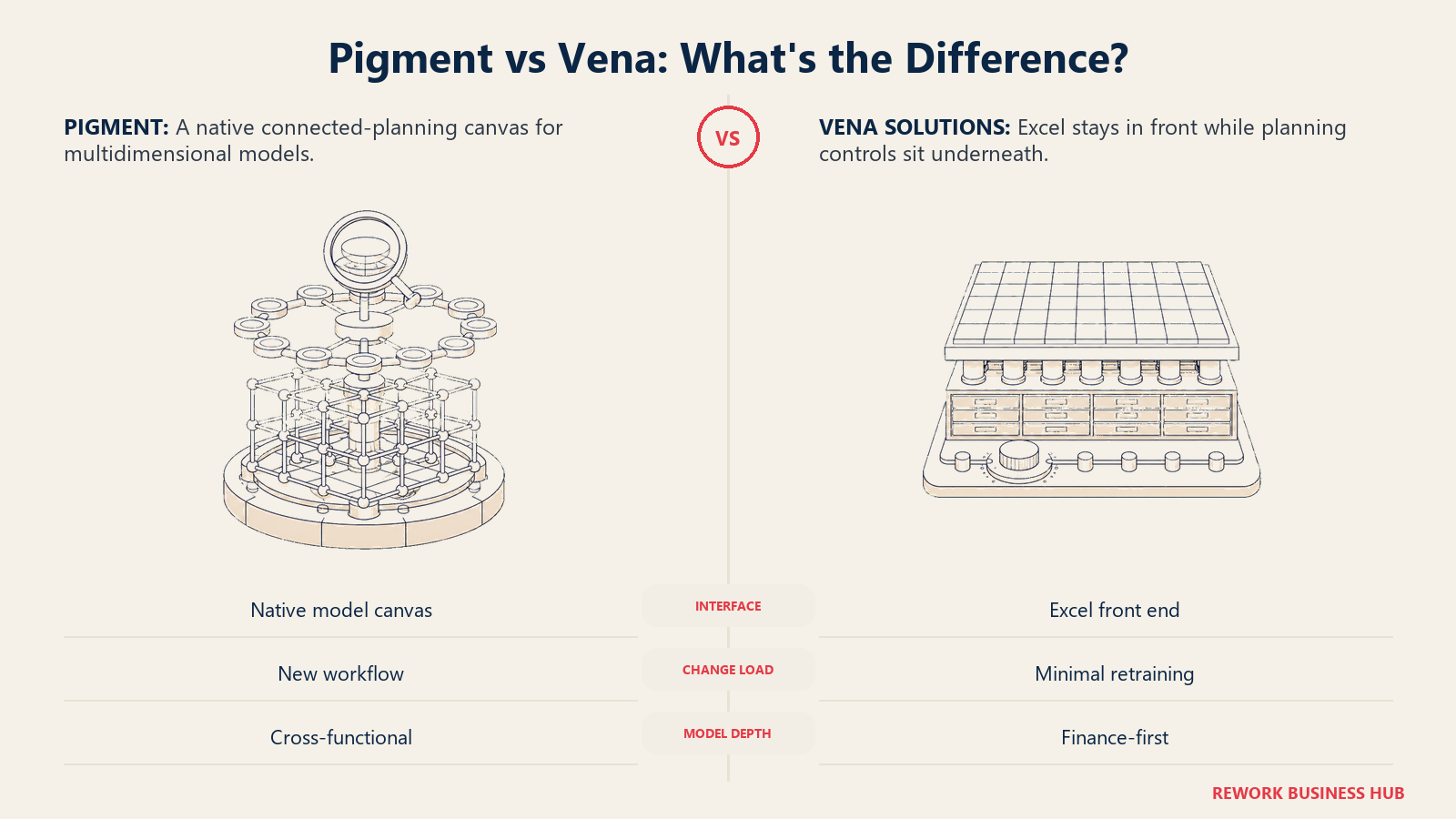
Vena takes the opposite interface bet from Pigment: keep Excel as the actual front end, layering database structure, workflow, and version control underneath the spreadsheet everyone already knows, rather than asking analysts to learn a new modeling canvas. For an evaluation where the real blocker is "our team doesn't want to learn another tool," that's the biggest difference here. Pricing runs on two named tiers, Professional (marked most popular) and Complete, with no public figures; on Professional, features like Vena Insights, Sandbox, Expert Managed Services, and Export APIs cost extra.
Target audience and sizing. Finance teams of 50 to 1,000 employees where Excel fluency is high and appetite for a new tool is low.
Stage fit. Best for a first real planning platform after spreadsheets stop scaling, where change management is the bigger risk.
| Pros | Cons |
|---|---|
| Native Excel interface, minimal retraining for finance staff | No published pricing on either tier |
| Two straightforward named tiers, Professional and Complete | Several features cost extra on top of the Professional tier |
| Nonprofit and Microsoft Dynamics 365 discounts available | Less dimensional modeling depth than Pigment for complex builds |
Pricing: Quote only. Two tiers, Professional and Complete, no published figures. Vena Insights, Sandbox, Expert Managed Services, and Export APIs cost extra on Professional.
Best for: Finance teams that want to modernize planning without asking analysts to abandon Excel. See the Vena alternatives guide if Vena is what you're replacing, or the Vena vs Datarails comparison if those two are your shortlist.
9. Cube - Spreadsheet-Native, Fast to Deploy
Cube sits at the opposite end of the implementation-weight spectrum from Pigment. Instead of replacing Excel or Sheets, it layers a database, version control, and automated data connections underneath the spreadsheet you already build in, so deployment runs weeks, not the months a cross-functional platform typically takes. On Cube's own pricing page, three tiers, Bronze, Silver, and Gold, sit behind a "Get quote" button; every tier states "Unlimited Dimensions and Users," and Gold adds premium support, MCP, and custom modules. No dollar figures are published on any tier.
Target audience and sizing. Lean finance teams of 20 to 500 employees that already model in spreadsheets and want that workflow to scale.
Stage fit. Best for a first FP&A purchase, or replacing a manual spreadsheet process.
| Pros | Cons |
|---|---|
| Fastest deployment here, keeps spreadsheets as the interface | No published pricing on any of its three tiers |
| Unlimited dimensions and users on every tier | Lighter modeling depth than Pigment for complex, multi-entity builds |
| Automated data connections reduce manual spreadsheet upkeep | Gold-tier features (MCP, custom modules) aren't priced separately |
Pricing: Quote only. Three named tiers, Bronze, Silver, Gold, all "Unlimited Dimensions and Users." No published figures.
Best for: Finance teams that want their spreadsheet models to scale without a full platform migration. See the Cube alternatives guide or the Cube vs Datarails comparison if Cube is on your shortlist.
10. Datarails - FinanceOS for Excel-Loyal Teams
Datarails makes essentially the same bet as Cube and Vena: keep Excel as the modeling surface, and automate the data-consolidation work that eats FP&A time. Pricing runs on three named tiers defined by seat and integration count, not dollar figures: FP&A Professional caps at 2 users, 1 integration; Premium at 5 users, 2 integrations; Expert at 15 users, 3 integrations, plus one supplementary product (Month-End Close, Cash Management, or Spend Control). All tiers include FinanceOS with unlimited dashboards, reporting, planning, plus AI Agents.
Target audience and sizing. Lean finance teams of 10 to 200 employees running planning primarily out of Excel today.
Stage fit. Best for a first move off manual spreadsheets, before a team is ready for a full migration.
| Pros | Cons |
|---|---|
| Excel stays the actual modeling interface, near-zero retraining | Tier structure caps users and integrations, not a flat price |
| AI Agents and AI Connector included at every tier | No published dollar figures at any tier |
| Vendor states no consultant fees on top of the quote | Scales less cleanly than Pigment once integrations grow past Expert |
Pricing: Custom quote. Three tiers by seat and integration count, not dollar figures (see above).
Best for: Small finance teams that want automated reporting built around the Excel workflow they already run. See the Datarails alternatives guide if Datarails is what you're replacing.
11. Drivetrain - Built Around Revenue Metrics, Not General Modeling
Drivetrain fits a specific evaluation: a SaaS or subscription company that finds Pigment's general-purpose modeling flexible but generic for the metrics that run the business, ARR, net revenue retention, CAC payback, cohort churn. Drivetrain ships those as templates instead of building them from scratch. Pricing is quote-based, and Drivetrain's own FAQ is direct about why: cost depends on the systems integrated and features needed, with implementation included at no separate setup fee.
Target audience and sizing. SaaS and subscription companies, roughly 50 to 1,000 employees, whose planning centers on recurring revenue metrics.
Stage fit. Best for Series A through D companies tired of rebuilding SaaS metrics by hand every quarter.
| Pros | Cons |
|---|---|
| SaaS metrics and revenue-model templates built in | No published pricing, quote depends on integrations |
| Implementation included in the quoted price | Narrower fit for non-subscription business models |
| Faster path to metrics dashboards than a general modeling platform | Less proven at the largest enterprise scale |
Pricing: Quote only. Fixed plans tailored to systems integrated. Implementation included, no separate setup fee.
Best for: Subscription and SaaS finance teams wanting revenue-metrics modeling built in, without Pigment's cross-functional scope.
12. Abacum - Collaborative FP&A for Scaling Tech Companies
Abacum's argument is close to Pigment's own modernization pitch, just narrower: the real bottleneck isn't the modeling engine, it's getting business partners outside finance to engage with the numbers. It connects live data from the GL, HRIS, and CRM without requiring department heads to learn Pigment-style modeling concepts, a fit where the complaint is "our business partners never touch the model." Pricing isn't published; the vendor's page offers a Book a Demo only.
Target audience and sizing. Scaling tech companies, roughly 100 to 1,000 employees, where FP&A wants deeper business-partner engagement.
Stage fit. Best for Series B through pre-IPO companies building a real FP&A function for the first time.
| Pros | Cons |
|---|---|
| Built around business-partner collaboration, not just modeling | No published pricing |
| Live connections to GL, HRIS, and CRM data | Younger platform, shorter enterprise track record than Pigment |
| Lighter learning curve for non-finance stakeholders | Less proven at the largest enterprise scale |
Pricing: No published pricing. Book a Demo only.
Best for: Scaling tech companies whose real problem is business-partner engagement, not raw modeling depth.
13. Limelight - Budget-Conscious CPM for SMB and Mid-Market
Limelight closes this list as the straightforward budget option: the core CPM job, budgeting, forecasting, reporting, consolidation, without Pigment's cross-functional ambitions, AI Modeler, or CSM-quoted price tag. Licensing is deliberately simple: two named tiers, Starter (up to 5 users) and Unlimited (no cap), neither with a published figure, but easy to reason about next to Pigment's fee-plus-fee model.
Target audience and sizing. Small and mid-market finance teams, roughly 10 to 250 employees, wanting dedicated CPM software without an enterprise commitment.
Stage fit. Best as a first planning platform for a company moving off spreadsheets.
| Pros | Cons |
|---|---|
| Simple two-tier structure, easy to reason about | No published pricing on either tier |
| Covers budgeting, forecasting, reporting, and consolidation | Smaller feature set and ecosystem than the enterprise players |
| Unlimited tier removes user-count anxiety past Starter | Less proven at genuine enterprise scale |
Pricing: Quote only. Two tiers, Starter (up to 5 users) and Unlimited (unlimited users). No published figures.
Best for: Small and mid-market finance teams that want dedicated CPM software without Pigment's scope or its multi-part pricing model.
Sizing and Persona Fit
Headcount changes the right answer more than any feature list does. A platform that's the obvious choice at 80 employees is often wrong at 800.
| Headcount | Best fit | Watch out for |
|---|---|---|
| Under 50 | Cube, Datarails, Limelight Starter | Datarails' per-tier user and integration caps |
| 50 to 200 | Vena Solutions, Prophix, Abacum, Drivetrain | Feature ceilings once planning gets complex |
| 200 to 1,000 | Centage, Planful, Limelight Unlimited, Datarails Expert | Module-by-module pricing can add up fast |
| 1,000 to 5,000 | Board, Workday Adaptive Planning, Anaplan | Implementation still runs through a certified partner |
| 5,000-plus | Anaplan, OneStream, Board | License and capacity costs scale with the org |
| Persona | Optimizes for | Strongest picks |
|---|---|---|
| CFO signing the renewal | Predictable total cost | Centage, Limelight, Cube |
| VP of Finance replacing Pigment wholesale | Comparable ambition, more history behind it | Anaplan, Board |
| FP&A lead who owns the model day to day | Lower expertise required to extend it | Vena Solutions, Datarails, Cube |
| Finance systems owner also running the close | Consolidation and planning together | OneStream, Workday Adaptive Planning |
| RevOps-adjacent lead at a SaaS company | Native SaaS and subscription metrics | Drivetrain, Abacum |
| Controller standardizing a first CPM tool | A published price, simple rollout | Centage, Limelight, Prophix |
Stage Fit
Company stage predicts what breaks in a planning process almost as reliably as headcount.
| Company stage | What usually breaks | Best fit |
|---|---|---|
| Seed to Series A | Planning lives in one founder's spreadsheet | Cube, Datarails, Limelight Starter |
| Series B, first real FP&A hire | No structured process, no business-partner visibility | Abacum, Vena Solutions, Prophix |
| Series C to D, scaling fast | SaaS metrics rebuilt by hand every quarter | Drivetrain, Planful, Centage |
| Late stage, pre-IPO | Consolidation and planning live in different systems | OneStream, Board |
| Public or large enterprise | Multi-entity governance, native ERP/HRIS integration | Anaplan, Workday Adaptive Planning, Board |
How to Choose: Decision Framework
Start with the finance job that must improve, then choose the platform category built around that job before comparing vendors.
| If you need... | Choose |
|---|---|
| The deepest connected-planning ecosystem and partner network | Anaplan |
| Native integration with Workday HCM or Financials | Workday Adaptive Planning |
| Planning and BI running on one platform | Board |
| Planning and statutory consolidation on one model | OneStream |
| A published price before your first sales call | Centage |
| AI-assisted budgeting at mid-market cost | Prophix |
| To keep Excel as the actual modeling interface | Vena Solutions, Cube, or Datarails |
| Native SaaS and subscription revenue metrics | Drivetrain |
| The simplest, lowest-friction CPM tool for a first purchase | Limelight |
Frequently Asked Questions about Pigment Alternatives
How much does Pigment cost?
Pigment doesn't publish pricing. It sells through three license types, Explorer, Contributor, and Editor, and the commercial model combines a platform fee, a use-case fee, and per-license costs, all quoted through a Customer Success Manager. There's no self-serve signup or published trial.
What is the cheapest Pigment alternative?
Most alternatives here also don't publish a starting price. Centage is the exception: Core runs $1,750 a month, Strategic $2,500, Performance $3,500, all billed annually. For lighter cost without a published figure, Limelight, Cube, and Datarails are built for faster rollouts than Pigment's scope.
What's the difference between Pigment's Explorer, Contributor, and Editor license types?
Explorer is the default, lowest-permission tier for people who mostly view outputs. Contributor can input data and update assumptions. Editor has full access, including model logic and structure, so Editor seats are typically the smallest and most expensive group in a deal.
Is Pigment overkill for a small finance team?
Often, yes. Pigment is built for cross-functional modeling across finance, sales, workforce, and supply chain, priced accordingly. A team that just needs a budget, a forecast, and a variance report is usually better served by Centage, Prophix, Limelight, or a spreadsheet-native tool like Cube.
Which alternative is closest to a direct swap for Pigment?
Anaplan and Board are the closest matches in ambition, both connected-planning platforms spanning multiple functions with the same CSM-quoted, no-public-price model. OneStream is the closer match if you also need statutory consolidation.
What do I lose if I leave Pigment?
The model logic built inside Pigment's structure, since formulas, drivers, and anything the AI Modeler generated don't export to another format. Document assumptions and data connections before migration starts, the same rebuild risk any modeling-platform move carries.
How long does implementing an alternative take compared to Pigment?
It depends more on scope than brand. Spreadsheet-native tools like Cube, Datarails, and Vena typically deploy in weeks. Cross-functional platforms like Anaplan, Board, Workday Adaptive Planning, and OneStream run timelines comparable to or longer than Pigment's, often months, since they solve an equally broad problem.
What to Do Next
Take your two strongest candidates from the decision framework and get an actual quote at your real headcount and license mix, not a generic demo scenario. Because nearly every vendor here is quote-only, the gap between "sounds reasonable" and "the actual number" only shows up once you ask.
Then build one real model in each finalist before signing anything, ideally the same one: next quarter's forecast for one department, at production-level detail. Time how long it takes a Finance analyst, not a consultant or a Model Builder, to get it working. That single test predicts total cost of ownership better than any feature comparison, and shows whether a platform's implementation weight matches what your team can carry.
Camellia writes about finance and planning software for B2B teams.

Principal Product Marketing Strategist
On this page
- Key Facts
- Quick Comparison Table
- Why Teams Leave Pigment
- 1. Anaplan - The Deepest Enterprise Connected-Planning Ecosystem
- 2. Workday Adaptive Planning - The Enterprise Peer With a Free Trial
- 3. Board - Planning and BI Under One Roof
- 4. OneStream - When Planning and Consolidation Need to Live Together
- 5. Planful - Finance-First, Without Pigment's Cross-Functional Modules
- 6. Prophix - Mid-Market CPM With AI Built Into the Budgeting Workflow
- 7. Centage - The Rare Mid-Market Platform With a Real Price List
- 8. Vena Solutions - For Teams That Refuse to Leave Excel
- 9. Cube - Spreadsheet-Native, Fast to Deploy
- 10. Datarails - FinanceOS for Excel-Loyal Teams
- 11. Drivetrain - Built Around Revenue Metrics, Not General Modeling
- 12. Abacum - Collaborative FP&A for Scaling Tech Companies
- 13. Limelight - Budget-Conscious CPM for SMB and Mid-Market
- Sizing and Persona Fit
- Stage Fit
- How to Choose: Decision Framework
- What to Do Next