Rillet vs DualEntry: Which AI-Native ERP Fits Your Finance Team in 2026?
Turn this article into takeaways for your work.


Each assistant summarizes the article only for you and suggests best practices for your work.
If you are a controller or head of finance at a growth-stage company, you have probably heard both names in the same week. Rillet and DualEntry are two New York-based startups selling the same basic idea: stop bolting AI onto a legacy ledger, and move to a general ledger and ERP built around AI from the start. Both target teams that have outgrown QuickBooks or Xero, and both pitch themselves against NetSuite and Sage Intacct for teams that find those systems slow to implement and heavy to run.
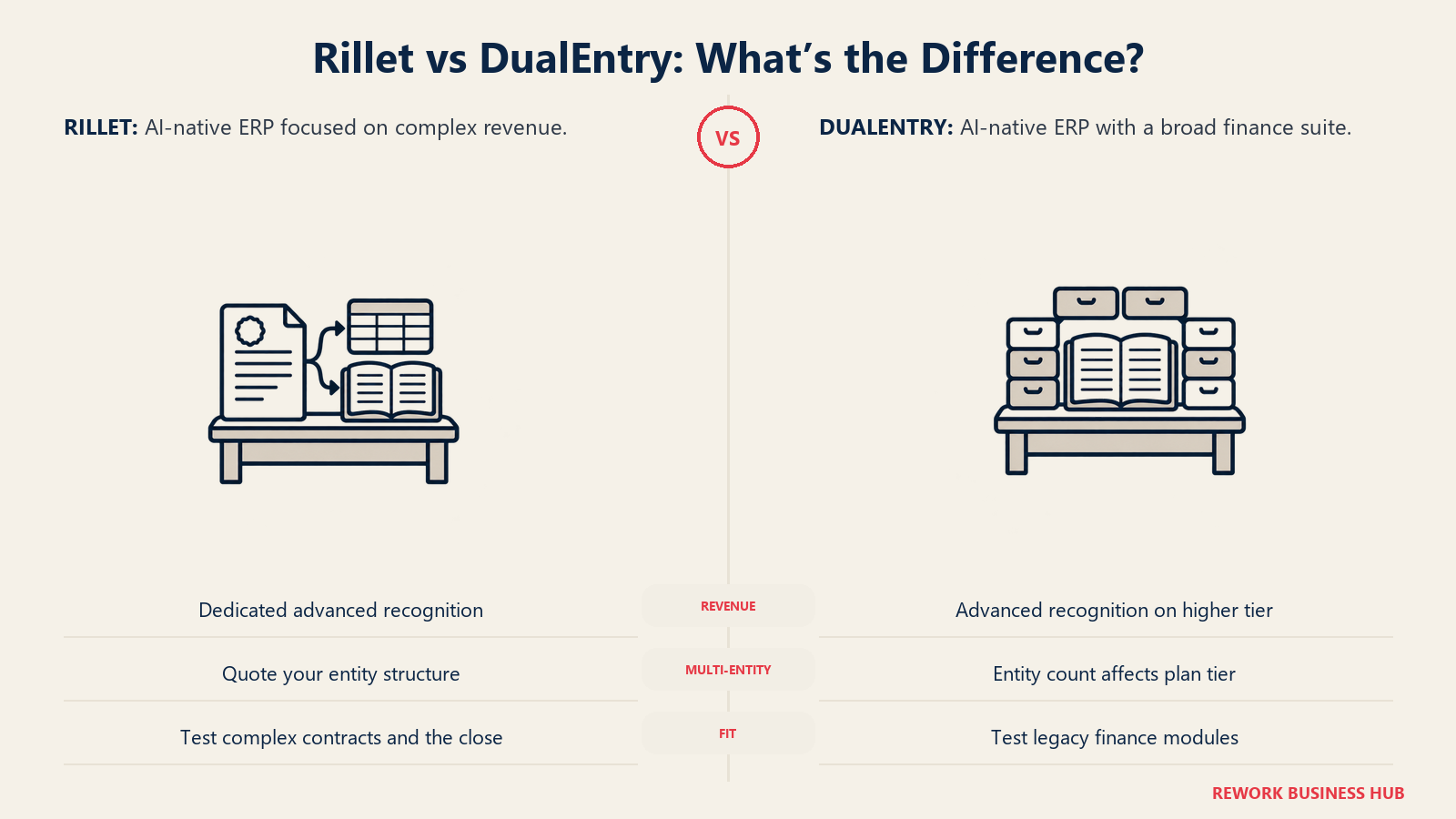
They are not interchangeable, though. Rillet leads with accountant-built revenue recognition, a continuous close and a SaaS-heavy customer base. DualEntry leads with a broader ERP footprint (order management, fixed assets, subscription billing, treasury, planning), tiers that scale by legal entity, and a migration pitch aimed at people leaving another ERP. This comparison is for finance leads choosing between the two, or deciding whether an AI-native ledger is the right move at all. If you want the wider field, including incumbents, start with our best NetSuite alternatives and best Sage Intacct alternatives roundups.
Key Facts
- Rillet describes itself as an AI-native ERP and accounting platform, built by accountants and founded in 2021, with "800+ customers in 70+ countries", per Rillet's own site and funding announcement.
- Rillet's funding page lists a $100M Series C led by ICONIQ at a $1B valuation, after a $25M Series A (May 2025) and a $70M Series B (August 2025), for over $200M raised, per Rillet's funding announcement.
- DualEntry raised a $90M Series A on October 2, 2025, led by Lightspeed Venture Partners and Khosla Ventures with GV, Contrary and Vesey Ventures participating, bringing total funding to over $100M, per DualEntry's funding announcement.
- DualEntry's published pricing has three tiers split by entity count: up to 3 entities on the base tier, up to 20 on Plus, and unlimited on Ultra, with no free trial and implementation included, per DualEntry's pricing page.
- Rillet lists implementation at "$10K-$30K" and "4-6 weeks, CPA-led", against "$75K-$400K+" and up to 18 months for an unnamed competitor, per Rillet's pricing page. Neither vendor publishes subscription prices.
- DualEntry's own NetSuite migration guide says to "plan for four to eight weeks depending on scope" and to run both systems for one to two months, per DualEntry's docs.
TL;DR: Rillet vs DualEntry at a Glance
| Rillet | DualEntry | |
|---|---|---|
| Positioning | AI-native ERP and accounting platform, built by accountants | AI-native ERP for mid-market companies |
| Founded / HQ | 2021, New York | New York |
| Funding | Over $200M raised; $100M Series C at $1B valuation | Over $100M raised; $90M Series A |
| Subscription pricing | Pricing on request | Pricing on request, three tiers by entity count |
| Implementation | Listed at $10K-$30K, 4-6 weeks, CPA-led | Included in all plans; "Live in 4-6 weeks" |
| Multi-entity | Multi-currency and intercompany | Up to 3, up to 20, or unlimited entities by tier |
| Revenue recognition | Advanced recognition for complex revenue models | Limited modules on base tier, advanced modules on Ultra |
| Integration claim | 12,000+ integrations incl. Salesforce, Stripe, Ramp | 13,000+ native integrations incl. Salesforce, Stripe, HubSpot |
| Free trial | Demo request only | No free trial |
| Best for | SaaS and subscription finance teams that want a CPA-led rollout | Teams leaving a legacy ERP that want a wide module set and entity-based tiers |
Who Each Product Is Built For
Neither vendor publishes a hard employee-count or revenue band. What you can read from their own materials is the shape of the customer.
| Dimension | Rillet | DualEntry |
|---|---|---|
| Self-described customer | Scaling SaaS companies | Mid-market companies |
| Named customers on vendor site | Haus, Jump, Scribe, Mercor | Slash, Graphite, Streamside Parks, Andera, Well, Nelo |
| Customer scale claims | 800+ customers in 70+ countries | Customers from $5M-revenue companies to NYSE-listed businesses |
| Typical buyer | Controller or Head of Finance outgrowing QuickBooks or Xero | Finance leads replacing NetSuite, Sage Intacct, Dynamics or similar |
| Where it leans | Revenue recognition and continuous close | Breadth of ERP modules and entity consolidation |
Customer claims on Rillet's homepage and DualEntry's homepage are the vendors' own. DualEntry's funding announcement says its users range "from $5 million-revenue companies to NYSE-listed businesses", which is a wide band, so ask for references at your size rather than assuming the top of that range applies to you.
If you are still deciding whether you need an ERP at all, our best accounting software for 2026 hub covers the full range from small-business tools up.
Core Platform Scope
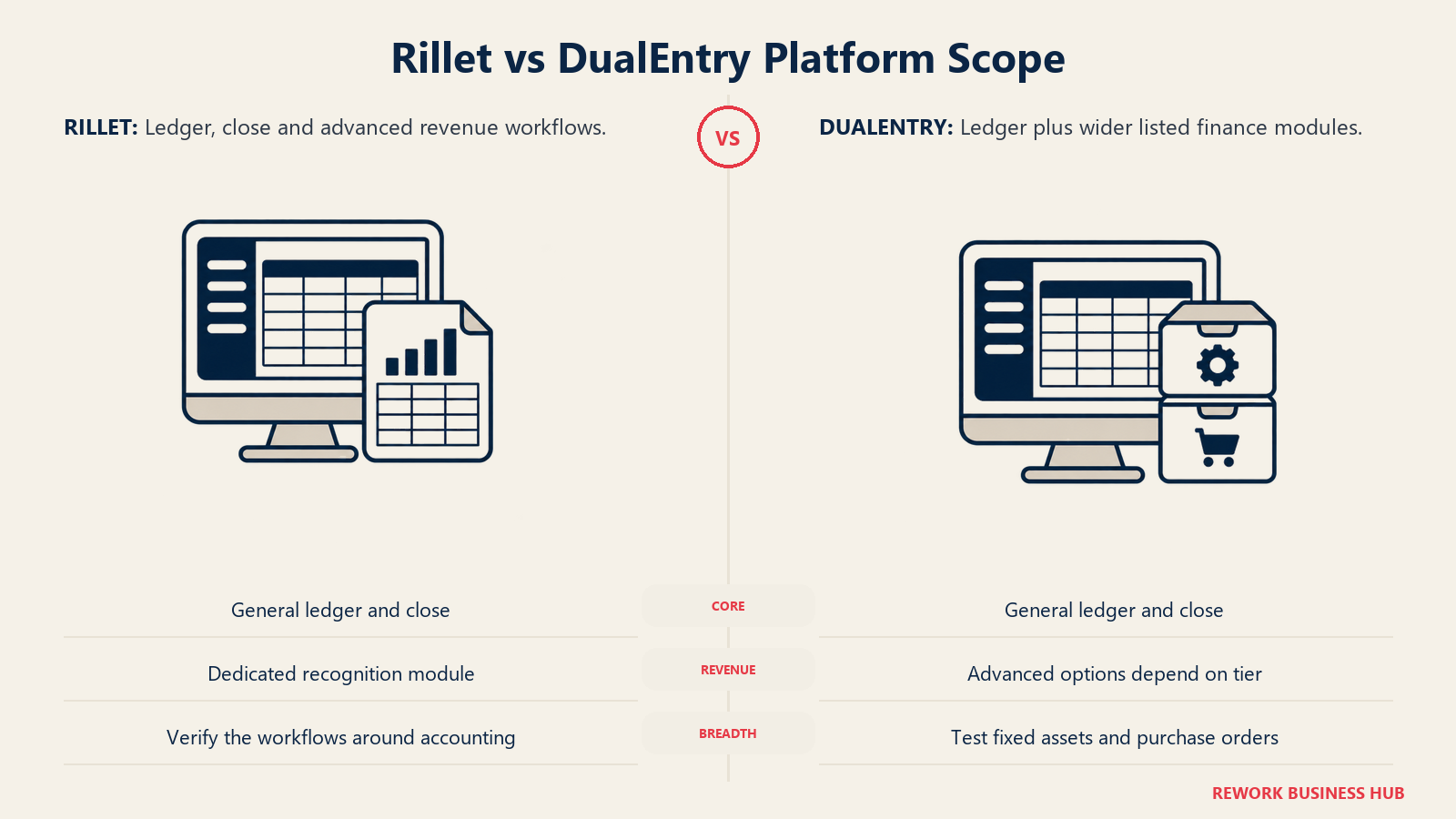
This is where the products start to separate. Both include a live general ledger and cover the finance basics. The difference is how far each one extends beyond them.
| Capability | Rillet | DualEntry |
|---|---|---|
| General ledger | Yes, live GL | Yes |
| Accounts receivable and payable | Yes | Yes |
| Bank reconciliation | Yes | Yes, reconciliation and cash management |
| Multi-entity consolidation | Yes, multi-currency and intercompany | Yes, described as unlimited subsidiaries |
| Multi-book (GAAP, IFRS, tax) | Flexible GAAP reporting | Yes, GAAP, IFRS and tax books |
| Revenue recognition | Advanced recognition | Revenue recognition, prepaid amortization, allocations |
| Order management | Not listed | Listed |
| Fixed assets | Not listed | Listed |
| Subscription billing | Usage-based billing, native | Listed |
| Purchase orders | Not listed | Listed |
| Budgeting and planning | Real-time reporting and investor metrics | Budgeting and planning, treasury management |
| Developer API | Not listed | Listed |
Rows marked "Not listed" mean the vendor does not advertise the capability, not that it does not exist. Ask each vendor directly for anything on your must-have list. The pattern is clear enough, though: DualEntry's page reads like a full ERP module list, while Rillet's reads like a finance-team platform centered on the ledger, close, revenue and reporting. Scope sources: Rillet and DualEntry.
AI Features: What Each Vendor Actually Claims
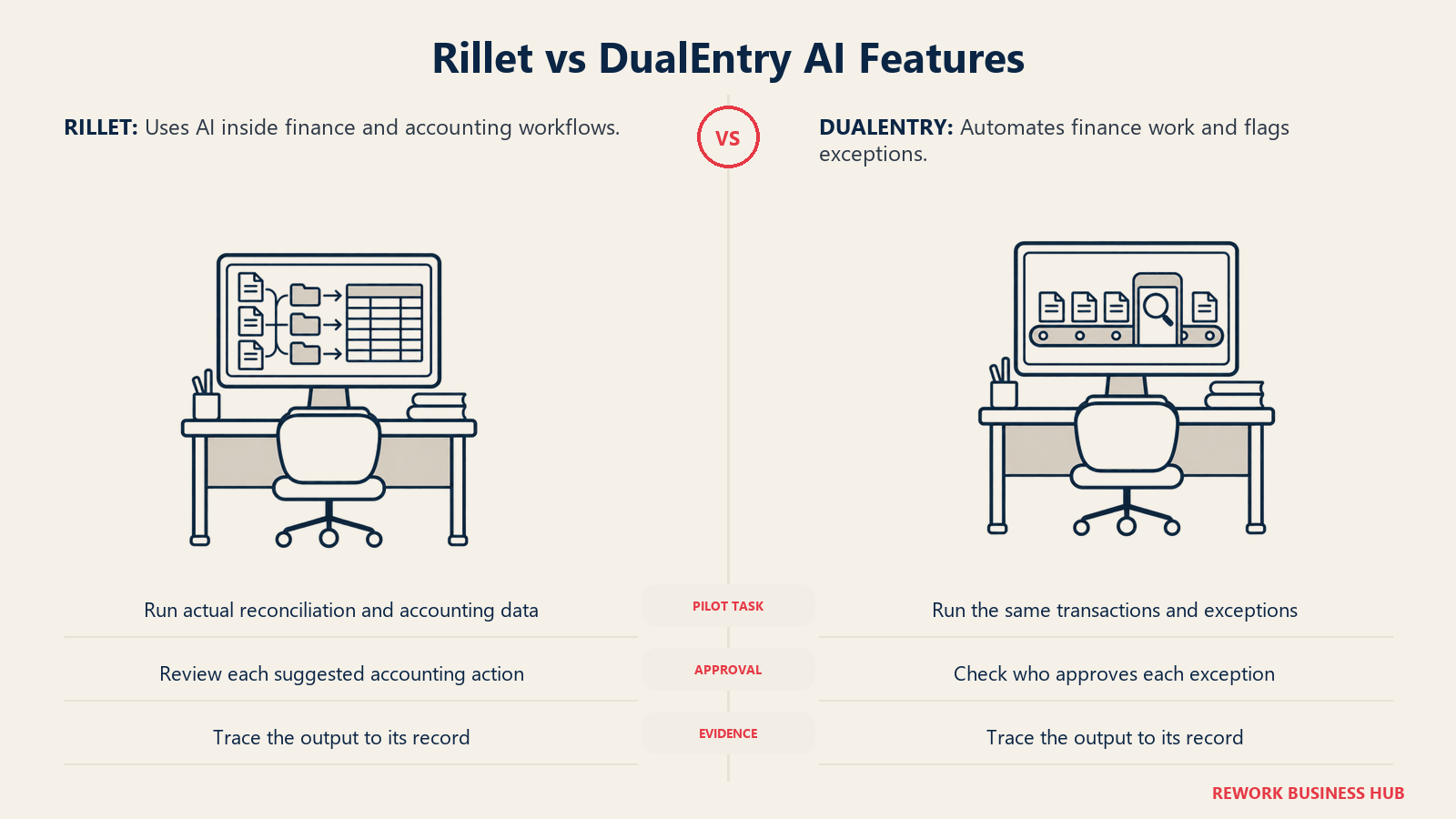
Both vendors say AI is built into the core rather than layered on top. The claims differ in specifics.
| AI area | Rillet | DualEntry |
|---|---|---|
| Named AI layer | Aura AI | AI built into the ERP core |
| Ledger questions | Answers questions about the GL | Natural-language reporting and analytics |
| Anomaly detection | Flags trends and anomalies across the finance stack | Anomaly detection |
| Close automation | Checklists, reconciliations and flux drafts run continuously | Automated close, flux commentary |
| Transaction matching | 99.7% of transactions post automatically (vendor claim) | Bank matching, intercompany eliminations and allocations |
| Task automation | Automates accounting tasks | Approval workflows, reconciliation |
Treat the headline automation figures as vendor marketing. Rillet states "99.7% of transactions post automatically" and "100+ hours saved per week" on its homepage, without saying whose data or which period those numbers come from. DualEntry describes its AI features in its funding announcement as bank matching, flux commentary, intercompany eliminations and allocations, reconciliation and anomaly detection. The right test is a pilot on your own transaction mix: how many bank lines match without a human, and how many journal entries does your team still touch?
For a broader look at the agents sitting around the ledger rather than inside it, see our best AI agents for accounting roundup, which covers both of these products alongside close and reconciliation tools.
Multi-Entity and Consolidation
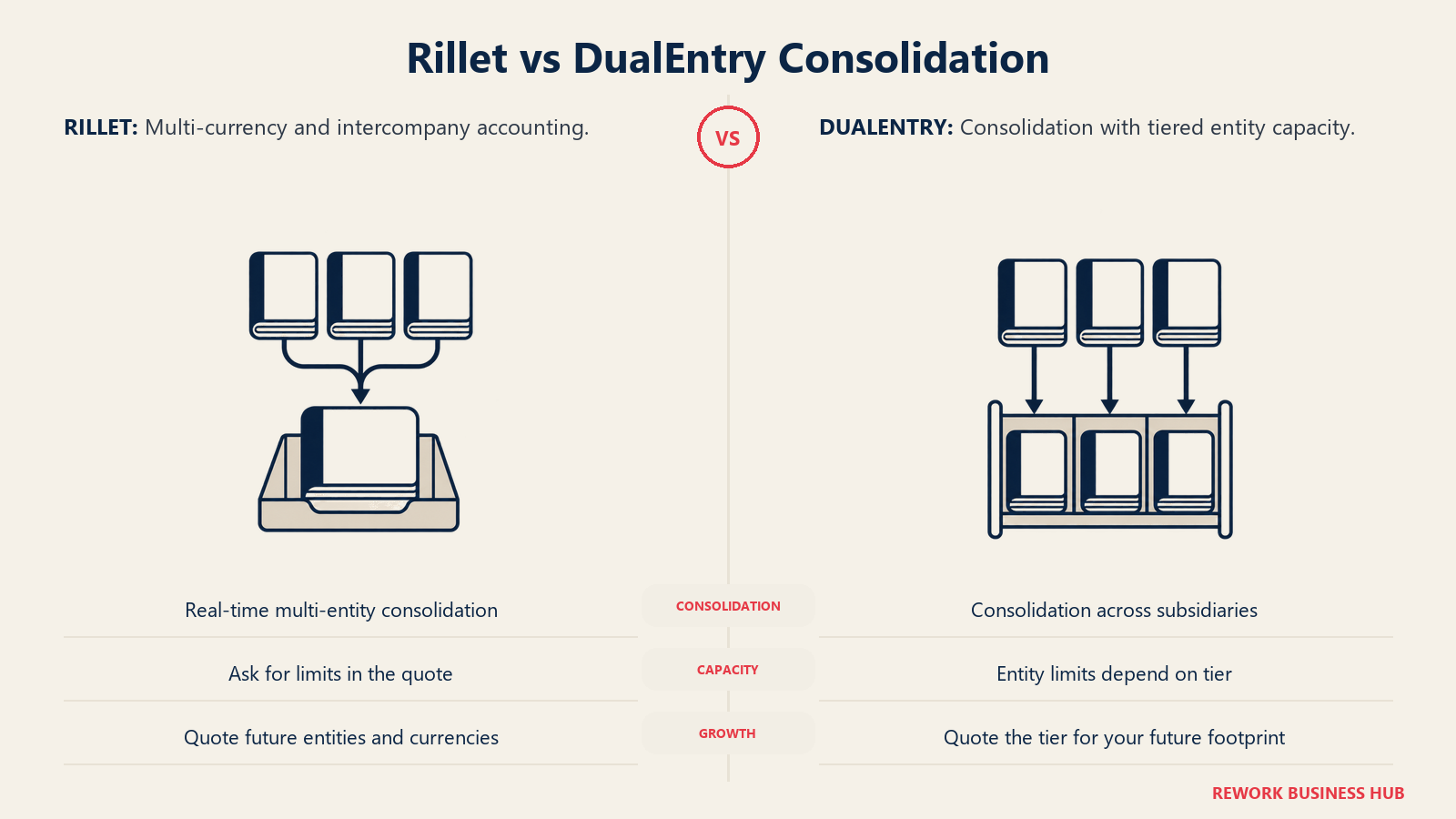
Multi-entity is where finance teams usually outgrow QuickBooks, and it is the clearest structural difference between these two pricing models.
| Multi-entity factor | Rillet | DualEntry |
|---|---|---|
| Entity model | Multi-currency and intercompany accounting | Tiered by entity count |
| Base tier entity limit | Pricing on request | Up to 3 entities |
| Mid tier | Pricing on request | Up to 20 entities, multi-currency consolidation |
| Top tier | Pricing on request | Unlimited entities |
| Consolidation | Real-time multi-entity consolidation | Consolidation across subsidiaries |
| Customer example | Not published | Streamside Parks consolidated 36 instances into one ERP across 50+ entities (vendor claim) |
DualEntry's tiers, per its pricing page, make your entity count part of the buying decision from day one. If you run 2 to 3 legal entities, the base tier covers you. If you run 15, you are in Plus. If your structure is going to grow through acquisitions, the Ultra tier is where unlimited entities sit, along with advanced revenue recognition modules, financial planning and dynamic allocations, and SAML authentication.
Rillet publishes no entity limits. That can be good or bad. It means you are not boxed in by a published tier, but it also means you cannot see where a price step happens until you have a quote. Ask both vendors to price your entity structure for today and for 24 months out.
Revenue Recognition
If you sell subscriptions, usage-based plans or milestone contracts, revenue recognition may decide the whole evaluation.
| Revenue recognition factor | Rillet | DualEntry |
|---|---|---|
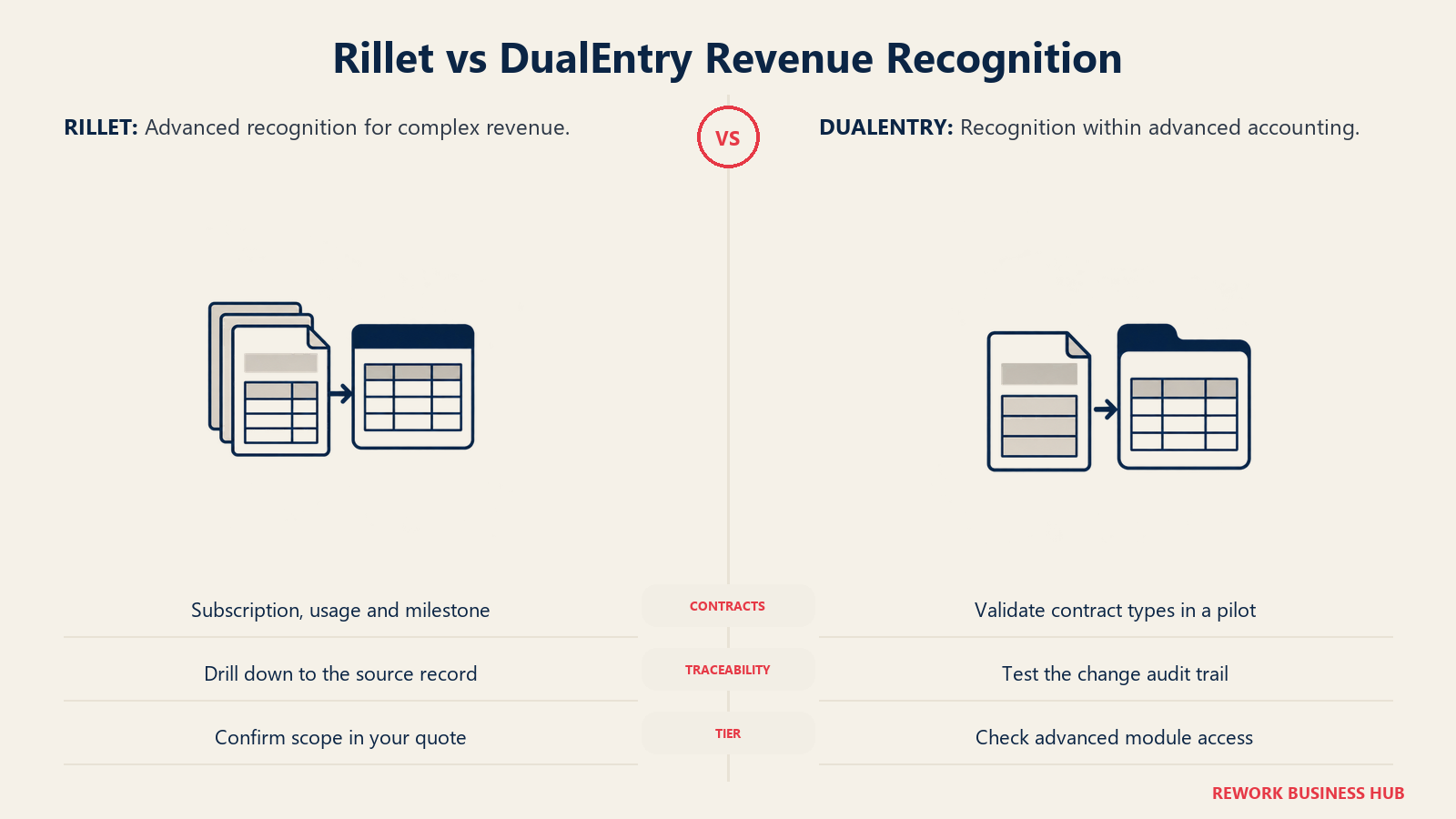
| Positioning | A headline module: "advanced recognition for complex revenue models" | Part of advanced accounting alongside prepaid amortization and account allocation |
| Standards | ASC 606 and IFRS 15 (vendor claim) | Not detailed |
| Contract types | Subscription, usage and milestone (vendor claim) | Subscription billing listed as a module |
| Traceability | Drill-down from recognized revenue to source records | Audit trail on every data change |
| Plan gating | Not described as gated | Limited modules on base tier, advanced modules on Ultra |
| CRM link | Syncs closed-won contracts from CRM (vendor claim) | Salesforce and HubSpot integrations |
Rillet's audit-readiness page describes revenue schedules generated from contracts, invoices and billing events, with drill-down from recognized revenue to source records. DualEntry's pricing page is more explicit about gating: the base tier includes "limited revenue recognition modules", while "advanced revenue recognition modules" come with Ultra.
If revenue recognition is your central problem, with multi-element contracts, usage tiers and frequent amendments, this is a strong reason to lean toward Rillet's focus and to test DualEntry's tier carefully before assuming the base plan is enough. If revenue recognition is a side requirement (simple subscriptions, light usage billing), the gating difference matters less.
Audit, Controls and Security
Controllers and auditors will ask about this before the CFO signs. Both vendors claim SOC 2 Type II. Both are self-reported on their sites, so request the reports under NDA.
| Controls factor | Rillet | DualEntry |
|---|---|---|
| SOC reports | SOC 1 Type II and SOC 2 Type II audits; SOC 2 report available under NDA | SOC 2 (Type I and Type II) attestations; reports via its Trust Center |
| Audit trail | "Immutable audit trails across transactions, approvals, and edits" | "Immutable, append-only record of every data change, retained for 7 years by default" |
| Approvals | Approval workflows gate posting to the GL | Approval workflows with a per-workflow self-approval setting for segregation of duties |
| Access control | Role-based permissions | Granular, entity-scoped roles |
| SSO | Not stated | Google, Microsoft or email login; SAML 2.0 or OIDC via WorkOS, configured by your account team |
| Period control | Period integrity features | Period locking |
Sources: Rillet's audit-readiness page and DualEntry's security and compliance docs.
Two practical notes. First, a SOC 2 report covers a stated window, so ask for the most recent one and read the exceptions. DualEntry's docs say as much and point you to its Trust Center for the observation periods. Second, segregation of duties on DualEntry is configured per approval workflow, so your controller needs to check the self-approval setting on every workflow that gates a key control rather than assuming a default.
If you are heading toward a first audit or an IPO, bring your auditors into the evaluation early and have them walk through journal entry testing in a sandbox on each product.
Integrations and the Wider Stack
Both vendors quote integration counts in the five figures, which is mostly a signal about connector marketplaces rather than depth.
| Integration factor | Rillet | DualEntry |
|---|---|---|
| Headline count | 12,000+ integrations | 13,000+ native integrations |
| Named CRM and billing | Salesforce, Stripe | Salesforce, HubSpot, Stripe |
| Named spend and HR | Ramp, Rippling, Brex | Gusto, BILL |
| Named banks | Not listed | Revolut, J.P. Morgan, Citi, HSBC |
| Named BI and data | Not listed | Looker, Power BI, Metabase, Snowflake |
| NetSuite as a connected system | Not a listed integration | Not a listed integration |
| Public API | Not listed | Developer API listed |
Counts and logos are from Rillet and DualEntry. A count like 12,000 or 13,000 usually includes long-tail connectors, so check the half-dozen systems you actually run: your CRM, billing tool, payroll, spend management, bank and data warehouse. Ask whether each connection is native, bidirectional and supported by the vendor or relies on a third party.
Migrating From NetSuite, Sage Intacct or QuickBooks
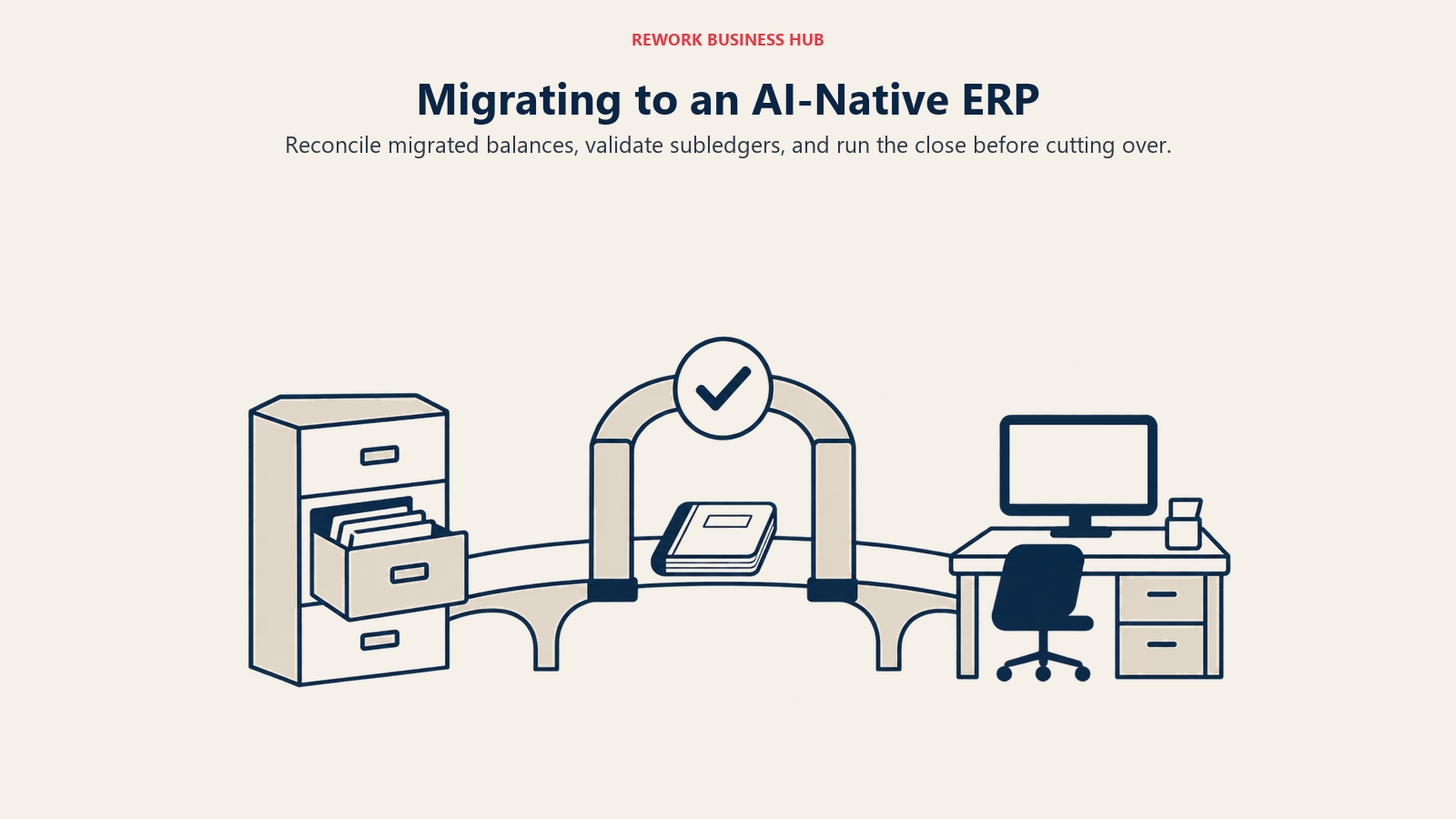
For many buyers, the migration question is the whole decision. Both products are built to replace the system you have, not to sit on top of it.
| Migration factor | Rillet | DualEntry |
|---|---|---|
| Headline timeline | "4-6 weeks, CPA-led"; goes live in under 45 days | "Live in 4-6 weeks"; "Data ingested in 24 hours" |
| NetSuite-specific guidance | Rillet team takes full ownership of data migration | Plan four to eight weeks depending on scope |
| Parallel run | Not detailed | One to two months of running both systems |
| Cutover rule | Not detailed | Do not decommission NetSuite until at least one full month-end close is done in DualEntry |
| Sources migrated from | Not stated | NetSuite, Sage Intacct, SAP, Microsoft Dynamics, Great Plains, QuickBooks Desktop, PeopleSoft, QuickBooks, Xero |
| Cost framing | Implementation listed at $10K-$30K | Implementation included in all plans |
| Financial incentive | None published | $6M ERP Rescue Fund for companies locked into long contracts |
Sources: Rillet's pricing page, DualEntry's pricing page, DualEntry's NetSuite migration guide and DualEntry's funding announcement.
DualEntry's own materials give you more than one timeline. Its pricing page says "Live in 4-6 weeks", its site navigation says "Go live in 24 hours", and its NetSuite guide says to plan four to eight weeks, plus a parallel run of one to two months. The reconciliation is probably this: a fast data ingestion for a simple single-entity company, and a longer, staged migration for a multi-subsidiary NetSuite shop. Read the NetSuite guide, because it is the more honest picture of a complex move. It says to map each NetSuite subsidiary to a DualEntry company first, to decide what to do with statistical and memo accounts, and to pay close attention to intercompany, foreign-currency revaluation and deferred revenue balances when comparing trial balances at cutover.
Rillet's timeline is also a vendor figure, and its comparison against "up to 18 months" for NetSuite is aimed at the long end of NetSuite projects. Its NetSuite comparison page lists "4-6 weeks, CPA-led" for Rillet. Whichever you choose, the safe plan is the same: run a parallel close, keep the old system read-only until one full close ties out, and write down the scope of historical data you are bringing across.
The ERP Rescue Fund is worth understanding but not counting on. DualEntry's rescue fund page says it set aside $6,000,000 and that it covers the remaining balance of your existing ERP subscription once you submit your contract. The page gives no eligibility conditions, per-company cap or payment timing, so treat it as a negotiating conversation, not a line in your budget.
For the NetSuite side of this decision, including incumbent alternatives that do not involve switching to a startup, see best NetSuite alternatives and Odoo vs Sage Intacct vs NetSuite.
Pricing and Total Cost of Ownership
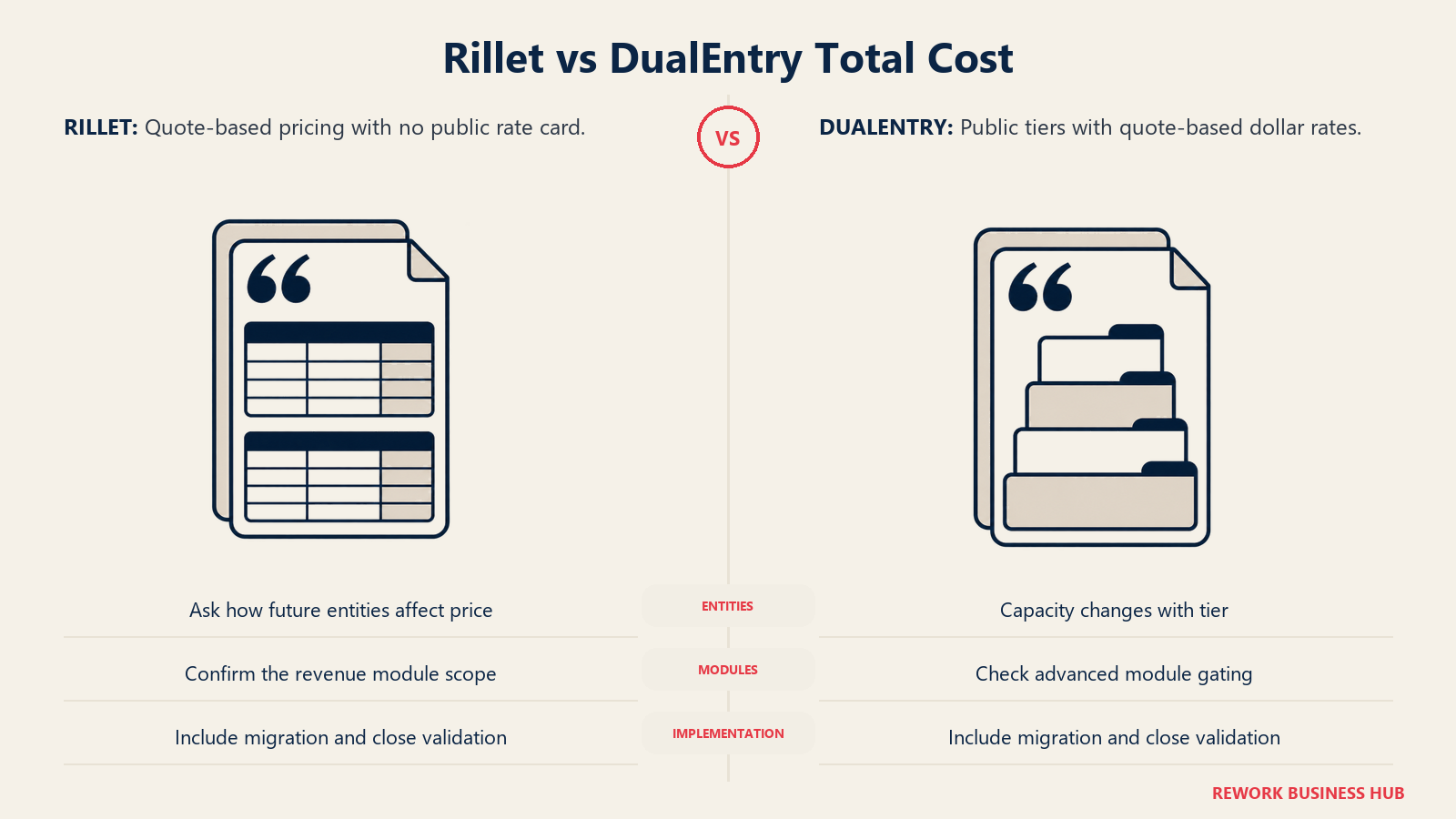
Neither vendor publishes a subscription price, so any specific dollar-per-month comparison would be invented. What you can compare is structure.
| Cost factor | Rillet | DualEntry |
|---|---|---|
| Subscription price | Pricing on request | Pricing on request |
| Pricing structure | Quote after demo | Three tiers by entity count and module depth |
| Free trial | Not offered; demo request | None ("we currently don't offer a free trial") |
| Implementation fee | Listed at $10K-$30K | Included in all plans |
| Per-user charges | Not published | Plans list unlimited users; pricing page also mentions an additional per-user fee with no amount |
| What drives price up | Not published | Entity count, advanced revenue recognition, planning, SAML |
| Competitor cost claim | NetSuite implementation "$75K-$400K+" | NetSuite implementation "typically bills implementation as a separate $75K-$250K project" |
Sources: Rillet's pricing page and DualEntry's pricing page. Both competitor cost figures are the vendors' own claims about NetSuite, and the two ranges do not match each other, which is a good reminder to get your own NetSuite quote or invoice history instead of relying on either.
When you ask for quotes, request the same package from both: your real entity count, the revenue recognition scope you need, the integrations you run, the user count by role, and whether implementation, data migration and the first year of support are in the number. Then add the cost of the parallel run, which is your own team's time, plus any contractor help with historical data.
Implementation, Support and What Happens After Go-Live
| Support factor | Rillet | DualEntry |
|---|---|---|
| Implementation model | CPA-led; Rillet team owns data migration | Included in all plans; account team handles setup items such as SSO |
| Post go-live | CSM and CPA team with same-day responses in a dedicated Slack channel (vendor claim) | Documentation site for accountants; Trust Center for compliance |
| Dedicated admin needed | "Not needed" (vendor claim) | Not stated |
| Documentation | Blog and product pages | Public docs covering migration, audit trail, period locking and banking connections |
Sources: Rillet's NetSuite comparison and DualEntry's docs. Rillet's CPA-led pitch is the clearest differentiator in this table. If your finance team is small and does not want to learn a new system alone, a vendor that staffs accountants on your onboarding is worth real money. DualEntry's public documentation is deeper than Rillet's, which helps if your team prefers to read the manual and self-configure.
When Rillet Is the Right Call
- Revenue recognition is your hardest problem. Subscription, usage and milestone contracts are central to Rillet's pitch, and it markets a dedicated advanced module, not a tier-gated add-on.
- You want accountants on your implementation. The CPA-led rollout and Slack-based support model suit lean finance teams.
- You are a SaaS or subscription company. Its named customers and its structured positioning point there, so you will find peers.
- You prefer not to pick a tier by entity count. Rillet publishes no entity tiers, which gives you room to negotiate a package.
- You are heading toward a first audit or IPO. Its audit-readiness material is written for exactly that moment.
When DualEntry Is the Right Call
- You are leaving a legacy ERP and want the widest module list. Order management, fixed assets, purchase orders, subscription billing, treasury and planning are all listed.
- Your entity structure is complex and growing. Entity-based tiers are predictable, and the top tier allows unlimited entities.
- You want implementation priced into the plan. DualEntry states implementation is included in all plans.
- You need documented migration steps from NetSuite or Sage Intacct. Its public NetSuite guide gives a concrete sequence, including parallel run and cutover rules.
- Your IT team needs SAML or OIDC single sign-on. Enterprise SSO is documented in its security docs.
When Neither Is the Right Call
An AI-native startup ledger is a bet on a young product. Both vendors were founded within the last few years, and neither has the multi-decade track record of NetSuite or Sage Intacct. If any of these describe you, look elsewhere first:
- You operate in a heavily regulated or specialized industry where a vertical ERP already exists.
- You need a large partner ecosystem of implementation consultants in your region.
- Your auditors or lenders require a specific, long-established system.
- You are a small business well served by a lighter tool. See QuickBooks vs Xero, best QuickBooks alternatives or best Xero alternatives.
- You want a Microsoft-centered stack. See best Dynamics 365 alternatives.
Decision Framework
| If this is true for you | Pick |
|---|---|
| Complex subscription, usage or milestone revenue is the main pain | Rillet |
| You want a CPA-led rollout and same-day support in Slack | Rillet |
| You need order management, fixed assets and purchase orders in the same system | DualEntry |
| You want entity-based tiers you can read before the first call | DualEntry |
| You are leaving NetSuite and want a documented parallel-run playbook | DualEntry, then ask Rillet for the same level of detail |
| You are locked into a long ERP contract and want help with the exit cost | DualEntry, by asking about the Rescue Fund |
| You need SAML SSO documented in public | DualEntry |
| You are preparing for a first audit or IPO | Either; make your auditors test both |
| Your revenue is simple and your entity count is 1 to 3 | Either; compare the quotes and the references |
What to Do Next
- Write your scope on one page. Entities, currencies, revenue models, integrations, user roles and audit requirements. Send the same page to both vendors.
- Ask for pricing in the same shape. Subscription, implementation, migration, support and anything that scales with entities or modules.
- Request references at your size and from your source system. If you run NetSuite today, ask to speak to a customer who migrated from NetSuite.
- Get the SOC 2 reports under NDA and have your controller read the exceptions.
- Run a parallel close. Do not retire your current ledger until one full month-end ties out in the new one.
- Compare against the wider field. Our best AI agents for accounting roundup covers the close and reconciliation tools that can sit next to or instead of a ledger swap.
Frequently Asked Questions about Rillet vs DualEntry
What is the main difference between Rillet and DualEntry?
Both are AI-native ERPs built around a live general ledger. Rillet centers on accountant-led rollouts, revenue recognition and continuous close, with a SaaS-heavy customer base. DualEntry lists a broader module set (order management, fixed assets, purchase orders, treasury, planning) and sells tiers by entity count.
How much do Rillet and DualEntry cost?
Neither publishes a subscription price. Both are pricing on request. Rillet's pricing page lists implementation at $10K-$30K, while DualEntry states implementation is included in all plans across its three tiers.
Do Rillet and DualEntry offer a free trial?
DualEntry states it does not offer a free trial. Rillet's site offers a demo request and does not describe a free trial. Plan on a sales-led evaluation with a pilot or sandbox conversation for both.
Which is better for replacing NetSuite?
Both target NetSuite replacements. DualEntry publishes a NetSuite migration guide recommending four to eight weeks plus a one to two month parallel run, and says not to decommission NetSuite until one full close ties out. Rillet lists a 4-6 week, CPA-led rollout. Ask each for a customer reference that migrated from NetSuite.
Are Rillet and DualEntry SOC 2 compliant?
Both say they undergo SOC 2 Type II audits. Rillet also lists SOC 1 Type II. Both make reports available under NDA, so request the latest report and read any exceptions before you sign.
How much funding have Rillet and DualEntry raised?
Rillet's funding page lists a $25M Series A, a $70M Series B and a $100M Series C led by ICONIQ at a $1B valuation, for over $200M raised. DualEntry's funding announcement lists a $90M Series A on October 2, 2025, bringing total funding to over $100M.
Can either handle multiple legal entities and currencies?
Yes. Rillet lists multi-currency and intercompany accounting. DualEntry lists multi-entity consolidation, multiple currencies and multi-book accounting, with entity limits of 3, 20 or unlimited depending on the tier.
Is an AI-native ERP riskier than NetSuite or Sage Intacct?
It is a younger product with a shorter public track record, so the risks are different, not necessarily larger. Offset them with reference calls, SOC 2 reports, a parallel close and a contract that protects your data export rights.
Related Resources:

Principal Solution Architect
On this page
- Key Facts
- TL;DR: Rillet vs DualEntry at a Glance
- Who Each Product Is Built For
- Core Platform Scope
- AI Features: What Each Vendor Actually Claims
- Multi-Entity and Consolidation
- Revenue Recognition
- Audit, Controls and Security
- Integrations and the Wider Stack
- Migrating From NetSuite, Sage Intacct or QuickBooks
- Pricing and Total Cost of Ownership
- Implementation, Support and What Happens After Go-Live
- When Rillet Is the Right Call
- When DualEntry Is the Right Call
- When Neither Is the Right Call
- Decision Framework
- What to Do Next