Odoo vs Sage Intacct vs NetSuite: Which ERP Fits What You're Actually Buying?
Turn this article into takeaways for your work.


Each assistant summarizes the article only for you and suggests best practices for your work.
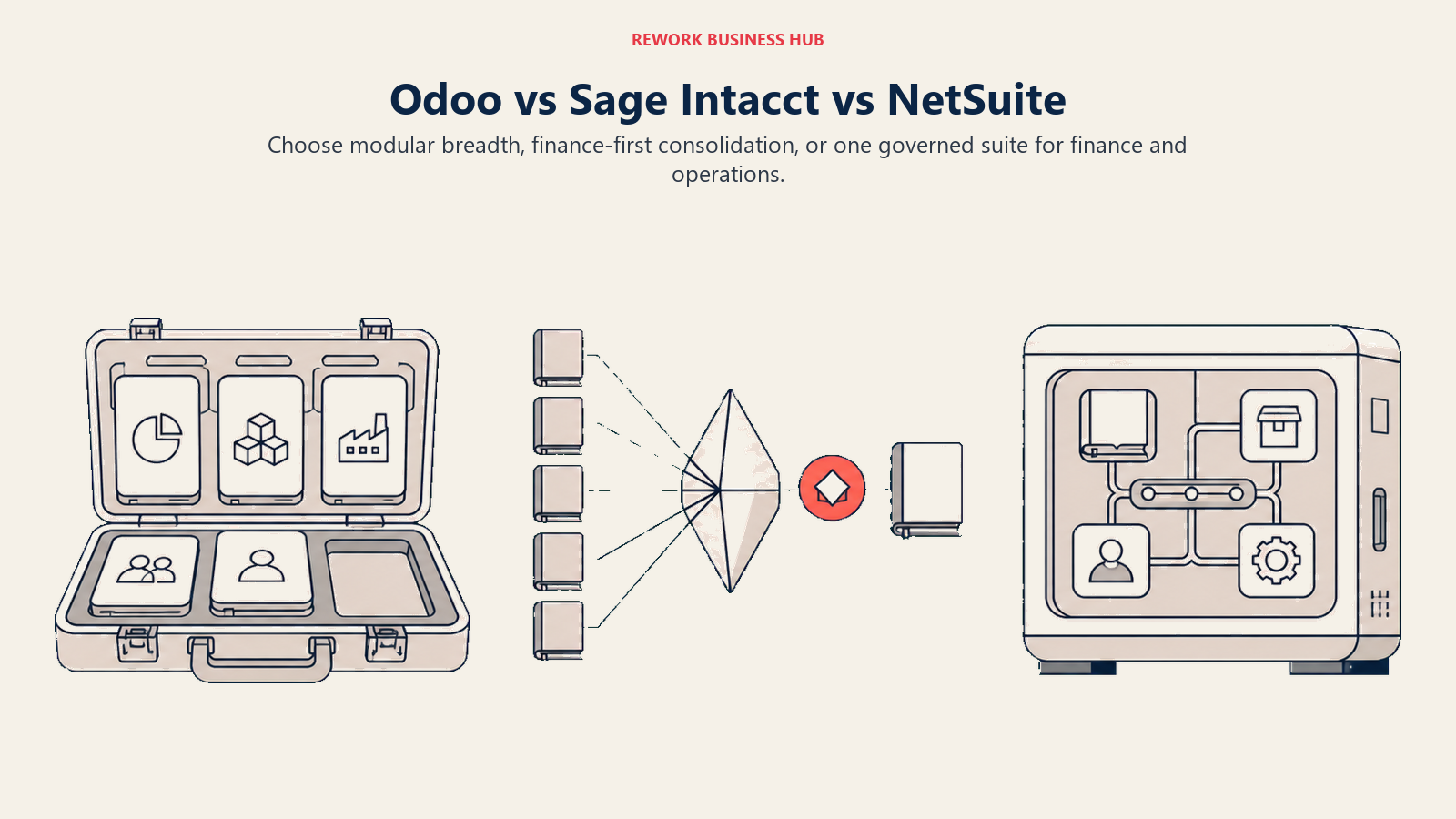
These three keep showing up in the same search and the same shortlist, and that's a little misleading, because they aren't competing for the same purchase. Odoo is a modular, open-core business suite: cheap per user, an enormous app catalogue, and a real cost that mostly shows up later, in the implementation partner and the customization work, not the license. Sage Intacct is an accounting-first cloud financial system: the strongest general ledger and multi-entity consolidation of the three, and it deliberately doesn't try to be a whole ERP. NetSuite is the full suite: finance, inventory, CRM, and commerce in one system, the heaviest implementation, the highest total cost, and the one product here built to stop you buying five other things.
If you're a CFO, controller, or COO running this evaluation, the honest starting point isn't a feature grid. It's four questions: how many legal entities and currencies do you actually consolidate, do you need real inventory or manufacturing (not just a stock count), do you have internal IT capacity to run whatever you pick, and what does the five-year total cost look like once implementation and renewal increases are added to the sticker price. Get those four answered before you take a single demo, and most of this shortlist sorts itself.
TL;DR
| Odoo | Sage Intacct | NetSuite | |
|---|---|---|---|
| What it is | Modular open-core business suite; accounting is one app among dozens on a shared data model | Accounting-first cloud financial system built for the GL and multi-entity consolidation | Full cloud ERP: finance, inventory, CRM, and commerce on one data model |
| Billing model | Published per-user pricing, monthly or annual | Custom quote after a demo and scoping call, no list price | Custom quote, no list price; base platform fee plus per-user licenses |
| Published entry price | Standard $7.25/user/mo billed yearly ($8.95/mo billed monthly) | None published | None published |
| Free or open tier | Community edition: free, open source, self-hosted. Also a hosted "One App Free" tier: $0, unlimited users, one app only | None | None |
| Accounting depth | Solid double-entry accounting; not built to out-depth a dedicated financial system | Best-in-class general ledger and dimensional, multi-entity consolidation | Strong general ledger with revenue recognition (ASC 606) built in |
| Inventory and manufacturing | Real multi-level bills of materials, routing, and manufacturing app | None natively; integrates outward to CRM and ops tools instead | Real multi-level bills of materials, routing, work orders, and work-in-process tracking |
| Multi-entity and multi-currency | Multi-company support, but it requires the Custom tier, not Standard | Genuine strength: dimensional chart of accounts across entity, department, project, and location at once | Genuine strength: OneWorld multi-subsidiary consolidation across entities and currencies |
| Implementation | Days for a single app; weeks to a few months for a full multi-app rollout | Weeks to a couple of months, typically with an implementation partner | 3 to 6 months or more, almost always with a certified NetSuite partner |
| Best for | Teams with internal technical capacity who want the broadest coverage at the lowest license cost | Controllers and CFOs whose core problem is the GL and consolidated reporting, not operations | Companies that want one governed system for finance and operations and can fund the implementation |
| Worst for | Teams that want a finished product with no configuration work | Businesses that need inventory, manufacturing, or CRM inside the same system | Single-entity businesses trying to fix a stock or CRM problem, not an accounting one |
Key Facts
- Odoo reports more than 28 million users worldwide, ranging from single-user startups to enterprises running 300,000-plus seats, per Odoo's own "About Us" page.
- Sage Intacct has held the AICPA's (via its subsidiary CPA.com) designation as the association's preferred financial management solution since 2009, the first and only accounting platform to carry that endorsement, per Sage Intacct's own AICPA designation page.
- About 30% of ERP implementation projects exceed their original budget, and roughly 22% finish later than planned, per Panorama Consulting Group's 2026 ERP Report, a reminder that the software price is never the whole number you'll actually pay.
What Each Tool Is Actually Built For
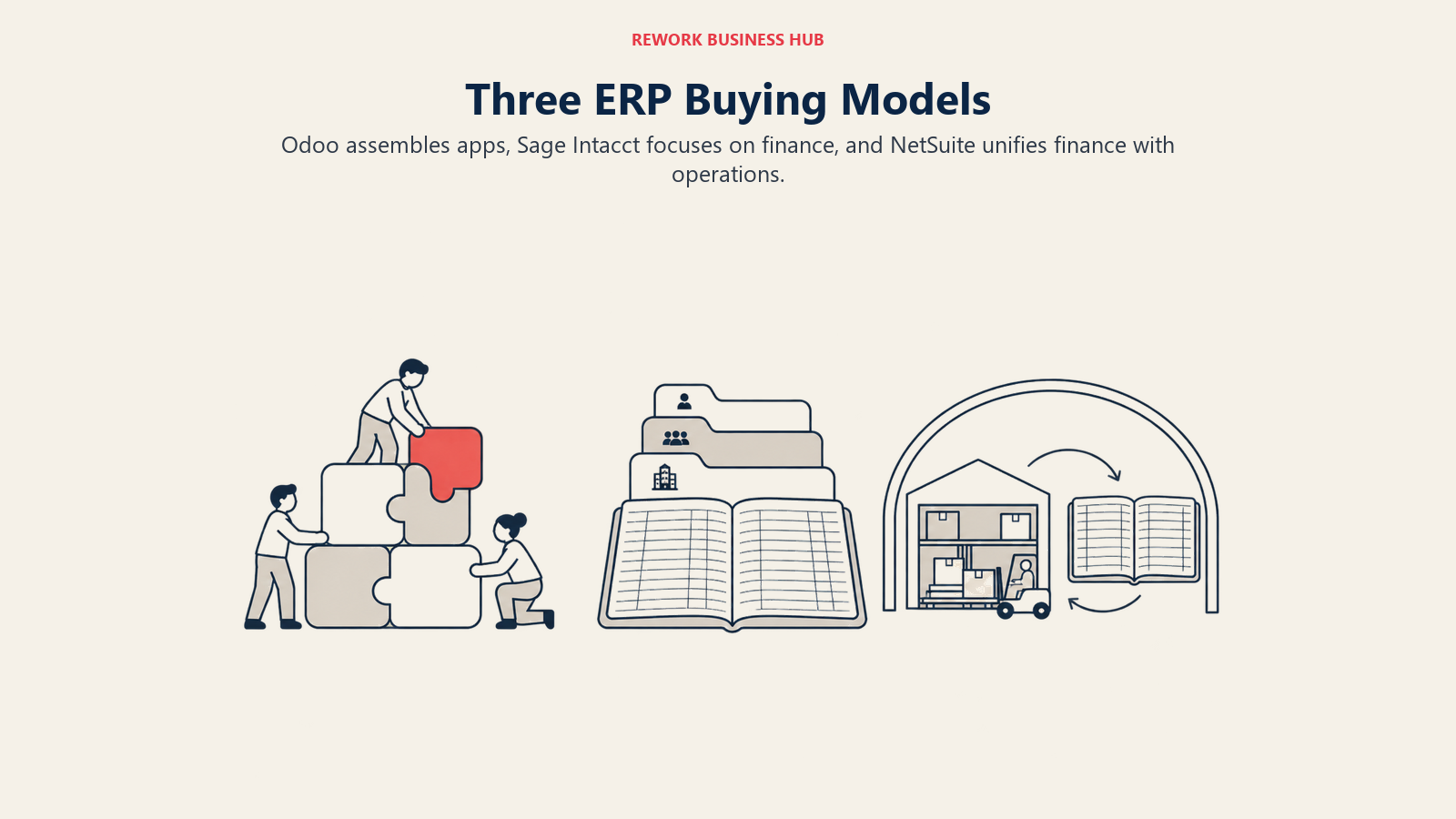
Odoo assembles apps, Sage Intacct focuses on finance, and NetSuite unifies finance with operations.
Odoo: The Modular Open-Core Suite
Odoo's pitch is breadth on one codebase. Every official app, CRM, accounting, inventory, manufacturing, HR, project management, e-commerce, shares the same underlying data model, so a sales order in the CRM app can flow straight into an invoice in accounting and a pick list in inventory without a separate integration to build or maintain. That's the genuine appeal for an operations leader tired of stitching five point solutions together with Zapier.
The free tier is real, not a crippled trial: One App Free gives you unlimited users on exactly one app, at no cost, hosted on Odoo Online. The fully open-source Community edition goes further; it's free to self-host with the full codebase, but you're the one running the server, applying updates, and supporting your own users, or paying a partner to do it for you. Once you want more than one app with real support behind it, you're on Enterprise cloud pricing: Standard at $7.25 to $8.95 per user a month depending on billing cadence, or Custom at $10.90 to $13.60 per user a month, which is the tier that unlocks multi-company support, Odoo Studio for visual customization, and a choice of hosting Odoo Online, Odoo.sh, or fully on-premise.
That Standard-versus-Custom split matters more than it looks. If you run more than one legal entity, you need Custom, not Standard, and that's a meaningfully higher per-seat price plus the setup work to configure multi-company correctly. Odoo's manufacturing app is also genuinely capable: multi-level bills of materials, routing, and work orders, deep enough that companies with light-to-moderate production needs sometimes skip NetSuite entirely. The trade is that none of this arrives pre-assembled. Customization beyond what Odoo Studio's visual tools cover needs a developer who knows Odoo's Python and XML conventions, and the real total cost of an Odoo rollout usually lives in that implementation and customization line, not the monthly per-user fee.
Sage Intacct: The Accounting-First Financial System
Sage Intacct picked a narrower job than the other two and went deep on it. The core differentiator is a dimensional chart of accounts: every transaction can be tagged by entity, department, project, and location simultaneously, so a controller can slice a P&L six different ways without a custom report built by IT. For a company running three, five, or ten legal entities that need to close and consolidate on a predictable schedule, that dimensional model is the reason Intacct wins finance procurement conversations, and the AICPA's exclusive preferred-solution endorsement since 2009 carries real weight in exactly those conversations.
What Sage Intacct deliberately does not do is try to be an operations platform. There's no native inventory management, no manufacturing module, no CRM. It integrates outward, commonly to Salesforce or HubSpot for the revenue side and to a payroll provider for HR, rather than trying to absorb those functions itself. That's a feature, not an oversight, for a buyer whose actual pain is the general ledger, but it means a company that also needs real inventory or production tracking will be running Sage Intacct alongside a second system, not instead of one.
Sage Intacct publishes no price list anywhere. It's sold through a demo and a scoping call, priced by named users, activated modules, and entity count, and every dollar figure in this article for Intacct is a third-party estimate, never Sage's own number.
NetSuite: The Full Suite
NetSuite, owned by Oracle since 2016, starts from a different premise than the other two: it isn't accounting software with operations bolted on, and it isn't an operations suite that treats finance as an afterthought. Financials, inventory, order management, procurement, a light CRM, and multi-subsidiary consolidation share one data model from day one. The manufacturing capability is genuinely MRP-grade: multi-level bills of materials with revisions, dedicated routing records, work orders, and work-in-process tracking, not a kitting feature dressed up as production planning.
The trade is cost and commitment. Oracle publishes no price anywhere; every pricing page redirects to a sales conversation. What you're buying is one governed system of record across every entity and currency, paid for in license cost, per-user cost, module cost, and a separate implementation that is frequently the single largest line item in year one. Plan on 3 to 6 months to go live, longer for a genuinely multi-subsidiary rollout, almost always with a certified NetSuite partner, and plan on needing a dedicated NetSuite administrator after go-live, not just during it.
Where Each One Fits by Company Stage
| Company stage | Odoo | Sage Intacct | NetSuite |
|---|---|---|---|
| Startup (1 to 20 employees) | Good fit if you have technical capacity; One App Free covers the basics at zero cost | Too expensive and too finance-only for this stage | Not designed for this stage |
| Growth (20 to 100 employees) | Strong fit, especially past a single app | Fit narrows to finance-only pain: multi-entity, grant tracking, or a controller who's outgrown QuickBooks | Rare fit unless the company is scaling very fast and already multi-entity |
| Mid-market (100 to 500 employees) | Good fit with dedicated technical or partner support | Best fit: the AICPA-preferred zone for controllers and CFOs at multi-entity companies | Best fit: full ERP scope justifies the cost and implementation load here |
| Enterprise (500-plus employees) | Workable but complex to govern at this scale without significant investment | Good fit for finance specifically; still needs a separate ops stack | Good fit, and the segment where NetSuite competes most directly with SAP and Dynamics 365 |
Decision by Business Goal
| If your actual goal is... | Pick |
|---|---|
| The lowest software cost per seat, and you have internal dev or ops capacity to configure it | Odoo |
| The strongest general ledger and multi-entity consolidation, without operational ERP overhead | Sage Intacct |
| One system for finance, inventory, CRM, and commerce, and budget isn't the binding constraint | NetSuite |
| Real bills of materials, routing, and work orders alongside financials | NetSuite, or Odoo if you have technical capacity to configure its manufacturing app |
| Consolidated reporting across 3 or more legal entities and currencies | Sage Intacct for finance-only needs; NetSuite if operations need to consolidate too |
| Predictable, published pricing you can budget against without a sales call | Odoo |
| Minimal internal IT footprint once the system is live | Sage Intacct; it's the one built to be run day to day by finance, not by an admin team |
Team and Role Fit
| Role | Odoo | Sage Intacct | NetSuite |
|---|---|---|---|
| CFO / Controller | Accounting app is solid but not the product's center of gravity | Owns the system; it was built for this role specifically | Owns financials as part of a much bigger platform |
| Operations / Warehouse | Real inventory and manufacturing apps, configured by you or a partner | No native tooling; needs a separate system | Full warehouse and production functionality if you license the modules |
| IT / IT admin | Needs real involvement, especially on Community edition or heavy customization | Light touch after implementation; mostly a finance-team tool day to day | Needs a dedicated NetSuite administrator on an ongoing basis, not just at launch |
| Sales / CRM users | Native CRM app on the same data model as everything else | Not covered; integrates with Salesforce or HubSpot instead | Included, though NetSuite's CRM has never been its strongest module |
| Board / Auditor | Depends entirely on how the deployment was configured | Built for this: dimensional reporting and a strong audit trail out of the box | Built for this: role-based approvals and revenue recognition designed for audit scrutiny |
Pricing at Real Team Sizes
Here's what's actually verifiable. Odoo publishes real per-user pricing, so the numbers below are exact. Sage Intacct and NetSuite are both quote-only, with no public rate card. Every Sage Intacct and NetSuite figure below is a third-party estimate from ERP Research, an independent ERP cost-research firm, and is labeled (reported) for that reason. Treat these as a starting point for your own quote, not a quote.
Annual Software Cost
| Odoo (Standard, annual billing) | Sage Intacct (reported) | NetSuite (reported) | |
|---|---|---|---|
| 10 users | $870/yr ($7.25/user/mo) | $10,000 to $15,000/yr, entry-tier deployment | $23,868 to $35,868/yr |
| 50 users | $4,350/yr | $25,000 to $75,000/yr, typical mid-market deployment | $71,388 to $131,388/yr |
| 200 users | $17,400/yr (Standard) or $26,160/yr (Custom, required for multi-company) | $50,000 to $200,000/yr, larger multi-entity deployment | $249,588 to $489,588/yr |
Two things to read carefully in that table. First, Sage Intacct genuinely isn't priced per seat the way the other two are; ERP Research's own per-user figure ($400 to $800 a month for a named user) doesn't scale linearly with headcount the way a SaaS seat price does, because a real Intacct deployment blends full financial users with cheaper self-service users and module fees. The three rows above map to ERP Research's own reported deployment bands, entry, typical mid-market, and larger multi-entity, not to a literal 10, 50, and 200-seat calculation, and a real 10-person mid-market rollout usually costs more than the entry-tier figure shown. Second, NetSuite's reported figures are modeled from a base platform fee around $999 a month plus per-user licenses of $99 to $199 a month, the same formula and source used in our Oracle NetSuite vs Unleashed vs Zoho Inventory comparison, kept identical here so the two articles don't contradict each other.
Implementation Cost (Separate From the Subscription)
Implementation is quoted separately from every vendor, and it's frequently the larger number in year one. Reported ranges, all from ERP Research:
| Tool | Reported implementation range | Typical mid-market deployment |
|---|---|---|
| Odoo | $5,000 to $200,000 | $20,000 to $75,000 for a standard 10 to 30-user rollout covering core ERP, CRM, and e-commerce |
| Sage Intacct | $10,000 to $200,000 | $30,000 to $75,000 on average |
| NetSuite | $25,000 to $750,000 | No separate typical band published; scope varies enormously by subsidiary count and module list |
Five-Year All-In: A Worked Example at 50 Users
Sticker price is never the number you actually pay. Here's the same 50-user shape from the table above, software over five years plus implementation, so you can see how the gap widens once the full commitment is on the table:
| Odoo | Sage Intacct | NetSuite | |
|---|---|---|---|
| 5-year software (reported annual x5) | $21,750 | $125,000 to $375,000 | $356,940 to $656,940 |
| Implementation (reported) | $20,000 to $75,000 | $30,000 to $75,000 | $25,000 to $750,000 |
| Five-year all-in estimate | ~$42,000 to $97,000 | ~$155,000 to $450,000 | ~$382,000 to $1.4 million+ |
That NetSuite range is wide because the underlying implementation figure is wide; a single-entity 50-user rollout sits at the bottom of it, and a multi-subsidiary rollout with heavy customization sits at the top. None of these totals include renewal increases, and that's not a minor omission. Sage Intacct and NetSuite are both sold on negotiated annual contracts, and neither publishes an escalator rate. Renewal-negotiation advisories that track these deals commonly report annual increases landing anywhere from the mid-single digits to low double digits once a contract doesn't cap them, and a heavily discounted year-one NetSuite quote repricing upward at renewal is one of the most frequently reported budget surprises in the category. Odoo's published per-user rate has also moved over the past year, so don't assume today's price holds for years two through five either. Negotiate a capped annual increase into a multi-year term before you sign, not after; it's the single easiest thing to fix in advance and one of the hardest to fix in year three.
Implementation and Change Management
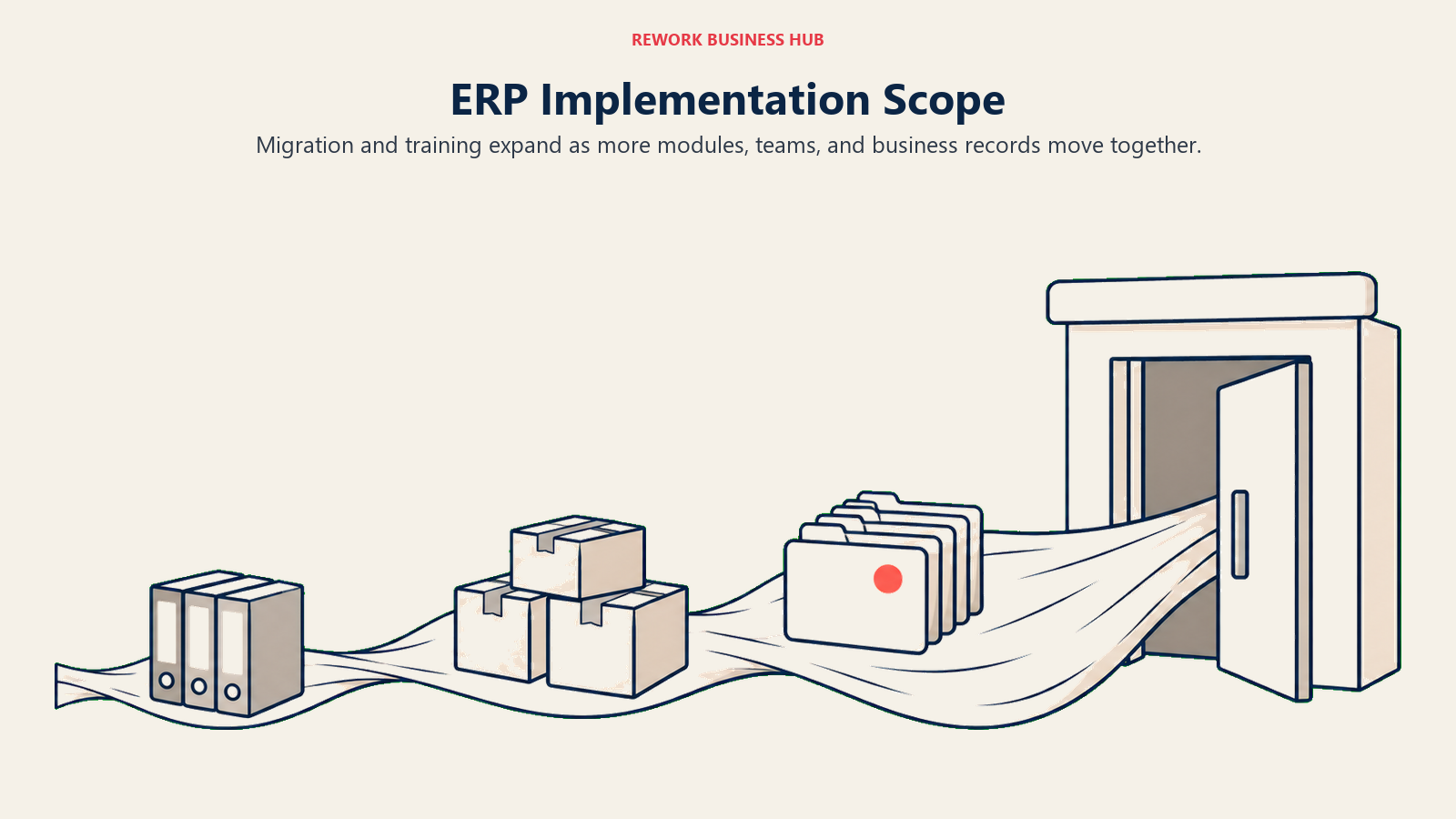
Migration and training expand as more modules, teams, and business records move together.
| Odoo | Sage Intacct | NetSuite | |
|---|---|---|---|
| Typical timeline | Days for a single app; weeks to a few months for a multi-app rollout | Weeks to a couple of months for a standard deployment | 3 to 6 months, longer for multi-subsidiary rollouts |
| Who's typically needed | Internal admin for configuration; a developer or Odoo partner for real customization | An implementation partner for setup; finance team runs it day to day after that | A certified NetSuite partner for implementation; a dedicated NetSuite administrator ongoing |
| Data migration load | Moderate: chart of accounts, inventory, and CRM data if multiple apps are in scope | Moderate to heavy: the general ledger and historical financials move here | Heaviest here: financials, inventory, and often CRM all migrate together |
| Training load | Concentrated on whichever apps each team actually uses | Mostly the finance team; light for everyone else | Broadest: finance, operations, and whichever teams get licensed modules |
Risk and Governance
Replacing an ERP gets harder when finance, inventory, and CRM depend on the same system.
| Odoo | Sage Intacct | NetSuite | |
|---|---|---|---|
| Vendor lock-in | Low on self-hosted Community; moderate to high on Enterprise cloud, more so with deep customization | Moderate: replacing the GL later is a real migration, but Intacct isn't also holding your CRM or inventory | High: NetSuite is often finance, inventory, and CRM together, so leaving usually means re-platforming more than one system at once |
| Audit trail and governance | Depends on configuration; Enterprise adds role-based access, but compliance depth is what you or your partner builds | Strong out of the box: dimensional GL and the AICPA-preferred designation reflect real audit and controls depth | Strong out of the box: role-based approvals and revenue recognition built for multi-subsidiary audit needs |
| Contract commitment | Monthly or annual on Enterprise cloud; Community carries no vendor contract, only your own hosting and support cost | Annual contract, typically negotiated at renewal | Annual contract, negotiated; heavily discounted year-one terms are common |
| Where your data lives | Odoo Online, Odoo.sh, or fully on-premise, your choice on the Custom tier | Sage-hosted cloud | Oracle-hosted cloud |
When Odoo Is the Right Call
- You have internal technical capacity, or a trusted partner, and want the broadest functional coverage (accounting, inventory, manufacturing, CRM, HR) on one codebase at the lowest license cost.
- Your business runs a single entity, or you're prepared to pay for the Custom tier if it doesn't.
- You want a real, usable free tier to start on, whether that's One App Free for a single app or the fully open-source Community edition if you're willing to self-host.
- You need genuine manufacturing depth (bills of materials, routing, work orders) without NetSuite's price tag.
When Sage Intacct Is the Right Call
- Your actual problem is the general ledger and consolidated reporting across multiple entities, departments, or projects, not operations.
- You're a controller or CFO who needs dimensional reporting an off-the-shelf accounting tool can't replicate, and the AICPA endorsement matters in your procurement process.
- You're comfortable running a separate system (or systems) for inventory, manufacturing, or CRM, because Intacct isn't going to absorb those functions.
- You have budget for a quote-only enterprise sale and don't need a published price to start the conversation.
When NetSuite Is the Right Call
- You need finance, inventory, CRM, and commerce in one governed system of record, and you're past the point where stitching together point solutions is sustainable.
- You run more than one legal entity or subsidiary and need real-time consolidated financials alongside operational data, not just a finance-only view.
- Budget supports a license plus a five- or six-figure implementation, and you have (or will hire) a certified partner and a multi-month runway before go-live.
- You need MRP-grade manufacturing (multi-level BOMs, routing, work orders) alongside financials in the same system.
Decision Framework
| If you need... | Pick | Why |
|---|---|---|
| The lowest total software cost, and you can configure it yourself or with a partner | Odoo | Published per-user pricing, and the broadest single-codebase functional coverage of the three |
| Best-in-class general ledger and multi-entity consolidation, nothing more | Sage Intacct | Built finance-first; the AICPA-preferred designation reflects genuine depth there |
| One system for finance and operations together, regardless of cost | NetSuite | The only one of the three built to be a single governed system of record across both |
| Real manufacturing (BOMs, routing, work orders) at the lowest cost | Odoo | Comparable manufacturing depth to NetSuite at a fraction of the license and implementation cost |
| A free tier to start on with zero commitment | Odoo | One App Free or the fully open-source Community edition; neither Sage Intacct nor NetSuite has an equivalent |
| Multi-subsidiary consolidation plus real inventory in one place | NetSuite | Sage Intacct doesn't do inventory; Odoo's multi-company support is real but requires the Custom tier and setup work |
| The least internal IT footprint after go-live | Sage Intacct | Built to be run by finance day to day, not by a dedicated administrator |
Frequently Asked Questions about Odoo, Sage Intacct, and NetSuite
What's the real difference between Odoo, Sage Intacct, and NetSuite?
Odoo is a modular, open-core business suite where accounting is one app among dozens, cheap per seat with the real cost sitting in implementation and customization. Sage Intacct is an accounting-first cloud financial system built for multi-entity consolidation and dimensional reporting, and it deliberately doesn't cover inventory, manufacturing, or CRM. NetSuite is a full ERP where finance, inventory, CRM, and commerce share one data model, at the highest cost and the heaviest implementation of the three.
How much do Odoo, Sage Intacct, and NetSuite actually cost?
Odoo publishes real per-user pricing: Standard runs $7.25 to $8.95 per user a month and Custom runs $10.90 to $13.60, depending on annual or monthly billing. Sage Intacct and NetSuite publish no price list and sell through a quote. Reported estimates from ERP Research put Sage Intacct at roughly $25,000 to $75,000 a year for a typical mid-market deployment and NetSuite at roughly $71,000 to $131,000 a year for 50 users, before implementation.
Can Odoo actually replace a full ERP like NetSuite?
For companies with internal technical capacity, Odoo covers more functional ground than Sage Intacct and rivals NetSuite on paper, accounting, inventory, manufacturing, CRM, and HR all live on one codebase. The trade is that Odoo ships that breadth as configuration you or a partner assembles, while NetSuite ships more of it pre-integrated at a much higher price.
Does Sage Intacct handle inventory or manufacturing?
No, not natively. Sage Intacct is deliberately finance-only. Companies that need inventory or manufacturing alongside strong financials typically pair Sage Intacct with a separate operations system, or choose NetSuite or Odoo instead.
How long does implementation actually take?
Odoo and Sage Intacct standard deployments commonly run several weeks to a couple of months depending on modules and data complexity. NetSuite implementations typically run 3 to 6 months, longer for multi-subsidiary rollouts, and almost always involve a certified partner.
Which one is easiest to leave if it doesn't work out?
Odoo Community, since it's self-hosted and open source with no vendor contract to unwind. Sage Intacct is a moderate lift to leave since it only replaces your general ledger. NetSuite carries the most lock-in, because leaving usually means re-platforming finance, inventory, and CRM at the same time, not just switching accounting software.
What to Do Next
Answer the four questions from the top of this article before you take a single demo. If your real problem is the general ledger and consolidated reporting, and operations aren't part of the ask, Sage Intacct is very likely the right shortlist of one; comparing it against a full ERP is comparing it against a different job. If you need finance and operations to genuinely live in one system and can fund a real implementation, put NetSuite and Odoo's Custom tier head to head, and weight that comparison by whether you have the internal technical capacity Odoo assumes you'll bring.
Then run the actual numbers for your headcount and entity count using the tables above, not the headline price from a sales deck. Get a written implementation quote before you compare anything else; on all three of these, it's frequently the bigger number, not the subscription. And if a capped annual increase isn't already in the contract you're about to sign, ask for one before you sign it, not at renewal, when you'll have far less leverage than you do today.
If either Sage Intacct or NetSuite feels like more than your actual operations require, our guides to best Sage Intacct alternatives, best NetSuite alternatives, and best Odoo alternatives each cover a wider field at lower price points. If Microsoft or SAP are also on your shortlist, best Dynamics 365 alternatives and best SAP Business One alternatives cover where those fit against this same trio. And if your actual problem turns out to be narrower than a full ERP, stock control specifically rather than the ledger, our Oracle NetSuite vs Unleashed vs Zoho Inventory comparison and best accounting software 2026 roundup both cover lighter-weight paths worth ruling out first. Our guide to choosing ERP software is a reasonable framework for running any shortlist through the same four questions this article opened with.

Principal Product Marketing Strategist
On this page
- TL;DR
- Key Facts
- What Each Tool Is Actually Built For
- Odoo: The Modular Open-Core Suite
- Sage Intacct: The Accounting-First Financial System
- NetSuite: The Full Suite
- Where Each One Fits by Company Stage
- Decision by Business Goal
- Team and Role Fit
- Pricing at Real Team Sizes
- Annual Software Cost
- Implementation Cost (Separate From the Subscription)
- Five-Year All-In: A Worked Example at 50 Users
- Implementation and Change Management
- Risk and Governance
- When Odoo Is the Right Call
- When Sage Intacct Is the Right Call
- When NetSuite Is the Right Call
- Decision Framework
- What to Do Next