Oracle NetSuite vs Unleashed vs Zoho Inventory: Which One Fits What You've Actually Outgrown?
Turn this article into takeaways for your work.


Each assistant summarizes the article only for you and suggests best practices for your work.
You've outgrown the spreadsheet. Maybe it was a stockout that cost a real customer, maybe it was two people editing the same tab and one losing, or maybe your accountant refused to close another month without a real system behind the numbers. Whatever the trigger, three names keep showing up in your research, and they could not be less alike: Oracle NetSuite, Unleashed, and Zoho Inventory.
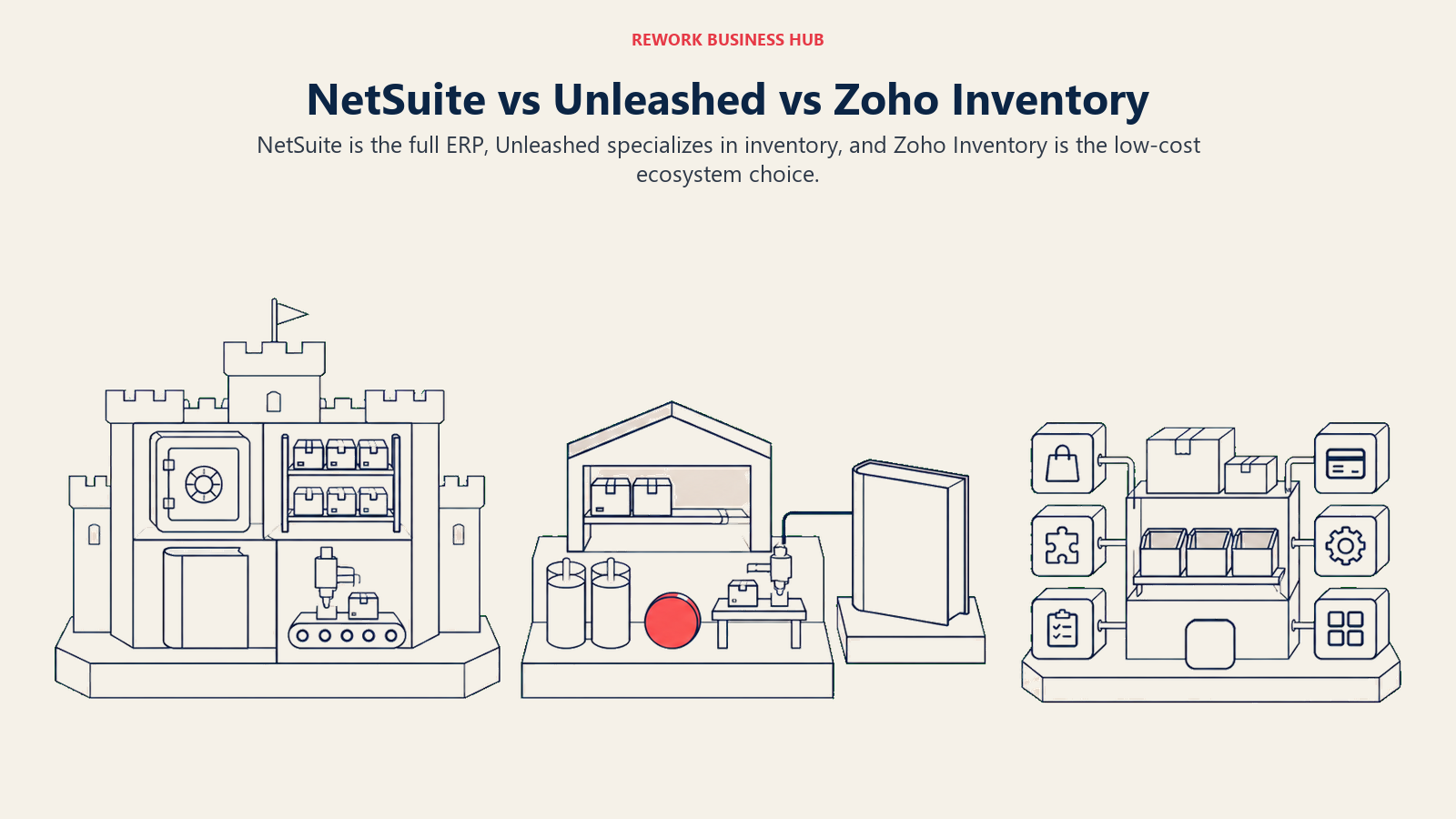
That's not bad research. These three genuinely are the same shopping trip, because each one answers "we can't run stock on a spreadsheet anymore." What separates them isn't a feature checklist so much as scale and commitment. NetSuite is a full ERP where inventory is one module among many, sold with an implementation partner and a signed annual contract. Unleashed is a dedicated inventory and light-production platform that sits next to the accounting software you already run. Zoho Inventory is the cheap, fast entry point that pulls hardest if you're already inside the Zoho ecosystem. The right pick isn't about which tool is "better." It's about which of your problems is actually broken: the stock, the books, or both.
TL;DR
| Oracle NetSuite | Unleashed | Zoho Inventory | |
|---|---|---|---|
| What it is | Full cloud ERP; inventory is one module among financials, order management, procurement and more | Dedicated inventory, order and light-production platform that syncs to your existing accounting system | Order and stock management app built inside the Zoho ecosystem |
| Billing model | Annual licence, quoted per company | Fixed tiers (Core, Pro) plus per-user and per-order add-ons | Fixed tiers, mostly billed annually, plus per-user, per-order and per-location add-ons |
| Published entry price | None. Oracle does not publish a price list anywhere | Unleashed Core $399/month, or $4,389/year billed annually (3 users, 100 orders/month) | Zoho Inventory Standard $29/month billed annually (3 users, 500 orders/month) |
| Free tier | None | None, free trial only | Free plan: 1 user, 50 orders/month, 1 to 2 locations |
| Accounting | Is your general ledger. Financials are a core module, not an integration | Syncs to Xero or QuickBooks Online. Doesn't replace either | Native to Zoho Books, plus a narrower QuickBooks Online sync (US accounts, one organization) |
| Manufacturing / BOM | Multi-level bills of materials, routing and work orders: real MRP-grade capability | Assembly bills of materials included; deeper production is a $69/month add-on (free with Pro) | Composite items only. Kitting and bundling, not a true bill of materials |
| Multi-warehouse | Unlimited locations, subsidiaries and currencies in the core platform | Multi-warehouse transfers included on every tier | 2 to 10 locations by tier, extra locations $10/month |
| Sales order ceiling | None published; volume gets negotiated into the licence | 100 orders/month included on both tiers; upgrades run $70 to $490/month | 500 to 15,000 orders/month by tier, add-on blocks of 500 orders at $7.50/month |
| Implementation | A separate, one-time fee, commonly the largest year-one line, usually needs a partner | Not published; ask before signing | Not required at the entry tiers; self-serve is realistic |
| Best for | Multi-entity or multi-currency companies that want inventory inside one governed ledger | Wholesalers and distributors who need landed cost, batch and serial accuracy without touching their books | Small and mid-size sellers who want real order management fast and cheap |
| Worst for | A single-entity product business that only needs stock control fixed | High-volume, low-margin sellers who will blow through the 100-order floor immediately | Manufacturers, or anyone about to outgrow the order cap on their busiest month |
Key Facts
- A March 2026 survey of 400 warehouse and operations professionals found 84.8% still use spreadsheets as their primary inventory tracking tool, including 53% of companies with 500 or more employees, so spreadsheet dependency isn't a small-business problem. (inFlow Inventory, State of Inventory Management 2026)
- Inventory distortion, meaning out-of-stocks plus overstocks, cost retailers $1.77 trillion globally in 2025, about 6.5% of global retail sales. (IHL Group, Fixing Inventory Distortion)
- Nearly 80% of warehouse associates and decision-makers say inaccurate inventory and out-of-stocks significantly hurt productivity, and 82% say they need better inventory tools. (Zebra, 2023 Global Warehousing Vision Study)
What Each Tool Is Actually Built For
Oracle NetSuite: Inventory Is One Module of Many
NetSuite starts from a different premise than the other two. It isn't inventory software with accounting bolted on, it's a full ERP (financials, inventory, order management, procurement, a light CRM and multi-subsidiary consolidation) where stock is one module beside the general ledger. Its manufacturing capability (multi-level bills of materials with revisions, dedicated routing records, work orders and work-in-process tracking) is genuinely MRP-grade, not a bolted-on kitting feature.
The trade is what you'd expect. Oracle doesn't publish a price anywhere: every pricing page redirects to a sales conversation, and every published range in a comparison article, including this one, is somebody's estimate rather than Oracle's number. What you're buying is one governed system of record across every entity and currency, paid for in licence cost, module cost, and a separate implementation that's frequently the largest line item in year one. If NetSuite is more than what you actually need, best NetSuite alternatives covers the mid-market field.
Unleashed: Inventory and Light Production, Next to Your Books
Unleashed picks a narrower job and does it with more precision than either of the others: landed cost allocation across freight, duty and insurance, batch and serial tracking with expiry dates, multi-warehouse transfers, and assembly bills of materials for building kits from purchased components. It's the system distributors and importers reach for when margin accuracy matters as much as knowing what's on the shelf.
Unleashed doesn't try to be your general ledger, though. It syncs to Xero or QuickBooks Online and leaves your books where they are, which is the whole pitch for a business whose accounting is fine and whose stock control isn't. The catch is the order ceiling: both published tiers include only 100 sales orders a month, tight for anything but a low-volume, high-value distributor.
Zoho Inventory: The Cheap, Fast Entry Point
Zoho Inventory does the unglamorous core of inventory well and prices it aggressively: multi-warehouse stock, purchase and sales orders, backorders and dropshipping, serial and batch tracking, barcode scanning, and native connections to Shopify, Amazon, eBay and Etsy. The free plan is a real starting point, not a demo, and the cheapest paid tier is $29 a month billed annually.
What makes it hard to beat at that price is the ecosystem: if you already run Zoho Books, Zoho CRM or Zoho Commerce, inventory becomes another module on the same customer and invoice record instead of another integration to maintain. It can also sync to QuickBooks Online if you're not on Zoho Books (US accounts only, one organization, matching currency). What it doesn't do is manufacturing; composite items cover kitting and bundling, not a real bill of materials.
The Real Question: What Are You Actually Outgrowing?
Here's the plain version of this article's argument, stated once: if your accounting is fine and only stock is broken, buying a full ERP is an expensive way to solve the wrong problem. NetSuite fixes a ledger problem better than anything here, and it fixes a stock problem too, but you pay full ERP price for both whether you needed the first one or not. Work out which failure is actually yours before you shortlist anything.
| What's actually broken | Buy... | Not... |
|---|---|---|
| Stock counts are wrong and nobody trusts the number, but invoicing and the books are fine | Unleashed or Zoho Inventory | NetSuite. You'd be replacing a ledger that isn't broken |
| The books themselves are the mess: multiple entities, multiple currencies, or an accountant asking for a real consolidated GL | NetSuite, or a comparable ERP | A dedicated inventory tool won't touch this |
| You're already deep in Zoho (Books, CRM, Commerce) and just need orders and stock added | Zoho Inventory | Paying for ecosystem you'd have to rebuild elsewhere |
| You import goods, need landed cost by container, or carry batch and expiry liability | Unleashed | Zoho Inventory's costing isn't built for this |
| You make what you sell, with real routings and shop-floor steps | Neither goes deep enough; look at NetSuite or a dedicated MRP | Buying "inventory software" alone |
That single diagnostic question does more work than any feature grid: a ten-person wholesaler with clean books buying NetSuite to fix a stockout problem pays six figures for a ledger migration nobody asked for, and a 40-person company faking multi-entity consolidation across spreadsheets makes the opposite mistake, since no inventory tool fixes books that are the real problem.
Multi-Warehouse and Location Support
Every growing product business adds a second warehouse eventually, or a 3PL, or a retail backroom, and the three tools handle it on completely different terms.
| Oracle NetSuite | Unleashed | Zoho Inventory | |
|---|---|---|---|
| Locations included | Unlimited, across subsidiaries and currencies | Multi-warehouse transfers on every tier, no published cap | 2 (Standard) to 10 (Enterprise), by tier |
| Extra locations | Priced into the licence | Not metered separately | $10/month each |
| What a "location" really means | Can represent a full subsidiary in a different country and currency | A physical warehouse or stockroom | A physical warehouse or stockroom |
| Bin-level detail | Available through the warehouse management module | Warehouse features bundled free on Pro, $149/month on Core | Advanced warehousing add-on, $124.17/month |
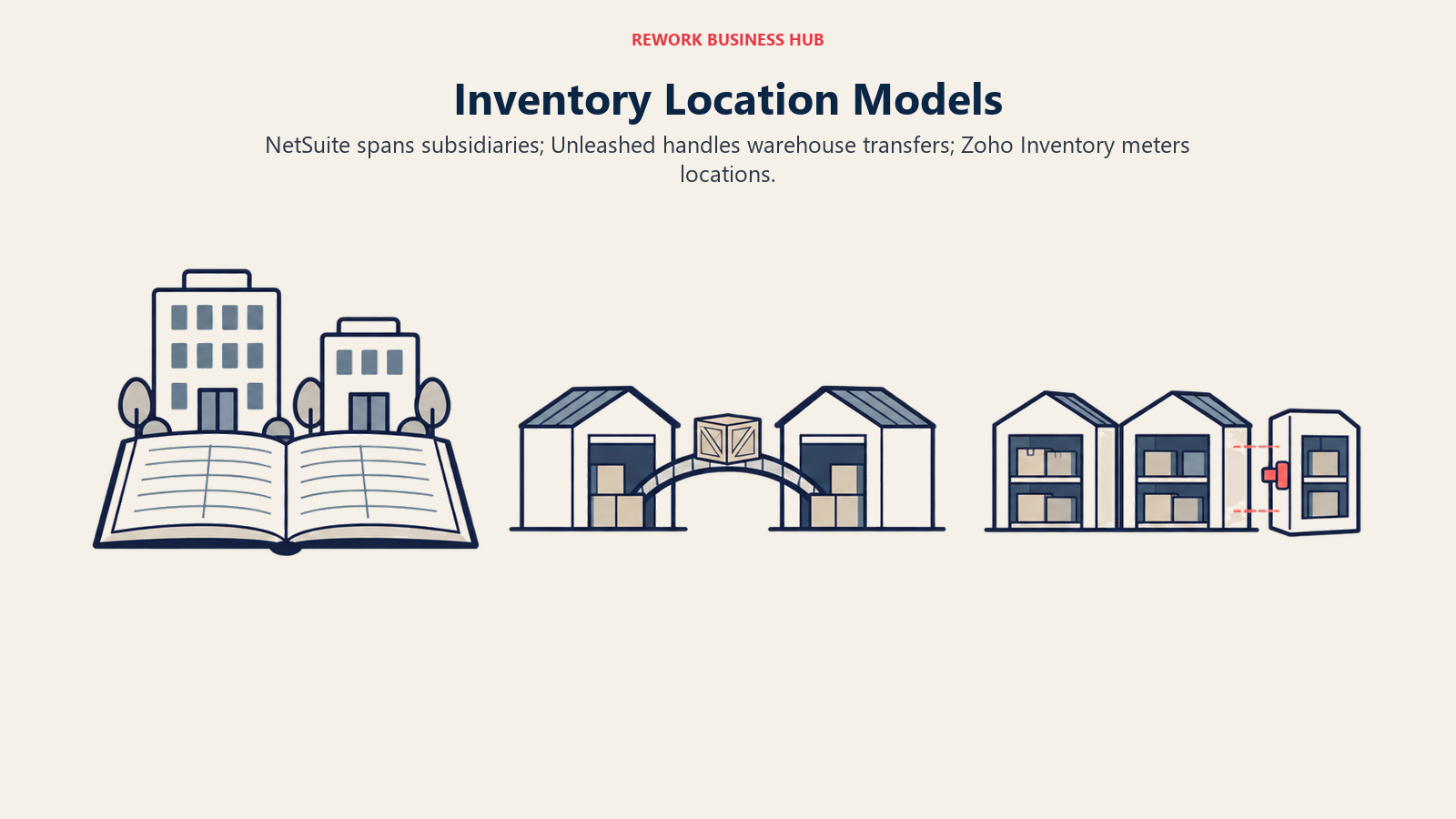
NetSuite's advantage isn't warehouse count, it's what a location can mean: a subsidiary in a different country and currency, consolidating into one set of financials. Unleashed and Zoho Inventory both do the more common job (stock across physical locations, transfers between them) but only one charges per location, and Zoho Inventory's flat $10-a-month rate rarely decides the purchase on its own.
Manufacturing and Assembly: How Much BOM Do You Actually Need?
This is where the three products separate the most, and where buyers most often overpay or underbuy without realizing it.
| Manufacturing capability | Oracle NetSuite | Unleashed | Zoho Inventory |
|---|---|---|---|
| Bill of materials | Multi-level, with revisions and costing | Single-level assembly BOMs, included | Composite items only (kitting and bundling) |
| Routing / operation sequencing | Yes, dedicated Manufacturing Routing records | Not native | Not available |
| Work orders / work-in-process | Yes, full work order and WIP tracking | Assembly builds, not scheduled work orders | Not available |
| Deeper production module | Part of NetSuite's broader manufacturing capability, quoted like the rest of the platform | Production and Manufacturing add-on, $69/month (free with Pro) | Not offered |
| Verdict | Real MRP-grade manufacturing | Light assembly, fine for kitting finished goods from purchased components | Not a manufacturing tool at all |
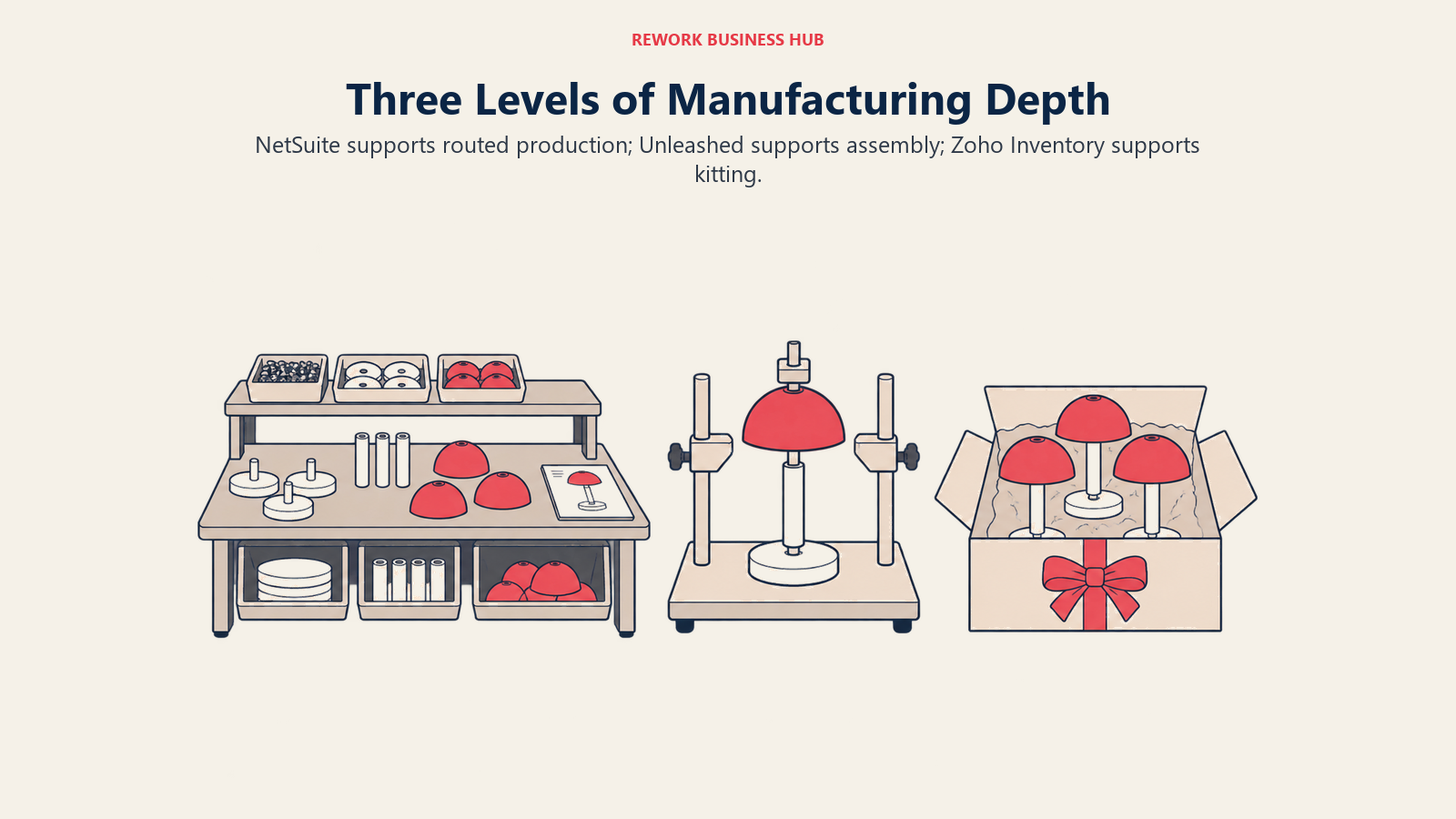
If you assemble kits from purchased components (a gift box, a bundle, a finished good built from three purchased parts) both Unleashed's assembly BOMs and Zoho's composite items get you there, and Unleashed's version is the more capable. If you're running a production floor with sequenced operations, work orders and routed steps, neither goes deep enough, and you're really choosing between NetSuite and a dedicated MRP like the ones covered in our Cin7 vs Katana comparison. Don't let a sales conversation talk you into believing composite items or assembly BOMs are the same thing as production planning. They aren't, and finding that out three months into a rollout is expensive.
The Accounting Integration Question
This is the fork in the road that decides more of this purchase than any feature list.
| Oracle NetSuite | Unleashed | Zoho Inventory | |
|---|---|---|---|
| Relationship to your books | Is the general ledger; financials are a core module | Syncs to Xero or QuickBooks Online; doesn't replace either | Native to Zoho Books; also syncs to QuickBooks Online (US only, one organization, matching currency) |
| What switching costs you | A full chart-of-accounts migration and a new system of record | Nothing on the accounting side. Keep your existing books | Nothing if you're already on Zoho Books; a real integration project if you're not |
| Right fit | Your accounting itself is the constraint, not just stock | Your books are fine; only stock is broken | Your books are fine, and ideally already Zoho |
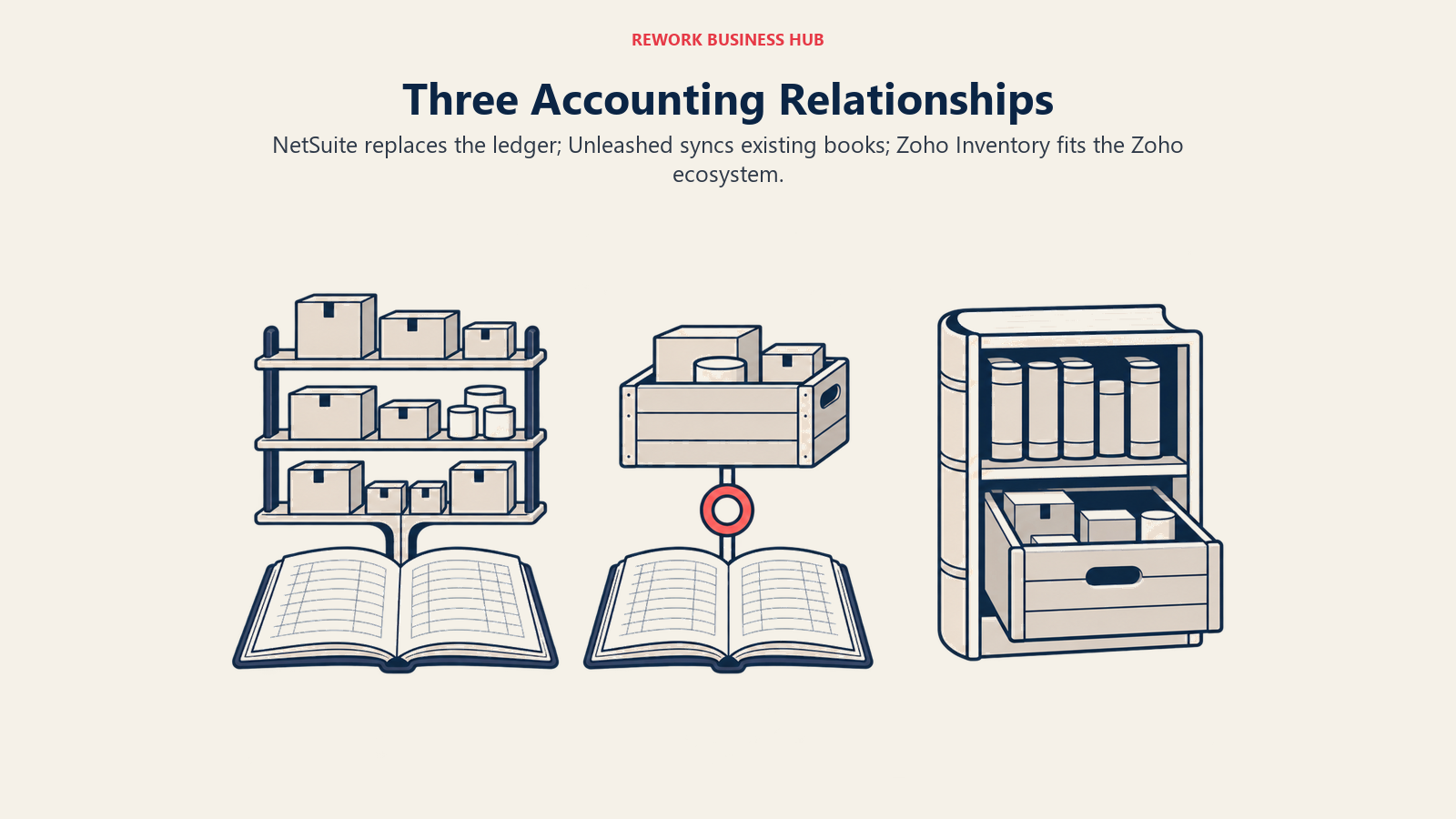
NetSuite replaces your general ledger. That's not a footnote, it's the biggest single fact about the product: choosing NetSuite means a chart-of-accounts migration and a new system of record, whether or not your current books (QuickBooks, Xero, whatever you're on) are actually the problem. If they're not, you're paying ERP implementation cost to fix something that wasn't broken. Our guide to choosing ERP software walks through that decision if you're still weighing it.
Unleashed and Zoho Inventory take the opposite position: they assume your books are fine and refuse to touch them. Unleashed posts into Xero or QuickBooks Online; Zoho Inventory posts natively into Zoho Books, and separately into QuickBooks Online if that's what you run instead, though that sync is narrower. If your complaint is "our accounting is fine, our stock count is a lie," either is the right shopping list and NetSuite is the wrong one. Best QuickBooks alternatives, best Xero alternatives, and best Zoho Books alternatives cover that side of the stack if it's also under review.
Team and Role Fit
Match the tool to who actually has to live in it every day, not just who signs the contract.
| Role | Oracle NetSuite | Unleashed | Zoho Inventory |
|---|---|---|---|
| Controller / Finance | Owns the system; single ledger across entities | Reconciles against Xero or QuickBooks Online, doesn't touch a second ledger | Reconciles against Zoho Books, or a narrower QuickBooks Online sync |
| Operations / Warehouse | Full warehouse-management workflows if you license the module | Multi-warehouse, batch and serial, landed cost | Multi-location up to the tier cap, barcode scanning |
| Founder / COO | Buys governance and one system of record | Buys margin accuracy without a ledger migration | Buys the cheapest path to real order management |
| IT / Implementation lead | Owns a multi-month rollout, usually with a partner | Light lift, self-serve realistic for most single-entity teams | Self-serve, same-week setup realistic |
Notice what doesn't change across all three: whoever places or fulfills an order needs a licensed seat, and that seat count drives cost, not total headcount. A 40-person company where only 8 people touch inventory pays for roughly 8 seats almost everywhere here, not 40.
Pricing at Real Team Sizes
Headline prices are close to useless here, because seats, order volume and modules all move independently. Below are three real shapes of product business, priced against each vendor's own published numbers: a small brand (5 users, ~400 orders/month, one warehouse), a growing distributor (10 users, ~1,500 orders/month, 2 to 3 warehouses, light assembly), and a larger operation (25 users, ~5,000 orders/month, several warehouses).
| Annual software cost | Small brand (5 users, ~400 orders/mo) | Growing distributor (10 users, ~1,500 orders/mo) | Larger operation (25 users, ~5,000 orders/mo) |
|---|---|---|---|
| Zoho Inventory | $528 (Standard $29/mo + 2 extra users at $7.50/mo each) | $1,548 (Plus $129/mo, which covers 10 users exactly and leaves headroom on the 7,500-order cap) | $4,338 (Enterprise $249/mo + 15 extra users at $7.50/mo each) |
| Unleashed | $6,885 (Core $4,389/yr + 2 extra users at $69/mo + the 500-order upgrade at $70/mo) | $15,759 (Pro $8,019/yr + 5 extra users at $89/mo + the 1,500-order upgrade at $200/mo) | $35,259 (Pro $8,019/yr + 20 extra users at $89/mo + the unlimited-order upgrade at $490/mo) |
| Oracle NetSuite (reported, not Oracle-published) | ~$20,928 | ~$29,868 | ~$56,688 or more |
Oracle publishes no price for NetSuite anywhere; every attempt to pull one directly from netsuite.com or oracle.com during this update returned a blocked page or a sales form, never a rate card. The NetSuite row is modeled from a base platform fee around $999 a month and per-user licences of $99 to $199 a month, reported by ERP Research, an independent NetSuite cost-research firm that itself labels these as estimates rather than published Oracle rates. Treat it as a conversation starter, not a quote.
None of the three NetSuite figures include implementation, either. ERP Research reports a separate one-time range of $25,000 to $750,000 depending on scope, and it's frequently the largest year-one line item, not the licence. At the low end, implementation alone costs more than four years of the growing distributor's entire Unleashed bill. Get that number in writing before comparing anything else.
Where Each One Actually Breaks: Order Volume and Ceilings
| Included orders/month | What happens above it | |
|---|---|---|
| Zoho Inventory Standard | 500 | $7.50/month per extra 500-order block, or upgrade a tier |
| Zoho Inventory Premium | 3,000 | Same $7.50 per-block add-on, or upgrade to Plus |
| Zoho Inventory Plus | 7,500 | Same add-on pricing, or move to Enterprise |
| Zoho Inventory Enterprise | 15,000 | Add-on blocks keep stacking; no published ceiling above that |
| Unleashed Core / Pro | 100 on both tiers | Fixed upgrade tiers from $70 to $490/month, up to unlimited |
| Oracle NetSuite | None published | Volume is priced into the negotiated licence, not metered per order |
Zoho Inventory's ceiling is the one buyers most often get surprised by, because it's denominated in orders, not seats, and a good Black Friday can push a small team up a tier with nothing about the team itself changing. Standard's 500 orders a month sounds generous until a real launch, and the fix is an add-on block at $7.50 per extra 500 orders or a tier upgrade. Our Zoho Inventory alternatives guide covers this in more depth if that ceiling is what's pushing your search.
Unleashed's ceiling is tighter in absolute terms, at 100 orders a month on both tiers, but it's honest about it, publishing exact upgrade prices instead of making you guess. Model your real order volume before you sign, not your volume on a slow month.
NetSuite doesn't meter orders at all. Volume gets negotiated into the licence, which is either a relief (no surprise overage bill) or a headache (no published number to check your own usage against).
Implementation and Change Management
| Oracle NetSuite | Unleashed | Zoho Inventory | |
|---|---|---|---|
| Typical setup | Weeks to months; chart-of-accounts migration; usually an implementation partner | Days to a couple of weeks; connect to your existing Xero or QuickBooks Online | Days; self-serve for most small teams |
| Onboarding fee | Separate, one-time, not published (reported $25,000 to $750,000+) | Not published; ask | Not required at the entry tiers |
| Who needs training | Finance, ops, and whichever teams get modules | Warehouse and ops staff mainly | Whoever places or fulfills orders |
| Data migration load | Heaviest here. You're migrating the ledger itself | Moderate: stock, suppliers, price lists | Lightest: stock and orders only |
The gap here is the widest in the comparison. Zoho Inventory is realistically self-serve: connect your sales channels, import your SKUs, and start taking real orders inside a week. Unleashed adds a bit more setup (mapping the accounting sync, landed cost rules) but rarely needs a partner for a single-entity distributor.
NetSuite is a different category of project: migrating a live general ledger, mapping every subsidiary's chart of accounts, and configuring whichever modules you've licensed is realistically weeks to months, and most companies bring in a partner rather than attempt it alone. Our guide to modeling total cost of ownership for SaaS is a reasonable template for running all three vendors through.
Risk and Governance
| Oracle NetSuite | Unleashed | Zoho Inventory | |
|---|---|---|---|
| Vendor lock-in | High. Your ledger, inventory and often CRM all live here | Moderate. Losing Unleashed means re-platforming stock only | Low to moderate, especially paired with Zoho Books or Zoho CRM |
| Audit trail / governance | Built for it: multi-entity consolidation, role-based approvals | Reasonable for a single-entity distributor | Basic; not built for complex governance |
| Contract commitment | Annual licence, negotiated | Monthly or annual, no long lock-in described on the pricing page | Monthly or annual, easy to downgrade |
| Data ownership | Oracle-hosted, standard SaaS terms | Hosted by The Access Group, Unleashed's parent company | Zoho-hosted |
If governance and audit trail are the actual requirement (a board, an auditor, or a parent company wanting consolidated multi-entity reporting) that's a legitimate reason to pay NetSuite's premium; neither Unleashed nor Zoho Inventory competes there. If the need is closer to "know what happened to this batch if we get a recall notice," Unleashed's batch and serial tracking gets you most of the way for a fraction of the cost.
When Oracle NetSuite Is the Right Call
- You run more than one legal entity, currency or subsidiary and need one consolidated ledger.
- Your accounting software itself, not just stock, is breaking, or you need real multi-level BOMs, routing and work orders alongside financials.
- Budget supports a licence plus a five- or six-figure implementation, and you have (or will hire) a partner and a multi-month runway before go-live.
When Unleashed Is the Right Call
- Your books are fine (Xero or QuickBooks Online) and only stock is the problem.
- You import goods and need landed cost by container, freight and duty.
- You carry batch, lot or expiry liability, common in food, supplements or cosmetics.
- You're a distributor or wholesaler assembling simple kits, with high order value and comparatively low order count.
When Zoho Inventory Is the Right Call
- You're already running Zoho Books, Zoho CRM or Zoho Commerce.
- Budget is the primary constraint and you need real order management, not just a spreadsheet replacement.
- Your order volume genuinely stays under a few thousand orders a month.
- You want to be live this week, not next quarter, and don't need manufacturing or landed-cost precision.
Decision Framework
| If you need... | Pick | Why |
|---|---|---|
| Real stock control fixed, and accounting is already fine | Unleashed or Zoho Inventory | Both sit beside Xero, QuickBooks Online or Zoho Books instead of replacing your books |
| The cheapest real order management, especially if you're on Zoho already | Zoho Inventory | $29/month billed annually buys 500 orders and genuine order management |
| Accurate landed cost, batch and serial tracking for imports or regulated goods | Unleashed | Purpose-built costing and traceability that Zoho Inventory doesn't attempt |
| Multi-level BOMs, routing and real production scheduling | Oracle NetSuite, or a dedicated MRP | Unleashed's BOMs are assembly-only; Zoho's are kitting only |
| Multiple legal entities, currencies or subsidiaries reporting to one ledger | Oracle NetSuite | This is the one job only a full ERP does natively |
| A fixed monthly order cap you keep almost hitting | The next Zoho tier, or Cin7 Core | See our inventory management software guide for the order-volume-first shortlist |
| One system for stock, orders, invoices and the customer record, not just inventory | Neither. That's a different category | See "What to Do Next" below |
What to Do Next
Answer the accounting question first. If your books are fine and only stock is broken, cross NetSuite off the list before you take a single demo call, no matter how good the sales deck looks. That one decision eliminates the most expensive and slowest option here for most readers.
Then size your real order volume, not your best month or your worst one. Zoho Inventory and Unleashed both meter orders, and guessing wrong means paying for headroom you don't need or hitting a wall you didn't see coming. Pull 12 months of order data before you price anything, then run a real trial with your own SKUs, not a demo catalog: load a genuine purchase order, fulfill a real sales order, and reconcile a day's transactions against your actual books. That two-week test predicts fit better than any comparison article, including this one.
One more thing worth saying plainly: none of these three tools puts your stock count on the same record as your customer, deal and invoice. If your real problem is four disconnected tools rather than inventory depth, that's a different shopping trip, and our inventory management software guide covers where a consolidated platform fits that narrower case, and where it doesn't.

Business Consultant
On this page
- TL;DR
- Key Facts
- What Each Tool Is Actually Built For
- Oracle NetSuite: Inventory Is One Module of Many
- Unleashed: Inventory and Light Production, Next to Your Books
- Zoho Inventory: The Cheap, Fast Entry Point
- The Real Question: What Are You Actually Outgrowing?
- Multi-Warehouse and Location Support
- Manufacturing and Assembly: How Much BOM Do You Actually Need?
- The Accounting Integration Question
- Team and Role Fit
- Pricing at Real Team Sizes
- Where Each One Actually Breaks: Order Volume and Ceilings
- Implementation and Change Management
- Risk and Governance
- When Oracle NetSuite Is the Right Call
- When Unleashed Is the Right Call
- When Zoho Inventory Is the Right Call
- Decision Framework
- What to Do Next