ClientSuccess vs Akita vs SmartKarrot: Which Customer Success Platform Fits a Small CS Team in 2026?
Turn this article into takeaways for your work.


Each assistant summarizes the article only for you and suggests best practices for your work.
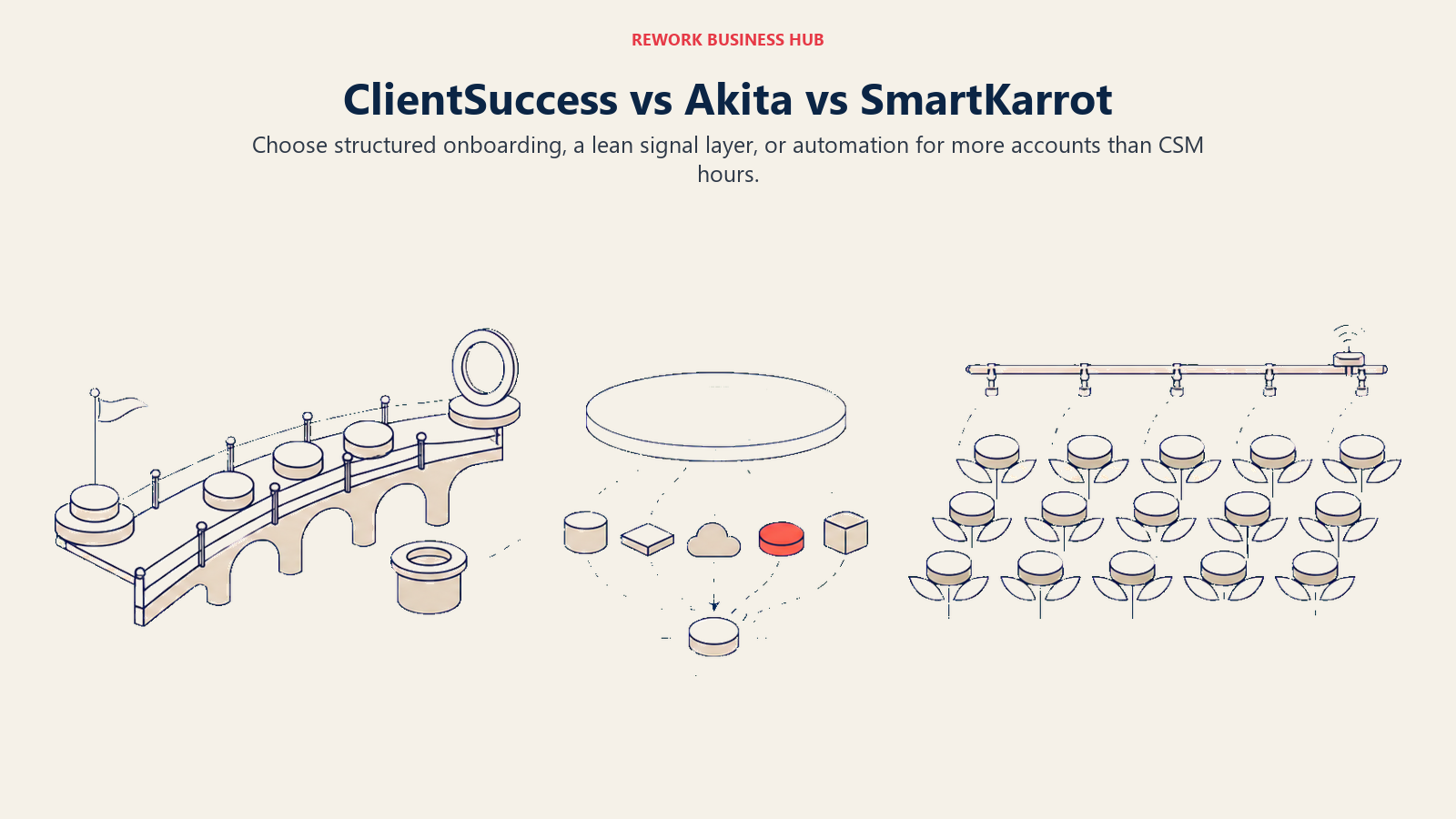
If ClientSuccess, Akita, and SmartKarrot are the three names left on your list, you've already been through the more expensive part of this search. You looked at Gainsight, maybe Planhat, and the quote, or the shape of the quote, told you the deal was priced for a CS Ops function you don't have and a budget you don't have either. That's a legitimate reason to land here. These three are built for a CS team of two to twenty five people, usually buying a first or second dedicated platform, usually run by whoever does CS today rather than a dedicated administrator.
What's actually different between them isn't feature depth, not really. At this price tier, none of the three is going to out-configure the others on a spec sheet. What's different is company size, and that matters more in this comparison than in any other in this collection, because a customer success platform is a multi-year data commitment. Your health-score logic, your segment definitions, and your playbook triggers all live inside whichever vendor you pick, in a format that doesn't export cleanly to whatever you switch to next. Buy from a small shop and you're betting on that shop's survival, not just its software.
Start with the question this tier makes unavoidable: are all three still here. Yes, ClientSuccess, Akita, and SmartKarrot are all independently operated and still selling. One disambiguation is worth making explicitly, because it's the exact mistake a rushed vendor check produces. Search "Akita acquired" and the top results are about Akita Software, a Boston API observability company Postman bought in July 2023. That's a different company. The customer success platform in this comparison is Akita, a small Dublin-founded team at akitaapp.com, with no connection to the Postman deal.
Key Facts
- For B2B SaaS companies with $25,000 to $50,000 average contract value, the segment most readers of this article sell into, median net revenue retention is 102%, with the top quartile at 111%, per SaaS Capital.
- Raising retention by 5% increases profits by 25% to 95%, and acquiring a new customer costs five to 25 times more than keeping an existing one, Bain research cited by Harvard Business Review.
- 95% of B2B tech companies now have an established CS function, but only 51% have a dedicated CS Ops team, the exact role a configurable platform assumes exists, per the Customer Success Index 2025, a vendor benchmark from Gainsight.
- Akita has reportedly raised around $27,000 in total funding, against ClientSuccess's $11M and SmartKarrot's roughly $1.07M across two rounds (reported, Crunchbase and PitchBook). That funding gap explains most of why one of these three prices so far below the other two.
- Akita is the only vendor of these three, and one of only three vendors in this category's full 15-platform field, to publish a complete self-serve rate card with a specific price at every tier including Enterprise, confirmed on a direct check of its pricing page this week.
TL;DR
| ClientSuccess | Akita | SmartKarrot | |
|---|---|---|---|
| Founded | 2014, Lehi, Utah | 2014, Dublin, Ireland | 2018, Frisco, Texas |
| Ideal customer | Mid-market B2B SaaS wanting a structured, named CSM motion | Lean CS or CX team layering health scores on an existing stack | Account-heavy portfolios needing automation ahead of headcount |
| Core strength | States its pricing formula in public and has grown by acquiring onboarding tools | Only vendor here with a full, current, self-serve rate card | SmartAssist, SmartOps, and SmartKonversations push further into AI than the other two attempt |
| Company backing | $11M raised, three acquisitions since 2023 | Reported around $27K raised, a very small team | Reported around $1.07M raised, roughly 67 employees |
| Published price | No, tier caps only | Yes, $49 to $499 a month, every tier priced | Entry tier only, $15,000 a year |
| Own SOC 2 certification | Yes, SOC 2 Type II confirmed | Not independently found; page cites AWS's certifications | Not publicly documented |
| Weakest point | Customer-count caps that read very small on the lower tiers | Thin team and thin funding sitting behind an aggressive price | $15,000 floor doesn't move until you cross 5 users |
What Each Tool Is Actually Built For
ClientSuccess is the most conventional of the three, and that's the point. Client 360 dashboards, health scoring, success plans built around goals and KBOs, revenue and renewal tracking, and a pulse view for leadership are all standard CS-platform furniture. What's less standard is the company's own growth pattern: since 2023, ClientSuccess has acquired Status, a customer-onboarding and collaboration product, and Baton, an onboarding and implementation platform. Buying two onboarding-specific companies is a real signal about where ClientSuccess thinks its differentiation lives, and it lines up with what the product itself emphasizes, an assigned CSM from the Growth package up and onboarding-only support even at Startup.
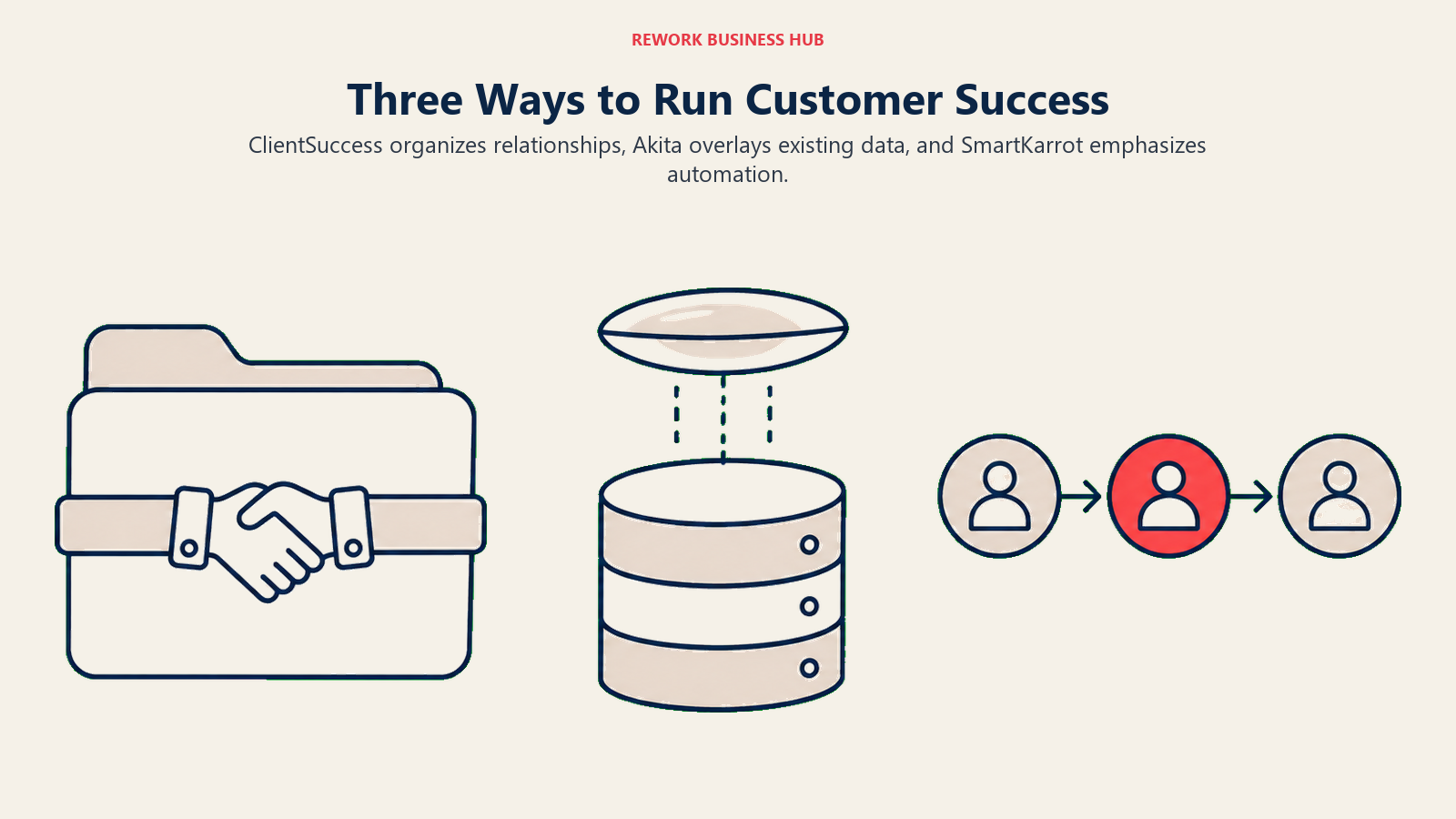
Akita takes the opposite bet. Rather than trying to be the system of record, it positions itself as a thin, fast layer that pulls signal from whatever you already run, claiming over 100 SaaS integrations on its own homepage, and turns that into health scores, segments, tasks, and alerts. There's no adjacent product line, no education platform, no customer portal builder. If ClientSuccess wants to own the relationship, Akita wants to sit quietly on top of the tools that already own it.
SmartKarrot is the automation bet. Beyond the core scorecard-and-playbook layer, its site names four distinct AI-adjacent modules: SmartOps for proactive, data-driven recommendations, SmartKonversations for call transcription that can trigger workflows, SmartInsights for embedded BI, and SmartAssist, which SmartKarrot calls the industry's first virtual assistant built for customer success. That's a real answer to a specific problem: more accounts than CSM hours, and a bet that automation closes the gap better than adding headcount.
| ClientSuccess | Akita | SmartKarrot | |
|---|---|---|---|
| Sweet-spot company size | 20 to 250 employees | 10 to 100 employees | 100 to 600 employees |
| CS team size | 2 to 15 CSMs | 2 to 4 CSMs | 5 to 25 practitioners |
| Primary use case | Goals, KBOs, and renewal tracking with a named CSM relationship | Health scores and alerts fed by tools you already run | Automating touchpoints and playbooks across a book too large for manual coverage |
| Adjacent products | Acquired Status and Baton, both onboarding-focused | None; connects outward instead of owning modules | SmartOps, SmartKonversations, SmartAssist, SmartInsights |
| System-of-record posture | Wants to be the CS system of record | Explicitly a layer on top of your CRM and product data | System of record for account intelligence and expansion signals |
Company and Risk Profile
This is the section that matters most at this price tier, and the one most comparison articles skip because it doesn't fit a feature checkbox. All three companies check out as real, operating businesses as of this write-up. Their balance sheets do not look remotely alike.
| ClientSuccess | Akita | SmartKarrot | |
|---|---|---|---|
| Founded | 2014 | 2014 | 2018 |
| Headquarters | Lehi, Utah | Dublin, Ireland | Frisco, Texas |
| Founders | Dave Blake | Barry Devon, David Clay Smith | Prithwi Dasgupta, Arnab Chatterjee |
| Funding raised | $11M | Reported around $27K (Crunchbase, PitchBook) | Reported around $1.07M across two rounds, 2020 and 2021 |
| Team size | Not independently disclosed | Reported 6 to 50 depending on source (LinkedIn, PitchBook) | Reported around 67 (ZoomInfo) |
| Recent trajectory | Acquired Status (2023) and Baton (2024), both onboarding tools | Steady, low-growth, self-funded pricing model | Added SmartAssist and expanded its AI feature set |
| Independently operating | Yes | Yes | Yes |
Read the funding row against the pricing row and the rest of this article makes more sense. ClientSuccess can afford to acquire other companies and still not be the cheapest option here. SmartKarrot has raised enough to build four distinct AI modules and staff a real support org, and prices accordingly. Akita has, by the most visible public record, raised next to nothing, and its price reflects a company running lean rather than a company subsidizing growth. None of that is a knock. A small, self-funded team can be a perfectly good vendor. It does change what you should ask before you sign a multi-year contract.
What actually happens if a vendor this size gets acquired or wound down. This category has already shown the pattern. The wider field has consolidated hard, as the full customer success software roundup documents, and Catalyst, once an independent CS company, is now sold as a product line inside Totango, a detail covered in both Gainsight vs ChurnZero and Vitally vs Gainsight vs ChurnZero. The unrelated Postman-Akita Software deal mentioned above is still a useful template for what a small-vendor acquisition usually looks like: the acquirer runs the product through a migration window, then sunsets it on its own schedule, not yours.
None of that is a reason to avoid these three. It's a reason to treat the contract, not the demo, as the real diligence. Get data export rights specified in writing. Document your own health-score weights and segment definitions outside the platform as you build them, the same discipline covered in the Planhat alternatives guide's migration section, because that documentation survives a vendor change even when the software doesn't. Then ask each vendor directly what happens to your account if it's acquired tomorrow. A vendor's answer, or its refusal to answer, tells you something a feature list never will.
Decision by Business Goal
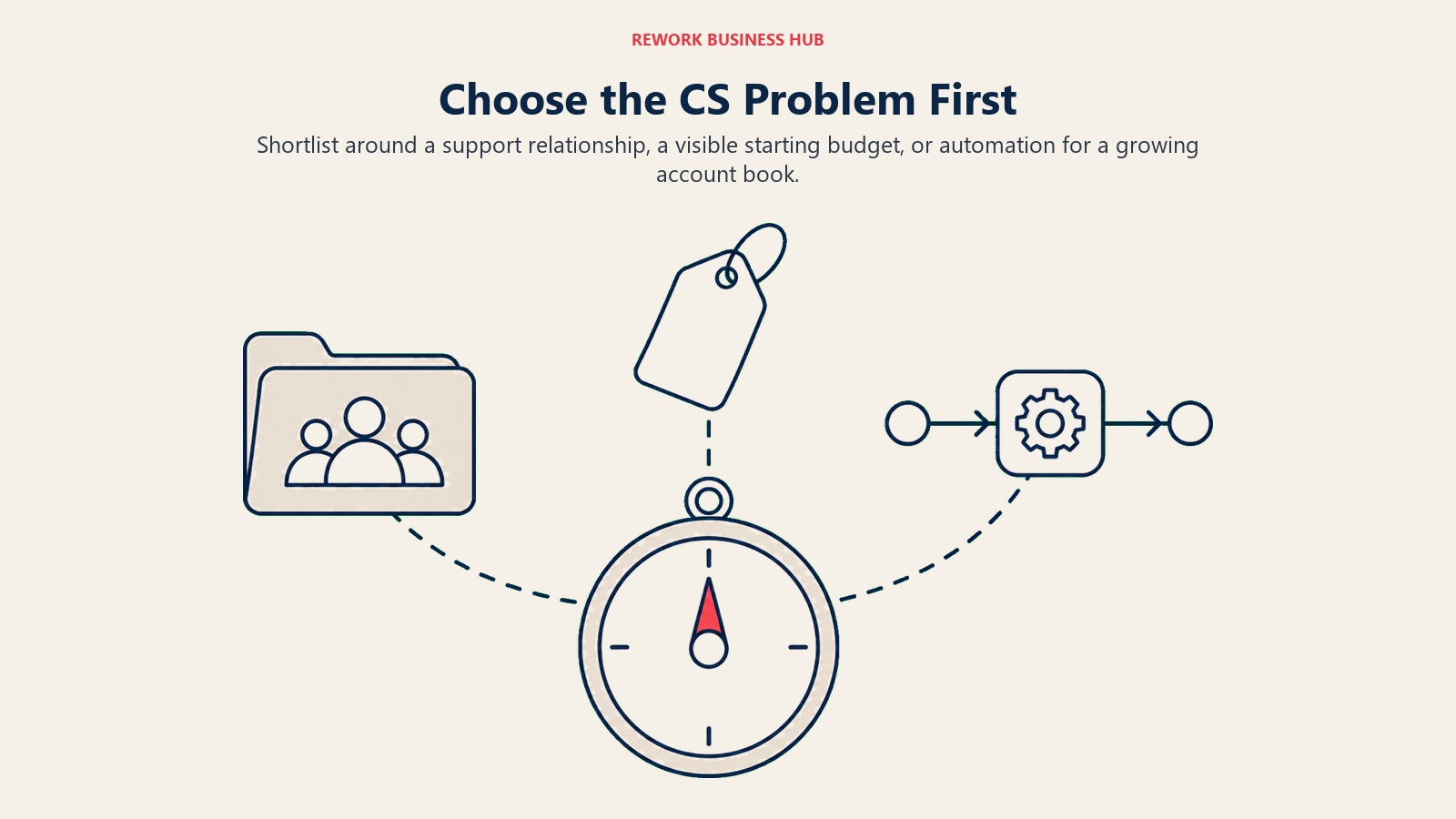
Shortlist around a support relationship, a visible starting budget, or automation for a growing account book.
| If your goal is... | Pick | Why |
|---|---|---|
| A defined package and a support relationship you can explain before the sales call | ClientSuccess | The only one of the three that states its pricing formula in public, even without dollar figures |
| A published price you can budget against today, on a genuinely small team | Akita | Full rate card starting at $49 a month, cheapest at every account volume modeled below |
| Automated playbooks and AI-assisted account intelligence for a book too large to cover manually | SmartKarrot | SmartAssist, SmartOps, and SmartKonversations are real, named product depth the other two don't attempt |
| Avoiding a rebuild of your integration stack around the CS tool | Akita | Built to layer onto 100-plus existing SaaS tools rather than become a new system of record |
| A vendor with the balance sheet to survive a bad year | ClientSuccess | $11M raised and three acquisitions since 2023, against a reported ~$27K for Akita and ~$1.07M for SmartKarrot |
| The lowest fixed cost under roughly 500 accounts | Akita | SmartKarrot's $15,000 floor doesn't move until you cross 5 users; Akita's price does |
| A hands-on onboarding motion baked into the vendor's own product history | ClientSuccess | Acquired Status and Baton, both onboarding-specific products, since 2023 |
Team and Role Fit
| Team | ClientSuccess | Akita | SmartKarrot |
|---|---|---|---|
| CSMs (daily users) | Goals, KBOs, and a Client 360 view built around a named account relationship | Simple enough for a two-person team to run without a training cycle | Automation-first; CSMs review what the platform already flagged |
| CS Ops / admin | Not assumed; positioned as low-maintenance | Not assumed; the vendor's own framing is live in days | Helpful but not required at Basic, more valuable from Growth up |
| Renewals and AM | Revenue and renewal tracking included at every package | Alerts and tasks, not a dedicated renewal-forecast module | Expansion signals and account intelligence built in |
| Executives | Pulse view for leadership; no per-seat viewer charge mentioned | Read-only users included free, 4 at Small Teams, 8 at Growing Teams | Not clearly published; ask directly on the call |
| IT / Security | SOC 2 Type II under the vendor's own audit | Inherits AWS's SOC 2, ISO 27001, and PCI DSS; confirm any independent audit with Akita | Confirm certifications with SmartKarrot |
Pricing at Real Team Sizes
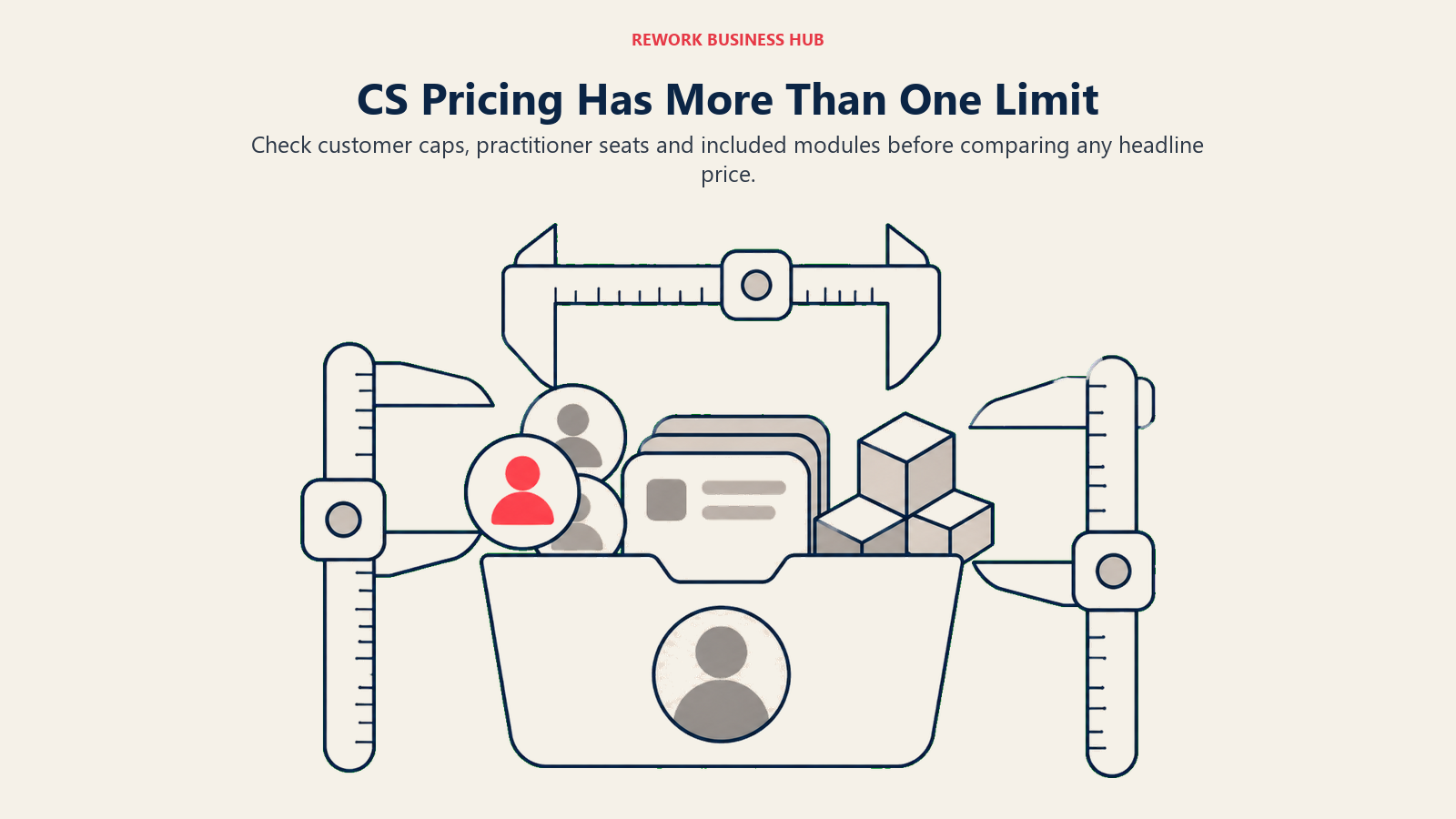
None of these three publish everything, but two of them publish more than the category norm. Across the full 15-vendor field in the customer success software roundup, only one vendor published a complete rate card. In this trio alone, two of the three publish real numbers, which flips the usual pattern in this category on its head.
| Vendor | Publishes a price? | What the page actually gives you |
|---|---|---|
| Akita | Full rate card | Three tiers, every one priced by the dollar, with seat, integration, and account limits stated |
| SmartKarrot | Entry tier only | Basic at $15,000 a year for 5 users, flagged by the vendor as a discounted price; Growth, Pro, and Enterprise are Contact Sales |
| ClientSuccess | No dollar figures, but a stated formula | Customer-count and full-license ceilings published per package; the vendor states pricing is based on CSM count and modules |
Account volume, not CSM headcount, is what actually moves these quotes, so the table below prices all three at 200, 1,000, and 5,000 customer accounts. To keep the CSM axis realistic without pretending it doesn't matter, it assumes a lean, mixed-touch ratio of roughly one CSM per 500 accounts: 2 CSMs at 200 accounts, 4 at 1,000, and 10 at 5,000. Your real ratio will differ. What matters is which side of each vendor's caps you land on.
| Book size | ClientSuccess | Akita | SmartKarrot |
|---|---|---|---|
| 200 accounts, ~2 CSMs | Exceeds the Growth package's 50-customer cap; an Enterprise quote is required | Small Teams: $49/month = $588/year ($470.40 with 20% annual prepay) | Basic: $15,000/year flat, since 2 users sits inside the 5-user cap |
| 1,000 accounts, ~4 CSMs | Still over the Growth cap; Enterprise quote required | Growing Teams: $99/month = $1,188/year ($950.40 annual prepay) | Still Basic, still $15,000/year, since 4 users still sits inside the 5-user cap |
| 5,000 accounts, ~10 CSMs | Enterprise quote required, same as above | Growing Teams plus 6 extra full users: $273/month = $3,276/year ($2,620.80 annual prepay), or Enterprise flat at $499/month = $5,988/year | Exceeds Basic's 5-user cap; Growth (10 users) fits exactly but has no published price |
Three things are worth sitting with in that table. First, ClientSuccess's own pricing page states a hard cap of 10 customers on Startup and 50 on Growth, so it's worth asking your rep directly what counts as a "customer" against that cap: at 200 accounts under almost any reasonable reading, you're already an Enterprise-shaped buyer with no published number to plan against. Second, SmartKarrot's $15,000 floor is fixed within its user cap, so it costs the same at 200 accounts as at 999, and the pricing only flexes once your book needs Growth's extra seats. Third, Akita's account ceilings, up to 10,000 on Small Teams alone, mean accounts are rarely the real constraint; at 10 CSMs, it's the $29-a-month per-extra-user charge that separates the $1,188 and $3,276 rows, not the account count.
None of this accounts for what you're actually buying. SmartKarrot's $15,000 buys real automation depth Akita doesn't attempt, a legitimate trade, not a discount error. But that price also reflects a 67-person, VC-backed cost structure, where Akita's reflects a handful of people running a lean, self-funded product. Both are honest prices for what they are.
Implementation and Change Management
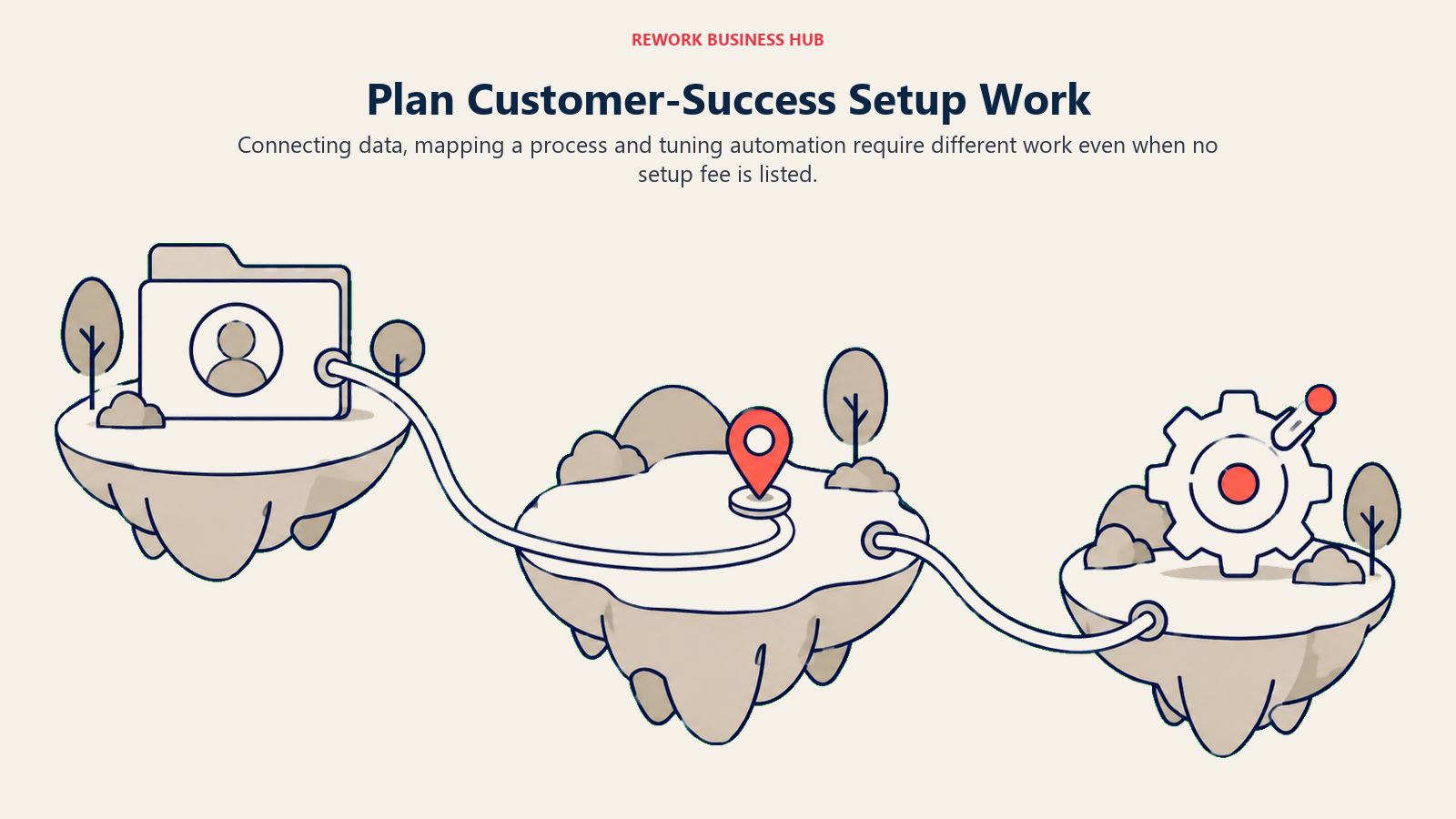
Connecting data, mapping a process and tuning automation require different work even when no setup fee is listed.
| Factor | ClientSuccess | Akita | SmartKarrot |
|---|---|---|---|
| Stated implementation fee | None; no setup fees at any package | None; no setup or cancellation fees | Not published |
| Typical time to go live | 4 to 6 weeks, 8 to 12 for Enterprise, per the vendor | Days, consistent with the vendor's 14-day trial framing | Not published; the automation depth implies more configuration than Akita |
| Internal owner required | A named CSM included from Growth up | Not required; built for a founder or a two-person team to self-serve | Helpful at Growth and Pro, where a dedicated CSM is included |
| Trial available | Not published | 14-day free trial, no credit card details published | Not published |
The honest read here: Akita is the fastest to a working setup because there's the least to configure. SmartKarrot's automation modules, SmartOps, SmartKonversations, SmartAssist, are the kind of features that take longer to tune well than to turn on, so budget calendar time for that even though the vendor doesn't publish a number. ClientSuccess sits in the middle, closer to a normal SaaS onboarding than a platform build.
Risk and Governance
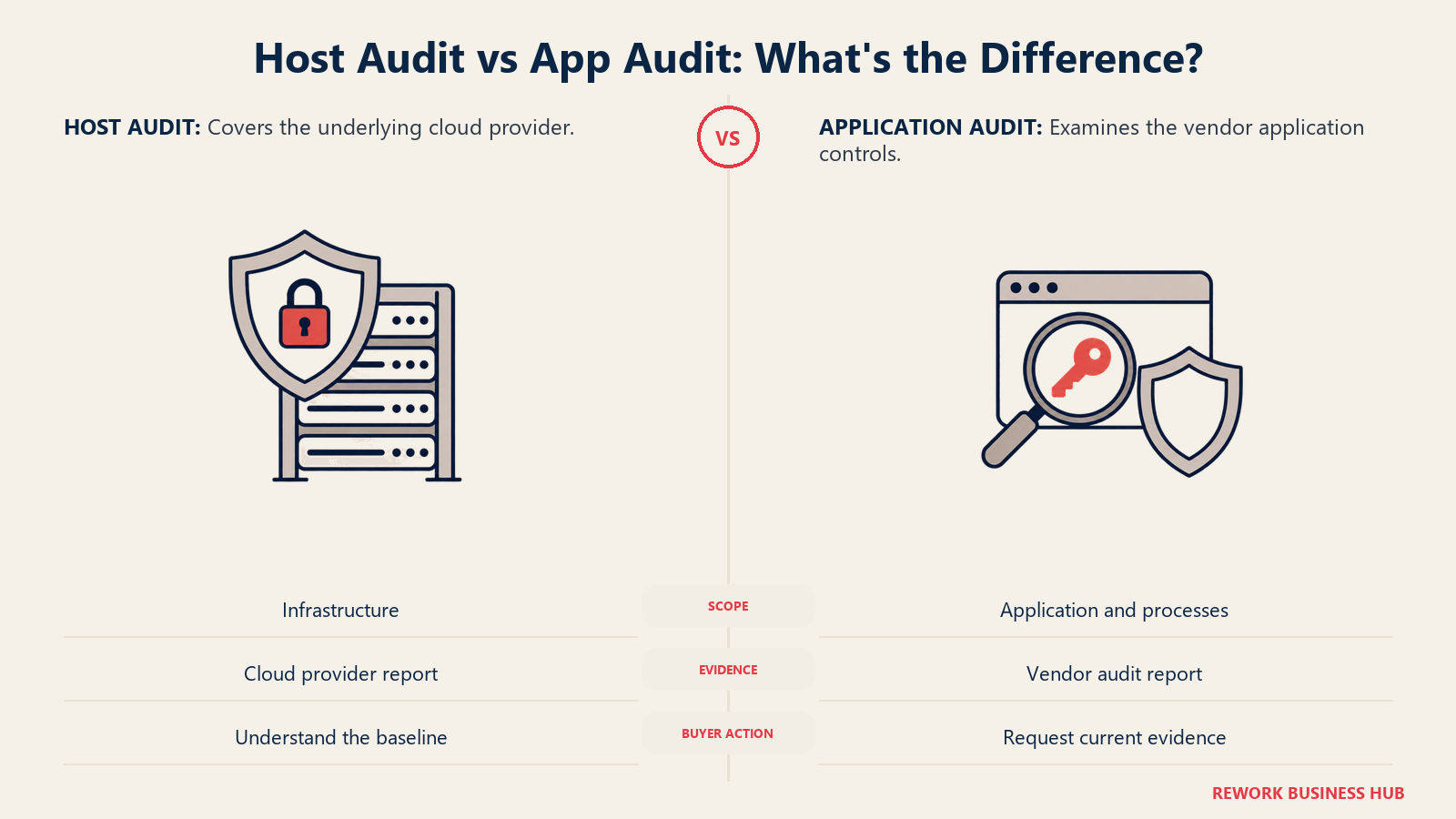
Cloud infrastructure certification does not establish an independent audit of the SaaS application and its controls.
| ClientSuccess | Akita | SmartKarrot | |
|---|---|---|---|
| Own SOC 2 Type II | Yes, stated directly on its security page | Not found; the page cites AWS's SOC 1, SOC 2, SOC 3, ISO 27001, and PCI DSS certifications instead | Not found on a public page |
| GDPR | Referenced, with a Data Processing Amendment and a sub-processor list | Referenced, via a separate linked document | Not found on a public page |
| HIPAA | Named in page metadata, not detailed in the body | Not mentioned | Not mentioned |
| Data hosting | AWS, Google Cloud, and Microsoft Azure sub-processors, mostly US | AWS | Not published |
| What to do about the gaps | Ask for the SOC 2 report directly; the page gives a contact for it | Ask whether Akita holds its own audit beyond AWS's infrastructure certifications | Ask directly; there's nothing to independently verify from the public site |
The gap between "our cloud host is certified" and "we are independently certified" matters more than it looks. Akita's security page leans entirely on AWS's own SOC 2, ISO 27001, and PCI DSS status. That's a legitimate baseline, most small SaaS companies do exactly this, but it's not the same claim as an independent audit of Akita's own application, access controls, and processes. ClientSuccess is the only one of the three with a stated SOC 2 Type II certification of its own. If a security review is part of your buying process, get that distinction in writing from whichever of these three you're closest to signing, rather than assuming AWS's compliance passes through automatically.
When ClientSuccess Is the Right Call
You want the vendor to explain its own pricing logic before the first call. Stating that price is based on CSM count and modules, with published customer and license caps per package, is more transparency than most of this category offers at any price.
Onboarding, not renewal tracking, is your actual weak point. Two acquisitions in two years, both onboarding-specific products, are a real signal about where ClientSuccess is investing, not just a marketing claim.
You want a named CSM relationship and a support contact, not a self-serve tool. Assigned CSM support from the Growth package up is a structural choice, not an add-on.
Vendor durability matters as much as the product. $11M raised and a track record of acquiring rather than being acquired is the strongest financial position of the three.
When Akita Is the Right Call
You need a real number today and a two-to-four-person team is the actual size of your CS function. No other vendor in this trio, or in most of this category, lets you price your exact team in under a minute on the vendor's own site.
Your product and CRM data already exist elsewhere, and you don't want a second system of record. Built to connect outward to 100-plus SaaS tools rather than replace any of them.
Cost discipline outweighs feature depth at your current stage. At every account volume modeled above, Akita is the cheapest option by a wide margin, sometimes by an order of magnitude.
You've made peace with buying from a very small, thinly capitalized team. That's the honest trade behind the price. If vendor durability is a dealbreaker for your board or your procurement process, weigh that before you commit data to it.
When SmartKarrot Is the Right Call
Your CSM-to-account ratio has already broken, and automation is the only realistic fix. SmartOps, SmartKonversations, and SmartAssist are built for exactly that gap, and neither ClientSuccess nor Akita attempts equivalent depth.
You're managing enough accounts that the $15,000 floor is a rounding error, not a budget event. The price stops looking steep once your book is large enough that the alternative is hiring another CSM.
You want AI doing real operational work, transcribing calls, surfacing recommendations, drafting next steps, rather than a chatbot bolted onto a dashboard. The named feature set here is genuinely more built-out than what ClientSuccess or Akita ship.
A funded, growing vendor is worth the premium to you. Roughly $1.07M raised and about 67 employees is a meaningfully larger, better-resourced operation than Akita, even if it's still small next to Gainsight or ChurnZero.
If None of These Three Fit
| If this is you | What to do instead |
|---|---|
| You've priced these three and still want more governance depth | See Gainsight vs ChurnZero, or the three-way in Vitally vs Gainsight vs ChurnZero |
| Your data model is too unusual for a templated tool at any price | Best Planhat alternatives covers the configurable end of the category properly |
| You have under 100 accounts or fewer than 2 people doing CS | A CRM plus a shared spreadsheet is still a legitimate answer; revisit in two quarters |
| You want the full field before narrowing further | Start with best customer success software for 2026 |
| Your real gap is ticket volume, not account health | Best help desk software covers the reactive side |
| Your CRM itself can't cleanly support any of these integrations | Sort the foundation first with best CRM software for 2026 |
Decision Framework
| If this is true for you | Pick |
|---|---|
| You want the vendor to explain its pricing logic before a sales call | ClientSuccess |
| You want a specific number today, with no call required | Akita |
| You're automating for a book that has outgrown manual CSM coverage | SmartKarrot |
| Your CS team is genuinely small, under five people, and cost is the deciding factor | Akita |
| Onboarding is your actual weak point, not renewal tracking | ClientSuccess |
| You want AI doing real work, not a bolt-on feature | SmartKarrot |
| Vendor financial durability matters as much as the product itself | ClientSuccess |
What to Do Next
Run the same three questions past all three vendors before another demo. First, what exactly counts toward your account or customer cap, in writing, not in a sales deck: ClientSuccess's Startup and Growth caps read small enough to change which tier you're actually quoted. Second, the fully loaded first-year number including add-on modules, since SmartKarrot's automation suite and Akita's per-seat charges both move the sticker price more than the base tier implies. Third, what happens to your account, data, and configuration if the company is acquired or shuts down mid-contract. All three should have an answer; a vendor that doesn't is telling you something.
Price your actual account count, not a round number, using the SaaS vendor evaluation scorecard as a template if you don't have your own. Before any of that, know what your health score is actually supposed to measure: customer health monitoring and the more statistically grounded churn prediction models are worth reading first, because a cheap platform running on an undefined health model is still an expensive mistake. If SmartKarrot's automation angle is the deciding factor, best AI agents for customer success looks at that capability across a wider set of tools.
Run a real trial against your own ten most obviously at-risk accounts before you sign anything. A platform that can't independently rediscover risk you already know about won't find risk you don't, whichever of the three you're closest to choosing.

Principal Product Marketing Strategist
On this page
- Key Facts
- TL;DR
- What Each Tool Is Actually Built For
- Company and Risk Profile
- Decision by Business Goal
- Team and Role Fit
- Pricing at Real Team Sizes
- Implementation and Change Management
- Risk and Governance
- When ClientSuccess Is the Right Call
- When Akita Is the Right Call
- When SmartKarrot Is the Right Call
- If None of These Three Fit
- Decision Framework
- What to Do Next