Qlik Cloud Analytics vs ThoughtSpot vs Sisense: Which One Fits After Power BI and Tableau?
Turn this article into takeaways for your work.


Each assistant summarizes the article only for you and suggests best practices for your work.
Updated August 2026
You've already run the Power BI versus Tableau decision, or you ran it and neither one actually solved the problem. Maybe your data estate is too tangled for a query-based semantic model to keep up with, and you need something that surfaces relationships a predefined join would miss entirely. Maybe the real bottleneck isn't dashboard-building at all: the people who need answers won't open a BI tool and build a chart, they'll only type a question. Or maybe you're not buying internal BI in the first place. You're a software company that needs analytics living inside your own product, under your own brand, which is a different purchase than a company-wide reporting standard entirely.
Qlik Cloud Analytics, ThoughtSpot, and Sisense sit behind those three different answers. Qlik's associative engine is a genuinely different way of querying data than the SQL-generating model every other tool on this page runs on, and it wins where governed self-service across a complex, many-source data estate matters more than a prettier chart. ThoughtSpot bets on natural-language search as the primary interface, built for the moment a business leader wants to ask a question instead of waiting on an analyst. Sisense is built to disappear into someone else's product: a purchase a product or engineering team makes, not one an internal ops team makes. None of the three is a Power BI or Tableau replacement in the direct sense. If you're still mid-way through eliminating those two, our Power BI vs Tableau comparison and the best Power BI alternatives and best Tableau alternatives roundups cover that ground directly. This article assumes you're past it.
None of the three vendors publishes a complete price list, and all three sell on annual, negotiated terms once you're past the entry tier. This comparison prices what each one does publish, at 25, 100, and 500 users, names the unit each one actually meters on (it isn't always seats), and separates what a viewer-only seat costs from what a full builder seat costs, since that gap moves the total more than the sticker price ever does.
TL;DR
| Qlik Cloud Analytics | ThoughtSpot | Sisense | |
|---|---|---|---|
| Best for | Governed self-service across a complex, many-source data estate | Business users asking questions in plain language instead of building dashboards | Software companies embedding analytics inside their own product |
| Core differentiator | Associative engine: click any value and see what's related and what isn't, nothing gets pre-filtered out of view | Spotter: natural-language search grounded in a governed semantic layer (Models and Worksheets) | Deep white-label embedding on a headless, API-first architecture |
| Entry paid tier | Starter, $300/month billed annually (10 users, 10 GB) | Essentials, $25/user/month billed annually (5 to 50 users) | No published entry price; a free-trial Self-Serve plan only |
| What it meters on | Data capacity in GB, not headcount, above Starter | Named users, gated by a row-count ceiling per tier | Nothing published; every deal is quote-only |
| Permanent free tier | No | No | No, Self-Serve is a free trial, not a permanent tier |
| Natural-language / AI layer | Answers Agents plus GenAI support, both expand by tier | Spotter AI Agents, but only from Pro up; Essentials doesn't include it | Sisense Intelligence AI suite, with a bring-your-own-LLM option |
| 2026 Gartner Magic Quadrant standing | Leader, 16th consecutive year | Leader, one of the only independent vendors in the Leaders quadrant | Not positioned as a Leader in the 2026 report |
| Ownership | Majority owned by Thoma Bravo since 2016; ADIA closed a minority co-investment in 2025 | Privately held, venture-backed; no IPO despite years of speculation | Privately held, venture-backed; new CEO since April 2023 |
Key Facts
- Gartner named Qlik a Leader in the 2026 Magic Quadrant for Analytics and Business Intelligence Platforms for the 16th consecutive year, announced June 29, 2026 (Qlik).
- ThoughtSpot was named a Leader in the same 2026 Magic Quadrant and is one of the only independent, non-hyperscaler-owned vendors in the Leaders quadrant, with Gartner citing its Spotter conversational analytics, external semantic layer connectivity, and agent workflow orchestration (ThoughtSpot).
- A wholly owned subsidiary of the Abu Dhabi Investment Authority closed a minority investment in Qlik alongside majority owner Thoma Bravo in May 2025, in a deal that valued the company at $10 billion (Qlik).
- ThoughtSpot replaced its old flat "$95 a month for 20 users" Essentials bundle with straight per-user pricing starting at $25/user/month, so any quote for this vendor from more than a year ago is very likely wrong (ThoughtSpot pricing).
- Sisense CEO Ariel Katz spent nearly four years running Microsoft's Power BI as general manager before joining Sisense; he became Sisense's CEO in April 2023 when longtime CEO Amir Orad moved to executive chairman (TechTarget).
What Each Platform Is Actually Built For
All three get lumped into "enterprise BI" comparisons with Power BI and Tableau, but they're not answering the same question those two answer. Each one is a bet on a specific gap.
Qlik Cloud Analytics: Associative Exploration, Not Query-Based Filtering
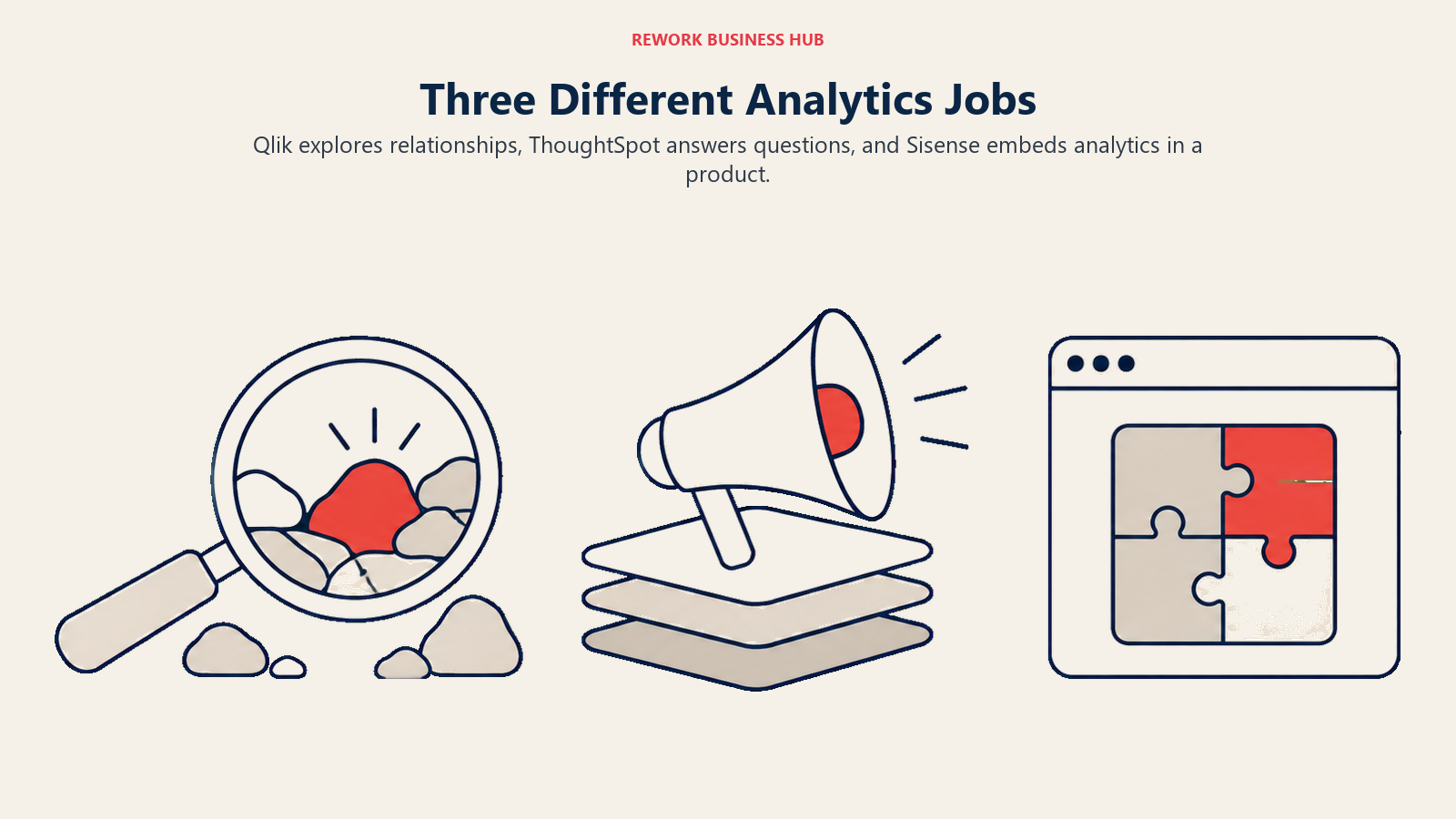
Every other tool on this page, including Power BI and Tableau, runs a query per chart and drops whatever doesn't match the current filter. Qlik's associative engine works differently: it holds the full dataset in memory and colors every value based on your current selection, using what Qlik calls the Power of Gray. Selected values turn green, associated values stay white, and everything excluded by the selection turns gray, still visible, not hidden (Qlik's own documentation). That matters more than it sounds: the gray values are often where the real finding is, the products that didn't sell to a segment, the accounts that never converted, the exact "not" question a filtered dashboard can't answer because it already dropped the rows. Starter includes base Answers Agents access for GenAI-assisted analysis, and Standard and Premium expand that layer further.
ThoughtSpot: Search Is the Interface, Not a Feature Bolted On
ThoughtSpot's whole premise is that a business user should type a question and get a chart back, not learn a query language or wait on an analyst. Spotter, its AI agent layer, handles that conversational loop, grounded in governed Models and Worksheets rather than freeform guessing against raw tables. Gartner's 2026 Leader placement specifically cited Spotter's conversational analytics, its connectivity to external semantic layers, and its agent workflow orchestration as the differentiators. The honest limitation applies to every AI-search BI tool: a natural-language answer is only as trustworthy as the model underneath it, and an ungoverned warehouse gets you a confident wrong number just as fast as a right one. Whichever chart Spotter hands back still has to follow basic information design, which is why our dashboard design guide is worth a read regardless of which of these three you pick.
Sisense: Built to Disappear Inside Someone Else's Product
Sisense's design center is different from both of the above: it isn't built for a company's own analysts to explore data, it's built to be embedded inside a SaaS product and white-labeled so an end customer never knows a third-party BI engine is running underneath. Teams integrate it through an iframe or the Compose SDK, on top of ElastiCube, Sisense's proprietary in-memory engine, and the Self-Serve tier ships built-in AI for natural-language queries and auto-narratives out of the box. The current CEO underscores that positioning: Ariel Katz ran Microsoft's Power BI as general manager for nearly four years before joining Sisense, a competitor's former product lead now running the embedded-analytics alternative. The buyer here is rarely the person evaluating Qlik or ThoughtSpot. It's a product or engineering budget line, not an internal reporting one.
| Qlik Cloud Analytics | ThoughtSpot | Sisense | |
|---|---|---|---|
| Query approach | Associative in-memory engine, holds the full dataset, doesn't pre-filter | Natural-language search over a governed semantic layer (Models and Worksheets) | ElastiCube, a proprietary in-memory engine, embedding-first |
| Primary interface | Click-to-explore dashboards and apps | Type a question, get a chart back | Embedded dashboards inside a host application |
| Semantic layer portability | Proprietary; no dbt Semantic Layer sync, no interoperability layer published | Models and Worksheets export as TML; connects to the dbt Semantic Layer through an integration | Proprietary ElastiCube; no git-based or dbt-native modeling layer |
| Primary buying motion | Central data or analytics team standardizing internal reporting | Business teams wanting self-service without a query language | Product or engineering team shipping analytics as a feature |
Decision by Business Goal
| Business goal | Best fit | Why |
|---|---|---|
| Stop the "five dashboards that all disagree" problem across dozens of source systems | Qlik Cloud Analytics | The associative model surfaces relationships across sources without a rigid pre-built join, so ungoverned reporting sprawl has less room to happen |
| Get non-technical leaders asking questions directly instead of filing a ticket with the analytics team | ThoughtSpot | Search-first interface, though only from the Pro tier up; Essentials doesn't include Spotter |
| Put a branded analytics feature inside a SaaS product without building a BI engine in-house | Sisense | Embedding and white-labeling are the product's whole design center, not an add-on |
| Keep AI answers grounded instead of confidently wrong | ThoughtSpot or Qlik | Both gate their AI layer on a governed semantic model; Sisense's bring-your-own-LLM option shifts more of that grounding work onto your own team |
| Avoid a per-user bill that grows every time you add a viewer | Qlik Cloud Analytics | Above Starter, extra users cost nothing; the bill tracks data volume, not headcount |
| Keep a clean, self-serve number to put in a budget spreadsheet before a sales call | ThoughtSpot | The only one of the three with a published per-user rate at every self-serve tier |
| Preserve the option to migrate the semantic model to another tool later | ThoughtSpot | The only one of the three with any published model export or dbt Semantic Layer connectivity |
Team and Role Fit
| Team / role | Where they fit best | Why |
|---|---|---|
| Central data or analytics engineering team | Qlik Cloud Analytics | Associative apps and data models are usually owned by a dedicated Qlik developer or data engineer, not assembled by business users from scratch |
| Business users, executives, frontline managers | ThoughtSpot | Built for someone who types a question, not someone who builds a chart; the whole pitch is skipping the query-builder step |
| Product and engineering teams | Sisense | Compose SDK and iframe embedding are developer-facing tools; this is a build-into-your-app project, not a dashboard-authoring one |
| RevOps, FP&A, and other cross-functional analysts | ThoughtSpot or Qlik | Both support self-service on top of a governed layer, ThoughtSpot for ad hoc questions and Qlik for connecting many source systems at once; see our RevOps metrics guide for what that layer needs to cover |
| IT and governance leads running a company-wide rollout | Qlik Cloud Analytics | Capacity-based pricing and 16 straight years as a Gartner Leader suit a centrally administered, many-source rollout better than a strict per-seat model does |
What Each Platform Actually Meters
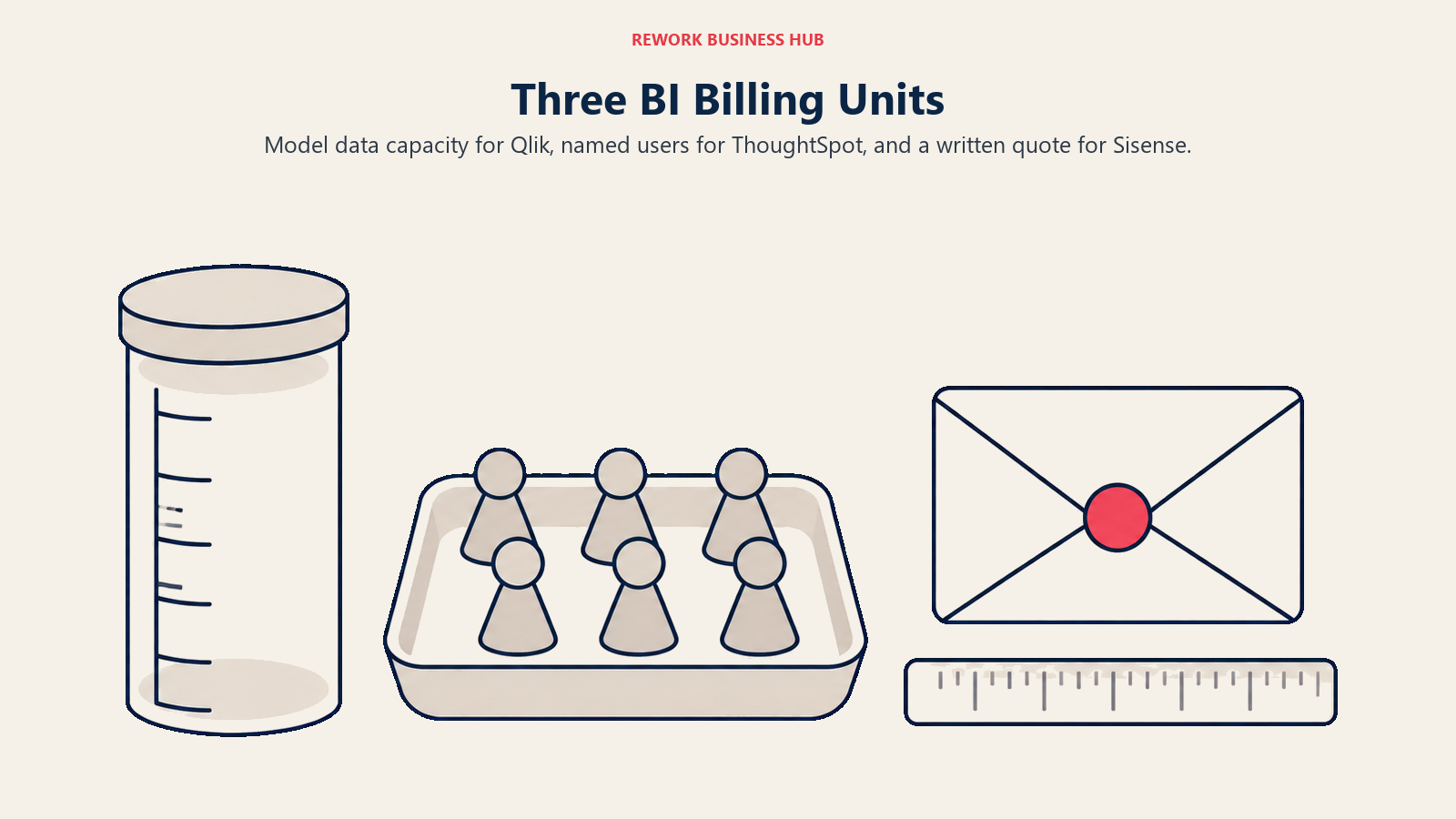
Vendor pricing pages give you a per-unit number, not what your rollout costs, and the unit itself is different across all three. Get this wrong and every other number in this article is wrong too.
| Qlik Cloud Analytics | ThoughtSpot | Sisense | |
|---|---|---|---|
| Billed unit | Data capacity in GB, fixed per tier | Named users, billed monthly, paid annually | Not published; negotiated per deal |
| What actually grows the bill | Connecting more data, not adding people | Adding people, up to each tier's user ceiling | Unknown from the public pricing page |
| Where the ceiling sits | Starter: 10 GB fixed, cannot increase on that tier. Standard: 25 GB, expandable in 25 GB steps. Premium: 50 GB, expandable in 25 or 250 GB packs | Essentials: 5 to 50 users, up to 25 million rows. Pro: up to 1,000 users, up to 250 million rows | No published ceiling |
| Users beyond the included count | Starter allows buying more users, but Qlik doesn't publish the rate; Standard and Premium include unlimited users at no extra cost | Every additional user bills at the tier's flat per-user rate; no separate, cheaper role | Not applicable, no self-serve tier exists |
Does a Viewer-Only Seat Cost Less?
| Qlik Cloud Analytics | ThoughtSpot | Sisense | |
|---|---|---|---|
| Separate viewer-only price | No. The current Cloud Analytics tiers name "users," not roles; nothing on the public pricing page charges less for someone who only looks at a finished dashboard | No. Essentials and Pro both bill every named user at the same flat per-user rate, whether they build content or only view it | Unknown. No pricing is published for any role at any tier |
| What this means for budgeting | The cost lever is data volume, so a large, mostly read-only audience doesn't inflate the bill the way it would on a per-seat tool | A large, mostly read-only rollout costs exactly as much per person as a team of full builders; there's no Viewer-tier discount to plan around | You can't model this until you're in a sales conversation, for a viewer audience of any size |
That absence is the biggest structural difference from Power BI and Tableau, both of which sell a meaningfully cheaper Viewer or read-only license. None of these three do, at least not on a published page, which changes how a large internal audience gets budgeted from the start.
Real Cost at 25, 100, and 500 Users
Because these three platforms meter on three different things, matching them at the same headcount doesn't put them on the same basis. Treat the tables below as what a realistic rollout costs, not a pure per-seat multiplication.
25 Users
| Platform | Tier required | Basis | Annual cost |
|---|---|---|---|
| Qlik Cloud Analytics | Standard (Starter tops out at 10 users) | Unlimited users, 25 GB data cap | $9,900 |
| ThoughtSpot | Essentials | 25 users at $25/month each, within the 5 to 50 user band | $7,500 |
| Sisense | Not published | Self-Serve free trial only; Enterprise requires a sales call regardless of headcount | Contact sales |
100 Users
| Platform | Tier required | Basis | Annual cost |
|---|---|---|---|
| Qlik Cloud Analytics | Standard if data stays under 25 GB, Premium if it doesn't | Unlimited users either way; data volume is the only variable | $9,900 to $33,000, depending on data volume |
| ThoughtSpot | Pro (100 users exceeds Essentials' 50-user ceiling) | 100 users at $50/month each | $60,000 |
| Sisense | Not published | Enterprise conversation required at any headcount | Contact sales |
500 Users
| Platform | Tier required | Basis | Annual cost |
|---|---|---|---|
| Qlik Cloud Analytics | Enterprise (500 active users almost always exceeds Premium's 50 GB) | Custom quote, 250 GB floor | Contact sales |
| ThoughtSpot | Pro list price technically fits (500 is under the 1,000-user ceiling) | 500 users at $50/month each, at list | $300,000 at list, or a negotiated Enterprise deal |
| Sisense | Not published | Enterprise conversation required at any headcount | Contact sales |
The pattern traces straight back to the metering table above. Qlik's number moves with data volume, not headcount, so the jump from 25 to 100 users can cost nothing extra if your data footprint hasn't grown, a mechanic no strictly per-seat tool offers. ThoughtSpot is the opposite: cheapest and most transparent of the three at 25 seats, most punishing at 500, since $50 a month per person with no viewer discount adds up fast once a rollout reaches hundreds of mostly read-only consumers, which is why most buyers at that scale negotiate an Enterprise deal instead of paying Pro list price. Sisense simply won't tell you at any of the three sizes, a dealbreaker or a non-issue depending on whether your procurement process can tolerate budgeting on faith until a number is in writing.
AI and Natural-Language Features
| Qlik Cloud Analytics | ThoughtSpot | Sisense | |
|---|---|---|---|
| Core AI product | Answers Agents, conversational analytics grounded in Qlik's data model | Spotter, natural-language search and conversational analysis | Sisense Intelligence AI suite, natural-language queries and auto-narratives |
| What's actually included at the entry tier | Starter includes base Answers Agents access | Essentials does not include Spotter at all; natural-language search starts on Pro at $50/user/month | Self-Serve includes built-in AI for natural-language queries |
| What the next tier adds | Standard adds unstructured data and GenAI support plus more Answers Agents; Premium adds further GenAI capacity | Pro caps Spotter at 25 queries per user per month; Enterprise removes the query cap | Enterprise adds the full AI suite with a bring-your-own-LLM option |
| Model grounding | Grounded in Qlik's own associative data model | Grounded in governed Models and Worksheets; Gartner specifically cited this as a Leader-quadrant strength | Grounded in whatever data model and LLM you connect; more of that grounding work sits with your own team |
The ThoughtSpot row is the one worth reading twice if natural-language search is the actual reason you're on this page. The $25 headline price gets you dashboards, not Spotter. Budget for Pro, at $50 a user, before you count on the natural-language pitch actually shipping to your team.
Implementation and Change Management
None of these three ship a trustworthy first dashboard in an afternoon the way a free connector tool does. All three assume a real data-modeling investment before anything is solid enough to put in front of a business user who isn't going to check your work.
| Qlik Cloud Analytics | ThoughtSpot | Sisense | |
|---|---|---|---|
| Time to a first working dashboard | Fast for someone who already thinks in associative terms; slower for a team used to SQL-style filtering | Fast for the end user asking questions; slow until the underlying Models and Worksheets are actually built and governed | Slower by design; embedding is a development project with a real sprint, not a same-day self-serve setup |
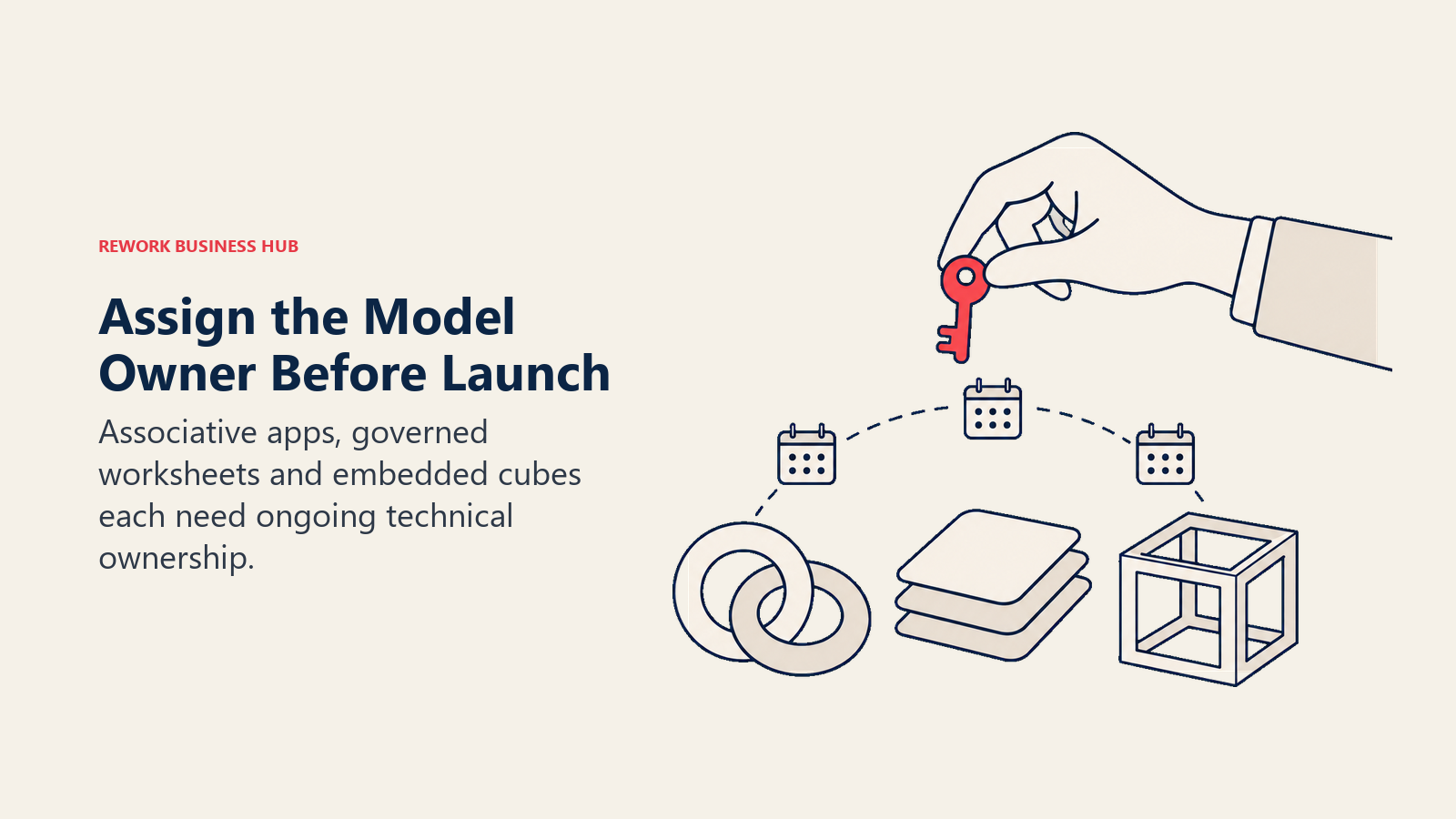
| Who owns the ongoing model | A dedicated Qlik app developer or data engineer maintains the associative data model and its data pipelines | A data or analytics engineer maintains Models and Worksheets; Spotter is only as trustworthy as this layer | An analytics engineer or BI developer maintains the ElastiCube; a product or front-end engineer maintains the embedded surface |
| Guided onboarding included | Only at Premium and above | Not published on the self-serve pricing page | Not published; Enterprise deals typically include a dedicated customer success manager |
| Real risk during rollout | Business users expecting a query-based tool need to unlearn that mental model first | A natural-language answer on top of an unmodeled warehouse returns a confident wrong number just as easily as a right one | The embedding project can run longer than the BI evaluation itself, since it's really a software integration, not a dashboard configuration |
Whoever inherits the semantic model after launch matters as much as who builds it. Budget that ownership as a real role, not a side task, the same way you'd plan any other piece of your data analyst tech stack: an associative app, a set of governed Worksheets, or an ElastiCube left unmaintained degrades quietly until someone asks a question it can no longer answer correctly.
Risk and Governance
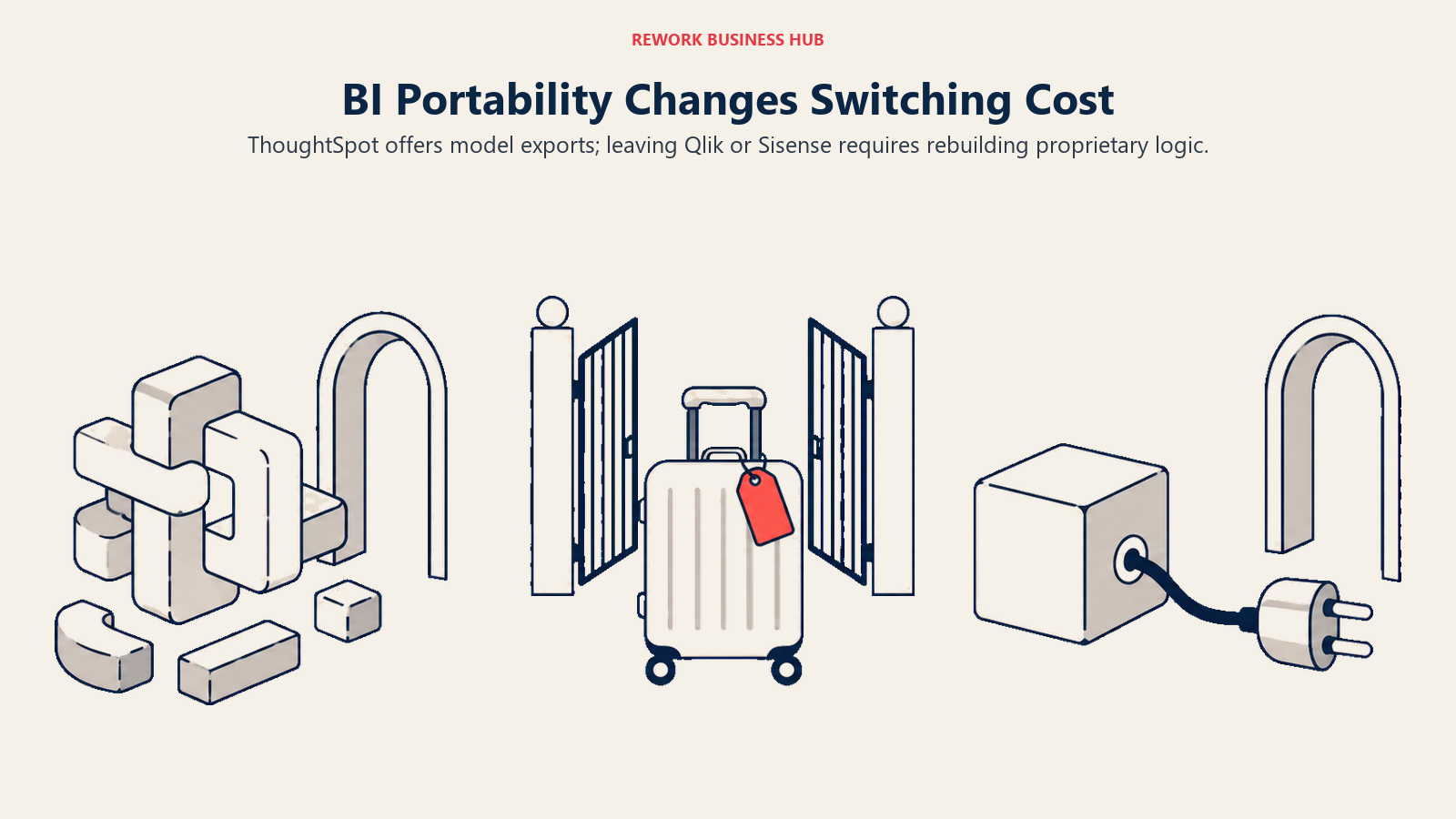
Ownership matters more on a multi-year BI commitment than almost anywhere else in the stack, because the semantic model you build becomes the thing that's hard to leave, not the dashboards sitting on top of it.
| Qlik Cloud Analytics | ThoughtSpot | Sisense | |
|---|---|---|---|
| Ownership | Majority owned by Thoma Bravo (private equity) since 2016; ADIA closed a minority co-investment in May 2025 at a $10 billion valuation | Privately held, venture-backed (investors include Lightspeed Venture Partners and Khosla Ventures); no IPO despite years of speculation | Privately held, venture-backed; Ariel Katz became CEO in April 2023 after running Microsoft's Power BI |
| Publicly traded | No | No | No |
| Semantic model portability | Proprietary associative model; no dbt Semantic Layer sync, no interoperability layer published | Models and Worksheets export as TML, and connect to the dbt Semantic Layer through an integration | Proprietary ElastiCube; no git-based or dbt-native modeling layer |
| What leaving actually costs | Rebuilding every associative app from scratch; the model has no direct equivalent in a query-based tool | The most portable of the three; TML export and dbt connectivity give you a real migration path for the model layer | Rebuilding the ElastiCube plus redoing the embedded integration in the new tool's SDK, likely the highest switching cost of the three |
| Where governance actually lives | Capacity tiers plus app and space permissions | Governed Models and Worksheets, the layer Spotter's answers are grounded in | Data isolation and column-level security land at the Enterprise tier, not Self-Serve |
None of the three is public, so none carries a public vendor's disclosure obligations. Qlik has the clearest single control investor: Thoma Bravo has held majority ownership since 2016, and ADIA's 2025 investment added a second large institutional stakeholder rather than changing control. ThoughtSpot and Sisense are both still venture-backed with a broader investor base and no reported controlling private equity stake, a different risk shape, not automatically a safer one.
When Qlik Cloud Analytics Is the Right Call
- Your data estate spans many source systems, and a query-based semantic model keeps missing relationships between them.
- You want AI features available at the entry tier instead of waiting for the top of the stack. Starter already includes base Answers Agents access.
- Your data volume grows slower than your headcount. Above Starter, adding people costs nothing.
- You want the vendor with the longest, most consistent governance track record of the three: 16 consecutive years as a Gartner Leader.
When ThoughtSpot Is the Right Call
- Your real bottleneck is that business users won't open a BI tool and build a chart. They'll only type a question.
- You want the only one of the three with a genuinely self-serve, published per-user price at every tier, so you can budget before a sales call.
- You're planning to keep your options open. TML export and dbt Semantic Layer connectivity give you a real path to another tool later.
- You can commit to modeling the data properly first. Spotter is only as trustworthy as the Models and Worksheets underneath it, and that layer doesn't build itself.
When Sisense Is the Right Call
- You're a product or engineering team putting analytics inside your own application, not standing up an internal reporting function.
- White-labeling matters. Your customers should never know a third-party BI engine is running under the hood.
- You have development capacity to treat this as a software integration project, using Compose SDK or iframe embedding, not a business-user self-serve rollout.
- You're comfortable evaluating without a published number and taking the pricing conversation on faith until Enterprise terms are actually on the table.
Decision Framework
| If this is true for you | Pick |
|---|---|
| Your data estate has dozens of source systems and joins keep breaking down | Qlik Cloud Analytics |
| Business users should ask questions directly instead of filing a request with analytics | ThoughtSpot |
| You're building a customer-facing product feature, not an internal dashboard | Sisense |
| Extra viewers shouldn't add to the bill | Qlik Cloud Analytics |
| You need a self-serve number today, not a sales call | ThoughtSpot |
| Keeping a migration path open matters more than anything else here | ThoughtSpot |
| You want the longest, most consistent governance track record of the three | Qlik Cloud Analytics |
| None of the three fit, and you actually need one governed metric shared across every dashboard | See our best Looker alternatives |
| Qlik is already your incumbent and this is a renewal decision | See our best Qlik Sense alternatives |
| Sisense is already your incumbent and the embedding bill is the problem | See our best Sisense alternatives |
What to Do Next
- Model your real data volume, not just headcount, before you price Qlik. GB, not seats, is what actually moves that bill, and Starter's 10 GB ceiling can't be raised at any price on that tier.
- Get a Spotter demo against your own unmodeled data before you buy ThoughtSpot on the natural-language pitch. Essentials doesn't include Spotter at all. That's a Pro-tier feature starting at $50 a user.
- If Sisense is on your list, ask for pricing in writing before the second call. The published page gives you nothing to plan a budget around, and a real evaluation shouldn't run on faith alone.
- If none of these three actually fit, widen the search. Our best business intelligence tools for 2026 roundup covers 15 platforms, including the ThoughtSpot alternatives guide if the per-user Pro math is what stopped you, the Domo alternatives guide if an all-in-one credit model is the real ask, and the Looker alternatives guide if a governed semantic layer across every dashboard matters more than any single feature covered here.
- Assign the semantic model's long-term owner before launch, not after. Whether it's an associative app, a set of governed Worksheets, or an ElastiCube, an unmaintained model is the most common reason a promising BI rollout quietly stops being trustworthy.
Frequently Asked Questions about Qlik Cloud Analytics, ThoughtSpot, and Sisense
What is Qlik Cloud Analytics' associative engine, and how is it different from Power BI or Tableau?
It's a query approach that holds your whole dataset in memory and colors every value based on your current selection: green for selected, white for associated, gray for excluded but still visible. Power BI and Tableau both generate a query per chart and simply drop unrelated rows, so you never see what a selection excluded. Qlik keeps that context in view, which is why it surfaces relationships a predefined join or filter would miss.
Does ThoughtSpot's Essentials tier include Spotter, its natural-language search feature?
No. Essentials, at $25 per user per month billed annually, covers dynamic dashboards and interactive insights but not Spotter. Natural-language search and Spotter AI Agents start on the Pro tier at $50 per user per month, capped at 25 Spotter queries per user per month until you reach Enterprise.
How does Qlik Cloud Analytics pricing actually work?
It's capacity based, not per seat: Starter is $300/month for 10 users and a fixed 10 GB, Standard is $825/month for unlimited users and 25 GB, Premium is $2,750/month for 50 GB, and Enterprise is a custom quote starting at a 250 GB minimum. Above Starter, adding people costs nothing; adding data is what moves the bill.
How much does Sisense cost?
Sisense publishes no price at all. Its pricing page names exactly two options: a free-trial Self-Serve plan and a custom-quoted Enterprise plan, with no dollar figures attached to either, regardless of how many users or how much data you're planning around.
Which of the three is easiest to migrate away from later?
ThoughtSpot, by a real margin. Its Models and Worksheets export as TML and connect to the dbt Semantic Layer through an integration, giving you a genuine path to another tool. Qlik's associative model and Sisense's ElastiCube are both proprietary with no dbt or git-based modeling layer, so leaving either one means rebuilding the semantic model from scratch.
Who is actually buying Sisense instead of Qlik or ThoughtSpot?
A different buyer altogether. Sisense's core use case is a product or engineering team embedding white-labeled analytics inside its own application, using iframe or Compose SDK integration, while Qlik and ThoughtSpot are both bought by a data or analytics team standardizing internal, company-facing reporting. Treating all three as if they compete for the same budget line misreads what Sisense is for.
Are any of these three cheaper than Power BI or Tableau?
At the entry tier, ThoughtSpot Essentials at $25 per user per month lands close to Power BI Pro's $14. Qlik's Starter, at $300 a month for 10 users, works out to roughly $30 per user at full capacity, though the pricing logic stops being per-seat once you cross into Standard. Sisense can't be compared at all without a quote. Match the tool to the problem it solves first, then price the shortlist.
Is Qlik Cloud Analytics the same product as Qlik Sense?
Qlik Cloud Analytics is Qlik's current cloud analytics product and pricing structure, built on the same associative engine that powered Qlik Sense. The old per-user "Business" plan sold under the Qlik Sense name is no longer offered; the capacity-based Starter, Standard, Premium, and Enterprise tiers described here are the live offer as of August 2026.

Principal Product Marketing Strategist
On this page
- TL;DR
- Key Facts
- What Each Platform Is Actually Built For
- Qlik Cloud Analytics: Associative Exploration, Not Query-Based Filtering
- ThoughtSpot: Search Is the Interface, Not a Feature Bolted On
- Sisense: Built to Disappear Inside Someone Else's Product
- Decision by Business Goal
- Team and Role Fit
- What Each Platform Actually Meters
- Does a Viewer-Only Seat Cost Less?
- Real Cost at 25, 100, and 500 Users
- 25 Users
- 100 Users
- 500 Users
- AI and Natural-Language Features
- Implementation and Change Management
- Risk and Governance
- When Qlik Cloud Analytics Is the Right Call
- When ThoughtSpot Is the Right Call
- When Sisense Is the Right Call
- Decision Framework
- What to Do Next