Best AI Tools for Private Equity in 2026
Turn this article into takeaways for your work.


Each assistant summarizes the article only for you and suggests best practices for your work.
If you're evaluating AI tools for a private equity deal team in 2026, Grata and SourceScrub lead for AI-native deal sourcing across private companies, Affinity and Intapp DealCloud lead for relationship-driven pipeline and full deal-lifecycle CRM, PitchBook leads if you want natural-language search layered onto data you already trust, Keye, Hebbia, and Rogo lead for AI-assisted diligence and research on live deals, AlphaSense and BlueFlame AI lead for market intelligence and multi-model deal workspaces, Eilla leads for lean SMB M&A teams that want end-to-end automation, Canoe Intelligence and Chronograph lead for portfolio monitoring and LP reporting, and Ontra and Datasite lead for contract automation and secure data rooms. This guide ranks 15 tools by the specific job in the fund's workflow, deal sourcing, diligence, portfolio monitoring, or legal and data-room work, not by whichever vendor raised the loudest round this quarter.
This guide is scoped to the private equity firm's own tech stack: the tools a deal team, portfolio operations group, or fund's legal function buys to run the fund. If your gap is actually AI for the finance function inside a portfolio company (FP&A, forecasting, spend), best AI tools for finance teams covers that adjacent category (Cube, Datarails, Pigment, Anaplan, Ramp) in depth, and the two guides are built to be read together, not instead of each other. Pricing below was checked against vendor pages, procurement benchmarking sites, and buyer-reported contract data in July 2026.
Updated July 2026: What Changed
- Datasite went on a consolidation spree. It acquired Grata (2025), then Sourcescrub in August 2025 to merge Sourcescrub's human-verified data into Grata's AI-native search, then closed BlueFlame AI on July 1, 2026, folding an agentic deal workspace on top of its existing Diligence virtual data room. One vendor now owns sourcing, diligence workspace, and the VDR for a meaningful share of PE deal flow.
- Rogo raised $160M at a $2B valuation in April 2026, three months after a $75M Series C at $750M, and extended its OpenAI collaboration to explicitly target PE and hedge fund users, roughly 100,000 professionals by the company's own estimate.
- Keye launched Odin in January 2026, positioning it as a deterministic (not just generative) diligence co-pilot aimed at closing the gap between AI speed and the audit-ready rigor a QofE-style deliverable needs.
- Affinity added 71 new private equity firms in the six months before mid-2026, bringing its PE customer count past 330, as more mid-market funds standardize on relationship intelligence over spreadsheet-based pipeline tracking.
Key Facts
- 86% of corporate and private equity leaders had integrated generative AI into their M&A workflows, and 65% of them did so within the prior year, per Deloitte's 2025 GenAI in M&A Survey.
- 88% of private equity respondents had invested $1 million or more in generative AI specifically for their M&A teams, per Deloitte.
- 67% of dealmakers name data security as their leading concern with GenAI adoption, ahead of data quality and availability at 65%, per Deloitte.
- Due diligence and deal sourcing are the two workflows GPs most often cite as delivering the highest ROI from generative AI inside the firm, per Bain's GP Outlook for 2026.
- 39% of GPs don't expect AI to have any material financial impact on their portfolio companies in 2026, reflecting how uneven AI's payoff still is once you leave the deal team, per Bain.
- Among GenAI adopters in dealmaking, 40% apply it to strategy and market assessment, and 35% each to target screening and due diligence, the pre-sign stages where most 2026 tooling is concentrated, per Deloitte.
Quick Comparison Table
| Tool | Best For | Starting Price | Key Strength | Key Limitation |
|---|---|---|---|---|
| Grata | AI-native deal sourcing across 21M+ private companies | Quote-only, enterprise | Contextual AI search plus a live private-company dataset, now merged with Sourcescrub | No public pricing; positioning shifting as the Sourcescrub integration lands |
| SourceScrub | Human-verified data on companies that show up at conferences and trade events | From roughly $20K/yr | Expert-in-the-loop verified data, strong for software and services niches | Being absorbed into Grata under Datasite, so its standalone future is in flux |
| Affinity | Relationship-driven sourcing and pipeline CRM | Quote-only, ~$12K-35K/yr for small teams | Automated relationship strength scoring from email and calendar data | Per-fund minimums price out very small independent sponsors |
| Intapp DealCloud | Full deal-lifecycle system of record | Quote-only, ~$85K-1.43M/yr | AI-assisted deal notes, tagging, and reporting across the whole lifecycle | Enterprise implementation with a multi-role rollout; not built for a two-person team |
| PitchBook | Comps, market data, and natural-language search across public and private markets | Quote-only, ~$12K-70K/yr per team | Navigator AI+HI brings conversational search to a dataset most funds already trust | Per-seat pricing climbs fast; adding users is not cheap |
| Keye (Odin) | Deterministic, audit-ready QofE-style diligence co-pilot | Quote-only, enterprise | Built to be defensible, not just fast, for middle-market diligence | Early-stage vendor (2023 founding); reference set is still growing |
| Hebbia (Matrix) | Multi-agent research across CIMs, filings, and expert call transcripts | Quote-only, ~$3K-20K/seat/yr reported | Cross-references PitchBook data with your own diligence archive in one query | Enterprise sales-only pricing; heavier document volume raises cost |
| Rogo (Felix) | AI copilot embedded in Excel, PowerPoint, and Word for deal work | Quote-only, enterprise multi-year | Fine-tuned finance model plugs directly into the tools bankers and associates already use | No public pricing; built and priced for institutional-scale contracts |
| AlphaSense | Market intelligence and expert call transcripts | Quote-only, ~$10K-40K+/seat/yr | Deep expert-call library alongside broker research and filings | Seat pricing scales fast; average enterprise deal size tops $50K-100K |
| BlueFlame AI | Agentic, multi-model deal workspace | Quote-only, custom enterprise | Model-agnostic orchestration across sourcing, diligence, and IC memo drafting | Now a Datasite company post-acquisition; roadmap and pricing may shift |
| Eilla | Lean SMB M&A and PE teams wanting end-to-end automation | Quote-only, custom | Automates early-stage due diligence, comps, and valuation reports from one workspace | Small, early-stage vendor (2022 founding, single seed round); thinner track record |
| Canoe Intelligence | Portfolio and GP document and data automation | Quote-only, custom | Extracts and standardizes alt-investment data from capital calls to valuations | Not a monitoring dashboard by itself; it feeds data downstream |
| Chronograph | LP and GP portfolio monitoring, benchmarking, and reporting at scale | Quote-only, ~$30K-150K/yr | Monitors $5.9T+ in client capital across 258,000+ private companies | Pricing climbs quickly for multi-fund LPs needing custom benchmarks |
| Ontra | High-volume NDA, joinder, and contract automation | Quote-only, usage-based | Purpose-built for private-market legal edge cases, not generic CLM | Best fit is high document volume; overkill for a firm doing a handful of deals a year |
| Datasite | Secure virtual data room with AI-powered indexing | Quote-only, buyer-reported avg ~$68K/yr per deal | AI auto-categorization into due diligence indexes, now bundled with Grata and Sourcescrub data | Legacy VDR pricing model still gates deeper AI features behind premium contracts |
Framework: By Firm Type and Deal Stage
| Firm Profile | Budget Signal | Best Fits |
|---|---|---|
| Independent sponsor / solo GP | Free to under $20,000/yr | PitchBook (single seat), Eilla, SourceScrub (entry tier) |
| Lower middle market (funds under $500M AUM) | $20,000-75,000/yr | Grata, Affinity (Essential), Keye, Chronograph (entry) |
| Middle market ($500M-5B AUM) | $75,000-250,000/yr | Hebbia, AlphaSense, Intapp DealCloud (mid-tier), Ontra |
| Upper middle market / large cap (5B+ AUM) | $250,000+/yr | Rogo, Intapp DealCloud (enterprise), Chronograph (multi-fund), Datasite |
| Portfolio operations, cross-fund | Varies by module | Canoe Intelligence, Chronograph, Ontra (finance solutions) |
How to Choose: Decision Framework
Before you sit through a dozen demos, figure out which stage of the fund's workflow is actually broken. Most firms waste a procurement cycle evaluating an enterprise diligence platform when the real bottleneck is that deal teams still track relationships in a shared spreadsheet, or the reverse: they buy a flashy sourcing tool while diligence still takes six weeks of manual document review. If you want the fuller version of this evaluation process outside private markets specifically, how to choose a CRM and how to choose ERP software both walk through the underlying vendor-selection criteria.
| If you need... | Pick... | Why |
|---|---|---|
| Broad private-company discovery with AI-native search | Grata | 21M+ company dataset now combined with Sourcescrub's verified data under one owner |
| Relationship-driven sourcing built on your team's actual network | Affinity | Automated relationship scoring from email and calendar data, purpose-built for private capital |
| One system of record across sourcing, diligence, and portfolio | Intapp DealCloud | Manages the full deal lifecycle instead of stitching together point tools |
| Natural-language search across market data you already trust | PitchBook | Navigator's AI+HI approach sits on top of PitchBook's existing dataset, not a separate silo |
| A deterministic, audit-ready diligence co-pilot for QofE-style work | Keye (Odin) | Built specifically to be defensible enough to stand behind, not just fast |
| Multi-agent research across CIMs, filings, and expert calls in one query | Hebbia (Matrix) | Cross-references PitchBook data against your own prior diligence archive |
| An AI copilot embedded directly in Excel, PowerPoint, and Word | Rogo (Felix) | Meets deal teams inside the tools they already open every day |
| Deep market intelligence and an expert-call transcript library | AlphaSense | Broker research, filings, and expert calls in one search, useful pre- and post-LOI |
| A model-agnostic, agentic deal workspace | BlueFlame AI | Orchestrates sourcing, diligence, and IC memo drafting without locking you to one model |
| End-to-end automation for a small SMB-focused M&A team | Eilla | One workspace covering early diligence, comps, and valuation reports |
| Automated document and data collection from GPs | Canoe Intelligence | Extracts and standardizes alt-investment data so downstream tools stay current |
| Portfolio monitoring and LP reporting at real scale | Chronograph | Already benchmarks trillions in client capital across hundreds of thousands of companies |
| High-volume NDA and routine contract negotiation | Ontra | Purpose-built for private-market legal edge cases most generic CLM tools miss |
| A secure data room with AI-assisted document indexing | Datasite | AI auto-categorization plus deep integration with Grata and Sourcescrub data |
1. Grata: AI-Native Deal Sourcing for Private Companies
Grata's bet is that most deal sourcing still runs on outdated SIC codes and stale contact lists, and that contextual AI search against a live, investment-grade dataset finds relevant targets faster than a keyword filter ever could. The platform covers 21 million-plus private companies, syncs with Salesforce, HubSpot, and DealCloud, and layers agentic AI on top so a deal team can describe an investment thesis in plain language instead of building a Boolean search string.
Grata's position got stronger in 2026: Datasite folded Sourcescrub's human-verified, expert-in-the-loop data into Grata's search infrastructure, combining AI-native discovery with manually confirmed company details. That consolidation is still settling, so expect some overlap and pricing changes as the two products merge fully.
Best for: Deal teams at any fund size doing thesis-driven sourcing across a broad private-company universe
Key strengths:
- Contextual AI search that understands an investment thesis, not just keyword matching
- 21M+ private company dataset, now strengthened by Sourcescrub's verified data
- Native syncs into Salesforce, HubSpot, and DealCloud pipelines
| Pros | Cons |
|---|---|
| Deep private-company coverage plus AI-native search | No public pricing or self-serve tier |
| Now backed by Sourcescrub's verified data layer | Product roadmap is mid-integration as of mid-2026 |
2. SourceScrub: Verified Data for Conference-Sourced Deals
SourceScrub built its reputation on data quality rather than raw AI horsepower: its Expert-in-the-loop system manually verifies company profiles pulled from conferences, trade events, and association memberships, which matters most for sourcing in fragmented software and services niches where public data is thin. Sourcing Plus starts around $20,000 a year for 250 company exports; the Winning Professional tier bumps that to 1,000 exports plus CRM integrations and Data Connect as paid add-ons.
The bigger story for 2026 is who owns SourceScrub now. Datasite acquired it from Francisco Partners in August 2025 and is merging its verified data into Grata, so a firm evaluating SourceScrub today is really evaluating where that combined platform lands over the next year.
Best for: Mid-market PE and VC teams sourcing in software, tech, and conference-heavy verticals
Key strengths:
- Expert-in-the-loop verification beats raw scraped data on accuracy
- 15M+ company profiles updated on a regular cadence
- Clear entry-level pricing relative to enterprise-only competitors
| Pros | Cons |
|---|---|
| Human-verified data quality, not just AI inference | Standalone future uncertain post-Datasite acquisition |
| Transparent entry pricing around $20K/yr | Export volume caps push cost up quickly for active sourcing teams |
3. Affinity: Relationship Intelligence CRM for Private Capital
Affinity's core insight is that in private equity, the deal often follows the relationship, not the other way around. The platform passively captures email and calendar data across a firm to score relationship strength, surface warm intros, and flag when a key contact has gone quiet, all without a partner manually logging an interaction. More than 330 PE firms now run on Affinity, up 71 in just the six months before mid-2026, as funds move away from spreadsheet-based pipeline tracking.
Pricing is quote-only and gated by seats and fund count. Vendr transaction data puts Essential-tier contracts for 5-15 users at $12,000-$35,000 a year, while Advanced-tier contracts for 15-40 users commonly land between $40,000 and $120,000.
Best for: Deal teams whose sourcing edge comes from relationship density, not raw data volume
Key strengths:
- Automated relationship-strength scoring from existing email and calendar activity
- Strong adoption momentum specifically within private equity in 2026
- Purpose-built workflows for fund structures, not a retrofitted sales CRM
| Pros | Cons |
|---|---|
| No manual data entry required to build relationship intelligence | Per-fund minimums make it expensive for very small teams |
| Widely adopted, so onboarding talent already knows the platform | Quote-only pricing with real seat minimums |
4. Intapp DealCloud: The Full Deal-Lifecycle System of Record
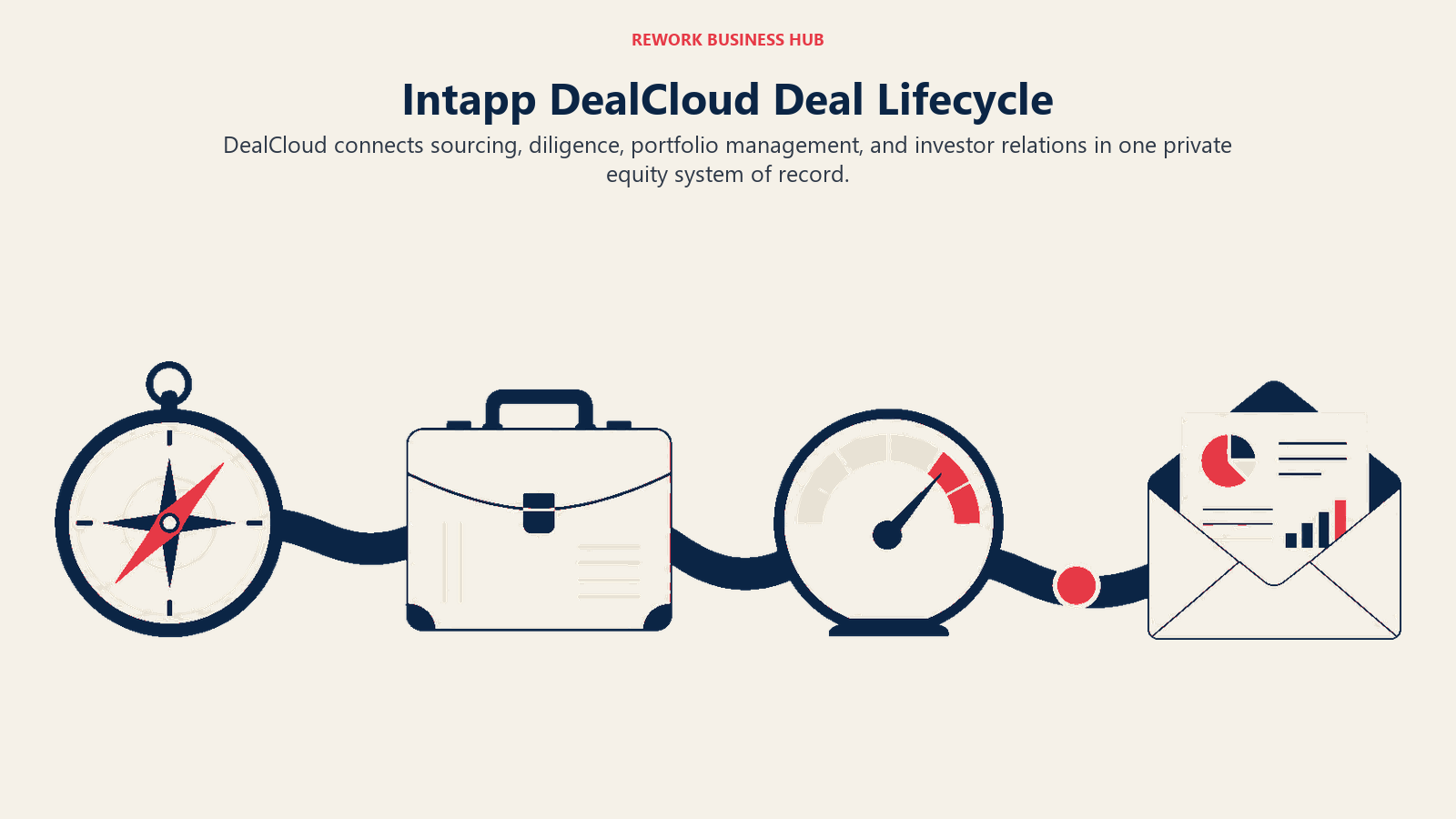
DealCloud takes the opposite approach from point tools: it aims to be the single system of record across sourcing, diligence, portfolio management, and investor relations, with Intapp Assist layering generative summaries, data tagging, and contextual insights on top. It's the platform choice for a fund that has outgrown spreadsheets and disconnected tools entirely and wants one AI-powered system running the whole investment lifecycle. If you're weighing it against a broader set of AI-enabled CRMs before narrowing to private-market specialists, best AI CRM tools and best CRM software are useful side reads.
That completeness comes at enterprise cost and complexity. Expect $85,000 to $1.43 million a year depending on modules and firm size, and a rollout that involves four vendor-side roles and four client-side roles before go-live. Paine Schwartz Partners' 2026 selection of DealCloud specifically to accelerate AI-driven growth is a useful signal of where the platform is headed.
Best for: Established mid-market to large-cap funds replacing multiple disconnected systems with one AI-powered system of record
Key strengths:
- Covers the full lifecycle, not just one stage of the deal
- Intapp Assist adds generative summaries and tagging natively inside the workflow
- Deep customization for fund-specific reporting and governance
| Pros | Cons |
|---|---|
| One AI-powered platform instead of five disconnected tools | Six-figure-plus pricing puts it out of reach for smaller funds |
| Proven at scale with major PE brands | Multi-role implementation model is a real time investment |
5. PitchBook: Natural-Language Search on Data You Already Trust
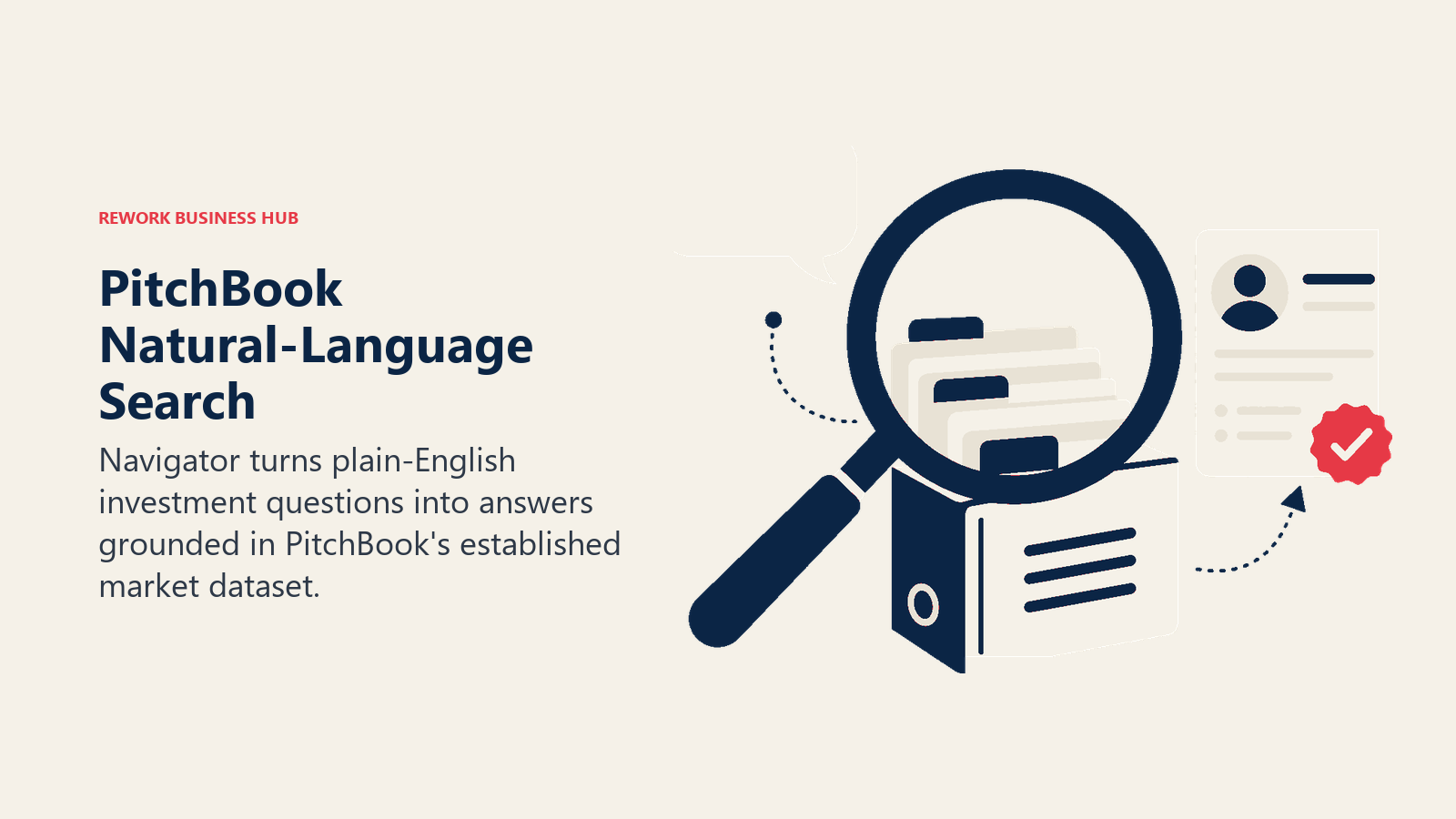
PitchBook's advantage isn't that it invented a new dataset in 2026, it's that it layered Navigator, an AI+HI (AI plus human insight) natural-language search capability, directly onto the market data most PE professionals already reference daily. Ask a complex question in plain English and Navigator returns an answer backed by PitchBook's underlying dataset instead of a generic model guess, alongside features like a VC Exit Predictor and instant AI summaries of company profiles.
Pricing stays quote-only, but public benchmarking gives a usable range: roughly $12,000-$20,000 a year for a single seat, climbing to $70,000-$124,500-plus for enterprise teams, with per-seat cost dropping as headcount grows and multi-year commitments unlocking further discounts.
Best for: Firms that already rely on PitchBook data and want AI search layered on top rather than a separate tool to learn
Key strengths:
- Navigator's AI+HI search combines automation with editorial-grade data quality
- VC Exit Predictor and AI company summaries add forward-looking context
- Familiar to nearly every analyst and associate coming out of banking or consulting
| Pros | Cons |
|---|---|
| Trusted underlying dataset most of the industry already uses | Per-seat pricing gets expensive fast for larger deal teams |
| AI search adds real speed without forcing a workflow change | Best value comes from multi-year commitments, less flexible short-term |
6. Keye (Odin): Deterministic Diligence Co-Pilot
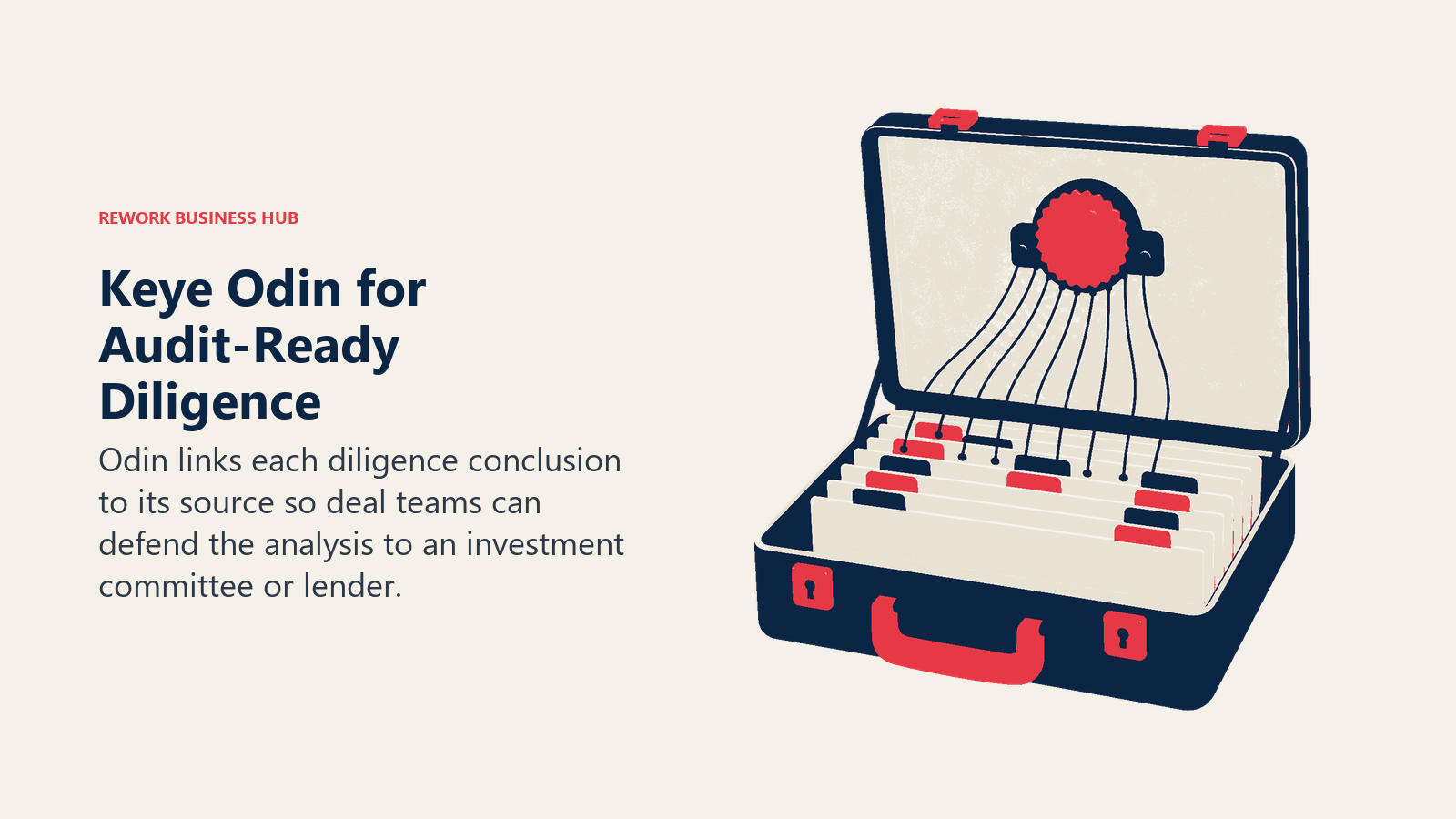
Keye's founders, both ex-McKinsey QuantumBlack and ex-private equity, built the platform around a specific complaint from deal partners: generative AI outputs that sound confident but can't be traced back to a source aren't usable in a QofE-style deliverable. Odin, launched in January 2026, is positioned as a deterministic co-pilot: deal teams ask questions in plain English and get audit-ready, source-linked analysis instead of a plausible-sounding paragraph.
Keye is still an early-stage vendor (founded 2023, backed by a $4.5M seed round), with named customers including TSG Consumer and Centerbridge as of early 2026. Pricing is quote-only and enterprise-focused, aimed at middle-market deal teams weighing the AI subscription against the cost of outsourcing more diligence work to an accounting firm. For the adjacent QofE and audit-style workflow itself, best AI tools for accounting covers the tools accounting firms use on the other side of that engagement.
Best for: Middle-market deal teams that want AI diligence output they can actually defend to an IC or lender
Key strengths:
- Deterministic, source-linked output built for audit trails, not just speed
- Founded by operators with direct PE and diligence backgrounds
- Named references at recognizable middle-market PE firms
| Pros | Cons |
|---|---|
| Built specifically to be defensible, not just fast | Early-stage vendor with a shorter track record than incumbents |
| Direct fit for QofE-adjacent diligence work | Custom pricing only, no published rate card |
7. Hebbia (Matrix): Multi-Agent Research Across Everything
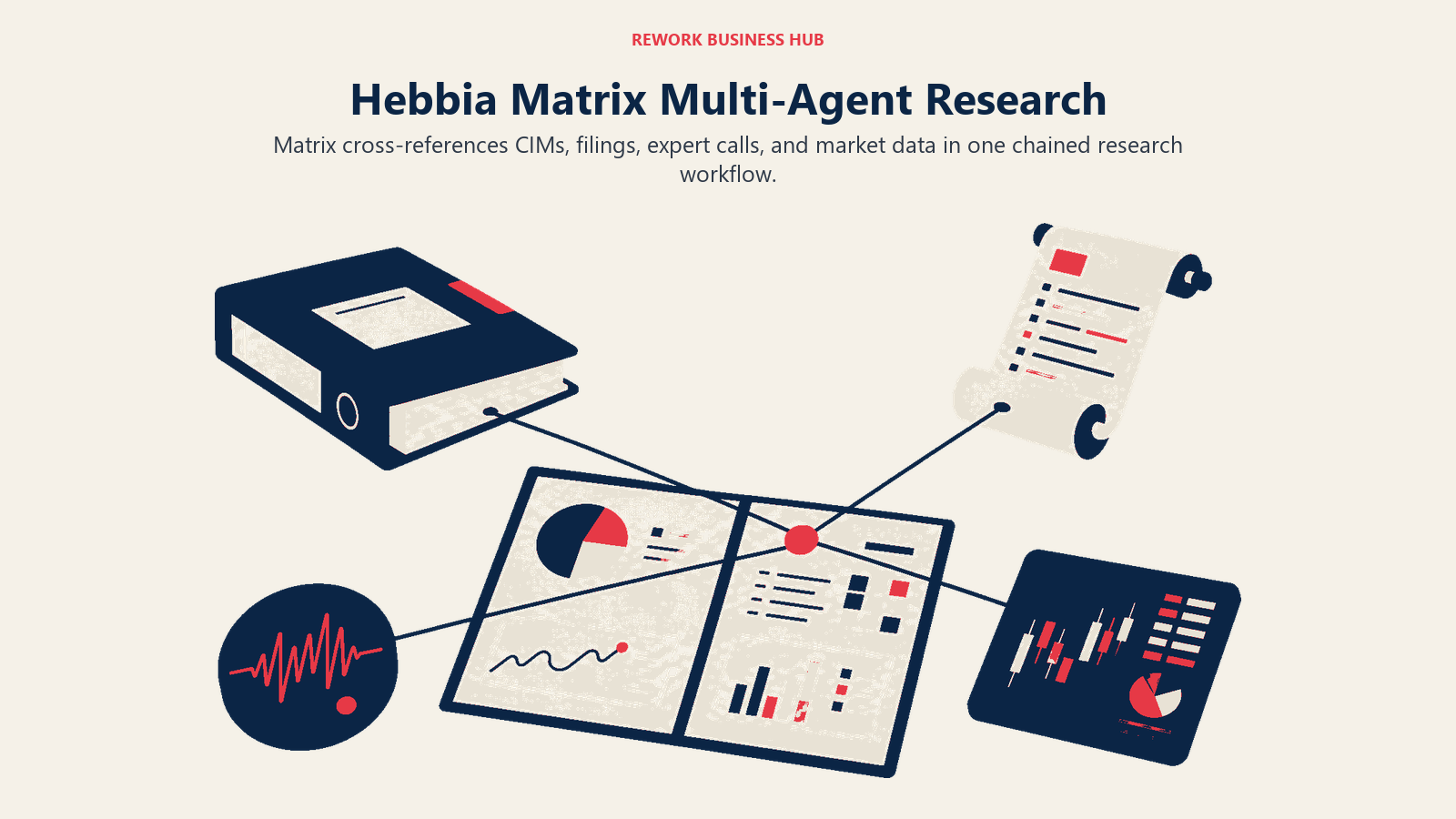
Hebbia's Matrix platform is built to handle the messiest research workflows end-to-end: cross-referencing PitchBook screening results against prior diligence expert call transcripts and CIM documents in a single query, then chaining that into full analysis without a human stitching each step together. Reported outcomes include private equity teams saving 20-30 hours per deal on screening and diligence research alone.
Pricing runs entirely through an enterprise sales process, but third-party reporting cites Professional seats around $10,000 a year and Lite seats at $3,000-$3,500 a year, with document volume as a real cost driver on top of seat count.
Best for: Deal teams handling high document volume across screening, diligence, and expert-network research
Key strengths:
- Multi-agent chaining handles complex, multi-step research in one query
- Cross-references your own diligence archive against live market data
- Reported 20-30 hours saved per deal on research-heavy stages
| Pros | Cons |
|---|---|
| Handles genuinely complex, multi-document research well | Opaque, enterprise-only pricing with no public rate card |
| Strong reported time savings on screening and diligence | Cost scales with document volume, which can surprise heavy users |
8. Rogo (Felix): The Copilot Inside Excel, PowerPoint, and Word
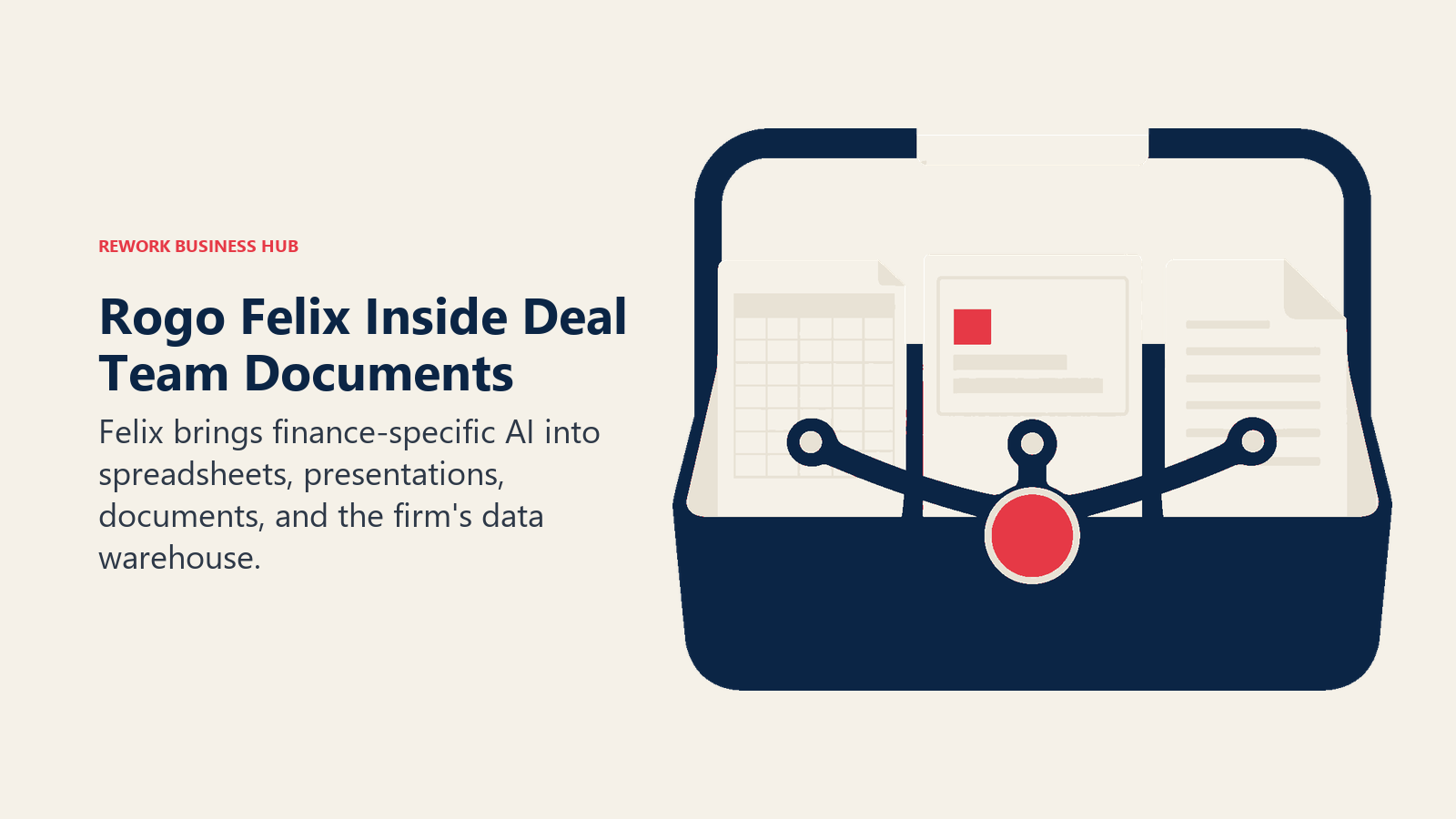
Rogo's Felix agent is designed to handle complex, multi-step financial tasks with less human hand-holding: deal screening, CIM generation, buyer outreach drafts, and data-room diligence, all surfaced inside Excel, PowerPoint, Word, and a firm's own data warehouse rather than a separate browser tab. More than 35,000 professionals across top investment banks, PE firms, and asset managers already use the platform.
Rogo's 2026 trajectory has been aggressive: a $75M Series C in January at a $750M valuation, then a $160M Series D in April at a $2B valuation, alongside an OpenAI collaboration explicitly extending access to PE and hedge fund users. Pricing remains enterprise, quote-only, and sold on multi-year contracts, consistent with its institutional-scale ambitions. For a broader look at how agentic AI is showing up across deal work, best AI agents covers the category Rogo and Hebbia both compete in.
Best for: Deal teams that want an AI copilot embedded in the tools they already work in daily, not a new standalone app
Key strengths:
- Native integration inside Excel, PowerPoint, and Word workflows
- Fine-tuned finance model rather than a generic LLM wrapper
- Rapid, well-capitalized growth signals long-term platform stability
| Pros | Cons |
|---|---|
| Meets analysts and associates inside tools they already use | Enterprise-only, multi-year contracts, no self-serve option |
| Backed by major 2026 funding rounds and an OpenAI partnership | Newer platform still building out its full feature depth |
9. AlphaSense: Market Intelligence and Expert Call Transcripts
AlphaSense's edge is breadth: broker research, company filings, transcripts, and a large library of expert call transcripts, all searchable in one platform. For private equity specifically, that expert-call access is often the differentiator, giving deal teams a competitive read on a target's market position without commissioning a fresh set of primary calls. AlphaSense reportedly hit $600 million in ARR in March 2026, up from roughly $540 million at the end of 2025, with 7,000-plus enterprise customers across industries.
Pricing sits in the $10,000-$40,000-plus per seat, per year range, with average enterprise deal sizes of $50,000-$100,000-plus and some large customers paying seven figures. Buyers commonly negotiate below list price through multi-year commitments and volume-based seat pricing.
Best for: Deal and portfolio teams who need broad market intelligence and expert-call access alongside sourcing tools
Key strengths:
- Large expert call transcript library, valuable pre- and post-LOI
- Broad coverage across broker research, filings, and company documents
- Enterprise-grade scale with 7,000+ customers as social proof
| Pros | Cons |
|---|---|
| Expert call access gives a real edge in target evaluation | Per-seat pricing climbs quickly with team size |
| Broad content coverage in a single search interface | Average enterprise deal size is meaningfully higher than sourcing-only tools |
10. BlueFlame AI: The Agentic, Multi-Model Deal Workspace
BlueFlame positions itself as an intelligent deal workspace rather than a single-purpose tool: multi-model AI orchestration lets a deal team route different tasks (sourcing summaries, diligence Q&A, IC memo drafts) to whichever underlying model handles that job best, instead of locking the whole firm to one vendor's model. The platform pairs its software with a white-glove onboarding model, including workflow configuration and ongoing optimization support.
The defining 2026 event for BlueFlame was getting acquired by Datasite on July 1, joining Grata and Sourcescrub under one owner. That consolidation likely strengthens BlueFlame's data access over time, but firms evaluating it today should ask directly about roadmap continuity and whether pricing structures are changing post-acquisition.
Best for: Firms that want an agentic workspace spanning sourcing, diligence, and memo drafting without being locked into one AI model
Key strengths:
- Model-agnostic orchestration across the deal workflow
- White-glove onboarding and ongoing workflow optimization support
- Now backed by Datasite's broader private-market data assets
| Pros | Cons |
|---|---|
| Flexibility to route tasks across multiple underlying models | No public pricing; every deal is custom-quoted |
| Strengthened data access following the Datasite acquisition | Recently acquired, so near-term roadmap changes are likely |
11. Eilla: End-to-End Automation for Lean SMB M&A Teams
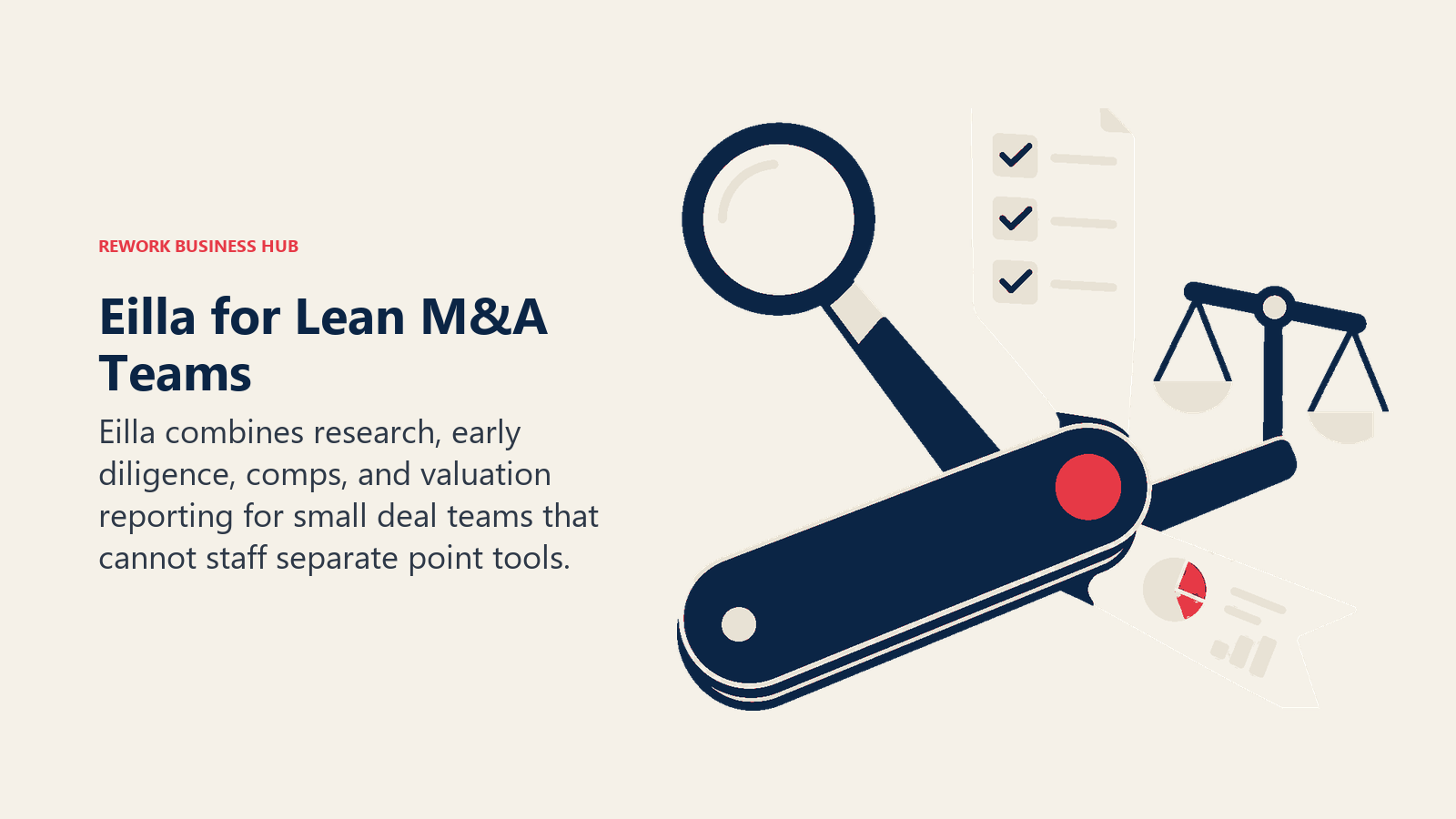
Eilla is a London-based platform built specifically for the smaller end of the market: independent sponsors, boutique M&A advisors, and lean PE teams who don't have the headcount to run separate tools for research, diligence, and valuation. It automates the early stages of due diligence with expert-level company and market analysis, generates data-driven valuation reports using real-time public and private comp data, and lets firms bring their own internal files into the workflow without sacrificing compliance control.
Eilla is genuinely small: a single $1.5M seed round to date and a 2022 founding date, so it doesn't carry the reference base of Hebbia or Rogo. What it offers instead is a lower-friction, more affordable entry point into AI-assisted deal work for teams that would otherwise be priced out of enterprise platforms entirely.
Best for: Independent sponsors and small M&A/PE teams that need one workspace instead of five point tools
Key strengths:
- Covers research, diligence, and valuation reporting in a single platform
- Built for the smaller end of the market that larger vendors underserve
- Supports bringing in internal files without compliance trade-offs
| Pros | Cons |
|---|---|
| Purpose-built for lean teams priced out of enterprise tools | Small, early-stage vendor with a limited public track record |
| Covers multiple diligence stages in one workspace | No published pricing to benchmark against competitors |
12. Canoe Intelligence: Automated Alts Data Collection
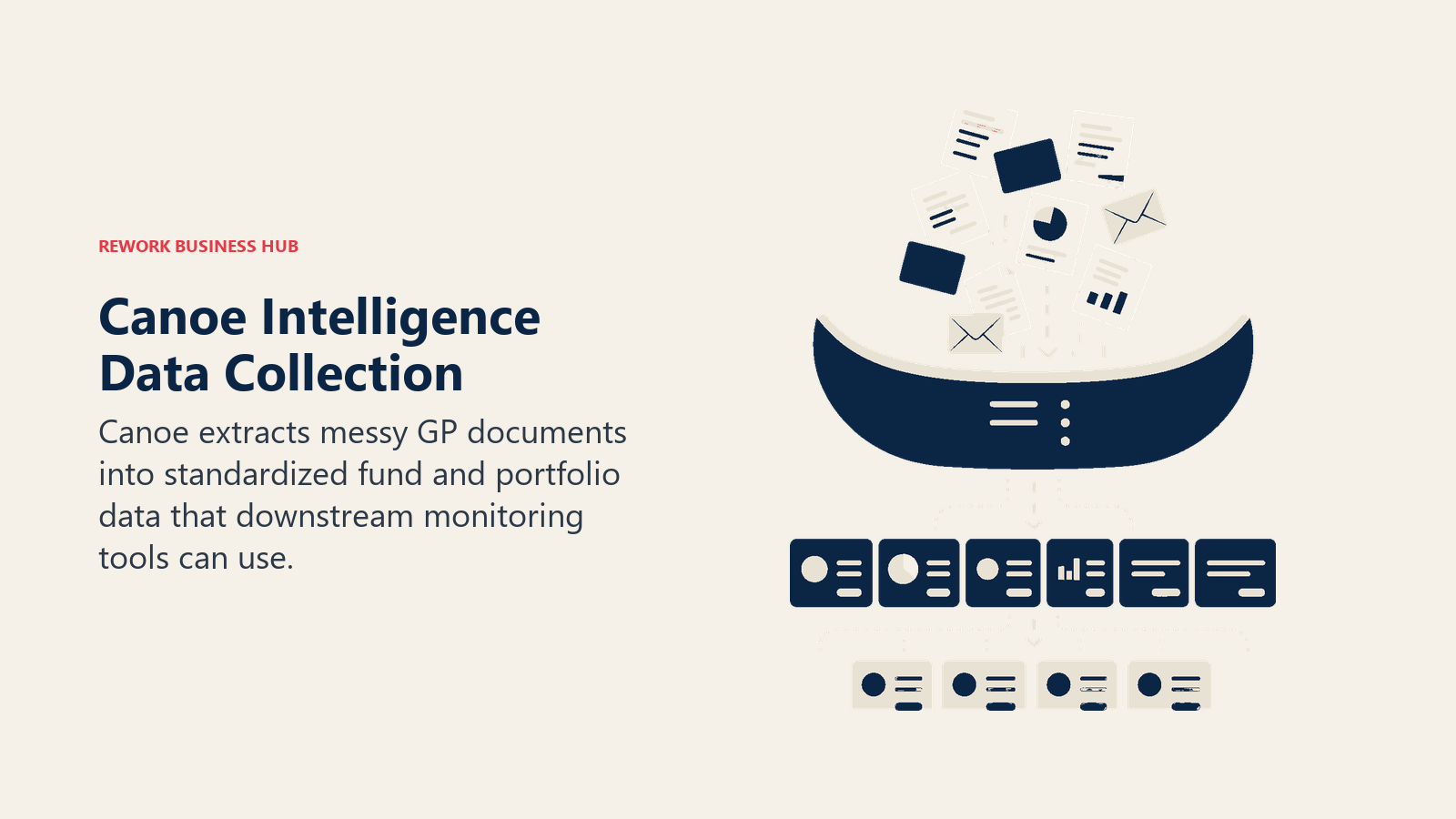
Canoe solves a specific, unglamorous problem: getting clean, standardized data out of the flood of PDFs, capital call notices, and GP communications that alternative investment managers receive constantly. The platform extracts everything from basic financials to detailed operating metrics, sector exposures, and geographic breakdowns at both the fund and portfolio-company level, then feeds that structured data into whatever reporting or monitoring tool sits downstream.
Canoe expanded its AI footprint in 2025-2026 with Canoe Labs, letting clients test AI-driven document summarization directly, and a partnership with Prime Buchholz (Canoe x PrimePlus) that moves clients from raw documents to portfolio analytics without extra administrative overhead. Once that data is clean, most funds still need a separate layer for turning it into analysis; best AI tools for data analysis covers that adjacent step.
Best for: LPs and GPs drowning in unstructured GP documents who need clean, structured data before they can even start monitoring
Key strengths:
- Extracts and standardizes data across fund and portfolio-company levels
- Monitors for missing or overdue GP documents automatically
- New AI Labs offering lets teams test summarization before committing
| Pros | Cons |
|---|---|
| Genuinely solves the document chaos problem at the source | Not a monitoring dashboard by itself; it's the data layer underneath one |
| Integrates with major custodians and reporting platforms | No public pricing available |
13. Chronograph: Portfolio Monitoring and LP Reporting at Scale
Chronograph is the incumbent for institutional-grade portfolio monitoring, running two product lines: Chronograph LP for transparency into private capital commitments across funds and vehicles, and Chronograph GP for automating portfolio company data collection, analytics, valuation, and reporting. As of 2026 the platform monitors more than $5.9 trillion in client invested capital, with over 258,000 private companies represented and more than $1 trillion in aggregate valuation marks processed quarterly.
Pricing runs from roughly $30,000 a year for an entry-level deployment to $150,000 a year for multi-fund LPs needing custom benchmark requirements. Chronograph closed a Series A round on June 17, 2026, signaling continued investment in the platform after years as an established category leader.
Best for: LPs and GPs that need institutional-grade portfolio monitoring and benchmarking, not a lightweight dashboard
Key strengths:
- Massive scale of client capital and portfolio company coverage
- Separate LP and GP product lines matched to each side's actual workflow
- Deep benchmarking capabilities for multi-fund LPs
| Pros | Cons |
|---|---|
| Proven at true institutional scale | Custom benchmark requirements push pricing toward the top of the range |
| Purpose-built LP and GP product lines | Overkill for a single-fund lower middle-market sponsor |
14. Ontra: Contract Automation for Private Markets
Ontra takes a narrower, deeper approach than a generic contract lifecycle management (CLM) tool: it's built specifically to negotiate and manage the high-volume, routine agreements private capital firms generate constantly, NDAs, joinders, non-reliance letters, access agreements, vendor contracts, and LP transfer agreements, using AI to standardize and accelerate negotiation on documents that would otherwise eat associate hours.
Because Ontra maps directly to private-market legal edge cases instead of forcing a firm to customize horizontal CLM software, it tends to fit funds with genuinely high contract volume best. Pricing is usage-based and quote-only, which makes it a poor fit for a firm doing only a handful of deals a year but a clear win for one running dozens of NDAs a month.
Best for: Firms with high-volume routine contract negotiation, especially NDAs and joinders during active fundraising or deal sourcing
Key strengths:
- Purpose-built for private-market contract types, not retrofitted CLM
- Usage-based pricing scales with actual document volume
- Reduces associate hours spent on routine legal negotiation
| Pros | Cons |
|---|---|
| Deep specialization in private-market legal workflows | Low-volume firms may not see enough usage to justify the cost |
| Usage-based pricing avoids paying for unused capacity | Custom, quote-only pricing with no public benchmark |
15. Datasite: AI-Powered Virtual Data Room
Datasite remains the default virtual data room for a large share of PE and M&A transactions, and its 2026 AI push adds automated categorization into pre-defined due diligence indexes on top of the secure document infrastructure funds already rely on for live deals. Its biggest 2026 move wasn't a feature launch, it was acquisitions: owning Grata, Sourcescrub, and BlueFlame AI now positions Datasite as a full-stack private-market intelligence and workflow platform, not just a data room vendor.
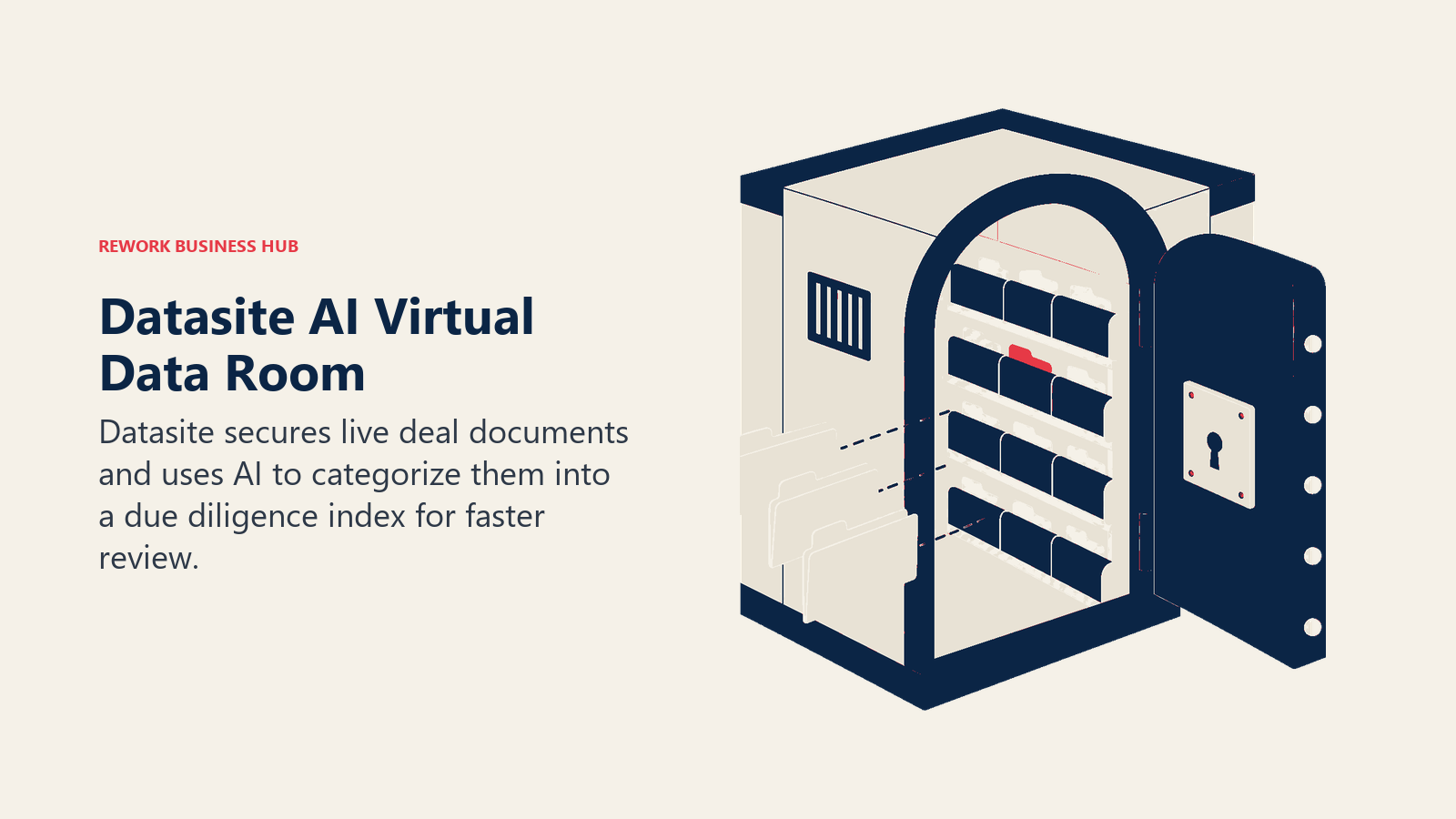
Pricing stays project-based and customized per deal. Buyer-reported averages land around $68,000 a year based on benchmarking across 334 real M&A deals, though legacy per-page pricing ($0.40-$0.85 per page) still routinely pushes mid-market deals past $50,000, and deeper AI features often sit behind premium-tier contracts rather than the base rate.
Best for: Funds running live, high-stakes deals that need a secure data room with AI-assisted document indexing built in
Key strengths:
- AI auto-categorization into due diligence indexes speeds up buy-side review
- Deepening integration with Grata and Sourcescrub's private-market data
- Established, trusted infrastructure for the most sensitive deal documents
| Pros | Cons |
|---|---|
| Trusted, established infrastructure for sensitive deal documents | Legacy per-page pricing can push costs higher than modern competitors |
| Growing AI feature set backed by real acquisition investment | Deeper AI capabilities often gated behind premium contracts |
Data Security and Confidentiality: What to Check Before You Buy
Private equity deal data is about as sensitive as B2B data gets: material non-public information (MNPI), unannounced deal terms, and portfolio company financials that could move markets or breach an NDA if they leaked. That's exactly why 67% of dealmakers name data security as their top concern with GenAI adoption, ahead of data quality itself, per Deloitte's 2025 GenAI in M&A Survey. Before signing with any vendor on this list, get clear, written answers to these questions:
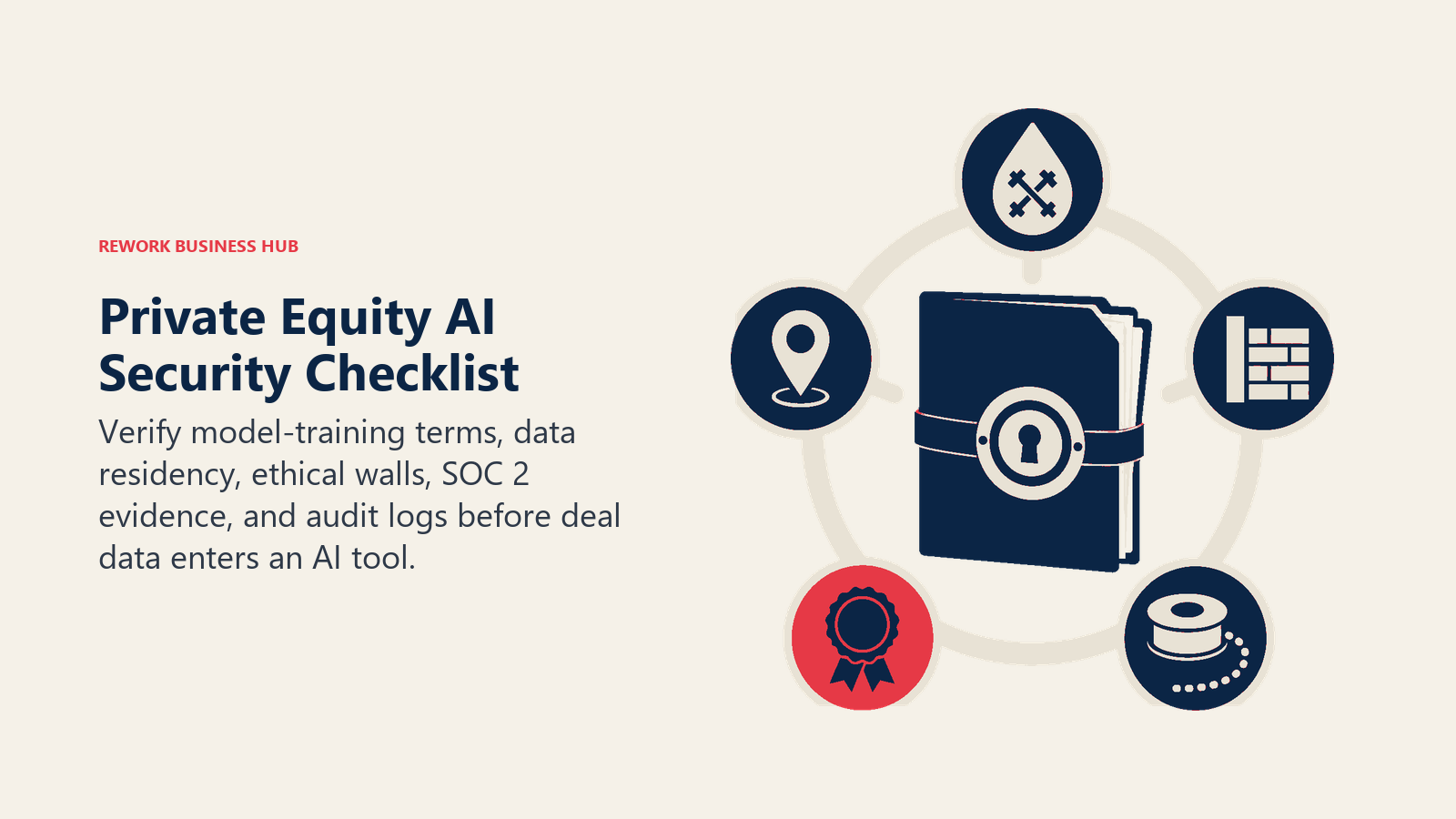
- Does the vendor train its underlying models on your data? Every enterprise-grade tool here should offer a contractual guarantee that client documents aren't used to train models shared with other customers.
- Where is data hosted, and does that satisfy your LPs' data residency requirements? This matters more for cross-border funds and LPs with specific regulatory obligations.
- Can you set deal-team-level permissioning and ethical walls? A tool that gives every associate visibility into every live deal is a liability the moment two competing sell-side processes land in the same firm.
- Is there a SOC 2 Type II report (or equivalent) you can review? Ask for it directly rather than taking a vendor's security page at face value.
- What's the audit trail? LPs increasingly ask GPs how AI was used in a deal; a vendor that can't produce a clear log of what the AI touched makes that conversation harder than it needs to be.
What to Do Next
Pick the single stage of your workflow that's costing the most partner and associate time right now, sourcing, diligence, portfolio monitoring, or legal, and run a focused 30-day pilot with your top two vendors in that category rather than trying to evaluate all 15 tools on this list at once. Most funds get more signal from one deep pilot on a live or recent deal than from a dozen sales demos.

Principal Product Marketing Strategist
On this page
- Updated July 2026: What Changed
- Key Facts
- Quick Comparison Table
- Framework: By Firm Type and Deal Stage
- How to Choose: Decision Framework
- 1. Grata: AI-Native Deal Sourcing for Private Companies
- 2. SourceScrub: Verified Data for Conference-Sourced Deals
- 3. Affinity: Relationship Intelligence CRM for Private Capital
- 4. Intapp DealCloud: The Full Deal-Lifecycle System of Record
- 5. PitchBook: Natural-Language Search on Data You Already Trust
- 6. Keye (Odin): Deterministic Diligence Co-Pilot
- 7. Hebbia (Matrix): Multi-Agent Research Across Everything
- 8. Rogo (Felix): The Copilot Inside Excel, PowerPoint, and Word
- 9. AlphaSense: Market Intelligence and Expert Call Transcripts
- 10. BlueFlame AI: The Agentic, Multi-Model Deal Workspace
- 11. Eilla: End-to-End Automation for Lean SMB M&A Teams
- 12. Canoe Intelligence: Automated Alts Data Collection
- 13. Chronograph: Portfolio Monitoring and LP Reporting at Scale
- 14. Ontra: Contract Automation for Private Markets
- 15. Datasite: AI-Powered Virtual Data Room
- Data Security and Confidentiality: What to Check Before You Buy
- What to Do Next