Best AI Tools for Accounting in 2026: 13 Tools Ranked by Use Case
Turn this article into takeaways for your work.


Each assistant summarizes the article only for you and suggests best practices for your work.
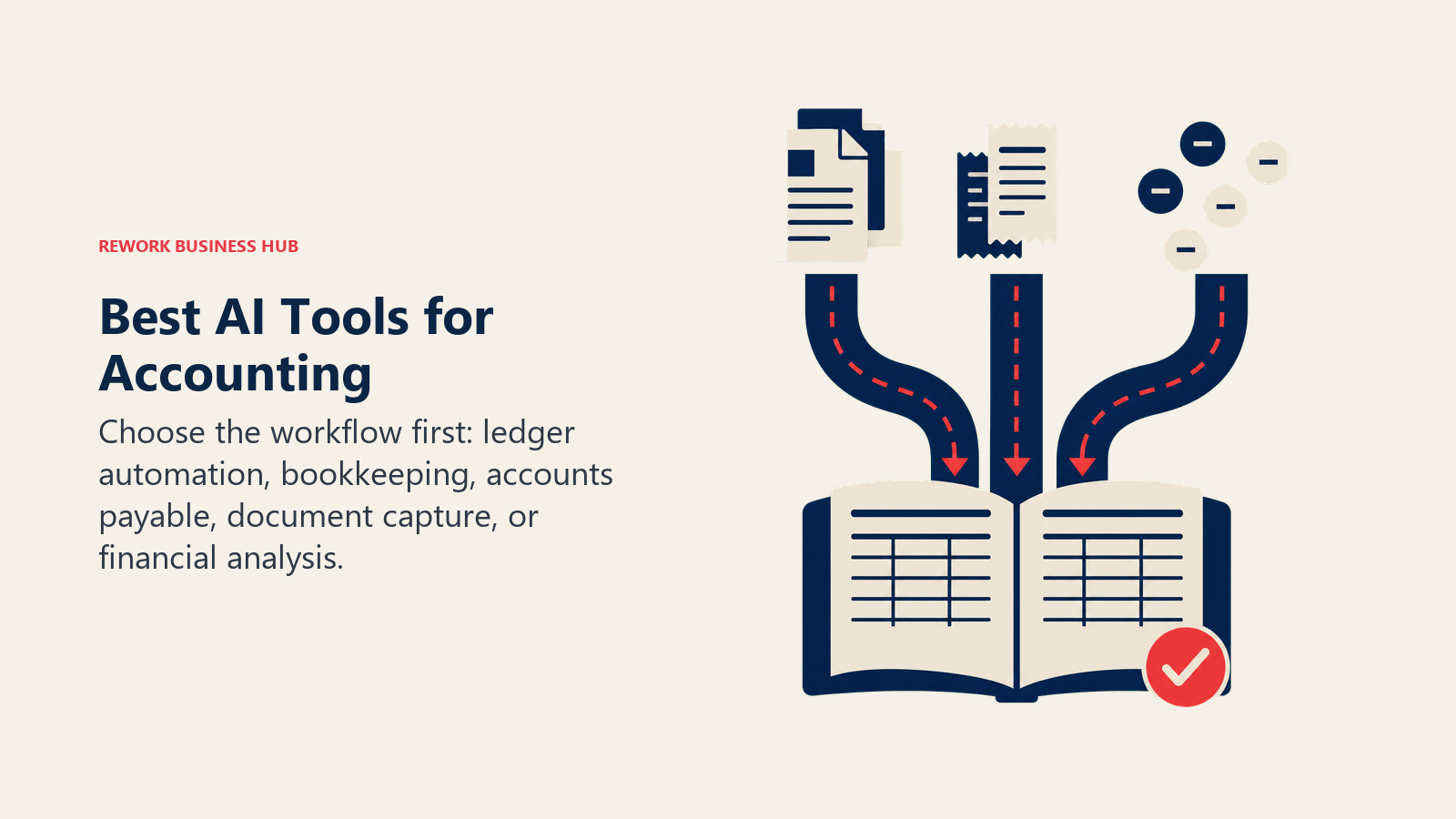
If you're picking an AI tool for accounting in 2026, QuickBooks and Xero lead if you just want AI layered onto the ledger you already run, Zeni, Digits, Puzzle, Truewind, Docyt, and Booke AI lead if you want AI to actually do the bookkeeping, BILL, Ramp, and Vic.ai lead for AI-driven accounts payable and spend, Klippa leads for receipt and invoice OCR, and ChatGPT is the fastest general-purpose assistant for one-off financial analysis. This guide ranks 13 tools by the job you're actually trying to get done, not by whichever vendor shipped the loudest AI announcement this quarter.
Most "best AI accounting tools" lists mix a $20-a-month chatbot with a six-figure enterprise close platform and call it a ranking. That's not useful for a decision. Each tool below is evaluated on what it actually automates, who it's built for, and what it costs, based on vendor pricing and real buyer-reported fit for teams from a solo bookkeeper to a finance department running a full monthly close.
Updated July 2026: What Changed
- Intuit poured AI investment into Intuit Assist, then raised prices to fund it. QuickBooks Online tiers went up 15-25% across the board in 2026, with Advanced (the tier that unlocks the Finance and Project Management Agents) jumping the hardest. Basic AI categorization still ships free in every plan; the deeper agents are gated by tier.
- Xero's JAX went from feature to default experience. JAX (Just Ask Xero) now auto-reconciles over 80% of bank lines in real time and is accessible via SMS, email, and WhatsApp on every paid Xero plan. Xero also opened XeroForce, a natural-language custom AI agent builder, to invite-only alpha users.
- Digits switched to outcome-based pricing for accounting firms. Instead of charging firms for software access, Digits now only bills a firm once a client's books hit 95% zero-touch transaction processing, a meaningful shift from flat per-seat SaaS pricing.
- BILL shipped new AI agents for touchless AP. The Invoice Coding Agent cuts manual coding time by roughly 20%, and a new W-9 Agent automates vendor tax-form collection, eliminating an estimated 80% of the manual back-and-forth.
Key Facts
- Generative AI use among tax and accounting professionals nearly doubled to 40% in 2026, up from 22% the year before, and 69% of US tax and accounting professionals now report using AI in some form, per Thomson Reuters' 2026 AI in Professional Services Report.
- 88% of accounting professionals used AI for at least one client service in the past 12 months, and 86% used it for at least one firm operation, per Intuit's 2026 Accountant Technology Survey.
- 90% of finance functions are projected to deploy at least one AI-enabled technology solution by the end of 2026, per Gartner.
- Finance teams that have adopted AI robustly in specific functions report spending 20 to 30 percent less time on data crunching, per McKinsey's research on AI in finance.
- 44% of CFOs now use generative AI for five or more use cases, up from just 7% in 2024, per the same McKinsey research.
Quick Comparison Table
| Tool | Best For | Starting Price | Key Strength | Key Limitation |
|---|---|---|---|---|
| QuickBooks Online (Intuit Assist) | US small businesses wanting AI on a familiar ledger | Simple Start $38/mo | Deepest US tax, payroll, and accountant network | Real AI agents locked behind Plus/Advanced tiers |
| Xero (JAX) | SMBs wanting AI reconciliation out of the box | Early $25/mo | JAX auto-reconciles 80%+ of bank lines by default | Entry tier caps invoices and bills per month |
| Zeni | Startups wanting bookkeeping fully done for them | Starter $494/mo | Human-reviewed AI books plus real-time dashboard | Priced like a service, not software |
| Digits | Growing SMBs wanting software-first AI bookkeeping | Essentials $65/mo | 24/7 AI categorization, no per-user fee | Advanced dimensional accounting needs custom tier |
| Puzzle | Early-stage startups on Stripe, Mercury, Brex, Ramp | Free under $20K/mo volume | Governed AI ledger built cash + accrual from day one | Best fit narrows outside a standard SaaS stack |
| BILL (BILL AI) | AP/AR teams wanting touchless invoice processing | Essentials $49/user/mo | Invoice Coding and W-9 Agents cut manual AP work | Deeper automation requires Team/Corporate tiers |
| Ramp | Teams wanting AI spend control tied to corporate cards | Free (core) | AI Policy Agent enforces spend rules automatically | Advanced ERP sync needs the paid Plus tier |
| Vic.ai | High-volume AP teams (1,000+ invoices/month) | Custom (no self-serve) | Fully autonomous invoice coding at real scale | Overkill and costly below real invoice volume |
| Docyt | Multi-location businesses (hotels, restaurants, franchises) | $299/mo | Per-location automated close and RevFlow reporting | Each location needs its own subscription |
| Booke AI | Bookkeeping firms and solo bookkeepers | $129/mo (single business) | 95% autonomous categorization inside QBO/Xero | Best value is firm-tier, not single-business pricing |
| Truewind | Startups wanting a fully managed AI close | Custom (no self-serve) | AI + human accountants replace a full finance hire | No published pricing; requires a sales call |
| Klippa (SpendControl) | Teams wanting AI receipt and invoice OCR | From €5/user/mo | Fast, accurate OCR data extraction from receipts | Narrower scope than a full accounting platform |
| ChatGPT | Ad hoc financial analysis and modeling help | Plus $20/mo | Sandboxed code execution for quick financial modeling | Not a system of record; no ledger or audit trail |
How to Choose: Decision Framework
Before comparing features, it helps to know what job you're actually hiring an AI accounting tool to do. Most buying mistakes happen when a team picks a full AI bookkeeping service when what they really needed was a faster OCR tool, or the other way around. If you want the fuller version of this framework, how to choose accounting software walks through the underlying evaluation criteria before AI even enters the picture.
| If you need... | Pick... | Why |
|---|---|---|
| An AI layer on the ledger you already run and accountants already know | QuickBooks (Intuit Assist) | Deepest US accountant network; AI agents added on top of a familiar system |
| AI reconciliation that works out of the box on day one | Xero (JAX) | JAX auto-reconciles the majority of bank lines without setup |
| Your bookkeeping fully done, with a human reviewing the AI's work | Zeni or Truewind | Both pair AI categorization with accountant oversight, not just software |
| Software-first AI bookkeeping without per-seat pricing | Digits | Unlimited users and connections at a flat monthly price |
| A startup ledger that's AI-native from the first transaction | Puzzle | Built specifically for Stripe/Mercury/Brex-stack startups |
| Touchless accounts payable at real volume | BILL or Vic.ai | BILL fits most SMB AP teams; Vic.ai fits 1,000+ invoices/month |
| AI spend policy enforcement tied to corporate cards | Ramp | AI Policy Agent flags and blocks out-of-policy spend automatically |
| Multi-location bookkeeping (hotels, restaurants, franchises) | Docyt | Purpose-built for per-location close and consolidated reporting |
| A firm-facing AI bookkeeper for managing multiple clients | Booke AI | Firm pricing tiers built around client count, not per-business fees |
| Fast, accurate receipt and invoice OCR without a full platform switch | Klippa | Narrow, strong OCR layer that plugs into existing accounting/ERP tools |
| A quick financial model or scenario analysis, no new tool to learn | ChatGPT | Sandboxed code execution inside a tool most finance teams already use |
Framework: By Business Size
| Business Profile | Budget Signal | Best Fits |
|---|---|---|
| Solo freelancer or micro-business | Free to under $50/mo | ChatGPT, Xero Early, QuickBooks Simple Start |
| Early-stage startup (pre-Series A) | Free to $150/mo | Puzzle, Digits Essentials |
| Growing SMB (10-100 employees) | $65-500/mo | Digits, QuickBooks Plus, Xero Growing/Established, BILL |
| Venture-backed startup wanting hands-off books | $500-2,000+/mo | Zeni, Truewind |
| Multi-location or franchise business | $299+/mo per location | Docyt |
| Bookkeeping or accounting firm serving clients | $20-250/client/mo | Booke AI, Digits (firm plans) |
| High-volume AP team (1,000+ invoices/mo) | Custom, five figures/yr | Vic.ai |
1. QuickBooks Online (Intuit Assist): Deepest AI Layer on the Most Widely Used Ledger
QuickBooks is the default small-business accounting platform in the US, and in 2026 Intuit has spent over $2 billion building AI agents directly into it rather than bolting on a separate product. Intuit Assist now includes an Accounting Agent, Payments Agent, Customer Agent, Sales Tax Agent, and, on the top tier, Finance and Project Management Agents that handle forecasting and job costing.
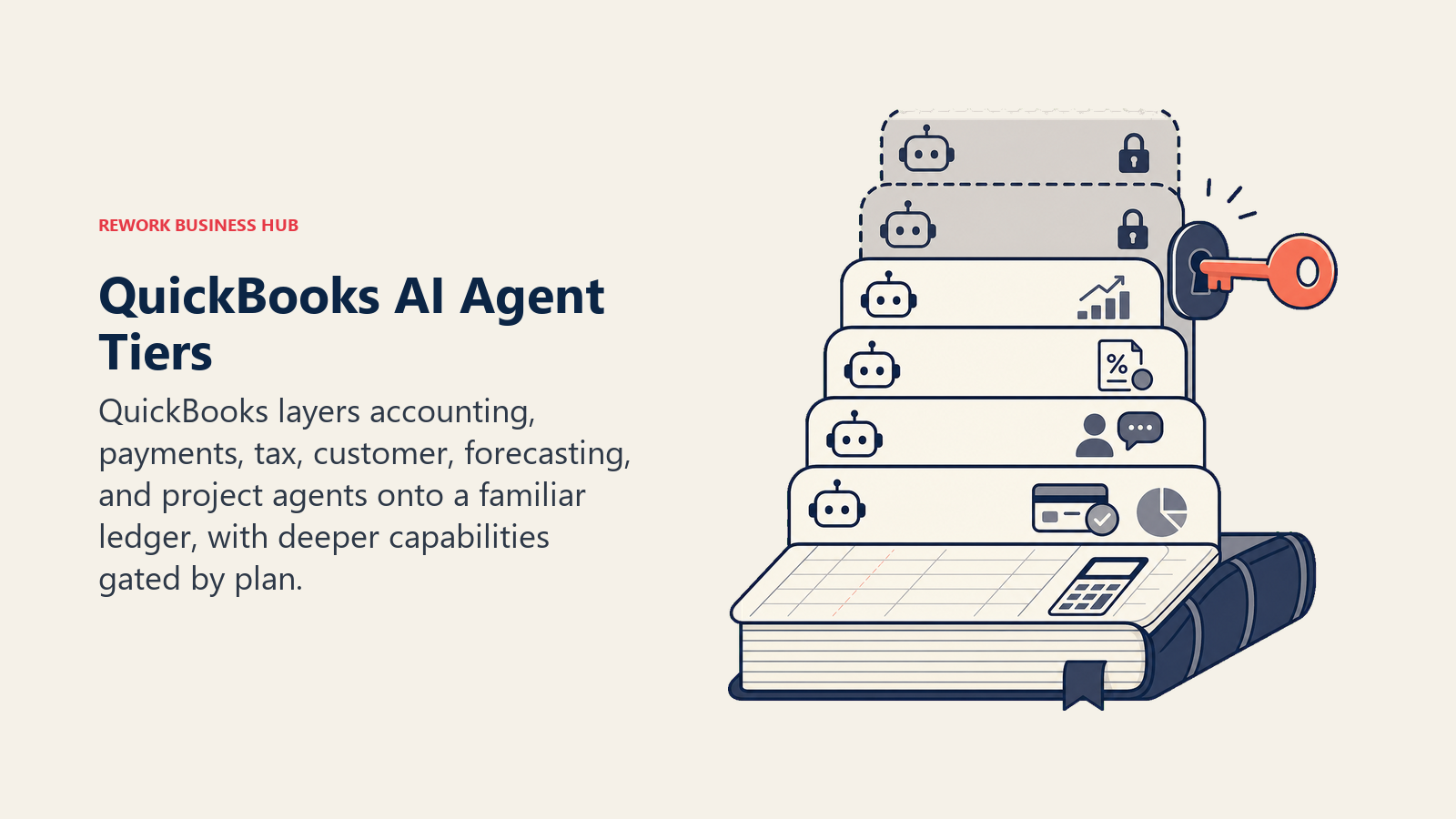
The catch is that the real AI depth is tier-gated. Basic AI features like expense auto-categorization and invoice reminders ship free in every plan, but the Accounting and Payments Agents need Essentials or higher, the Customer and Sales Tax Agents need Plus, and the Finance and Project Management Agents need Advanced. Intuit funded that AI buildout partly through price hikes: every QuickBooks Online tier rose 15-25% in 2026. If those increases are the reason you're looking elsewhere, best QuickBooks alternatives covers 11 honest options.
Best for: US small businesses that want AI added to a ledger their accountant already knows, and are willing to pay Intuit's premium for the largest accountant network in the category
Key strengths:
- Broadest US accountant and bookkeeper network of any tool on this list
- AI agents span the full workflow: categorization, payments, customer follow-up, sales tax, forecasting
- Basic AI categorization and reminders included free at every tier
Limitations:
- Deepest AI agents (Finance, Project Management) require the $340/mo Advanced tier
- 2026 price increases of 15-25% across every plan
- AI features are additive to an already dense feature set, which raises the learning curve
| What you get | What you don't |
|---|---|
| Widest US accountant and integration ecosystem | Real AI agent depth requires Plus or Advanced pricing |
| AI agents cover categorization through forecasting | 15-25% price increases across every tier in 2026 |
| Free basic AI in every plan, including Simple Start | Feature density makes onboarding slower than AI-native tools |
Pricing: Simple Start $38/mo, Essentials $85/mo, Plus $140/mo, Advanced $340/mo, reflecting the August 2026 pricing update. See quickbooks.intuit.com/pricing.
2. Xero (JAX): Best AI Reconciliation Out of the Box
Xero's bet in 2026 is that AI shouldn't be a separate feature you have to turn on, it should be the default way you interact with your books. JAX (Just Ask Xero) is Xero's AI financial superagent: it learns how a business runs, auto-reconciles bank lines, surfaces real-time financial insights, and can be reached via SMS, email, or WhatsApp instead of only inside the app.
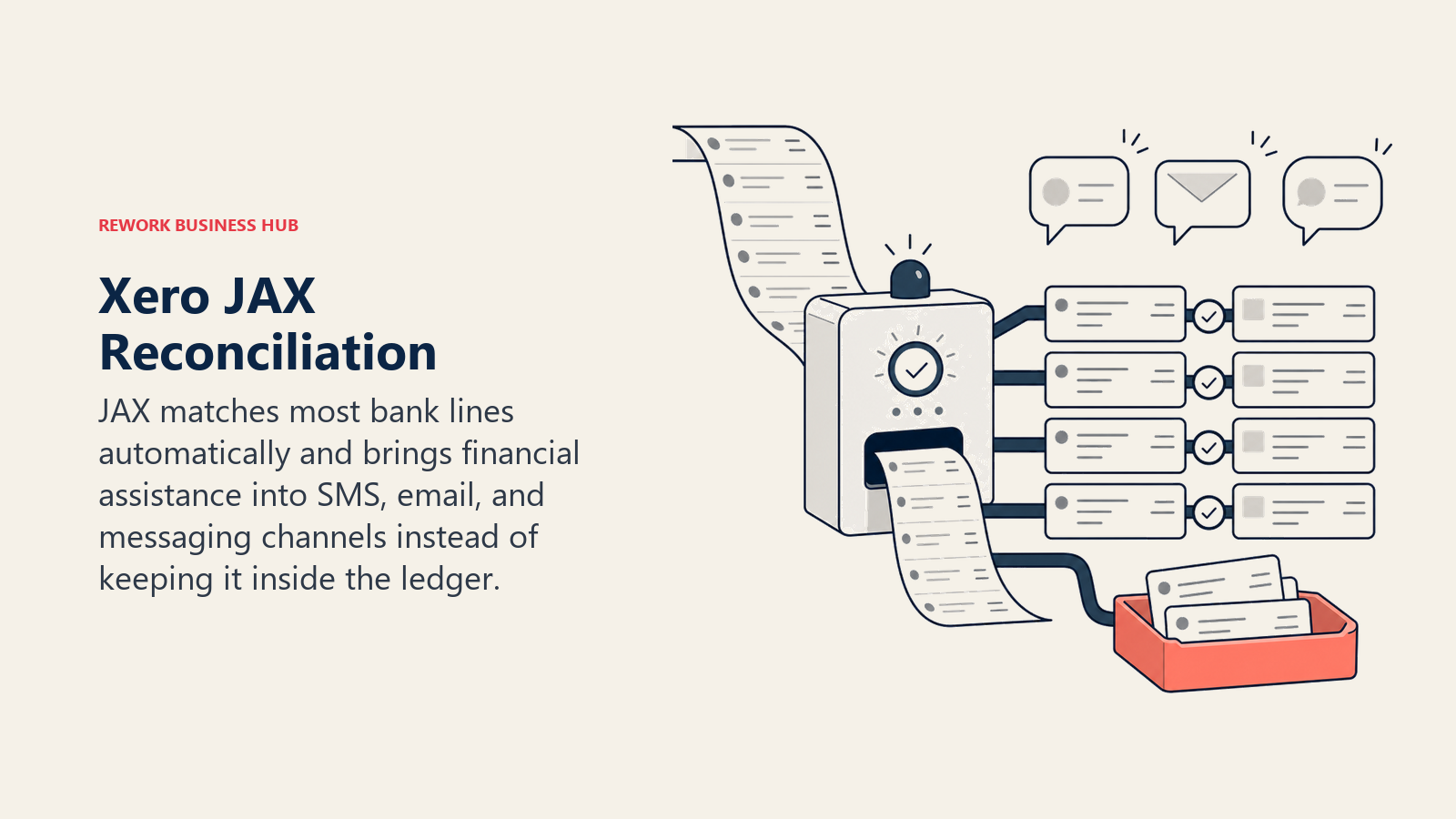
The headline number is real: JAX auto-reconciles more than 80% of bank lines in real time using transaction history patterns, with the remainder flagged for manual approval. That's a meaningfully lower-friction starting point than a tool where AI reconciliation is a premium add-on. Xero also launched XeroForce, a natural-language custom AI agent builder, though it's still invite-only alpha as of mid-2026. If Xero's ANZ/UK-first design (thin US payroll, capped invoices on entry tiers) is the sticking point rather than the AI, best Xero alternatives covers 10 tools built more squarely for US teams.
Best for: SMBs that want strong AI reconciliation without paying extra for it, especially teams comfortable managing finances through chat channels like SMS or WhatsApp
Key strengths:
- JAX auto-reconciles over 80% of bank lines without manual setup
- Accessible outside the app via SMS, email, and WhatsApp
- Included across all paid tiers, not gated behind an enterprise plan
Limitations:
- Entry-tier (Early) caps monthly invoices and bills, which pushes growing teams to a higher plan fast
- Native US payroll is limited; most US customers route through a Gusto integration
- XeroForce (custom AI agent builder) is still alpha and not broadly available
| What you get | What you don't |
|---|---|
| JAX auto-reconciliation included on every paid plan | Entry tier caps invoice/bill volume, forcing early upgrades |
| Multi-channel access (SMS, email, WhatsApp) to your books | Native US payroll still routes through a third-party integration |
| Clean, well-reviewed bank reconciliation UX | Custom AI agent builder (XeroForce) is invite-only alpha |
Pricing: Early $25/mo, Growing $55/mo, Established $90/mo, all US tiers include JAX. See xero.com/us/pricing-plans.
3. Zeni: AI Bookkeeping With a Human Accountant Behind It
Zeni's pitch is that startups shouldn't have to choose between AI speed and accountant accuracy. The platform runs AI categorization and reconciliation continuously, then routes the output through a dedicated human bookkeeping team before it hits your books, paired with a real-time financial dashboard that updates daily instead of waiting for month-end close.
That hybrid model is exactly why Zeni is priced like a service rather than software. At $494 to $719 a month before add-ons like fractional CFO or tax filing, it's a meaningful line item, not a rounding error, even for a funded startup. The tradeoff buyers are making is confidence: you get AI speed with a human backstop, which matters most for venture-backed companies that need investor-ready financials without hiring a controller.
Best for: Venture-backed startups that want bookkeeping fully handled, with AI doing the heavy lifting and a human accountant reviewing the output
Key strengths:
- AI categorization and reconciliation reviewed by dedicated human bookkeepers, not fully automated
- Real-time dashboard updates daily rather than at month-end
- Add-on fractional CFO and tax services from the same vendor
Limitations:
- Priced closer to an outsourced accounting service than SaaS software
- Pricing scales with monthly expenses and revenue, which can surprise growing teams
- Less useful if you want to keep bookkeeping in-house with your own team
| What you get | What you don't |
|---|---|
| AI speed with human-reviewed accuracy on every close | Service-level pricing, not a flat software subscription |
| Real-time financial dashboard, updated daily | Less control if you want an in-house bookkeeping team |
| Add-on fractional CFO and tax filing available | Custom pricing scales with complexity, expenses, and revenue |
Pricing: Starter $494/mo (pre-revenue companies), Growth $719/mo (revenue-generating companies), Enterprise custom, with a 10% discount for annual billing. See zeni.ai/pricing.
4. Digits: Software-First AI Bookkeeping Without Per-User Fees
Digits takes the opposite approach from Zeni: it's built to be pure software, not a service with a human team behind the AI. The Core plan runs 24/7 AI bookkeeping and transaction categorization, automated bill pay and invoicing, and live financial dashboards, and it supports unlimited users and connections at a flat monthly price rather than charging per seat.
The 2026 shift worth noting is Digits' move to outcome-based pricing for accounting firms specifically: instead of paying for software access, a firm now only gets billed once a client's transactions hit 95% zero-touch processing. That aligns the vendor's incentive with actually automating the work, not just shipping features. For businesses evaluating Digits directly (not through a firm), the individual-business tiers are straightforward flat pricing.
Best for: Growing SMBs and accounting firms that want AI bookkeeping as pure software, without per-user pricing or a mandatory human-in-the-loop service
Key strengths:
- No per-user fee; unlimited users and connections on every individual-business tier
- Outcome-based firm pricing means Digits only gets paid when automation actually works
- Dimensional accounting (department, location, project) available on higher tiers
Limitations:
- Advanced features (native Stripe/Ramp/BILL integrations, dimensional accounting) require the Pro tier
- Multi-entity accounting and close automation are Enterprise-only
- Younger platform than QuickBooks or Xero, with a thinner third-party integration marketplace
| What you get | What you don't |
|---|---|
| Flat monthly pricing, no per-seat charges | Dimensional accounting and premium integrations need Pro tier |
| 24/7 AI categorization across unlimited connections | Multi-entity accounting is Enterprise-only |
| Outcome-based pricing for firms rewards real automation | Smaller integration ecosystem than QuickBooks or Xero |
Pricing: Essentials $65/mo, Core $100/mo (most popular), Pro $250/mo. Firm plans run $35-250/client/mo or outcome-based. See digits.com/pricing.
5. Puzzle: AI-Native Ledger Built for Startups
Puzzle rebuilds the general ledger around AI agents instead of bolting AI onto a decades-old accounting core. Rather than rules-based bank feeds, Puzzle's agents draft categorizations, reconciliations, and even month-end close steps, but nothing posts to the ledger without human approval, which the company calls "governed automation."
The product is squarely built for startups running on Stripe, Mercury, Brex, and Ramp: it processes up to 98% of transactions automatically and supports both cash and accrual accounting from the same underlying ledger, so a founder can watch runway in cash terms while producing investor-ready accrual financials without a second system. If you're standing up finance function for the first time, how to choose accounting software for startups is a useful companion read before you commit to any AI-native ledger.
Best for: US-based, venture-track startups under roughly $5M ARR with a standard SaaS fintech stack, wanting AI bookkeeping as software rather than a managed service
Key strengths:
- Governed automation: AI drafts every entry, but nothing posts without approval
- Cash and accrual views from one ledger, useful for runway tracking plus investor reporting
- Free entry tier for companies under $20K in monthly transaction volume
Limitations:
- Best fit narrows fast outside a standard Stripe/Mercury/Brex/Ramp stack
- Less mature than QuickBooks or Xero for anything beyond standard SaaS accounting
- Not built for multi-location, franchise, or heavy-inventory businesses
| What you get | What you don't |
|---|---|
| AI-native ledger with human-approved governed automation | Best fit narrows outside a standard startup fintech stack |
| Cash and accrual accounting from one system | Not designed for inventory-heavy or multi-location businesses |
| Free tier for pre-revenue, low-volume startups | Newer platform with less accountant familiarity than QuickBooks/Xero |
Pricing: Free under $20K/mo in transaction volume; paid tiers run roughly $30-150/mo adding burn insights, unlimited users, and subledgers. See puzzle.io/pricing.
6. BILL (BILL AI): Touchless Accounts Payable for SMB Teams
BILL has evolved from a niche AP tool into an AI-powered financial operations platform covering AP, AR, expense management, and access to credit. The 2026 additions are specific and practical: an Invoice Coding Agent that reduces manual coding time by roughly 20% while improving accuracy, and a W-9 Agent that autonomously emails vendors to collect tax forms, eliminating an estimated 80% of that manual back-and-forth.
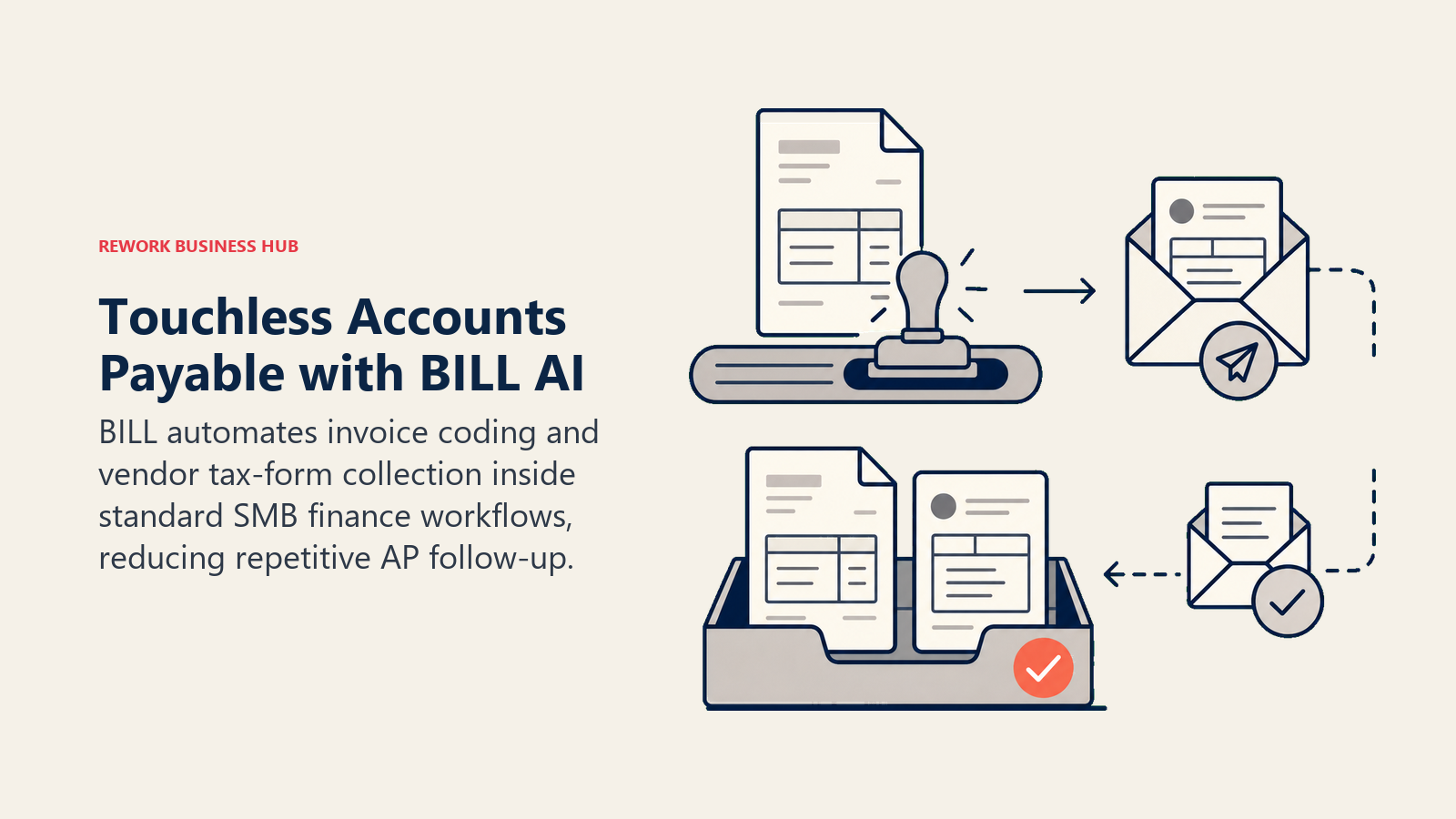
Unlike Vic.ai, BILL's AI agents are woven into standard per-user tiers rather than sold as a separate enterprise product, which makes it the more accessible option for a typical SMB AP team rather than a high-volume shared services center. Over 100,000 customers are now using BILL's newer AI agents, a meaningful adoption signal for a feature set that only shipped broadly in the past year. If invoicing and billing workflows (not just AP) are your bigger pain point, how to choose billing and invoicing software covers the adjacent buying decision.
Best for: SMB finance teams that want AI-assisted invoice coding and vendor management without an enterprise AP procurement cycle
Key strengths:
- Invoice Coding Agent cuts manual coding time by roughly 20%
- W-9 Agent automates vendor tax-form collection almost entirely
- AI capability included in standard per-user pricing, not a separate SKU
Limitations:
- Two-way accounting sync (QuickBooks, Xero) requires the Team tier or above
- Custom approval policies and procurement features need the Corporate tier
- Multi-location and deep ERP integrations (NetSuite, Sage Intacct, Dynamics) are Enterprise-only
| What you get | What you don't |
|---|---|
| AI agents for invoice coding and vendor W-9 collection | Real accounting sync needs the Team tier, not Essentials |
| AI features included in standard per-user pricing | Advanced procurement and approvals require Corporate tier |
| Free Spend & Expense product alongside paid AP/AR | Deep ERP integrations gated behind custom Enterprise pricing |
Pricing: AP & AR Essentials $49/user/mo, Team $65/user/mo, Corporate $89/user/mo, Enterprise custom. Spend & Expense is free. See bill.com/pricing.
7. Ramp: AI-Enforced Spend Policy Tied to Corporate Cards
Ramp's core product is corporate cards and spend management, and its AI layer is built to enforce policy in real time rather than clean up after the fact. The AI Policy Agent flags and can automatically block out-of-policy spend as it happens, tied directly to Ramp's card issuing, rather than relying on a finance team catching violations during expense review weeks later.
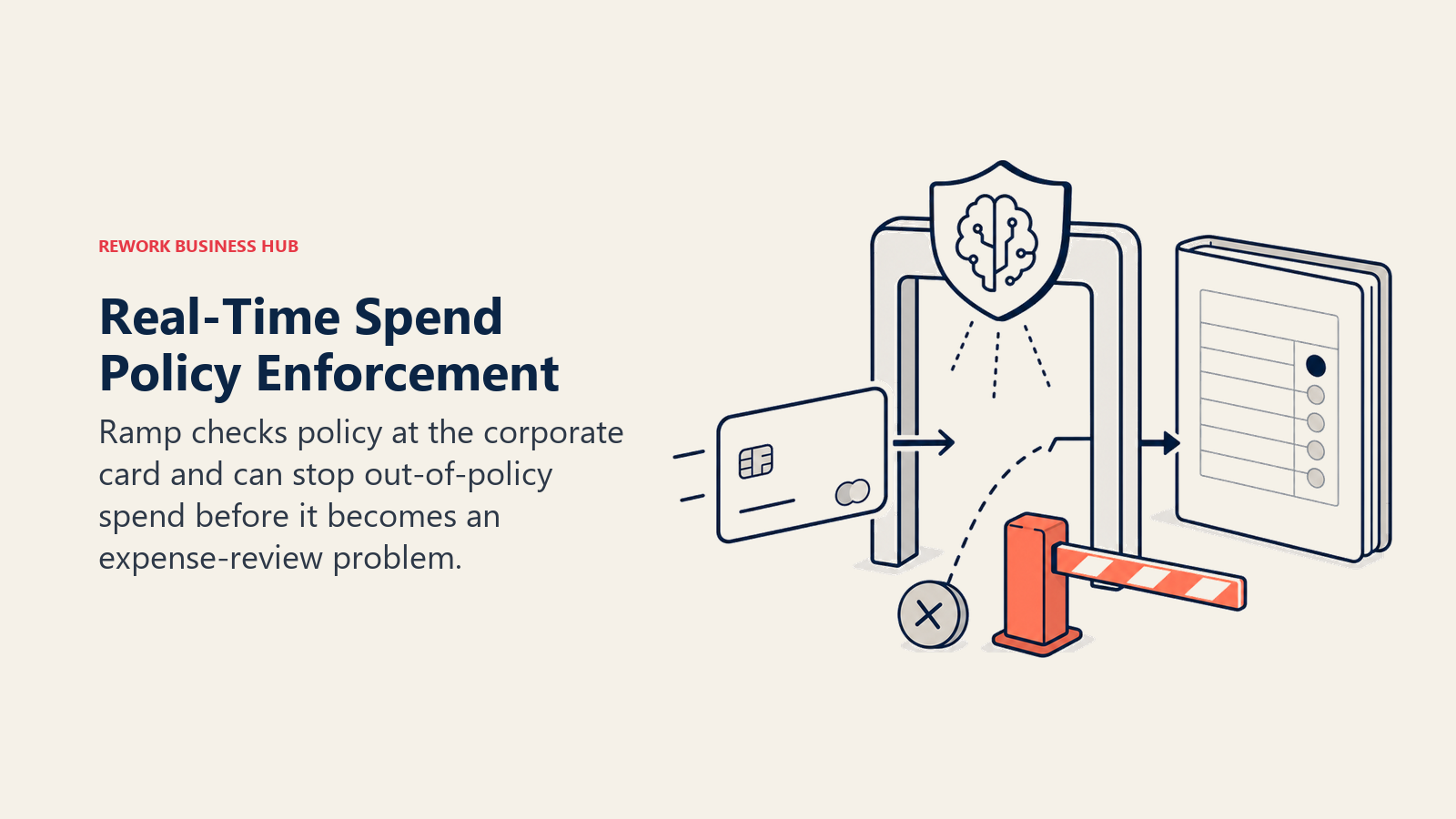
Ramp's free tier is genuinely usable: accounting sync, expense management, and unlimited cards cost nothing. The paid Plus tier adds the AI Policy Agent along with advanced ERP integrations for NetSuite and Sage Intacct, procurement automation, and multi-entity support, priced per user plus a platform fee. Enterprise contract sizes have grown fast in 2026, with average enterprise ARR nearly doubling from Q4 2025 to Q1 2026, a signal that larger finance teams are adopting Ramp's AI spend controls, not just startups.
Best for: Teams that want AI to enforce spend policy proactively, tied to the corporate cards they're already issuing, rather than a separate expense-review step
Key strengths:
- AI Policy Agent blocks or flags out-of-policy spend automatically, in real time
- Genuinely free core tier: cards, accounting sync, and expense management
- Strong NetSuite and Sage Intacct integrations on the paid Plus tier
Limitations:
- AI Policy Agent and advanced ERP sync require the paid Plus tier
- Less of a full bookkeeping platform; strongest as a spend and card layer on top of your GL
- Enterprise pricing has climbed quickly as larger teams adopt the platform
| What you get | What you don't |
|---|---|
| Free core tier with real accounting sync and unlimited cards | AI Policy Agent requires the paid Plus tier |
| Real-time, automatic policy enforcement on card spend | Not a full bookkeeping platform on its own |
| Strong NetSuite/Sage Intacct integration for finance teams | Enterprise contract pricing has risen quickly in 2026 |
Pricing: Free (core spend management and accounting sync); Plus $15/user/mo plus a platform fee. Enterprise is custom. See ramp.com.
8. Vic.ai: Fully Autonomous AP for High-Volume Invoice Processing
Vic.ai is built for one specific job: autonomous invoice coding at a volume where manual review genuinely doesn't scale. Instead of assisting a human coder, Vic.ai's AI is designed to code and approve invoices independently once it's trained on your historical data, aimed at organizations processing at least 1,000 invoices a month per entity.
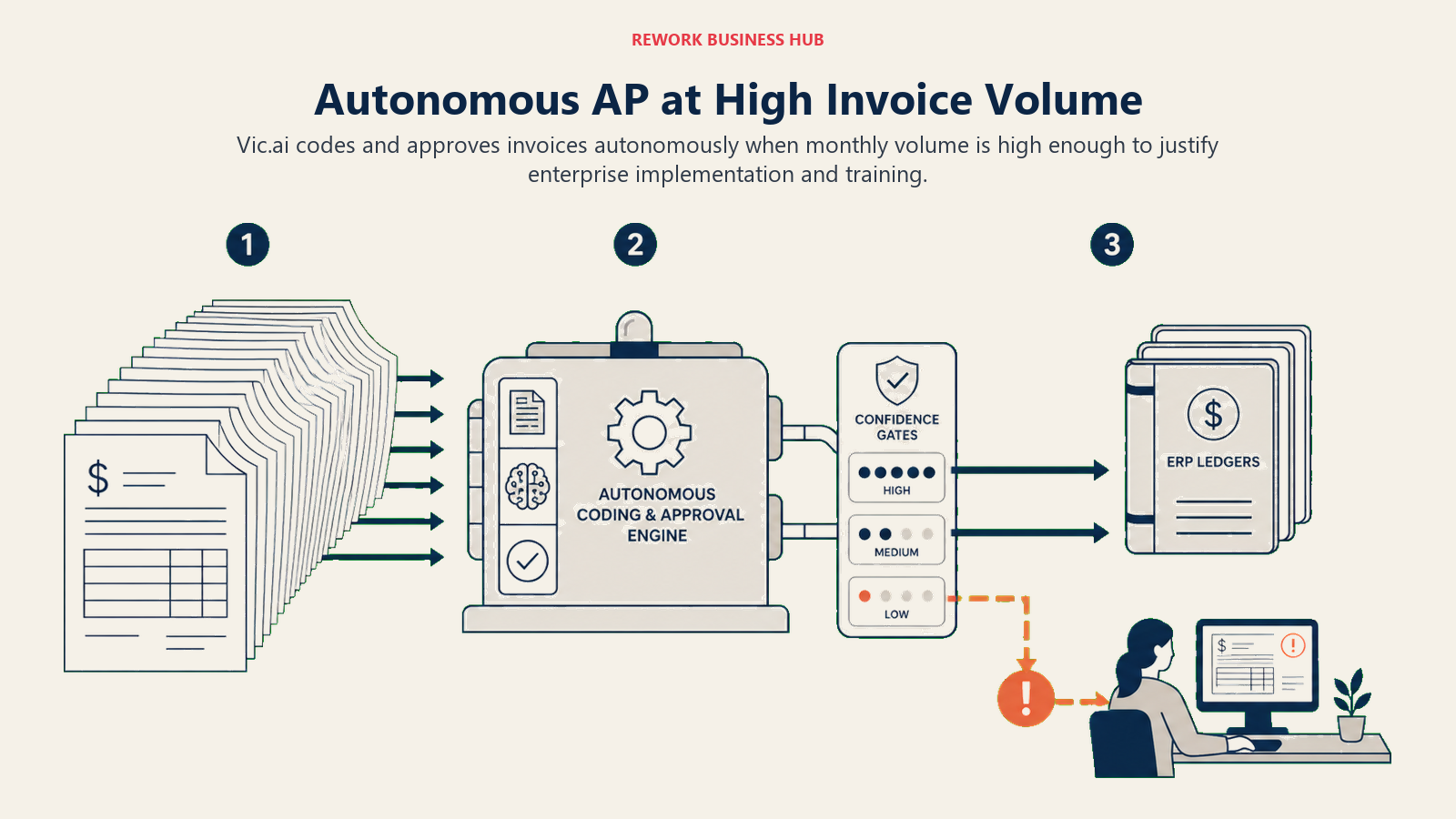
That focus makes Vic.ai the wrong tool below real volume. Reviewers are consistent on this point: it's overkill under 1,000 invoices a month, and BILL or Ramp deliver similar practical outcomes for a fraction of the cost at that scale. Pricing is fully custom, based on invoice volume, active ERP integrations, and selected modules, with no self-serve tier and an example 12-month contract landing around $25,000. Budget for a multi-month procurement process, not a same-day signup.
Best for: Mid-market to enterprise AP teams processing 1,000+ invoices a month per entity that want genuinely autonomous coding, not just AI-assisted suggestions
Key strengths:
- Designed for full autonomy, not just AI-assisted human review
- Deep ERP integration depth for high-volume, multi-entity invoice processing
- Free pilot/evaluation model before committing to a paid contract
Limitations:
- No self-serve or transparent pricing; every deal is a custom sales cycle
- Genuinely overkill and cost-inefficient below roughly 1,000 invoices a month
- Multi-month procurement timeline compared to BILL or Ramp's near-instant signup
| What you get | What you don't |
|---|---|
| True autonomous invoice coding at real enterprise scale | No transparent, self-serve pricing tier |
| Free evaluation model before a paid commitment | Poor value below roughly 1,000 invoices/month |
| Deep ERP integration for multi-entity AP operations | Multi-month procurement, not a same-day signup |
Pricing: Custom enterprise pricing based on invoice volume and ERP integrations; no self-serve tier. Example 12-month contracts run near $25,000. See vic.ai.
9. Docyt: AI Close Automation for Multi-Location Businesses
Docyt targets a specific gap most general accounting AI tools miss: businesses running the same books across many locations, like hotel groups, restaurant chains, and franchises. Its Docyt AI Companion, RevFlow (revenue automation), ExpenseFlow, ClosingFlow, and InsightFlow modules are built to standardize and automate the close process consistently across every location, not just one entity.
The tradeoff is structural, not just a pricing detail: each business location needs its own Docyt subscription, so a group running three properties needs three subscriptions, not one account with multiple entities bundled in. That makes Docyt's real cost scale directly with your footprint, which is worth modeling before you commit if you're a multi-unit operator.
Best for: Multi-location businesses (hotel groups, restaurant chains, franchise operators) that need a standardized, automated close across every property
Key strengths:
- Purpose-built modules for revenue, expense, and close automation at each location
- Consistent standardization across locations, reducing per-property bookkeeping variance
- Custom pricing available for accounting firms managing multiple client locations
Limitations:
- Each location requires its own subscription, so cost scales directly with footprint
- Less relevant for a single-location business; the multi-location design is the whole value proposition
- Narrower category focus than a general-purpose platform like QuickBooks or Xero
| What you get | What you don't |
|---|---|
| Purpose-built AI close automation for multi-unit operators | Each location needs its own separate subscription |
| Standardized revenue, expense, and close workflows | Overkill and poorly suited for single-location businesses |
| Custom firm pricing for managing multiple client properties | Narrower scope than a general accounting platform |
Pricing: Plans start at $299/mo, scaling to $499, $799, and $999+/mo based on transaction volume and features. See docyt.com/pricing.
10. Booke AI: AI Bookkeeper Built for Firms and Solo Bookkeepers
Booke AI is built to sit inside the tools accountants already use, QuickBooks and Xero, rather than replace them. It uses AI (built on GPT-4) to reach roughly 95% autonomous bookkeeping: transaction categorization, reconciliation assistance, and OCR-driven data entry, with a client portal for firms managing multiple businesses at once. If you're comparing this category more broadly against traditional bookkeeping software, how to choose bookkeeping software is worth a read before you commit.
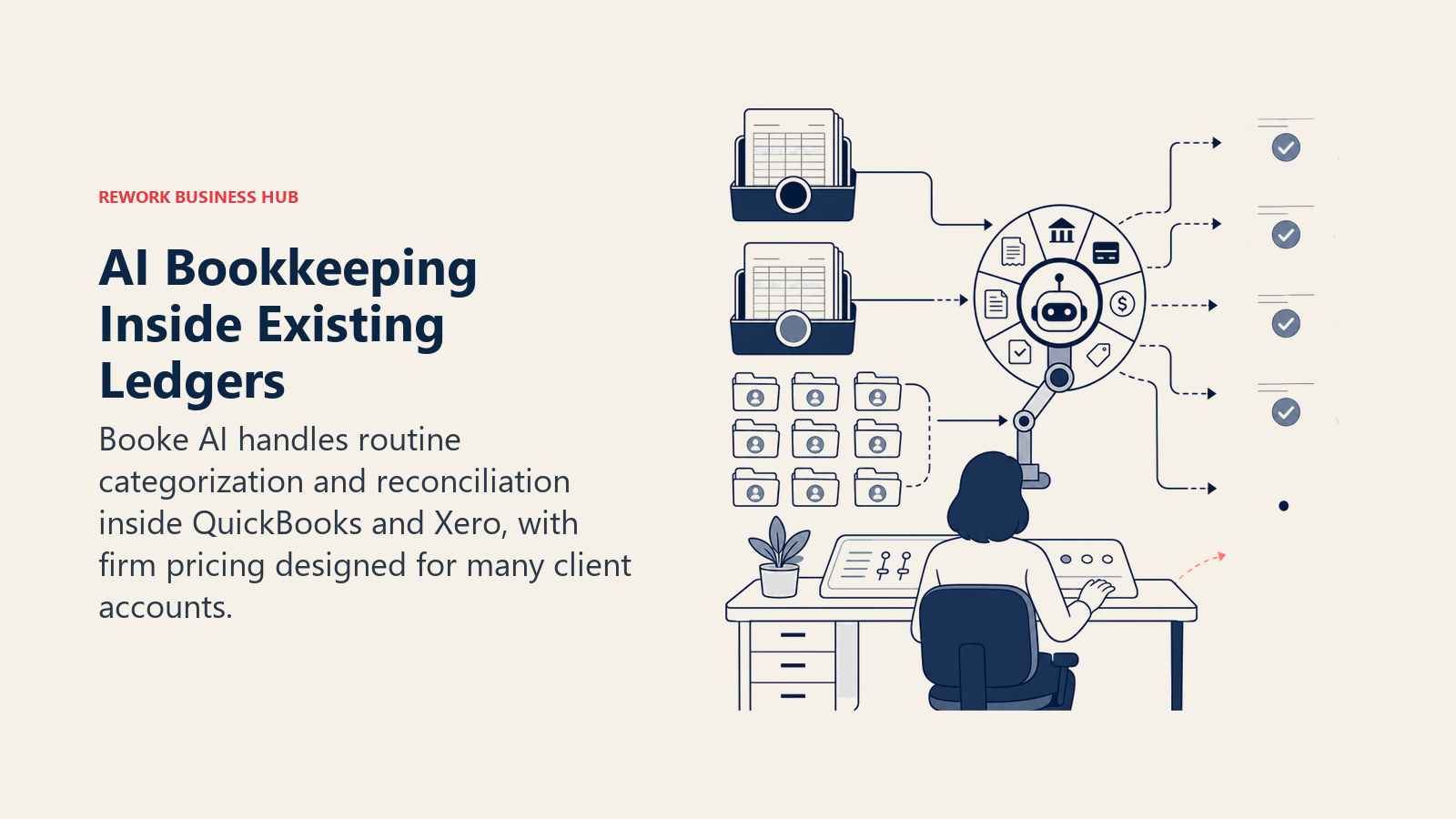
Booke AI's pricing structure makes its real value clear for firms rather than single businesses. A firm managing many clients pays $20/client/mo for the Data Entry Automation Hub or $50/client/mo for the full Robotic AI Bookkeeper tier, both cheaper per client than the $129/mo single-business price, which is really built for a solo bookkeeper or small firm testing the platform on one account.
Best for: Bookkeeping firms managing multiple QuickBooks or Xero clients, or solo bookkeepers wanting AI to handle the bulk of routine categorization
Key strengths:
- Roughly 95% autonomous bookkeeping inside QuickBooks and Xero, not a separate ledger
- Client portal built for firms managing many businesses at once
- Per-client firm pricing is meaningfully cheaper than the single-business rate
Limitations:
- Single-business pricing ($129/mo) is a weaker value than firm-tier per-client pricing
- Layered on top of QuickBooks/Xero, so you still pay for the underlying ledger separately
- Best value depends on running enough client volume to benefit from firm tiers
| What you get | What you don't |
|---|---|
| ~95% autonomous bookkeeping inside QuickBooks/Xero | Requires and adds cost on top of an existing QBO/Xero subscription |
| Firm pricing built around per-client volume | Single-business pricing is the weakest value tier |
| Client portal for firms managing multiple businesses | Not a standalone ledger; it automates work inside another platform |
Pricing: $129/mo for a single business; firm plans run $20/client/mo (Data Entry Automation Hub) or $50/client/mo (Robotic AI Bookkeeper). See booke.ai/pricing.
11. Truewind: Fully Managed AI Close for Startups
Truewind positions itself as a direct alternative to hiring a controller or accounting team, not as software you operate yourself. Its AI handles the bulk of month-end close work, and a team of human accountants reviews and finalizes it, aimed at replacing what the company estimates as $270,000 to $400,000 a year in accountant salary costs with a managed service at a fraction of the price.
Like Truewind's closest AI-native competitor Zeni, there's no published self-serve pricing: every engagement starts with a sales conversation about your transaction volume, workflow complexity, and how much automation depth you actually need, with example annual contracts landing around $25,000. That's a meaningful commitment, so it fits best for startups that have decided they want close fully off their plate rather than teams still deciding how hands-on they want to be.
Best for: Startups that want month-end close fully handled by a combination of AI and human accountants, without hiring an in-house controller
Key strengths:
- AI-driven close paired with human accountant review and sign-off
- Positioned as a genuine alternative to a full-time accounting hire, not just a tool
- Implementation-first onboarding: workflow mapping, system integration, team onboarding included
Limitations:
- No published pricing tiers; every deal requires a sales conversation
- Priced closer to an outsourced service than self-serve software
- Less relevant if you want to keep close ownership in-house
| What you get | What you don't |
|---|---|
| AI-driven close reviewed and finalized by human accountants | No published pricing; every deal is a custom sales conversation |
| Positioned as an alternative to a full accounting hire | Priced as a managed service, not flat-rate software |
| Implementation support (workflow mapping, onboarding) included | Not built for teams that want to own close in-house |
Pricing: Custom, no self-serve tier; example annual contracts run near $25,000. See truewind.ai.
12. Klippa (SpendControl): AI OCR for Receipts and Invoices
Klippa's SpendControl solves a narrower but real problem: getting data out of receipts and invoices accurately without manual entry. Its AI-driven OCR extracts date, amount, VAT, and currency from a photographed receipt or uploaded invoice, feeding straight into expense workflows, custom approval chains, and accounting or ERP integrations, with built-in error and fraud detection.
Because Klippa is scoped to expense and invoice capture rather than full bookkeeping, it's the tool to add on top of an existing accounting platform, not a replacement for one. That narrower scope is also what keeps entry pricing low relative to the full AI bookkeeping platforms on this list.
Best for: Teams that want fast, accurate AI OCR for receipts and invoices layered onto an existing accounting or ERP system, not a full platform switch
Key strengths:
- Strong AI OCR accuracy for date, amount, VAT, and currency extraction
- Built-in error and fraud detection on submitted expenses
- Integrates into existing accounting/ERP stacks rather than requiring a full switch
Limitations:
- Narrow scope: expense and invoice capture, not full bookkeeping or close automation
- Requires pairing with a separate ledger or ERP system to be useful
- Detailed 2026 pricing tiers beyond the entry plan are not fully public
| What you get | What you don't |
|---|---|
| Accurate AI OCR for receipts and invoices | Narrow scope; not a full accounting or bookkeeping platform |
| Built-in fraud and error detection on expenses | Needs a separate ledger/ERP to be a complete workflow |
| Low entry price relative to full AI bookkeeping platforms | Full pricing tiers beyond entry aren't clearly published |
Pricing: SpendControl starts from €5/user/mo (Effective plan), scaling with workflow and integration needs. See klippa.com/en/expense-management/pricing.
13. ChatGPT: Fastest Path to a Quick Financial Model or Analysis
ChatGPT isn't accounting software, and it doesn't try to be. What it's genuinely good for is the ad hoc financial work that doesn't belong in a ledger: modeling a pricing scenario, sanity-checking a variance in a spreadsheet, drafting a board memo explaining a cash flow swing, or running Python in its sandboxed Data Analyst mode against an exported CSV of transactions. For a side-by-side on how it stacks up against Claude and Gemini for this kind of work, see Claude vs ChatGPT vs Gemini.
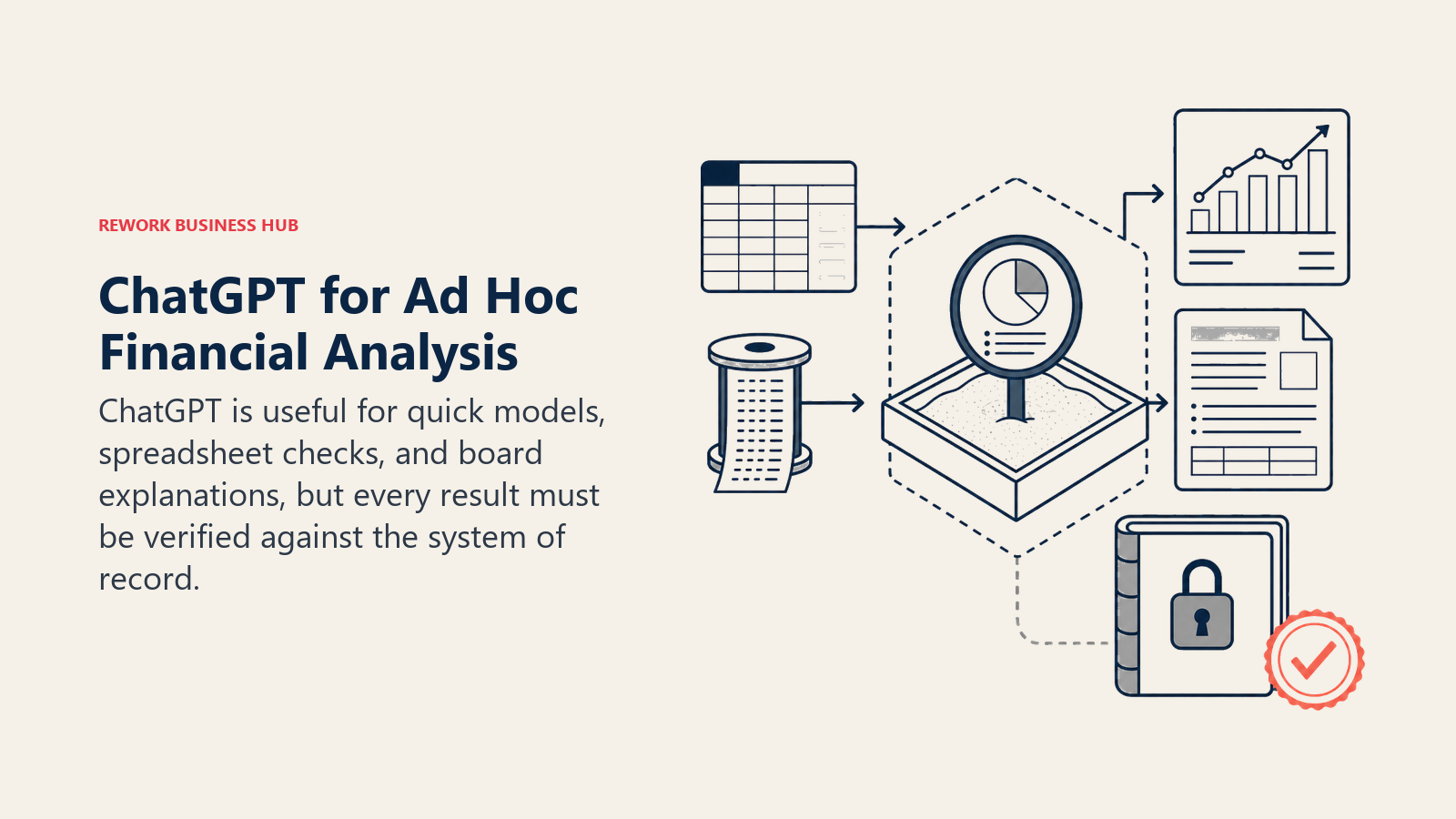
The advantage is that most finance teams already have it open, so there's no procurement cycle for a quick question. The limitation is exactly as important: ChatGPT has no ledger, no audit trail, and no accounting controls, so anything it produces needs to be verified against your actual system of record before it informs a real decision.
Best for: Finance teams and founders who want fast, disposable financial analysis or modeling help without adopting a dedicated tool
Key strengths:
- Sandboxed code execution handles real spreadsheet math, not just suggested formulas
- Near-zero onboarding; most finance professionals already have it open
- Useful for drafting board-ready explanations of financial trends and variances
Limitations:
- Not a system of record; no ledger, audit trail, or accounting controls
- No live connection to your accounting data unless you export and upload it manually
- Outputs need to be verified against your actual books before they inform a decision
| What you get | What you don't |
|---|---|
| Fast, sandboxed financial modeling and analysis | No ledger, audit trail, or built-in accounting controls |
| Near-zero onboarding for teams that already use it | No live connection to your books without manual export |
| Useful for board memos and variance explanations | Every output needs verification against your system of record |
Pricing: Free tier is limited. Plus is $20/mo. Business runs roughly $20-25/user/mo billed annually. Enterprise is negotiated, typically $50-60/user/mo at 150+ seats. See chatgpt.com/pricing.
Pricing at a Glance
| Tool | Entry Price | Pricing Model | Free Tier? |
|---|---|---|---|
| QuickBooks Online | Simple Start $38/mo | Flat monthly tier | No |
| Xero | Early $25/mo | Flat monthly tier | No |
| Zeni | Starter $494/mo | Managed-service pricing | No |
| Digits | Essentials $65/mo | Flat monthly tier, no per-seat fee | No |
| Puzzle | Free under $20K/mo volume | Volume-based tiers | Yes |
| BILL | Essentials $49/user/mo | Per-user tiers | Spend & Expense only |
| Ramp | Free (core) | Per-user + platform fee above free tier | Yes |
| Vic.ai | Custom (no self-serve) | Volume-based enterprise pricing | Free pilot/evaluation |
| Docyt | $299/mo per location | Per-location tiers | No |
| Booke AI | $129/mo (single business) | Flat or per-client (firms) | No |
| Truewind | Custom (no self-serve) | Managed-service pricing | No |
| Klippa | From €5/user/mo | Per-user tiers | Not published |
| ChatGPT | Plus $20/mo | Flat monthly tier | Limited free tier |
Where AI Accounting Tools Are Headed
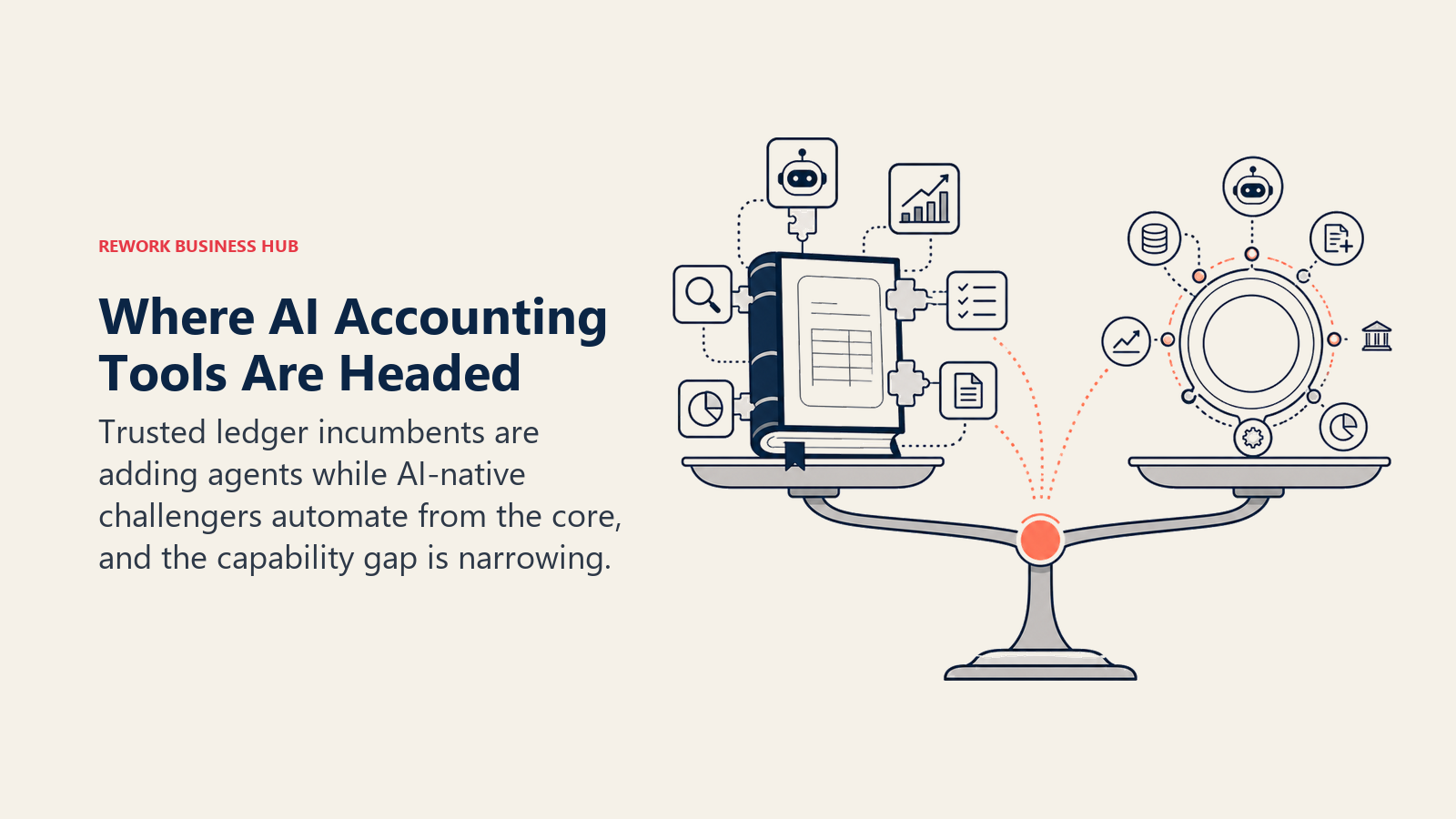
The category is splitting into two clear camps. On one side, the incumbents (QuickBooks, Xero) are layering increasingly capable AI agents onto ledgers that accountants already trust, funding that development partly through price increases. On the other side, AI-native challengers (Zeni, Digits, Puzzle, Truewind, Docyt, Booke AI) are betting that a smaller, newer company can out-automate the incumbents by building AI into the core of the product rather than adding it on top. Expect the gap between these camps to narrow through the rest of 2026 as more legacy platforms ship deeper agentic features, and expect AI adoption in accounting to keep climbing well past today's already-high numbers, since AICPA's biennial Top Issues Survey found that managing change from AI and technology is now the leading long-term concern for CPA firms of nearly every size.
If you're weighing whether AI bookkeeping tools can replace a controller entirely or should stay a productivity layer under your existing team, how to choose accounting software for small business and how to choose payroll software are useful next reads for the adjacent decisions most finance leaders are making at the same time. And if AI tooling is becoming a bigger part of how your whole business operates, not just accounting, best AI tools in 2026 and best AI tools for data analysis cover the categories most finance and ops leaders are evaluating alongside this one.
Frequently Asked Questions about AI Tools for Accounting
What is the best AI tool for accounting in 2026?
There's no single best tool. QuickBooks and Xero are the strongest picks if you want AI layered onto a ledger your accountant already knows, Zeni, Digits, Puzzle, and Truewind lead if you want AI to actually do the bookkeeping, BILL, Ramp, and Vic.ai lead for AI-driven accounts payable, and ChatGPT is the fastest option for a one-off financial question. Match the tool to the job, not a general ranking.
Can AI actually replace a bookkeeper or accountant?
Mostly not yet, and most of the tools on this list don't claim to. Puzzle, Zeni, and Truewind all keep a human reviewing or approving AI-generated entries before they post, what Puzzle calls "governed automation." Booke AI reaches roughly 95% autonomous categorization but still runs inside QuickBooks or Xero rather than replacing an accountant's oversight. AI is best trusted to handle volume and drafting; a human should still own final review, especially before tax filings or investor reporting.
Is QuickBooks or Xero better for AI features specifically?
Xero's JAX ships stronger AI reconciliation by default across every paid tier, auto-clearing over 80% of bank lines without extra cost. QuickBooks' Intuit Assist covers a wider range of AI agents (accounting, payments, customer, sales tax, finance, project management), but the deeper agents are gated behind Plus and Advanced pricing. If reconciliation is your main pain point, Xero's default AI experience is stronger out of the box; if you want the broadest AI agent coverage and are willing to pay for the top tier, QuickBooks Advanced goes further.
What's the cheapest way to start using AI for accounting?
If you already pay for ChatGPT Plus ($20/mo), you have a capable assistant for ad hoc financial modeling and analysis today. For an actual AI-assisted ledger, Xero's Early plan ($25/mo) includes JAX reconciliation on the cheapest tier of any full accounting platform on this list, and Puzzle is free for startups under $20,000 in monthly transaction volume.
Are AI accounting tools accurate enough to trust without review?
Not yet, for anything that matters. Per Gartner, 90% of finance functions are projected to have deployed at least one AI-enabled solution by the end of 2026, but that's deployment, not full autonomy. Even the most autonomous tools here (Vic.ai, Booke AI, Puzzle) keep some form of human approval step before entries post permanently. Treat AI output as a strong first draft, not a final answer, until you've validated a tool's accuracy against your own books over several months.
How is AI accounting pricing typically structured?
Three patterns show up across this list. Flat monthly SaaS pricing (QuickBooks, Xero, Digits, Puzzle) charges by tier or transaction volume, not per user. Per-user or per-transaction pricing (BILL, Ramp, Klippa) scales with your team size or invoice count. Managed-service pricing (Zeni, Truewind) charges closer to a fraction of an accountant's salary than a software subscription, because a human is reviewing the AI's work.
Do these tools work well for firms managing multiple clients, not just one business?
Several are purpose-built for that. Booke AI and Digits both offer per-client firm pricing that's cheaper than their single-business rate. Docyt is built for multi-location businesses and offers custom firm pricing for accountants managing several client properties. QuickBooks and Xero both have large accountant-facing ecosystems, though the AI agents themselves are priced at the business level, not the firm level.
What changed most in AI accounting tools during 2026?
The biggest shift is incumbents (QuickBooks, Xero) closing the AI-native gap with challengers, while also raising prices to fund that development. QuickBooks' price hikes of 15-25% and Xero's JAX becoming a default, not premium, feature both happened this year. Digits' move to outcome-based firm pricing and BILL's new Invoice Coding and W-9 Agents are the clearest signs that AI accounting is moving from "AI-assisted" toward "AI-executed with human sign-off" across the category.

Principal Product Marketing Strategist
On this page
- Updated July 2026: What Changed
- Key Facts
- Quick Comparison Table
- How to Choose: Decision Framework
- Framework: By Business Size
- 1. QuickBooks Online (Intuit Assist): Deepest AI Layer on the Most Widely Used Ledger
- 2. Xero (JAX): Best AI Reconciliation Out of the Box
- 3. Zeni: AI Bookkeeping With a Human Accountant Behind It
- 4. Digits: Software-First AI Bookkeeping Without Per-User Fees
- 5. Puzzle: AI-Native Ledger Built for Startups
- 6. BILL (BILL AI): Touchless Accounts Payable for SMB Teams
- 7. Ramp: AI-Enforced Spend Policy Tied to Corporate Cards
- 8. Vic.ai: Fully Autonomous AP for High-Volume Invoice Processing
- 9. Docyt: AI Close Automation for Multi-Location Businesses
- 10. Booke AI: AI Bookkeeper Built for Firms and Solo Bookkeepers
- 11. Truewind: Fully Managed AI Close for Startups
- 12. Klippa (SpendControl): AI OCR for Receipts and Invoices
- 13. ChatGPT: Fastest Path to a Quick Financial Model or Analysis
- Pricing at a Glance
- Where AI Accounting Tools Are Headed