Best AI Tools for Language Learning in 2026: 15 Tools for Conversation, Tutoring, and Corporate Training
Turn this article into takeaways for your work.


Each assistant summarizes the article only for you and suggests best practices for your work.
No single app covers the whole job of learning a language. Duolingo Max and Babbel handle daily structured practice, Speak, Praktika, Loora, and Langua exist almost entirely to get you talking out loud, ChatGPT's Advanced Voice Mode gives free-form conversation practice to anyone who already pays for it, Pimsleur and Rosetta Stone cover audio and pronunciation, and Voxy and italki solve the two ends of the spectrum: standardized training for a whole company, or a real human tutor for the nuance an AI still misses. This guide ranks 15 tools by where they actually fit, for individual learners, for students already leaning on AI for coursework, and for the L&D teams now buying language training at scale.
Every tool below was evaluated on real conversation and coursework use, not a vendor demo.
What Changed in 2026
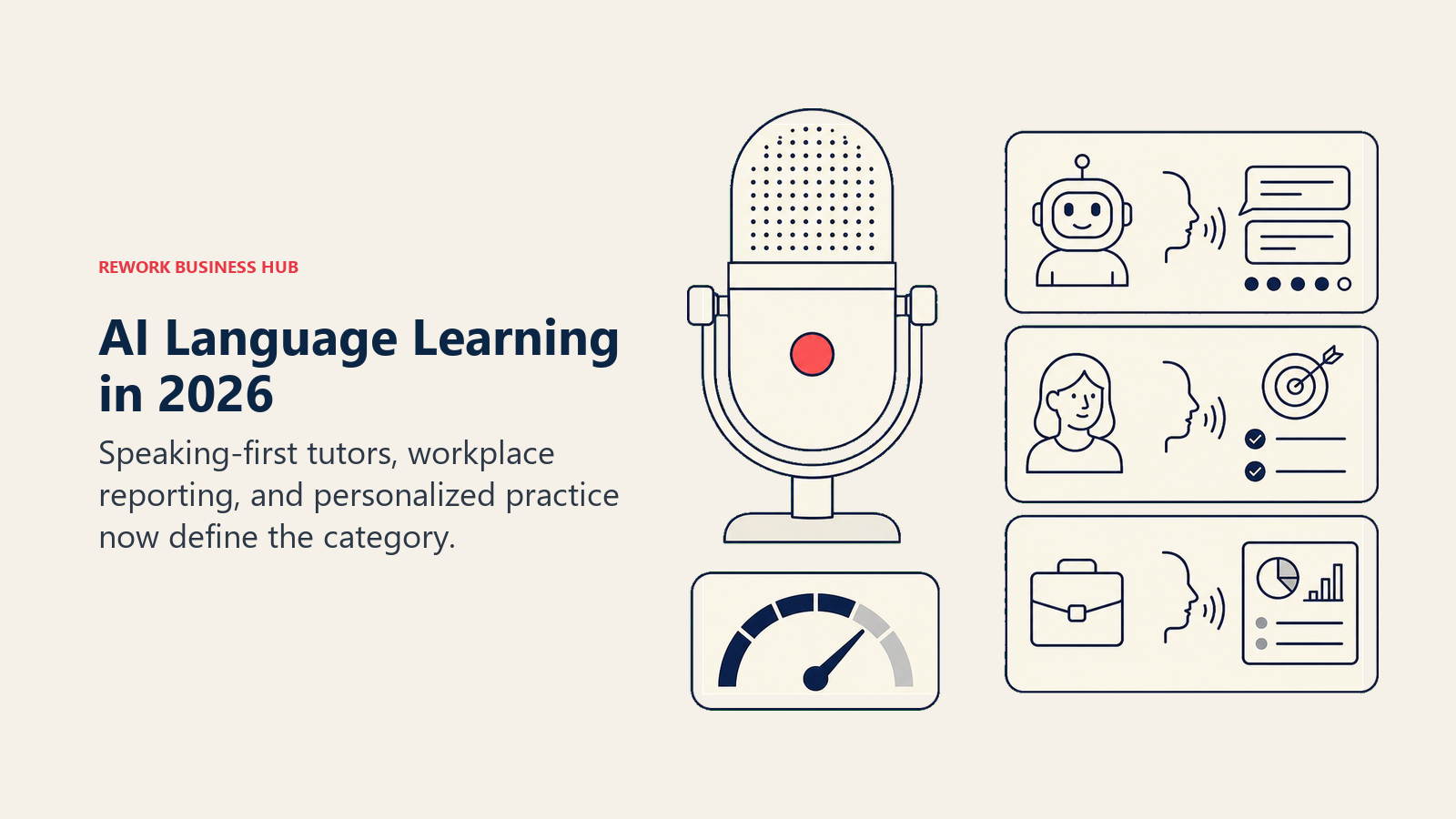
The category's center of gravity has moved from passive lesson completion toward live practice that produces measurable speaking progress.
- Duolingo made "Explain My Answer" (AI grammar explanations) free for all users in January 2026, which means Duolingo Max is now differentiated almost entirely by its two AI conversation features, Video Call and Roleplay, available for Spanish, French, German, Italian, Portuguese, Japanese, and Korean from English.
- Speak raised a $78 million Series C, with the OpenAI Startup Fund among the investors, underscoring how much capital is chasing AI-native, speaking-first language apps over traditional course-based ones.
- The EF Corporate Learning Maturity Report's 2026 edition found a widening link between language program maturity and business performance, and flagged AI-driven personalization as the clearest differentiator between companies that see ROI on language training and those that don't.
- Praktika, Loora, and Langua all pushed further into real-time AI video or voice tutoring in 2026, a category that barely existed two years ago and now competes directly with entry-level human tutoring on price.
- Corporate language platforms increasingly ship admin dashboards and usage reporting alongside the AI tutor itself, a response to L&D teams who got burned buying consumer app licenses nobody used.
Key Facts
- Language learning apps generated $1.54 billion in revenue in 2025, up 18.8% year over year, with 327 million downloads, according to Business of Apps.
- Duolingo crossed $1 billion in annual revenue for the first time in 2025, posting $1.037 billion, up 38.6% from $748 million in 2024, with daily active users climbing 30% to more than 50 million, per Inc.com's coverage of the earnings report.
- The global language learning app market is projected to reach $6.7 billion in 2026 and grow to $24.37 billion by 2035, a 15.43% CAGR, according to Business Research Insights.
- Over 90% of learners who used Duolingo's AI-powered Video Call and Roleplay features for a month felt prepared to use their new language in real-life situations, and over 60% said they used what they learned outside the app, per Duolingo's own efficacy research.
- 64% of US teens aged 13 to 17 say they've used an AI chatbot, according to Pew Research Center's February 2026 survey of 1,458 US teens, a big part of the pipeline now driving AI conversation-practice adoption.
- Miscommunication costs US businesses an estimated $1.2 trillion annually, or roughly $12,506 per employee, according to Grammarly and The Harris Poll's State of Business Communication report, a number cited repeatedly by corporate language vendors to justify training spend on global teams.
- University-level Spanish learners using Duolingo showed significant gains in receptive and productive skills, pronunciation, grammar, and vocabulary after three months, measured against a third-party standardized test, according to a peer-reviewed study published in Foreign Language Annals (DOI 10.1111/flan.12600).
Quick Comparison Table
| Tool | Best For | Starting Price | Key Strength | Key Limitation |
|---|---|---|---|---|
| Duolingo Max | Gamified daily habit plus AI conversation | Free; Max $29.99/mo or $168/yr | Huge existing habit loop, low friction to start | AI conversation limited to 7 languages from English |
| Speak | Maximizing actual speaking time | Free; Premium ~$17.99/mo | Built almost entirely around talking, not tapping | No universal student or business discount |
| Praktika | Avatar-led AI tutoring that feels human | $8/mo, billed annually only | Video avatars with full curriculum in one tier | No monthly option, price varies by country |
| Loora | English speaking fluency for professionals | Free trial; ~$10 to $15/mo | Real-time voice feedback on grammar and fluency | Single tutor personality, limited accent options |
| Langua (LanguaTalk) | Immersive AI conversation from stories | Standard ~$19.99/mo; Unlimited $29.99/mo | Adjustable-speed conversation built from real narratives | Pricier than most competitors on this list |
| ChatGPT (Advanced Voice Mode) | Free-form practice if you already pay for it | Free; Plus $20/mo | Works in nearly any language, zero extra setup | No dedicated curriculum or progress tracking |
| Babbel | Proven structured beginner curriculum | Free trial; ~$8.95/mo on 12-month plan | Linguist-built short lessons, live class add-on | One language per subscription unless Lifetime |
| Pimsleur | Audio-only, hands-free study | Premium $19.95/mo | Spaced-repetition audio method, strong on accent | No visual grammar drills or reading practice |
| Rosetta Stone | No-translation immersion with AI pronunciation scoring | 3-month ~$47 to $50 | TruAccent pronunciation engine, 25 languages on Lifetime | Pricier upfront, slower for grammar-heavy learners |
| Memrise | Real native-speaker video plus AI drills | $14.99/mo; annual ~$7.50/mo | Native speaker clips, not a single synthetic voice | Weaker structured grammar path than Babbel |
| Busuu | AI feedback plus human community correction | $10.50/mo; annual ~$5.25/mo | Blends AI Study Plan with native-speaker corrections | Community correction turnaround isn't instant |
| TalkPal | Cheapest unlimited AI chat practice | Free (10 min/day); Premium $9.99/mo | Unlimited AI conversation for under $10/mo | Free tier capped tightly, less structured than rivals |
| LingoDeer | Grammar-first learning for Asian languages | $14.99/mo; lifetime $159.99 | Explicit grammar explanations for Japanese, Korean, Chinese | Less AI-conversation-heavy than newer apps |
| italki | Real human tutors when AI hits its limit | Pay per lesson, $4 to $25+ | Actual native-speaker nuance and accountability | No subscription, cost scales with usage |
| Voxy | Standardizing training across a global workforce | Custom enterprise quote | AI-curated content plus admin usage reporting | Not built for individual, self-serve learners |
1. Duolingo Max: The Default Daily-Habit App With AI Built In
Duolingo is still the app most people open first, and its underlying gamification loop, streaks, leaderboards, hearts, is the reason it holds onto more casual learners than any structured course. Max layers two AI features on top of the free and Super tiers: Video Call, a conversation with an AI character like Lily, and Roleplay, scenario-based speaking practice (ordering coffee, checking into a hotel). Since January 2026, "Explain My Answer," the AI grammar explainer, became free for everyone, so Max's paid value now rests almost entirely on those two conversation features.
Max currently covers Spanish, French, German, Italian, Portuguese, Japanese, and Korean when learning from English, so if your target language isn't on that list, Max buys you nothing over Super.
| What you get | What you don't |
|---|---|
| The most habit-forming daily practice loop of any app on this list | AI Video Call and Roleplay only cover 7 languages from English |
| Explain My Answer AI grammar help is now free for everyone | No corporate admin dashboard or team licensing |
| Low-pressure gamified format that's easy to stick with | Speaking practice is scripted roleplay, not open conversation |
| Massive existing user base means constant feature investment | Vocabulary depth can feel shallow past intermediate level |
Pricing: Free; Super $12.99/mo (lower with annual billing); Max $29.99/mo or $168/yr in the US.
Best for: Casual daily learners who want a gamified habit loop with occasional AI conversation practice layered on top, in one of the seven supported languages.
2. Speak: Best for Actually Talking Instead of Tapping
Speak's entire design philosophy is that most apps let you "finish" a lesson without ever opening your mouth. Its AI tutor runs full spoken conversations, gives real-time pronunciation and grammar feedback, and structures lessons around output, not multiple-choice recognition. The company raised $78 million in a Series C round that included the OpenAI Startup Fund, a signal of where investor money is betting the category goes next.
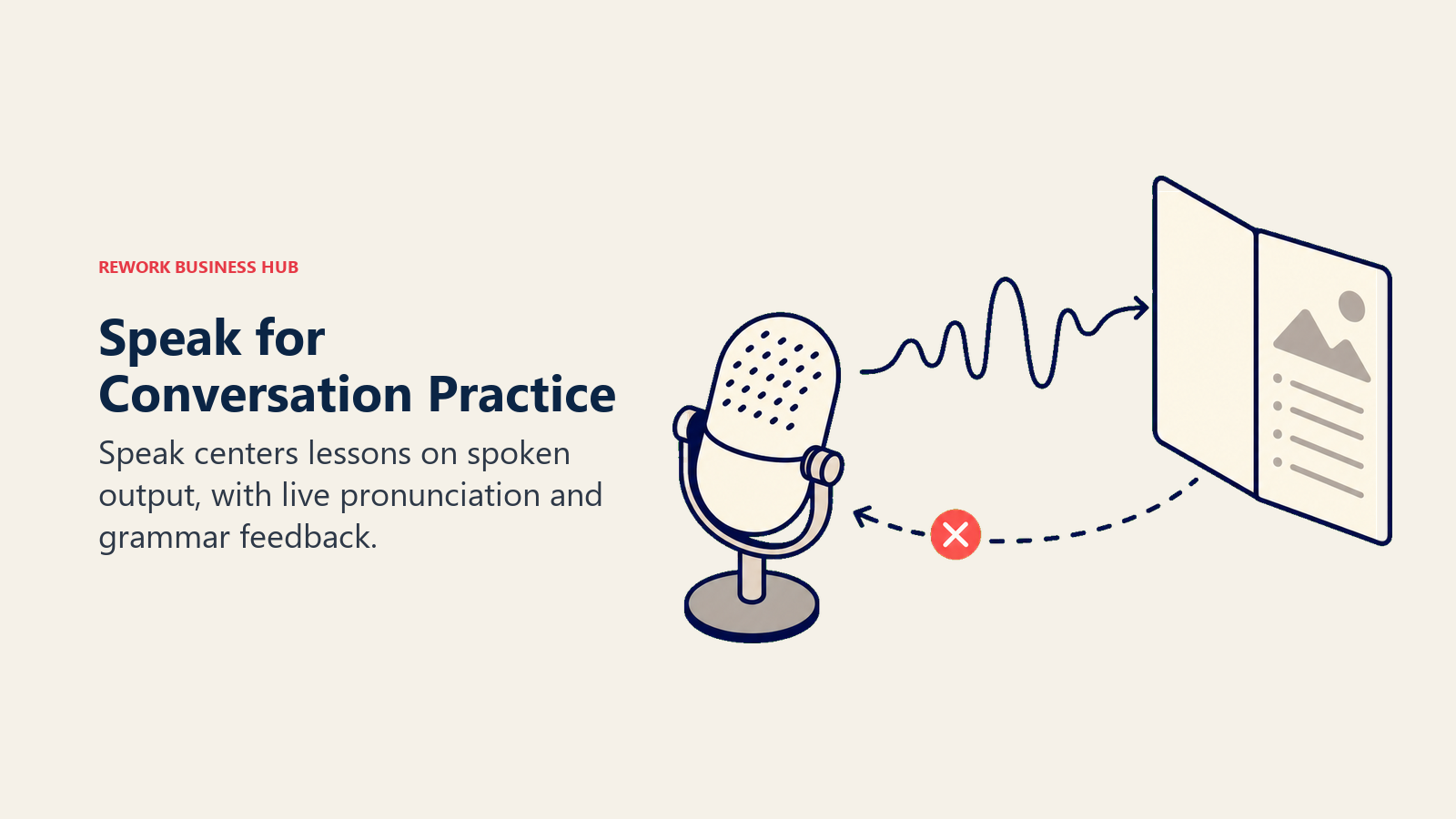
Premium Plus unlocks a custom lesson builder, letting you generate practice around a specific scenario, like an upcoming client call or a trip itinerary, rather than working through a fixed curriculum.
| What you get | What you don't |
|---|---|
| Lessons built around speaking out loud, not passive tapping | No universal student or corporate discount as of July 2026 |
| Real-time feedback on pronunciation, grammar, and fluency | Premium Plus roughly doubles the monthly cost |
| Custom lesson builder on Premium Plus for specific scenarios | Regional pricing varies, always confirm the live in-app price |
| Backed by serious AI-focused investors, fast feature pace | No offline audio-only mode like Pimsleur |
Pricing: Free trial (7 days); Premium $17.99/mo ($99 to $120/yr annual); Premium Plus $39.99/mo ($179.99/yr).
Best for: Adult learners who want to spend nearly all their study time actually speaking, not recognizing words on a screen.
3. Praktika: Best for an Avatar Tutor That Feels Like a Real Person
Praktika's pitch is video, not text or a disembodied voice. You talk to an animated AI tutor avatar that responds in real time, adjusts to your level, and walks you through structured learning paths and a full library of conversation topics, all under one flat subscription with no confusing upsells or hidden AI limits. Compared to a traditional human tutor running $50 an hour, or roughly $400 a month at regular cadence, Praktika's flat rate is a fraction of the cost.
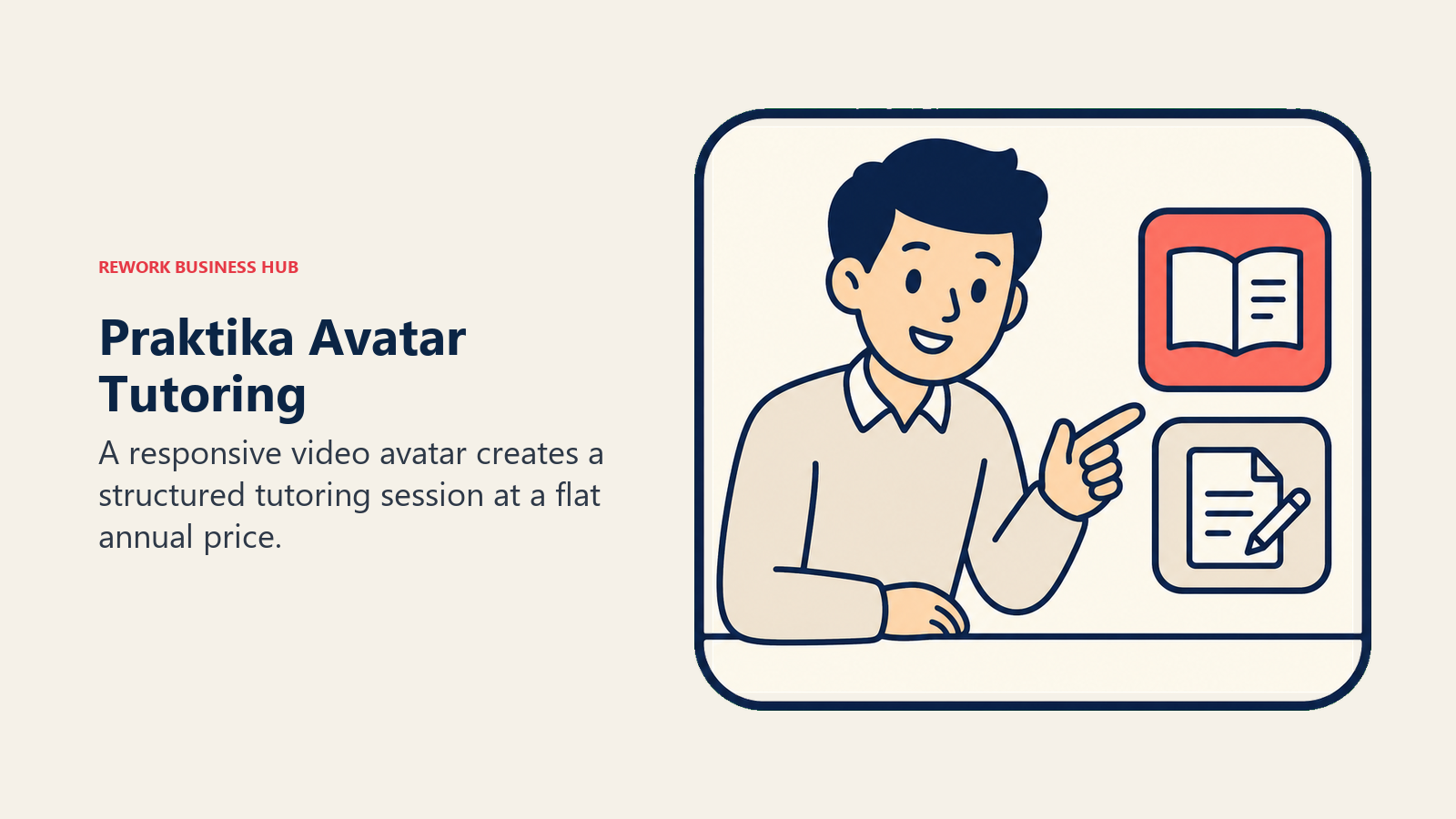
The tradeoff is commitment: there's no month-to-month plan, so you're paying for a year upfront even if you're not sure the format is for you.
| What you get | What you don't |
|---|---|
| Full curriculum, avatars, and conversation library in one tier | No monthly billing option, annual commitment required |
| Feels closer to a real tutoring session than a chatbot | Price varies by country, always check local pricing |
| Advanced feedback on speaking, not just multiple choice | Newer platform, smaller course library than Babbel or Duolingo |
| Dramatically cheaper than hourly human tutoring | Video-first format needs a stable connection to feel smooth |
Pricing: $8/mo, billed annually only (no monthly plan); price varies by region.
Best for: Learners who want an AI tutor that feels like a real conversation partner, at a fraction of hourly human tutoring rates.
4. Loora: Best for English Fluency, Especially for Professionals
Loora is narrower than most tools on this list by design: it's built specifically for English speaking practice, with real-time voice conversation and instant feedback on grammar, pronunciation, and fluency. That focus shows up in its corporate offering too, with team plans priced per user for companies that need to get non-native-English employees speaking confidently for client calls and cross-border meetings.
The individual app has one tutor personality and doesn't offer accent options, which some learners find limiting if they specifically want, say, a British or Australian model to imitate.
| What you get | What you don't |
|---|---|
| Real-time voice conversation with instant fluency feedback | English-only, not a multi-language platform |
| Corporate team plans built specifically for the workplace | Single tutor personality, no accent customization |
| Competitive pricing against $50/hr traditional tutoring | Less brand recognition than Duolingo, Babbel, or Speak |
| Clear focus makes onboarding fast for busy professionals | Deeper grammar instruction is thinner than Babbel's |
Pricing: Free trial; individual roughly $10 to $15/mo depending on plan; corporate team plans from around $10/user/mo.
Best for: Non-native English professionals who need spoken fluency for work, and the HR teams buying it for them at scale.
5. Langua (LanguaTalk): Best for Immersive Conversation From Real Stories
Langua takes a different angle than scenario-based roleplay apps: its AI conversation partner is built around immersive audio stories, and you can adjust the speaking speed as your listening comprehension improves. It corrects grammar mid-conversation without breaking the flow, which makes it feel closer to a patient human tutor than a quiz app.
It's priced at the higher end of this list, which the company itself frames as roughly equivalent to a single hour with a human tutor, spread across a month of essentially unlimited AI conversation.
| What you get | What you don't |
|---|---|
| Conversation built from real, adjustable-speed narrative content | Higher price point than most apps on this list |
| Mid-conversation grammar correction without breaking flow | Skews toward intermediate-to-advanced learners |
| Free trial (5 days monthly, 7 days annual) plus 30-day guarantee | Smaller language catalog than Duolingo or Babbel |
| Designed to feel like a patient tutor, not a scripted bot | No offline or audio-only mode |
Pricing: Standard ~$19.99/mo; Unlimited $29.99/mo or $199.99/yr (promotional pricing sometimes ~$159.99/yr).
Best for: Intermediate to advanced learners who want long-form immersive conversation, not short scripted drills.
6. ChatGPT (Advanced Voice Mode): Best if You Already Pay for It
If you already have ChatGPT Plus for work, its Advanced Voice Mode doubles as a genuinely capable, zero-setup conversation partner in almost any language. Ask it to only respond in Spanish, correct your grammar after each turn, and quiz you on vocabulary, and it will, without a dedicated curriculum, streak tracking, or progress dashboard behind it.
The tradeoff is exactly what you'd expect from a general-purpose tool repurposed for a specific job: no structured course, no pronunciation scoring engine like Rosetta Stone's TruAccent, and it can occasionally state something linguistically wrong with total confidence. For a deeper look at how it stacks up against its two biggest rivals, see our Claude vs ChatGPT vs Gemini breakdown.
| What you get | What you don't |
|---|---|
| Real-time voice conversation in nearly any language | No dedicated curriculum, streaks, or progress tracking |
| Zero extra cost if you already pay for Plus | No specialized pronunciation-scoring engine |
| Fully customizable practice via custom instructions or GPTs | Can state incorrect grammar rules with total confidence |
| Works for any language pairing, not a fixed list of 7 or so | Free tier has message caps during peak hours |
Pricing: Free; ChatGPT Go $8/mo (select markets); Plus $20/mo; Pro $200/mo.
Best for: Self-directed learners who already use ChatGPT daily and want free-form conversation practice without a second subscription.
7. Babbel: Best Proven Structured Course for Beginners
Babbel's advantage is that it was built by linguists as a structured course from day one, not retrofitted with AI conversation features later. Short, focused lessons build grammar and vocabulary in a deliberate sequence, live classes are available as an add-on, and speech recognition checks pronunciation against native-speaker recordings. For teams, Babbel for Business extends the same structured approach to onboarding relocated staff or standardizing a company's second-language requirement.
A standard subscription covers one language; only the Lifetime plan unlocks Babbel's full language catalog.
| What you get | What you don't |
|---|---|
| Linguist-built structured curriculum, not AI-generated on the fly | Standard plan covers one language only |
| Live class add-on for real human practice | List price is high; effective price depends on the sale |
| Babbel for Business extends the model to team onboarding | Less open-ended conversation practice than Speak or Loora |
| Lifetime plan unlocks every language for one payment | Lifetime list price (~$299) is steep without a sale |
Pricing: Monthly ~$17.95 list; 12-month plan $8.95/mo ($107.40/yr); Lifetime ~$299 list, frequently discounted to $170 to $200.
Best for: Beginners who want a proven, deliberately sequenced curriculum, and companies running Babbel for Business for relocation or onboarding.
8. Pimsleur: Best Audio-Only, Hands-Free Method
Pimsleur's spaced-repetition audio method has outlasted most of its original competitors because it solves a specific problem: studying while your eyes and hands are busy, driving, walking, doing chores. There's no screen requirement, which makes it the easiest app on this list to actually stick with during a commute.
All Access is built for someone who might switch languages mid-subscription; Premium locks you into a single primary language at a slightly lower price.
| What you get | What you don't |
|---|---|
| True hands-free, audio-only study, ideal for commutes | No visual grammar drills or reading practice built in |
| Decades-refined spaced-repetition method for retention | Feels slower to reach conversational output than app-first tools |
| All Access lets you sample multiple languages | Pricier per month than most app-based competitors |
| 7-day free trial across all plans | Lifetime plan (~$475) is one of the priciest on this list |
Pricing: Premium $19.95/mo; All Access $20.95/mo (~$131.96 first year, $164.95 on renewal); one-time course $159.99/level; Lifetime ~$475.
Best for: Commuters and drivers who want a proven audio-only method with zero screen time required.
9. Rosetta Stone: Best for No-Translation Immersion With AI Pronunciation Scoring
Rosetta Stone still runs on the same core idea it launched with decades ago, learn a language the way you learned your first one, through immersion, without translation. What's new is TruAccent, its AI speech-recognition engine that scores your pronunciation against native speakers in real time, giving instant feedback the original CD-ROM version never could.
The Lifetime plan is the standout value if you catch a sale: 25 languages under one payment, frequently discounted well below its ~$399 list price.
| What you get | What you don't |
|---|---|
| No-translation immersion method with AI pronunciation scoring | Slower to reach explicit grammar understanding than Babbel |
| TruAccent gives instant, native-speaker-benchmarked feedback | List pricing is high without waiting for a sale |
| Lifetime plan covers all 25 languages for one payment | Interface feels dated next to newer, AI-native apps |
| 3-day free trial, 30-day money-back guarantee | Less open conversation practice than Speak or Langua |
Pricing: 3-month ~$47 to $50; 12-month $130 to $145/yr ($11 to $12/mo); Lifetime ~$399 list, frequently on sale for $149 to $199.
Best for: Learners who want an immersion-first method with AI-scored pronunciation, and don't mind paying more upfront for lifetime access.
10. Memrise: Best for Real Native-Speaker Video Plus AI Drills
Memrise's differentiator is that a lot of its content isn't AI-generated at all, it's short video clips of real native speakers using words and phrases in context, which exposes you to actual accents, slang, and pacing rather than a single synthetic tutor voice. AI-generated practice conversations sit alongside that video library, and mnemonic techniques help vocabulary stick.
It's a strong complement to a more structured app rather than a full replacement for one, since its grammar sequencing is looser than Babbel's or LingoDeer's.
| What you get | What you don't |
|---|---|
| Real native-speaker video clips, not one synthetic voice | Grammar path is looser and less sequenced than Babbel |
| AI-generated conversation practice layered on top | Free tier limits course depth |
| Mnemonic techniques help vocabulary retention | Better as a supplement than a standalone curriculum |
| Lifetime option available for a one-time fee | Speaking practice is thinner than dedicated AI-tutor apps |
Pricing: Monthly $14.99/mo; annual as low as ~$7.50/mo equivalent; Lifetime up to $199.99.
Best for: Vocabulary-heavy learners who want to hear real native speakers, used alongside a more structured grammar course.
11. Busuu: Best Blend of AI Feedback and Human Community Correction
Busuu splits the difference between a pure-AI app and a human-tutor marketplace. Its AI Study Plan personalizes your lesson sequence, but written and spoken exercises also get corrected by real native speakers in its community, a layer of human nuance most AI-only apps skip entirely. Courses are built around CEFR levels, which makes progress easy to map to standardized proficiency benchmarks.
Community correction isn't instant the way AI feedback is, so if you need an answer in the moment, it's a poor substitute for a live AI conversation partner.
| What you get | What you don't |
|---|---|
| AI Study Plan personalizes lesson order to your pace | Community correction isn't instant like AI feedback |
| Real native-speaker corrections on your written and spoken work | Fewer open-ended AI conversation features than Speak or Loora |
| CEFR-aligned structure maps cleanly to standard proficiency levels | Premium pricing structure has changed names more than once |
| Generous free tier before you need to upgrade | Mobile app purchases can run up to 30% higher than the website |
Pricing: Monthly $10.50/mo (~$126/yr); annual $5.25/mo ($62.99/yr); frequent promotions cut annual pricing further.
Best for: Learners who want AI-personalized pacing plus real human correction, without booking and scheduling a live tutor.
12. TalkPal: Best Cheapest Unlimited AI Chat Practice
TalkPal strips the format down to what a lot of learners actually want: an AI chat partner for unlimited practice, at the lowest price on this list. The free tier caps daily use at 10 minutes, but Premium removes that cap entirely for well under $10 a month, and the annual plan drops the effective monthly cost even further.
It won't replace a full structured curriculum, but as a bolt-on for daily conversation reps, it's hard to beat on price.
| What you get | What you don't |
|---|---|
| Unlimited AI chat practice for under $10/mo on Premium | Free tier is capped tightly at 10 minutes a day |
| Role-play scenarios across a wide range of languages | Less structured curriculum than Babbel or LingoDeer |
| Cheapest paid tier of any AI conversation app on this list | Smaller brand and course library than category leaders |
| 14-day free trial before committing | Advanced grammar explanation is thinner than dedicated apps |
Pricing: Free (10 min/day); Premium $9.99/mo; Premium annual ~$4.99/mo billed yearly.
Best for: Budget-conscious learners who mainly want unlimited AI chat reps, not a full replacement curriculum.
13. LingoDeer: Best Grammar-First App for Asian Languages
Most AI-conversation apps lean on immersion and pattern recognition; LingoDeer leans the other way, with explicit grammar explanations built specifically for languages that trip up English speakers the most, Japanese, Korean, and Chinese, alongside a broader catalog. That grammar-first structure is genuinely useful for learners who find pure immersion frustrating without understanding why a sentence is built the way it is.
It's less AI-conversation-heavy than newer entrants like Praktika or Langua, so pair it with an AI speaking app if open conversation is your main gap.
| What you get | What you don't |
|---|---|
| Explicit, structured grammar explanations, not just pattern drills | Less AI conversation practice than Praktika or Langua |
| Particularly strong for Japanese, Korean, and Chinese | Interface and gamification feel less polished than Duolingo |
| Multilingual Pass covers every language under one subscription | Lifetime plan (~$159.99) still requires an upfront commitment |
| Unlimited free trial covers a real first unit before paying | Not built around open-ended speaking practice |
Pricing: Single language $14.99/mo, $39.99/3mo, $79.99/yr; Multilingual Pass same tiers; Lifetime $159.99 (either plan).
Best for: Learners tackling grammatically distant languages who want explicit rules explained, not just immersion by repetition.
14. italki: Best for a Real Human Tutor When AI Hits Its Limit
Every AI tool on this list eventually runs into the same wall: cultural nuance, slang, and the kind of correction that comes from a real person who's lived in the culture, not trained on it. italki is a marketplace of thousands of human tutors, split between Community Tutors and Professional Teachers, with no subscription required. You pay per lesson, book a discounted trial first, and build a relationship with a specific tutor over time.
It's the natural next step once AI conversation practice stops catching your mistakes, and increasingly, learners pair it with one of the AI apps above rather than choosing one over the other. Language teachers building their own AI-assisted teaching stack should also see our best AI tools for educators guide.
| What you get | What you don't |
|---|---|
| Real native-speaker tutors, not a synthetic conversation partner | No subscription, cost scales directly with how much you use it |
| Pay-per-lesson model with no long-term commitment | Quality and availability vary by tutor and language |
| Discounted trial lessons before committing to a tutor | Requires scheduling, unlike an always-available AI app |
| Wide price range fits both beginner and premium budgets | Doesn't gamify daily practice the way app-based tools do |
Pricing: Pay per lesson, no subscription; Community Tutors from ~$4 to $20/hr; Professional Teachers from ~$10/lesson; most learners spend $15 to $40/hr.
Best for: Learners who've outgrown AI-only practice and need real human nuance, accountability, and cultural context.
15. Voxy: Best for Standardizing Language Training Across a Global Workforce
Voxy is built for a different buyer than the rest of this list: an HR or L&D leader trying to standardize English (or another business language) training across hundreds or thousands of employees spread across countries and time zones. Its AI curates real-world content, news articles, work-relevant material, into personalized lessons, live tutoring is available as an add-on, and admin dashboards give L&D teams actual usage data instead of a black box of individual app downloads.
None of that matters to a solo learner. Voxy doesn't publish self-serve pricing; you contact sales, and enterprise language platforms in this category typically land somewhere between roughly €150 and €600 per learner per year at scale, with implementation costs from around $1,000 for a small team up past $50,000 for a large global rollout. If your organization is weighing this against a broader corporate training stack, our best AI tools for corporate training guide covers the adjacent category, and our best AI tools for HR teams roundup covers the people-ops side of the same rollout.
| What you get | What you don't |
|---|---|
| AI-curated, business-relevant content instead of generic lessons | No self-serve pricing, requires a sales conversation |
| Admin dashboards and usage reporting built for L&D teams | Overkill and overpriced for an individual learner |
| Scales across hundreds or thousands of distributed employees | Implementation can run well past $50,000 at large scale |
| Live tutoring add-on layered on top of the AI curriculum | Slower to deploy than an individual signing up for an app |
Pricing: Enterprise, custom quote; comparable platforms in this category typically run roughly €150 to €600 per learner per year at scale, with implementation from about $1,000 (small team) to $50,000+ (large enterprise).
Best for: HR and L&D teams standardizing language training across a global, distributed workforce, not individual self-serve learners.
How to Choose: Decision Framework
| If you need... | Pick... | Why |
|---|---|---|
| A gamified daily habit with some AI conversation | Duolingo Max | Biggest existing user base, low-friction to start |
| Maximum time actually speaking out loud | Speak or Loora | Both are built around output, not recognition |
| A tutor that feels like a real person on video | Praktika | Avatar-led sessions at a fraction of tutoring cost |
| Deep immersive conversation from real stories | Langua | Adjustable-speed conversation, not scripted drills |
| To reuse a subscription you already pay for | ChatGPT Advanced Voice Mode | No extra cost if you have Plus already |
| A proven structured beginner curriculum | Babbel | Linguist-built sequencing, live class add-on |
| Audio-only, hands-free practice for commutes | Pimsleur | Decades-refined spaced repetition, zero screen time |
| No-translation immersion with pronunciation scoring | Rosetta Stone | TruAccent AI scores you against native speakers |
| Grammar explained clearly for a distant language | LingoDeer | Built specifically for Japanese, Korean, Chinese |
| A real human tutor once AI stops catching mistakes | italki | Cultural nuance and accountability an AI can't give |
| To standardize training across a global company | Voxy | Admin reporting and AI-curated business content |
AI Language Tool Mistakes People Make
| Mistake | What It Looks Like | What to Do Instead |
|---|---|---|
| Subscribing to three overlapping apps at once | Signing up for every free trial in week one, finishing none | Pick one AI conversation tool and one structured curriculum, add more only after finishing a unit |
| Treating AI conversation as passive listening | Reading the AI's text response instead of speaking your own answer out loud | Use headphones and actually speak every response; typing silently skips the pronunciation benefit entirely |
| Trusting one AI tutor for pronunciation with no human check | Relying only on an in-app pronunciation score, never getting a live correction | Pair AI practice with at least one italki session a month to catch what the AI misses |
| Assuming AI tutors are equally strong in every language | Picking a tool based on its Spanish or English reviews, then using it for a lower-resource language | Check reviews specific to your target language; AI conversation quality varies significantly by language |
| Paying full retail price without checking for a discount | Buying Rosetta Stone, Babbel, or Pimsleur at list price | Wait for or search for a sale; most of these apps run frequent promotions well below list price |
| Buying company-wide app licenses with no usage tracking | Purchasing consumer app seats for an entire team, then never checking who used them | Use a platform built for L&D, like Voxy or Babbel for Business, with admin usage reporting |
Frequently Asked Questions about AI Tools for Language Learning
What is the best AI tool for language learning in 2026?
There's no single best tool for every learner. Duolingo Max is the strongest default for gamified daily practice, Speak and Loora are strongest for maximizing actual speaking time, Praktika offers the most human-feeling avatar tutor, and Voxy is the pick for companies standardizing training across a global workforce.
Can I actually become fluent using only an AI app?
AI apps get you a long way, especially for output practice and pronunciation feedback, but most learners who reach genuine conversational fluency eventually add a real human tutor through something like italki for cultural nuance and correction an AI still misses. Duolingo's own research found over 90% of learners using its AI conversation features for a month felt prepared for real-life use, which is a strong start, not a finish line.
Is Duolingo Max worth the price over regular Duolingo Super?
Since Explain My Answer became free for all users in January 2026, Max's value now comes almost entirely from its two AI conversation features, Video Call and Roleplay. If you're learning one of the seven supported languages and want AI speaking practice inside the app you already use daily, it's worth it; otherwise Super covers most of what most learners need.
What's the difference between Speak, Praktika, and Loora?
Speak is built around maximizing general speaking output across many languages, Praktika is built around a video AI avatar that mimics an in-person tutoring session, and Loora is narrowly focused on English fluency for professionals, including corporate team plans for the workplace.
Do any AI language apps have real corporate or student discounts?
Babbel for Business and Voxy are built specifically for company-wide rollouts with custom enterprise pricing, while Loora offers per-user team plans. Most consumer apps, including Duolingo, Speak, and Praktika, don't publish a separate corporate tier, so companies typically negotiate bulk licensing directly.
How should companies handle language training for global teams?
Treat it as an L&D purchase, not a batch of individual app licenses. Platforms like Voxy or Babbel for Business give admin dashboards and usage reporting, which matters given that miscommunication already costs US businesses an estimated $1.2 trillion a year according to Grammarly and Harris Poll research; a training program nobody uses doesn't move that number.
Can ChatGPT replace a dedicated language learning app?
Partially. Advanced Voice Mode gives free-form conversation practice in nearly any language at no extra cost if you already pay for Plus, but it has no dedicated curriculum, streak tracking, or pronunciation-scoring engine, so it works best as a supplement to a structured app, not a full replacement.
How much should I expect to spend on AI language tools per month?
Most individual learners can cover a solid stack for $10 to $30 a month, combining a cheap unlimited AI chat tool like TalkPal with occasional italki sessions, up to $40 to $60 a month for a premium combination like Speak or Langua plus regular human tutoring.
What to Do Next
Pick one AI conversation tool and one structured curriculum, not five overlapping subscriptions, and give it a full month before judging the format. If you're learning for travel or a hobby, start with Duolingo Max or Speak's free trial. If you're a professional who needs spoken fluency for work, Loora or Langua are worth the higher price tag, and if AI stops catching your mistakes, add an italki tutor rather than switching apps again. If you're evaluating this for a team rather than yourself, start with our best AI tools for corporate training guide and our best AI tools for HR teams roundup before you sign a company-wide contract. And if you want the fuller picture across every AI category, not just language learning, see our best AI tools in 2026 roundup, or if translation rather than learning is the actual job, our best AI translation tools guide covers that separately.

Principal Product Marketing Strategist
On this page
- What Changed in 2026
- Key Facts
- Quick Comparison Table
- 1. Duolingo Max: The Default Daily-Habit App With AI Built In
- 2. Speak: Best for Actually Talking Instead of Tapping
- 3. Praktika: Best for an Avatar Tutor That Feels Like a Real Person
- 4. Loora: Best for English Fluency, Especially for Professionals
- 5. Langua (LanguaTalk): Best for Immersive Conversation From Real Stories
- 6. ChatGPT (Advanced Voice Mode): Best if You Already Pay for It
- 7. Babbel: Best Proven Structured Course for Beginners
- 8. Pimsleur: Best Audio-Only, Hands-Free Method
- 9. Rosetta Stone: Best for No-Translation Immersion With AI Pronunciation Scoring
- 10. Memrise: Best for Real Native-Speaker Video Plus AI Drills
- 11. Busuu: Best Blend of AI Feedback and Human Community Correction
- 12. TalkPal: Best Cheapest Unlimited AI Chat Practice
- 13. LingoDeer: Best Grammar-First App for Asian Languages
- 14. italki: Best for a Real Human Tutor When AI Hits Its Limit
- 15. Voxy: Best for Standardizing Language Training Across a Global Workforce
- How to Choose: Decision Framework
- AI Language Tool Mistakes People Make
- What to Do Next