Best AI Tools for HR Teams in 2026: 12 Tools Mapped Across the HR Lifecycle
Turn this article into takeaways for your work.


Each assistant summarizes the article only for you and suggests best practices for your work.
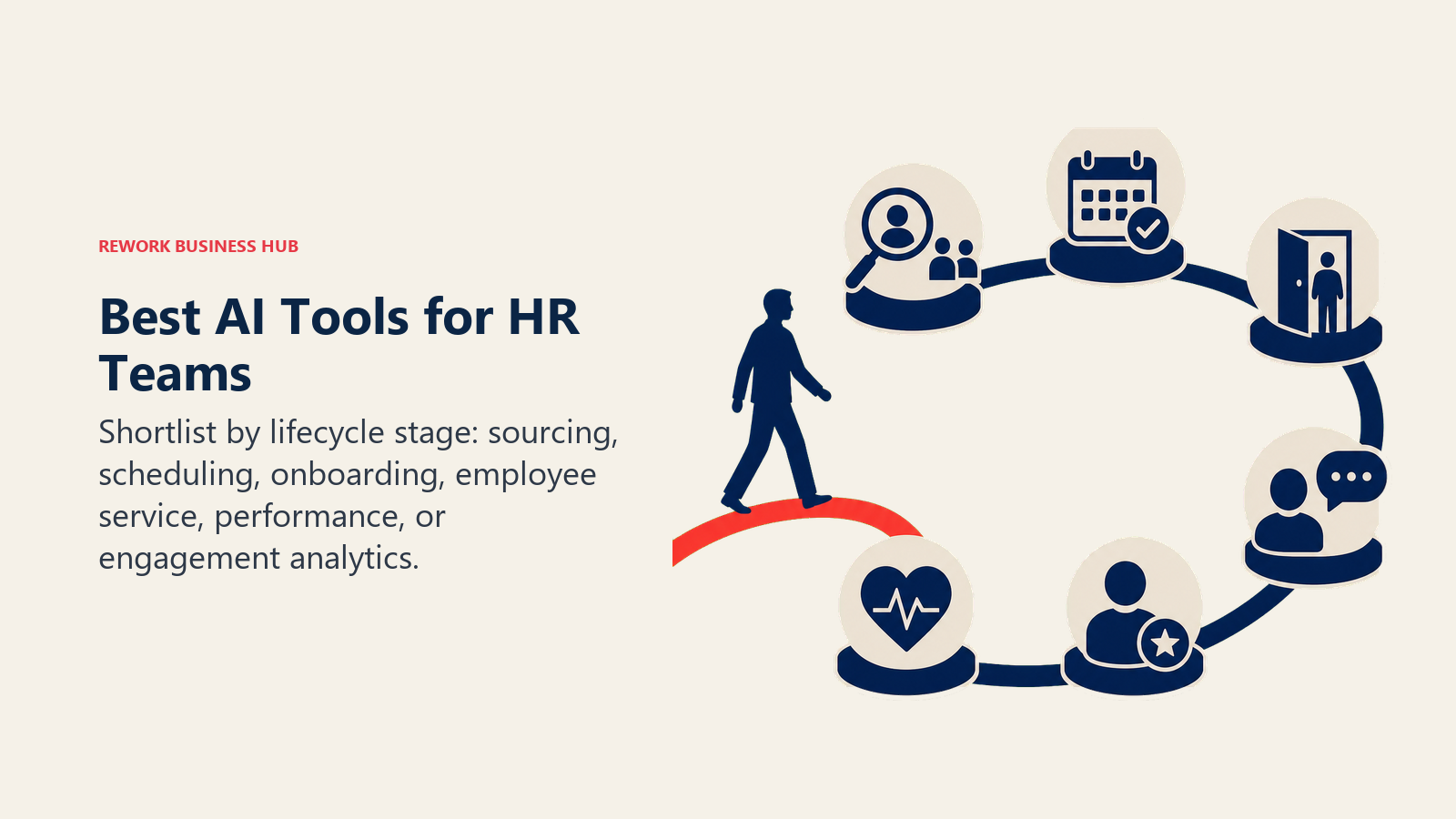
An HR team's AI problem isn't one problem. Sourcing and screening candidates is a different job than scheduling their interviews, which is a different job than onboarding the ones you hire, which is a different job than answering "how many PTO days do I have left" for the ones who've been there three years. This guide maps 12 real AI tools to the six stages of that lifecycle (sourcing and screening, interview scheduling, onboarding, HR helpdesk, performance, and engagement analytics) so you can shortlist by the stage that actually hurts, not by whichever tool has the loudest marketing this quarter.
Most "AI tools for HR" roundups rank a stack of unrelated tools by feature count and call it a list. That's not how HR teams actually buy. You don't need 12 tools; you need one or two for the specific stage that's broken today, plus a sense of what a unified platform handles versus what still needs a specialist. If you want a deeper, function-by-function ranking across the full HR stack, our best AI tools for HR guide covers 13 tools that way. If recruiting specifically is the pain, best AI recruiting tools goes deeper on sourcing and screening alone. This guide sits above both: it's the lifecycle map you use to figure out which stage to fix first.
What Changed in 2026
- ServiceNow completed its $2.85 billion acquisition of Moveworks on December 15, 2025, and roughly two months later launched ServiceNow EmployeeWorks, folding Moveworks' conversational AI and enterprise search directly into ServiceNow's unified employee portal. That changes how HR helpdesk AI gets bought in 2026: it's increasingly a module of the ITSM platform you already own, not a separate purchase.
- The EU AI Act's high-risk obligations for Annex III systems, which explicitly cover AI used for recruitment, candidate screening, and job ad targeting, become enforceable on August 2, 2026. Any HR team using AI anywhere in hiring needs a documented risk assessment and human oversight process in place before that date. See the compliance section below.
- Paradox's Olivia continues integrating into Workday's talent stack following Workday's October 2025 acquisition of Paradox, and its packaging keeps shifting as that integration deepens, so verify current terms before you sign.
Key Facts
- Talent acquisition is the top AI use case in HR at 64% adoption, followed by learning and development at 43% and performance management at 25%, per SHRM's State of AI in HR 2026 report.
- 82% of CHROs plan to adopt AI agents within the next year, per Gartner's "Prepare for the Future of AI Agents in HR" research, cited via Eightfold.
- Recruiters using AI save roughly a full workday a week, about 20% of their work week, per LinkedIn's Future of Recruiting report.
- Structured onboarding produces 50% greater new-hire productivity and makes new employees 58% more likely to still be with the company after three years, per SHRM.
- Disengaged employees cost the global economy $8.9 trillion in lost productivity a year, while teams in the top quartile of engagement post 23% higher profitability than the bottom quartile, per Gallup.
- 85% of employers using automation or AI in HR say it saves time and/or increases efficiency, per SHRM.
- AI systems used for recruitment, candidate screening, and job ad targeting are classified high-risk under Annex III of the EU AI Act, with obligations enforceable from August 2, 2026, per the European Commission's AI Act Service Desk.
The HR AI Lifecycle Map
Before the tool list, here's the shape of the problem. Six stages, six different jobs, and not every team needs AI at every stage on day one.
| Stage | What AI Actually Handles | Tools in This Guide |
|---|---|---|
| Sourcing and screening | Finding candidates in a huge pool, then filtering or scoring them before a human looks | SeekOut, HireVue |
| Interview scheduling | Coordinating calendars across candidates and multiple interviewers without the email back-and-forth | GoodTime, Paradox (Olivia) |
| Onboarding | Automating paperwork, task checklists, and policy Q&A for new hires (and new contractors) | Rippling AI, Deel, Paradox (Olivia) |
| HR helpdesk and employee service | Answering routine employee questions and resolving tickets without a human agent | Leena AI, Moveworks (ServiceNow) |
| Performance management | Drafting review summaries, tracking 1:1 themes, and surfacing goal progress | Lattice AI, 15Five |
| Engagement analytics | Turning survey data into manager-level, actionable insight instead of a static dashboard | Culture Amp |
Rework's People app spans multiple of these stages (HRIS, time & attendance, and onboarding-adjacent workflows) as part of a broader operations platform rather than a stage-specific specialist; it's covered on its own further down.
Quick Comparison Table
| Tool | Lifecycle Stage | Best For | Starting Price | Key Strength |
|---|---|---|---|---|
| Rework (People app) | All stages (unified platform) | Mid-size teams wanting HR unified with sales and work ops | People app pricing not published (contact); other engines from $69/mo billed yearly | HRIS, attendance, and timesheets share a data model with CRM and work ops |
| SeekOut | Sourcing | AI sourcing across 1B+ public profiles | $149/mo (Recruit Core, annual) | Deep diversity and skills filters on a massive candidate index |
| HireVue | Screening | Structured, scored AI video interviews at scale | Not published; Vendr median $20,900/yr | Competency-based AI scoring standardizes screening decisions |
| GoodTime | Interview scheduling | Eliminating recruiter-coordinator scheduling back-and-forth | Not published; estimated $250-$500+/mo for smaller teams | AI scheduling logic synced across every interviewer's calendar |
| Paradox (Olivia) | Screening, scheduling, onboarding | High-volume, frontline hiring and onboarding | Custom, from roughly $1,000+/mo | One 24/7 conversational thread spans three lifecycle stages |
| Rippling AI | Onboarding | Companies wanting HR, IT, and finance onboarding unified | $8/employee/mo (Core) + $35/mo base | AI workflow builder automates onboarding across departments |
| Deel | Onboarding (global) | Hiring and onboarding employees and contractors across borders | $599/employee/mo (EOR); $49/contractor/mo | AI-assisted compliance across 130+ countries |
| Leena AI | HR helpdesk | Large enterprises wanting an agentic HR service desk | Custom quote only | Pre-built "AI colleagues" auto-resolve routine HR tickets |
| Moveworks (ServiceNow) | HR helpdesk | Enterprises standardizing employee service AI inside ServiceNow | Median annual contract around $130,000 | Folded directly into ServiceNow's unified employee portal |
| Lattice AI | Performance | Teams layering AI performance management on an existing HRIS | $13/seat/mo (Foundations); $4,000/yr minimum | AI review summaries, 1:1 theme tracking, and comp insights |
| 15Five | Performance and engagement | Continuous feedback with AI coaching at a lower price point | $4/user/mo (Engage) up to $16/user/mo (Total) | Kona AI meeting assistant bundled with check-ins and OKRs |
| Culture Amp | Engagement analytics | Mid-size to large teams wanting AI-powered survey analytics | Not published; estimated from $4,500+/yr | People Science and AI Coach across engagement, performance, and development |
Stage 1: Sourcing and Screening
This is where most "AI for HR" spend still concentrates: finding candidates in a pool too large to browse manually, then filtering or scoring them before a recruiter ever opens a resume. If this is your only pain point, our best AI recruiting tools guide covers 12 tools here in more depth, including sourcing specialists like hireEZ and Eightfold that didn't make this lifecycle-wide cut.
SeekOut: AI Sourcing Across a Massive Candidate Index
SeekOut's pitch is depth of index and depth of filtering: over a billion public profiles, searchable by skills, diversity criteria, and inferred career trajectory rather than just keyword match. For recruiting teams that need to build a candidate pool from scratch, especially for hard-to-fill technical or diversity-focused searches, that breadth is the draw.
The tradeoff is that SeekOut is a sourcing tool, not a full applicant tracking system. It's strongest paired with an existing ATS rather than as a replacement for one.
| What you get | What you don't |
|---|---|
| AI sourcing across 1B+ public candidate profiles | Not an ATS; needs to sit alongside your existing system |
| Deep diversity and skills-based filtering | Full platform depth requires the higher Enterprise tier |
| Annual contracts keep per-month cost predictable | Best value at higher search volume, less so for occasional hiring |
| Strong for hard-to-fill technical and specialized roles | Candidate outreach still requires a human sourcer's judgment |
Pricing: $149/month (Recruit Core, billed annually); higher tiers with expanded filters and integrations are custom-quoted.
Best for: Recruiting teams sourcing technical or specialized roles who need to build candidate pools beyond what an ATS's applicant database can surface.
HireVue: Structured, Scored AI Video Interviews
HireVue standardizes what would otherwise be dozens of inconsistent live phone screens into structured, competency-based video interviews that AI scores against a defined rubric. For high-volume screening where every candidate needs a comparable, defensible evaluation, that consistency is the value proposition.
The honest limitation is cost and rigidity: HireVue is priced for volume, not for teams hiring a handful of roles a year, and structured scoring works best when the role itself is structured enough to define clear competencies upfront.
| What you get | What you don't |
|---|---|
| Structured, AI-scored video interviews at scale | Pricing not published; Vendr-reported median lands north of $20K/yr |
| Consistent, defensible screening criteria across candidates | Less useful for roles too undefined to score against a rubric |
| Reduces recruiter time spent on first-round live screens | Candidate experience concerns if async video isn't well managed |
| Strong audit trail for screening decisions | Overkill for teams screening under a few hundred candidates a year |
Pricing: Not published; the median contract value reportedly sits around $20,900/year.
Best for: Mid-size to large recruiting teams screening enough candidates per role that a structured, scored video format pays back the setup effort.
Stage 2: Interview Scheduling
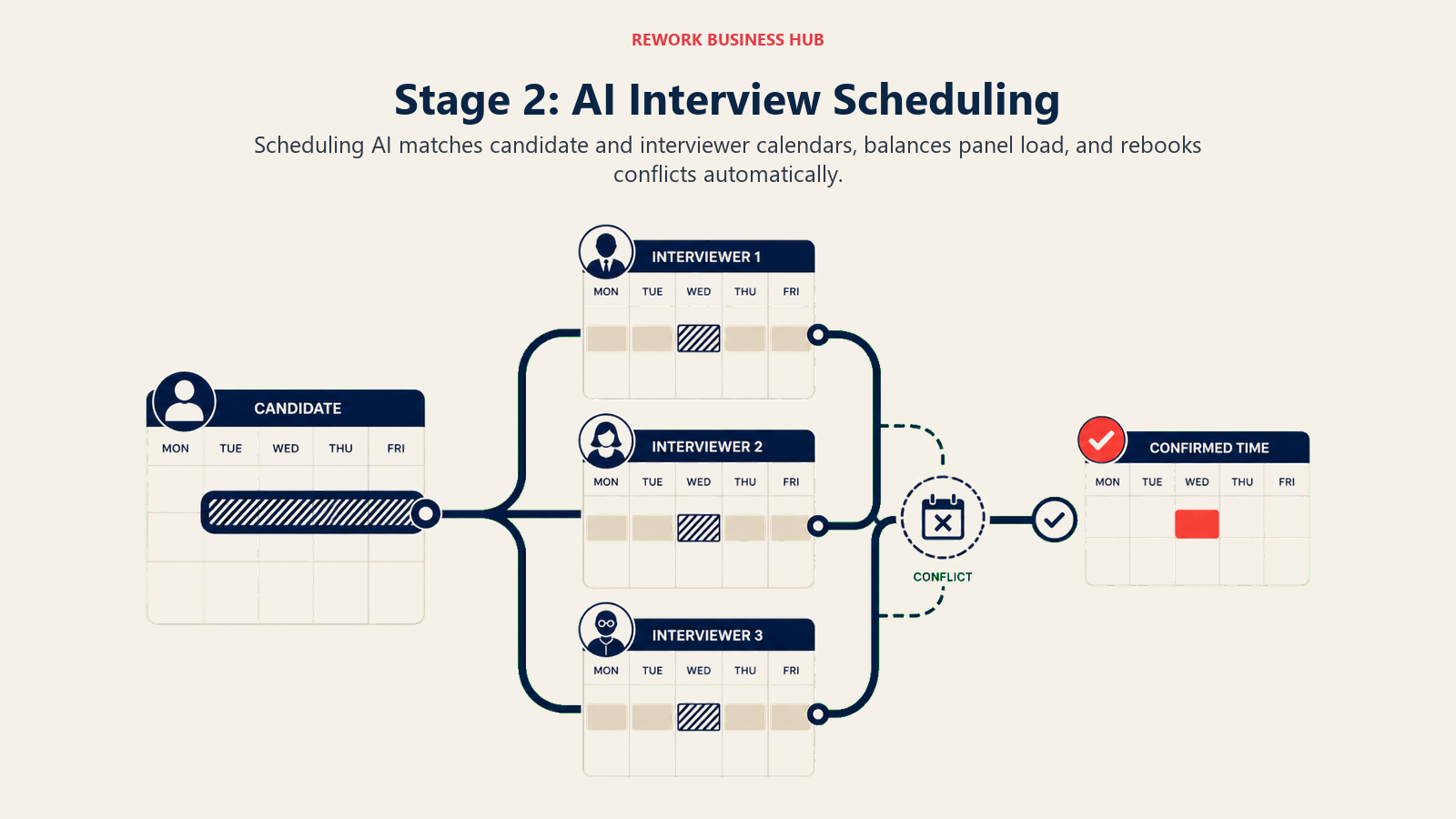
Interview scheduling is the least glamorous stage and the one that eats the most raw hours: coordinating a single interview across a candidate's calendar and two or three interviewers' calendars, then rescheduling when someone inevitably has a conflict. This is a distinct problem from meeting notes or transcription; if what you actually need is AI notetaking for the interviews themselves once they're on the calendar, see our best AI meeting assistants guide instead.
GoodTime: AI Scheduling Logic Built for Recruiting Coordination
GoodTime is purpose-built for the specific chaos of recruiting coordination: matching candidate availability against multiple interviewer calendars, respecting interviewer load limits, and automatically rebooking when someone cancels, all without a coordinator manually replaying the same email thread for every candidate. For teams running high interview volume with panel interviews, that automation removes one of recruiting's most repetitive manual tasks.
GoodTime doesn't publish pricing, and quotes scale with team size and interview volume, so it's worth a demo before assuming it fits a smaller team's budget.
| What you get | What you don't |
|---|---|
| AI scheduling logic synced across every interviewer's calendar | No published pricing; quotes vary by team size and volume |
| Automatic rebooking when interviewers cancel or conflict | Built for volume; less cost-efficient for occasional hiring |
| Reduces coordinator time spent on manual calendar tetris | Primarily a scheduling tool, not a full ATS or CRM |
| Strong fit for panel interviews with multiple stakeholders | Best ROI shows up at higher interview volume |
Pricing: Not published; roughly $250-$500+/month for smaller teams, with custom enterprise quotes for larger volume.
Best for: Recruiting teams running frequent panel interviews who are losing real coordinator hours to manual scheduling back-and-forth.
Paradox (Olivia): One Conversation Spans Screening, Scheduling, and Onboarding
Paradox's Olivia earns a spot across three stages of this lifecycle map because it's genuinely built to span them: the same conversational AI thread that screens a high-volume frontline candidate over SMS also handles interview scheduling and, once hired, walks them through onboarding paperwork and first-day logistics. For retail, hospitality, and healthcare-scale hiring where candidates don't live in email, that single-thread continuity is the differentiator.
Paradox doesn't publish pricing, and its packaging is actively shifting following Workday's October 2025 acquisition. For teams evaluating it purely as a screening tool rather than an onboarding assistant, the best AI recruiting tools guide covers it alongside HireVue and SeekOut in more depth.
| What you get | What you don't |
|---|---|
| 24/7 conversational AI for screening, scheduling, and onboarding | No published pricing; everything is custom-quoted |
| One continuous thread across three lifecycle stages | Not a general HRIS or performance tool |
| SMS and chat-native, fits candidates who don't check email daily | Packaging is shifting post-Workday acquisition |
| Purpose-built for high-volume, frontline hiring | Overkill for low-volume, knowledge-work hiring |
Pricing: Custom, starting from roughly $1,000+/month for smaller deployments; mid-market deployments commonly run $25,000-$60,000/year.
Best for: Retail, hospitality, and healthcare-scale organizations that want screening, scheduling, and onboarding handled in one conversational thread instead of three separate tools.
Stage 3: Onboarding
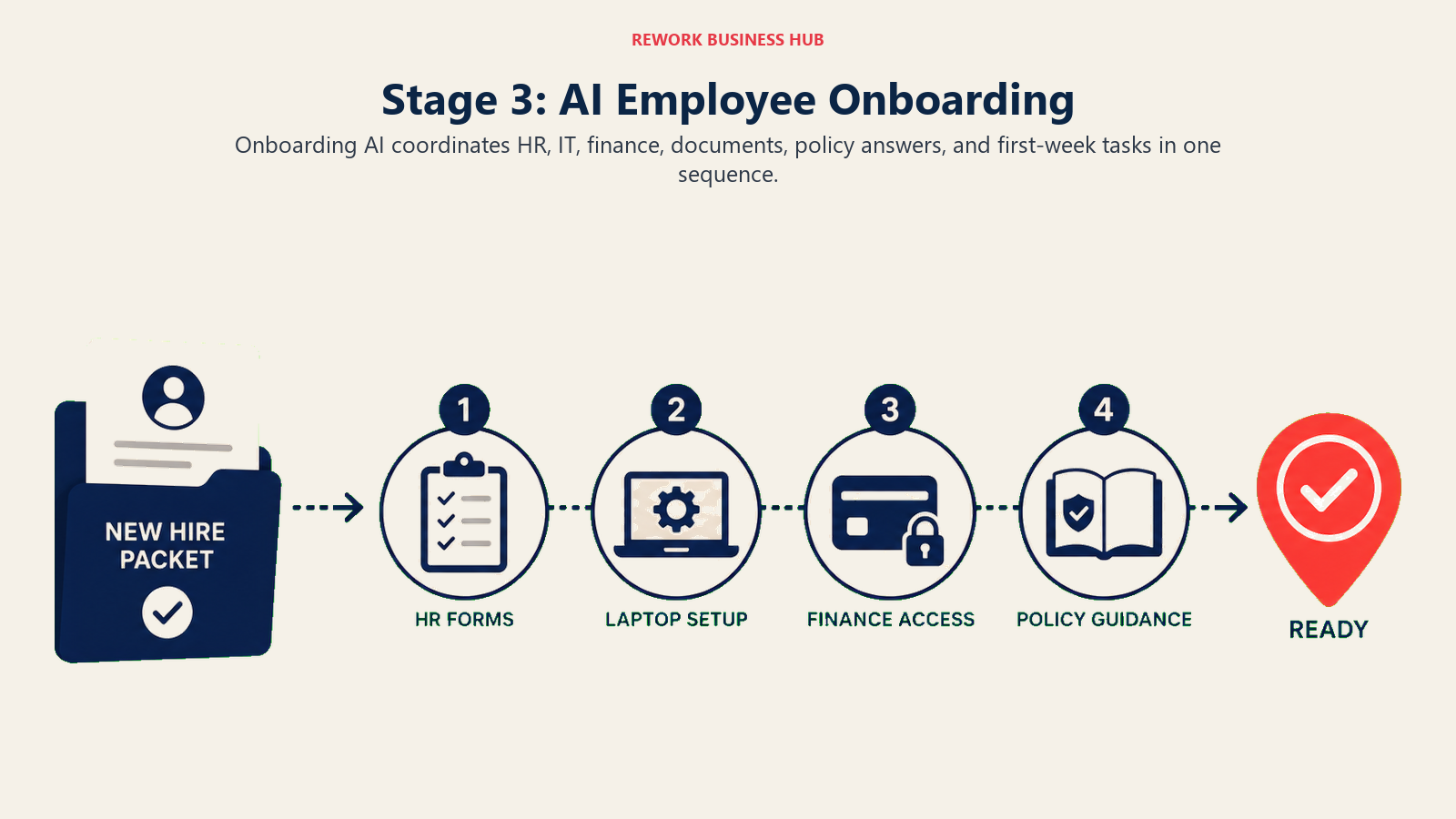
Onboarding is where AI tools shift from candidate-facing to employee-facing: task checklists, policy questions, document collection, and the first-week logistics that determine whether a new hire feels set up or lost. Teams building a custom onboarding assistant from scratch (rather than buying one) can also start from our AI Employee Onboarding Agent blueprint, which walks through task guidance and policy Q&A design section by section.
Rippling AI: Onboarding Automated Across HR, IT, and Finance
Rippling's onboarding value comes from its breadth: because HR, IT, and finance run on the same platform, a new hire's onboarding workflow can trigger IT device provisioning and finance system access in the same automated sequence, not three disconnected tickets across three tools. Rippling AI sits in the workflow builder, automating policy Q&A and onboarding checklists without custom code.
The tradeoff is Rippling's modular pricing: core HR is competitively priced on its own, but the IT and finance modules that make onboarding genuinely cross-functional each add cost. If you're comparing it against other unified HR platforms, see our best Rippling alternatives list.
| What you get | What you don't |
|---|---|
| AI-automated onboarding across HR, IT, and finance workflows | Module-level pricing is custom and not fully published |
| Cross-functional onboarding in one sequence, not three separate tickets | Easy to overbuy modules you don't need yet |
| Strong automation builder for checklists and approvals | Implementation fees and annual contracts add friction |
| Scales from SMB to large mid-market | Total cost climbs fast once IT and finance modules are added |
Pricing: Core HR from $8/employee/month plus a $35/month base fee; most full builds land at $20-35 per employee per month once payroll, IT, and benefits modules are added.
Best for: Growing companies (25-500 employees) that want onboarding to trigger IT and finance provisioning automatically, not just an HR checklist.
Deel: AI-Assisted Onboarding Across 130+ Countries
Deel's onboarding problem is different from Rippling's: it's not about connecting HR to IT and finance, it's about onboarding employees and contractors compliantly across dozens of countries at once, each with its own employment law, tax treatment, and paperwork. Deel's AI layer helps automate the compliance-heavy parts of that (contract generation, classification checks, document collection) so a distributed hiring team doesn't need in-house employment counsel in every country.
That specialization comes at a real per-employee price for the Employer of Record (EOR) product, which makes Deel a poor fit as a general-purpose core HRIS for a single-country team.
| What you get | What you don't |
|---|---|
| AI-assisted compliance and onboarding across 130+ countries | EOR pricing is steep at low volume |
| Handles contractor and full-time employee classification together | Best-of-breed for global hiring, not a core HRIS replacement |
| Fastest path to compliant onboarding in a new country | Overkill for teams hiring only in one country |
| Contract generation and document collection automated | Full HR platform depth (performance, engagement) is limited |
Pricing: $599/employee/month (EOR); $49/contractor/month, per Deel's published rate card.
Best for: Companies onboarding employees and contractors across multiple countries who need compliant paperwork handled without hiring local employment counsel for each one.
Stage 4: HR Helpdesk and Employee Service
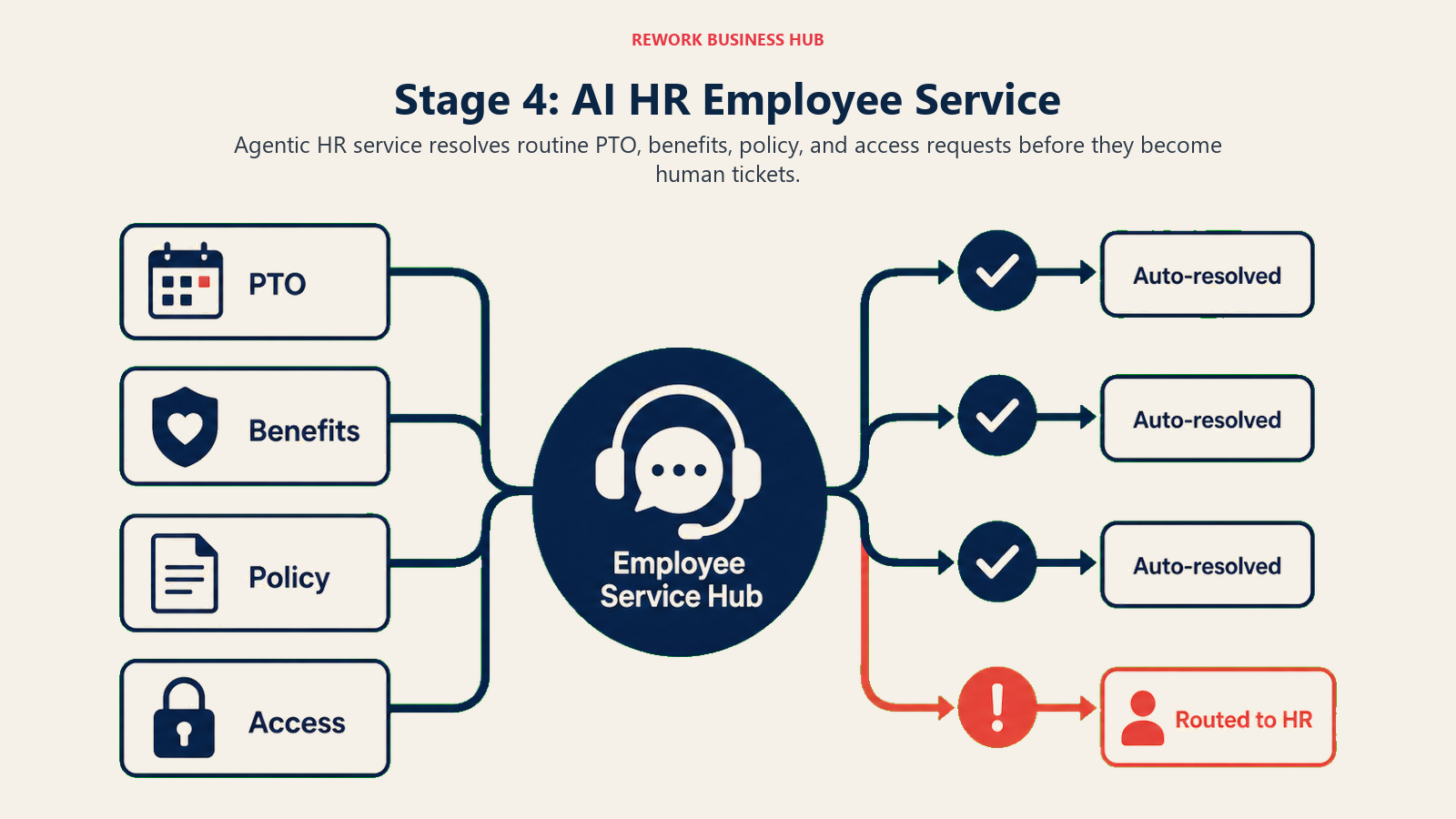
Once someone's onboarded, most of what they need from HR is repetitive: PTO balances, benefits questions, policy lookups, password resets that land on HR's desk anyway. This is the stage where agentic AI has moved fastest in 2026, largely because it looks a lot like customer support automation applied internally. If your team is already evaluating a general-purpose support chatbot for this, our best AI chatbots comparison covers the non-HR-specific options too.
Leena AI: Agentic HR Service Desk for the Enterprise
Leena AI's positioning is "AI colleagues" rather than chatbots: pre-built AI agents that sit across HR, IT, and finance and are designed to resolve routine employee requests (password resets, policy questions, leave balance checks, onboarding paperwork) without a human ticket ever being opened. The vendor reports agents going live in roughly 45 days and auto-resolving more than 70% of tickets, a vendor-reported figure worth validating in your own pilot rather than taking at face value.
This is squarely an enterprise play. Leena AI doesn't publish pricing, and its headcount-based, quote-driven model is built for large, stable organizations, not teams still figuring out their HR tech stack.
| What you get | What you don't |
|---|---|
| Pre-built "AI colleagues" for HR, IT, and finance ticket resolution | Custom, quote-driven pricing with no published tiers |
| Vendor-reported 70%+ auto-resolution and fast go-live | Headcount-based pricing is hard to forecast |
| Reduces routine ticket load on HR operations teams | Overkill for teams without high ticket volume |
| Built for large, stable enterprise headcounts | Vendor-reported metrics should be validated in a pilot |
Pricing: Custom, enterprise-only; no published pricing tiers.
Best for: Large enterprises with high HR/IT/finance ticket volume wanting an agentic AI service desk layered on top of their existing systems.
Moveworks (ServiceNow): Employee Service AI Inside Your ITSM Platform
Moveworks' pitch shifted meaningfully in 2026. Since ServiceNow completed its acquisition in December 2025 and launched ServiceNow EmployeeWorks two months later, Moveworks' conversational AI and enterprise search now live inside ServiceNow's unified employee portal rather than as a standalone product. For organizations that already run ServiceNow for IT service management, that means HR helpdesk AI is increasingly a configuration decision within a platform they already own, not a new vendor relationship.
For companies not already on ServiceNow, adopting Moveworks now means adopting ServiceNow's broader platform, which is a much bigger commitment than a point HR helpdesk tool.
| What you get | What you don't |
|---|---|
| Conversational AI and enterprise search inside ServiceNow's employee portal | Effectively requires ServiceNow as the underlying platform now |
| Serves HR, IT, and finance requests from one unified interface | No standalone, HR-only entry point post-acquisition |
| Backed by ServiceNow's workflow and governance engine | Median annual contract value runs around six figures |
| Strong fit for enterprises already invested in ServiceNow | Not a lightweight option for smaller HR teams |
Pricing: Median annual contract around $130,000, breaking down to roughly $15-45 per employee; ServiceNow does not publish standalone list pricing.
Best for: Enterprises already running ServiceNow for IT service management that want employee service AI extended into HR on the same platform.
Stage 5: Performance Management
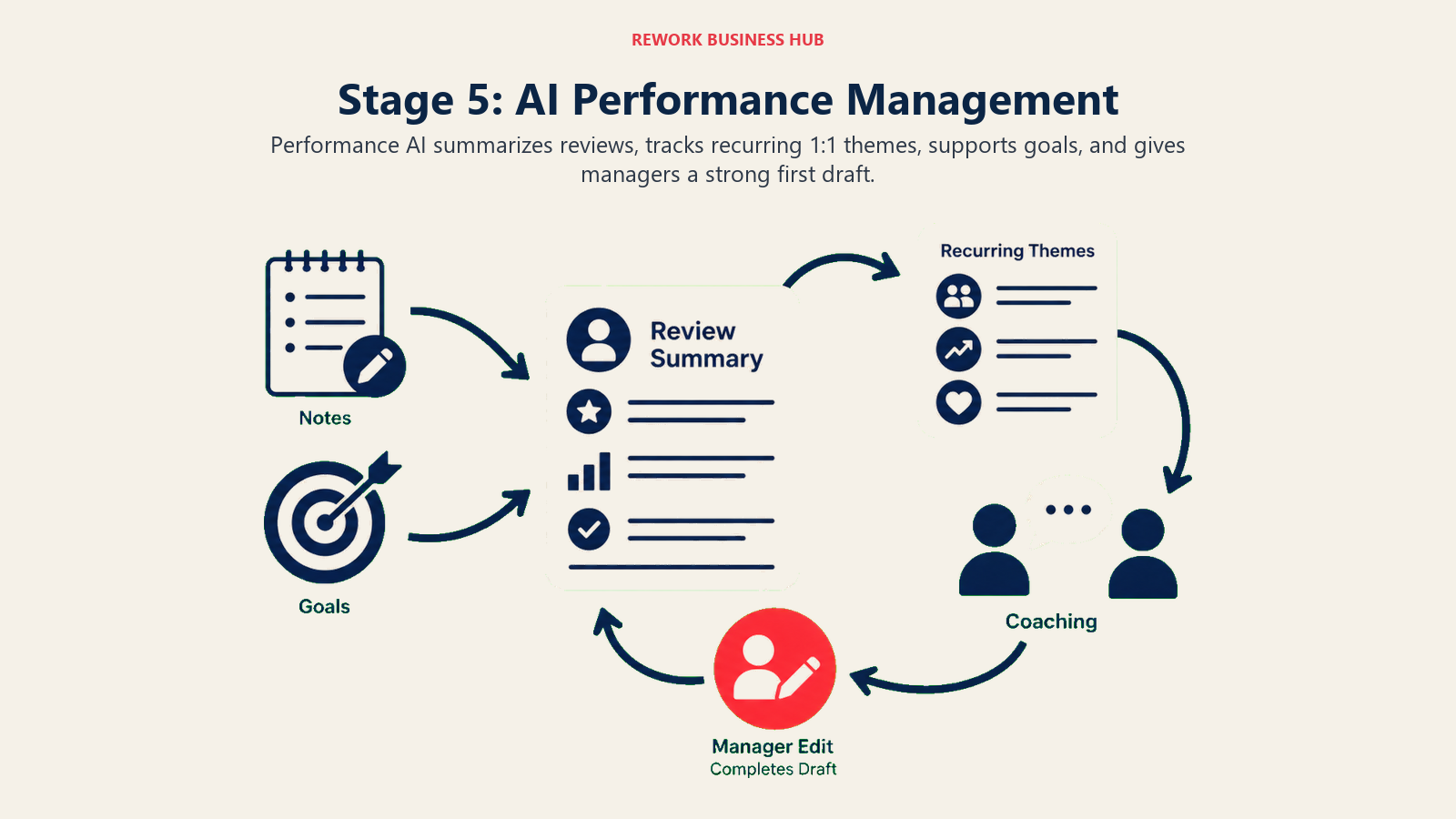
Performance management is where AI shifted from "nice to have" to genuinely time-saving fastest: summarizing reviews, tracking recurring 1:1 themes, and drafting first passes so managers edit instead of starting from a blank page. Teams designing their own review process before picking a tool can start with our Performance Review Framework, and teams building a custom AI drafting layer can reference the AI Performance Review Agent blueprint.
Lattice AI: AI Layered on Performance, Goals, and Engagement
Lattice built its name on performance management and OKRs, and its AI layer extends that focus rather than trying to be a full HRIS. The AI agent summarizes performance reviews, tracks recurring themes across 1:1 meetings, surfaces engagement insights, and assists with compensation analysis, all sitting on top of whatever core HRIS already runs your payroll.
That's the honest tradeoff: Lattice is not an HRIS and has no payroll of its own, so it needs a system like BambooHR, Rippling, or HiBob running underneath it. Our best Lattice alternatives list covers other options if you want performance management bundled differently.
| What you get | What you don't |
|---|---|
| AI review summaries, 1:1 theme tracking, and compensation insights | Not an HRIS; needs a core payroll system alongside it |
| Modular pricing lets you buy only the modules you need | $4,000/year minimum regardless of team size |
| Best-in-class OKR and goals tooling | Engagement and Grow modules cost extra on top of the base |
| Strong manager-facing coaching tools | Full stack (Performance + Engagement + Grow + Comp) adds up fast |
Pricing: Foundations bundle (Performance, Goals & OKRs, succession, 1:1s) at $13/seat/month; Engagement +$4/seat/month; Grow +$4/seat/month; Compensation +$6/seat/month. $4,000/year minimum contract.
Best for: Mid-size to large teams that already have a core HRIS and want a dedicated AI layer for performance, goals, and engagement.
15Five: Continuous Feedback with AI Coaching at a Lower Entry Price
15Five's angle is continuous, lighter-weight performance management rather than a heavyweight annual review cycle: check-ins, 1:1s, and OKRs with AI woven throughout, including Kona, an AI meeting assistant that generates performance-relevant notes and coaching prompts from manager conversations. For teams that find Lattice's pricing or depth more than they need, 15Five's modular tiers give a lower entry point into similar territory.
The honest limitation is the same as Lattice's: 15Five is not an HRIS and doesn't run payroll, so it sits alongside whatever core system handles employee records.
| What you get | What you don't |
|---|---|
| AI-powered engagement surveys and continuous check-ins | Not an HRIS; needs a core payroll system alongside it |
| Kona AI meeting assistant generates coaching-ready notes | Full platform (Engage + Perform) costs more than either alone |
| Lower entry price than Lattice for similar functional territory | Compensation module is a separate add-on |
| Manager training microlearnings bundled into the Total plan | Smaller ecosystem and brand recognition than Lattice |
Pricing: Engage (surveys and AI analytics) at $4/user/month; Perform (reviews, 1:1s, OKRs) at $11/user/month; Total (both, plus manager training) at $16/user/month; Kona add-on at $2/employee/month.
Best for: Mid-size teams wanting continuous performance and engagement feedback with AI coaching, at a lower price point than a full Lattice deployment.
Stage 6: Engagement Analytics
Engagement surveys have existed for decades; what's new in 2026 is AI turning raw survey data into insight a manager can actually act on, rather than a company-wide dashboard nobody opens after the all-hands.
Culture Amp: AI-Powered Engagement, Performance, and Development Analytics
Culture Amp's bet is that engagement, performance, and development data should live in one analytics layer rather than three disconnected survey tools. Its AI Coach sits across all three modules, translating survey results and review data into specific, manager-level coaching suggestions instead of a single static company report, backed by what the company calls decades of accumulated People Science research.
Culture Amp doesn't publish pricing, and cost scales meaningfully with which modules you select and how many employees they cover, so budgeting requires a sales conversation before you can compare it cleanly against a standalone tool like Macorva or a bundled option like Lattice's Engagement module.
| What you get | What you don't |
|---|---|
| AI Coach across engagement, performance, and development modules | No published pricing; quote-based and scales with modules selected |
| People Science research backing survey design and benchmarks | Enterprise-scale contracts run well into five figures annually |
| Manager-level, actionable coaching insight, not just a dashboard | Standalone survey tool; needs a core HRIS alongside it |
| Strong benchmarking data across industries and company sizes | Full three-module depth costs more than picking one |
Pricing: Not published; roughly $4,500/year and up for small teams, with the Engage module running $5-9/employee/month, and enterprise teams (1,000+ employees) reportedly paying $36,000-$45,000+/year.
Best for: Mid-size to large teams wanting AI-powered engagement, performance, and development analytics in one unified platform rather than three separate survey tools.
Rework: HR Unified Across Every Stage
Rework's People app takes a different approach than every other tool on this list: instead of specializing in one lifecycle stage, it covers the core of what most mid-size teams need from HR software (an HRIS for employee records, time & attendance tracking, and timesheets) on the same platform as Rework's CRM, lead management, and work ops products. The AI positioning isn't stage-specific depth. It's that HR data doesn't have to sit in a sixth disconnected tool when the rest of the company already runs sales, marketing, and project work through Rework.
That makes it a genuinely different fit than the specialists above. If your actual problem is that HR, sales, and ops each live in separate systems and you want HR data pulled into the same operating system the rest of the company already uses, Rework is worth a look. If you need deep candidate screening AI, agentic ticket resolution, or an AI-native performance suite, it isn't the right fit yet, and honestly says so.
| What you get | What you don't |
|---|---|
| HRIS, time & attendance, and timesheets on the same platform as CRM and work ops | Not a deep global payroll or benefits administration suite |
| HR data unified with sales, lead, and project workflows | People app pricing isn't published yet; contact for a quote |
| No candidate screening or ticket-resolution AI to fall out of scope for compliance | Less stage-specific AI depth than SeekOut, Leena AI, or Lattice today |
| Fits teams already consolidating tool sprawl across departments | Not built for solo HR admins or very small teams |
Pricing: The People app has no published per-employee rate yet; contact rework.com/pricing for a quote. Rework's engines start at $69/month billed yearly (Sales Engine) and $99/month billed yearly (Marketing, Process or Project Engine), each with 5 seats included; those prices don't apply to People.
Best for: 20-500 person teams that want HR unified with sales, lead, and work ops on one data model instead of running HR as a sixth disconnected tool.
Bias and Compliance: What the EU AI Act Means for Your HR AI Stack
If any tool in your stack touches recruitment, candidate screening, or job ad targeting, the compliance conversation isn't optional in 2026. The EU AI Act classifies those specific uses as high-risk under Annex III, and the obligations attached to that classification become enforceable on August 2, 2026, per the European Commission's AI Act Service Desk. This applies to any organization operating in or hiring from the EU, not just EU-headquartered companies, and the scope extends beyond traditional employees to contractors and platform workers evaluated by the same systems.
This isn't legal advice, and the exact requirements depend on your specific deployment, so involve counsel before your compliance deadline arrives. But the shape of what's coming is clear enough to plan around now.
| Obligation | What It Means for HR Teams | Deadline |
|---|---|---|
| Documented risk assessment | Identify and document known and foreseeable risks in any recruitment or screening AI before and during use | Enforceable August 2, 2026 |
| Bias testing | Test screening and scoring tools for discriminatory outcomes across protected characteristics, not just accuracy | Enforceable August 2, 2026 |
| Human oversight | A human must review and be able to override AI-driven candidate decisions; full automation of hire/reject calls is not compliant | Enforceable August 2, 2026 |
| Transparency disclosure | Candidates must be told when AI is used to evaluate them | Enforceable August 2, 2026 |
| Technical documentation | Maintain records of how the AI system works, what data trained it, and how it's monitored | Enforceable August 2, 2026 |
| Continuous monitoring | Ongoing tracking of the system's real-world performance and risk profile, not a one-time audit | Ongoing after August 2, 2026 |
Of the tools in this guide, SeekOut, HireVue, and Paradox sit squarely in scope because they source, screen, or score candidates. GoodTime, the onboarding tools, the HR helpdesk tools, and the performance and engagement tools generally fall outside Annex III point 4 because they don't make recruitment or selection decisions, though EU works-council and data protection rules can still apply to any employee-data AI tool regardless of Annex III status. Rework's People app doesn't perform candidate screening or selection, so it isn't the high-risk use case here, but that's a reason to verify scope for every tool in your stack, not a reason to skip the exercise.
How to Choose: Decision Framework
The right HR AI tool depends on the lifecycle job, the systems already in place, and whether the team needs answers or completed work.
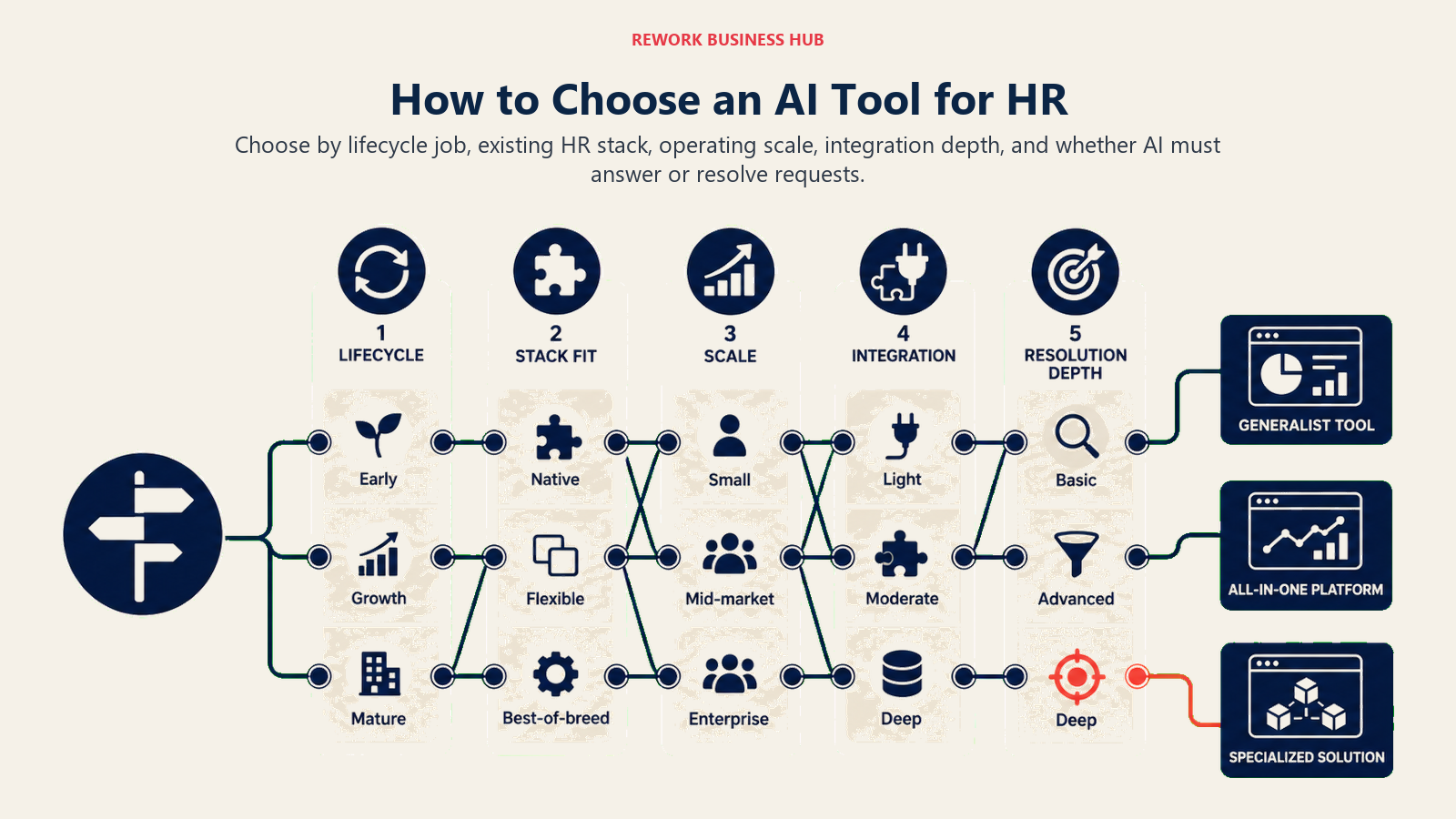
| If you need... | Pick... | Why |
|---|---|---|
| AI sourcing across a huge public candidate index | SeekOut | Deepest candidate index paired with strong diversity and skills filters |
| Structured, scored video interviews at scale | HireVue | Competency-based AI scoring standardizes screening decisions |
| To stop losing hours to scheduling back-and-forth | GoodTime | Purpose-built AI scheduling logic synced across every interviewer's calendar |
| 24/7 conversational screening, scheduling, and onboarding in one thread | Paradox (Olivia) | The only tool here that spans three lifecycle stages in one conversation |
| HR, IT, and finance onboarding automated in one system | Rippling AI | AI workflow builder automates onboarding across departments |
| To onboard employees and contractors across borders compliantly | Deel | AI-assisted compliance across 130+ countries |
| An agentic HR service desk that resolves tickets, not just answers FAQs | Leena AI | Pre-built "AI colleagues" auto-resolve routine requests |
| Employee service AI already inside your ITSM platform | Moveworks (ServiceNow) | Folded directly into ServiceNow's unified employee portal |
| AI performance reviews and 1:1 tracking on an existing HRIS | Lattice AI | Best-in-class OKR and review AI layered on whatever runs payroll |
| Continuous engagement plus performance at a lower price point | 15Five | AI coaching (Kona) bundled with check-ins at a lower cost than Lattice |
| AI-powered engagement survey analytics at scale | Culture Amp | People Science plus AI Coach across engagement, performance, and development |
| HR unified with sales, lead, and work ops instead of a standalone stack | Rework (People app) | HRIS, attendance, and timesheets share a data model with the rest of your ops |
What to Do Next
Pick the lifecycle stage that hurts most right now, not the tool with the flashiest AI demo. Shortlist two options from the same row of the decision framework above, run a 30-day pilot with real candidates or real employee data, and measure whether it actually reduces manual work before you sign an annual contract. If any tool you're piloting touches recruitment or screening, start the EU AI Act risk assessment in parallel, not after you've already signed. And if your core problem turns out to be that HR data lives in a different system than the rest of your company's revenue and operations work, Rework's People app is worth a look alongside the specialists on this list.

Principal Product Marketing Strategist
On this page
- What Changed in 2026
- Key Facts
- The HR AI Lifecycle Map
- Quick Comparison Table
- Stage 1: Sourcing and Screening
- SeekOut: AI Sourcing Across a Massive Candidate Index
- HireVue: Structured, Scored AI Video Interviews
- Stage 2: Interview Scheduling
- GoodTime: AI Scheduling Logic Built for Recruiting Coordination
- Paradox (Olivia): One Conversation Spans Screening, Scheduling, and Onboarding
- Stage 3: Onboarding
- Rippling AI: Onboarding Automated Across HR, IT, and Finance
- Deel: AI-Assisted Onboarding Across 130+ Countries
- Stage 4: HR Helpdesk and Employee Service
- Leena AI: Agentic HR Service Desk for the Enterprise
- Moveworks (ServiceNow): Employee Service AI Inside Your ITSM Platform
- Stage 5: Performance Management
- Lattice AI: AI Layered on Performance, Goals, and Engagement
- 15Five: Continuous Feedback with AI Coaching at a Lower Entry Price
- Stage 6: Engagement Analytics
- Culture Amp: AI-Powered Engagement, Performance, and Development Analytics
- Rework: HR Unified Across Every Stage
- Bias and Compliance: What the EU AI Act Means for Your HR AI Stack
- How to Choose: Decision Framework
- What to Do Next