Best AI Tools for Customer Success in 2026
Turn this article into takeaways for your work.


Each assistant summarizes the article only for you and suggests best practices for your work.
If you're evaluating AI tools for customer success in 2026, the field splits into three jobs. Dedicated CS platforms like Gainsight AI, Totango, ChurnZero, Vitally, Planhat, ClientSuccess, and Custify run health scoring, playbooks, and renewal workflows as their core product. Relationship-intelligence and support-adjacent layers like Staircase AI and Pylon sit on top of, or beside, whatever CS platform or CRM you already run. And general-purpose AI, HubSpot's Breeze layered on Service Hub, and ChatGPT itself, gets used by CSMs every day for QBR prep, call summaries, and renewal emails without being a CS platform at all. This guide ranks 12 tools by the job they actually do, with 2026 pricing.
Rework isn't on this ranked list, and that's deliberate. Its unified contact timeline and handoff from sales genuinely help a small team keep customer context in one place, but it isn't a dedicated CS platform: no health scoring, no NRR/GRR tracking, no renewal playbooks. Ranking it against tools purpose-built for that job wouldn't be honest. There's a short note on where it does and doesn't fit near the end of this guide. For the full picture of what a CS tech stack needs beyond any single tool, the CSM tools and tech stack guide is worth reading alongside this one.
Updated July 2026: What Changed
- Totango and Catalyst, merged since February 2024, are still shaking out under one roof. Catalyst now ships as the "Catalyst Customer Growth Platform" inside Totango's Customer Revenue Optimization suite, alongside Totango's own Customer Success Platform and the Unison AI engine. CS leaders evaluating alternatives in 2026 cite pricing instability and ownership uncertainty across the two brands as a real factor in their search.
- Gainsight acquired Staircase AI, folding a standalone relationship-intelligence product (churn signals mined from emails, calls, and Slack) into the Gainsight ecosystem. Staircase still sells as a standalone product for now, but expect deeper bundling as the acquisition matures.
- OpenAI cut ChatGPT Business (formerly Team) pricing to $20/seat/month on annual billing, effective April 2, 2026, down from the prior Team pricing, making it a cheaper on-ramp for CS teams that just want AI drafting and summarization without a dedicated CS platform.
- HubSpot's Breeze Customer Agent moved from per-conversation to per-resolution pricing in April 2026, cutting the headline rate from $1.00 to $0.50 per conversation but tying the charge to an actual resolved outcome.
- Every major CS platform vendor (Gainsight, Totango, ChurnZero, Planhat) is now marketing "agentic" health scoring and next-best-action recommendations, but almost none publish list pricing for the AI layer specifically. Budget for AI features as a negotiated add-on, not a line item you can price from a website.
Key Facts
- Consolidating customer success functions (account management, service, training, and sales) delivers a risk-adjusted ROI of 107% within three years for a composite $1 billion organization, driven by a 5-point retention gain and 6% revenue uplift per account, per Forrester's Total Economic Impact study.
- Bootstrapped B2B SaaS companies ($3M-$20M ARR) post a median net revenue retention of 103% in 2026, with the 90th percentile reaching 117.9%, and retention held essentially flat year over year even as growth slowed, per SaaS Capital's 2026 benchmarking report.
- Gainsight's own customers report a median CS spend of roughly 3% of revenue versus about 8% for non-customers running comparable books of business, per Gainsight's 2026 customer data.
- That same Gainsight dataset shows platform customers are 13% more likely to adopt AI in CS workflows and cover 25% to 70% more accounts per CSM than non-customers, depending on segment, per Gainsight.
- Gartner projects 40% of enterprise applications will embed task-specific AI agents by the end of 2026, up from under 5% in 2025, per Gartner's research, a shift already showing up as CS platforms bundle AI health scoring natively instead of selling it as an add-on.
- 97% of Zendesk customers report a positive ROI from AI-powered customer experience initiatives over the past year, per Zendesk's CX Trends 2026 report.
Quick Comparison Table
| Tool | Best For | Standout Capability | Starting Price | Free Tier? |
|---|---|---|---|---|
| Gainsight AI | Enterprise CS orgs wanting the most mature, AI-native platform | Deepest health scoring, playbooks, and Horizon AI agents on the market | Custom (est. $150-$300/user/mo) | No |
| Totango | Mid-market to enterprise teams wanting a broad CS platform | SuccessBLOCs journey orchestration plus Unison AI | Custom (est. $80K/yr median negotiated) | No |
| Catalyst (Totango) | Teams wanting signal-driven engagement inside the Totango suite | Lightweight, workflow-first UI CS teams historically loved | Custom, sold as part of Totango's CRO suite | No |
| ChurnZero | Mid-market SaaS tying renewal and expansion to CSM playbooks | ChurnScore health scoring plus in-app Cheat Sheets | Custom (est. $15K-$80K/yr) | No |
| Vitally | Tech-touch and PLG teams needing an AI CS copilot | Tech-Touch, Hybrid-Touch, High-Touch tiers built for scale | Custom (est. $1,500-$2,000/mo entry) | No |
| Planhat | Teams wanting unlimited seats and a flexible data model | CS platform, CRM-lite, and PSA in one customer-data model | Custom (est. $1,150/mo Start-Up) | No |
| ClientSuccess | Mid-market SaaS wanting Gainsight-depth without Gainsight cost | Positioned 30-50% below Gainsight-tier platforms | Custom (est. from $1,000+/mo) | No |
| Custify | Smaller B2B SaaS teams wanting a published entry price | One of the few CS platforms with a real list price | $899/mo (up to 3 seats) | No |
| Staircase AI | Teams wanting relationship intelligence layered on an existing stack | Mines emails, calls, and Slack for churn and expansion signals | $499/mo (published starting price) | No |
| Pylon | B2B support and CS teams wanting a modern shared inbox | Slack/Teams/email/chat unified with AI triage agents | $59/seat/mo (3-seat min) | No |
| HubSpot Breeze | HubSpot Service Hub customers wanting AI on data they already have | Pay only for resolved conversations, not every attempt | $0.50/resolution + Service Hub seat | Partial |
| ChatGPT | CS teams wanting cheap AI drafting and summarization, no platform | QBR prep, call summaries, renewal emails in one flexible tool | $20/seat/mo (Business, annual) | Yes (Free tier) |
How to Choose: Decision Framework
| If you need... | Pick... | Why |
|---|---|---|
| The most mature, AI-native platform for a large CS org | Gainsight AI | Deepest health scoring and playbook maturity; now bundling Staircase AI relationship intelligence |
| A broad CS platform with journey orchestration | Totango | SuccessBLOCs plus Unison AI cover onboarding through renewal in one suite |
| Signal-driven engagement inside that same suite | Catalyst (Totango) | Lightweight workflow automation CS teams adopted before the merger |
| Renewal and expansion tightly tied to CSM playbooks | ChurnZero | ChurnScore health scoring plus real-time Cheat Sheets for reps |
| An AI copilot for tech-touch or PLG-style CS | Vitally | Tiered for one-to-many motion; unlimited observer seats on every plan |
| Unlimited seats and a flexible customer data model | Planhat | No per-seat tax; CS, CRM-lite, and PSA share one model |
| Gainsight-like depth without Gainsight-tier cost | ClientSuccess | Built for $5M-$500M ARR SaaS companies specifically |
| A published starting price you can budget from today | Custify | $899/mo for 3 seats is a real number, not a demo request |
| Relationship intelligence layered on a stack you already run | Staircase AI | Mines unstructured comms for signals your CS platform can't see alone |
| A modern shared inbox where support and CS overlap | Pylon | Slack/Teams-native, AI triage agents, built for B2B specifically |
| AI on Service Hub data you already have | HubSpot Breeze | Native to existing HubSpot contact and ticket records |
| Cheap, flexible AI for QBR prep and drafting, no platform | ChatGPT | $20/seat/mo; works alongside any CS platform or spreadsheet |
Framework: By Customer Base Size and CS Maturity
| Stage | Signal | Best Fits |
|---|---|---|
| Pre-formal CS function, under 50 accounts | Founder or AE handling CS part-time | ChatGPT for drafting, a spreadsheet, and a shared inbox |
| First dedicated CSM, 50-300 accounts | Health tracked in a spreadsheet, renewals slipping through cracks | Custify, ClientSuccess, Vitally Tech-Touch |
| Growing CS team, 300-2,000 accounts | Multiple CSMs need shared playbooks and health scoring | ChurnZero, Planhat, Vitally Hybrid-Touch |
| Mature CS org, 2,000+ accounts or $10M+ ARR | RevOps demands NRR/GRR reporting tied to the board deck | Gainsight AI, Totango, Catalyst |
| Signal gap on an existing platform | Health scores miss sentiment shifts and stakeholder changes | Staircase AI layered on top |
| Support and CS overlap heavily | Same team fields tickets and owns relationships | Pylon, or HubSpot Breeze if already on HubSpot |
1. Gainsight AI: The Most Mature, Now AI-Native Platform
Gainsight has been the category leader in customer success software for over a decade, and its 2026 positioning leans hard into "AI-native" with Horizon AI agents layered across health scoring, playbook triggers, and now the Staircase AI relationship-intelligence engine it acquired earlier this year. For enterprise CS orgs with the budget and the account complexity to justify it, nothing else on this list matches the depth.
Best for: Enterprise CS organizations (typically 500+ managed accounts) that want the deepest health scoring, playbook automation, and AI agent tooling in one platform
Key strengths:
- Most mature health scoring and playbook engine in the category, refined over more than a decade of enterprise deployments
- Horizon AI agents now handle next-best-action recommendations and some playbook execution autonomously
- Staircase AI acquisition adds relationship-intelligence signal mining (sentiment, stakeholder changes) natively, rather than requiring a separate integration
Limitations:
- No public pricing; buyers managing 500-1,500 customer records commonly see initial quotes in the $60,000-$120,000 annual range
- Implementation fees can reach $120,000, with 5-10% annual uplifts common at renewal
- Overkill for teams under a few hundred accounts; the platform's depth becomes admin overhead below enterprise scale
Pricing: Custom, quote-only. Third-party benchmarks put per-user pricing at $150-$300/user/month (Essentials to Enterprise), with a median annual contract around $50,501 based on 296 verified purchases tracked by Vendr.
| What you get | What you don't |
|---|---|
| Deepest health scoring and playbook maturity in the category | No public pricing; quotes commonly run $60K-$120K/yr |
| Horizon AI agents plus native Staircase AI signal mining | Implementation fees can reach $120K on top of license cost |
| Longest track record of any dedicated CS platform | Overkill and admin-heavy below a few hundred managed accounts |
If your CS stack still needs a CRM as its spine before a platform like this makes sense, the CSM tools and tech stack guide covers how the pieces fit together, and best CRM software in 2026 ranks 15 CRM platforms by fit.
2. Totango: Broad CS Platform With Unison AI
Totango's pitch is coverage: SuccessBLOCs give CS teams pre-built journey templates for onboarding, adoption, and renewal, and the Unison AI engine layers predictive health scoring and recommended actions across the whole customer lifecycle. Since absorbing Catalyst in the 2024 merger, Totango markets itself as a "Customer Revenue Optimization" suite rather than a pure CS platform, positioning itself for teams that want CS and growth signals in one place.
Best for: Mid-market to enterprise CS teams wanting broad lifecycle coverage without stitching together separate onboarding, health-scoring, and renewal tools
Key strengths:
- SuccessBLOCs give teams a running start with pre-built journey templates instead of building health scoring from scratch
- Unison AI applies predictive scoring and recommended next actions across the full customer lifecycle
- Enterprise and Premier tiers bundle practitioner seats, viewer seats, and account volume into one negotiated package
Limitations:
- Fully quote-based; a sample configuration (2,500 accounts, 3 editor licenses) lists at $120,000/year, with buyers achieving 30-39% discounts to a median negotiated price of $80,040
- Post-merger brand and roadmap consolidation with Catalyst has created real uncertainty that shows up in why CS leaders evaluate alternatives
- Viewer/editor seat structure means real cost depends heavily on how many people need write access versus read-only
Pricing: Custom, quote-only. Buyer-reported list price for a standard 2,500-account configuration runs $120,000/year, with a median negotiated price of $80,040/year after typical discounting.
| What you get | What you don't |
|---|---|
| Broad lifecycle coverage via pre-built SuccessBLOCs | No public pricing; list-to-negotiated spread runs 30-39% |
| Unison AI predictive scoring across the full lifecycle | Post-merger roadmap uncertainty with the Catalyst brand |
| Enterprise/Premier tiers bundle seats and account volume | Editor vs. viewer seat structure complicates real cost |
3. Catalyst (via Totango): Signal-Driven Engagement, Now Bundled
Before the 2024 merger, Catalyst built a loyal following among CS teams for a genuinely different UI: a Slack-like, workflow-first interface that made playbook triggers and account health feel less like enterprise software and more like a modern productivity tool. That product now ships as the "Catalyst Customer Growth Platform" inside Totango's Customer Revenue Optimization suite, sold alongside, not instead of, Totango's own Customer Success Platform.
Best for: CS teams that valued Catalyst's lightweight, workflow-first UI and want that experience with Totango's broader lifecycle and GTM signal coverage behind it
Key strengths:
- Workflow-first interface built around triggers and playbooks rather than static dashboards, still one of the more approachable UIs in the category
- Product and usage signals feed engagement workflows more directly than in most traditional CS platforms
- Now backed by Totango's broader account, viewer-seat, and Unison AI infrastructure
Limitations:
- No separately published pricing; sold as part of Totango's negotiated CRO suite package, so isolating Catalyst's specific cost isn't possible from the outside
- Two co-CEOs and two legacy product lines under one roof means roadmap priorities are still settling more than two years after the merger
- Buyers evaluating it in 2026 should confirm in writing which capabilities stay Catalyst-branded versus which get folded into core Totango
Pricing: Custom, sold as part of Totango's Customer Revenue Optimization suite. No standalone Catalyst pricing is published separately from the combined Totango quote.
| What you get | What you don't |
|---|---|
| Lightweight, workflow-first UI still favored by many CS teams | No pricing separate from the combined Totango quote |
| Product/usage signals feed engagement workflows directly | Roadmap and branding still consolidating post-merger |
| Backed by Totango's broader infrastructure and Unison AI | Isolating Catalyst-specific value from Totango is hard to do |
4. ChurnZero: Renewal and Expansion Tied to CSM Playbooks
ChurnZero's differentiator is real-time: ChurnScore health scoring updates continuously, and "Cheat Sheets" surface the exact context a CSM needs (recent usage, open tickets, renewal date) inside a single view rather than a report they have to go pull. The platform prices primarily on the number of customer accounts you manage, with CSM seats billed as a separate add-on.
Best for: Mid-market SaaS companies that want renewal and expansion workflows tightly coupled to real-time health scoring and CSM playbooks
Key strengths:
- ChurnScore health scoring updates in real time rather than on a batch/nightly refresh cycle
- In-app Cheat Sheets give CSMs account context without leaving their workflow
- Journeys (automated playbook sequences) trigger on account state changes, not just calendar dates
Limitations:
- No published pricing; buyer-reported deals in 2025-2026 typically land between $15,000 and $80,000 per year depending on account count and modules
- CSM seat licenses are billed separately from the account-based platform fee, reportedly around $1,400 per user per year, which can surprise budget planners
- Essentials tier ($15,000-$30,000/yr for 100-500 accounts) is thinner on automation than Growth or Enterprise
Pricing: Custom, quote-only. Essentials tier (100-500 accounts) commonly runs $15,000-$30,000/year; Growth tier (500-2,000 accounts) runs $40,000-$80,000/year. CSM seat licenses add roughly $1,400/user/year.
| What you get | What you don't |
|---|---|
| Real-time ChurnScore health scoring | No published pricing; deals commonly land $15K-$80K/yr |
| In-app Cheat Sheets for account context | CSM seats billed separately, roughly $1,400/user/yr |
| Journeys trigger on account state, not just the calendar | Essentials tier is thinner on automation than higher tiers |
For teams that need CSM metrics like NRR, GRR, and health scores defined clearly before shopping for a platform like this, that framework is worth reading first.
5. Vitally: An AI Copilot Built for Tech-Touch and PLG CS
Vitally markets itself as an "AI-powered copilot" for CS teams, and its three named tiers, Tech-Touch, Hybrid-Touch, and High-Touch, map directly to how much of the customer base gets one-to-many digital engagement versus one-to-one human attention. Every tier includes unlimited automations and unlimited observer seats, a genuinely different pricing philosophy than platforms that charge per seat regardless of role.
Best for: Product-led growth and tech-touch CS teams managing a large book of smaller accounts that need automation more than headcount
Key strengths:
- Tiers map directly to engagement model (Tech-Touch, Hybrid-Touch, High-Touch) instead of forcing every customer into the same pricing bucket
- Unlimited observer seats on every plan means non-CSM stakeholders (sales, product, leadership) can see account context without a per-seat charge
- AI copilot drafts account summaries and suggested next actions directly inside the CS workflow
Limitations:
- No published pricing and no free plan; list pricing for the Starter-equivalent tier runs roughly $1,500-$2,000/month for 100-200 accounts
- Vendr-tracked negotiated contracts for small teams (100-300 accounts) commonly land in the $18,000-$30,000 annual range
- Strongly prefers multi-year contracts; 12-month terms lose the 15-30% discount multi-year buyers typically get
Pricing: Custom, quote-only. List pricing for the entry tier runs roughly $1,500-$2,000/month for 100-200 accounts; negotiated small-team contracts commonly land $18,000-$30,000/year.
| What you get | What you don't |
|---|---|
| Tiers matched to engagement model, not one-size pricing | No published pricing; entry list runs $1,500-$2,000/mo |
| Unlimited observer seats on every plan | Multi-year contracts required to get the best discount |
| AI copilot for account summaries and next actions | Best fit for tech-touch motion, less so for high-touch enterprise |
See AI in the CSM workflow for a broader look at where AI copilots genuinely save CSM time versus where they add noise.
6. Planhat: Unlimited Seats, Flexible Customer Data Model
Planhat's bet is that CS software shouldn't force every stakeholder decision through a per-seat cost calculation. All three named tiers, Start-Up, Professional, and Enterprise, reportedly include unlimited users, with pricing instead scaling on the number of active customer accounts and which modules (CS Platform, CRM-lite, Professional Services Automation) you turn on.
Best for: Teams wanting to roll CS visibility out broadly across the company without a per-seat cost penalty, and that want CS, light CRM, and services delivery data in one model
Key strengths:
- Unlimited users on every tier means sales, product, and leadership can see account health without a seat tax
- Modular structure (CS Platform, CRM-lite, PSA, AI Platform add-on) lets teams pay only for what they use
- Flexible, configurable data model handles unconventional account hierarchies better than more rigid platforms
Limitations:
- No list pricing published; Start-Up tier list pricing runs roughly $1,150/month, with most organizations paying $15,000-$60,000/year overall
- Mid-market deployments on the Professional tier typically land $25,000-$45,000/year; Enterprise-tier complex deployments exceed $60,000/year
- Account-volume-based pricing means cost still scales with growth even though seats don't
Pricing: Custom, quote-only. Start-Up tier list pricing runs roughly $1,150/month; most organizations pay $15,000-$60,000/year depending on account volume and modules, with mid-market Professional deployments typically $25,000-$45,000/year.
| What you get | What you don't |
|---|---|
| Unlimited users on every tier, no seat tax | No published list pricing beyond the Start-Up entry point |
| Modular CS Platform, CRM-lite, and PSA in one data model | Cost still scales with account volume as you grow |
| Flexible data model for unconventional account structures | AI Platform and advanced modules priced as separate add-ons |
If a CRM isn't yet part of your stack, how to choose a CRM for SaaS is a useful companion read before deciding how much CRM-lite functionality you actually need from a CS platform like this.
7. ClientSuccess: Gainsight-Depth Positioning at a Lower Price
ClientSuccess positions itself explicitly against Gainsight: comparable core functionality (health scoring, journey management, NPS, renewal forecasting, playbook automation) at what the vendor and third-party buyers both describe as 30-50% lower cost. It targets a specific band of SaaS companies, $5 million to $500 million in ARR, rather than trying to serve solo founders or the largest enterprises.
Best for: Mid-market SaaS companies ($5M-$500M ARR) that want Gainsight-style functionality without Gainsight-tier pricing or implementation complexity
Key strengths:
- Core feature set (health scoring, journeys, NPS, renewal forecasting, playbook automation) covers most of what mid-market CS teams actually use daily
- Positioned and priced specifically for the $5M-$500M ARR band, rather than a generic SMB-to-enterprise spread
- Add-ons (Meeting Intelligence, Automation & AI, Onboarding Portals) let teams add AI capability incrementally instead of buying it all upfront
Limitations:
- No published pricing anywhere; every plan is "contact for pricing," with third-party estimates starting around $1,000+/month
- Smaller integration marketplace and implementation partner ecosystem than Gainsight or Totango
- Annual payment strongly preferred, with 15-20% discounts over month-to-month rates that aren't broadly available
Pricing: Custom, quote-only. Third-party estimates put entry pricing at $1,000+/month, positioned at roughly 30-50% below comparable Gainsight-tier deployments.
| What you get | What you don't |
|---|---|
| Gainsight-comparable core feature set at lower cost | No published pricing anywhere; estimates only |
| Priced specifically for the $5M-$500M ARR band | Smaller integration and implementation ecosystem |
| Incremental AI and automation add-ons | Annual payment strongly preferred for best discounting |
8. Custify: One of the Few CS Platforms With a Real List Price
Custify is a rare thing in this category: a dedicated B2B SaaS CS platform that publishes an actual starting price instead of routing every visitor to a demo request. At $899/month for up to 3 seats, a small CS team can budget from Custify's website before ever talking to sales, something none of the enterprise-tier platforms on this list allow.
Best for: Smaller B2B SaaS teams (typically under 20-30 CSMs) that want automated health scoring and no-code playbooks with a price they can see before booking a call
Key strengths:
- Published starting price ($899/month, 3 seats) is unusual in a category dominated by "contact sales"
- No setup fees, a meaningful difference from platforms where implementation alone can run tens of thousands of dollars
- No-code workflow builder lets CS ops build playbooks without engineering support
Limitations:
- Beyond the 3-seat entry tier, pricing moves to custom quotes, so the published number doesn't scale predictably
- Thinner integration ecosystem and implementation partner network than Gainsight, Totango, or Planhat
- No free plan or free trial to test the platform before committing to a paid seat
Pricing: $899/month published starting price for up to 3 seats. Beyond that, custom quote based on account volume and modules. No setup fees.
| What you get | What you don't |
|---|---|
| Published starting price, rare in this category | Beyond 3 seats, pricing becomes custom quote |
| No setup fees on top of the subscription | Thinner ecosystem than the larger enterprise platforms |
| No-code playbook builder for CS ops | No free plan or trial to test before paying |
9. Staircase AI (by Gainsight): Relationship Intelligence Layered On Top
Staircase AI doesn't run playbooks or track renewal dates. It reads: emails, meeting transcripts, support conversations, and Slack messages get analyzed by AI to surface signals a health score alone would miss, a sudden change in an executive sponsor, a shift in sentiment across a thread, momentum (or its absence) toward multi-threading a deal. Gainsight acquired the company in 2026, though it still sells as a distinct product for now.
Best for: CS teams that already run a CRM or CS platform for workflow and want an AI layer specifically for signal detection across unstructured customer communication
Key strengths:
- Analyzes emails, calls, Slack, and support conversations together rather than any single channel in isolation
- Surfaces specific relationship events (stakeholder changes, sentiment shifts, executive engagement) that structured health scores typically miss
- Published starting price ($499/month) gives buyers a real entry point before a sales conversation
Limitations:
- Not a full CS platform on its own; no native playbook execution or renewal forecasting, it's a signal layer for a platform you already run
- Now owned by Gainsight, which raises a real question about how long it stays available as a standalone product outside the Gainsight ecosystem
- Pricing beyond the published $499/month starting point is sales-led and not published
Pricing: $499/month published starting price. Beyond that, custom, sales-led pricing.
| What you get | What you don't |
|---|---|
| AI signal mining across email, calls, Slack, and support | Not a full CS platform; no native playbooks or forecasting |
| Published $499/mo starting price | Now owned by Gainsight; standalone future is uncertain |
| Surfaces stakeholder and sentiment signals structured scores miss | Custom pricing beyond the entry point |
A CSM reading these signals still needs a place to act on them. A day in the life of a CSM shows what that workflow actually looks like when the tools are wired together well.
10. Pylon: A Modern Shared Inbox Where Support and CS Overlap
Pylon markets itself as "agentic B2B support," and for CS teams at smaller companies where the same people field tickets and own renewal relationships, that overlap is real. Slack, Teams, email, and chat all land in one shared inbox with AI triage agents, positioned as a modern alternative to running a traditional helpdesk alongside a separate CS tool.
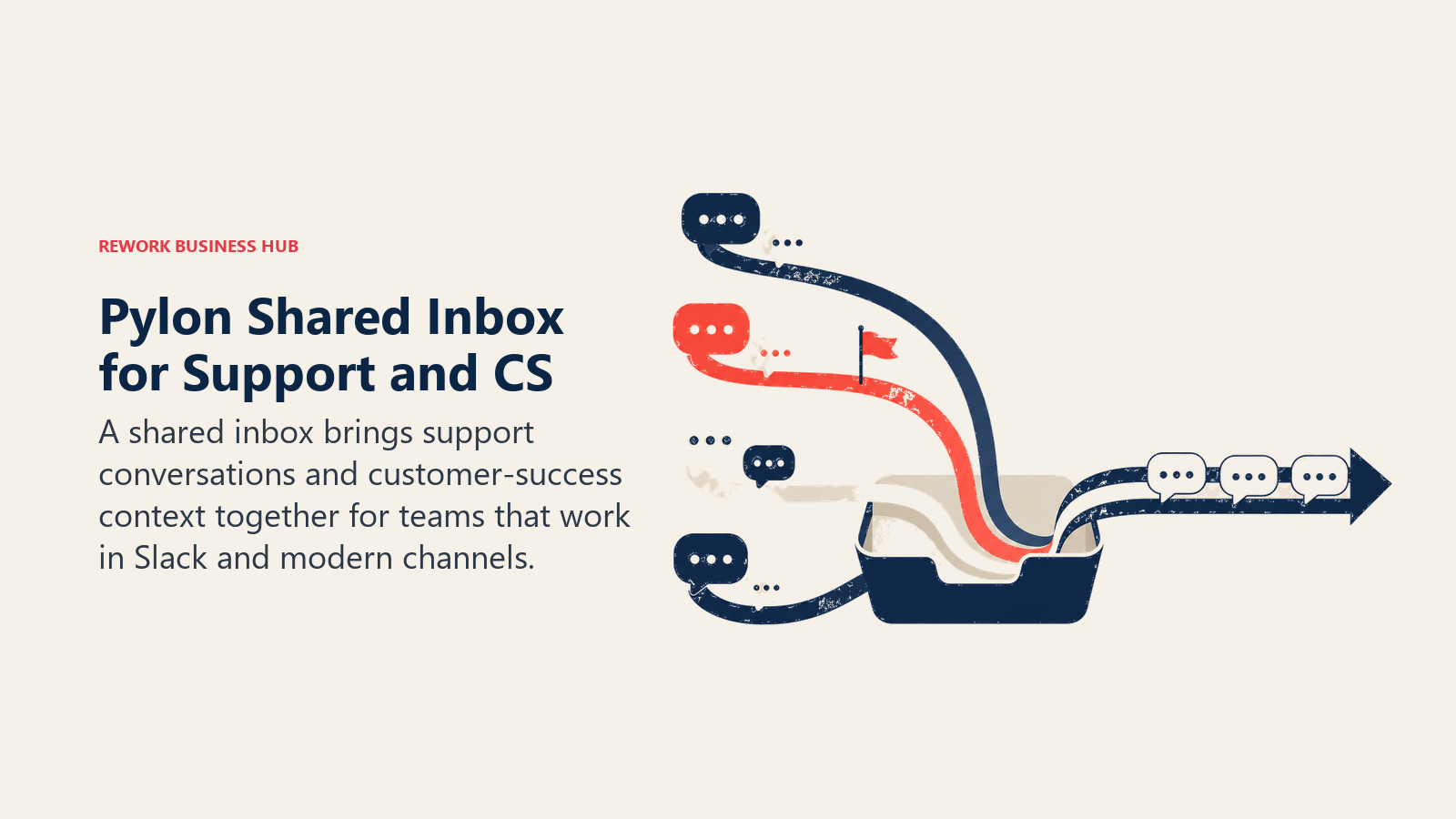
Best for: B2B SaaS teams where support and customer success responsibilities overlap heavily and a traditional ticketing platform plus a separate CS tool feels like double the software for one job
Key strengths:
- Slack, Microsoft Teams, WhatsApp, Telegram, email, and chat unified into one shared inbox, genuinely B2B-native rather than adapted from consumer support tooling
- AI Assistants handle routing, summarization, and issue translation; Autonomous AI Agents can resolve issues without a human touching the ticket
- Every tier's pricing (including seat minimums) is published, unusual for this category
Limitations:
- Every plan enforces a seat minimum (3 seats for Starter/Professional, 7 for Enterprise), so total cost ranges from $177/month to $3,535/month before any AI add-on
- AI is not included at any tier; AI Assistants cost an extra $50/seat/month, and Autonomous AI Agents start at $100/month plus usage-based issue volume charges
- Not a CS platform in the Gainsight/ChurnZero sense: no health scoring, no renewal forecasting, no NRR/GRR reporting
Pricing: Starter $59/seat/month (3-seat minimum), Professional $89/seat/month (3-seat minimum), Enterprise $139/seat/month (7-seat minimum), annual billing. AI Assistants add-on $50/seat/month; Autonomous AI Agents from $100/month plus usage.
| What you get | What you don't |
|---|---|
| B2B-native shared inbox across Slack, Teams, email, chat | Seat minimums on every tier; AI costs extra on top |
| AI triage and autonomous resolution agents available | Not a CS platform; no health scoring or renewal forecasting |
| Published pricing at every tier, rare in this space | Best fit where support and CS genuinely overlap, not for dedicated CS orgs |
If a dedicated helpdesk is a better fit than a hybrid support/CS inbox, best help desk software in 2026 ranks 13 platforms by fit, and best AI tools for customer support covers the AI-native ticketing side of this same category.
11. HubSpot Breeze: AI on Service Hub Data You Already Have
For CS teams already living inside HubSpot's Smart CRM and Service Hub, Breeze Customer Agent adds AI resolution and drafting on top of contact and ticket data that's already there, no separate CS platform integration required. HubSpot's April 2026 pricing change moved the model from charging per conversation to charging only for resolved outcomes.
Best for: Teams already running HubSpot Service Hub Professional or Enterprise that want AI-assisted resolution and drafting without adopting a dedicated CS platform
Key strengths:
- Pay only when the agent resolves the conversation, not for every attempt, a meaningfully different incentive than flat per-conversation pricing
- Native to HubSpot's existing contact, deal, and ticket data, so there's no separate CS platform integration to build and maintain
- Already resolving 65% of conversations and cutting resolution time by 39% across more than 8,000 activated HubSpot customers, per HubSpot
Limitations:
- Full Breeze Customer Agent access requires Service Hub Professional or Enterprise, a real cost step up from Starter
- Not a CS platform: no dedicated health scoring, no NRR/GRR reporting, no renewal playbook automation beyond what Service Hub's general workflow tools offer
- A one-time onboarding fee sits on top of the per-resolution rate, so the effective cost runs above the $0.50 headline
Pricing: $0.50 per resolved conversation (50 HubSpot credits), billed on top of a Service Hub Professional or Enterprise seat (from roughly $90/seat/month). Baseline Breeze AI features are included from the Starter tier.
| What you get | What you don't |
|---|---|
| Pay-per-resolution pricing on data you already have | Requires Service Hub Pro or Enterprise for full access |
| Native to existing HubSpot contact and ticket records | Not a CS platform; no health scoring or renewal automation |
| Already resolving 65% of conversations, per HubSpot | One-time onboarding fee adds to the $0.50 headline |
For a direct look at how this compares to a lighter AI-in-CRM approach, see Rework vs HubSpot Breeze.
12. ChatGPT: Cheap, Flexible AI for the Work Around the Platform
Every CS platform on this list handles structured data: health scores, renewal dates, playbook triggers. None of them draft a QBR narrative from scratch, summarize a messy 45-minute call transcript into three action items, or rewrite a renewal email so it doesn't sound like a template. That's the job CSMs increasingly hand to ChatGPT, alongside whatever CS platform or spreadsheet they already run.
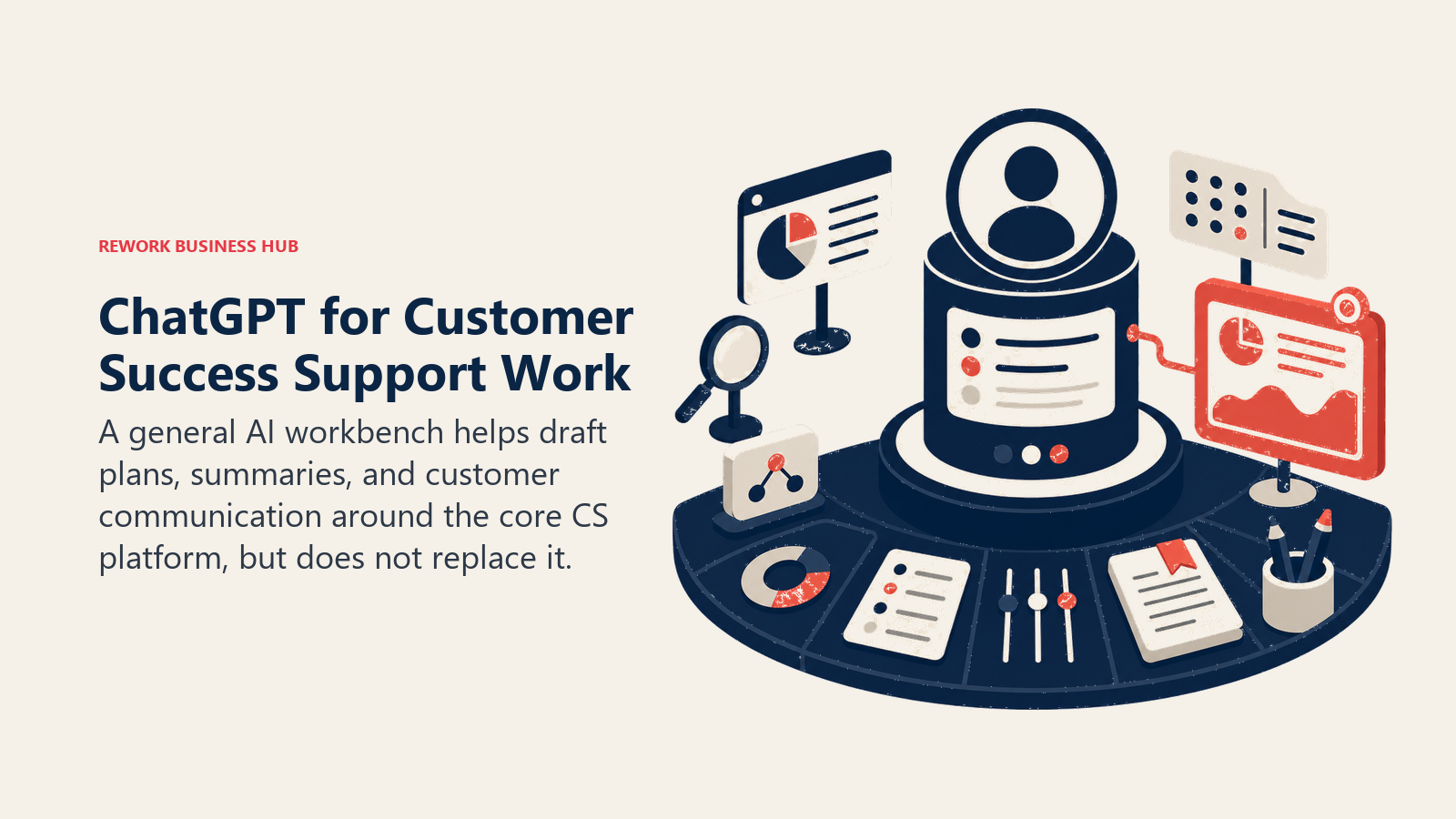
Best for: CS teams and individual CSMs wanting flexible, low-cost AI for drafting, summarizing, and QBR prep, without buying or configuring a dedicated CS platform
Key strengths:
- Business plan (formerly Team) dropped to $20/seat/month on annual billing as of April 2026, a low floor for a 2-seat minimum
- Genuinely flexible: drafts renewal emails, summarizes call transcripts pasted in manually, builds QBR outlines, none of which requires platform-specific configuration
- Enterprise tier adds SSO, data controls, and the Codex agent for teams that need compliance sign-off, at a real cost step up
Limitations:
- No native CRM or CS data model; every input has to be pasted or connected manually unless a team builds custom integrations
- No health scoring, no renewal tracking, no playbook automation, it's a drafting and reasoning tool, not a system of record
- Enterprise tier requires a 150-seat minimum and annual prepaid billing, with buyer-reported contracts averaging around $60/seat/month, a floor near $108,000/year that's out of reach for most standalone CS teams
Pricing: Business (formerly Team) $20/seat/month on annual billing or $25/seat/month monthly, 2-seat minimum. Enterprise custom, buyer-reported $45-$75/seat/month, 150-seat minimum, annual only.
| What you get | What you don't |
|---|---|
| $20/seat/mo entry point, 2-seat minimum | No CRM or CS data model; manual copy-paste unless integrated |
| Flexible drafting, summarizing, and QBR prep | No health scoring, renewal tracking, or playbook automation |
| Enterprise tier for teams needing SSO and compliance controls | Enterprise requires a 150-seat minimum, out of reach for most CS teams |
For QBR prep specifically, QBRs customers look forward to covers what separates a useful AI-assisted QBR from a generic AI-generated one, and best AI tools in 2026 ranks 25 tools across 10 categories if ChatGPT alone isn't covering your team's broader AI needs.
Where Rework Fits (And Where It Doesn't)
Rework is a CRM and sales/lead ops platform, not a dedicated customer success platform, which is why it's left out of the ranked list above. What it does offer is a unified contact timeline, WhatsApp, Messenger, Instagram DM, web chat, and email on one record, plus a structured handoff when a deal moves from sales to whoever owns the account after close. For a smaller team where the same person or a tight group handles both the sale and the relationship afterward, having that full history in one place, instead of reconstructing it from a separate CS tool, has real value.
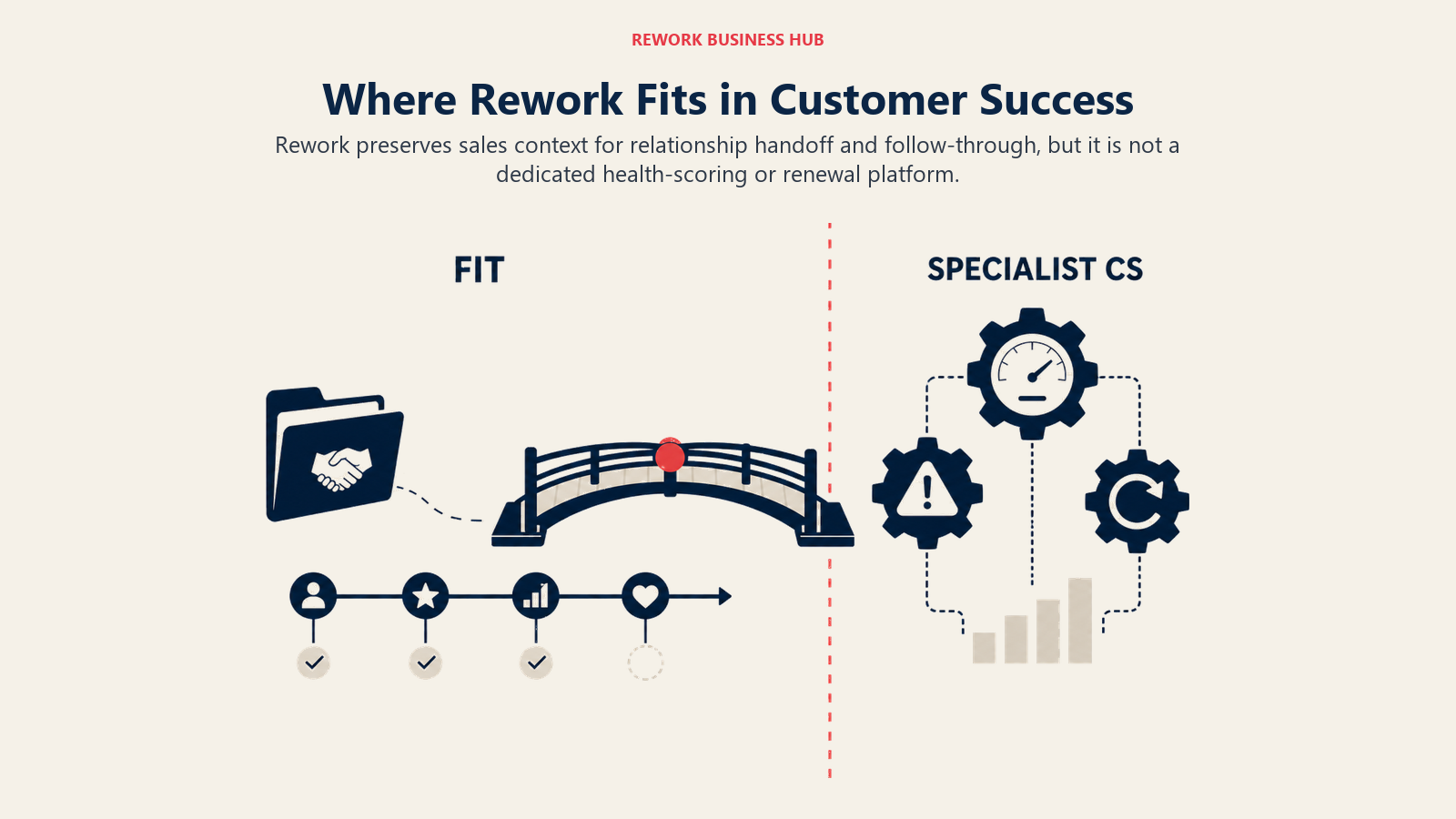
What it isn't: a health-scoring engine, an NRR/GRR reporting layer, or a renewal-playbook automation platform like the tools ranked above. If your CS org needs formal health scores, automated playbooks triggered by account state, or usage-signal-driven churn prediction, pick from the list above instead. Rework's Sales Engine starts at $69/month billed yearly, with 5 sales seats included; see rework.com/pricing for current details. Teams weighing an AI-in-CRM approach more broadly can read Rework vs Salesforce Agentforce.
Pricing at a Glance
| Tool | Entry Price | Pricing Model | Free Tier? |
|---|---|---|---|
| Gainsight AI | Custom (est. $150-$300/user/mo) | Per-user, quote-only | No |
| Totango | Custom (est. $80K/yr median negotiated) | Account volume + seat tiers | No |
| Catalyst (Totango) | Custom, part of Totango's CRO suite | Bundled with Totango quote | No |
| ChurnZero | Custom (est. $15K-$80K/yr) | Account volume + CSM seat add-on | No |
| Vitally | Custom (est. $1,500-$2,000/mo entry) | Tiered by engagement model | No |
| Planhat | Custom (est. $1,150/mo Start-Up) | Account volume + modules, unlimited seats | No |
| ClientSuccess | Custom (est. from $1,000+/mo) | Quote-only | No |
| Custify | $899/mo (3 seats) | Published entry, custom beyond | No |
| Staircase AI | $499/mo | Published entry, sales-led beyond | No |
| Pylon | $59/seat/mo (3-seat min) | Seat-based + AI add-ons | No |
| HubSpot Breeze | $0.50/resolution + Service Hub seat (~$90/mo) | Outcome-based + seat | Partial |
| ChatGPT | $20/seat/mo (Business, annual) | Seat-based | Yes (Free tier) |
Where AI in Customer Success Is Headed
The direction is consolidation and signal depth, not new categories. Gainsight buying Staircase AI folds a standalone relationship-intelligence vendor into the largest incumbent, the same pattern playing out in adjacent categories as AI-native point solutions get absorbed rather than staying independent. Totango and Catalyst are still two years into proving that a 2024 merger can produce one coherent product instead of two brands sharing a sales team, and CS leaders evaluating alternatives in 2026 are watching that closely.
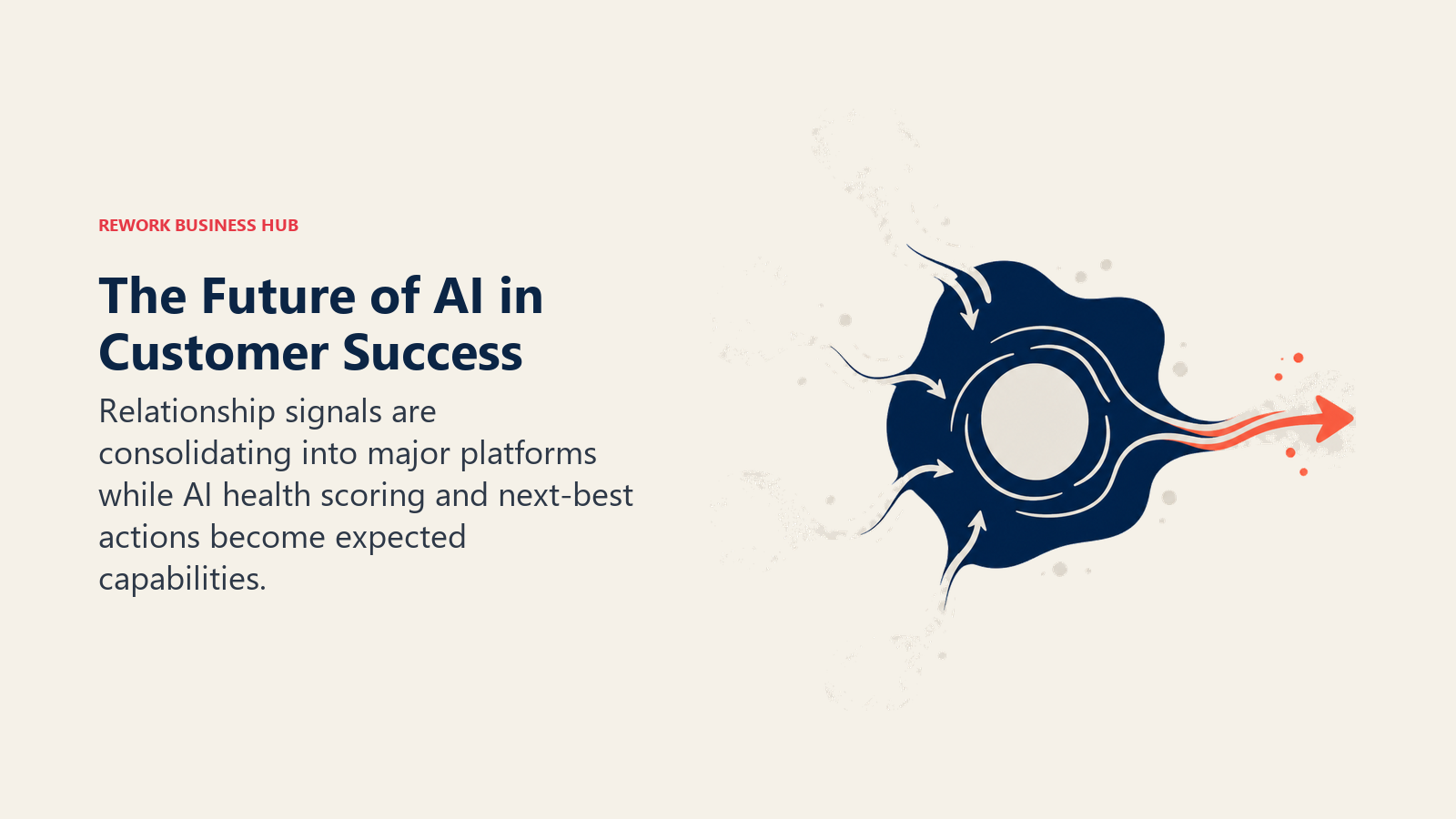
The bigger shift is that AI health scoring and next-best-action recommendations are becoming table stakes rather than a premium add-on, even though almost no vendor publishes what the AI layer costs separately from the base platform. Budget for it as a negotiated line item. Gartner's prediction that 40% of enterprise applications will embed task-specific AI agents by the end of 2026 is already visible in this category specifically: every platform on this list now markets some flavor of AI-driven health scoring or recommended action, up from a genuine minority just two years ago. Whether that AI meaningfully changes retention outcomes, or just changes what vendors put in their pricing decks, is the question worth asking in every demo.
Frequently Asked Questions about AI Tools for Customer Success
What is the best AI tool for customer success in 2026?
There's no single best tool. Gainsight AI leads on depth and maturity for enterprise CS orgs, Totango and Catalyst lead broad lifecycle coverage, ChurnZero and Vitally lead mid-market and tech-touch renewal workflows, and Custify is the rare platform with a published starting price. Match the tool to your account volume and CS maturity, not a general ranking.
How much does customer success software cost in 2026?
Most dedicated CS platforms are quote-only and scale with account volume rather than seats. Buyer-reported deals commonly range from $15,000 to $80,000 per year for mid-market teams (ChurnZero, Vitally, Planhat) up to $60,000-$120,000 or more for enterprise deployments (Gainsight, Totango). Custify is a rare exception with a published $899/month starting price for 3 seats.
Is Gainsight or Totango the better fit for an enterprise CS team?
Gainsight generally has the deeper, more mature health-scoring and playbook engine, refined over the longest track record in the category, now extended with Horizon AI agents and the acquired Staircase AI signal layer. Totango offers broader lifecycle coverage through SuccessBLOCs and, since its 2024 merger, the Catalyst engagement workflows in the same suite. Buyers should weigh Gainsight's depth against Totango's post-merger roadmap uncertainty.
Do I need a dedicated CS platform, or can I use a CRM and AI tools instead?
It depends on account volume and maturity. Teams under roughly 300 accounts with one or two CSMs can often run on a CRM plus ChatGPT for drafting and a spreadsheet for health tracking. Past that point, a dedicated platform like Custify, ClientSuccess, or ChurnZero starts paying for itself in the CSM hours it saves on manual tracking and reporting.
What's the difference between a CS platform and a relationship-intelligence tool like Staircase AI?
A CS platform (Gainsight, Totango, ChurnZero, Vitally, Planhat, ClientSuccess, Custify) runs health scoring, playbooks, and renewal workflows as its core product, the system of record for CS work. A relationship-intelligence tool like Staircase AI doesn't replace that; it reads unstructured communication (email, calls, Slack) to surface signals, sentiment shifts, stakeholder changes, that a structured health score alone would miss, layered on top of a platform you already run.
Can Pylon or HubSpot Breeze replace a dedicated CS platform?
Not for a dedicated CS function. Pylon is a B2B-native shared inbox with AI triage, closer to a modern helpdesk than a CS platform, useful where support and CS responsibilities overlap heavily at smaller companies. HubSpot Breeze adds AI resolution to Service Hub data you already have. Neither includes health scoring, NRR/GRR reporting, or renewal-playbook automation the way Gainsight or ChurnZero do.
Does Rework offer customer success software?
Not as a dedicated product. Rework is a CRM and sales/lead ops platform with a unified contact timeline (WhatsApp, Messenger, Instagram DM, web chat, email) and a structured handoff from sales, which helps keep customer history in one place for smaller teams. It doesn't have health scoring, NRR/GRR tracking, or renewal-playbook automation, so pick from the ranked list above if that's what your CS function needs.
What to Do Next
Match the tool to your account volume and CS maturity, not the length of a feature list. Under a few hundred accounts, start with Custify, ClientSuccess, or even a CRM plus ChatGPT before paying enterprise-platform prices. Past that scale, shortlist two platforms against the decision framework above and run a real pilot against a slice of your existing book before signing a multi-year contract, since the list-to-negotiated price spread on most of these tools runs 20-40%. If your evaluation spans the broader AI stack beyond CS specifically, best AI tools in 2026 ranks 25 tools across 10 categories, and best AI tools for customer support covers the ticketing side of the same AI-adoption wave. And if your CSMs are still reconstructing account context from seven different tabs every morning, the CSM tools and tech stack guide is the place to start fixing that before buying anything new.

Principal Product Marketing Strategist
On this page
- Updated July 2026: What Changed
- Key Facts
- Quick Comparison Table
- How to Choose: Decision Framework
- Framework: By Customer Base Size and CS Maturity
- 1. Gainsight AI: The Most Mature, Now AI-Native Platform
- 2. Totango: Broad CS Platform With Unison AI
- 3. Catalyst (via Totango): Signal-Driven Engagement, Now Bundled
- 4. ChurnZero: Renewal and Expansion Tied to CSM Playbooks
- 5. Vitally: An AI Copilot Built for Tech-Touch and PLG CS
- 6. Planhat: Unlimited Seats, Flexible Customer Data Model
- 7. ClientSuccess: Gainsight-Depth Positioning at a Lower Price
- 8. Custify: One of the Few CS Platforms With a Real List Price
- 9. Staircase AI (by Gainsight): Relationship Intelligence Layered On Top
- 10. Pylon: A Modern Shared Inbox Where Support and CS Overlap
- 11. HubSpot Breeze: AI on Service Hub Data You Already Have
- 12. ChatGPT: Cheap, Flexible AI for the Work Around the Platform
- Where Rework Fits (And Where It Doesn't)
- Pricing at a Glance
- Where AI in Customer Success Is Headed
- What to Do Next