Best AI Tools for Brand Monitoring in 2026: 12 Tools for Tracking Mentions, Sentiment, and Reputation
Turn this article into takeaways for your work.


Each assistant summarizes the article only for you and suggests best practices for your work.
Brandwatch and Meltwater lead for enterprise teams that need every social platform, news site, forum, and review in one Boolean query, Sprinklr and Hootsuite lead for teams that want monitoring bolted onto a social management or CXM suite they already run, Brand24, Awario, and Mention lead for lean marketing teams that just need to know who's talking about them and how they feel about it, Determ and Talkwalker lead for PR and comms teams tracking earned media, YouScan leads for visual and image-based mention detection, and Reputation.com leads for multi-location businesses managing review responses at scale. No single tool wins every job, so this guide is organized by who each one actually fits.
Every tool below was evaluated on which sources it actually monitors (social, news, blogs, forums, review sites, podcasts), how sentiment analysis and alerting work in practice, and real pricing. This is a different category from AI search visibility tools, which track whether ChatGPT and Perplexity cite your brand in an AI-generated answer, and from social media management tools, which focus on scheduling and publishing. If you're mixing those up, our best AI visibility tools guide and best AI tools for social media guide cover those jobs specifically. This guide is about listening: catching every mention of your brand across the open web, scoring how people feel about it, and alerting your team fast enough to act.
Updated July 2026: What Changed
- Mention went enterprise-only. Its legacy self-serve tiers (Solo, Pro, Pro Plus) were discontinued in July 2025, leaving a single $599/month Company Plan with a hard 50,000 monthly mention cap, and social publishing features were spun off into a separate Agorapulse subscription in January 2026.
- Sprinklr killed self-serve entirely. As of April 30, 2026, Sprinklr requires a minimum enterprise commitment, with real deployments starting around $50,000 a year once implementation and seats are factored in.
- Reputation.com finally published pricing. After years of quote-only sales, the review and reputation management platform now lists per-location pricing starting at $80/month, a rare transparency move in a category still dominated by custom quotes.
- AI sentiment moved from tagging to summarizing. Most platforms on this list now generate an AI-written summary of what's driving a sentiment spike instead of just a red or green chart, cutting the manual analysis step that used to eat up an analyst's morning.
- Credit-based pricing is spreading beyond AI visibility tools. YouScan, Determ, and Awario all price around topics, mentions, or credits rather than flat seats, so your bill now moves with monitoring volume, not headcount.
Key Facts
- 84% of consumers say a brand's response speed directly affects how they view a crisis, and 64% believe brands should respond publicly on social media rather than through a press release or website statement, according to Sprout Social's Q2 2026 Pulse Survey (Sprout Social).
- 73% of consumers expect a brand to respond to a social mention within 24 hours or sooner, per the Sprout Social Index (Sprout Social).
- 97% of consumers read reviews when evaluating a local business, and 41% now "always" read reviews before choosing one, up from 29% a year earlier, per BrightLocal's Local Consumer Review Survey 2026 (BrightLocal).
- 80% of consumers say they're more likely to use a business that responds to all of its reviews, per the same BrightLocal survey (BrightLocal).
- A one-star increase in a Yelp rating drives a 5% to 9% increase in revenue for independent restaurants, per Harvard Business School researcher Michael Luca's study of Yelp and Washington State revenue data (Harvard Business School).
- 49% of consumers now trust online reviews as much as a personal recommendation from someone they know, per BrightLocal's 2026 survey (BrightLocal).
Quick Comparison Table
| Tool | Best For | Starting Price | Key Strength | Key Limitation |
|---|---|---|---|---|
| Brandwatch | Enterprise consumer intelligence programs | Custom, historically ~$800-1,000/mo entry | Deepest social + web listening, strong AI sentiment and image analysis | No public pricing; full deployments often run $36,000-$150,000+/year |
| Meltwater | PR and comms teams needing global media monitoring | Custom, quote-based | Broadest news, print, and broadcast media coverage alongside social | Median contract around $25,000/year; standalone social listening rarely sold alone |
| Sprinklr | Enterprise CXM programs unifying listening with service and marketing | Custom, enterprise minimum ~$50,000/year | Unified suite: listening, service, social, and marketing in one platform | Self-serve discontinued; implementation adds 15-30% on top of licensing |
| Sprout Social | Teams already using Sprout for social management | $199/mo (Standard), listening sold as a custom add-on | Clean unified inbox plus listening in the same login | Listening pricing is undisclosed and typically requires a custom quote |
| Hootsuite (Lumen) | Teams wanting scheduling and enterprise-grade listening in one place | $99/user/mo (Standard); full listening is Enterprise-only | Talkwalker-powered Lumen listening once you're on Enterprise | Meaningful listening (30-day history and beyond) is gated behind higher tiers |
| Talkwalker | Standalone enterprise social and web listening | Custom, historically ~$9,600/year (Core) | Deep historical data and image recognition across owned and earned media | No public pricing; mid-market Analyze tier contracts run ~$27,000/year |
| Brand24 | Mid-market marketing teams wanting AI-scored sentiment on a budget | $199/mo (Individual, annual) | Strong AI sentiment scoring and influence scoring at a reachable price | Enterprise tier jumps sharply to $1,499/mo minimum |
| Mention | Teams that only need alerting, not social publishing | $599/mo (Company Plan only) | AI Alert Summary and Boolean search on every alert | Self-serve tiers discontinued; hard 50,000 monthly mention cap |
| Awario | Startups and solo marketers on a tight budget | $29/mo (Starter, annual) | Cheapest real self-serve entry point with genuine mention volume | Sentiment analysis and deeper features are thinner than paid-tier rivals |
| Determ | PR and comms teams tracking earned media by topic | €99/mo (Focus, 1 topic) | Simple topic-based pricing built for media monitoring workflows | Setup and Boolean query tuning often needs specialist help |
| YouScan | Consumer brands needing visual mention detection | $499/mo (Starter-3, annual) | Image recognition spots logos in photos with no caption mention | Entry tier caps at 3 topics and 15,000 mentions/month |
| Reputation.com | Multi-location businesses managing review response at scale | $80/location/mo (Rep Core, annual) | Purpose-built for review management across many locations | Per-location pricing gets expensive fast for large footprints |
Framework: Which Job Are You Actually Buying For?
Most teams shopping this category conflate three different jobs: social listening (what people say about you on social platforms), media monitoring (what journalists and publications write about you), and reputation management (what customers post in reviews). Before comparing dashboards, figure out which job is driving the purchase.
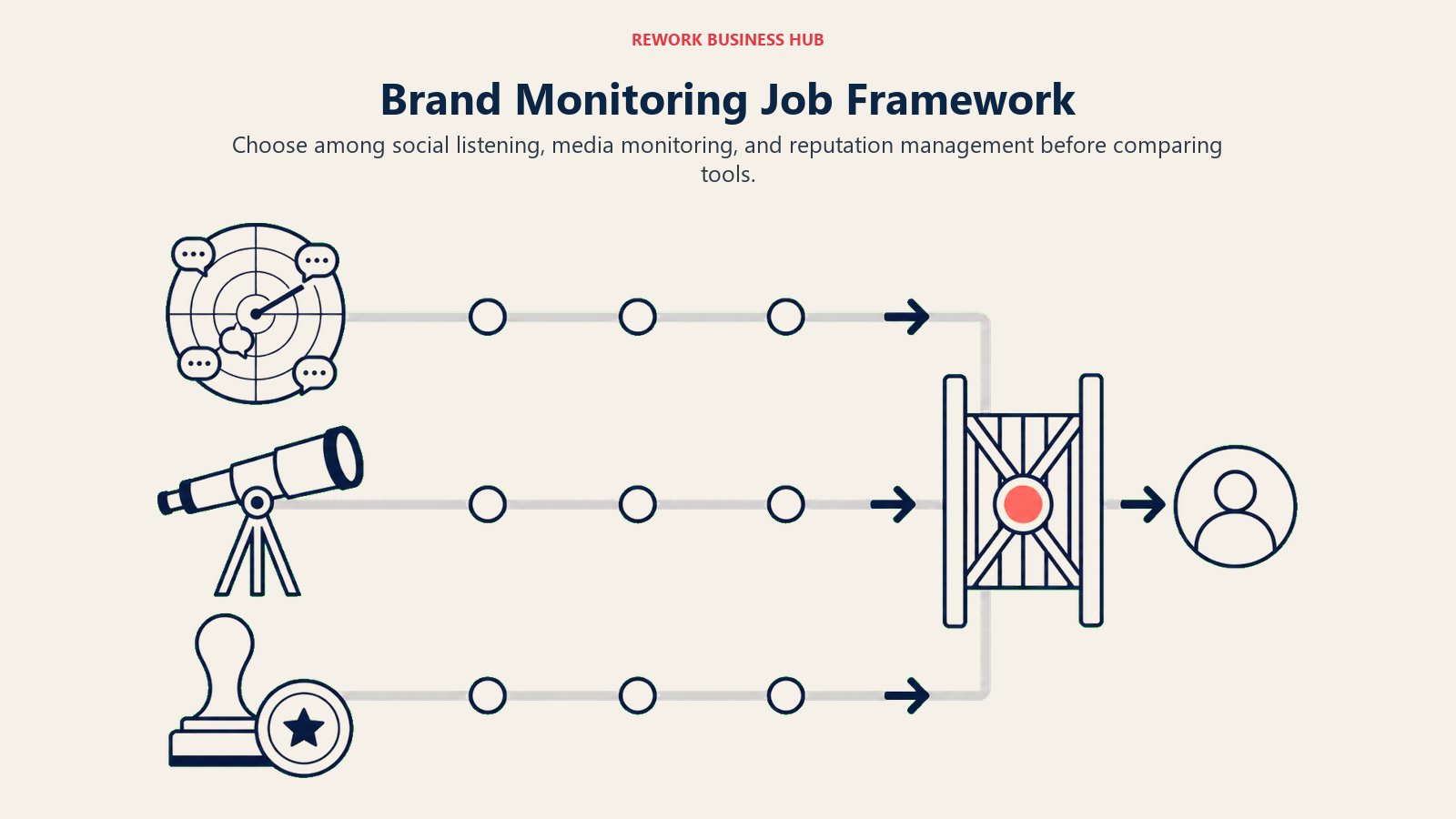
- Are you tracking conversation or coverage? If you care about Reddit threads, X posts, and forum chatter, you want a social-listening-first tool like Brand24, Awario, or Brandwatch. If you care about what journalists publish, Meltwater and Determ are built around press and broadcast sources first.
- Do you need one brand tracked well, or many locations tracked cheaply? A single-location B2B brand doesn't need Reputation.com's per-location pricing; a 200-location retail chain doesn't want to pay Brandwatch enterprise rates per location. Match the pricing model to your footprint.
- Who owns the response? A dashboard that flags a sentiment drop is only useful if someone owns the follow-up: a support ticket, a review reply, a press statement. Tools bundled into a broader suite (Sprinklr, Sprout Social, Hootsuite) route the alert straight to the person who responds; standalone listening tools (Brandwatch, Talkwalker, Determ) usually hand that off to a separate workflow, which works fine if your customer support tooling already owns that queue.
Stage Fit Matrix
| Stage | What You Need | Best Fits |
|---|---|---|
| Pre-monitoring (never tracked mentions) | A cheap, fast way to see if anyone's even talking about you | Awario, Brand24 |
| Early monitoring (validating the category matters) | Real sentiment scoring without enterprise commitment | Brand24, Mention, YouScan |
| PR-led growth (earned media matters most) | Press, broadcast, and topic-based tracking | Determ, Talkwalker |
| Multi-location or review-heavy business | Review response management at scale | Reputation.com |
| Mature marketing team extending into listening | Listening bolted onto an existing suite | Sprout Social, Hootsuite |
| Enterprise consumer intelligence or CXM program | Deep listening tied to service, marketing, or research | Brandwatch, Meltwater, Sprinklr |
Sizing and Persona Table
| Tool | Ideal Team Size | Primary Buyer Persona |
|---|---|---|
| Brandwatch | 200-10,000+ employees | VP Marketing, Head of Consumer Insights |
| Meltwater | 50-5,000+ employees | Communications Director, PR Manager |
| Sprinklr | 500-10,000+ employees | CXM Director, VP Customer Experience |
| Sprout Social | 10-500 employees | Social Media Manager, Marketing Director |
| Hootsuite (Lumen) | 10-1,000 employees | Social Media Manager, Marketing Operations Lead |
| Talkwalker | 100-5,000+ employees | Head of Insights, Communications Director |
| Brand24 | 1-200 employees | Marketing Manager, Founder, Small Agency |
| Mention | 20-500 employees | PR Manager, Marketing Director |
| Awario | 1-50 employees | Solo Marketer, Startup Founder |
| Determ | 5-500 employees | PR Manager, Communications Lead |
| YouScan | 20-500 employees | Brand Manager, Consumer Insights Analyst |
| Reputation.com | Multi-location businesses, any size | VP Customer Experience, Franchise Marketing Director |
1. Brandwatch: Deepest Enterprise Consumer Intelligence
Brandwatch built its reputation on breadth and depth: it pulls from social platforms, news, blogs, forums, and reviews, then layers AI sentiment analysis and image recognition on top so a logo in a photo counts as a mention even without a caption. It sits inside a three-product suite (Consumer Intelligence, Social Media Management, and Influencer Marketing), so teams that need research-grade listening alongside publishing tools can run both from one vendor.
The catch is pricing transparency. Brandwatch sells entirely through custom enterprise contracts with no public price list. Third-party contract data suggests a professional entry point around $800 to $1,000 a month, with full deployments landing anywhere from $36,000 to $150,000+ a year depending on data volume, seats, and which product lines you buy.
| What you get | What you don't |
|---|---|
| Deepest social, news, forum, and image-based listening in the category | No public pricing; every deal is custom-quoted |
| AI sentiment analysis and consumer intelligence built for research teams | Entry-level pricing starts high relative to Brand24 or Awario |
| Three integrated products: listening, social management, influencer marketing | Overkill for a team that just wants basic mention alerts |
Pricing: Custom, contact sales; third-party estimates put entry contracts around $800-1,000/month, with mid-market to enterprise deals ranging $20,000-$150,000+/year.
Best for: Enterprise consumer insights and marketing teams running a dedicated brand intelligence program across social, news, and visual media.
2. Meltwater: Broadest Media Monitoring for PR Teams
Meltwater's core strength is coverage of traditional and digital media: newspapers, broadcast transcripts, trade publications, and blogs, layered with social listening so a PR or comms team can see a story's full lifecycle from a journalist's first article to the social conversation it sparks. It's the tool most newsrooms and comms departments already have some familiarity with.
Pricing is entirely quote-based, built from which modules you license (media monitoring, social listening, influencer marketing, media contacts database), how many regions and languages you need, and your user count. Anonymized contract data puts smaller single-region deployments around $15,000-$30,000 a year, with mid-market configurations at $40,000-$80,000 and a reported median around $25,000 a year.
| What you get | What you don't |
|---|---|
| Broadest traditional and broadcast media coverage in this list | No public pricing anywhere; every quote is custom |
| Modular: monitoring, listening, influencer marketing, and media contacts | Standalone social listening is rarely sold on its own |
| Strong global and multi-language coverage for international brands | Median contracts ($25,000/year) sit well above self-serve alternatives |
Pricing: Custom, contact sales; third-party contract data suggests $15,000-$150,000+/year depending on modules and scope, median around $25,000/year.
Best for: PR and communications teams that need traditional media monitoring alongside social listening in one workflow.
3. Sprinklr: Unified Enterprise CXM With Listening Built In
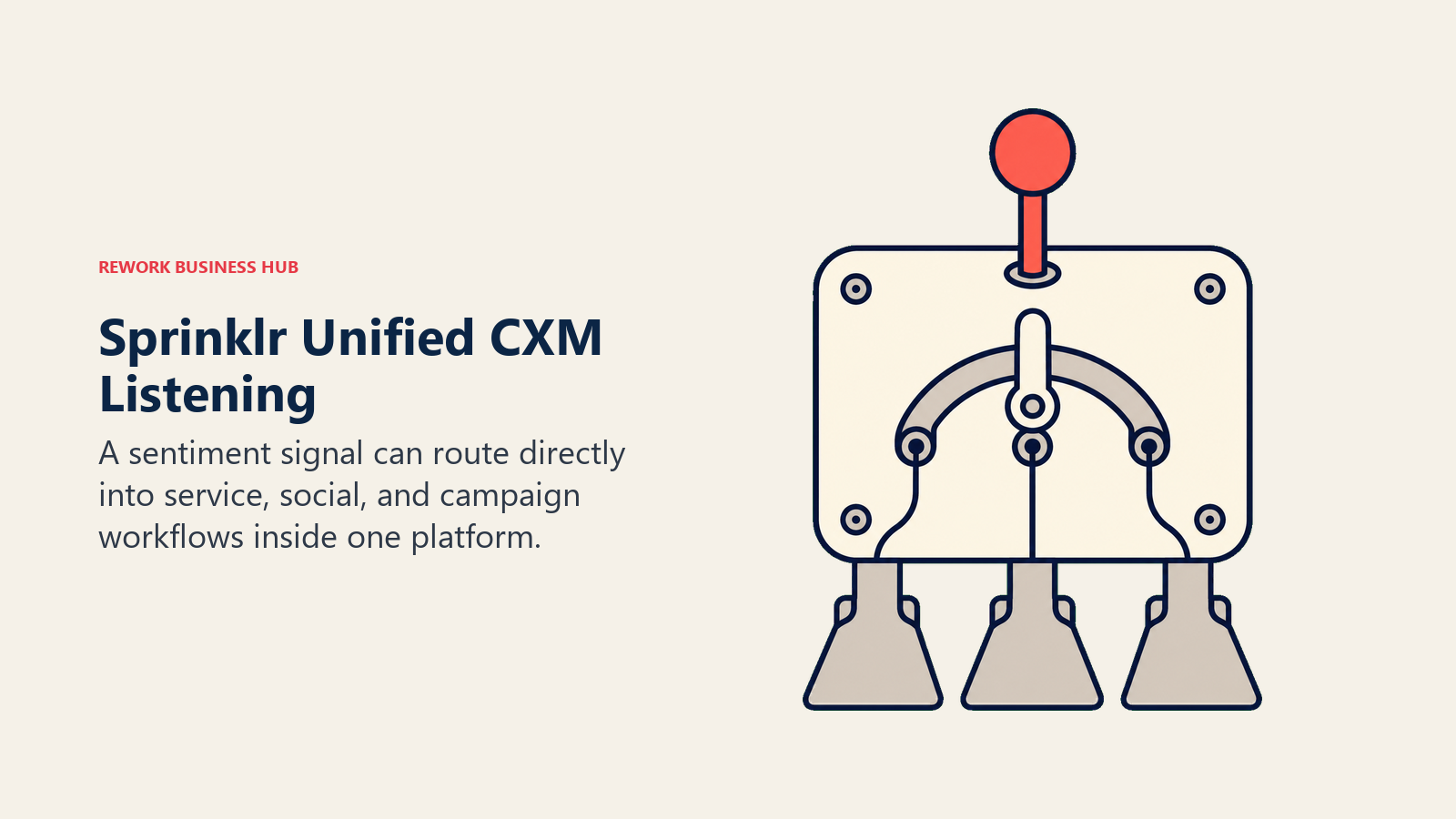
Sprinklr's pitch is that listening shouldn't live in a separate tool from the teams who act on it: its Insights module sits inside the same platform as customer service, social publishing, and marketing, so a sentiment spike can route directly into a support queue or a campaign brief without a handoff. That's a meaningfully different shape from a pure-play listening tool.
As of April 30, 2026, Sprinklr discontinued its self-serve program entirely. Real enterprise deployments now start around $50,000 a year, with a reported median closer to $129,000 annually once you factor in the specific suites (Service, Social, Insights, Marketing) you license, each priced and metered separately, plus implementation fees that typically add another 15-30% in year one.
| What you get | What you don't |
|---|---|
| Listening routes directly into service, social, and marketing workflows | Self-serve is gone; minimum commitment starts around $50,000/year |
| Handles enterprise-scale volume (10M+ mentions across multiple brands) | Four separately licensed and metered suites add real complexity |
| One platform instead of stitching listening to a separate CXM stack | Implementation and professional services add 15-30% on top of licensing |
Pricing: Custom, contact sales; enterprise contracts start around $50,000/year, median around $129,000/year.
Best for: Large enterprises that want listening unified with customer service, social publishing, and marketing in one CXM platform.
4. Sprout Social: Listening Bolted Onto a Social Management Suite You Already Use
Sprout Social's base plans (Essentials, Standard, Professional, Advanced) cover scheduling, a unified inbox, and analytics, and Advanced adds inbox-level sentiment on incoming messages. Social Listening is a separate, more powerful module: it monitors Reddit, Tumblr, news, and the wider web for brand mentions, sentiment trends, and competitive share of voice, not just what lands in your inbox.
The tradeoff is that Listening isn't included in any base tier and isn't publicly priced. It's sold as a custom add-on scoped to your topics and data volume, on top of a per-seat base plan that already runs $199 to $399 a month per user before you add it.
| What you get | What you don't |
|---|---|
| Listening lives in the same login as scheduling, inbox, and analytics | Listening isn't included in any base tier; it's a separate paid add-on |
| Covers Reddit, Tumblr, news, and general web beyond just social inbox | Per-seat base pricing ($199-$399/mo) adds up before Listening is even quoted |
| Strong for teams that already run their social calendar in Sprout | No public Listening price; every quote is custom |
Pricing: Essentials $79/mo, Standard $199/mo, Professional $299/mo, Advanced $399/mo per seat; Social Listening is a custom-quoted add-on.
Best for: Marketing teams already running Sprout Social for scheduling and inbox management who want listening in the same platform.
5. Hootsuite (Lumen): Scheduling Plus Enterprise-Grade Listening
Hootsuite folded its former Talkwalker acquisition into a unified module called Lumen, which brings listening, insights, and intelligence into the same dashboard as scheduling and publishing. On the Advanced plan, that shows up as 30-day social brand-mention search; the deeper, Talkwalker-powered listening capability that most brand monitoring buyers actually want is reserved for Enterprise.
That structure means the sticker price undersells what you'll actually pay for real listening. Standard ($99/user/month) and Advanced ($249/user/month) get you scheduling, an inbox, and basic listening history, but full Lumen listening, Salesforce integration, and SSO are Enterprise-only, with real Enterprise deals often landing in the $16,000-$18,000+/year range once accounts and add-ons are factored in.
| What you get | What you don't |
|---|---|
| Scheduling, publishing, and listening in one familiar dashboard | Meaningful listening (beyond 30-day history) is Enterprise-only |
| Talkwalker-powered Lumen brings enterprise-grade data underneath | Per-user pricing on lower tiers isn't built for heavy listening use |
| Easier onboarding for teams that already know Hootsuite's interface | Enterprise pricing ($16,000-$18,000+/year) isn't public or fixed |
Pricing: Standard $99/user/mo, Advanced $249/user/mo, Enterprise custom (historically $16,000-$18,000+/year).
Best for: Teams that want scheduling and enterprise-caliber listening in one vendor and are willing to pay for the Enterprise tier to get it.
6. Talkwalker: Standalone Enterprise Listening With Deep History
Sold both as Hootsuite's Lumen backend and as its own standalone product (alongside sibling platform NetBase Quid), Talkwalker's independent offering focuses on image recognition, historical data depth, and broad source coverage for enterprise research and comms teams that don't want it bundled into a scheduling tool.
Like most enterprise listening vendors, Talkwalker keeps pricing off its public site. Third-party contract data (via Vendr) suggests entry-level Core licenses starting around $9,600 a year, with mid-market Analyze-tier deployments carrying median contracts closer to $27,000 a year, both figures third-party estimates rather than vendor-published numbers.
| What you get | What you don't |
|---|---|
| Deep historical data and image recognition across owned and earned media | No public pricing; figures are third-party estimates, not vendor-confirmed |
| Standalone option for teams that don't want listening bundled with scheduling | Requires sales engagement even for a baseline quote |
| Unlimited users included on every tier | Entry Core tier (~$9,600/year) still costs more than most mid-market rivals |
Pricing: Custom, contact sales; third-party estimates put Core around $9,600/year and Analyze around $27,000/year (median contract, per Vendr).
Best for: Enterprise research and comms teams that want standalone, image-capable listening without a bundled scheduling tool.
7. Brand24: AI-Scored Sentiment at a Reachable Mid-Market Price
Brand24 built its name on making AI sentiment scoring and an "influence score" (how much reach each mention actually has) accessible below enterprise pricing. The Individual plan starts at 3 keywords and 2,000 mentions a month with 12-hour update intervals; higher tiers add more keywords, faster updates, podcast monitoring, and white-label reporting that small agencies use for client reports.
Pricing is annual-billing-rate based, running $199 to $599 a month across four public tiers, with monthly billing running 20-25% higher. Above that, Enterprise starts at a $1,499/month minimum, a steep jump from the Business tier that limits Brand24's appeal for teams that outgrow Business but aren't ready for that price.
| What you get | What you don't |
|---|---|
| Real AI sentiment scoring and influence scoring on every paid tier | Individual tier's 12-hour update interval is slow for fast-moving crises |
| White-label reporting on Pro, useful for agencies serving clients | Enterprise jumps to a $1,499/mo minimum, a big gap from Business |
| Podcast monitoring and topic analysis on the Business tier | Monthly billing runs 20-25% above the advertised annual rate |
Pricing: Individual $199/mo, Team $299/mo, Pro $399/mo, Business $599/mo (annual billing), Enterprise from $1,499/mo.
Best for: Mid-market marketing teams and agencies that want real AI sentiment scoring without enterprise pricing or a custom quote.
8. Mention: Alerting-Only Since the Enterprise Pivot
Mention has narrowed sharply in the past year: what used to be a self-serve tiered product (Solo, Pro, Pro Plus) is now a single $599/month Company Plan, and social publishing and engagement features were spun off entirely into a separate Agorapulse subscription in January 2026. What's left is focused, AI-summarized alerting: five Boolean-capable alerts, an AI Alert Summary and Overview, spike notifications, and scheduled reporting.
The 50,000 monthly mention cap is a hard limit shared across every alert and workspace; exceeding it halts data collection until the 30-day rolling cycle resets, which is worth sizing against your brand's actual mention volume before buying.
| What you get | What you don't |
|---|---|
| AI Alert Summary condenses a spike into a readable brief automatically | Self-serve tiers are gone; $599/mo is now the only entry point |
| Five Boolean-capable alerts cover most single-brand monitoring needs | Hard 50,000 monthly mention cap shared across all alerts |
| Spike notifications via SMS, desktop, and email keep response fast | Social publishing now requires a separate Agorapulse subscription |
Pricing: Company Plan $599/mo, billed yearly, 50,000 monthly mention cap.
Best for: Teams that want focused, AI-summarized mention alerting and don't need social publishing bundled in.
9. Awario: The Cheapest Real Self-Serve Entry Point
Awario is the budget option that still delivers genuine mention volume rather than a crippled trial-tier experience. Starter covers 30,000 new mentions a month and 5,000 stored mentions per topic for one user; Pro scales to 300,000 new mentions and 10 team members, which is enough for most small marketing teams to run real ongoing monitoring rather than a one-off check.
Where Awario trades down from Brand24 or Brandwatch is depth: sentiment analysis and influence scoring exist but are noticeably thinner than what paid-tier rivals offer, and there's no image recognition or podcast monitoring. For a solo marketer or an early-stage startup deciding whether monitoring is even worth budget, that tradeoff is usually fine.
| What you get | What you don't |
|---|---|
| Real ongoing monitoring starting at $29/mo (annual), not a crippled trial | Sentiment analysis and influence scoring are thinner than Brand24 |
| 30,000-1,000,000 new mentions/month depending on tier | No image recognition or podcast monitoring |
| Unlimited team members on Enterprise, 10 on Pro | 7-day free trial is short for evaluating a monitoring workflow |
Pricing: Starter $29/mo, Pro $89/mo, Enterprise $249/mo (annual billing), roughly 40% higher on monthly billing.
Best for: Solo marketers, startups, and small teams that want real self-serve monitoring at the lowest real price in the category.
10. Determ: Topic-Based Pricing Built for PR and Comms Workflows
Determ positions itself squarely for PR managers and communications teams: media monitoring and brand tracking organized around named "topics" (a product line, a campaign, a competitor) rather than generic keyword lists, with campaign-level reporting built for the way comms teams actually report up to leadership.
Pricing is transparent and topic-based: Focus covers a single topic, Expand covers five, and Command covers ten, all with monthly, quarterly, or annual billing. What's less transparent is implementation: teams commonly need 40-80 hours of setup for Boolean query tuning, sometimes bringing in a specialist at $150-$300 an hour to get queries dialed in correctly.
| What you get | What you don't |
|---|---|
| Transparent, topic-based public pricing (rare in this category) | No hard cap on topics or mentions above the public tiers, but cost scales fast |
| Built specifically for PR and comms reporting workflows | Boolean query setup often needs 40-80 hours of specialist tuning |
| Monthly, quarterly, and annual billing options | Fewer social-native features (influence scoring, image recognition) than Brand24 |
Pricing: Focus €99/mo (1 topic), Expand €299/mo (5 topics), Command €499/mo (10 topics), custom above.
Best for: PR and communications teams that want transparent, topic-based pricing built around media monitoring, not generic social listening.
11. YouScan: Visual Recognition for Consumer Brands
YouScan's differentiator is image recognition: it identifies your logo, product, or packaging in a photo even when there's no text mention alongside it, which matters for consumer brands where a large share of organic mentions are visual (a product on a plate, a logo on a shelf, a package in an unboxing photo) rather than written.
The Starter-3 plan covers 3 topics and 15,000 monthly mentions with unlimited users and access to its Insights Copilot AI assistant. Larger brands and agencies move to custom Unlimited plans with add-ons for deeper visual insights, audience analysis, and API access, priced around use case (brand monitoring, market research, trend analysis) rather than a fixed tier ladder.
| What you get | What you don't |
|---|---|
| Image recognition catches visual mentions text-only tools miss entirely | Starter-3 entry tier caps at 3 topics and 15,000 mentions/month |
| Insights Copilot AI assistant included even on the entry tier | Unlimited plans for larger brands are custom-quoted, not public |
| Unlimited users on every tier, unusual for this price point | Visual Insights and Audience Insights are paid add-ons above Starter |
Pricing: Starter-3 $499/mo (annual billing), Unlimited custom for larger brands and agencies.
Best for: Consumer brands (retail, food and beverage, apparel) where a meaningful share of organic mentions are visual rather than text-based.
12. Reputation.com: Review Response Management at Multi-Location Scale
Reputation.com solves a narrower but very real problem: a business with dozens or hundreds of locations (a franchise, a multi-location healthcare group, a retail chain) needs to monitor and respond to reviews across every one of them without a corporate team manually checking each Google Business Profile. It's less "listen everywhere" and more "manage review reputation at scale, per location."
In a rare move for this category, Reputation.com published real per-location pricing in 2026 rather than staying quote-only. Rep Core starts at $80 per location per month, with Rep Core + Pulse (one survey) at $115 and Rep Core + Surveys (six surveys) at $150, all billed annually; custom plans exist for organizations above 125 locations.
| What you get | What you don't |
|---|---|
| Purpose-built for review response at scale across many locations | Per-location pricing gets expensive fast for large footprints (200+ sites) |
| Rare public per-location pricing in a category that's usually quote-only | Less suited to a single-location brand than Brand24 or Awario |
| Survey add-ons (Pulse, Surveys) tie review data to customer experience scores | All tiers require annual billing commitment |
Pricing: Rep Core $80/location/mo, Rep Core + Pulse $115/location/mo, Rep Core + Surveys $150/location/mo (annual), custom above 125 locations.
Best for: Multi-location businesses and franchises that need review response management across many sites, not open-web social listening.
Brand Monitoring Buying Mistakes to Avoid
| Mistake | What It Looks Like | What to Do Instead |
|---|---|---|
| Buying a listening tool for a review-management job | Signing up for Brandwatch when you actually just need Google review replies at 40 locations | Match Reputation.com's per-location model to a review-heavy, multi-location business |
| Assuming "monitoring" includes acting on it | A dashboard flags a sentiment drop with no owner assigned to respond | Route alerts into whatever tool your customer support team already works from |
| Confusing brand monitoring with AI search visibility | Buying a GEO tool expecting it to track Reddit and news mentions | Use a dedicated AI visibility tool for AI answer engines, a monitoring tool for the open web |
| Underestimating mention volume before buying | Hitting Mention's 50,000-mention cap or Awario's Starter limit mid-month | Estimate monthly mention volume from a free trial before committing to a tier |
| Skipping the crisis-response plan | A spike alert fires at 2am with no one assigned to answer it | Pair the tool with an on-call or escalation process before a real crisis tests it |
| Treating share of voice as a vanity metric | Reporting sentiment percentages with no link to support tickets or sales | Connect monitoring data to pipeline or support volume before reporting up |
| Not re-verifying enterprise pricing | Budgeting off a review site's number from a prior contract cycle | Re-quote before renewal; Sprinklr, Brandwatch, and Meltwater all price custom each cycle |
Decision Framework
The final choice becomes easier when the team weighs source coverage, response ownership, and budget against the monitoring job it actually needs done.
| If you need... | Pick... | Why |
|---|---|---|
| The deepest enterprise social and web listening | Brandwatch | Broadest source coverage plus AI image recognition and sentiment |
| Traditional media and broadcast monitoring for PR | Meltwater or Determ | Both are built around press and broadcast coverage, not just social |
| Listening unified with customer service and marketing | Sprinklr | One CXM platform routes alerts directly into service and campaign workflows |
| Listening added to a tool you already use for scheduling | Sprout Social or Hootsuite (Lumen) | Same login as your existing social management workflow |
| Standalone enterprise listening without a bundled scheduler | Talkwalker | Deep historical data and image recognition, sold on its own |
| Real AI sentiment scoring at mid-market pricing | Brand24 | Influence scoring and sentiment analysis below enterprise cost |
| Focused, AI-summarized alerting only | Mention | AI Alert Summary condenses spikes without a bundled publishing tool |
| The cheapest real self-serve monitoring | Awario | $29/mo covers genuine mention volume, not a crippled trial |
| Visual mention detection for a consumer brand | YouScan | Image recognition catches logo and product mentions with no caption |
| Review response management across many locations | Reputation.com | Purpose-built per-location pricing and workflow for multi-site brands |
What to Do Next
Pick the job first, then the tool. If you've never tracked a single mention of your brand, start with a free trial of Awario or Brand24 and run it for two weeks before spending anything: you'll learn your real mention volume, which matters more than any feature comparison. If you're already fielding real complaints or press coverage and don't have a monitoring tool yet, that's the more urgent gap to close, since 84% of consumers judge a brand by how fast it responds to a crisis, not just what it eventually says. Once you've picked a tool, the harder work is building the response process behind it: who checks alerts, who owns a review reply, who's on call for a spike at 2am. For the marketing execution layer that usually sits next to brand monitoring in a stack, our best AI marketing tools and best AI tools for digital marketing roundups cover the tools most teams pair with a listening platform, and agencies managing this across multiple client brands should also see our best AI tools for marketing agencies guide. For the customer service side of the same workflow, choosing AI customer service tools and our broader best AI tools in 2026 roundup are useful next reads.

Principal Product Marketing Strategist
On this page
- Updated July 2026: What Changed
- Key Facts
- Quick Comparison Table
- Framework: Which Job Are You Actually Buying For?
- Stage Fit Matrix
- Sizing and Persona Table
- 1. Brandwatch: Deepest Enterprise Consumer Intelligence
- 2. Meltwater: Broadest Media Monitoring for PR Teams
- 3. Sprinklr: Unified Enterprise CXM With Listening Built In
- 4. Sprout Social: Listening Bolted Onto a Social Management Suite You Already Use
- 5. Hootsuite (Lumen): Scheduling Plus Enterprise-Grade Listening
- 6. Talkwalker: Standalone Enterprise Listening With Deep History
- 7. Brand24: AI-Scored Sentiment at a Reachable Mid-Market Price
- 8. Mention: Alerting-Only Since the Enterprise Pivot
- 9. Awario: The Cheapest Real Self-Serve Entry Point
- 10. Determ: Topic-Based Pricing Built for PR and Comms Workflows
- 11. YouScan: Visual Recognition for Consumer Brands
- 12. Reputation.com: Review Response Management at Multi-Location Scale
- Brand Monitoring Buying Mistakes to Avoid
- Decision Framework
- What to Do Next