Best AI Visibility Tools in 2026 (GEO and AI Search Monitoring)
Turn this article into takeaways for your work.


Each assistant summarizes the article only for you and suggests best practices for your work.
Your customers are asking ChatGPT, Perplexity, and Google AI Overviews for recommendations before they ever type a query into a search box, and there's a good chance you have no idea whether your brand shows up in the answer. AI visibility tools (also called GEO or AEO platforms) exist to close that blind spot: they run your brand's likely buyer prompts against the major AI engines on a schedule, track whether you're mentioned, and show you who's winning the citation instead. This guide compares 13 real tools, from category leaders like Profound to budget options like Rankscale. If you're still deciding which underlying models matter most to your buyers, our Claude vs ChatGPT vs Gemini breakdown and Perplexity vs ChatGPT Search vs Gemini comparison are good starting points.
Every tool below was evaluated on which AI engines it actually tracks (not just claims to track), how its pricing scales with usage, and what it does beyond a dashboard: does it audit your content, does it connect to analytics, does it help you fix what's missing. A few of these are brand-new standalone platforms built for this category alone; others are AI-tracking modules bolted onto SEO tools you may already pay for.
Updated October 2026: What Changed
- This category barely existed a year ago. Ahrefs shipped Brand Radar, whose AI Visibility Index now spans 447 million prompts, and Semrush expanded its own index to 126 million US prompts; both are established SEO vendors extending into AI tracking rather than new entrants.
- Two vendors on this list were acquired in 2026. Semrush, including its AI Visibility Toolkit, is now an Adobe company (deal completed 28 April 2026), and Scrunch AI was acquired by Sitecore (announced 3 June 2026, financial terms undisclosed; Bloomberg reported about $225M). Both products still ship, but neither is an independent vendor any more, which matters when you are betting a reporting workflow on a roadmap.
- HubSpot made a free tier the default entry point. The AEO Grader launched as a one-time, no-signup brand check, with a $50/month AEO monitoring product sitting behind it (also bundled free into Marketing Hub Professional and Enterprise).
- Credit-based and usage-based pricing replaced flat per-seat tiers. Rankscale, AthenaHQ, and Peec AI all price by prompt or credit volume rather than seats, which means your bill moves with how many prompts and engines you track, not how many people log in.
- Pricing transparency moved in both directions. Profound stopped publishing a base price, so the $99 to $399 tiers you'll still see cited around the web are historical third-party signals rather than a live checkout price, though it does publish some agency add-ons. Goodie AI went the opposite way: widely described as quote-only, it now publishes three brand tiers on its own pricing page.
- Engine coverage gaps are now a real differentiator. Most tools track ChatGPT, Perplexity, and Google AI Overviews by default, but Claude, Grok, Meta AI, and Google AI Mode are frequently paid add-ons or missing entirely, so read the fine print before you assume "AI visibility" means every engine your buyers actually use.
Key Facts
- Gartner forecast in 2024 that traditional search engine volume would drop 25% by 2026 as AI chatbots and virtual agents absorb queries that used to go to a search box, a directional shift most SEO teams now treat as underway even as the exact number stays debated (Gartner).
- Roughly 80% of consumers now get a "zero-click" answer in at least 40% of their searches, cutting organic web traffic by an estimated 15% to 25%, according to Bain's research on AI-driven search behavior (Bain & Company).
- AI referral traffic to websites grew roughly 700% over the course of 2025, per Semrush's analysis of AI search referral patterns, though it still accounts for a small single-digit share of total web traffic (Semrush).
- Visitors arriving from AI platforms convert at 4.4 times the rate of traditional organic search traffic, and 81% of organizations that fully integrate SEO and AI visibility into one workflow report increased traffic or leads from AI platforms, versus 36% of teams that manage the two separately, per the same Semrush research (Semrush).
- Ahrefs' study of 1.4 million real ChatGPT prompts found the model retrieves dozens of URLs per query but ends up citing only about half of them, and 88% of the sources it does cite were pulled directly from search results rather than the model's own training data (Ahrefs).
- Only about 12% of URLs cited in AI answers also rank in Google's top 10 for the same query, meaning strong traditional SEO rankings do not reliably predict AI citation, per a separate Ahrefs analysis of AI-search overlap (Ahrefs).
- Wikipedia and Reddit alone now account for more than 25% of all ChatGPT citations in the US, according to a 5W Research synthesis of AI citation data, which is a large part of why brand-owned content struggles to break through without a deliberate strategy (PR Newswire).
Quick Comparison Table
| Tool | Best For | Starting Price | Key Strength | Key Limitation |
|---|---|---|---|---|
| Profound | Enterprise AI visibility programs | No base price published; ~$99/mo is a historical signal | Deepest prompt-level tracking, agentic analytics | Base plans are demo-gated; enterprise deals reported at $2,000+/mo |
| Ahrefs Brand Radar | Teams already on Ahrefs wanting AI data alongside SEO data | Index from $199/mo, prompt packs $50-$250/mo, plus a base plan from $129/mo | 447M-prompt index, tied to Ahrefs' backlink data | Requires an active Ahrefs subscription; no Claude or Grok coverage; prices are geo-served |
| Semrush AI Toolkit / Enterprise AIO (an Adobe company) | Teams already on Semrush | $99/mo add-on, +50 prompts for $60/mo | 126M-prompt AI Visibility Index, same dashboard as SEO data | Enterprise AIO pricing is custom; Semrush's own pages disagree on seat cost |
| HubSpot AI Search Grader + AEO | A free first look, then low-cost ongoing monitoring | Free grader; $50/mo for AEO monitoring | Genuinely free entry point; bundled into Marketing Hub Pro/Enterprise | The free grader is a one-time snapshot, not continuous tracking |
| Otterly.ai | Budget-conscious teams wanting real ongoing tracking | $29/mo | Cheapest real self-serve plan with all four core engines | Gemini and Google AI Mode are $9-$149/mo add-ons |
| Peec AI | Agencies managing multiple brand accounts | $95/mo (brands), agency plans $245-$795/mo | Unlimited users and client seats, multi-country tracking included | Only 3 models per tier; extras are $35-$165/mo each and Perplexity is a paid add-on |
| AthenaHQ | Mid-market teams wanting credit-based flexibility | $295/mo (17% off annual, about $245) | Unlimited seats, $300/mo of included credit, AI blindspot detection | 3,600 credits is weekly rather than daily cadence; extra credits are quote-only |
| Scrunch AI (a Sitecore company) | Enterprise GEO plus AI-ready content delivery | From $250/mo, but the tier ladder differs by region | Monitoring, auditing, optimization, and an Agent Experience Platform in one product | Entry tier covers 4 engines; 9-engine coverage is Enterprise |
| Goodie AI | Enterprise brands wanting a closed-loop AEO system | Core $399/mo annual, $478.80 billed monthly | Built-in AEO Writer generates AI-optimized content, not just reports | Three published brand tiers, but the entry tier is still enterprise-priced |
| SE Ranking (SE Visible / AI Search add-on) | Teams already on SE Ranking's SEO platform | $89/mo add-on on a $129/mo Core plan | Cheapest way to add AI tracking to an existing rank tracker | Standalone SE Visible covers only ChatGPT and Google AI Mode |
| Nightwatch | Teams that want rank tracking and AI visibility in one workflow | EUR 79/mo (Starter), AI agent credits included per tier | 13 years of ranking data connected to AI citation tracking | AI visibility is still a beta add-on, not a mature core product |
| Rankscale | Lowest floor price across the most AI engines | $20/mo ($17 annual) | 17+ AI platforms tracked from the entry tier, credit top-ups anytime | Credits are weighted per engine, so Claude costs 8x a ChatGPT check |
| Trakkr | Budget alternative to enterprise-style dashboards | ~$100/mo after trial | All AI models included on every plan, no per-model fees | Smaller company with a thinner feature set than Profound or Scrunch |
How to Choose an AI Visibility Tool in 2026
Most teams buying into this category make the same mistake CRM buyers made a decade ago: they shop features before they define the job. Before comparing dashboards, answer three questions.
- Which AI engines do your actual buyers use? ChatGPT and Google AI Overviews cover the widest base, but if you sell to developers or researchers, Perplexity and Claude matter more than the vendor's default engine list suggests. Check exactly which engines are included by default versus billed as add-ons.
- Do you already pay for an SEO platform? If you're on Ahrefs or Semrush, the AI Toolkit or Brand Radar add-on is usually cheaper and better integrated than a standalone tool, because it sits next to backlink and keyword data you already have.
- What will you actually do with the data? A dashboard that shows you're losing share of voice to a competitor is only useful if someone owns the follow-up: rewriting a page, publishing a comparison article, fixing structured data. Tools like Scrunch AI and Goodie AI build that action layer in; most others are monitoring-only, which works fine if your team already leans on AI tools for digital marketing to act on the findings, or has a dedicated AI SEO content brief agent to turn gaps into drafts.
Framework: By Company Stage
| Stage | What You Need | Best Fits |
|---|---|---|
| Pre-tracking (never checked AI visibility) | A free, no-commitment first look | HubSpot AI Search Grader |
| Early monitoring (validating the category matters) | Cheap, real ongoing tracking | Otterly.ai, Rankscale, Trakkr |
| Growth (building a repeatable process) | Mid-market platform with action recommendations | AthenaHQ, Peec AI |
| Mature SEO team extending into AI | Bolt-on to existing SEO stack | Ahrefs Brand Radar, Semrush AI Toolkit, SE Ranking AI Search |
| Enterprise GEO program | Deep tracking plus content and analytics integration | Profound, Scrunch AI, Goodie AI |
Sizing and Persona Table
| Tool | Ideal Team Size | Primary Buyer Persona |
|---|---|---|
| Profound | 100-5,000+ employees | VP Marketing, Head of SEO, Enterprise GEO lead |
| Ahrefs Brand Radar | 20-500 employees | SEO Manager, Head of Content, Growth Marketer |
| Semrush AI Toolkit | 20-1,000 employees | SEO Manager, Digital Marketing Director |
| HubSpot AI Search Grader + AEO | 1-500 employees | Marketing Manager, Founder, Solo Marketer |
| Otterly.ai | 1-100 employees | Solo SEO, Small Agency, Startup Marketer |
| Peec AI | 5-200 employees (agency-heavy) | Agency Owner, Multi-Brand Marketing Manager |
| AthenaHQ | 20-500 employees | Head of Growth, SEO Director |
| Scrunch AI | 100-5,000+ employees | Enterprise Marketing Director, GEO Program Owner |
| Goodie AI | 100-5,000+ employees | Enterprise CMO, Brand Director |
| SE Ranking | 5-200 employees | SEO Consultant, Small Agency |
| Nightwatch | 5-200 employees | SEO Manager, Agency Account Lead |
| Rankscale | 1-100 employees | Solo Marketer, Indie Founder, Small Agency |
| Trakkr | 5-200 employees | Marketing Manager, Growth Lead on a budget |
1. Profound: Deepest Enterprise AI Visibility Tracking
Profound built its reputation as the platform enterprise marketing teams reach for when they need prompt-level detail: not just "are we mentioned," but which exact prompts trigger a mention, what sentiment surrounds it, and how that shifts week over week across ChatGPT, Perplexity, Gemini, and Google AI Overviews. It's the closest thing this category has to an established category leader.
The catch in 2026 is pricing transparency. Profound no longer publishes a base price, so the Starter ($99/mo, ChatGPT only) and Growth ($399/mo, 3 engines) tiers still cited across review sites are historical signals rather than a live checkout price. It is not fully opaque, though: under the "For agencies" toggle it does publish a client workspace at $399/mo and five trial workspaces at $199/mo. Third-party reviews put real enterprise deployments anywhere from $2,000 to $5,000+ per month once seats, platform count, and support tier are factored in, which is a reported range rather than a vendor-confirmed one. On viability, Profound announced a $180M Series D at a $1.8B valuation in September 2026, a company statement rather than an independent valuation, but a relevant one if you are signing a multi-year enterprise agreement.
| What you get | What you don't |
|---|---|
| Prompt-level tracking with sentiment and citation detail | No published base price; only agency add-ons are listed |
| Broad engine coverage including agentic analytics | Enterprise deals run well into four figures monthly |
| Established brand with enterprise case studies | Overkill for a team just starting to monitor AI visibility |
Pricing: No base price published; published agency add-ons include a client workspace at $399/mo and 5 trial workspaces at $199/mo. Historical self-serve signals of $99/mo (Starter) to $399/mo (Growth); enterprise deployments reported at $2,000+/mo.
Best for: Enterprise marketing and SEO teams running a dedicated AI visibility program with budget to match.
2. Ahrefs Brand Radar: AI Visibility Backed by a 447M-Prompt Index
Ahrefs built Brand Radar as an extension of the backlink and keyword dataset it already runs, which is its real advantage: you can cross-reference an AI mention with the same domain's backlink profile and branded search demand in one place, without stitching two tools together. It tracks six engines, Google AI Overviews, Google AI Mode, ChatGPT, Perplexity, Gemini, and Microsoft Copilot, against an AI Visibility Index of 447 million prompts.
The honest gap is coverage and cost. Brand Radar skips Claude, Grok, and Meta AI entirely, and it requires an active Ahrefs base subscription (Lite starts at $129/mo) before you can buy into the AI data. Ahrefs splits that data two ways: the AI Visibility Index for looking up any brand, and Custom Prompts for tracking your own, sold as packages at $50, $100, and $250 a month with per-check overage of $0.020, $0.015, and $0.010 respectively. Enterprise is published at $1,499/mo on an annual commitment. One caution that matters more than any single figure: Ahrefs prices in local currency by region, so treat the dollar figures as one region's view and confirm the rate shown to you.
| What you get | What you don't |
|---|---|
| Cross-referenced with Ahrefs' backlink and keyword data | No Claude, Grok, or Meta AI coverage |
| A 447M-prompt index across 6 major engines | Requires a separate paid Ahrefs base subscription |
| Share of voice and top-cited-domain views | No native GA4 attribution or content production layer |
Pricing: AI Visibility Index from $199/mo; Custom Prompt packages at $50, $100, or $250/mo with overage per check; Enterprise $1,499/mo on an annual commitment, all on top of an Ahrefs base plan starting at $129/mo. Shown in the currency of your region.
Best for: SEO teams already on Ahrefs who want AI visibility data next to their existing backlink and ranking data.
3. Semrush AI Toolkit / Enterprise AIO: AI Visibility Inside an Existing SEO Stack (Now Adobe-Owned)
Semrush's answer to this category is the AI Visibility Toolkit, an add-on that plugs into the same dashboard your SEO team already uses, backed by a 2026 AI Visibility Index that analyzed 126 million US AI search prompts across major engines. For teams that don't want a fourth login just to check AI citations, that integration is the whole pitch. One thing most roundups still miss: Semrush is no longer independent. Adobe completed its acquisition on 28 April 2026 and is folding Semrush into its Customer Experience Orchestration platform, which is worth weighing if you are picking a tool for the next three years rather than the next quarter.
Enterprise AIO steps that up with a dedicated account manager, custom integrations, and priority support, aimed at large organizations running AI visibility as a strategic initiative rather than a side project. Enterprise AIO keeps its real pricing behind a sales conversation. The entry tier is published at $99/mo for 25 tracked prompts, and Semrush's knowledge base sells another 50 prompts for $60/mo, which contradicts the common claim that there is no published way to add prompt volume. Be aware that Semrush's own two pages do not agree with each other on seats: the pricing page says additional users from $45 while the knowledge base says each extra teammate needs a $99 license. Confirm which applies to your account before sizing a team rollout.
| What you get | What you don't |
|---|---|
| Same dashboard as your existing Semrush SEO data | Enterprise AIO pricing is fully custom; seat cost is stated two different ways |
| Backed by a 126M-prompt AI Visibility Index | Add-on pricing sits on top of a required base Semrush plan |
| Dedicated account management at the Enterprise tier | Less specialized than a purpose-built GEO platform |
Pricing: $99/mo AI Visibility Toolkit add-on for 25 prompts on top of a base Semrush plan, plus $60/mo per additional 50 prompts; Enterprise AIO is custom-quoted.
Best for: Marketing and SEO teams already running Semrush who want AI tracking without adding a new vendor.
4. HubSpot AI Search Grader + AEO: The Free Way In
HubSpot's AEO Grader is the lowest-friction way to find out where you stand: a free, one-time diagnostic that scores your brand across five dimensions (sentiment, presence quality, brand recognition, share of voice, and market position) using ChatGPT, Perplexity, and Gemini, with no account or credit card required.
Once you've seen the snapshot, the paid HubSpot AEO product turns it into ongoing monitoring, tracking specific prompts, comparing competitors, and surfacing prioritized fixes for $50/month, or included at no extra cost inside Marketing Hub Professional and Enterprise. That makes it one of the cheapest ways to get continuous AI visibility tracking if you're already in the HubSpot ecosystem. Read the limits before you commit, though: the product is still labelled Beta, it covers 25 tracked prompts and one instance per brand, and it tracks three engines with genuinely no Google AI Overviews coverage, which is the single most-cited surface for most B2B buyers. The product line came out of HubSpot's acquisition of XFunnel, announced 31 October 2025, rather than being built in-house.
| What you get | What you don't |
|---|---|
| Genuinely free one-time brand check, no signup required | Free grader is a snapshot, not continuous monitoring |
| $50/mo ongoing AEO tracking, free inside Marketing Hub Pro/Enterprise | Still Beta, 25 prompts, and no Google AI Overviews coverage |
| Easiest on-ramp for teams that have never checked AI visibility | Full value requires being in or adopting the HubSpot ecosystem |
Pricing: AEO Grader is free; ongoing AEO monitoring is $50/mo ($45/mo billed annually), included free in Marketing Hub Professional and Enterprise.
Best for: Teams that have never checked their AI visibility and want a free first look before committing budget.
5. Otterly.ai: The Cheapest Real Ongoing Monitoring Plan
Otterly.ai earned its place as the budget entry point for teams that want actual recurring tracking, not just a one-time snapshot. The $29/month Lite plan covers 15 prompts across all four core engines (ChatGPT, Google AI Overviews, Perplexity, and Copilot), plus 1,000 GEO URL audits and multi-country tracking across more than 50 markets, with unlimited team members even on the cheapest tier.
Scale up and Otterly adds an API, an MCP server, and a Looker Studio connector at the Standard tier, which is a meaningful jump for teams that want AI search treated as a real analytics channel rather than a dashboard you check occasionally. The tradeoff is the add-on list. Gemini and Google AI Mode aren't included by default, costing $9, $59, or $149 a month as you move up the tiers, and Claude is a separate add-on again at $29, $109, or $439. Price the engines you actually need, because on the Premium tier those two add-ons alone can cost more than the plan.
| What you get | What you don't |
|---|---|
| Real ongoing tracking starting at $29/mo | Gemini and Google AI Mode cost extra |
| Unlimited team members on every tier | Only 15 prompts on the entry plan |
| API, MCP server, and Looker Studio connector at Standard | Premium tier needed for meaningful prompt volume (400) |
Pricing: Lite $29/mo, Standard $189/mo, Premium $489/mo, roughly 15% cheaper billed annually.
Best for: Small teams and solo SEOs who want real, affordable ongoing AI visibility tracking without enterprise overhead.
6. Peec AI: Built for Agencies Managing Multiple Brands
Peec AI's whole product shape is built around the agency workflow: unlimited users on every plan, centralized billing across client projects, and no extra charge for tracking queries across any supported country or language. If you're managing AI visibility for five or ten client brands at once, that flat structure avoids the per-seat math that makes most tools expensive at agency scale.
Pricing runs on tracked prompts and models rather than seats. The Starter tier (annual billing) covers 50 prompts for $80/month, scaling to 350 prompts at $420/month on the Advanced tier, with a 7-day free trial and no credit card required to start. Two details decide whether the headline rate is the real one. Each tier lets you run only 3 models at a time from a list that includes ChatGPT, Google AI Mode, AI Overviews, Copilot, Gemini, and Naver AI, and extra models are sold as add-ons at $35, $85, or $165 a month by tier ($30, $70, or $140 on annual billing). Perplexity is not in the base list at all on brand plans, it is a paid add-on, so a shortlist that assumes Perplexity is included will come in over budget.
| What you get | What you don't |
|---|---|
| Unlimited users and centralized client billing | Only 3 models per tier; extras cost $35-$165/mo each |
| No extra charge for additional countries or languages | Pricing scales fast with prompt volume at agency scale |
| 7-day free trial, no credit card required | Fewer content/optimization features than Scrunch or Goodie |
Pricing: Starter $80/mo (50 prompts, annual), Pro $205/mo (150 prompts), Advanced $420/mo (350 prompts), from $95/mo billed monthly. Agency plans are published separately at Essential $245/mo (3 projects), Growth $495/mo (10 projects), Scale $795/mo (25 projects), all with unlimited team and client users.
Best for: Agencies and consultancies tracking AI visibility across multiple client brands under one bundle.
7. AthenaHQ: Credit-Based Mid-Market GEO Platform
AthenaHQ's pitch is flexibility without per-seat penalties: unlimited seats with role-based access control on every plan, and a credit system (1 credit equals 1 AI response tracked) that lets you decide how to spend your budget across prompts and engines instead of being locked into a fixed prompt count. The Self-Serve plan includes 3,600 credits a month plus AI blindspot detection, which flags competitor mentions you're missing.
Pricing sits in the mid-market range: the Starter plan is $295/month, billed monthly by default, with 17% off for annual billing, which works out near $245/month. Lower figures circulating on review sites appear to come from expired promotions and are not on AthenaHQ's own plans page today. The useful way to read the credit allowance is per response: 3,600 credits for $295 is about 8 cents per tracked AI answer. Be careful translating that into cadence, because 3,600 responses covers roughly 50 prompts across 4 engines at weekly checks, not daily ones. There is also a free tier with 300 credits and $25 of credit to test with, and the paid plans integrate directly with CMS platforms like HubSpot, Framer, and Shopify.
| What you get | What you don't |
|---|---|
| Unlimited seats with role-based access control | Credit system requires monitoring to avoid running out mid-month |
| AI blindspot detection for missed competitor mentions | List price sits above Otterly or Rankscale for similar coverage |
| Direct CMS integrations (HubSpot, Framer, Shopify) | Extra credits are quote-only, so heavy daily tracking can't be priced up front |
Pricing: Starter $295/mo for 3,600 credits, about 8 cents per AI response, 17% off on annual billing; a free tier includes 300 credits; Enterprise is custom and extra credits are quote-only.
Best for: Mid-market marketing teams that want unlimited seats and flexible credit-based tracking without an agency-tier price tag.
8. Scrunch AI: Enterprise GEO Plus a Content Delivery Layer
Scrunch AI, acquired by Sitecore in a deal announced 3 June 2026, goes further than most competitors on this list by pairing monitoring with an actual action layer: its Agent Experience Platform (AXP) doesn't just tell you an AI engine is missing your content, it helps structure and deliver content specifically for AI agents to retrieve. Note what that action layer does and does not do, because it gets described loosely elsewhere: it structures and serves content for retrieval, it does not draft the content for you. Add in prompt-level tracking, sentiment analysis, and a clean GA4 integration for AI referral traffic, and Scrunch positions itself as a full-stack GEO platform rather than a monitoring dashboard.
That depth comes at enterprise pricing, and the tier ladder genuinely depends on where you load the page from. A US-routed check returns Starter at $300/month ($250 on annual billing) for 350 prompts, 3 seats, and 7 engines, with Growth at $500/month ($417 annual) for 700 prompts and 5 seats. A check from outside the US returns a single Core plan at $250/month covering 125 prompts, 5,000 responses, 5 seats, and 4 engines (ChatGPT, Perplexity, AI Overviews, and Copilot), with a custom Enterprise tier for the full 9-engine set. Both layouts are real and current, so verify which one your region is served before you build a business case. Extra seats run $25/month each, or $75 for five, and Scrunch states SOC 2 Type II on its own pages.
| What you get | What you don't |
|---|---|
| Monitoring, auditing, optimization, and content delivery in one platform | Entry tier covers 4 engines; the full 9-engine set is Enterprise-only |
| Clean GA4 integration for AI referral traffic | Built for enterprise budgets, not small teams |
| SOC 2 compliance for regulated or enterprise buyers | More complex to onboard than single-purpose monitoring tools |
Pricing: From $250/mo, but the published ladder varies by region: Starter $300/mo ($250 annual) and Growth $500/mo ($417 annual) on US-served pages, or a single Core plan at $250/mo elsewhere. Extra seats $25/mo. Enterprise custom.
Best for: Enterprise marketing teams that want AI visibility monitoring paired with a content delivery layer built for AI agents.
9. Goodie AI: Closed-Loop AEO With a Built-In Content Writer
Goodie's differentiator is the AEO Writer, a feature that generates AI-optimized content directly from the gaps its monitoring surfaces, closing the loop between "here's what's missing" and "here's a draft to fix it." Every plan includes Prompt Research, Visibility Monitoring, Optimization Actions, and Analytics & Attribution, positioned as a full closed-loop system rather than a dashboard you have to act on manually.
Goodie counts enterprise brands like Unilever and SteelSeries among its customers, and despite being widely described as quote-only, it does publish fixed tiers. Brand plans are Core at $399/month and Pro at $999/month, but read the billing term before you budget, because the page shows its annual rates by default: billed monthly, those same plans are $478.80 and $1,198.80. Core covers 120 prompts, 5 models, and 5 seats; Pro raises that to 250 prompts and 8 models. There is also an agency Growth plan at $275/month on annual billing, or $330 billed quarterly, where the often-quoted "30 prompts" figure applies per pitch workspace rather than to the whole plan.
| What you get | What you don't |
|---|---|
| Built-in AEO Writer generates content from monitoring gaps | Published rates are annual; billed monthly the entry tier is $478.80 |
| Full closed-loop system on every plan | Entry tier at $399/mo annual still prices out small teams |
| Enterprise customer base (Unilever, SteelSeries) | Requires a sales conversation to get a real quote |
Pricing: Core $399/mo and Pro $999/mo on annual billing, or $478.80 and $1,198.80 billed monthly; agency Growth $275/mo annual, or $330 billed quarterly; Enterprise custom.
Best for: Enterprise brands that want AI visibility monitoring and AI-optimized content generation in one closed-loop system.
10. SE Ranking (SE Visible / AI Search Add-On): Cheapest Add-On to an Existing Rank Tracker
SE Ranking took the same approach as Ahrefs and Semrush: bolt AI tracking onto an SEO platform teams already use. The AI Search add-on costs $89/month billed monthly, or $71.20 on annual billing, on top of a Core plan at $129/month ($103.20 annual), adding an AI Results Tracker covering AI Overviews, AI Mode, Perplexity, and ChatGPT plus the SE Visible dashboard for brand mentions.
SE Ranking also markets SE Visible as a standalone product for teams that don't want the full SEO suite, though it's more limited and its current standalone rate is not published on the main subscription page, so ask for it directly rather than budgeting off a review-site figure. Either way, once you add meaningful AI coverage the effective cost lands around $200 to $220 a month, which is worth knowing before the entry-level plan pulls you in on headline price alone.
| What you get | What you don't |
|---|---|
| Cheapest add-on route if you already use SE Ranking | Real AI coverage pushes the total to about $200-$220/mo |
| Standalone SE Visible option for non-SE Ranking users | Standalone version covers only 2 engines |
| Combined rank tracking and AI visibility in one login | Less specialized than a purpose-built GEO platform |
Pricing: AI Search add-on $89/mo monthly or $71.20 annual, on a Core plan at $129/mo monthly or $103.20 annual; standalone SE Visible is quote-only on that page.
Best for: Teams already on SE Ranking who want the cheapest path to add AI visibility tracking.
11. Nightwatch: Rank Tracking and AI Visibility in One Workflow
Nightwatch has been a specialized SEO rank tracker since 2016, known for extreme local granularity (down to ZIP-code level across 107,000+ locations) and 99.9% claimed rank-tracking accuracy with raw HTML snapshots stored for every check. In 2026 it added AI visibility as a beta add-on, connecting more than a decade of ranking history to citation tracking across ChatGPT, Claude, Gemini, and Perplexity.
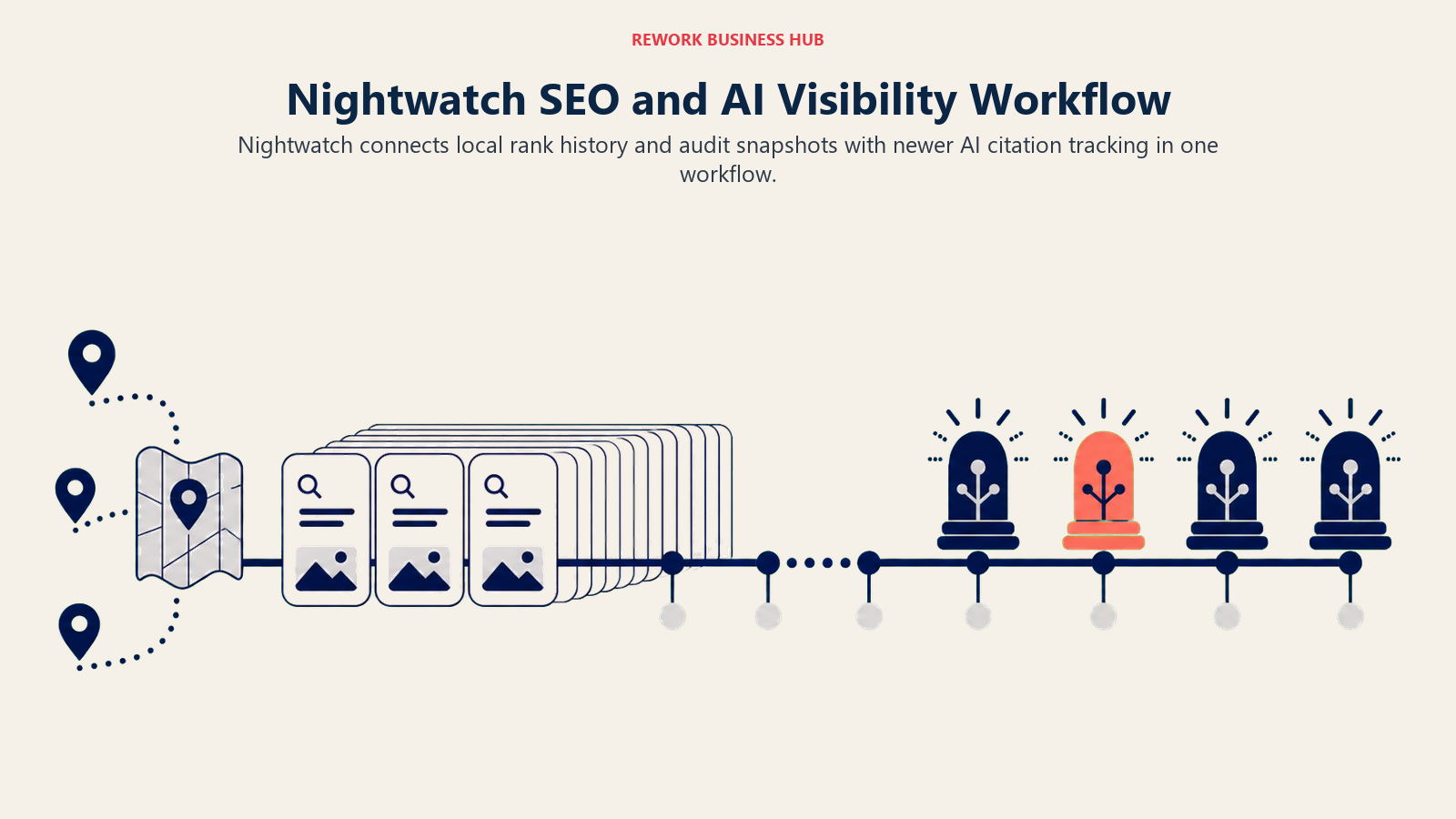
The appeal is having one rank-tracking workflow instead of two separate tools for traditional and AI search. The honest caveat is that the AI tracking piece is still labeled beta, so teams that need mature, battle-tested AI monitoring should weigh that against Nightwatch's genuinely strong core rank-tracking product.
| What you get | What you don't |
|---|---|
| Traditional rank tracking and AI visibility in one login | AI visibility is still a beta feature, not fully mature |
| Unlimited seats and white-label reports even on the entry plan | AI credits are capped per tier, not expandable as a flat add-on |
| Raw HTML snapshots for every ranking check, for audit purposes | Less specialized for AI visibility than purpose-built GEO tools |
Pricing: Starter EUR 79/month, Professional EUR 159/month, Agency EUR 399/month, Enterprise custom, every tier with unlimited user seats. Nightwatch now prices in euros and folds the SEO agent into each plan as a monthly credit allowance (100, 1,000 and 5,000 credits respectively) instead of selling AI visibility as a flat add-on.
Best for: SEO teams that want traditional rank tracking and AI visibility in a single tool rather than two separate subscriptions.
12. Rankscale: The Lowest Floor Price Across the Most AI Engines
Rankscale wins on raw affordability and engine breadth: its Essentials tier starts at $20/month ($17 on annual billing, which is annual-only) and covers 17+ AI platforms, including ChatGPT, Perplexity, Google AI Overviews, and Gemini, with no engine sold as a paid add-on. The credit system is where the real cost sits, because credits are weighted by engine rather than flat: ChatGPT, Perplexity, Gemini, and AI Mode cost 0.25 credits per prompt, DeepSeek costs 1, and Claude costs 2, making a Claude check eight times the price of a ChatGPT one. So there is an effective per-engine cost even though there is no per-engine fee. Topped-up credits stay active through your subscription rather than expiring.
That makes Rankscale the cheapest way to get broad engine coverage in this category. The ladder runs Essentials $20, Pro $99, Pro+ $229 (3,000 credits), Growth $385 (5,500 credits), and Enterprise $780 (12,000 credits, 200 web audits, 100 brand monitoring slots). Watch which tier unlocks what, because the entry plan is the thin one: unlimited seats start at Pro, the REST API at Pro+, and white-label reporting at Growth. The tradeoff is that heavy prompt volume drains the entry-tier credit allowance quickly, so teams tracking dozens of prompts across many engines will need to move up fast.
| What you get | What you don't |
|---|---|
| 17+ AI engines tracked from the $20/mo entry tier | Credit system can drain fast with heavy prompt volume |
| No per-engine add-on fees, unlike most competitors | Credits are weighted, so a Claude check costs 8x a ChatGPT one |
| Credits top up anytime and don't expire mid-subscription | Unlimited seats start at Pro, the API at Pro+, white-label at Growth |
Pricing: Essentials $20/mo ($17 annual), Pro $99/mo, Pro+ $229/mo, Growth $385/mo, Enterprise $780/mo, credit-based with per-engine credit weighting.
Best for: Budget-conscious teams that want the broadest AI engine coverage at the lowest possible entry price.
13. Trakkr: A Budget Alternative to Enterprise-Style Dashboards
Trakkr positions itself squarely as the accessible alternative to Profound-style enterprise tools: all AI models (ChatGPT, Claude, Gemini, Perplexity, and four more) are included on every plan with no per-model fees or credit metering, which simplifies budgeting compared to the credit systems used by Rankscale and AthenaHQ.
The Growth plan runs about $100/month after a 14-day free trial and covers one brand with 3 team seats, while the Scale plan at $500/month extends coverage to 10 brands with unlimited seats, client access, and API access, aimed at small agencies that have outgrown a single-brand tool but aren't ready for Profound's enterprise pricing. If you hit a prompt ceiling you don't have to jump a tier: Trakkr sells prompt packs at $39 for 50, $59 for 100, and $99 for 200, and extra brands at $50/month each.
| What you get | What you don't |
|---|---|
| All AI models included on every plan, no metering | Smaller company with less brand recognition than incumbents |
| Simple flat pricing instead of credit systems | Fewer content-generation features than Scrunch or Goodie |
| Scale plan covers 10 brands for small agencies | Growth plan is limited to a single brand |
Pricing: Growth ~$100/mo (1 brand, 3 seats), Scale $500/mo (10 brands, unlimited seats), 14-day free trial.
Best for: Small agencies and budget-conscious marketing teams that want simple, flat pricing without credit metering.
AI Visibility Buying Mistakes to Avoid
Most teams evaluating this category for the first time make predictable mistakes, because the tools themselves are still young enough that best practices haven't fully settled.
| Mistake | What It Looks Like | What to Do Instead |
|---|---|---|
| Buying before defining prompts to track | Signing up for a big platform, then struggling to fill out prompt lists | Draft 20-50 real buyer prompts before comparing tools |
| Assuming "AI visibility" means every engine | Discovering Claude or Grok isn't tracked after you've already paid | Confirm the exact engine list and which are paid add-ons |
| Treating it as a vanity metric | Reporting share-of-voice numbers with no link to pipeline | Connect AI referral traffic to your CRM or analytics before reporting up |
| Ignoring add-on costs | Budgeting for the base plan, then getting surprised by Gemini or AI Mode fees | Price out full engine coverage, not just the entry tier |
| Buying agency tier for one brand | Paying Peec AI's agency pricing to track a single company | Match the plan tier to how many brands you're actually tracking |
| Confusing a free grader with ongoing monitoring | Running HubSpot's AEO Grader once and calling it done | Use free tools for a first look, then budget for continuous tracking |
| Skipping the content follow-up | Watching a dashboard show declining visibility with no owner to fix it | Pick a tool with an action layer (Scrunch, Goodie) if you lack a content team |
| Not re-verifying pricing | Budgeting off a review site's numbers from months ago | Re-check vendor pricing pages before renewal; this category moves fast |
Decision Framework
The final shortlist should reflect company stage, the SEO data already in use, required engine coverage, and whether the team needs monitoring alone or a built-in action layer.
| If you need... | Pick... | Why |
|---|---|---|
| The deepest enterprise-grade prompt tracking | Profound | Category leader for prompt-level detail and sentiment analysis |
| AI visibility next to data from an SEO tool you already pay for | Ahrefs Brand Radar or Semrush AI Toolkit | Same dashboard as your backlink and keyword data |
| A free first look before committing budget | HubSpot AI Search Grader | Genuinely free, no signup, one-time brand snapshot |
| The cheapest real ongoing monitoring | Otterly.ai | $29/mo covers all four core engines with unlimited team members |
| Multi-brand tracking for an agency | Peec AI | Unlimited users, centralized billing across client projects |
| The broadest engine coverage at the lowest floor price | Rankscale | 17+ engines tracked from $20/mo |
| Monitoring plus an action layer for fixing gaps | Scrunch AI or Goodie AI | Both pair tracking with content delivery or generation |
| Rank tracking and AI visibility in one login | Nightwatch | 13 years of ranking data connected to AI citation tracking |
| Flat pricing without credit metering | Trakkr | All models included on every plan, no per-model fees |
| Credit-based flexibility with generous free credit | AthenaHQ | Unlimited seats plus $300/mo of included credit |
What to Do Next
Pick one tool and run it for 30 days before you commit to an annual plan. Write down 20-30 real buyer prompts your customers would plausibly ask an AI engine, run them through your shortlist's free trial or entry tier, and see whether the tool actually surfaces something actionable, not just a share-of-voice number with nowhere to go. The tools that matter in 2026 are the ones connected to a follow-up: a content brief, a structured-data fix, a competitor gap someone on your team owns. If you're building out that content motion at scale, the AI content operator playbook for scaling SEO is a useful next read, and our broader best AI tools in 2026 roundup covers the writing, coding, and automation tools that typically sit alongside a GEO platform in a marketing team's stack.
If you're already running Ahrefs or Semrush, start there before adding a new vendor. If you've never checked your AI visibility at all, HubSpot's free grader is the fastest way to find out whether this category is worth budget in the first place.

Principal Product Marketing Strategist
On this page
- Updated October 2026: What Changed
- Key Facts
- Quick Comparison Table
- How to Choose an AI Visibility Tool in 2026
- Framework: By Company Stage
- Sizing and Persona Table
- 1. Profound: Deepest Enterprise AI Visibility Tracking
- 2. Ahrefs Brand Radar: AI Visibility Backed by a 447M-Prompt Index
- 3. Semrush AI Toolkit / Enterprise AIO: AI Visibility Inside an Existing SEO Stack (Now Adobe-Owned)
- 4. HubSpot AI Search Grader + AEO: The Free Way In
- 5. Otterly.ai: The Cheapest Real Ongoing Monitoring Plan
- 6. Peec AI: Built for Agencies Managing Multiple Brands
- 7. AthenaHQ: Credit-Based Mid-Market GEO Platform
- 8. Scrunch AI: Enterprise GEO Plus a Content Delivery Layer
- 9. Goodie AI: Closed-Loop AEO With a Built-In Content Writer
- 10. SE Ranking (SE Visible / AI Search Add-On): Cheapest Add-On to an Existing Rank Tracker
- 11. Nightwatch: Rank Tracking and AI Visibility in One Workflow
- 12. Rankscale: The Lowest Floor Price Across the Most AI Engines
- 13. Trakkr: A Budget Alternative to Enterprise-Style Dashboards
- AI Visibility Buying Mistakes to Avoid
- Decision Framework
- What to Do Next