Best AI Music Generators in 2026: 12 Tools Ranked by Use Case

Turn this article into takeaways for your work.


Each assistant summarizes the article only for you and suggests best practices for your work.
Suno and Udio still generate the widest range of full songs with vocals, ElevenLabs Music leads on licensed, commercial-safe training data, Soundraw and Beatoven.ai are built for scoring video and podcasts by mood, and Google's Lyria is the free option baked into an ecosystem most teams already use. This guide ranks 12 AI music generators by the job you're actually hiring them for, not by which one sounds best in a cherry-picked demo.
The category looks completely different than it did a year ago. Warner Music and Universal Music Group both settled their copyright lawsuits against the leading AI music platforms and signed licensing deals instead, which changed what you can legally download, remix, and monetize on each tool. If you evaluated AI music generators before late 2025, several of the rules you learned no longer apply. The entries most affected by the licensing shakeup are flagged below.
Updated July 2026: What Changed
- Warner Music settled with Suno in November 2025 and signed a licensing deal that adds "licensed models," monthly download caps, and the Songkick live-data platform to Suno. Free-tier songs are now playable and shareable but no longer downloadable; only paid subscribers can export files.
- Universal Music Group settled with Udio in October 2025, but the deal is more restrictive. Udio is shifting into a "walled garden" fan-engagement platform built around licensed catalog remixing rather than open-ended text-to-song generation, and creations increasingly can't leave the platform at all.
- UMG and Sony are still suing Suno separately in federal court in Massachusetts even after the Warner settlement, so Suno's legal exposure isn't fully resolved industry-wide.
- ElevenLabs shipped Music v2 in May 2026, trained on licensed data and explicitly cleared for commercial use, with better vocals, arrangement, and multilingual support than the v1 model.
- Riffusion rebranded to Producer.ai in mid-2025, and Google acquired the startup in February 2026, folding its conversational music agent into Google Labs and DeepMind alongside the Lyria 3 model.
- Google replaced the free MusicFX tool with Google Flow Music, built on Lyria 3, adding a paid Plus tier for longer, higher-fidelity tracks.
Key Facts
- Global recorded music revenue grew 6.4% to $31.7 billion in 2025, its 11th straight year of growth, with streaming now 69.6% of that total and 837 million paid subscribers worldwide, per IFPI's Global Music Report 2026.
- Direct AI-generated music revenue could grow from roughly $400 million in 2024 to $2.1 billion by 2030, a near 30% annual growth rate, per Goldman Sachs' Music in the Air research.
- 44% of all new tracks uploaded to Deezer each day, close to 75,000 songs, are now fully AI-generated, up from 10,000 a day in January 2025, per Deezer's April 2026 newsroom disclosure.
- In a blind test of 9,000 listeners across 8 countries, 97% could not reliably tell a fully AI-generated song from a human-made one, and 80% said AI tracks should be clearly labeled, per the Deezer/Ipsos survey.
- 48% of independent musicians say they've used AI somewhere in their music-making process, down from 59.5% in 2023 as legal and creative concerns grew, per Ditto Music's 2025 artist survey.
- Suno users generate roughly 7 million songs a day, equal to Spotify's entire catalog every two weeks, and the platform had passed 100 million total users, 2 million paid subscribers, and $300 million in annual recurring revenue by February 2026, per TechCrunch.
Quick Comparison Table
| Tool | Best For | Starting Price | Key Strength | Key Limitation |
|---|---|---|---|---|
| Suno | Full songs with vocals, fast | Free; Pro $10/mo | Widest style range, strongest vocals | Free tier can't download after the Warner deal |
| Udio | High-fidelity prompt-based songs | Free; Standard $10/mo | Strong prompt adherence, remix tools | Now a "walled garden," exports are restricted |
| ElevenLabs Music | Teams already on ElevenLabs | Free; Starter $6/mo | Licensed training data, commercial-cleared | Credit-metered, adds up fast on long tracks |
| Google Lyria (Flow Music) | Free instrumental beds, Google users | Free; Plus $19.99/mo | Deep Gemini and Workspace integration | Full 3-minute tracks need a paid tier |
| Stable Audio | Developers needing an API | Free; Pro from $11.99/mo | Open-model heritage, strong API support | Shorter max track lengths than rivals |
| Soundraw | Unlimited royalty-free downloads | $11.04/mo, no free plan | Genre and mood sliders built for editors | No free tier to test before paying |
| AIVA | Orchestral and cinematic scoring | Free; Standard from ~$12/mo | Deep classical and game-score depth, MIDI export | Full copyright ownership requires the Pro tier |
| Beatoven.ai | Scoring video and podcasts by mood | Creator $10/mo, no free plan | Scene-based mood editing, no theory needed | Minutes-based pricing punishes heavy use |
| Mubert | Real-time and API generative audio | Free; Creator $14/mo | Built for apps, games, adaptive streaming | Real scale needs the $199/mo Business tier |
| Loudly | Budget creation plus distribution | Free; Personal $8/mo | Bundles generation with streaming distribution | Fewer mixing controls than Soundraw |
| Boomy | Cheapest path to a streaming release | Free; Personal $2.99/mo | Lowest-cost route to Spotify and Apple Music | Output quality trails Suno and Udio for full songs |
| Riffusion (Producer.ai) | Conversational, Google-backed agent | Free; paid from ~$64/mo | Backed by Google Labs and DeepMind, tied to Lyria 3 | Newly acquired, pricing and roadmap still settling |
1. Suno: Widest Range of Full Songs With Vocals
Suno remains the default first stop for anyone typing a prompt and expecting a finished, radio-ready song with vocals back. Its v5.5 model handles genre-blending and vocal styling better than most competitors, and the November 2025 licensing deal with Warner Music gave it a legal footing none of its rivals fully match yet, even with UMG and Sony still litigating separately.
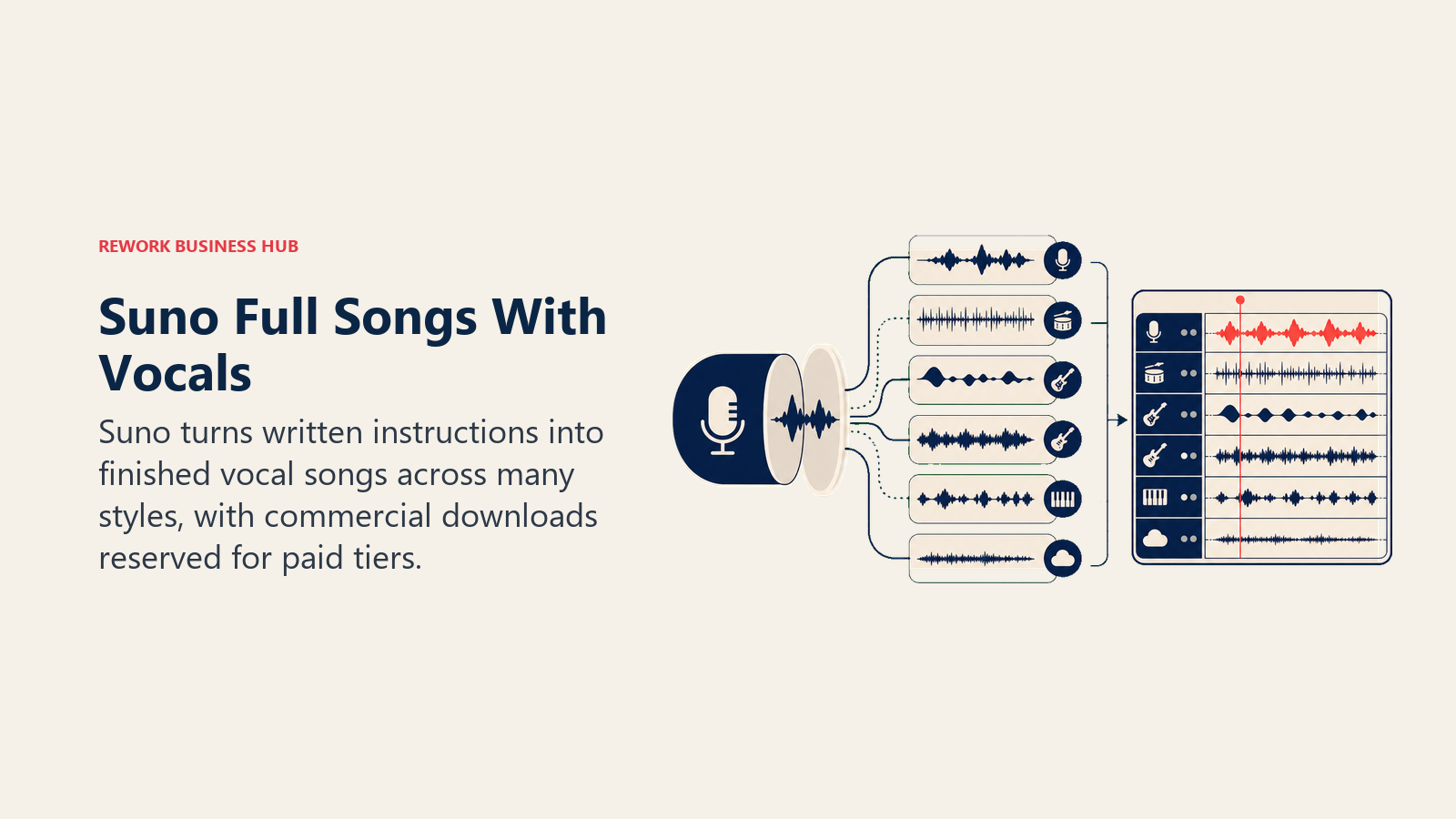
The free plan renews 50 credits daily (roughly 10 songs) but, under the new Warner terms, those songs are playable and shareable only, not downloadable. Paid tiers restore full commercial rights and exports. Pro at $10/month ($8/month billed annually) includes 2,500 monthly credits (about 500 songs), stem separation up to 12 tracks, and a priority queue. Premier at $30/month ($24/month annually) adds Suno Studio, a full AI-native DAW with MIDI export, multi-track editing, and batch generation for teams producing at volume.
| What you get | What you don't |
|---|---|
| Widest style and vocal range of any generator here | Free-tier downloads are gone post-Warner deal |
| Suno Studio DAW on Premier for real production work | UMG and Sony litigation is still unresolved |
| Fast generation, strong prompt-to-song fidelity | Credits don't roll over month to month |
Pricing: Free (no downloads); Pro $10/mo ($8/mo annual); Premier $30/mo ($24/mo annual). See suno.com/pricing.
Best for: Marketing teams, podcasters, and YouTubers who need a finished vocal track fast and are willing to pay for commercial rights.
2. Udio: High-Fidelity Prompting, Now a Walled Garden
Udio built its reputation on prompt adherence, producing songs that stick close to what you actually asked for, with strong remix and extend tools. That reputation is intact, but the product itself changed shape after Universal Music Group's October 2025 settlement.
Udio is now pivoting toward a licensed "fan engagement" model: remixing and mashing up UMG's catalog inside the platform rather than freely generating and exporting original songs. Creations increasingly stay inside Udio's walled garden instead of being downloadable assets you own outright. That's a meaningful shift if your workflow depends on exporting finished audio files for editing elsewhere.
| What you get | What you don't |
|---|---|
| Strong prompt adherence and remix/extend controls | Downloads are increasingly restricted post-UMG deal |
| Access to licensed major-label catalog material | Less useful if you need a portable, exportable file |
| Straightforward credit-based pricing | Free tier caps at 3 full 2:10 songs a day |
Pricing: Free (100 credits/mo, 10/day cap); Standard $10/mo ($8/mo annual); Pro $30/mo (6,000 credits). See udio.com/pricing.
Best for: Fans and creators who want to remix licensed catalog material inside Udio's platform rather than generate fully original, exportable tracks.
3. ElevenLabs Music: Licensed Data, Commercial-Cleared
ElevenLabs built its name on voice AI, and Music is its newest layer on top of that same infrastructure. The pitch is straightforward: Music v2, shipped in May 2026, was trained on licensed data from the ground up and is explicitly cleared for commercial use, which sidesteps the copyright uncertainty still hanging over Suno and Udio.
Because Music lives inside ElevenLabs' broader credit system rather than as a standalone product, pricing scales with how much audio you generate rather than a flat monthly song count. Eleven Music runs 900 credits per minute of generated audio (about $0.15/minute through the API), so a 90-second track costs meaningfully more credits than a 15-second one. For teams already paying for ElevenLabs voice cloning or dubbing, Music slots into the same plan without a separate subscription.
| What you get | What you don't |
|---|---|
| Trained on licensed data, cleared for commercial use | Credit-metered pricing gets expensive on longer tracks |
| One subscription covers voice, dubbing, and music | Fewer genre presets than dedicated music tools |
| Strong vocal and arrangement quality in v2 | No dedicated free "music-only" tier |
Pricing: Free $0/mo (10,000 credits); Starter $6/mo (30,000 credits); Creator $22/mo (121,000 credits); Pro $99/mo (600,000 credits). See elevenlabs.io/pricing.
Best for: Teams already using ElevenLabs for voice or dubbing that want commercially safe background music without adding another vendor.
4. Google Lyria (Flow Music): Free, Deep in the Google Ecosystem
Google's approach to AI music has consolidated around the Lyria model family. MusicFX, the free Google Labs tool that made short instrumental loops, has been effectively superseded by Google Flow Music, which runs on Lyria 3 and targets longer, more structured output alongside Google's video generation tools.
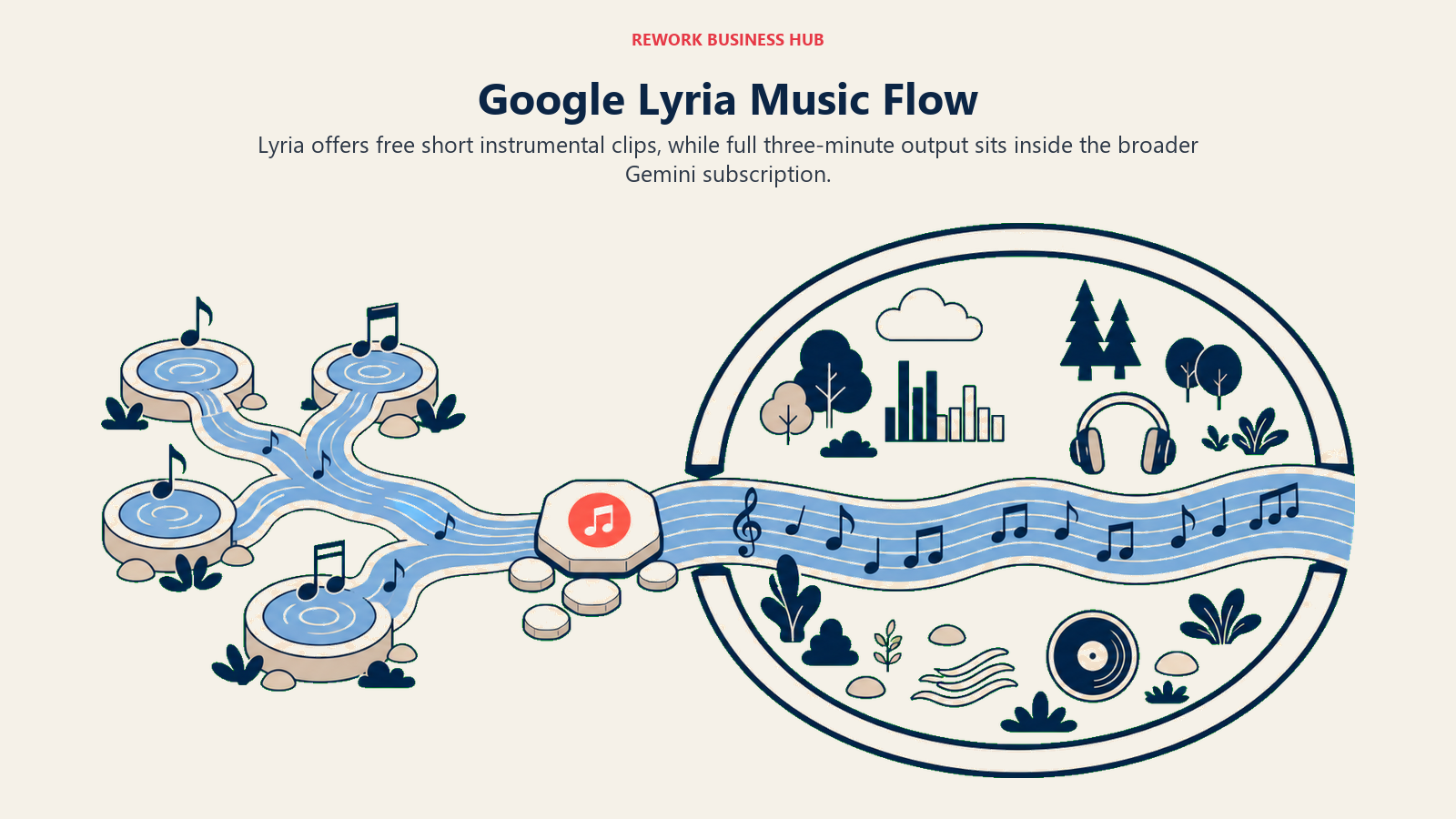
The free tier ships with daily credits and no credit card required, which makes it the easiest way to test AI music without commitment. The catch is depth: Lyria 3 Clip, available on the free tier and the $19.99/month Plus plan, tops out at 30-second tracks. Getting the full 3-minute Lyria 3 Pro output requires a Gemini Pro subscription, which folds music generation into a broader AI bundle rather than selling it as a standalone product.
| What you get | What you don't |
|---|---|
| Genuinely free tier, no card required to start | Full-length tracks are gated behind Gemini Pro |
| Tight integration with Google Workspace and Gemini | Fewer vocal and genre controls than Suno or Udio |
| High-quality 48kHz stereo instrumental output | Positioned as instrumental beds, not vocal songs |
Pricing: Free (daily credits); Plus $19.99/mo (Lyria 3 Clip, 30-sec tracks); full Lyria 3 Pro output requires Gemini Pro. See Google's Lyria documentation.
Best for: Teams already inside Google Workspace or Gemini who want quick instrumental beds without adding a new subscription.
5. Stable Audio: Open-Model Heritage, API-First
Stable Audio carries Stability AI's open-model philosophy into music: it's the generator developers reach for when they want to build AI music generation into their own product rather than use someone else's app. The API and SDK support are more mature here than on most consumer-facing tools in this list.
The hosted product at stableaudio.com offers a free tier (24 signup credits, non-commercial, occasionally paused in high-abuse regions) and a Professional tier starting around $11.99/month for roughly 250 monthly generations with a personal commercial license. Track lengths run shorter than Suno or Udio, typically capped in the range of 90 seconds to a few minutes depending on the plan, which fits sound design and short-form use better than full song production.
| What you get | What you don't |
|---|---|
| Mature API and SDK for building AI music into your app | Shorter max track lengths than song-focused rivals |
| Commercial rights included on paid tiers | Free credits sometimes unavailable by region |
| Strong for sound design, stingers, and short loops | Less vocal capability than Suno, Udio, or ElevenLabs |
Pricing: Free (24 signup credits, non-commercial); Professional from $11.99/mo (~250 generations). See stableaudio.com/pricing.
Best for: Developers and product teams building AI-generated audio into their own application rather than using a standalone editor.
6. Soundraw: Unlimited Downloads for Video Editors
Soundraw skips vocals and prompts entirely in favor of genre, mood, and energy sliders, which makes it faster to dial in a background track for a specific video cut than typing and retyping text prompts. There's no free tier, you generate for free but pay to download, which keeps the product focused on paying creators rather than casual browsers.
Every paid tier grants unlimited MP3 downloads with full royalty-free rights for video, podcasts, ads, and client work, a licensing structure aimed squarely at agencies and freelance editors billing multiple projects. Higher tiers add WAV and stem exports for teams that need to remix the track in a DAW rather than drop in a finished MP3.
| What you get | What you don't |
|---|---|
| Unlimited MP3 downloads on every paid plan | No free tier or trial download |
| Royalty-free rights explicitly cover client work | No vocal generation, instrumental only |
| Mood and energy sliders tuned for video editors | WAV and stems require the top Unlimited tier |
Pricing: Creator $11.04/mo; Artist Starter $19.49/mo; Artist Pro $23.39/mo; Artist Unlimited $32.49/mo. See soundraw.io.
Best for: Video editors and agencies who need fast, royalty-free background tracks and bill that work to clients.
7. AIVA: Orchestral Depth for Film and Game Scoring
AIVA has stayed in its lane since long before the current AI music boom: composed, orchestral, cinematic music for film, games, and trailers, with MIDI export for composers who want to edit the output in a traditional DAW rather than accept a finished stem. It's the closest thing on this list to a virtual composer rather than a text-to-song generator.
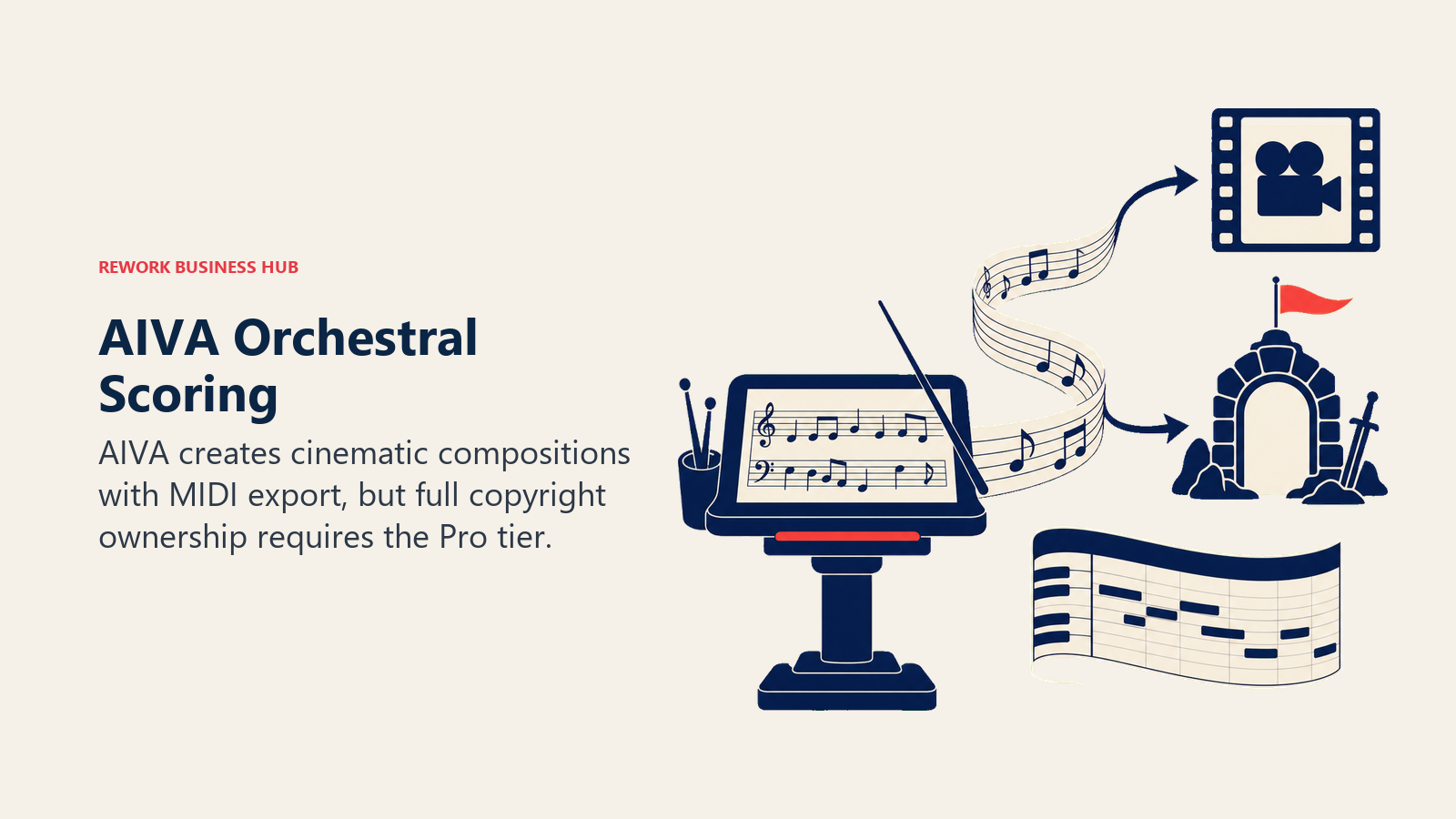
The tiering is built around who owns the output. The Free plan caps at 3 downloads a month and AIVA retains copyright with no monetization allowed. Standard, at roughly €11/month billed annually, raises that to 15 downloads and limited monetization on YouTube, Twitch, TikTok, and Instagram, still under AIVA's copyright. Only the Pro plan, around €33/month billed annually, transfers full copyright ownership to you with unrestricted commercial use and WAV exports.
| What you get | What you don't |
|---|---|
| Deep orchestral and cinematic composition depth | Full copyright ownership requires the Pro tier |
| MIDI export for editing in a traditional DAW | Weaker at pop vocals than Suno or Udio |
| Clear, tiered path from hobbyist to full ownership | Pricing in euros, less familiar for US buyers |
Pricing: Free (3 downloads/mo, no commercial rights); Standard ~€11/mo annual; Pro ~€33/mo annual (full copyright). See aiva.ai.
Best for: Composers, game studios, and indie filmmakers who want orchestral scoring depth and eventual full ownership of the output.
8. Beatoven.ai: Mood-Based Scoring for Video and Podcasts
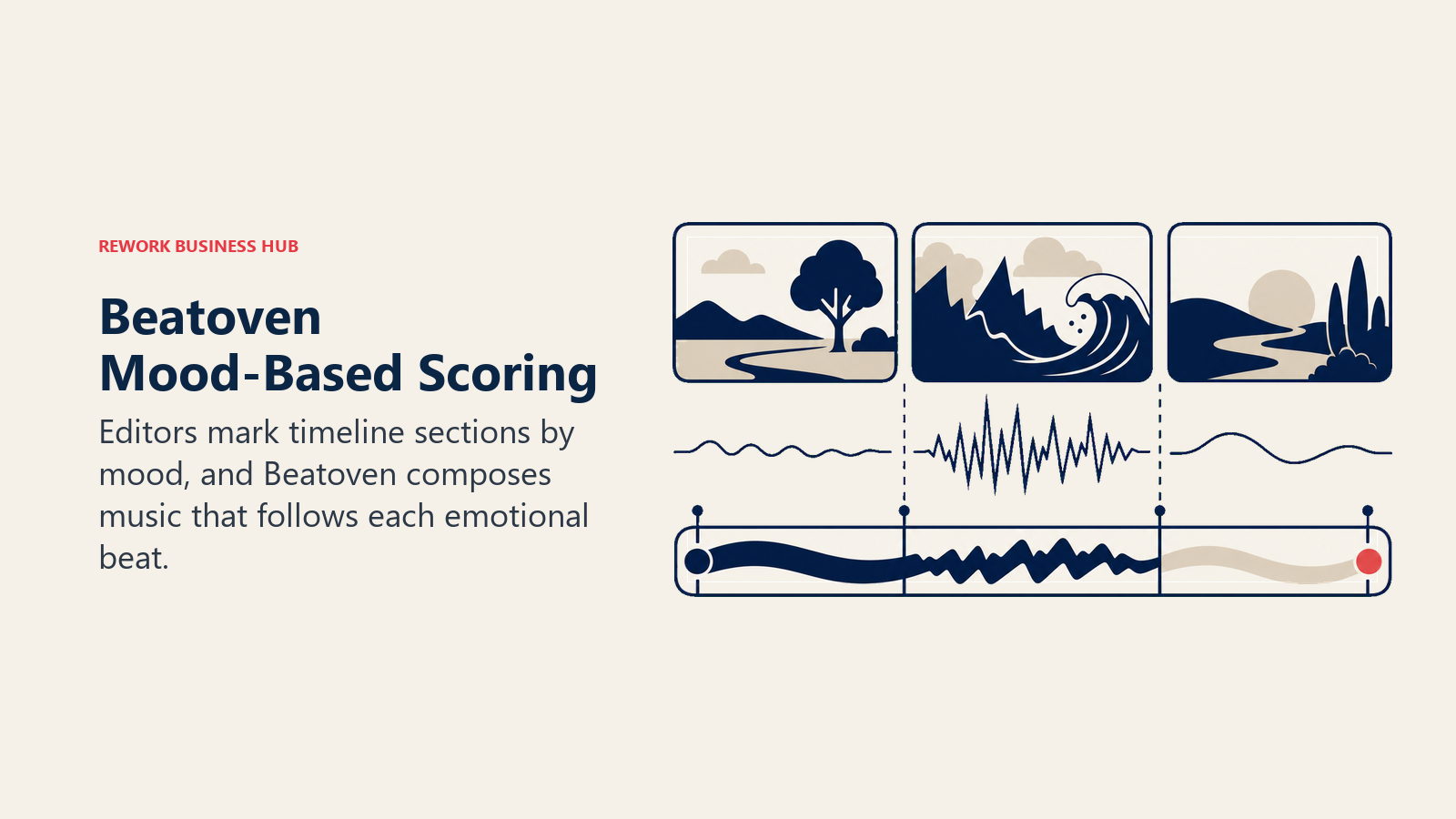
Beatoven.ai is built around a different mental model than most of this list: instead of typing a genre or style, you mark up sections of your video or podcast timeline by mood (tense, uplifting, somber) and the tool composes music that follows those emotional beats. That workflow makes it genuinely fast for editors who don't want to think in music theory terms at all.
There's no free plan, only a limited monthly trial (one Composer generation, one Maestro generation, one Maestro SFX generation). Pricing runs on a minutes-based system rather than a per-track model: Creator Lite at $3/month is the cheapest entry point, Creator at $10/month (or $100/year) includes 30 minutes of downloads, and Visionary at $20/month (or $200/year) doubles that to 60 minutes, with extra minutes at $3 each if you go over.
| What you get | What you don't |
|---|---|
| Scene-based mood editing, no music theory needed | No free plan, only a capped monthly trial |
| Purpose-built for syncing music to video timing | Minutes-based pricing punishes heavy output |
| Reasonable entry price at the Creator Lite tier | Fewer genre presets than Soundraw or Mubert |
Pricing: Creator Lite $3/mo; Creator $10/mo (30 min); Visionary $20/mo (60 min); extra minutes $3 each. See beatoven.ai/pricing.
Best for: Video editors and podcast producers scoring by scene or mood rather than searching for a matching genre track.
9. Mubert: Real-Time Generative Audio for Apps and Games
Mubert's distinguishing feature is that it doesn't just generate finished tracks, it generates music in real time through an API, adapting to app state, game events, or a live stream as it happens. That's a different problem than "give me a 3-minute song," and Mubert is one of the few tools on this list built to solve it.
For creators who just want royalty-free background tracks for social content, the Creator plan at $14/month covers that without attribution requirements. The Pro plan at $39/month adds full commercial licensing for freelancers, advertisers, and indie game developers working on client-facing projects. Real scale, agencies, studios, or platforms embedding Mubert into their own product, requires the $199/month Business tier or a custom Enterprise/API agreement.
| What you get | What you don't |
|---|---|
| Real-time, adaptive generation via API | Real scale requires the $199/mo Business tier |
| Purpose-built for games, apps, and live streams | Less suited to one-off finished songs than Suno |
| Free Ambassador tier to test before paying | API integration work needed to use it well |
Pricing: Free (Ambassador); Creator $14/mo; Pro $39/mo; Business $199/mo; Enterprise custom. See mubert.com/render/pricing.
Best for: App and game developers who need adaptive, real-time generative audio rather than static finished tracks.
10. Loudly: Budget Generation Bundled With Distribution
Loudly's pitch is that generation and distribution shouldn't be two separate purchases. Every paid plan bundles AI music creation with a built-in path to release tracks on Spotify, Apple Music, and other streaming platforms, which matters if the end goal is an artist profile rather than a background track for someone else's video.
The free plan is unusually generous, covering roughly 90% of the platform's features with a daily generation allowance, though it caps at one download a day and 30-second previews. Personal at $8/month (billed annually) unlocks 900 monthly track creations, tracks up to 7 minutes, 300 downloads, and basic distribution. Pro at $24/month (billed annually) triples the track allowance, extends songs to 30 minutes, and upgrades to Distro Plus, which pays 100% of streaming royalties back to you.
| What you get | What you don't |
|---|---|
| Generation and streaming distribution in one product | Fewer advanced mixing controls than Soundraw |
| Unusually generous free tier to start | Full royalty payout requires an annual Pro plan |
| Stem and sample packs included on paid tiers | Track quality trails Suno or Udio for vocal songs |
Pricing: Free (limited); Personal $8/mo annual; Pro $24/mo annual. See loudly.com/music/pricing.
Best for: Independent creators who want to generate tracks and actually release them to streaming platforms from the same tool.
11. Boomy: The Cheapest Path to a Streaming Release
Boomy exists to get a song from a text prompt to a live Spotify listing at the lowest possible price. The free plan alone allows 25 songs a month with personal downloads, and the Personal plan at $2.99/month adds unlimited creation plus distribution to more than 40 platforms including Spotify, Apple Music, Amazon Music, and YouTube Music.

The honest tradeoff is output quality. Boomy's generation engine is faster and cheaper than Suno or Udio but noticeably behind on vocal realism and song structure for anything beyond simple, loop-based tracks. It's a genuinely useful tool for someone testing whether AI-assisted music distribution is worth pursuing before spending more, not a replacement for a serious production workflow.
| What you get | What you don't |
|---|---|
| Lowest-cost path to a real streaming release | Output quality trails Suno and Udio noticeably |
| Distribution to 40+ platforms bundled in | Commercial licensing and full ownership need Pro |
| Simple, fast interface for non-musicians | Better suited to loops than complex song structure |
Pricing: Free (25 songs/mo); Personal $2.99/mo (unlimited + distribution); Pro around $9.99/mo (commercial licensing, priority exports). See boomy.com.
Best for: Hobbyists and first-time creators who want the cheapest possible route to a live streaming release.
12. Riffusion (Producer.ai): Google-Backed Conversational Agent
Riffusion started as one of the earliest AI music experiments, spinning audio spectrograms out of an image-generation model. It rebranded to Producer.ai in mid-2025 with a new flagship model, FUZZ 2.0, and a more conversational interface for iterating on a track. Google acquired the company in February 2026, folding its team and technology into Google Labs and DeepMind alongside the Lyria 3 model.
That acquisition makes Producer.ai the one entry on this list whose roadmap is actively in motion. It runs a freemium model with a usable free tier (two concurrent generations) and paid plans reported around $64/month for expanded concurrent generation limits, though pricing and packaging are still settling post-acquisition, so confirm current terms directly before committing budget.
| What you get | What you don't |
|---|---|
| Conversational, iterative workflow for refining a track | Pricing and roadmap still settling post-acquisition |
| Backed by Google Labs and DeepMind engineering | Smaller community and track record than Suno or Udio |
| FUZZ 2.0 model with improved vocals and instrumentation | Less third-party documentation while it stabilizes |
Pricing: Free (2 concurrent generations); paid plans reportedly from ~$64/mo. See producer.ai.
Best for: Early adopters comfortable with a product still integrating into Google's AI stack, in exchange for backing from a much larger engineering team.
How to Choose: Decision Framework
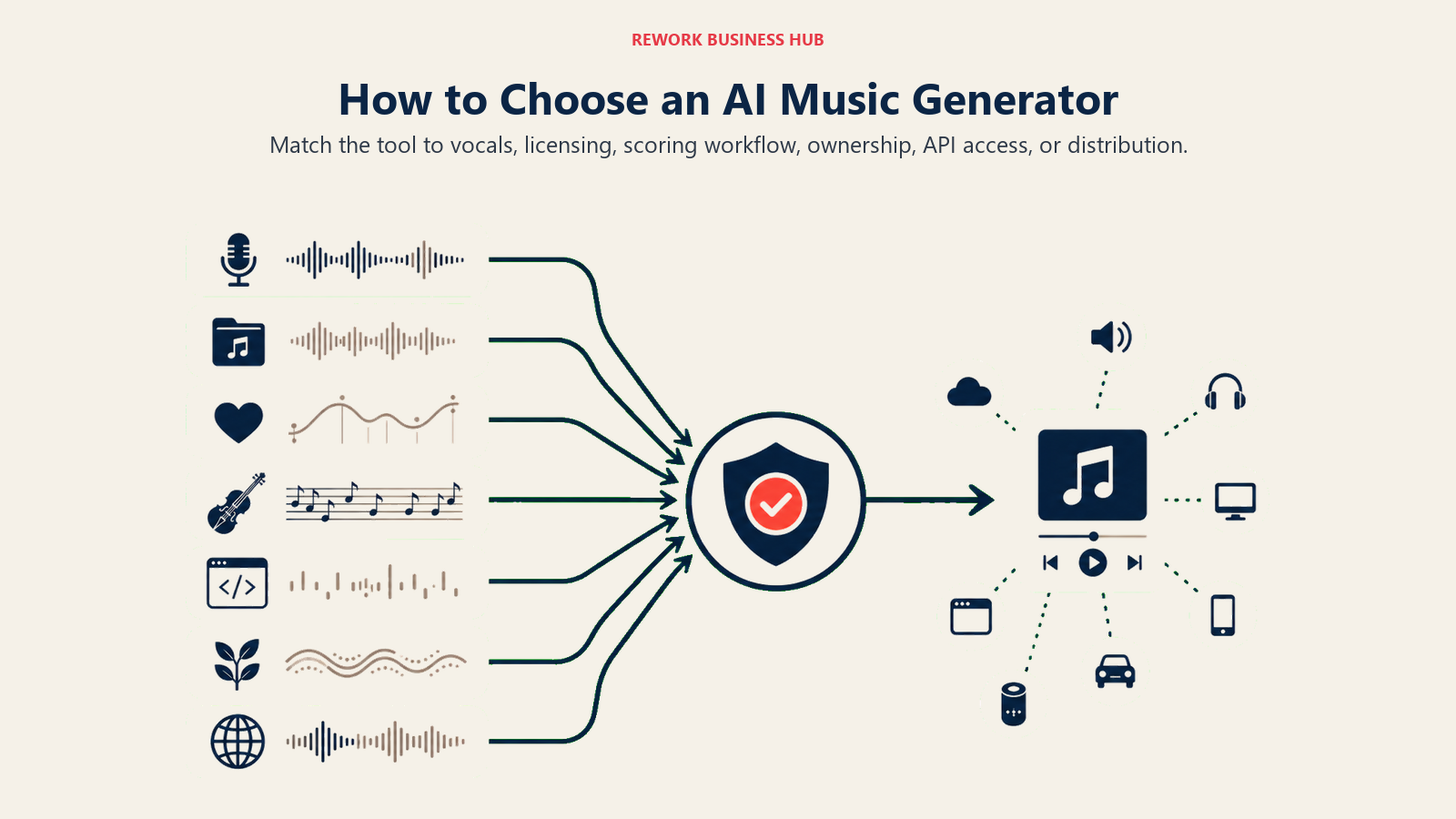
Use the decision map below to match vocals, licensing, scoring workflow, ownership, API access, or distribution to the right generator.
| If you need... | Pick... | Why |
|---|---|---|
| A finished vocal song, fast, with commercial rights | Suno | Widest style range, strongest vocals, full rights on paid tiers |
| Commercially safe music with zero copyright ambiguity | ElevenLabs Music | Music v2 trained on licensed data, cleared for commercial use |
| Unlimited royalty-free background tracks for client video work | Soundraw | Unlimited downloads on every paid tier, explicit client-work rights |
| Music scored to the emotional beats of a video or podcast | Beatoven.ai | Mood and scene-based editing built for that exact workflow |
| Orchestral or cinematic scoring with eventual full ownership | AIVA | Deepest classical and game-score depth, MIDI export, Pro-tier ownership |
| A free option inside a Google/Gemini workflow you already pay for | Google Lyria (Flow Music) | No new subscription, tight Workspace and Gemini integration |
| To embed generative audio inside your own app or product | Mubert or Stable Audio | Real-time API (Mubert) or mature developer SDK (Stable Audio) |
| The cheapest possible route to a live streaming release | Boomy | Personal plan at $2.99/mo with distribution to 40+ platforms |
| Generation bundled with a real distribution and royalty pipeline | Loudly | Distro Basic and Distro Plus built into every paid plan |
Whatever you pick, treat the licensing status as part of the evaluation, not an afterthought. A track generated on a tool still fighting an active copyright suit carries more platform-takedown risk than one built on licensed training data, even if the audio itself sounds identical. If your team is also evaluating the broader AI stack beyond music, the best AI tools in 2026 roundup covers the other 24 categories, and Claude vs ChatGPT vs Gemini is worth reading before you commit to Google's ecosystem for Lyria specifically.
Frequently Asked Questions about AI Music Generators
What is the best AI music generator in 2026?
There's no single best tool for everyone. Suno and Udio lead on full vocal songs, ElevenLabs Music leads on licensed, commercial-safe generation, Soundraw and Beatoven.ai are built for scoring video and podcasts, and Google's Lyria is the strongest free option if you're already in the Google ecosystem.
Is AI-generated music copyrighted, and can I sell it?
It depends on the tool and your plan tier. Free tiers on Suno, Udio, and AIVA generally exclude commercial rights, and Udio's post-UMG "walled garden" model restricts what you can export at all. Paid tiers on Suno, ElevenLabs Music, Soundraw, and AIVA's Pro plan grant commercial rights or full copyright ownership; always confirm the exact terms on your specific plan before using a track commercially.
What changed with the Suno and Udio lawsuits?
Warner Music settled with Suno in November 2025 and Universal Music Group settled with Udio in October 2025, both trading litigation for licensing deals. Suno gained "licensed models" and download caps for free users; Udio is pivoting toward a more restricted, licensed remix platform. UMG and Sony are still suing Suno separately in Massachusetts federal court.
Which AI music generator has the best free plan?
Google's Lyria (via Flow Music) and Loudly both offer genuinely usable free tiers without a credit card. Suno and Udio's free tiers still let you generate and stream tracks, but downloading and commercial use now require a paid plan under their new licensing deals.
Can AI music generators create realistic vocals?
Suno and Udio produce the most convincing vocal performances of the tools in this guide, and ElevenLabs Music's v2 model closed much of that gap in May 2026. AIVA, Stable Audio, Soundraw, Beatoven.ai, and Mubert are primarily instrumental tools and either lack vocal generation or handle it as a secondary feature.
Which tool is best for scoring a YouTube video or podcast?
Beatoven.ai's mood-and-scene editing and Soundraw's genre and energy sliders are both purpose-built for syncing background music to video or podcast timing, and both include royalty-free licensing that explicitly covers client work.
How much does an AI music generator cost per month?
Entry-level paid plans mostly land between $3 and $14 a month (Boomy, Beatoven.ai, Loudly, Mubert, Suno, Udio). Mid-tier plans for unlimited downloads or higher fidelity run $20 to $40 a month (Soundraw, AIVA Pro, Mubert Pro, Loudly Pro). Business and API-scale tiers, like Mubert Business or Producer.ai's paid plan, run $65 to $200 a month or higher.
Will listeners notice a track is AI-generated?
Usually not from the audio alone. In a blind test of 9,000 listeners across 8 countries run by Deezer and Ipsos, 97% failed to reliably identify which tracks were fully AI-generated, though 80% of respondents said they want AI-generated tracks clearly labeled regardless.
What to Do Next
Pick two tools based on the job, not the demo reel: one for finished, vocal-forward songs (Suno or ElevenLabs Music if licensing certainty matters most) and one for scoring background audio to video or podcast content (Soundraw or Beatoven.ai). Generate against a real brief, a specific video cut or a specific campaign, rather than a generic prompt, and check the commercial-rights terms on your actual plan tier before you publish anything built with the output. If your team is building out a broader AI-assisted content workflow, AI in the content marketer workflow and the content marketer tools and tech stack guide are good next reads, and the best AI tools for content writers and best AI tools for digital marketing roundups cover the rest of the stack music usually gets paired with. If video is part of the deliverable too, the best Canva alternatives list covers the design side of the same workflow.

Principal Product Marketing Strategist
On this page
- Updated July 2026: What Changed
- Key Facts
- Quick Comparison Table
- 1. Suno: Widest Range of Full Songs With Vocals
- 2. Udio: High-Fidelity Prompting, Now a Walled Garden
- 3. ElevenLabs Music: Licensed Data, Commercial-Cleared
- 4. Google Lyria (Flow Music): Free, Deep in the Google Ecosystem
- 5. Stable Audio: Open-Model Heritage, API-First
- 6. Soundraw: Unlimited Downloads for Video Editors
- 7. AIVA: Orchestral Depth for Film and Game Scoring
- 8. Beatoven.ai: Mood-Based Scoring for Video and Podcasts
- 9. Mubert: Real-Time Generative Audio for Apps and Games
- 10. Loudly: Budget Generation Bundled With Distribution
- 11. Boomy: The Cheapest Path to a Streaming Release
- 12. Riffusion (Producer.ai): Google-Backed Conversational Agent
- How to Choose: Decision Framework
- What to Do Next