Devin vs Claude Code: Which AI Software Engineer Fits Your Team in 2026?
Turn this article into takeaways for your work.


Each assistant summarizes the article only for you and suggests best practices for your work.
You're being asked to put real budget behind an AI that writes code, and two names keep coming up: Devin and Claude Code. Search "devin vs claude code" and you'll find a lot of benchmark chatter. Most of it skips the question that actually decides a rollout: where does the agent work, and who is supposed to be watching it?
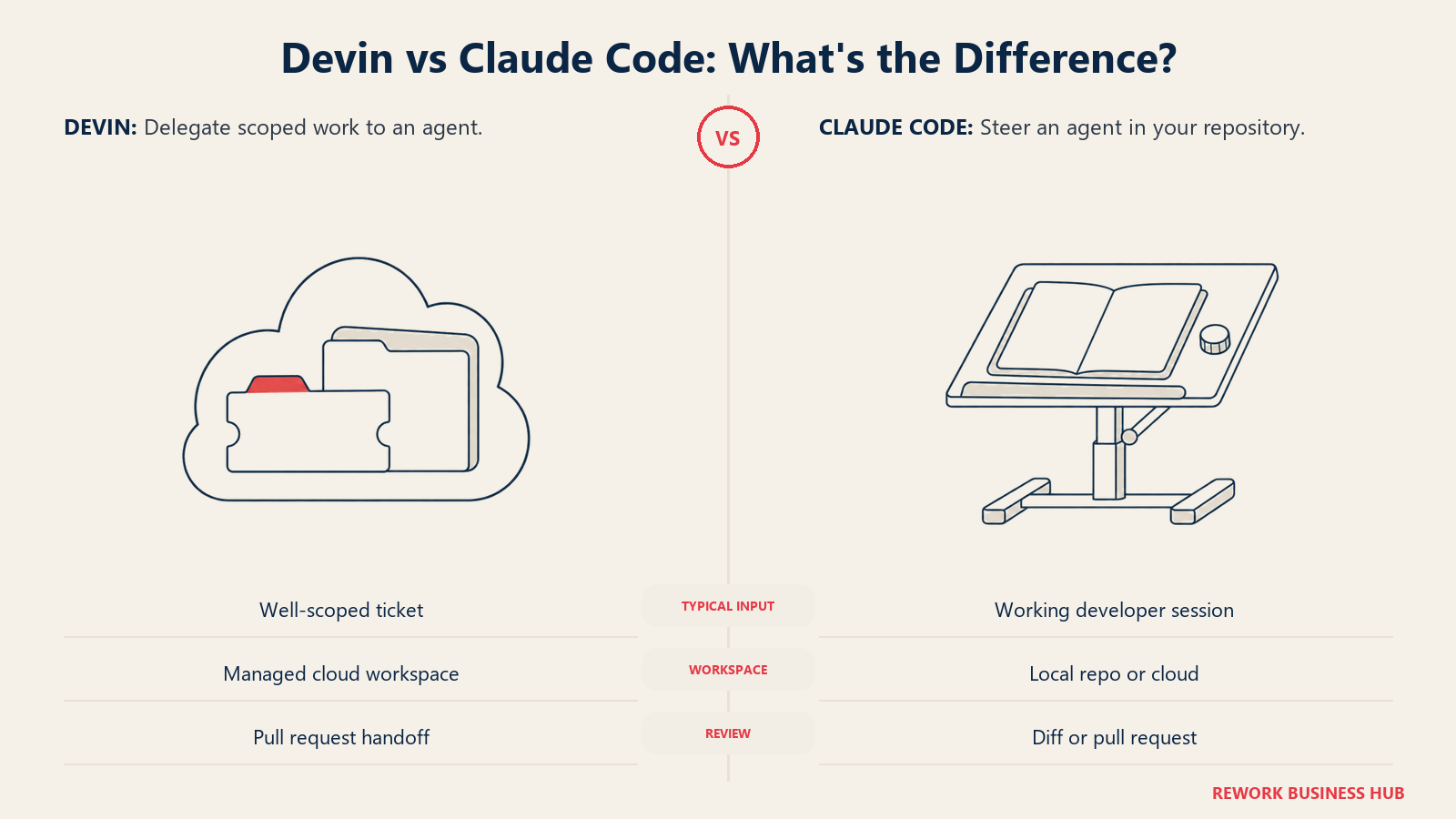
Devin is Cognition's autonomous software engineer. You hand it a ticket, it spins up its own cloud workspace with a shell, an editor, and a browser, and it comes back with a pull request. Claude Code is Anthropic's agentic coding tool. It runs against your real repository from the terminal, an IDE, a desktop app, or the web, and it's built around a developer steering the work. Both can now run in the cloud and both can run in parallel, so the gap is narrower than it was a year ago. It hasn't closed.
This comparison is for the CTO, VP Engineering, Head of Engineering, or technical founder who has to defend the purchase: what each costs at real team sizes, what it does to your security review, and which operating model matches how your engineers already ship. If you want the wider field first, the best AI coding agents in 2026 ranks the category, and how to choose an AI coding assistant covers the evaluation criteria.
Key Facts
- Devin is made by Cognition, which describes itself as "an independent agent lab" and announced a raise of over $2B at a $48B valuation on September 8, 2026.
- Windsurf is now Devin Desktop. Cognition announced the rename on June 2, 2026, so Devin today is a family: Devin Cloud, Devin Desktop, Devin CLI, and Devin Review, sharing one agent and context.
- Claude Code runs in the terminal, VS Code, JetBrains, a desktop app, and the web, all on the same engine.
- Entry paid price is the same: Devin Pro is $20/month; Claude Pro is $20/month billed monthly or $17/month billed annually.
- Team pricing differs in shape. Devin Teams is $80/month minimum plus $40/month per full seat, up to 200 users. Claude Team Standard is $25/seat/month billed monthly or $20 billed annually, for 2 to 150 seats.
- Devin's own rule of thumb: if a task would take you three hours or less, Devin can most likely do it.
TL;DR
| Dimension | Devin | Claude Code |
|---|---|---|
| Made by | Cognition | Anthropic |
| Core idea | An autonomous engineer you delegate tickets to | An agent that works in your repo while you steer |
| Where it runs by default | Devin's cloud workspace (shell, IDE, browser) | Your machine, with cloud sessions as an option |
| Surfaces | Web app, Devin Desktop, Devin CLI, Devin Review, API | Terminal, VS Code, JetBrains, desktop app, web |
| Ticket intake | Slack, Microsoft Teams, Linear, Jira, GitHub | Slack (@Claude), GitHub Actions, GitLab CI/CD, CLI |
| Models | Frontier models from OpenAI, Claude, Gemini, and SpaceXAI plus open source, and Cognition's SWE-2 | Claude models |
| Entry paid price | Pro, $20/month | Pro, $20/month ($17/month billed annually) |
| Team price | $80/month minimum plus $40/month per full seat | $25/seat/month ($20 billed annually) |
| Enterprise billing unit | ACUs, priced in the order form | Per seat plus usage at API rates |
| Free tier | Yes, light quota | No Claude Code on the Free plan |
| Best for | Delegating well-scoped backlog tickets in parallel | Engineers who want a steerable agent in their own repo |
Two Operating Models, Not Two Versions of One Tool
This is the decision that matters, and it sits upstream of price.
Devin is a delegate. According to Devin's documentation, a session gives the agent a shell, an embedded IDE, and a browser, and you can step in to take over any of them. It's designed to run many sessions at once: the docs suggest handing out Linear or Jira tickets at the start of the day and reviewing draft pull requests later. Its sweet spot, per Cognition, is tasks with verifiable outcomes and clear scope, like getting CI green or matching an existing pattern.
Claude Code is a collaborator that can also work alone. The CLI is composable: you can pipe logs into it, run it in CI, or script it. It reads a CLAUDE.md file at the start of every session for your standards and architecture notes, supports skills, hooks, and MCP connections to tools like Jira and Slack, and can spawn subagents that work different parts of a task at the same time. The default unit of work is a session you're close to, though background agents and cloud sessions let it run unattended too.
Neither is purely one or the other anymore. Devin ships a local CLI and a desktop editor for work you want to watch. Claude Code ships cloud sessions and scheduled tasks for work you don't. What differs is the center of gravity.
| Devin | Claude Code | |
|---|---|---|
| Center of gravity | Delegate a ticket, review the PR | Steer a session, review the diff |
| Primary workspace | Cognition's cloud VM | Your repo and git history |
| Local option | Devin Desktop and Devin CLI | Terminal, IDE extensions, desktop app |
| Cloud option | Devin Cloud (the core product) | Cloud sessions at claude.ai/code |
| Parallel work | Designed for many concurrent sessions | Subagents, background agents, parallel cloud sessions |
| Recurring work | Automations and scheduled sessions | Cloud scheduled tasks, desktop scheduled tasks, /loop |
| Typical handoff | Pull request | Commit, branch, or pull request |
Decision by Engineering Goal
| Your goal | Best fit | Why |
|---|---|---|
| Clear a backlog of small, well-defined tickets without pulling senior engineers off roadmap work | Devin | Built to take tickets from Linear, Jira, or Slack and return pull requests, many at once |
| Give every developer a capable agent in the repo they already work in | Claude Code | Runs in the terminal, VS Code, or JetBrains with no new workspace to learn |
| Run migrations and modernization across many repos | Devin | Cognition documents Java upgrades, COBOL modernization, and JavaScript to TypeScript migrations as use cases |
| Wire an agent into your own CI and scripts | Claude Code | A scriptable CLI plus GitHub Actions and GitLab CI/CD support |
| Keep inference inside your own cloud account | Claude Code | Runs through Amazon Bedrock, Google Cloud's Agent Platform, or Microsoft Foundry |
| Keep code execution on machines you control while a vendor runs the agent loop | Devin | Devin Outposts runs commands, file edits, and repo access on your infrastructure |
| Predictable cost for a handful of developers | Claude Code | Flat per-seat tiers with published rates |
| Automated PR review on every pull request | Either | Devin Review is built into the Devin web app; Claude Code has GitHub Code Review |
Capability Comparison
All the headline capabilities overlap on paper. The differences are in how they're packaged.
| Capability | Devin | Claude Code |
|---|---|---|
| Autonomous multi-step coding | Core product | Yes, in sessions, background agents, and cloud sessions |
| Runs and tests its own work | Runs the app, clicks through the UI, records testing | Runs tests and commands in your environment |
| Browser use | Built into the Devin workspace | Chrome integration for debugging live web apps |
| Code review | Devin Review: grouped diffs, bug catcher with confidence levels, security scanning | GitHub Code Review and a /security-review command |
| Event-driven work | Automations, Auto-Triage, Devin Oncall | Cloud scheduled tasks, GitHub events, Slack |
| Team knowledge | Knowledge, Playbooks, AGENTS.md, Skills | CLAUDE.md, auto memory, skills; can read AGENTS.md |
| Extensibility | MCP servers and marketplace, plugins, hooks in the CLI | MCP, plugins, hooks, Agent SDK |
| Mobile and remote | Not a headline feature | Remote Control, mobile app, claude --teleport |
| Repository hosts | GitHub, GitLab, Bitbucket, Azure DevOps | GitHub and GitLab for CI; works on any local git repo |
Two details are worth underlining. First, Devin documents specific limits: vague instructions, very large projects, tasks longer than about three hours, and tasks with little context all produce weaker results, and Cognition recommends splitting big work into focused sessions. Second, the two aren't mutually exclusive. Devin Desktop supports the open Agent Client Protocol, so Claude Agent can run inside Devin's editor next to Devin's own agent. Plenty of teams will end up with both.
Where Devin Fits Your Workflow
The easiest way to evaluate Devin is to count tickets, not developers.
Look at your backlog. How many items are scoped tightly enough that a competent contractor could finish them from the ticket alone? Dependency bumps, flaky-test fixes, small bug reports with reproduction steps, framework upgrades, coverage gaps, internal tooling. That pile is Devin's territory. Cognition's own use-case library leans the same way: it documents Java upgrades, COBOL modernization, SAS to PySpark, and NoSQL to SQL migrations as worked examples.
The operating pattern is different from a coding assistant. Someone has to write good tickets, because specificity drives success. Someone has to review every pull request, because Devin's output arrives as a PR, not as a suggestion in an editor. And someone has to set up the environment so the agent can run your tests. Cognition provides repo setup, environment blueprints, and knowledge onboarding for this. The payoff is throughput on work that otherwise sits unstarted.
Where Claude Code Fits Your Workflow
Claude Code suits teams where the developer is still the unit of productivity and the goal is to make each one faster across everything, not just the delegable tail.
A developer can start in the terminal, hand a long task to a cloud session, and pull it back with claude --teleport. A tech lead can mention @Claude in Slack with a bug report and get a pull request back. Platform teams can run it headless in CI, for example to translate strings or triage issues. Because CLAUDE.md, settings, and MCP servers are shared across every surface, the setup work you do once carries over.
The tradeoff is that nothing about it forces a delegation workflow. Teams that want a clear "tickets go in, PRs come out" lane have to build it with Slack, Actions, scheduled tasks, and conventions. Teams that want flexibility get it.
Pricing: Individual and Team Plans
Prices below are list prices in US dollars from each vendor's own pricing page. Devin lists no annual option; Claude lists annual rates on some plans.
| Plan | Devin | Claude Code (via Claude plans) |
|---|---|---|
| Free | Free: $0, 1 member, light quota, unlimited Tab completions and inline edits | Free plan exists but does not include Claude Code |
| Entry paid (individual) | Pro: $20/month, 1 member | Pro: $20/month billed monthly, $17/month billed annually ($200 billed upfront) |
| Higher individual | Max: $200/month, 1 member, "significantly higher quotas" | Max: $100/month (5x Pro usage); Ultra: $200/month (10x Pro weekly usage, no 5-hour limit for verified accounts) |
| Team, standard | Teams: $80/month minimum plus $40/month per full seat, up to 200 users | Team Standard: $25/seat/month billed monthly, $20/seat/month billed annually, 2 to 150 seats |
| Team, premium | Not a separate tier | Team Premium: $125/seat/month billed monthly, $100/seat/month billed annually (5x Standard usage) |
| Enterprise | Custom, billed in ACUs per the order form | $20/seat/month billed annually, 20-seat minimum, plus usage at API rates |
Sources: Devin pricing, Devin self-serve plans, Devin Enterprise billing, Claude pricing.
Pricing models don't line up one for one, so a few notes matter more than the sticker:
The metering units differ, and Devin's changed. Self-serve Devin plans no longer talk about ACUs. They use a quota that refreshes daily and weekly, and work past that quota is funded by on-demand credits that never expire. Enterprise Devin is still billed in Agent Compute Units, at the rate in your order form. Claude's subscription plans run on a rolling usage limit every 5 hours plus a weekly limit, with higher tiers multiplying the allowance.
Devin Teams has flex seats. Beyond the $40 full seats, members can hold a free flex seat whose usage draws on the shared credit pool. That's good for occasional users and a budgeting trap if everyone is on flex.
Neither vendor publishes the allowance as a dollar figure. Devin calls its Max quota "significantly higher" than Pro without a multiplier. Claude gives multipliers (5x, 10x) relative to Pro but not an absolute token count. Budget from a pilot, not from the plan name.
Pricing at 1, 10, and 50 Developers
Subscription cost only, using the entry team tier of each vendor. This excludes Devin on-demand credits and any Claude usage past plan limits.
| Team size | Devin | Claude Code (Team Standard) |
|---|---|---|
| 1 developer | Pro: $240/year | Pro: $240/year billed monthly, $200/year billed annually ($17/month) |
| 10 developers | Teams: $5,760/year ($80 + 10 x $40, per month, times 12) | $3,000/year billed monthly, $2,400/year billed annually |
| 50 developers | Teams: $24,960/year ($80 + 50 x $40, per month, times 12) | $15,000/year billed monthly, $12,000/year billed annually |
On subscription alone, Claude Code is cheaper at every team size, and the gap widens with headcount because Devin's $40 full seat is higher than Claude's $25 seat. That comparison is incomplete in both directions. A developer using Devin lightly may never exceed their quota. A developer using Devin for dozens of parallel sessions will buy credits, and the price of that extra usage depends on API pricing and model mix, which no pricing page converts into a fixed monthly bill. On the Claude side, heavy users on Standard seats will hit the usage window and need Premium seats at $100 to $125 each.
So the practical ranking is: Claude Code is cheaper per seat; Devin's cost scales with how much work you delegate. A team that delegates a large backlog may find Devin's per-ticket economics better than adding headcount, but that's a measurement to run in a pilot, not a claim either pricing page supports.
Models and Lock-in
| Devin | Claude Code | |
|---|---|---|
| Model providers | OpenAI, Claude, Gemini, and SpaceXAI plus open source models on paid plans | Claude models |
| Vendor's own model | SWE-2, free on Pro | None |
| Third-party agents in the same tool | Yes, via Agent Client Protocol in Devin Desktop | Runs inside VS Code and Cursor via extension |
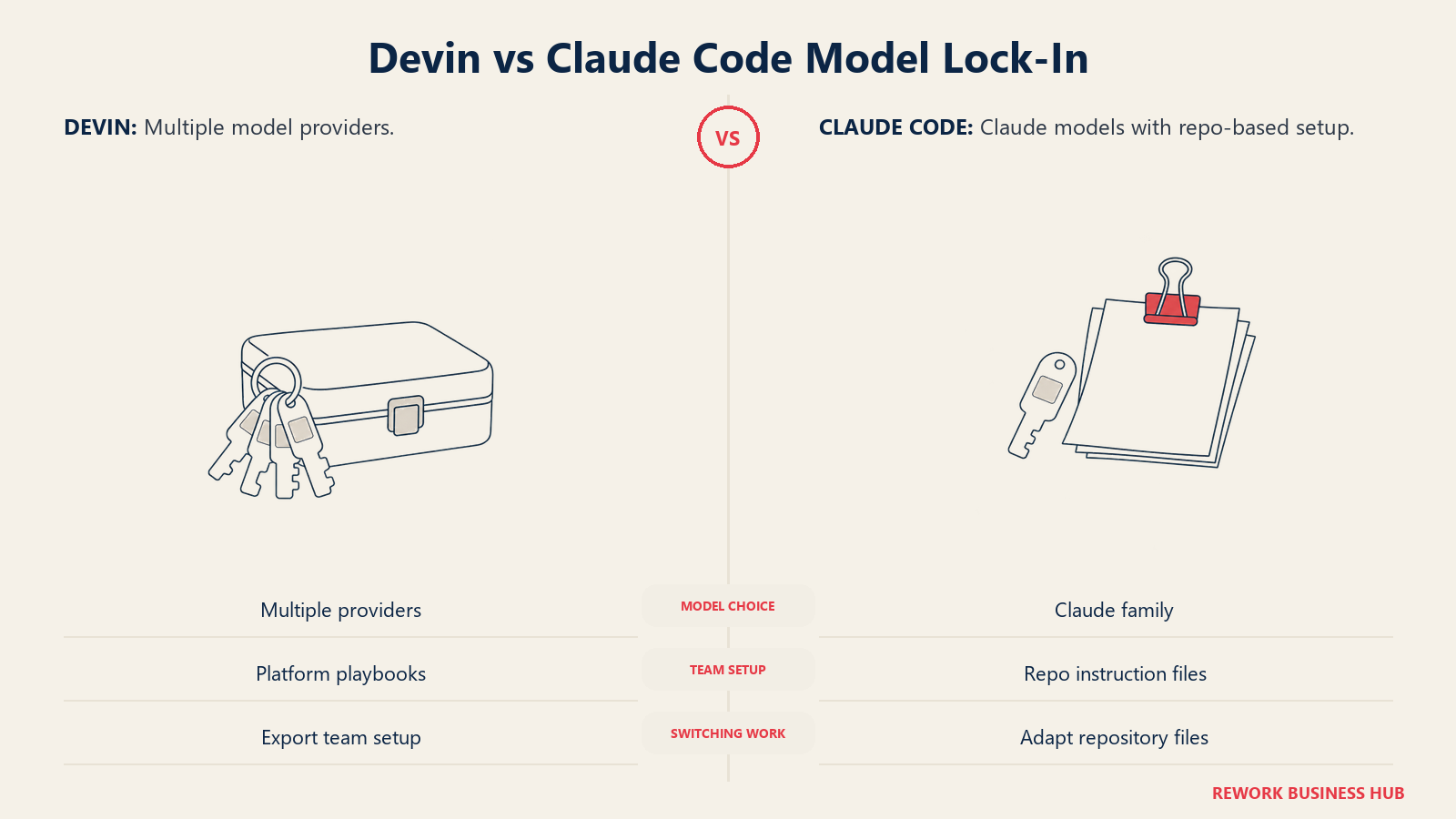
| Switching cost | Moderate; playbooks, knowledge, and automations live in Devin | Low to moderate; CLAUDE.md, skills, and MCP configs are plain files in your repo |
Devin's multi-model approach reduces single-lab dependency, which matters if your risk team dislikes concentration on one model provider. Claude Code's single-lab design trades that for tight integration and fewer moving parts. Because project instructions live in repository files, moving off Claude Code mostly means rewriting a handful of text files. Moving off Devin means exporting institutional setup that lives in its platform.
Vendor stability is also a factor. Devin's product line has changed names and structure quickly: Windsurf became Devin Desktop in June 2026, and Cascade, the previous local agent, was replaced by Devin Local. The full list of options is in the best Devin alternatives, and Claude Code vs Codex covers the other head-to-head. If that kind of change worries your procurement team, our vendor lock-in strategies and vendor evaluation framework for AI tools are worth reading before you sign. If you're weighing Devin Desktop specifically as an editor, Cursor vs Windsurf covers it head to head, and the best Windsurf alternatives covers the exit options.
Security, Deployment, and Governance
Your security team will ask about these before anything else.
| Area | Devin | Claude Code |
|---|---|---|
| Certification | SOC 2 Type II, held since September 2024 | SOC 2 Type 2 report and ISO 27001 certificate, via the Anthropic Trust Center |
| Training on your code | Not by default, per Cognition | Governed by Commercial Terms for Team, Enterprise, and API; consumer plans have user-controlled settings |
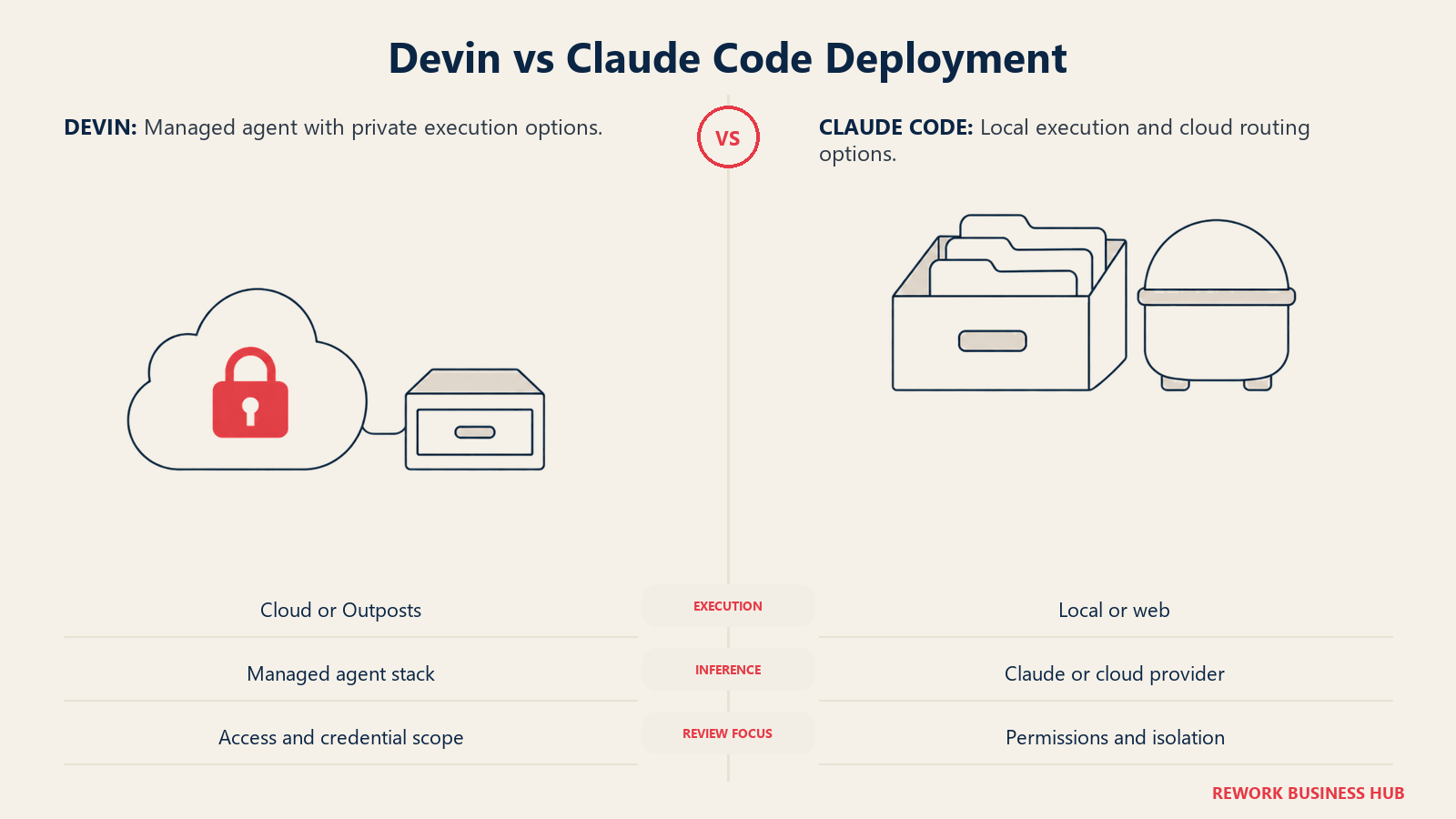
| Execution location | Cognition's cloud VMs; Outposts moves execution to your infrastructure | Local machine by default; Anthropic-hosted VMs for cloud sessions; self-hosted environments available |
| Network and filesystem controls | Security Profiles, IP access lists | Sandboxed bash, permission modes, managed settings, network allowlists for cloud sessions |
| Private cloud inference | Dedicated deployment and VPC options on Enterprise | Amazon Bedrock, Google Cloud's Agent Platform, Microsoft Foundry |
| SSO and provisioning | SAML/OIDC SSO, SCIM, custom roles and RBAC | SSO and team admin on Team plans; role-based permissions on Enterprise |
| Audit and monitoring | Consumption analytics, session insights | OpenTelemetry metrics; audit logging for cloud sessions |
Sources: Devin enterprise security, Devin Outposts, Claude Code security, Claude Code deployment options.
The key difference is where the agent loop and the code touch each other. With Devin's standard setup, your code is cloned into a Cognition-run workspace. With Outposts, Devin Cloud still runs the agent loop (inference and planning), but commands, file edits, and repository access happen on machines you operate, connected by outbound HTTPS only. With Claude Code, the agent runs on the developer's machine, and inference can be routed through a cloud account you already control.
Neither design is automatically safer. Local execution puts the blast radius on a developer laptop, so permissions and sandboxing matter. Cloud execution isolates the work but means your code lives in someone else's environment. Match the model to your compliance posture, not to a marketing claim.
Implementation and Change Management
| Factor | Devin | Claude Code |
|---|---|---|
| Time to first useful result | Needs repo setup and environment configuration before it can run your tests | Install, log in, run in a project; CLAUDE.md improves results over time |
| Who has to learn something new | Ticket writers and reviewers; the agent does the coding | Every developer who will drive it |
| Process change | High: delegation, PR review volume, ticket quality | Low to moderate: a new tool inside existing habits |
| Review burden | Concentrated in pull requests | Spread across sessions and diffs |
| Admin setup | Orgs, integrations, secrets, playbooks, usage policies | Managed settings, permissions, MCP allowlists |
| Risk if adoption stalls | Idle seats and unreviewed PRs pile up | Developers quietly stop invoking it |
Devin changes how work flows through your team. Claude Code changes how fast each person works. The first is a bigger organizational bet with a bigger potential payoff. The second is easier to start and easier to abandon.
Risk and Governance
| Risk factor | Devin | Claude Code |
|---|---|---|
| Vendor maturity | Cognition, founded in 2024 and well funded, with a product line that has been restructured repeatedly | Anthropic, the maker of the Claude models, with Claude Code on one engine across every surface |
| Cost predictability | Moderate on subscription; variable once on-demand credits or Enterprise ACUs are involved | High on subscription seats; usage-based if you move to API billing |
| Review risk | Large volume of agent-written PRs can outpace reviewers | Smaller, session-sized changes that a developer already watched |
| Autonomy risk | Higher by design; scope and permissions need clear limits | Lower by default; permission modes ask before acting unless you loosen them |
| Dependency on one vendor's roadmap | Product direction follows Cognition's agent strategy | Product direction follows Anthropic's models and tooling |
When Devin Is the Right Call
You have a real backlog of well-scoped work and not enough hands to start it. Migrations, upgrades, test coverage, small bugs, and recurring maintenance are where delegation pays off, and Devin's integrations with Linear, Jira, Slack, and GitHub mean tickets can become pull requests without a developer opening an editor.
It also fits organizations that want a governed, centrally managed agent platform with usage policies, custom roles, and Outposts for execution on their own infrastructure. The honest limitation: results track ticket quality, so teams with vague tickets and thin test suites will be disappointed, and the cost of heavy parallel use isn't something you can predict from the pricing page. If it doesn't fit, the best Devin alternatives compares the rest of the field.
When Claude Code Is the Right Call
You want every developer to be faster across the full range of their work, including ambiguous design work that can't be written up as a ticket. It runs wherever your engineers already are, scripts into CI, and keeps its configuration in files you own. It's also the stronger fit if compliance requires inference inside your own AWS, Google Cloud, or Azure account.
The honest limitation: it doesn't come with a ticket-to-PR delegation workflow out of the box, there's no Claude Code on the free plan, and subscription seats run against a usage window rather than a pool you can top up mid-task. If it isn't the right shape, the best Claude Code alternatives covers eleven other tools, and Claude Code vs Cursor vs GitHub Copilot puts it next to the editor-first options.
Decision Framework
| Scenario | Best fit | Why |
|---|---|---|
| A backlog of scoped tickets and too few engineers | Devin | Designed for ticket-to-PR delegation at parallel scale |
| Developers who want a steerable agent in their own repo | Claude Code | Works in the terminal, IDE, desktop, or web without a new workspace |
| Large migrations or modernization programs | Devin | Documented use cases and parallel sessions |
| Lowest published subscription cost for a team | Claude Code | $2,400 to $3,000 a year at 10 developers versus $5,760 for Devin Teams |
| Code execution must stay on infrastructure you control | Devin (Outposts) or Claude Code (self-hosted or local) | Both have a path, with different tradeoffs |
| Inference must stay in your own cloud account | Claude Code | Bedrock, Google Cloud's Agent Platform, or Foundry |
| Multi-model flexibility | Devin | Several labs plus SWE-2 under one plan |
| Minimal process change | Claude Code | Fits existing developer workflows |
| Both delegation and in-repo steering | Both | Devin Desktop can host Claude Agent over ACP, and many teams run two tools |
Frequently Asked Questions about Devin vs Claude Code
What is the main difference between Devin and Claude Code?
Devin is built around delegation. You assign a ticket and it works in its own cloud workspace, then returns a pull request. Claude Code is built around a developer steering an agent in their own repository, with cloud and background modes available when you want it to work unattended.
Is Windsurf the same as Devin?
Windsurf is now Devin Desktop. Cognition, which owns Devin, announced the rename on June 2, 2026, and the editor now sits in the same product family as Devin Cloud, Devin CLI, and Devin Review. Existing plans and settings carried over.
How much does Devin cost?
Devin has a Free plan, Pro at $20/month, Max at $200/month for one member, and Teams at an $80/month minimum plus $40/month per full seat for up to 200 users. Enterprise is custom and billed in ACUs per the order form. Self-serve plans use a refreshing quota, with extra usage bought as on-demand credits.
How much does Claude Code cost?
Claude Code is included with paid Claude plans: Pro at $20/month ($17/month billed annually), Max at $100/month, and Ultra at $200/month. Team Standard seats are $25/month billed monthly or $20 billed annually, and Team Premium seats are $125 or $100. Enterprise is $20/seat/month billed annually with a 20-seat minimum, plus usage at API rates.
Which is cheaper for a 10-person engineering team?
On subscription alone, Claude Code Team Standard is cheaper: $3,000 a year billed monthly or $2,400 billed annually, versus $5,760 a year for Devin Teams. Heavy Devin use adds on-demand credits, and heavy Claude use may push developers to Premium seats, so run a pilot before comparing totals.
Can Devin or Claude Code run inside my own infrastructure?
Partly, in different ways. Devin Outposts keeps command execution, file edits, and repository access on machines you operate while Devin Cloud runs the agent loop. Claude Code runs locally by default and can route inference through Amazon Bedrock, Google Cloud's Agent Platform, or Microsoft Foundry.
Does Devin use Claude models?
Devin's paid plans include frontier models from OpenAI, Claude, Gemini, and SpaceXAI plus open source models, along with Cognition's SWE-2. Devin Desktop can also run Claude Agent through the Agent Client Protocol, so the two tools can sit side by side.
Can we use both at once?
Yes. A common split is Devin for backlog tickets that can be delegated and Claude Code for hands-on work in the repo. Budget for two sets of seats and decide up front which kinds of work go where.
What to Do Next
Don't pick on a demo. Run a two-week pilot with two small groups on comparable work.
Give the first group a batch of 15 to 20 well-scoped tickets from your real backlog and let Devin take them. Give the second group Claude Code and the same kind of work, driven by developers. Measure merged pull requests, review time per PR, revisions after review, and the real cost per merged change, including Devin credits or Claude usage beyond plan limits.
Before you expand, get answers in writing on the items budgets tend to miss: the ACU rate in a Devin Enterprise order form, Devin's flex-seat rules, Claude's usage window for the seat tier you actually need, and where your code is stored and executed under each design. If a review layer is part of the plan, the best AI code review tools in 2026 covers the options.

Principal Product Marketing Strategist
On this page
- Key Facts
- TL;DR
- Two Operating Models, Not Two Versions of One Tool
- Decision by Engineering Goal
- Capability Comparison
- Where Devin Fits Your Workflow
- Where Claude Code Fits Your Workflow
- Pricing: Individual and Team Plans
- Pricing at 1, 10, and 50 Developers
- Models and Lock-in
- Security, Deployment, and Governance
- Implementation and Change Management
- Risk and Governance
- When Devin Is the Right Call
- When Claude Code Is the Right Call
- Decision Framework
- What to Do Next