Sierra vs Decagon: Which Enterprise AI Customer Service Agent Fits in 2026?
Turn this article into takeaways for your work.


Each assistant summarizes the article only for you and suggests best practices for your work.
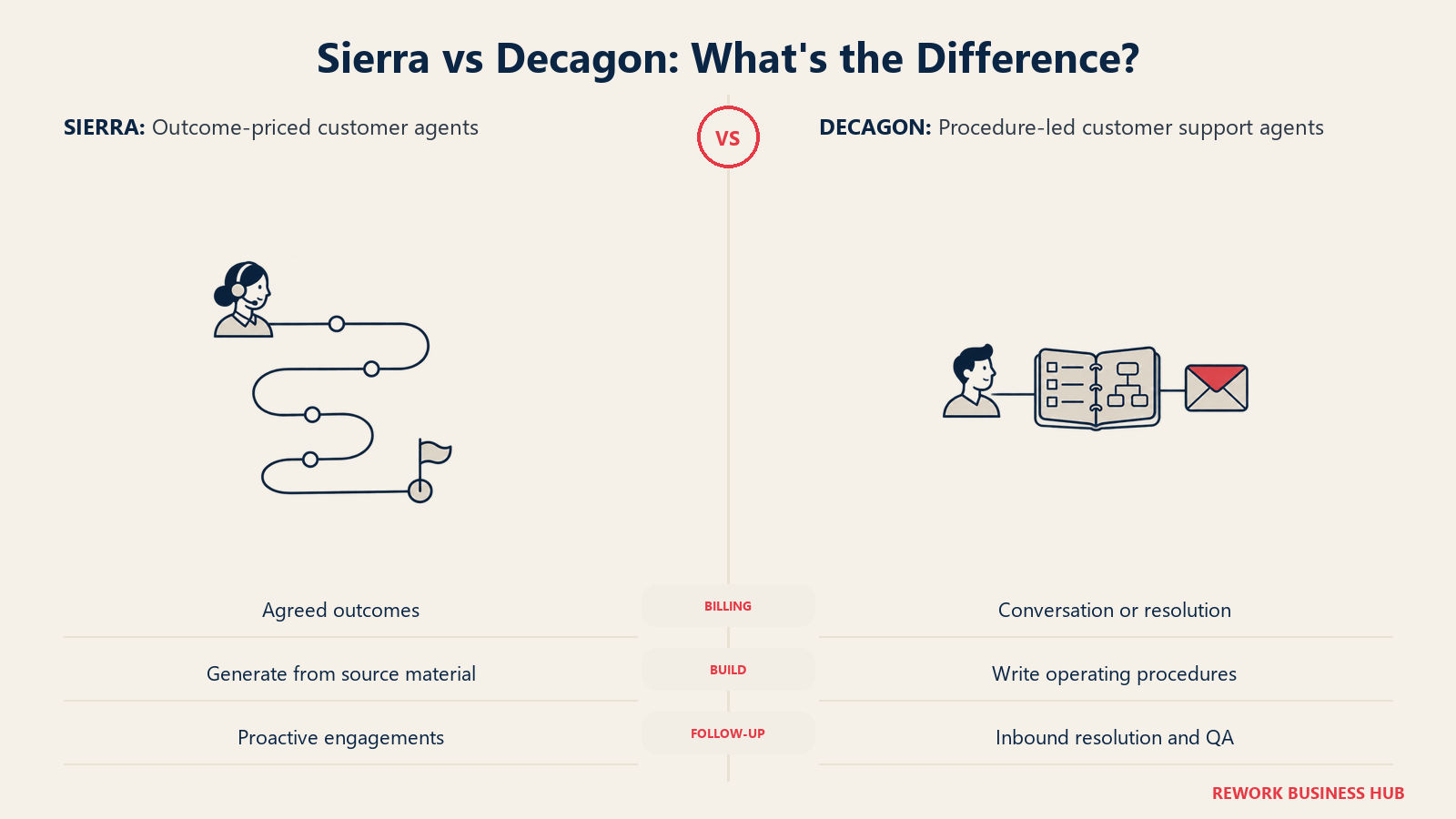
Sierra and Decagon look like twins from the outside. Both are venture-backed AI customer service platforms. Both sell to large brands. Both have a customer list full of names you'd recognize, both talk about agents that resolve conversations rather than deflect them, and neither will give you a price without a sales conversation. If you've landed on this page, you've probably seen both in a shortlist and can't tell what actually separates them.
The differences are real, but they live in places that marketing pages don't headline. They're in the unit you get billed on, in how much of the agent your own team can write and change, in what each vendor does after the first conversation ends, and in how much compliance detail you can see before you sign an NDA. This guide is built around those decision criteria. It doesn't repeat the pricing-model deep dive from Fin vs Sierra, the voice-versus-chat framing from Decagon vs Parloa, or the long lists in best Sierra alternatives and best Decagon alternatives. It answers one question: if these are your two finalists, how do you choose?
Every product fact here comes from each vendor's own pages. Where a figure is a vendor claim, the text says so. Where a detail isn't public, the text says that too, so you can put it on your question list.
TL;DR
| Sierra | Decagon | |
|---|---|---|
| What it is | Agent platform for building, testing and improving customer-facing agents | AI agent platform built around natural-language procedures |
| Billing | Outcome-based, with criteria agreed per customer | Per conversation or per resolution |
| Published rates | None | None |
| Channels listed | Chat, SMS, WhatsApp, email, voice and ChatGPT | Voice, chat and email, plus a channel for personal agents |
| How you build | Ghostwriter generates agents from SOPs, transcripts and goals; Agent Studio for editing | Agent Operating Procedures written in plain language; Duet helps build |
| After launch | Insights, Explorer, Monitors, Experiments, Observability, Horizon | Experiments, Testing and QA, Watchtower, Insights |
| Compliance shown on its own site | SOC 2, ISO 27001, ISO 42001, HIPAA, GDPR, EU AI Act, STAR Level One, FedRAMP, PCI DSS | Trust Center linked; no certifications named on the homepage |
| Latest reported funding | $950M at over $15B, May 2026 | $250M Series D at $4.5B, January 2026 |
| Strongest fit | Large brands wanting outcome-priced agents and proactive use cases | Brands wanting operators to own procedures across voice, chat and email |
| Weakest fit | Buyers who need a rate card before any call | Buyers who need compliance documents visible up front |
Key Facts
- Sierra raised $950 million at a post-money valuation of more than $15 billion, led by Tiger Global and GV, per Trending Topics, which also says Sierra claims more than 40 percent of Fortune 50 companies as customers.
- Sierra reached $100 million in annual revenue run rate in November 2025, per TechCrunch; Trending Topics puts it at $150 million by early February 2026.
- Decagon raised a $250 million Series D at a $4.5 billion valuation, led by Coatue Management and Index Ventures, per Built In SF, which says it added more than 100 enterprise customers in its last fiscal year.
- Sierra's pricing post says an unresolved conversation or an escalation usually carries no charge, and that outcome criteria are agreed upfront with each customer.
- Decagon's pricing post says "the vast majority of our customers choose per-conversation pricing" and that per-resolution is a higher fixed rate with no charge for escalations.
- Sierra's Horizon announcement of July 16, 2026 says "you don't pay for tokens, you pay for business outcomes delivered."
Why These Two Get Compared
The comparison makes sense because they overlap on the hard parts. Each one targets the enterprise buyer with a large, messy contact volume. Each one claims to resolve conversations end to end instead of linking to help articles. Each one comes with its own testing, monitoring and experimentation tools, so you aren't buying a bare language model. And each one is quote-only, which means your first real data point is a proposal, not a price page.
They also share a funding story. Both raised large rounds within the last year, which affects how long you should expect them to keep shipping fast and how much roadmap risk is baked into a multi-year contract.
| Shared trait | Sierra | Decagon |
|---|---|---|
| Buyer | Large enterprise CX organizations | Large digital-first and enterprise brands |
| Sales motion | Demo and custom proposal | Demo and custom proposal |
| Self-serve trial | Not offered on its site | Not offered on its site; the call to action is "Get a demo" |
| Own testing tools | Experiments, Monitors, Observability | Experiments, Testing and QA, Watchtower |
| Stated pricing philosophy | Pay for results | Pay per conversation, or per resolved conversation |
| Voice, chat and email | All three | All three |
If you haven't yet narrowed the field to these two, start with best AI agents for customer service in 2026, which ranks the category by helpdesk and team size.
Criterion 1: The Unit You're Billed On
This is the deepest difference, and it's easy to miss because both vendors say "you only pay when it works." They don't mean the same thing.
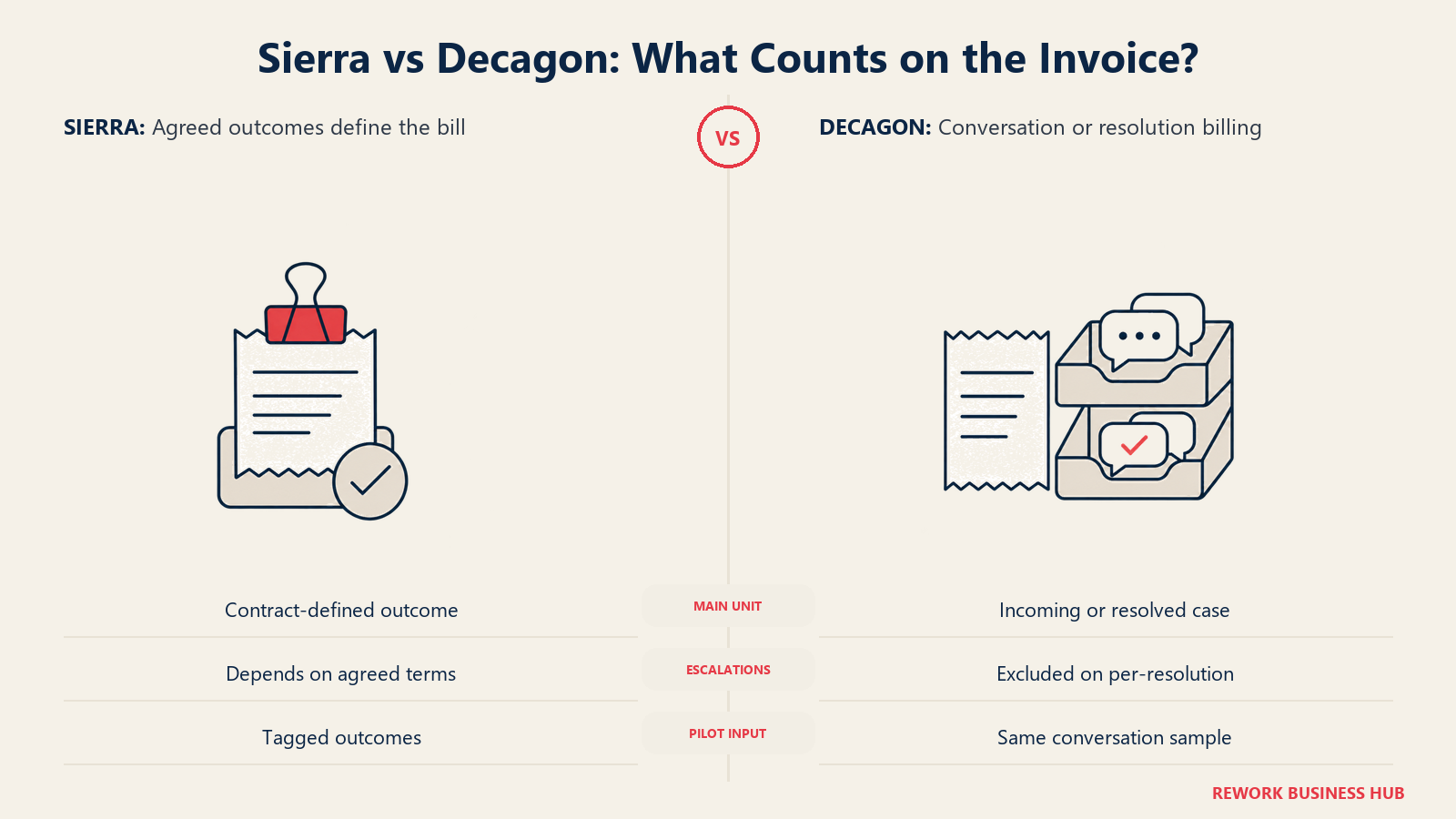
Sierra says it charges per outcome, not per seat or per unit of usage. The pricing post lists outcomes such as a resolved support conversation, a saved cancellation, and an upsell or cross-sell, and says that for routing or greeter-style interactions it may propose consumption-based pricing, where you pay per conversation regardless of outcome. The criteria for each outcome are set in advance with you. No rates appear on the page.
Decagon describes two models. Per conversation is "a fixed rate for every incoming conversation, with flexible pricing for higher volumes." Per resolution is a higher fixed rate for each fully resolved conversation, with no charge for escalations. The vast majority of customers pick per-conversation, according to Decagon's own post, which says customers value its predictability. The post gives no dollar amounts, and it says larger resolution commitments lower the rate.
So the question isn't "which one charges for results." It's "who defines a result, and what happens to the bill when the agent can't finish." With Sierra, the contract decides what counts. With Decagon, you choose between a unit that counts every conversation and a unit that counts only resolved ones.
| Sierra | Decagon | |
|---|---|---|
| Billing unit | Outcome, defined in your contract | Conversation, or resolved conversation |
| Who defines the unit | Negotiated per customer | Decagon's two standard models |
| Unresolved conversation | Usually no charge, per Sierra | Billed under per-conversation; not billed under per-resolution |
| Escalation | Usually no charge, per Sierra | Not billed under per-resolution |
| Non-support outcomes (cancellation saved, upsell) | Named as outcomes in the pricing post | Hunter Douglas reports revenue from fully AI-handled conversations on Decagon's site |
| Volume discounts | Confirm with the vendor | Flexible pricing for higher volumes under per-conversation |
| Published rates | None | None |
A practical way to feel the difference is to imagine a month where your agent gets worse at one issue type. Under Decagon's per-conversation model, your invoice doesn't fall, because the conversations still arrived. Under Sierra's outcome model or Decagon's per-resolution model, it falls, because fewer outcomes completed. That sounds like protection, but it also means a vendor paid on outcomes has an incentive to define outcomes generously, and a vendor paid per conversation has less direct pressure to improve resolution. Neither incentive is evil. Both are something you manage in the contract.
What to do with this: don't compare rates. Give both vendors the same month of conversations, tagged by issue type, and ask each to produce a priced invoice under its proposed unit. If you need a framework for modeling the meters, AI agent cost optimization covers it.
Criterion 2: Who Builds and Changes the Agent
The second split is operational. It determines how many hours a week your own team spends on the agent after launch.
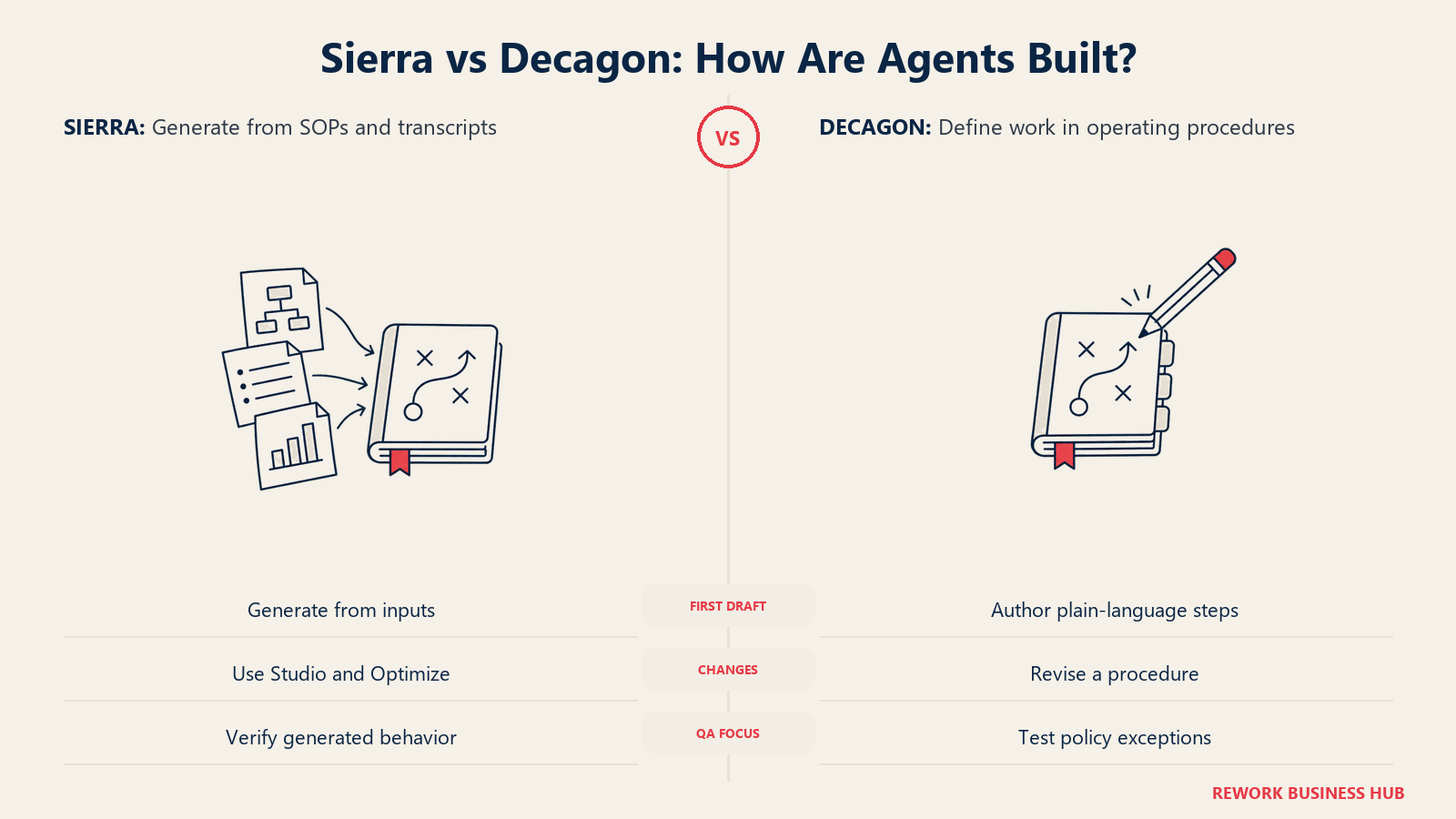
Sierra's site describes Ghostwriter, which builds agents from uploaded SOPs, transcripts, whiteboard photos and audio, or from a plain-English goal, and includes an Optimize feature for automated updates. Agent Studio lets teams build agents "with or without engineering support." The pitch is that the platform does much of the first draft, then improves the agent as conversations accumulate.
Decagon's homepage describes Agent Operating Procedures, or AOPs, which define agent workflows in natural language. It also lists Duet, an "AI partner to build self-improving agents," and recent launches called Voice 3, Modules and Duet Apprentice. The pitch is that the person who knows how a refund exception works writes it down, and the agent follows it.
| Sierra | Decagon | |
|---|---|---|
| First draft of the agent | Ghostwriter generates it from SOPs, transcripts, audio or a goal | Operators write AOPs; Duet assists |
| Editing surface | Agent Studio, with or without engineering | AOPs in natural language |
| Automated improvement | Optimize inside Ghostwriter | Duet and Duet Apprentice |
| Reusable building blocks | Confirm with the vendor | Modules |
| Training for your staff | Confirm with the vendor | Decagon University courses |
| Likely owner after launch | Shared between your team and Sierra tooling | Your support operations team, by design |
The risk profile differs. A generated agent is fast to stand up, but you must verify it behaves the way your policies say. A hand-written procedure library is slower to start, but every rule is one a person on your team read and approved. If your operation has strict, auditable policies (refund limits, identity checks, regulated disclosures), hand-written procedures may give you more confidence. If your documentation is scattered across call recordings and old SOPs, a tool that can ingest them may save weeks.
Ask both vendors the same question: on a Tuesday afternoon, how does someone on our team change how the agent handles a returns exception, test it, and ship it, without opening a ticket? The answer tells you more than any demo.
Criterion 3: Channels and Where Customers Meet the Agent
On the surface the channel lists match. Dig in and the emphasis differs.
Sierra's homepage says you can deploy a single agent across chat, SMS, WhatsApp, email, voice and ChatGPT. The ChatGPT channel stands out. If more of your customers start in an AI assistant before they ever visit your site, that's a channel to evaluate, though you should ask how Sierra handles authentication and account actions there.
Decagon's homepage lists voice, chat and email as the channels, describing voice as "human-like conversation," chat as "safe, on-brand replies" and email as "contextual resolutions." It also headlines something different: detection of personal agents, with a dedicated channel to serve them and permissions the customer controls. That's a bet that your next big support volume may come from customers' own AI agents calling on their behalf.
| Sierra | Decagon | |
|---|---|---|
| Chat | Yes | Yes |
| Yes | Yes | |
| Voice | Yes | Yes; Voice 3 listed among recent launches |
| SMS | Yes | Confirm with the vendor |
| Yes | Confirm with the vendor | |
| ChatGPT | Yes | Not listed |
| Customer-owned AI agents | Confirm with the vendor | Dedicated channel with customer-controlled permissions |
| Site languages offered | English, Spanish, French, German, Japanese, Korean | Confirm with the vendor |
If your customers live on WhatsApp and SMS, Sierra's list covers them on its face. If your concern is the coming wave of machine-to-machine support, Decagon's personal-agent channel is at least a stated position. For voice-heavy operations, neither of these two is the specialist; best AI voice agents in 2026 and best AI agents for call centers in 2026 cover the voice-first field.
Criterion 4: What Happens After the Conversation Ends
Sierra made a point of this in July 2026. Its Horizon announcement describes a platform that lets agents pursue long-horizon goals, such as originating a loan, by contacting customers over days, weeks or months and feeding each completed interaction back into the agent's decisions. The post says Horizon extends Agent OS, which powers "hundreds of companies, from Santander to Rocket Mortgage and Cigna," and it names no Horizon customers beyond one unnamed healthcare provider using it to schedule specialist referrals as a design partner.
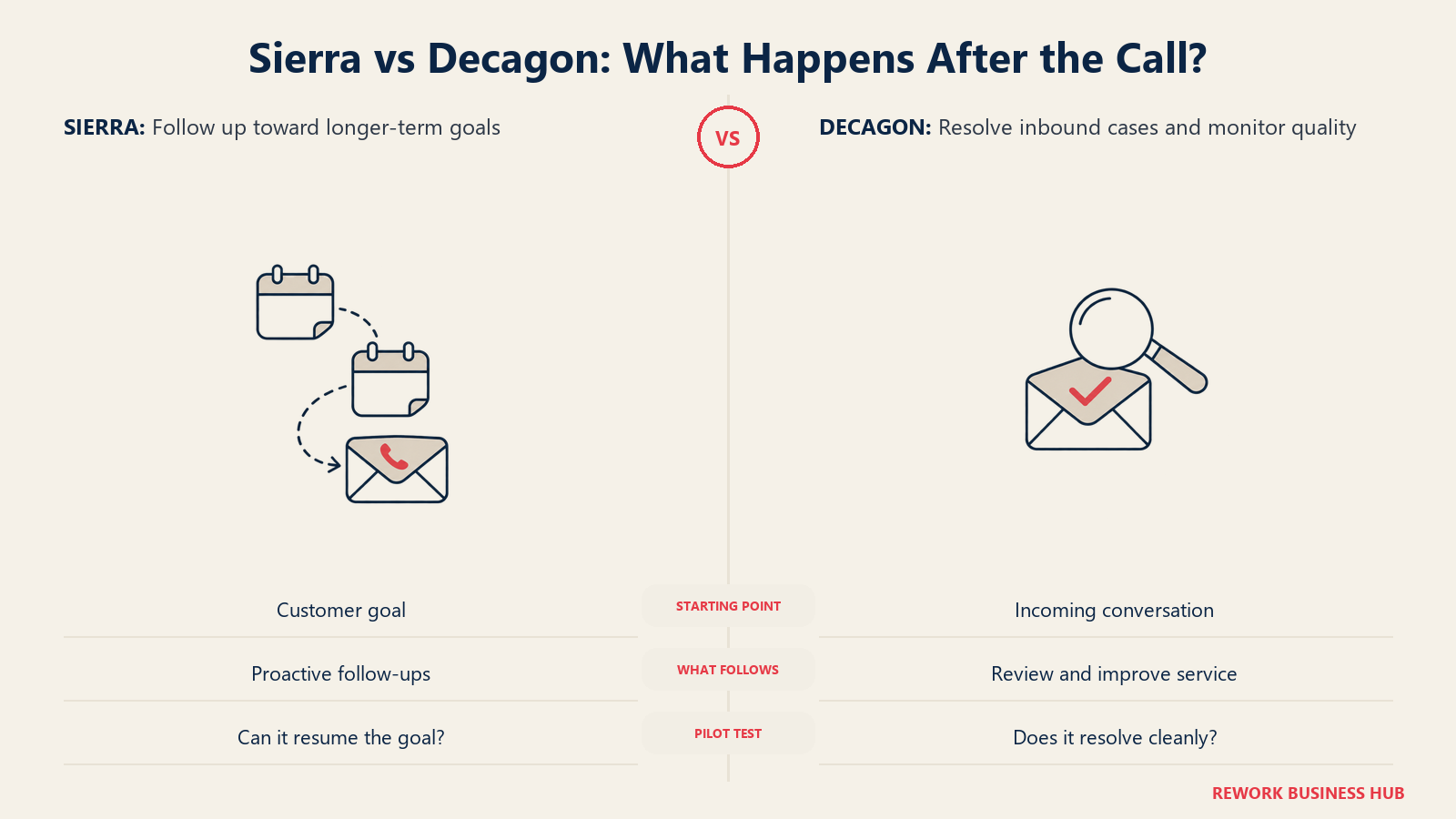
Decagon's site is organized differently. It emphasizes resolution within the conversation, with Insights and Reporting framed as "voice of the customer," Suggestions for AI-powered knowledge, and Watchtower for always-on quality assurance. It reports revenue outcomes as well, for example $1 million from fully AI-handled conversations at Hunter Douglas, but the product pages describe conversations the customer starts rather than outreach the agent initiates.
| Sierra | Decagon | |
|---|---|---|
| Proactive, multi-day engagement | Horizon, announced July 16, 2026 | Not described on the homepage; confirm with the vendor |
| Conversation analytics | Explorer, a ChatGPT-style analysis of agent conversations | Insights and Reporting |
| Quality alerts | Monitors flag conversations needing attention | Watchtower, always-on QA |
| Live experimentation | Experiments, multivariate testing of conversation design | Experiments, live A/B testing |
| Tool-call and latency tracking | Observability | Confirm with the vendor |
| Knowledge improvement | Optimize inside Ghostwriter | Suggestions |
If your goals are retention saves, collections, onboarding nudges or loan origination, where the agent needs to follow up, Sierra's Horizon is the only one of the two with a named product for it. If your goals are resolving inbound volume cleanly and keeping quality high, the two stacks are closer than the marketing suggests.
Criterion 5: Compliance You Can See Before You Sign
Sierra's homepage shows nine badges: SOC 2, ISO 27001, ISO 42001, HIPAA, GDPR, the EU AI Act, STAR Level One (self-assessment), FedRAMP and PCI DSS. Two details deserve a second look. STAR Level One is a self-assessment, so it isn't the same assurance as a third-party certification. And a badge on a homepage doesn't tell you which product surfaces the report covers.
Decagon's homepage names no certifications. It links a Trust Center, a Security page and a Privacy Policy. That isn't evidence that it lacks them; it means the evidence sits behind the Trust Center and your security questionnaire, not on the front page. Plan for the extra step.
| Sierra | Decagon | |
|---|---|---|
| SOC 2 | Listed | Confirm in Trust Center |
| ISO 27001 | Listed | Confirm in Trust Center |
| ISO 42001 (AI management) | Listed | Confirm in Trust Center |
| HIPAA | Listed | Confirm with the vendor |
| GDPR | Listed | Confirm with the vendor |
| EU AI Act | Listed | Confirm with the vendor |
| PCI DSS | Listed | Confirm with the vendor |
| FedRAMP | Listed | Confirm with the vendor |
The practical implication: Sierra shortens the early security screen, especially for regulated industries and anyone handling card data or selling to US federal agencies. Decagon asks you to do more of the legwork, but the ask is a standard one. In both cases request the actual reports, the scope, the date of the last audit, and the data-processing terms. For voice, ask specifically how call recordings are stored, redacted and retained.
Criterion 6: Customers and Proof
Both vendors show long customer lists, but the lists skew differently.
Sierra's site shows logos including Rocket Mortgage, Gap Inc., Singtel, SoftBank, Singapore Airlines, Hyatt, Uber, Vanguard, Santander, SiriusXM, DIRECTV, Wayfair, Sutter Health, Redfin, ADT, Rivian, Fiserv, Fanatics, CarMax, HP, Nubank, Docusign, Ramp, SoFi and Paychex, among others. That's a mix of financial services, telecom, travel, retail and healthcare, with heavy weight on large regulated brands. Sierra also claims more than 40 percent of Fortune 50 companies as customers, per Trending Topics.
Decagon's site names Chime, Duolingo, ClassPass, Hunter Douglas, Oura, Curology, Valon, Rippling, Mercado Libre, Notion, Hertz, Perplexity, Noom and 1-800-Flowers in text, with more shown as logos, including Deutsche Telekom, American Airlines, Delta Airlines and Ticketmaster. It lists industries served as financial services, travel and hospitality, healthcare, technology, retail, telecommunications and insurance. The mix leans toward digital-first consumer and software brands with large, varied queues.
| Sierra | Decagon | |
|---|---|---|
| Customer skew | Large regulated enterprises, plus consumer brands | Digital-first consumer and software brands, plus large enterprises |
| Examples named by the vendor | Rocket Mortgage, Vanguard, Santander, Hyatt, SiriusXM | Chime, Duolingo, Rippling, Hertz, Notion |
| Overlap | Fanatics appears on both vendors' sites | Fanatics appears on both vendors' sites |
| Industries shown | Financial services, telecom, travel, healthcare, retail | Financial services, travel, healthcare, technology, retail, telecom, insurance |
Now the outcome figures. Decagon's homepage publishes a set of customer results: 70% chat and voice resolution at Chime, an 80% deflection rate at Duolingo, 95% cost reduction at ClassPass, $1 million in revenue from fully AI-handled conversations at Hunter Douglas, a 3x increase in CSAT at Oura, a 65% reduction in costs at Curology, 50%-plus resolution on voice at Valon and a 32% increase in deflection at Rippling. These are vendor-reported and measure different things: resolution, deflection, cost and satisfaction are not interchangeable.
Sierra's homepage shows example report cards, such as a 32% sNPS figure and 120,000 conversations, but those are illustrations of its analysis tools, not customer results, so don't cite them as proof. Sierra's outcome evidence comes through its customer stories and testimonials from CLEAR, Rocket Mortgage, SiriusXM and Minted. Ask for the metrics behind those.
| Proof type | Sierra | Decagon |
|---|---|---|
| Customer results with numbers on the homepage | Testimonials; the example figures on the page are product illustrations | Eight customer results with specific percentages or dollar figures |
| Metric definitions | Ask for the definition of an outcome | Ask for the definition of resolution versus deflection |
| Independent review ratings | Confirm with the vendor | Confirm with the vendor |
Whichever you favor, ask for a reference customer whose queue resembles yours, then ask that customer for month-one and month-six containment, not the launch-day figure.
Criterion 7: Funding, Scale and Vendor Risk
Both companies are well capitalized, and the scale difference is notable.
Sierra's most recent round was $950 million at a post-money valuation of more than $15 billion, reported on May 4, 2026, with Tiger Global and GV leading, per Trending Topics. That source also reports annual recurring revenue of $100 million in late November 2025 and $150 million by early February 2026. The TechCrunch report on the $100 million milestone says Sierra was previously valued at $10 billion after a $350 million round led by Greenoaks in September 2025, so figures older than May 2026 will understate the current valuation.
Decagon raised $250 million in a Series D at a $4.5 billion valuation, which Built In SF described as triple its valuation from just under six months before, with Coatue Management and Index Ventures leading. The same report says Decagon added more than 100 enterprise customers in its last fiscal year.
| Sierra | Decagon | |
|---|---|---|
| Latest reported round | $950M | $250M Series D |
| Valuation | More than $15B post-money | $4.5B |
| Reported lead investors | Tiger Global and GV | Coatue Management and Index Ventures |
| Reported timing | May 2026 | January 2026 |
| Reported revenue scale | $100M ARR in November 2025; $150M by early February 2026 | Not reported |
| Founders | Bret Taylor and Clay Bavor | Confirm with the vendor |
Funding is a runway signal, not a quality signal. Both will likely keep shipping quickly, which means features you compare today may look different by the time you sign. Put any roadmap capability you're buying for into the contract, and ask what happens to your pricing and data if either company is acquired. The market has already seen consolidation: Salesforce completed its acquisition of Fin on September 10, 2026, which is covered in Fin vs Sierra.
How the Two Fail Differently
Every platform in this category has a characteristic way of disappointing you, and knowing it in advance changes how you pilot.
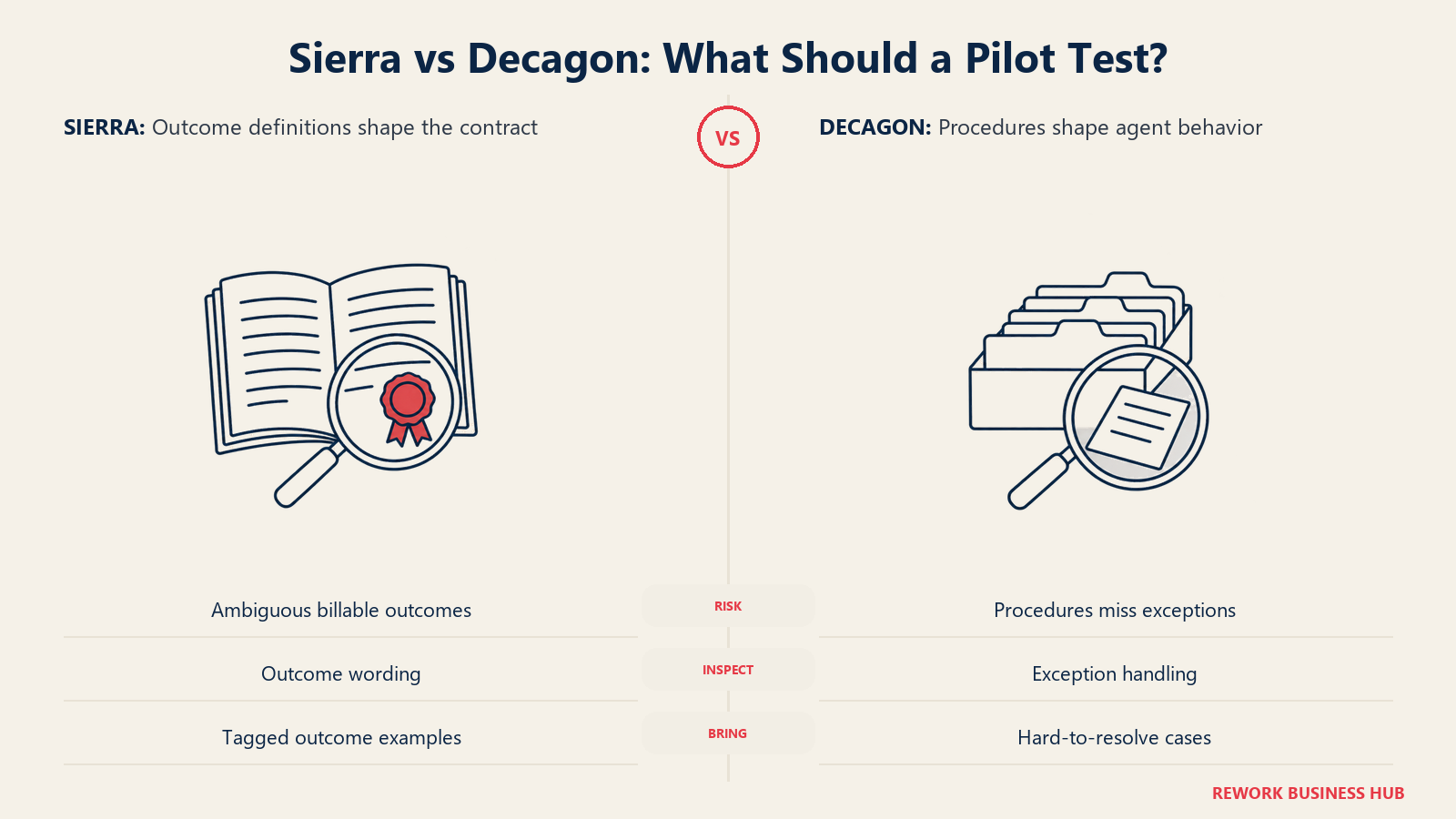
With Sierra, the usual risk is contractual rather than technical. Because outcome criteria are negotiated, a vague definition can leave you paying for conversations you'd never have counted as wins, or arguing about a month of invoices. The fix is boring and effective: get the definition of every billable outcome, every exclusion and the audit rights on billing data into the contract before the pilot scales. A second risk is dependence. A platform that drafts and improves agents for you is convenient, and it also means your team may understand the agent less well than it would if it had written every rule.
With Decagon, the usual risk is operational. Procedures written in plain language are only as good as the people maintaining them, and a library of hundreds of procedures can drift out of date when policies change and nobody owns the update. A second risk is the billing unit. Per-conversation pricing is predictable, but it means a conversation the agent fails to resolve still shows up on the invoice, so you need your own resolution metric to know whether you're getting value.
Neither failure is a reason to skip a vendor. Both are reasons to write the pilot around them: put the contract questions to Sierra early, and put the ownership questions to Decagon early. A pilot that tests the risk each vendor is most likely to create tells you far more than one that tests the happy path both have rehearsed.
A Scorecard You Can Run in a Week
Use this to turn the criteria above into a decision. Weight each row from one to five according to how much it matters to you, score each vendor after its demo and reference calls, and let the totals argue with your gut.
| Criterion | What to test | Weight (1 to 5) |
|---|---|---|
| Billing unit | Price the same sample month under each vendor's proposed unit | |
| Outcome definition | Read the exact contract wording for what counts, and what is excluded | |
| Build ownership | Time a real change from request to live, with your own staff | |
| Channel fit | Run your top channel on a real queue, not a demo environment | |
| Proactive use cases | Ask each vendor to scope one follow-up workflow end to end | |
| Compliance evidence | Request the reports and scope for the surfaces you'll use | |
| Reference customers | Speak to one customer whose queue resembles yours | |
| Vendor risk | Review roadmap commitments, price protection and exit terms |
What to Ask Both Vendors
These questions surface the differences quickly, and a vendor's willingness to answer in writing is itself a signal.
| Question | Why it matters |
|---|---|
| Which of our conversations would you bill, and which would you not? | Turns marketing pricing into an invoice |
| Who can change the agent after launch, and how long does a change take? | Reveals the real operating model |
| What's in scope for each compliance report you hold? | Separates the badge from the control |
| How are escalations, abandoned chats and repeat contacts counted? | The edge cases drive the bill |
| What is the customer-reported containment rate at month six? | Launch numbers flatter |
| What do you need from our team each week after launch? | Hidden labor |
| What happens to our data and prices if you're acquired? | Vendor risk is real in this market |
Cost Modeling Without a Rate Card
Neither vendor publishes a rate, so you can't build a spreadsheet of unit prices. You can build a structure that makes the quotes comparable. The idea is to define your volume once and force both vendors to price against it.
| Input | How to get it |
|---|---|
| Monthly conversations by channel | Export from your helpdesk or contact platform |
| Top 20 contact reasons by volume | Tag a sample of 500 conversations |
| Share you'd let an agent resolve alone | Judged by your support leads, not the vendor |
| Share that must escalate | Policy, regulation or complexity |
| Voice minutes, if relevant | Telephony reports |
| Non-support outcomes you want (saves, upsells) | Agree the definitions with finance first |
Then ask each vendor for an all-in monthly invoice on that sample, including every add-on, minimum commitment and services fee. Add your own staff hours for tuning. Divide by resolved conversations to get a cost per resolution that you can compare across both. If one vendor's quote is cheaper but requires four hours a day of your team's time, the comparison isn't what it first appears.
When Sierra Is the Right Call
- You want outcomes beyond support deflection, such as saved cancellations, upsells or loan origination, written into the contract and the product.
- Proactive, multi-day engagement matters to you, and you want a named product (Horizon) for it.
- You need a wide set of compliance badges visible during procurement, including PCI DSS and FedRAMP, and you'll verify the scope in the security review.
- Your customers reach you on WhatsApp, SMS and increasingly through ChatGPT, and you want one agent across all of them.
- You prefer a platform that generates a first draft from your SOPs and transcripts and keeps improving it.
- You're comfortable negotiating outcome definitions as part of the contract.
When Decagon Is the Right Call
- Your operators know your policies best, and you want them writing and changing procedures in plain language.
- You value a choice between per-conversation pricing and per-resolution pricing, including a model that charges nothing for escalations.
- Your queue is a mix of chat, email and voice, and you want the same procedure logic behind all three.
- You find the published customer results from digital-first brands close to your own situation.
- You're curious about serving customers' personal AI agents and want a vendor that already has a position on it.
- You're fine with the Trust Center route for security evidence, as long as the documents arrive before the pilot.
When Neither Is the Right Call
Both vendors are built for large operations, and neither lists a self-serve tier. If your volume is a few hundred tickets a month, you're likely better off with an agent that publishes a rate and starts in a day; best Fin AI agent alternatives covers helpdesk-native and published-price options. If your stack already centers on a CRM, best Agentforce alternatives shows how CRM-native agents compare. And if you're choosing across the broader enterprise field, best enterprise AI agent platforms in 2026 is the wider map, while choosing an AI agent platform helps with the build-versus-buy question.
Decision Framework
| If you are... | Pick |
|---|---|
| Wanting outcome-priced agents for support, retention and sales in one contract | Sierra |
| Needing proactive, multi-day customer engagement | Sierra (Horizon) |
| Needing a long compliance badge list during procurement | Sierra |
| Serving customers on WhatsApp, SMS and ChatGPT | Sierra |
| Wanting support operators to write and own procedures | Decagon |
| Preferring to choose between per-conversation and per-resolution billing | Decagon |
| Wanting dedicated handling for customers' personal AI agents | Decagon |
| Comparing digital-first peers like Chime, Duolingo and Rippling | Decagon |
| Needing a published price or a free trial | Neither; see best Sierra alternatives |
| Unsure and wanting the whole field | See best Decagon alternatives |
What to Do Next
- Tag a real month of conversations. Pull the top 20 contact reasons and mark which you'd let an agent resolve alone, which need a handoff and which must stay human.
- Send both vendors the same sample. Ask each for an all-in invoice under its own billing unit, with the outcome or conversation definitions written out.
- Request the security evidence in parallel. Ask Sierra for the scope behind its badges and Decagon for the Trust Center documents, so legal isn't the bottleneck.
- Run a four-to-six-week pilot on one queue. Define "resolved" in writing before it starts, and measure wrong-answer rate and tuning hours as well as containment.
- Time a policy change. Ask your own team to change one rule in each platform and record how long it takes. The result predicts your life after launch.
Related Resources:

Co-Founder, Rework.com
On this page
- TL;DR
- Key Facts
- Why These Two Get Compared
- Criterion 1: The Unit You're Billed On
- Criterion 2: Who Builds and Changes the Agent
- Criterion 3: Channels and Where Customers Meet the Agent
- Criterion 4: What Happens After the Conversation Ends
- Criterion 5: Compliance You Can See Before You Sign
- Criterion 6: Customers and Proof
- Criterion 7: Funding, Scale and Vendor Risk
- How the Two Fail Differently
- A Scorecard You Can Run in a Week
- What to Ask Both Vendors
- Cost Modeling Without a Rate Card
- When Sierra Is the Right Call
- When Decagon Is the Right Call
- When Neither Is the Right Call
- Decision Framework
- What to Do Next