Decagon vs Parloa: Which AI Customer Service Agent Fits Your Team in 2026?
Turn this article into takeaways for your work.


Each assistant summarizes the article only for you and suggests best practices for your work.
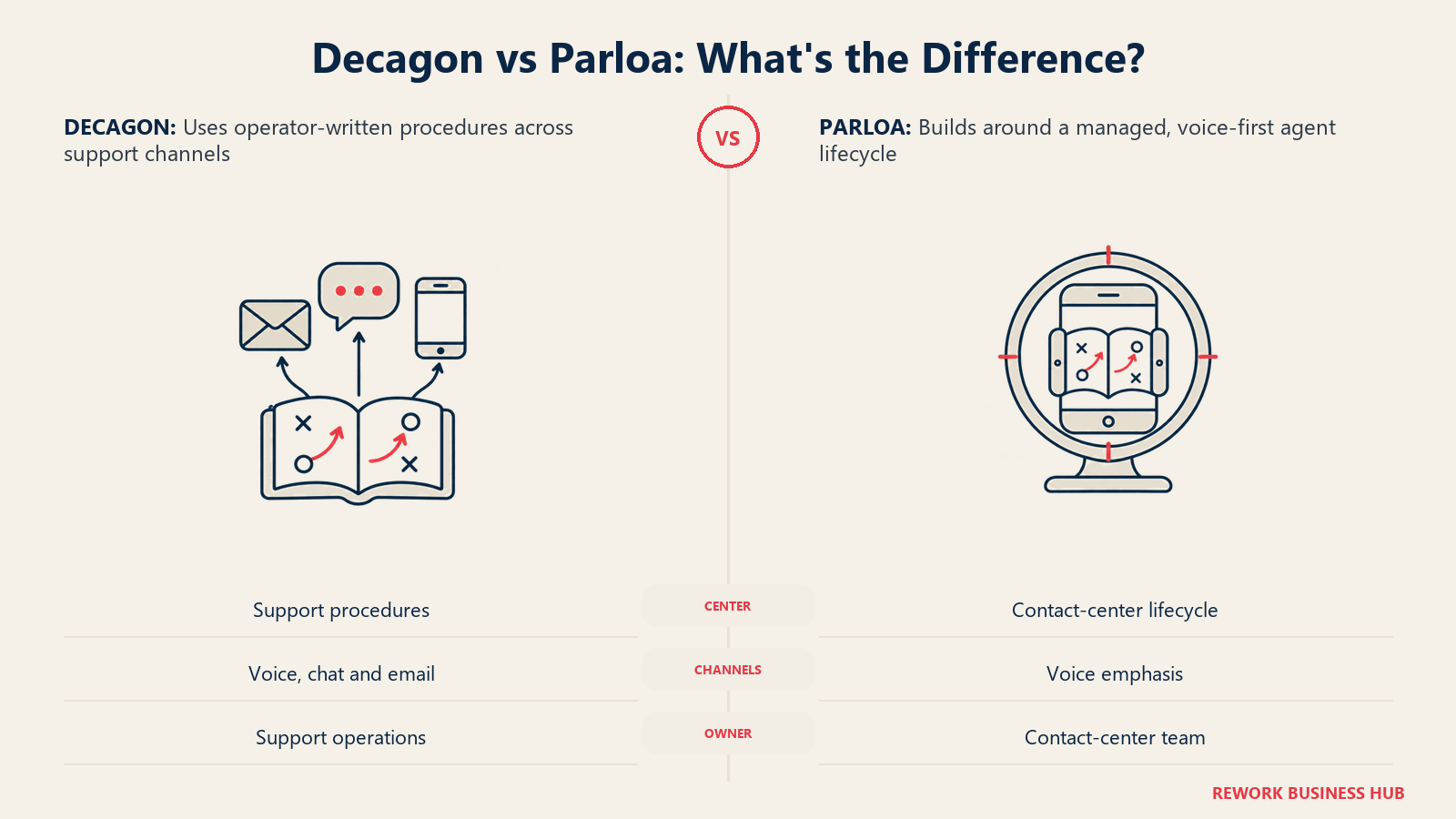
If these two are on your shortlist, you're probably past the "should we use an AI agent at all" stage and into the harder question: what kind of operation are you automating? Decagon and Parloa both sell AI agents that talk to your customers, both sell to large companies, and neither will give you a price without a sales call. But they come at the problem from different directions.
Decagon's pitch is one agent across voice, chat and email, built from workflows your support team writes in plain language. Parloa's pitch is a platform for the whole agent lifecycle, with a long enterprise compliance list and a heritage in contact centers and voice. Neither is wrong. They suit different buyers, and picking the wrong one means you'll spend a quarter finding that out the slow way.
This comparison sticks to what each vendor says on its own pages, flags every place where a number is a vendor claim, and tells you what to ask before you sign. Where a detail isn't public, it says so, so you can put it on your question list instead of discovering it in the contract.
TL;DR
| Decagon | Parloa | |
|---|---|---|
| Core philosophy | One concierge agent across voice, chat and email, built from natural-language procedures | A full agent-lifecycle platform for enterprise contact centers, voice-led |
| Pricing model | Per conversation or per resolution, quoted | Per minute for voice and per interaction for chat, quoted |
| Published rates | No | No |
| Channels | Voice, chat and email in one platform | Voice is the clearest focus; chat is priced as a unit; confirm email and messaging with the vendor |
| How you build | Agent Operating Procedures (AOPs) written in natural language | Agent Builder plus a Performance Lab for simulation, per the platform page |
| Compliance badges on the homepage | Trust Center linked; confirm certifications with the vendor | ISO 27001, SOC 2 Type II, HIPAA, PCI DSS, DORA, EU AI Act |
| Best for | Support teams that want chat, email and voice handled by one agent | Large contact centers where the phone line is the main problem |
| Weakest fit | Teams that need a published price before talking to sales | Small queues, or teams whose volume is mostly chat and email |
Key Facts
- Decagon raised a $250 million Series D at a $4.5 billion valuation in January 2026, led by Coatue and Index Ventures, per Built In SF.
- Parloa raised a $350 million Series D at a $3 billion valuation on January 15, 2026, led by General Catalyst, per Parloa's announcement.
- Parloa's pricing page says it bills "per minute for voice and per interaction for chat."
- Decagon's pricing post says "the vast majority of our customers choose per-conversation pricing" over per-resolution.
- Parloa's platform page says its conversational infrastructure supports "over 140 languages" for voice interactions.
- Enterprises buying ready-made AI agent solutions instead of building their own rose from 53% in 2024 to 76% in 2025, per Menlo Ventures' State of Generative AI in the Enterprise.
- Gartner predicts over 40% of agentic AI projects will be canceled by the end of 2027, citing unclear business value and inadequate risk controls as the leading causes.
Who Each Tool Is Actually Built For
Decagon describes itself on decagon.ai as AI agents "that treat every customer like the only one." The platform covers voice, chat and email in one place, and the customers it shows are digital-first brands with big, varied queues: Chime, Duolingo, Notion, Hertz, Rippling and similar. If your support volume is a mix of in-app chat, email tickets and a growing phone line, and you want the same agent logic behind all of it, that's the shape Decagon is built for.
Parloa's homepage headline is "AI agents that turn customer conversations into lasting loyalty," and the platform it describes covers agent lifecycle management, model orchestration, context and channels. The logos and testimonials skew toward large European and global enterprises: Booking.com, Zalando, SAP, Swiss Life Germany, Muenchener Verein, AUTO1 Group. The company calls itself "born in the EU," shows a long compliance badge row, and offers its site in English and German. If you run a regulated contact center, especially in Europe, and the phone is where most of your cost sits, that's Parloa's home turf.
| Decagon | Parloa | |
|---|---|---|
| Sweet-spot org | Digital-first brands with mixed chat, email and voice queues | Large enterprises and regulated contact centers, often European |
| Who builds the agent | Support and CX operators writing procedures in natural language | Teams using Agent Builder, with vendor help for larger rollouts (confirm the split with Parloa) |
| Customers shown by the vendor | Chime, Duolingo, Notion, Hertz, Rippling, Deutsche Telekom, American Airlines | Booking.com, Zalando, SAP, Swiss Life Germany, AUTO1 Group, HealthEquity |
| Primary buying trigger | Wanting one agent logic across every channel | Wanting to automate calls at contact-center scale with enterprise controls |
| Weakest fit | A buyer who wants a published rate card | A buyer whose queue is mostly email and chat |
If you want the wider field before narrowing to these two, Best Decagon Alternatives in 2026 covers ten options and why teams leave Decagon, and Best AI Agents for Customer Service in 2026 ranks the category by how each vendor defines a resolution.
Build Experience: Procedures in Plain Language vs a Lifecycle Platform
Decagon's headline building block is the Agent Operating Procedure. Its homepage says AOPs "let you define agent workflows in natural language," and positions them as an alternative to complex configuration languages. In practice that means the person who knows how a refund exception or an address change works can write the procedure, rather than handing a spec to an engineer. Decagon also lists Duet, an "AI partner to build self-improving agents," plus testing and QA simulations, Experiments for live A/B tests and Watchtower for always-on quality monitoring.
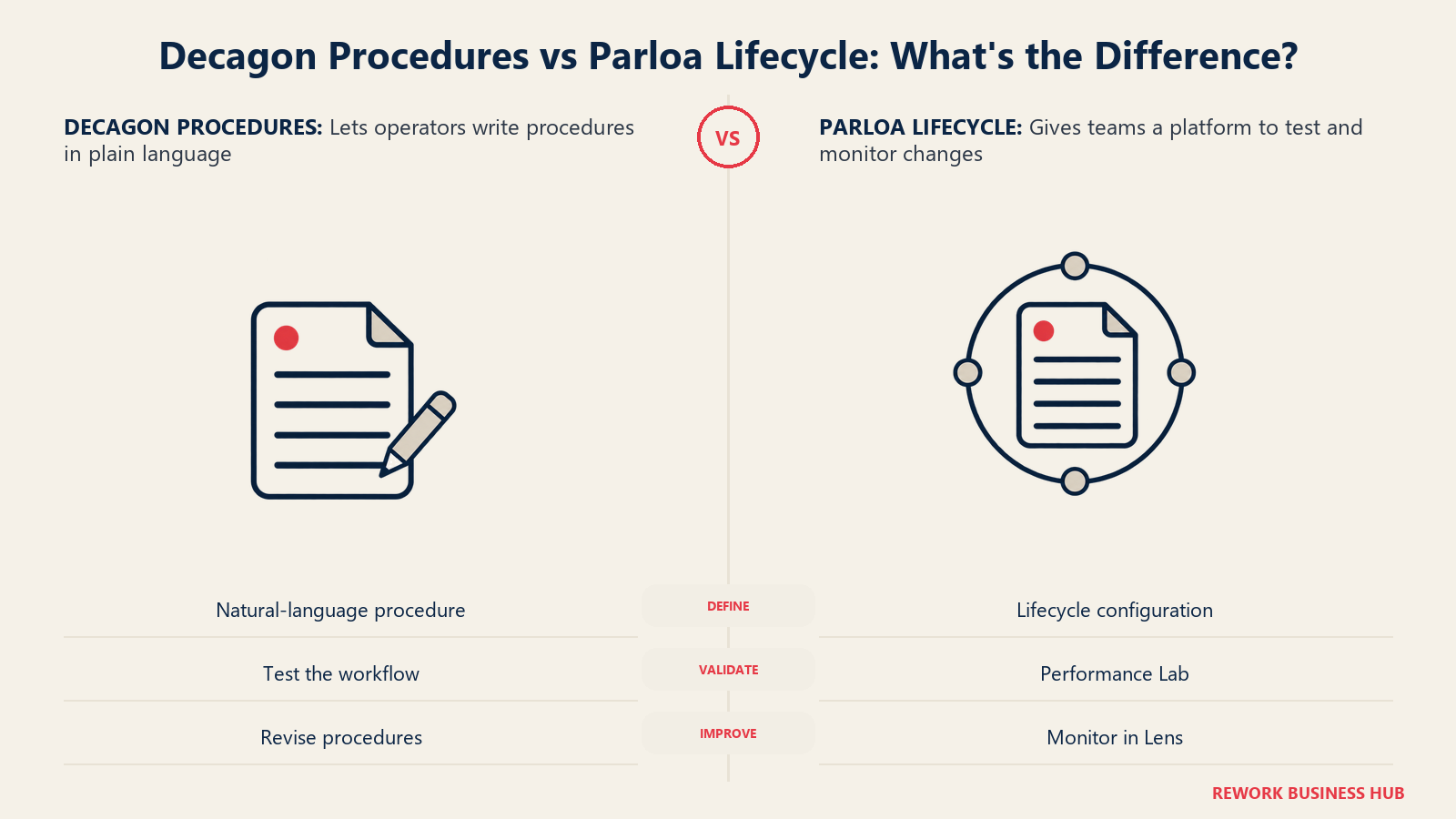
Parloa describes "one platform across the AI agent lifecycle." Its platform page lists a Performance Lab to "simulate and test AI agents for every update or model change," Parloa Lens to monitor agents in production, a conversational infrastructure layer for human-like voice interactions, and model orchestration and tuning that tests models for each application. Agent Builder and Parloa Navigator appear in its navigation, though the platform page doesn't describe them, so ask for a live walkthrough of both.
The practical difference is who holds the pen. Decagon leans toward operators writing and editing procedures themselves. Parloa's materials lean toward a managed lifecycle: design, simulate, deploy, monitor. Either can work. The failure mode on the Decagon side is a procedure library that nobody owns after launch. On the Parloa side it's a rollout that depends heavily on vendor services you'll pay for.
| Decagon | Parloa | |
|---|---|---|
| Primary build interface | AOPs in natural language, with Duet to help build | Agent Builder, per Parloa's navigation; confirm details in a demo |
| Pre-launch testing | Testing and QA simulations | Performance Lab simulation for every update or model change |
| Live experimentation | Experiments for A/B tests | Not described on the platform page; confirm with the vendor |
| Production monitoring | Watchtower for always-on quality monitoring | Parloa Lens for monitoring agents in production |
| Who owns changes after launch | Your support operators, by design | Depends on the engagement; confirm the split with the vendor |
The buyer question is simple: who can change the agent on a Tuesday afternoon without a ticket to the vendor?
Channels: Where Each One Is Strongest
Decagon states that voice, chat and email sit in one platform. Its homepage describes voice as "human-like conversation," chat as "safe, on-brand replies" and email as "contextual resolutions." That's a clean story if your customers switch channels mid-issue, because the same procedure can run behind each one.
Parloa's platform page talks about voice interactions and says nothing about other channels, while its pricing page prices chat by the interaction, so chat exists as a billable unit. How deep Parloa's email and messaging support goes isn't described publicly, so treat that as a question for the vendor, not an assumption either way. What the page does say is that the infrastructure is built to handle "unlimited concurrent conversations" and supports "over 140 languages" for voice, which matters if your call center spans markets.
| Decagon | Parloa | |
|---|---|---|
| Voice | Yes, one of three core channels | Yes, the clearest focus on its platform page |
| Chat | Yes | Yes, priced per interaction |
| Yes | Confirm with the vendor | |
| Languages | Confirm with the vendor | Over 140 languages for voice interactions, per Parloa |
| Concurrency | Confirm with the vendor | "Unlimited concurrent conversations," per Parloa |
If voice is your biggest line item, read Best AI Agents for Call Centers in 2026 and Best AI Voice Agents in 2026 alongside this comparison, because latency and telephony integration decide voice deployments more than any feature list.
Pricing: Two Quote-Only Models, Two Different Units
Neither vendor publishes a rate. That's the first fact to plan around: both processes start with a sales conversation, a scoping exercise and a custom proposal. The useful comparison is the unit each one bills on, because that determines how your invoice behaves when volume or call length changes.
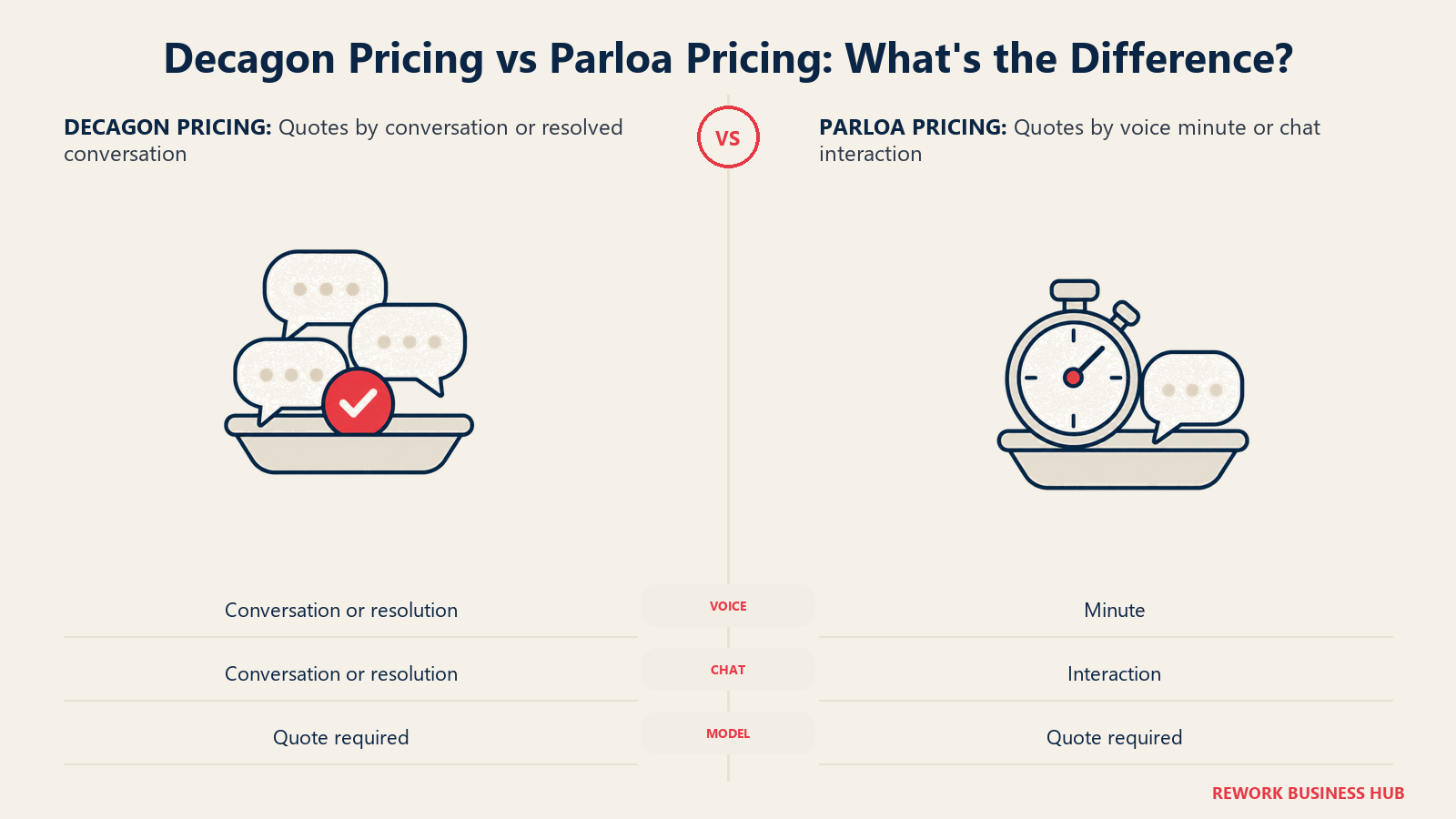
Decagon's pricing post describes two models. Per conversation is "a fixed rate for every incoming conversation, with flexible pricing for higher volumes." Per resolution is "a higher fixed rate for each fully resolved conversation, with no charge for escalations." The same post says the vast majority of customers pick per-conversation. Pricing on request is the honest answer for the dollar amount.
Parloa's pricing page says pricing is consumption-based, "per minute for voice and per interaction for chat." Rates reflect the complexity of each use case. You select a volume package based on expected needs, and it applies across all your use cases. Outcome-based pricing is available "when it makes sense," with no details given. Parloa describes a custom process: it analyzes your contact center, models costs and impact, then designs a pricing model. Pricing on request.
| Decagon | Parloa | |
|---|---|---|
| Billing unit | Per conversation, or per resolved conversation | Per minute (voice) and per interaction (chat) |
| Published dollar rates | No, pricing on request | No, pricing on request |
| Outcome-based option | Yes, per-resolution | "When it makes sense," per Parloa; details on request |
| What drives your bill | Conversation count, or resolution count | Minutes of talk time and interaction count, plus the volume package |
| Charge for escalations | None under per-resolution; per-conversation still bills them | Confirm how escalated calls and chats are metered |
| Self-serve tier | No | No |
The structural consequence is worth spelling out. Under per-minute voice billing, a long, tangled call costs more, and an agent that resolves calls faster lowers your bill. Under Decagon's per-conversation billing, length doesn't matter but volume does, and a conversation that escalates still bills. Under per-resolution billing, you only pay when the agent finishes the job, at a higher rate per resolved item. Model your own last quarter of tickets and calls against each unit before you accept a quote, and ask each vendor to quote the same scenario so you can compare invoices instead of rate cards.
A caution on third-party numbers: some roundups cite buyer-reported contract ranges for both vendors. Treat any such figure as unconfirmed. Some older write-ups also describe Parloa as billing per resolved conversation, but its own pricing page describes per-minute and per-interaction billing with outcome-based pricing as an option. Go by the vendor page and your quote.
Security, Compliance and Data Control
Parloa leads with this. Its homepage says "Born in the EU. Secure by design." and shows badges for ISO 27001, SOC 2 Type II, HIPAA, PCI DSS, DORA and EU AI Act compliance. Its platform page adds Parloa Zones for data sovereignty, which is the feature to ask about if you have data-residency requirements. It also states it is the only customer-facing agentic AI platform to earn SAP's endorsed app premium certification, a claim you should treat as a vendor statement.
Decagon links a Trust Center and a Security page from its homepage, but the homepage doesn't list specific certifications. That doesn't mean it lacks them. It means you should request the current compliance documentation, penetration test summary and data-processing terms during the evaluation, and not infer anything from a missing badge.
| Decagon | Parloa | |
|---|---|---|
| Public compliance badges on homepage | Not listed; Trust Center linked | ISO 27001, SOC 2 Type II, HIPAA, PCI DSS, DORA, EU AI Act |
| Data residency | Confirm with the vendor | Parloa Zones for data sovereignty, per platform page |
| EU positioning | Confirm with the vendor | "Born in the EU," English and German site |
| Healthcare use | Confirm HIPAA terms and BAA with the vendor | HIPAA badge shown; confirm BAA scope per contract |
| Payment data on calls | Confirm PCI handling with the vendor | PCI DSS badge shown; confirm call-recording and redaction setup |
A badge on a homepage is a starting point. Ask for the actual reports, ask which product surfaces they cover, and ask what's in scope for voice recordings, because that's where most of the sensitive data lands.
Proof Points: What Each Vendor Claims, and How to Read It
Both vendors publish customer outcomes. All of them are vendor-reported, and they measure different things, so don't line them up in a spreadsheet as if they were the same metric.
Decagon's site reports 70% chat and voice resolution at Chime, an 80% deflection rate at Duolingo, a 3x increase in CSAT at Oura, a 65% reduction in costs at Curology and a 32% increase in deflection at Rippling. Resolution, deflection and cost reduction are three different measures.
Parloa's homepage claims 70% lower cost per contact, 3X faster time to resolution and 24/7 coverage with zero wait times, and shows 4.5 out of 5 ratings on both Gartner Peer Insights and G2.
| Decagon (vendor-reported) | Parloa (vendor-reported) | |
|---|---|---|
| Headline outcome | 70% chat and voice resolution at Chime | 70% lower cost per contact |
| Second outcome | 80% deflection at Duolingo | 3X faster time to resolution |
| Metric type | Resolution, deflection, CSAT, cost | Cost per contact, time to resolution, availability |
| Independent ratings shown | Confirm with the vendor | Gartner Peer Insights 4.5/5 and G2 4.5/5 |
| What to ask for | The denominator and the definition of "resolved" | The baseline cost per contact and the use case behind the 70% |
The right move with either vendor is to ask for a reference customer with a queue like yours, then ask that customer what their containment rate was in month one versus month six.
Funding and Stability
Both companies are well funded, which matters when you're signing a multi-year contract with a young vendor. Decagon announced a $250 million Series D at a $4.5 billion valuation in January 2026, per Built In SF. Parloa announced a $350 million Series D at a $3 billion valuation on January 15, 2026, led by General Catalyst with existing investors including EQT Ventures, Altimeter Capital, Durable Capital Partners and Mosaic Ventures, per Parloa's announcement.
Funding is a signal about runway, not about product fit. It does mean both will likely keep shipping quickly, which cuts both ways: features you compare today may look different by the time you sign. Put roadmap commitments you're relying on into the contract.
| Decagon | Parloa | |
|---|---|---|
| Latest round | Series D, $250M | Series D, $350M |
| Valuation at that round | $4.5B | $3B |
| Announced | January 2026 | January 15, 2026 |
| Lead | Coatue and Index Ventures | General Catalyst |
Implementation Effort and Time to Value
Neither vendor publishes an implementation timeline, so any number you hear comes from the sales team and should be put in writing. What you can compare is where the work lands.
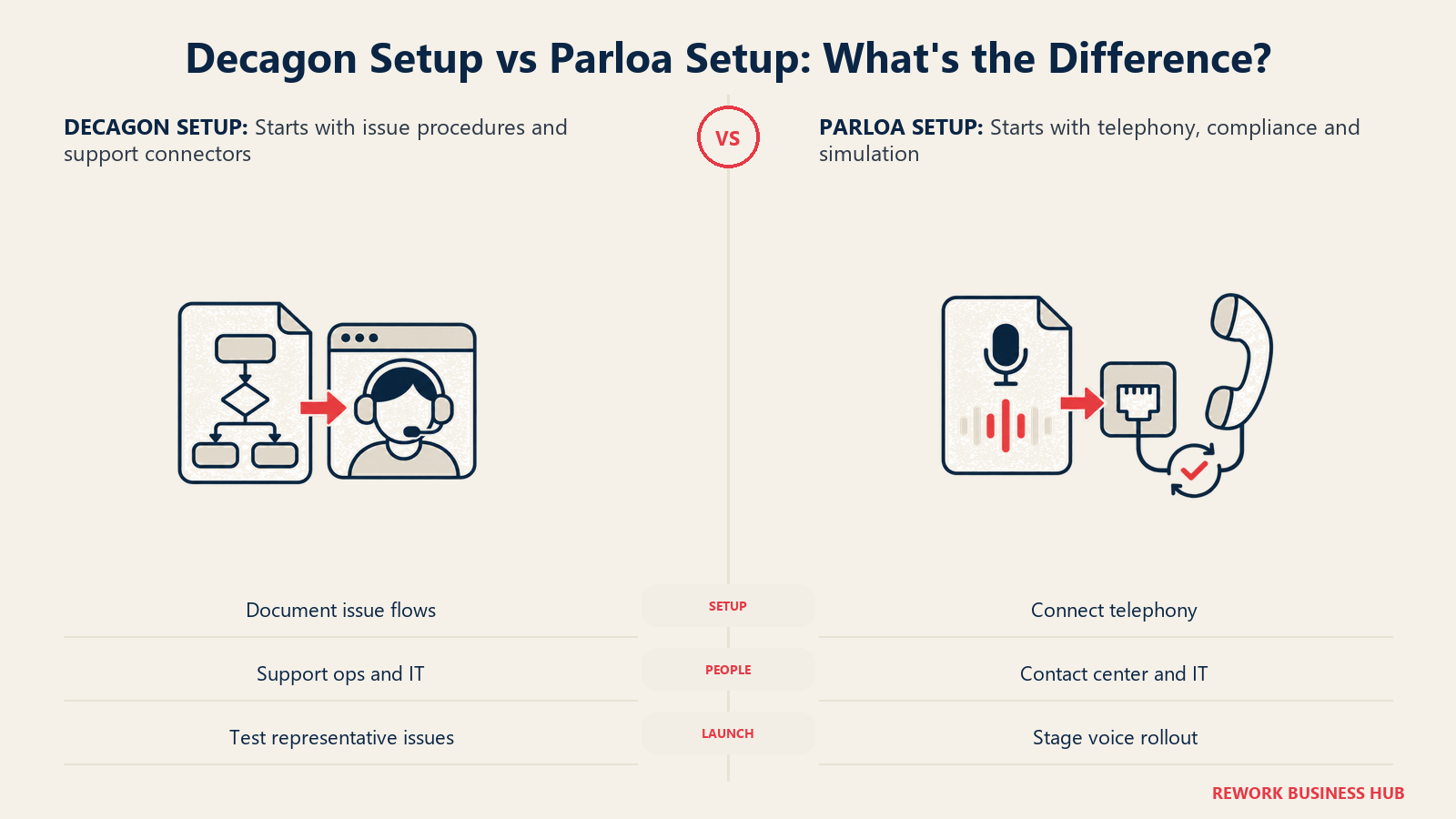
With Decagon, the work is mostly procedure design: documenting how your best agents handle each issue type, writing it as AOPs, wiring the connectors to your helpdesk and order systems, and running simulations. The people involved are support operations leads and whoever owns the integrations.
With Parloa, the work is mostly contact-center engineering: telephony integration, call flows, language coverage, compliance review and a staged rollout through simulation and monitoring. Expect legal, security and IT to be at the table from the first week, especially in regulated industries.
| Decagon | Parloa | |
|---|---|---|
| Heaviest lift | Writing and testing procedures | Telephony, compliance and call-flow integration |
| Who must be involved | Support ops, helpdesk admin, integrations owner | Contact-center ops, IT or telephony, security and legal |
| Pre-launch gate | QA simulations | Performance Lab simulations |
| Post-launch rhythm | Edit AOPs, review Experiments and Watchtower | Review Lens monitoring, retune models |
| Timeline | Ask for a written estimate | Ask for a written estimate |
Where Neither Is a Fit
Both vendors target larger operations and neither offers a self-serve tier, so a team handling a few hundred tickets a month will find both a heavy lift. Teams in that position are better served by an agent that publishes a rate and starts in a day; the Best Decagon Alternatives in 2026 guide covers those. If you want a fully managed agent where the vendor does the tuning, look at Best Sierra Alternatives in 2026 to see how that model compares, and Fin vs Sierra for the outcome-priced head-to-head. And if the phone line is the only problem and you want to build rather than buy, Best AI Phone Agents in 2026 covers a broader set of voice tools, including developer platforms.
When Decagon Is the Right Call
- Your queue is a real mix of chat, email and voice, and you want the same procedure logic behind every channel
- You want your own support operators to write and edit agent behavior in natural language without engineering tickets
- You value built-in experimentation and always-on quality monitoring as part of the platform
- You're a digital-first company whose peers appear in Decagon's customer list
- You want the choice between per-conversation and per-resolution billing, including a model that charges nothing for escalations
When Parloa Is the Right Call
- The phone is your largest cost center and you run a real contact center
- You operate in regulated industries or in Europe and want to see ISO 27001, SOC 2 Type II, HIPAA, PCI DSS, DORA and EU AI Act on the vendor's own site
- You need voice across many languages and want a vendor that states support for over 140
- Data sovereignty matters and you want to evaluate Parloa Zones
- You prefer a managed lifecycle of design, simulation, deployment and monitoring over a build-it-yourself approach
Decision Framework
Use this as a final fit check. The answer depends on your channel mix, your compliance posture and who will own the agent after launch.
| If you are... | Pick |
|---|---|
| Handling a mix of chat, email and voice with one agent logic | Decagon |
| Running a large voice-first contact center | Parloa |
| Wanting support operators to write procedures in plain language | Decagon |
| Needing a visible enterprise compliance badge row and data-sovereignty options | Parloa |
| Wanting the option to pay only for resolved conversations | Decagon (per-resolution) or ask Parloa about outcome-based terms |
| Billing by call minutes and chat interactions | Parloa |
| A small queue that needs a published price | Neither; see Best Decagon Alternatives in 2026 |
| Comparing the whole category before you decide | See Best AI Agents for Customer Service in 2026 |
What to Do Next
- Count your channels. Pull a month of volume by voice, chat and email. If voice is under a fifth of it, start with Decagon. If voice is the majority, start with Parloa.
- Ask both for the same scenario quote. Give each the same month of real volume and ask for the invoice in their own billing unit. Compare invoices, not rate cards.
- Request the compliance packet. Ask Decagon for its current certifications and Parloa for the reports behind its badges, scoped to the product surfaces you'd use.
- Run a four-to-six week pilot on one issue type. Pick a high-volume, low-risk case such as order status or appointment changes, and define "resolved" in writing before the pilot starts.
- Ask who changes the agent after launch. If your answer is "our support team," confirm the vendor's tooling supports that. If it's "the vendor," confirm what that costs.
Frequently Asked Questions about Decagon vs Parloa
Is Decagon or Parloa cheaper?
Neither publishes a rate, so pricing on request is the only honest answer. Decagon bills per conversation or per resolved conversation. Parloa bills per minute for voice and per interaction for chat. Ask both to quote the same month of your real volume and compare the invoices.
Which is better for phone calls?
Parloa puts voice at the center of its platform and prices it per minute, with support for over 140 languages in its voice infrastructure. Decagon also covers voice alongside chat and email. If calls dominate your volume, Parloa is the more natural starting point, but run a pilot on your own call mix before deciding.
Can Decagon handle email as well as chat and voice?
Yes, Decagon lists voice, chat and email as the three channels in one platform. Parloa's platform page focuses on voice and its pricing covers chat, so confirm email and messaging support with Parloa directly.
What are Agent Operating Procedures?
AOPs are Decagon's way of defining agent workflows in natural language. They're meant to let support operators write how an issue should be handled without learning a configuration language or filing an engineering ticket.
Which one has stronger published compliance credentials?
Parloa's homepage shows ISO 27001, SOC 2 Type II, HIPAA, PCI DSS, DORA and EU AI Act badges. Decagon links a Trust Center but doesn't list certifications on its homepage, so request its current documentation. Either way, ask for the actual reports, not the badge.
Do either offer a free trial or self-serve plan?
Neither publishes one. Both start with a sales conversation and a custom proposal, so budget time for scoping before you can test anything.
Related Resources:

Co-Founder, Rework.com
On this page
- TL;DR
- Key Facts
- Who Each Tool Is Actually Built For
- Build Experience: Procedures in Plain Language vs a Lifecycle Platform
- Channels: Where Each One Is Strongest
- Pricing: Two Quote-Only Models, Two Different Units
- Security, Compliance and Data Control
- Proof Points: What Each Vendor Claims, and How to Read It
- Funding and Stability
- Implementation Effort and Time to Value
- Where Neither Is a Fit
- When Decagon Is the Right Call
- When Parloa Is the Right Call
- Decision Framework
- What to Do Next