Fin vs Sierra: Which AI Customer Service Agent Fits Your Team in 2026?
Turn this article into takeaways for your work.


Each assistant summarizes the article only for you and suggests best practices for your work.
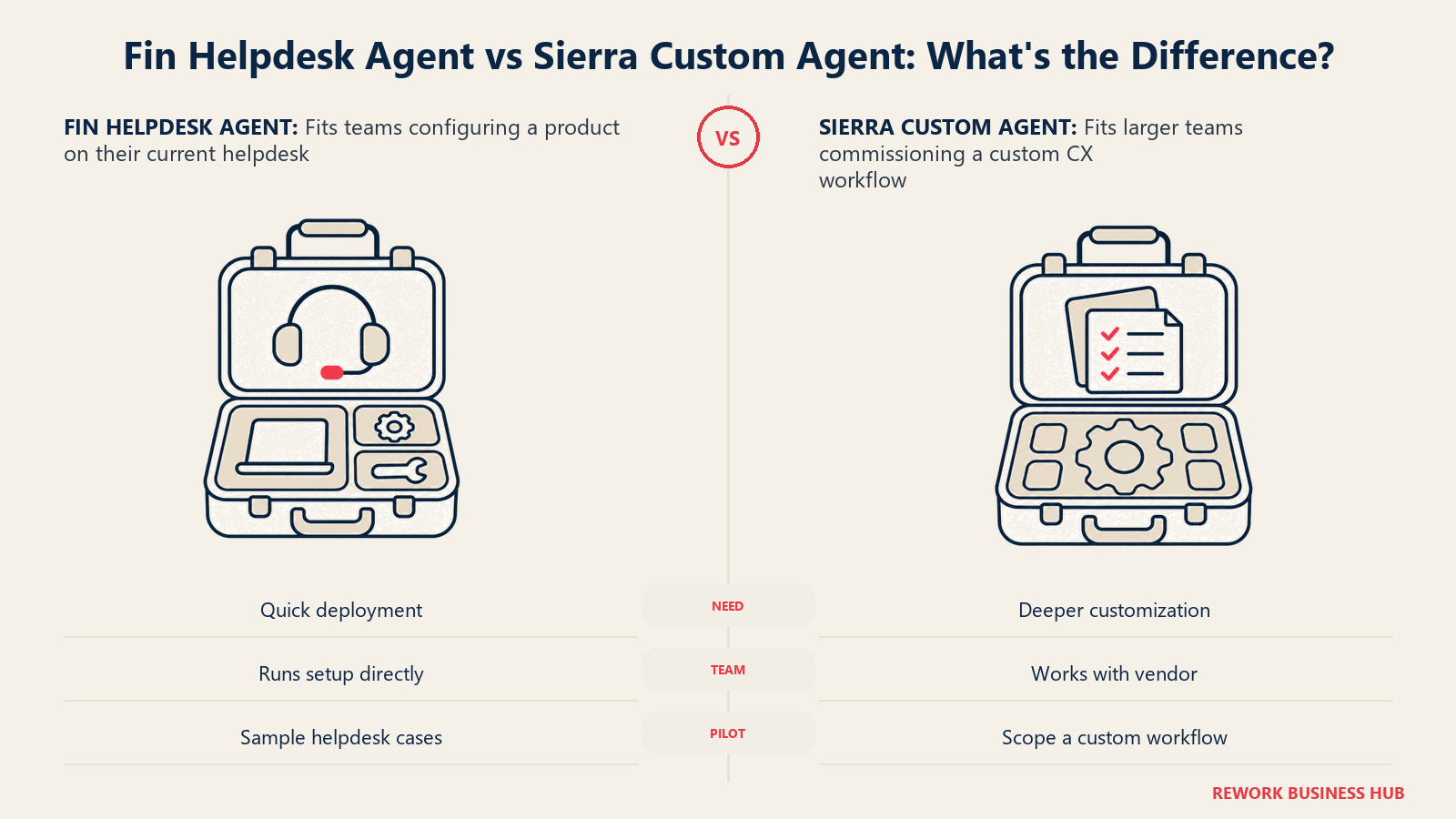
If you're comparing these two, you've probably already decided that paying per ticket-handler is the wrong model for AI support, and that you want to pay for results instead. Both vendors agree with you. Fin and Sierra both charge on outcomes rather than seats or flat subscriptions. Where they split is almost everything around that idea: whether you can see the price before you talk to sales, whether the agent sits on top of the helpdesk you already run, how much of the build is yours versus theirs, and who owns the company.
That last point changed this year. Fin, the AI agent that grew out of Intercom, was acquired by Salesforce, and the deal closed on September 10, 2026. Sierra, founded by former Salesforce co-CEO Bret Taylor and longtime Google executive Clay Bavor, remains independent. So a decision that used to be "two well-funded CX agent vendors" is now partly a decision about how close you want your customer-service agent to sit to a CRM giant.
This guide compares the two on what matters when you're the person who has to defend the purchase: pricing mechanics, channels, build effort, governance, and the situations where each one is plainly the better call.
TL;DR
| Fin | Sierra | |
|---|---|---|
| What it is | AI customer service agent that runs on Intercom or on top of other helpdesks | Conversational AI platform for businesses, built and tuned with the vendor |
| Ownership | Part of Salesforce since September 10, 2026 | Independent company |
| Pricing model | Per outcome | Outcome-based, defined per customer |
| Published price | Yes: $0.99 per outcome on fin.ai/pricing | No rate card published; pricing on request |
| Helpdesk fit | Intercom, Salesforce, Zendesk, HubSpot, Freshdesk and others | Deploys as its own agent layer across channels |
| Channels | Voice, chat, email, Slack, social and more | Chat, SMS, WhatsApp, email, voice and ChatGPT |
| Typical buyer | Support leaders who want a fast, self-serve start | Enterprises that want a high-touch, custom-built agent |
| Weakest fit | Teams that need a heavily customized, vendor-built workflow | Teams that need a budget number before any sales conversation |
Key Facts
- Salesforce completed its acquisition of Fin on September 10, 2026, and says Fin's AI agent has an average resolution rate of 76% across a customer base of more than 30,000 companies. That's the vendor's own figure.
- Fin lists $0.99 per outcome, with a 50-outcome monthly minimum when it runs on your current helpdesk, and says it charges one outcome per conversation even when Fin takes several actions.
- Fin's pricing page counts more than resolutions as outcomes: procedure handoffs, disqualifications and self-serve routing are $0.99 each, while a qualification is $9.99.
- Sierra's own outcome-based pricing post says an unresolved conversation usually carries no charge, and so does an escalation. It publishes no rates.
- Sierra reached $100 million in annual revenue run rate in November 2025 and was last valued at $10 billion, according to TechCrunch.
What Each Tool Is Actually Built For
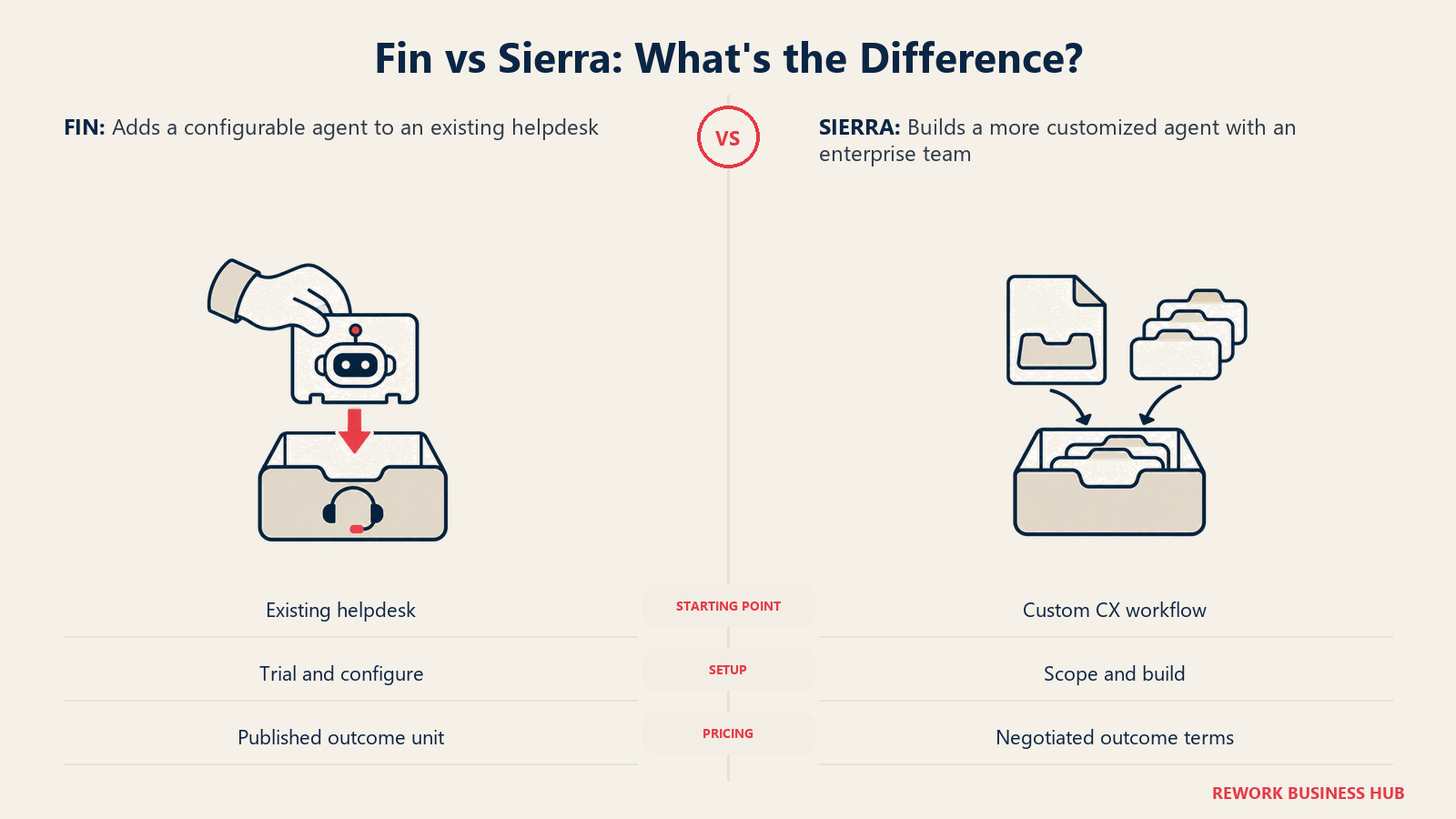
Fin is a product you can start with. Its pricing page offers a 14-day free trial that requires no credit card, and its homepage says it can be live with any helpdesk in under an hour. That's a vendor claim, so treat it as the best case, but it tells you what Fin is optimized for: a support team lead who wants to point an agent at a help center and see what happens this month.
Sierra is a platform you commission. Its site describes tooling for building agents from uploaded SOPs and call transcripts or from a plain-English goal, plus products for testing, monitoring and experimentation. The logo wall is large enterprise: Rocket Mortgage, Gap Inc., SoftBank, Uber, Vanguard, Santander, SiriusXM, Wayfair, CarMax and Docusign appear on the page. That doesn't mean you need to be that large to buy, but it does tell you who the sales motion is built around.
| Fin | Sierra | |
|---|---|---|
| Sweet-spot buyer | Support and CX leaders who want to start fast and measure | Large CX organizations that want a custom-built agent and a vendor partner |
| Who configures it | Your support ops team, working from your help center and procedures | A joint effort with Sierra's team and its agent-building tools |
| Primary trigger to buy | Want AI resolutions without replatforming the helpdesk | Want one agent across many channels with deep business logic |
| Biggest risk | Outcome count grows faster than you forecast | Contract terms and outcome definitions matter more than the demo |
If you want the wider field beyond these two, best AI agents for customer service in 2026 ranks the category by team size and helpdesk, and the two vendor-specific lists, best Fin AI agent alternatives and best Sierra alternatives, cover what teams move to when either one falls short.
Pricing Mechanics: A Published Unit vs a Negotiated One
Both vendors tie cost to results, so on paper they're close cousins. In practice the experience of buying them differs more than the model does.
Fin's page states the unit. It's "$0.99 per outcome" when Fin runs on your current helpdesk, with a 50-outcome monthly minimum and minimum commitments that you discuss with sales. If you run Fin on Intercom, the page says "from $0.99 per outcome" plus $19 per helpdesk seat per month. There are optional add-ons: Pro, which includes Operator, from $100 per month, and a Copilot add-on at $35 per user per month that the FAQ says is currently available for Salesforce. Fin Voice is custom priced through sales. Fin states unlimited teammates with no extra seat costs for helpdesk integrations, no setup, integration or platform fees, and billing in USD only.
The nuance is in the word "outcome." On Fin's pricing page, resolutions, procedure handoffs, disqualifications and self-serve routing each cost $0.99, a qualification costs $9.99, and you pay one outcome per conversation. Conversations passed to your team without an outcome aren't charged. So your bill isn't "resolutions times $0.99". It's the mix of outcome types your agent produces. If you run a sales-qualification flow, the $9.99 line item can matter more than the base rate.
Sierra's model is described differently. Its pricing post says it gets paid when it completes a task for you, with outcomes such as a resolved support conversation, a saved cancellation, an upsell or a cross-sell. It says "in most cases" there's no charge for an unresolved conversation or an escalation. It also says the criteria for each outcome are agreed upfront with each customer, and that for some interactions, such as routing or greeter-style conversations, a blended approach may apply, where payment follows conversation count regardless of outcome. No rates appear anywhere in that post.
| Fin | Sierra | |
|---|---|---|
| Billing unit | Outcome, one per conversation | Outcome, defined per engagement |
| Published rate | $0.99 per outcome (qualification $9.99) | None published; pricing on request |
| Minimums | 50 outcomes per month on your current helpdesk; minimum commitments via sales | Confirm with the vendor |
| Seat costs | None on helpdesk integrations; $19 per helpdesk seat per month on Intercom | Confirm with the vendor |
| Setup fees | Stated as none | Confirm with the vendor |
| Unresolved or escalated conversations | Handoffs to your team without an outcome aren't charged | Usually no charge, per Sierra's pricing post |
| Billing currency and payment | USD only; major cards online, ACH and wire via sales | Confirm with the vendor |
| Free trial | 14 days, no credit card | Confirm with the vendor |
The practical consequence is about who can run the pilot. A support director can open a Fin trial and show the CFO a unit price in the same meeting. With Sierra, you can't budget until you've had the scoping conversation, and the contract's outcome definitions become the real price list. That isn't automatically worse. A negotiated definition can be tighter around what your business actually values, and it can exclude things you'd never want to pay for. But it does mean your legal and finance reviewers get involved earlier.
For a framework on modeling these meters before you sign, see AI agent cost optimization.
Channels and Deployment
Both vendors cover the channels most support teams care about, with different emphasis.
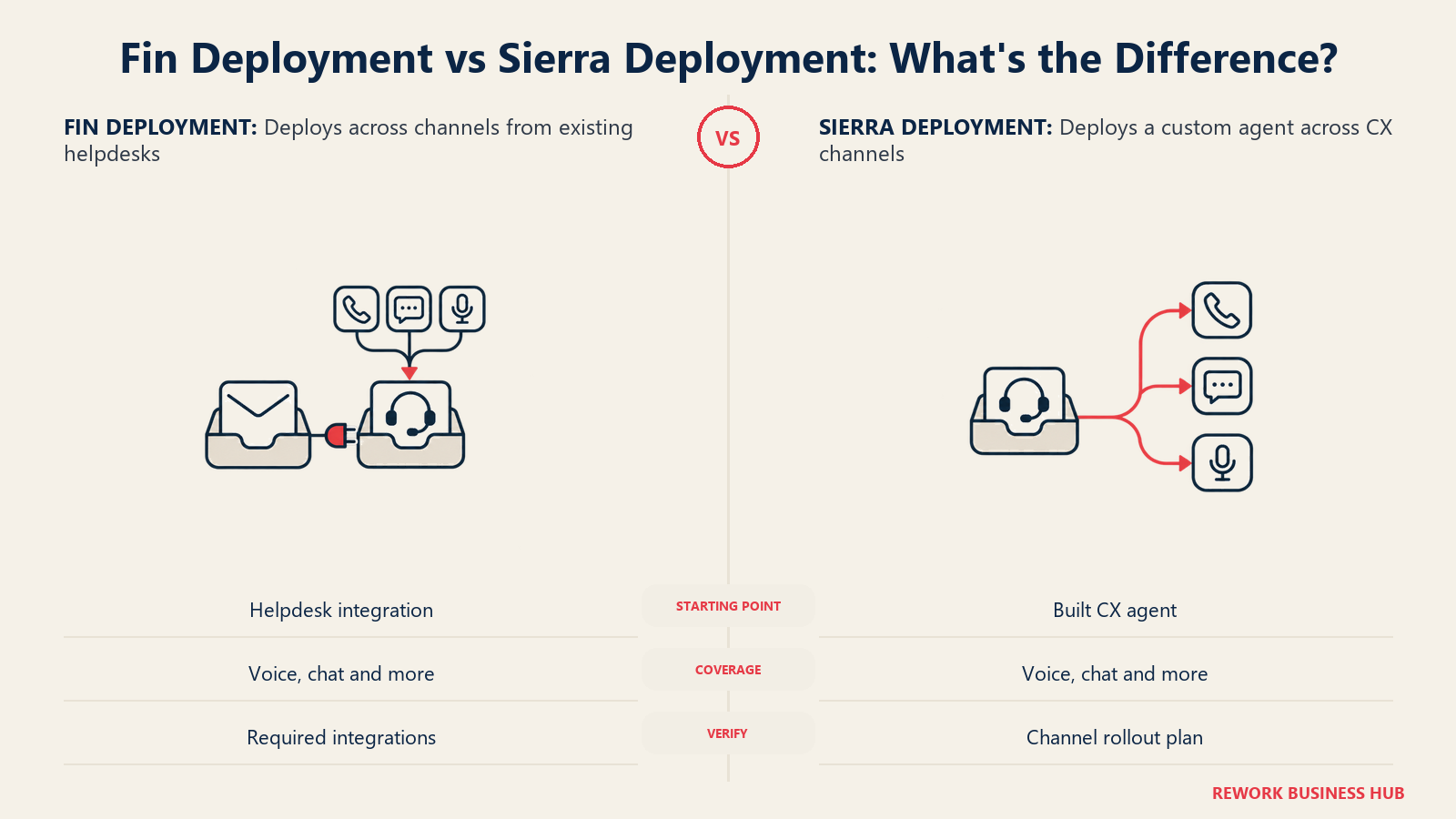
Fin's homepage says it works across voice, chat, email, Slack, social and more. It says it's built into Intercom and also supports Salesforce, Zendesk, HubSpot and Freshdesk, plus many other helpdesks. The Salesforce release adds live chat, email, WhatsApp, SMS, voice and Slack to the channel list. That helpdesk-agnostic stance is the point: you keep your ticketing system and add Fin on top.
Sierra's site says one agent can be deployed across chat, SMS, WhatsApp, email, voice and ChatGPT. The ChatGPT channel is worth noticing if your customers increasingly start in an AI assistant rather than on your site. Sierra's page also describes a "context engine" and monitoring products, which suggest the agent is meant to be a first-class system with its own observability rather than a layer inside a ticketing tool.
| Fin | Sierra | |
|---|---|---|
| Chat | Yes | Yes |
| Yes | Yes | |
| Voice | Yes; Fin Voice is custom priced via sales | Yes |
| SMS and WhatsApp | Listed in Salesforce's release | Yes |
| Slack | Yes | Confirm with the vendor |
| ChatGPT as a channel | Confirm with the vendor | Yes, listed on its site |
| Helpdesk integrations | Intercom, Salesforce, Zendesk, HubSpot, Freshdesk and others | Confirm which of your systems it connects to during scoping |
| Languages | Fin says it speaks dozens of languages | Sierra describes agents as multilingual |
If voice is the main reason you're shopping, read the phone-specific field in best AI agents for call centers in 2026 before you finalize a shortlist. Voice quality and telephony integration vary a lot between vendors, and neither of these two vendors' marketing pages will tell you how a specific carrier setup behaves.
Building and Controlling the Agent
This is where the "launch it yourself" versus "build it with a partner" split shows up most clearly.
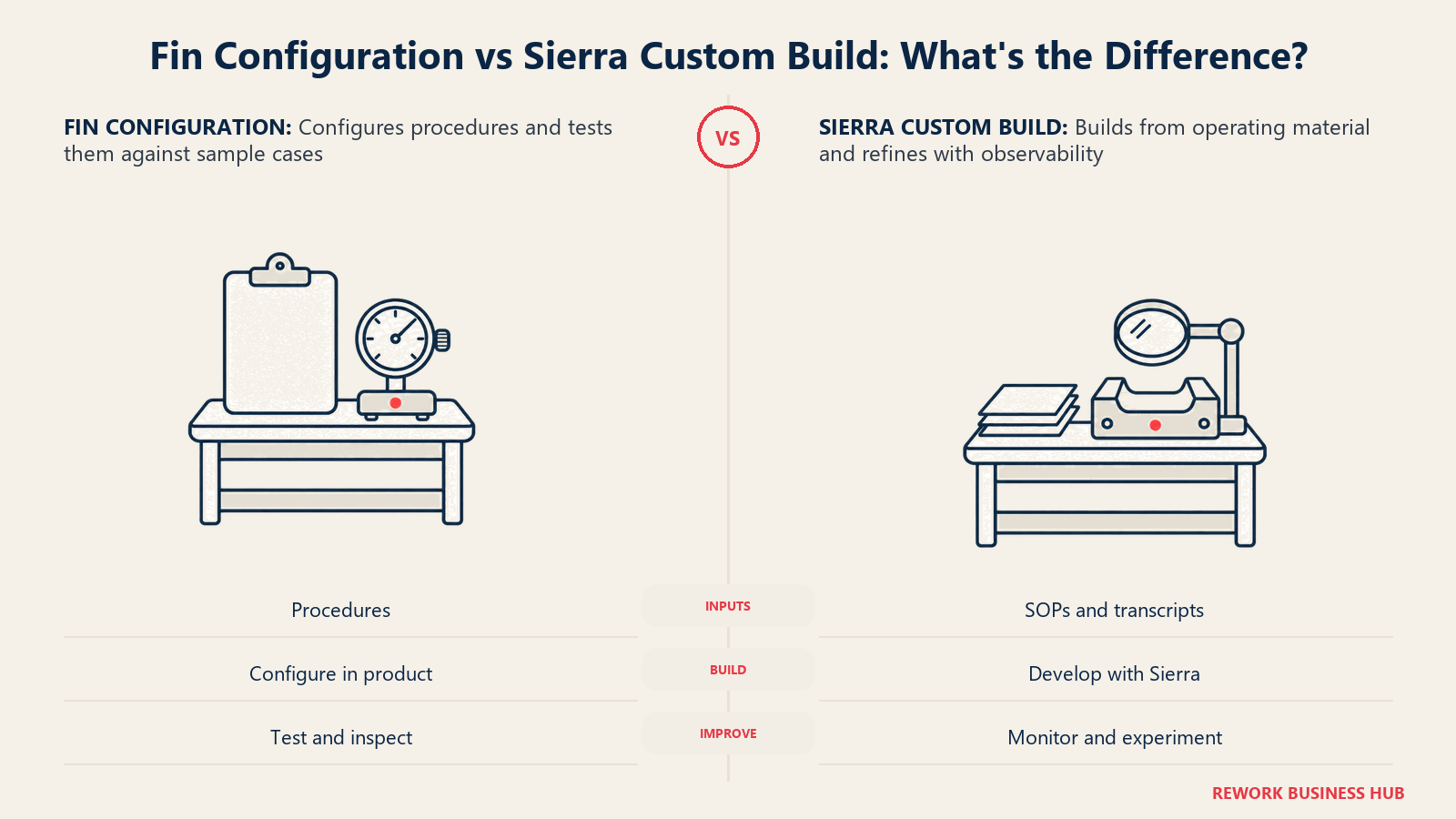
Fin gives you the Procedures feature, which its page says lets Fin resolve complex, multi-step workflows by reasoning through problems. It also advertises a testing suite for simulations, regression testing and manual inspection before changes go live. The mechanics are meant to be run by your own team: write the procedures, simulate, ship, look at the outcomes.
Sierra's page lists a set of connected pieces. Ghostwriter builds agents from SOPs, transcripts and other materials, or from a plain-English goal. Agent Studio, Insights, Explorer, Monitors, Experiments and Observability cover the lifecycle after launch, and Horizon covers long-horizon planning, customer context and proactive engagement. The pitch is that the platform handles the build-and-improve loop with you.
| Fin | Sierra | |
|---|---|---|
| Build approach | Procedures written and managed by your team | Agents generated from SOPs and transcripts, refined with the vendor's tooling |
| Pre-launch testing | Simulations, regression testing, manual inspection | Experiments and testing tools; confirm depth with the vendor |
| Post-launch monitoring | Outcome reporting; confirm dashboard depth with the vendor | Monitors, Insights and Observability listed on its site |
| Proactive outreach | Confirm with the vendor | Listed under Horizon |
| Who owns the improvement loop | Mostly you | Shared with the vendor |
| Time to a first live agent | Fin claims under an hour on a supported helpdesk | Scoped per engagement |
Neither site tells you how much of your own staff time the improvement loop eats. That's the question to put in front of both vendors: after launch, how many hours a week does your team spend reviewing conversations, correcting answers and updating procedures? A cheap unit price doesn't help if the tuning work lands on two people who are already stretched.
For the broader decision about whether to build with a platform or hand the build to a vendor, choosing an AI agent platform walks through the options.
Governance, Security and Ownership
Both vendors list a long set of certifications, so the useful comparison is where they overlap and where you need to ask.
Fin's homepage lists SOC 2, ISO 27001, ISO 42001, AIUC-1, ISO 27701 and HIPAA, a 99.8% SLA, and data hosting in the US, EU or Australia. Sierra's site lists SOC 2, ISO 27001, ISO 42001, HIPAA, GDPR, the EU AI Act, STAR Level One, FedRAMP and PCI DSS. Sierra's list is longer on its face, particularly if you handle card data or work with US federal agencies. Fin's list names the data-residency regions explicitly, which matters if you have EU or Australian customers with residency requirements.
| Fin | Sierra | |
|---|---|---|
| Certifications listed | SOC 2, ISO 27001, ISO 42001, AIUC-1, ISO 27701, HIPAA | SOC 2, ISO 27001, ISO 42001, HIPAA, GDPR, EU AI Act, STAR Level One, FedRAMP, PCI DSS |
| Data residency | US, EU or Australia | Confirm with the vendor |
| Stated uptime | 99.8% SLA | Confirm with the vendor |
| Parent company | Salesforce (since September 10, 2026) | Independent |
| Vendor independence from your CRM | Lower if you're not a Salesforce shop | Higher |
Ownership deserves its own paragraph. Salesforce says Fin will continue as part of Salesforce AI Labs, keep serving its customers and sit alongside Agentforce. It says Fin works with the help desks and systems companies already use. The release says nothing about pricing, so ask for price protection in writing if you sign a multi-year agreement. If you compete with Salesforce, or you're wary of data flowing near a CRM vendor, raise it with legal before the pilot, not after.
Evidence on Performance: What You Can and Can't Compare
The temptation is to put Fin's 76% resolution rate next to a Sierra number and declare a winner. Don't. Fin's homepage says its average resolution rate is 76% across 12,000-plus customers, with many seeing over 85%, while the Salesforce release says 76% across a base of more than 30,000 companies. Those two vendor pages count customers differently, which is a reminder that these are marketing averages, not audited benchmarks.
What a resolution rate averages across is also a catch. A company with a clean help center and simple questions will see far higher containment than one handling refunds, account changes and policy exceptions. Your rate depends on your content, your policies and what you let the agent do. The only number that predicts your result is the one you measure on your own conversations.
| What to measure in a pilot | Why it matters |
|---|---|
| Resolution rate on your real top-20 contact reasons | Averages hide your hardest categories |
| Rate of confident wrong answers, found by human review | A wrong answer that counts as an outcome costs you twice |
| Escalation quality: does the human get full context? | Handoffs are where customers get angry |
| Cost per resolved conversation, all-in | Includes seats, add-ons and staff review time |
| Hours of tuning per week | The hidden labor line |
Cost at Realistic Volumes
Treat these as planning arithmetic, not quotes. They multiply Fin's published rate by an assumed volume. They assume every counted outcome is a $0.99 outcome (a resolution, handoff, disqualification or routing), no qualification outcomes, no Pro or Copilot add-on, and no Fin Voice. Sierra can't be modeled from public information, so its column says so.
| Monthly outcomes | Fin on your current helpdesk (at $0.99 each) | Fin on Intercom, plus 10 helpdesk seats at $19 each | Sierra |
|---|---|---|---|
| 50 (the stated monthly minimum) | About $49.50 | About $239.50 | Pricing on request |
| 1,000 | About $990 | About $1,180 | Pricing on request |
| 5,000 | About $4,950 | About $5,140 | Pricing on request |
| 20,000 | About $19,800 | About $19,990 | Pricing on request |
Three things stand out. First, at low volume the Intercom seat charge dominates, so the seat count matters more than the outcome rate. Second, at higher volume the seat charge nearly disappears and your total is basically outcome count times the rate, which means every point of resolution you add shows up directly on the invoice. That's the nature of outcome pricing: success is a cost, and you're buying it on purpose. Third, if your volume is large and steady, ask about a committed rate. Fin's page points minimum commitments to sales, and large buyers often negotiate.
For Sierra, the right approach is a worked example. Give the vendor a representative month of your conversation mix and ask them to price it under their proposed outcome definitions, including what happens to routing conversations that may be billed on a blended basis. If the number comes back lower than the Fin arithmetic above, you've learned something. If it comes back higher, ask what extra you're getting: custom build, more channels, deeper integration, or a managed improvement loop.
When Fin Is the Right Call
- You want a published unit price you can put in a budget memo before any sales call.
- Your helpdesk is Intercom, Zendesk, Salesforce, HubSpot or Freshdesk, and you'd rather add an agent on top than replatform.
- Your team will own the agent day to day and wants to write procedures and run simulations itself.
- You want a no-credit-card trial and a short path from "interested" to "measuring real conversations."
- You're a Salesforce shop and welcome the idea of an agent that sits alongside Agentforce under the same parent.
- You're comfortable that an outcome includes handoffs, disqualifications and routing, and you've modeled the mix.
When Sierra Is the Right Call
- You're a large CX organization that wants a vendor-built, deeply customized agent rather than a configurable product.
- Your use cases go beyond support deflection into saved cancellations, upsells or proactive engagement, and you want the outcome definitions written around them.
- You need a broad compliance list, such as PCI DSS or FedRAMP, and want it on the vendor's own page.
- You want one agent spanning chat, SMS, WhatsApp, email, voice and ChatGPT, with monitoring and experimentation tooling built in.
- You prefer an independent vendor, with no CRM parent, owning your customer conversations.
- Your finance and legal teams are fine negotiating outcome definitions as part of the contract.
If Neither Fits
Plenty of teams end up with a third answer. If your tickets live in a helpdesk that sells its own agent, the native option may be simpler. If your real problem is the phone line, a voice-first vendor may beat both. And if you want a like-for-like enterprise peer to Sierra, best Decagon alternatives is the starting point, while Decagon vs Parloa compares two other enterprise-grade options head to head.
Decision Framework
| If you are... | Pick |
|---|---|
| Needing a public price before talking to sales | Fin |
| Running Intercom, Zendesk, HubSpot or Freshdesk and wanting an add-on agent | Fin |
| A support team that wants to own the build and the tuning | Fin |
| A large enterprise wanting a custom, vendor-partnered agent build | Sierra |
| Wanting upsell, retention or proactive use cases scoped into the contract | Sierra |
| Requiring PCI DSS or FedRAMP on the vendor's own certification list | Sierra (confirm scope in the security review) |
| Uneasy about CRM-vendor ownership of your customer data | Sierra |
| A Salesforce customer comfortable with the parent relationship | Fin |
| Unsure and wanting the wider field | See best AI agents for customer service in 2026 |
What to Do Next
- Pull a real month of conversations. Tag the top 20 contact reasons and note which ones you'd let an agent resolve alone, which need a handoff, and which must stay human.
- Start the Fin trial against that sample. It's the fastest way to get a measured resolution rate and a cost-per-outcome number from your own data.
- Ask Sierra for a priced worked example on the same sample, with outcome definitions, treatment of escalations and routing, and any minimums written out.
- Run both for two to four weeks on one queue and compare resolution rate, wrong-answer rate, escalation quality and all-in cost per resolved conversation, including your team's tuning hours.
- Get contract protections before you scale: price protection through the Salesforce transition if you pick Fin, and a clear outcome definition and audit rights on billing if you pick Sierra.
Related Resources:

Co-Founder, Rework.com
On this page
- TL;DR
- Key Facts
- What Each Tool Is Actually Built For
- Pricing Mechanics: A Published Unit vs a Negotiated One
- Channels and Deployment
- Building and Controlling the Agent
- Governance, Security and Ownership
- Evidence on Performance: What You Can and Can't Compare
- Cost at Realistic Volumes
- When Fin Is the Right Call
- When Sierra Is the Right Call
- If Neither Fits
- Decision Framework
- What to Do Next